

The DOI matches its Crossref record; 46 of the 46 references it cites were found in a registry or an index.
Looking for Myself: Current Multisensory Input Alters Self-Face Recognition
Open accessAbstract
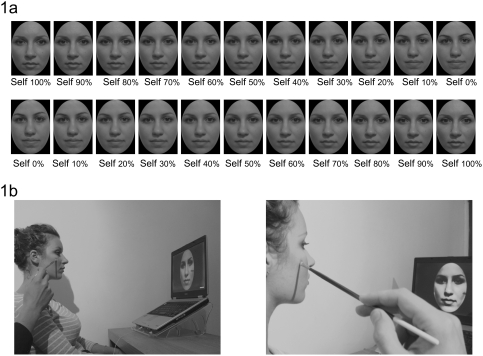
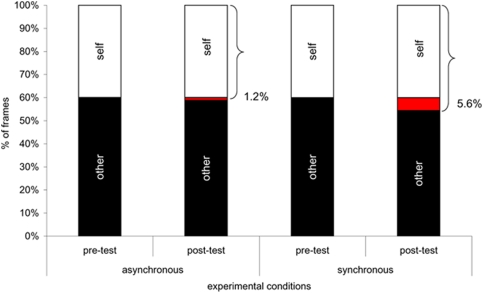
How do I know the person I see in the mirror is really me? Is it because I know the person simply looks like me, or is it because the mirror reflection moves when I move, and I see it being touched when I feel touch myself? Studies of face-recognition suggest that visual recognition of stored visual features inform self-face recognition. In contrast, body-recognition studies conclude that multisensory integration is the main cue to selfhood. The present study investigates for the first time the specific contribution of current multisensory input for self-face recognition. Participants were stroked on their face while they were looking at a morphed face being touched in synchrony or asynchrony. Before and after the visuo-tactile stimulation participants performed a self-recognition task. The results show that multisensory signals have a significant effect on self-face recognition. Synchronous tactile stimulation while watching another person's face being similarly touched produced a bias in recognizing one's own face, in the direction of the other person included in the representation of one's own face. Multisensory integration can update cognitive representations of one's body, such as the sense of ownership. The present study extends this converging evidence by showing that the correlation of synchronous multisensory signals also updates the representation of one's face. The face is a key feature of our identity, but at the same time is a source of rich multisensory experiences used to maintain or update self-representations.
Overview
The claims and statistics of this paper haven’t been checked yet.
Run the check — free, no account needed. It reads the open-access text and checks the sources it cites.
Integrity signals
Registry
Cites
Statistics
Figures
Verification
Claims the paper makes
The claims and statistics of this paper haven’t been checked yet.
Run the check — free, no account needed. It reads the open-access text and checks the sources it cites.
Claims other papers make about this one
Each is checked against this paper’s own text: does it say what the citing paper says it does?
In the citing paper
“The first relevant finding to support our argument is that experimentally induced modulations of body ownership enhance perceived physical similarity between self and other.”
From Changing bodies changes minds: Owning another body affects social cognition (2015) · cites this paper as [26]
In the citing paper
“In a more objective quantification of a comparable effect, participants accepted morphed photos of faces with a higher percentage of the other as depicting themselves after experiencing an enfacement illusion, suggesting that the participants' stored representations of their own faces were altered to incorporate aspects of the other person [26,35,36].”
From Changing bodies changes minds: Owning another body affects social cognition (2015) · cites this paper as [26]
In the citing paper
“For example, after the rubber hand illusion, participants rated the rubber hand as more physically similar to their own [26].”
From Changing bodies changes minds: Owning another body affects social cognition (2015) · cites this paper as [26]
In the citing paper
“produces a measurable bias in self-face recognition, whereby participants perceive the other's face as looking more like their own [26,35,36].”
From Changing bodies changes minds: Owning another body affects social cognition (2015) · cites this paper as [26]
In the citing paper
“Tsakiris [32] showed that synchronous, but not asynchronous, visuo-tactile stimulation between the participant’s own face and a morphed face, containing a blending of the facial features of the participant (50%) with the features of someone else’s face (50%), produced a measurable bias in self-face recognition.”
From The other in me: interpersonal multisensory stimulation changes the mental representation of the self (2012) · cites this paper as [32]
In the citing paper
“Using unfamiliar faces rules out the possibility that the bias in self-face recognition towards the other’s face could be accounted simply by face familiarity and affiliation with the other [32], while obtaining a baseline self-recognition prior to stimulation allows us to quantify the exact change in self-face recognition as a result of multisensory stimulation (cf. [33]).”
From The other in me: interpersonal multisensory stimulation changes the mental representation of the self (2012) · cites this paper as [32]
In the citing paper
“These findings are compatible with the behavioral results of Tsakiris [32] and Sforza et al. [33], but importantly, they show, for the first time, that IMS between one’s own face and a completely unknown face can affect the mental representation of one’s own face.”
From The other in me: interpersonal multisensory stimulation changes the mental representation of the self (2012) · cites this paper as [32]
In the citing paper
“Tsakiris [32] used a self-other morphed face during visuo-tactile stimulation, rather than an unfamiliar other;”
From The other in me: interpersonal multisensory stimulation changes the mental representation of the self (2012) · cites this paper as [32]
In the citing paper
“This issue was investigated by Tsakiris [32] and Sforza et al. [33], who failed to find significant differences between self-recognition changes for the “self to other” and “other to self” directions [32] and between the judgments given under different instruction conditions (e.g., to evaluate the amount of “self” or to evaluate the amount of “other” contained in the morphs) [33].”
From The other in me: interpersonal multisensory stimulation changes the mental representation of the self (2012) · cites this paper as [32]
In the citing paper
“Experiment 1 was designed to control for potential confounds reported in previous studies, such as the use of a familiar face [32], [33] and the lack of a pre-test baseline self-recognition performance [33].”
From The other in me: interpersonal multisensory stimulation changes the mental representation of the self (2012) · cites this paper as [32]
In the citing paper
“This asymmetric effect for the two directions of morphing could also be observed in Experiment 1, but was not found in previous studies where the other’s face was a familiar one [32], [33].”
From The other in me: interpersonal multisensory stimulation changes the mental representation of the self (2012) · cites this paper as [32]
In the citing paper
“Is it possible that synchronous IMS disrupts face recognition performance in general? This seems unlikely, given that Tsakiris [32] showed the behavioral effect to be specific to the face seen during visuo-tactile stimulation, and not to other familiar faces that were not seen during stimulation.”
From The other in me: interpersonal multisensory stimulation changes the mental representation of the self (2012) · cites this paper as [32]
In the citing paper
“The percentage of change reported in Experiment 1 is comparable to that reported in similar studies that used a familiar “other” face (1.8% in [32], and 4.4% in [33]).”
From The other in me: interpersonal multisensory stimulation changes the mental representation of the self (2012) · cites this paper as [32]
In the citing paper
“Previous studies failed to find significant differences between self-recognition changes for the “self to other” and “other to self” directions in a video morphing from one face to the other [32], a task identical to the one used in our Experiment 4, and between the judgments of morphed images under different instruction conditions (either to evaluate the amount of “self” or to evaluate the amount”
From The other in me: interpersonal multisensory stimulation changes the mental representation of the self (2012) · cites this paper as [32]
Self-check
Percentages, sums and reported differences re-computed from the paper’s own numbers.
The self-check needs the paper’s full text.
Citations
Cites
The distributed human neural system for face perception
Haxby, J. V., Hoffman, E. A., & Gobbini, M. I. (2000) · Trends in Cognitive Sciences · doi:10.1016/s1364-6613(00)01482-0 · Cited by 4,891
Rubber hands ‘feel’ touch that eyes see
Botvinick, M., & Cohen, J. (1998) · Nature · doi:10.1038/35784 · Cited by 4,410
Understanding face recognition
Bruce, V., & Young, A. (1986) · British Journal of Psychology · doi:10.1111/j.2044-8295.1986.tb02199.x · Cited by 4,067
Parts and Wholes in Face Recognition
Tanaka, J. W., & Farah, M. J. (1993) · The Quarterly Journal of Experimental Psychology Section A · doi:10.1080/14640749308401045 · Cited by 2,179
A cortical area selective for visual processing of the human body
Downing, P. E., Jiang, Y., Shuman, M., & Kanwisher, N. (2001) · Science · doi:10.1126/science.1063414 · Cited by 2,043
The fusiform face area: a cortical region specialized for the perception of faces
Kanwisher, N., & Yovel, G. (2006) · Philosophical Transactions of the Royal Society B: Biological Sciences · doi:10.1098/rstb.2006.1934 · Cited by 1,718
That's my hand! Activity in premotor cortex reflects feeling of ownership of a limb
Ehrsson, H. H., Spence, C., & Passingham, R. E. (2004) · Science · doi:10.1126/science.1097011 · Cited by 1,348
The rubber hand illusion revisited: visuotactile integration and self-attribution
Tsakiris, M., & Haggard, P. (2005) · Journal of Experimental Psychology: Human Perception and Performance · doi:10.1037/0096-1523.31.1.80 · Cited by 1,328
What is embodiment? A psychometric approach
Longo, M. R., Schüür, F., Kammers, M. P. M., Tsakiris, M., & Haggard, P. (2008) · Cognition · doi:10.1016/j.cognition.2007.12.004 · Cited by 956
If I were you: Perceptual illusion of body swapping
Petkova, V. I., & Ehrsson, H. H. (2008) · PLoS ONE · doi:10.1371/journal.pone.0003832 · Cited by 953
Cited by
Sorted by citations
Items 201–300 of 331
Portingale, J., Butler, D. L., & Krug, I. (2024) · Journal of Eating Disorders · doi:10.1186/s40337-024-01026-8 · Cited by 6
Portingale, J., Krug, I., & Butler, D. L. (2024) · European Eating Disorders Review · doi:10.1002/erv.3150 · Cited by 5
Quintard, V., Jouffre, S., Paladino, M. P., & Bouquet, C. A. (2019) · Consciousness and Cognition · doi:10.1016/j.concog.2019.102849 · Cited by 5
Volpara, G., Nani, A., & Cauda, F. (2022) · Topoi · doi:10.1007/s11245-022-09815-z · Cited by 5
How far can the self be extended? Automatic attention capture is triggered not only by the self-face
Żochowska, A., Wójcik, M. J., & Nowicka, A. (2023) · Frontiers in Psychology · doi:10.3389/fpsyg.2023.1279653 · Cited by 5
Golbabaei, S., & Borhani, K. (2024) · Scientific Reports · doi:10.1038/s41598-024-76731-0 · Cited by 4
“Involving Interface”: An Extended Mind Theoretical Approach to Roboethics
Anderson, M., Ishiguro, H., & Fukushi, T. (2010) · Accountability in Research · doi:10.1080/08989621.2010.524082 · Cited by 5
Autoscopic Phenomena: Clinical and Experimental Perspectives
Sforza, A. L., & Blanke, O. (2011) · Springer eBooks · doi:10.1007/978-1-4614-0959-5_15 · Cited by 5
Self-Identification With Another’s Body Alters Self-Other Face Distinction
Dobricki, M., & Mohler, B. J. (2015) · Perception · doi:10.1177/0301006615594697 · Cited by 6
Haj-Bolouri, A. (2025) · ACM SIGMIS Database the DATABASE for Advances in Information Systems · doi:10.1145/3733612.3733615 · Cited by 4
Exploring the Influence of Avatar Skin Tone in VR Educational Games
Oyedokun, O., Mubarrat, S. T., Joshi, A., Mousas, C., & Kao, D. (2024) · Annual Symposium on Computer-Human Interaction in Play · doi:10.1145/3665463.3678799 · Cited by 5
Brédart, S., & Dardenne, B. (2015) · Frontiers in Psychology · doi:10.3389/fpsyg.2015.01474 · Cited by 4
Effects of right or left face stimulation on self and other perception in enfacement illusion
Gülbetekin, E., Altun, E., Er, M. N., Fidancı, A., Keskin, P., & Steenken, D. (2021) · Social Neuroscience · doi:10.1080/17470919.2021.1886983 · Cited by 4
Bodily ownership and agency sensations in a natural state
Hidaka, S., Sasaki, K., Kawagoe, T., Asai, N., & Teramoto, W. (2021) · Scientific Reports · doi:10.1038/s41598-021-87843-2 · Cited by 4
Aging Strikes the Self-Face Advantage in Featural Processing
Qian, H., Wang, Z., Yan, L., & Gao, X. (2017) · Experimental Aging Research · doi:10.1080/0361073x.2017.1333834 · Cited by 4
“Atypical touch perception in MTS may derive from an abnormally plastic self-representation”
Bufalari, I., Porciello, G., & Aglioti, S. M. (2015) · Cognitive Neuroscience · doi:10.1080/17588928.2015.1057486 · Cited by 4
A task control theory of mirror-touch synesthesia
Heyes, C. M., & Catmur, C. (2015) · Cognitive Neuroscience · doi:10.1080/17588928.2015.1057485 · Cited by 4
Maister, L., & Farmer, H. (2015) · Cognitive Neuroscience · doi:10.1080/17588928.2015.1075490 · Cited by 4
Beyond the colour of my skin: How skin colour affects the sense of body-ownership
Farmer, H., Tajadura‐Jiménez, A., & Manos Tsakiris, A. (2012) · PsycEXTRA Dataset · doi:10.1037/e617242012-112 · Cited by 4
Silverstein, S. M., Zolnik, T. A., Larkum, M. E., & Thompson, J. L. (2026) · Current Research in Neurobiology · doi:10.1016/j.crneur.2026.100165 · Cited by 4
Altered Auditory Self-recognition in People with Schizophrenia
Pan, C., & Zhou, A. (2020) · The Spanish Journal of Psychology · doi:10.1017/sjp.2020.53 · Cited by 3
Insights on embodiment induced by visuo-tactile stimulation during robotic telepresence
Farizon, D., Dominey, P. F., & Ventre‐Dominey, J. (2021) · Scientific Reports · doi:10.1038/s41598-021-02091-8 · Cited by 3
Provenzano, L., Gohlke, H., Saetta, G., Bufalari, I., Lenggenhager, B., & Lesur, M. R. (2024) · PLoS ONE · doi:10.1371/journal.pone.0295342 · Cited by 4
Embodiment in the enfacement illusion is mediated by self–other overlap
Payne, B., & Catmur, C. (2024) · Philosophical Transactions of the Royal Society B Biological Sciences · doi:10.1098/rstb.2023.0146 · Cited by 3
Maister, L., & Ciaunica, A. (2025) · Cognition · doi:10.1016/j.cognition.2025.106261 · Cited by 3
Bertoni, T., Ricci, G., Jöhr, J., Donno, B., Cataldi, J., Fellrath, J., Stephan, A., Foglia, C., Lecci, S., Dauvin, F., et al. (2026) · Cell Reports Medicine · doi:10.1016/j.xcrm.2026.102705 · Cited by 3
Embodying the Face: The Intersubjectivity of Portraits and Self-portraits
D, V. G. M. (2022) · Topoi · doi:10.1007/s11245-022-09810-4 · Cited by 3
The Self and alien self in psyche and soma
Mizen, C. S. (2022) · Journal of Analytical Psychology · doi:10.1111/1468-5922.12819 · Cited by 3
Changes in self-other boundaries modulate children’s body image attitudes
Cook, C., Crucianelli, L., & Filippetti, M. L. (2023) · Frontiers in Human Neuroscience · doi:10.3389/fnhum.2023.1181395 · Cited by 3
Szymanek, P., & Ciołkosz, M. (2023) · Journal for the Cognitive Science of Religion · doi:10.1558/jcsr.22811 · Cited by 4
Macruz, A., Zhao, B., & Sperling, D. M. (2024) · Computers in Human Behavior · doi:10.1016/j.chb.2024.108339 · Cited by 3
Multisensory Facial Stimulation Implicitly Improves Evaluations of the Goodness of Attractive Others
Jeong, J. W., Chang, E., & Kim, H. T. (2019) · Frontiers in Psychology · doi:10.3389/fpsyg.2019.01239 · Cited by 3
Moreno, P. P. (2016) · Asclepio · doi:10.3989/asclepio.2016.12 · Cited by 3
Cardini, F., Tajadura‐Jiménez, A., Serino, A., & Manos Tsakiris, A. (2012) · Seeing and Perceiving · doi:10.1163/187847612x648422 · Cited by 3
Representation of Self versus Others’ Actions
Dewey, J. A., & Knoblich, G. (2016) · Cambridge University Press eBooks · doi:10.1017/cbo9781107279353.018 · Cited by 3
Factors and Influences of Body Ownership Over Virtual Hands
Ogawa, N., Narumi, T., & Hirose, M. (2017) · Lecture notes in computer science · doi:10.1007/978-3-319-58521-5_46 · Cited by 3
Luongo, M. A., & Pazzaglia, M. (2016) · Frontiers in Human Neuroscience · doi:10.3389/fnhum.2016.00526 · Cited by 3
Shibuya, S., & Ohki, Y. (2025) · European Journal of Neuroscience · doi:10.1111/ejn.70035 · Cited by 2
Deng, D., Bujić, M., & Hamari, J. (2025) · ACM Symposium on Virtual Reality Software and Technology (VRST) · doi:10.1145/3756884.3766029 · Cited by 2
Haug, E., Øie, M. G., Svendsen, I. H., Møller, P., Nelson, B., & Melle, I. S. (2023) · Frontiers in Psychology · doi:10.3389/fpsyg.2023.1124859 · Cited by 3
Jordan, H., Buck, L. E., Shinde, P., & McDonnell, R. (2023) · IEEE Conference on Virtual Reality and 3D User Interfaces Abstracts and Workshops (VRW) · doi:10.1109/vrw58643.2023.00275 · Cited by 2
Kasahara, S., Kumasaki, N., & Shimizu, K. (2024) · Scientific Reports · doi:10.1038/s41598-024-63233-2 · Cited by 2
Steinmassl, K., & Paulus, M. (2024) · Journal of Experimental Child Psychology · doi:10.1016/j.jecp.2024.105990 · Cited by 3
Portingale, J., Butler, D. L., & Krug, I. (2025) · Nutrients · doi:10.3390/nu17111861 · Cited by 2
Portingale, J., Krug, I., & Butler, D. (2025) · European eating disorders review · doi:10.1002/erv.70039 · Cited by 3
Startle eye-blink modulation by facial self-resemblance and current mood
Finke, J. B., Larra, M. F., Schilling, T. M., Lass‐Hennemann, J., Blumenthal, T. D., & Schächinger, H. (2015) · International Journal of Psychophysiology · doi:10.1016/j.ijpsycho.2015.04.009 · Cited by 2
Liu, S., Ma, X., Yin, M., Zhu, H., Zhao, Y., Nelson, B., Jia Liu, B., & Jia, H. (2014) · Chinese Science Bulletin · doi:10.1007/s11434-014-0198-5 · Cited by 2
The Effect of Attention to Self-Related Information
芳, 王. (2014) · Advances in Psychology · doi:10.12677/ap.2014.43053 · Cited by 2
Rombout, L. E., & Postma-Nilsenová, M. (2019) · International Conference on Affective Computing and Intelligent Interaction and workshops · doi:10.1109/acii.2019.8925492 · Cited by 2
Kelly, C., Kemper, J., & Руттен, Э. (2021) · doi:10.5040/9781501380303 · Cited by 2
Self-face advantage and social threat: Cross-cultural aspects
Rumyantzeva, P. V., Gorbachev, D. A., Ivanov, A. S., & Kunakh, K. V. (2023) · Psychology in Education · doi:10.33910/2686-9527-2023-5-2-161-168 · Cited by 2
Gülbetekin, E., Bayraktar, S., Kantar, D., Özsoy, E. V., Er, M. N., Altun, E., & Fidancı, A. (2023) · Social Neuroscience · doi:10.1080/17470919.2023.2245126 · Cited by 2
Trust in virtual ingroup or outgroup members relies on perceived self–other overlap
Ma, K., Long, Y., Huang, C., & Hommel, B. (2023) · Quarterly Journal of Experimental Psychology · doi:10.1177/17470218231203203 · Cited by 2
The Territory of my Body: Testosterone Prevents Limb Cooling in the Rubber Hand Illusion
van der Westhuizen, D., Page, T., Solms, M., & van Honk, J. (2019) · Multisensory Research · doi:10.1163/22134808-20191361 · Cited by 2
Growing up a self: on the relation between body image and the experience of the interoceptive body
Drysdale, R., & Manos Tsakiris, A. (2021) · Oxford University Press eBooks · doi:10.1093/oso/9780198851721.003.0013 · Cited by 2
Do I need a body to know who I am? Neural mechanisms of body ownership
Petkova, V. I. (2011) · Figshare · Cited by 2
Filippetti, M. L. (2015) · Frontiers in Psychology · doi:10.3389/fpsyg.2015.01551 · Cited by 2
Experiencing Resonance: Choral Singing in Medical Education
Nemoy, L. (2016) · uO Research (University of Ottawa) · doi:10.20381/ruor-500 · Cited by 2
Editorial: The bodily self in the multisensory world
Fossataro, C., Noel, J., & Bruno, V. (2024) · Frontiers in Human Neuroscience · doi:10.3389/fnhum.2024.1418014 · Cited by 2
Tanaka, T., Hayashida, K., & Morioka, S. (2022) · Frontiers in Human Neuroscience · doi:10.3389/fnhum.2022.837496 · Cited by 1
Gómez, J. L. D. (2021) · Mente y Cultura · doi:10.17711/myc.2021.006 · Cited by 1
Lavenne-Collot, N., Maubant, E., Déroulez, S., Bronsard, G., Wehrmann, M., Botbol, M., & Berthoz, A. (2025) · PLoS ONE · doi:10.1371/journal.pone.0309548 · Cited by 17
Kollakowski, N., Pletti, C., & Paulus, M. (2025) · Developmental Science · doi:10.1111/desc.70009 · Cited by 1
Ciorli, T., Mazza, A., Volpara, G., Petracchini, D., Monte, O. D., & Pia, L. (2025) · Cognition & Emotion · doi:10.1080/02699931.2025.2536524 · Cited by 1
Reflective Realities: Exploring the Mechanisms of Mirror Dwelling in Social Virtual Reality
Zheleva, A., Clercq, A. D., Emmerechts, E., Talsma, D., & Bombeke, K. (2025) · Media Psychology · doi:10.1080/15213269.2025.2538145 · Cited by 1
Steinmassl, K., & Paulus, M. (2026) · Journal of Cognition and Development · doi:10.1080/15248372.2025.2606269 · Cited by 1
Ma, K., Wang, M., & Hommel, B. (2026) · Consciousness and Cognition · doi:10.1016/j.concog.2025.103982 · Cited by 1
Gao, M., Duan, W., Liu, T., Gao, Y., & Tang, X. (2026) · Behavioral Sciences · doi:10.3390/bs16010128 · Cited by 1
Multivariate analysis of the neural representation of the physical and psychological self
Knyazev, G. G., Savostyanov, A. N., Bocharov, A. V., Saprigyn, A. E., Levin, E. A., & Lebedkin, D. A. (2026) · Neuroscience and Behavioral Physiology · doi:10.1007/s11055-026-01940-1 · Cited by 1
D'Adamo, A., Srinivasan, K., Vidal, L. T., de la Prida, D., Azpicueta-Ruiz, L. A., Väljamäe, A., & Tajadura‐Jiménez, A. (2026) · CHI Conference on Human Factors in Computing Systems · doi:10.1145/3772318.3793153 · Cited by 1
Sansoni, M., Portingale, J., Gaspari, S. D., Brizzi, G., Chorzępa, M., & Riva, G. (2026) · Computers in Human Behavior · doi:10.1016/j.chb.2026.109054 · Cited by 1
Manos Tsakiris, A. (2011) · Cambridge University Press eBooks · doi:10.1017/cbo9781139019484.006 · Cited by 1
Gaetano, J., van der Zwan, R., & Brooks, A. (2012) · Cross Connect (Southern Cross University) · Cited by 1
Beck, B., Bertini, C., & Làdavas, E. (2012) · Seeing and Perceiving · doi:10.1163/187847612x647306 · Cited by 1
Eye to I: Males Recognize Own Eye Movements, Females Inhibit Recognition.
Chandrasekharan, S., Date, G., Pande, P., Rahaman, J., Shaikh, R., Srivastava, A., Srivastava, N., & Agrawal, H. (2015) · eScholarship (California Digital Library) · Cited by 1
大北, 碧., 二瓶正登, 慶太, 西., & 幸祐, 澤. (2018) · 認知科学 · doi:10.11225/jcss.25.392 · Cited by 1
Взаимосвязь самоотношения и глазодвигательных паттернов при восприятии женщинами собственного лица
Яровая, Н. П., Araviiskaia, E. R., Зуева, В. С., Skuratova, K. A., & Шелепин, Е. Ю. (2021) · Российский психологический журнал · doi:10.21702/rpj.2021.1.2 · Cited by 3
Giroux, M., Barra, J., Graff, C., & Guerraz, M. (2021) · SHS Web of Conferences · doi:10.1051/shsconf/202113002001 · Cited by 1
The Mechanisms Underlying the Human Minimal Self
Hafner, V., Hommel, B., Kayhan, E., Lee, D., Paulus, M., & Verschoor, S. A. (2022) · Frontiers research topics · doi:10.3389/978-2-88976-660-4 · Cited by 1
The Antagonism Hypothesis: A New View on the Emergence of Consciousness
Xiong, W., & Yu, L. (2024) · Brain and Behavior · doi:10.1002/brb3.70201 · Cited by 1
Bodily disownership is associated with self-concept fragmentation
Tacikowski, P., & Ehrsson, H. H. (2025) · iScience · doi:10.1016/j.isci.2025.112805 · Cited by 1
Rabinowitch, T.-C., & Cirelli, L. K. (2023) · Oxford University Press eBooks · doi:10.1093/oxfordhb/9780190927523.013.11 · Cited by 1
Assessing audiotactile interactions: Spatiotemporal factors and role of visual experience
Occelli, V. (2009) · Unitn-eprints PhD (University of Trento) · doi:10.15168/11572_368342 · Cited by 1
Synchronous haptic experience and self-other boundaries in human computer interaction
Kelly, N. (2013) · doi:10.31274/etd-180810-3310 · Cited by 1
Synaesthesia: mechanisms and broader traits
Janik, A. (2016) · Goldsmiths (University of London) · doi:10.25602/gold.00018236 · Cited by 1
Crossey, B. P. (2018) · University of Birmingham Institutional Research Archive (University of Birmingham) · Cited by 1
Altered self-recognition in schizophrenia - A reply to critics
Sandsten, K. E., & Parnas, J. (2020) · Schizophrenia Research · doi:10.1016/j.schres.2020.10.007 · Cited by 1
My voice therefore I spoke: sense of agency over speech enhanced in hearing self-voicePreprint
Ohata, R., Asai, T., Imaizumi, S., & Imamizu, H. (2020) · bioRxiv (Cold Spring Harbor Laboratory) · doi:10.1101/2020.11.20.392308 · Cited by 1
“I Am a Strange Video Loop”: Digital Technologies of the Self in Picture-Perfect Mediations
Pisters, P. (2021) · doi:10.5040/9781501380303.ch-010 · Cited by 1
Panagiotopoulou, E., Crucianelli, L., Lemma, A., & Fotopoulou, A. (2020) · PsyArXiv (OSF Preprints) · doi:10.31234/osf.io/6rcyg · Cited by 1
Wolman, A., Çatal, Y., Wolff, A., Scalabrini, A., Ahmadi, A. E., & Northoff, G. (2022) · Research Square · doi:10.21203/rs.3.rs-1761381/v1 · Cited by 1
Portingale, J., Krug, I., Rheenen, T. E. V., Kiropoulos, L. A., Bartholomeusz, C. F., Nasser, H. M., & Butler, D. L. (2025) · Research Square · doi:10.21203/rs.3.rs-5488208/v1 · Cited by 1
Fribourg, R. (2020) · theses.fr (ABES) · doi:10.70675/7cdf8293zc276z4be5z91f5z2d40df1d6d69 · Cited by 1
Pečeňák, J., Kopeliovic, B., & Turcek, M. (2014) · PubMed
Developing an Applied Semiotics of Prophetic Perceptuality
Chironna, M. J. (2016) · Digital Commons - George Fox University (George Fox University)
The Effect of Attention to Self-Related Information
Wang, F., Yang, H., & Gu, N. (2014)
The stimulus invariance of human sex cue processing : a cross-cultural study using non-face stimuli
Gaetano, J. (2015) · Cross Connect (Southern Cross University)
Телесные иллюзии: феноменология, механизмы, экспериментальные модели
Perepelkina, O. S., Арина, Г. А., & Николаева, В. В. (2014) · Психологические исследования · doi:10.54359/ps.v7i38.589
PERCEPTUAL PROCESSING OF AUDITORY FEEDBACK DURING SPEECH PRODUCTION AND ITS NEURAL SUBSTRATES
Zheng, Z. Z. (2012) · QSpace (Queen's University Library)
Metadata
- Authors
- Tsakiris, M.
- Venue
- PLoS ONE
- Publisher
- Public Library of Science (PLoS)
- Published
- 2008-12-24
- Volume
- 3
- Issue
- 12
- Pages
- e4040
- ISSN
- 1932-6203 (ISSN-L)
- PMC
- PMC2603324
- OpenAlex
- W2155205708
- Cited by
- 330
- References
- 45
- Citations by year
- 2026: 17 · 2025: 16 · 2024: 22 · 2023: 18 · 2022: 18 · 2021: 24 · 2020: 24 · 2019: 15 · 2018: 18 · 2017: 17 · 2016: 24 · 2015: 29 · 2014: 22 · 2013: 25 · 2012: 16
- FWCI
- 11.29
- Type
- journal article
- Language
- en
- Open access
- gold
- doi.org
- Locations
- PLoS ONE (publishedVersion, cc-by)
- PubMed Central (publishedVersion, cc-by)
- PubMed (publishedVersion)
- DOAJ (DOAJ: Directory of Open Access Journals) (submittedVersion)
- Royal Holloway Digital Repository (Royal Holloway University of London) (submittedVersion, cc-by)
- Royal Holloway Digital Repository (Royal Holloway University of London) (submittedVersion)
- Funders
- Economic and Social Research Council (RES‐061‐25‐0233)
- Topics
- Social Sciences › Psychology › Experimental and Cognitive Psychology › Multisensory perception and integration
- Life Sciences › Neuroscience › Cognitive Neuroscience › Face Recognition and Perception
- Life Sciences › Neuroscience › Cognitive Neuroscience › Tactile and Sensory Interactions
- Keywords
- self-face recognition, multisensory integration, visuo-tactile stimulation, representation of the body, self-representation, face identity, specular reflection, morphed faces
- MeSH terms
- Adult, Awareness, Body Image, Face, Female, Humans, Image Processing, Computer-Assisted, Male, Mental Processes, Pattern Recognition, Visual, Photic Stimulation, Physical Stimulation, Self Concept, Sensation, Visual Perception, Recognition, Psychology, Young Adult
About these checks
Registry, retraction, Cites and statistics results are computed, not judged, with one exception: a printed reference that no index lists is read once by a model before it counts as a citation error. Claims are extracted by a model and kept only when their quote appears verbatim in the text; each cited source is then checked, with a model’s help, for whether it says what the claim relies on. Those verdicts can be wrong — read the claim’s quote and the cited source before relying on one.
Statistics and arithmetic are recomputed, not judged.
Confidence bands are shown only for fields calibrated on our annotated test set. None is calibrated yet, so no band is shown.
What counts as a claim ›How we measure confidence ›How we check this ›
Are you an author, or do you see a problem with this page? Request a review
