

The DOI matches its Crossref record; 46 of the 46 references it cites were found in a registry or an index.
Looking for Myself: Current Multisensory Input Alters Self-Face Recognition
Open accessAbstract
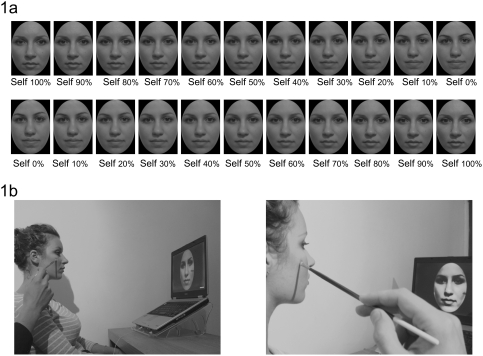
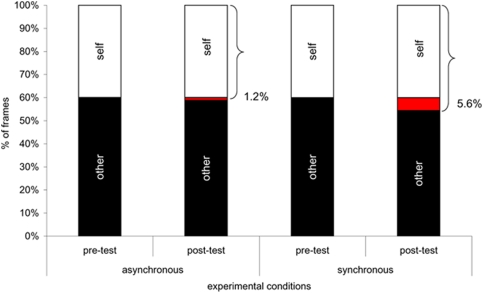
How do I know the person I see in the mirror is really me? Is it because I know the person simply looks like me, or is it because the mirror reflection moves when I move, and I see it being touched when I feel touch myself? Studies of face-recognition suggest that visual recognition of stored visual features inform self-face recognition. In contrast, body-recognition studies conclude that multisensory integration is the main cue to selfhood. The present study investigates for the first time the specific contribution of current multisensory input for self-face recognition. Participants were stroked on their face while they were looking at a morphed face being touched in synchrony or asynchrony. Before and after the visuo-tactile stimulation participants performed a self-recognition task. The results show that multisensory signals have a significant effect on self-face recognition. Synchronous tactile stimulation while watching another person's face being similarly touched produced a bias in recognizing one's own face, in the direction of the other person included in the representation of one's own face. Multisensory integration can update cognitive representations of one's body, such as the sense of ownership. The present study extends this converging evidence by showing that the correlation of synchronous multisensory signals also updates the representation of one's face. The face is a key feature of our identity, but at the same time is a source of rich multisensory experiences used to maintain or update self-representations.
Overview
The claims and statistics of this paper haven’t been checked yet.
Run the check — free, no account needed. It reads the open-access text and checks the sources it cites.
Integrity signals
Registry
Cites
Statistics
Figures
Verification
Claims the paper makes
The claims and statistics of this paper haven’t been checked yet.
Run the check — free, no account needed. It reads the open-access text and checks the sources it cites.
Claims other papers make about this one
Each is checked against this paper’s own text: does it say what the citing paper says it does?
In the citing paper
“The first relevant finding to support our argument is that experimentally induced modulations of body ownership enhance perceived physical similarity between self and other.”
From Changing bodies changes minds: Owning another body affects social cognition (2015) · cites this paper as [26]
In the citing paper
“In a more objective quantification of a comparable effect, participants accepted morphed photos of faces with a higher percentage of the other as depicting themselves after experiencing an enfacement illusion, suggesting that the participants' stored representations of their own faces were altered to incorporate aspects of the other person [26,35,36].”
From Changing bodies changes minds: Owning another body affects social cognition (2015) · cites this paper as [26]
In the citing paper
“For example, after the rubber hand illusion, participants rated the rubber hand as more physically similar to their own [26].”
From Changing bodies changes minds: Owning another body affects social cognition (2015) · cites this paper as [26]
In the citing paper
“produces a measurable bias in self-face recognition, whereby participants perceive the other's face as looking more like their own [26,35,36].”
From Changing bodies changes minds: Owning another body affects social cognition (2015) · cites this paper as [26]
In the citing paper
“Tsakiris [32] showed that synchronous, but not asynchronous, visuo-tactile stimulation between the participant’s own face and a morphed face, containing a blending of the facial features of the participant (50%) with the features of someone else’s face (50%), produced a measurable bias in self-face recognition.”
From The other in me: interpersonal multisensory stimulation changes the mental representation of the self (2012) · cites this paper as [32]
In the citing paper
“Using unfamiliar faces rules out the possibility that the bias in self-face recognition towards the other’s face could be accounted simply by face familiarity and affiliation with the other [32], while obtaining a baseline self-recognition prior to stimulation allows us to quantify the exact change in self-face recognition as a result of multisensory stimulation (cf. [33]).”
From The other in me: interpersonal multisensory stimulation changes the mental representation of the self (2012) · cites this paper as [32]
In the citing paper
“These findings are compatible with the behavioral results of Tsakiris [32] and Sforza et al. [33], but importantly, they show, for the first time, that IMS between one’s own face and a completely unknown face can affect the mental representation of one’s own face.”
From The other in me: interpersonal multisensory stimulation changes the mental representation of the self (2012) · cites this paper as [32]
In the citing paper
“Tsakiris [32] used a self-other morphed face during visuo-tactile stimulation, rather than an unfamiliar other;”
From The other in me: interpersonal multisensory stimulation changes the mental representation of the self (2012) · cites this paper as [32]
In the citing paper
“This issue was investigated by Tsakiris [32] and Sforza et al. [33], who failed to find significant differences between self-recognition changes for the “self to other” and “other to self” directions [32] and between the judgments given under different instruction conditions (e.g., to evaluate the amount of “self” or to evaluate the amount of “other” contained in the morphs) [33].”
From The other in me: interpersonal multisensory stimulation changes the mental representation of the self (2012) · cites this paper as [32]
In the citing paper
“Experiment 1 was designed to control for potential confounds reported in previous studies, such as the use of a familiar face [32], [33] and the lack of a pre-test baseline self-recognition performance [33].”
From The other in me: interpersonal multisensory stimulation changes the mental representation of the self (2012) · cites this paper as [32]
In the citing paper
“This asymmetric effect for the two directions of morphing could also be observed in Experiment 1, but was not found in previous studies where the other’s face was a familiar one [32], [33].”
From The other in me: interpersonal multisensory stimulation changes the mental representation of the self (2012) · cites this paper as [32]
In the citing paper
“Is it possible that synchronous IMS disrupts face recognition performance in general? This seems unlikely, given that Tsakiris [32] showed the behavioral effect to be specific to the face seen during visuo-tactile stimulation, and not to other familiar faces that were not seen during stimulation.”
From The other in me: interpersonal multisensory stimulation changes the mental representation of the self (2012) · cites this paper as [32]
In the citing paper
“The percentage of change reported in Experiment 1 is comparable to that reported in similar studies that used a familiar “other” face (1.8% in [32], and 4.4% in [33]).”
From The other in me: interpersonal multisensory stimulation changes the mental representation of the self (2012) · cites this paper as [32]
In the citing paper
“Previous studies failed to find significant differences between self-recognition changes for the “self to other” and “other to self” directions in a video morphing from one face to the other [32], a task identical to the one used in our Experiment 4, and between the judgments of morphed images under different instruction conditions (either to evaluate the amount of “self” or to evaluate the amount”
From The other in me: interpersonal multisensory stimulation changes the mental representation of the self (2012) · cites this paper as [32]
Self-check
Percentages, sums and reported differences re-computed from the paper’s own numbers.
The self-check needs the paper’s full text.
Citations
Cites
The distributed human neural system for face perception
Haxby, J. V., Hoffman, E. A., & Gobbini, M. I. (2000) · Trends in Cognitive Sciences · doi:10.1016/s1364-6613(00)01482-0 · Cited by 4,891
Rubber hands ‘feel’ touch that eyes see
Botvinick, M., & Cohen, J. (1998) · Nature · doi:10.1038/35784 · Cited by 4,410
Understanding face recognition
Bruce, V., & Young, A. (1986) · British Journal of Psychology · doi:10.1111/j.2044-8295.1986.tb02199.x · Cited by 4,067
Parts and Wholes in Face Recognition
Tanaka, J. W., & Farah, M. J. (1993) · The Quarterly Journal of Experimental Psychology Section A · doi:10.1080/14640749308401045 · Cited by 2,179
A cortical area selective for visual processing of the human body
Downing, P. E., Jiang, Y., Shuman, M., & Kanwisher, N. (2001) · Science · doi:10.1126/science.1063414 · Cited by 2,043
The fusiform face area: a cortical region specialized for the perception of faces
Kanwisher, N., & Yovel, G. (2006) · Philosophical Transactions of the Royal Society B: Biological Sciences · doi:10.1098/rstb.2006.1934 · Cited by 1,718
That's my hand! Activity in premotor cortex reflects feeling of ownership of a limb
Ehrsson, H. H., Spence, C., & Passingham, R. E. (2004) · Science · doi:10.1126/science.1097011 · Cited by 1,348
The rubber hand illusion revisited: visuotactile integration and self-attribution
Tsakiris, M., & Haggard, P. (2005) · Journal of Experimental Psychology: Human Perception and Performance · doi:10.1037/0096-1523.31.1.80 · Cited by 1,328
What is embodiment? A psychometric approach
Longo, M. R., Schüür, F., Kammers, M. P. M., Tsakiris, M., & Haggard, P. (2008) · Cognition · doi:10.1016/j.cognition.2007.12.004 · Cited by 956
If I were you: Perceptual illusion of body swapping
Petkova, V. I., & Ehrsson, H. H. (2008) · PLoS ONE · doi:10.1371/journal.pone.0003832 · Cited by 953
Cited by
Sorted by citations
The Sense of Embodiment in Virtual Reality
Kilteni, K., Groten, R., & Slater, M. (2012) · PRESENCE Virtual and Augmented Reality · doi:10.1162/pres_a_00124 · Cited by 1,901
Toward a second-person neuroscience
Schilbach, L., Timmermans, B., Reddy, V., Costall, A., Bente, G., Schlicht, T., & Vogeley, K. (2013) · Behavioral and Brain Sciences · doi:10.1017/s0140525x12000660 · Cited by 1,510
Multisensory brain mechanisms of bodily self-consciousness.
Blanke, O. (2012) · Nature Reviews Neuroscience · doi:10.1038/nrn3292 · Cited by 1,147
My body in the brain: A neurocognitive model of body-ownership.
Tsakiris, M. (2010) · Neuropsychologia · doi:10.1016/j.neuropsychologia.2009.09.034 · Cited by 1,069
Pan, X., & Hamilton, A. F. D. C. (2018) · British Journal of Psychology · doi:10.1111/bjop.12290 · Cited by 801
Behavioral, Neural, and Computational Principles of Bodily Self-Consciousness
Blanke, O., Slater, M., & Serino, A. (2015) · Neuron · doi:10.1016/j.neuron.2015.09.029 · Cited by 698
The free-energy self: a predictive coding account of self-recognition
Apps, M. A. J., & Tsakiris, M. (2014) · Neuroscience & Biobehavioral Reviews · doi:10.1016/j.neubiorev.2013.01.029 · Cited by 514
The Rubber Hand Illusion: feeling of ownership and proprioceptive drift do not go hand in hand
Rohde, M., Di Luca, M., & Ernst, M. O. (2011) · PLoS ONE · doi:10.1371/journal.pone.0021659 · Cited by 486
Suzuki, K., Garfinkel, S. N., Critchley, H. D., & Seth, A. K. (2013) · Neuropsychologia · doi:10.1016/j.neuropsychologia.2013.08.014 · Cited by 476
Mentalizing homeostasis: the social origins of interoceptive inference
Fotopoulou, A., & Tsakiris, M. (2017) · Neuropsychoanalysis · doi:10.1080/15294145.2017.1294031 · Cited by 428
The multisensory basis of the self: From body to identity to others
Manos Tsakiris, A. (2016) · Quarterly Journal of Experimental Psychology · doi:10.1080/17470218.2016.1181768 · Cited by 443
Changing bodies changes minds: Owning another body affects social cognition
Maister, L., Slater, M., Sanchez-Vives, M. V., & Tsakiris, M. (2015) · Trends in Cognitive Sciences · doi:10.1016/j.tics.2014.11.001 · Cited by 384
McKay, R., & Whitehouse, H. (2015) · Psychological Bulletin · doi:10.1037/a0038455 · Cited by 353
Manos Tsakiris, A., Carpenter, L., James, D., & Fotopoulou, A. (2009) · Experimental Brain Research · doi:10.1007/s00221-009-2039-3 · Cited by 350
The Senses of Agency and Ownership: A Review
Braun, N., Debener, S., Spychała, N., Bongartz, E., Sörös, P., Müller, H., & Philipsen, A. (2018) · Frontiers in Psychology · doi:10.3389/fpsyg.2018.00535 · Cited by 364
Drumming in Immersive Virtual Reality: The Body Shapes the Way We Play
Kilteni, K., Bergstrom, I., & Slater, M. (2013) · IEEE Transactions on Visualization and Computer Graphics · doi:10.1109/tvcg.2013.29 · Cited by 326
Heydrich, L., Dodds, T. J., Aspell, J. E., Herbelin, B., Bülthoff, H., Mohler, B. J., & Blanke, O. (2013) · Frontiers in Psychology · doi:10.3389/fpsyg.2013.00946 · Cited by 329
Petkova, V. I., Khoshnevis, M., & Ehrsson, H. H. (2011) · Frontiers in Psychology · doi:10.3389/fpsyg.2011.00035 · Cited by 311
Serino, A. (2019) · Neuroscience & Biobehavioral Reviews · doi:10.1016/j.neubiorev.2019.01.016 · Cited by 304
Synchronous multisensory stimulation blurs self-other boundaries.
Paladino, M.-P., Mazzurega, M., Pavani, F., & Schubert, T. W. (2010) · Psychological Science · doi:10.1177/0956797610379234 · Cited by 297
My face in yours: visuo-tactile facial stimulation influences sense of identity
Sforza, A., Bufalari, I., Haggard, P., & Aglioti, S. M. (2010) · Social Neuroscience · doi:10.1080/17470910903205503 · Cited by 247
Osimo, S. A., Pizarro, R., Spanlang, B., & Slater, M. (2015) · Scientific Reports · doi:10.1038/srep13899 · Cited by 242
Filippetti, M. L., Johnson, M. H., Lloyd‐Fox, S., Dragovic, D., & Farroni, T. (2013) · Current Biology · doi:10.1016/j.cub.2013.10.017 · Cited by 249
Qin, P., Wang, M., & Northoff, G. (2020) · Neuroscience & Biobehavioral Reviews · doi:10.1016/j.neubiorev.2020.05.004 · Cited by 223
Grivaz, P., Blanke, O., & Serino, A. (2017) · NeuroImage · doi:10.1016/j.neuroimage.2016.12.052 · Cited by 203
Rabinowitch, T.-C., & Knafo‐Noam, A. (2015) · PLoS ONE · doi:10.1371/journal.pone.0120878 · Cited by 222
The neural correlates of visual self-recognition
Devue, C., & Brédart, S. (2010) · Consciousness and Cognition · doi:10.1016/j.concog.2010.09.007 · Cited by 191
The role of prediction in social neuroscience
Brown, E. C., & Brüne, M. (2012) · Frontiers in Human Neuroscience · doi:10.3389/fnhum.2012.00147 · Cited by 190
Chuan-Peng, H., Di, X., Eickhoff, S. B., Zhang, M., Peng, K., Guo, H., & Sui, J. (2015) · Neuroscience & Biobehavioral Reviews · doi:10.1016/j.neubiorev.2015.12.003 · Cited by 188
Tajadura-Jiménez, A., & Tsakiris, M. (2014) · Journal of Experimental Psychology: General · doi:10.1037/a0033171 · Cited by 167
Multisensory processes in body ownership
Ehrsson, H. H. (2019) · Elsevier eBooks · doi:10.1016/b978-0-12-812492-5.00008-5 · Cited by 159
Tajadura-Jiménez, A., Longo, M. R., Coleman, R., & Tsakiris, M. (2012) · Consciousness and Cognition · doi:10.1016/j.concog.2012.10.004 · Cited by 150
Tajadura‐Jiménez, A., Banakou, D., Bianchi‐Berthouze, N., & Slater, M. (2017) · Scientific Reports · doi:10.1038/s41598-017-09497-3 · Cited by 156
Tajadura-Jiménez, A., Grehl, S., & Tsakiris, M. (2012) · PLoS ONE · doi:10.1371/journal.pone.0040682 · Cited by 147
Self awareness and the body image
Longo, M. R., Schüür, F., Kammers, M. P. M., Manos Tsakiris, A., & Haggard, P. (2009) · Acta Psychologica · doi:10.1016/j.actpsy.2009.02.003 · Cited by 137
Beyond the colour of my skin: how skin colour affects the sense of body-ownership
Farmer, H., Tajadura-Jiménez, A., & Tsakiris, M. (2012) · Consciousness and Cognition · doi:10.1016/j.concog.2012.04.011 · Cited by 123
Social perception of others shapes one's own multisensory peripersonal space
Pellencin, E., Paladino, M. P., Herbelin, B., & Serino, A. (2018) · Cortex · doi:10.1016/j.cortex.2017.08.033 · Cited by 117
Newborn Body Perception: Sensitivity to Spatial Congruency
Filippetti, M. L., Orioli, G., Johnson, M. H., & Farroni, T. (2015) · Infancy · doi:10.1111/infa.12083 · Cited by 116
Fribourg, R., Ogawa, N., Hoyet, L., Argelaguet, F., Narumi, T., Hirose, M., & Lécuyer, A. (2020) · IEEE Transactions on Visualization and Computer Graphics · doi:10.1109/tvcg.2020.2999197 · Cited by 114
Sel, A., Azevedo, R. T., & Tsakiris, M. (2016) · Cerebral Cortex · doi:10.1093/cercor/bhw296 · Cited by 111
Explaining mirror-touch synesthesia
Ward, J., & Banissy, M. J. (2015) · Cognitive Neuroscience · doi:10.1080/17588928.2015.1042444 · Cited by 108
Pfeiffer, C., Lopez, C., Schmutz, V., Dueñas, J., Martuzzi, R., & Blanke, O. (2013) · PLoS ONE · doi:10.1371/journal.pone.0061751 · Cited by 116
Fotopoulou, A., Jenkinson, P. M., Manos Tsakiris, A., Haggard, P., Rudd, A., & Kopelman, M. D. (2011) · Neuropsychologia · doi:10.1016/j.neuropsychologia.2011.10.011 · Cited by 109
Using Facial Animation to Increase the Enfacement Illusion and Avatar Self-Identification
González-Franco, M., Steed, A. J., Hoogendyk, S., & Ofek, E. (2020) · IEEE Transactions on Visualization and Computer Graphics · doi:10.1109/tvcg.2020.2973075 · Cited by 105
The ‘Enfacement’ illusion: A window on the plasticity of the self
Porciello, G., Bufalari, I., Minio-Paluello, I., Pace, E. D., & Aglioti, S. M. (2018) · Cortex · doi:10.1016/j.cortex.2018.01.007 · Cited by 109
Losing One's Hand: Visual-Proprioceptive Conflict Affects Touch Perception
Folegatti, A., de Vignemont, F., Pavani, F., Rossetti, Y., & Farnè, A. (2009) · PLoS ONE · doi:10.1371/journal.pone.0006920 · Cited by 97
Neural Mechanisms of Body Awareness in Infants
Filippetti, M. L., Lloyd‐Fox, S., Longo, M. R., Farroni, T., & Johnson, M. H. (2014) · Cerebral Cortex · doi:10.1093/cercor/bhu261 · Cited by 94
The self and its prolonged intrinsic neural timescale in schizophrenia
Northoff, G., Sandsten, K. E., Nordgaard, J., Kjaer, T. W., & Parnas, J. (2021) · Schizophrenia Bulletin · doi:10.1093/schbul/sbaa083 · Cited by 91
Rohde, M., Wold, A., Karnath, H., & Ernst, M. O. (2013) · PLoS ONE · doi:10.1371/journal.pone.0080688 · Cited by 86
Embodied VR environment facilitates motor imagery brain–computer interface training
Škola, F., & Liarokapis, F. (2018) · Computers & Graphics · doi:10.1016/j.cag.2018.05.024 · Cited by 88
Toward Enhanced Teleoperation Through Embodiment
Toet, A., Kuling, I. A., Krom, B. N., & van Erp, J. B. F. (2020) · Frontiers in Robotics and AI · doi:10.3389/frobt.2020.00014 · Cited by 92
The N250 Brain Potential to Personally Familiar and Newly Learned Faces and Objects
Pierce, L. J., Scott, L. S., Boddington, S. E., Droucker, D., Curran, T., & Tanaka, J. W. (2011) · Frontiers in Human Neuroscience · doi:10.3389/fnhum.2011.00111 · Cited by 84
The bodily self and its disorders: neurological, psychological and social aspects
Brugger, P., & Lenggenhager, B. (2014) · Current Opinion in Neurology · doi:10.1097/wco.0000000000000151 · Cited by 82
A neuroanatomical predictor of mirror self-recognition in chimpanzees
Hecht, E. E., Mahovetz, L. M., Preuss, T. M., & Hopkins, W. D. (2016) · Social Cognitive and Affective Neuroscience · doi:10.1093/scan/nsw159 · Cited by 84
Apps, M. A. J., Tajadura‐Jiménez, A., Sereno, M. I., Blanke, O., & Manos Tsakiris, A. (2013) · Cerebral Cortex · doi:10.1093/cercor/bht199 · Cited by 79
Fluidity of gender identity induced by illusory body-sex change
Tacikowski, P., Fust, J., & Ehrsson, H. H. (2020) · Scientific Reports · doi:10.1038/s41598-020-71467-z · Cited by 79
Geng, H., Zhang, S., Li, Q., Tao, R., & Xu, S. (2012) · Neuropsychologia · doi:10.1016/j.neuropsychologia.2012.07.040 · Cited by 76
Filippetti, M. L., & Manos Tsakiris, A. (2016) · Cognition · doi:10.1016/j.cognition.2016.11.002 · Cited by 74
Mroczko-Wąsowicz, A., & Werning, M. (2012) · Frontiers in Psychology · doi:10.3389/fpsyg.2012.00279 · Cited by 76
Mirror-touch synaesthesia changes representations of self-identity
Maister, L., Banissy, M. J., & Tsakiris, M. (2013) · Neuropsychologia · doi:10.1016/j.neuropsychologia.2013.01.020 · Cited by 68
Monti, A., Porciello, G., Panasiti, M. S., & Aglioti, S. M. (2021) · Psychological Research · doi:10.1007/s00426-021-01477-7 · Cited by 65
Farmer, H., & Maister, L. (2017) · Social Justice Research · doi:10.1007/s11211-017-0294-1 · Cited by 72
Salagean, A., Crellin, E., Parsons, M., Cosker, D. P., & Fraser, D. S. (2023) · CHI Conference on Human Factors in Computing Systems · doi:10.1145/3544548.3581182 · Cited by 63
The Effect of Gender Body-Swap Illusions on Working Memory and Stereotype Threat
Peck, T. C., Doan, M., Bourne, K. A., & Good, J. J. (2018) · IEEE Transactions on Visualization and Computer Graphics · doi:10.1109/tvcg.2018.2793598 · Cited by 68
Self-face advantage over familiar and unfamiliar faces: A three-level meta-analytic approach
Bortolon, C., & Raffard, S. (2018) · Psychonomic Bulletin & Review · doi:10.3758/s13423-018-1487-9 · Cited by 68
Fini, C., Cardini, F., Tajadura-Jiménez, A., Serino, A., & Tsakiris, M. (2013) · Frontiers in Behavioral Neuroscience · doi:10.3389/fnbeh.2013.00165 · Cited by 59
Affective Touch Enhances Self-Face Recognition During Multisensory Integration
Panagiotopoulou, E., Filippetti, M. L., Manos Tsakiris, A., & Fotopoulou, A. (2017) · Scientific Reports · doi:10.1038/s41598-017-13345-9 · Cited by 58
Oxytocin sharpens self-other perceptual boundary
Colonnello, V., Chen, F. S., Panksepp, J., & Heinrichs, M. (2013) · Psychoneuroendocrinology · doi:10.1016/j.psyneuen.2013.08.010 · Cited by 58
Perception of Our Own Body Influences Self-Concept and Self-Incoherence Impairs Episodic Memory
Tacikowski, P., Weijs, M. L., & Ehrsson, H. H. (2020) · iScience · doi:10.1016/j.isci.2020.101429 · Cited by 62
Farmer, H., McKay, R., & Manos Tsakiris, A. (2013) · Psychological Science · doi:10.1177/0956797613494852 · Cited by 62
Self-other bodily merging in the context of synchronous but arbitrary-related multisensory inputs.
Mazzurega, M., Pavani, F., Paladino, M. P., & Schubert, T. W. (2011) · Experimental Brain Research · doi:10.1007/s00221-011-2744-6 · Cited by 56
Body perception, awareness, and illusions
Costantini, M. (2014) · Wiley Interdisciplinary Reviews Cognitive Science · doi:10.1002/wcs.1309 · Cited by 57
My face, my heart: Cultural differences in integrated bodily self-awareness
Maister, L., & Manos Tsakiris, A. (2013) · Cognitive Neuroscience · doi:10.1080/17588928.2013.808613 · Cited by 59
That’s not quite me: limb ownership encoding in the brain
Limanowski, J., & Blankenburg, F. (2015) · Social Cognitive and Affective Neuroscience · doi:10.1093/scan/nsv079 · Cited by 56
Wolman, A., Çatal, Y., Wolff, A., Wainio‐Theberge, S., Scalabrini, A., Ahmadi, A. E., & Northoff, G. (2023) · NeuroImage · doi:10.1016/j.neuroimage.2023.119896 · Cited by 56
Mood migration: How enfacing a smile makes you happier
Ma, K., Sellaro, R., Lippelt, D. P., & Hommel, B. (2016) · Cognition · doi:10.1016/j.cognition.2016.02.018 · Cited by 56
Frontier of Self and Impact Prediction
Cléry, J. C., & Hamed, S. B. (2018) · Frontiers in Psychology · doi:10.3389/fpsyg.2018.01073 · Cited by 61
Payne, S., & Manos Tsakiris, A. (2016) · Cognitive Affective & Behavioral Neuroscience · doi:10.3758/s13415-016-0461-0 · Cited by 51
Visual processing of moving and static self body-parts
Frassinetti, F., Pavani, F., Zamagni, E., Fusaroli, G., Vescovi, M., Benassi, M., Avanzi, S., & Farnè, A. (2009) · Neuropsychologia · doi:10.1016/j.neuropsychologia.2009.03.012 · Cited by 52
Animation realism affects perceived character appeal of a self-virtual face
Kokkinara, E., & McDonnell, R. (2015) · Motion in Games · doi:10.1145/2822013.2822035 · Cited by 52
Gaggioli, A., Ferscha, A., Riva, G., Dunne, S., & Viaud‐Delmon, I. (2015) · doi:10.1515/9783110471137 · Cited by 51
Cardini, F., Tajadura‐Jiménez, A., Serino, A., & Manos Tsakiris, A. (2012) · Journal of Experimental Psychology Human Perception & Performance · doi:10.1037/a0031049 · Cited by 49
Apps, M. A. J., Tajadura‐Jiménez, A., Turley, G., & Manos Tsakiris, A. (2012) · NeuroImage · doi:10.1016/j.neuroimage.2012.08.053 · Cited by 47
The rubber hand illusion in a mirror
Bertamini, M., Berselli, N., Bode, C., Lawson, R., & Wong, L. T. (2011) · Consciousness and Cognition · doi:10.1016/j.concog.2011.04.006 · Cited by 47
Binding body and self in visuo‐vestibular conflicts
Macauda, G., Bertolini, G., Palla, A., Straumann, D., Brugger, P., & Lenggenhager, B. (2014) · European Journal of Neuroscience · doi:10.1111/ejn.12809 · Cited by 51
I feel your fear: shared touch between faces facilitates recognition of fearful facial expressions
Maister, L., Tsiakkas, E., & Tsakiris, M. (2013) · Emotion · doi:10.1037/a0030884 · Cited by 46
Is that me in the mirror? Depersonalisation modulates tactile mirroring mechanisms
Adler, J., Schabinger, N., Michal, M., Beutel, M. E., & Gillmeister, H. (2016) · Neuropsychologia · doi:10.1016/j.neuropsychologia.2016.03.009 · Cited by 44
Altered self-recognition in patients with schizophrenia
Sandsten, K. E., Nordgaard, J., Kjaer, T. W., Gallese, V., Ardizzi, M., Ferroni, F., Petersen, J., & Parnas, J. (2020) · Schizophrenia Research · doi:10.1016/j.schres.2020.01.022 · Cited by 44
Enfacing others but only if they are nice to you
Bufalari, I., Lenggenhager, B., Porciello, G., Holmes, B. S., & Aglioti, S. M. (2014) · Frontiers in Behavioral Neuroscience · doi:10.3389/fnbeh.2014.00102 · Cited by 49
Cohesion and Joint Speech: Right Hemisphere Contributions to Synchronized Vocal Production
Jasmin, K. M., McGettigan, C., Agnew, Z. K., Lavan, N., Josephs, O., Cummins, F., & Scott, S. K. (2016) · Journal of Neuroscience · doi:10.1523/jneurosci.4075-15.2016 · Cited by 44
Audio-visual sensory deprivation degrades visuo-tactile peri-personal space
Noel, J.-P., Park, H.-D., Pasqualini, I., Lissek, H., Wallace, M., Blanke, O., & Serino, A. (2018) · Consciousness and Cognition · doi:10.1016/j.concog.2018.04.001 · Cited by 42
Banissy, M. J., & Ward, J. (2013) · Frontiers in Human Neuroscience · doi:10.3389/fnhum.2013.00112 · Cited by 42
Perceiving a Stranger's Voice as Being One's Own: A ‘Rubber Voice’ Illusion?
Zheng, Z. Z., MacDonald, E., Munhall, K. G., & Johnsrude, I. S. (2011) · PLoS ONE · doi:10.1371/journal.pone.0018655 · Cited by 45
The development of body representations: an associative learning account
de Klerk, C. C. J. M., Filippetti, M. L., & Rigato, S. (2021) · Proceedings of the Royal Society B Biological Sciences · doi:10.1098/rspb.2021.0070 · Cited by 45
“I” and “Me”: The Self in the Context of Consciousness
Wozniak, M. M. (2018) · Frontiers in Psychology · doi:10.3389/fpsyg.2018.01656 · Cited by 56
Pozeg, P., Galli, G., & Blanke, O. (2015) · Frontiers in Psychology · doi:10.3389/fpsyg.2015.01749 · Cited by 41
My true face: Unmasking one's own face representation.
Mora, L., Cowie, D., Banissy, M., & Cocchini, G. (2018) · Acta Psychologica · doi:10.1016/j.actpsy.2018.08.014 · Cited by 66
What can mirror-touch synaesthesia tell us about the sense of agency?
Cioffi, M. C., Moore, J. W., & Banissy, M. J. (2014) · Frontiers in Human Neuroscience · doi:10.3389/fnhum.2014.00256 · Cited by 36
Atypical bodily self-awareness in vicarious pain responders
Bowling, N. C., Botan, V., Santiesteban, I., Ward, J., & Banissy, M. J. (2019) · Philosophical Transactions of the Royal Society B Biological Sciences · doi:10.1098/rstb.2018.0361 · Cited by 34
Salami, A., Andreu-Pérez, J., & Gillmeister, H. (2020) · Neuroscience & Biobehavioral Reviews · doi:10.1016/j.neubiorev.2020.08.011 · Cited by 37
Metadata
- Authors
- Tsakiris, M.
- Venue
- PLoS ONE
- Publisher
- Public Library of Science (PLoS)
- Published
- 2008-12-24
- Volume
- 3
- Issue
- 12
- Pages
- e4040
- ISSN
- 1932-6203 (ISSN-L)
- PMC
- PMC2603324
- OpenAlex
- W2155205708
- Cited by
- 330
- References
- 45
- Citations by year
- 2026: 17 · 2025: 16 · 2024: 22 · 2023: 18 · 2022: 18 · 2021: 24 · 2020: 24 · 2019: 15 · 2018: 18 · 2017: 17 · 2016: 24 · 2015: 29 · 2014: 22 · 2013: 25 · 2012: 16
- FWCI
- 11.29
- Type
- journal article
- Language
- en
- Open access
- gold
- doi.org
- Locations
- PLoS ONE (publishedVersion, cc-by)
- PubMed Central (publishedVersion, cc-by)
- PubMed (publishedVersion)
- DOAJ (DOAJ: Directory of Open Access Journals) (submittedVersion)
- Royal Holloway Digital Repository (Royal Holloway University of London) (submittedVersion, cc-by)
- Royal Holloway Digital Repository (Royal Holloway University of London) (submittedVersion)
- Funders
- Economic and Social Research Council (RES‐061‐25‐0233)
- Topics
- Social Sciences › Psychology › Experimental and Cognitive Psychology › Multisensory perception and integration
- Life Sciences › Neuroscience › Cognitive Neuroscience › Face Recognition and Perception
- Life Sciences › Neuroscience › Cognitive Neuroscience › Tactile and Sensory Interactions
- Keywords
- self-face recognition, multisensory integration, visuo-tactile stimulation, representation of the body, self-representation, face identity, specular reflection, morphed faces
- MeSH terms
- Adult, Awareness, Body Image, Face, Female, Humans, Image Processing, Computer-Assisted, Male, Mental Processes, Pattern Recognition, Visual, Photic Stimulation, Physical Stimulation, Self Concept, Sensation, Visual Perception, Recognition, Psychology, Young Adult
About these checks
Registry, retraction, Cites and statistics results are computed, not judged, with one exception: a printed reference that no index lists is read once by a model before it counts as a citation error. Claims are extracted by a model and kept only when their quote appears verbatim in the text; each cited source is then checked, with a model’s help, for whether it says what the claim relies on. Those verdicts can be wrong — read the claim’s quote and the cited source before relying on one.
Statistics and arithmetic are recomputed, not judged.
Confidence bands are shown only for fields calibrated on our annotated test set. None is calibrated yet, so no band is shown.
What counts as a claim ›How we measure confidence ›How we check this ›
Are you an author, or do you see a problem with this page? Request a review
