

How Many Scientists Fabricate and Falsify Research? A Systematic Review and Meta-Analysis of Survey Data
Open accessThe DOI matches its Crossref record; 66 of the 74 references it cites were found in a registry or an index; none of the 21 sources its claims cite is checked for support yet.
Abstract
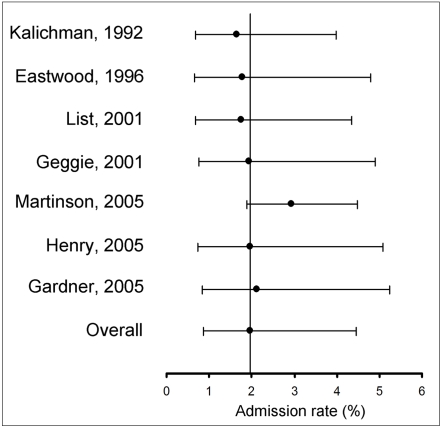
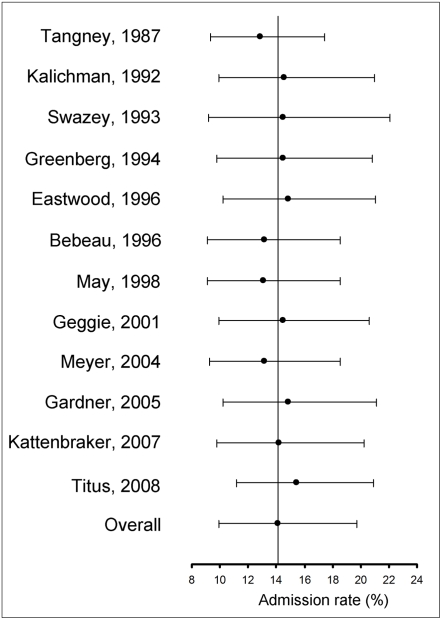
The frequency with which scientists fabricate and falsify data, or commit other forms of scientific misconduct is a matter of controversy. Many surveys have asked scientists directly whether they have committed or know of a colleague who committed research misconduct, but their results appeared difficult to compare and synthesize. This is the first meta-analysis of these surveys. To standardize outcomes, the number of respondents who recalled at least one incident of misconduct was calculated for each question, and the analysis was limited to behaviours that distort scientific knowledge: fabrication, falsification, "cooking" of data, etc... Survey questions on plagiarism and other forms of professional misconduct were excluded. The final sample consisted of 21 surveys that were included in the systematic review, and 18 in the meta-analysis. A pooled weighted average of 1.97% (N = 7, 95%CI: 0.86-4.45) of scientists admitted to have fabricated, falsified or modified data or results at least once--a serious form of misconduct by any standard--and up to 33.7% admitted other questionable research practices. In surveys asking about the behaviour of colleagues, admission rates were 14.12% (N = 12, 95% CI: 9.91-19.72) for falsification, and up to 72% for other questionable research practices. Meta-regression showed that self reports surveys, surveys using the words "falsification" or "fabrication", and mailed surveys yielded lower percentages of misconduct. When these factors were controlled for, misconduct was reported more frequently by medical/pharmacological researchers than others. Considering that these surveys ask sensitive questions and have other limitations, it appears likely that this is a conservative estimate of the true prevalence of scientific misconduct.
Overview
CoChat Summary
TL;DR
This systematic review and meta-analysis of survey data estimated that about 2% of scientists admitted to fabricating, falsifying, or modifying data or results at least once, while 14.12% reported knowing a colleague who did so. The paper argues these are conservative estimates and that methodological choices strongly shape the observed rates.
Key findings
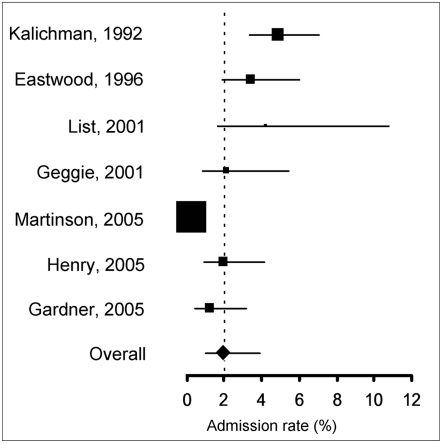
- Across surveys explicitly asking whether scientists ever fabricated or falsified data or altered/modifed results, the pooled weighted estimate was 1.97% (95% CI 0.86–4.45; N = 7), with significant heterogeneity (Cochran’s Q = 61.7777, df = 6, P < 0.0001).
- When only questions explicitly using the words “fabrication” or “falsification” were included, the pooled estimate for self-reports was 1.06% (95% CI 0.31–3.51; N = 4).
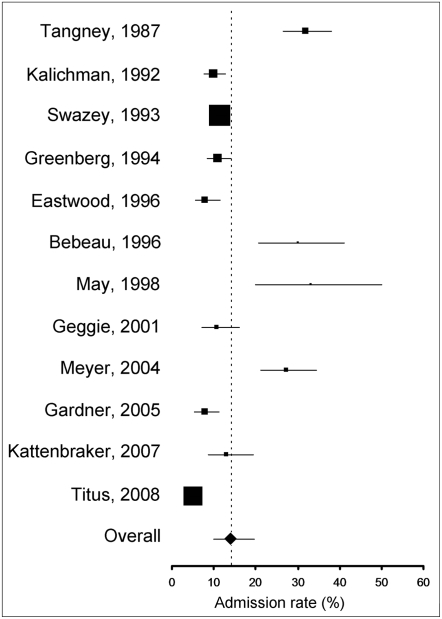
- For reports about colleagues’ misconduct, the pooled weighted estimate was 14.12% (95% CI 9.91–19.72; N = 12); restricting to questions using “fabrication” or “falsification” gave 12.34% (95% CI 8.43–17.71; N = 11).
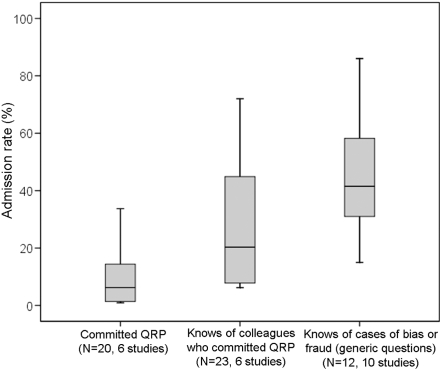
- Other questionable research practices were reported more often: up to 33.7% in self-reports and up to 72% when asking about colleagues.
Methods
- Systematic review and meta-analysis of quantitative surveys asking scientists whether they had committed or observed scientific misconduct in the past; plagiarism and other non-knowledge-distorting misconduct were excluded.
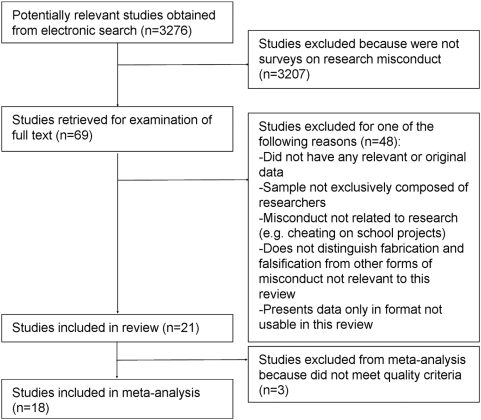
- Searches were run in the first two weeks of August 2008 across citation databases, journals, grey literature sources, and internet search engines; the final review included 21 studies, with 18 in the meta-analysis.
- Main analysis computed the proportion recalling at least one incident, logit-transformed and inverse-variance weighted in a random-effects meta-analysis; meta-regression tested methodological factors such as self vs. non-self reports, mailed vs. handed-out surveys, and use of the words “fabrication”/“falsification.”
Limitations
- The paper states that using the percentage of respondents recalling at least one incident is a rough measure of misconduct frequency; this can under- or overestimate prevalence depending on whether respondents committed multiple incidents or only one.
- The paper notes that non-response bias was recognized by most surveys as a limitation, and that the validity of self-reports may be affected by social expectations; the text also suggests self-reports likely underestimate misconduct.
- Evident from the text: the included studies were heterogeneous in methods and wording, and some outcomes were too diverse for meaningful meta-analysis, so only crude unweighted parameters were calculated for broader questionable research practices.
Model-written summary. Check it against the paper before relying on it.
Integrity signals
Registry
Cites
Statistics
Figures
Verification
Claims the paper makes
0 Valid · 0 Not valid · 14 Not checked · 61 Own results and interpretations
A result the paper reports from its own data — it cites no other source for it, so there is none to check. The quote shows it is in the paper.
In the paper
“When these factors were controlled for, misconduct was reported more frequently by medical/pharmacological researchers than others.”
§ How Many Scientists Fabricate and Falsify Research? A Systematic Review and Meta-Analysis of Survey Data > Abstract
plainstates an association- Asserted: passes — The authors put it forward as true.
- Checkable: passes — It can be checked against evidence.
- Load-bearing: passes — The paper’s conclusions depend on it.
- Based: passes — The paper gives a reason why it holds.
- Rests on 2 assumptions not shown here.
A result the paper reports from its own data — it cites no other source for it, so there is none to check. The quote shows it is in the paper.
In the paper
“A pooled weighted average of 1.97% (N = 7, 95%CI: 0.86–4.45) of scientists admitted to have fabricated, falsified or modified data or results at least once –a serious form of misconduct by any standard– and up to 33.7% admitted other questionable research practices.”
§ How Many Scientists Fabricate and Falsify Research? A Systematic Review and Meta-Analysis of Survey Data > Abstract
plainn = 7- Asserted: passes — The authors put it forward as true.
- Checkable: passes — It can be checked against evidence.
- Load-bearing: passes — The paper’s conclusions depend on it.
- Based: passes — The paper gives a reason why it holds.
- Rests on 2 assumptions not shown here.
A result the paper reports from its own data — it cites no other source for it, so there is none to check. The quote shows it is in the paper.
In the paper
“A pooled weighted average of 1.97% (N = 7, 95%CI: 0.86–4.45) of scientists admitted to have fabricated, falsified or modified data or results at least once –a serious form of misconduct by any standard– and up to 33.7% admitted other questionable research practices.”
§ How Many Scientists Fabricate and Falsify Research? A Systematic Review and Meta-Analysis of Survey Data > Abstract
plain- Asserted: passes — The authors put it forward as true.
- Checkable: passes — It can be checked against evidence.
- Load-bearing: passes — The paper’s conclusions depend on it.
- Based: passes — The paper gives a reason why it holds.
- Rests on 2 assumptions not shown here.
A result the paper reports from its own data — it cites no other source for it, so there is none to check. The quote shows it is in the paper.
In the paper
“In surveys asking about the behaviour of colleagues, admission rates were 14.12% (N = 12, 95% CI: 9.91–19.72) for falsification, and up to 72% for other questionable research practices.”
§ How Many Scientists Fabricate and Falsify Research? A Systematic Review and Meta-Analysis of Survey Data > Abstract
plainn = 12- Asserted: passes — The authors put it forward as true.
- Checkable: passes — It can be checked against evidence.
- Load-bearing: passes — The paper’s conclusions depend on it.
- Based: passes — The paper gives a reason why it holds.
- Rests on 2 assumptions not shown here.
A result the paper reports from its own data — it cites no other source for it, so there is none to check. The quote shows it is in the paper.
In the paper
“Meta-analysis yielded mean pooled estimates that are higher than most previous estimates.”
§ How Many Scientists Fabricate and Falsify Research? A Systematic Review and Meta-Analysis of Survey Data > Introduction
plain- Asserted: passes — The authors put it forward as true.
- Checkable: passes — It can be checked against evidence.
- Load-bearing: passes — The paper’s conclusions depend on it.
- Based: passes — The paper gives a reason why it holds.
- Rests on 2 assumptions not shown here.
31 more claims
Create a free account to see all 75 claims and to verify the 4 references still open.
- It may state two separate claims as one. 24
- Probably not a substantial claim. 25
Claims other papers make about this one
Each is checked against this paper’s own text: does it say what the citing paper says it does?
The cited source says what the claim attributes to it.
In the citing paper
“there are other more common sources of unreliability in the literature (41)(42)(43)(44)”
From Misconduct accounts for the majority of retracted scientific publications (2012) · cites this paper as [43]
The cited source says what the claim attributes to it.
In the citing paper
“The prevalence of researchers who have been involved in scientific misconduct is estimated to be around 2% [2]”
From Checklist to assess Trustworthiness in RAndomised Controlled Trials (TRACT checklist): concept proposal and pilot (2023) · cites this paper as [2]
The cited source says what the claim attributes to it.
In the citing paper
“This is how a small number of people 40 with flexible morals can pollute the scientific literature disproportionately.”
From Fraudulent studies are undermining the reliability of systematic reviews: on the prevalence of problematic images in preclinical depression studies (2025) · cites this paper as [40]
The cited source says what the claim attributes to it.
In the citing paper
“A meta-analysis by Fanelli, combining the results of 18 published surveys, found that 1.9% of researchers have admitted to modification, falsification, or fabrication of data (3).”
From The Prevalence of Inappropriate Image Duplication in Biomedical Research Publications (2016) · cites this paper as [3]
The cited source says what the claim attributes to it.
In the citing paper
“A systematic review and meta-analysis of survey data estimated that 1.97% of authors admitted to have fabricated, falsified, or modified data or results at least once and, in surveys asking about the behavior of colleagues, the admission rate was 14.12% for falsification [13].”
From No raw data, no science: another possible source of the reproducibility crisis (2020) · cites this paper as [13]
6 more claims about this paper
Create a free account to see every claim other papers make about this one.
Citations
Cites
(2000) · Cited by 9,198
The Sociology of Science: Theoretical and Empirical Investigations
Kaplan, N., Merton, R. K., & Storer, N. W. (1974) · Technology and Culture · doi:10.2307/3102264 · Cited by 4,005
The Normative Structure of Science
Merton, R. Κ. (1973) · Medical Entomology and Zoology · Cited by 2,315
The Hazards of Scoring the Quality of Clinical Trials for Meta-analysis
Jüni, P. (1999) · JAMA · doi:10.1001/jama.282.11.1054 · Cited by 1,981 · cited 1×
“All remaining papers were included, and were not graded on a quality scale, because the validity and use of quality measures in meta-analysis is controversial [21], [22].”
BackgroundScope and Impact of Financial Conflicts of Interest in Biomedical Research: A Systematic Review
Bekelman, J. E., Li, Y., & Gross, C. P. (2003) · JAMA · doi:10.1001/jama.289.4.454 · Cited by 1,816 · cited 1×
“This would support growing fears that the large financial interests that often drive medical research are severely biasing it [50], [51], [52].”
BackgroundTourangeau, R., & Smith, T. W. (1996) · Public Opinion Quarterly · doi:10.1086/297751 · Cited by 1,295 · cited 1×
“However, the accuracy of responses to sensitive questions is often independent of response rates, and depends strongly on respondents' perception of anonymity and confidentiality [43], [44].”
BackgroundA comparison of methods to detect publication bias in meta‐analysis
Macaskill, P., Walter, S. D., & Irwig, L. (2001) · Statistics in Medicine · doi:10.1002/sim.698 · Cited by 1,286 · cited 1×
“The popular funnel-plot-based methods to test for publication bias in meta-analysis are inappropriate and potentially misleading when the number of included studies is small and heterogeneity is large [25], [26].”
MethodMartinson, B. C., Anderson, M. S., & de Vries, R. (2005) · Nature · doi:10.1038/435737a · Cited by 1,096 · cited 9×
“All the above results were robust with respect to inclusion or exclusion of any particular study, with perhaps one exception: Martinson et al. (2005) [19], which is one of the largest and most frequently cited surveys on misconduct published to date.”
BackgroundMethodResultInfluentialAdjusting for publication bias in the presence of heterogeneity
Terrin, N., Schmid, C. H., Lau, J., & Olkin, I. (2003) · Statistics in Medicine · doi:10.1002/sim.1461 · Cited by 809 · cited 1×
“The popular funnel-plot-based methods to test for publication bias in meta-analysis are inappropriate and potentially misleading when the number of included studies is small and heterogeneity is large [25], [26].”
MethodIs Academic Medicine for Sale?
Angell, M. (2000) · New England Journal of Medicine · doi:10.1056/nejm200005183422009 · Cited by 582
Research works printed but not linked: 2
- Eastwood S Derish P Leash E Ordway S 1996 Ethical issues in biomedical research: perceptions and practices of postdoctoral research fellows responding to a survey. Science and Engineering Ethics 2 89 114 11657788 · DOI
- Kattenbraker MS 2007 Health education research and publication: ethical considerations and the response of health educators Carbondale Southern Illinois University.Doctoral dissertation
Cited by
Items 1,501–1,600 of 1,924
Mentoring the Next Generation of Academic Child Neurologists
Brumback, R. A., Foster‐Barber, A., Khakoo, Y., & Lewis, K. S. (2013) · Journal of Child Neurology · doi:10.1177/0883073813491628
“Unfortunately, the many scandals related to articles published in highly regarded medical and scientific journals indicates a need for constant vigilance and better training for those scientists and clinicians conducting investigations as well as for those providing the journal peer reviews.(9-14) Mentoring of aspirin…”
BackgroundInnovation or Plagiarism; Think twice before you write
Khan, A. H. (2013) · Archives of Pharmacy Practice · doi:10.4103/2045-080x.111572
Beyond randomised controlled trials – evidence for complementary medicine
Golden, I. (2012) · Focus on Alternative and Complementary Therapies · doi:10.1111/j.2042-7166.2012.01158.x
Editorial: Misconduct in Scientific Publications
Howarth, R. W. (2015) · Limnology and Oceanography · doi:10.1002/lno.10131
“And a 2009 meta-analysis of survey data indicates that approximately 2% of scientists admit to having fabricated or “modified” data and over 30% indicate they have participated in some “questionable practices” (Fanelli 2009).”
BackgroundLa Ciencia bajo presión: comportamientos inadecuados y daños sociales.
Faria, R. (2014) · Revistes Científiques de la University of Barcelona (University of Barcelona)
Asian Public Concern over the Ethics of Scientists: Predictors and Implications for Research Ethics
Smolak, A., Gorroochurn, P., Kamarulzaman, A., & Janjua, N. A. (2012) · Accountability in Research · doi:10.1080/08989621.2012.728912
“A recent meta-analysis of scientific misconduct found that a pooled weighted average of 1.97% of researchers admitted to having fabricated, falsified, or modified data, and up to 33.7% admitted other questionable research practices (Fanelli, 2009).”
BackgroundInfluentialHolm, S. (2011) · International Journal of Sport Policy and Politics · doi:10.1080/19406940.2011.579143
“(Fanelli 2009)6 Serious instances of scientific misconduct are thus not rare.”
BackgroundBond, C. M. (2013) · International Journal of Pharmacy Practice · doi:10.1111/ijpp.12044
“Fanelli and colleagues have reported that 2% of authors have admitted misconduct and 14% were aware of the guilt of others.([7]) Real fraud is perhaps relatively rare, but events on the lower treads of the ‘staircase of misconduct,’ such as wrong observation, wrong analysis, inadequate records, or selective reporting…”
BackgroundBhatta, D. N. (2013) · World Journal of Preventive Medicine · doi:10.12691/jpm-1-3-2
“Albeit, previous literature revealed that the 30-70 percent of the respondents had experienced unsuitable behavior in the research [2].”
BackgroundInstitutions et revues biomédicales : des articles de mauvaise qualité et des chercheurs honnêtes !
Maisonneuve, H., & Slim, K. (2015) · Journal de Chirurgie Viscérale · doi:10.1016/j.jchirv.2015.07.003
Arjaghi, M. M., Zandiyeh, A., Kadivar, M., & Ghasemi, A. (2015) · مجله علوم پزشکی رازی
Homeopathy research at Barcelona 2013: At last, the fat lady sings !
Milgrom, L. R. (2013)
Контроль Качества Социальных Обследований (Quality Control of Social Surveys)Preprint
Rogozin, D., & Ipatova, A. A. (2015) · SSRN Electronic Journal · doi:10.2139/ssrn.2664597
McHan, M. J. (2013) · California State University ScholarWorks (system-wide DSpace)
Essays in Applied EconomicsPreprint
Brodeur, A. (2017) · SSRN Electronic Journal · doi:10.2139/ssrn.3024181
Wissenschaftliche Integrität: Umgang mit Daten und Publikationsethik
Elger, B. S., & Engel-Glatter, S. (2015) · Der MKG-Chirurg · doi:10.1007/s12285-015-0008-3 · Cited by 1
Ethics in Research and Publication
Jackson, S. H., & Norman, G. A. V. (2015) · Springer eBooks · doi:10.1007/978-3-319-15949-2_16 · Cited by 1
Investigating David Baltimore and Thereza Imanishi-KariPreprint
Daemmrich, A. A. (2015) · SSRN Electronic Journal · doi:10.2139/ssrn.2587959
Workshop V: Cultural Perception and Bias/Science Practice and Ethics
Kwek, L. C., Lin, J. G., Pierron-Bohnes, V., & Dawson, S. P. (2015) · AIP conference proceedings · doi:10.1063/1.4937647
Fibroblast Differentiation and Models of Human Skin
Rakar, J. (2016) · Linköping University medical dissertations · doi:10.3384/diss.diva-125925
Perceptions and predictors of questionable research practices in the social sciences
Gordon, A. M., & Harton, H. C. (2016) · UNI ScholarWorks (University of Northern Iowa)
Borracci, R. A., Baldi, J., Doval, H. C., & Tajer, C. D. (2011)
Lim, J.-S., Han, D., Lee, S., Hwang, O., Kwag, J., & Cho, S.-B. (2015) · Journal of Animal Environmental Science · doi:10.11109/jaes.2015.21.3.83 · Cited by 2
Fraud in academic medical research: lessons from Flanders, Belgium
Winter, J. D., & Kosolosky, L. (2013) · Riviste UNIMI (Università degli studi di Milano)
Ivanovas, G. (2012) · Homœopathic Links · doi:10.1055/s-0031-1298219
Using Nanopublications to Incentivize the Semantic Exposure of Life Science Information.
Thompson, M., & Schultes, E. (2012)
George, S. L. (2016) · International Journal of Clinical Oncology · doi:10.1007/s10147-016-0991-z
Plagiarism and Scientific Misconduct
Petro, J. A. (2014) · The American Journal of Cosmetic Surgery · doi:10.5992/ajcs-d-14-00039.1
“Fraud is not only increasingly common, it is still signiÞ cantly underreported.(14)”
BackgroundHuppertz, H. ‐. (2016) · Zeitschrift für Rheumatologie · doi:10.1007/s00393-016-0097-z
Improving research reporting to avoid waste in psychological research
Alderdice, F. A., Newham, J. J., & Worobey, J. (2016) · Journal of Reproductive and Infant Psychology · doi:10.1080/02646838.2016.1207894
“Fanelli (2009) found that a pooled estimated of 18 surveys suggests that 2% of scientists admit to fabricating, falsifying or modifying data at least once.”
BackgroundLegal Aspects of DNA Testing and the Scientific Expert in Court
Butler, J. M. (2011) · Elsevier eBooks · doi:10.1016/b978-0-12-374513-2.00018-x
Misconduct in Scientific Research
Ptasinski, V. (2016)
When perfect is the enemy of the good
Ak, B. (2016) · Medical Journal of Dr D Y Patil University · doi:10.4103/0975-2870.194179
Boling, C. S. (2016) · Michigan State University Libraries · doi:10.25335/m5vb08
So you want to publish your research in the Journal of Thrombosis and Haemostasis?
Greaves, M. (2016) · Journal of Thrombosis and Haemostasis · doi:10.1111/jth.13585
Naučno nepoštenje Prevare – najteži prekršaji etike nauke
Bogdanović, G., & Vučković-Dekić, L. (2016) · Биомедицинска истраживања · doi:10.7251/bii1602192b
“U metaanalizi o učestalosti naučnog nepoštenja Fanelli [4] је saopštio da je 2% istraživača bar jedanput fabrikovalo, falsifikovalo ili modifikovalo”
InfluentialAddressing the epidemic of scientific misconduct
Corea, E. M., & Molligoda, H. (2016) · Journal Of The Postgraduate Institute of Medicine · doi:10.4038/jpgim.8142
The Cognitive Mechanisms of Value-Based Choice
Winkle, J. A. (2017) · DukeSpace (Duke University)
No compromise to ethical research and publications
Das, K. K. (2017) · Indian Journal of Health Sciences and Biomedical Research (KLEU) · doi:10.4103/2349-5006.198571
Flossing, remoaning and remainia – dentistry in denial'
Costa, C. (2016) · Dental Update · doi:10.12968/denu.2016.43.10.984
Would JISAKOS have published Darwin?
van Dijk, C. N. (2017) · Journal of ISAKOS Joint Disorders & Orthopaedic Sports Medicine · doi:10.1136/jisakos-2017-000154
y, P. A., Bayés‐Genís, A., Sanchis‐Llopis, J. A., & Heras, M. (2011)
What’s Responsible for the Retraction Boom?
Marcus, A., & Oransky, I. (2017) · Springer eBooks · doi:10.1007/978-3-658-12909-5_3
Veldkamp, C. L. S., Hartgerink, C. H. J., van Assen, M. A. L. M., & Wicherts, J. M. (2016) · PsyArXiv (OSF Preprints) · doi:10.31234/osf.io/uk6ju
Pathological Reasoning Within Sciences
Newman, M. C. (2018) · Elsevier eBooks · doi:10.1016/b978-0-12-809642-0.00004-2
Determining the Extent of Data Fabrication Following an Apparent Single Incident
Snyder, P. J., Mayes, L. C., & Smith, W. E. (2015) · Elsevier eBooks · doi:10.1016/b978-0-12-405198-0.00010-2
Research Integrity and Research Misconduct
Israel, M. (2018) · Springer eBooks · doi:10.1007/978-3-319-23514-1_49-1
Tarcitano, L. A. C. (2018) · Revista Brasileira de Geriatria e Gerontologia · doi:10.1590/1981-22562018021.180096
ÉTICA NA PESQUISA CIENTÍFICA: REVISÃO INTEGRATIVA
da Silva, F. D., Elias, R. A., Lucas, S. D. S., Lucchese, R., & Vêra, I. (2017) · Perspectivas em Psicologia · doi:10.14393/ppv21n1a2017-07
Research Integrity in Public Health
Gorman, D. M. (2018) · Oxford University Press eBooks · doi:10.1093/obo/9780199756797-0189
Understanding health worker data use in a South African antiretroviral therapy register
Jobson, G. A., Murphy, J., van Huyssteen, M., Myburgh, H., Hurter, T., Grobbelaar, C. J., Struthers, H. E., McIntyre, J. A., & Peters, R. P. H. (2018) · Tropical Medicine & International Health · doi:10.1111/tmi.13146
Mentiras, maquillajes y mercantilización en la Psicología
Aguayo, L. V. (2018) · APUNTES DE PSICOLOGÍA · doi:10.55414/ap.v36i1-2.718
Lenguaje, memoria y corporeidad: estudio empírico del efecto de las representaciones corporeizadas
Álamo, A. M. D. (2018) · Gredos (University of Salamanca) · doi:10.14201/gredos.143555 · Cited by 3
Research Integrity Dissemination System
Аrtyukhov, А., & Vasilyeva, T. (2018) · Advances in library and information science (ALIS) book series · doi:10.4018/978-1-5225-6310-5.ch002
Ethics in medicine and research: Responsibilities of a medical scientist
Ray, S., & Mathai, S. S. (2018) · Journal of Marine Medical Society · doi:10.4103/jmms.jmms_78_18
The contribution of Douglas Altman’s research to the EVIDENCE Journal
Helal, L. C. A. S. (2018) · Journal of Evidence-Based Healthcare · doi:10.17267/2675-021xevidence.v1i1.2007
Shahab, S., & Shamsi, T. S. (2019) · National Journal of Health Sciences · doi:10.21089/njhs.41.0001
The Ethical Foundations of Medical Scientific Writing
Hanna, M. G. (2019) · Springer eBooks · doi:10.1007/978-3-030-02955-5_2
Hanna, M. (2019) · Springer eBooks · doi:10.1007/978-3-030-02955-5_11
Research misconduct: definitions, manifestations and extentPreprint
Bornmann, L. (2013) · arXiv (Cornell University) · doi:10.48550/arxiv.1309.7747 · Cited by 1
“The meta-analysis of Fanelli [58] was limited to misconduct that distort scientific knowledge (e.”
InfluentialDeep Impact: Unintended consequences of journal rank
Brembs, B., Button, K. S., & Munafo, M. R. (2013) · University of Regensburg Publication Server (University of Regensburg) · doi:10.48550/arxiv.1301.3748
“Although cases of clear scientific misconduct initially constituted a minority of cases (Fanelli, 2009; Van Noorden, 2011; Wager and Williams, 2011; Nath et al., 2006; Cokol et al., 2007; Steen, 2011a), the fraction of retractions due to misconduct has risen sharper than the overall retraction rate and now the majorit…”
BackgroundScientific Utopia: II. Restructuring incentives and practices to promote truth over publishabilityPreprint
Nosek, B. A., Spies, J. R., & Motyl, M. S. (2016) · OSF Preprints (OSF Preprints) · doi:10.31219/osf.io/k4bgq_v1
Response to correspondence regarding ‘How to write a clinical case report’
Morresey, P. R. (2019) · Equine Veterinary Education · doi:10.1111/eve.13142
Topics Related to Managing a Review
Tod, D. (2019) · Springer eBooks · doi:10.1007/978-3-030-12263-8_12
Ballantyne, N. (2019) · Oxford University Press eBooks · doi:10.1093/oso/9780190847289.003.0004
Novices and Expert Disagreement
Ballantyne, N. (2019) · Oxford University Press eBooks · doi:10.1093/oso/9780190847289.003.0009
Ballantyne, N. (2019) · Oxford University Press eBooks · doi:10.1093/oso/9780190847289.003.0005
How Do Epistemic Principles Guide?
Ballantyne, N. (2019) · Oxford University Press eBooks · doi:10.1093/oso/9780190847289.003.0003
Regulative Epistemology in the Seventeenth Century
Ballantyne, N. (2019) · Oxford University Press eBooks · doi:10.1093/oso/9780190847289.003.0002
Ballantyne, N. (2019) · Oxford University Press eBooks · doi:10.1093/oso/9780190847289.003.0011
Reducing Shared Vulnerabilities to Data Misuse
Rogers, W. (2019) · Cambridge University Press eBooks · doi:10.1017/9781108649247.012
Hoe dik is het ik? Neurowetenschap en het ongrijpbare zelf
Meijsing, M. A. M. M. (2019) · Algemeen Nederlands Tijdschrift voor Wijsbegeerte · doi:10.5117/antw2019.3.002.meij
Is the replication crisis a problem for biologists? A geometric morphometric approachPreprint
Vrdoljak, J., Sánchez, K. I., Arreola-Ramos, R., Huesa, E. G. D., Villagra, A., Ávila, L. J., & Morando, M. (2019) · bioRxiv (Cold Spring Harbor Laboratory) · doi:10.1101/862052
Bunting, W. C. (2018) · SSRN Electronic Journal · doi:10.2139/ssrn.3199804
Peer Review in Scholarly Journal Publishing
Roberts, J., Overstreet, K., Hendrick, R., & Mahar, J. (2019) · Springer eBooks · doi:10.1007/978-3-319-76040-7_5-1 · Cited by 1
Huberts, L. W. J. C., & van Rijswoud, E. (2019) · Data Archiving and Networked Services (DANS)
Notes on the Fringes of the Replication Crisis in Management Science
Hensel, P. G. (2019) · Problemy Zarządzania - Management Issues · doi:10.7172/1644-9584.84.4
Perceptions of questionable research practices in social work and other disciplines
Gordon, A. M., Juby, C., & Harton, H. C. (2016) · UNI ScholarWorks (University of Northern Iowa)
Scientist as Subject: How Researcher Behaviors Influence Psychological KnowledgePreprint
Fox, N. W. (2019) · PsyArXiv (OSF Preprints) · doi:10.31234/osf.io/6m7cn · Cited by 1
An Introduction to the Journal of Scientific Practice and Integrity
Bird, T., & Egilman, D. S. (2019) · doi:10.35122/jospi.2019.873868
SOCIAL MEDIA RECRUITMENT: IN JOB FINDINGS AMONG THE GENERATION Y (FRESH GRADUATES)
Kunasagaram, L., & Samy, C. R. A. (2020) · International Journal of Modern Trends in Social Sciences · doi:10.35631/ijmtss.311002 · Cited by 2
Rehumanizing science: Three studies on behavioural scientometrics
Bi, W. (2020) · Queensland University of Technology · doi:10.5204/thesis.eprints.180852
Peer Review: Objectivity, Anonymity, TrustPreprint
Ucko, D. (2020) · arXiv (Cornell University) · doi:10.48550/arxiv.2005.04702 · Cited by 1
Indizien für schlechte Forschung und ein Plädoyer
Dubben, H.-H. (2020) · Vandenhoeck & Ruprecht eBooks · doi:10.13109/9783666403965.169
YAMANE, Y., UNZAI, H., INADA, Y., et al. (2020) · Journal of Research in Science Education · doi:10.11639/sjst.20007
Scherz, P. (2019) · Cambridge University Press eBooks · doi:10.1017/9781108593694.003
Science’s endangered reputation
Tsybeskov, L. (2020) · Physics Today · doi:10.1063/pt.3.4580
Montagni, I., Stahl-Timmins, W., Monneraud, L., & Kurth, T. (2020) · Les Enjeux de l information et de la communication · doi:10.3917/enic.027.0027 · Cited by 3
“Cepen-dant, cela peut donner aux chercheurs en santé la possibilité de déformer leurs résultats ou de valoriser les résultats les plus intéressants de leur recherche, intentionnellement ou non (Fanelli, 2009).”
BackgroundEstablishing a framework for an African Genome Archive
Southgate, J. (2019) · University of the Western Cape Electronic Theses and Dissertations Repository (University of the Western Cape)
Discovery and the Evidentiary Foundations of Implicit BiasPreprint
King, A. G., Mitchell, G., Black, R. W., Conway, C. A., & Totten, J. A. (2015) · SSRN Electronic Journal · doi:10.2139/ssrn.2564261
Kahkoska, A. R. (2019) · Carolina Digital Repository (University of North Carolina at Chapel Hill) · doi:10.17615/pmkd-k264
hafez, D. E. (2021) · المجلة الدولية لعلوم المكتبات و المعلومات · doi:10.21608/ijlis.2021.157855
SCIENTIFIC PRODUCTION AND SCIENTIFIC QUALIFICATION EVALUATION: SOME PROBLEMATIC ISSUES
Lamanauskas, V. (2011) · ŠVIETIMAS POLITIKA VADYBA KOKYBĖ / EDUCATION POLICY MANAGEMENT AND QUALITY · doi:10.48127/spvk-epmq/11.3.08
Taylor, A. J. W. (2013) · Journal of Psychology Research · doi:10.17265/2159-5542/2013.11.001
Metadata
- Authors
- Fanelli, D.
- Affiliations
- University of Edinburgh (GB)
- Corresponding author
- Fanelli, Daniele
- ORCID
- Fanelli, Daniele
- Venue
- PLoS ONE
- Publisher
- Public Library of Science (PLoS)
- Published
- 2009-05-29
- Volume
- 4
- Issue
- 5
- Pages
- e5738
- ISSN
- 1932-6203 (ISSN-L)
- PMC
- PMC2685008
- OpenAlex
- W2152243616
- Cited by
- 1,911
- References
- 74
- Citations by year
- 2026: 77 · 2025: 110 · 2024: 128 · 2023: 136 · 2022: 157 · 2021: 145 · 2020: 163 · 2019: 166 · 2018: 125 · 2017: 125 · 2016: 119 · 2015: 106 · 2014: 82 · 2013: 93 · 2012: 84
- FWCI
- 19.42
- Type
- journal article
- Language
- en
- Open access
- gold
- doi.org
- Locations
- PLoS ONE (publishedVersion, cc-by)
- PubMed Central (publishedVersion, cc-by)
- PubMed (publishedVersion)
- Edinburgh Research Explorer (University of Edinburgh) (acceptedVersion, public-domain)
- RePEc: Research Papers in Economics (submittedVersion)
- DOAJ (DOAJ: Directory of Open Access Journals) (submittedVersion, cc-by-sa)
- Figshare (submittedVersion, cc-by)
- DigitalGeorgetown (Georgetown University Library) (submittedVersion)
- Funders
- European Commission (221441)
- Economic and Social Research Council (ES/F028180/1)
- Topics
- Social Sciences › Education › Academic integrity and plagiarism
- Physical Sciences › Mathematics › Statistics and Probability › Benford’s Law and Fraud Detection
- Social Sciences › Library and Information Sciences › Academic Publishing and Open Access
- Keywords
- research misconduct, scientific fraud, data fabrication, data falsification, questionable research practices, self-report questionnaire
- MeSH terms
- Data Collection, Regression Analysis, Research Personnel, Scientific Misconduct, Ethics, Research
About these checks
Registry, retraction, Cites and statistics results are computed, not judged, with one exception: a printed reference that no index lists is read once by a model before it counts as a citation error. Claims are extracted by a model and kept only when their quote appears verbatim in the text; each cited source is then checked, with a model’s help, for whether it says what the claim relies on. Those verdicts can be wrong — read the claim’s quote and the cited source before relying on one.
A language model drew the claims from the paper on 2026-10-10, under version 3 of the claim definition (model deepseek-v4.1-flash, prompt extract-v3).
A second model labelled each claim on 2026-10-10 (model jev-1.13-20260917, definition revision gold-guideline-v0.2).
Statistics and arithmetic are recomputed, not judged.
Confidence bands are shown only for fields calibrated on our annotated test set. None is calibrated yet, so no band is shown.
What counts as a claim ›How we measure confidence ›How we check this ›
Are you an author, or do you see a problem with this page? Request a review
Data sources
Bibliographic data: Semantic Scholar, OpenAlex, Crossref.
Contains information from the Semantic Scholar Academic Graph Datasets, made available under the ODC Attribution License (ODC-BY 1.0).
Semantic Scholar’s data is described in: Kinney, R., et al. (2023). The Semantic Scholar Open Data Platform. arXiv:2301.10140.
