

How Many Scientists Fabricate and Falsify Research? A Systematic Review and Meta-Analysis of Survey Data
Open accessThe DOI matches its Crossref record; 66 of the 74 references it cites were found in a registry or an index; none of the 21 sources its claims cite is checked for support yet.
Abstract
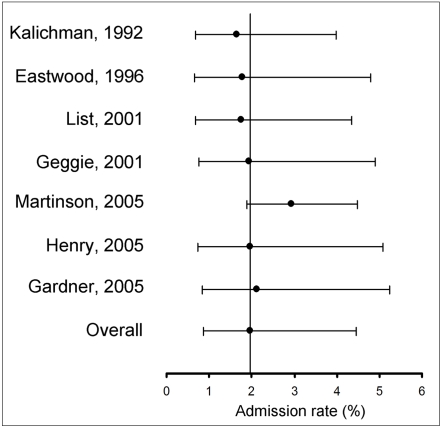
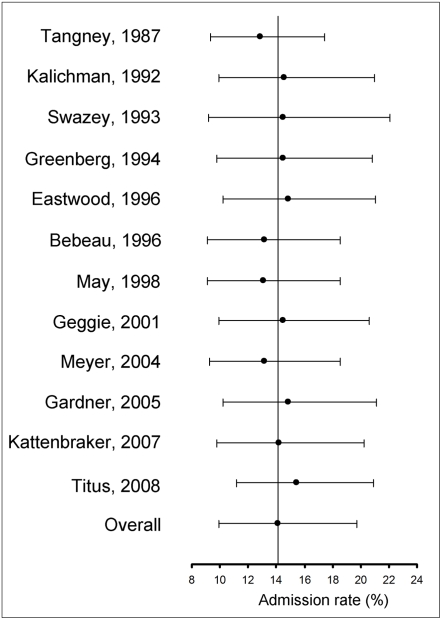
The frequency with which scientists fabricate and falsify data, or commit other forms of scientific misconduct is a matter of controversy. Many surveys have asked scientists directly whether they have committed or know of a colleague who committed research misconduct, but their results appeared difficult to compare and synthesize. This is the first meta-analysis of these surveys. To standardize outcomes, the number of respondents who recalled at least one incident of misconduct was calculated for each question, and the analysis was limited to behaviours that distort scientific knowledge: fabrication, falsification, "cooking" of data, etc... Survey questions on plagiarism and other forms of professional misconduct were excluded. The final sample consisted of 21 surveys that were included in the systematic review, and 18 in the meta-analysis. A pooled weighted average of 1.97% (N = 7, 95%CI: 0.86-4.45) of scientists admitted to have fabricated, falsified or modified data or results at least once--a serious form of misconduct by any standard--and up to 33.7% admitted other questionable research practices. In surveys asking about the behaviour of colleagues, admission rates were 14.12% (N = 12, 95% CI: 9.91-19.72) for falsification, and up to 72% for other questionable research practices. Meta-regression showed that self reports surveys, surveys using the words "falsification" or "fabrication", and mailed surveys yielded lower percentages of misconduct. When these factors were controlled for, misconduct was reported more frequently by medical/pharmacological researchers than others. Considering that these surveys ask sensitive questions and have other limitations, it appears likely that this is a conservative estimate of the true prevalence of scientific misconduct.
Overview
CoChat Summary
TL;DR
This systematic review and meta-analysis of survey data estimated that about 2% of scientists admitted to fabricating, falsifying, or modifying data or results at least once, while 14.12% reported knowing a colleague who did so. The paper argues these are conservative estimates and that methodological choices strongly shape the observed rates.
Key findings
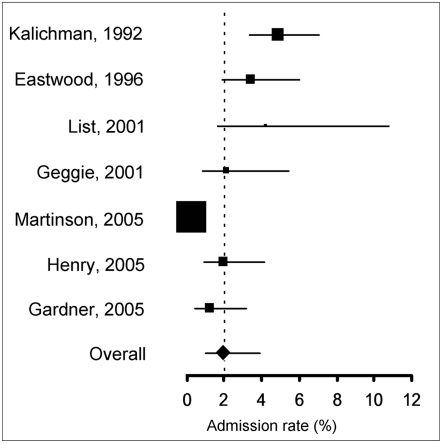
- Across surveys explicitly asking whether scientists ever fabricated or falsified data or altered/modifed results, the pooled weighted estimate was 1.97% (95% CI 0.86–4.45; N = 7), with significant heterogeneity (Cochran’s Q = 61.7777, df = 6, P < 0.0001).
- When only questions explicitly using the words “fabrication” or “falsification” were included, the pooled estimate for self-reports was 1.06% (95% CI 0.31–3.51; N = 4).
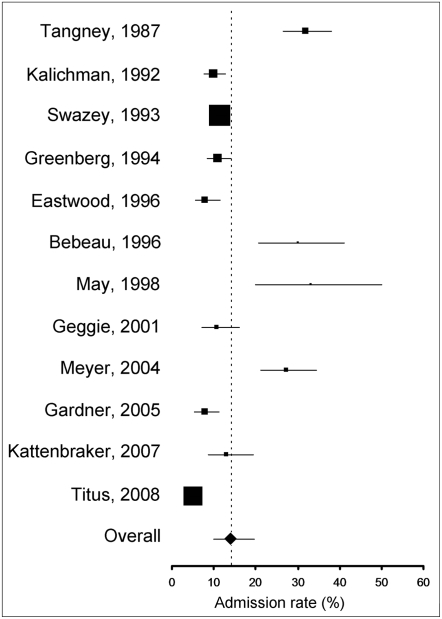
- For reports about colleagues’ misconduct, the pooled weighted estimate was 14.12% (95% CI 9.91–19.72; N = 12); restricting to questions using “fabrication” or “falsification” gave 12.34% (95% CI 8.43–17.71; N = 11).
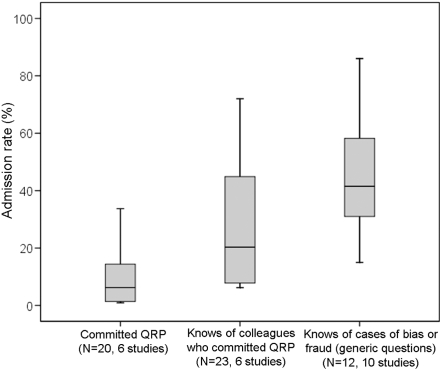
- Other questionable research practices were reported more often: up to 33.7% in self-reports and up to 72% when asking about colleagues.
Methods
- Systematic review and meta-analysis of quantitative surveys asking scientists whether they had committed or observed scientific misconduct in the past; plagiarism and other non-knowledge-distorting misconduct were excluded.
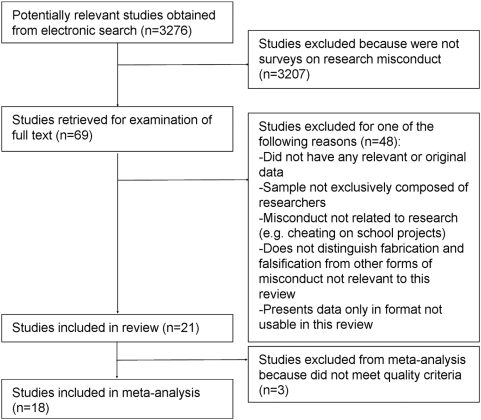
- Searches were run in the first two weeks of August 2008 across citation databases, journals, grey literature sources, and internet search engines; the final review included 21 studies, with 18 in the meta-analysis.
- Main analysis computed the proportion recalling at least one incident, logit-transformed and inverse-variance weighted in a random-effects meta-analysis; meta-regression tested methodological factors such as self vs. non-self reports, mailed vs. handed-out surveys, and use of the words “fabrication”/“falsification.”
Limitations
- The paper states that using the percentage of respondents recalling at least one incident is a rough measure of misconduct frequency; this can under- or overestimate prevalence depending on whether respondents committed multiple incidents or only one.
- The paper notes that non-response bias was recognized by most surveys as a limitation, and that the validity of self-reports may be affected by social expectations; the text also suggests self-reports likely underestimate misconduct.
- Evident from the text: the included studies were heterogeneous in methods and wording, and some outcomes were too diverse for meaningful meta-analysis, so only crude unweighted parameters were calculated for broader questionable research practices.
Model-written summary. Check it against the paper before relying on it.
Integrity signals
Registry
Cites
Statistics
Figures
Verification
Claims the paper makes
0 Valid · 0 Not valid · 14 Not checked · 61 Own results and interpretations
A result the paper reports from its own data — it cites no other source for it, so there is none to check. The quote shows it is in the paper.
In the paper
“When these factors were controlled for, misconduct was reported more frequently by medical/pharmacological researchers than others.”
§ How Many Scientists Fabricate and Falsify Research? A Systematic Review and Meta-Analysis of Survey Data > Abstract
plainstates an association- Asserted: passes — The authors put it forward as true.
- Checkable: passes — It can be checked against evidence.
- Load-bearing: passes — The paper’s conclusions depend on it.
- Based: passes — The paper gives a reason why it holds.
- Rests on 2 assumptions not shown here.
A result the paper reports from its own data — it cites no other source for it, so there is none to check. The quote shows it is in the paper.
In the paper
“A pooled weighted average of 1.97% (N = 7, 95%CI: 0.86–4.45) of scientists admitted to have fabricated, falsified or modified data or results at least once –a serious form of misconduct by any standard– and up to 33.7% admitted other questionable research practices.”
§ How Many Scientists Fabricate and Falsify Research? A Systematic Review and Meta-Analysis of Survey Data > Abstract
plainn = 7- Asserted: passes — The authors put it forward as true.
- Checkable: passes — It can be checked against evidence.
- Load-bearing: passes — The paper’s conclusions depend on it.
- Based: passes — The paper gives a reason why it holds.
- Rests on 2 assumptions not shown here.
A result the paper reports from its own data — it cites no other source for it, so there is none to check. The quote shows it is in the paper.
In the paper
“A pooled weighted average of 1.97% (N = 7, 95%CI: 0.86–4.45) of scientists admitted to have fabricated, falsified or modified data or results at least once –a serious form of misconduct by any standard– and up to 33.7% admitted other questionable research practices.”
§ How Many Scientists Fabricate and Falsify Research? A Systematic Review and Meta-Analysis of Survey Data > Abstract
plain- Asserted: passes — The authors put it forward as true.
- Checkable: passes — It can be checked against evidence.
- Load-bearing: passes — The paper’s conclusions depend on it.
- Based: passes — The paper gives a reason why it holds.
- Rests on 2 assumptions not shown here.
A result the paper reports from its own data — it cites no other source for it, so there is none to check. The quote shows it is in the paper.
In the paper
“In surveys asking about the behaviour of colleagues, admission rates were 14.12% (N = 12, 95% CI: 9.91–19.72) for falsification, and up to 72% for other questionable research practices.”
§ How Many Scientists Fabricate and Falsify Research? A Systematic Review and Meta-Analysis of Survey Data > Abstract
plainn = 12- Asserted: passes — The authors put it forward as true.
- Checkable: passes — It can be checked against evidence.
- Load-bearing: passes — The paper’s conclusions depend on it.
- Based: passes — The paper gives a reason why it holds.
- Rests on 2 assumptions not shown here.
A result the paper reports from its own data — it cites no other source for it, so there is none to check. The quote shows it is in the paper.
In the paper
“Meta-analysis yielded mean pooled estimates that are higher than most previous estimates.”
§ How Many Scientists Fabricate and Falsify Research? A Systematic Review and Meta-Analysis of Survey Data > Introduction
plain- Asserted: passes — The authors put it forward as true.
- Checkable: passes — It can be checked against evidence.
- Load-bearing: passes — The paper’s conclusions depend on it.
- Based: passes — The paper gives a reason why it holds.
- Rests on 2 assumptions not shown here.
31 more claims
Create a free account to see all 75 claims and to verify the 4 references still open.
- It may state two separate claims as one. 24
- Probably not a substantial claim. 25
Claims other papers make about this one
Each is checked against this paper’s own text: does it say what the citing paper says it does?
The cited source says what the claim attributes to it.
In the citing paper
“there are other more common sources of unreliability in the literature (41)(42)(43)(44)”
From Misconduct accounts for the majority of retracted scientific publications (2012) · cites this paper as [43]
The cited source says what the claim attributes to it.
In the citing paper
“The prevalence of researchers who have been involved in scientific misconduct is estimated to be around 2% [2]”
From Checklist to assess Trustworthiness in RAndomised Controlled Trials (TRACT checklist): concept proposal and pilot (2023) · cites this paper as [2]
The cited source says what the claim attributes to it.
In the citing paper
“This is how a small number of people 40 with flexible morals can pollute the scientific literature disproportionately.”
From Fraudulent studies are undermining the reliability of systematic reviews: on the prevalence of problematic images in preclinical depression studies (2025) · cites this paper as [40]
The cited source says what the claim attributes to it.
In the citing paper
“A meta-analysis by Fanelli, combining the results of 18 published surveys, found that 1.9% of researchers have admitted to modification, falsification, or fabrication of data (3).”
From The Prevalence of Inappropriate Image Duplication in Biomedical Research Publications (2016) · cites this paper as [3]
The cited source says what the claim attributes to it.
In the citing paper
“A systematic review and meta-analysis of survey data estimated that 1.97% of authors admitted to have fabricated, falsified, or modified data or results at least once and, in surveys asking about the behavior of colleagues, the admission rate was 14.12% for falsification [13].”
From No raw data, no science: another possible source of the reproducibility crisis (2020) · cites this paper as [13]
6 more claims about this paper
Create a free account to see every claim other papers make about this one.
Citations
Cites
(2000) · Cited by 9,198
The Sociology of Science: Theoretical and Empirical Investigations
Kaplan, N., Merton, R. K., & Storer, N. W. (1974) · Technology and Culture · doi:10.2307/3102264 · Cited by 4,005
The Normative Structure of Science
Merton, R. Κ. (1973) · Medical Entomology and Zoology · Cited by 2,315
The Hazards of Scoring the Quality of Clinical Trials for Meta-analysis
Jüni, P. (1999) · JAMA · doi:10.1001/jama.282.11.1054 · Cited by 1,981 · cited 1×
“All remaining papers were included, and were not graded on a quality scale, because the validity and use of quality measures in meta-analysis is controversial [21], [22].”
BackgroundScope and Impact of Financial Conflicts of Interest in Biomedical Research: A Systematic Review
Bekelman, J. E., Li, Y., & Gross, C. P. (2003) · JAMA · doi:10.1001/jama.289.4.454 · Cited by 1,816 · cited 1×
“This would support growing fears that the large financial interests that often drive medical research are severely biasing it [50], [51], [52].”
BackgroundTourangeau, R., & Smith, T. W. (1996) · Public Opinion Quarterly · doi:10.1086/297751 · Cited by 1,295 · cited 1×
“However, the accuracy of responses to sensitive questions is often independent of response rates, and depends strongly on respondents' perception of anonymity and confidentiality [43], [44].”
BackgroundA comparison of methods to detect publication bias in meta‐analysis
Macaskill, P., Walter, S. D., & Irwig, L. (2001) · Statistics in Medicine · doi:10.1002/sim.698 · Cited by 1,286 · cited 1×
“The popular funnel-plot-based methods to test for publication bias in meta-analysis are inappropriate and potentially misleading when the number of included studies is small and heterogeneity is large [25], [26].”
MethodMartinson, B. C., Anderson, M. S., & de Vries, R. (2005) · Nature · doi:10.1038/435737a · Cited by 1,096 · cited 9×
“All the above results were robust with respect to inclusion or exclusion of any particular study, with perhaps one exception: Martinson et al. (2005) [19], which is one of the largest and most frequently cited surveys on misconduct published to date.”
BackgroundMethodResultInfluentialAdjusting for publication bias in the presence of heterogeneity
Terrin, N., Schmid, C. H., Lau, J., & Olkin, I. (2003) · Statistics in Medicine · doi:10.1002/sim.1461 · Cited by 809 · cited 1×
“The popular funnel-plot-based methods to test for publication bias in meta-analysis are inappropriate and potentially misleading when the number of included studies is small and heterogeneity is large [25], [26].”
MethodIs Academic Medicine for Sale?
Angell, M. (2000) · New England Journal of Medicine · doi:10.1056/nejm200005183422009 · Cited by 582
Research works printed but not linked: 2
- Eastwood S Derish P Leash E Ordway S 1996 Ethical issues in biomedical research: perceptions and practices of postdoctoral research fellows responding to a survey. Science and Engineering Ethics 2 89 114 11657788 · DOI
- Kattenbraker MS 2007 Health education research and publication: ethical considerations and the response of health educators Carbondale Southern Illinois University.Doctoral dissertation
Cited by
Items 1,301–1,400 of 1,924
O desafio da qualidade e integridade das publicações científicas
Sarti, T. D. (2017) · Revista Brasileira de Medicina de Família e Comunidade · doi:10.5712/rbmfc12(39)1434 · Cited by 2
Text Mining Basics in Bioinformatics
Maio, C. D., Fenza, G., Loia, V., et al. (2017) · Elsevier eBooks · doi:10.1016/b978-0-12-809633-8.20475-5 · Cited by 2
Swaen, G. M. H., Bouter, L. M., Atsma, W. J., et al. (2017) · University of Twente Research Information · Cited by 2
Public Statements of Good Conduct Promote Pro-Social BehaviorPreprint
Koessler, A., Page, L., & Dulleck, U. (2018) · SSRN Electronic Journal · doi:10.2139/ssrn.3184836 · Cited by 2
Wortner, P., Schubotz, M., Breitinger, C., Leible, S., & Gipp, B. (2019) · arXiv (Cornell University) · doi:10.48550/arxiv.1904.00237 · Cited by 2
“, attempting to manipulate steps 3 and 4 of the research cycle – in order to publish more successfully [5, 6].”
BackgroundManzanas podridas: Malas prácticas de investigación y ciencia descuidadaPreprint
Abril-Ruiz, A. (2019) · PsyArXiv (OSF Preprints) · doi:10.31234/osf.io/z82mh · Cited by 4
Zeevi, Y., Astashenko, S., Mudrik, L., & Benjamini, Y. (2020) · arXiv (Cornell University) · doi:10.48550/arxiv.2006.11585 · Cited by 4
Standardised Data on Initiatives – STARDIT: Beta VersionPreprint
Nunn, J., & Shafee, T. M. A. (2021) · OSF Preprints (OSF Preprints) · doi:10.31219/osf.io/w5xj6 · Cited by 2
Klein, M. (2022) · médecine/sciences · doi:10.1051/medsci/2022045 · Cited by 2
Parker, L., Boughton, S. L., Lawrence, R., & Bero, L. A. (2022) · SSRN Electronic Journal · doi:10.2139/ssrn.4071671 · Cited by 2
Resnik, D. B. (2016) · Springer eBooks · doi:10.1007/978-3-319-09483-0_392 · Cited by 3
Is biomedical research self-correcting? Modeling insights on the persistence of spurious sciencePreprint
Grimes, D. R. (2023) · bioRxiv (Cold Spring Harbor Laboratory) · doi:10.1101/2023.07.17.549436 · Cited by 2
Referencing and Citation Styles
Madler, A. M., & Renwick, S. (2024) · Elsevier eBooks · doi:10.1016/b978-0-323-95689-5.00213-3 · Cited by 2
Maoui, A. (2024) · Pan African Medical Journal · doi:10.11604/pamj.2024.48.182.44793 · Cited by 2
Hypotheses presence and acceptance in seven soil science journals
Nardi, P., Matteo, G. D., & Hartemink, A. E. (2014) · Geoderma · doi:10.1016/j.geoderma.2014.12.005 · Cited by 1
“The directionality of submitting manuscripts according to their outcomes distorts scientific literature, might dissuade high risk project and encourage scientists to fabricate and falsify their data (Fanelli, 2009).”
BackgroundAttitude of Students Towards Academic Dishonesty in UMT
Khan, Z. U. (2019) · doi:10.7176/jep/10-1-07 · Cited by 1
Tessuto, G. (2020) · Lingue e linguaggi · doi:10.1285/i22390359v34p231 · Cited by 1
“…cases covering authorship criteria failure, falsification, fabrication, or other issues, recorded by ethicsrelated professional organisations over their websites and documented in meta-analytical surveys across the disciplines (DuBois et al. 2013; Fanelli 2009; Fanelli et al. 2019; Steneck 2006).”
BackgroundIvory, J. (2018) · Journal of Communication Technology · doi:10.51548/joctec-2018-002 · Cited by 1
The Short Path from Wishful Thinking to Scientific Fraud
Franzen, S. (2021) · Springer eBooks · doi:10.1007/978-3-030-68063-3_6 · Cited by 1
Conflicts of Interest and Scientific Objectivity
Shamoo, A. E., & Resnik, D. B. (2022) · Oxford University Press eBooks · doi:10.1093/oso/9780197547090.003.0008 · Cited by 3
Лебедев, Д. В. (2022) · Sociological Journal · doi:10.19181/socjour.2022.28.4.9313 · Cited by 1
Evidence-Based Research Integrity Policy
Redman, B. K. (2023) · Springer eBooks · doi:10.1007/978-3-031-27111-3_3 · Cited by 1
Cheating Engagedly Described and the Judgment-Action Gap Narrowed Widely
Krettenauer, T. (2023) · Human Development · doi:10.1159/000535293 · Cited by 1
“…other trends, such as the increasing use of paper mills for acquiring academic credentials (Candal-Pedreira et al., 2022; Else & Van Noorden, 2021) and the repeated reporting of data fal-si fi cations and fabrications (see Fanelli, 2009), these tendencies suggest that universities are in trouble.”
BackgroundPlagiat jako forma braku poszanowania praw autorskich pracowników nauki. Perspektywa wiktymologiczna
Moczuk, E., Kamuda, D., & Leśniak-Moczuk, A. D. (2023) · Forum Polityki Kryminalnej · doi:10.31261/fpk.2023.06.04 · Cited by 1
Karakitsos, P., & Mylonas, K. S. (2024) · International Journal of Cardiology · doi:10.1016/j.ijcard.2024.131987 · Cited by 3
Advancing data honesty in experimental biology
Dubiner, S., & Arbel, M. (2024) · Journal of Experimental Biology · doi:10.1242/jeb.247383 · Cited by 2
Bailey, C. D. (2024) · Emerald Group Publishing Limited eBooks · doi:10.1108/s1574-076520240000026005 · Cited by 1
Tau, N., Akova, M., Barac, A., Nasim, A., Righi, E., & Yahav, D. (2024) · Clinical Microbiology and Infection · doi:10.1016/j.cmi.2024.07.015 · Cited by 1
The Journal of Hepatology: A new team at 40
Ratziu, V., & Tacke, F. (2025) · Journal of Hepatology · doi:10.1016/j.jhep.2025.01.001 · Cited by 1
Enumerating the K-Fold Configurations in Multi-Class Classification Problems
Fazekas, A., & Kovács, G. (2025) · International Conference on Data Science and Machine Learning Applications (CDMA) · doi:10.1109/cdma61895.2025.00008 · Cited by 3
“The main causes include flawed experimental setups [8], ’cosmetic adjustments’ [4], or typographical errors.”
Deepfake Insects? Deciding How to Respond to a New Threat to Taxonomy
Jong, G. D. D., & Fischer, B. (2025) · American Entomologist · doi:10.1093/ae/tmaf001 · Cited by 1
AlQershi, N. A., Alzoraiki, M., Ali, G. A., & Emam, A. S. (2025) · Journal of Academic Ethics · doi:10.1007/s10805-025-09666-4 · Cited by 1
“These individuals often lack the necessary expertise to conduct rigorous research, focusing instead on producing publications that serve internal interests rather than advancing knowledge (Fanelli, 2009).”
RetractedTsuge, T., Yamamoto, N., Tomita, Y., Hagiyama, A., Shiratsuchi, D., Okamura, M., Kaneko, T., Suzuki, K., Nakashima, Y., Taito, S., et al. (2025) · Cureus · doi:10.7759/cureus.95695 · Cited by 2
“To ensure that recommendations and decisions derived from SRs are less prone to bias, both complete reporting and robust methodology are essential [3,4].”
Decolonising the ivory tower: confronting systemic barriers and epistemic injustice in academia
Ball, C. (2026) · International Journal of Inclusive Education · doi:10.1080/13603116.2025.2612119 · Cited by 14
Questionable Research Practices: A Principled Classification and Ranking Based on Survey Data
Fanelli, D., Voodla, A., Andres, S., & Uusberg, A. (2026) · Science and Engineering Ethics · doi:10.1007/s11948-026-00589-w · Cited by 1
“The first limitation concerns the high heterogeneity of samples and survey methods, which is a known and important limitation of survey data on scientific integrity (Fanelli, 2009 ; Xie et al., 2021 ).”
InfluentialSelf-citationMostafavi, Z. S. (2026) · Higher Education Quarterly · doi:10.1111/hequ.70140 · Cited by 2
Micro-cheating practices and scholarly hypocrisy
Macfarlane, B. (2026) · Perspective of Higher Education · doi:10.1016/j.phe.2026.03.005 · Cited by 1
Institutionalizing Ethics, Encountering Misconduct: A Case From Kazakhstan
Ispambetova, B. (2026) · Higher Education Quarterly · doi:10.1111/hequ.70154 · Cited by 1
Nazarovets, S. (2026) · Research Integrity and Peer Review · doi:10.1186/s41073-026-00214-1 · Cited by 2
“Within these measurement frameworks, fabrication, falsification, plagiarism, and severe authorship violations appear most prominently as reference categories for defining misconduct (e.g., [9, 16, 29]).”
CASSAI, A. D., Dost, B., Asti, N., Bianco, A., Bisi, M., Curmaci, E., Giacon, T. A., Nardelli, M., & Tulgar, S. (2026) · Canadian Journal of Anesthesia/Journal canadien d anesthésie · doi:10.1007/s12630-026-03168-6 · Cited by 1
“” 10,14 Moreover, almost two thirds of SRs showed variations within the PICOS framework.”
Publication ethics: obligations of authors, peer-reviewers, and editors
Norman, G. A. V., & Jackson, S. (2010) · Cambridge University Press eBooks · doi:10.1017/cbo9780511841361.037 · Cited by 1
The social work environment of researchers committing scientific misconduct
Versteege, N. (2013) · Utrecht University Repository (Utrecht University) · Cited by 2
Images and imagination: the role of figures in plant cell and molecular biology publications
Stewart, C. N. (2014) · Plant Cell Reports · doi:10.1007/s00299-014-1579-6 · Cited by 1
“Fanelli’s (2009) meta-analysis of research misconduct surveys found that 1.”
BackgroundInfluentialA code of conduct for European scientists
AXELSEN, N. H., & Bosch, X. (2012) · Nature · doi:10.1038/489208d · Cited by 1
Responsible Conduct: The Ethics of It All in Life and Research
Lumpkin, A., & Stoll, S. K. (2013) · ValpoScholar (Valparaiso University) · Cited by 1
Plagiarism: It's not just for students
Dyrud, M. A. (2014) · IEEE International Symposium on Ethics in Engineering, Science, and Technology (ETHICS) · doi:10.1109/ethics.2014.6893386 · Cited by 1
Fraud in biomedical research — The role of journal Editors
Caterina, R. D., Griffioen, A. W., & Porreca, F. (2011) · Life Sciences · doi:10.1016/j.lfs.2011.09.016 · Cited by 1
Maintaining good research practice: Research integrity in the UK
Parry, J. (2014) · Maturitas · doi:10.1016/j.maturitas.2014.08.010 · Cited by 1
‘Scientists in the dock’: regulating science
Alghrani, A., & Chan, S. (2012) · Cambridge University Press eBooks · doi:10.1017/cbo9781139177382.012 · Cited by 1
Ethics in Publishing - Today's Epidemic
Ploth, D. W. (2014) · The American Journal of the Medical Sciences · doi:10.1097/maj.0000000000000353 · Cited by 1
Ryan, K. L., Blackbourne, L. H., Cancio, L. C., Dunn, W. J., Jordan, B. S., McClinton, A., Nelson, B. S., Rathbone, C. R., Ross, J. D., & Kragh, J. F. (2012) · The Journal of Trauma: Injury, Infection, and Critical Care · doi:10.1097/ta.0b013e3182605f9e · Cited by 3
“’’(9) Although the previous examples are well publicized, recent surveys of scientists suggest that the prevalence of fabrication, falsification, or plagiarism (FFP) is only 1% to 2%, based on self-reporting.(10,11) However, approximately 33% of scientists admitted to using questionable research practices (e.”
BackgroundInfluentialPrice of misconduct probes can surpass $500,000
Palmer, R. (2010) · Nature Medicine · doi:10.1038/nm0910-939b · Cited by 1
Barrett, P. T. (2016) · Personality and Individual Differences · doi:10.1016/j.paid.2016.04.038 · Cited by 1
“My opinion is that many researchers were carefully selecting the cases they used to form their final analysis samples; a questionable research practise now known to be more common than originally thought among many social science investigators (Fanelli, 2009; John, Loewenstein, & Prelec, 2012).”
BackgroundForschungsethik und Forschungspraxis
Eisend, M., & Kuß, A. (2016) · Springer eBooks · doi:10.1007/978-3-658-09705-9_10 · Cited by 1
Comment: Promoting Research Integrity in Political Science
Phillips, T. B. (2017) · PS Political Science & Politics · doi:10.1017/s1049096516002377 · Cited by 1
Cohort Studies, Meta-analyses, and Clinical Trials in Childhood Hypertension
Larkins, N., & Craig, J. C. (2016) · Springer eBooks · doi:10.1007/978-3-319-31420-4_54-1 · Cited by 1
Burdens Without Blessings: Peer Reviewers Get No Respect
Ferraris, V. A. (2017) · The Annals of Thoracic Surgery · doi:10.1016/j.athoracsur.2017.02.014 · Cited by 1
The State of Science and Unreliable Research
Hughes, L. D. (2014) · Cited by 1
Response to Leslie Rose and John Garrow: Clinical trials, clinical evidence, and selective citation
Milgrom, L. R. (2010) · Homeopathy · doi:10.1016/j.homp.2010.02.009 · Cited by 1
Citation Counts and More Citation Counts: Useful? Interesting? or Counterproductive?
Campbell, J. P. (2017) · Industrial and Organizational Psychology · doi:10.1017/iop.2017.65 · Cited by 1
Larivée, S. J. (2017) · Revue de psychoéducation · doi:10.7202/1042258ar · Cited by 2
“Ces résultats correspondent à ceux de Fanelli (2009) qui a synthétisé une vingtaine d’études conduites sur le sujet entre 1985 et 2005.”
BackgroundStewardship of Integrity in Scientific Communication
Albertine, K. H. (2018) · The Anatomical Record · doi:10.1002/ar.23858 · Cited by 2
“…et al., 2005; Titus et al., 2008; Baerlocher et al., 2010; John et al., 2012; McDowell et al., 2014; Montgomery et al., 2014) or retrospective inquiries of databases (Fanelli, 2009; Steen et al., 2013; Fanelli et al., 2015), both designs of which have limitations, as identified in these papers.”
BackgroundMaceiras, S. D. (2018) · Geopolítica(s) Revista de estudios sobre espacio y poder · doi:10.5209/geop.57886 · Cited by 1
Pathology and Epidemiology of Plagiarism (1)
Vazirinejad, R. (2018) · Journal of Occupational Health and Epidemiology · doi:10.29252/johe.7.1.1 · Cited by 1
Scientific honesty and publicly shared lab notebooks
van Steensel, B. (2018) · EMBO Reports · doi:10.15252/embr.201846866 · Cited by 3
“Anonymous self-reporting surveys indicated that about 0.5 – 4% of scientists admit having fabricated or altered data [3 – 6].”
InfluentialLing, M. H. (2018) · Advances in Biotechnology & Microbiology · doi:10.19080/aibm.2018.11.555824 · Cited by 1
“Since Fanelli D [13] analysed surveys published to 2008 inclusive, 10 published surveys from 2009 to 2018 are reviewed here:”
BackgroundResultInfluentialHanna, M. (2019) · Springer eBooks · doi:10.1007/978-3-030-02955-5_21 · Cited by 2
The Scientific Article and the Future of Physical and Rehabilitation Medicine
Frontera, W. R. (2018) · The Journal of the International Society of Physical and Rehabilitation Medicine · doi:10.4103/ijprm.ijprm_10_18 · Cited by 1
Etos nauki we współczesnej Polsce
Bieliński, J., & Tomczyńska, A. (2019) · Nauka i Szkolnictwo Wyższe · doi:10.14746//nisw.2019.1-2.7 · Cited by 6
Publishing as Pedagogy: Reflections on Innovating in the Ivory Tower
Halcomb-Smith, L., Crump, A., & Sarkar, M. (2020) · Advances in higher education and professional development book series · doi:10.4018/978-1-7998-2943-0.ch004 · Cited by 1
“Questionable” Behaviors and Practices in Academic Productivity in Postgraduate Studies in Mexico
Ferrer, A. E. E., Uribe, L. M. I., & Bautista, C. D. F. (2015) · Sociology Study · doi:10.17265/2159-5526/2015.01.002 · Cited by 3
Schüpfer, G., Hein, J., Casutt, M., et al. (2012) · Der Anaesthesist · Cited by 1
Rahut, S. K., Tanvir, R. A., Rahman, S., & Akhter, S. (2021) · Advances in data mining and database management book series · doi:10.4018/978-1-7998-5589-7.ch014 · Cited by 1
“However, still many peer-reviewing frauds are detected and removed from various journals for biased reviewing (Stoye, 2019) (Mahoney, 1977) including Sage publications removed 60 research papers for exploiting peer reviews (Fanelli, 2009).”
BackgroundThe Changing Face of Biological Research and the Growing Role of Biosecurity
Dunaway, N., & Berger, K. M. (2021) · Advanced sciences and technologies for security applications · doi:10.1007/978-3-030-69464-7_6 · Cited by 3
Data Fraud and Essence of Data Verifiability
Bali, P., Kutikuppala, L. V. S., Avti, P., & Medhi, B. (2021) · Springer eBooks · doi:10.1007/978-981-16-3074-3_9 · Cited by 4
Expanding Conflicts of Interest in Public Health Research
Subrahmanyam, V. R. (2021) · Voices in Bioethics · doi:10.52214/vib.v7i.8700 · Cited by 2
Othman, M. S., Ludin, A. F. M., Muralitharan, R. V., Yaacob, W. M. N. N. W. M., Liew, S. L., Zuha, A. A., Ra’oh, N. A., Ruzaini, N. R. A., & Norazmi, N. A. (2022) · Jurnal Intelek · doi:10.24191/ji.v17i1.15848 · Cited by 1
“Research misconduct is commonly reported in the scientific literature (Fanelli, 2009; Gardner et al., 2005; Smith, 2006) and is more frequently reported in pharmacological, clinical and medical research than in other fields.”
BackgroundPilz, L. R., Abel, U. R., & Pritsch, M. (2013) · Strahlentherapie · doi:10.1007/978-3-540-88305-0_15 · Cited by 2
Lieberman, E. S. (2020) · Cambridge University Press eBooks · doi:10.1017/9781108762519.003 · Cited by 3
Haug, C. J., Hofmann, B., Irgens-Jensen, H., Nagel, A., Nydal, R., Rognstad, O.-A., Solberg, B., & Kalleberg, R. (2016) · doi:10.17585/noasp.8.27 · Cited by 1
Is There an Alternative to Moderate Scientism?
Makuła, S. (2022) · Organon F · doi:10.31577/orgf.2022.29106 · Cited by 1
Drug targets slip-sliding away
(2011) · Nature Medicine · doi:10.1038/nm.2530 · Cited by 1
Resnik, D. B. (2018) · International library of ethics, law, and the new medicine/The international library of ethics, law, and the new medicine · doi:10.1007/978-3-319-68756-8_10 · Cited by 4
Caplan, A. L., & Redman, B. K. (2018) · Springer eBooks · doi:10.1007/978-3-319-51358-4_9 · Cited by 1
Shamoo, A. E., & Resnik, D. B. (2022) · Oxford University Press eBooks · doi:10.1093/oso/9780197547090.003.0006 · Cited by 1
Shamoo, A. E., & Resnik, D. B. (2022) · Oxford University Press eBooks · doi:10.1093/oso/9780197547090.003.0002 · Cited by 2
Ensconcing a biostatistics clinic in tertiary care research institute of India
Kamal, K., Sharma, M., Rahul, M., Kapoor, R., & Koushal, V. (2022) · Journal of Family Medicine and Primary Care · doi:10.4103/jfmpc.jfmpc_1653_21 · Cited by 1
HIRAYAMA, K., Kuranari, M., Wakuda, H., Otani, N., Imai, H., & Uemura, N. (2022) · Translational and Regulatory Sciences · doi:10.33611/trs.2022-003 · Cited by 1
Measurement Issues in Synthesizing Survey-Item Responses
Becker, B. J., & Gözütok, A. S. (2022) · Emerging topics in statistics and biostatistics · doi:10.1007/978-3-031-14525-4_6 · Cited by 1
Optimizing Blockchain Technology in Academic Medicine
Kelley, K. C., & Allsbrook, A. P. (2023) · Integrated science · doi:10.1007/978-3-031-14591-9_11 · Cited by 1
A Guide to Responsible Research
Marušić, A. (2023) · Collaborative bioethics · doi:10.1007/978-3-031-22412-6 · Cited by 4
How to Deal with Allegations of Misconduct
Marušić, A., & Roje, R. (2023) · Collaborative bioethics · doi:10.1007/978-3-031-22412-6_9 · Cited by 1
Abdullah, S., Khan, Z. W., Fatima, S., Ali, N., Tauqeer, A., & Razzaq, J. A. (2023) · International Journal of Health Sciences · doi:10.53730/ijhs.v7ns1.14178 · Cited by 1
Research Misconduct and Questionable Research Practices
Resnik, D. B. (2023) · Collaborative bioethics · doi:10.1007/978-3-031-29455-6_3 · Cited by 1
Testing under information manipulation
Martinez-Gorricho, S., & Oyarzún, C. (2023) · Economic Theory · doi:10.1007/s00199-023-01514-z · Cited by 2
The replication crisis in science and its overlap into kinantropology: an introduction
Baloun, L., & Mališ, J. (2023) · Tělesná kultura · doi:10.5507/tk.2023.002 · Cited by 1
Putting your trust in ICU clinical trials: the journal’s role
Hodgson, C. L., Póvoa, P. M. S. R., & Citerio, G. (2023) · Intensive Care Medicine · doi:10.1007/s00134-023-07235-0 · Cited by 1
Sitges‐Serra, A. (2023) · Euphyía - Revista de Filosofía · doi:10.33064/32euph4959 · Cited by 2
Eliciting Honest Information from Authors Using Sequential Review
Zhang, Y., Schoenebeck, G. R., & Su, W. (2024) · Proceedings of the AAAI Conference on Artificial Intelligence · doi:10.1609/aaai.v38i9.28860 · Cited by 4
Skarbek, O. (2024) · Krytyka Prawa · doi:10.7206/kp.2080-1084.666 · Cited by 1
Metadata
- Authors
- Fanelli, D.
- Affiliations
- University of Edinburgh (GB)
- Corresponding author
- Fanelli, Daniele
- ORCID
- Fanelli, Daniele
- Venue
- PLoS ONE
- Publisher
- Public Library of Science (PLoS)
- Published
- 2009-05-29
- Volume
- 4
- Issue
- 5
- Pages
- e5738
- ISSN
- 1932-6203 (ISSN-L)
- PMC
- PMC2685008
- OpenAlex
- W2152243616
- Cited by
- 1,911
- References
- 74
- Citations by year
- 2026: 77 · 2025: 110 · 2024: 128 · 2023: 136 · 2022: 157 · 2021: 145 · 2020: 163 · 2019: 166 · 2018: 125 · 2017: 125 · 2016: 119 · 2015: 106 · 2014: 82 · 2013: 93 · 2012: 84
- FWCI
- 19.42
- Type
- journal article
- Language
- en
- Open access
- gold
- doi.org
- Locations
- PLoS ONE (publishedVersion, cc-by)
- PubMed Central (publishedVersion, cc-by)
- PubMed (publishedVersion)
- Edinburgh Research Explorer (University of Edinburgh) (acceptedVersion, public-domain)
- RePEc: Research Papers in Economics (submittedVersion)
- DOAJ (DOAJ: Directory of Open Access Journals) (submittedVersion, cc-by-sa)
- Figshare (submittedVersion, cc-by)
- DigitalGeorgetown (Georgetown University Library) (submittedVersion)
- Funders
- European Commission (221441)
- Economic and Social Research Council (ES/F028180/1)
- Topics
- Social Sciences › Education › Academic integrity and plagiarism
- Physical Sciences › Mathematics › Statistics and Probability › Benford’s Law and Fraud Detection
- Social Sciences › Library and Information Sciences › Academic Publishing and Open Access
- Keywords
- research misconduct, scientific fraud, data fabrication, data falsification, questionable research practices, self-report questionnaire
- MeSH terms
- Data Collection, Regression Analysis, Research Personnel, Scientific Misconduct, Ethics, Research
About these checks
Registry, retraction, Cites and statistics results are computed, not judged, with one exception: a printed reference that no index lists is read once by a model before it counts as a citation error. Claims are extracted by a model and kept only when their quote appears verbatim in the text; each cited source is then checked, with a model’s help, for whether it says what the claim relies on. Those verdicts can be wrong — read the claim’s quote and the cited source before relying on one.
A language model drew the claims from the paper on 2026-10-10, under version 3 of the claim definition (model deepseek-v4.1-flash, prompt extract-v3).
A second model labelled each claim on 2026-10-10 (model jev-1.13-20260917, definition revision gold-guideline-v0.2).
Statistics and arithmetic are recomputed, not judged.
Confidence bands are shown only for fields calibrated on our annotated test set. None is calibrated yet, so no band is shown.
What counts as a claim ›How we measure confidence ›How we check this ›
Are you an author, or do you see a problem with this page? Request a review
Data sources
Bibliographic data: Semantic Scholar, OpenAlex, Crossref.
Contains information from the Semantic Scholar Academic Graph Datasets, made available under the ODC Attribution License (ODC-BY 1.0).
Semantic Scholar’s data is described in: Kinney, R., et al. (2023). The Semantic Scholar Open Data Platform. arXiv:2301.10140.
