

How Many Scientists Fabricate and Falsify Research? A Systematic Review and Meta-Analysis of Survey Data
Open accessThe DOI matches its Crossref record; 66 of the 74 references it cites were found in a registry or an index; none of the 21 sources its claims cite is checked for support yet.
Abstract
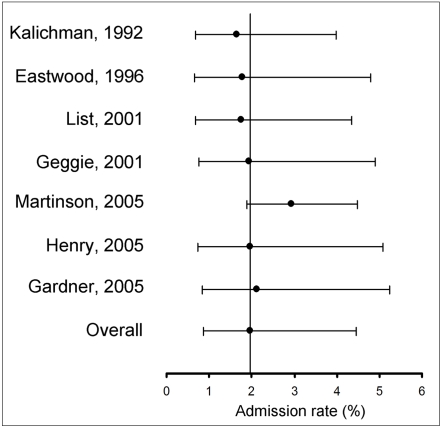
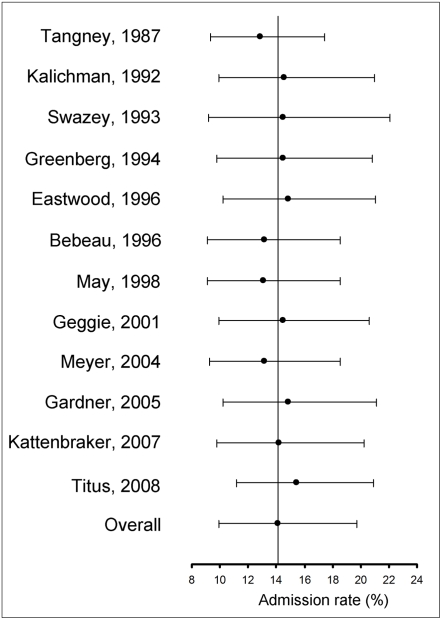
The frequency with which scientists fabricate and falsify data, or commit other forms of scientific misconduct is a matter of controversy. Many surveys have asked scientists directly whether they have committed or know of a colleague who committed research misconduct, but their results appeared difficult to compare and synthesize. This is the first meta-analysis of these surveys. To standardize outcomes, the number of respondents who recalled at least one incident of misconduct was calculated for each question, and the analysis was limited to behaviours that distort scientific knowledge: fabrication, falsification, "cooking" of data, etc... Survey questions on plagiarism and other forms of professional misconduct were excluded. The final sample consisted of 21 surveys that were included in the systematic review, and 18 in the meta-analysis. A pooled weighted average of 1.97% (N = 7, 95%CI: 0.86-4.45) of scientists admitted to have fabricated, falsified or modified data or results at least once--a serious form of misconduct by any standard--and up to 33.7% admitted other questionable research practices. In surveys asking about the behaviour of colleagues, admission rates were 14.12% (N = 12, 95% CI: 9.91-19.72) for falsification, and up to 72% for other questionable research practices. Meta-regression showed that self reports surveys, surveys using the words "falsification" or "fabrication", and mailed surveys yielded lower percentages of misconduct. When these factors were controlled for, misconduct was reported more frequently by medical/pharmacological researchers than others. Considering that these surveys ask sensitive questions and have other limitations, it appears likely that this is a conservative estimate of the true prevalence of scientific misconduct.
Overview
CoChat Summary
TL;DR
This systematic review and meta-analysis of survey data estimated that about 2% of scientists admitted to fabricating, falsifying, or modifying data or results at least once, while 14.12% reported knowing a colleague who did so. The paper argues these are conservative estimates and that methodological choices strongly shape the observed rates.
Key findings
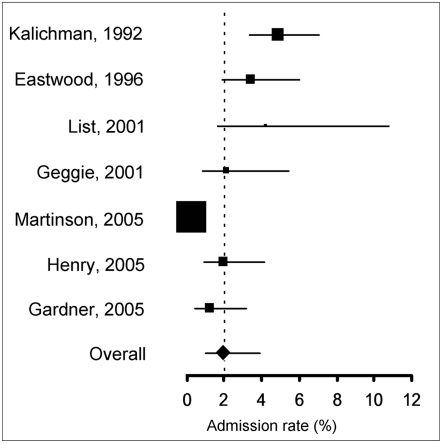
- Across surveys explicitly asking whether scientists ever fabricated or falsified data or altered/modifed results, the pooled weighted estimate was 1.97% (95% CI 0.86–4.45; N = 7), with significant heterogeneity (Cochran’s Q = 61.7777, df = 6, P < 0.0001).
- When only questions explicitly using the words “fabrication” or “falsification” were included, the pooled estimate for self-reports was 1.06% (95% CI 0.31–3.51; N = 4).
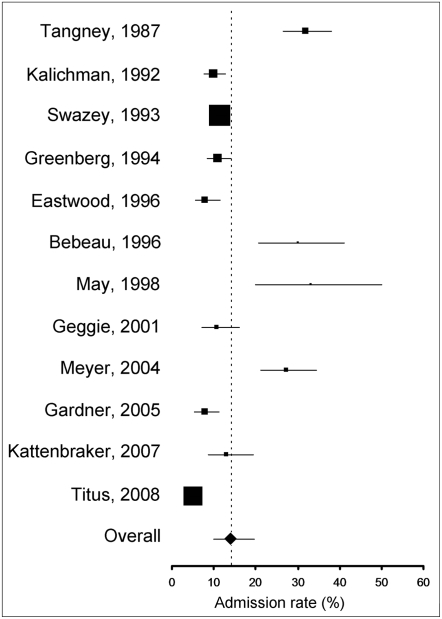
- For reports about colleagues’ misconduct, the pooled weighted estimate was 14.12% (95% CI 9.91–19.72; N = 12); restricting to questions using “fabrication” or “falsification” gave 12.34% (95% CI 8.43–17.71; N = 11).
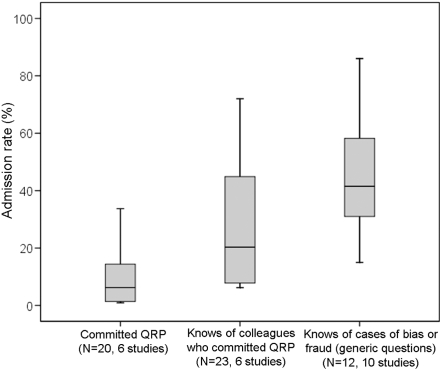
- Other questionable research practices were reported more often: up to 33.7% in self-reports and up to 72% when asking about colleagues.
Methods
- Systematic review and meta-analysis of quantitative surveys asking scientists whether they had committed or observed scientific misconduct in the past; plagiarism and other non-knowledge-distorting misconduct were excluded.
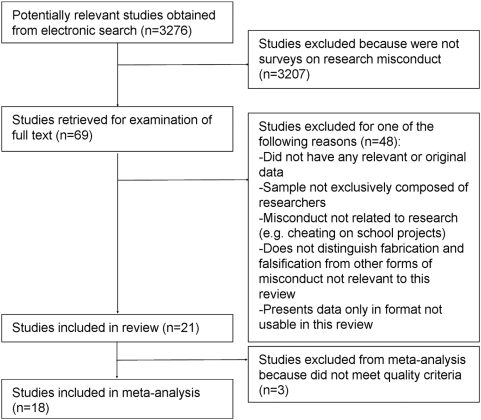
- Searches were run in the first two weeks of August 2008 across citation databases, journals, grey literature sources, and internet search engines; the final review included 21 studies, with 18 in the meta-analysis.
- Main analysis computed the proportion recalling at least one incident, logit-transformed and inverse-variance weighted in a random-effects meta-analysis; meta-regression tested methodological factors such as self vs. non-self reports, mailed vs. handed-out surveys, and use of the words “fabrication”/“falsification.”
Limitations
- The paper states that using the percentage of respondents recalling at least one incident is a rough measure of misconduct frequency; this can under- or overestimate prevalence depending on whether respondents committed multiple incidents or only one.
- The paper notes that non-response bias was recognized by most surveys as a limitation, and that the validity of self-reports may be affected by social expectations; the text also suggests self-reports likely underestimate misconduct.
- Evident from the text: the included studies were heterogeneous in methods and wording, and some outcomes were too diverse for meaningful meta-analysis, so only crude unweighted parameters were calculated for broader questionable research practices.
Model-written summary. Check it against the paper before relying on it.
Integrity signals
Registry
Cites
Statistics
Figures
Verification
Claims the paper makes
0 Valid · 0 Not valid · 14 Not checked · 61 Own results and interpretations
A result the paper reports from its own data — it cites no other source for it, so there is none to check. The quote shows it is in the paper.
In the paper
“When these factors were controlled for, misconduct was reported more frequently by medical/pharmacological researchers than others.”
§ How Many Scientists Fabricate and Falsify Research? A Systematic Review and Meta-Analysis of Survey Data > Abstract
plainstates an association- Asserted: passes — The authors put it forward as true.
- Checkable: passes — It can be checked against evidence.
- Load-bearing: passes — The paper’s conclusions depend on it.
- Based: passes — The paper gives a reason why it holds.
- Rests on 2 assumptions not shown here.
A result the paper reports from its own data — it cites no other source for it, so there is none to check. The quote shows it is in the paper.
In the paper
“A pooled weighted average of 1.97% (N = 7, 95%CI: 0.86–4.45) of scientists admitted to have fabricated, falsified or modified data or results at least once –a serious form of misconduct by any standard– and up to 33.7% admitted other questionable research practices.”
§ How Many Scientists Fabricate and Falsify Research? A Systematic Review and Meta-Analysis of Survey Data > Abstract
plainn = 7- Asserted: passes — The authors put it forward as true.
- Checkable: passes — It can be checked against evidence.
- Load-bearing: passes — The paper’s conclusions depend on it.
- Based: passes — The paper gives a reason why it holds.
- Rests on 2 assumptions not shown here.
A result the paper reports from its own data — it cites no other source for it, so there is none to check. The quote shows it is in the paper.
In the paper
“A pooled weighted average of 1.97% (N = 7, 95%CI: 0.86–4.45) of scientists admitted to have fabricated, falsified or modified data or results at least once –a serious form of misconduct by any standard– and up to 33.7% admitted other questionable research practices.”
§ How Many Scientists Fabricate and Falsify Research? A Systematic Review and Meta-Analysis of Survey Data > Abstract
plain- Asserted: passes — The authors put it forward as true.
- Checkable: passes — It can be checked against evidence.
- Load-bearing: passes — The paper’s conclusions depend on it.
- Based: passes — The paper gives a reason why it holds.
- Rests on 2 assumptions not shown here.
A result the paper reports from its own data — it cites no other source for it, so there is none to check. The quote shows it is in the paper.
In the paper
“In surveys asking about the behaviour of colleagues, admission rates were 14.12% (N = 12, 95% CI: 9.91–19.72) for falsification, and up to 72% for other questionable research practices.”
§ How Many Scientists Fabricate and Falsify Research? A Systematic Review and Meta-Analysis of Survey Data > Abstract
plainn = 12- Asserted: passes — The authors put it forward as true.
- Checkable: passes — It can be checked against evidence.
- Load-bearing: passes — The paper’s conclusions depend on it.
- Based: passes — The paper gives a reason why it holds.
- Rests on 2 assumptions not shown here.
A result the paper reports from its own data — it cites no other source for it, so there is none to check. The quote shows it is in the paper.
In the paper
“Meta-analysis yielded mean pooled estimates that are higher than most previous estimates.”
§ How Many Scientists Fabricate and Falsify Research? A Systematic Review and Meta-Analysis of Survey Data > Introduction
plain- Asserted: passes — The authors put it forward as true.
- Checkable: passes — It can be checked against evidence.
- Load-bearing: passes — The paper’s conclusions depend on it.
- Based: passes — The paper gives a reason why it holds.
- Rests on 2 assumptions not shown here.
31 more claims
Create a free account to see all 75 claims and to verify the 4 references still open.
- It may state two separate claims as one. 24
- Probably not a substantial claim. 25
Claims other papers make about this one
Each is checked against this paper’s own text: does it say what the citing paper says it does?
The cited source says what the claim attributes to it.
In the citing paper
“there are other more common sources of unreliability in the literature (41)(42)(43)(44)”
From Misconduct accounts for the majority of retracted scientific publications (2012) · cites this paper as [43]
The cited source says what the claim attributes to it.
In the citing paper
“The prevalence of researchers who have been involved in scientific misconduct is estimated to be around 2% [2]”
From Checklist to assess Trustworthiness in RAndomised Controlled Trials (TRACT checklist): concept proposal and pilot (2023) · cites this paper as [2]
The cited source says what the claim attributes to it.
In the citing paper
“This is how a small number of people 40 with flexible morals can pollute the scientific literature disproportionately.”
From Fraudulent studies are undermining the reliability of systematic reviews: on the prevalence of problematic images in preclinical depression studies (2025) · cites this paper as [40]
The cited source says what the claim attributes to it.
In the citing paper
“A meta-analysis by Fanelli, combining the results of 18 published surveys, found that 1.9% of researchers have admitted to modification, falsification, or fabrication of data (3).”
From The Prevalence of Inappropriate Image Duplication in Biomedical Research Publications (2016) · cites this paper as [3]
The cited source says what the claim attributes to it.
In the citing paper
“A systematic review and meta-analysis of survey data estimated that 1.97% of authors admitted to have fabricated, falsified, or modified data or results at least once and, in surveys asking about the behavior of colleagues, the admission rate was 14.12% for falsification [13].”
From No raw data, no science: another possible source of the reproducibility crisis (2020) · cites this paper as [13]
6 more claims about this paper
Create a free account to see every claim other papers make about this one.
Citations
Cites
(2000) · Cited by 9,198
The Sociology of Science: Theoretical and Empirical Investigations
Kaplan, N., Merton, R. K., & Storer, N. W. (1974) · Technology and Culture · doi:10.2307/3102264 · Cited by 4,005
The Normative Structure of Science
Merton, R. Κ. (1973) · Medical Entomology and Zoology · Cited by 2,315
The Hazards of Scoring the Quality of Clinical Trials for Meta-analysis
Jüni, P. (1999) · JAMA · doi:10.1001/jama.282.11.1054 · Cited by 1,981 · cited 1×
“All remaining papers were included, and were not graded on a quality scale, because the validity and use of quality measures in meta-analysis is controversial [21], [22].”
BackgroundScope and Impact of Financial Conflicts of Interest in Biomedical Research: A Systematic Review
Bekelman, J. E., Li, Y., & Gross, C. P. (2003) · JAMA · doi:10.1001/jama.289.4.454 · Cited by 1,816 · cited 1×
“This would support growing fears that the large financial interests that often drive medical research are severely biasing it [50], [51], [52].”
BackgroundTourangeau, R., & Smith, T. W. (1996) · Public Opinion Quarterly · doi:10.1086/297751 · Cited by 1,295 · cited 1×
“However, the accuracy of responses to sensitive questions is often independent of response rates, and depends strongly on respondents' perception of anonymity and confidentiality [43], [44].”
BackgroundA comparison of methods to detect publication bias in meta‐analysis
Macaskill, P., Walter, S. D., & Irwig, L. (2001) · Statistics in Medicine · doi:10.1002/sim.698 · Cited by 1,286 · cited 1×
“The popular funnel-plot-based methods to test for publication bias in meta-analysis are inappropriate and potentially misleading when the number of included studies is small and heterogeneity is large [25], [26].”
MethodMartinson, B. C., Anderson, M. S., & de Vries, R. (2005) · Nature · doi:10.1038/435737a · Cited by 1,096 · cited 9×
“All the above results were robust with respect to inclusion or exclusion of any particular study, with perhaps one exception: Martinson et al. (2005) [19], which is one of the largest and most frequently cited surveys on misconduct published to date.”
BackgroundMethodResultInfluentialAdjusting for publication bias in the presence of heterogeneity
Terrin, N., Schmid, C. H., Lau, J., & Olkin, I. (2003) · Statistics in Medicine · doi:10.1002/sim.1461 · Cited by 809 · cited 1×
“The popular funnel-plot-based methods to test for publication bias in meta-analysis are inappropriate and potentially misleading when the number of included studies is small and heterogeneity is large [25], [26].”
MethodIs Academic Medicine for Sale?
Angell, M. (2000) · New England Journal of Medicine · doi:10.1056/nejm200005183422009 · Cited by 582
Research works printed but not linked: 2
- Eastwood S Derish P Leash E Ordway S 1996 Ethical issues in biomedical research: perceptions and practices of postdoctoral research fellows responding to a survey. Science and Engineering Ethics 2 89 114 11657788 · DOI
- Kattenbraker MS 2007 Health education research and publication: ethical considerations and the response of health educators Carbondale Southern Illinois University.Doctoral dissertation
Cited by
Items 1,401–1,500 of 1,924
Fabrykowanie i fałszowanie badań naukowych – wyzwanie dla ustawodawcy czy nieistotny problem?
Skarbek, O. (2024) · Krytyka Prawa · doi:10.7206/kp.2080-1084.665 · Cited by 1
Proxy failure in academia: More than just another example
Watve, M. (2024) · Behavioral and Brain Sciences · doi:10.1017/s0140525x23002984 · Cited by 4
Lessons Learned From Data Falsification During an Academic Course Using A Root-Cause Analysis
Silvern, R., Shvartsur, R., Kagan, I., et al. (2024) · Nurse Educator · doi:10.1097/nne.0000000000001686 · Cited by 1
Breach of academic values and misconduct: the case of Sci-Hub
Rossello, G., & Martinelli, A. (2024) · Scientometrics · doi:10.1007/s11192-024-05046-8 · Cited by 4
“Academic misconduct related to research, such as data fabrication (Fanelli, 2009), citation manipulation (Fong & Wilhite, 2017), plagiarism (Karabag & Berggren, 2012), questionable research practices (Necker, 2014), and misbehaviour in authorship (Smith et al., 2020) is growing (Holtfreter et al.,…”
Geoghan, S., & Holtfreter, K. (2024) · Journal of Financial Crime · doi:10.1108/jfc-05-2024-0145 · Cited by 2
Edwards-Schachter, M. (2024) · NOvation - Critical Studies of Innovation · doi:10.5380/nocsi.v0i6.95876 · Cited by 1
“(Martinson et al. , 2005; Anderson et al. , 2007; Fanelli 2009; Begley, 2013; Marco-Cuenca et al. , 2021; Carvalho et al. , 2022).”
Addressing Errors in Scientific Publishing: The Role of Errata
Regmi, S. (2024) · Journal of Nepal Medical Association · doi:10.31729/jnma.8759 · Cited by 1
What Can We Learn from the Retraction of Medical Articles
Peterson, C., & NUGENT, K. M. (2024) · Medical Science Educator · doi:10.1007/s40670-024-02171-0 · Cited by 2
“Up to 72% of respondents reported colleagues engaging in questionable or dishonest practices [25].”
Witte, E. H., & Ponocny, I. (2024) · Frontiers in Psychology · doi:10.3389/fpsyg.2024.1377336 · Cited by 3
Beyond the Original: Exploring Replication Research in Higher Education
Soppe, K. F. B., & Huisman, J. (2024) · Emerald Group Publishing Limited eBooks · doi:10.1108/s2056-375220240000010007 · Cited by 2
Bhattacharyya, S., Mahapatra, B. B., Palakodeti, D., Ladher, R. K., Sane, S. P., & Ramanathan, A. (2025) · Ethics and integrity in educational contexts · doi:10.1007/978-3-031-95686-7_2 · Cited by 1
Ethical, Legal and Social Issues (ELSI)
Trent, R. J. (2012) · Elsevier eBooks · doi:10.1016/b978-0-12-381451-7.00010-4 · Cited by 1
Qualität und Integrität bei der Erstellung und Veröffentlichung wissenschaftlicher Ergebnisse
Lüscher, T. F. (2014) · Herz · doi:10.1007/s00059-014-4120-3 · Cited by 1
Monosyllable Speech Recognition through Facial Movement Analysis
Kang, D., Seo, J.-W., Choi, J., Choi, J.-B., & Tack, G. (2014) · The Transactions of The Korean Institute of Electrical Engineers · doi:10.5370/kiee.2014.63.6.813 · Cited by 1
Algunas reflexiones sobre ética y moral en el ambiente académico
Cañón-Montañéz, W., & Acelas, A. L. R. (2016) · Revista CUIDARTE · doi:10.15649/cuidarte.v7i1.309 · Cited by 3
Problematic trial detection in ClinicalTrials.gov
Hartgerink, C. H. J., & George, S. L. (2015) · Research Ideas and Outcomes · doi:10.3897/rio.1.e7462 · Cited by 1
Do We Need a Science of Science?
Maiväli, Ü. (2015) · Elsevier eBooks · doi:10.1016/b978-0-12-418689-7.00001-6 · Cited by 1
The Cost of Scientific Misconduct
Tarazi, C. (2015) · Pediatric Research · doi:10.1038/pr.2015.150 · Cited by 1
“Daniele Fanelli reported that about two percent of researchers owned up to having “fabricated, falsified or modified data or results at least once” (1).”
BackgroundHaug, C. J., Hofmann, B., Irgens-Jensen, H., Kalleberg, R., Nagel, A., Nydal, R., Rognstad, O.-A., & Solberg, B. (2016) · doi:10.17585/noasp.8.20 · Cited by 1
Introduction: An Oblique Perspective on Research Misconduct
Zwart, H. A. E. (2017) · Library of ethics and applied philosophy · doi:10.1007/978-3-319-65554-3_1 · Cited by 1
Vargas, C. P. M. (2018) · ACTA MEDICA PERUANA · doi:10.35663/amp.2018.352.569 · Cited by 1
“Fanelli, mediante una revisión sistemática, analizó a 21 encuestas realizadas a miles de investigadores acerca de MCC, casi el 2% de los entrevistados admitió haber fabricado o falsificado datos o resultados al menos una vez, el 33,7% admitió haber realizado otras prácticas de investigación cuestionables [13].”
BackgroundNewgreen, D. F., Landman, K. A., & Osborne, J. M. (2019) · Methods in molecular biology · doi:10.1007/978-1-4939-9412-0_2 · Cited by 2
Making a Difference - or Not: an Evaluation of the Effects of Failing to Evaluate
Krohn, M. D. (2019) · American Journal of Criminal Justice · doi:10.1007/s12103-019-09477-5 · Cited by 1
“Fanelli (2009) reports that surveys indicate that scientists frequently admit to have modified or altered research to improve the outcome.”
BackgroundInfluentialEvaluating rule breaking behavior in a Nigerian protected forest reserve area
Akinsorotan, O. A., Oguntuase, B. G., Olaniyi, O. E., & Nnamuka, S. S. (2019) · Journal of applied science and environmental management · doi:10.4314/jasem.v23i6.12 · Cited by 1
“Such data driven interventions are effective in achieving conservation goals (Fanelli, 2009).”
BackgroundBallantyne, N. (2019) · Oxford University Press eBooks · doi:10.1093/oso/9780190847289.003.0001 · Cited by 1
Ética y conductas inapropiadas en la práctica de la investigación
Martínez, J. H. D. R., & Valdés, D. C. D. R. (2019) · Medicina y Ética · doi:10.36105/mye.2020v31n1.02 · Cited by 14
“De este modo, todo el tiempo, los recursos y el trabajo invertidos en la investigación se verían comprometidos (16).”
BackgroundInfluentialInevitability, contingency, and the epistemic significance of time
Benda, L. (2020) · Time & Society · doi:10.1177/0961463x20951679 · Cited by 5
“…of academia effectively diminishes the possibilities for independent and authentic thinking, as the “time of reason” is being under attack from the external forces of politics and economy, resulting in proliferating cases of bad analyses of data, premature judgments, and fraud (cf. Fanelli, 2009).”
BackgroundThe Ambit of Ethics in the South African Academic Institutions
Shange, X. M. (2020) · Advances in educational technologies and instructional design book series · doi:10.4018/978-1-7998-1249-4.ch002 · Cited by 1
“A study in grey”: a critical reflection on scientific (mis)behaviors in quantitative inquiries
Derdowski, L. A. (2020) · Journal of Teaching in Travel & Tourism · doi:10.1080/15313220.2020.1822768 · Cited by 1
“Fanelli (2009) found that an average of 1.97% of scientists admitted to having fabricated, falsified or modified data or results at least once in their academic life, which constitutes a serious form of misconduct by any standards.”
BackgroundInfluentialConstrucción periodística de la mala praxis científica
Fernández, M. D. M., & Hernández, J. D. S. (2020) · Dialnet (Universidad de la Rioja) · Cited by 1
Holla, R., & Schuftan, C. (2020) · World Nutrition · doi:10.26596/wn.2020114100-110 · Cited by 1
“…this may influence the results and/or conclusions of the research (Bes-Rastrollo et al., 2013; Katzmarzyk et al., 2016; Siri-Tarino et al., 2010), as researchers can be pressured to change the design of the study, the methodology, the results, or which results are reported and how (Fanelli, 2009).”
BackgroundResultThe extent of scam in the scientific world — How intellectual can the scam appear?
Hussaindeen, J. R. (2021) · Journal of Optometry · doi:10.1016/j.optom.2020.09.001 · Cited by 1
Scientific Image Forgery, Journalism, and Public Communication of Science
López-Cantos, F. (2021) · International Journal of Sociotechnology and Knowledge Development · doi:10.4018/ijskd.2021070106 · Cited by 1
Gerring, J., Mahoney, J., & Elman, C. (2020) · Cambridge University Press eBooks · doi:10.1017/9781108762519.018 · Cited by 2
Gerring, J., Karcher, S., & Apfeld, B. (2020) · Cambridge University Press eBooks · doi:10.1017/9781108762519.015 · Cited by 3
Gerring, J. (2020) · Cambridge University Press eBooks · doi:10.1017/9781108762519.014 · Cited by 2
Gross, N., & Robertson, C. T. (2020) · Cambridge University Press eBooks · doi:10.1017/9781108762519.017 · Cited by 2
Díaz, Á. H. F., García, J. G., & Reyes, J. I. P. (2022) · Papel Político · doi:10.11144/javeriana.papo25.fcti
George, S. L., Buyse, M. E., & Piantadosi, S. (2020) · Springer eBooks · doi:10.1007/978-3-319-52677-5_163-1 · Cited by 1
Collaboration within Academia and with Industry
Shamoo, A. E., & Resnik, D. B. (2022) · Oxford University Press eBooks · doi:10.1093/oso/9780197547090.003.0004 · Cited by 4
The Decline of the Case Report: How Did We Get Here and What Lies Ahead?
Sorenson, T. J., Ferry, A. M., Davis, M. J., et al. (2022) · Plastic & Reconstructive Surgery · doi:10.1097/prs.0000000000009419 · Cited by 1
George, S. L., Buyse, M. E., & Piantadosi, S. (2022) · Springer eBooks · doi:10.1007/978-3-319-52636-2_163 · Cited by 1
КРИЗА РЕПЛІКАЦІЇ. СУЧАСНИЙ СТАН РОЗВИТКУ КРИМІНОЛОГІЧНИХ ДОСЛІДЖЕНЬ
KOROSTELOVA, L. A. (2022) · Вісник Луганського державного університету внутрішніх справ імені Е О Дідоренка · doi:10.33766/2524-0323.97.50-58 · Cited by 1
Cohort Studies, Meta-analyses, and Clinical Trials in Childhood Hypertension
Larkins, N., & Craig, J. C. (2023) · Springer eBooks · doi:10.1007/978-3-031-06231-5_54 · Cited by 1
Assessing last decimal digits in retracted research articles: accounting for missing zeroes
Schumm, W. R. (2023) · SCIREA Journal of Sociology · doi:10.54647/sociology841134 · Cited by 2
Understanding Contract Cheating and Essay Mills Through a Social Lens in the Era of Web 3.0
Khan, Z. R., Vel, P., Asylguzhina, E., & Mulani, V. (2023) · Springer eBooks · doi:10.1007/978-3-031-39989-3_116 · Cited by 1
Ennigkeit, F., Englert, C., Stehle, J., & Schweizer, G. (2023) · Zeitschrift für Sportpsychologie · doi:10.1026/1612-5010/a000404 · Cited by 1
Forging Success : Soviet Managers and False Accounting, 1943 to 1962Preprint
Harrison, M., & Harrison, M. (2009) · RePEc: Research Papers in Economics · doi:10.22004/ag.econ.271291 · Cited by 1
Vaganay, A. (2014) · London School of Economics and Political Science Theses Online (London School of Economics and Political Science) · Cited by 5
Ethical and Legal Aspects of Publishing: Avoiding Plagiarism and Other Issues
Pierson, C. (2012) · Wiley eBooks · doi:10.1002/9781118702727.ch12 · Cited by 1
Change Again: A New Look for Journal Articles
Brumback, R. A. (2010) · Journal of Child Neurology · doi:10.1177/0883073810365740 · Cited by 1
“Another critical portion of the current change in article appearance is the highlighting of new sections that are necessary to reduce the potential for the ethical lapses or dishonesty of physicians and scientists that has been increasingly identified in recent years.(3-14) There will now be specific sections at the e…”
BackgroundKoops, S. E. S. (2012) · International Urogynecology Journal · doi:10.1007/s00192-011-1660-4 · Cited by 1
“Estimations of this kind of fraud worldwide vary between 1 and 2% [1].”
BackgroundGardner, W. P., & Heck, K. M. (2009) · Research Ethics · doi:10.1177/174701610900500402 · Cited by 1
“When surveyed anonymously, about 2% of scientists will admit to having fabricated, falsified or modified data or results at least once [9].”
BackgroundResearch Publication: Ethical Aspects
Trocchio, F. D. (2015) · Elsevier eBooks · doi:10.1016/b978-0-08-097086-8.11009-8 · Cited by 1
Challenges for a Research Publication
Chandrashekhar, Y., & Narula, J. (2014) · Journal of the American College of Cardiology · doi:10.1016/j.jacc.2014.07.001 · Cited by 3
Good science, bad science: Questioning research practices in psychological research
Bakker, M. (2014) · UvA-DARE (University of Amsterdam) · Cited by 1
De-Biasing Strategic CommunicationPreprint
Gesche, T. (2017) · SSRN Electronic Journal · doi:10.2139/ssrn.2723374 · Cited by 1
“Third, outright cheating such as making up data or more subtle techniques such as selective sampling and data mining are methods with which these test statistics can be misrepresent or manipulated at the costs of ethical, reputational and legal concerns (Fanelli, 2009; Steen, 2011; Simonsohn, 2014).”
A mathematical theory of knowledge, science, bias and pseudosciencePreprint
Fanelli, D. (2016) · doi:10.7287/peerj.preprints.1968v1 · Cited by 1
Self-citationWatson, A. D. (2016) · uO Research (University of Ottawa) · doi:10.20381/ruor-5731 · Cited by 1
Scientific integrity and research in health in Brazil: a review of literature
Pádua, G. C. C., & Guilhem, D. (2018) · Figshare · doi:10.6084/m9.figshare.7514876 · Cited by 1
Genter, M. B., Brock, W. J., & Mattes, W. B. (2015) · Toxicological Sciences · doi:10.1093/toxsci/kfu284 · Cited by 1
Researcher Conduct Determines Data ReliabilityPreprint
Wass, M. N., Ray, L., & Michaelis, M. (2018) · Preprints.org · doi:10.20944/preprints201804.0068.v1 · Cited by 1
Honesty and Truth in Academic Research and Writing
Lüscher, T. F. (2019) · Wiley eBooks · doi:10.1002/9781118907283.ch17 · Cited by 1
Author response: Four erroneous beliefs thwarting more trustworthy research
Yarborough, M. A., Nadon, R., & Karlin, D. (2019) · eLife · doi:10.7554/elife.45261.003 · Cited by 1
Agrawal, R. (2021) · Indian Journal of Pathology and Microbiology · doi:10.4103/ijpm.ijpm_1375_20 · Cited by 1
Learning to identify image manipulations in scientific publicationsPreprint
Mazaheri, G., Avila, K. U., & Roy–Chowdhury, A. K. (2021) · arXiv (Cornell University) · doi:10.48550/arxiv.2102.01874 · Cited by 6
2. Petites et grandes fraudes scientifiques, le poids de la compétition
Fagot-Largeault, A. (2014) · Presses universitaires de Franche-Comté eBooks · doi:10.4000/books.pufc.23447 · Cited by 1
Publication Bias and Editorial Statement on Negative FindingsPreprint
Brodeur, A., & Pérez, C. B. (2017) · MetArXiv (OSF Preprints) · doi:10.31222/osf.io/xq9nt · Cited by 4
“Many papers also point out that there is a selection bias in favour of positive results by editors and referees (McCloskey, 1985; Ashenfelter and Greenstone, 2004; Stanley, 2008; Fanelli, 2009; Franco et al., 2014; Havránek, 2015; Havránek and Sokolova, 2016).”
ResultEthical and Legal Aspects of Publishing
Pierson, C. (2021) · Wiley eBooks · doi:10.1002/9781119583592.ch11 · Cited by 2
The Life Cycle of Invasive Alien Species Occurrence Data
Wallace, R. D., Bargeron, C. T., LaForest, J. H., & Carroll, R. L. (2021) · Wiley eBooks · doi:10.1002/9781119607045.ch49 · Cited by 1
Honorary Authorship in Health Sciences: A Protocol for a Systematic Review of Survey ResearchPreprint
Reynders, R. M., ter Riet, G., Girolamo, N. D., & Malički, M. (2021) · Research Square · doi:10.21203/rs.3.rs-511533/v1 · Cited by 1
Resnik, D. B. (2014) · Springer eBooks · doi:10.1007/978-3-319-05544-2_392-1 · Cited by 1
Minor, W., & Cooper, D. R. (2020) · Faculty Opinions – Post-Publication Peer Review of the Biomedical Literature · doi:10.3410/f.737405003.793574963 · Cited by 1
Issues with Ethics in Research – A Case Study of the IHU Mediterranee InfectionPreprint
Frank, F., Florens, N., Barrière, J., Billy, É., Saada, V., Samuel, A., & Besançon, L. (2023) · doi:10.31219/osf.io/rymtz · Cited by 1
Using AI to Detect AI-Generated Research PapersPreprint
Pletcher, S. N. (2023) · doi:10.31219/osf.io/7rbds · Cited by 2
Assessing Last Decimal Digits in Retracted Research Articles: Accounting for Missing ZeroesPreprint
Schumm, W. R. (2023) · Preprints.org · doi:10.20944/preprints202306.0603.v1 · Cited by 1
On the Dearth of Retractions in Social Work: A Preliminary Analysis of Ten Leading JournalsPreprint
Dunleavy, D. J. (2024) · doi:10.31222/osf.io/y9pvm · Cited by 1
Sørensen, M. P., Lambert, M., & Ravn, T. (2024) · Research Square · doi:10.21203/rs.3.rs-4467477/v1 · Cited by 2
Brooker, R., & Allum, N. (2024) · doi:10.31222/osf.io/ur2sd · Cited by 1
Making misconduct make sense: Justifications of scientific wrongdoing and their consequencesPreprint
Velicu, A., & Rauhut, H. (2025) · SocArXiv (OSF Preprints) · doi:10.31235/osf.io/ud5mg_v1 · Cited by 1
How big data has created a big crisis in science
Zhang, K. (2018) · The Conversation · doi:10.64628/aai.sdh3xfnsv · Cited by 2
Andersen, R. (2025) · Human Resource Management Journal · doi:10.1111/1748-8583.70019 · Cited by 3
Rational choice and moral intent in the responsible conduct of research
Gordon, A. M. (2012) · Iowa State University Digital Repository (Iowa State University) · doi:10.31274/etd-180810-1461 · Cited by 3
“9% of scientists have reportedly fabricated or falsified research data (Fanelli, 2009).”
BackgroundMethodResultInfluentialTutkimusvilpin ja muiden tutkimusrikkeiden määrittely kaipaa uudistamista
Räsänen, L. (2010) · Tieteessä tapahtuu
Incentivizing Transparency in Psychological Science: Enter ScienpostingPreprint
Gullo, M. J., & O’Gorman, J. G. (2013) · SSRN Electronic Journal · doi:10.2139/ssrn.2258209
“Fanelli’s (2009) meta-analysis of 21 surveys estimated that just under 2% of scientists report that they have fabricated, falsified, or modified data or”
BackgroundBorracci, R. A., Baldi, J., Doval, H. C., et al. (2011) · doi:10.7775/rac.79.2.536
La mitología del artículo científico
Valencia, A. (2013) · Institutional Repository University of Antioquia (University of Antioquia) · Cited by 1
Conflicts of interest in the reporting of biomedical research in mainstream newspapers in Canada
Buist, S. D. (2013) · DUT Open Scholar (Durban University of Technology) · doi:10.51415/10321/922
Ethics of Research: Scientific Misconduct
Blom, E. C., & Vries, R. G. D. (2010) · Wiley eBooks · doi:10.1002/9780470015902.a0003483
Grupos de investigación en ciencias biomédicas. Algunas recomendaciones
Cardona, R., Sánchez, J., & Sánchez, A. (2015) · Revista Alergia México · doi:10.29262/ram.v62i3.110
Fraud and Freud: is there an association in scientific misconduct?
van der Wall, E. E. (2012) · Netherlands Heart Journal · doi:10.1007/s12471-011-0235-9
Romero, L. (2012) · Revista Peruana de Biología · doi:10.15381/rpb.v19i2.848
What are these results telling me
Scicluna, E. A. (2012) · International journal of infection control · doi:10.3396/ijic.v8i4.10459
Quel avenir pour les journaux électroniques biomédicaux ?
Maisonneuve, H., & Schnitter, C. (2009) · La Presse Médicale · doi:10.1016/j.lpm.2009.07.002 · Cited by 1
“La revue systématique de PLoS ONE publiée en mai 2009 est une excellente étude dans un domaine où peu de données existent ; celui de la falsification des données scientifiques [29].”
BackgroundInvestigating the investigators: research malfeasance
Henry, B. (2012) · Clinical Investigation · doi:10.4155/cli.12.63
Research ethics – from ethos to regulations
Przyłuska-Fiszer, A. (2012) · Advances in Rehabilitation · doi:10.2478/rehab-2013-0046
Lim, J.-S., Cho, S.-B., Hwang, O., & Yang, S. H. (2014) · Journal of Animal Environmental Science · doi:10.11109/jaes.2014.20.2.77
Why Misconduct Trumps Patient–Therapist Confidentiality and Ways to Avoid the Disclosure Dilemma
Steneck, N. H. (2013) · The American Journal of Bioethics · doi:10.1080/15265161.2013.828539
“Anyone working on an academic campus should know that studies predict that about 1% of researchers engage in formally defined research misconduct and 10% or more engage in other forms of unprofessional behavior (Fanelli 2009; Steneck 2006).”
BackgroundA Not-So-Fundamental Limitation on Studying Complex Systems with Statistics: Comment on Rabin (2011)
Thomas, D. M. (2012) · Journal of Statistical Physics · doi:10.1007/s10955-012-0647-y
“A more recent survey of psychologists found that over 90 % “admitted to having engaged in at least one QRP” [5].”
Background
Metadata
- Authors
- Fanelli, D.
- Affiliations
- University of Edinburgh (GB)
- Corresponding author
- Fanelli, Daniele
- ORCID
- Fanelli, Daniele
- Venue
- PLoS ONE
- Publisher
- Public Library of Science (PLoS)
- Published
- 2009-05-29
- Volume
- 4
- Issue
- 5
- Pages
- e5738
- ISSN
- 1932-6203 (ISSN-L)
- PMC
- PMC2685008
- OpenAlex
- W2152243616
- Cited by
- 1,911
- References
- 74
- Citations by year
- 2026: 77 · 2025: 110 · 2024: 128 · 2023: 136 · 2022: 157 · 2021: 145 · 2020: 163 · 2019: 166 · 2018: 125 · 2017: 125 · 2016: 119 · 2015: 106 · 2014: 82 · 2013: 93 · 2012: 84
- FWCI
- 19.42
- Type
- journal article
- Language
- en
- Open access
- gold
- doi.org
- Locations
- PLoS ONE (publishedVersion, cc-by)
- PubMed Central (publishedVersion, cc-by)
- PubMed (publishedVersion)
- Edinburgh Research Explorer (University of Edinburgh) (acceptedVersion, public-domain)
- RePEc: Research Papers in Economics (submittedVersion)
- DOAJ (DOAJ: Directory of Open Access Journals) (submittedVersion, cc-by-sa)
- Figshare (submittedVersion, cc-by)
- DigitalGeorgetown (Georgetown University Library) (submittedVersion)
- Funders
- European Commission (221441)
- Economic and Social Research Council (ES/F028180/1)
- Topics
- Social Sciences › Education › Academic integrity and plagiarism
- Physical Sciences › Mathematics › Statistics and Probability › Benford’s Law and Fraud Detection
- Social Sciences › Library and Information Sciences › Academic Publishing and Open Access
- Keywords
- research misconduct, scientific fraud, data fabrication, data falsification, questionable research practices, self-report questionnaire
- MeSH terms
- Data Collection, Regression Analysis, Research Personnel, Scientific Misconduct, Ethics, Research
About these checks
Registry, retraction, Cites and statistics results are computed, not judged, with one exception: a printed reference that no index lists is read once by a model before it counts as a citation error. Claims are extracted by a model and kept only when their quote appears verbatim in the text; each cited source is then checked, with a model’s help, for whether it says what the claim relies on. Those verdicts can be wrong — read the claim’s quote and the cited source before relying on one.
A language model drew the claims from the paper on 2026-10-10, under version 3 of the claim definition (model deepseek-v4.1-flash, prompt extract-v3).
A second model labelled each claim on 2026-10-10 (model jev-1.13-20260917, definition revision gold-guideline-v0.2).
Statistics and arithmetic are recomputed, not judged.
Confidence bands are shown only for fields calibrated on our annotated test set. None is calibrated yet, so no band is shown.
What counts as a claim ›How we measure confidence ›How we check this ›
Are you an author, or do you see a problem with this page? Request a review
Data sources
Bibliographic data: Semantic Scholar, OpenAlex, Crossref.
Contains information from the Semantic Scholar Academic Graph Datasets, made available under the ODC Attribution License (ODC-BY 1.0).
Semantic Scholar’s data is described in: Kinney, R., et al. (2023). The Semantic Scholar Open Data Platform. arXiv:2301.10140.
