

How Many Scientists Fabricate and Falsify Research? A Systematic Review and Meta-Analysis of Survey Data
Open accessThe DOI matches its Crossref record; 66 of the 74 references it cites were found in a registry or an index; none of the 21 sources its claims cite is checked for support yet.
Abstract
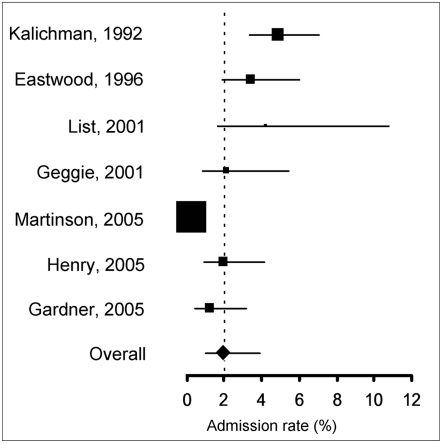
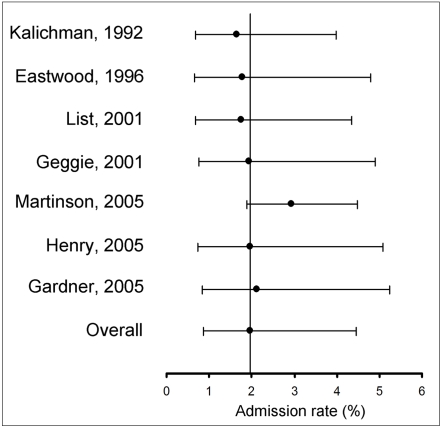
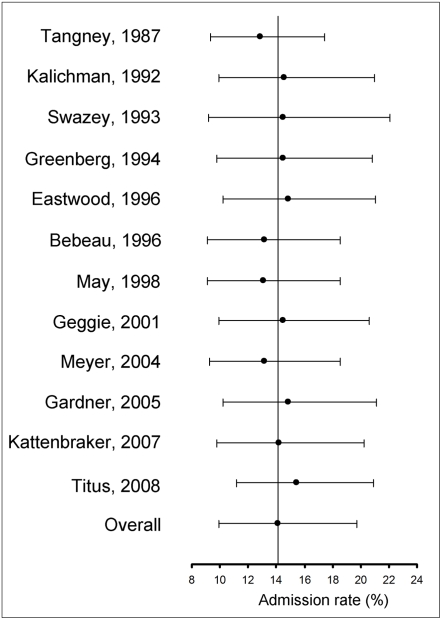
The frequency with which scientists fabricate and falsify data, or commit other forms of scientific misconduct is a matter of controversy. Many surveys have asked scientists directly whether they have committed or know of a colleague who committed research misconduct, but their results appeared difficult to compare and synthesize. This is the first meta-analysis of these surveys. To standardize outcomes, the number of respondents who recalled at least one incident of misconduct was calculated for each question, and the analysis was limited to behaviours that distort scientific knowledge: fabrication, falsification, "cooking" of data, etc... Survey questions on plagiarism and other forms of professional misconduct were excluded. The final sample consisted of 21 surveys that were included in the systematic review, and 18 in the meta-analysis. A pooled weighted average of 1.97% (N = 7, 95%CI: 0.86-4.45) of scientists admitted to have fabricated, falsified or modified data or results at least once--a serious form of misconduct by any standard--and up to 33.7% admitted other questionable research practices. In surveys asking about the behaviour of colleagues, admission rates were 14.12% (N = 12, 95% CI: 9.91-19.72) for falsification, and up to 72% for other questionable research practices. Meta-regression showed that self reports surveys, surveys using the words "falsification" or "fabrication", and mailed surveys yielded lower percentages of misconduct. When these factors were controlled for, misconduct was reported more frequently by medical/pharmacological researchers than others. Considering that these surveys ask sensitive questions and have other limitations, it appears likely that this is a conservative estimate of the true prevalence of scientific misconduct.
Overview
CoChat Summary
TL;DR
This systematic review and meta-analysis of survey data estimated that about 2% of scientists admitted to fabricating, falsifying, or modifying data or results at least once, while 14.12% reported knowing a colleague who did so. The paper argues these are conservative estimates and that methodological choices strongly shape the observed rates.
Key findings
- Across surveys explicitly asking whether scientists ever fabricated or falsified data or altered/modifed results, the pooled weighted estimate was 1.97% (95% CI 0.86–4.45; N = 7), with significant heterogeneity (Cochran’s Q = 61.7777, df = 6, P < 0.0001).
- When only questions explicitly using the words “fabrication” or “falsification” were included, the pooled estimate for self-reports was 1.06% (95% CI 0.31–3.51; N = 4).
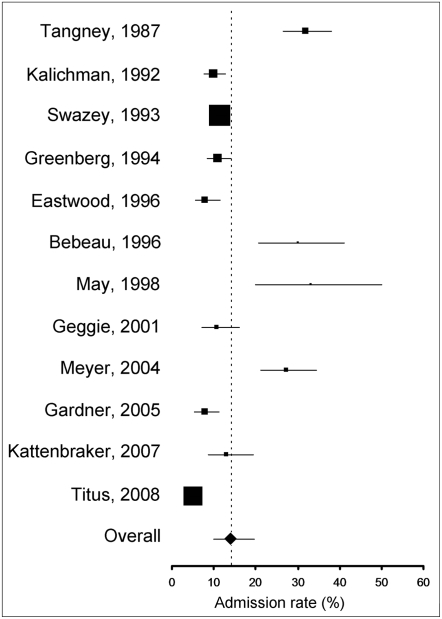
- For reports about colleagues’ misconduct, the pooled weighted estimate was 14.12% (95% CI 9.91–19.72; N = 12); restricting to questions using “fabrication” or “falsification” gave 12.34% (95% CI 8.43–17.71; N = 11).
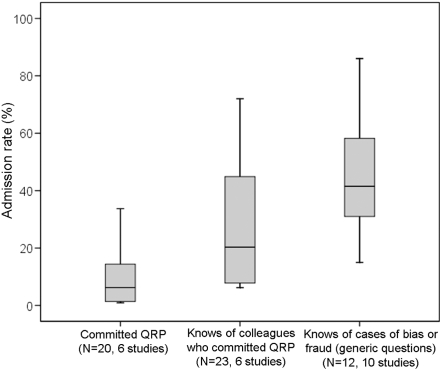
- Other questionable research practices were reported more often: up to 33.7% in self-reports and up to 72% when asking about colleagues.
Methods
- Systematic review and meta-analysis of quantitative surveys asking scientists whether they had committed or observed scientific misconduct in the past; plagiarism and other non-knowledge-distorting misconduct were excluded.
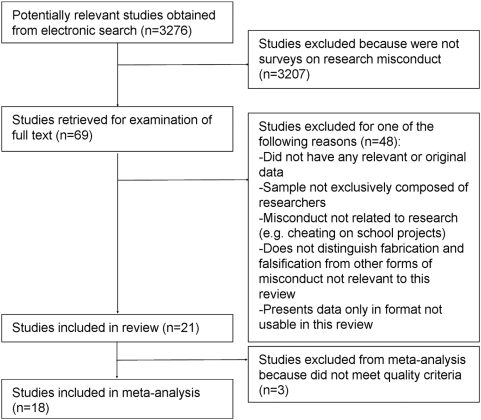
- Searches were run in the first two weeks of August 2008 across citation databases, journals, grey literature sources, and internet search engines; the final review included 21 studies, with 18 in the meta-analysis.
- Main analysis computed the proportion recalling at least one incident, logit-transformed and inverse-variance weighted in a random-effects meta-analysis; meta-regression tested methodological factors such as self vs. non-self reports, mailed vs. handed-out surveys, and use of the words “fabrication”/“falsification.”
Limitations
- The paper states that using the percentage of respondents recalling at least one incident is a rough measure of misconduct frequency; this can under- or overestimate prevalence depending on whether respondents committed multiple incidents or only one.
- The paper notes that non-response bias was recognized by most surveys as a limitation, and that the validity of self-reports may be affected by social expectations; the text also suggests self-reports likely underestimate misconduct.
- Evident from the text: the included studies were heterogeneous in methods and wording, and some outcomes were too diverse for meaningful meta-analysis, so only crude unweighted parameters were calculated for broader questionable research practices.
Model-written summary. Check it against the paper before relying on it.
Integrity signals
Registry
Cites
Statistics
Figures
Verification
Claims the paper makes
0 Valid · 0 Not valid · 14 Not checked · 61 Own results and interpretations
A result the paper reports from its own data — it cites no other source for it, so there is none to check. The quote shows it is in the paper.
In the paper
“When these factors were controlled for, misconduct was reported more frequently by medical/pharmacological researchers than others.”
§ How Many Scientists Fabricate and Falsify Research? A Systematic Review and Meta-Analysis of Survey Data > Abstract
plainstates an association- Asserted: passes — The authors put it forward as true.
- Checkable: passes — It can be checked against evidence.
- Load-bearing: passes — The paper’s conclusions depend on it.
- Based: passes — The paper gives a reason why it holds.
- Rests on 2 assumptions not shown here.
A result the paper reports from its own data — it cites no other source for it, so there is none to check. The quote shows it is in the paper.
In the paper
“A pooled weighted average of 1.97% (N = 7, 95%CI: 0.86–4.45) of scientists admitted to have fabricated, falsified or modified data or results at least once –a serious form of misconduct by any standard– and up to 33.7% admitted other questionable research practices.”
§ How Many Scientists Fabricate and Falsify Research? A Systematic Review and Meta-Analysis of Survey Data > Abstract
plainn = 7- Asserted: passes — The authors put it forward as true.
- Checkable: passes — It can be checked against evidence.
- Load-bearing: passes — The paper’s conclusions depend on it.
- Based: passes — The paper gives a reason why it holds.
- Rests on 2 assumptions not shown here.
A result the paper reports from its own data — it cites no other source for it, so there is none to check. The quote shows it is in the paper.
In the paper
“A pooled weighted average of 1.97% (N = 7, 95%CI: 0.86–4.45) of scientists admitted to have fabricated, falsified or modified data or results at least once –a serious form of misconduct by any standard– and up to 33.7% admitted other questionable research practices.”
§ How Many Scientists Fabricate and Falsify Research? A Systematic Review and Meta-Analysis of Survey Data > Abstract
plain- Asserted: passes — The authors put it forward as true.
- Checkable: passes — It can be checked against evidence.
- Load-bearing: passes — The paper’s conclusions depend on it.
- Based: passes — The paper gives a reason why it holds.
- Rests on 2 assumptions not shown here.
A result the paper reports from its own data — it cites no other source for it, so there is none to check. The quote shows it is in the paper.
In the paper
“In surveys asking about the behaviour of colleagues, admission rates were 14.12% (N = 12, 95% CI: 9.91–19.72) for falsification, and up to 72% for other questionable research practices.”
§ How Many Scientists Fabricate and Falsify Research? A Systematic Review and Meta-Analysis of Survey Data > Abstract
plainn = 12- Asserted: passes — The authors put it forward as true.
- Checkable: passes — It can be checked against evidence.
- Load-bearing: passes — The paper’s conclusions depend on it.
- Based: passes — The paper gives a reason why it holds.
- Rests on 2 assumptions not shown here.
A result the paper reports from its own data — it cites no other source for it, so there is none to check. The quote shows it is in the paper.
In the paper
“Meta-analysis yielded mean pooled estimates that are higher than most previous estimates.”
§ How Many Scientists Fabricate and Falsify Research? A Systematic Review and Meta-Analysis of Survey Data > Introduction
plain- Asserted: passes — The authors put it forward as true.
- Checkable: passes — It can be checked against evidence.
- Load-bearing: passes — The paper’s conclusions depend on it.
- Based: passes — The paper gives a reason why it holds.
- Rests on 2 assumptions not shown here.
31 more claims
Create a free account to see all 75 claims and to verify the 4 references still open.
- It may state two separate claims as one. 24
- Probably not a substantial claim. 25
Claims other papers make about this one
Each is checked against this paper’s own text: does it say what the citing paper says it does?
The cited source says what the claim attributes to it.
In the citing paper
“there are other more common sources of unreliability in the literature (41)(42)(43)(44)”
From Misconduct accounts for the majority of retracted scientific publications (2012) · cites this paper as [43]
The cited source says what the claim attributes to it.
In the citing paper
“The prevalence of researchers who have been involved in scientific misconduct is estimated to be around 2% [2]”
From Checklist to assess Trustworthiness in RAndomised Controlled Trials (TRACT checklist): concept proposal and pilot (2023) · cites this paper as [2]
The cited source says what the claim attributes to it.
In the citing paper
“This is how a small number of people 40 with flexible morals can pollute the scientific literature disproportionately.”
From Fraudulent studies are undermining the reliability of systematic reviews: on the prevalence of problematic images in preclinical depression studies (2025) · cites this paper as [40]
The cited source says what the claim attributes to it.
In the citing paper
“A meta-analysis by Fanelli, combining the results of 18 published surveys, found that 1.9% of researchers have admitted to modification, falsification, or fabrication of data (3).”
From The Prevalence of Inappropriate Image Duplication in Biomedical Research Publications (2016) · cites this paper as [3]
The cited source says what the claim attributes to it.
In the citing paper
“A systematic review and meta-analysis of survey data estimated that 1.97% of authors admitted to have fabricated, falsified, or modified data or results at least once and, in surveys asking about the behavior of colleagues, the admission rate was 14.12% for falsification [13].”
From No raw data, no science: another possible source of the reproducibility crisis (2020) · cites this paper as [13]
6 more claims about this paper
Create a free account to see every claim other papers make about this one.
Citations
Cites
(2000) · Cited by 9,198
The Sociology of Science: Theoretical and Empirical Investigations
Kaplan, N., Merton, R. K., & Storer, N. W. (1974) · Technology and Culture · doi:10.2307/3102264 · Cited by 4,005
The Normative Structure of Science
Merton, R. Κ. (1973) · Medical Entomology and Zoology · Cited by 2,315
The Hazards of Scoring the Quality of Clinical Trials for Meta-analysis
Jüni, P. (1999) · JAMA · doi:10.1001/jama.282.11.1054 · Cited by 1,981 · cited 1×
“All remaining papers were included, and were not graded on a quality scale, because the validity and use of quality measures in meta-analysis is controversial [21], [22].”
BackgroundScope and Impact of Financial Conflicts of Interest in Biomedical Research: A Systematic Review
Bekelman, J. E., Li, Y., & Gross, C. P. (2003) · JAMA · doi:10.1001/jama.289.4.454 · Cited by 1,816 · cited 1×
“This would support growing fears that the large financial interests that often drive medical research are severely biasing it [50], [51], [52].”
BackgroundTourangeau, R., & Smith, T. W. (1996) · Public Opinion Quarterly · doi:10.1086/297751 · Cited by 1,295 · cited 1×
“However, the accuracy of responses to sensitive questions is often independent of response rates, and depends strongly on respondents' perception of anonymity and confidentiality [43], [44].”
BackgroundA comparison of methods to detect publication bias in meta‐analysis
Macaskill, P., Walter, S. D., & Irwig, L. (2001) · Statistics in Medicine · doi:10.1002/sim.698 · Cited by 1,286 · cited 1×
“The popular funnel-plot-based methods to test for publication bias in meta-analysis are inappropriate and potentially misleading when the number of included studies is small and heterogeneity is large [25], [26].”
MethodMartinson, B. C., Anderson, M. S., & de Vries, R. (2005) · Nature · doi:10.1038/435737a · Cited by 1,096 · cited 9×
“All the above results were robust with respect to inclusion or exclusion of any particular study, with perhaps one exception: Martinson et al. (2005) [19], which is one of the largest and most frequently cited surveys on misconduct published to date.”
BackgroundMethodResultInfluentialAdjusting for publication bias in the presence of heterogeneity
Terrin, N., Schmid, C. H., Lau, J., & Olkin, I. (2003) · Statistics in Medicine · doi:10.1002/sim.1461 · Cited by 809 · cited 1×
“The popular funnel-plot-based methods to test for publication bias in meta-analysis are inappropriate and potentially misleading when the number of included studies is small and heterogeneity is large [25], [26].”
MethodIs Academic Medicine for Sale?
Angell, M. (2000) · New England Journal of Medicine · doi:10.1056/nejm200005183422009 · Cited by 582
Research works printed but not linked: 2
- Eastwood S Derish P Leash E Ordway S 1996 Ethical issues in biomedical research: perceptions and practices of postdoctoral research fellows responding to a survey. Science and Engineering Ethics 2 89 114 11657788 · DOI
- Kattenbraker MS 2007 Health education research and publication: ethical considerations and the response of health educators Carbondale Southern Illinois University.Doctoral dissertation
Cited by
Shamseer, L., Moher, D., Clarke, M., Ghersi, D., Liberati, A., Petticrew, M., Shekelle, P., Stewart, L. A., & the PRISMA-P Group (2015) · BMJ · doi:10.1136/bmj.g7647 · Cited by 13,120
Measuring the Prevalence of Questionable Research Practices With Incentives for Truth Telling
John, L. K., Loewenstein, G., & Prelec, D. (2012) · Psychological Science · doi:10.1177/0956797611430953 · Cited by 2,239
“For example, a meta-analysis of surveys—none of which provided incentives for truthful responding—found that, among scientists from a variety of disciplines, 9.5% of respondents admitted to having engaged in QRPs other than data falsification; the upper-boundary estimate was 33.7% (Fanelli, 2009).”
BackgroundResultInfluentialReducing waste from incomplete or unusable reports of biomedical research
Glasziou, P., Altman, D. G., Bossuyt, P., Boutron, I., Clarke, M., Julious, S., Michie, S., Moher, D., & Wager, E. (2014) · The Lancet · doi:10.1016/s0140-6736(13)62228-x · Cited by 1,319
Nosek (2012) · doi:10.1177/1745691612459058 · Cited by 1,301
“This is a strong incentive against it, and—regardless of incentives—most resist such behavior because it is easy to identify as wrong (Fanelli, 2009).”
Misconduct accounts for the majority of retracted scientific publications
Fang, F. C., Steen, R. G., & Casadevall, A. (2012) · Proceedings of the National Academy of Sciences · doi:10.1073/pnas.1212247109 · Cited by 1,232
Citations, Citation Indicators, and Research Quality: An Overview of Basic Concepts and Theories
Aksnes, D. W., Langfeldt, L., & Wouters, P. (2019) · Sage Open · doi:10.1177/2158244019829575 · Cited by 1,257
“The literature contains numerous publications of which the solidity is poor, the results unreliable or even involving misconduct or scientific fraud (Fanelli, 2009).”
BackgroundReproducibility in Science: Improving the Standard for Basic and Preclinical Research
Begley, C. G., & Ioannidis, J. P. A. (2015) · Circulation Research · doi:10.1161/circresaha.114.303819 · Cited by 1,035
“of questionable research practices seems to affect the majority of researchers.(51) Table 1.”
Do Pressures to Publish Increase Scientists' Bias? An Empirical Support from US States Data
Fanelli, D. (2010) · PLoS ONE · doi:10.1371/journal.pone.0010271 · Cited by 805
“fabrication and falsification are probably rare, but other questionable research practices might be relatively common [26].”
BackgroundSelf-citation“Positive” results increase down the Hierarchy of the Sciences
Fanelli, D. (2010) · PLoS ONE · doi:10.1371/journal.pone.0010068 · Cited by 734
“Survey data suggests that outright scientific misconduct is relatively rare compared to more subtle forms of bias, although it is probably higher than commonly assumed, particularly in medical/clinical research [69].”
BackgroundSelf-citationPerceptual consciousness overflows cognitive access
Block, N. (2011) · Trends in Cognitive Sciences · doi:10.1016/j.tics.2011.11.001 · Cited by 679
Edwards, M. A., & Roy, S. (2017) · Environmental Engineering Science · doi:10.1089/ees.2016.0223 · Cited by 688
“…too frequently suffer from lack of replicability, rely on biased data-sets, apply low or substandard statistical methods, fail to guard against researcher biases, and their findings are overhyped (Fanelli, 2009; Aschwanden, 2015; Belluz and Hoffman, 2015; Nuzzo, 2015; Gobry, 2016; Wilson, 2016).”
Why Science Is Not Necessarily Self-Correcting
Ioannidis, J. P. A. (2012) · Perspectives on Psychological Science · doi:10.1177/1745691612464056 · Cited by 563
“Several empirical studies in psychological science have highlighted some of the mechanisms that lead to such selective reporting without necessarily classic file-drawer type of publication bias (Bakker & Wicherts, 2011; Fiedler, 2011; Simmons, Nelson, & Simonsohn, 2011) and Wagenmakers et al. (2012) make a lively pres…”
BackgroundThe Dark Side of Competition for Status
Charness, G., Masclet, D., & Villeval, M. C. (2014) · Management Science · doi:10.1287/mnsc.2013.1747 · Cited by 510
“2001; Preston and Szymanski, 2003; Enders and Hoover, 2004; Shleifer, 2004; Fanelli, 2009; Schwieren and Weichselbaumer, 2010).”
Transparency, Reproducibility, and the Credibility of Economics Research
Christensen, G., & Miguel, E. (2018) · Journal of Economic Literature · doi:10.1257/jel.20171350 · Cited by 446
“…of Health, and John, Loewenstein, and Prelec (2012) in psychology, as well as a meta-analysis of 18 surveys of academic misbehavior, do not paint a very rosy picture, with 2% of respondents admitting to data fabrication, and 34% admitting to lesser forms of academic misconduct (Fanelli 2009).”
Deep impact: unintended consequences of journal rank
Brembs, B., Button, K., & Munafò, M. (2013) · Frontiers in Human Neuroscience · doi:10.3389/fnhum.2013.00291 · Cited by 441
“Although cases of clear scientific misconduct initially constituted a minority of cases (Fanelli, 2009; Van Noorden, 2011; Wager and Williams, 2011; Nath et al., 2006; Cokol et al., 2007; Steen, 2011a), the fraction of retractions due to misconduct has risen sharper than the overall retraction rate and now the majorit…”
BackgroundIs science really facing a reproducibility crisis, and do we need it to?
Fanelli, D. (2018) · Proceedings of the National Academy of Sciences · doi:10.1073/pnas.1708272114 · Cited by 416
Self-citationStar Wars: The Empirics Strike Back
Brodeur, A., Lé, M., Sangnier, M., & Zylberberg, Y. (2016) · American Economic Journal: Applied Economics · doi:10.1257/app.20150044 · Cited by 430
Why has the number of scientific retractions increased?
Steen, R. G., Casadevall, A., & Fang, F. C. (2013) · PLoS ONE · doi:10.1371/journal.pone.0068397 · Cited by 415
“A meta-analysis of 11,647 scientists reported in 21 separate studies concluded that 2% of scientists had committed research fraud at least once in their career [17].”
BackgroundRetracted Science and the Retraction Index
Fang, F. C., & Casadevall, A. (2011) · Infection and Immunity · doi:10.1128/iai.05661-11 · Cited by 405
“In such situations, desperate authors may be enticed to take short cuts, withhold data from the review process, over-interpret results, manipulate images, and engage in behavior ranging from questionable practices to outright fraud (26).”
BackgroundRetractedMarušić, A., Bošnjak, L., & Jerončić, A. (2011) · PLoS ONE · doi:10.1371/journal.pone.0023477 · Cited by 394
“This prevalence of ethical problems in authorship is more than 10-fold greater than the 2% prevalence of research misconduct of fabrication, falsification or data modification, reported in the recent metaanalysis [7].”
BackgroundMethodThe limitations to our understanding of peer review
Tennant, J. P., & Ross-Hellauer, T. (2020) · Research Integrity and Peer Review · doi:10.1186/s41073-020-00092-1 · Cited by 384
“This is perhaps one of the main reasons why fraudulent behaviour, or questionable research practices, still enter the scholarly record at high proportions, even though peer review occurs [15, 92].”
BackgroundA Comprehensive Survey of Retracted Articles from the Scholarly Literature
Grieneisen, M. L., & Zhang, M. (2012) · PLoS ONE · doi:10.1371/journal.pone.0044118 · Cited by 355
“On one hand, some feel that the rise in retractions reflects a very real and pressing issue: Although retracted publications represent only a miniscule percentage of the total literature [1], [2], surveys of researchers have suggested that only a fraction of research misconduct cases are caught and publicly discredite…”
BackgroundOpportunities for Use of Blockchain Technology in Medicine
Radanović, I., & Likić, R. (2018) · Applied Health Economics and Health Policy · doi:10.1007/s40258-018-0412-8 · Cited by 348
Preregistering qualitative research
L. Haven, T., & Van Grootel, D. L. (2019) · Accountability in Research · doi:10.1080/08989621.2019.1580147 · Cited by 311
“First, researchers don ’ t always behave as they should; researchers even admit to engaging in research misbehaviours that range from fabrication of data to leaving out outliers without a valid reason to do so (Martinson, Anderson, and de Vries 2005; Fanelli 2009).”
BackgroundScientific Misconduct and the Myth of Self-Correction in Science
Stroebe, W., Postmes, T., & Spears, R. (2012) · Perspectives on Psychological Science · doi:10.1177/1745691612460687 · Cited by 323
“According to a meta-analysis of 18 such surveys, nearly 2% of respondents admitted to having fabricated or falsified data at some point (Fanelli, 2009).”
MethodMeta-research: Why research on research matters
Ioannidis, J. P. A. (2018) · PLOS Biology · doi:10.1371/journal.pbio.2005468 · Cited by 314
No raw data, no science: another possible source of the reproducibility crisis
Miyakawa, T. (2020) · Molecular Brain · doi:10.1186/s13041-020-0552-2 · Cited by 268
Swedberg, R. (2020) · The Production of Knowledge · doi:10.1017/9781108762519.002 · Cited by 293
Newton, P. M. (2018) · Frontiers in Education · doi:10.3389/feduc.2018.00067 · Cited by 227
“…67 Fanelli states “given the objectivity of the information collected and the fact that all details affecting the quality of studies are reported in this paper, it was not necessary to have the data extracted/verified by more than one person” (Fanelli, 2009) and the same principle was used here.”
BackgroundMethodResultInfluentialGopalakrishna, G., ter Riet, G., Vink, G., Stoop, I., Wicherts, J. M., & Bouter, L. M. (2022) · PLOS ONE · doi:10.1371/journal.pone.0263023 · Cited by 296
“Our research integrity survey among academics across all disciplinary fields and ranks is one of the largest worldwide [9, 10].”
BackgroundMethodResultInfluentialThe Prevalence of Inappropriate Image Duplication in Biomedical Research Publications
Bik, E. M., Casadevall, A., & Fang, F. C. (2016) · mBio · doi:10.1128/mbio.00809-16 · Cited by 287
Fanelli, D., Costas, R., & Larivière, V. (2015) · PLOS ONE · doi:10.1371/journal.pone.0127556 · Cited by 268
Self-citationWhy Growing Retractions Are (Mostly) a Good Sign
Fanelli, D. (2013) · PLoS Medicine · doi:10.1371/journal.pmed.1001563 · Cited by 272
“Survey data suggest that misconduct lies at the extreme of a continuum of ‘‘sloppy’’ and questionable research practices [13].”
BackgroundInfluentialSelf-citation“Excellence R Us”: university research and the fetishisation of excellence
Moore, S., Neylon, C., Paul Eve, M., Paul O’Donnell, D., & Pattinson, D. (2017) · Palgrave Communications · doi:10.1057/palcomms.2016.105 · Cited by 264
“Hypercompetition in turn leads to greater (we might even say more shameless, see Anderson et al., 2007; Fanelli, 2009; Tijdink et al., 2014; Chubb and Watermeyer, 2016) attempts to perform this “excellence”, driving a circular conservatism and reification of existing power structures while harming rather than improvin…”
BackgroundInfluentialGotfredsen, K., & Holm, B. (2000) · PubMed · Cited by 327
Open science saves lives: lessons from the COVID-19 pandemic
Besançon, L., Peiffer-Smadja, N., Segalas, C., Jiang, H., Masuzzo, P., Smout, C., Billy, E., Deforet, M., & Leyrat, C. (2021) · BMC Medical Research Methodology · doi:10.1186/s12874-021-01304-y · Cited by 249
“Considering that data fabrication and/or falsification has been observed in the scientific community and its frequency probably underestimated [86], some have suggested [15] that the policy of “sharing data upon request” is not enough.”
BackgroundKang, N., Summers, J. J., & Cauraugh, J. H. (2016) · Journal of Neurology, Neurosurgery & Psychiatry · doi:10.1136/jnnp-2015-311242 · Cited by 246
Research design: the methodology for interdisciplinary research framework
Tobi, H., & Kampen, J. K. (2018) · Quality & Quantity · doi:10.1007/s11135-017-0513-8 · Cited by 242
“While the frequency of QRPs may easily eclipse that of deliberate fraud (John et al. 2012) these practices have received less attention than deliberate misconduct.”
BackgroundA tutorial on testing hypotheses using the Bayes factor.
Hoijtink, H., Mulder, J., van Lissa, C., & Gu, X. (2019) · Psychological Methods · doi:10.1037/met0000201 · Cited by 234
Modelling science trustworthiness under publish or perish pressure
Grimes, D. R., Bauch, C. T., & Ioannidis, J. P. A. (2018) · Royal Society Open Science · doi:10.1098/rsos.171511 · Cited by 225
Publication Pressure and Scientific Misconduct in Medical Scientists
Tijdink, J. K., Verbeke, R., & Smulders, Y. M. (2014) · Journal of Empirical Research on Human Research Ethics · doi:10.1177/1556264614552421 · Cited by 221
“The main aim of this study is to address the potential relationship between publication pressure, and self-reported fraud and QRP.”
BackgroundResultInfluentialBéné, C. (2022) · World Development · doi:10.1016/j.worlddev.2022.105881 · Cited by 225
Responsible Conduct of Research
Shamoo, A. E., & Resnik, D. B. (2022) · doi:10.1093/oso/9780197547090.001.0001 · Cited by 224
Frequency and reasons for outcome reporting bias in clinical trials: interviews with trialists
Smyth, R. M. D., Kirkham, J. J., Jacoby, A., Altman, D. G., Gamble, C., & Williamson, P. R. (2011) · BMJ · doi:10.1136/bmj.c7153 · Cited by 220
“The strength of our study rests in its use of interviews to provide valuable insight into the decision making process from the planning to the publication stage of clinical trials. Our study adds to the growing body of empirical evidence on research behaviour.”
BackgroundRetractions in the scientific literature: do authors deliberately commit research fraud?
Steen, R. G. (2011) · Journal of Medical Ethics · doi:10.1136/jme.2010.038125 · Cited by 217
“A meta-analysis including 11 647 scientists assessed in 21 separate studies (including three that were described above) concluded that 2% of scientists had committed research fraud at least once in their career.(18) If these numbers are credibledand it is likely they are conservative because people are loath to admit…”
BackgroundParkhurst, J. (2016) · London School of Economics and Political Science Research Online (London School of Economics and Political Science) · doi:10.4324/9781315675008 · Cited by 756
Moylan, E. C., & Kowalczuk, M. K. (2016) · BMJ Open · doi:10.1136/bmjopen-2016-012047 · Cited by 212
Bouter, L. M., Tijdink, J., Axelsen, N., Martinson, B. C., & ter Riet, G. (2016) · Research Integrity and Peer Review · doi:10.1186/s41073-016-0024-5 · Cited by 211
“A metaanalysis of 21 surveys concludes that 2% of the participants admit to have fabricated or falsified data at least once during the last 3 years [16].”
Backgroundp-Curve and p-Hacking in Observational Research
Bruns, S. B., & Ioannidis, J. P. A. (2016) · PLOS ONE · doi:10.1371/journal.pone.0149144 · Cited by 210
“However, there is evidence that the incentive system of academic publishing fosters scientists to even engage in questionable research practices to search for and select statistically significant results [9,10].”
BackgroundAuthorship and citation manipulation in academic research
Fong, E. A., & Wilhite, A. W. (2017) · PLOS ONE · doi:10.1371/journal.pone.0187394 · Cited by 205
Xie, Y., Wang, K., & Kong, Y. (2021) · Science and Engineering Ethics · doi:10.1007/s11948-021-00314-9 · Cited by 205
“This finding supplements previous meta-analyses, as neither Fanelli (2009) nor Pupovac and Fanelli (2015) found that social scientists reported more RM than others.”
BackgroundMethodResultInfluentialThe Retraction Penalty: Evidence from the Web of Science
Lu, S. F., Jin, G. Z., Uzzi, B., & Jones, B. (2013) · Scientific Reports · doi:10.1038/srep03146 · Cited by 191
Scientific citations favor positive results: a systematic review and meta-analysis.
Duyx, B., Urlings, M. J. E., Swaen, G. M. H., Bouter, L. M., & Zeegers, M. P. (2017) · Journal of Clinical Epidemiology · doi:10.1016/j.jclinepi.2017.06.002 · Cited by 197
“According to a meta-analysis of surveys [3], researchers report to engage in QRPs (about 34%) much more often than in research misconduct (about 2%).”
BackgroundAI-generated research paper fabrication and plagiarism in the scientific community
Elali, F. R., & Rachid, L. N. (2023) · Patterns · doi:10.1016/j.patter.2023.100706 · Cited by 197
“Researchers are compelled to publish as many papers as possible by these factors, indicating that there are external goals some researchers strive for and an increasing number of hoops one must jump through to succeed in other facets of one’s career.(13) In the context of medical education and training, research has b…”
BackgroundResnik, D. B., & Hosseini, M. (2025) · AI and Ethics · doi:10.1007/s43681-024-00493-8 · Cited by 228
“21 This speculation is further corroborated by the fact that a small proportion of scientists deliberately fabricate or falsify data at some point in their careers [73, 140].”
Financial costs and personal consequences of research misconduct resulting in retracted publications
Stern, A. M., Casadevall, A., Steen, R. G., & Fang, F. C. (2014) · eLife · doi:10.7554/elife.02956 · Cited by 189
“A meta-analysis of survey data indicates that approximately 2% of scientists admit to data falsification or manipulation on at least one occasion (Fanelli, 2009), whereas less than 0.02% of published data are retracted due to fabrication, falsification, or plagiarism (Claxton, 2005; Fang et al.,…”
InfluentialWhat is science’s crisis really about?
Saltelli, A., & Funtowicz, S. (2017) · Futures · doi:10.1016/j.futures.2017.05.010 · Cited by 187
“One third of scientists in a recent poll admitted having recurred to ‘questionable research practices’, and in a 2% of cases to have falsified research (Fanelli, 2009).”
BackgroundSummers, J. J., Kang, N., & Cauraugh, J. H. (2016) · Ageing Research Reviews · doi:10.1016/j.arr.2015.11.004 · Cited by 184
“This conventional procedure minimizes data biasing effects (Fanelli, 2009; Rosenthal, 1995; Sterne and Egger, 2001).”
The history of fiber-reinforced polymer composite laminate fatigue
Vassilopoulos, A. P. (2020) · International Journal of Fatigue · doi:10.1016/j.ijfatigue.2020.105512 · Cited by 182
Management Science on the Credibility Bubble: Cardinal Sins and Various Misdemeanors.
BEDEIAN, A. G., TAYLOR, S. G., & MILLER, A. N. (2010) · Academy of Management Learning & Education · doi:10.5465/amle.2010.56659889 · Cited by 223
Editorial: Evidence on Questionable Research Practices: The Good, the Bad, and the Ugly
Banks, G. C., Rogelberg, S. G., Woznyj, H. M., Landis, R. S., & Rupp, D. E. (2016) · Journal of Business and Psychology · doi:10.1007/s10869-016-9456-7 · Cited by 173
“• In a meta-analysis of surveys asking about the behavior of colleagues, Fanelli (2009) found that 72 % of respondents reported observing a variety of QRPs, such as data manipulation.”
BackgroundMethodZhu, X., Xiao, Z., Dong, M. C., & Gu, J. (2019) · Technovation · doi:10.1016/j.technovation.2019.05.005 · Cited by 177
Questionable research practices among italian research psychologists
Agnoli, F., Wicherts, J. M., Veldkamp, C. L. S., Albiero, P., & Cubelli, R. (2017) · PLOS ONE · doi:10.1371/journal.pone.0172792 · Cited by 162
“These results align with the wider literature on the prevalence of falsification of data based on surveys of researchers in many other scientific fields [23].”
ResultIoannidis, J. P. A., Kim, B. Y. S., & Trounson, A. (2018) · Nature Biomedical Engineering · doi:10.1038/s41551-018-0314-y · Cited by 175
Ballot, A., Fastner, J., & Wiedner, C. (2010) · Applied and Environmental Microbiology · doi:10.1128/aem.02285-09 · Cited by 174
A Perspective – can copper complexes be developed as a novel class of therapeutics?
Wehbe, M., Leung, A. W. Y., Abrams, M. J., Orvig, C., & Bally, M. B. (2017) · Dalton Transactions · doi:10.1039/c7dt01955f · Cited by 173
Martin, B. R. (2013) · Research Policy · doi:10.1016/j.respol.2013.03.011 · Cited by 170
“…while 4% knew of colleagues who had fabricated data,3 and no less than 2% were aware of questionable research practices among their olleagues (Fanelli, 2009).4 With regard to the particular probem of self-plagiarism and related activities described below, the umber of academic articles…”
BackgroundQuestions About Questionable Research Practices in the Field of Management: A Guest Commentary
Banks, G. C., O’Boyle, E. H., Pollack, J. M., White, C. D., Batchelor, J. H., Whelpley, C. E., Abston, K. A., Bennett, A. A., & Adkins, C. L. (2016) · Journal of Management · doi:10.1177/0149206315619011 · Cited by 163
“A meta-analytic study by Fanelli (2009) suggested that approximately 2% of scientists across fields have either falsified or modified data and that 34% have employed other QRPs. Comparably, less than 2% of psychologists stated that they had falsified data, and approximately one third specified that…”
Ensuring the Quality, Fairness, and Integrity of Journal Peer Review: A Possible Role of Editors
Resnik, D. B., & Elmore, S. A. (2016) · Science and Engineering Ethics · doi:10.1007/s11948-015-9625-5 · Cited by 161
“97 % of scientists admitted to fabricating or falsifying data at least once in their careers (Fanelli 2009).”
BackgroundScience’s reproducibility and replicability crisis: International business is not immune
Aguinis, H., Cascio, W. F., & Ramani, R. S. (2017) · Journal of International Business Studies · doi:10.1057/s41267-017-0081-0 · Cited by 162
“…that 30–40% of researchers engage in HARKing, the number is likely higher because only a minority of researchers are likely to admit openly that they engaged in this Journal of International Business Studies practice (Banks, O’Boyle et al., 2016; Bedeian, Taylor, & Miller, 2010; Fanelli, 2009).”
BackgroundResearch Misconduct in Low- and Middle-Income Countries
Ana, J., Koehlmoos, T., Smith, R., & Yan, L. L. (2013) · PLoS Medicine · doi:10.1371/journal.pmed.1001315 · Cited by 159
“Unsurprisingly it is difficult, probably impossible, to get reliable data on the prevalence and incidence of research misconduct, but Daniele Fanelli has conducted a systematic review and metaanalysis of surveys asking researchers about misconduct [9].”
BackgroundScientific misbehavior in economics
Necker, S. (2014) · Research Policy · doi:10.1016/j.respol.2014.05.002 · Cited by 181
Reforming Science: Methodological and Cultural Reforms
Casadevall, A., & Fang, F. C. (2012) · Infection and Immunity · doi:10.1128/iai.06183-11 · Cited by 156
“However, competition in excess can be a compelling incentive for scientific misconduct ranging from egregious fraud to more subtle transgressions, such as selective reporting of results (12).”
BackgroundAn A–Z of Applied Linguistics Research Methods
Loewen, S., & Plonsky, L. (2016) · doi:10.1007/978-1-137-40322-3 · Cited by 156
Interventions to prevent misconduct and promote integrity in research and publication
Marusic, A., Wager, E., Utrobicic, A., Rothstein, H. R., & Sambunjak, D. (2016) · Cochrane Database of Systematic Reviews · doi:10.1002/14651858.mr000038.pub2 · Cited by 154
Governing knowledge in the scientific community: Exploring the role of retractions in biomedicine
Furman, J. L., Jensen, K., & Murray, F. (2012) · Research Policy · doi:10.1016/j.respol.2011.11.001 · Cited by 151
“Other estimates suggest that false science is more widespread: A meta-analysis of data on scientific misconduct reports “a pooled weighted average of 1.97% of scientists admitted to have fabricated, falsified or modified data or results at least once” (Fanelli 2009, p.1).”
BackgroundResultInfluentialRutjens, B. T., Heine, S. J., Sutton, R. M., & van Harreveld, F. (2018) · Advances in Experimental Social Psychology · doi:10.1016/bs.aesp.2017.08.001 · Cited by 146
“…suggest that although a typically fewer than 2% of scientists admit blatant fraud, much larger numbers admit engaging in other questionable research practices that exaggerate the significance of their findings (Fanelli, 2009; Martinson, Anderson, & De Vries, 2005; but see Fiedler & Schwarz, 2016).”
BackgroundA checklist to assess Trustworthiness in RAndomised Controlled Trials (TRACT checklist)
Mol, B. W., Lai, S., Rahim, A., Bordewijk, E. M., Wang, R., Eekelen, R. V., Gurrin, L. C., Thornton, J. G., Wely, M. V., & Li, W. (2023) · doi:10.21203/rs.3.rs-2119486/v1 · Cited by 149
Plagiarism in Scientific Publishing
Mašić, I. (2012) · Acta Informatica Medica · doi:10.5455/aim.2012.20.208-213 · Cited by 181
Newton, P. M., & Essex, K. (2024) · Journal of Academic Ethics · doi:10.1007/s10805-023-09485-5 · Cited by 144
“We used a methodology based on previous work in systematically reviewing survey-based research in education, misbelief and misconduct (Fanelli, 2009; Newton, 2018; Newton & Salvi, 2020).”
Yang, D. (2019) · Journal of Renewable and Sustainable Energy · doi:10.1063/1.5087462 · Cited by 162
Mol, B. W., Lai, S., Rahim, A., Bordewijk, E. M., Wang, R., van Eekelen, R., Gurrin, L. C., Thornton, J. G., van Wely, M., & Li, W. (2023) · Research Integrity and Peer Review · doi:10.1186/s41073-023-00130-8 · Cited by 154
“The prevalence of researchers who have been involved in scientific misconduct is estimated to be around 2% [2] and, for randomized clinical trials (RCTs), this percentage is likely to be higher.”
BackgroundCampos-Varela, I., & Ruano-Raviña, A. (2019) · Gaceta Sanitaria · doi:10.1016/j.gaceta.2018.01.009 · Cited by 140
“information contained in the study, that no relevant information has been omitted and that all discrepancies”
Editorial: preclinical data reproducibility for R&D - the challenge for neuroscience
Steckler, T. (2015) · SpringerPlus · doi:10.1186/2193-1801-4-1 · Cited by 140
Foraging in Semantic Fields: How We Search Through Memory
Hills, T. T., Todd, P. M., & Jones, M. N. (2015) · Topics in Cognitive Science · doi:10.1111/tops.12151 · Cited by 157
Reducing bias, increasing transparency and calibrating confidence with preregistration
Hardwicke, T. E., & Wagenmakers, E.-J. (2023) · Nature Human Behaviour · doi:10.1038/s41562-022-01497-2 · Cited by 179
Ensuring the quality and specificity of preregistrations
Bakker, M., Veldkamp, C. L. S., van Assen, M. A. L. M., Crompvoets, E. A. V., Ong, H. H., Nosek, B. A., Soderberg, C. K., Mellor, D., & Wicherts, J. M. (2020) · PLOS Biology · doi:10.1371/journal.pbio.3000937 · Cited by 138
Arrison, T., & Nerem, R. M. (2017) · Special Publications · doi:10.1002/9781119067825.ch2 · Cited by 135
HARKing's Threat to Organizational Research: Evidence From Primary and Meta‐Analytic Sources
Bosco, F. A., Aguinis, H., Field, J. G., Pierce, C. A., & Dalton, D. R. (2016) · Personnel Psychology · doi:10.1111/peps.12111 · Cited by 130
“HARKing’s prevalence has been acknowledged by authors and editors (e.g., Bedeian et al., 2010; Fanelli, 2009), authors’ evolving hypothesis statements within sources over time (O’Boyle et al., in press), and suspiciously low hypothesis falsification rates (e.g., Fanelli, 2010; Francis, Tanzman, &…”
InfluentialHARKing: How Badly Can Cherry-Picking and Question Trolling Produce Bias in Published Results?
Murphy, K. R., & Aguinis, H. (2017) · Journal of Business and Psychology · doi:10.1007/s10869-017-9524-7 · Cited by 171
“…Rupp, 2016b; Bedeian, Taylor, & Miller, 2010; Bettis, Ethiraj, Gambardella, Helfat, & Mitchell, 2016; Bosco, Aguinis, Field, Pierce, & Dalton, 2016; Fanelli, 2009; Grand et al., in press; Hitchcock & Sober, 2004; Hollenbeck & Wright, 2017; Lipton, 2005; Leung, 2011; O’Boyle, Banks, &…”
BackgroundInfluentialStrengthening the Practice of Exercise and Sport-Science Research
Halperin, I., Vigotsky, A. D., Foster, C., & Pyne, D. B. (2018) · International Journal of Sports Physiology and Performance · doi:10.1123/ijspp.2017-0322 · Cited by 130
“In more-extreme circumstances, some scientists may be tempted to manipulate their data to fi nd a positive effect 33,39 or, alternatively, change their original hypotheses (aim or research question) according to their fi ndings in an attempt to present the results as positive (also known as HARKing…”
BackgroundThe Production of Knowledge: Enhancing Progress in Social Science
(2020) · Cambridge University Press eBooks · doi:10.1017/9781108762519 · Cited by 247
US studies may overestimate effect sizes in softer research
Fanelli, D., & Ioannidis, J. P. A. (2013) · Proceedings of the National Academy of Sciences · doi:10.1073/pnas.1302997110 · Cited by 130
Self-citationIrreproducibility in Preclinical Biomedical Research: Perceptions, Uncertainties, and Knowledge Gaps
Jarvis, M. F., & Williams, M. (2016) · Trends in Pharmacological Sciences · doi:10.1016/j.tips.2015.12.001 · Cited by 129
“Misconduct Adding to the concerns regarding reproducibility are reports of growing rates of retractions of published biomedical research findings due to unethical behavior or scientific misconduct [31,58–61].”
BackgroundScientists Admitting to Plagiarism: A Meta-analysis of Surveys
Pupovac, V., & Fanelli, D. (2014) · Science and Engineering Ethics · doi:10.1007/s11948-014-9600-6 · Cited by 148
“…admission rates for all types of scientific misconduct are higher in non-self reports compared to self-reports could have several explanations, including the fact that people tend to see themselves as more better than average (what is sometimes called the “Muhammad Ali effect”, see Fanelli 2009).”
InfluentialSelf-citationRadin, A. K., Abutu, A. A., Okwero, M. A., Adler, M. R., Anyaike, C., Asiimwe, H. T., Behumbiize, P., Efuntoye, T. A., King, R. L., Nabitaka, L. K., et al. (2017) · JAIDS Journal of Acquired Immune Deficiency Syndromes · doi:10.1097/qai.0000000000001313 · Cited by 133
COVID-19 research: pandemic versus “paperdemic”, integrity, values and risks of the “speed science”
Dinis‐Oliveira, R. J. (2020) · Forensic Sciences Research · doi:10.1080/20961790.2020.1767754 · Cited by 166
“Regarding the causes of research misconduct, several have been reported in the literature, and they are typically grouped into two types: structural/organizational misconduct and individual misconduct [20, 30, 31].”
BackgroundGross, C. G. (2015) · Annual Review of Psychology · doi:10.1146/annurev-psych-122414-033437 · Cited by 149
Data fraud in clinical trials.
George, S. L., & Buyse, M. (2015) · Clinical Investigation · doi:10.4155/cli.14.116 · Cited by 126
Reproducibility and Research Integrity
Resnik, D. B., & Shamoo, A. E. (2016) · Accountability in Research · doi:10.1080/08989621.2016.1257387 · Cited by 151
Metadata
- Authors
- Fanelli, D.
- Affiliations
- University of Edinburgh (GB)
- Corresponding author
- Fanelli, Daniele
- ORCID
- Fanelli, Daniele
- Venue
- PLoS ONE
- Publisher
- Public Library of Science (PLoS)
- Published
- 2009-05-29
- Volume
- 4
- Issue
- 5
- Pages
- e5738
- ISSN
- 1932-6203 (ISSN-L)
- PMC
- PMC2685008
- OpenAlex
- W2152243616
- Cited by
- 1,911
- References
- 74
- Citations by year
- 2026: 77 · 2025: 110 · 2024: 128 · 2023: 136 · 2022: 157 · 2021: 145 · 2020: 163 · 2019: 166 · 2018: 125 · 2017: 125 · 2016: 119 · 2015: 106 · 2014: 82 · 2013: 93 · 2012: 84
- FWCI
- 19.42
- Type
- journal article
- Language
- en
- Open access
- gold
- doi.org
- Locations
- PLoS ONE (publishedVersion, cc-by)
- PubMed Central (publishedVersion, cc-by)
- PubMed (publishedVersion)
- Edinburgh Research Explorer (University of Edinburgh) (acceptedVersion, public-domain)
- RePEc: Research Papers in Economics (submittedVersion)
- DOAJ (DOAJ: Directory of Open Access Journals) (submittedVersion, cc-by-sa)
- Figshare (submittedVersion, cc-by)
- DigitalGeorgetown (Georgetown University Library) (submittedVersion)
- Funders
- European Commission (221441)
- Economic and Social Research Council (ES/F028180/1)
- Topics
- Social Sciences › Education › Academic integrity and plagiarism
- Physical Sciences › Mathematics › Statistics and Probability › Benford’s Law and Fraud Detection
- Social Sciences › Library and Information Sciences › Academic Publishing and Open Access
- Keywords
- research misconduct, scientific fraud, data fabrication, data falsification, questionable research practices, self-report questionnaire
- MeSH terms
- Data Collection, Regression Analysis, Research Personnel, Scientific Misconduct, Ethics, Research
About these checks
Registry, retraction, Cites and statistics results are computed, not judged, with one exception: a printed reference that no index lists is read once by a model before it counts as a citation error. Claims are extracted by a model and kept only when their quote appears verbatim in the text; each cited source is then checked, with a model’s help, for whether it says what the claim relies on. Those verdicts can be wrong — read the claim’s quote and the cited source before relying on one.
A language model drew the claims from the paper on 2026-10-10, under version 3 of the claim definition (model deepseek-v4.1-flash, prompt extract-v3).
A second model labelled each claim on 2026-10-10 (model jev-1.13-20260917, definition revision gold-guideline-v0.2).
Statistics and arithmetic are recomputed, not judged.
Confidence bands are shown only for fields calibrated on our annotated test set. None is calibrated yet, so no band is shown.
What counts as a claim ›How we measure confidence ›How we check this ›
Are you an author, or do you see a problem with this page? Request a review
Data sources
Bibliographic data: Semantic Scholar, OpenAlex, Crossref.
Contains information from the Semantic Scholar Academic Graph Datasets, made available under the ODC Attribution License (ODC-BY 1.0).
Semantic Scholar’s data is described in: Kinney, R., et al. (2023). The Semantic Scholar Open Data Platform. arXiv:2301.10140.
