

How Many Scientists Fabricate and Falsify Research? A Systematic Review and Meta-Analysis of Survey Data
Open accessThe DOI matches its Crossref record; 66 of the 74 references it cites were found in a registry or an index; none of the 21 sources its claims cite is checked for support yet.
Abstract
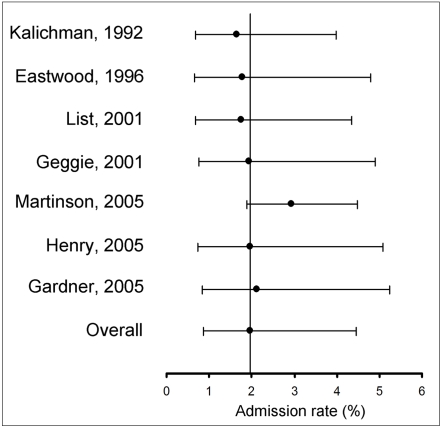
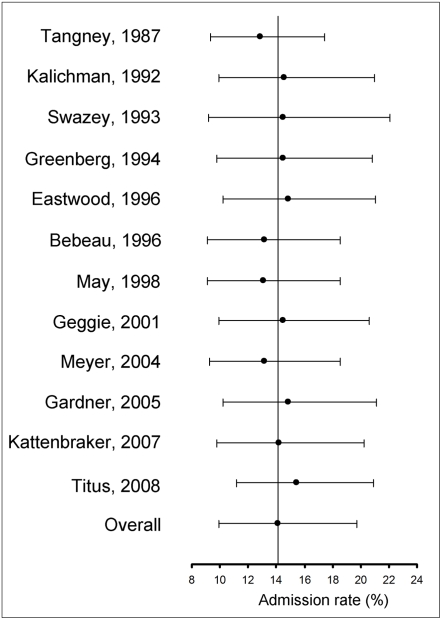
The frequency with which scientists fabricate and falsify data, or commit other forms of scientific misconduct is a matter of controversy. Many surveys have asked scientists directly whether they have committed or know of a colleague who committed research misconduct, but their results appeared difficult to compare and synthesize. This is the first meta-analysis of these surveys. To standardize outcomes, the number of respondents who recalled at least one incident of misconduct was calculated for each question, and the analysis was limited to behaviours that distort scientific knowledge: fabrication, falsification, "cooking" of data, etc... Survey questions on plagiarism and other forms of professional misconduct were excluded. The final sample consisted of 21 surveys that were included in the systematic review, and 18 in the meta-analysis. A pooled weighted average of 1.97% (N = 7, 95%CI: 0.86-4.45) of scientists admitted to have fabricated, falsified or modified data or results at least once--a serious form of misconduct by any standard--and up to 33.7% admitted other questionable research practices. In surveys asking about the behaviour of colleagues, admission rates were 14.12% (N = 12, 95% CI: 9.91-19.72) for falsification, and up to 72% for other questionable research practices. Meta-regression showed that self reports surveys, surveys using the words "falsification" or "fabrication", and mailed surveys yielded lower percentages of misconduct. When these factors were controlled for, misconduct was reported more frequently by medical/pharmacological researchers than others. Considering that these surveys ask sensitive questions and have other limitations, it appears likely that this is a conservative estimate of the true prevalence of scientific misconduct.
Overview
CoChat Summary
TL;DR
This systematic review and meta-analysis of survey data estimated that about 2% of scientists admitted to fabricating, falsifying, or modifying data or results at least once, while 14.12% reported knowing a colleague who did so. The paper argues these are conservative estimates and that methodological choices strongly shape the observed rates.
Key findings
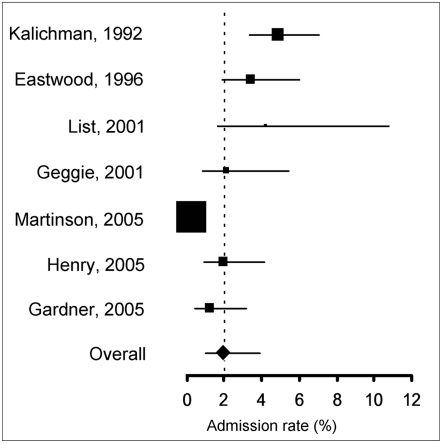
- Across surveys explicitly asking whether scientists ever fabricated or falsified data or altered/modifed results, the pooled weighted estimate was 1.97% (95% CI 0.86–4.45; N = 7), with significant heterogeneity (Cochran’s Q = 61.7777, df = 6, P < 0.0001).
- When only questions explicitly using the words “fabrication” or “falsification” were included, the pooled estimate for self-reports was 1.06% (95% CI 0.31–3.51; N = 4).
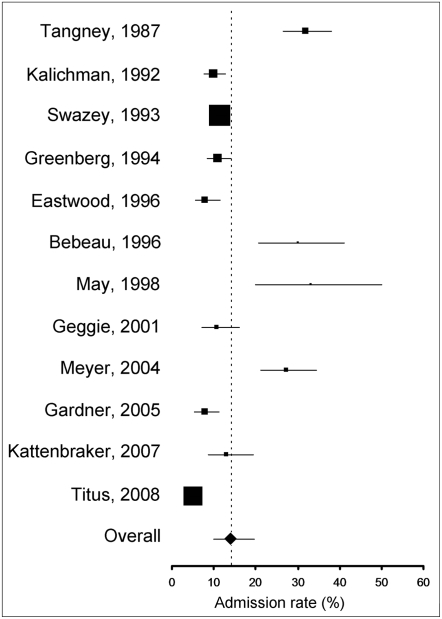
- For reports about colleagues’ misconduct, the pooled weighted estimate was 14.12% (95% CI 9.91–19.72; N = 12); restricting to questions using “fabrication” or “falsification” gave 12.34% (95% CI 8.43–17.71; N = 11).
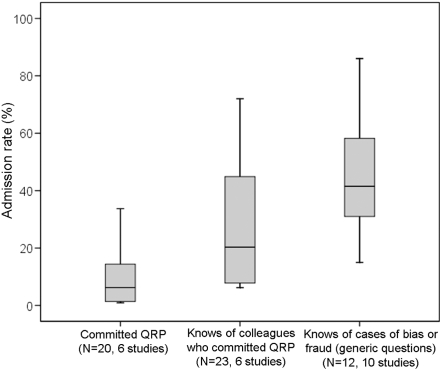
- Other questionable research practices were reported more often: up to 33.7% in self-reports and up to 72% when asking about colleagues.
Methods
- Systematic review and meta-analysis of quantitative surveys asking scientists whether they had committed or observed scientific misconduct in the past; plagiarism and other non-knowledge-distorting misconduct were excluded.
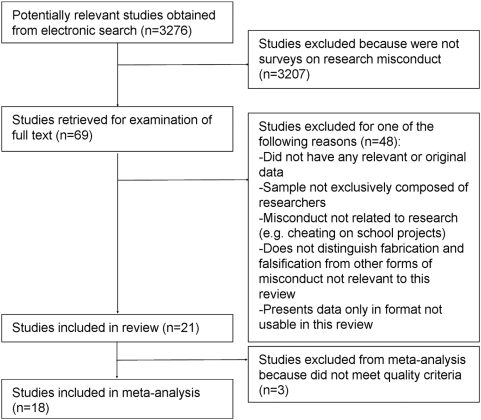
- Searches were run in the first two weeks of August 2008 across citation databases, journals, grey literature sources, and internet search engines; the final review included 21 studies, with 18 in the meta-analysis.
- Main analysis computed the proportion recalling at least one incident, logit-transformed and inverse-variance weighted in a random-effects meta-analysis; meta-regression tested methodological factors such as self vs. non-self reports, mailed vs. handed-out surveys, and use of the words “fabrication”/“falsification.”
Limitations
- The paper states that using the percentage of respondents recalling at least one incident is a rough measure of misconduct frequency; this can under- or overestimate prevalence depending on whether respondents committed multiple incidents or only one.
- The paper notes that non-response bias was recognized by most surveys as a limitation, and that the validity of self-reports may be affected by social expectations; the text also suggests self-reports likely underestimate misconduct.
- Evident from the text: the included studies were heterogeneous in methods and wording, and some outcomes were too diverse for meaningful meta-analysis, so only crude unweighted parameters were calculated for broader questionable research practices.
Model-written summary. Check it against the paper before relying on it.
Integrity signals
Registry
Cites
Statistics
Figures
Verification
Claims the paper makes
0 Valid · 0 Not valid · 14 Not checked · 61 Own results and interpretations
A result the paper reports from its own data — it cites no other source for it, so there is none to check. The quote shows it is in the paper.
In the paper
“When these factors were controlled for, misconduct was reported more frequently by medical/pharmacological researchers than others.”
§ How Many Scientists Fabricate and Falsify Research? A Systematic Review and Meta-Analysis of Survey Data > Abstract
plainstates an association- Asserted: passes — The authors put it forward as true.
- Checkable: passes — It can be checked against evidence.
- Load-bearing: passes — The paper’s conclusions depend on it.
- Based: passes — The paper gives a reason why it holds.
- Rests on 2 assumptions not shown here.
A result the paper reports from its own data — it cites no other source for it, so there is none to check. The quote shows it is in the paper.
In the paper
“A pooled weighted average of 1.97% (N = 7, 95%CI: 0.86–4.45) of scientists admitted to have fabricated, falsified or modified data or results at least once –a serious form of misconduct by any standard– and up to 33.7% admitted other questionable research practices.”
§ How Many Scientists Fabricate and Falsify Research? A Systematic Review and Meta-Analysis of Survey Data > Abstract
plainn = 7- Asserted: passes — The authors put it forward as true.
- Checkable: passes — It can be checked against evidence.
- Load-bearing: passes — The paper’s conclusions depend on it.
- Based: passes — The paper gives a reason why it holds.
- Rests on 2 assumptions not shown here.
A result the paper reports from its own data — it cites no other source for it, so there is none to check. The quote shows it is in the paper.
In the paper
“A pooled weighted average of 1.97% (N = 7, 95%CI: 0.86–4.45) of scientists admitted to have fabricated, falsified or modified data or results at least once –a serious form of misconduct by any standard– and up to 33.7% admitted other questionable research practices.”
§ How Many Scientists Fabricate and Falsify Research? A Systematic Review and Meta-Analysis of Survey Data > Abstract
plain- Asserted: passes — The authors put it forward as true.
- Checkable: passes — It can be checked against evidence.
- Load-bearing: passes — The paper’s conclusions depend on it.
- Based: passes — The paper gives a reason why it holds.
- Rests on 2 assumptions not shown here.
A result the paper reports from its own data — it cites no other source for it, so there is none to check. The quote shows it is in the paper.
In the paper
“In surveys asking about the behaviour of colleagues, admission rates were 14.12% (N = 12, 95% CI: 9.91–19.72) for falsification, and up to 72% for other questionable research practices.”
§ How Many Scientists Fabricate and Falsify Research? A Systematic Review and Meta-Analysis of Survey Data > Abstract
plainn = 12- Asserted: passes — The authors put it forward as true.
- Checkable: passes — It can be checked against evidence.
- Load-bearing: passes — The paper’s conclusions depend on it.
- Based: passes — The paper gives a reason why it holds.
- Rests on 2 assumptions not shown here.
A result the paper reports from its own data — it cites no other source for it, so there is none to check. The quote shows it is in the paper.
In the paper
“Meta-analysis yielded mean pooled estimates that are higher than most previous estimates.”
§ How Many Scientists Fabricate and Falsify Research? A Systematic Review and Meta-Analysis of Survey Data > Introduction
plain- Asserted: passes — The authors put it forward as true.
- Checkable: passes — It can be checked against evidence.
- Load-bearing: passes — The paper’s conclusions depend on it.
- Based: passes — The paper gives a reason why it holds.
- Rests on 2 assumptions not shown here.
31 more claims
Create a free account to see all 75 claims and to verify the 4 references still open.
- It may state two separate claims as one. 24
- Probably not a substantial claim. 25
Claims other papers make about this one
Each is checked against this paper’s own text: does it say what the citing paper says it does?
The cited source says what the claim attributes to it.
In the citing paper
“there are other more common sources of unreliability in the literature (41)(42)(43)(44)”
From Misconduct accounts for the majority of retracted scientific publications (2012) · cites this paper as [43]
The cited source says what the claim attributes to it.
In the citing paper
“The prevalence of researchers who have been involved in scientific misconduct is estimated to be around 2% [2]”
From Checklist to assess Trustworthiness in RAndomised Controlled Trials (TRACT checklist): concept proposal and pilot (2023) · cites this paper as [2]
The cited source says what the claim attributes to it.
In the citing paper
“This is how a small number of people 40 with flexible morals can pollute the scientific literature disproportionately.”
From Fraudulent studies are undermining the reliability of systematic reviews: on the prevalence of problematic images in preclinical depression studies (2025) · cites this paper as [40]
The cited source says what the claim attributes to it.
In the citing paper
“A meta-analysis by Fanelli, combining the results of 18 published surveys, found that 1.9% of researchers have admitted to modification, falsification, or fabrication of data (3).”
From The Prevalence of Inappropriate Image Duplication in Biomedical Research Publications (2016) · cites this paper as [3]
The cited source says what the claim attributes to it.
In the citing paper
“A systematic review and meta-analysis of survey data estimated that 1.97% of authors admitted to have fabricated, falsified, or modified data or results at least once and, in surveys asking about the behavior of colleagues, the admission rate was 14.12% for falsification [13].”
From No raw data, no science: another possible source of the reproducibility crisis (2020) · cites this paper as [13]
6 more claims about this paper
Create a free account to see every claim other papers make about this one.
Citations
Cites
(2000) · Cited by 9,198
The Sociology of Science: Theoretical and Empirical Investigations
Kaplan, N., Merton, R. K., & Storer, N. W. (1974) · Technology and Culture · doi:10.2307/3102264 · Cited by 4,005
The Normative Structure of Science
Merton, R. Κ. (1973) · Medical Entomology and Zoology · Cited by 2,315
The Hazards of Scoring the Quality of Clinical Trials for Meta-analysis
Jüni, P. (1999) · JAMA · doi:10.1001/jama.282.11.1054 · Cited by 1,981 · cited 1×
“All remaining papers were included, and were not graded on a quality scale, because the validity and use of quality measures in meta-analysis is controversial [21], [22].”
BackgroundScope and Impact of Financial Conflicts of Interest in Biomedical Research: A Systematic Review
Bekelman, J. E., Li, Y., & Gross, C. P. (2003) · JAMA · doi:10.1001/jama.289.4.454 · Cited by 1,816 · cited 1×
“This would support growing fears that the large financial interests that often drive medical research are severely biasing it [50], [51], [52].”
BackgroundTourangeau, R., & Smith, T. W. (1996) · Public Opinion Quarterly · doi:10.1086/297751 · Cited by 1,295 · cited 1×
“However, the accuracy of responses to sensitive questions is often independent of response rates, and depends strongly on respondents' perception of anonymity and confidentiality [43], [44].”
BackgroundA comparison of methods to detect publication bias in meta‐analysis
Macaskill, P., Walter, S. D., & Irwig, L. (2001) · Statistics in Medicine · doi:10.1002/sim.698 · Cited by 1,286 · cited 1×
“The popular funnel-plot-based methods to test for publication bias in meta-analysis are inappropriate and potentially misleading when the number of included studies is small and heterogeneity is large [25], [26].”
MethodMartinson, B. C., Anderson, M. S., & de Vries, R. (2005) · Nature · doi:10.1038/435737a · Cited by 1,096 · cited 9×
“All the above results were robust with respect to inclusion or exclusion of any particular study, with perhaps one exception: Martinson et al. (2005) [19], which is one of the largest and most frequently cited surveys on misconduct published to date.”
BackgroundMethodResultInfluentialAdjusting for publication bias in the presence of heterogeneity
Terrin, N., Schmid, C. H., Lau, J., & Olkin, I. (2003) · Statistics in Medicine · doi:10.1002/sim.1461 · Cited by 809 · cited 1×
“The popular funnel-plot-based methods to test for publication bias in meta-analysis are inappropriate and potentially misleading when the number of included studies is small and heterogeneity is large [25], [26].”
MethodIs Academic Medicine for Sale?
Angell, M. (2000) · New England Journal of Medicine · doi:10.1056/nejm200005183422009 · Cited by 582
Research works printed but not linked: 2
- Eastwood S Derish P Leash E Ordway S 1996 Ethical issues in biomedical research: perceptions and practices of postdoctoral research fellows responding to a survey. Science and Engineering Ethics 2 89 114 11657788 · DOI
- Kattenbraker MS 2007 Health education research and publication: ethical considerations and the response of health educators Carbondale Southern Illinois University.Doctoral dissertation
Cited by
Items 1,001–1,100 of 1,924
The Impact on Public Trust of Image Manipulation in Science
López-Cantos, F. (2019) · Informing Science The International Journal of an Emerging Transdiscipline · doi:10.28945/4407 · Cited by 8
Measurement Replication in Qualitative and Quantitative Studies
Reiter, D. (2020) · Cambridge University Press eBooks · doi:10.1017/9781108762519.011 · Cited by 6
Botella, J., Suero, M., Durán, J. I., & Blazquez, D. (2021) · Anales de Psicología · doi:10.6018/analesps.433051 · Cited by 6
“Fanelli (2009) performed a meta-analysis of 18 surveys of researchers about their own behavior regarding QRPs, and about those of close colleagues.”
BackgroundMethodGerring, J., Mahoney, J., & Elman, C. (2020) · Cambridge University Press eBooks · doi:10.1017/9781108762519.001 · Cited by 6
Maggio, L. A., Haustein, S., Costello, J. A., Driessen, E. W., & Artino, A. R. (2022) · Perspectives on Medical Education · doi:10.1007/s40037-022-00717-9 · Cited by 6
Awareness of scientific publication ethics in higher education
Can, İ. H., & Honca, M. (2022) · International Journal of Ethics Education · doi:10.1007/s40889-022-00154-6 · Cited by 6
“2019; Fanelli 2009).”
Ethical Publications in Medical Research
Das, K. K., & Biradar, M. S. (2016) · InTech eBooks · doi:10.5772/64947 · Cited by 7
“These unethical practices are taken place at each of the steps in research, that is performing works to disseminating knowledge through scientific publications [8, 9].”
BackgroundInfluentialPalmer, N., & Forrester‐Jones, R. (2018) · Advances in research ethics and integrity · doi:10.1108/s2398-601820180000003004 · Cited by 5
Publication misconduct: Perceptions of participants of a faculty development programme
Singh, S. P., Dhir, S. K., Sharma, M., & Singh, T. (2018) · The National Medical Journal of India · doi:10.4103/0970-258x.255762 · Cited by 5
Altman, M. (2020) · Springer proceedings in mathematics & statistics · doi:10.1007/978-3-030-36568-4_16 · Cited by 6
Red for danger in systematic reviews?
Moore, A. (2021) · European Journal of Hospital Pharmacy · doi:10.1136/ejhpharm-2021-003080 · Cited by 9
Milgrom, L. R. (2009) · The Journal of Alternative and Complementary Medicine · doi:10.1089/acm.2009.0674 · Cited by 5
“…medical procedures are well known to lack scientific evidence; 24 fraud in biomedical and pharmacological research has been exposed recently and objectively referenced, 25,26 while clear evidence exists for the harm that can result from routine conventional medical practice and prescribing.”
Detecting Duplication in Students’ Research Data: A Method and Illustration
Allen, P., Lourenco, A., & Roberts, L. D. (2015) · Ethics & Behavior · doi:10.1080/10508422.2015.1019070 · Cited by 10
“Despite evidence suggesting that cases like these occur most commonly in biomedical research (Fanelli, 2009; Grieneisen & Zhang, 2012; Stroebe, Postmes, & Spears, 2012), our own field, psychology, has not escaped scandal.”
BackgroundInfluentialMedical research misconduct need regulatory reforms
Bedi, N. (2014) · Indian Journal of Community Medicine · doi:10.4103/0970-0218.143017 · Cited by 5
“Surprisingly, when they were inquired about other researchers’misconduct it was interestingly answered that 14% of researchers fabricated, falsified the data and three quarters researchers did act for irresponsible research practices.(8)”
BackgroundScientific fraud in corrosion science research: A review
Khaled, K. F. (2013) · Research on Chemical Intermediates · doi:10.1007/s11164-013-1079-2 · Cited by 5
Bhat, A., Shah, A. D., & Sherighar, S. (2017) · Journal of Empirical Research on Human Research Ethics · doi:10.1177/1556264617698277 · Cited by 5
“There have been numerous reports of scientific misconduct in both developed and developing countries (Fanelli, 2009; Okonta & Rossouw, 2014; Patnaik, 2016).”
BackgroundTruth or Consequences: The Growing Trend of Publication Retraction
Bean, J. R. (2017) · World Neurosurgery · doi:10.1016/j.wneu.2017.04.086 · Cited by 5
An Assessment of Retractions as a Measure of Scientific Misconduct and Impact on Public Health Risks
Abritis, A. J. (2015) · Digital Commons - University of South Florida (University of South Florida) · Cited by 6
Piraino, S. W. (2017) · bioRxiv (Cold Spring Harbor Laboratory) · doi:10.1101/179135 · Cited by 6
“Fabrication and errors may be difficult to detect and may persist un-noticed in the 101 literature [21], leaving open the possiblity that these ocurrences are not as rare as scientists 102 might hope or desire [17,22].”
BackgroundVeldkamp, C. L. S. (2017) · PsyArXiv (OSF Preprints) · doi:10.31234/osf.io/g8cjq · Cited by 6
Robustness of the adult statistical word segmentation literature: Part 1Preprint
Hartshorne, J. K., Skorb, L., Dietz, S. L., Garcia, C., Iozzo, G., Lamirato, K., Ledoux, J., Mu, J., Murdock, K., Ravid, J., et al. (2017) · doi:10.31234/osf.io/vu8je · Cited by 5
Cerri, J. (2018) · bioRxiv (Cold Spring Harbor Laboratory) · doi:10.1101/368951 · Cited by 5
“The second reason lies in the fact that some researchers manipulate or falsify their data to obtain the desired outcomes (Fanelli, 2009).”
BackgroundBuyse, M. E., & Evans, S. J. W. (2016) · Wiley eBooks · doi:10.1002/9781118445112.stat04938.pub2 · Cited by 5
Hastings, R. C., Labib, K., Lechner, I. M., Bouter, L. M., Widdershoven, G. A. M., & Evans, N. (2022) · doi:10.31222/osf.io/kn5y9 · Cited by 5
Statistical learning and dyslexia: a systematic reviewPreprint
Schmalz, X., Altoè, G., & Mulatti, C. (2019) · OSF Preprints (OSF Preprints) · doi:10.31219/osf.io/wg3vq · Cited by 5
Fifty Shades of QE: Comparing Findings of Central Bankers and Academics
Fabo, B., Jančoková, M., Kempf, E., & Pástor, Ľ. (2020) · National Bureau of Economic Research · doi:10.3386/w27849 · Cited by 7
P-hacking in clinical trials and how incentives shape the distribution of results across phases
Adda, J., Decker, C., & Ottaviani, M. (2019) · Proceedings of the National Academy of Sciences · doi:10.1073/pnas.1919906117 · Cited by 68
AI in orthopedics: how to measure one’s real contribution and avoid cheating?
Micicoi, G., Ollivier, M. P., & Argenson, J. (2026) · Orthopaedics & Traumatology Surgery & Research · doi:10.1016/j.otsr.2026.104616 · Cited by 8
Ng, W. P., Pang, K. Y., Ooi, P. B., & Phan, C. (2023) · Journal of Academic Ethics · doi:10.1007/s10805-023-09487-3 · Cited by 4
“Fanelli (2009) shows that there is an average of around 2% of scientists admitted having falsified, fabricated, or modified results or data at least once, and over 14% of scientists observed these acts of misconduct being done by their colleagues.”
Breaking bad? Playing the fool and constructing the ‘bad researcher’ in entrepreneurship
Harrison, R. (2024) · Journal of Business Venturing Insights · doi:10.1016/j.jbvi.2024.e00484 · Cited by 4
Characteristics of Global Retracted Publications in Engineering Sciences: A Bibliometric Analysis
Khademizadeh, S., Dakhesh, S., & Lund, B. D. (2025) · Journal of Academic Ethics · doi:10.1007/s10805-025-09595-2 · Cited by 5
“Fanelli (2009) showed that 1.97% of scientists admit - ted to data fabrication or data falsification at least once, and 33.7% of them also admitted to other research violations.”
InfluentialLi, D., Mach, L. T., & CORNELIS, G. C. (2025) · Science and Engineering Ethics · doi:10.1007/s11948-025-00539-y · Cited by 6
“Fanelli’s meta-analysis reported that less than 2% of participants admitted to fabrication and falsification (Fanelli, 2009 ), and 1.7% admitted to plagiarism (Pupovac & Fanelli, 2015 ).”
InfluentialThe future of medical publication as we move towards the second half of the 21st century
Chloros, G. D., Civil, I. D., & Giannoudis, P. V. (2019) · Injury · doi:10.1016/j.injury.2019.12.017 · Cited by 4
Replication for Quantitative Research
Freese, J., & Peterson, D. (2020) · Cambridge University Press eBooks · doi:10.1017/9781108762519.010 · Cited by 5
Replicability: 21st Century Crisis of the Positivist Social Sciences
Kalelioğlu, U. B. (2021) · Uluslararası Sosyal Bilgilerde Yeni Yaklaşımlar Dergisi (IJONASS) · doi:10.38015/sbyy.1003103 · Cited by 4
Tang, X., Burris, L. E., Hu, N., & Brenkus, N. R. (2020) · ASEE Annual Conference & Exposition · doi:10.18260/1-2--33190 · Cited by 4
“imperative to enhance EL in the research community, given the alarming rate of research misconduct and questionable practice (Martinson et al., 2005; Fanelli, 2009).”
BackgroundImproving medical research in the United Kingdom
Bradley, S. H., DeVito, N., Lloyd, K. E., Logullo, P., & Butler, J. E. (2022) · BMC Research Notes · doi:10.1186/s13104-022-06050-y · Cited by 6
“research? While fraud is an important problem that leads to nonreproducible research, many of the issues that undermine reproducibility do not involve deliberate misconduct [3, 4].”
BackgroundWatts, L. L., Lefkowitz, J. M., Gonzalez, M. F., & Nandi, S. (2023) · Industrial and Organizational Psychology · doi:10.1017/iop.2022.112 · Cited by 5
“Most notably the code fails to warn against falsification, or the “willful distortion of data or results” (Fanelli, 2009, p. 1).”
BackgroundYamamoto, N., Taito, S., Miura, T., Ariie, T., Tomita, Y., Ogihara, H., Shiratsuchi, D., Yorifuji, T., & Tsujimoto, Y. (2023) · Journal of Clinical Medicine · doi:10.3390/jcm12227031 · Cited by 6
“Moreover, SRs with complete reporting or rigorous implementation methods can lead to less biased recommendations and decisions [3,4].”
BackgroundScientific Peer Review in an Era of Artificial Intelligence
Kadri, S., Dorri, N., Osaiweran, M., Garyali, P., & Petković, M. (2024) · Springer eBooks · doi:10.1007/978-981-97-4060-4_23 · Cited by 6
Hayvon, J. C. (2024) · Journal of Progressive Human Services · doi:10.1080/10428232.2024.2413325 · Cited by 4
“Notably, the examples cited are limited only to prominent cases where retraction generated considerable academic discourse (Bolli et al., 2021; Fanelli & Tregenza, 2009; Steen, 2011).”
Cenci, J., Franco, M. C., Pereira‐Cenci, T., Corrêa, M. B., Helal, L. C. A. S., Moher, D., Bouter, L. M., Huysmans, M. C. D. N. J. M., & Cenci, M. S. (2024) · Brazilian Oral Research · doi:10.1590/1807-3107bor-2024.vol38.0135 · Cited by 6
Yang, Y., Lagisz, M., & Nakagawa, S. (2025) · Research Synthesis Methods · doi:10.1017/rsm.2024.3 · Cited by 6
“54,55 58 Bibliometrics can bring two major additions to meta-analyses.”
Teaching trust in science: a critical new focus for science education
Hopkin, K., Roberts, K. J., & Alberts, B. (2025) · Frontiers in Communication · doi:10.3389/fcomm.2025.1589116 · Cited by 5
“In an analysis conducted in 2009, some 2% of the scientists surveyed admitted to fabricating, falsifying, or modifying data at least once (Fanelli, 2009).”
Hafetz, J., Felkins, J., Allston, A., Mann, H., Long, D. L., Ford, C. A., & McDonald, C. C. (2025) · Journal of Transport & Health · doi:10.1016/j.jth.2025.102045 · Cited by 5
Features and signals in precocious citation impact: A meta-research study
Ioannidis, J. P. A. (2025) · PLoS ONE · doi:10.1371/journal.pone.0328531 · Cited by 15
“Estimates of fraud have been recently revised upwards [53] versus prior estimates [54], with ongoing debate about the proposed values.”
Mburu, G., Santesso, N. A., Brignardello‐Petersen, R., Farquhar, C. M., Kennedy, R., & Kiarie, J. N. (2025) · Human Reproduction · doi:10.1093/humrep/deaf217 · Cited by 5
“Across several scientific disciplines, an estimated 1.97% of scientists have admitted fabricating, falsifying or modifying data or results at least once (Fanelli, 2009).”
InfluentialSiordia, C. (2014) · Journal of Depression & Anxiety · doi:10.4172/2167-1044.1000149 · Cited by 4
Beyond Randomized Controlled Trials: Evidence in Complementary Medicine
Golden, I. (2012) · Journal of Evidence-Based Complementary & Alternative Medicine · doi:10.1177/2156587211429351 · Cited by 5
Publish to flourish: is it corrupting science?
Rajasekaran, S. (2012) · Bone and Joint 360 · doi:10.1302/2048-0105.14.360057 · Cited by 4
Formulating the American Geophysical Union’s Scientific Integrity and Professional Ethics Policy
Gundersen, L. C. S., & Townsend, R. (2014) · Elsevier eBooks · doi:10.1016/b978-0-12-799935-7.00008-3 · Cited by 4
The right and the wrong with epilepsy and her science
Shorvon, S. D., & Schmidt, D. (2016) · Epilepsia Open · doi:10.1002/epi4.12011 · Cited by 4
Scientific research misconduct in social science research: What is it and how can we address it?
Henry, P., Garza, L., & Wood, J. (2018) · Sociology International Journal · doi:10.15406/sij.2018.02.00036 · Cited by 4
Etyczne aspekty działalności badawczej w naukach empirycznych
Morawski, R. Z. (2011) · Wydawnictwa Uniwersytetu Warszawskiego eBooks · doi:10.31338/uw.9788323510635 · Cited by 12
Transparency and Reproducibility: Conceptualizing the Problem
Christensen, G., & Miguel, E. A. (2020) · Cambridge University Press eBooks · doi:10.1017/9781108762519.006 · Cited by 4
Words, Objects and Events in Economics: The Making of Economic Theory
Róna, P., Zsolnai, L., & Wincewicz-Price, A. (2020) · Virtues and Economics/Virtues and economics · doi:10.1007/978-3-030-52673-3 · Cited by 4
“Scientists can cause harm in many ways.2 They plagiarize.3 They also fabricate and falsify data (Fanelli 2009).”
BackgroundFake news and fake research: Why meta‐research matters more than ever
McGee, R., & Dawson, A. C. (2020) · Journal of Paediatrics and Child Health · doi:10.1111/jpc.15237 · Cited by 4
Guidance Document: Good Academic Research Practices
Patwardhan, B., Anand, D., Anamika, C., Subhasree, N., & Rakesh, B. (2020) · PhilPapers (PhilPapers Foundation) · Cited by 16
An existentialist approach to authentic science
Tan, S. Z. K., & Lim, L. W. (2021) · IBRO Neuroscience Reports · doi:10.1016/j.ibneur.2021.07.001 · Cited by 5
“This is particularly important in the current climate of academic research with increasing rates of retractions due to fraud (Steen, 2011), more researchers admitting to questionable research practices (Fanelli, 2009), and greater evidence of more research with false findings (Ioannidis, 2005).”
BackgroundWhat’s Right and Wrong in Preclinical Science: A Matter of Principled Investigation
Smith, L. N. (2022) · Frontiers in Behavioral Neuroscience · doi:10.3389/fnbeh.2022.805661 · Cited by 4
“At worst, it encourages scientific fraud (Fanelli, 2009; Devine et al., 2021).”
BackgroundFreckelton, I. R. (2020) · Springer eBooks · doi:10.1007/978-3-030-16759-2_6 · Cited by 4
Perry, G. (2016) · Journal of Herpetology · doi:10.1670/16-068 · Cited by 5
“Research exceptionalism” in the COVID-19 pandemic: an analysis of scientific retractions in Scopus
Rubbo, P., Lievore, C., dos Santos, C. B., Picinin, C. T., Pìlatti, L. A., & Pedroso, B. (2022) · Ethics & Behavior · doi:10.1080/10508422.2022.2080067 · Cited by 6
“However, Cokol et al. (2007) argued that not all articles with ethical problems have been or will be retracted, and Fanelli (2009) contends that identified fraudulent publications represent only a tiny proportion of scientific production, with only 2% of scientists admitting to having falsified or…”
BackgroundPerceptions on the role of research integrity officers in French medical schools
Deniau, N. (2023) · Accountability in Research · doi:10.1080/08989621.2023.2173070 · Cited by 6
“However, good practices are not always upheld (Pupovac and Fanelli 2015; Fanelli 2009; Martinson, Anderson, and de Vries 2005).”
The absolute state of research in Communication Education: facing Hanlon’s Razor
Rudick, C. K. (2023) · Communication Education · doi:10.1080/03634523.2023.2171449 · Cited by 4
“Fanelli’s meta-analysis (2009) found that nearly 2% of scientists admitted to fabricating, falsifying, or modifying data at least once, and up to 34% admitted to other questionable prac-”
BackgroundMzhelsky, A. (2023) · Science Editor and Publisher · doi:10.24069/sep-22-53 · Cited by 4
Are we at the start of the artificial intelligence era in academic publishing?
Vuong, Q., La, V., Nguyen, M., Jin, R., & Le, T.-T. (2023) · Science Editing · doi:10.6087/kcse.310 · Cited by 7
“Implementing regulations requires a high level of understanding of the sys-tem; otherwise, the pursuit of self-interest would likely lead to misconduct and exploitation behind the scenes, just like what has been happening in the current system [12,13].”
BackgroundEvading open science: The black box of student data collection
Ludwig, T., Altenmüller, M. S., Schramm, L. F. F., & Twardawski, M. (2023) · Social Psychological Bulletin · doi:10.32872/spb.9411 · Cited by 6
“%) as other self-reported data-related QRP/M among researchers (Fanelli, 2009; Xie et al., 2021) and among students (Krishna & Peter, 2018).”
BackgroundResultCurrent situation and influence factors of scientific integrity in China: A multicenter survey
Liu, X., Guo, Y., Gao, W., Xie, Y., Zhao, H., & Du, J. (2023) · Asia-Pacific Journal of Oncology Nursing · doi:10.1016/j.apjon.2023.100365 · Cited by 4
“18,19 Among the factors contributing to scienti fi c misconduct, personal ethical failures, pressure from various sources, such as publication, promotion, and obtaining external funding, as well as insuf fi cient education on scienti fi c integrity, are considered to be the main factors that lead to…”
BackgroundStatistical inference and reproducibility in geobiology
Sperling, E. A., Tecklenburg, S., & Duncan, L. E. (2019) · Geobiology · doi:10.1111/gbi.12333 · Cited by 5
“True scientific fraud is also something that makes headlines and erodes public trust, but again likely only accounts for a small proportion of replication failures (Bouter, Tijdink, Axelsen, Martinson, & ten Riet, 2016; Fanelli, 2009).”
BackgroundResearch misconduct and publication ethics: a South African perspective
Ballyram, R., & Nienaber, A. (2019) · South African Dental Journal · doi:10.17159/2519-0105/2019/v74no1a4 · Cited by 6
Reproducibility, Fabrication, and Falsification
DeFranco, J. F., & Voas, J. M. (2021) · Computer · doi:10.1109/mc.2021.3055926 · Cited by 4
An Exploratory Analysis of 4844 Withdrawn Articles and Their Retraction Notes
Toma, C., & Padureanu, L. (2021) · Open Journal of Social Sciences · doi:10.4236/jss.2021.911028 · Cited by 4
Applied Bayesian Approaches for Research in Motor Neuron Disease
Temp, A. G. M., Naumann, M., Hermann, A., & Glaß, H. (2022) · Frontiers in Neurology · doi:10.3389/fneur.2022.796777 · Cited by 4
“Other problems range from inappropriate data transformations, incorrect use of statistical methods (14) to misinterpretation of statistical readouts (15, 16).”
BackgroundMcIntosh, T. J., Antes, A. L., Schenk, E., Rolf, L., & DuBois, J. M. (2023) · Accountability in Research · doi:10.1080/08989621.2023.2187292 · Cited by 8
“Research integrity violations include falsification or fabrication of data and plagiarism (Fanelli and Tregenza 2009; Office of Research Integrity 2020).”
Ornithology from the Tree Tops
Bijlsma, R. G. (2020) · Ardea · doi:10.5253/arde.v107i3.a13 · Cited by 5
Homeopathy UK: The Sick Man of Europe?
Milgrom, L. R. (2012) · Forschende Komplementärmedizin / Research in Complementary Medicine · doi:10.1159/000339950 · Cited by 4
Research fraud and The Bone & Joint Journal
Parsons, N., Smith, R. C., Griffin, X. L., Stengel, D., & Costa, M. L. (2013) · The Bone & Joint Journal · doi:10.1302/0301-620x.95b7.32324 · Cited by 4
The Interrelationship between Research Integrity, Conflict of Interest, and the Research Environment
Grinnell, F. (2014) · Journal of Microbiology and Biology Education · doi:10.1128/jmbe.v15i2.851 · Cited by 5
“According to meta-analysis of 18 independent surveys, about two percent of researchers admit to having committed research misconduct at least once and know of such behavior by about 14% of colleagues (2).”
Science as a Social Enterprise
Maiväli, Ü. (2015) · Elsevier eBooks · doi:10.1016/b978-0-12-418689-7.00007-7 · Cited by 5
Ethics of research for patients in pain
Waisel, D. B. (2017) · Current Opinion in Anaesthesiology · doi:10.1097/aco.0000000000000438 · Cited by 5
Misconduct in Clinical Research in India: Perception of Clinical Research Professional in India
Patel, M. (2017) · Journal of Clinical Research & Bioethics · doi:10.4172/2155-9627.1000303 · Cited by 4
“Despite the publication of misconduct in the media and role of regulatory governance through the globe, misconduct has often been underreported [6-9].”
BackgroundAires, J. P., & Pìlatti, L. A. (2017) · Revista Brasileira de Ensino de Ciência e Tecnologia · doi:10.3895/rbect.v10n3.7745 · Cited by 5
Ciência à medida: conflitos de interesse e interferência na investigação científica financiada
Faria, R. (2018) · Sociologia Revista da Faculdade de Letras da Universidade do Porto · doi:10.21747/08723419/soc36a5 · Cited by 6
Responsible scientific research at Inserm: a field study
Estienne, M., Chevalier, C., Fagard, C., Letondal, P., & Giesen, E. (2020) · International Journal of Metrology and Quality Engineering · doi:10.1051/ijmqe/2019016 · Cited by 5
Scientific conduct and misconduct: honesty is still the best policy
Dahanukar, N., & Molur, S. (2012) · Journal of Threatened Taxa · doi:10.11609/jott.04092012.2845-8 · Cited by 4
“…against the same (Martinson et al. 2005; Errami et al. Journal of Threatened Taxa | www.threatenedtaxa.org | August 2012 | 4(9): 2845–2848 2845 2008; Fanelli 2009; Long et al. 2009; Resnik et al. 2009) it is now becoming clear that journal policies regarding scientific misconduct, which hitherto…”
BackgroundThe Law and Economics of Research FraudPreprint
Guerra-Pujol, F. E. (2015) · SSRN Electronic Journal · doi:10.2139/ssrn.2669118 · Cited by 4
Patterns of retractions from 1981-2020 : Does a fraud lead to another fraud?Preprint
Sharma, K. (2020) · arXiv (Cornell University) · doi:10.48550/arxiv.2011.13091 · Cited by 8
“There are large number of authors who keeps on publishing fraud research (Fanelli, 2009; Kuroki and Ukawa, 2018).”
BackgroundStandardised Data on Initiatives – STARDIT: Beta VersionPreprint
Nunn, J., Shafee, T. M. A., Chang, S., Stephens, R., Elliot, J., Oliver, S. R., John, D., Smith, M. P., Orr, N., Preston, J., et al. (2021) · Research Square · doi:10.21203/rs.3.rs-934285/v1 · Cited by 4
Unethical Practices by Accounting Researchers: Incidence, Intentions, and InsightsPreprint
Bailey, C. D. (2019) · SSRN Electronic Journal · doi:10.2139/ssrn.3501602 · Cited by 5
“Fanelli, Costas, and Larivière (2015) argue that, contrary to common assumptions, pressures to publish are not the driving force undermining academic integrity.”
Fifty Shades of QE: Comparing Findings of Central Bankers and AcademicsPreprint
Fabo, B., Jančoková, M., Kempf, E., & Pástor, Ľ. (2021) · SSRN Electronic Journal · doi:10.2139/ssrn.3779630 · Cited by 17
Ethical ambiguity in the academic periphery: Global versus local science in explaining plagiarismPreprint
Губа, К. С., & Tsivinskaya, A. O. (2021) · doi:10.31235/osf.io/u8qwz · Cited by 4
Retractions in Scopus: An Engineering Journal Articles Investigation
Solomon, D., Heckman, C., & Hubbard, D. E. (2022) · Science & Technology Libraries · doi:10.1080/0194262x.2022.2098892 · Cited by 8
Researchers on research integrity: a survey of European and American researchersPreprint
Allum, N., Reid, A., Bidoglia, M., et al. (2022) · doi:10.31222/osf.io/fgy7c · Cited by 4
Rajakumar, H. K., Găman, M., Puyana, J. C., & Bonilla-Escobar, F. J. (2024) · International Journal of Medical Students · doi:10.5195/ijms.2024.2763 · Cited by 7
Commentary: Study highlights ethical ambiguity in physics
Ecklund, E. H., Johnson, D. R., & Matthews, K. R. W. (2015) · Physics Today · doi:10.1063/pt.3.2796 · Cited by 4
Berrío, J. P., & Kalliokoski, O. (2025) · FEBS Letters · doi:10.1002/1873-3468.70077 · Cited by 7
“This is how a small number of people [10] with flexible morals can pollute the scientific literature disproportionately.”
Is Crowdsourcing a Puppet Show? Detecting a New Type of Fraud in Online Platforms
Wang, S., Jui, I. J., & Thorpe, J. (2024) · New Security Paradigms Workshop · doi:10.1145/3703465.3703472 · Cited by 6
“The integrity of data is foundational to scientific knowledge, and compromised data can lead to invalid conclusions, echoing historical instances where data falsification undermined scientific progress [24].”
Wu, X., Zheng, T., Nie, Y., Wu, J., Chen, J., Pathak, J. L., & Wu, L. (2025) · BMC Medical Ethics · doi:10.1186/s12910-025-01183-8 · Cited by 7
“Questionable research practices falling outside of FFP are estimated to be even more prevalent [5].”
Alghamdi, S. M., Chikwendu, O. C., Chukwuma, O. U., Otieno, D. O., Okwu, M. O., Khalid, S., & Vlachostergiou, A. (2025) · Global Bioethics · doi:10.1080/11287462.2025.2550823 · Cited by 7
“There is pressure to perform, exerted by both the community and peers (Fanelli, 2009).”
Metadata
- Authors
- Fanelli, D.
- Affiliations
- University of Edinburgh (GB)
- Corresponding author
- Fanelli, Daniele
- ORCID
- Fanelli, Daniele
- Venue
- PLoS ONE
- Publisher
- Public Library of Science (PLoS)
- Published
- 2009-05-29
- Volume
- 4
- Issue
- 5
- Pages
- e5738
- ISSN
- 1932-6203 (ISSN-L)
- PMC
- PMC2685008
- OpenAlex
- W2152243616
- Cited by
- 1,911
- References
- 74
- Citations by year
- 2026: 77 · 2025: 110 · 2024: 128 · 2023: 136 · 2022: 157 · 2021: 145 · 2020: 163 · 2019: 166 · 2018: 125 · 2017: 125 · 2016: 119 · 2015: 106 · 2014: 82 · 2013: 93 · 2012: 84
- FWCI
- 19.42
- Type
- journal article
- Language
- en
- Open access
- gold
- doi.org
- Locations
- PLoS ONE (publishedVersion, cc-by)
- PubMed Central (publishedVersion, cc-by)
- PubMed (publishedVersion)
- Edinburgh Research Explorer (University of Edinburgh) (acceptedVersion, public-domain)
- RePEc: Research Papers in Economics (submittedVersion)
- DOAJ (DOAJ: Directory of Open Access Journals) (submittedVersion, cc-by-sa)
- Figshare (submittedVersion, cc-by)
- DigitalGeorgetown (Georgetown University Library) (submittedVersion)
- Funders
- European Commission (221441)
- Economic and Social Research Council (ES/F028180/1)
- Topics
- Social Sciences › Education › Academic integrity and plagiarism
- Physical Sciences › Mathematics › Statistics and Probability › Benford’s Law and Fraud Detection
- Social Sciences › Library and Information Sciences › Academic Publishing and Open Access
- Keywords
- research misconduct, scientific fraud, data fabrication, data falsification, questionable research practices, self-report questionnaire
- MeSH terms
- Data Collection, Regression Analysis, Research Personnel, Scientific Misconduct, Ethics, Research
About these checks
Registry, retraction, Cites and statistics results are computed, not judged, with one exception: a printed reference that no index lists is read once by a model before it counts as a citation error. Claims are extracted by a model and kept only when their quote appears verbatim in the text; each cited source is then checked, with a model’s help, for whether it says what the claim relies on. Those verdicts can be wrong — read the claim’s quote and the cited source before relying on one.
A language model drew the claims from the paper on 2026-10-10, under version 3 of the claim definition (model deepseek-v4.1-flash, prompt extract-v3).
A second model labelled each claim on 2026-10-10 (model jev-1.13-20260917, definition revision gold-guideline-v0.2).
Statistics and arithmetic are recomputed, not judged.
Confidence bands are shown only for fields calibrated on our annotated test set. None is calibrated yet, so no band is shown.
What counts as a claim ›How we measure confidence ›How we check this ›
Are you an author, or do you see a problem with this page? Request a review
Data sources
Bibliographic data: Semantic Scholar, OpenAlex, Crossref.
Contains information from the Semantic Scholar Academic Graph Datasets, made available under the ODC Attribution License (ODC-BY 1.0).
Semantic Scholar’s data is described in: Kinney, R., et al. (2023). The Semantic Scholar Open Data Platform. arXiv:2301.10140.
