

How Many Scientists Fabricate and Falsify Research? A Systematic Review and Meta-Analysis of Survey Data
Open accessThe DOI matches its Crossref record; 66 of the 74 references it cites were found in a registry or an index; none of the 21 sources its claims cite is checked for support yet.
Abstract
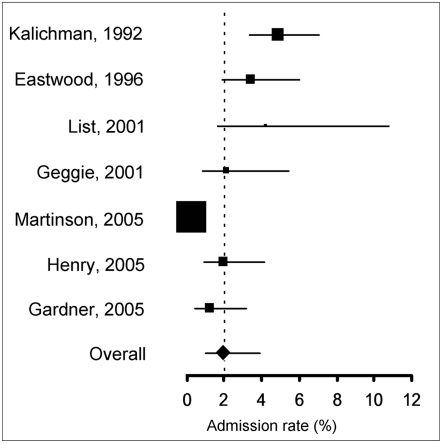
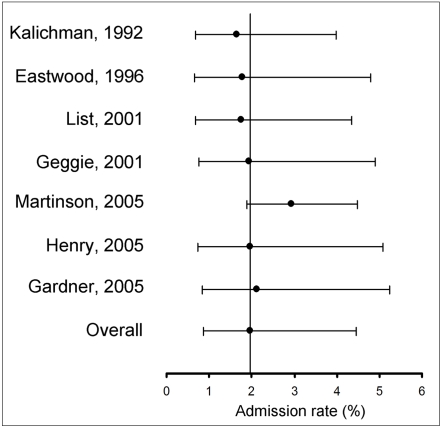
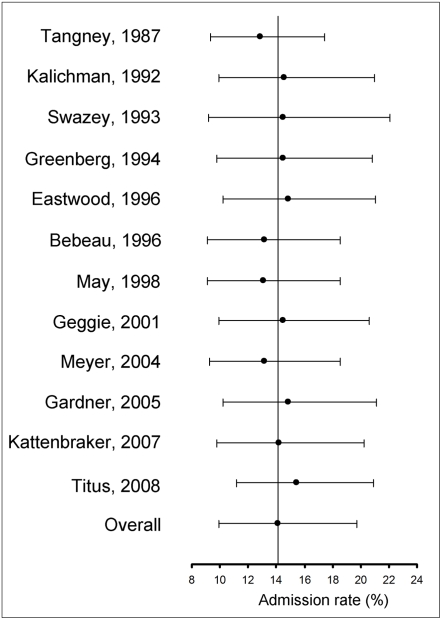
The frequency with which scientists fabricate and falsify data, or commit other forms of scientific misconduct is a matter of controversy. Many surveys have asked scientists directly whether they have committed or know of a colleague who committed research misconduct, but their results appeared difficult to compare and synthesize. This is the first meta-analysis of these surveys. To standardize outcomes, the number of respondents who recalled at least one incident of misconduct was calculated for each question, and the analysis was limited to behaviours that distort scientific knowledge: fabrication, falsification, "cooking" of data, etc... Survey questions on plagiarism and other forms of professional misconduct were excluded. The final sample consisted of 21 surveys that were included in the systematic review, and 18 in the meta-analysis. A pooled weighted average of 1.97% (N = 7, 95%CI: 0.86-4.45) of scientists admitted to have fabricated, falsified or modified data or results at least once--a serious form of misconduct by any standard--and up to 33.7% admitted other questionable research practices. In surveys asking about the behaviour of colleagues, admission rates were 14.12% (N = 12, 95% CI: 9.91-19.72) for falsification, and up to 72% for other questionable research practices. Meta-regression showed that self reports surveys, surveys using the words "falsification" or "fabrication", and mailed surveys yielded lower percentages of misconduct. When these factors were controlled for, misconduct was reported more frequently by medical/pharmacological researchers than others. Considering that these surveys ask sensitive questions and have other limitations, it appears likely that this is a conservative estimate of the true prevalence of scientific misconduct.
Overview
CoChat Summary
TL;DR
This systematic review and meta-analysis of survey data estimated that about 2% of scientists admitted to fabricating, falsifying, or modifying data or results at least once, while 14.12% reported knowing a colleague who did so. The paper argues these are conservative estimates and that methodological choices strongly shape the observed rates.
Key findings
- Across surveys explicitly asking whether scientists ever fabricated or falsified data or altered/modifed results, the pooled weighted estimate was 1.97% (95% CI 0.86–4.45; N = 7), with significant heterogeneity (Cochran’s Q = 61.7777, df = 6, P < 0.0001).
- When only questions explicitly using the words “fabrication” or “falsification” were included, the pooled estimate for self-reports was 1.06% (95% CI 0.31–3.51; N = 4).
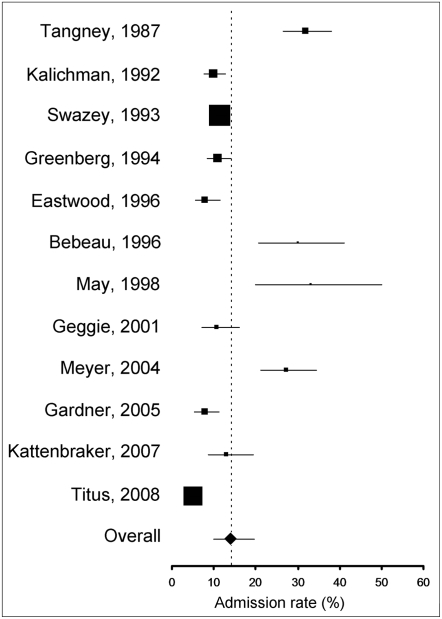
- For reports about colleagues’ misconduct, the pooled weighted estimate was 14.12% (95% CI 9.91–19.72; N = 12); restricting to questions using “fabrication” or “falsification” gave 12.34% (95% CI 8.43–17.71; N = 11).
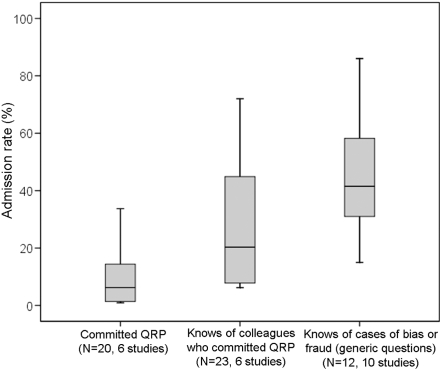
- Other questionable research practices were reported more often: up to 33.7% in self-reports and up to 72% when asking about colleagues.
Methods
- Systematic review and meta-analysis of quantitative surveys asking scientists whether they had committed or observed scientific misconduct in the past; plagiarism and other non-knowledge-distorting misconduct were excluded.
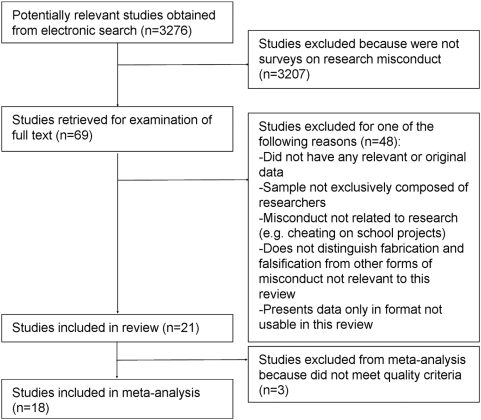
- Searches were run in the first two weeks of August 2008 across citation databases, journals, grey literature sources, and internet search engines; the final review included 21 studies, with 18 in the meta-analysis.
- Main analysis computed the proportion recalling at least one incident, logit-transformed and inverse-variance weighted in a random-effects meta-analysis; meta-regression tested methodological factors such as self vs. non-self reports, mailed vs. handed-out surveys, and use of the words “fabrication”/“falsification.”
Limitations
- The paper states that using the percentage of respondents recalling at least one incident is a rough measure of misconduct frequency; this can under- or overestimate prevalence depending on whether respondents committed multiple incidents or only one.
- The paper notes that non-response bias was recognized by most surveys as a limitation, and that the validity of self-reports may be affected by social expectations; the text also suggests self-reports likely underestimate misconduct.
- Evident from the text: the included studies were heterogeneous in methods and wording, and some outcomes were too diverse for meaningful meta-analysis, so only crude unweighted parameters were calculated for broader questionable research practices.
Model-written summary. Check it against the paper before relying on it.
Integrity signals
Registry
Cites
Statistics
Figures
Verification
Claims the paper makes
0 Valid · 0 Not valid · 14 Not checked · 61 Own results and interpretations
A result the paper reports from its own data — it cites no other source for it, so there is none to check. The quote shows it is in the paper.
In the paper
“When these factors were controlled for, misconduct was reported more frequently by medical/pharmacological researchers than others.”
§ How Many Scientists Fabricate and Falsify Research? A Systematic Review and Meta-Analysis of Survey Data > Abstract
plainstates an association- Asserted: passes — The authors put it forward as true.
- Checkable: passes — It can be checked against evidence.
- Load-bearing: passes — The paper’s conclusions depend on it.
- Based: passes — The paper gives a reason why it holds.
- Rests on 2 assumptions not shown here.
A result the paper reports from its own data — it cites no other source for it, so there is none to check. The quote shows it is in the paper.
In the paper
“A pooled weighted average of 1.97% (N = 7, 95%CI: 0.86–4.45) of scientists admitted to have fabricated, falsified or modified data or results at least once –a serious form of misconduct by any standard– and up to 33.7% admitted other questionable research practices.”
§ How Many Scientists Fabricate and Falsify Research? A Systematic Review and Meta-Analysis of Survey Data > Abstract
plainn = 7- Asserted: passes — The authors put it forward as true.
- Checkable: passes — It can be checked against evidence.
- Load-bearing: passes — The paper’s conclusions depend on it.
- Based: passes — The paper gives a reason why it holds.
- Rests on 2 assumptions not shown here.
A result the paper reports from its own data — it cites no other source for it, so there is none to check. The quote shows it is in the paper.
In the paper
“A pooled weighted average of 1.97% (N = 7, 95%CI: 0.86–4.45) of scientists admitted to have fabricated, falsified or modified data or results at least once –a serious form of misconduct by any standard– and up to 33.7% admitted other questionable research practices.”
§ How Many Scientists Fabricate and Falsify Research? A Systematic Review and Meta-Analysis of Survey Data > Abstract
plain- Asserted: passes — The authors put it forward as true.
- Checkable: passes — It can be checked against evidence.
- Load-bearing: passes — The paper’s conclusions depend on it.
- Based: passes — The paper gives a reason why it holds.
- Rests on 2 assumptions not shown here.
A result the paper reports from its own data — it cites no other source for it, so there is none to check. The quote shows it is in the paper.
In the paper
“In surveys asking about the behaviour of colleagues, admission rates were 14.12% (N = 12, 95% CI: 9.91–19.72) for falsification, and up to 72% for other questionable research practices.”
§ How Many Scientists Fabricate and Falsify Research? A Systematic Review and Meta-Analysis of Survey Data > Abstract
plainn = 12- Asserted: passes — The authors put it forward as true.
- Checkable: passes — It can be checked against evidence.
- Load-bearing: passes — The paper’s conclusions depend on it.
- Based: passes — The paper gives a reason why it holds.
- Rests on 2 assumptions not shown here.
A result the paper reports from its own data — it cites no other source for it, so there is none to check. The quote shows it is in the paper.
In the paper
“Meta-analysis yielded mean pooled estimates that are higher than most previous estimates.”
§ How Many Scientists Fabricate and Falsify Research? A Systematic Review and Meta-Analysis of Survey Data > Introduction
plain- Asserted: passes — The authors put it forward as true.
- Checkable: passes — It can be checked against evidence.
- Load-bearing: passes — The paper’s conclusions depend on it.
- Based: passes — The paper gives a reason why it holds.
- Rests on 2 assumptions not shown here.
31 more claims
Create a free account to see all 75 claims and to verify the 4 references still open.
- It may state two separate claims as one. 24
- Probably not a substantial claim. 25
Claims other papers make about this one
Each is checked against this paper’s own text: does it say what the citing paper says it does?
The cited source says what the claim attributes to it.
In the citing paper
“there are other more common sources of unreliability in the literature (41)(42)(43)(44)”
From Misconduct accounts for the majority of retracted scientific publications (2012) · cites this paper as [43]
The cited source says what the claim attributes to it.
In the citing paper
“The prevalence of researchers who have been involved in scientific misconduct is estimated to be around 2% [2]”
From Checklist to assess Trustworthiness in RAndomised Controlled Trials (TRACT checklist): concept proposal and pilot (2023) · cites this paper as [2]
The cited source says what the claim attributes to it.
In the citing paper
“This is how a small number of people 40 with flexible morals can pollute the scientific literature disproportionately.”
From Fraudulent studies are undermining the reliability of systematic reviews: on the prevalence of problematic images in preclinical depression studies (2025) · cites this paper as [40]
The cited source says what the claim attributes to it.
In the citing paper
“A meta-analysis by Fanelli, combining the results of 18 published surveys, found that 1.9% of researchers have admitted to modification, falsification, or fabrication of data (3).”
From The Prevalence of Inappropriate Image Duplication in Biomedical Research Publications (2016) · cites this paper as [3]
The cited source says what the claim attributes to it.
In the citing paper
“A systematic review and meta-analysis of survey data estimated that 1.97% of authors admitted to have fabricated, falsified, or modified data or results at least once and, in surveys asking about the behavior of colleagues, the admission rate was 14.12% for falsification [13].”
From No raw data, no science: another possible source of the reproducibility crisis (2020) · cites this paper as [13]
6 more claims about this paper
Create a free account to see every claim other papers make about this one.
Citations
Cites
(2000) · Cited by 9,198
The Sociology of Science: Theoretical and Empirical Investigations
Kaplan, N., Merton, R. K., & Storer, N. W. (1974) · Technology and Culture · doi:10.2307/3102264 · Cited by 4,005
The Normative Structure of Science
Merton, R. Κ. (1973) · Medical Entomology and Zoology · Cited by 2,315
The Hazards of Scoring the Quality of Clinical Trials for Meta-analysis
Jüni, P. (1999) · JAMA · doi:10.1001/jama.282.11.1054 · Cited by 1,981 · cited 1×
“All remaining papers were included, and were not graded on a quality scale, because the validity and use of quality measures in meta-analysis is controversial [21], [22].”
BackgroundScope and Impact of Financial Conflicts of Interest in Biomedical Research: A Systematic Review
Bekelman, J. E., Li, Y., & Gross, C. P. (2003) · JAMA · doi:10.1001/jama.289.4.454 · Cited by 1,816 · cited 1×
“This would support growing fears that the large financial interests that often drive medical research are severely biasing it [50], [51], [52].”
BackgroundTourangeau, R., & Smith, T. W. (1996) · Public Opinion Quarterly · doi:10.1086/297751 · Cited by 1,295 · cited 1×
“However, the accuracy of responses to sensitive questions is often independent of response rates, and depends strongly on respondents' perception of anonymity and confidentiality [43], [44].”
BackgroundA comparison of methods to detect publication bias in meta‐analysis
Macaskill, P., Walter, S. D., & Irwig, L. (2001) · Statistics in Medicine · doi:10.1002/sim.698 · Cited by 1,286 · cited 1×
“The popular funnel-plot-based methods to test for publication bias in meta-analysis are inappropriate and potentially misleading when the number of included studies is small and heterogeneity is large [25], [26].”
MethodMartinson, B. C., Anderson, M. S., & de Vries, R. (2005) · Nature · doi:10.1038/435737a · Cited by 1,096 · cited 9×
“All the above results were robust with respect to inclusion or exclusion of any particular study, with perhaps one exception: Martinson et al. (2005) [19], which is one of the largest and most frequently cited surveys on misconduct published to date.”
BackgroundMethodResultInfluentialAdjusting for publication bias in the presence of heterogeneity
Terrin, N., Schmid, C. H., Lau, J., & Olkin, I. (2003) · Statistics in Medicine · doi:10.1002/sim.1461 · Cited by 809 · cited 1×
“The popular funnel-plot-based methods to test for publication bias in meta-analysis are inappropriate and potentially misleading when the number of included studies is small and heterogeneity is large [25], [26].”
MethodIs Academic Medicine for Sale?
Angell, M. (2000) · New England Journal of Medicine · doi:10.1056/nejm200005183422009 · Cited by 582
Research works printed but not linked: 2
- Eastwood S Derish P Leash E Ordway S 1996 Ethical issues in biomedical research: perceptions and practices of postdoctoral research fellows responding to a survey. Science and Engineering Ethics 2 89 114 11657788 · DOI
- Kattenbraker MS 2007 Health education research and publication: ethical considerations and the response of health educators Carbondale Southern Illinois University.Doctoral dissertation
Cited by
Items 1,201–1,300 of 1,924
The Tempo Giusto : A Call for Recalibrating Time in Human Movement Research
Ramalho, A. L. G., Duarte‐Mendes, P., Paulo, R. M., & Petrica, J. (2025) · Quest · doi:10.1080/00336297.2025.2586504 · Cited by 4
“…– the delay between publication and incorporation into cumulative knowledge – lengthen as findings accumulate faster than they can be integrated (Tria et al., 2014), 1 and indicators of integrity show strain: self-reports of questionable practices rise under pressure to publish (Fanelli, 2009).”
Essentials of research integrity for ecologists
Schlacher Thomas, A., Assaf, Y., Barboza, C. A. D. M., Corte, G. N., Leonardo, C., Dugan, J. E., Michael, E., Emery, K., Fanini, L., Hubbard, D. M., et al. (2025) · Estuarine Coastal and Shelf Science · doi:10.1016/j.ecss.2025.109686 · Cited by 2
Ética de la comunicación científica
Elli, J. R. (2015) · Neurología Argentina · doi:10.1016/j.neuarg.2014.07.004 · Cited by 4
Institutional research and biomedical journals: Poor quality articles and honest researchers!
Maisonneuve, H., & Slim, K. (2015) · Journal of Visceral Surgery · doi:10.1016/j.jviscsurg.2015.09.004 · Cited by 2
Redman, B. K., & Caplan, A. L. (2015) · Research Ethics · doi:10.1177/1747016115587157 · Cited by 3
“The rate reported largely in the US and UK summarized in a systematic review was 14% (Fanelli, 2009).”
BackgroundPublish and who should perish: you or science?
Kun, Á. (2019) · Science Editor and Publisher · doi:10.24069/2542-0267-2019-1-2-76-93 · Cited by 4
“Сколько мелких манипуляций и выдумок проходят незамеченными? Когда 2% исследователей признают, что они сфабриковали данные или манипулировали ими [82], тогда проблема скорее носит системный характер, нежели заключается в действиях отдельных «злодеев от науки».”
Transparency and Reproducibility: Potential Solutions
Christensen, G., & Miguel, E. A. (2020) · Cambridge University Press eBooks · doi:10.1017/9781108762519.007 · Cited by 3
Governing knowledge in the scientific community: Exploring the role of retractions in biomedicine
Furman, J. L., Jensen, K. L., & Murray, F. (2012) · RePEc: Research Papers in Economics · Cited by 2
Questionable Research Practices (QRPs) and Their Devastating Scientific Effects
Bausell, R. B. (2021) · Oxford University Press eBooks · doi:10.1093/oso/9780197536537.003.0004 · Cited by 2
Managing Data and Statistical Code According to the FAIR Principles
Janda, L. A. (2022) · The MIT Press eBooks · doi:10.7551/mitpress/12200.003.0042 · Cited by 2
Decay of Web References in Academic Publications: A Case of Turkish Librarianship Journal
Yayla, K. (2022) · Türk Kütüphaneciliği · doi:10.24146/tk.1048628 · Cited by 3
Percepção do Conceito de Plágio no curso de Ciências Biológicas da Universidade de Brasília
Gomes, P. H. D. S. F., & de Menezes, J. P. C. (2022) · Revista Brasileira de Ensino Superior · doi:10.18256/2447-3944.2022.v6i1.3572 · Cited by 2
Questionable Research Practices Among Dentists
Waseem, U., Awan, S., Malik, K. A., Javed, D., Zafar, S., Khan, F. A., & Tariq, A. (2022) · Pakistan Journal of Medical and Health Sciences · doi:10.53350/pjmhs22169415 · Cited by 2
Ethics in scientific publication: spectrum of misconducts
PINTO, A., Capasso, R., Gianluca, M. U. T. O., BIANCHI, E., Guida, F., RODRIGUEZ, R., ROSSI, C., & Vecchione, D. (2023) · Journal of Radiological Review · doi:10.23736/s2723-9284.22.00217-1 · Cited by 3
Forschungs- und Wissenschaftsethik
Döring, N. M. (2023) · Springer eBooks · doi:10.1007/978-3-662-64762-2_4 · Cited by 3
Development of a Concept Inventory on Open and Transparent Research Practices
Markant, D. B., & Galati, A. (2023) · Collabra Psychology · doi:10.1525/collabra.75226 · Cited by 3
Qusada, A. H. (2023) · Cureus · doi:10.7759/cureus.43382 · Cited by 3
“In order to conduct research on living things in the Saudi Arabian context without breaking any laws, the Law of Ethics of Research on Living Things (Article 321, by the Ministers' Council to the King of Saudi Arabia in 2010) and the implementing regulations of the Law of Ethics of Research on Living Things, which was…”
BackgroundInfluentialMachado, B. C., Almódovar, A. A. B., Vicentini, A. P., Catarino, R. M., Bugno, A., da Cruz, L. N., & Caiaffa-Filho, H. (2022) · BEPA Boletim Epidemiológico Paulista · doi:10.57148/bepa.2022.v.19.37814 · Cited by 1
How can we assess whether to trust collectives of scientists?
Clark, E. (2024) · The British Journal for the Philosophy of Science · doi:10.1086/729661 · Cited by 1
Understanding Contract Cheating and Essay Mills Through a Social Lens in the Era of Web 3.0
Khan, Z. R., Vel, P., Asylguzhina, E., & Mulani, V. (2024) · Springer international handbooks of education · doi:10.1007/978-3-031-54144-5_116 · Cited by 2
Leclerc, O., & Klausser, N. (2024) · Research Ethics · doi:10.1177/17470161241240241 · Cited by 6
“…directly and have therefore been addressed using imperfect proxies such as surveys of scientists (Anderson, 1993; Dubois and Guaspare, 2022; Fanelli, 2009; Haven et al., 2019; Palla and Singson, 2023; Seadle, 2017; Zuckerman, 2020), the number of retractions (Fanelli, 2013; Fang et al.,…”
Hyper-ambition and the Replication Crisis: Why Measures to Promote Research Integrity can Falter
Erden, Y. J. (2024) · Journal of Academic Ethics · doi:10.1007/s10805-024-09528-5 · Cited by 5
“There is much evidence that all of this feeds into what has been called a ‘replication cri-sis’ across a number of sciences, and which has thrown academic measures of success into sharp relief (Ioannidis, 2005; Fanelli, 2009; Ritchie, 2020).”
A Novel Natural Language Processing Based Model for Plagiarism Detection
Patil, R., Kadam, V., Nakate, R., Kadam, S., Pattade, S., & Mitkari, M. (2024) · International Conference on Emerging Smart Computing and Informatics (ESCI) · doi:10.1109/esci59607.2024.10497386 · Cited by 2
“Further research corroborates these apprehensions: 60% of scientists surveyed in Science and Engineering Ethics in 2018 reported having observed or suspected plagiarism among colleagues [19].”
ResultŠinko, L., Baehr, L. A., Murray, E. S. H., Kobulsky, J. M., McLoughlin, G. M., Schroeder, K., & Schumacher, L. M. (2024) · Health Promotion Practice · doi:10.1177/15248399241278966 · Cited by 3
“From falsified research outcomes (Fanelli, 2009) to instances of plagiarism and data manipulation (Van Noorden, 2022), to the loss of public confidence in the research enterprise (Kazemian et al., 2021), the prevalence of research misconduct highlights the urgent need for comprehensive prevention…”
Artificial intelligence: The researcher's assistant or sheep in wolf's clothing?
Anthea, P., & Campani, C. (2024) · United European Gastroenterology Journal · doi:10.1002/ueg2.12689 · Cited by 3
Costa, P. I. D., Gass, S. M., Manchón, R. M., et al. (2024) · Research methods in applied linguistics · doi:10.1075/rmal.7.22dec · Cited by 2
Challenges and Best Practices in Research Ethics and Integrity
(2024) · Advances in medical education, research, and ethics (AMERE) book series · doi:10.4018/979-8-3693-3828-5.ch006 · Cited by 2
Ethical Pitfalls in Scientific Publishing
Thulasingam, M., & Karthikeyan, B. (2024) · International Journal of Advanced Medical and Health Research · doi:10.4103/ijamr.ijamr_265_24 · Cited by 2
Hailu, H. B., Wolde, T. T., Wubete, B. Y., Ali, J., & Bitew, S. T. (2025) · F1000Research · doi:10.12688/f1000research.159997.1 · Cited by 5
“I would suggest inserting 'a' in front of 'Public University.”
Crone, G., & Green, C. D. (2025) · Theory & Psychology · doi:10.1177/09593543241311861 · Cited by 3
“In another systematic review, Fanelli (2009) reviewed 21 surveys in which scientific researchers were asked to anonymously disclose if they, or other researchers they knew, fabricated data.”
Grimes, D. R., & Gorski, D. H. (2025) · Journal of Medical Internet Research · doi:10.2196/64679 · Cited by 3
“There is increasing recognition that much of what is published in medical journals may not be reproducible and that biased, or outright fabricated results, taint biomedical literature [28-30], an alarmingly common occurrence [31].”
Velicu, A., Winter, F., Rathmann, J. M. K., & Rauhut, H. (2025) · Scientometrics · doi:10.1007/s11192-025-05357-4 · Cited by 3
“QRP lacks an all-encompassing definition (for examples, see Fanelli, 2009), and can include many behaviors.”
InfluentialFlanagan, M., Rattan, A., Au, L. S., Patabendige, M., Whigham, C., Jans, S. M. P. J., Cofie, P., Hofmeyr, G. J., Rosseland, L. A., Weeks, A. D., et al. (2025) · BJOG An International Journal of Obstetrics & Gynaecology · doi:10.1111/1471-0528.18279 · Cited by 3
“There is increasing evidence that data with compromised integrity are included in evidence synthesis within medicine [12–15], and also in obstetrics and gynae-cology [16, 17].”
Scientific misconduct in the pharmaceutical industry
Hoogendoorn, M.-L., & de Lange, A. (2013) · Utrecht University Repository (Utrecht University) · Cited by 2
Current State in Scientific Publishing: AOA Critical Issues Symposium
Wolf, J. M., Sandell, L. J., Leopold, S. S., & Dodson, K. (2019) · Journal of Bone and Joint Surgery · doi:10.2106/jbjs.18.01260 · Cited by 2
Tagging My Tears and Fears: Text-Mining the Autoethnography
Sapach, S. (2020) · Digital Studies / Le champ numérique · doi:10.16995/dscn.328 · Cited by 2
Blockchain and Clinical Data Economics: The Tokenization of Clinical Research in the EU
Pêgo, A. C., Raposo, I. G., & Loureiro, M. (2021) · Advances in data mining and database management book series · doi:10.4018/978-1-7998-7363-1.ch011 · Cited by 3
Nine Ways to Detect Possible Scientific Misconduct in Research with Small (N < 200) Samples
Schumm, W. R., Crawford, D. W., Lockett, L., AlRashed, A., & bin Ateeq, A. (2021) · Psychology Research and Applications · doi:10.22606/pra.2021.32001 · Cited by 3
Developing RRI and Research Ethics in Universities
Sánchez, L. B., & Feenstra, R. A. (2023) · Lecture notes in computer science · doi:10.1007/978-3-031-33177-0_7 · Cited by 2
Collins, H. M., & Bornmann, L. (2014) · Journal of the Association for Information Science and Technology · doi:10.1002/asi.23159 · Cited by 2
“In surveys asking about the behavior of colleagues, admission rates were 14.12% (N = 12, 95% CI: 9.91–19.72) for falsification, and up to 72% for other questionable research practices” (Fanelli, 2009).”
InfluentialAcademic misconduct in teaching portfolios
Erikson, M. G., Erlandson, P., & Erikson, M. (2015) · The International Journal for Academic Development · doi:10.1080/1360144x.2015.1083435 · Cited by 3
“Fanelli (2009) also reported that falsifications had been observed by 14% of the scientists in the studies, and as many as 72% had observed other questionable practices by colleagues.”
BackgroundInfluentialPrivacy-Preserving Verification of Clinical Research
Makri, E., Everts, M. H., Hoogh, D. S., et al. (2014) · University of Twente Research Information · Cited by 2
Langhoff‐Roos, J., & Geirsson, R. T. (2011) · Acta Obstetricia Et Gynecologica Scandinavica · doi:10.1111/j.1600-0412.2011.01243.x · Cited by 2
“We think that when the final enquiry has shown that wrong data acquisition or data handling was not wilfully done, then those researchers should also have a right to have their voice heard again on the matter (3,4).”
BackgroundOld Studies with New Authors: A Discovery Ending with Retraction
Paszkowicz, W., Pelka, J. B., Krupka, J., & Abramowicz, A. (2011) · Acta Physica Polonica A · doi:10.12693/aphyspola.119.901 · Cited by 2
“[5]).”
Noorden, R. V. (2013) · Nature · doi:10.1038/497300a · Cited by 2
Petites et grandes fraudes scientifiques
Fagot-Largeault, A. (2011) · Collège de France eBooks · doi:10.4000/books.cdf.1620 · Cited by 4
Moreno‐Rueda, G. (2011) · Science and Engineering Ethics · doi:10.1007/s11948-011-9289-8 · Cited by 2
“Meanwhile, surveys have reported that about 2% of scientists admit having committed misconduct, which gives a conservative estimate (Fanelli 2009).”
BackgroundInfluentialEducation in the Responsible Conduct of Research in Psychology: Methods and Scope
DiLorenzo, T. A., Becker-Fiegeles, J., & Gibelman, M. (2013) · Accountability in Research · doi:10.1080/08989621.2014.847659 · Cited by 5
“A recent meta-analysis (Fanelli, 2009) of 18 published studies on misconduct reported that only 2% of scientists have engaged in misconduct.”
BackgroundSchraub, S., & Ayed, F. B. (2010) · ONCOLOGIE · doi:10.1007/s10269-010-1960-1 · Cited by 3
“En 2009, Fanelli a publié la première méta-analyse des enquêtes concernant la fraude [13].”
BackgroundTharyan, P. (2012) · Mens Sana monographs · doi:10.4103/0973-1229.91426 · Cited by 3
“These are referred to merely as “questionable research practices” (QRS) by some (Fanelli, 2009 [7] ).”
Medeiros, K. E., Gibson, C., Mecca, J. T., Giorgini, V., Connelly, S., & Mumford, M. D. (2015) · Accountability in Research · doi:10.1080/08989621.2014.989219 · Cited by 2
“7% of surveyed researchers admitted to engaging in some form of questionable research practice (Fanelli, 2009).”
BackgroundInfluentialALGUMAS REFLEXÕES SOBRE O EXERCÍCIO DA PESQUISA NA EDUCAÇÃO FÍSICA
da Silva, P. M., Kubo, K. C. D. M. L., Camata, T. V., & Soriano, J. B. (2013) · Pensar a Prática · doi:10.5216/rpp.v16i4.20895 · Cited by 3
Empirically Supported Treatments and Efficacy Trials: What Steps Do We Still Need to Take?
Nasser, J. D. (2013) · Journal of Contemporary Psychotherapy · doi:10.1007/s10879-013-9236-x · Cited by 2
“; Feeny et al. 2009, p. 726).”
BackgroundJeon, Y.-K., Joo, Y.-R., Ye, E., Kim, M.-S., & Jeon, C. (2013) · Journal of Korean Ophthalmic Optics Society · doi:10.14479/jkoos.2013.18.2.187 · Cited by 2
Sánchez, P. G., Uribe, L. M. I., & Yebra, J. M. (2016) · Dialnet (Universidad de la Rioja) · Cited by 2
STATISTICS, BIOMEDICINE AND SCIENTIFIC FRAUD
Felice, C. D., Cortelazzo, A., Leoncini, S., Signorini, C., Hayek, J., & Ciccoli, L. (2016) · Journal of the Siena Academy of Sciences · doi:10.4081/jsas.2015.6411 · Cited by 2
Burdens without blessings: Peer reviewers get no respect
Ferraris, V. A. (2017) · Journal of Thoracic and Cardiovascular Surgery · doi:10.1016/j.jtcvs.2016.12.028 · Cited by 5
Wong, P. N. (2017) · Bandung · doi:10.1186/s40728-017-0043-8 · Cited by 2
“These would entail the following aspects (Boughton 2017a, b; Fanelli 2009).”
BackgroundHow Asian publishers can compete with publishers in Europe and North America
Huh, S. Y. (2018) · Science Editing · doi:10.6087/kcse.124 · Cited by 2
Framing the Game: An Architectonic Analogue for Meta-Theorizing Academic Activities
Spitzberg, B. H. (2018) · Studies in Media and Communication · doi:10.11114/smc.v6i1.2943 · Cited by 2
“13 Such hyper-competitiveness may in part account for the risky moves of falsifying research (Fanelli, 2009), as well as the ever-burgeoning market that solicits research in a manner often independent of its actual quality (Bohannon, 2013).”
Chapter 2: Questioning the Virtue of Virtue Ethics: Slowing the Rush to Virtue in Research Ethics
Kwiatkowski, R. M. (2018) · Advances in research ethics and integrity · doi:10.1108/s2398-601820180000003003 · Cited by 2
Faria, R. (2018) · Springer eBooks · doi:10.1007/978-3-319-73435-4_2 · Cited by 2
Improving the ACGIH threshold limit value (TLV) process
Smith, C. J., & Perfetti, T. A. (2018) · Toxicology Research and Application · doi:10.1177/2397847318801758 · Cited by 3
Social Costs of Non-Responsible Research
Faucheux, S., Combe, C. G., Kuszla, C., & O’Connor, M. (2019) · Springer eBooks · doi:10.1007/978-3-030-11458-9_11 · Cited by 7
The market for scientific lemons, and the marketization of science
Bonilla, J. Z. (2019) · THEORIA An International Journal for Theory History and Foundations of Science · doi:10.1387/theoria.19508 · Cited by 2
Kotavaara, O. (2019) · Fennia · doi:10.11143/fennia.80216 · Cited by 2
The Index Thomisticus as a Big Data Project
Rockwell, G., & Passarotti, M. (2018) · Umanistica Digitale · doi:10.6092/issn.2532-8816/8575 · Cited by 2
Dealing with Imperfect Elicitation Results
van de Schoot, R., Griffioen, E., & Winter, S. D. (2021) · International series in management science/operations research/International series in operations research & management science · doi:10.1007/978-3-030-46474-5_18 · Cited by 2
Ethical and Legal Considerations
Flanagin, A. (2020) · Oxford University Press eBooks · doi:10.1093/jama/9780190246556.003.0005 · Cited by 6
What’s Wrong with Replicating the Old Boys’ Networks?
Teele, D. L. (2020) · Cambridge University Press eBooks · doi:10.1017/9781108762519.016 · Cited by 2
The Use and Misuse of Statistics
Sawka, K. A. (2020) · Springer eBooks · doi:10.1007/978-3-030-48043-1_7 · Cited by 2
Nasr, S. S., Sherif, G. M., Ibrahim, A. S., & Allam, R. M. (2020) · Journal of the Egyptian National Cancer Institute · doi:10.1186/s43046-020-00050-4 · Cited by 2
Park, T., Song, H., & Lee, S. J. (2021) · IEEE Access · doi:10.1109/access.2021.3071794 · Cited by 2
The Common Statistical Faux Pas in Journal Publications
Balogun, J. A. (2021) · Springer eBooks · doi:10.1007/978-3-030-75385-6_68 · Cited by 2
Gerring, J. (2020) · Cambridge University Press eBooks · doi:10.1017/9781108762519.013 · Cited by 2
Haug, C. J., Hofmann, B., Irgens-Jensen, H., Nagel, A., Nydal, R., Rognstad, O.-A., Solberg, B., & Kalleberg, R. (2016) · doi:10.17585/noasp.8.25 · Cited by 2
The admissibility of fingerprint evidence: An African perspective
Ezegbogu, M. O., & Omede, P. I.-O. (2022) · Canadian Society of Forensic Science Journal · doi:10.1080/00085030.2022.2068404 · Cited by 6
Lotsberg, M. L., & Peters, S. D. (2022) · Human perspectives in health sciences and technology · doi:10.1007/978-3-030-92612-0_10 · Cited by 4
Malas prácticas en la escritura científica
Rodríguez, A. D. R. (2022) · Fides et Ratio - Revista de Difusión cultural y científica de la Universidad La Salle en Bolivia · doi:10.55739/fer.v23i23.109 · Cited by 5
Cohort Studies, Meta-analyses, and Clinical Trials in Childhood Hypertension
Larkins, N., & Craig, J. C. (2018) · Springer eBooks · doi:10.1007/978-3-319-31107-4_54 · Cited by 2
Joubert, P., & Rogers, S. M. (2015) · Springer eBooks · doi:10.1007/978-3-662-48316-9_6 · Cited by 2
Freckelton, I. R. (2020) · Springer eBooks · doi:10.1007/978-3-319-76040-7_6-2 · Cited by 2
Publish without bias or perish without replications
Ventura, R. (2022) · Studies in History and Philosophy of Science Part A · doi:10.1016/j.shpsa.2022.08.010 · Cited by 2
Financial Conflicts of Interest in School Psychology: A Continuing Problem
Beaujean, A. A., McGill, R. J., & Dombrowski, S. C. (2022) · Contemporary School Psychology · doi:10.1007/s40688-022-00435-3 · Cited by 3
“Despite scientists’ good faith efforts at minimizing bias in their work, they can still engage in questionable research practices that may alter what they conclude from their investigations (Fanelli, 2009; John et al., 2012).”
Evaluating Policy Impact: Working Out What Works
Leigh, A. (2023) · Australian Economic Review · doi:10.1111/1467-8462.12530 · Cited by 2
An Epistemic Advantage of Accommodation over Prediction
Dellsén, F. (2023) · Philosophers Imprint · doi:10.3998/phimp.4961 · Cited by 2
Leucht, S., Siafis, S., Schneider‐Thoma, J., Tajika, A., Priller, J., Davis, J. M., & Furukawa, T. A. (2024) · Schizophrenia · doi:10.1038/s41537-024-00442-8 · Cited by 3
“It does, of course, not mean that all studies emerging from such countries are methodologically poor and that all studies from more experienced countries are good 27 , but problems must be expected more frequently in the former.”
BackgroundShould Researchers Destroy Audio or Video Recordings?
Resnik, D. B., Antes, A. L., & Mozersky, J. T. (2024) · Ethics & Human Research · doi:10.1002/eahr.500205 · Cited by 7
Ivory, J. (2024) · Media and Communication · doi:10.17645/mac.7852 · Cited by 2
“…practices” (John et al., 2012) enter the parlance as grim reminders that a primary culprit for the replication crisis is at best selective flexibility in analysis, reporting, and publication of data and, at worst, deliberate misrepresentation of findings (Fanelli, 2009; Simmons et al., 2011).”
BackgroundHolm, S., Hofmann, B., & Laake, P. (2015) · Elsevier eBooks · doi:10.1016/b978-0-12-799943-2.00002-1 · Cited by 2
Neutralidade científica: aspectos éticos na obtenção de resultados
Aznar, F. D. D. C., de Freitas, A. R., Capelari, M. M., Aznar, F. D. C., Peres, S. H. D. C. S., & Sales-Peres, A. (2017) · Revista latinoamericana de bioética · doi:10.18359/rlbi.1899 · Cited by 3
Troublesome News, Fake News, Biased or Incomplete News
Shader, R. I. (2018) · Clinical Therapeutics · doi:10.1016/j.clinthera.2018.08.003 · Cited by 2
Integridad y conductas inapropiadas en investigación biomédica
Luisa Schonhaut, B. (2019) · Revista chilena de pediatría · doi:10.32641/rchped.v90i2.1034 · Cited by 3
Victims and addicts of biostatistics
Morken, N. (2019) · Acta Obstetricia Et Gynecologica Scandinavica · doi:10.1111/aogs.13669 · Cited by 2
Two Questions to Foster Critical Thinking in the Field of Psychology
Holtz, P. (2020) · Meta-Psychology · doi:10.15626/mp.2018.984 · Cited by 5
“A closely related problem is the apparently frequent use of questionable research practices (QRPs; Fanelli, 2009; Leslie, Loewenstein, & Prelec, 2012; Martinson, Anderson, De Vries, 2005) such as phacking (making a statistically non-significant result appear significant; Simmons, Nelson, &…”
BackgroundGerring, J., & Cojocaru, L. (2020) · Cambridge University Press eBooks · doi:10.1017/9781108762519.005 · Cited by 1
Les manques à l’intégrité scientifique et médicale
Sculier, J. (2015) · Cahiers de psychologie clinique · doi:10.3917/cpc.044.0013 · Cited by 4
Misconduct in scientific publications
Glina, S. (2012) · Einstein (São Paulo) · doi:10.1590/s1679-45082012000400001 · Cited by 2
“Fanelli(3) published a meta-analysis evaluating the publications that investigated scientists behavior on misconduct.”
BackgroundPragmatism and Psychological Flexibility in the Research Context
Long, D. M., & Sanford, B. T. (2015) · Wiley eBooks · doi:10.1002/9781118489857.ch6 · Cited by 5
End of Publication? Open access and a new scholarly communication technologyPreprint
Parinov, S. I., & Antonova, V. K. (2016) · arXiv (Cornell University) · doi:10.48550/arxiv.1608.05505 · Cited by 2
“By the direct pre-publication communication, the research community should achieve better cooperation among the scholars and more transparency in research, which became highly demanded during the last years [4], [5].”
Background
Metadata
- Authors
- Fanelli, D.
- Affiliations
- University of Edinburgh (GB)
- Corresponding author
- Fanelli, Daniele
- ORCID
- Fanelli, Daniele
- Venue
- PLoS ONE
- Publisher
- Public Library of Science (PLoS)
- Published
- 2009-05-29
- Volume
- 4
- Issue
- 5
- Pages
- e5738
- ISSN
- 1932-6203 (ISSN-L)
- PMC
- PMC2685008
- OpenAlex
- W2152243616
- Cited by
- 1,911
- References
- 74
- Citations by year
- 2026: 77 · 2025: 110 · 2024: 128 · 2023: 136 · 2022: 157 · 2021: 145 · 2020: 163 · 2019: 166 · 2018: 125 · 2017: 125 · 2016: 119 · 2015: 106 · 2014: 82 · 2013: 93 · 2012: 84
- FWCI
- 19.42
- Type
- journal article
- Language
- en
- Open access
- gold
- doi.org
- Locations
- PLoS ONE (publishedVersion, cc-by)
- PubMed Central (publishedVersion, cc-by)
- PubMed (publishedVersion)
- Edinburgh Research Explorer (University of Edinburgh) (acceptedVersion, public-domain)
- RePEc: Research Papers in Economics (submittedVersion)
- DOAJ (DOAJ: Directory of Open Access Journals) (submittedVersion, cc-by-sa)
- Figshare (submittedVersion, cc-by)
- DigitalGeorgetown (Georgetown University Library) (submittedVersion)
- Funders
- European Commission (221441)
- Economic and Social Research Council (ES/F028180/1)
- Topics
- Social Sciences › Education › Academic integrity and plagiarism
- Physical Sciences › Mathematics › Statistics and Probability › Benford’s Law and Fraud Detection
- Social Sciences › Library and Information Sciences › Academic Publishing and Open Access
- Keywords
- research misconduct, scientific fraud, data fabrication, data falsification, questionable research practices, self-report questionnaire
- MeSH terms
- Data Collection, Regression Analysis, Research Personnel, Scientific Misconduct, Ethics, Research
About these checks
Registry, retraction, Cites and statistics results are computed, not judged, with one exception: a printed reference that no index lists is read once by a model before it counts as a citation error. Claims are extracted by a model and kept only when their quote appears verbatim in the text; each cited source is then checked, with a model’s help, for whether it says what the claim relies on. Those verdicts can be wrong — read the claim’s quote and the cited source before relying on one.
A language model drew the claims from the paper on 2026-10-10, under version 3 of the claim definition (model deepseek-v4.1-flash, prompt extract-v3).
A second model labelled each claim on 2026-10-10 (model jev-1.13-20260917, definition revision gold-guideline-v0.2).
Statistics and arithmetic are recomputed, not judged.
Confidence bands are shown only for fields calibrated on our annotated test set. None is calibrated yet, so no band is shown.
What counts as a claim ›How we measure confidence ›How we check this ›
Are you an author, or do you see a problem with this page? Request a review
Data sources
Bibliographic data: Semantic Scholar, OpenAlex, Crossref.
Contains information from the Semantic Scholar Academic Graph Datasets, made available under the ODC Attribution License (ODC-BY 1.0).
Semantic Scholar’s data is described in: Kinney, R., et al. (2023). The Semantic Scholar Open Data Platform. arXiv:2301.10140.
