

How Many Scientists Fabricate and Falsify Research? A Systematic Review and Meta-Analysis of Survey Data
Open accessThe DOI matches its Crossref record; 66 of the 74 references it cites were found in a registry or an index; none of the 21 sources its claims cite is checked for support yet.
Abstract
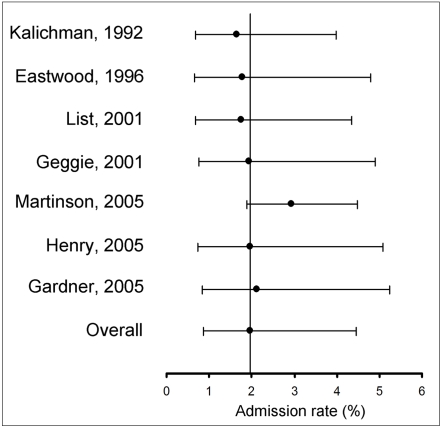
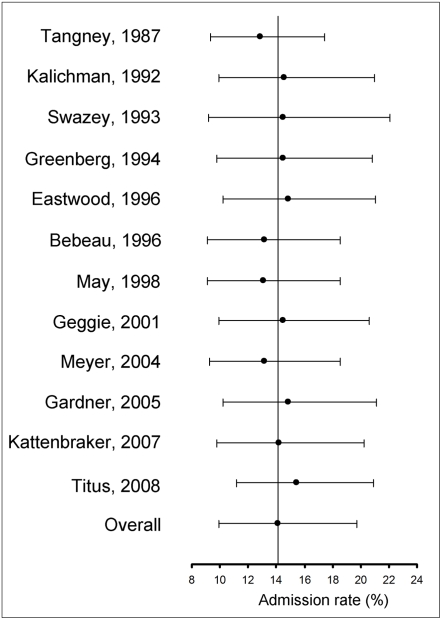
The frequency with which scientists fabricate and falsify data, or commit other forms of scientific misconduct is a matter of controversy. Many surveys have asked scientists directly whether they have committed or know of a colleague who committed research misconduct, but their results appeared difficult to compare and synthesize. This is the first meta-analysis of these surveys. To standardize outcomes, the number of respondents who recalled at least one incident of misconduct was calculated for each question, and the analysis was limited to behaviours that distort scientific knowledge: fabrication, falsification, "cooking" of data, etc... Survey questions on plagiarism and other forms of professional misconduct were excluded. The final sample consisted of 21 surveys that were included in the systematic review, and 18 in the meta-analysis. A pooled weighted average of 1.97% (N = 7, 95%CI: 0.86-4.45) of scientists admitted to have fabricated, falsified or modified data or results at least once--a serious form of misconduct by any standard--and up to 33.7% admitted other questionable research practices. In surveys asking about the behaviour of colleagues, admission rates were 14.12% (N = 12, 95% CI: 9.91-19.72) for falsification, and up to 72% for other questionable research practices. Meta-regression showed that self reports surveys, surveys using the words "falsification" or "fabrication", and mailed surveys yielded lower percentages of misconduct. When these factors were controlled for, misconduct was reported more frequently by medical/pharmacological researchers than others. Considering that these surveys ask sensitive questions and have other limitations, it appears likely that this is a conservative estimate of the true prevalence of scientific misconduct.
Overview
CoChat Summary
TL;DR
This systematic review and meta-analysis of survey data estimated that about 2% of scientists admitted to fabricating, falsifying, or modifying data or results at least once, while 14.12% reported knowing a colleague who did so. The paper argues these are conservative estimates and that methodological choices strongly shape the observed rates.
Key findings
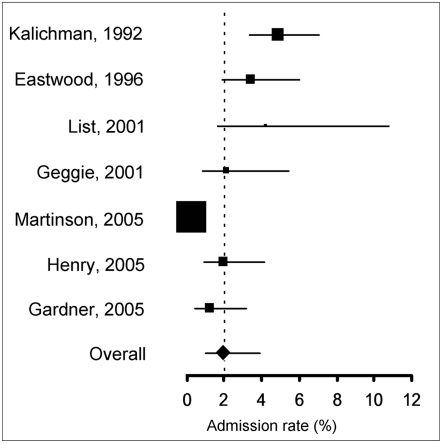
- Across surveys explicitly asking whether scientists ever fabricated or falsified data or altered/modifed results, the pooled weighted estimate was 1.97% (95% CI 0.86–4.45; N = 7), with significant heterogeneity (Cochran’s Q = 61.7777, df = 6, P < 0.0001).
- When only questions explicitly using the words “fabrication” or “falsification” were included, the pooled estimate for self-reports was 1.06% (95% CI 0.31–3.51; N = 4).
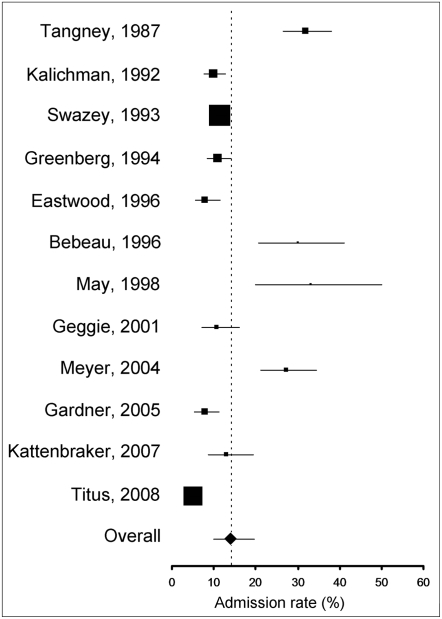
- For reports about colleagues’ misconduct, the pooled weighted estimate was 14.12% (95% CI 9.91–19.72; N = 12); restricting to questions using “fabrication” or “falsification” gave 12.34% (95% CI 8.43–17.71; N = 11).
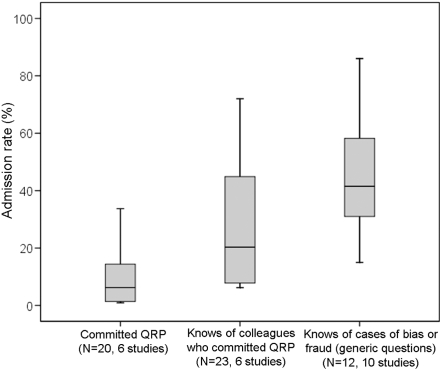
- Other questionable research practices were reported more often: up to 33.7% in self-reports and up to 72% when asking about colleagues.
Methods
- Systematic review and meta-analysis of quantitative surveys asking scientists whether they had committed or observed scientific misconduct in the past; plagiarism and other non-knowledge-distorting misconduct were excluded.
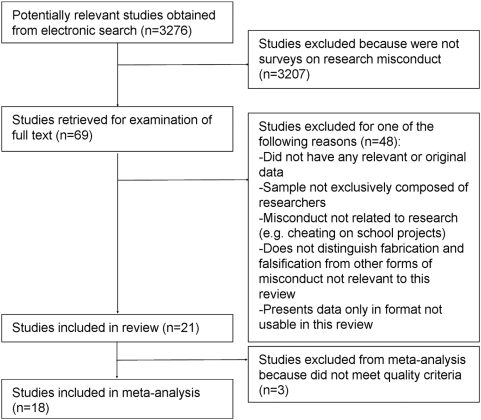
- Searches were run in the first two weeks of August 2008 across citation databases, journals, grey literature sources, and internet search engines; the final review included 21 studies, with 18 in the meta-analysis.
- Main analysis computed the proportion recalling at least one incident, logit-transformed and inverse-variance weighted in a random-effects meta-analysis; meta-regression tested methodological factors such as self vs. non-self reports, mailed vs. handed-out surveys, and use of the words “fabrication”/“falsification.”
Limitations
- The paper states that using the percentage of respondents recalling at least one incident is a rough measure of misconduct frequency; this can under- or overestimate prevalence depending on whether respondents committed multiple incidents or only one.
- The paper notes that non-response bias was recognized by most surveys as a limitation, and that the validity of self-reports may be affected by social expectations; the text also suggests self-reports likely underestimate misconduct.
- Evident from the text: the included studies were heterogeneous in methods and wording, and some outcomes were too diverse for meaningful meta-analysis, so only crude unweighted parameters were calculated for broader questionable research practices.
Model-written summary. Check it against the paper before relying on it.
Integrity signals
Registry
Cites
Statistics
Figures
Verification
Claims the paper makes
0 Valid · 0 Not valid · 14 Not checked · 61 Own results and interpretations
A result the paper reports from its own data — it cites no other source for it, so there is none to check. The quote shows it is in the paper.
In the paper
“When these factors were controlled for, misconduct was reported more frequently by medical/pharmacological researchers than others.”
§ How Many Scientists Fabricate and Falsify Research? A Systematic Review and Meta-Analysis of Survey Data > Abstract
plainstates an association- Asserted: passes — The authors put it forward as true.
- Checkable: passes — It can be checked against evidence.
- Load-bearing: passes — The paper’s conclusions depend on it.
- Based: passes — The paper gives a reason why it holds.
- Rests on 2 assumptions not shown here.
A result the paper reports from its own data — it cites no other source for it, so there is none to check. The quote shows it is in the paper.
In the paper
“A pooled weighted average of 1.97% (N = 7, 95%CI: 0.86–4.45) of scientists admitted to have fabricated, falsified or modified data or results at least once –a serious form of misconduct by any standard– and up to 33.7% admitted other questionable research practices.”
§ How Many Scientists Fabricate and Falsify Research? A Systematic Review and Meta-Analysis of Survey Data > Abstract
plainn = 7- Asserted: passes — The authors put it forward as true.
- Checkable: passes — It can be checked against evidence.
- Load-bearing: passes — The paper’s conclusions depend on it.
- Based: passes — The paper gives a reason why it holds.
- Rests on 2 assumptions not shown here.
A result the paper reports from its own data — it cites no other source for it, so there is none to check. The quote shows it is in the paper.
In the paper
“A pooled weighted average of 1.97% (N = 7, 95%CI: 0.86–4.45) of scientists admitted to have fabricated, falsified or modified data or results at least once –a serious form of misconduct by any standard– and up to 33.7% admitted other questionable research practices.”
§ How Many Scientists Fabricate and Falsify Research? A Systematic Review and Meta-Analysis of Survey Data > Abstract
plain- Asserted: passes — The authors put it forward as true.
- Checkable: passes — It can be checked against evidence.
- Load-bearing: passes — The paper’s conclusions depend on it.
- Based: passes — The paper gives a reason why it holds.
- Rests on 2 assumptions not shown here.
A result the paper reports from its own data — it cites no other source for it, so there is none to check. The quote shows it is in the paper.
In the paper
“In surveys asking about the behaviour of colleagues, admission rates were 14.12% (N = 12, 95% CI: 9.91–19.72) for falsification, and up to 72% for other questionable research practices.”
§ How Many Scientists Fabricate and Falsify Research? A Systematic Review and Meta-Analysis of Survey Data > Abstract
plainn = 12- Asserted: passes — The authors put it forward as true.
- Checkable: passes — It can be checked against evidence.
- Load-bearing: passes — The paper’s conclusions depend on it.
- Based: passes — The paper gives a reason why it holds.
- Rests on 2 assumptions not shown here.
A result the paper reports from its own data — it cites no other source for it, so there is none to check. The quote shows it is in the paper.
In the paper
“Meta-analysis yielded mean pooled estimates that are higher than most previous estimates.”
§ How Many Scientists Fabricate and Falsify Research? A Systematic Review and Meta-Analysis of Survey Data > Introduction
plain- Asserted: passes — The authors put it forward as true.
- Checkable: passes — It can be checked against evidence.
- Load-bearing: passes — The paper’s conclusions depend on it.
- Based: passes — The paper gives a reason why it holds.
- Rests on 2 assumptions not shown here.
31 more claims
Create a free account to see all 75 claims and to verify the 4 references still open.
- It may state two separate claims as one. 24
- Probably not a substantial claim. 25
Claims other papers make about this one
Each is checked against this paper’s own text: does it say what the citing paper says it does?
The cited source says what the claim attributes to it.
In the citing paper
“there are other more common sources of unreliability in the literature (41)(42)(43)(44)”
From Misconduct accounts for the majority of retracted scientific publications (2012) · cites this paper as [43]
The cited source says what the claim attributes to it.
In the citing paper
“The prevalence of researchers who have been involved in scientific misconduct is estimated to be around 2% [2]”
From Checklist to assess Trustworthiness in RAndomised Controlled Trials (TRACT checklist): concept proposal and pilot (2023) · cites this paper as [2]
The cited source says what the claim attributes to it.
In the citing paper
“This is how a small number of people 40 with flexible morals can pollute the scientific literature disproportionately.”
From Fraudulent studies are undermining the reliability of systematic reviews: on the prevalence of problematic images in preclinical depression studies (2025) · cites this paper as [40]
The cited source says what the claim attributes to it.
In the citing paper
“A meta-analysis by Fanelli, combining the results of 18 published surveys, found that 1.9% of researchers have admitted to modification, falsification, or fabrication of data (3).”
From The Prevalence of Inappropriate Image Duplication in Biomedical Research Publications (2016) · cites this paper as [3]
The cited source says what the claim attributes to it.
In the citing paper
“A systematic review and meta-analysis of survey data estimated that 1.97% of authors admitted to have fabricated, falsified, or modified data or results at least once and, in surveys asking about the behavior of colleagues, the admission rate was 14.12% for falsification [13].”
From No raw data, no science: another possible source of the reproducibility crisis (2020) · cites this paper as [13]
6 more claims about this paper
Create a free account to see every claim other papers make about this one.
Citations
Cites
(2000) · Cited by 9,198
The Sociology of Science: Theoretical and Empirical Investigations
Kaplan, N., Merton, R. K., & Storer, N. W. (1974) · Technology and Culture · doi:10.2307/3102264 · Cited by 4,005
The Normative Structure of Science
Merton, R. Κ. (1973) · Medical Entomology and Zoology · Cited by 2,315
The Hazards of Scoring the Quality of Clinical Trials for Meta-analysis
Jüni, P. (1999) · JAMA · doi:10.1001/jama.282.11.1054 · Cited by 1,981 · cited 1×
“All remaining papers were included, and were not graded on a quality scale, because the validity and use of quality measures in meta-analysis is controversial [21], [22].”
BackgroundScope and Impact of Financial Conflicts of Interest in Biomedical Research: A Systematic Review
Bekelman, J. E., Li, Y., & Gross, C. P. (2003) · JAMA · doi:10.1001/jama.289.4.454 · Cited by 1,816 · cited 1×
“This would support growing fears that the large financial interests that often drive medical research are severely biasing it [50], [51], [52].”
BackgroundTourangeau, R., & Smith, T. W. (1996) · Public Opinion Quarterly · doi:10.1086/297751 · Cited by 1,295 · cited 1×
“However, the accuracy of responses to sensitive questions is often independent of response rates, and depends strongly on respondents' perception of anonymity and confidentiality [43], [44].”
BackgroundA comparison of methods to detect publication bias in meta‐analysis
Macaskill, P., Walter, S. D., & Irwig, L. (2001) · Statistics in Medicine · doi:10.1002/sim.698 · Cited by 1,286 · cited 1×
“The popular funnel-plot-based methods to test for publication bias in meta-analysis are inappropriate and potentially misleading when the number of included studies is small and heterogeneity is large [25], [26].”
MethodMartinson, B. C., Anderson, M. S., & de Vries, R. (2005) · Nature · doi:10.1038/435737a · Cited by 1,096 · cited 9×
“All the above results were robust with respect to inclusion or exclusion of any particular study, with perhaps one exception: Martinson et al. (2005) [19], which is one of the largest and most frequently cited surveys on misconduct published to date.”
BackgroundMethodResultInfluentialAdjusting for publication bias in the presence of heterogeneity
Terrin, N., Schmid, C. H., Lau, J., & Olkin, I. (2003) · Statistics in Medicine · doi:10.1002/sim.1461 · Cited by 809 · cited 1×
“The popular funnel-plot-based methods to test for publication bias in meta-analysis are inappropriate and potentially misleading when the number of included studies is small and heterogeneity is large [25], [26].”
MethodIs Academic Medicine for Sale?
Angell, M. (2000) · New England Journal of Medicine · doi:10.1056/nejm200005183422009 · Cited by 582
Research works printed but not linked: 2
- Eastwood S Derish P Leash E Ordway S 1996 Ethical issues in biomedical research: perceptions and practices of postdoctoral research fellows responding to a survey. Science and Engineering Ethics 2 89 114 11657788 · DOI
- Kattenbraker MS 2007 Health education research and publication: ethical considerations and the response of health educators Carbondale Southern Illinois University.Doctoral dissertation
Cited by
Items 1,801–1,900 of 1,924
Misconduct in science and medicine
Masquelet, A. C. (2025) · EFORT Open Reviews · doi:10.1530/eor-2025-0126
“A 2009 survey by Professor Daniele Fanelli found that nearly 2% of medical researchers admitted to fabricating, falsifying, or altering data or results at least once, and some 15% said they had become aware of fraud committed by their colleagues (24).”
Essentials of Research Integrity for EcologistsPreprint
Schlacher, T. A., Assaf, Y., Barboza, C. A. D. M., et al. (2025) · SSRN Electronic Journal · doi:10.2139/ssrn.5339115
Anikin, A. (2025) · Psychonomic Bulletin & Review · doi:10.3758/s13423-025-02740-3
“Only a few percent of researchers admit engaging in data fabrication or falsification, but the estimated prevalence is much higher (Fanelli, 2009; Heath-ers, 2025b; Williams & Roberts, 2016).”
Practical Approaches for Navigating Authorship Conflict
Michel, P., Bhansali, P., Herrmann, L. E., Shah, N. H., & Marek, S. (2025) · Hospital Pediatrics · doi:10.1542/hpeds.2025-008326
Evidenzbasierte Forschungsintegritätspolitik
Redman, B. K. (2025) · Springer eBooks · doi:10.1007/978-3-031-92469-9_3
Media Stars: Statistical Significance and Research ImpactPreprint
Brodeur, A., Cook, N., Heyes, A., & Wright, T. J. (2025) · SSRN Electronic Journal · doi:10.2139/ssrn.5371748
The Face of Fake Science: Four Episodes for Reflection
Аrtyukhov, А. (2025) · Ethics and integrity in educational contexts · doi:10.1007/978-3-031-95686-7_14
Gouy, C. M. L., Armond, A. C. V., Carvalho, S., de Souza, M. C., & Penido, C. (2025) · American Journal of Pharmaceutical Education · doi:10.1016/j.ajpe.2025.101484
From Hadronic Bubbles to Quantum Gravity: Chasing the Infinite with Antonio Aurilia
Nicolini, P. (2025) · Fundamental theories of physics · doi:10.1007/978-3-031-76066-2_3 · Cited by 1
Handling ethical issues in Clinical Nutrition
Cárdenas, D., & Lobo, D. N. (2025) · Clinical Nutrition · doi:10.1016/j.clnu.2025.08.028
Yüksel, A. (2025) · CABI eBooks · doi:10.1079/9781800628076.0001
The Erosion of Research Integrity: Crises, Pseudoscience, and the Illusion of Progress
Yüksel, A. (2025) · CABI eBooks · doi:10.1079/9781800628076.0003
Ethical Issues in International Business Research
Holtbrügge, D. (2025) · Management International Review · doi:10.1007/s11575-025-00598-0 · Cited by 3
“…in leading management and international business journals (e.g., Aguinis et al., 2017; Arnold, 2021 ; Banks et al., 2016 ; Bedeian et al., 2010 ; Hall & Martin, 2019 ; Miller et al., 2024), cases of academic misconduct are repeatedly reported (Fanelli, 2009; Tourish, 2019; Xie et al., 2021).”
Statistics and Persuasion in Medicine
Osimani, B. (2025) · Oxford University Press eBooks · doi:10.1093/oxfordhb/9780197625835.013.0013
Nguyen, L. T., & Tuamsuk, K. (2025) · De Gruyter eBooks · doi:10.1515/9783111373485-024
Strategies to Tackle Academic Misconduct in Academic Writing
Çelik, Ö., & YILMAZ, T. S. (2025) · Springer eBooks · doi:10.1007/978-981-96-9678-9_8
Mamun, M. A., Huraira, M. A., Begum, M., Jitu, M. H. I., Muntashir, N., Khan, M. M., Das, P., Rahman, S., Misma, U. Z., Nath, S. K., et al. (2025) · Scientific Reports · doi:10.1038/s41598-025-19488-4 · Cited by 2
“Tools like the DOAJ and Beall’s List are valuable for distinguishing credible open-access journals from potentially predatory ones 12 , while an understanding of plagiarism and research misconduct is vital for upholding ethical standards in science 22 .”
Sivasubramaniam, S. D. (2025) · Ethics and integrity in educational contexts · doi:10.1007/978-3-031-98157-9_8
Genre Camouflage: How Fraudulent Scientific Images are Successful
Pflugfelder, E. H. (2025) · ACM International Conference on Design of Communication (SIGDOC) · doi:10.1145/3711670.3764620
Epistemic Virtue, Cognitive Diversity, and the Division of Labor
Bland, S. (2025) · Erkenntnis · doi:10.1007/s10670-025-01033-4 · Cited by 1
“Most disturbingly, Fanelli (2009) found that nearly 2% of surveyed scientists admitted to faking their data at least once, and 14% reported knowing others who have engaged in fraudulent research.”
de Holanda, C. M. S., & dos Santos, R. N. M. (2025) · Informação & Informação · doi:10.5433/1981-8920.2025v30n3p464
Mugelli, A. (2025) · European Cardiology Review · doi:10.15420/ecr.2025.71
What Retractions Tell Us About Research Integrity in Mexican Academia
Torres, K. E. O., Litewka, S. G., & Heitman, E. (2025) · Developing World Bioethics · doi:10.1111/dewb.70011 · Cited by 1
Chekenya, N. S. (2025) · International Political Science Review · doi:10.1177/01925121251378171
“As argued by Fanelli (2009) in a meta-analysis across scientific fields, formal retractions severely underrepresent the true scale of questionable research practices.”
Antes, A. L. (2015) · Emerald Group Publishing Limited eBooks · doi:10.1108/978-1-68123-133-420251010
DA CONDUTA ÉTICA À CIÊNCIA RESPONSÁVEL NA PESQUISA EM ADMINISTRAÇÃO
Costa, M. M., Sousa, M. D. M., Limongi, R., Torres, M. M., & Noll, P. R. E. S. (2025) · Revista de Administração de Empresas · doi:10.1590/s0034-759020250610x · Cited by 1
Alordiah, C. O., & Chenube, O. (2025) · Innovations in Education and Teaching International · doi:10.1080/14703297.2025.2595240
Why social norms matter in science: Determinants of misconduct in German-speaking Europe
Oberhauser, V., Velicu, A., & Rauhut, H. (2025) · Social Science Research · doi:10.1016/j.ssresearch.2025.103292 · Cited by 1
Beyond the p < 0.05 trap: the adaptive integrity model for preventing and detecting P-hacking
Affognon, D. A. (2025) · Frontiers in Education · doi:10.3389/feduc.2025.1675991 · Cited by 1
“P-hacking P-hacking forms part of a broader spectrum of questionable research practices, including selective reporting, publication bias, and outcome switching, that reflect systemic rather than purely individual pressures (Fanelli, 2009; Fraser et al., 2018; Simmons et al., 2011; John et al., 2012).”
InfluentialRegaining Scientific Authority in a Post-Truth Landscape
Petzold, A. M., & Nichols, M. D. (2025) · Publications · doi:10.3390/publications13040065 · Cited by 3
“As an example of this, the anti-scientific stance of the Trump administration has led to the curtailment of budgets, the reduction in scientific grants and a cessation of long-standing research focused and in the hard sciences (Fanelli, 2009).”
Ayikobua, E. T., Munabi, I. G., Nabukenya, S., Opito, R., & Mwaka, E. (2025) · Discover Education · doi:10.1007/s44217-025-00945-1 · Cited by 5
“Interestingly, our study found that participants were more likely to report observing colleagues engaged in misconduct than admitting to their own involvement, and this is consistent with the literature [2, 6, 31].”
How can we overcome the barriers to researchers producing high quality, open research?
Tukanova, M., Hsing, P.-Y., Freeman, A. L. J., Fellows, T., Thompson, J., & Munafo, M. R. (2023) · PhilPapers (PhilPapers Foundation) · doi:10.57874/axc8-vs07
Frank, F., Florens, N., Meyerowitz‐Katz, G., Barrière, J., Billy, É., Saada, V., Samuel, A., Robert, J., & Besançon, L. (2024) · Figshare · doi:10.6084/m9.figshare.26603983
Reynders, R. M., ter Riet, G., Di Girolamo, N., & Malički, M. (2022) · Figshare · doi:10.6084/m9.figshare.19517363
Reynders, R. M., ter Riet, G., Di Girolamo, N., & Malički, M. (2022) · Figshare · doi:10.6084/m9.figshare.19517360
Were, E. O., Kiplagat, J., Kaguiri, E., Ayikukwei, R., & Yebei, V. N. (2023) · Figshare · doi:10.6084/m9.figshare.23665099
Frank, F., Florens, N., Meyerowitz‐Katz, G., Barrière, J., Billy, E., Saada, V., Samuel, A., Robert, J., & Besançon, L. (2024) · Figshare · doi:10.6084/m9.figshare.26603989
Armond, A. C. V., Gordijn, B., Lewis, J., Hosseini, M., Bodnár, J. K., Holm, S., & Kakuk, P. (2021) · Figshare · doi:10.6084/m9.figshare.14524527
Mol, B. W., Lai, S., Rahim, A., Bordewijk, E. M., Wang, R., van EEKELEN, R., Gurrin, L. C., Thornton, J. G., van Wely, M., & Li, W. (2024) · Figshare · doi:10.6084/m9.figshare.26593376
Bordino, M., Ravizzotti, E., & Vercelli, S. (2020) · Figshare · doi:10.6084/m9.figshare.13311255
Frank, F., Florens, N., Meyerowitz‐Katz, G., Barrière, J., Billy, E., Saada, V., Samuel, A., Robert, J., & Besançon, L. (2024) · Figshare · doi:10.6084/m9.figshare.26603986
Bonn, N. A., & Pinxten, W. (2021) · Figshare · doi:10.6084/m9.figshare.13572181
Additional file 4 of Standardised data on initiatives—STARDIT: Beta version
Nunn, J., Shafee, T., Chang, S., Stephens, R., Elliott, J., Oliver, S. R., John, D., Smith, M., Orr, N., Preston, J., et al. (2022) · Figshare · doi:10.6084/m9.figshare.20342238
Additional file 1 of Standardised data on initiatives—STARDIT: Beta version
Nunn, J. S., Shafee, T., Chang, S., Stephens, R., Elliott, J., Oliver, S. R., John, D., Smith, M., Orr, N., Preston, J., et al. (2022) · Figshare · doi:10.6084/m9.figshare.20342226
Haven, T., Tijdink, J., Martinson, B. C., Bouter, L. M., & Oort, F. J. (2021) · Figshare · doi:10.6084/m9.figshare.14532144
Additional file 3 of Standardised data on initiatives—STARDIT: Beta version
Nunn, J. S., Shafee, T., Chang, S., Stephens, R., Elliott, J., Oliver, S. R., John, D., Smith, M., Orr, N., Preston, J., et al. (2022) · Figshare · doi:10.6084/m9.figshare.20342235
Armond, A. C. V., Gordijn, B., Lewis, J., Hosseini, M., Bodnár, J. K., Holm, S., & Kakuk, P. (2021) · Figshare · doi:10.6084/m9.figshare.14524521
Armond, A. C. V., Gordijn, B., Lewis, J., Hosseini, M., Bodnár, J. K., Holm, S., & Kakuk, P. (2021) · Figshare · doi:10.6084/m9.figshare.14524524
Additional file 2 of Standardised data on initiatives—STARDIT: Beta version
Nunn, J. S., Shafee, T., Chang, S., Stephens, R., Elliott, J., Oliver, S. R., John, D., Smith, M., Orr, N., Preston, J., et al. (2022) · Figshare · doi:10.6084/m9.figshare.20342232
Armond, A. C. V., Gordijn, B., Lewis, J., Hosseini, M., Bodnár, J. K., Holm, S., & Kakuk, P. (2021) · Figshare · doi:10.6084/m9.figshare.14524530
Research practices and assessment of research misconductPreprint
Wicherts, J. M., & Hartgerink, C. H. J. (2016) · OSF Preprints (OSF Preprints)
Réinventer l'intégrité académique à l'ère de l'intelligence artificielle
Torres, C. G., & Forgas, R. C. (2025) · doi:10.3917/ems.berga.2025.01.0095
A Bibliometric and Scoping Review of Research Integrity among Research Scholars
Das, J., Rout, S. K., -, B. S., Sahoo, P., Mahapatra, S., & Dash, S. (2025) · Asian Journal of Interdisciplinary Research · doi:10.54392/ajir25412
Transforming Higher Education: The Impact of Generative AI on Teaching and Research
Fu, Y. C., Quetzal, A. S., Lin, Y. C., & Junedi, J. (2026) · Higher education in Asia · doi:10.1007/978-981-95-2531-7_12
“Psychology—God Have Mercy, Are You Still Sticking With It?”
Frindte, W. (2026) · Springer eBooks · doi:10.1007/978-3-658-50113-6_14
Ethical, Legal, and Administrative Issues in Research
Mugwe, J. N., & Runo, S. (2026) · Springer eBooks · doi:10.1007/978-981-95-1892-0_6
Assessing Questionable and Responsible Research Practices in Psychology Master’s Theses
Augusteijn, H. E. M., van Assen, M. A. L. M., Sijtsma, K., & Wicherts, J. M. (2026) · Behavioral Sciences · doi:10.3390/bs16010110 · Cited by 1
“Luckily, research misconduct is much scarcer than QRPs; estimates of research misconduct range between 2% (Fanelli, 2009) and 8% (Gopalakrishna et al., 2022a).”
Tsuge, T., Yamamoto, N., Tomita, Y., Hagiyama, A., Shiratsuchi, D., Okamura, M., Kaneko, T., Suzuki, K., Nakashima, Y., Taito, S., et al. (2025) · American Journal of Physical Medicine & Rehabilitation · doi:10.1097/phm.0000000000002860 · Cited by 2
Data sharing intentions of neuroscience researchers: A consequentialist theory perspective
Wu, Z., Huang, L., Wang, M., & He, X. (2026) · Library & Information Science Research · doi:10.1016/j.lisr.2026.101398
Brookes, P. S. (2026) · bioRxiv (Cold Spring Harbor Laboratory) · doi:10.64898/2026.01.16.700000 · Cited by 1
Retractions in Scholarly Publishing: Causes, Consequences, and the Path Forward
Negm, A. M., Farhan, S. H., & Singh, R. (2026) · Trends in Scholarly Publishing · doi:10.21124/tsp.2026.15.22
A meta-ethnographic synthesis of researchers' views on scholarly misconduct in the health sciences
Shahid, S. H. B., & Sinnamon, L. S. (2026) · Library & Information Science Research · doi:10.1016/j.lisr.2026.101399
Trends in publications on scientific misconduct from 2000 to 2024: a Scopus-based bibliometric study
Castro, J. E. Q., & Castro, M. D. P. Q. (2026) · Science Editing · doi:10.6087/kcse.389
Jafari, A., SeyyedHosseini, S., & BasirianJahromi, R. (2026) · International Dental Journal · doi:10.1016/j.identj.2026.109406
“30 Faced with the crisis of data fabrication and falsification by authors, journals, and publishers have not been idle.”
Veselská, R., Širůček, J., Gefenas, E., Borovečki, A., Vlček, M., Zvejniece, L., Grosek, Š., Kohus, Z., Ruszkowska, J., Velescu, B. Ș., et al. (2026) · Scientific Reports · doi:10.1038/s41598-026-39928-z
A low-cost approach to high quality responsible conduct of research education
Martin, S. R., Camino, B. G., CUMMINS, P. J., & MACPHERSON, C. C. (2026) · International Journal of Ethics Education · doi:10.1007/s40889-026-00235-w
“Scholars have conducted empirical research to understand the prevalence of research misconduct (Fanelli 2009; John et al. 2012; Stricker and Günther 2019; Kaiser et al. 2021; Xie et al. 2021; Gopalakrishna et al. 2022; Phogat et al. 2023; Herrera-Añazco et al. 2024).”
Time, Quality, and Integrity: Temporal Autonomy as a Missing Link in Research Assessment Reform
Sørensen, M. P., Lambert, M., Ravn, T., & Vostal, F. (2026) · Science and Engineering Ethics · doi:10.1007/s11948-026-00588-x · Cited by 1
“…of scientific misconduct – fabrication, falsification and plagiarism (FFP) – but that questionable research practices (QRPs) are much more widespread (Steneck, 2006; Fanelli, 2009; John et al., 2012; Anderson et al., 2013; Bouter et al., 2016; Gopalakrishna et al., 2022; Schneider et al., 2023).”
Studd, H., Avenell, A., Grey, A. B., & Bolland, M. J. (2026) · Research Integrity and Peer Review · doi:10.64898/2026.02.25.26346683
The sterility of evidence: Research misconduct as a patient-safety threat
Tripathi, S., & Nundy, S. (2026) · Current Medicine Research and Practice · doi:10.4103/cmrp.cmrp_4_26
Developing a Research Integrity Culture Framework for Business Schools
Strazda, A., Kozlinska, I., & Englis, P. D. (2026) · Journal of Academic Ethics · doi:10.1007/s10805-026-09736-1
Social and behavioral experiments, history of
Olthof, M., Maatman, F. O., & Bisselink, S. (2026) · Elsevier eBooks · doi:10.1016/b978-0-443-26629-4.00279-3
Yaw, K., & Ferronato, T. (2026) · Elsevier eBooks · doi:10.1016/b978-0-323-95504-1.01554-4
Untangling Conflicts: Personal, Financial, and Institutional Dilemmas in Research Ethics
Kaur, A., Kaur, G., & Sandhu, R. (2026) · IGI Global eBooks · doi:10.4018/979-8-3693-8302-5.ch005
Editor's view: What makes a scientist successful?
Rudan, I. (2026) · Journal of Global Health · doi:10.7189/jogh.16.01002 · Cited by 1
Ndiaye, C. (2023) · theses.fr (ABES) · doi:10.70675/b39bdc2ez07cez4888zb0aeza438564226b8 · Cited by 2
Brown, M., Sacco, D. F., Raible, C., Wallace, K. J., & Lemacks, J. L. (2026) · Accountability in Research · doi:10.1080/08989621.2026.2659673
“Such behaviors appear prevalent across the sciences (Fanelli 2009), including psychology (John, Loewenstein, and Prelec 2012), educational research (Makel et al. 2019, 2021), biology (Rajtmajer, Errington, and Hillary 2022), chemistry (Ciriminna et al. 2024), and public health (Hicks 2023).”
Açık Bilim ve Yeniden Üretilebilirlik: Çok Kriterli Karar Alma Vaka Çalışmasından Perspektifler
Yayla, K., & Soyuer, H. (2025) · Türk Kütüphaneciliği · doi:10.24146/tk.1694565
Generative AI and project scholarship: The collision is coming fast
Pinto, J. K. (2026) · International Journal of Project Management · doi:10.1016/j.ijproman.2026.102858
Erklärungs- und Beobachtungsprobleme
Frindte, W., & Frindte, I. (2026) · Springer eBooks · doi:10.1007/978-3-658-50561-5_5
Pressman, M. S. (2026) · Journal of Empirical Research on Human Research Ethics · doi:10.1177/15562646261453181
“Despite long-standing recognition of data fabrication as scienti fi c misconduct, empirical studies suggest that a meaningful proportion of researchers report direct or indirect exposure to such practices, revealing structural vulnerabilities in trust-based research systems (Fanelli, 2009).”
Jones, B., & Jones, L. (2026) · BMC Psychology · doi:10.1186/s40359-026-04894-8
“Lastly, fabrication or fal-sification is manipulating or inventing data, references, or findings in research or coursework [56].”
Staller, M. S., & Körner, S. (2026) · Frontiers in Sociology · doi:10.3389/fsoc.2026.1758071 · Cited by 2
““Misconduct,” “questionable research practices,” or “bias” are attributed to individuals, teams or institutions (Bouter, 2024; Fanelli, 2009; John et al., 2011).”
Fuglsang, S., Horbach, S. P. J. M., Sørensen, M. P., & Mejlgaard, N. (2026) · Accountability in Research · doi:10.1080/08989621.2026.2679561
Taru, J., & Ecklund, E. H. (2026) · Journal for the Scientific Study of Religion · doi:10.1111/jssr.70076
Perceptions of Chinese Biomedical Researchers Towards Academic Misconduct: An Updated Survey
Liao, Q., Chen, K.-L., Zheng, M., Zhang, Y.-Y., Fan, Y., Eslick, G. D., He, X.-X., He, H., Chen, K.-Y., & Xia, H. H. (2026) · Journal of Academic Ethics · doi:10.1007/s10805-026-09750-3
“…review and meta-analysis in 2009 reported that 72% of researchers had either committed or witnessed misconduct, highlighting the widespread nature of the issue(Fanelli, 2009), while an updated systematic review and meta-analysis in 2021 showed the pooled prevalence was 39.7% (Xie et al., 2021).”
Influential1236 Research ethics in communication science: practical and aspirational landscapes
Lahman, M. K. E., Gittner, K. B., & Brown, C. (2026) · De Gruyter eBooks · doi:10.1515/9783111087139-006
Seghier, M. L. (2026) · International Journal of Imaging Systems and Technology · doi:10.1002/ima.70393
“Yet, statistics have been used not only to inform but also to persuade, distort, and even lie [27].”
Sogi, G. M. (2026) · Contemporary Clinical Dentistry · doi:10.4103/ccd.ccd_345_26
Hosain, S., & Chowdhury, R. (2026) · Beijing international review of education · doi:10.1177/25902547261453178
Zaw, T. M. M., Heathers, J., & Meyerowitz‐Katz, G. (2026) · Research Integrity and Peer Review · doi:10.1186/s41073-026-00205-2 · Cited by 1
“…that medical researchers reported misconduct at higher rates than their peers in other disciplines, including falsification and fabrication of data [11], and (b) medical researchers dominate the Retraction Watch Leader-board – to date, 6 out of the 10 authors with multiple retraction records in…”
And This is Where You Come In—A Valedictory
Holochwost, S. J., Mills-Koonce, R., & Brown, E. D. (2026) · Oxford University Press eBooks · doi:10.1093/9780198960683.003.0008
Editorial - integrity in scientific publishing
Wiersma, B., Elvir, J. A., Welschot, T., Herckès, P., & Nair, A. R. (2026) · Environmental Monitoring and Assessment · doi:10.1007/s10661-026-15528-2
“…and degree completion are often tied to publication metrics, creating incentives for unethical practices, sometimes facilitated by AI tools (Fanelli, 2009; We are writing this editorial to clearly highlight the ethical and fraudulent challenges we are facing as editors of scientific…”
Sultanaamin, K., Balneaves, L. G., Kumar, S., Leach, M., Su, K., Veziari, Y., Wardle, J., Cramer, H., & Ng, J. Y. (2026) · Integrative Medicine Research · doi:10.1016/j.imr.2026.101385 · Cited by 1
L’intégrité et l’éthique dans la recherche en milieu policier : Une revue de la littérature
Telle, É., Majzner, M., Tiberi, L., Vicenzutto, A., & Pham, T. H. (2026) · Annales Médico-psychologiques revue psychiatrique · doi:10.1016/j.amp.2026.06.001
Metadata
- Authors
- Fanelli, D.
- Affiliations
- University of Edinburgh (GB)
- Corresponding author
- Fanelli, Daniele
- ORCID
- Fanelli, Daniele
- Venue
- PLoS ONE
- Publisher
- Public Library of Science (PLoS)
- Published
- 2009-05-29
- Volume
- 4
- Issue
- 5
- Pages
- e5738
- ISSN
- 1932-6203 (ISSN-L)
- PMC
- PMC2685008
- OpenAlex
- W2152243616
- Cited by
- 1,911
- References
- 74
- Citations by year
- 2026: 77 · 2025: 110 · 2024: 128 · 2023: 136 · 2022: 157 · 2021: 145 · 2020: 163 · 2019: 166 · 2018: 125 · 2017: 125 · 2016: 119 · 2015: 106 · 2014: 82 · 2013: 93 · 2012: 84
- FWCI
- 19.42
- Type
- journal article
- Language
- en
- Open access
- gold
- doi.org
- Locations
- PLoS ONE (publishedVersion, cc-by)
- PubMed Central (publishedVersion, cc-by)
- PubMed (publishedVersion)
- Edinburgh Research Explorer (University of Edinburgh) (acceptedVersion, public-domain)
- RePEc: Research Papers in Economics (submittedVersion)
- DOAJ (DOAJ: Directory of Open Access Journals) (submittedVersion, cc-by-sa)
- Figshare (submittedVersion, cc-by)
- DigitalGeorgetown (Georgetown University Library) (submittedVersion)
- Funders
- European Commission (221441)
- Economic and Social Research Council (ES/F028180/1)
- Topics
- Social Sciences › Education › Academic integrity and plagiarism
- Physical Sciences › Mathematics › Statistics and Probability › Benford’s Law and Fraud Detection
- Social Sciences › Library and Information Sciences › Academic Publishing and Open Access
- Keywords
- research misconduct, scientific fraud, data fabrication, data falsification, questionable research practices, self-report questionnaire
- MeSH terms
- Data Collection, Regression Analysis, Research Personnel, Scientific Misconduct, Ethics, Research
About these checks
Registry, retraction, Cites and statistics results are computed, not judged, with one exception: a printed reference that no index lists is read once by a model before it counts as a citation error. Claims are extracted by a model and kept only when their quote appears verbatim in the text; each cited source is then checked, with a model’s help, for whether it says what the claim relies on. Those verdicts can be wrong — read the claim’s quote and the cited source before relying on one.
A language model drew the claims from the paper on 2026-10-10, under version 3 of the claim definition (model deepseek-v4.1-flash, prompt extract-v3).
A second model labelled each claim on 2026-10-10 (model jev-1.13-20260917, definition revision gold-guideline-v0.2).
Statistics and arithmetic are recomputed, not judged.
Confidence bands are shown only for fields calibrated on our annotated test set. None is calibrated yet, so no band is shown.
What counts as a claim ›How we measure confidence ›How we check this ›
Are you an author, or do you see a problem with this page? Request a review
Data sources
Bibliographic data: Semantic Scholar, OpenAlex, Crossref.
Contains information from the Semantic Scholar Academic Graph Datasets, made available under the ODC Attribution License (ODC-BY 1.0).
Semantic Scholar’s data is described in: Kinney, R., et al. (2023). The Semantic Scholar Open Data Platform. arXiv:2301.10140.
