

The DOI matches its Crossref record; 53 of the 55 references it cites were found in a registry or an index; none of the 31 sources its claims cite is checked for support yet.
Keeping in touch with one’s self: multisensory mechanisms of self-consciousness
Open accessAbstract
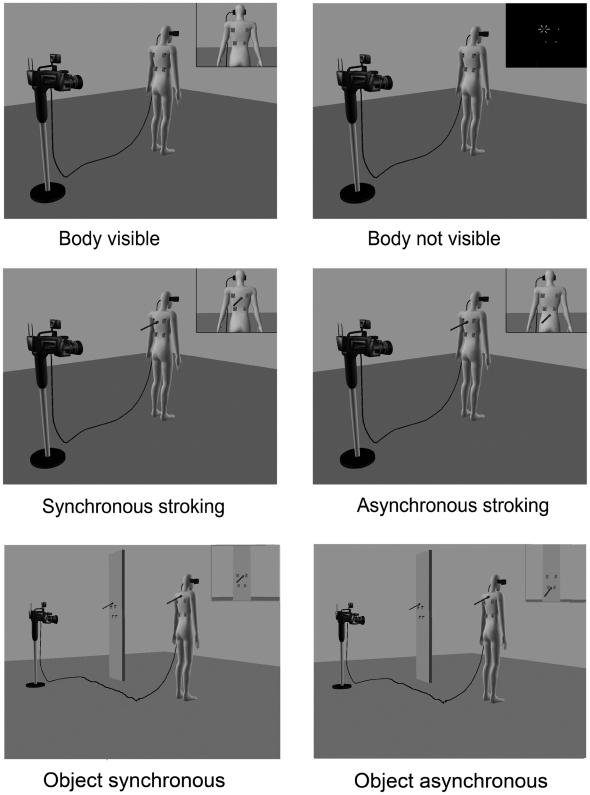
BACKGROUND: The spatial unity between self and body can be disrupted by employing conflicting visual-somatosensory bodily input, thereby bringing neurological observations on bodily self-consciousness under scientific scrutiny. Here we designed a novel paradigm linking the study of bodily self-consciousness to the spatial representation of visuo-tactile stimuli by measuring crossmodal congruency effects (CCEs) for the full body. METHODOLOGY/PRINCIPAL FINDINGS: We measured full body CCEs by attaching four vibrator-light pairs to the trunks (backs) of subjects who viewed their bodies from behind via a camera and a head mounted display (HMD). Subjects made speeded elevation (up/down) judgments of the tactile stimuli while ignoring light stimuli. To modulate self-identification for the seen body subjects were stroked on their backs with a stick and the felt stroking was either synchronous or asynchronous with the stroking that could be seen via the HMD. We found that (1) tactile stimuli were mislocalized towards the seen body (2) CCEs were modulated systematically during visual-somatosensory conflict when subjects viewed their body but not when they viewed a body-sized object, i.e. CCEs were larger during synchronous than during asynchronous stroking of the body and (3) these changes in the mapping of tactile stimuli were induced in the same experimental condition in which predictable changes in bodily self-consciousness occurred. CONCLUSIONS/SIGNIFICANCE: These data reveal that systematic alterations in the mapping of tactile stimuli occur in a full body illusion and thus establish CCE magnitude as an online performance proxy for subjective changes in global bodily self-consciousness.
Overview
AI snapshot
Written from the paper’s full text.
TL;DR
This paper links full-body multisensory conflict to tactile spatial representation by measuring crossmodal congruency effects (CCEs) for vibrotactile targets and LED distractors on the back. It reports that full-body CCEs are modulated by seeing one’s body and by synchronous versus asynchronous stroking, and that these changes accompany altered self-identification and self-location.
Key findings
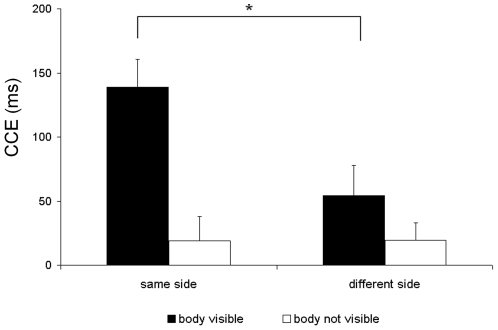
- Full-body CCEs were present when subjects viewed their body: in Study 1, the body × side × congruency interaction was significant (F1,10 = 10.13, p = 0.01), and the CCE was larger for same-side than different-side visual distractors when the body was visible (t1,10 = 3.22, p = 0.009) but not when it was not visible (t1,10 = 0.83, p > 0.05).
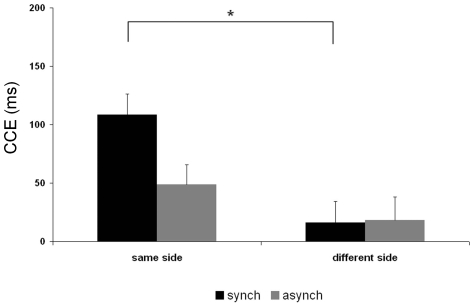
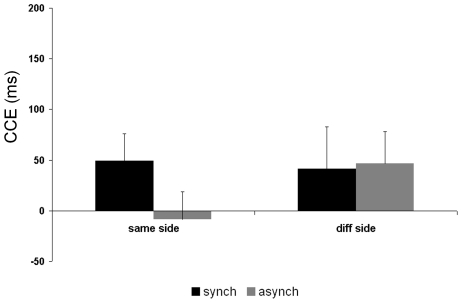
- With a 233 ms LED–vibration SOA, stroking type modulated the CCE: Study 2 showed a significant stroking × side × congruency interaction (F1,12 = 11.30, p = 0.006), with a larger same-side versus different-side CCE during synchronous stroking (t1,12 = 4.01, p = 0.002) but not asynchronous stroking (t1,12 = 2.17, p > 0.05).
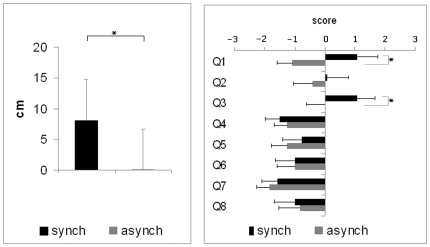
- In Study 2, synchronous stroking produced a mean self-location drift of 8.1 cm toward the virtual body versus 0.1 cm in the asynchronous condition (t1,12 = 2.21, p = 0.047), and higher questionnaire ratings for touch location (Q1: z = 2.8, p = 0.005) and self-identification with the virtual body (Q3: z = 2.3, p = 0.020).
- In the object control (Study 3), no significant CCE effects were found for the object condition, while the body condition replicated the synchronous-stroking effect (same vs different side: t1,8 = 2.60, p = 0.031; asynchronous: t1,8 = 0.39, p > 0.05).
Methods
- Thirty-five healthy right-handed subjects participated across three studies: Study 1 n = 13 (8 males, mean age 24), Study 2 n = 13 (9 males, mean age 26), and Study 3 n = 9 (6 males, mean age 23); two Study 1 subjects were excluded from analyses for chance-level performance, and different subjects took part in each study.
- Subjects stood 2 m in front of a 3D camera and viewed their backs via a head-mounted display; four vibrator–light pairs were attached to their backs, and stroking was applied synchronously or asynchronously (400 ms camera delay). They made speeded up/down tactile judgments while ignoring lights; CCE was computed as RT in incongruent minus congruent trials. Study 1 used a 33 ms LED–vibration SOA, while Studies 2 and 3 used 233 ms.
- Analyses used repeated-measures ANOVAs with factors including body/stroking type, side, and congruency; drift and questionnaire measures were analyzed with t-tests and Wilcoxon matched-pairs tests, with alpha = 0.05. Incorrect trials and responses over 1500 ms were discarded, averaging 4.8% of trials per subject.
Limitations
- The paper states that stimuli were applied only to the backs, so non-stimulated body parts may not have been affected and the measured effects may not be fully global; it calls for future studies testing generalization to non-stimulated parts such as the hands.
- The paper states that Study 1’s lack of stroking effects on self-location and self-identification may have resulted from adding the LED–vibration visuo-tactile mismatch to the stroking mismatch, and that the SOA choice may have influenced multisensory weighting; it also notes that the CCE data cannot by themselves determine whether touch or vision is remapped, and discusses alternative explanations such as task relevance, response bias, and visual recoding.
- Evident from the text: the per-study samples were small (13, 13, and 9 subjects), and the object-control questionnaire ratings for self-identification with the object were barely or not positive despite a significant synchronous-versus-asynchronous difference.
Model-written summary. Check it against the paper before relying on it.
Integrity signals
Registry
Cites
Statistics
Figures
Verification
Claims the paper makes
37 Own result · 21 Not checked yet · 19 Own interpretation · 4 Own method · 4 No basis given
A result the paper reports from its own data — it cites no other source for it, so there is none to check. The quote shows it is in the paper.
In the paper
“The error rates showed a similar pattern of modulation by congruency and side.”
§ Keeping in Touch with One's Self: Multisensory Mechanisms of Self-Consciousness > Results > Results of Study 1
plaincorrelational- Asserted: passes — The authors put it forward as true.
- Checkable: passes — It can be checked against evidence.
- Load-bearing: unclear — It is unclear whether the paper’s conclusions depend on it.
- Based: passes — The paper gives a reason why it holds.
A result the paper reports from its own data — it cites no other source for it, so there is none to check. The quote shows it is in the paper.
In the paper
“The ‘body not visible condition’ did not show these effects on the size of the CCE.”
§ Keeping in Touch with One's Self: Multisensory Mechanisms of Self-Consciousness > Results > Results of Study 1
plain- Asserted: passes — The authors put it forward as true.
- Checkable: passes — It can be checked against evidence.
- Load-bearing: passes — The paper’s conclusions depend on it.
- Based: passes — The paper gives a reason why it holds.
A result the paper reports from its own data — it cites no other source for it, so there is none to check. The quote shows it is in the paper.
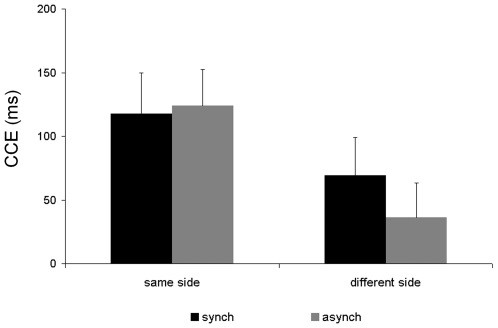
In the paper
“there was no significant three-way interaction between stroking, side and congruency.”
§ Keeping in Touch with One's Self: Multisensory Mechanisms of Self-Consciousness > Results > Results of Study 1
plain- Asserted: passes — The authors put it forward as true.
- Checkable: passes — It can be checked against evidence.
- Load-bearing: unclear — It is unclear whether the paper’s conclusions depend on it.
- Based: passes — The paper gives a reason why it holds.
A result the paper reports from its own data — it cites no other source for it, so there is none to check. The quote shows it is in the paper.
In the paper
“The difference in the size of the CCE for same and different side light presentation was similar for synchronous and asynchronous conditions (figure 3).”
§ Keeping in Touch with One's Self: Multisensory Mechanisms of Self-Consciousness > Results > Results of Study 1
plain- Asserted: passes — The authors put it forward as true.
- Checkable: passes — It can be checked against evidence.
- Load-bearing: unclear — It is unclear whether the paper’s conclusions depend on it.
- Based: passes — The paper gives a reason why it holds.
A result the paper reports from its own data — it cites no other source for it, so there is none to check. The quote shows it is in the paper.
In the paper
“a significant three-way interaction between body, side and congruency (F1,10 = 10.13; p = 0.01).”
§ Keeping in Touch with One's Self: Multisensory Mechanisms of Self-Consciousness > Results > Results of Study 1
plaincorrelational- Asserted: passes — The authors put it forward as true.
- Checkable: passes — It can be checked against evidence.
- Load-bearing: passes — The paper’s conclusions depend on it.
- Based: passes — The paper gives a reason why it holds.
A result the paper reports from its own data — it cites no other source for it, so there is none to check. The quote shows it is in the paper.
In the paper
“In the body visible condition the CCE was larger when the light appeared on the same side as the tactile stimulus, compared to when it appeared on the different side.”
§ Keeping in Touch with One's Self: Multisensory Mechanisms of Self-Consciousness > Results > Results of Study 1
plaincorrelational- Asserted: passes — The authors put it forward as true.
- Checkable: passes — It can be checked against evidence.
- Load-bearing: passes — The paper’s conclusions depend on it.
- Based: passes — The paper gives a reason why it holds.
A result the paper reports from its own data — it cites no other source for it, so there is none to check. The quote shows it is in the paper.
In the paper
“CCEs were modulated systematically during visual-somatosensory conflict when subjects viewed their body but not when they viewed a body-sized object”
§ Keeping in Touch with One's Self: Multisensory Mechanisms of Self-Consciousness > Abstract > Methodology/Principal Findings
plaindirect- Asserted: passes — The authors put it forward as true.
- Checkable: passes — It can be checked against evidence.
- Load-bearing: passes — The paper’s conclusions depend on it.
- Based: passes — The paper gives a reason why it holds.
A result the paper reports from its own data — it cites no other source for it, so there is none to check. The quote shows it is in the paper.
In the paper
“study 1 showed that CCEs are found when the LEDs are presented on a body but not when the body is not visible”
§ Keeping in Touch with One's Self: Multisensory Mechanisms of Self-Consciousness > Results > Results of Study 2
plain- Asserted: passes — The authors put it forward as true.
- Checkable: passes — It can be checked against evidence.
- Load-bearing: passes — The paper’s conclusions depend on it.
- Based: passes — The paper gives a reason why it holds.
A result the paper reports from its own data — it cites no other source for it, so there is none to check. The quote shows it is in the paper.
In the paper
“CCEs were larger during synchronous than during asynchronous stroking of the body”
§ Keeping in Touch with One's Self: Multisensory Mechanisms of Self-Consciousness > Abstract > Methodology/Principal Findings
plaincorrelational- Asserted: passes — The authors put it forward as true.
- Checkable: passes — It can be checked against evidence.
- Load-bearing: passes — The paper’s conclusions depend on it.
- Based: passes — The paper gives a reason why it holds.
A result the paper reports from its own data — it cites no other source for it, so there is none to check. The quote shows it is in the paper.
In the paper
“The size of the drift in the synchronous condition was significantly different from the drift in the asynchronous condition (t1,12 = 2.21; p = 0.047; two-tailed t-test).”
§ Keeping in Touch with One's Self: Multisensory Mechanisms of Self-Consciousness > Results > Results of Study 2
plain- Asserted: passes — The authors put it forward as true.
- Checkable: passes — It can be checked against evidence.
- Load-bearing: passes — The paper’s conclusions depend on it.
- Based: passes — The paper gives a reason why it holds.
- It may state two separate claims as one. 25
- Probably not a substantial claim. 10
A result the paper reports from its own data — it cites no other source for it, so there is none to check. The quote shows it is in the paper.
In the paper
“No significant effects (p>0.05) of stroking type were found for self-location – the size of the drift in self-location did not differ for synchronous and asynchronous conditions.”
§ Keeping in Touch with One's Self: Multisensory Mechanisms of Self-Consciousness > Results > Results of Study 1
plain- Asserted: passes — The authors put it forward as true.
- Checkable: passes — It can be checked against evidence.
- Load-bearing: unclear — It is unclear whether the paper’s conclusions depend on it.
- Based: passes — The paper gives a reason why it holds.
It may state two separate claims as one.
A result the paper reports from its own data — it cites no other source for it, so there is none to check. The quote shows it is in the paper.
In the paper
“the CCE was significantly larger for the same side compared to the different side visual presentation when the body was visible (t1,10 = 3.22; p = 0.009) but not when the body was not visible (t1,10 = 0.83; p>0.05).”
§ Keeping in Touch with One's Self: Multisensory Mechanisms of Self-Consciousness > Results > Results of Study 1
plain- Asserted: passes — The authors put it forward as true.
- Checkable: passes — It can be checked against evidence.
- Load-bearing: passes — The paper’s conclusions depend on it.
- Based: passes — The paper gives a reason why it holds.
It may state two separate claims as one.
A result the paper reports from its own data — it cites no other source for it, so there is none to check. The quote shows it is in the paper.
In the paper
“The ANOVA did not reveal any significant main effects: stroking type (F1, 8 = 0.04, p = 0.846); side (F1, 8 = 0.01, p = 0.921); congruency (F1, 8 = 4.43, p = 0.068), or any significant interactions: stroking type×side (F1, 8 = 1.57, p = 0.246); stroking type×congruency (F1, 8 = 0.60, p = 0.460); side×congruency (F1, 8 = 0.452, p = 0.520); stroking type×side×congruency (F1, 8 = 1.17, p = 0.311).”
§ Keeping in Touch with One's Self: Multisensory Mechanisms of Self-Consciousness > Results > Results of Study 3
plain- Asserted: passes — The authors put it forward as true.
- Checkable: passes — It can be checked against evidence.
- Load-bearing: passes — The paper’s conclusions depend on it.
- Based: passes — The paper gives a reason why it holds.
It may state two separate claims as one.
A result the paper reports from its own data — it cites no other source for it, so there is none to check. The quote shows it is in the paper.
In the paper
“The ANOVA revealed a significant main effect of side (F1,12 = 9.10; p = 0.011), congruency (F1,12 = 15.80; p = 0.002), a significant interaction between side and congruency (F1,12 = 13.40; p = 0.003), and crucially, a significant three-way interaction between stroking type, side and congruency (F1,12 = 11.30; p = 0.006).”
§ Keeping in Touch with One's Self: Multisensory Mechanisms of Self-Consciousness > Results > Results of Study 2
plaincorrelational- Asserted: passes — The authors put it forward as true.
- Checkable: passes — It can be checked against evidence.
- Load-bearing: passes — The paper’s conclusions depend on it.
- Based: passes — The paper gives a reason why it holds.
It may state two separate claims as one.
A result the paper reports from its own data — it cites no other source for it, so there is none to check. The quote shows it is in the paper.
In the paper
“For the questionnaire data, there was a significant difference between ratings of the self-identification question (“I felt as if the object was my body“) for the synchronous and asynchronous object blocks (z = 2.20; p = 0.03), however the ratings were barely, or not even positive (4.1 for synchronous and 2.9 for synchronous on a scale where rating 4 is neither positive nor negative, i.e. ‘zero’).”
§ Keeping in Touch with One's Self: Multisensory Mechanisms of Self-Consciousness > Results > Results of Study 3
plaincorrelational- Asserted: passes — The authors put it forward as true.
- Checkable: passes — It can be checked against evidence.
- Load-bearing: unclear — It is unclear whether the paper’s conclusions depend on it.
- Based: passes — The paper gives a reason why it holds.
It may state two separate claims as one.
A result the paper reports from its own data — it cites no other source for it, so there is none to check. The quote shows it is in the paper.
In the paper
“In the synchronous condition the subjects showed a mean drift in self-location of 8.1 cm towards the virtual body, whereas in the asynchronous condition the mean drift was 0.1 cm”
§ Keeping in Touch with One's Self: Multisensory Mechanisms of Self-Consciousness > Results > Results of Study 2
plain- Asserted: passes — The authors put it forward as true.
- Checkable: passes — It can be checked against evidence.
- Load-bearing: passes — The paper’s conclusions depend on it.
- Based: passes — The paper gives a reason why it holds.
It may state two separate claims as one.
A result the paper reports from its own data — it cites no other source for it, so there is none to check. The quote shows it is in the paper.
In the paper
“Our second prediction was not confirmed: stroking (synchronous versus asynchronous) neither modulated the CCE, nor did it modify self-location or self-identification.”
§ Keeping in Touch with One's Self: Multisensory Mechanisms of Self-Consciousness > Results > Results of Study 1
plain- Asserted: passes — The authors put it forward as true.
- Checkable: passes — It can be checked against evidence.
- Load-bearing: passes — The paper’s conclusions depend on it.
- Based: passes — The paper gives a reason why it holds.
It may state two separate claims as one.
A result the paper reports from its own data — it cites no other source for it, so there is none to check. The quote shows it is in the paper.
In the paper
“Second, full body CCEs are larger during synchronous stroking than during asynchronous stroking of one's back, and depend on the temporal delay between the vibro-tactile and LED stimuli.”
§ Keeping in Touch with One's Self: Multisensory Mechanisms of Self-Consciousness > Discussion
plaindirect- Asserted: passes — The authors put it forward as true.
- Checkable: passes — It can be checked against evidence.
- Load-bearing: passes — The paper’s conclusions depend on it.
- Based: passes — The paper gives a reason why it holds.
It may state two separate claims as one.
A result the paper reports from its own data — it cites no other source for it, so there is none to check. The quote shows it is in the paper.
In the paper
“we found that the CCE is present for the full body, and is larger when subjects see their body (as compared to when they do not see their body).”
§ Keeping in Touch with One's Self: Multisensory Mechanisms of Self-Consciousness > Results > Results of Study 1
plaincorrelational- Asserted: passes — The authors put it forward as true.
- Checkable: passes — It can be checked against evidence.
- Load-bearing: passes — The paper’s conclusions depend on it.
- Based: passes — The paper gives a reason why it holds.
It may state two separate claims as one.
A result the paper reports from its own data — it cites no other source for it, so there is none to check. The quote shows it is in the paper.
In the paper
“Analysis of the error rates for the object control showed that error rates were lower for the asynchronous condition than the synchronous condition: there was a significant main effect of stroking type (F1, 8 = 5.61, p = 0.045).”
§ Keeping in Touch with One's Self: Multisensory Mechanisms of Self-Consciousness > Results > Results of Study 3
plaincorrelational- Asserted: passes — The authors put it forward as true.
- Checkable: passes — It can be checked against evidence.
- Load-bearing: unclear — It is unclear whether the paper’s conclusions depend on it.
- Based: passes — The paper gives a reason why it holds.
It may state two separate claims as one.
A result the paper reports from its own data — it cites no other source for it, so there is none to check. The quote shows it is in the paper.
In the paper
“Third, both full body CCEs and measures of bodily self-consciousness are modulated by visuo-tactile stimulation (type of stroking): In the synchronous stroking condition CCEs are larger, the drift towards the seen body is greater and the questionnaire ratings of self- identification with the seen body are higher compared to in the asynchronous condition.”
§ Keeping in Touch with One's Self: Multisensory Mechanisms of Self-Consciousness > Discussion
plaindirect- Asserted: passes — The authors put it forward as true.
- Checkable: passes — It can be checked against evidence.
- Load-bearing: passes — The paper’s conclusions depend on it.
- Based: passes — The paper gives a reason why it holds.
It may state two separate claims as one.
A result the paper reports from its own data — it cites no other source for it, so there is none to check. The quote shows it is in the paper.
In the paper
“The error rates showed a similar pattern of modulation by congruency and side. There was a significant main effect of congruency (F1,12 = 21.69; p = 0.001) and a significant interaction between side and congruency (F1,12 = 60.46; p = 0.000).”
§ Keeping in Touch with One's Self: Multisensory Mechanisms of Self-Consciousness > Results > Results of Study 2
plaincorrelational- Asserted: passes — The authors put it forward as true.
- Checkable: passes — It can be checked against evidence.
- Load-bearing: unclear — It is unclear whether the paper’s conclusions depend on it.
- Based: passes — The paper gives a reason why it holds.
It may state two separate claims as one.
A result the paper reports from its own data — it cites no other source for it, so there is none to check. The quote shows it is in the paper.
In the paper
“We replicated the previous result for the ‘body’ condition in this new sample of subjects, i.e. the effects confirmed those of study 2: during synchronous stroking the CCE was significantly larger when the light appeared on the same side as the tactile stimulus compared to when it appeared on the different side (t1,8 = 2.60; p = 0.031), whereas the CCE during asynchronous stroking did not differ”
§ Keeping in Touch with One's Self: Multisensory Mechanisms of Self-Consciousness > Results > Results of Study 3
plain- Asserted: passes — The authors put it forward as true.
- Checkable: passes — It can be checked against evidence.
- Load-bearing: passes — The paper’s conclusions depend on it.
- Based: passes — The paper gives a reason why it holds.
It may state two separate claims as one.
A result the paper reports from its own data — it cites no other source for it, so there is none to check. The quote shows it is in the paper.
In the paper
“Planned comparisons between same and different side CCEs for synchronous and asynchronous conditions revealed that the CCE was significantly larger for the same side than different side in the synchronous condition (t1,12 = 4.01; p = 0.002), but not in the asynchronous condition (t1,12 = 2.17; p>0.05).”
§ Keeping in Touch with One's Self: Multisensory Mechanisms of Self-Consciousness > Results > Results of Study 2
plain- Asserted: passes — The authors put it forward as true.
- Checkable: passes — It can be checked against evidence.
- Load-bearing: passes — The paper’s conclusions depend on it.
- Based: passes — The paper gives a reason why it holds.
It may state two separate claims as one.
A result the paper reports from its own data — it cites no other source for it, so there is none to check. The quote shows it is in the paper.
In the paper
“Such effects were absent when the stimulus display did not show the subject's body, and when an object was viewed in the place of the body, even though the visual stimuli (LEDs) were still visible and in the same spatial configuration.”
§ Keeping in Touch with One's Self: Multisensory Mechanisms of Self-Consciousness > Discussion
plain- Asserted: passes — The authors put it forward as true.
- Checkable: passes — It can be checked against evidence.
- Load-bearing: passes — The paper’s conclusions depend on it.
- Based: passes — The paper gives a reason why it holds.
It may state two separate claims as one.
What the paper did — it cites no source for this, so there is none to check. The quote shows it is in the paper.
In the paper
“The mean RTs and the drift (self-location) measures (calculated relative to initial position = 0) were normally distributed (Kolmogorov-Smirnov test for normality)”
§ Keeping in Touch with One's Self: Multisensory Mechanisms of Self-Consciousness > Methods > Statistical analysis
plain- Asserted: passes — The authors put it forward as true.
- Checkable: passes — It can be checked against evidence.
- Load-bearing: fails — The paper’s conclusions may not depend on it.
- Based: passes — The paper gives a reason why it holds.
Probably not a substantial claim. The paper’s conclusions may not depend on it. It may state two separate claims as one.
In the paper
“Self-identification with the seen body and other phenomenological aspects were assessed at the end of each block by a questionnaire adapted from [18]; see Table 1.”
§ Keeping in Touch with One's Self: Multisensory Mechanisms of Self-Consciousness > Methods > Procedure
What the sources say
- Not checked yetcites [18] B Lenggenhager, 2007, Video Ergo Sum: Manipulating Bodily Self-Consciousness., Science source
plain- Asserted: passes — The authors put it forward as true.
- Checkable: passes — It can be checked against evidence.
- Load-bearing: passes — The paper’s conclusions depend on it.
- Based: passes — The paper gives a reason why it holds.
Probably not a substantial claim.
What the paper did — it cites no source for this, so there is none to check. The quote shows it is in the paper.
In the paper
“The order of blocks was counterbalanced across subjects.”
§ Keeping in Touch with One's Self: Multisensory Mechanisms of Self-Consciousness > Methods > Procedure
plain- Asserted: passes — The authors put it forward as true.
- Checkable: passes — It can be checked against evidence.
- Load-bearing: fails — The paper’s conclusions may not depend on it.
- Based: passes — The paper gives a reason why it holds.
Probably not a substantial claim. The paper’s conclusions may not depend on it.
In the paper
“When the ‘felt stroking’ on the back of the body was congruent with the ‘seen stroking’ on the ‘virtual’ body, subjects showed higher degrees of ownership (or self-identification) for the virtual body, and mislocalized their self to a position outside their bodily borders.”
§ Keeping in Touch with One's Self: Multisensory Mechanisms of Self-Consciousness > Introduction
What the sources say
- Not checked yetcites [18] B Lenggenhager, 2007, Video Ergo Sum: Manipulating Bodily Self-Consciousness., Science source
plaindirect- Asserted: passes — The authors put it forward as true.
- Checkable: passes — It can be checked against evidence.
- Load-bearing: passes — The paper’s conclusions depend on it.
- Based: passes — The paper gives a reason why it holds.
It may state two separate claims as one.
What the paper did — it cites no source for this, so there is none to check. The quote shows it is in the paper.
In the paper
“Two subjects were excluded from the analyses of study 1 because of chance-level performance in some conditions.”
§ Keeping in Touch with One's Self: Multisensory Mechanisms of Self-Consciousness > Methods > Subjects
plaindirectn = 2- Asserted: passes — The authors put it forward as true.
- Checkable: passes — It can be checked against evidence.
- Load-bearing: fails — The paper’s conclusions may not depend on it.
- Based: passes — The paper gives a reason why it holds.
Probably not a substantial claim. The paper’s conclusions may not depend on it.
What the paper did — it cites no source for this, so there is none to check. The quote shows it is in the paper.
In the paper
“As a result an average of 4.8% of trials per subject were discarded.”
§ Keeping in Touch with One's Self: Multisensory Mechanisms of Self-Consciousness > Methods > Statistical analysis
plain- Asserted: passes — The authors put it forward as true.
- Checkable: passes — It can be checked against evidence.
- Load-bearing: fails — The paper’s conclusions may not depend on it.
- Based: passes — The paper gives a reason why it holds.
Probably not a substantial claim. The paper’s conclusions may not depend on it.
None of the sources cited for this claim have been checked yet.
In the paper
“The stimulus onset asynchrony (SOA) of 33 msec in study 1 was chosen based on previous studies on CCEs [30], [33] which reported maximal CCEs for an SOA of ∼30–100 msec.”
§ Keeping in Touch with One's Self: Multisensory Mechanisms of Self-Consciousness > Results > Results of Study 1
What the sources say
- Not checked yetcites [30] C Spence, 2004, Spatial constraints on visual-tactile cross-modal distractor congruency effects Cognitive, Affective and Behavioral Neuroscience
- Not checked yetcites [33] DI Shore, 2006, Temporal aspects of the visuotactile congruency effect., Neuroscience Letters source
plaindirect- Asserted: passes — The authors put it forward as true.
- Checkable: passes — It can be checked against evidence.
- Load-bearing: passes — The paper’s conclusions depend on it.
- Based: passes — The paper gives a reason why it holds.
Probably not a substantial claim.
In the paper
“A complex range of temporal, spatial (and cognitive) factors determines the weighting of each unisensory input during multisensory integration [35]–[37].”
§ Keeping in Touch with One's Self: Multisensory Mechanisms of Self-Consciousness > Results > Results of Study 1
What the sources say
- Not checked yetcites [35]–[37]
plaindirect- Asserted: passes — The authors put it forward as true.
- Checkable: passes — It can be checked against evidence.
- Load-bearing: passes — The paper’s conclusions depend on it.
- Based: passes — The paper gives a reason why it holds.
Probably not a substantial claim.
A conclusion the paper draws from its own results — it cites no other source for it, so there is none to check. The quote shows it is in the paper.
In the paper
“It is therefore possible that the particular combination of visual and tactile signals that were present in the experimental conditions in study 1 may have affected the visuo-tactile integration involved in the computation of self-location.”
§ Keeping in Touch with One's Self: Multisensory Mechanisms of Self-Consciousness > Results > Results of Study 1
hedgedconditional- Asserted: passes — The authors put it forward as true.
- Checkable: passes — It can be checked against evidence.
- Load-bearing: passes — The paper’s conclusions depend on it.
- Based: passes — The paper gives a reason why it holds.
Probably not a substantial claim.
A conclusion the paper draws from its own results — it cites no other source for it, so there is none to check. The quote shows it is in the paper.
In the paper
“This may have been because in the present set-up we added a second visuo-tactile mismatch (LED versus vibration) to the visuo-tactile mismatch already present due to stroking, thus the stimuli in the congruency task may have interfered with mechanisms related to self-location and self-identification.”
§ Keeping in Touch with One's Self: Multisensory Mechanisms of Self-Consciousness > Results > Results of Study 1
hedgedconditional- Asserted: passes — The authors put it forward as true.
- Checkable: passes — It can be checked against evidence.
- Load-bearing: fails — The paper’s conclusions may not depend on it.
- Based: passes — The paper gives a reason why it holds.
Probably not a substantial claim. The paper’s conclusions may not depend on it.
A conclusion the paper draws from its own results — it cites no other source for it, so there is none to check. The quote shows it is in the paper.
In the paper
“This side effect is likely to be a due to a change in the spatial perceptual representations because if the touch is represented as being closer in space to where the body (and LEDs) are seen then we would expect the difference between same and different side CCEs to be larger.”
§ Keeping in Touch with One's Self: Multisensory Mechanisms of Self-Consciousness > Discussion
hedgedconditional- Asserted: passes — The authors put it forward as true.
- Checkable: passes — It can be checked against evidence.
- Load-bearing: passes — The paper’s conclusions depend on it.
- Based: passes — The paper gives a reason why it holds.
It may state two separate claims as one.
None of the sources cited for this claim have been checked yet.
In the paper
“The present data show that the previously described [17], [18], [25], [27] changes in self-location and self-identification are - under certain experimental conditions - associated with changes in the CCE, and hence with changes in the mapping of tactile stimuli.”
§ Keeping in Touch with One's Self: Multisensory Mechanisms of Self-Consciousness > Discussion
What the sources say
boostedcorrelational- Asserted: passes — The authors put it forward as true.
- Checkable: passes — It can be checked against evidence.
- Load-bearing: passes — The paper’s conclusions depend on it.
- Based: passes — The paper gives a reason why it holds.
It may state two separate claims as one.
A conclusion the paper draws from its own results — it cites no other source for it, so there is none to check. The quote shows it is in the paper.
In the paper
“We argue that when the LED-vibro-tactile stimuli were made more asynchronous (by introducing the larger SOA), this may have influenced the differential weighting of all visual and tactile stimuli present, and therefore have affected how the felt stroking and seen stroking were integrated.”
§ Keeping in Touch with One's Self: Multisensory Mechanisms of Self-Consciousness > Discussion
hedgedconditional- Asserted: passes — The authors put it forward as true.
- Checkable: passes — It can be checked against evidence.
- Load-bearing: passes — The paper’s conclusions depend on it.
- Based: passes — The paper gives a reason why it holds.
It may state two separate claims as one.
A conclusion the paper draws from its own results — it cites no other source for it, so there is none to check. The quote shows it is in the paper.
In the paper
“The difference in CCEs we report can only show that tactile and spatial stimuli are perceived as being closer to each other (in the synchronous condition) – this finding cannot by itself show whether it is touch or vision that is remapped.”
§ Keeping in Touch with One's Self: Multisensory Mechanisms of Self-Consciousness > Discussion
plain- Asserted: passes — The authors put it forward as true.
- Checkable: passes — It can be checked against evidence.
- Load-bearing: passes — The paper’s conclusions depend on it.
- Based: passes — The paper gives a reason why it holds.
It may state two separate claims as one.
None of the sources cited for this claim have been checked yet.
In the paper
“It is well known that multisensory integration is strongly influenced by the temporal relations between stimuli [33], [35]–[37].”
§ Keeping in Touch with One's Self: Multisensory Mechanisms of Self-Consciousness > Discussion
What the sources say
- Not checked yetcites [33] DI Shore, 2006, Temporal aspects of the visuotactile congruency effect., Neuroscience Letters source
- Not checked yetcites [35]–[37]
boosteddirect- Asserted: passes — The authors put it forward as true.
- Checkable: passes — It can be checked against evidence.
- Load-bearing: passes — The paper’s conclusions depend on it.
- Based: passes — The paper gives a reason why it holds.
Probably not a substantial claim.
A conclusion the paper draws from its own results — it cites no other source for it, so there is none to check. The quote shows it is in the paper.
In the paper
“The self-related aspects of the CCE appear to be not simply an effect of seeing a body, but of identifying with the seen body, and having an altered self-location (biased towards the spatial location at which the body is seen).”
§ Keeping in Touch with One's Self: Multisensory Mechanisms of Self-Consciousness > Discussion
hedgedconditional- Asserted: passes — The authors put it forward as true.
- Checkable: passes — It can be checked against evidence.
- Load-bearing: passes — The paper’s conclusions depend on it.
- Based: passes — The paper gives a reason why it holds.
It may state two separate claims as one.
A conclusion the paper draws from its own results — it cites no other source for it, so there is none to check. The quote shows it is in the paper.
In the paper
“In conclusion, the present data reveal full body-related CCEs, and ‘self-related’ CCEs, the latter demonstrating that the magnitude of the CCE is associated with ‘what I experience as my body’ and ‘where I experience my body to be’.”
§ Keeping in Touch with One's Self: Multisensory Mechanisms of Self-Consciousness > Discussion
boostedcorrelational- Asserted: passes — The authors put it forward as true.
- Checkable: passes — It can be checked against evidence.
- Load-bearing: passes — The paper’s conclusions depend on it.
- Based: passes — The paper gives a reason why it holds.
It may state two separate claims as one.
A conclusion the paper draws from its own results — it cites no other source for it, so there is none to check. The quote shows it is in the paper.
In the paper
“The present study reveals that systematic alterations in the mapping of tactile stimuli occur in the full body illusion, and thus establishes CCE magnitude as an online performance proxy for subjective changes in bodily self-consciousness.”
§ Keeping in Touch with One's Self: Multisensory Mechanisms of Self-Consciousness > Discussion
boostedcorrelational- Asserted: passes — The authors put it forward as true.
- Checkable: passes — It can be checked against evidence.
- Load-bearing: passes — The paper’s conclusions depend on it.
- Based: passes — The paper gives a reason why it holds.
It may state two separate claims as one.
A conclusion the paper draws from its own results — it cites no other source for it, so there is none to check. The quote shows it is in the paper.
In the paper
“Firstly, CCEs were associated with changes in self-identification (and thus more global changes than changes in self-attribution measured in the RHI).”
§ Keeping in Touch with One's Self: Multisensory Mechanisms of Self-Consciousness > Discussion
plaincorrelational- Asserted: passes — The authors put it forward as true.
- Checkable: passes — It can be checked against evidence.
- Load-bearing: passes — The paper’s conclusions depend on it.
- Based: passes — The paper gives a reason why it holds.
It may state two separate claims as one.
The paper relies on this without support.
The crossmodal congruency effect has a relatively large magnitude and is less susceptible to experimenter expectancy effects than previous behavioural proxies of bodily self-consciousness.
“This measure has a number of advantages: its magnitude is relatively large and it is less susceptible to experimenter expectancy effects than previous behavioural proxies of bodily self-consciousness.”
The paper relies on this without support.
The congruency task enables repeated, online measurements during manipulations of self-consciousness, and this has not previously been done in studies of partial or global bodily self-consciousness.
“Moreover, the congruency task enables the collection of repeated, ‘online’ measurements during manipulations of self-consciousness: this has not previously been done in studies of partial or global bodily self-consciousness.”
Claims other papers make about this one
Each is checked against this paper’s own text: does it say what the citing paper says it does?
In the citing paper
“Recent findings have shown that BSC impacts several perceptual and cognitive functions such as tactile perception [48,49], pain perception [50,51], visual perception [52–54], as well as egocentric cognitive processes [55].”
From First-person view of one’s body in immersive virtual reality: Influence on episodic memory (2019) · cites this paper as [48]
In the citing paper
“Our questionnaire data (Q3) show that participants from both groups self-identified more strongly with the virtual body when the tactile stroking was applied synchronously with the visual stroking (Aspell et al., 2009;Lenggenhager et al., 2007).”
From Multisensory mechanisms in temporo-parietal cortex support self-location and first-person perspective (2011) · cites this paper as Aspell et al., 2009
Self-check
Percentages, sums and reported differences re-computed from the paper’s own numbers.
Each contradiction between two passages listed here was confirmed by an independent check.
Rated minor: it would not touch a result — a value no result rests on, a p-value that stays on the same side of the significance level, or a conflict that is clerical, resolved elsewhere in the paper, or outside its own findings.
In the paper
§ Keeping in Touch with One's Self: Multisensory Mechanisms of Self-Consciousness > Results > Results of Study 3
“4.1 for synchronous”
§ Keeping in Touch with One's Self: Multisensory Mechanisms of Self-Consciousness > Results > Results of Study 3
“2.9 for synchronous”
Citations
Cites
The feeling of what happens: body and emotion in the making of consciousness
(2000) · Choice Reviews Online · doi:10.5860/choice.37-6553 · Cited by 6,001
Rubber hands ‘feel’ touch that eyes see
Botvinick, M., & Cohen, J. (1998) · Nature · doi:10.1038/35784 · Cited by 4,410
The Feeling of What Happens: Body and Emotion in the Making of Consciousness
Panksepp, J., & Modell, A. H. (2000) · Neuropsychoanalysis · doi:10.1080/15294145.2000.10773287 · Cited by 3,421
Gallagher, S. (2005) · doi:10.1093/0199271941.001.0001 · Cited by 3,311
Philosophical conceptions of the self: implications for cognitive science.
Gallagher, S. (2000) · Trends in Cognitive Sciences · doi:10.1016/s1364-6613(99)01417-5 · Cited by 2,881 · cited 1×
“This has been explored in research investigating multisensory and sensorimotor bodily mechanisms and their relevance for conscious aspects of processing related to body and self (or bodily selfconsciousness: [5–9]).”
BackgroundEvans, G., & McDowell, J. (1982) · Medical Entomology and Zoology · Cited by 2,360
Multisensory integration: current issues from the perspective of the single neuron
Stein, B. E., & Stanford, T. R. (2008) · Nature Reviews Neuroscience · doi:10.1038/nrn2331 · Cited by 1,598
That's my hand! Activity in premotor cortex reflects feeling of ownership of a limb
Ehrsson, H. H., Spence, C., & Passingham, R. E. (2004) · Science · doi:10.1126/science.1097011 · Cited by 1,348
The rubber hand illusion revisited: visuotactile integration and self-attribution
Tsakiris, M., & Haggard, P. (2005) · Journal of Experimental Psychology: Human Perception and Performance · doi:10.1037/0096-1523.31.1.80 · Cited by 1,328
Video ergo sum: manipulating bodily self-consciousness
Lenggenhager, B., Tadi, T., Metzinger, T., & Blanke, O. (2007) · Science · doi:10.1126/science.1143439 · Cited by 1,265
Self-citation
Cited by
Sorted by citations
The Sense of Embodiment in Virtual Reality
Kilteni, K., Groten, R., & Slater, M. (2012) · PRESENCE Virtual and Augmented Reality · doi:10.1162/pres_a_00124 · Cited by 1,901
Multisensory brain mechanisms of bodily self-consciousness.
Blanke, O. (2012) · Nature Reviews Neuroscience · doi:10.1038/nrn3292 · Cited by 1,147
Self-citationBehavioral, Neural, and Computational Principles of Bodily Self-Consciousness
Blanke, O., Slater, M., & Serino, A. (2015) · Neuron · doi:10.1016/j.neuron.2015.09.029 · Cited by 698
Self-citationPhantom percepts: Tinnitus and pain as persisting aversive memory networks
Ridder, D. D., Elgoyhen, A. B., Romo, R., & Langguth, B. (2011) · Proceedings of the National Academy of Sciences · doi:10.1073/pnas.1018466108 · Cited by 635
The building blocks of the full body ownership illusion
Maselli, A., & Slater, M. (2013) · Frontiers in Human Neuroscience · doi:10.3389/fnhum.2013.00083 · Cited by 655
Embodiment, ownership and disownership
de Vignemont, F. (2010) · Consciousness and Cognition · doi:10.1016/j.concog.2010.09.004 · Cited by 509
Ionta, S., Heydrich, L., Lenggenhager, B., Mouthon, M., Fornari, E., Chapuis, D., Gassert, R., & Blanke, O. (2011) · Neuron · doi:10.1016/j.neuron.2011.03.009 · Cited by 473
Self-citationThe Senses of Agency and Ownership: A Review
Braun, N., Debener, S., Spychała, N., Bongartz, E., Sörös, P., Müller, H., & Philipsen, A. (2018) · Frontiers in Psychology · doi:10.3389/fpsyg.2018.00535 · Cited by 367
Heydrich, L., Dodds, T. J., Aspell, J. E., Herbelin, B., Bülthoff, H., Mohler, B. J., & Blanke, O. (2013) · Frontiers in Psychology · doi:10.3389/fpsyg.2013.00946 · Cited by 329
Self-citationPetkova, V. I., Khoshnevis, M., & Ehrsson, H. H. (2011) · Frontiers in Psychology · doi:10.3389/fpsyg.2011.00035 · Cited by 311
Threat and the body: how the heart supports fear processing
Garfinkel, S. N., & Critchley, H. D. (2016) · Trends in Cognitive Sciences · doi:10.1016/j.tics.2015.10.005 · Cited by 298
How to Build an Embodiment Lab: Achieving Body Representation Illusions in Virtual Reality
Spanlang, B., Normand, J., Borland, D., Kilteni, K., Giannopoulos, E., Pomés, A., González-Franco, M., Pérez-Marcos, D., Arroyo-Palacios, J., Navarro, X., et al. (2014) · Frontiers in Robotics and AI · doi:10.3389/frobt.2014.00009 · Cited by 291
Minimal self-models and the free energy principle.
Limanowski, J., & Blankenburg, F. (2013) · Frontiers in Human Neuroscience · doi:10.3389/fnhum.2013.00547 · Cited by 263
Aspell, J. E., Heydrich, L., Marillier, G., Lavanchy, T., Herbelin, B., & Blanke, O. (2013) · Psychological Science · doi:10.1177/0956797613498395 · Cited by 257
Self-citationGrivaz, P., Blanke, O., & Serino, A. (2017) · NeuroImage · doi:10.1016/j.neuroimage.2016.12.052 · Cited by 203
Self-citationCascio, C. J., Foss-Feig, J. H., Burnette, C. P., Heacock, J. L., & Cosby, A. A. (2012) · Autism · doi:10.1177/1362361311430404 · Cited by 184
Schizophrenia as a self-disorder due to perceptual incoherence
Postmes, L., Sno, H. N., Goedhart, S., van der Stel, J., Heering, H. D., & de Haan, L. (2013) · Schizophrenia Research · doi:10.1016/j.schres.2013.07.027 · Cited by 195
Peripersonal space as the space of the bodily self
Noel, J.-P., Pfeiffer, C., Blanke, O., & Serino, A. (2015) · Cognition · doi:10.1016/j.cognition.2015.07.012 · Cited by 171
Self-citationFribourg, R., Argelaguet, F., Lécuyer, A., & Hoyet, L. (2020) · IEEE Transactions on Visualization and Computer Graphics · doi:10.1109/tvcg.2020.2973077 · Cited by 168
Multisensory processes in body ownership
Ehrsson, H. H. (2019) · Elsevier eBooks · doi:10.1016/b978-0-12-812492-5.00008-5 · Cited by 159
Virtual reality improves embodiment and neuropathic pain caused by spinal cord injury
Pozeg, P., Palluel, E., Ronchi, R., Solcà, M., Al-Khodairy, A.-W., Jordan, X., Kassouha, A., & Blanke, O. (2017) · Neurology · doi:10.1212/wnl.0000000000004585 · Cited by 156
Self-citationMultisensory Presence in Virtual Reality
Gallace, A., Ngo, M. K., Sulaitis, J., & Spence, C. J. (2011) · IGI Global eBooks · doi:10.4018/978-1-60960-821-7.ch001 · Cited by 143
Maselli, A., & Slater, M. (2014) · Frontiers in Human Neuroscience · doi:10.3389/fnhum.2014.00693 · Cited by 141
Full body illusion is associated with widespread skin temperature reduction
Salomon, R., Lim, M., Pfeiffer, C., Gassert, R., & Blanke, O. (2013) · Frontiers in Behavioral Neuroscience · doi:10.3389/fnbeh.2013.00065 · Cited by 134
Self-citationFull body action remapping of peripersonal space: The case of walking
Noel, J.-P., Grivaz, P., Marmaroli, P., Lissek, H., Blanke, O., & Serino, A. (2015) · Neuropsychologia · doi:10.1016/j.neuropsychologia.2014.08.030 · Cited by 130
Self-citationCrossmodal congruency measures of lateral distance effects on the rubber hand illusion
Zopf, R., Savage, G. R., & Williams, M. (2009) · Neuropsychologia · doi:10.1016/j.neuropsychologia.2009.10.028 · Cited by 118
Seeing and identifying with a virtual body decreases pain perception
Hänsell, A., Lenggenhagerl, B., von Känell, R., Curatolol, M., & Blankel, O. (2011) · European Journal of Pain · doi:10.1016/j.ejpain.2011.03.013 · Cited by 115
Self-citationPfeiffer, C., Lopez, C., Schmutz, V., Dueñas, J., Martuzzi, R., & Blanke, O. (2013) · PLoS ONE · doi:10.1371/journal.pone.0061751 · Cited by 116
Self-citationOthers' Actions Reduce Crossmodal Integration in Peripersonal Space
Heed, T., Habets, B., Sebanz, N., & Knoblich, G. (2010) · Current Biology · doi:10.1016/j.cub.2010.05.068 · Cited by 104
Does tool use extend peripersonal space? A review and re-analysis
Holmes, N. P. (2012) · Experimental Brain Research · doi:10.1007/s00221-012-3042-7 · Cited by 113
The brain network reflecting bodily self-consciousness: a functional connectivity study
Ionta, S., Martuzzi, R., Salomon, R., & Blanke, O. (2014) · Social Cognitive and Affective Neuroscience · doi:10.1093/scan/nst185 · Cited by 116
Self-citationIllusory self-identification with an avatar reduces arousal responses to painful stimuli
Romano, D., Pfeiffer, C., Maravita, A., & Blanke, O. (2014) · Behavioural Brain Research · doi:10.1016/j.bbr.2013.12.049 · Cited by 103
Self-citationBlefari, M. L., Martuzzi, R., Salomon, R., Bello‐Ruiz, J., Herbelin, B., Serino, A., & Blanke, O. (2017) · European Journal of Neuroscience · doi:10.1111/ejn.13567 · Cited by 94
Self-citationRonchi, R., Bello‐Ruiz, J., Łukowska, M., Herbelin, B., Cabrilo, I., Schaller, K., & Blanke, O. (2015) · Neuropsychologia · doi:10.1016/j.neuropsychologia.2015.02.010 · Cited by 94
Self-citationFirst-person view of one’s body in immersive virtual reality: Influence on episodic memory
Bréchet, L., Mange, R., Herbelin, B., Theillaud, Q., Gauthier, B., Serino, A., & Blanke, O. (2019) · PLOS ONE · doi:10.1371/journal.pone.0197763 · Cited by 85
Self-citationToward Enhanced Teleoperation Through Embodiment
Toet, A., Kuling, I. A., Krom, B. N., & van Erp, J. B. F. (2020) · Frontiers in Robotics and AI · doi:10.3389/frobt.2020.00014 · Cited by 92
Lenggenhager, B., Halje, P., & Blanke, O. (2011) · European Journal of Neuroscience · doi:10.1111/j.1460-9568.2011.07647.x · Cited by 84
Self-citationMulti-sensory and sensorimotor foundation of bodily self-consciousness—an interdisciplinary approach
Ionta, S., Gassert, R., & Blanke, O. (2011) · Frontiers in Psychology · doi:10.3389/fpsyg.2011.00383 · Cited by 84
Self-citationAugmentation-related brain plasticity
Pino, G. D., Maravita, A., Zollo, L., Guglielmelli, E., & Lazzaro, V. D. (2014) · Frontiers in Systems Neuroscience · doi:10.3389/fnsys.2014.00109 · Cited by 83
The relationship between virtual body ownership and temperature sensitivity
Llobera, J., Sanchez-Vives, M. V., & Slater, M. (2013) · Journal of The Royal Society Interface · doi:10.1098/rsif.2013.0300 · Cited by 81
The limits of agency in walking humans
Kannape, O. A., Schwabe, L., Tadi, T., & Blanke, O. (2010) · Neuropsychologia · doi:10.1016/j.neuropsychologia.2010.02.005 · Cited by 80
Self-citationPhysiological and Perceptual Responses to Athletic Avatars while Cycling in Virtual Reality
Kocur, M., Habler, F., Schwind, V., Woźniak, P. W., Wolff, C. G., & Henze, N. (2021) · CHI Conference on Human Factors in Computing Systems · doi:10.1145/3411764.3445160 · Cited by 81
Mroczko-Wąsowicz, A., & Werning, M. (2012) · Frontiers in Psychology · doi:10.3389/fpsyg.2012.00279 · Cited by 76
Menzer, F., Brooks, A., Halje, P., Faller, C., Vetterli, M., & Blanke, O. (2010) · Cognitive Neuroscience · doi:10.1080/17588921003743581 · Cited by 71
Self-citationNew frontiers in the rubber hand experiment: when a robotic hand becomes one’s own
Caspar, É. A., Beir, A. D., da Gama, P. A. M. D. S., Yernaux, F., Axel Cleeremans, B., & Vanderborght, B. (2014) · Behavior Research Methods · doi:10.3758/s13428-014-0498-3 · Cited by 69
Altered bodily self-consciousness and peripersonal space in autism
Mul, C.-L., Cardini, F., Stagg, S. D., Sadeghi Esfahlani, S., Kiourtsoglou, D., Cardellicchio, P., & Aspell, J. E. (2019) · Autism · doi:10.1177/1362361319838950 · Cited by 67
Self-citationPritchard, S. C., Zopf, R., Polito, V., Kaplan, D. M., & Williams, M. (2016) · Frontiers in Psychology · doi:10.3389/fpsyg.2016.01649 · Cited by 68
Fingelkurts, A. A., Fingelkurts, A. A., & Kallio-Tamminen, T. (2015) · Cognitive Processing · doi:10.1007/s10339-015-0743-4 · Cited by 63
Bodily self: an implicit knowledge of what is explicitly unknown
Frassinetti, F., Ferri, F., Maini, M., Benassi, M., & D, V. G. M. (2011) · Experimental Brain Research · doi:10.1007/s00221-011-2708-x · Cited by 60
Sengül, A., van Elk, M., Rognini, G., Aspell, J. E., Bleuler, H., & Blanke, O. (2012) · PLoS ONE · doi:10.1371/journal.pone.0049473 · Cited by 59
Self-citationMatsuda, Y., Nakamura, J., Amemiya, T., Ikei, Y., & Kitazaki, M. (2021) · Frontiers in Virtual Reality · doi:10.3389/frvir.2021.654088 · Cited by 58
Perception of Our Own Body Influences Self-Concept and Self-Incoherence Impairs Episodic Memory
Tacikowski, P., Weijs, M. L., & Ehrsson, H. H. (2020) · iScience · doi:10.1016/j.isci.2020.101429 · Cited by 62
Site-specific visual feedback reduces pain perception
Diers, M., Zieglgänsberger, W., Trojan, J., Drevensek, A. M., Erhardt-Raum, G., & Flor, H. (2013) · Pain · doi:10.1016/j.pain.2013.02.022 · Cited by 60
Body perception, awareness, and illusions
Costantini, M. (2014) · Wiley Interdisciplinary Reviews Cognitive Science · doi:10.1002/wcs.1309 · Cited by 57
Heydrich, L., Aspell, J. E., Marillier, G., Lavanchy, T., Herbelin, B., & Blanke, O. (2018) · Scientific Reports · doi:10.1038/s41598-018-27698-2 · Cited by 55
Self-citationMeasuring perceived self-location in virtual reality
Nakul, E., Orlando-Dessaints, N., Lenggenhager, B., & Lopez, C. (2020) · Scientific Reports · doi:10.1038/s41598-020-63643-y · Cited by 62
Self-citationBreathing and sense of self: Visuo–respiratory conflicts alter body self-consciousness
Adler, D., Herbelin, B., Similowski, T., & Blanke, O. (2014) · Respiratory Physiology & Neurobiology · doi:10.1016/j.resp.2014.08.003 · Cited by 54
Self-citationSuppression of the N1 auditory evoked potential for sounds generated by the upper and lower limbs
van Elk, M., Salomon, R., Kannape, O. A., & Blanke, O. (2014) · Biological Psychology · doi:10.1016/j.biopsycho.2014.06.007 · Cited by 63
Self-citationVisual consciousness and bodily self-consciousness
Faivre, N., Salomon, R., & Blanke, O. (2015) · Current Opinion in Neurology · doi:10.1097/wco.0000000000000160 · Cited by 50
Self-citationKeromnes, G., Sylvie Chokron, A., Celume, M.-P., Berthoz, A., Botbol, M., Canitano, R., Boisguéheneuc, F. D., Jaafari, N., Lavenne-Collot, N., Martin, B., et al. (2019) · Frontiers in Psychology · doi:10.3389/fpsyg.2019.00719 · Cited by 61
Anatomically plausible illusory posture affects mental rotation of body parts
Ionta, S., Sforza, A. L., Funato, M., & Blanke, O. (2012) · Cognitive Affective & Behavioral Neuroscience · doi:10.3758/s13415-012-0120-z · Cited by 48
Self-citationFeeling the pain of others is associated with self-other confusion and prior pain experience
Derbyshire, S. W. G., Osborn, J., & Brown, S. (2013) · Frontiers in Human Neuroscience · doi:10.3389/fnhum.2013.00470 · Cited by 48
Embodiment of supernumerary robotic limbs in virtual reality
Arai, K. I., Saito, H., Fukuoka, M., Ueda, S., Sugimoto, M., Kitazaki, M., & İnami, M. (2022) · Scientific Reports · doi:10.1038/s41598-022-13981-w · Cited by 50
Putting pain out of mind with an ‘out of body’ illusion
Pamment, J., & Aspell, J. E. (2016) · European Journal of Pain · doi:10.1002/ejp.927 · Cited by 48
Self-citationVisuo-tactile integration and body ownership during self-generated action
Rognini, G., Sengül, A., Aspell, J. E., Salomon, R., Bleuler, H., & Blanke, O. (2013) · European Journal of Neuroscience · doi:10.1111/ejn.12128 · Cited by 46
Self-citationThe bodily self: Insights from clinical and experimental research
Diéguez, S., & Lopez, C. (2016) · Annals of Physical and Rehabilitation Medicine · doi:10.1016/j.rehab.2016.04.007 · Cited by 50
Scandola, M., Aglioti, S. M., Bonente, C., Avesani, R., & Moro, V. (2016) · Scientific Reports · doi:10.1038/srep24126 · Cited by 45
Betka, S., Adler, D., Similowski, T., & Blanke, O. (2022) · Biological Psychology · doi:10.1016/j.biopsycho.2022.108329 · Cited by 52
Self-citationIn the presence of others: Self-location, balance control and vestibular processing
Lopez, C., Falconer, C. J., Deroualle, D., & Mast, F. W. (2015) · Neurophysiologie Clinique · doi:10.1016/j.neucli.2015.09.001 · Cited by 44
Selfhood triumvirate: From phenomenology to brain activity and back again
Fingelkurts, A. A., Fingelkurts, A. A., & Kallio-Tamminen, T. (2020) · Consciousness and Cognition · doi:10.1016/j.concog.2020.103031 · Cited by 47
Cowie, D. A., McKenna, A., Bremner, A. J., & Aspell, J. E. (2017) · Developmental Science · doi:10.1111/desc.12557 · Cited by 47
Self-citationPozeg, P., Galli, G., & Blanke, O. (2015) · Frontiers in Psychology · doi:10.3389/fpsyg.2015.01749 · Cited by 41
Self-citationTidoni, E., Gergondet, P., Fusco, G., Kheddar, A., & Aglioti, S. M. (2016) · IEEE Transactions on Neural Systems and Rehabilitation Engineering · doi:10.1109/tnsre.2016.2597863 · Cited by 39
Vestibular Contributions to the Sense of Body, Self, and Others
Lenggenhager, B., & Lopez, C. (2015) · Zurich Open Repository and Archive (University of Zurich) · doi:10.15502/9783958570023 · Cited by 44
Self-citationForce feedback facilitates multisensory integration during robotic tool use
Sengül, A., Rognini, G., van Elk, M., Aspell, J. E., Bleuler, H., & Blanke, O. (2013) · Experimental Brain Research · doi:10.1007/s00221-013-3526-0 · Cited by 39
Self-citationKeromnes, G., Motillon, T., Coulon, N., Berthoz, A., Boisguéheneuc, F. D., Wehrmann, M., Martin, B., Thirioux, B., Bonnot, O., Ridereau, R., et al. (2018) · Schizophrenia · doi:10.1038/s41537-018-0065-5 · Cited by 37
Aspell, J. E., Palluel, E., & Blanke, O. (2012) · Neuroscience · doi:10.1016/j.neuroscience.2012.04.039 · Cited by 37
Self-citationvan Elk, M., Duizer, M., Sligte, I. G., & van Schie, H. T. (2016) · Cognitive Affective & Behavioral Neuroscience · doi:10.3758/s13415-016-0462-z · Cited by 40
Being Moved by the Self and Others: Influence of Empathy on Self-Motion Perception
Lopez, C., Falconer, C. J., & Mast, F. W. (2013) · PLoS ONE · doi:10.1371/journal.pone.0048293 · Cited by 39
Verhulst, A., Normand, J., Lombart, C., Sugimoto, M., & Moreau, G. (2018) · Frontiers in Robotics and AI · doi:10.3389/frobt.2018.00113 · Cited by 40
Palluel, E., Aspell, J. E., & Blanke, O. (2011) · Journal of Neurophysiology · doi:10.1152/jn.00744.2010 · Cited by 35
Self-citationScrambled body differentiates body part ownership from the full body illusion
Kondo, R., Tani, Y., Sugimoto, M., İnami, M., & Kitazaki, M. (2020) · Scientific Reports · doi:10.1038/s41598-020-62121-9 · Cited by 35
van Elk, M., Forget, J., & Blanke, O. (2013) · Consciousness and Cognition · doi:10.1016/j.concog.2013.02.006 · Cited by 33
Self-citationShaqiri, A., Roinishvili, M., Kaliuzhna, M., Favrod, O., Chkonia, E. D., Herzog, M. H., Blanke, O., & Salomon, R. (2017) · Schizophrenia Bulletin · doi:10.1093/schbul/sbx098 · Cited by 36
Self-citationThe Structure of Conscious Bodily Self-Perception during Full-Body Illusions
Dobricki, M., & de la Rosa, S. (2013) · PLoS ONE · doi:10.1371/journal.pone.0083840 · Cited by 36
Gauthier, B., Bréchet, L., Lance, F., Mange, R., Herbelin, B., Faivre, N., Bolton, T. A. W., Ville, D. V. D., & Blanke, O. (2020) · NeuroImage · doi:10.1016/j.neuroimage.2020.117370 · Cited by 37
Self-citationSense of self impacts spatial navigation and hexadirectional coding in human entorhinal cortex
Moon, H.-J., Gauthier, B., Park, H.-D., Faivre, N., & Blanke, O. (2022) · Communications Biology · doi:10.1038/s42003-022-03361-5 · Cited by 39
Self-citationSeeing the body modulates audiotactile integration
Aspell, J. E., Lavanchy, T., Lenggenhager, B., & Blanke, O. (2010) · European Journal of Neuroscience · doi:10.1111/j.1460-9568.2010.07210.x · Cited by 31
Self-citationPasqualini, I., Llobera, J., & Blanke, O. (2013) · Frontiers in Psychology · doi:10.3389/fpsyg.2013.00354 · Cited by 30
Self-citationThe hypothesis testing brain: some philosophical applications
Hohwy, J. (2010) · Conference of the Australasian Society for Cognitive Science · doi:10.5096/ascs200922 · Cited by 35
Pfeiffer, C., Schmutz, V., & Blanke, O. (2014) · Experimental Brain Research · doi:10.1007/s00221-014-4080-0 · Cited by 28
Self-citationCanzoneri, E., di Pellegrino, G., Herbelin, B., Blanke, O., & Serino, A. (2016) · Cognition · doi:10.1016/j.cognition.2016.05.016 · Cited by 27
Self-citationMultisensory perception and bodily self-consciousness: from out-of-body to inside-body experience
Aspell, J. E., Lenggenhager, B., & Blanke, O. (2012) · Infoscience (Ecole Polytechnique Fédérale de Lausanne) · doi:10.5167/uzh-139731 · Cited by 28
Self-citationThe Effects of Rotating the Self Out of the Body in the Full Virtual Body Ownership Illusion
Blom, K. J., Arroyo-Palacios, J., & Slater, M. (2014) · Perception · doi:10.1068/p7618 · Cited by 26
Enlarged representation of peripersonal space in pregnancy
Cardini, F., Fatemi-Ghomi, N., Gajewska-Knapik, K., Gooch, V., & Aspell, J. E. (2019) · Scientific Reports · doi:10.1038/s41598-019-45224-w · Cited by 25
Self-citationLiddicoat, S. (2020) · HERD Health Environments Research & Design Journal · doi:10.1177/1937586720904805 · Cited by 26
A novel manipulation method of human body ownership using an fMRI-compatible master–slave system
Hara, M., Salomon, R., van der Zwaag, W., Kober, T., Rognini, G., Nabae, H., Yamamoto, A., Blanke, O., & Higuchi, T. (2014) · Journal of Neuroscience Methods · doi:10.1016/j.jneumeth.2014.05.038 · Cited by 29
Self-citationI feel who I see: Visual body identity affects visual–tactile integration in peripersonal space
Salomon, R., van Elk, M., Aspell, J. E., & Blanke, O. (2012) · Consciousness and Cognition · doi:10.1016/j.concog.2012.06.012 · Cited by 26
Self-citationMaselli, A. (2015) · Cognitive Processing · doi:10.1007/s10339-015-0667-z · Cited by 28
The perspectives of mapping and monitoring of the sense of self in neurosurgical patients
Schaller, K., Iannotti, G. R., Orepić, P., Betka, S., Haemmerli, J., Boëx, C., Alcoba-Banqueri, S., Garín, D., Herbelin, B., Park, H.-D., et al. (2021) · Acta Neurochirurgica · doi:10.1007/s00701-021-04778-3 · Cited by 24
Self-citation
Metadata
- Authors
- Aspell, J. E., Lenggenhager, B., & Blanke, O.
- Affiliations
- École Polytechnique Fédérale de Lausanne (CH)
- University Hospital of Geneva (CH)
- Corresponding author
- Aspell, Jane E.
- Lenggenhager, Bigna
- Blanke, Olaf
- Venue
- PLoS ONE
- Publisher
- Public Library of Science (PLoS)
- Published
- 2009-08-05
- Volume
- 4
- Issue
- 8
- Pages
- e6488
- ISSN
- 1932-6203 (ISSN-L)
- PMC
- PMC2715165
- OpenAlex
- W2106775387
- Semantic Scholar
- 66533e7a3a26916d4bccbeacff85a8bf397bfbf9
- Cited by
- 205
- References
- 55
- Citations by year
- 2026: 1 · 2025: 10 · 2024: 3 · 2023: 8 · 2022: 12 · 2021: 13 · 2020: 16 · 2019: 13 · 2018: 13 · 2017: 9 · 2016: 13 · 2015: 17 · 2014: 19 · 2013: 20 · 2012: 11
- FWCI
- 16.08
- Type
- journal article
- Language
- en
- Open access
- gold
- doi.org
- Locations
- PLoS ONE (publishedVersion, cc-by)
- Europe PMC (PubMed Central) (publishedVersion, cc-by)
- PubMed Central (publishedVersion, cc-by)
- PubMed (publishedVersion)
- Infoscience (Ecole Polytechnique Fédérale de Lausanne) (submittedVersion, cc-by-nc-nd)
- KOPS (University of Konstanz) (submittedVersion, cc-by)
- RePEc: Research Papers in Economics (submittedVersion)
- DOAJ (DOAJ: Directory of Open Access Journals) (submittedVersion, cc-by-sa)
- Infoscience (Ecole Polytechnique Fédérale de Lausanne) (submittedVersion)
- Zurich Open Repository and Archive (University of Zurich) (submittedVersion, other-oa)
- Funders
- National Science Foundation
- Schweizerischer Nationalfonds zur Förderung der Wissenschaftlichen Forschung (067874, 3100-067874.02)
- Topics
- Social Sciences › Psychology › Experimental and Cognitive Psychology › Multisensory perception and integration
- Physical Sciences › Computer Science › Human-Computer Interaction › Virtual Reality Applications and Impacts
- Life Sciences › Neuroscience › Cognitive Neuroscience › Tactile and Sensory Interactions
- Keywords
- bodily self-consciousness, multisensory integration, full-body illusion, body image, self-identification, head-mounted displays
- MeSH terms
- Adult, Female, Humans, Male, Psychophysiology, Surveys and Questionnaires, Self Concept
About these checks
Registry, retraction, Cites and statistics results are computed, not judged, with one exception: a printed reference that no index lists is read once by a model before it counts as a citation error. Claims are extracted by a model and kept only when their quote appears verbatim in the text; each cited source is then checked, with a model’s help, for whether it says what the claim relies on. Those verdicts can be wrong — read the claim’s quote and the cited source before relying on one.
A language model drew the claims from the paper on 2026-10-09, under version 3 of the claim definition (model deepseek-v4.1-flash, prompt extract-v3).
A second model labelled each claim on 2026-10-09 (model jev-1.13-20260917, definition revision gold-guideline-v0.2).
Statistics and arithmetic are recomputed, not judged.
Confidence bands are shown only for fields calibrated on our annotated test set. None is calibrated yet, so no band is shown.
What counts as a claim ›How we measure confidence ›How we check this ›
Are you an author, or do you see a problem with this page? Request a review
