

Inter-Brain Synchronization during Social Interaction
Open accessThe DOI matches its Crossref record; 67 of the 68 references it cites were found in a registry or an index.
Abstract
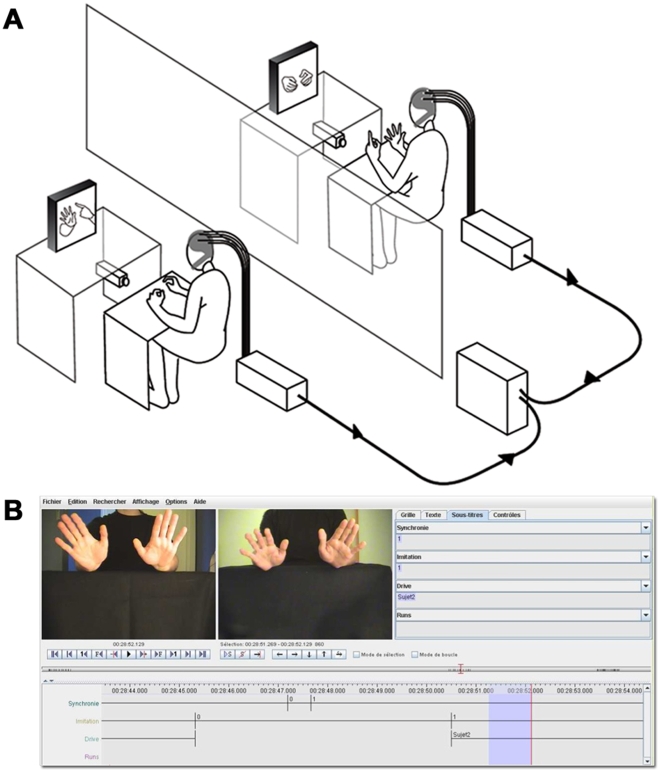
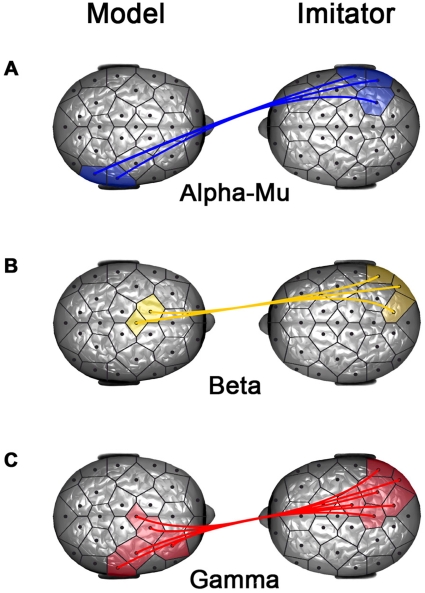
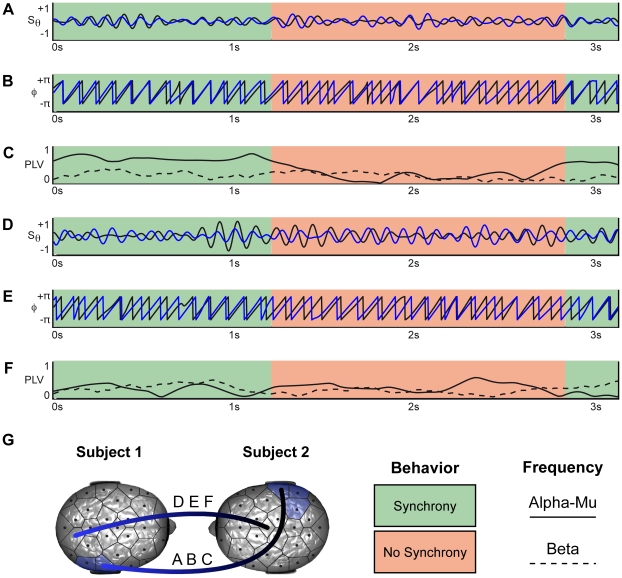
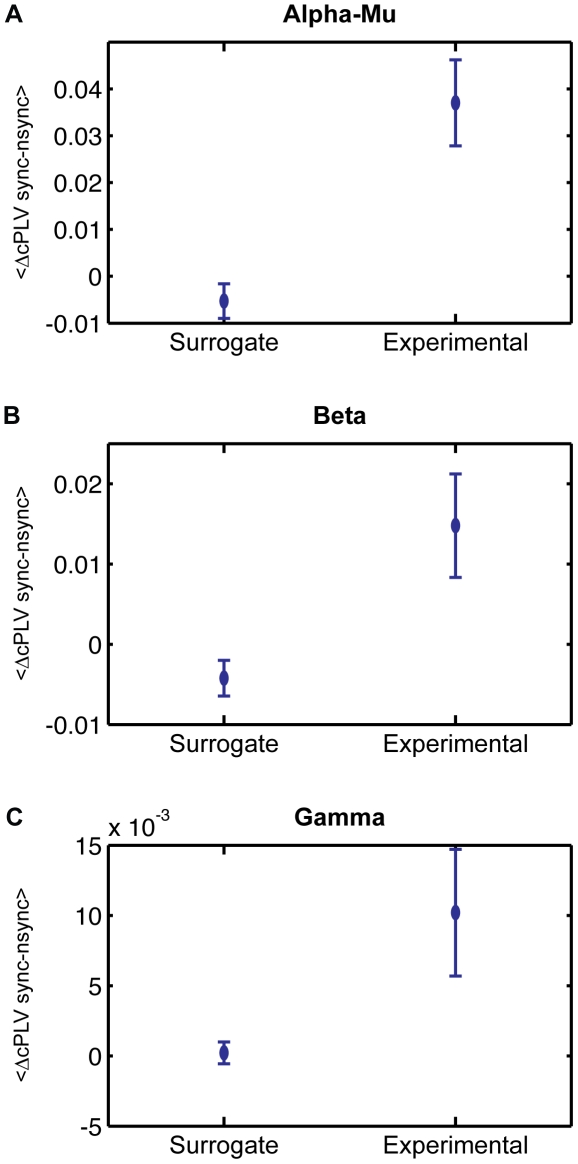
During social interaction, both participants are continuously active, each modifying their own actions in response to the continuously changing actions of the partner. This continuous mutual adaptation results in interactional synchrony to which both members contribute. Freely exchanging the role of imitator and model is a well-framed example of interactional synchrony resulting from a mutual behavioral negotiation. How the participants' brain activity underlies this process is currently a question that hyperscanning recordings allow us to explore. In particular, it remains largely unknown to what extent oscillatory synchronization could emerge between two brains during social interaction. To explore this issue, 18 participants paired as 9 dyads were recorded with dual-video and dual-EEG setups while they were engaged in spontaneous imitation of hand movements. We measured interactional synchrony and the turn-taking between model and imitator. We discovered by the use of nonlinear techniques that states of interactional synchrony correlate with the emergence of an interbrain synchronizing network in the alpha-mu band between the right centroparietal regions. These regions have been suggested to play a pivotal role in social interaction. Here, they acted symmetrically as key functional hubs in the interindividual brainweb. Additionally, neural synchronization became asymmetrical in the higher frequency bands possibly reflecting a top-down modulation of the roles of model and imitator in the ongoing interaction.
Overview
The claims and statistics of this paper haven’t been checked yet.
Free: it reads the open-access text and checks the first 5 claims that cite a source we can check. Create a free account to check every claim.
Integrity signals
Registry
Cites
Statistics
Figures

Verification
Claims the paper makes
The claims and statistics of this paper haven’t been checked yet.
Free: it reads the open-access text and checks the first 5 claims that cite a source we can check. Create a free account to check every claim.
Claims other papers make about this one
Each is checked against this paper’s own text: does it say what the citing paper says it does?
The check wasn’t confident either way, so it gives no verdict — never disputed.
In the citing paper
“The sample size was not determined a priori—each dataset's sample size was guided by prior work in their corresponding fields [38, 39, 40].”
From Interpersonal Synchronization of Autonomic Physiology via Mere Visual Contact (2026) · cites this paper as [38]
Experimental — accuracy not yet measured
Self-check
Percentages, sums and reported differences re-computed from the paper’s own numbers.
The self-check needs the paper’s full text.
Citations
Cites
A Mathematical Theory of Communication
Shannon, C. E. (1948) · Bell System Technical Journal · doi:10.1002/j.1538-7305.1948.tb01338.x · Cited by 88,486
The Mathematical Theory of Communication
Shannon, C. E., Weaver, W., & Wiener, N. (1950) · Physics Today · doi:10.1063/1.3067010 · Cited by 9,801
Nonparametric statistical testing of EEG- and MEG-data
Maris, E., & Oostenveld, R. (2007) · Journal of Neuroscience Methods · doi:10.1016/j.jneumeth.2007.03.024 · Cited by 8,496 · cited 1×
“Following previous studies [41,42], the resulting t-value matrices were then thresholded for absolute values larger than 2.”
The brainweb: phase synchronization and large-scale integration
Varela, F., Lachaux, J.-P., Rodriguez, E., & Martinerie, J. (2001) · Nature Reviews Neuroscience · doi:10.1038/35067550 · Cited by 4,761
Self-citationA mechanism for cognitive dynamics: neuronal communication through neuronal coherence.
Fries, P. (2005) · Trends in Cognitive Sciences · doi:10.1016/j.tics.2005.08.011 · Cited by 4,284 · cited 3×
“have been proposed as a key mechanism for information integration [28], temporal binding [51], flexible neuronal communication [34,52] and unified cognitive processes [45,53].”
InfluentialMeasuring phase synchrony in brain signals
Lachaux, J.-P., Rodriguez, E., Martinerie, J., & Varela, F. J. (1999) · Human Brain Mapping · doi:10.1002/(sici)1097-0193(1999)8:4<194::aid-hbm4>3.0.co;2-c · Cited by 3,798
Self-citationDynamic predictions: Oscillations and synchrony in top–down processing
Engel, A. K., Fries, P., & Singer, W. (2001) · Nature Reviews Neuroscience · doi:10.1038/35094565 · Cited by 3,454 · cited 1×
“Within one brain, synchronous neural oscillations have been previously observed in a range of processes such as conscious perception [44–46], working and long term memory [47,48], states of anticipation or attention [48,49] and empathy [50].”
Mathematical Theory of Communication
(2013) · Encyclopedia of Systems Biology · doi:10.1007/978-1-4419-9863-7_100015 · Cited by 3,290
Rizzolatti, G., & Arbib, M. A. (1998) · Trends in Neurosciences · doi:10.1016/s0166-2236(98)01260-0 · Cited by 2,858
Cortical mechanisms of human imitation
Iacoboni, M., Woods, R. P., Brass, M., Bekkering, H., Mazziotta, J. C., & Rizzolatti, G. (1999) · Science · doi:10.1126/science.286.5449.2526 · Cited by 2,683 · cited 1×
“Though imitation is commonly considered as a foundation for learning, socialization and communication [21,22], its use as a paradigm has been limited so far to test the direct matching hypothesis in an intraindividual perspective [23–27].”
Perception's shadow: long-distance synchronization of human brain activity
Rodriguez, E., George, N., Lachaux, J.-P., Martinerie, J., Renault, B., & Varela, F. J. (1999) · Nature · doi:10.1038/17120 · Cited by 1,915
Self-citationIntersubject synchronization of cortical activity during natural vision
Hasson, U., Nir, Y., Levy, I., Fuhrmann, G., & Malach, R. (2004) · Science · doi:10.1126/science.1089506 · Cited by 1,839 · cited 1×
“Until now indeed, most fMRI explorations of interpersonal processes have scanned one individual only [11,12] or several individuals separately in front of the same visual scene [13].”
Temporal binding and the neural correlates of sensory awareness.
Engel, A. K., & Singer, W. (2001) · Trends in Cognitive Sciences · doi:10.1016/s1364-6613(00)01568-0 · Cited by 1,372
Modulation of Neuronal Interactions Through Neuronal Synchronization
Womelsdorf, T., Schoffelen, J.-M., Oostenveld, R., Singer, W., Desimone, R., Engel, A. K., & Fries, P. (2007) · Science · doi:10.1126/science.1139597 · Cited by 1,367
Human gamma-frequency oscillations associated with attention and memory
Jensen, O., Kaiser, J., & Lachaux, J.-P. (2007) · Trends in Neurosciences · doi:10.1016/j.tins.2007.05.001 · Cited by 1,245
Umiltà, M. A., Kohler, E., Gallese, V., Fogassi, L., Fadiga, L., Keysers, C., & Rizzolatti, G. (2001) · Neuron · doi:10.1016/s0896-6273(01)00337-3 · Cited by 1,192
Radical embodiment: neural dynamics and consciousness
Thompson, E., & Varela, F. J. (2001) · Trends in Cognitive Sciences · doi:10.1016/s1364-6613(00)01750-2 · Cited by 1,144
Decety, J., & Lamm, C. (2007) · The Neuroscientist · doi:10.1177/1073858407304654 · Cited by 1,044
The functional significance of mu rhythms: Translating “seeing” and “hearing” into “doing”
Pineda, J. A. (2005) · Brain Research Reviews · doi:10.1016/j.brainresrev.2005.04.005 · Cited by 1,016
Synchronous neural oscillations and cognitive processes
Ward, L. M. (2003) · Trends in Cognitive Sciences · doi:10.1016/j.tics.2003.10.012 · Cited by 1,009
Hyperscanning: Simultaneous fMRI during Linked Social Interactions
Montague, P. (2002) · NeuroImage · doi:10.1006/nimg.2002.1150 · Cited by 833 · cited 1×
“This new field, however, has revealed rapidly how difficult it is to ‘let humans interact socially while probing their brain activity’, as said by Montague and colleagues [18].”
Synchronization of neural activity across cortical areas correlates with conscious perception
Melloni, L., Molina, C., Pena, M., Torres, D., Singer, W., & Rodriguez, E. (2007) · The Journal of Neuroscience · doi:10.1523/jneurosci.4623-06.2007 · Cited by 716 · cited 1×
“Within one brain, synchronous neural oscillations have been previously observed in a range of processes such as conscious perception [44–46], working and long term memory [47,48], states of anticipation or attention [48,49] and empathy [50].”
Movement intention after parietal cortex stimulation in humans
Desmurget, M., Reilly, K. T., Richard, N., Szathmari, A., Mottolese, C., & Sirigu, A. (2009) · Science · doi:10.1126/science.1169896 · Cited by 695
Phase Synchrony among Neuronal Oscillations in the Human Cortex
Palva, J. M., Palva, S., & Kaila, K. (2005) · The Journal of Neuroscience · doi:10.1523/jneurosci.4250-04.2005 · Cited by 659
Brain basis of human social interaction: from concepts to brain imaging
Hari, R., & Kujala, M. V. (2009) · Physiological Reviews · doi:10.1152/physrev.00041.2007 · Cited by 638
Developing through relationships: origins of communication, self, and culture
(1993) · Choice Reviews Online · doi:10.5860/choice.31-2374 · Cited by 584
Cortical Networks Underlying Mechanisms of Time Perception
Harrington, D. L., Haaland, K. Y., & Knight, R. T. (1998) · The Journal of Neuroscience · doi:10.1523/jneurosci.18-03-01085.1998 · Cited by 561
The Imitative Mind: Development, Evolution and Brain Bases
Meltzoff, A. N., & Prinz, W. (2002) · Cited by 540
Intentional attunement: Mirror neurons and the neural underpinnings of interpersonal relations
Gallese, V., Eagle, M. N., & Migone, P. (2007) · Journal of the American Psychoanalytic Association · doi:10.1177/00030651070550010601 · Cited by 496
An oscillator model of the timing of turn-taking
Wilson, M., & Wilson, T. P. (2005) · Psychonomic Bulletin & Review · doi:10.3758/bf03206432 · Cited by 483
Blakemore, S.-J., & Frith, C. (2003) · Current Opinion in Neurobiology · doi:10.1016/s0959-4388(03)00043-6 · Cited by 448
A PET exploration of the neural mechanisms involved in reciprocal imitation
Decety, J., Chaminade, T., Grèzes, J., & Meltzoff, A. N. (2002) · NeuroImage · doi:10.1006/nimg.2001.0938 · Cited by 445
Brains swinging in concert: cortical phase synchronization while playing guitar.
Lindenberger, U., Li, S.-C., Gruber, W., & Müller, V. (2009) · BMC Neuroscience · doi:10.1186/1471-2202-10-22 · Cited by 444
The phi complex as a neuromarker of human social coordination
Tognoli, E., Lagarde, J., DeGuzman, G. C., & Kelso, J. A. S. (2007) · Proceedings of the National Academy of Sciences · doi:10.1073/pnas.0611453104 · Cited by 437
Hand Movement Direction Decoded from MEG and EEG
Waldert, S., Preissl, H., Demandt, E., Braun, C., Birbaumer, N., Aertsen, A., & Mehring, C. (2008) · The Journal of Neuroscience · doi:10.1523/jneurosci.5171-07.2008 · Cited by 415
New Perspectives in Early Communicative Development
(2017) · Routledge eBooks · doi:10.4324/9781315111322 · Cited by 403
Neural dissociation between visual awareness and spatial attention
Wyart, V., & Tallon-Baudry, C. (2008) · The Journal of Neuroscience · doi:10.1523/jneurosci.4748-07.2008 · Cited by 391 · cited 1×
“This is consistent with motor transient activities involved in the beta band [57] and the implication of gamma in attentional processes, perceptual awareness and cognitive control [34,58].”
Oscillatory Synchrony between Human Extrastriate Areas during Visual Short-Term Memory Maintenance
Tallon-Baudry, C., Bertrand, O., & Fischer, C. (2001) · The Journal of Neuroscience · doi:10.1523/jneurosci.21-20-j0008.2001 · Cited by 388
Expectancies for social contingency in 2‐month‐olds
Nadel, J., Carchon, I., Kervella, C., Marcelli, D., & Réserbat‐Plantey, D. (1999) · Developmental Science · doi:10.1111/1467-7687.00065 · Cited by 367
Self-citationReconstructing Three-Dimensional Hand Movements from Noninvasive Electroencephalographic Signals
Bradberry, T. J., Gentili, R. J., & Contreras-Vidal, J. L. (2010) · The Journal of Neuroscience · doi:10.1523/jneurosci.6107-09.2010 · Cited by 360
Live face-to-face interaction during fMRI: A new tool for social cognitive neuroscience
Redcay, E., Dodell-Feder, D., Pearrow, M. J., Mavros, P. L., Kleiner, M., Gabrieli, J. D. E., & Saxe, R. (2010) · NeuroImage · doi:10.1016/j.neuroimage.2010.01.052 · Cited by 336 · cited 1×
“So-called interactive paradigms mainly consist in non contingent social stimuli that do not allow true social interaction [7].”
Prediction of arm movement trajectories from ECoG-recordings in humans
Pistohl, T., Ball, T., Schulze-Bonhage, A., Aertsen, A., & Mehring, C. (2008) · Journal of Neuroscience Methods · doi:10.1016/j.jneumeth.2007.10.001 · Cited by 331
The Imitative Mind: Development, Evolution and Brain Bases
(2002) · Cambridge University Press eBooks · doi:10.1017/cbo9780511489969 · Cited by 328
Wallstrom, G. L., Kass, R. E., Miller, A., Cohn, J. F., & Fox, N. A. (2004) · International Journal of Psychophysiology · doi:10.1016/j.ijpsycho.2004.03.007 · Cited by 326
Mapping the information flow from one brain to another during gestural communication
Schippers, M. B., Roebroeck, A., Renken, R., Nanetti, L., & Keysers, C. (2010) · Proceedings of the National Academy of Sciences · doi:10.1073/pnas.1001791107 · Cited by 323
Is the mirror neuron system involved in imitation? A short review and meta-analysis
Molenberghs, P., Cunnington, R., & Mattingley, J. B. (2009) · Neuroscience & Biobehavioral Reviews · doi:10.1016/j.neubiorev.2009.03.010 · Cited by 295
Coherent neural representation of hand speed in humans revealed by MEG imaging
Jerbi, K., Lachaux, J.-P., N′Diaye, K., Pantazis, D., Leahy, R. M., Garnero, L., & Baillet, S. (2007) · Proceedings of the National Academy of Sciences · doi:10.1073/pnas.0609632104 · Cited by 289 · cited 1×
“The theta synchronization was found between the two right parietal regions but not in motor regions, although theta band is involved in the encoding of low level parameters of hand movements such as position [59–61] and speed [62].”
Self-citationNonparametric statistical testing of coherence differences
Maris, E., Schoffelen, J.-M., & Fries, P. (2007) · Journal of Neuroscience Methods · doi:10.1016/j.jneumeth.2007.02.011 · Cited by 279
Babiloni, C., Babiloni, F., Carducci, F., Cincotti, F., Cocozza, G., Del Percio, C., Moretti, D. V., & Rossini, P. M. (2002) · NeuroImage · doi:10.1006/nimg.2002.1192 · Cited by 256
The ‘when’ pathway of the right parietal lobe
Battelli, L., Pascual-Leone, A., & Cavanagh, P. (2007) · Trends in Cognitive Sciences · doi:10.1016/j.tics.2007.03.001 · Cited by 233
Motor cognition: a new paradigm to study self–other interactions
Jackson, P. L., & Decety, J. (2004) · Current Opinion in Neurobiology · doi:10.1016/j.conb.2004.01.020 · Cited by 223
Flow of affective information between communicating brains
Anders, S., Heinzle, J., Weiskopf, N., Ethofer, T., & Haynes, J.-D. (2011) · NeuroImage · doi:10.1016/j.neuroimage.2010.07.004 · Cited by 206 · cited 1×
“Simultaneous fMRI or EEG recordings of several brains (i.e. hyperscanning) have recently opened a new field [14–17].”
A comparison of random field theory and permutation methods for the statistical analysis of MEG data
Pantazis, D., Nichols, T. E., Baillet, S., & Leahy, R. M. (2005) · NeuroImage · doi:10.1016/j.neuroimage.2004.09.040 · Cited by 196
Neuroelectrical Hyperscanning Measures Simultaneous Brain Activity in Humans
Astolfi, L., Toppi, J., De Vico Fallani, F., Vecchiato, G., Salinari, S., Mattia, D., Cincotti, F., & Babiloni, F. (2010) · Brain Topography · doi:10.1007/s10548-010-0147-9 · Cited by 190
The human action recognition system and its relationship to Broca’s area: an fMRI study
Hamzei, F., Rijntjes, M., Dettmers, C., Glauche, V., Weiller, C., & Büchel, C. (2003) · NeuroImage · doi:10.1016/s1053-8119(03)00087-9 · Cited by 189
Hypermethods for EEG hyperscanning
Babiloni, F., Cincotti, F., Mattia, D., Mattiocco, M., De Vico Fallani, F., Tocci, A., Bianchi, L., Marciani, M. G., & Astolfi, L. (2006) · 2006 International Conference of the IEEE Engineering in Medicine and Biology Society · doi:10.1109/iembs.2006.260754 · Cited by 125
Nadel, J., & Butterworth, G. E. (1999) · Cambridge University Press eBooks · Cited by 114
Self-citationThe Social Function of Reciprocal Imitation in 2-Year-Old Peers
Nadel-Brulfert, J., & Baudonniere, P. M. (1982) · International Journal of Behavioral Development · doi:10.1177/016502548200500105 · Cited by 106
Self-citationTowards a proper estimation of phase synchronization from time series
Chávez, M., Besserve, M., Adam, C., & Martinerie, J. M. (2006) · Journal of Neuroscience Methods · doi:10.1016/j.jneumeth.2005.12.009 · Cited by 97
Self-citationThe ‘when’ parietal pathway explored by lesion studies
Battelli, L., Walsh, V., Pascual-Leone, A., & Cavanagh, P. (2008) · Current Opinion in Neurobiology · doi:10.1016/j.conb.2008.08.004 · Cited by 85
Pfurtscheller, G., Woertz, M., Supp, G. G., & Lopes, F. H. D. S. (2003) · Neuroscience Letters · doi:10.1016/s0304-3940(02)01479-9 · Cited by 78
Sensitivity to Social Contingency and Positive Emotion in 2‐Month‐Olds
Soussignan, R., Nadel, J., Canet, P., & Gerardin, P. (2006) · Infancy · doi:10.1207/s15327078in1002_2 · Cited by 78
Self-citationSynchronous with Your Feelings: Sensorimotor γ Band and Empathy for Pain
Betti, V., Zappasodi, F., Rossini, P. M., Aglioti, S. M., & Tecchio, F. (2009) · The Journal of Neuroscience · doi:10.1523/jneurosci.2759-09.2009 · Cited by 72
Is Broca's Area Crucial for Imitation?
Makuuchi, M. (2005) · Cerebral Cortex · doi:10.1093/cercor/bhh157 · Cited by 59
Adaptability and Diversity in Simulated Turn-taking Behavior
Iizuka, H., & Ikegami, T. (2004) · Artificial Life · doi:10.1162/1064546041766442 · Cited by 50
Turn-taking Interaction as a Cooperative and Co-creative Process
Ikegami, T., & Iizuka, H. (2007) · Infant Behavior and Development · doi:10.1016/j.infbeh.2007.02.002 · Cited by 36
Prépin, K., & Revel, A. (2007) · Advanced Robotics · doi:10.1163/156855307782506192 · Cited by 23
Cited by
Toward a second-person neuroscience
Schilbach, L., Timmermans, B., Reddy, V., Costall, A., Bente, G., Schlicht, T., & Vogeley, K. (2013) · Behavioral and Brain Sciences · doi:10.1017/s0140525x12000660 · Cited by 1,510
Sensorimotor synchronization: a review of recent research (2006–2012).
Repp, B. H., & Su, Y.-H. (2013) · Psychonomic Bulletin & Review · doi:10.3758/s13423-012-0371-2 · Cited by 1,204
Brain-to-brain synchrony tracks real-world dynamic group interactions in the classroom
Dikker, S., Wan, L., Davidesco, I., Kaggen, L., Oostrik, M., McClintock, J., Rowland, J., Michalareas, G., Van Bavel, J. J., Ding, M., et al. (2017) · Current Biology · doi:10.1016/j.cub.2017.04.002 · Cited by 871
“…for social cognition in a range of social-psycho-logical contexts, including development [21, 23], and provides a plausible account for prior findings showing an increase in brain-to-brain synchrony during laboratory tasks that required dyads to coordinate visual attention (e.g., [3, 5, 8, 11]).”
The Neurobiology of Human Attachments
Feldman, R. (2017) · Trends in Cognitive Sciences · doi:10.1016/j.tics.2016.11.007 · Cited by 839
Cui, X., Bryant, D. M., & Reiss, A. L. (2012) · NeuroImage · doi:10.1016/j.neuroimage.2011.09.003 · Cited by 807
“EEG-based hyperscanning has enabled the study of social interaction in a more naturalistic environment (Astolfi et al., 2010; Dumas et al., 2010; Lindenberger et al., 2009), for example in poker playing (Babiloni et al.”
Metadata
- Authors
- Dumas, G., Nadel, J., Soussignan, R., Martinerie, J., & Garnero, L.
- Affiliations
- Centre National de la Recherche Scientifique (FR)
- Corresponding author
- Dumas, Guillaume
- Venue
- PLoS ONE
- Publisher
- Public Library of Science (PLoS)
- Published
- 2010-08-17
- Volume
- 5
- Issue
- 8
- Pages
- e12166
- ISSN
- 1932-6203 (ISSN-L)
- PMC
- PMC2923151
- OpenAlex
- W1986163111
- Cited by
- 966
- References
- 68
- Citations by year
- 2026: 73 · 2025: 80 · 2024: 68 · 2023: 55 · 2022: 78 · 2021: 106 · 2020: 127 · 2019: 53 · 2018: 54 · 2017: 57 · 2016: 42 · 2015: 31 · 2014: 54 · 2013: 35 · 2012: 33
- FWCI
- 38.29
- Type
- journal article
- Language
- en
- Open access
- gold
- doi.org
- Locations
- PLoS ONE (publishedVersion, cc-by)
- PubMed Central (publishedVersion, cc-by)
- PubMed (publishedVersion)
- HAL (submittedVersion, other-oa)
- HAL (submittedVersion)
- RePEc: Research Papers in Economics (submittedVersion)
- DOAJ (DOAJ: Directory of Open Access Journals) (submittedVersion, cc-by-sa)
- Topics
- Social Sciences › Psychology › Social Psychology › Action Observation and Synchronization
- Life Sciences › Neuroscience › Cognitive Neuroscience › Neural dynamics and brain function
- Life Sciences › Neuroscience › Cognitive Neuroscience › EEG and Brain-Computer Interfaces
- Keywords
- inter-brain synchrony, social interaction, interactional synchrony, spontaneous imitation, turn-taking, hyperscanning, top-down modulation, mirror neuron system
- MeSH terms
- Behavior, Brain, Electroencephalography, Female, Humans, Imitative Behavior, Interpersonal Relations, Male, Young Adult
About these checks
Registry, retraction, Cites and statistics results are computed, not judged, with one exception: a printed reference that no index lists is read once by a model before it counts as a citation error. Claims are extracted by a model and kept only when their quote appears verbatim in the text; each cited source is then checked, with a model’s help, for whether it says what the claim relies on. Those verdicts can be wrong — read the claim’s quote and the cited source before relying on one.
Statistics and arithmetic are recomputed, not judged.
Confidence bands are shown only for fields calibrated on our annotated test set. None is calibrated yet, so no band is shown.
What counts as a claim ›How we measure confidence ›How we check this ›
Are you an author, or do you see a problem with this page? Request a review
Data sources
Bibliographic data: Semantic Scholar, OpenAlex, Crossref.
Contains information from the Semantic Scholar Academic Graph Datasets, made available under the ODC Attribution License (ODC-BY 1.0).
Semantic Scholar’s data is described in: Kinney, R., et al. (2023). The Semantic Scholar Open Data Platform. arXiv:2301.10140.
