

Accelerated Telomere Attrition Is Associated with Relative Household Income, Diet and Inflammation in the pSoBid Cohort
Open accessThe DOI matches its Crossref record; 44 of the 45 references it cites were found in a registry or an index.
Abstract
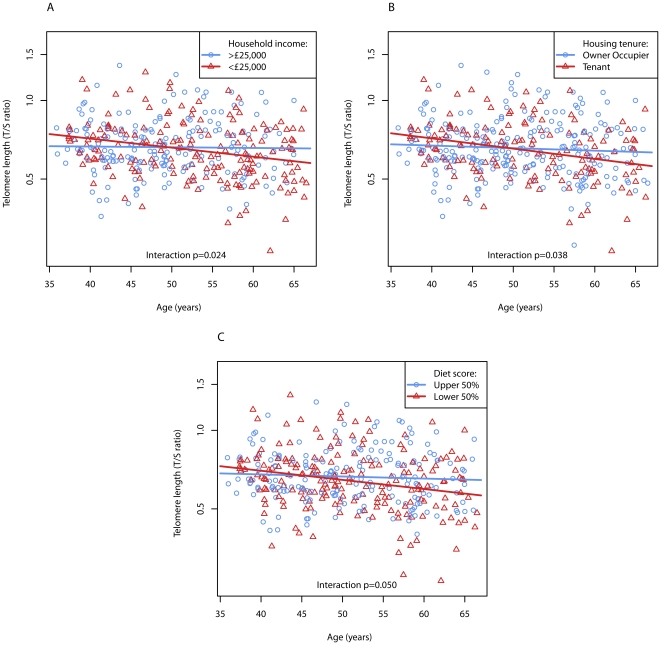
BACKGROUND: It has previously been hypothesized that lower socio-economic status can accelerate biological ageing, and predispose to early onset of disease. This study investigated the association of socio-economic and lifestyle factors, as well as traditional and novel risk factors, with biological-ageing, as measured by telomere length, in a Glasgow based cohort that included individuals with extreme socio-economic differences. METHODS: A total of 382 blood samples from the pSoBid study were available for telomere analysis. For each participant, data was available for socio-economic status factors, biochemical parameters and dietary intake. Statistical analyses were undertaken to investigate the association between telomere lengths and these aforementioned parameters. RESULTS: The rate of age-related telomere attrition was significantly associated with low relative income, housing tenure and poor diet. Notably, telomere length was positively associated with LDL and total cholesterol levels, but inversely correlated to circulating IL-6. CONCLUSIONS: These data suggest lower socio-economic status and poor diet are relevant to accelerated biological ageing. They also suggest potential associations between elevated circulating IL-6, a measure known to predict cardiovascular disease and diabetes with biological ageing. These observations require further study to tease out potential mechanistic links.
Overview
The claims and statistics of this paper haven’t been checked yet.
Free: it reads the open-access text and checks the first 5 claims that cite a source we can check. Create a free account to check every claim.
Integrity signals
Registry
Cites
Statistics
Figures
Verification
Claims the paper makes
The claims and statistics of this paper haven’t been checked yet.
Free: it reads the open-access text and checks the first 5 claims that cite a source we can check. Create a free account to check every claim.
Claims other papers make about this one
Each is checked against this paper’s own text: does it say what the citing paper says it does?
The source backs part of the claim, not all of it — or backs it for a different population, condition or comparison.
In the citing paper
“cumulative social deprivation was biologically embedded via inflammatory, epigenetic and microbiome‐related pathways that accelerated ageing and resulted in earlier onset of age‐related disease in deprived communities [11, 22, 23, 24, 25, 26, 27].”
From Ignoring the planet: A critical blind spot for research on ageing (2025) · cites this paper as [11]
Experimental — accuracy not yet measuredThe source backs part of the claim, not all of it — or backs it for a different population, condition or comparison.
In the citing paper
“We have growing evidence, however, that age‐related healthspan is directly linked to bio‐psychosocial factors, in particular, socioeconomic position [11].”
From Ignoring the planet: A critical blind spot for research on ageing (2025) · cites this paper as [11]
Experimental — accuracy not yet measuredThe source backs part of the claim, not all of it — or backs it for a different population, condition or comparison.
In the citing paper
“increasing evidence has underscored the crucial role of environmental inputs across the life course and across generations, in shaping both individual and intergenerational trajectories of age‐related health.”
From Ignoring the planet: A critical blind spot for research on ageing (2025) · cites this paper as [11]
Experimental — accuracy not yet measured
Self-check
Percentages, sums and reported differences re-computed from the paper’s own numbers.
The self-check needs the paper’s full text.
Citations
Cites
Social determinants of health inequalities
Marmot, M. (2005) · The Lancet · doi:10.1016/s0140-6736(05)71146-6 · Cited by 5,086
Cellular senescence: when bad things happen to good cells
Campisi, J., & d'Adda di Fagagna, F. (2007) · Nature Reviews Molecular Cell Biology · doi:10.1038/nrm2233 · Cited by 4,441 · cited 1×
“Telomere attrition is thought to represent a molecular clock, at least at the cellular level, where it has been hypothesised to act as an anti-neoplastic mechanism [16], proposed to function by countering the accumulation of mutations over successive cell divisions, which potentially could produce neoplastic cells.”
Gompertz, B. (1825) · Philosophical Transactions of the Royal Society of London · doi:10.1098/rstl.1825.0026 · Cited by 3,816 · cited 2×
“Gompertz (1825) first described ageing as an increase in the likelihood of mortality with increasing chronological age [1].”
Telomere measurement by quantitative PCR
Cawthon, R. M. (2002) · Nucleic Acids Research · doi:10.1093/nar/30.10.e47 · Cited by 3,487 · cited 2×
“Telomere length determination DNA was extracted from PBLs following standard procedures and telomere lengths in the DNA samples were determined by QPCR, following the method of Cawthon [44] as described previously [11,33].”
Accelerated telomere shortening in response to life stress
Epel, E. S., Blackburn, E. H., Lin, J., Dhabhar, F. S., Adler, N. E., Morrow, J. D., & Cawthon, R. M. (2004) · Proceedings of the National Academy of Sciences · doi:10.1073/pnas.0407162101 · Cited by 3,002
Persistent DNA damage signalling triggers senescence-associated inflammatory cytokine secretion
Rodier, F., Coppé, J.-P., Patil, C. K., Hoeijmakers, W. A. M., Muñoz, D. P., Raza, S. R., Freund, A., Campeau, E., Davalos, A. R., & Campisi, J. (2009) · Nature Cell Biology · doi:10.1038/ncb1909 · Cited by 2,232
Kirkwood, T. B. L., & Austad, S. N. (2000) · Nature · doi:10.1038/35041682 · Cited by 1,774 · cited 1×
“. In man, this equates to a corresponding, progressive loss of metabolic and physiological functions, though the trajectory for this is not uniform, indicative of underlying inter-individual variation in the biology of ageing”
Telomeres and human disease: ageing, cancer and beyond
Blasco, M. A. (2005) · Nature Reviews Genetics · doi:10.1038/nrg1656 · Cited by 1,434
Leukocyte Telomere Length and Cardiovascular Disease in the Cardiovascular Health Study
Fitzpatrick, A. L., Kronmal, R. A., Gardner, J. P., Psaty, B. M., Jenny, N. S., Tracy, R. P., Walston, J., Kimura, M., & Aviv, A. (2006) · American Journal of Epidemiology · doi:10.1093/aje/kwj346 · Cited by 773 · cited 1×
“Recent human data have now established telomere attrition as a major risk factor for numerous diseases, including cardiovascular disease (CVD), hypertension, diabetes and end stage renal disease [11,20–22] as well as being associated with elevated psychological stresses [23].”
Brouilette, S. W., Moore, J. S., McMahon, A. D., Thompson, J. R., Ford, I., Shepherd, J., Packard, C. J., & Samani, N. J. (2007) · The Lancet · doi:10.1016/s0140-6736(07)60071-3 · Cited by 745 · cited 1×
“Recent human data have now established telomere attrition as a major risk factor for numerous diseases, including cardiovascular disease (CVD), hypertension, diabetes and end stage renal disease [11,20–22] as well as being associated with elevated psychological stresses [23].”
Self-citationDanesh, J., Kaptoge, S., Mann, A. G., Sarwar, N., Wood, A., Angleman, S. B., Wensley, F., Higgins, J. P. T., Lennon, L., Eiriksdottir, G., et al. (2008) · PLoS Medicine · doi:10.1371/journal.pmed.0050078 · Cited by 676 · cited 2×
“In our study, telomere attrition was associated with increasing IL-6 levels, an emerging risk factor for CVD, which may predict fatal events more strongly than non-fatal events [40].”
White Cell Telomere Length and Risk of Premature Myocardial Infarction
Brouilette, S., Singh, R. K., Thompson, J. R., Goodall, A. H., & Samani, N. J. (2003) · Arteriosclerosis, Thrombosis, and Vascular Biology · doi:10.1161/01.atv.0000067426.96344.32 · Cited by 590
[Principle of marginotomy in template synthesis of polynucleotides].
Olovnikov, A. M. (1971) · PubMed · Cited by 563
Expression of p16 INK4a in peripheral blood T‐cells is a biomarker of human aging
Liu, Y., Sanoff, H. K., Cho, H., Burd, C. E., Torrice, C., Ibrahim, J. G., Thomas, N. E., & Sharpless, N. E. (2009) · Aging Cell · doi:10.1111/j.1474-9726.2009.00489.x · Cited by 509
Demissie, S., Levy, D., Benjamin, E. J., Cupples, L. A., Gardner, J. P., Herbert, A., Kimura, M., Larson, M. G., Meigs, J. B., Keaney, J. F., et al. (2006) · Aging Cell · doi:10.1111/j.1474-9726.2006.00224.x · Cited by 508 · cited 1×
“Although telomere length is inversely related to chronological age in humans, there is considerable inter-individual variation in telomere length at any specific age [17].”
Increased telomerase activity and comprehensive lifestyle changes: a pilot study
Ornish, D., Lin, J., Daubenmier, J., Weidner, G., Epel, E., Kemp, C., Magbanua, M. J. M., Marlin, R., Yglecias, L., Carroll, P. R., et al. (2008) · The Lancet Oncology · doi:10.1016/s1470-2045(08)70234-1 · Cited by 430
Status Syndrome: How Your Social Standing Directly Affects Your Health and Life Expectancy
De Vogli, R. (2004) · BMJ · doi:10.1136/bmj.329.7462.408 · Cited by 411 · cited 2×
“Our observations provide an intuitive link between proven socio-economic drivers of disease [5,36,37] and a biological phenomenon underlying any predisposition, or extant disease, namely cellular ageing.”
Telomere length is paternally inherited and is associated with parental lifespan
Njajou, O. T., Cawthon, R. M., Damcott, C. M., Wu, S.-H., Ott, S., Garant, M. J., Blackburn, E. H., Mitchell, B. D., Shuldiner, A. R., & Hsueh, W.-C. (2007) · Proceedings of the National Academy of Sciences · doi:10.1073/pnas.0702703104 · Cited by 387 · cited 1×
“Any putative link, however, may be weak and open to multiple confounders, such as parental telomere length and epigenetic effects [32].”
Martin‐Ruiz, C. M., Gussekloo, J., van Heemst, D., von Zglinicki, T., & Westendorp, R. G. J. (2005) · Aging Cell · doi:10.1111/j.1474-9726.2005.00171.x · Cited by 318 · cited 1×
“The Q-PCR methodology employed in the present study yielded similar telomere length data in keeping with other reports [10,33,42] using the same methodology.”
MethodShort Telomeres Are Associated With Increased Carotid Atherosclerosis in Hypertensive Subjects
Benetos, A., Gardner, J. P., Zureik, M., Labat, C., Xiaobin, L., Adamopoulos, C., Temmar, M., Bean, K. E., Thomas, F., & Aviv, A. (2004) · Hypertension · doi:10.1161/01.hyp.0000113081.42868.f4 · Cited by 313 · cited 1×
“Recent human data have now established telomere attrition as a major risk factor for numerous diseases, including cardiovascular disease (CVD), hypertension, diabetes and end stage renal disease [11,20–22] as well as being associated with elevated psychological stresses [23].”
The effects of social status on biological aging as measured by white‐blood‐cell telomere length
Cherkas, L. F., Aviv, A., Valdes, A. M., Hunkin, J. L., Gardner, J. P., Surdulescu, G. L., Kimura, M., & Spector, T. D. (2006) · Aging Cell · doi:10.1111/j.1474-9726.2006.00222.x · Cited by 306 · cited 3×
“Ofthe four previous studies in this field [29–31 , 34 ] only two have indicated an association with SES.”
InfluentialTaylor, A. E., Ebrahim, S., Ben-Shlomo, Y., Martin, R. M., Whincup, P. H., Yarnell, J. W., Wannamethee, S. G., & Lawlor, D. A. (2010) · The American Journal of Clinical Nutrition · doi:10.3945/ajcn.2009.28757 · Cited by 259 · cited 1×
“Furthermore, we have observed a relationship with a measure of adiposity, namely waist/hip ratio (Table 1), a predictive measure for CVD and diabetes as well as all cause mortality in prospective studies [35].”
Replicative Aging, Telomeres, and Oxidative Stress
SARETZKI, G., & VON ZGLINICKI, T. (2002) · Annals of the New York Academy of Sciences · doi:10.1111/j.1749-6632.2002.tb02079.x · Cited by 253
Harris, S. E., Deary, I. J., MacIntyre, A., Lamb, K. J., Radhakrishnan, K., Starr, J. M., Whalley, L. J., & Shiels, P. G. (2006) · Neuroscience Letters · doi:10.1016/j.neulet.2006.07.055 · Cited by 200 · cited 3×
“Telomere length determination DNA was extracted from PBLs following standard procedures and telomere lengths in the DNA samples were determined by QPCR, following the method of Cawthon [44] as described previously [11,33].”
MethodSelf-citationAdipokines and Risk of Type 2 Diabetes in Older Men
Wannamethee, S. G., Lowe, G. D. O., Rumley, A., Cherry, L., Whincup, P. H., & Sattar, N. (2007) · Diabetes Care · doi:10.2337/dc06-2416 · Cited by 194
Self-citationTelomere Length Is Associated With Obesity Parameters but With a Gender Difference
Nordfjäll, K., Eliasson, M., Stegmayr, B., Melander, O., Nilsson, P., & Roos, G. (2008) · Obesity · doi:10.1038/oby.2008.413 · Cited by 188 · cited 2×
“Poorer quality, fat and sugar rich diets, are known to result in the production of more reactive oxygen species, which directly cause DNA breaks that lead to gene malfunction, telomere attrition and disease [38,39].”
Carrero, J. J., Stenvinkel, P., Fellström, B., Qureshi, A. R., Lamb, K., Heimbürger, O., Bárány, P., Radhakrishnan, K., Lindholm, B., Soveri, I., et al. (2008) · Journal of Internal Medicine · doi:10.1111/j.1365-2796.2007.01890.x · Cited by 186 · cited 5×
“The association of IL-6 with biological age is in keeping with recent observations indicating that senescent cells up-regulate and secrete IL-6 [9,11].”
MethodInfluentialSelf-citationBiomarkers of aging and disease: Introduction and definitions
Sprott, R. L. (2010) · Experimental Gerontology · doi:10.1016/j.exger.2009.07.008 · Cited by 178
Human telomere biology: pitfalls of moving from the laboratory to epidemiology
Aviv, A., Valdes, A. M., & Spector, T. D. (2006) · International Journal of Epidemiology · doi:10.1093/ije/dyl169 · Cited by 172
Markers of cellular senescence in zero hour biopsies predict outcome in renal transplantation
Koppelstaetter, C., Schratzberger, G., Perco, P., Hofer, J., Mark, W., Öllinger, R., Oberbauer, R., Schwarz, C., Mitterbauer, C., Kainz, A., et al. (2008) · Aging Cell · doi:10.1111/j.1474-9726.2008.00398.x · Cited by 124 · cited 3×
“Conversely, shorter telomeres were associated with increased levels of IL-6 (7.2% decrease in IL6 levels per one SD increase in log telomere length, p = 0.022, Table 2).”
InfluentialCellular senescence in pretransplant renal biopsies predicts postoperative organ function
McGlynn, L. M., Stevenson, K., Lamb, K., Zino, S., Brown, M., Prina, A., Kingsmore, D., & Shiels, P. G. (2009) · Aging Cell · doi:10.1111/j.1474-9726.2008.00447.x · Cited by 108
Self-citationSattar, N., Murray, H. M., Welsh, P., Blauw, G. J., Buckley, B. M., Cobbe, S., de Craen, A. J. M., Lowe, G. D., Jukema, J. W., Macfarlane, P. W., et al. (2009) · PLoS Medicine · doi:10.1371/journal.pmed.1000099 · Cited by 101 · cited 1×
“One hypothesis for the increased disease prevalence in these communities is underlying chronic inflammation (elevated CRP or IL-6), a known component and predictor of CVD and diabetes [26,27], that is linked to a diverse range of pathologies.”
Self-citationNo association between socio‐economic status and white blood cell telomere length
Adams, J., Martin‐Ruiz, C., Pearce, M. S., White, M., Parker, L., & Von Zglinicki, T. (2007) · Aging Cell · doi:10.1111/j.1474-9726.2006.00258.x · Cited by 85
Telomere dysfunction in hypertension
Fuster, J. J., Díez, J., & Andrés, V. (2007) · Journal of Hypertension · doi:10.1097/hjh.0b013e3282ef6196 · Cited by 68 · cited 1×
“Many such pathologies, showing an association with increased telomere attrition rates, are predominant in deprived communities where there is a higher prevalence of classical risk factors for disease, but this explanation does not account totally for these variations in disease incidence [10,24,25].”
Deans, K. A., Bezlyak, V., Ford, I., Batty, G. D., Burns, H., Cavanagh, J., Groot, E. D., McGinty, A., Millar, K., Shiels, P. G., et al. (2009) · BMJ · doi:10.1136/bmj.b4170 · Cited by 64 · cited 4×
“Measurement of biochemical parameters have been described in detail elsewhere [5].”
InfluentialSelf-citationSocioeconomic status and telomere length: the West of Scotland Coronary Prevention Study: Table 1
Batty, G. D., Wang, Y., Brouilette, S. W., Shiels, P., Packard, C., Moore, J., Samani, N. J., & Ford, I. (2009) · Journal of Epidemiology and Community Health · doi:10.1136/jech.2009.088427 · Cited by 58 · cited 2×
“Interestingly, in the light of possible confounders relating to the veracity of SES data, employment status (men who reported being out of work) was reported to associate significantly with shorter telomeres [34], in a large cross sectional study from an overlapping demographic area (the WOSCOPS cohort).”
Self-citationOlder men with higher self-rated socioeconomic status have shorter telomeres
Woo, J., Suen, E. W. C., Leung, J. C. S., Tang, N. L. S., & Ebrahim, S. (2009) · Age and Ageing · doi:10.1093/ageing/afp098 · Cited by 41 · cited 3×
“positive [29], null [30,33,34] and negative associations [31].”
Improving Precision in Investigating Aging: Why Telomeres Can Cause Problems
Shiels, P. G. (2010) · The Journals of Gerontology Series A: Biological Sciences and Medical Sciences · doi:10.1093/gerona/glq095 · Cited by 37 · cited 2×
“The use of such a marker would avoid the potentially confounding effects of differences in telomere length measurement methodology, that currently beset the field [14].”
Self-citationVelupillai, Y. N., Packard, C. J., Batty, G. D., Bezlyak, V., Burns, H., Cavanagh, J., Deans, K., Ford, I., McGinty, A., Millar, K., et al. (2008) · BMC Public Health · doi:10.1186/1471-2458-8-126 · Cited by 36 · cited 3×
“The design of the psychological, social, and biological determinants of ill health (pSoBid) study has been described elsewhere [6].”
MethodSelf-citationCommentary: Raising the bar on telomere epidemiology
Aviv, A. (2009) · International Journal of Epidemiology · doi:10.1093/ije/dyp298 · Cited by 24 · cited 2×
“However, there are many equivocal reports regarding how useful this marker is when applied in epidemiological studies [13,14].”
Welsh, P. I., Woodward, M., Rumley, A., MacMahon, S. W., & Lowe, G. D. O. (2010) · Cytokine · doi:10.1016/j.cyto.2009.12.014 · Cited by 14 · cited 1×
“The association between accelerated biological ageing and increased IL-6 levels has been previously been reported to be linked with disease [11], general health [9] and social deprivation [41].”
Biomarkers of Aging with Prognostic and Predictive Value in Non-Oncological Diseases
Koppelstaetter, C., Kern, G., & Mayer, G. J. (2009) · Current Medicinal Chemistry · doi:10.2174/092986709789057644 · Cited by 11 · cited 1×
“Despite cell cycle inhibitor transcript levels providing an accurate indication of organ and T cell biological age [7–9] the overwhelming majority of studies employ determination of telomere length in peripheral blood leukocytes (PBLs) in a clinical context [10–12].”
Telomeres, ageing and oxidation.
Lamb, K. J., & Shiels, P. G. (2009) · PubMed · Cited by 8
Self-citationEnnals, R. (2006) · AI & Society · doi:10.1007/s00146-006-0037-6 · Cited by 3
Cited by
Gender and telomere length: Systematic review and meta-analysis
Gardner, M., Bann, D., Wiley, L., Cooper, R., Hardy, R., Nitsch, D., Martin-Ruiz, C., Shiels, P., Sayer, A. A., Barbieri, M., et al. (2014) · Experimental Gerontology · doi:10.1016/j.exger.2013.12.004 · Cited by 513
“…has been associated with cardiovascular risk factors (Benetos et al., 2001; Bekaert et al., 2007; Fitzpatrick et al., 2007; Nordfjall et al., 2008b; Shiels et al., 2011) and cardiovascular disease (Brouilette et al., 2007; Fitzpatrick et al., 2007), it did not predict risk for enhanced cancer…”
BackgroundInfluentialSelf-citationShalev, I., Moffitt, T. E., Sugden, K., Williams, B., Houts, R. M., Danese, A., Mill, J., Arseneault, L., & Caspi, A. (2013) · Molecular Psychiatry · doi:10.1038/mp.2012.32 · Cited by 489
Understanding how we age: insights into inflammaging
Baylis, D., Bartlett, D. B., Patel, H. P., & Roberts, H. C. (2013) · Longevity & Healthspan · doi:10.1186/2046-2395-2-8 · Cited by 411
“Negative relationships with telomere length have also been demonstrated with CRP [29] and IL-6 [30].”
BackgroundChronic kidney disease and premature ageing
Kooman, J. P., Kotanko, P., Schols, A. M. W. J., Shiels, P. G., & Stenvinkel, P. (2014) · Nature Reviews Nephrology · doi:10.1038/nrneph.2014.185 · Cited by 376
Self-citationNeedham, B. L., Adler, N., Gregorich, S., Rehkopf, D., Lin, J., Blackburn, E. H., & Epel, E. S. (2013) · Social Science & Medicine · doi:10.1016/j.socscimed.2013.02.023 · Cited by 321
“, 2012) but inconsistent with others (Adams et al., 2007; Batty et al., 2009; Carroll et al., 2013; Cherkas et al., 2006; Shiels et al., 2011).”
BackgroundResultInfluential
Metadata
- Authors
- Shiels, P. G., McGlynn, L. M., MacIntyre, A., Johnson, P. C. D., Batty, G. D., Burns, H., Cavanagh, J., Deans, K. A., Ford, I., McConnachie, A., McGinty, A., McLean, J. S., Millar, K., Sattar, N., Tannahill, C., Velupillai, Y. N., & Packard, C. J.
- Affiliations
- University of Glasgow (GB)
- MRC/CSO Social and Public Health Sciences Unit (GB)
- Scottish Government (GB)
- NHS Greater Glasgow and Clyde (GB)
- Glasgow Centre for Population Health (GB)
- University College Cork (IE)
- Corresponding author
- Shiels, Paul G.
- ORCID
- Venue
- PLoS ONE
- Publisher
- Public Library of Science (PLoS)
- Published
- 2011-07-27
- Volume
- 6
- Issue
- 7
- Pages
- e22521
- ISSN
- 1932-6203 (ISSN-L)
- PMC
- PMC3144896
- OpenAlex
- W2077449065
- Cited by
- 143
- References
- 45
- Citations by year
- 2026: 2 · 2025: 6 · 2024: 9 · 2023: 3 · 2022: 4 · 2021: 7 · 2020: 13 · 2019: 12 · 2018: 11 · 2017: 11 · 2016: 5 · 2015: 5 · 2014: 17 · 2013: 17 · 2012: 19
- FWCI
- 12.00
- Type
- journal article
- Language
- en
- Open access
- gold
- doi.org
- Locations
- PLoS ONE (publishedVersion, cc-by)
- Europe PMC (PubMed Central) (publishedVersion, cc-by)
- PubMed Central (publishedVersion, cc-by)
- PubMed (publishedVersion)
- Arrow@dit (Dublin Institute of Technology) (acceptedVersion)
- ENLIGHTEN (Jurnal Bimbingan dan Konseling Islam) (acceptedVersion)
- University of Limerick Institutional Repository (University of Limerick) (acceptedVersion, cc-by-nc-sa)
- RePEc: Research Papers in Economics (submittedVersion)
- DOAJ (DOAJ: Directory of Open Access Journals) (submittedVersion, cc-by-sa)
- UCL Discovery (University College London) (submittedVersion)
- Figshare (submittedVersion, cc-by)
- University of Limerick Institutional Repository (University of Limerick) (submittedVersion, cc-by-nc-sa)
- University of Limerick Institutional Repository (University of Limerick)
- Funders
- NHS Greater Glasgow and Clyde
- Scottish Government
- Glasgow Centre for Population Health
- University of Glasgow
- Topics
- Life Sciences › Biochemistry, Genetics and Molecular Biology › Cell Biology › Telomeres, Telomerase, and Senescence
- Social Sciences › Health › Health disparities and outcomes
- Life Sciences › Biochemistry, Genetics and Molecular Biology › Aging › Genetics, Aging, and Longevity in Model Organisms
- Keywords
- telomere length, biological aging, accelerated aging, socioeconomic status, relative income, housing tenure, diet, inflammation, interleukin-6, cholesterol, cardiovascular risk
- MeSH terms
- Adult, Diet, Family Characteristics, Female, Housing, Humans, Income, Inflammation, Life Style, Male, Middle Aged, Regression Analysis, Cohort Studies, Biomarkers, Interleukin-6, Telomere
About these checks
Registry, retraction, Cites and statistics results are computed, not judged, with one exception: a printed reference that no index lists is read once by a model before it counts as a citation error. Claims are extracted by a model and kept only when their quote appears verbatim in the text; each cited source is then checked, with a model’s help, for whether it says what the claim relies on. Those verdicts can be wrong — read the claim’s quote and the cited source before relying on one.
Statistics and arithmetic are recomputed, not judged.
Confidence bands are shown only for fields calibrated on our annotated test set. None is calibrated yet, so no band is shown.
What counts as a claim ›How we measure confidence ›How we check this ›
Are you an author, or do you see a problem with this page? Request a review
Data sources
Bibliographic data: Semantic Scholar, OpenAlex, Crossref.
Contains information from the Semantic Scholar Academic Graph Datasets, made available under the ODC Attribution License (ODC-BY 1.0).
Semantic Scholar’s data is described in: Kinney, R., et al. (2023). The Semantic Scholar Open Data Platform. arXiv:2301.10140.
