

The DOI matches its Crossref record; 50 of the 50 references it cites were found in a registry or an index; none of the 36 sources its claims cite is checked for support yet.
Hunter-Gatherer Energetics and Human Obesity
Open accessAbstract
Western lifestyles differ markedly from those of our hunter-gatherer ancestors, and these differences in diet and activity level are often implicated in the global obesity pandemic. However, few physiological data for hunter-gatherer populations are available to test these models of obesity. In this study, we used the doubly-labeled water method to measure total daily energy expenditure (kCal/day) in Hadza hunter-gatherers to test whether foragers expend more energy each day than their Western counterparts. As expected, physical activity level, PAL, was greater among Hadza foragers than among Westerners. Nonetheless, average daily energy expenditure of traditional Hadza foragers was no different than that of Westerners after controlling for body size. The metabolic cost of walking (kcal kg(-1) m(-1)) and resting (kcal kg(-1) s(-1)) were also similar among Hadza and Western groups. The similarity in metabolic rates across a broad range of cultures challenges current models of obesity suggesting that Western lifestyles lead to decreased energy expenditure. We hypothesize that human daily energy expenditure may be an evolved physiological trait largely independent of cultural differences.
Overview
AI snapshot
Written from the paper’s full text.
TL;DR
Doubly labeled water measurements in Hadza hunter-gatherers show that, despite higher physical activity levels and lower body fat than Westerners, their total daily energy expenditure is similar after controlling for body size. The paper argues that obesity differences between populations are more likely driven by energy intake than by reduced energy expenditure from Western lifestyles.
Key findings
- Hadza adults had lower body fat than Western adults: Hadza women 20.9±4.6% and men 13.5±4.2%, versus Western women 37.9±7.0% and men 22.5±5.0%.
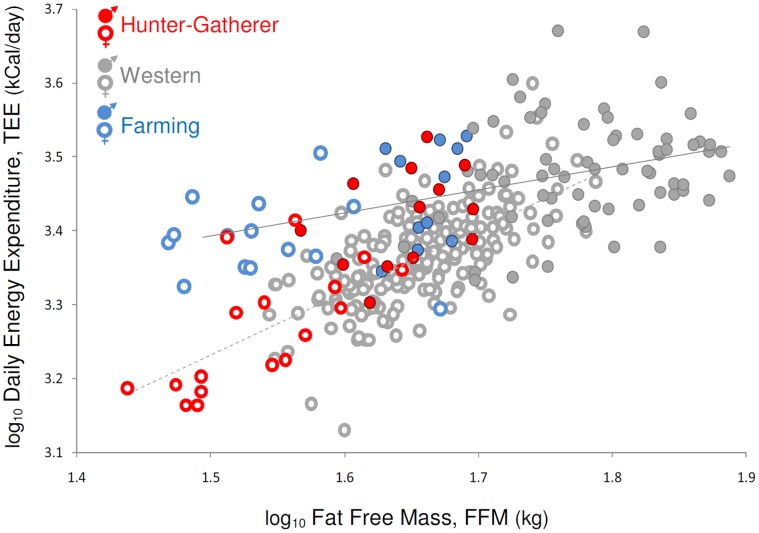
- TEE did not differ between Hadza and Western groups after controlling for fat-free mass and age: Hadza women 1877±364 kCal/day vs Western women 2347±360 kCal/day; Hadza men 2649±395 kCal/day vs Western men 3053±464 kCal/day; lifestyle had no effect on TEE (women: F(139)=0.18, p=0.67; men: F(49)=0.17, p=0.68).
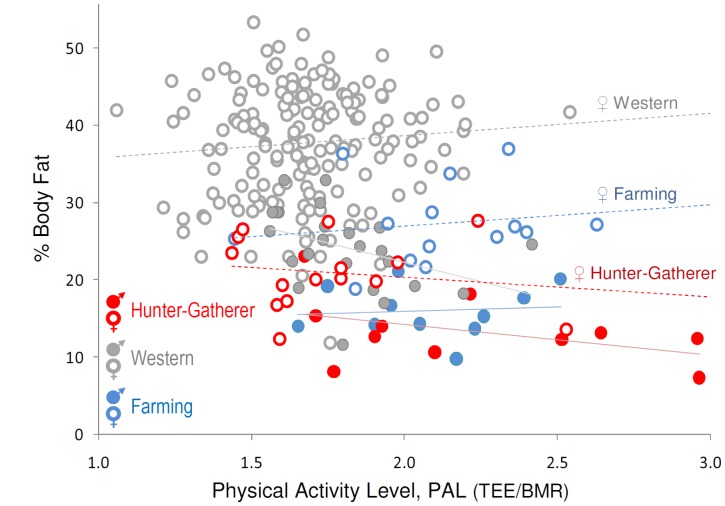
- Physical activity level was higher among Hadza men (2.26±0.48) than Western men (1.81±0.21; F(43)=13.07, p=0.001), and slightly higher among Hadza women (1.78±0.30) than Western women (1.68±0.22; F(162)=3.80, p=0.05).
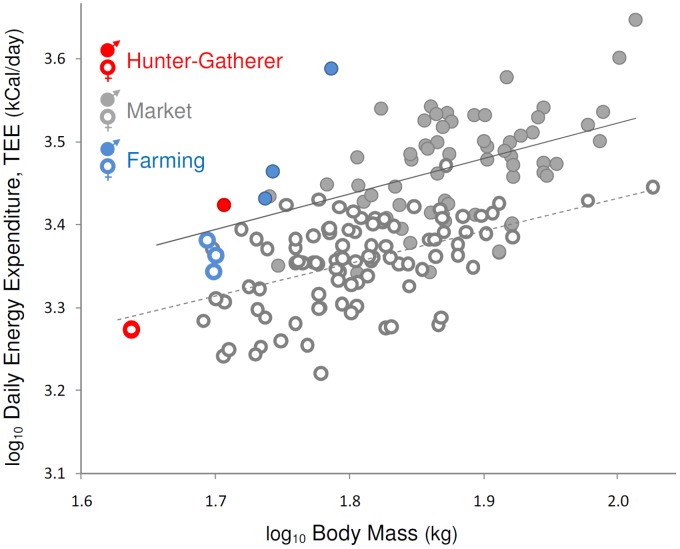
- Farming populations had higher TEE than predicted for body size, while Hadza did not differ from market-economy populations (t(155)=−0.35, p=0.73); farming groups had consistently greater TEE in population comparisons (t=2.76, p=0.006).
Methods
- TEE was measured using doubly labeled water over an 11-day period in 30 Hadza adults (13 men ages 18–65, 17 women ages 18–75); PAL was calculated as TEE/estimated BMR.
- Daily walking distance was measured with GPS in Hadza subjects; resting metabolic rate and walking cost were measured with portable respirometry in subsets (RMR n=19; walking cost n=14).
- Comparative analyses used previous DLW studies and new U.S. adult measurements (n=68), plus a population-level meta-analysis of 198 single-sex cohorts representing 4,972 subjects; generalized linear models controlled for fat-free mass, age, sex, and body size where applicable.
Limitations
- The paper states it was not an intervention study: it examined habitual TEE, PAL, and body composition but did not test the effects of imposing increased physical activity on Westerners.
- The paper states that TEE and PAL measurements of other traditional populations, preferably hunter-gatherers, are needed to assess whether the Hadza pattern is typical of human foragers.
- The paper notes that BMR was estimated rather than measured for Hadza subjects, and that fat-free mass was unavailable for most populations in population-level analyses, so total body mass was used as a body-size index; evident from the text, Hadza subsamples for RMR and walking cost were small (n=19 and n=14), and the comparative dataset combines heterogeneous prior studies.
Model-written summary. Check it against the paper before relying on it.
Integrity signals
Registry
Cites
Statistics
Figures
Verification
Claims the paper makes
26 Not checked yet · 16 Own result · 14 Own interpretation · 9 Own method
A result the paper reports from its own data — it cites no other source for it, so there is none to check. The quote shows it is in the paper.
In the paper
“TEE among Hadza adults was strongly related to body size, specifically fat free mass (FFM) (r2 = 0.66, n = 30, p<0.001; Table S1).”
§ Hunter-Gatherer Energetics and Human Obesity > Results
boostedcorrelationaln = 30- Asserted: passes — The authors put it forward as true.
- Checkable: passes — It can be checked against evidence.
- Load-bearing: unclear — It is unclear whether the paper’s conclusions depend on it.
- Based: passes — The paper gives a reason why it holds.
A result the paper reports from its own data — it cites no other source for it, so there is none to check. The quote shows it is in the paper.
In the paper
“Nonetheless, average daily energy expenditure of traditional Hadza foragers was no different than that of Westerners after controlling for body size.”
- Also stated in: § Results · plain
“In multivariate comparisons of TEE controlling for FFM and age, Hadza women’s energy expenditure was similar to that of Western women (n = 186) and Hadza men’s TEE was similar to Western men (n = 53); lifestyle had no effect on TEE (women: F(139) = 0.18, p = 0.67; men: F(49) = 0.17, p = 0.68) (Fig. 1, Table S1).”
- Also stated in: § Discussion · plain
“TEE among Hadza and Westerners was indistinguishable when controlling for lean mass and fat mass (common proxies for non-activity metabolic costs) despite differences in lifestyle and estimated PAL.”
§ Hunter-Gatherer Energetics and Human Obesity > Abstract
plain- Asserted: passes — The authors put it forward as true.
- Checkable: passes — It can be checked against evidence.
- Load-bearing: passes — The paper’s conclusions depend on it.
- Based: passes — The paper gives a reason why it holds.
- Also stated in: § Results · plain
A result the paper reports from its own data — it cites no other source for it, so there is none to check. The quote shows it is in the paper.
In the paper
“In comparisons among individual subjects, female Bolivian farmers [13] had higher TEE than Western and Hadza women (p<0.001 both comparisons, Table 1), and farming groups (n = 3) had consistently greater TEE in population comparisons (t = 2.76, p = 0.006, Table S1) (Fig. 1, 2).”
§ Hunter-Gatherer Energetics and Human Obesity > Results
plaincorrelationaln = 3 ·- Asserted: passes — The authors put it forward as true.
- Checkable: passes — It can be checked against evidence.
- Load-bearing: passes — The paper’s conclusions depend on it.
- Based: passes — The paper gives a reason why it holds.
In the paper
“In comparisons among individual subjects, female Bolivian farmers [13] had higher TEE than Western and Hadza women (p<0.001 both comparisons, Table 1), and farming groups (n = 3) had consistently greater TEE in population comparisons (t = 2.76, p = 0.006, Table S1) (Fig. 1, 2).”
§ Hunter-Gatherer Energetics and Human Obesity > Results
What the sources say
- Not checked yetcites [13] H Kashiwazaki, 1995, Energy expenditure determined by the doubly labeled water method in Bolivian Aymara living in a high altitude agropastoral community., Am J Clin Nutr source
plain- Asserted: passes — The authors put it forward as true.
- Checkable: passes — It can be checked against evidence.
- Load-bearing: passes — The paper’s conclusions depend on it.
- Based: passes — The paper gives a reason why it holds.
A result the paper reports from its own data — it cites no other source for it, so there is none to check. The quote shows it is in the paper.
In the paper
“However, individual variation in daily walking distance did not explain variation in TEE.”
- Also stated in: § Results · plain
“but TEE was not correlated with mean daily travel distance (F(28) = 0.75, p = 0.39) (Table S1).”
§ Hunter-Gatherer Energetics and Human Obesity > Results
plain- Asserted: passes — The authors put it forward as true.
- Checkable: passes — It can be checked against evidence.
- Load-bearing: passes — The paper’s conclusions depend on it.
- Based: passes — The paper gives a reason why it holds.
- Also stated in: § Results · plain
None of the sources cited for this claim have been checked yet.
In the paper
“The metabolic cost of walking (kcal kg−1 m−1) and resting (kcal kg−1 s−1) were also similar among Hadza and Western groups.”
- Also stated in: § Results · plain
“RMR for Hadza adults measured while sitting averaged 11% above predicted BMR [27], within the range of values (7–35%) reported for other populations [35].”
§ Hunter-Gatherer Energetics and Human Obesity > Abstract
What the sources say
plain- Asserted: passes — The authors put it forward as true.
- Checkable: passes — It can be checked against evidence.
- Load-bearing: passes — The paper’s conclusions depend on it.
- Based: passes — The paper gives a reason why it holds.
- Also stated in: § Results · plain
A result the paper reports from its own data — it cites no other source for it, so there is none to check. The quote shows it is in the paper.
In the paper
“While the Hadza likely perform traditional foraging tasks (e.g., digging tubers or chopping tree limbs for honey) more efficiently than unacculturated Westerners can [34], comparisons of activities common across cultures do not indicate that Hadza muscle and locomotor physiology inherently more efficient.”
§ Hunter-Gatherer Energetics and Human Obesity > Results
hedged- Asserted: passes — The authors put it forward as true.
- Checkable: passes — It can be checked against evidence.
- Load-bearing: passes — The paper’s conclusions depend on it.
- Based: passes — The paper gives a reason why it holds.
A result the paper reports from its own data — it cites no other source for it, so there is none to check. The quote shows it is in the paper.
In the paper
“In multivariate comparisons controlling for mass, height, sex, and age, body fat percentages for Hadza adults were lower than individuals from Western (U.S. and Europe) populations (F(228) = 22.72, p<0.001).”
- Also stated in: § Discussion · plain
“Further, while Hadza differed from Western populations in body fat percentage (F(202) = 44.05, p<0.001), variation in adiposity both within and between populations was not correlated with PAL (F(207) = 0.36, p = 0.55) (Fig. 3) nor with TEE (F(209) = 3.02, p = 0.08, β = 12.06; note that the effect of TEE on adiposity, while not statistically significant, is positive in this sample).”
§ Hunter-Gatherer Energetics and Human Obesity > Results
plain- Asserted: passes — The authors put it forward as true.
- Checkable: passes — It can be checked against evidence.
- Load-bearing: passes — The paper’s conclusions depend on it.
- Based: passes — The paper gives a reason why it holds.
- Also stated in: § Discussion · plain
A result the paper reports from its own data — it cites no other source for it, so there is none to check. The quote shows it is in the paper.
In the paper
“Similarly, TEE of Hadza women who were pregnant or lactating (n = 8; 1 pregnant, 7 lactating) was no different from other Hadza women (n = 9; F(16) = 0.96, p = 0.35) after controlling for FFM (Table S1).”
§ Hunter-Gatherer Energetics and Human Obesity > Results
plainn = 8- Asserted: passes — The authors put it forward as true.
- Checkable: passes — It can be checked against evidence.
- Load-bearing: passes — The paper’s conclusions depend on it.
- Based: passes — The paper gives a reason why it holds.
A result the paper reports from its own data — it cites no other source for it, so there is none to check. The quote shows it is in the paper.
In the paper
“Further, while Hadza differed from Western populations in body fat percentage (F(202) = 44.05, p<0.001), variation in adiposity both within and between populations was not correlated with PAL (F(207) = 0.36, p = 0.55) (Fig. 3) nor with TEE (F(209) = 3.02, p = 0.08, β = 12.06; note that the effect of TEE on adiposity, while not statistically significant, is positive in this sample).”
§ Hunter-Gatherer Energetics and Human Obesity > Discussion
plain- Asserted: passes — The authors put it forward as true.
- Checkable: passes — It can be checked against evidence.
- Load-bearing: passes — The paper’s conclusions depend on it.
- Based: passes — The paper gives a reason why it holds.
- Probably not a substantial claim. 13
- It may state two separate claims as one. 17
In the paper
“Daily walking distances for Hadza women (mean 5.8, std. dev. ±1.7 km/day) and men (11.4±2.1 km/day) were significantly different (p<0.001, t-test), consistent with previous measurements in hunting and gathering societies [10].”
§ Hunter-Gatherer Energetics and Human Obesity > Results
What the sources say
- Not checked yetcites [10] FW Marlowe, 2005, Hunter-gatherers and human evolution., Evol Anth source
plain- Asserted: passes — The authors put it forward as true.
- Checkable: passes — It can be checked against evidence.
- Load-bearing: fails — The paper’s conclusions may not depend on it.
- Based: passes — The paper gives a reason why it holds.
Probably not a substantial claim. The paper’s conclusions may not depend on it.
A result the paper reports from its own data — it cites no other source for it, so there is none to check. The quote shows it is in the paper.
In the paper
“Estimated daily energy expenditure on walking (kCal/day) accounted for an average of 6.7% (±1.9%) of TEE among Hadza women and 11.0% (±3.4%) among Hadza men (Text S1), but TEE was not correlated with mean daily travel distance (F(28) = 0.75, p = 0.39) (Table S1).”
§ Hunter-Gatherer Energetics and Human Obesity > Results
hedged- Asserted: passes — The authors put it forward as true.
- Checkable: passes — It can be checked against evidence.
- Load-bearing: unclear — It is unclear whether the paper’s conclusions depend on it.
- Based: passes — The paper gives a reason why it holds.
It may state two separate claims as one.
A result the paper reports from its own data — it cites no other source for it, so there is none to check. The quote shows it is in the paper.
In the paper
“Not only is TEE statistically indistinguishable between Westerners and Hadza foragers, but the range of TEE within Western, foraging, and farming populations largely overlap, both at the individual and population levels (Table 1, Fig. 1, 2).”
§ Hunter-Gatherer Energetics and Human Obesity > Discussion
plain- Asserted: passes — The authors put it forward as true.
- Checkable: passes — It can be checked against evidence.
- Load-bearing: passes — The paper’s conclusions depend on it.
- Based: passes — The paper gives a reason why it holds.
It may state two separate claims as one.
A conclusion the paper draws from its own results — it cites no other source for it, so there is none to check. The quote shows it is in the paper.
In the paper
“Regressing TEE on estimated BMR suggests that group differences in PAL were related to differences in body size, as the Hadza are significantly smaller than their Western counterparts (Table 1).”
§ Hunter-Gatherer Energetics and Human Obesity > Results
hedgedcorrelational- Asserted: passes — The authors put it forward as true.
- Checkable: passes — It can be checked against evidence.
- Load-bearing: passes — The paper’s conclusions depend on it.
- Based: passes — The paper gives a reason why it holds.
It may state two separate claims as one.
A conclusion the paper draws from its own results — it cites no other source for it, so there is none to check. The quote shows it is in the paper.
In the paper
“The similarity in metabolic rates across a broad range of cultures challenges current models of obesity suggesting that Western lifestyles lead to decreased energy expenditure.”
- Also stated in: § Discussion · plain
“Measurements of TEE among Hadza hunter-gatherers challenge the view that Western lifestyles result in abnormally low energy expenditure, and that decreased energy expenditure is a primary cause of obesity in developed countries.”
§ Hunter-Gatherer Energetics and Human Obesity > Abstract
plaindirect- Asserted: passes — The authors put it forward as true.
- Checkable: passes — It can be checked against evidence.
- Load-bearing: passes — The paper’s conclusions depend on it.
- Based: passes — The paper gives a reason why it holds.
It may state two separate claims as one.
- Also stated in: § Discussion · plain
A conclusion the paper draws from its own results — it cites no other source for it, so there is none to check. The quote shows it is in the paper.
In the paper
“However, because TEE is correlated with estimated BMR with a slope <1.0, PAL (the ratio of TEE/BMR) tends to be greater among smaller individuals; this is particularly evident among men in our sample (Fig. S3).”
§ Hunter-Gatherer Energetics and Human Obesity > Results
plaindirect- Asserted: passes — The authors put it forward as true.
- Checkable: passes — It can be checked against evidence.
- Load-bearing: passes — The paper’s conclusions depend on it.
- Based: passes — The paper gives a reason why it holds.
It may state two separate claims as one.
A conclusion the paper draws from its own results — it cites no other source for it, so there is none to check. The quote shows it is in the paper.
In the paper
“We hypothesize that human daily energy expenditure may be an evolved physiological trait largely independent of cultural differences.”
- Also stated in: § Discussion · hedged
“We hypothesize that TEE may be a relatively stable, constrained physiological trait for the human species, more a product of our common genetic inheritance than our diverse lifestyles.”
§ Hunter-Gatherer Energetics and Human Obesity > Abstract
hedgedconditional- Asserted: fails — The authors may not put it forward as true.
- Checkable: passes — It can be checked against evidence.
- Load-bearing: passes — The paper’s conclusions depend on it.
- Based: passes — The paper gives a reason why it holds.
Probably not a substantial claim. The authors may not put it forward as true.
- Also stated in: § Discussion · hedged
In the paper
“Physical activity has important, positive effects on health [39], and increased physical activity has been shown to play an important role in weight loss and weight-maintenance programs [40].”
§ Hunter-Gatherer Energetics and Human Obesity > Discussion
What the sources say
- Not checked yetcites [39] 2010, Global recommendations on physical activity for health. World Health Organization, Geneva.
plaindirect- Asserted: passes — The authors put it forward as true.
- Checkable: passes — It can be checked against evidence.
- Load-bearing: fails — The paper’s conclusions may not depend on it.
- Based: passes — The paper gives a reason why it holds.
Probably not a substantial claim. The paper’s conclusions may not depend on it.
What the paper did — it cites no source for this, so there is none to check. The quote shows it is in the paper.
In the paper
“Power analyses indicated that sample sizes were sufficient to detect a 4.2% difference in mean TEE (Hadza vs. Western, α = 0.05) in comparisons among women (power 97%) and 7.6% difference among men (power 93%).”
§ Hunter-Gatherer Energetics and Human Obesity > Results
hedged- Asserted: passes — The authors put it forward as true.
- Checkable: passes — It can be checked against evidence.
- Load-bearing: passes — The paper’s conclusions depend on it.
- Based: passes — The paper gives a reason why it holds.
It may state two separate claims as one.
What the paper did — it cites no source for this, so there is none to check. The quote shows it is in the paper.
In the paper
“Results were unchanged when Hadza were compared to all market-economy individuals, or when body mass was substituted for FFM (Table S1), or when sexes were combined for analyses (lifestyle: F(189) = 0.25, p = 0.62).”
§ Hunter-Gatherer Energetics and Human Obesity > Results
plain- Asserted: passes — The authors put it forward as true.
- Checkable: passes — It can be checked against evidence.
- Load-bearing: unclear — It is unclear whether the paper’s conclusions depend on it.
- Based: passes — The paper gives a reason why it holds.
It may state two separate claims as one.
What the paper did — it cites no source for this, so there is none to check. The quote shows it is in the paper.
In the paper
“Among the large Western sample (n = 239), a test for homogeneity of slopes revealed that men and women differed in the relationship between FFM and TEE (F(238) = 2.68, p<0.001). Slope heterogeneity violates the assumptions of ANCOVA and other GLM comparisons, and thus men and women were compared separately in multivariate analyses of TEE.”
§ Hunter-Gatherer Energetics and Human Obesity > Methods > Statistical Analyses
plaincorrelationaln = 239- Asserted: passes — The authors put it forward as true.
- Checkable: passes — It can be checked against evidence.
- Load-bearing: passes — The paper’s conclusions depend on it.
- Based: passes — The paper gives a reason why it holds.
It may state two separate claims as one.
In the paper
“Physical activity has important, positive effects on health [39], and increased physical activity has been shown to play an important role in weight loss and weight-maintenance programs [40].”
§ Hunter-Gatherer Energetics and Human Obesity > Discussion
What the sources say
- Not checked yetcites [40] JP Chaput, 2011, Physical activity plays an important role in body weight regulation. J Obes. 2011.
plaindirect- Asserted: passes — The authors put it forward as true.
- Checkable: passes — It can be checked against evidence.
- Load-bearing: fails — The paper’s conclusions may not depend on it.
- Based: passes — The paper gives a reason why it holds.
Probably not a substantial claim. The paper’s conclusions may not depend on it.
In the paper
“The Hadza are a population of hunter-gatherers living in a savannah-woodland environment in Northern Tanzania; their traditional foraging lifestyle has been documented extensively in previous work [17].”
§ Hunter-Gatherer Energetics and Human Obesity > Introduction
What the sources say
- Not checked yetcites [17] FW Marlowe, 2010, The Hadza: Hunter-Gatherers of Tanzania. Univ. California Berkeley.
plain- Asserted: passes — The authors put it forward as true.
- Checkable: passes — It can be checked against evidence.
- Load-bearing: passes — The paper’s conclusions depend on it.
- Based: passes — The paper gives a reason why it holds.
Probably not a substantial claim. It may state two separate claims as one.
What the paper did — it cites no source for this, so there is none to check. The quote shows it is in the paper.
In the paper
“Analyzing males and females separately does not affect the pattern of population comparisons; results from combined-sex analyses were similar (see below).”
§ Hunter-Gatherer Energetics and Human Obesity > Methods > Statistical Analyses
plain- Asserted: passes — The authors put it forward as true.
- Checkable: passes — It can be checked against evidence.
- Load-bearing: unclear — It is unclear whether the paper’s conclusions depend on it.
- Based: passes — The paper gives a reason why it holds.
It may state two separate claims as one.
In the paper
“This view is consistent with Sahlins’ [47] proposition that Pleistocene hunter-gatherers enjoyed an “original affluence,” spending only a moderate amount of time on subsistence work each day, as well as a recent study indicating that Neolithic foragers were no less productive than early farmers in obtaining food [48].”
§ Hunter-Gatherer Energetics and Human Obesity > Discussion
What the sources say
- Not checked yetcites [47] M Sahlins, 1972, Stone Age Economics. Aldine, Chicago.
plain- Asserted: passes — The authors put it forward as true.
- Checkable: passes — It can be checked against evidence.
- Load-bearing: fails — The paper’s conclusions may not depend on it.
- Based: passes — The paper gives a reason why it holds.
Probably not a substantial claim. The paper’s conclusions may not depend on it.
What the paper did — it cites no source for this, so there is none to check. The quote shows it is in the paper.
In the paper
“Tests for homogeneity of slopes revealed that slopes were similar among Western and Hadza women (F(201) = 0.36, p = 0.55) and among Western and Hadza men (F(64) = 0.77, p = 0.38).”
§ Hunter-Gatherer Energetics and Human Obesity > Methods > Statistical Analyses
plain- Asserted: passes — The authors put it forward as true.
- Checkable: passes — It can be checked against evidence.
- Load-bearing: passes — The paper’s conclusions depend on it.
- Based: passes — The paper gives a reason why it holds.
It may state two separate claims as one.
A conclusion the paper draws from its own results — it cites no other source for it, so there is none to check. The quote shows it is in the paper.
In the paper
“We hypothesize that TEE may be a relatively stable, constrained physiological trait for the human species, more a product of our common genetic inheritance than our diverse lifestyles.”
§ Hunter-Gatherer Energetics and Human Obesity > Discussion
hedgedconditional- Asserted: fails — The authors may not put it forward as true.
- Checkable: passes — It can be checked against evidence.
- Load-bearing: passes — The paper’s conclusions depend on it.
- Based: passes — The paper gives a reason why it holds.
Probably not a substantial claim. The authors may not put it forward as true.
None of the sources cited for this claim have been checked yet.
In the paper
“Humans are known to have greater TEE than orangutans [50], a closely related ape, but have low TEE compared to other eutherian mammals [50], [51].”
§ Hunter-Gatherer Energetics and Human Obesity > Discussion
What the sources say
boosted- Asserted: passes — The authors put it forward as true.
- Checkable: passes — It can be checked against evidence.
- Load-bearing: unclear — It is unclear whether the paper’s conclusions depend on it.
- Based: passes — The paper gives a reason why it holds.
It may state two separate claims as one.
What the paper did — it cites no source for this, so there is none to check. The quote shows it is in the paper.
In the paper
“It is important to note that this was not an intervention study; we examined habitual TEE, PAL, and body composition in hunter-gatherers and Westerners, but did not examine the effects of imposing increased physical activity on Westerners.”
§ Hunter-Gatherer Energetics and Human Obesity > Discussion
plain- Asserted: passes — The authors put it forward as true.
- Checkable: passes — It can be checked against evidence.
- Load-bearing: passes — The paper’s conclusions depend on it.
- Based: passes — The paper gives a reason why it holds.
Probably not a substantial claim. It may state two separate claims as one.
What the paper did — it cites no source for this, so there is none to check. The quote shows it is in the paper.
In the paper
“Institutional approval and informed consent were obtained prior to data collection.”
- Also stated in: § Ethics Statement · plain
“Institutional approvals, including university (Washington University Institutional Review Board) and all cognizant local governmental agencies (including Tanzanian National Institute for Medical Research and Commission for Science and Technology), were obtained prior to conducting this study. All subjects gave their informed, verbal consent prior to participation.”
§ Hunter-Gatherer Energetics and Human Obesity > Introduction
plain- Asserted: passes — The authors put it forward as true.
- Checkable: passes — It can be checked against evidence.
- Load-bearing: fails — The paper’s conclusions may not depend on it.
- Based: passes — The paper gives a reason why it holds.
Probably not a substantial claim. The paper’s conclusions may not depend on it.
- Also stated in: § Ethics Statement · plain
None of the sources cited for this claim have been checked yet.
In the paper
“For example, while Western diets are certainly more sugar-rich and energy-dense than more “traditional” diets and wild foods [4], [8], [9], many hunter-gatherers seasonally consume a large portion of their daily calories as honey [10], [11] (Fig. S2), which has high concentrations of glucose and fructose [12].”
§ Hunter-Gatherer Energetics and Human Obesity > Introduction
What the sources say
- Not checked yetcites [4] AM Prentice, 2003, Fast foods, energy density and obesity: a possible mechanistic link Obesity Reviews
- Not checked yetcites [8] MJ Schoeninger, 2001, Composition of tubers used by Hadza foragers of Tanzania., J Food Comp Analysis source
- Not checked yetcites [9] S Murray, 2001, Nutritional composition of some wild plant foods and honey used by Hadza foragers of Tanzania., J Food Comp Analysis source
boostedcorrelational- Asserted: passes — The authors put it forward as true.
- Checkable: passes — It can be checked against evidence.
- Load-bearing: unclear — It is unclear whether the paper’s conclusions depend on it.
- Based: passes — The paper gives a reason why it holds.
It may state two separate claims as one.
In the paper
“Because it was not feasible to measure basal metabolic rate (BMR, kCal/day), we calculated physical activity level (PAL) as TEE/estimated BMR (Methods).”
- Also stated in: § Measuring TEE using Doubly Labeled Water · plain
“Physical activity level (PAL) was calculated as TEE/estimated BMR for each subject following previous studies [13]–[16].”
§ Hunter-Gatherer Energetics and Human Obesity > Introduction
What the sources say
- Not checked yetcites [13]–[16]
plaindirect- Asserted: passes — The authors put it forward as true.
- Checkable: passes — It can be checked against evidence.
- Load-bearing: passes — The paper’s conclusions depend on it.
- Based: passes — The paper gives a reason why it holds.
Probably not a substantial claim.
- Also stated in: § Measuring TEE using Doubly Labeled Water · plain
What the paper did — it cites no source for this, so there is none to check. The quote shows it is in the paper.
In the paper
“Including fat mass as an independent variable modestly improved the fit of multivariate models for TEE but did not affect the pattern of results (Table S1).”
§ Hunter-Gatherer Energetics and Human Obesity > Results
plain- Asserted: passes — The authors put it forward as true.
- Checkable: passes — It can be checked against evidence.
- Load-bearing: fails — The paper’s conclusions may not depend on it.
- Based: passes — The paper gives a reason why it holds.
Probably not a substantial claim. The paper’s conclusions may not depend on it. It may state two separate claims as one.
A conclusion the paper draws from its own results — it cites no other source for it, so there is none to check. The quote shows it is in the paper.
In the paper
“Since energy throughput in these populations is unlikely to burn the extra calories provided, such efforts may unintentionally increase the incidence of excess adiposity and associated metabolic complications such as insulin resistance.”
§ Hunter-Gatherer Energetics and Human Obesity > Discussion
hedgedconditional- Asserted: passes — The authors put it forward as true.
- Checkable: passes — It can be checked against evidence.
- Load-bearing: passes — The paper’s conclusions depend on it.
- Based: passes — The paper gives a reason why it holds.
It may state two separate claims as one.
What the paper did — it cites no source for this, so there is none to check. The quote shows it is in the paper.
In the paper
“To ensure that incomplete measures of daily travel did not skew travel estimates downward, measurements were only considered to represent a full day of travel if the GPS device captured 10 or more hours that day; incomplete recordings were excluded from subsequent analysis.”
§ Hunter-Gatherer Energetics and Human Obesity > Methods > Resting Metabolic Rate and Walking Cost
plain- Asserted: passes — The authors put it forward as true.
- Checkable: passes — It can be checked against evidence.
- Load-bearing: passes — The paper’s conclusions depend on it.
- Based: passes — The paper gives a reason why it holds.
Probably not a substantial claim.
In the paper
“This view is consistent with Sahlins’ [47] proposition that Pleistocene hunter-gatherers enjoyed an “original affluence,” spending only a moderate amount of time on subsistence work each day, as well as a recent study indicating that Neolithic foragers were no less productive than early farmers in obtaining food [48].”
§ Hunter-Gatherer Energetics and Human Obesity > Discussion
What the sources say
- Not checked yetcites [48] S Bowles, 2011, Cultivation of cereals by the first farmers was not more productive than foraging., Proc Natl Acad Sci USA source
hedged- Asserted: passes — The authors put it forward as true.
- Checkable: passes — It can be checked against evidence.
- Load-bearing: fails — The paper’s conclusions may not depend on it.
- Based: passes — The paper gives a reason why it holds.
Probably not a substantial claim. The paper’s conclusions may not depend on it.
In the paper
“Notably, metabolic measurements are lacking for hunter-gatherer societies, whose diet and lifestyle provide the best models for studies of human evolution [10].”
§ Hunter-Gatherer Energetics and Human Obesity > Introduction
What the sources say
- Not checked yetcites [10] FW Marlowe, 2005, Hunter-gatherers and human evolution., Evol Anth source
plain- Asserted: passes — The authors put it forward as true.
- Checkable: passes — It can be checked against evidence.
- Load-bearing: passes — The paper’s conclusions depend on it.
- Based: passes — The paper gives a reason why it holds.
It may state two separate claims as one.
The paper relies on this without support.
The proximate cause of weight gain is energy imbalance, with food energy intake exceeding total energy expenditure.
“The proximate cause of weight gain is energy imbalance, with food energy intake (kCal/day) exceeding total energy expenditure (kCal/day), but the societal causes of the global obesity pandemic remain a focus of debate [1]–[7].”
Claims other papers make about this one
Each is checked against this paper’s own text: does it say what the citing paper says it does?
The source backs part of the claim, not all of it — or backs it for a different population, condition or comparison.
In the citing paper
“Despite substantially higher levels of physical activity, total daily energy expenditure among hunter-gatherers in Africa’s savannahs today is largely similar to that of adults living in modern European or US cities, where obesity prevalence is high83.”
From Joint international consensus statement for ending stigma of obesity (2020) · cites this paper as [83]
Experimental — accuracy not yet measuredThe source backs part of the claim, not all of it — or backs it for a different population, condition or comparison.
In the citing paper
“This connectivity would facilitate ready dispersal by hunter-gatherers with an average daily foraging range of 10–15 km (41, 42).”
From Humans, water, and the colonization of Australia (2016) · cites this paper as [42]
Experimental — accuracy not yet measuredThe cited source says what the claim attributes to it.
In the citing paper
“However, studies over the past decade or more have questioned the role of sedentary lifestyle as an explanation for increased obesity rates in extant societies.84”
From Definition and diagnostic criteria of clinical obesity (2025) · cites this paper as [84]
The cited source says what the claim attributes to it.
In the citing paper
“Although the case for physical inactivity as a cause of obesity is weak,84 there is clear evidence that it contributes to adverse metabolic effects associated with obesity.”
From Definition and diagnostic criteria of clinical obesity (2025) · cites this paper as [84]
In the citing paper
“In other subsistence groups where activity levels and energy expenditure have been estimated, sample sizes are often small and of restricted age ranges, e.g. [11], [12].”
From Physical Activity and Modernization among Bolivian Amerindians (2013) · cites this paper as [11]
In the citing paper
“Body fat percentage has been shown to be unrelated to PAL and energy expenditure in Western populations as well [11], [54].”
From Physical Activity and Modernization among Bolivian Amerindians (2013) · cites this paper as [11]
In the citing paper
“Second, Hadza hunter-gatherers of Tanzania show similar total daily energy expenditure as Westerners despite displaying higher PALs, and their body fat percentage was unrelated to PAL or energetic expenditure [11].”
From Physical Activity and Modernization among Bolivian Amerindians (2013) · cites this paper as [11]
Statistics recomputed
Every reported test result, recomputed from its test statistic and degrees of freedom. A result shows as not adding up only once an independent check has confirmed it.
- Consistentt(155) = -0.35reported p = .73 · recomputed p = .727
“t(155) = −0.35, p = .73”
Self-check
Percentages, sums and reported differences re-computed from the paper’s own numbers.
Self-check results appear here once an independent check has confirmed them.
Citations
Cites
The global obesity pandemic: shaped by global drivers and local environments
Swinburn, B. A., Sacks, G., Hall, K. D., McPherson, K., Finegood, D. T., Moodie, M. L., & Gortmaker, S. L. (2011) · The Lancet · doi:10.1016/s0140-6736(11)60813-1 · Cited by 4,888 · cited 3×
“The proximate cause of weight gain is energy imbalance, with food energy intake (kCal/day) exceeding total energy expenditure (kCal/day), but the societal causes of the global obesity pandemic remain a focus of debate [1–7].”
BackgroundResultLevesque, R. J. R. (2017) · Springer eBooks · doi:10.1007/978-3-319-32132-5_447-2 · Cited by 4,060
Sahlins, M., & Graeber, D. (2017) · Routledge (orig. 1972) · doi:10.4324/9781315184951 · Cited by 3,159
Healthy percentage body fat ranges: an approach for developing guidelines based on body mass index
Gallagher, D., Heymsfield, S. B., Heo, M., Jebb, S. A., Murgatroyd, P. R., & Sakamoto, Y. (2000) · The American Journal of Clinical Nutrition · doi:10.1093/ajcn/72.3.694 · Cited by 2,139 · cited 1×
“Hadza were highly active and lean, with body fat percentages on the low end of the normal healthy range for Western populations [33] (Table 1).”
BackgroundLong-term persistence of hormonal adaptations to weight loss
Sumithran, P., Prendergast, L. A., Delbridge, E., Purcell, K., Shulkes, A., Kriketos, A., & Proietto, J. (2011) · New England Journal of Medicine · doi:10.1056/nejmoa1105816 · Cited by 1,449
Obesity in Britain: gluttony or sloth?
Prentice, A. M., & Jebb, S. A. (1995) · BMJ · doi:10.1136/bmj.311.7002.437 · Cited by 1,163
Basal metabolic rate studies in humans: measurement and development of new equations
Henry, C. (2005) · Public Health Nutrition · doi:10.1079/phn2005801 · Cited by 1,033 · cited 3×
“RMR for Hadza adults measured while sitting averaged 11% above predicted BMR [27], within the range of values (7–35%) reported for other populations [35].”
BackgroundMethodHunter-gatherers and human evolution.
Marlowe, F. W. (2005) · Evolutionary Anthropology: Issues, News, and Reviews · doi:10.1002/evan.20046 · Cited by 944 · cited 4×
“As in many other forager societies [10], there is a sexual division of foraging effort; Hadza men hunt game and gather honey, while Hadza women gather plant foods.”
BackgroundResultInfluentialSelf-citationA guide to analysis of mouse energy metabolism
Tschöp, M. H., Speakman, J. R., Arch, J. R. S., Auwerx, J., Brüning, J. C., Chan, L., Eckel, R. H., Farese, R. V., Galgani, J. E., Hambly, C., et al. (2012) · Nature Methods · doi:10.1038/nmeth.1806 · Cited by 813 · cited 1×
“We tested for differences in TEE and PAL between lifestyle groups while controlling for FFM, age, and other variables using generalized linear modeling (GLM), an approach recommended by Tschop and colleagues [32].”
MethodFast foods, energy density and obesity: a possible mechanistic link
Prentice, A. M., & Jebb, S. A. (2003) · Obesity Reviews · doi:10.1046/j.1467-789x.2003.00117.x · Cited by 731
Cited by
Sorted by citations
Definition and diagnostic criteria of clinical obesity
Rubino, F., Cummings, D. E., Eckel, R. H., Cohen, R. V., Wilding, J. P. H., Brown, W. A., Stanford, F. C., Batterham, R. L., Farooqi, I. S., Farpour-Lambert, N. J., et al. (2025) · The Lancet Diabetes & Endocrinology · doi:10.1016/s2213-8587(24)00316-4 · Cited by 1,811
“85,86 Although the case for physical inactivity as a cause of obesity is weak, 84 there is clear evidence that it contributes to adverse metabolic effects associated with obesity.”
Gut microbiome of the Hadza hunter-gatherers
Schnorr, S. L., Candela, M., Rampelli, S., Centanni, M., Consolandi, C., Basaglia, G., Turroni, S., Biagi, E., Peano, C., Severgnini, M., et al. (2014) · Nature Communications · doi:10.1038/ncomms4654 · Cited by 1,317
“Men are highly mobile foragers and range far from the central camp site in order to obtain game meat and honey (Pontzer et al., 2012).”
BackgroundSelf-citationJoint international consensus statement for ending stigma of obesity
Rubino, F., Puhl, R. M., Cummings, D. E., Eckel, R. H., Ryan, D. H., Mechanick, J. I., Nadglowski, J., Ramos Salas, X., Schauer, P. R., Twenefour, D., et al. (2020) · Nature Medicine · doi:10.1038/s41591-020-0803-x · Cited by 1,152
“Despite substantially higher levels of physical activity, total daily energy expenditure among huntergatherers in Africa's savannahs today is largely similar to that of adults living in modern European or US cities, where obesity prevalence is high 83 .”
BackgroundChaix, A., Zarrinpar, A., Miu, P., & Panda, S. (2014) · Cell Metabolism · doi:10.1016/j.cmet.2014.11.001 · Cited by 956
“The incidence of obesity is on the increase and, although the driving causes are multifactorial, nutritional imbalance is a major contributor (Pontzer et al., 2012; Swinburn et al., 2011).”
BackgroundThe microbiome of uncontacted Amerindians
Clemente, J. C., Pehrsson, E. C., Blaser, M. J., Sandhu, K., Gao, Z., Wang, B., Magris, M., Hidalgo, G., Contreras, M., Noya-Alarcón, Ó., et al. (2015) · Science Advances · doi:10.1126/sciadv.1500183 · Cited by 851
Natural Sleep and Its Seasonal Variations in Three Pre-industrial Societies
Yetish, G., Kaplan, H., Gurven, M., Wood, B., Pontzer, H., Manger, P. R., Wilson, C., McGregor, R., & Siegel, J. M. (2015) · Current Biology · doi:10.1016/j.cub.2015.09.046 · Cited by 395
“2 (Table S2), with none of the participants having BMIs >30, in keeping with prior anthropological observations of a lack of obesity in these populations [11].”
ResultInfluentialSelf-citationEthics in Qualitative Research
Mauthner, M., Birch, M., Jessop, J., & Miller, T. (2002) · SAGE Publications Ltd eBooks · doi:10.4135/9781849209090 · Cited by 394
Obesity energetics: body weight regulation and the effects of diet composition
Hall, K. D., & Guo, J. (2017) · Gastroenterology · doi:10.1053/j.gastro.2017.01.052 · Cited by 367
Lifestyle interventions for the prevention and treatment of hypertension
Valenzuela, P. L., Carrera‐Bastos, P., Gálvez, B. G., Ruiz‐Hurtado, G., Ordovás, J. M., Ruilope, L. M., & Lucía, A. (2020) · Nature Reviews Cardiology · doi:10.1038/s41569-020-00437-9 · Cited by 400
Constrained Total Energy Expenditure and Metabolic Adaptation to Physical Activity in Adult Humans
Pontzer, H., Durazo-Arvizu, R., Dugas, L. R., Plange-Rhule, J., Bovet, P., Forrester, T. E., Lambert, E. V., Cooper, R. S., Schoeller, D. A., & Luke, A. (2016) · Current Biology · doi:10.1016/j.cub.2015.12.046 · Cited by 326
“As a result, comparing industrialized populations with more active traditional populations [6, 7], or animal populations in the wild with those in captivity [8], may not reveal differences in total energy expenditure despite clear differences in physical activity.”
BackgroundSelf-citationExercise-dependent regulation of the tumour microenvironment
Koelwyn, G. J., Quail, D. F., Zhang, X., White, R. M., & Jones, L. W. (2017) · Nature reviews. Cancer · doi:10.1038/nrc.2017.78 · Cited by 307
Molecular aspects of fructose metabolism and metabolic disease
Herman, M. A., & Birnbaum, M. J. (2021) · Cell Metabolism · doi:10.1016/j.cmet.2021.09.010 · Cited by 315
Evidence of Lévy walk foraging patterns in human hunter–gatherers
Raichlen, D. A., Wood, B. M., Gordon, A. D., Mabulla, A. Z. P., Marlowe, F. W., & Pontzer, H. (2013) · Proceedings of the National Academy of Sciences · doi:10.1073/pnas.1318616111 · Cited by 292
“Data collection took place over four 2-wk periods in September of 2009, August of 2010, and January of 2011 and covered rainy and dry seasons at the two camp locations (39).”
BackgroundSelf-citationMetabolic acceleration and the evolution of human brain size and life history
Pontzer, H., Brown, M. H., Raichlen, D. A., Dunsworth, H. M., Hare, B. A., Walker, K. K., Luke, A. H., Dugas, L. R., Durazo-Arvizú, R., Schoeller, D. A., et al. (2016) · Nature · doi:10.1038/nature17654 · Cited by 285
Self-citationTen things to know about ten cardiovascular disease risk factors
Bays, H. E., Taub, P. R., Epstein, E., Michos, E. D., Ferraro, R. A., Bailey, A. L., Kelli, H. M., Ferdinand, K. C., Echols, M. R., Weintraub, H., et al. (2021) · American Journal of Preventive Cardiology · doi:10.1016/j.ajpc.2021.100149 · Cited by 274
Adaptive Capacity: An Evolutionary Neuroscience Model Linking Exercise, Cognition, and Brain Health
Raichlen, D. A., & Alexander, G. E. (2017) · Trends in Neurosciences · doi:10.1016/j.tins.2017.05.001 · Cited by 264
Self-citationIs Exercise Really Medicine? An Evolutionary Perspective
Lieberman, D. E. (2015) · Current Sports Medicine Reports · doi:10.1249/jsr.0000000000000168 · Cited by 185
When Pandemic Hits: Exercise Frequency and Subjective Well-Being During COVID-19 Pandemic
Brand, R., Timme, S., & Nosrat, S. (2020) · Frontiers in Psychology · doi:10.3389/fpsyg.2020.570567 · Cited by 197
“Importantly, future research should investigate whether human beings, if given a chance, have a tendency to become physically active (Pontzer et al., 2012), or on the other hand have a tendency to minimize their physical activity and save energy (Cheval et al.”
BackgroundBays, H. E., Kirkpatrick, C. F., Maki, K. C., Toth, P. P., Morgan, R. T., Tondt, J., Christensen, S. M., Dixon, D. L., & Jacobson, T. A. (2024) · Journal of clinical lipidology · doi:10.1016/j.jacl.2024.04.001 · Cited by 208
Primate energy expenditure and life history
Pontzer, H., Raichlen, D. A., Gordon, A. D., Schroepfer-Walker, K. K., Hare, B., O’Neill, M. C., Muldoon, K. M., Dunsworth, H. M., Wood, B. M., Isler, K., et al. (2014) · Proceedings of the National Academy of Sciences · doi:10.1073/pnas.1316940111 · Cited by 165
Self-citationCurrent views on hunter‐gatherer nutrition and the evolution of the human diet
Crittenden, A. N., & Schnorr, S. L. (2017) · American Journal of Physical Anthropology · doi:10.1002/ajpa.23148 · Cited by 183
“Not only are behavioral and quantitative dietary data collected, but also an array of human biological samples (e.g., urine, stool, saliva, serum, blood, dental calculus, and hair) (Gurven et al., 2016; Leonard, Vashro, O’connell, & Henry, 2015; Pontzer et al., 2012).”
BackgroundWilliams, A. N., Ulm, S., Sapienza, T., Lewis, S., & TURNEY, C. S. M. (2018) · Quaternary Science Reviews · doi:10.1016/j.quascirev.2017.11.030 · Cited by 162
“…distances are well within a huntergatherer’s typical foraging range of ∼14–20 km per day (e.g. Gould, 1977; O'Connell and Hawkes, 1984; Marlowe, 2005; Pontzer et al., 2012), and which would have encompassed both the Pleistocene coastlines and hinterland – the latter now part of the contemporary…”
BackgroundConstrained Total Energy Expenditure and the Evolutionary Biology of Energy Balance
Pontzer, H. (2015) · Exercise and Sport Sciences Reviews · doi:10.1249/jes.0000000000000048 · Cited by 158
Self-citationPhysical activity patterns and biomarkers of cardiovascular disease risk in hunter‐gatherers
Raichlen, D. A., Pontzer, H., Harris, J. A., Mabulla, A. Z. P., Marlowe, F. W., Josh Snodgrass, J., Eick, G., Colette Berbesque, J., Sancilio, A., & Wood, B. M. (2017) · American Journal of Human Biology · doi:10.1002/ajhb.22919 · Cited by 151
“This lifestyle requires considerable movement during the day to hunt and gather foods, to collect water, to gather firewood, and to make social visits to neighboring camps (Marlowe, 2010; Pontzer et al., 2012; Raichlen et al., 2014).”
BackgroundSelf-citationTen things to know about ten cardiovascular disease risk factors – 2022
Bays, H. E., Agarwala, A., German, C. A., Satish, P., Iluyomade, A., Dudum, R., Thakkar, A., Rifai, M. A., Mehta, A., Thobani, A., et al. (2022) · American Journal of Preventive Cardiology · doi:10.1016/j.ajpc.2022.100342 · Cited by 148
“[22, 23, 24] Despite higher levels of physical activity, total energy expenditure among rural hunter-gatherers may be like adults living in European or US cities with high rates of obesity.”
BackgroundPhysical Activity and Modernization among Bolivian Amerindians
Gurven, M., Jaeggi, A. V., Kaplan, H., & Cummings, D. (2013) · PLoS ONE · doi:10.1371/journal.pone.0055679 · Cited by 129
“Note: Data sources include [12], [28], [11], [67], [68] and [42].”
BackgroundInfluentialPhysical activity does not influence obesity risk: time to clarify the public health message
Luke, A. H., & Cooper, R. (2013) · International Journal of Epidemiology · doi:10.1093/ije/dyt159 · Cited by 142
The Biology of Physiological Health
Ayres, J. S. (2020) · Cell · doi:10.1016/j.cell.2020.03.036 · Cited by 137
“In themodern world, humans are now more sedentary and undergo ad libitum feeding leading to obesity andmetabolic syndrome (Pontzer et al., 2012).”
BackgroundExercise, APOE genotype, and the evolution of the human lifespan
Raichlen, D. A., & Alexander, G. E. (2014) · Trends in Neurosciences · doi:10.1016/j.tins.2014.03.001 · Cited by 132
“Foraging efforts to provision grandchildren require aerobic fitness because hunter-gatherers must trek long distances each day [112].”
BackgroundSelf-citationHadza sleep biology: Evidence for flexible sleep‐wake patterns in hunter‐gatherers
Samson, D. R., Crittenden, A. N., Mabulla, I. A., Mabulla, A. Z. P., & Nunn, C. L. (2017) · American Journal of Physical Anthropology · doi:10.1002/ajpa.23160 · Cited by 129
“Intriguingly, despite the fact that Hadza daily energy expenditure is comparable with western populations (Pontzer et al., 2012), we found an association between greater BMI and longer sleep duration, suggesting a difference between the Hadza and Western populations, where high BMI is associated…”
BackgroundSelf-citationWells, J. C. K., & Stock, J. T. (2020) · Frontiers in Endocrinology · doi:10.3389/fendo.2020.00325 · Cited by 139
Cooperative breeding and maternal energy expenditure among aka foragers
Meehan, C. L., Quinlan, R. J., & Malcom, C. D. (2012) · American Journal of Human Biology · doi:10.1002/ajhb.22336 · Cited by 130
“It was necessary to utilize PAR values not derived from studies of tropical forest foragers as there is a dearth of research on human energetics on these populations, likely due to the difficulty operationalizing EE studies with mobile groups (for exceptions see: Madimenos et al., 2011; Pasquet and Koppert, 1993; Pont…”
BackgroundMethodResultInfluentialHow humans evolved large brains: Comparative evidence
Isler, K., & van Schaik, C. P. (2014) · Evolutionary Anthropology Issues News and Reviews · doi:10.1002/evan.21403 · Cited by 126
Energy expenditure and activity among Hadza hunter‐gatherers
Pontzer, H., Raichlen, D. A., Wood, B. M., Thompson, M. E., Racette, S. B., Mabulla, A. Z. P., & Marlowe, F. W. (2015) · American Journal of Human Biology · doi:10.1002/ajhb.22711 · Cited by 122
“Note that the mean PAL values here are lower than that we initially reported, particularly for men (Pontzer et al., 2012), because of improved age estimates for two men and one woman in our sample and the correction of an arithmetic error in the estimation of BMR for five men in our initial…”
BackgroundMethodResultInfluentialSelf-citationFecal metabolome of the Hadza hunter-gatherers: a host-microbiome integrative view
Turroni, S., Fiori, J., Rampelli, S., Schnorr, S. L., Consolandi, C., Barone, M., Biagi, E., Fanelli, F., Mezzullo, M., Crittenden, A. N., et al. (2016) · Scientific Reports · doi:10.1038/srep32826 · Cited by 112
Population structure of human gut bacteria in a diverse cohort from rural Tanzania and Botswana
Hansen, M. E. B., Rubel, M. A., Bailey, A. G., Ranciaro, A., Thompson, S. R., Campbell, M. C., Beggs, W., Dave, J. R., Mokone, G. G., Mpoloka, S. W., et al. (2019) · Genome Biology · doi:10.1186/s13059-018-1616-9 · Cited by 110
“Hadza men and women have different activity patterns, where men are highly mobile foragers with access to honey and game meat, while Hadza women forage for local materials and may engage in more frequent “snacking” on fiber-enriched foods than men [58, 59].”
BackgroundComparative Reproductive Energetics of Human and Nonhuman Primates
Thompson, M. E. (2013) · Annual Review of Anthropology · doi:10.1146/annurev-anthro-092412-155530 · Cited by 114
Brown, R. E., Sharma, A. M., Ardern, C. I., Mirdamadi, P., Mirdamadi, P., & Kuk, J. L. (2015) · Obesity Research & Clinical Practice · doi:10.1016/j.orcp.2015.08.007 · Cited by 109
The effect of exercise on non‐exercise physical activity and sedentary behavior in adults
Melanson, E. L. (2017) · Obesity Reviews · doi:10.1111/obr.12507 · Cited by 113
“Second, cross-sectional studies comparing cohorts of American women to Nigerian women (55), hunter–gatherers to European and Americans (27) reported no differences in TDEE (adjusted for body size) despite dramatic differences in PA.”
BackgroundResultEnergy Constraint as a Novel Mechanism Linking Exercise and Health
Pontzer, H. (2018) · Physiology · doi:10.1152/physiol.00027.2018 · Cited by 102
Self-citationAdiposopathy, “Sick Fat,” Ockham’s Razor, and Resolution of the Obesity Paradox
Bays, H. E. (2014) · Current Atherosclerosis Reports · doi:10.1007/s11883-014-0409-1 · Cited by 103
Energy Expenditure in Humans and Other Primates: A New Synthesis
Pontzer, H. (2015) · Annual Review of Anthropology · doi:10.1146/annurev-anthro-102214-013925 · Cited by 104
“…(e.g., Nagy & Milton 1979; Stein et al. 1988; Singh et al. 1989; Heini et al. 1991, 1996; Kashiwazaki et al. 1995, 2009; Drack et al. 1999; Esparza et al. 2000; Schmid & Speakman 2000; Snodgrass et al. 2006; Pontzer et al. 2010, 2012, 2014; Simmen et al. 2010, 2015; Rosetta et al. 2011).”
BackgroundInfluentialSelf-citationElliott, K. H., Vaillant, M. L., Kato, A., Gaston, A. J., Ropert‐Coudert, Y., Hare, J. F., Speakman, J. R., & Croll, D. A. (2013) · Journal of Animal Ecology · doi:10.1111/1365-2656.12126 · Cited by 92
“In support of the last possibility, hunter-gatherers have the same daily energy expenditure as Westerners despite having higher activity levels presumably due to reductions in other energy costs among hunter-gatherers (Pontzer et al. 2012).”
BackgroundLay Theories of Obesity Predict Actual Body Mass
McFerran, B., & Mukhopadhyay, A. (2013) · Psychological Science · doi:10.1177/0956797612473121 · Cited by 91
“…lifestyles (Blair & Brodney, 1999) or genetics (Comuzzie & Allison, 1998) as causes of obesity, the strongest scientific evidence points to increased consumption of food and drink (Jakicic, Marcus, Gallagher, Napolitano, & Lang, 2003; Ledikwe, Ello-Martin, & Rolls, 2005; Pontzer et al., 2012).”
BackgroundBalancing growth, reproduction, maintenance, and activity in evolved energy economies
Pontzer, H., & McGrosky, A. (2022) · Current Biology · doi:10.1016/j.cub.2022.05.018 · Cited by 95
Self-citationPureza, I. R. D. O. M., Macena, M. D. L., da Silva Junior, A. E., Praxedes, D. R. S., Vasconcelos, L. G. L., & Bueno, N. B. (2021) · Clinical Nutrition · doi:10.1016/j.clnu.2020.10.031 · Cited by 89
Bays, H. E., Kirkpatrick, C. F., Maki, K. C., Toth, P. P., Morgan, R. T., Tondt, J., Christensen, S. M., Dixon, D. L., & Jacobson, T. A. (2024) · Obesity Pillars · doi:10.1016/j.obpill.2024.100108 · Cited by 111
“…intake is higher or lower in fat [239,242], despite variances in plant vs meat intake [239,242], and despite weight-adjusted total energy expenditure among rural hunter-gathers being similar to some Western populations (i.e., European or US cities), which have high rates of obesity [243].”
BackgroundEat first, share later: Hadza hunter–gatherer men consume more while foraging than in central places
Berbesque, J. C., Wood, B. M., Crittenden, A. N., Mabulla, A. Z. P., & Marlowe, F. W. (2016) · Evolution and Human Behavior · doi:10.1016/j.evolhumbehav.2016.01.003 · Cited by 75
“The mean daily total energy expenditure (TEE) for Hadza men has been measured to be 2,649 ± 395 (range 2,008–3,363) kilocalories per day (Pontzer et al., 2012).”
Self-citationThe changing microbial landscape of Western society: Diet, dwellings and discordance
Broussard, J. L., & Devkota, S. (2016) · Molecular Metabolism · doi:10.1016/j.molmet.2016.07.007 · Cited by 76
“revealed that the total energy expenditure per day (TEE; kcal/g) among Hadza hunteregatherers in northern Tanzania was not greater than their Western counterparts despite having significantly greater physical activity [38].”
BackgroundArcher, E., Lavie, C. J., & Hill, J. O. (2018) · Progress in Cardiovascular Diseases · doi:10.1016/j.pcad.2018.06.002 · Cited by 79
Lieberman, D. E., Kistner, T. M., Richard, D. J., Lee, I.-M. M., & Baggish, A. L. (2021) · Proceedings of the National Academy of Sciences · doi:10.1073/pnas.2107621118 · Cited by 82
The genetics of childhood obesity and interaction with dietary macronutrients
Garver, W. S., Newman, S. B., Gonzales‐Pacheco, D., Castillo, J., Jelínek, D., Heidenreich, R. A., & Orlando, R. A. (2013) · Genes & Nutrition · doi:10.1007/s12263-013-0339-5 · Cited by 81
Humans, water, and the colonization of Australia
Bird, M. I., O’Grady, D., & Ulm, S. (2016) · Proceedings of the National Academy of Sciences · doi:10.1073/pnas.1608470113 · Cited by 69
“This connectivity would facilitate ready dispersal by hunter-gatherers with an average daily foraging range of 10–15 km (41, 42).”
BackgroundVogel, E. R., Alavi, S. E., Utami-Atmoko, S. S., van Noordwijk, M. A., Bransford, T. D., Erb, W. M., Zulfa, A., Sulistyo, F., Farida, W. R., & Rothman, J. M. (2016) · American Journal of Primatology · doi:10.1002/ajp.22618 · Cited by 75
“However, recent studies have suggested that decreases in physical activity may not translate into lower daily energy expenditure (Pontzer et al., 2012).”
BackgroundThivel, D., Aucouturier, J., Doucet, É., Saunders, T. J., & Chaput, J. (2012) · Appetite · doi:10.1016/j.appet.2012.09.022 · Cited by 67
“This phenomenon has been recently illustrated in both adults (Pontzer et al., 2012) and children (Fremeaux et al.”
BackgroundA natural history of human tree climbing
Kraft, T. S., Venkataraman, V. V., & Dominy, N. J. (2014) · Journal of Human Evolution · doi:10.1016/j.jhevol.2014.02.002 · Cited by 69
“4% of total calories collected (Marlowe, 2004; Marlowe and Berbesque, 2009; Pontzer et al., 2012).”
BackgroundPomeroy, E., Macintosh, A. A., Wells, J. C. K., Cole, T. J., & Stock, J. T. (2018) · American Journal of Physical Anthropology · doi:10.1002/ajpa.23398 · Cited by 66
“…thought to have been more active in the past, particularly prior to the Holocene (Ruff et al., 1993, 2015; Ryan and Shaw, 2015; Shaw, 2010: but see Pontzer et al. 2012), this sample is more likely to encompass a range of variation in musculature and activity levels that will parallel both past…”
BackgroundPontzer, H., & Wood, B. M. (2021) · Annual Review of Nutrition · doi:10.1146/annurev-nutr-111120-105520 · Cited by 67
Self-citationPhysical activity alters limb bone structure but not entheseal morphology
Wallace, I. J., Winchester, J. M., Su, A., Boyer, D., & Konow, N. (2017) · Journal of Human Evolution · doi:10.1016/j.jhevol.2017.02.001 · Cited by 63
“Physical activity levels are a critical aspect of human biological and cultural variation (Leonard, 2008; Pontzer et al., 2012).”
BackgroundOcobock, C. (2016) · American Journal of Physical Anthropology · doi:10.1002/ajpa.23071 · Cited by 45
“Work among the Hadza observed that despite high levels of physical activity, Hadza total energy expenditure was not significantly different from more sedentary Western populations (Pontzer et al., 2012).”
BackgroundMutualism and manipulation in Hadza–honeyguide interactions
Wood, B. M., Pontzer, H., Raichlen, D. A., & Marlowe, F. W. (2014) · Evolution and Human Behavior · doi:10.1016/j.evolhumbehav.2014.07.007 · Cited by 53
“These research questions arise as part of our ongoing studies of Hadza behavioral ecology (Marlowe, 2003, 2010; Marlowe & Berbesque, 2009; Pontzer et al., 2012; Raichlen et al., 2014; Wood, 2006;Wood &Marlowe, 2013).”
BackgroundSelf-citationA simulation study of gene-by-environment interactions in GWAS implies ample hidden effects
Marigorta, U. M., & Gibson, G. C. (2014) · Frontiers in Genetics · doi:10.3389/fgene.2014.00225 · Cited by 57
“In the context of BMI, for instance, western urban women have been shown to present an average BMI value that is ∼4 standard deviations larger than the corresponding figure for Hadza hunter-gatherer women (see Table 1 in Pontzer et al., 2012).”
BackgroundMeasuring Time Use in Developing Country Agriculture: Evidence from Bangladesh and Uganda
Seymour, G., Malapit, H., & Quisumbing, A. R. (2020) · Feminist Economics · doi:10.1080/13545701.2020.1749867 · Cited by 52
Luke, A. H., Bovet, P., Plange‐Rhule, J., Forrester, T., Lambert, E. V., Schoeller, D. A., Dugas, L. R., Durazo-Arvizú, R., Shoham, D. A., Cao, G., et al. (2014) · BMC Public Health · doi:10.1186/1471-2458-14-397 · Cited by 51
Halsey, L. G., Green, J. A., Twiss, S. D., Arnold, W., Burthe, S. J., Butler, P. J., Cooke, S. J., Grémillet, D., Ruf, T., Hicks, O., et al. (2018) · Functional Ecology · doi:10.1111/1365-2435.13264 · Cited by 50
From the past to future: from energy expenditure to energy intake to energy expenditure
Müller, M. J., & Geisler, C. (2016) · European Journal of Clinical Nutrition · doi:10.1038/ejcn.2016.231 · Cited by 51
‘Evolutionary medicine’ perspectives on Alzheimer’s Disease: Review and new directions
Fox, M. M. (2018) · Ageing Research Reviews · doi:10.1016/j.arr.2018.07.008 · Cited by 48
“Like contemporary hunter-gatherers, pre-modern people would have been unlikely to frequently exhibit insulin resistance, and therefore may have been less susceptible to the glucose metabolism malfunctions characteristic of AD pathogenesis (Cordain et al., 2002; Pontzer et al., 2012).”
BackgroundEvolutionary origins of polycystic ovary syndrome: An environmental mismatch disorder
Charifson, M. A., & Trumble, B. C. (2019) · Evolution, Medicine, and Public Health · doi:10.1093/emph/eoz011 · Cited by 44
Dietary Transitions and Health Outcomes in Four Populations – Systematic Review
Pressler, M., Devinsky, J., Duster, M., Lee, J. H., Glick, C. S., Wiener, S., Laze, J., Friedman, D., Roberts, T. R., & Devinsky, O. (2022) · Frontiers in Nutrition · doi:10.3389/fnut.2022.748305 · Cited by 47
“Their lipid profiles, blood pressures and BMIs remain low compared to western populations (105, 126).”
BackgroundHunting Wildlife in the Tropics and Subtropics
Fa, J. E., Funk, S. M., & Nasi, R. (2022) · Cambridge University Press eBooks · doi:10.1017/9781316338704 · Cited by 56
Do Olympic Athletes Train as in the Paleolithic Era?
Boullosa, D. A., Abreu, L., Varela-Sanz, A., & Mujika, I. (2013) · Sports Medicine · doi:10.1007/s40279-013-0086-1 · Cited by 48
“There is anecdotal evidence of daily game pursuits of 10–15 km, with estimated and measured energy expenditures of *3,000–5,000 kcal/ day in modern hunter–gatherers [5, 10, 19, 26].”
The crown joules: energetics, ecology, and evolution in humans and other primates
Pontzer, H. (2017) · Evolutionary Anthropology Issues News and Reviews · doi:10.1002/evan.21513 · Cited by 50
“Fat-free mass explains 57% and 45%, respectively, of the variance in TEE and BMR, which is typical for human populations (Pontzer et al., 2012; Pontzer et al., 2016b; Pontzer, 2015b).”
BackgroundInfluentialSelf-citationUrlacher, S. S., Snodgrass, J. J., Dugas, L. R., Madimenos, F. C., Sugiyama, L. S., Liebert, M. A., Joyce, C., Terán, E., & Pontzer, H. (2020) · Journal of Nutrition · doi:10.1093/jn/nxaa361 · Cited by 47
“The negligible effect of market integration on children’s measured TEE shown here is consistent with previous DLW studies among adults (13, 14) and infants (40) that reported similar TEE between subsistence-based and industrialized populations.”
BackgroundResultSelf-citationHuman athletic paleobiology; using sport as a model to investigate human evolutionary adaptation
Longman, D. P., Wells, J. C. K., & Stock, J. T. (2020) · American Journal of Physical Anthropology · doi:10.1002/ajpa.23992 · Cited by 48
“Investigators in this area have highlighted the influence of physical activity as a selective pressure driving variability in metabolic efficiency (Pontzer, 2015a; Pontzer et al., 2016; Pontzer et al., 2012) and body proportions (Longman et al., 2019).”
BackgroundResultLassek, W. D., & Gaulin, S. J. C. (2022) · Frontiers in Psychology · doi:10.3389/fpsyg.2022.859931 · Cited by 55
Stephen, I. D., Hiew, V., Coetzee, V., Tiddeman, B., & Perrett, D. I. (2017) · Frontiers in Psychology · doi:10.3389/fpsyg.2017.01883 · Cited by 44
Froehle, A. W., Wells, G. K., Pollom, T. R., Mabulla, A. Z. P., Lew‐Levy, S., & Crittenden, A. N. (2018) · American Journal of Human Biology · doi:10.1002/ajhb.23209 · Cited by 44
Self-citationSánchez-Quinto, A., Cerqueda‐García, D., Falcón, L. I., Gaona, O., Martínez-Correa, S., Nieto, J., & González‐Santoyo, I. (2020) · Microorganisms · doi:10.3390/microorganisms8101592 · Cited by 45
Urban, L. E., WEBER, J. L., Heyman, M. B., Schichtl, R., Verstraete, S. G., Lowery, N., Das, S. K., Schleicher, M. M., Rogers, G. T., Economos, C. D., et al. (2016) · Journal of the Academy of Nutrition and Dietetics · doi:10.1016/j.jand.2015.11.009 · Cited by 43
Gerber, M., Cheval, B., Cody, R., Colledge, F., Hohberg, V., Klimentidis, Y. C., Lang, C., Looser, V. N., Ludyga, S., Stults‐Kolehmainen, M., et al. (2025) · Physiological Reviews · doi:10.1152/physrev.00021.2024 · Cited by 59
4000 years of human dietary evolution in central Germany, from the first farmers to the first elites
Münster, A., Knipper, C., Oelze, V. M., Nicklisch, N., Stecher, M., Schlenker, B., Ganslmeier, R., Fragata, M., Friederich, S., Dresely, V., et al. (2018) · PLoS ONE · doi:10.1371/journal.pone.0194862 · Cited by 44
Joint international consensus statement for ending stigma of obesity
Rubino, F., Puhl, R. M., De, C., Eckel, R. H., Ryan, D. H., Ji, M., Nadglowski, J. F., Salas, X. R., Schauer, P. R., Twenefour, D., et al. (2020) · Yearbook of pediatric endocrinology · doi:10.1530/ey.17.11.16 · Cited by 42
Ojiambo, R. M., Gibson, A. R., Konstabel, K., Lieberman, D. E., Speakman, J. R., Reilly, J. J., & Pitsiladis, Y. P. (2013) · Annals of Human Biology · doi:10.3109/03014460.2013.775344 · Cited by 43
“Conclusion: High physical activity levels were associated with much higher levels of energy expenditure than observed in Western societies.”
BackgroundResultInfluentialSugar Metabolism in Hummingbirds and Nectar Bats
Suarez, R. K., & Welch, K. C. (2017) · Nutrients · doi:10.3390/nu9070743 · Cited by 32
“Among Westerners, exercise has been shown to Nutrients 2017, 9, 743 12 of 16 prevent the adverse metabolic effects of high fructose ingestion [102,103].”
BackgroundInfluentialA Paradigm Shift for a Transition to Sustainable Urban Transport
Filippi, F. (2022) · Sustainability · doi:10.3390/su14052853 · Cited by 42
“Recent studies have shown a weak relationship between the level of physical activity and total energy consumption, a relatively stable physiological feature, more a product of our common genetic inheritance than of lifestyle [42].”
BackgroundBeing fat and smart: A comparative analysis of the fat-brain trade-off in mammals
Heldstab, S. A., van Schaik, C. P., & Isler, K. (2016) · Journal of Human Evolution · doi:10.1016/j.jhevol.2016.09.001 · Cited by 37
In Defense of Sugar: A Critique of Diet-Centrism
Archer, E. (2018) · Progress in Cardiovascular Diseases · doi:10.1016/j.pcad.2018.04.007 · Cited by 39
Foot strike patterns and hind limb joint angles during running in Hadza hunter-gatherers
Pontzer, H., Suchman, K. I., Raichlen, D. A., Wood, B. M., Mabulla, A. Z. P., & Marlowe, F. W. (2014) · Journal of sport and health science/Journal of Sport and Health Science · doi:10.1016/j.jshs.2014.03.010 · Cited by 35
“For 11 adult subjects, running trials were recorded during respirometry trials designed to measure energy expenditure (oxygen consumption and carbon Please cite this article in press as: Pontzer H, et al., Foot strike patterns and hind lim Health Science (2014), http://dx.doi.org/10.1016/j.jshs.2014.03.010 dioxide pro…”
BackgroundMethodInfluentialSelf-citationComprehensive Map of Molecules Implicated in Obesity
Jagannadham, J., Jaiswal, H. K., Agrawal, S., & Rawal, K. (2016) · PLoS ONE · doi:10.1371/journal.pone.0146759 · Cited by 35
Urlacher, S., & Kramer, K. (2018) · Scientific Reports · doi:10.1038/s41598-017-18738-4 · Cited by 32
Energy expenditure and obesity across the economic spectrum
McGrosky, A., Luke, A. H., Arab, L., Bedu-Addo, K., Bonomi, A., Bovet, P., Brage, S., Buchowski, M. S., Butte, N. F., Camps, S. G., et al. (2025) · Proceedings of the National Academy of Sciences · doi:10.1073/pnas.2420902122 · Cited by 39
Self-citationTravel fosters tool use in wild chimpanzees
Gruber, T., Zuberbühler, K., & Neumann, C. (2016) · eLife · doi:10.7554/elife.16371 · Cited by 34
Stibbard‐Hawkes, D. N. E., Attenborough, R., Mabulla, I. A., & Marlowe, F. W. (2020) · American Journal of Physical Anthropology · doi:10.1002/ajpa.24027 · Cited by 35
Self-citationEnergy balance and obesity: a UK perspective on the gluttonyv.sloth debate
Millward, D. J. (2013) · Nutrition Research Reviews · doi:10.1017/s095442241300005x · Cited by 34
“and estimates of walking distance((73)).”
BackgroundDo animals exercise to keep fit?
Halsey, L. G. (2016) · Journal of Animal Ecology · doi:10.1111/1365-2656.12488 · Cited by 36
The global diversity of eating patterns: Human nutritional health in comparative perspective
Leonard, W. R. (2014) · Physiology & Behavior · doi:10.1016/j.physbeh.2014.02.050 · Cited by 32
Christopher, L., Madimenos, F., Bribiescas, R., Urlacher, S., Snodgrass, J., Sugiyama, L., & Pontzer, H. (2019) · American Journal of Human Biology · doi:10.1002/ajhb.23223 · Cited by 29
Self-citationBetween a rock and a cold place: Neanderthal biocultural cold adaptations
Ocobock, C. J., Lacy, S., & Niclou, A. M. (2021) · Evolutionary Anthropology Issues News and Reviews · doi:10.1002/evan.21894 · Cited by 34
“For example, Hadza huntergatherers have higher TEEs than western populations, but lower TEEs than Bolivian farmers.(45) The low end of conservative Neanderthal TEE estimates is higher than the high end of extant population TEE measurements (Tables 1 and 2).”
BackgroundEnergy compensation and metabolic adaptation: “The Biggest Loser” study reinterpreted
Hall, K. D. (2021) · Obesity · doi:10.1002/oby.23308 · Cited by 33
“Despite their high levels of physical activity measured by accelerometry, total energy expenditure adjusted for body composition was not increased in hunter– gatherers compared with relatively sedentary Westerners (7).”
BackgroundBai, Y., Bao, X., Mu, Q., Fang, X., Zhu, R., Liu, C., Mo, F., Zhang, D., Jiang, G., Li, P., et al. (2021) · PeerJ · doi:10.7717/peerj.10598 · Cited by 32
Metadata
- Authors
- Pontzer, H., Raichlen, D. A., Wood, B. M., Mabulla, A. Z. P., Racette, S. B., & Marlowe, F. W.
- Affiliations
- Hunter College (US)
- University of Arizona (US)
- Yale University (US)
- University of Dar es Salaam (TZ)
- Washington University in St. Louis (US)
- University of Cambridge (GB)
- Corresponding author
- Pontzer, Herman
- Venue
- PLoS ONE
- Publisher
- Public Library of Science (PLoS)
- Published
- 2012-07-25
- Volume
- 7
- Issue
- 7
- Pages
- e40503
- ISSN
- 1932-6203 (ISSN-L)
- PMC
- PMC3405064
- OpenAlex
- W1975274499
- Semantic Scholar
- fe895f75853c89772336a20761f0c3e6fa3e22ca
- Cited by
- 349
- References
- 50
- Citations by year
- 2026: 15 · 2025: 23 · 2024: 19 · 2023: 31 · 2022: 22 · 2021: 36 · 2020: 41 · 2019: 15 · 2018: 21 · 2017: 24 · 2016: 32 · 2015: 18 · 2014: 21 · 2013: 24 · 2012: 6
- FWCI
- 21.31
- Type
- journal article
- Language
- en
- Open access
- gold
- doi.org
- Locations
- PLoS ONE (publishedVersion, cc-by)
- Europe PMC (PubMed Central) (publishedVersion, cc-by)
- PubMed Central (publishedVersion, cc-by)
- PubMed (publishedVersion)
- Digital Commons@Becker (Washington University School of Medicine) (submittedVersion)
- CUNY Academic Works (City University of New York) (submittedVersion)
- DOAJ (DOAJ: Directory of Open Access Journals) (submittedVersion, cc-by-sa)
- Figshare (submittedVersion, cc-by)
- Funders
- National Science Foundation
- University of Arizona
- Tanzania Commission for Science and Technology
- National Institute for Medical Research
- Topics
- Health Sciences › Medicine › Public Health, Environmental and Occupational Health › Obesity, Physical Activity, Diet
- Health Sciences › Medicine › Public Health, Environmental and Occupational Health › Indigenous Health and Education
- Life Sciences › Neuroscience › Endocrine and Autonomic Systems › Regulation of Appetite and Obesity
- Keywords
- hunter-gatherers, Hadza, human obesity, daily energy expenditure, physical activity level, energy cost of walking, resting metabolic rate, Western lifestyle, evolutionary physiology
- MeSH terms
- Adult, Aged, Aged, 80 and over, Energy Metabolism, Female, Humans, Life Style, Male, Middle Aged, Motor Activity, Obesity, Walking
About these checks
Registry, retraction, Cites and statistics results are computed, not judged, with one exception: a printed reference that no index lists is read once by a model before it counts as a citation error. Claims are extracted by a model and kept only when their quote appears verbatim in the text; each cited source is then checked, with a model’s help, for whether it says what the claim relies on. Those verdicts can be wrong — read the claim’s quote and the cited source before relying on one.
A language model drew the claims from the paper on 2026-10-06, under version 3 of the claim definition (model deepseek-v4.1-flash, prompt extract-v3).
A second model labelled each claim on 2026-10-06 (model jev-1.13-20260917, definition revision gold-guideline-v0.2).
Statistics and arithmetic are recomputed, not judged.
Confidence bands are shown only for fields calibrated on our annotated test set. None is calibrated yet, so no band is shown.
What counts as a claim ›How we measure confidence ›How we check this ›
Are you an author, or do you see a problem with this page? Request a review
