

A Method for Selectively Enriching Microbial DNA from Contaminating Vertebrate Host DNA
Open accessThe DOI matches its Crossref record; 48 of the 48 references it cites were found in a registry or an index.
Abstract
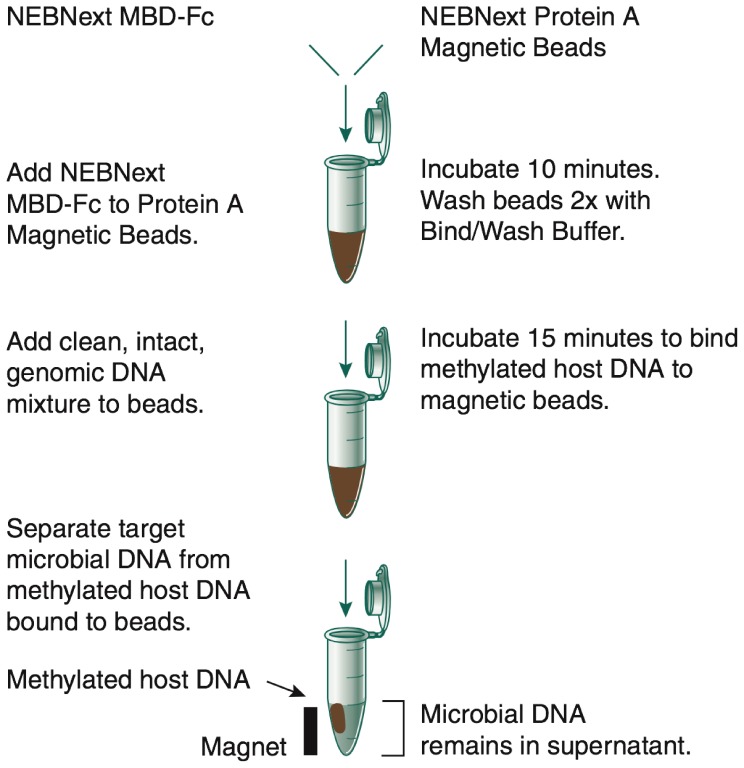
DNA samples derived from vertebrate skin, bodily cavities and body fluids contain both host and microbial DNA; the latter often present as a minor component. Consequently, DNA sequencing of a microbiome sample frequently yields reads originating from the microbe(s) of interest, but with a vast excess of host genome-derived reads. In this study, we used a methyl-CpG binding domain (MBD) to separate methylated host DNA from microbial DNA based on differences in CpG methylation density. MBD fused to the Fc region of a human antibody (MBD-Fc) binds strongly to protein A paramagnetic beads, forming an effective one-step enrichment complex that was used to remove human or fish host DNA from bacterial and protistan DNA for subsequent sequencing and analysis. We report enrichment of DNA samples from human saliva, human blood, a mock malaria-infected blood sample and a black molly fish. When reads were mapped to reference genomes, sequence reads aligning to host genomes decreased 50-fold, while bacterial and Plasmodium DNA sequences reads increased 8-11.5-fold. The Shannon-Wiener diversity index was calculated for 149 bacterial species in saliva before and after enrichment. Unenriched saliva had an index of 4.72, while the enriched sample had an index of 4.80. The similarity of these indices demonstrates that bacterial species diversity and relative phylotype abundance remain conserved in enriched samples. Enrichment using the MBD-Fc method holds promise for targeted microbiome sequence analysis across a broad range of sample types.
Overview
The claims and statistics of this paper haven’t been checked yet.
Free: it reads the open-access text and checks the first 5 claims that cite a source we can check. Create a free account to check every claim.
Integrity signals
Registry
Cites
Statistics
Figures


Verification
Claims the paper makes
The claims and statistics of this paper haven’t been checked yet.
Free: it reads the open-access text and checks the first 5 claims that cite a source we can check. Create a free account to check every claim.
Claims other papers make about this one
Each is checked against this paper’s own text: does it say what the citing paper says it does?
The source backs part of the claim, not all of it — or backs it for a different population, condition or comparison.
In the citing paper
“Limited enrichment in the 3–5 times range can be achieved with the use of antibodies against methylated human host DNA98, which enriches microbial reads owing to the lack of methylated DNA in most pathogen genomes.”
From Clinical metagenomics (2019) · cites this paper as [98]
Experimental — accuracy not yet measured
Self-check
Percentages, sums and reported differences re-computed from the paper’s own numbers.
The self-check needs the paper’s full text.
Citations
Cites
Fast gapped-read alignment with Bowtie 2
Langmead, B., & Salzberg, S. L. (2012) · Nature Methods · doi:10.1038/nmeth.1923 · Cited by 56,400
BLAST+: architecture and applications
Camacho, C., Coulouris, G., Avagyan, V., Ma, N., Papadopoulos, J., Bealer, K., & Madden, T. L. (2009) · BMC Bioinformatics · doi:10.1186/1471-2105-10-421 · Cited by 22,074 · cited 2×
“In a recent report, analysis of the human salivary microbiome using WGS sequencing revealed a large fraction of the BLASTN [36]”
BackgroundInfluentialChanges of Intestinal Functions in Liver Cirrhosis
Fukui, H., & Wiest, R. (2016) · Inflammatory Intestinal Diseases · doi:10.1159/000444436 · Cited by 6,808
Host-Bacterial Mutualism in the Human Intestine
Bäckhed, F., Ley, R. E., Sonnenburg, J. L., Peterson, D. A., & Gordon, J. I. (2005) · Science · doi:10.1126/science.1104816 · Cited by 5,277
Finishing the euchromatic sequence of the human genome
International Human Genome Sequencing Consortium (2004) · Nature · doi:10.1038/nature03001 · Cited by 4,971
Human DNA methylomes at base resolution show widespread epigenomic differences
Lister, R., Pelizzola, M., Dowen, R. H., Hawkins, R. D., Hon, G., Tonti-Filippini, J., Nery, J. R., Lee, L., Ye, Z., Ngo, Q.-M., et al. (2009) · Nature · doi:10.1038/nature08514 · Cited by 4,673
Meyer, F., Paarmann, D., D'Souza, M., Olson, R., Glass, E., Kubal, M., Paczian, T., Rodriguez, A., Stevens, R., Wilke, A., et al. (2008) · BMC Bioinformatics · doi:10.1186/1471-2105-9-386 · Cited by 3,565
A framework for human microbiome research
The Human Microbiome Project Consortium (2012) · Nature · doi:10.1038/nature11209 · Cited by 2,650
The NIH Human Microbiome Project
The NIH HMP Working Group, Peterson, J., Garges, S., Giovanni, M., McInnes, P., Wang, L., Schloss, J. A., Bonazzi, V., McEwen, J. E., Wetterstrand, K. A., et al. (2009) · Genome Research · doi:10.1101/gr.096651.109 · Cited by 2,066
Metagenomic microbial community profiling using unique clade-specific marker genes
Segata, N., Waldron, L., Ballarini, A., Narasimhan, V., Jousson, O., & Huttenhower, C. (2012) · Nature Methods · doi:10.1038/nmeth.2066 · Cited by 1,776
Austin, B., & Austin, D. A. (2016) · DIAL (Catholic University of Leuven) · doi:10.1007/978-3-319-32674-0 · Cited by 1,554
High-quality draft assemblies of mammalian genomes from massively parallel sequence data
Gnerre, S., MacCallum, I., Przybylski, D., Ribeiro, F. J., Burton, J. N., Walker, B. J., Sharpe, T., Hall, G., Shea, T. P., Sykes, S., et al. (2011) · Proceedings of the National Academy of Sciences · doi:10.1073/pnas.1017351108 · Cited by 1,533
Lewis, J. D., Meehan, R. R., Henzel, W. J., Maurer-Fogy, I., Jeppesen, P., Klein, F., & Bird, A. (1992) · Cell · doi:10.1016/0092-8674(92)90610-o · Cited by 1,371
Identification and Characterization of a Family of Mammalian Methyl-CpG Binding Proteins
Hendrich, B., & Bird, A. (1998) · Molecular and Cellular Biology · doi:10.1128/mcb.18.11.6538 · Cited by 1,360
Recent findings on the viable but nonculturable state in pathogenic bacteria
Oliver, J. D. (2010) · FEMS Microbiology Reviews · doi:10.1111/j.1574-6976.2009.00200.x · Cited by 1,203
Human oral, gut, and plaque microbiota in patients with atherosclerosis
Koren, O., Spor, A., Felin, J., Fåk, F., Stombaugh, J., Tremaroli, V., Behre, C. J., Knight, R., Fagerberg, B., Ley, R. E., et al. (2011) · Proceedings of the National Academy of Sciences · doi:10.1073/pnas.1011383107 · Cited by 1,196
Chen, T., Yu, W.-H., Izard, J., Baranova, O. V., Lakshmanan, A., & Dewhirst, F. E. (2010) · Database · doi:10.1093/database/baq013 · Cited by 1,162
Gut microbiome-host interactions in health and disease
Kinross, J. M., Darzi, A. W., & Nicholson, J. K. (2011) · Genome Medicine · doi:10.1186/gm228 · Cited by 691
Optimizing illumina next-generation sequencing library preparation for extremely at-biased genomes
Oyola, S. O., Otto, T. D., Gu, Y., Maslen, G., Manske, M., Campino, S., Turner, D. J., MacInnis, B., Kwiatkowski, D. P., Swerdlow, H. P., et al. (2012) · BMC Genomics · doi:10.1186/1471-2164-13-1 · Cited by 653
Self-citationEscherichia coli K-12: a cooperatively developed annotation snapshot--2005
Riley, M. (2006) · Nucleic Acids Research · doi:10.1093/nar/gkj405 · Cited by 608
Shock, L. S., Thakkar, P. V., Peterson, E. J., Moran, R. G., & Taylor, S. M. (2011) · Proceedings of the National Academy of Sciences · doi:10.1073/pnas.1012311108 · Cited by 555
A renaissance for the pioneering 16S rRNA gene
Tringe, S. G., & Hugenholtz, P. (2008) · Current Opinion in Microbiology · doi:10.1016/j.mib.2008.09.011 · Cited by 514
Deep Sequencing of the Oral Microbiome Reveals Signatures of Periodontal Disease
Liu, B., Faller, L. L., Klitgord, N., Mazumdar, V., Ghodsi, M., Sommer, D. D., Gibbons, T. R., Treangen, T. J., Chang, Y.-C., Li, S., et al. (2012) · PLoS ONE · doi:10.1371/journal.pone.0037919 · Cited by 411
Role of the gut microbiota in defining human health
Fujimura, K. E., Slusher, N. A., Cabana, M. D., & Lynch, S. V. (2010) · Expert Review of Anti-infective Therapy · doi:10.1586/eri.10.14 · Cited by 407
Fang, G., Munera, D., Friedman, D. I., Mandlik, A., Chao, M. C., Banerjee, O., Feng, Z., Losic, B., Mahajan, M. C., Jabado, O. J., et al. (2012) · Nature Biotechnology · doi:10.1038/nbt.2432 · Cited by 360
Regulation of DNMT1 stability through SET7-mediated lysine methylation in mammalian cells
Estève, P.-O., Chin, H. G., Benner, J., Feehery, G. R., Samaranayake, M., Horwitz, G. A., Jacobsen, S. E., & Pradhan, S. (2009) · Proceedings of the National Academy of Sciences · doi:10.1073/pnas.0810362106 · Cited by 318
Self-citationBiodiversity and functional genomics in the human microbiome
Morgan, X. C., Segata, N., & Huttenhower, C. (2013) · Trends in Genetics · doi:10.1016/j.tig.2012.09.005 · Cited by 263
The methylomes of six bacteria
Murray, I. A., Clark, T. A., Morgan, R. D., Boitano, M., Anton, B. P., Luong, K., Fomenkov, A., Turner, S. W., Korlach, J., & Roberts, R. J. (2012) · Nucleic Acids Research · doi:10.1093/nar/gks891 · Cited by 255
Pervasive CpG suppression in animal mitochondrial genomes
Cardon, L. R., Burge, C., Clayton, D. A., & Karlin, S. (1994) · Proceedings of the National Academy of Sciences · doi:10.1073/pnas.91.9.3799 · Cited by 238
Mitochondrial DNA in mortal and immortal human cells. Genome number, integrity, and methylation.
Shmookler Reis, R. J., & Goldstein, S. (1983) · Journal of Biological Chemistry · doi:10.1016/s0021-9258(17)44633-3 · Cited by 202
Gebhard, C., Schwarzfischer, L., Pham, T.-H., Schilling, E., Klug, M., Andreesen, R., & Rehli, M. (2006) · Cancer Research · doi:10.1158/0008-5472.can-06-0376 · Cited by 189
Glass, E. M., & Meyer, F. (2011) · Handbook of Molecular Microbial Ecology I · doi:10.1002/9781118010518.ch37 · Cited by 188
COMPARING BACTERIAL COMMUNITIES INFERRED FROM 16S rRNA GENE SEQUENCING AND SHOTGUN METAGENOMICS
Shah, N., Tang, H., Doak, T. G., & Ye, Y. (2010) · Biocomputing 2011 · doi:10.1142/9789814335058_0018 · Cited by 182
Hong, E. E., Okitsu, C. Y., Smith, A. D., & Hsieh, C.-L. (2013) · Molecular and Cellular Biology · doi:10.1128/mcb.00220-13 · Cited by 175 · cited 1×
“chloroplast DNA have been previously reported to have very low abundance of CpG methylation [28,29,39,40].”
BackgroundVerner-Jeffreys, D. W., Welch, T. J., Schwarz, T., Pond, M. J., Woodward, M. J., Haig, S. J., Rimmer, G. S. E., Roberts, E., Morrison, V., & Baker-Austin, C. (2009) · PLoS ONE · doi:10.1371/journal.pone.0008388 · Cited by 136
Using high throughput sequencing to explore the biodiversity in oral bacterial communities
Diaz, P. I., Dupuy, A. K., Abusleme, L., Reese, B., Obergfell, C., Choquette, L., Dongari‐Bagtzoglou, A., Peterson, D. E., Terzi, E., & Strausbaugh, L. D. (2012) · Molecular Oral Microbiology · doi:10.1111/j.2041-1014.2012.00642.x · Cited by 118
Auburn, S., Campino, S. G., Clark, T. G., DJIMDÉ, A. A., Zongo, I., Pinches, R. A., Manske, M., Mangano, V. D., Alcock, D., Anastasi, E., et al. (2011) · PLoS ONE · doi:10.1371/journal.pone.0022213 · Cited by 89
5-Methylcytidylic Acid: Absence from Mitochondrial DNA of Frogs and HeLa Cells
Dawid, I. B. (1974) · Science · doi:10.1126/science.184.4132.80 · Cited by 86
New methods for selective isolation of bacterial DNA from human clinical specimens
Horz, H., Scheer, S., Vianna, M. E., & Conrads, G. (2009) · Anaerobe · doi:10.1016/j.anaerobe.2009.04.009 · Cited by 83
Efficient Depletion of Host DNA Contamination in Malaria Clinical Sequencing
Oyola, S. O., Gu, Y., Manske, M., Otto, T. D., O’Brien, J., Alcock, D., MacInnis, B. L., Berriman, M., Newbold, C., Kwiatkowski, D. P., et al. (2012) · Journal of Clinical Microbiology · doi:10.1128/jcm.02507-12 · Cited by 81
Self-citationAnalysis of the salivary microbiome using culture-independent techniques
Lazarević, V., Whiteson, K., Gaïa, N., Gizard, Y., Hernández, D., Farinelli, L., Østerås, M., François, P., & Schrenzel, J. (2012) · Journal of Clinical Bioinformatics · doi:10.1186/2043-9113-2-4 · Cited by 70
Weir, M., Rajić, A., Dutil, L., Cernicchiaro, N., Uhland, F. C., Mercier, B. M., & Tuševljak, N. (2011) · Epidemiology and Infection · doi:10.1017/s0950268811001798 · Cited by 68
Whole genome sequencing analysis of Plasmodium vivax using whole genome capture
Bright, A., Tewhey, R., Abeles, S. R., Chuquiyauri, R., Llanos‐Cuentas, A., Ferreira, M. U., Schork, N. J., Vinetz, J. M., & Winzeler, E. A. (2012) · BMC Genomics · doi:10.1186/1471-2164-13-262 · Cited by 57
Web-based visual analysis for high-throughput genomics
Goecks, J., Eberhard, C., Too, T., The Galaxy Team, Nekrutenko, A., & Taylor, J. (2013) · BMC Genomics · doi:10.1186/1471-2164-14-397 · Cited by 53
CpG and TpA frequencies in the plant system
Bougraa, M., & Perrin, P. (1987) · Nucleic Acids Research · doi:10.1093/nar/15.14.5729 · Cited by 40
On the presence of minor bases in DNA of phages DD7 and Sd and their hosts
Nikolskaya, I. I., Tkatcheva, Z. G., Vanyushin, B. F., & Tikchonenko, T. I. (1968) · Biochimica et Biophysica Acta (BBA) - Nucleic Acids and Protein Synthesis · doi:10.1016/0005-2787(68)90211-6 · Cited by 15
Dichloromethane as an economic alternative to chloroform in the extraction of DNA from plant tissues
Chaves, A. L., Vergara, C. E., & Mayer, J. E. (1995) · Plant Molecular Biology Reporter · doi:10.1007/bf02668389 · Cited by 15
DNA methylation in Neisseria gonorrhoeae and other Neisseriae
Ritchot, N., & Roy, P. H. (1990) · Gene · doi:10.1016/0378-1119(90)90120-g · Cited by 14
Research works printed but not linked: 1
- Lister R, Pelizzola M, Dowen RH, Hawkins RD, Hon G, et al (2009) NIH Public Access. Nature 462: 315– 322 10.1038/nature08514.Human 19829295 PMC2857523 · doi:10.1038/nature08514.human
Cited by
Chiu, C. Y., & Miller, S. A. (2019) · Nature Reviews Genetics · doi:10.1038/s41576-019-0113-7 · Cited by 1,620
Nanopore metagenomics enables rapid clinical diagnosis of bacterial lower respiratory infection
Charalampous, T., Kay, G. L., Richardson, H., Aydin, A., Baldan, R., Jeanes, C., Rae, D., Grundy, S., Turner, D. J., Wain, J., et al. (2019) · Nature Biotechnology · doi:10.1038/s41587-019-0156-5 · Cited by 681
A new view of the fish gut microbiome: advances from next-generation sequencing
Ghanbari, M., Kneifel, W., & Domig, K. J. (2015) · Aquaculture · doi:10.1016/j.aquaculture.2015.06.033 · Cited by 669
Gut Microbiota, Inflammation, and Colorectal Cancer
Brennan, C. A., & Garrett, W. S. (2016) · Annual Review of Microbiology · doi:10.1146/annurev-micro-102215-095513 · Cited by 578
Insights into the human oral microbiome
Verma, D., Garg, P. K., & Dubey, A. K. (2018) · Archives of Microbiology · doi:10.1007/s00203-018-1505-3 · Cited by 541
Metadata
- Authors
- Feehery, G. R., Yigit, E., Oyola, S. O., Langhorst, B. W., Schmidt, V. T., Stewart, F. J., Dimalanta, E. T., Amaral-Zettler, L. A., Davis, T., Quail, M. A., & Pradhan, S.
- Affiliations
- New England Biolabs (United States) (US)
- Wellcome Sanger Institute (GB)
- Marine Biological Laboratory (US)
- Corresponding author
- Pradhan, Sriharsa
- ORCID
- Venue
- PLoS ONE
- Publisher
- Public Library of Science (PLoS)
- Published
- 2013-10-28
- Volume
- 8
- Issue
- 10
- Pages
- e76096
- ISSN
- 1932-6203 (ISSN-L)
- PMC
- PMC3810253
- OpenAlex
- W2109424333
- Cited by
- 212
- References
- 48
- Citations by year
- 2026: 9 · 2025: 19 · 2024: 23 · 2023: 8 · 2022: 26 · 2021: 22 · 2020: 24 · 2019: 21 · 2018: 19 · 2017: 13 · 2016: 15 · 2015: 5 · 2014: 7
- FWCI
- 4.03
- Type
- journal article
- Language
- en
- Open access
- gold
- doi.org
- Locations
- PLoS ONE (publishedVersion, cc-by)
- Europe PMC (PubMed Central) (publishedVersion, cc-by)
- PubMed Central (publishedVersion, cc-by)
- PubMed (publishedVersion)
- Open Access Server of the Woods Hole Scientific Community (Woods Hole Scientific Community) (submittedVersion, cc-by)
- DOAJ (DOAJ: Directory of Open Access Journals) (submittedVersion, cc-by-sa)
- Figshare (submittedVersion, cc-by)
- Funders
- Brown University
- Wellcome Trust (079355/Z/06/Z, 098051)
- University of Oxford
- Topics
- Life Sciences › Biochemistry, Genetics and Molecular Biology › Molecular Biology › Genomics and Phylogenetic Studies
- Physical Sciences › Environmental Science › Ecology › Microbial Community Ecology and Physiology
- Life Sciences › Biochemistry, Genetics and Molecular Biology › Molecular Biology › Gut microbiota and health
- Keywords
- host DNA removal, methyl-CpG binding domain, CpG methylation, paramagnetic beads, saliva microbiota, blood microbiome, malaria, Plasmodium, bacterial diversity, microbiome sequencing
- MeSH terms
- Animals, DNA, DNA-Binding Proteins, DNA, Bacterial, Humans, Immunoglobulin Fc Fragments, Protein Binding, Recombinant Fusion Proteins, Saliva, Vertebrates, DNA, Protozoan, CpG Islands, DNA Methylation, DNA Contamination
About these checks
Registry, retraction, Cites and statistics results are computed, not judged, with one exception: a printed reference that no index lists is read once by a model before it counts as a citation error. Claims are extracted by a model and kept only when their quote appears verbatim in the text; each cited source is then checked, with a model’s help, for whether it says what the claim relies on. Those verdicts can be wrong — read the claim’s quote and the cited source before relying on one.
Statistics and arithmetic are recomputed, not judged.
Confidence bands are shown only for fields calibrated on our annotated test set. None is calibrated yet, so no band is shown.
What counts as a claim ›How we measure confidence ›How we check this ›
Are you an author, or do you see a problem with this page? Request a review
Data sources
Bibliographic data: Semantic Scholar, OpenAlex, Crossref.
Contains information from the Semantic Scholar Academic Graph Datasets, made available under the ODC Attribution License (ODC-BY 1.0).
Semantic Scholar’s data is described in: Kinney, R., et al. (2023). The Semantic Scholar Open Data Platform. arXiv:2301.10140.
