

Single-nucleus and single-cell transcriptomes compared in matched cortical cell types
Open accessPublished version of a preprint
The DOI matches its Crossref record; 58 of the 58 references it cites were found in a registry or an index.
Abstract
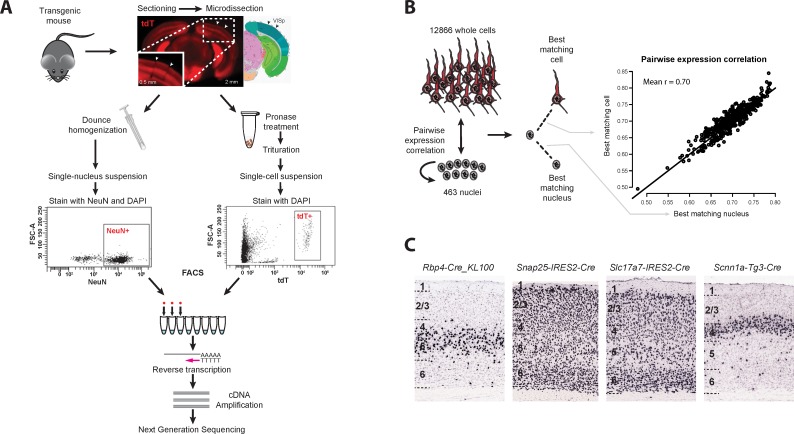
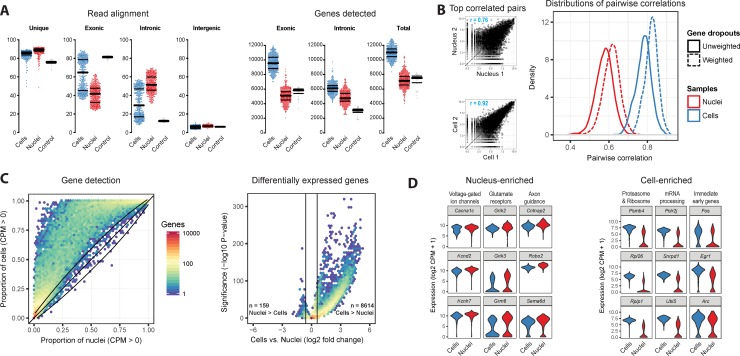
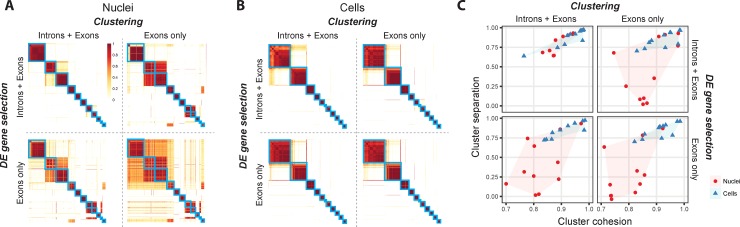
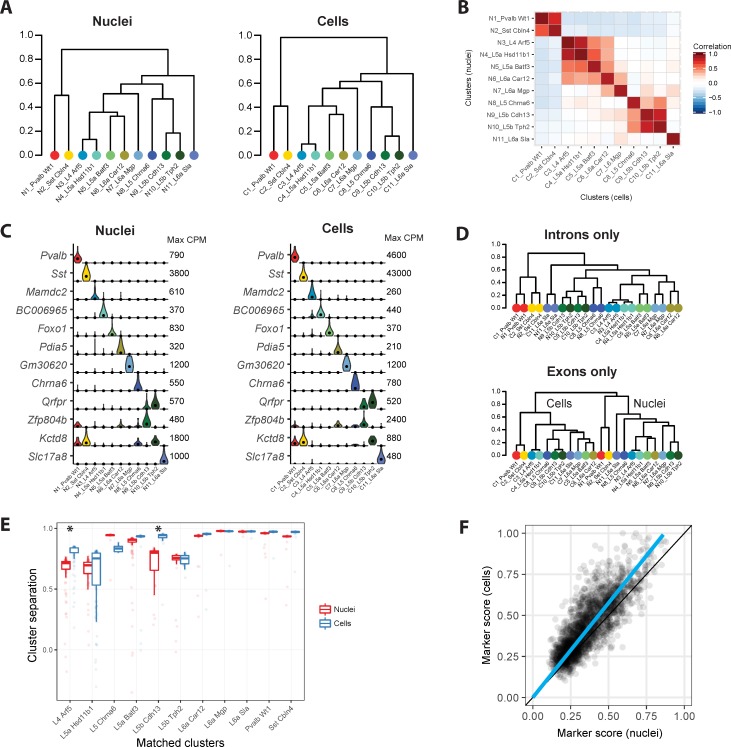
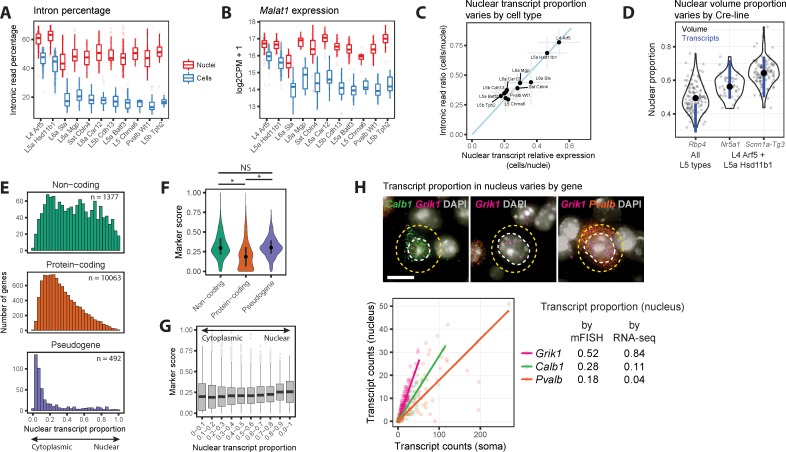
Transcriptomic profiling of complex tissues by single-nucleus RNA-sequencing (snRNA-seq) affords some advantages over single-cell RNA-sequencing (scRNA-seq). snRNA-seq provides less biased cellular coverage, does not appear to suffer cell isolation-based transcriptional artifacts, and can be applied to archived frozen specimens. We used well-matched snRNA-seq and scRNA-seq datasets from mouse visual cortex to compare cell type detection. Although more transcripts are detected in individual whole cells (~11,000 genes) than nuclei (~7,000 genes), we demonstrate that closely related neuronal cell types can be similarly discriminated with both methods if intronic sequences are included in snRNA-seq analysis. We estimate that the nuclear proportion of total cellular mRNA varies from 20% to over 50% for large and small pyramidal neurons, respectively. Together, these results illustrate the high information content of nuclear RNA for characterization of cellular diversity in brain tissues.
Overview
The claims and statistics of this paper haven’t been checked yet.
Free: it reads the open-access text and checks the first 5 claims that cite a source we can check. Create a free account to check every claim.
Integrity signals
Registry
Cites
Statistics
Figures
Verification
Claims the paper makes
The claims and statistics of this paper haven’t been checked yet.
Free: it reads the open-access text and checks the first 5 claims that cite a source we can check. Create a free account to check every claim.
Claims other papers make about this one
Each is checked against this paper’s own text: does it say what the citing paper says it does?
The source backs part of the claim, not all of it — or backs it for a different population, condition or comparison.
In the citing paper
“While scRNA-seq data are analyzed by mapping sequenced fragments to exons, snRNA-seq data analysis should also consider the abundance of intronic reads from pre-mRNA, which may account for >75% of fragments (Bakken et al., 2018; Gaidatzis et al., 2015).”
From Single-Cell Sequencing of Brain Cell Transcriptomes and Epigenomes (2021) · cites this paper as Bakken et al., 2018
Experimental — accuracy not yet measuredThe source backs part of the claim, not all of it — or backs it for a different population, condition or comparison.
In the citing paper
“Nuclear transcripts comprise ~20%−50% of all the RNA in the cell (Bakken et al., 2018), including immature and unspliced RNA molecules containing introns (Fig. 2a).”
From Single-Cell Sequencing of Brain Cell Transcriptomes and Epigenomes (2021) · cites this paper as Bakken et al., 2018
Experimental — accuracy not yet measuredThe source backs part of the claim, not all of it — or backs it for a different population, condition or comparison.
In the citing paper
“Fresh tissue samples are deemed appropriate for single-cell sequencing, whereas freeze-thaw samples are generally recommended for snRNA-seq [242, 243].”
From Single-cell sequencing to multi-omics: technologies and applications (2024) · cites this paper as [243]
Experimental — accuracy not yet measuredThe source backs part of the claim, not all of it — or backs it for a different population, condition or comparison.
In the citing paper
“Differential expression analysis comparing individual cell types profiled by snRNA-seq and scRNA-seq suggested higher expression of long noncoding RNAs in snRNA-seq libraries and higher expression of genes related to mitochondrial and ribosomal functions in scRNA-seq, in agreement with previous reports [24, 26]”
From Systematic assessment of tissue dissociation and storage biases in single-cell and single-nucleus RNA-seq workflows (2020) · cites this paper as [24]
Experimental — accuracy not yet measuredThe source backs part of the claim, not all of it — or backs it for a different population, condition or comparison.
In the citing paper
“whereas longer CDSs were enriched (NES = 1.91, padj = 3.6e-05), as already observed in earlier snRNA-seq studies (Bakken et al., 2018).”
From Single-Nucleus RNA-Seq Is Not Suitable for Detection of Microglial Activation Genes in Humans (2020) · cites this paper as Bakken et al., 2018
Experimental — accuracy not yet measured
6 more claims about this paper
Create a free account to see every claim other papers make about this one.
Self-check
Percentages, sums and reported differences re-computed from the paper’s own numbers.
The self-check needs the paper’s full text.
Citations
Cites
STAR: ultrafast universal RNA-seq aligner
Dobin, A., Davis, C. A., Schlesinger, F., Drenkow, J., Zaleski, C., Jha, S., Batut, P., Chaisson, M., & Gingeras, T. R. (2013) · Bioinformatics · doi:10.1093/bioinformatics/bts635 · Cited by 51,709
limma powers differential expression analyses for RNA-sequencing and microarray studies
Ritchie, M. E., Phipson, B., Wu, D., Hu, Y., Law, C. W., Shi, W., & Smyth, G. K. (2015) · Nucleic Acids Research · doi:10.1093/nar/gkv007 · Cited by 40,458
ggplot2: Elegant Graphics for Data Analysis
Wickham, H. (2009) · doi:10.1007/978-0-387-98141-3 · Cited by 14,447
Highly parallel genome-wide expression profiling of individual cells using nanoliter droplets.
Macosko, E. Z., Basu, A., Satija, R., Nemesh, J., Shekhar, K., Goldman, M., Tirosh, I., Bialas, A. R., Kamitaki, N., Martersteck, E. M., et al. (2015) · Cell · doi:10.1016/j.cell.2015.05.002 · Cited by 7,110
A robust and high-throughput Cre reporting and characterization system for the whole mouse brain
Madisen, L., Zwingman, T. A., Sunkin, S. M., Oh, S. W., Zariwala, H. A., Gu, H., Ng, L. L., Palmiter, R. D., Hawrylycz, M. J., Jones, A. R., et al. (2010) · Nature Neuroscience · doi:10.1038/nn.2467 · Cited by 6,907
Self-citationREVIGO summarizes and visualizes long lists of gene ontology terms
Supek, F., Bošnjak, M., Škunca, N., & Šmuc, T. (2011) · PLoS ONE · doi:10.1371/journal.pone.0021800 · Cited by 6,264
Genome-wide atlas of gene expression in the adult mouse brain
Lein, E. S., Hawrylycz, M. J., Ao, N., Ayres, M., Bensinger, A., Bernard, A., Boe, A. F., Boguski, M. S., Brockway, K. S., Byrnes, E. J., et al. (2007) · Nature · doi:10.1038/nature05453 · Cited by 5,572
Self-citationLandscape of transcription in human cells
Djebali, S., Davis, C. A., Merkel, A., Dobin, A., Lassmann, T., Mortazavi, A., Tanzer, A., Lagarde, J., Lin, W., Schlesinger, F., et al. (2012) · Nature · doi:10.1038/nature11233 · Cited by 5,187
Software for Computing and Annotating Genomic Ranges
Lawrence, M., Huber, W., Pagès, H., Aboyoun, P., Carlson, M., Gentleman, R., Morgan, M. T., & Carey, V. J. (2013) · PLoS Computational Biology · doi:10.1371/journal.pcbi.1003118 · Cited by 4,398
Cell types in the mouse cortex and hippocampus revealed by single-cell RNA-seq
Zeisel, A., Muñoz-Manchado, A. B., Codeluppi, S., Lönnerberg, P., La Manno, G., Juréus, A., Marques, S., Munguba, H., He, L., Betsholtz, C., et al. (2015) · Science · doi:10.1126/science.aaa1934 · Cited by 3,124
Research works printed but not linked: 1
- Aronesty E. “ ea-utils: Command-line tools for processing biological sequencing data.” Expr Anal. 2011; http://code.google.com/p/ea-utils
Cited by
Items 501–600 of 629
Wang, S., Xie, J., Zou, X., Pan, T., Yu, Q., Zhuang, Z., Zhong, Y., Wang, Z., Li, R., Lei, Y., et al. (2021) · SSRN Electronic Journal · doi:10.2139/ssrn.3904960
New molecular techniques for exploring neuronal appetite pathways
Tadross, J. A., Lam, B., & Yeo, G. S. H. (2021) · Current Opinion in Endocrine and Metabolic Research · doi:10.1016/j.coemr.2021.100309
Tiwari, V. K., & Singh, A. P. (2020) · Faculty Opinions – Post-Publication Peer Review of the Biomedical Literature · doi:10.3410/f.736463800.793571577
Sakib, M. S. (2021) · eDiss (Georg-August-Universität Göttingen) · doi:10.53846/goediss-8870 · Cited by 1
Single-cell RNA sequencing of conditional Pten knockout neurons in micePreprint
Svoboda, M., Luikart, B. W., & Bosco, G. (2022) · bioRxiv (Cold Spring Harbor Laboratory) · doi:10.1101/2022.03.17.484809
“It is therefore common to extract neuronal nuclei instead, which has several advantages (58).”
BackgroundMacKenzie, A., Hay, E. A., & McEwan, A. R. (2022) · Addiction Neuroscience · doi:10.1016/j.addicn.2022.100014 · Cited by 2
Lowry, C. (2019) · Faculty Opinions – Post-Publication Peer Review of the Biomedical Literature · doi:10.3410/f.736798495.793567171
Wiegleb, G., Reinhardt, S., Dahl, A., & Posnien, N. (2022) · Research Square · doi:10.21203/rs.3.rs-1623239/v1
Emerging Roles of TREM2 in Neurodegenerative Diseases
Kabir, M. T. (2022) · Springer eBooks · doi:10.1007/978-981-16-7606-2_7
Nuclei Isolation from Whole Tissue using a Detergent and Enzyme-Free Method
Eski, S. E., Dubois, C., & Singh, S. P. (2020) · Journal of Visualized Experiments · doi:10.3791/61471-v
Progress toward defining the molecular identities of neocortical neurons
Deleanu, R. (2021) · Journal of Cell Identity · doi:10.47570/joci.2022.006
Transcriptomic Definition of Neuron Types
He, J., & Stauffer, W. R. (2023) · Neuromethods · doi:10.1007/978-1-0716-2918-5_8
Neuro-urology research: a comprehensive overview
Verstegen, A. M. J. (2023) · Elsevier eBooks · doi:10.1016/b978-0-12-822455-7.00013-1
Chow, J. C., Tomková, M., Thomas, A., Rahmani, E., Shifman, S., & Hormozdiari, F. (2023) · bioRxiv (Cold Spring Harbor Laboratory) · doi:10.1101/2023.07.04.547726
“The identification of these subtypes has the potential to reveal the underlying etiology of complex diseases and common traits [1, 2].”
BackgroundStalder, L., Köchl, F., Hahn, K., Sultan, M., & Prasad, M. K. (2023) · doi:10.3791/65611-v
Isolation of Projection‐Specific and Behavior‐Relevant Amygdala Circuit for RNA Sequencing
He, Y., Zou, J., He, Y., Wang, C., Pan, B., & Pan, H. (2023) · Current Protocols · doi:10.1002/cpz1.858
Gene expression divergence during Drosophila head development on single nuclei resolution
Wiegleb, G. (2023) · eDiss (Georg-August-Universität Göttingen) · doi:10.53846/goediss-10159
Martin, N. (2023) · Carleton University's Institutional Repository (MacOdrum Library, Carleton University) · doi:10.22215/etd/2023-15695
Zhang, Y., Tan, J., Yang, K., Fan, W., Yu, B., & Shi, W. (2023) · Figshare · doi:10.6084/m9.figshare.23583532
Basile, G., Kahraman, S., Dirice, E., Pan, H., Dreyfuss, J. M., & Kulkarni, R. N. (2021) · Figshare · doi:10.6084/m9.figshare.15145913
Single-cell resolved differentiation of pre-Kranz anatomy in maize leaf primordiaPreprint
Yi, J., Su, H. Y., Tian, S., Sedelnikova, O. V., Chen, Y., Zhao, C., Yang, J., Zhang, Y., Zhu, X., Langdale, J. A., et al. (2024) · bioRxiv (Cold Spring Harbor Laboratory) · doi:10.1101/2024.07.10.602848
Andrew, B., Zulcinski, M., Emmett, A., & Westhead, D. R. (2024) · RNA technologies · doi:10.1007/978-3-031-62178-9_9
Xu, S., Yu, Z., & Ming, J. (2024) · The Annals of Applied Statistics · doi:10.1214/24-aoas1954 · Cited by 1
New Genome-Wide Technologies to Study Activity-Regulated Transcription
Niñerola, S., & Barco, Á. (2024) · Springer eBooks · doi:10.1007/978-3-031-68550-7_19
Farhan, S. M. K., Fiorini, M. R., Li, J., Fon, E. A., & Thomas, R. A. (2024) · Research Square · doi:10.21203/rs.3.rs-5471740/v1
Transcriptomics of optic nerve regeneration
Wang, S. K. (2025) · Elsevier eBooks · doi:10.1016/b978-0-443-15580-2.00013-8
Single Cell and Spatial Omics and Applications in Toxicology
Gallegos, D. A., Robarts, D. R., & Umbaugh, D. S. (2025) · Elsevier eBooks · doi:10.1016/b978-0-323-95488-4.00284-9
Srivastava, U., Sukreet, S., Kanchan, S., Kesheri, M., & Gupta, M. K. (2025) · Springer eBooks · doi:10.1007/978-981-96-7067-3_4
Bhasker, N., Chung, H., Boucherie, L., Kim, V., Speidel, S., & Weber, M. (2025) · bioRxiv (Cold Spring Harbor Laboratory) · doi:10.1101/2025.08.22.671789 · Cited by 3
Establishing single cell RNA transcriptomics: a brief guide
Cole, A. G. (2025) · Frontiers in Zoology · doi:10.1186/s12983-025-00579-x · Cited by 1
“For many applications entire cell capture is ideal, as the number of mRNAs within the cytoplasm is greater than that of the nucleus [2, 54].”
Cross-species optimization of nuclei isolation in plantsPreprint
Luo, Y., Yan, J., La, T., Yan, J., & Romay, M. C. (2025) · bioRxiv (Cold Spring Harbor Laboratory) · doi:10.1101/2025.09.04.674249
Ghamsari, M. R. E., de Graaf, C. A., Thijssen, R., You, Y., Lovell, N. H., Alinejad‐Rokny, H., & Ritchie, M. E. (2025) · bioRxiv (Cold Spring Harbor Laboratory) · doi:10.1101/2025.09.08.675012
“This high intronic content in nuclei may partially compensate for the loss of cytoplasmic RNA in snRNA-seq, and accounting for it may increase the number of detected clusters (Bakken et al., 2018).”
GENESIS: Generating scRNA-Seq data from Multiome Gene Expression
Riva, S. G., Myers, B., Buffa, F. M., & Tangherloni, A. (2025) · IEEE Conference on Computational Intelligence in Bioinformatics and Computational Biology (CIBCB) · doi:10.1109/cibcb66090.2025.11177099
“This difference can be attributed to the inherent characteristics of nuclear RNA sequencing [28].”
Yu, D., Germann, J., Murtaza, G., Hajdarovic, K. H., Babcock, K. R., Dehkordi, S. K., Jackson, A. C., Delalle, I., Orr, M. E., Zare, H., et al. (2025) · bioRxiv (Cold Spring Harbor Laboratory) · doi:10.1101/2025.10.08.681270 · Cited by 1
Non‐Enzymatic Generation of Placenta Single Cells From Third Trimester Human Placenta
Ameloko, J. U., Aimola, I. A., Fomukong, H. A., Salihu, A., Sallau, A. B., Kudan, Z. B., Baba, R. S., Dunason, S., Abubakar, H. H., Audu, K. E., et al. (2025) · Current Protocols · doi:10.1002/cpz1.70237
“Extended exposure to enzymatic treatment can reduce cell viability and impact the gene expression program (Bakken et al., 2018).”
Amini, L., Daher, U., Vallone, V. B. F., Baumgardt, M., Obermayer, B., Wiese, N., Kirsch, A. K., Fisch, T., Löwa, A., Schmueck‐Henneresse, M., et al. (2025) · Research Square · doi:10.21203/rs.3.rs-7871790/v1
Evolution of Mammalian Regulatory Networks in the Brain
Ganesan, R., & Pfenning, A. R. (2025) · Annual Review of Animal Biosciences · doi:10.1146/annurev-animal-111523-102317 · Cited by 1
Linde, J., Yildiz, C. B., Vöhringer, K., Nabbefeld, G., Graff, S., Pensold, D., Reichard, J., Hermanns, M., Weber-Hamacher, C., Spehr, M., et al. (2025) · bioRxiv (Cold Spring Harbor Laboratory) · doi:10.1101/2025.11.18.689032
“Consequently, apparent shifts in excitatory subclass proportions in split-pool snRNA-seq datasets should be interpreted with caution, as they may partly arise from these technical biases rather than genuine biological differences 37 .”
Basile, G., Kahraman, S., Dirice, E., Pan, H., Dreyfuss, J. M., & Kulkarni, R. N. (2021) · Figshare · doi:10.6084/m9.figshare.15145901
Additional file 4 of Gene panel selection for targeted spatial transcriptomics
Zhang, Y., Petukhov, V., Biederstedt, E., Que, R. A., Zhang, K., & Kharchenko, P. V. (2024) · Figshare · doi:10.6084/m9.figshare.26673084
Zhu, Y., Zhang, Y., He, S., Yi, S., Feng, H., Xia, X., Fang, X., Gong, X., & Zhao, P. (2024) · Figshare · doi:10.6084/m9.figshare.26170701
Zhu, Y., Zhang, Y., He, S., Yi, S., Feng, H., Xia, X., Fang, X., Gong, X., & Zhao, P. (2024) · Figshare · doi:10.6084/m9.figshare.26743076
Xie, G., Toledo, M. P., Hu, X., Yong, H. J., Sanchez, P. S., Liu, C., Naji, A., Irianto, J., & Wang, Y. J. (2024) · Figshare · doi:10.6084/m9.figshare.26714371
Zhu, Y., Zhang, Y., He, S., Yi, S., Feng, H., Xia, X., Fang, X., Gong, X., & Zhao, P. (2024) · Figshare · doi:10.6084/m9.figshare.26743070
Yang, S., Lan, T., Wei, R., Zhang, L., Lin, L., Du, H., Huang, Y., Zhang, G., Huang, S., Shi, M., et al. (2023) · Figshare · doi:10.6084/m9.figshare.24406763
Yang, S., Lan, T., Wei, R., Zhang, L., Lin, L., Du, H., Huang, Y., Zhang, G., Huang, S., Shi, M., et al. (2024) · Figshare · doi:10.6084/m9.figshare.24406943
Additional file 2 of Gene panel selection for targeted spatial transcriptomics
Zhang, Y., Petukhov, V., Biederstedt, E., Que, R. A., Zhang, K., & Kharchenko, P. V. (2024) · Figshare · doi:10.6084/m9.figshare.25067325
Zhu, Y., Zhang, Y., He, S., Yi, S., Feng, H., Xia, X., Fang, X., Gong, X., & Zhao, P. (2024) · Figshare · doi:10.6084/m9.figshare.26743061
Zhu, Y., Zhang, Y., He, S., Yi, S., Feng, H., Xia, X., Fang, X., Gong, X., & Zhao, P. (2024) · Figshare · doi:10.6084/m9.figshare.26743079
Slota, J. A., Sajesh, B. V., Frost, K. F., Medina, S. J., & Booth, S. A. (2022) · Figshare · doi:10.6084/m9.figshare.21532645
Basile, G., Kahraman, S., Dirice, E., Pan, H., Dreyfuss, J. M., & Kulkarni, R. N. (2021) · Figshare · doi:10.6084/m9.figshare.15145904
Zhang, Y., Tan, J., Yang, K., Fan, W., Yu, B., & Shi, W. (2023) · Figshare · doi:10.6084/m9.figshare.23583529
Zhu, Y., Zhang, Y., He, S., Yi, S., Feng, H., Xia, X., Fang, X., Gong, X., & Zhao, P. (2024) · Figshare · doi:10.6084/m9.figshare.26743064
Gupta, V., Frank, A. M., Matolka, N., & Lazzaro, B. P. (2022) · Figshare · doi:10.6084/m9.figshare.19977077
Kang, R. B., Li, Y., Rosselot, C., Zhang, T., Siddiq, M. M., Rajbhandari, P., Stewart, A. F., Scott, D. K., García-Ocaña, A., & Lu, G. (2023) · Figshare · doi:10.6084/m9.figshare.22729172
Xie, G., Toledo, M. P., Hu, X., Yong, H. J., Sanchez, P. S., Liu, C., Naji, A., Irianto, J., & Wang, Y. J. (2024) · Figshare · doi:10.6084/m9.figshare.26714359
Xie, G., Toledo, M. P., Hu, X., Yong, H. J., Sanchez, P. S., Liu, C., Naji, A., Irianto, J., & Wang, Y. J. (2024) · Figshare · doi:10.6084/m9.figshare.26714353
Additional file 4 of Single cell RNA-seq analysis of the flexor digitorum brevis mouse myofibers
Verma, R. X., Kannan, S., Lin, B. L., Fomchenko, K. M., Nieuwenhuis, T. O., Patil, A. H., Lukban, C., Yang, X., Fox-Talbot, K., McCall, M. N., et al. (2021) · Figshare · doi:10.6084/m9.figshare.14608760
Xie, G., Toledo, M. P., Hu, X., Yong, H. J., Sanchez, P. S., Liu, C., Naji, A., Irianto, J., & Wang, Y. J. (2024) · Figshare · doi:10.6084/m9.figshare.26714362
Additional file 3 of Gene panel selection for targeted spatial transcriptomics
Zhang, Y., Petukhov, V., Biederstedt, E., Que, R. A., Zhang, K., & Kharchenko, P. V. (2024) · Figshare · doi:10.6084/m9.figshare.26673081
Additional file 1 of Gene panel selection for targeted spatial transcriptomics
Zhang, Y., Petukhov, V., Biederstedt, E., Que, R. A., Zhang, K., & Kharchenko, P. V. (2024) · Figshare · doi:10.6084/m9.figshare.25067178
Xie, G., Toledo, M. P., Hu, X., Yong, H. J., Sanchez, P. S., Liu, C., Naji, A., Irianto, J., & Wang, Y. J. (2024) · Figshare · doi:10.6084/m9.figshare.26714356
Zhu, Y., Zhang, Y., He, S., Yi, S., Feng, H., Xia, X., Fang, X., Gong, X., & Zhao, P. (2024) · Figshare · doi:10.6084/m9.figshare.26743067
Xie, G., Toledo, M. P., Hu, X., Yong, H. J., Sanchez, P. S., Liu, C., Naji, A., Irianto, J., & Wang, Y. J. (2024) · Figshare · doi:10.6084/m9.figshare.26714368
Basile, G., Kahraman, S., Dirice, E., Pan, H., Dreyfuss, J. M., & Kulkarni, R. N. (2021) · Figshare · doi:10.6084/m9.figshare.15145910
Zhu, Y., Zhang, Y., He, S., Yi, S., Feng, H., Xia, X., Fang, X., Gong, X., & Zhao, P. (2024) · Figshare · doi:10.6084/m9.figshare.26743058
Xie, G., Toledo, M. P., Hu, X., Yong, H. J., Sanchez, P. S., Liu, C., Naji, A., Irianto, J., & Wang, Y. J. (2024) · Figshare · doi:10.6084/m9.figshare.26714365
Dai, D. L., Li, M., & Lee, E. B. (2024) · Figshare · doi:10.6084/m9.figshare.26608141
Zhu, Y., Zhang, Y., He, S., Yi, S., Feng, H., Xia, X., Fang, X., Gong, X., & Zhao, P. (2024) · Figshare · doi:10.6084/m9.figshare.26743052
Basile, G., Kahraman, S., Dirice, E., Pan, H., Dreyfuss, J. M., & Kulkarni, R. N. (2021) · Figshare · doi:10.6084/m9.figshare.15145907
Wiegleb, G., Reinhardt, S., Dahl, A., & Posnien, N. (2022) · Figshare · doi:10.6084/m9.figshare.21547285
Zhu, Y., Zhang, Y., He, S., Yi, S., Feng, H., Xia, X., Fang, X., Gong, X., & Zhao, P. (2024) · Figshare · doi:10.6084/m9.figshare.26743055
Truong, D. D., Lamhamedi-Cherradi, S.-E., Porter, R. W., Krishnan, S., Swaminathan, J., Gibson, A., Lazar, A. J., Livingston, J. A., Gopalakrishnan, V., Gordon, N. B., et al. (2024) · Figshare · doi:10.6084/m9.figshare.26593043
Zhu, Y., Zhang, Y., He, S., Yi, S., Feng, H., Xia, X., Fang, X., Gong, X., & Zhao, P. (2024) · Figshare · doi:10.6084/m9.figshare.26170542
Zhu, Y., Zhang, Y., He, S., Yi, S., Feng, H., Xia, X., Fang, X., Gong, X., & Zhao, P. (2024) · Figshare · doi:10.6084/m9.figshare.26743073
Dai, D. L., Li, M., & Lee, E. B. (2024) · Figshare · doi:10.6084/m9.figshare.26608144
Zhou, Y., Peng, M., Yang, B., Tong, T., Zhang, B., & Tang, N. (2022) · Figshare · doi:10.6084/m9.figshare.20306725
Practices for shrimp disease detection, control, management, and genetics improvement
Campa‐Córdova, Á. I., Mazón-Suástegui, J. M., López‐Carvallo, J. A., Bernal, M. R. G., Cruz‐Flores, R., Dhar, A. K., Peña-Navarro, N., Sánchez-Ortiz, A. C., & López‐Torres, M. A. (2025) · Elsevier eBooks · doi:10.1016/b978-0-443-27358-2.00005-1
Jadhav, A., & DeBruine, Z. J. (2025) · bioRxiv (Cold Spring Harbor Laboratory) · doi:10.64898/2025.12.18.695314
Benchmarking of single nuclei RNA-seq methods on human post-mortem brain tissue
Nikouei, K., Lundin, E., Memic, F., Stockmeier, C. A., & Hjerling‐Leffler, J. (2025) · Genomics · doi:10.1016/j.ygeno.2025.111184
Spatial mapping of cellular and molecular plasticity in the maternal and postpartum mouse brainPreprint
Arbabi, K., Ghazisaeidi, S., Kim, M., Kukreja, B., Feng, M. Y., Pogue, S., Hudson, H., Fafouti, M. E., Crouch, E. L., Galea, L. A. M., et al. (2026) · bioRxiv (Cold Spring Harbor Laboratory) · doi:10.64898/2026.01.03.697464
Cross-species optimization of nuclei isolation in ten plant species
Luo, Y., Yan, J., La, T., Buckler, E. S., Yan, J., & Romay, M. C. (2026) · Plant Methods · doi:10.1186/s13007-025-01491-5
Wu, J., Dong, H., Xu, X., & Wang, M. (2026) · Leukemia & lymphoma/Leukemia and lymphoma · doi:10.1080/10428194.2026.2649879
“For low-viability or frozen samples, single-nucleus RNA sequencing is often used instead, but the resolution is limited [75].”
Characterization of functional human-specific regulatory elements in prefrontal cortical cells
Jin, B., Zhu, L., Chang, H., Wei, Y., Tang, Y., Gao, Y., Tao, Q., Feng, T., Zhang, Y., Fang, J., et al. (2026) · Cell Reports · doi:10.1016/j.celrep.2026.117213
Single Nuclei Isolation from Coronary Endarterectomy Tissue of Coronary Artery Bypass Graft Patients
Jani, K., Gupta, V., Godhani, K., Patel, H., Jain, V., Vyas, P., Jain, A., Doshi, C. P., Nair, R. R., & Ramachandran, S. (2026) · Journal of Visualized Experiments · doi:10.3791/70382
Liu, K., Liao, S., Li, X., Song, L., Poo, M.-M., Zhao, J., Zhou, W., Cai, R., Wang, M., Ma, X., et al. (2026) · Cell Research · doi:10.1038/s41422-026-01246-4
“This may result from postnatal proliferation of non-neuronal cells, developmental changes in gene expression patterns in various cell types, and the emergence of auditory activity.”
Investigations génétiques et physiopathologiques des dysplasies corticales focales de type 2
Ribierre, T. (2020) · theses.fr (ABES) · doi:10.70675/7ac267e2z8712z4e0fza9a1z424bc9445787
Dietary Microplastics Engage Gut Mechanosensory-Endocrine Signaling and Disrupt Bone HomeostasisPreprint
Romero, A. S., Phatak, S., Patil, S., Dar, H. Y., Rivas, J. A., Oyebamiji, O., Maes, B. B., Goitom, S. S., Enriquez, C. M., Orozco, J., et al. (2026) · bioRxiv (Cold Spring Harbor Laboratory) · doi:10.64898/2026.04.03.716216
Bonarota, M.-S., Figueroa-Balderas, R. E., Cochetel, N., & Cantù, D. (2026) · bioRxiv (Cold Spring Harbor Laboratory) · doi:10.64898/2026.04.26.720720
“Single-nucleus sequencing captures nuclear transcripts and may underrepresent cytoplasmic or rapidly turned-over mRNAs, potentially limiting detection of genes with low nuclear localization (Bakken et al., 2018; Grindberg et al., 2013).”
Single-cell multiomics reveals microglia–neuron granulin signaling associated with brain agingPreprint
Han, S.-E., Kim, H., Song, J., Song, D., Cho, S., Kim, C., Kim, E., & Hwang, B. (2026) · Research Square · doi:10.21203/rs.3.rs-9134976/v1
Emerging Technologies and Innovations
Lucchetti, D., Colella, F., Toma, F., Cellini, B., & Sgambato, A. (2026) · Current clinical pathology · doi:10.1007/978-3-032-18790-1_18
Kim, J., Long, A. N., Xie, Y., Carter, K. T., Noehl-Tekorius, S. R., Elz, A., & Yu, M. (2026) · STAR Protocols · doi:10.1016/j.xpro.2026.104581
Transcriptomic signatures of hippocampal active place avoidance memory maintenance
Vingan, I., Phatarpekar, S., Tung, V. S. K., Hernandez, A. I., Evgrafov, O. V., & Alarcón, J. M. (2026) · Frontiers in Cellular Neuroscience · doi:10.3389/fncel.2026.1769317
“A key technical caveat is the known mismatch between nuclear and whole-cell transcriptomes (Ding et al., 2020; Oh et al., 2022; Bakken et al., 2018).”
Unraveling Brain Complexity: The Applications of Single-Cell Technologies in Neurological Disorders
Mehta, A., Banerjee, S., & Tiwari, A. K. (2026) · Springer eBooks · doi:10.1007/978-981-95-9789-5_11
Woodard, G. E., & Julien, C. (2026) · Behavioural Brain Research · doi:10.1016/j.bbr.2026.116267
Nühn, M. M., Sabet, N., Zuidmeer, N., van Abeelen, K. C. J., Hermans, L. E., Schipper, P. J., Kübler, R., Basson, A. E., Omar, T., Variava, E., et al. (2026) · bioRxiv (Cold Spring Harbor Laboratory) · doi:10.64898/2026.05.20.726582 · Cited by 1
Sumera, A., Crichton, A., Kind, P. C., Sibley, C. R., & Booker, S. A. (2026) · Frontiers in Neuroscience · doi:10.3389/fnins.2026.1819200 · Cited by 1
“%) coverage of transcripts in individual neurons (Bakken et al., 2018).”
Miyata, S., Shimizu, S., & Ishino, Y. (2026) · Neurology International · doi:10.3390/neurolint18060108
“To mitigate these artifacts, the recent transition to snRNA-seq enabled a high-fidelity reevaluation of OL diversity across the nervous system [23,24].”
Patiño, M., Bhamidipati, S. K., Cazares, C., & Callaway, E. M. (2026) · STAR Protocols · doi:10.1016/j.xpro.2026.104634
“7 While emerging probe-based capture methods (e.g., 10 3 Chromium Flex) may eventually enable whole-cell profiling from fixed or frozen tissue, their application to rabies tracing has not been demonstrated.”
Metadata
- Authors
- Bakken, T. E., Hodge, R. D., Miller, J. A., Yao, Z., Nguyen, T. N., Aevermann, B., Barkan, E., Bertagnolli, D., Casper, T., Dee, N., Garren, E., Goldy, J., Graybuck, L. T., Kroll, M., Lasken, R. S., Lathia, K., Parry, S., Rimorin, C., Scheuermann, R. H., Schork, N. J., Shehata, S. I., Tieu, M., Phillips, J. W., Bernard, A., Smith, K. A., Zeng, H., Lein, E. S., & Tasic, B.
- Affiliations
- Allen Institute for Brain Science (US)
- J. Craig Venter Institute (US)
- Corresponding author
- Bakken, Trygve E.
- Hodge, Rebecca D.
- Miller, Jeremy A.
- Yao, Zizhen
- Nguyen, Thuc Nghi
- Aevermann, Brian
- Barkan, Eliza
- Bertagnolli, Darren
- Casper, Tamara
- Dee, Nick
- Garren, Emma
- Goldy, Jeff
- Graybuck, Lucas T.
- Kroll, Matthew
- Lasken, Roger S.
- Lathia, Kanan
- Parry, Sheana
- Rimorin, Christine
- Scheuermann, Richard H.
- Schork, Nicholas J.
- Shehata, Soraya I.
- Tieu, Michael
- Phillips, John W.
- Bernard, Amy
- Smith, Kimberly A.
- Zeng, Hongkui
- Lein, Ed S.
- Tasic, Bosiljka
- ORCID
- Bakken, Trygve E.
- Hodge, Rebecca D.
- Miller, Jeremy A.
- Yao, Zizhen
- Nguyen, Thuc Nghi
- Aevermann, Brian
- Barkan, Eliza
- Bertagnolli, Darren
- Casper, Tamara
- Dee, Nick
- Goldy, Jeff
- Graybuck, Lucas T.
- Kroll, Matthew
- Lathia, Kanan
- Rimorin, Christine
- Scheuermann, Richard H.
- Schork, Nicholas J.
- Shehata, Soraya I.
- Tieu, Michael
- Phillips, John W.
- Bernard, Amy
- Smith, Kimberly A.
- Zeng, Hongkui
- Lein, Ed S.
- Tasic, Bosiljka
- Venue
- PLoS ONE
- Publisher
- Public Library of Science (PLoS)
- Published
- 2018-12-26
- Volume
- 13
- Issue
- 12
- Pages
- e0209648
- ISSN
- 1932-6203 (ISSN-L)
- PMC
- PMC6306246
- OpenAlex
- W2906213364
- Cited by
- 608
- References
- 57
- Citations by year
- 2026: 75 · 2025: 78 · 2024: 86 · 2023: 86 · 2022: 89 · 2021: 84 · 2020: 80 · 2019: 24 · 2018: 5
- FWCI
- 17.25
- Type
- journal article
- Language
- en
- Open access
- gold
- doi.org
- Licence
- Locations
- PLoS ONE (publishedVersion, cc-by)
- bioRxiv (Cold Spring Harbor Laboratory) (acceptedVersion)
- Europe PMC (PubMed Central) (publishedVersion, cc-by)
- PubMed Central (publishedVersion, cc-by)
- PubMed (publishedVersion)
- DOAJ (DOAJ: Directory of Open Access Journals) (submittedVersion, cc-by-sa)
- Figshare (submittedVersion, cc-by)
- Funders
- National Institute of Mental Health (U01MH105982)
- National Eye Institute (R01EY023173)
- Topics
- Life Sciences › Biochemistry, Genetics and Molecular Biology › Molecular Biology › Single-cell and spatial transcriptomics
- Life Sciences › Biochemistry, Genetics and Molecular Biology › Molecular Biology › Genomics and Phylogenetic Studies
- Life Sciences › Biochemistry, Genetics and Molecular Biology › Molecular Biology › Genomics and Chromatin Dynamics
- Keywords
- single-nucleus RNA sequencing, single-cell RNA sequencing, cell type annotation, mouse visual cortex, nuclear RNA, introns, pyramidal neurons, neuronal cell types, transcriptome comparison
- MeSH terms
- Animals, Cell Nucleus, Neurons, Visual Cortex, Sequence Analysis, RNA, Cell Lineage, Gene Expression Profiling, Mice, Single-Cell Analysis, Transcriptome
About these checks
Registry, retraction, Cites and statistics results are computed, not judged, with one exception: a printed reference that no index lists is read once by a model before it counts as a citation error. Claims are extracted by a model and kept only when their quote appears verbatim in the text; each cited source is then checked, with a model’s help, for whether it says what the claim relies on. Those verdicts can be wrong — read the claim’s quote and the cited source before relying on one.
Statistics and arithmetic are recomputed, not judged.
Confidence bands are shown only for fields calibrated on our annotated test set. None is calibrated yet, so no band is shown.
What counts as a claim ›How we measure confidence ›How we check this ›
Are you an author, or do you see a problem with this page? Request a review
Data sources
Bibliographic data: Semantic Scholar, OpenAlex, Crossref.
Contains information from the Semantic Scholar Academic Graph Datasets, made available under the ODC Attribution License (ODC-BY 1.0).
Semantic Scholar’s data is described in: Kinney, R., et al. (2023). The Semantic Scholar Open Data Platform. arXiv:2301.10140.
