

Single-nucleus and single-cell transcriptomes compared in matched cortical cell types
Open accessPublished version of a preprint
The DOI matches its Crossref record; 58 of the 58 references it cites were found in a registry or an index.
Abstract
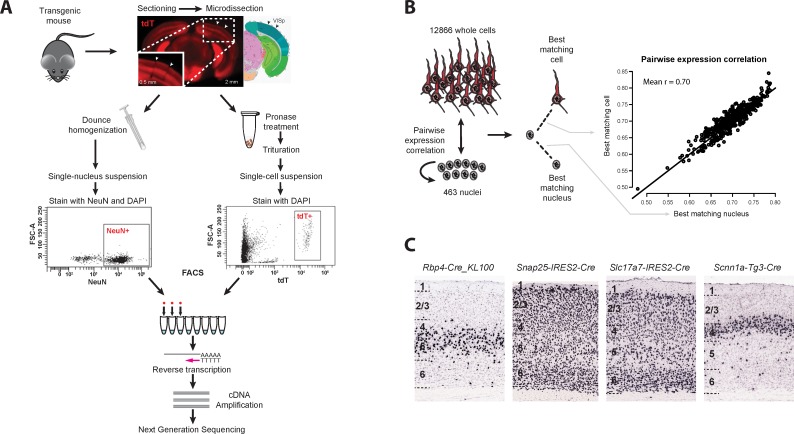
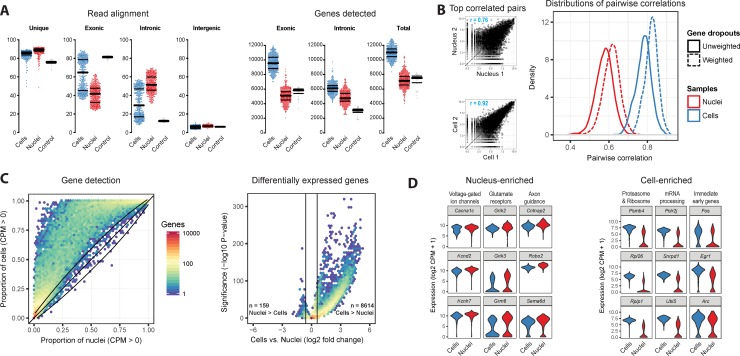
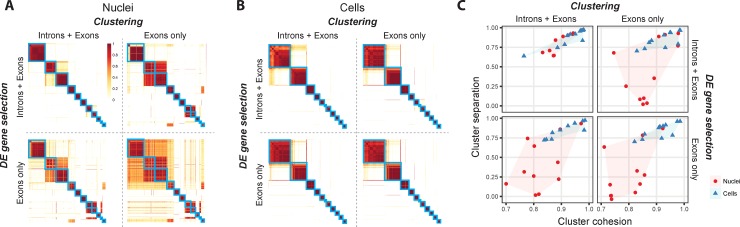
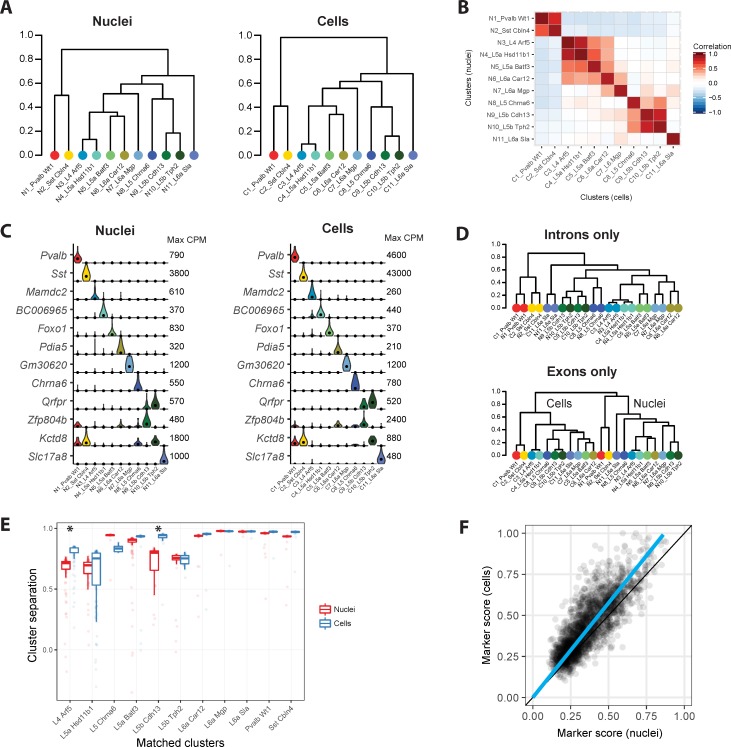
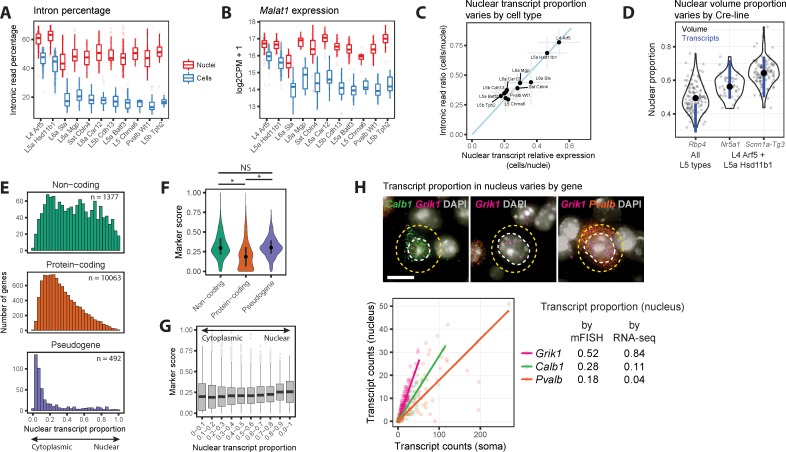
Transcriptomic profiling of complex tissues by single-nucleus RNA-sequencing (snRNA-seq) affords some advantages over single-cell RNA-sequencing (scRNA-seq). snRNA-seq provides less biased cellular coverage, does not appear to suffer cell isolation-based transcriptional artifacts, and can be applied to archived frozen specimens. We used well-matched snRNA-seq and scRNA-seq datasets from mouse visual cortex to compare cell type detection. Although more transcripts are detected in individual whole cells (~11,000 genes) than nuclei (~7,000 genes), we demonstrate that closely related neuronal cell types can be similarly discriminated with both methods if intronic sequences are included in snRNA-seq analysis. We estimate that the nuclear proportion of total cellular mRNA varies from 20% to over 50% for large and small pyramidal neurons, respectively. Together, these results illustrate the high information content of nuclear RNA for characterization of cellular diversity in brain tissues.
Overview
The claims and statistics of this paper haven’t been checked yet.
Free: it reads the open-access text and checks the first 5 claims that cite a source we can check. Create a free account to check every claim.
Integrity signals
Registry
Cites
Statistics
Figures
Verification
Claims the paper makes
The claims and statistics of this paper haven’t been checked yet.
Free: it reads the open-access text and checks the first 5 claims that cite a source we can check. Create a free account to check every claim.
Claims other papers make about this one
Each is checked against this paper’s own text: does it say what the citing paper says it does?
The source backs part of the claim, not all of it — or backs it for a different population, condition or comparison.
In the citing paper
“While scRNA-seq data are analyzed by mapping sequenced fragments to exons, snRNA-seq data analysis should also consider the abundance of intronic reads from pre-mRNA, which may account for >75% of fragments (Bakken et al., 2018; Gaidatzis et al., 2015).”
From Single-Cell Sequencing of Brain Cell Transcriptomes and Epigenomes (2021) · cites this paper as Bakken et al., 2018
Experimental — accuracy not yet measuredThe source backs part of the claim, not all of it — or backs it for a different population, condition or comparison.
In the citing paper
“Nuclear transcripts comprise ~20%−50% of all the RNA in the cell (Bakken et al., 2018), including immature and unspliced RNA molecules containing introns (Fig. 2a).”
From Single-Cell Sequencing of Brain Cell Transcriptomes and Epigenomes (2021) · cites this paper as Bakken et al., 2018
Experimental — accuracy not yet measuredThe source backs part of the claim, not all of it — or backs it for a different population, condition or comparison.
In the citing paper
“Fresh tissue samples are deemed appropriate for single-cell sequencing, whereas freeze-thaw samples are generally recommended for snRNA-seq [242, 243].”
From Single-cell sequencing to multi-omics: technologies and applications (2024) · cites this paper as [243]
Experimental — accuracy not yet measuredThe source backs part of the claim, not all of it — or backs it for a different population, condition or comparison.
In the citing paper
“Differential expression analysis comparing individual cell types profiled by snRNA-seq and scRNA-seq suggested higher expression of long noncoding RNAs in snRNA-seq libraries and higher expression of genes related to mitochondrial and ribosomal functions in scRNA-seq, in agreement with previous reports [24, 26]”
From Systematic assessment of tissue dissociation and storage biases in single-cell and single-nucleus RNA-seq workflows (2020) · cites this paper as [24]
Experimental — accuracy not yet measuredThe source backs part of the claim, not all of it — or backs it for a different population, condition or comparison.
In the citing paper
“whereas longer CDSs were enriched (NES = 1.91, padj = 3.6e-05), as already observed in earlier snRNA-seq studies (Bakken et al., 2018).”
From Single-Nucleus RNA-Seq Is Not Suitable for Detection of Microglial Activation Genes in Humans (2020) · cites this paper as Bakken et al., 2018
Experimental — accuracy not yet measured
6 more claims about this paper
Create a free account to see every claim other papers make about this one.
Self-check
Percentages, sums and reported differences re-computed from the paper’s own numbers.
The self-check needs the paper’s full text.
Citations
Cites
STAR: ultrafast universal RNA-seq aligner
Dobin, A., Davis, C. A., Schlesinger, F., Drenkow, J., Zaleski, C., Jha, S., Batut, P., Chaisson, M., & Gingeras, T. R. (2013) · Bioinformatics · doi:10.1093/bioinformatics/bts635 · Cited by 51,709
limma powers differential expression analyses for RNA-sequencing and microarray studies
Ritchie, M. E., Phipson, B., Wu, D., Hu, Y., Law, C. W., Shi, W., & Smyth, G. K. (2015) · Nucleic Acids Research · doi:10.1093/nar/gkv007 · Cited by 40,458
ggplot2: Elegant Graphics for Data Analysis
Wickham, H. (2009) · doi:10.1007/978-0-387-98141-3 · Cited by 14,447
Highly parallel genome-wide expression profiling of individual cells using nanoliter droplets.
Macosko, E. Z., Basu, A., Satija, R., Nemesh, J., Shekhar, K., Goldman, M., Tirosh, I., Bialas, A. R., Kamitaki, N., Martersteck, E. M., et al. (2015) · Cell · doi:10.1016/j.cell.2015.05.002 · Cited by 7,110
A robust and high-throughput Cre reporting and characterization system for the whole mouse brain
Madisen, L., Zwingman, T. A., Sunkin, S. M., Oh, S. W., Zariwala, H. A., Gu, H., Ng, L. L., Palmiter, R. D., Hawrylycz, M. J., Jones, A. R., et al. (2010) · Nature Neuroscience · doi:10.1038/nn.2467 · Cited by 6,907
Self-citationREVIGO summarizes and visualizes long lists of gene ontology terms
Supek, F., Bošnjak, M., Škunca, N., & Šmuc, T. (2011) · PLoS ONE · doi:10.1371/journal.pone.0021800 · Cited by 6,264
Genome-wide atlas of gene expression in the adult mouse brain
Lein, E. S., Hawrylycz, M. J., Ao, N., Ayres, M., Bensinger, A., Bernard, A., Boe, A. F., Boguski, M. S., Brockway, K. S., Byrnes, E. J., et al. (2007) · Nature · doi:10.1038/nature05453 · Cited by 5,572
Self-citationLandscape of transcription in human cells
Djebali, S., Davis, C. A., Merkel, A., Dobin, A., Lassmann, T., Mortazavi, A., Tanzer, A., Lagarde, J., Lin, W., Schlesinger, F., et al. (2012) · Nature · doi:10.1038/nature11233 · Cited by 5,187
Software for Computing and Annotating Genomic Ranges
Lawrence, M., Huber, W., Pagès, H., Aboyoun, P., Carlson, M., Gentleman, R., Morgan, M. T., & Carey, V. J. (2013) · PLoS Computational Biology · doi:10.1371/journal.pcbi.1003118 · Cited by 4,398
Cell types in the mouse cortex and hippocampus revealed by single-cell RNA-seq
Zeisel, A., Muñoz-Manchado, A. B., Codeluppi, S., Lönnerberg, P., La Manno, G., Juréus, A., Marques, S., Munguba, H., He, L., Betsholtz, C., et al. (2015) · Science · doi:10.1126/science.aaa1934 · Cited by 3,124
Research works printed but not linked: 1
- Aronesty E. “ ea-utils: Command-line tools for processing biological sequencing data.” Expr Anal. 2011; http://code.google.com/p/ea-utils
Cited by
Conserved cell types with divergent features in human versus mouse cortex
Hodge, R. D., Bakken, T. E., Miller, J. A., Smith, K. A., Barkan, E. R., Graybuck, L. T., Close, J. L., Long, B., Johansen, N., Penn, O., et al. (2019) · Nature · doi:10.1038/s41586-019-1506-7 · Cited by 1,775
Self-citationRobust decomposition of cell type mixtures in spatial transcriptomics
Cable, D. M., Murray, E., Zou, L. S., Goeva, A., Macosko, E. Z., Chen, F., & Irizarry, R. A. (2022) · Nature Biotechnology · doi:10.1038/s41587-021-00830-w · Cited by 1,487
“These effects have been previously found in comparisons between single-cell and single-nucleus RNAseq on the same biological sample [15], where it has been shown that e.”
Transcriptome-scale spatial gene expression in the human dorsolateral prefrontal cortex
Maynard, K. R., Collado-Torres, L., Weber, L. M., Uytingco, C., Barry, B. K., Williams, S. R., Catallini, J. L., Tran, M. N., Besich, Z., Tippani, M., et al. (2021) · Nature Neuroscience · doi:10.1038/s41593-020-00787-0 · Cited by 1,222
“While nuclear profiles are generally representative of whole cell profiles (Bakken et al., 2018), isolated nuclei lack the cytoplasmic compartment as well as axons and proximal dendrites, which limits our understanding of gene expression in the cytosol and neuropil (Skene et al.”
BackgroundLukassen, S., Chua, R. L., Trefzer, T., Kahn, N. C., Schneider, M. A., Muley, T., Winter, H., Meister, M., Veith, C., Boots, A. W., et al. (2020) · The EMBO Journal · doi:10.15252/embj.20105114 · Cited by 1,100
“On the other hand, it typically comes with less reads per cell and less genes detected (Bakken et al, 2018), although this bias seems low in our dataset, as the number of both detected genes and unique molecular identifiers (UMIs) is comparable across samples in both datasets (Appendix Fig S3).”
Systematic comparison of single-cell and single-nucleus RNA-sequencing methods
Ding, J., Adiconis, X., Simmons, S. K., Kowalczyk, M. S., Hession, C. C., Marjanovic, N. D., Hughes, T. K., Wadsworth, M. H., Burks, T., Nguyen, L. T., et al. (2020) · Nature Biotechnology · doi:10.1038/s41587-020-0465-8 · Cited by 871
Comparative cellular analysis of motor cortex in human, marmoset and mouse
Bakken, T. E., Jorstad, N. L., Hu, Q., Lake, B. B., Tian, W., Kalmbach, B. E., Crow, M., Hodge, R. D., Krienen, F. M., Sorensen, S. A., et al. (2021) · Nature · doi:10.1038/s41586-021-03465-8 · Cited by 812
Self-citationEvolution of cellular diversity in primary motor cortex of human, marmoset monkey, and mouse
Bakken, T. E., Jorstad, N. L., Hu, Q., Lake, B. B., Tian, W., Kalmbach, B. E., Crow, M., Hodge, R. D., Krienen, F. M., Sorensen, S. A., et al. (2020) · doi:10.1101/2020.03.31.016972 · Cited by 809
Self-citationA single-cell and single-nucleus RNA-Seq toolbox for fresh and frozen human tumors
Slyper, M., Porter, C. B. M., Ashenberg, O., Waldman, J., Drokhlyansky, E., Wakiro, I., Smillie, C., Smith-Rosario, G., Wu, J., Dionne, D., et al. (2020) · Nature Medicine · doi:10.1038/s41591-020-0844-1 · Cited by 744
Wu, H., Kirita, Y., Donnelly, E. L., & Humphreys, B. D. (2019) · Journal of the American Society of Nephrology · doi:10.1681/asn.2018090912 · Cited by 752
Denisenko, E., Guo, B. B., Jones, M., Hou, R., de Kock, L., Lassmann, T., Poppe, D., Clément, O., Simmons, R. K., Lister, R., et al. (2020) · Genome Biology · doi:10.1186/s13059-020-02048-6 · Cited by 686
“in scRNA-seq, in agreement with previous reports [24, 26] (Additional file 16).”
ResultDenisenko, E., Guo, B. B., Jones, M., Hou, R., de Kock, L., Lassmann, T., Poppe, D., Clement, O., Simmons, R. K., Lister, R., et al. (2019) · doi:10.1101/832444 · Cited by 686
The Physiology, Pathology, and Potential Therapeutic Applications of the TREM2 Signaling Pathway
Deczkowska, A., Weiner, A., & Amit, I. (2020) · Cell · doi:10.1016/j.cell.2020.05.003 · Cited by 648
RNA sequencing: new technologies and applications in cancer research
Hong, M., Tao, S., Zhang, L., Diao, L.-T., Huang, X., Huang, S., Xie, S.-J., Xiao, Z.-D., & Zhang, H. (2020) · Journal of Hematology & Oncology · doi:10.1186/s13045-020-01005-x · Cited by 596
Kamath, T., Abdulraouf, A., Burris, S. J., Langlieb, J., Gazestani, V., Nadaf, N. M., Balderrama, K., Vanderburg, C., & Macosko, E. Z. (2022) · Nature Neuroscience · doi:10.1038/s41593-022-01061-1 · Cited by 552
Jew, B., Alvarez, M., Rahmani, E., Miao, Z., Ko, A., Garske, K. M., Sul, J. H., Pietiläinen, K. H., Pajukanta, P., & Halperin, E. (2020) · Nature Communications · doi:10.1038/s41467-020-15816-6 · Cited by 440
Glioblastoma remodelling of human neural circuits decreases survival
Krishna, S., Choudhury, A., Keough, M. B., Seo, K., Ni, L., Kakaizada, S., Lee, A., Aabedi, A., Popova, G., Lipkin, B., et al. (2023) · Nature · doi:10.1038/s41586-023-06036-1 · Cited by 418
Self-citationIntegrated multimodal cell atlas of Alzheimer’s disease
Gabitto, M. I., Travaglini, K. J., Rachleff, V. M., Kaplan, E. S., Long, B., Ariza, J., Ding, Y., Mahoney, J. T., Dee, N., Goldy, J., et al. (2023) · doi:10.1101/2023.05.08.539485 · Cited by 425
Self-citationThe microbiota regulate neuronal function and fear extinction learning
Chu, C., Murdock, M. H., Jing, D., Won, T. H., Chung, H., Kressel, A. M., Tsaava, T., Addorisio, M. E., Putzel, G. G., Zhou, L., et al. (2019) · Nature · doi:10.1038/s41586-019-1644-y · Cited by 421
A transcriptomic and epigenomic cell atlas of the mouse primary motor cortex
Yao, Z., Liu, H., Xie, F., Fischer, S., Adkins, R. S., Aldridge, A. I., Ament, S. A., Bartlett, A., Behrens, M. M., Van den Berge, K., et al. (2021) · Nature · doi:10.1038/s41586-021-03500-8 · Cited by 398
Self-citationIntegrated multimodal cell atlas of Alzheimer’s disease
Gabitto, M. I., Travaglini, K. J., Rachleff, V. M., Kaplan, E. S., Long, B., Ariza, J., Ding, Y., Mahoney, J. T., Dee, N., Goldy, J., et al. (2024) · Nature Neuroscience · doi:10.1038/s41593-024-01774-5 · Cited by 397
Self-citationBeyond bulk: a review of single cell transcriptomics methodologies and applications
Kulkarni, A., Anderson, A. G., Merullo, D. P., & Konopka, G. (2019) · Current Opinion in Biotechnology · doi:10.1016/j.copbio.2019.03.001 · Cited by 356
Single-Nucleus RNA-Seq Is Not Suitable for Detection of Microglial Activation Genes in Humans
Thrupp, N., Sala Frigerio, C., Wolfs, L., Skene, N. G., Fattorelli, N., Poovathingal, S., Fourne, Y., Matthews, P. M., Theys, T., Mancuso, R., et al. (2020) · Cell Reports · doi:10.1016/j.celrep.2020.108189 · Cited by 351
“6e-05), as already observed in earlier snRNA-seq studies (Bakken et al., 2018).”
BackgroundResultFarmer, A., Thibivilliers, S., Ryu, K. H., Schiefelbein, J., & Libault, M. (2021) · Molecular Plant · doi:10.1016/j.molp.2021.01.001 · Cited by 317
Single-cell and spatial transcriptomics: deciphering brain complexity in health and disease
Piwecka, M., Rajewsky, N., & Rybak-Wolf, A. (2023) · Nature Reviews Neurology · doi:10.1038/s41582-023-00809-y · Cited by 320
Single-Cell Transcriptome Analysis in Plants: Advances and Challenges
Shaw, R., Tian, X., & Xu, J. (2021) · Molecular Plant · doi:10.1016/j.molp.2020.10.012 · Cited by 288
Applying high-dimensional single-cell technologies to the analysis of cancer immunotherapy
Gohil, S. H., Iorgulescu, J. B., Braun, D. A., Keskin, D. B., & Livak, K. J. (2021) · Nature Reviews Clinical Oncology · doi:10.1038/s41571-020-00449-x · Cited by 282
Lake, B. B., Chen, S., Hoshi, M., Plongthongkum, N., Salamon, D., Knoten, A., Vijayan, A., Venkatesh, R., Kim, E. H., Gao, D., et al. (2019) · Nature Communications · doi:10.1038/s41467-019-10861-2 · Cited by 280
HypoMap—a unified single-cell gene expression atlas of the murine hypothalamus
Steuernagel, L., Lam, B. Y. H., Klemm, P., Dowsett, G. K. C., Bauder, C. A., Tadross, J. A., Hitschfeld, T. S., del Rio Martin, A., Chen, W., de Solis, A. J., et al. (2022) · Nature Metabolism · doi:10.1038/s42255-022-00657-y · Cited by 267
Molecular signatures underlying neurofibrillary tangle susceptibility in Alzheimer’s disease
Otero-Garcia, M., Mahajani, S. U., Wakhloo, D., Tang, W., Xue, Y.-Q., Morabito, S., Pan, J., Oberhauser, J., Madira, A. E., Shakouri, T., et al. (2022) · Neuron · doi:10.1016/j.neuron.2022.06.021 · Cited by 262
Cerebellar nuclei evolved by repeatedly duplicating a conserved cell-type set
Kebschull, J. M., Richman, E. B., Ringach, N., Friedmann, D., Albarran, E., Kolluru, S. S., Jones, R. C., Allen, W. E., Wang, Y., Cho, S. W., et al. (2020) · Science · doi:10.1126/science.abd5059 · Cited by 260
Harmonized cross-species cell atlases of trigeminal and dorsal root ganglia
Bhuiyan, S. A., Xu, M., Yang, L., Semizoglou, E., Bhatia, P., Pantaleo, K. I., Tochitsky, I., Jain, A., Erdogan, B., Blair, S., et al. (2024) · Science Advances · doi:10.1126/sciadv.adj9173 · Cited by 235
Single-Cell Sequencing of Brain Cell Transcriptomes and Epigenomes
Armand, E. J., Li, J., Xie, F., Luo, C., & Mukamel, E. A. (2021) · Neuron · doi:10.1016/j.neuron.2020.12.010 · Cited by 241
“, 2017) with resolution comparable to scRNA-seq (Bakken et al., 2018; Yao et al., 2020a) .”
BackgroundMethodInfluentialSingle-cell spatial transcriptome reveals cell-type organization in the macaque cortex
Chen, A., Sun, Y., Lei, Y., Li, C., Liao, S., Meng, J., Bai, Y., Liu, Z., Liang, Z., Zhu, Z., et al. (2023) · Cell · doi:10.1016/j.cell.2023.06.009 · Cited by 232
Tutorial: guidelines for the experimental design of single-cell RNA sequencing studies
Lafzi, A., Moutinho, C., Picelli, S., & Heyn, H. (2018) · Nature Protocols · doi:10.1038/s41596-018-0073-y · Cited by 218
Cell transcriptomic atlas of the non-human primate Macaca fascicularis
Han, L., Wei, X., Liu, C., Volpe, G., Zhuang, Z., Zou, X., Wang, Z., Pan, T., Yuan, Y., Zhang, X., et al. (2022) · Nature · doi:10.1038/s41586-022-04587-3 · Cited by 209
Adipose tissue at single-cell resolution
Maniyadath, B., Zhang, Q., Gupta, R. K., & Mandrup, S. (2023) · Cell Metabolism · doi:10.1016/j.cmet.2023.02.002 · Cited by 202
Single-cell sequencing to multi-omics: technologies and applications
Wu, X., Yang, X., Dai, Y., Zhao, Z., Zhu, J., Guo, H., & Yang, R. (2024) · Biomarker Research · doi:10.1186/s40364-024-00643-4 · Cited by 222
“Fresh tissue samples are deemed appropriate for single-cell sequencing, whereas freeze-thaw samples are generally recommended for snRNA-seq [242, 243].”
BackgroundSingle nuclei RNA-seq of mouse placental labyrinth development
Marsh, B., & Blelloch, R. (2020) · eLife · doi:10.7554/elife.60266 · Cited by 194
“Recently, application of droplet-based transcriptome profiling to nuclei has been shown to provide high quality data and results which recapitulate those from whole cell scRNA-seq (Habib et al., 2017; Lake et al., 2018; Bakken et al., 2018; Ding et al., 2020).”
BackgroundHyperexcitable arousal circuits drive sleep instability during aging
Li, S.-B., Damonte, V. M., Chen, C., Wang, G. X., Kebschull, J. M., Yamaguchi, H., Bian, W.-J., Purmann, C., Pattni, R., Urban, A. E., et al. (2022) · Science · doi:10.1126/science.abh3021 · Cited by 189
Nuclei multiplexing with barcoded antibodies for single-nucleus genomics
Gaublomme, J. T., Li, B., McCabe, C., Knecht, A., Yang, Y., Drokhlyansky, E., Van Wittenberghe, N., Waldman, J., Dionne, D., Nguyen, L., et al. (2019) · Nature Communications · doi:10.1038/s41467-019-10756-2 · Cited by 199
A single-nuclei RNA sequencing study of Mendelian and sporadic AD in the human brain
Del-Aguila, J. L., Li, Z., Dube, U., Mihindukulasuriya, K. A., Budde, J. P., Fernandez, M. V., Ibanez, L., Bradley, J., Wang, F., Bergmann, K., et al. (2019) · Alzheimer's Research & Therapy · doi:10.1186/s13195-019-0524-x · Cited by 183
Machado, L., Geara, P., Camps, J., Dos Santos, M., Teixeira-Clerc, F., Van Herck, J., Varet, H., Legendre, R., Pawlotsky, J.-M., Sampaolesi, M., et al. (2021) · Cell Stem Cell · doi:10.1016/j.stem.2021.01.017 · Cited by 170
High-throughput single-сell sequencing in cancer research
Jia, Q., Chu, H., Jin, Z., Long, H., & Zhu, B. (2022) · Signal Transduction and Targeted Therapy · doi:10.1038/s41392-022-00990-4 · Cited by 178
“For example, during the processing of brain tissue into a single-cell suspension, neurons are more likely to be lost than glial cells, leading to deviation between cell composition obtained in the analysis and actual cell composition.(239,240) In response to this situation, single-nucleus analysis has become a useful…”
BackgroundSingle-cell transcriptomic atlas of primate cardiopulmonary aging
Ma, S., Sun, S., Li, J., Fan, Y., Qu, J., Sun, L., Wang, S., Zhang, Y., Yang, S., Liu, Z., et al. (2021) · Cell Research · doi:10.1038/s41422-020-00412-6 · Cited by 150
Enzymatic Dissociation Induces Transcriptional and Proteotype Bias in Brain Cell Populations
Mattei, D., Ivanov, A., van Oostrum, M., Pantelyushin, S., Richetto, J., Mueller, F., Beffinger, M., Schellhammer, L., vom Berg, J., Wollscheid, B., et al. (2020) · International Journal of Molecular Sciences · doi:10.3390/ijms21217944 · Cited by 145
“This method is increasingly used for frozen human brain tissue samples [25] and represents a valuable alternative for single-cell characterization of brain cells, albeit to a lower sequencing depth as compared to ordinary scSeq [23].”
BackgroundMethodJoint single-cell measurements of nuclear proteins and RNA in vivo
Chung, H., Parkhurst, C. N., Magee, E. M., Phillips, D., Habibi, E., Chen, F., Yeung, B. Z., Waldman, J., Artis, D., & Regev, A. (2021) · Nature Methods · doi:10.1038/s41592-021-01278-1 · Cited by 144
Multi-cellular communities are perturbed in the aging human brain and Alzheimer’s disease
Cain, A., Taga, M., McCabe, C., Green, G., Hekselman, I., White, C. C., Lee, D. I., Gaur, P., Rozenblatt-Rosen, O., Zhang, F., et al. (2020) · doi:10.1101/2020.12.22.424084 · Cited by 143
Enzymatic dissociation induces transcriptional and proteotype bias in brain cell populations
Mattei, D., Ivanov, A., van Oostrum, M., Pantelyushin, S., Richetto, J., Mueller, F., Beffinger, M. M., Schellhammer, L., vom Berg, J., Wollscheid, B., et al. (2020) · doi:10.1101/2020.05.14.095422 · Cited by 143
Multicellular communities are perturbed in the aging human brain and Alzheimer’s disease
Cain, A., Taga, M., McCabe, C., Green, G. S., Hekselman, I., White, C. C., Lee, D. I., Gaur, P., Rozenblatt-Rosen, O., Zhang, F., et al. (2023) · Nature Neuroscience · doi:10.1038/s41593-023-01356-x · Cited by 142
Single Cell RNA Sequencing in Atherosclerosis Research
Williams, J. W., Winkels, H., Durant, C. P., Zaitsev, K., Ghosheh, Y., & Ley, K. F. (2020) · Circulation Research · doi:10.1161/circresaha.119.315940 · Cited by 151
Ou, Z., Lin, S., Qiu, J., Ding, W., Ren, P., Chen, D., Wang, J., Tong, Y., Wu, D., Chen, A., et al. (2022) · Advanced Science · doi:10.1002/advs.202203040 · Cited by 173
Transcriptional profiling of microglia; current state of the art and future perspectives
Gerrits, E., Heng, Y., Boddeke, E. W. G. M., & Eggen, B. J. L. (2020) · Glia · doi:10.1002/glia.23767 · Cited by 140
“Consistent with previous findings, our nuclear data showed a higher proportion of reads mapping to intronic regions and a lower percentage of mitochondrial genes (Figure S1a and S1b) (Bakken et al., 2018; Lake et al., 2017).”
BackgroundResultInfluentialUchimura, K., Wu, H., Yoshimura, Y., & Humphreys, B. D. (2020) · Cell Reports · doi:10.1016/j.celrep.2020.108514 · Cited by 140
“To address this issue, we first found the best matching CD cells between the two protocols using a dropout weighted Pearson correlation approach (Bakken et al., 2018; Wu et al., 2019).”
MethodCortical Somatostatin Interneuron Subtypes Form Cell-Type Specific Circuits
Wu, S. J., Sevier, E., Dwivedi, D., Saldi, G.-A., Hairston, A., Yu, S. Q., Abbott, L., Choi, D. H., Sherer, M., Qiu, Y., et al. (2022) · Neuron · doi:10.1016/j.neuron.2023.05.032 · Cited by 153
Matson, K. J. E., Russ, D. E., Kathe, C., Hua, I., Maric, D., Ding, Y., Krynitsky, J., Pursley, R. H., Sathyamurthy, A., Squair, J. W., et al. (2022) · Nature Communications · doi:10.1038/s41467-022-33184-1 · Cited by 160
A single-cell transcriptomic and anatomic atlas of mouse dorsal raphe Pet1 neurons
Okaty, B. W., Sturrock, N., Escobedo Lozoya, Y., Chang, Y., Senft, R. A., Lyon, K. A., Alekseyenko, O. V., & Dymecki, S. M. (2020) · eLife · doi:10.7554/elife.55523 · Cited by 123
Single-cell transcriptomes of developing and adult olfactory receptor neurons in Drosophila
McLaughlin, C. N., Brbić, M., Xie, Q., Li, T., Horns, F., Kolluru, S. S., Kebschull, J. M., Vacek, D., Xie, A., Li, J., et al. (2021) · eLife · doi:10.7554/elife.63856 · Cited by 150
Single cell transcriptome profiling of the human alcohol-dependent brain
Brenner, E., Tiwari, G. R., Kapoor, M., Liu, Y., Brock, A., & Mayfield, R. D. (2020) · Human Molecular Genetics · doi:10.1093/hmg/ddaa038 · Cited by 118
Diversity of transcriptomic microglial phenotypes in aging and Alzheimer's disease
Boche, D., & Gordon, M. N. (2022) · Alzheimer's & Dementia · doi:10.1002/alz.12389 · Cited by 114
Single-cell analysis of the aging female mouse hypothalamus
Hajdarovic, K. H., Yu, D., Hassell, L.-A., Evans, S. A., Packer, S., Neretti, N., & Webb, A. E. (2022) · Nature Aging · doi:10.1038/s43587-022-00246-4 · Cited by 130
Anatomical and single-cell transcriptional profiling of the murine habenular complex
Wallace, M. L., Huang, K. W., Hochbaum, D., Hyun, M., Radeljic, G., & Sabatini, B. L. (2020) · eLife · doi:10.7554/elife.51271 · Cited by 113
A cell-type-specific atlas of the inner ear transcriptional response to acoustic trauma
Milon, B. C., Shulman, E. D., So, K. S., Cederroth, C. R., Lipford, E. L., Sperber, M., Sellon, J. B., Sarlus, H., Pregernig, G., Shuster, B., et al. (2021) · Cell Reports · doi:10.1016/j.celrep.2021.109758 · Cited by 123
“Single-nucleus RNA-seq has evolved as a method that can efficiently replace scRNA-seq (Bakken et al., 2018; Korrapati et al., 2019).”
Progressive Cellular Senescence Mediates Renal Dysfunction in Ischemic Nephropathy
Kim, S. R., Puranik, A. S., Jiang, K., Chen, X., Zhu, X.-Y., Taylor, I., Khodadadi-Jamayran, A., Lerman, A., Hickson, L. J., Childs, B. G., et al. (2021) · Journal of the American Society of Nephrology · doi:10.1681/asn.2020091373 · Cited by 106
Systematic comparative analysis of single cell RNA-sequencing methods
Ding, J., Adiconis, X., Simmons, S. K., Kowalczyk, M. S., Hession, C. C., Marjanovic, N. D., Hughes, T. K., Wadsworth, M. H., Burks, T., Nguyen, L. T., et al. (2019) · bioRxiv (Cold Spring Harbor Laboratory) · doi:10.1101/632216 · Cited by 106
Chromatin organization in the female mouse brain fluctuates across the oestrous cycle
Jaric, I., Rocks, D., Greally, J. M., Suzuki, M., & Kundakovic, M. (2019) · Nature Communications · doi:10.1038/s41467-019-10704-0 · Cited by 105
Patch-seq: Past, Present, and Future
Lipovsek, M., Bardy, C., Cadwell, C. R., Hadley, K., Kobak, D., & Tripathy, S. J. (2021) · Journal of Neuroscience · doi:10.1523/jneurosci.1653-20.2020 · Cited by 112
“Bioinformatics pipelines for low-level processing of Patch-seq data are typically identical to those currently in use for dissociated single-cell and single-nucleus RNA-seq data (Lun et al., 2016; Luecken and Theis, 2019; Vieth et al., 2019).”
BackgroundInfluentialSelewa, A., Dohn, R., Eckart, H., Lozano, S., Xie, B., Gauchat, E., Elorbany, R., Rhodes, K., Burnett, J., Gilad, Y., et al. (2020) · Scientific Reports · doi:10.1038/s41598-020-58327-6 · Cited by 102
A Single Cell but Many Different Transcripts: A Journey into the World of Long Non-Coding RNAs
Alessio, E., Bonadio, R. S., Buson, L., Chemello, F., & Cagnin, S. (2020) · International Journal of Molecular Sciences · doi:10.3390/ijms21010302 · Cited by 100
“In fact, it was evidenced a good correlation among nuclei gene expression and cell gene expression [126,127].”
BackgroundWang, M., Song, W., Chen, M., Wang, Q., Zhou, X., Xu, P., Krek, A., Yoon, Y., Ho, L., Orr, M. E., et al. (2022) · Molecular Neurodegeneration · doi:10.1186/s13024-022-00517-z · Cited by 110
A survey of the mouse hindbrain in the fed and fasted states using single-nucleus RNA sequencing
Dowsett, G. K. C., Lam, B. Y. H., Tadross, J. A., Cimino, I., Rimmington, D., Coll, A. P., Polex-Wolf, J., Knudsen, L. B., Pyke, C., & Yeo, G. S. H. (2021) · Molecular Metabolism · doi:10.1016/j.molmet.2021.101240 · Cited by 98
“While cytosolic RNA is inherently different from the mix of unspliced RNA emerging from the transcriptional machinery within the nucleus, transcriptome data from single nuclei are qualitatively reflective of that from single cells, certainly in terms of different cell types and their unique repertoire of transcripts […”
BackgroundPerspectives on single-nucleus RNA sequencing in different cell types and tissues
Kim, N., Kang, H., Jo, A., Yoo, S.-A., & Lee, H.-O. (2023) · Journal of Pathology and Translational Medicine · doi:10.4132/jptm.2022.12.19 · Cited by 97
“The most frequently used se- quencing procedure for snRNA-seq is Chromium 3' scRNAseq (10 × Genomics), and the sequencing read mapping process (Cell Ranger 7.0, 10 × Genomics) currently used is identical for scRNA-seq and snRNA-seq.”
BackgroundInfluentialDesign and application of single-cell RNA sequencing to study kidney immune cells in lupus nephritis
Rao, D. A., Arazi, A., Wofsy, D., & Diamond, B. (2019) · Nature Reviews Nephrology · doi:10.1038/s41581-019-0232-6 · Cited by 103
Bayesian estimation of cell type–specific gene expression with prior derived from single-cell data
Wang, J., Roeder, K., & Devlin, B. (2021) · Genome Research · doi:10.1101/gr.268722.120 · Cited by 103
“Nuclear RNA accounts for only 20%–50% of the RNAmolecules in the whole cell, and this fraction varies across cell types (Bakken et al. 2018).”
BackgroundSingle cell multi-omics reveal intra-cell-line heterogeneity across human cancer cell lines
Zhu, Q., Zhao, X., Zhang, Y., Li, Y., Liu, S., Han, J., Sun, Z., Wang, C., Deng, D., Wang, S., et al. (2023) · Nature Communications · doi:10.1038/s41467-023-43991-9 · Cited by 105
“Single cells (80% viability) were lysed and transposed to generate single nucleus suspensions according to the corresponding protocols 50 .”
Liu, C., Wu, T., Fan, F., Liu, Y., Wu, L., Junkin, M., Wang, Z., Yu, Y., Wang, W., Wei, W., et al. (2019) · bioRxiv (Cold Spring Harbor Laboratory) · doi:10.1101/818450 · Cited by 86
Bakken, T. E., van Velthoven, C. T., Menon, V., Hodge, R. D., Yao, Z., Nguyen, T. N., Graybuck, L. T., Horwitz, G. D., Bertagnolli, D., Goldy, J., et al. (2021) · eLife · doi:10.7554/elife.64875 · Cited by 85
Self-citationSingle cell approaches to address adipose tissue stromal cell heterogeneity
Rondini, E. A., & Granneman, J. G. (2020) · Biochemical Journal · doi:10.1042/bcj20190467 · Cited by 92
Koenitzer, J. R., Wu, H., Atkinson, J. J., Brody, S. L., & Humphreys, B. D. (2020) · American Journal of Respiratory Cell and Molecular Biology · doi:10.1165/rcmb.2020-0095ma · Cited by 107
Maynard, K. R., Tippani, M., Takahashi, Y., Phan, B. N., Hyde, T. M., Jaffe, A. E., & Martinowich, K. (2020) · Nucleic Acids Research · doi:10.1093/nar/gkaa312 · Cited by 83
“While RNA expression is lower in the nucleus than the cytoplasm, several studies have shown that these measures are highly correlated (40,41).”
Shi, D., Jouannet, V., Agustí, J., Kaul, V., Levitsky, V., Sanchez, P., Mironova, V. V., & Greb, T. (2021) · The Plant Cell · doi:10.1093/plcell/koaa019 · Cited by 82
van der Valk, W. H., van Beelen, E. S. A., Steinhart, M. R., Nist-Lund, C. A., Osorio, D., de Groot, J. C. M. J., Sun, L., van Benthem, P. P. G., Koehler, K. R., & Locher, H. (2023) · Cell Reports · doi:10.1016/j.celrep.2023.112623 · Cited by 99
“25,26 In addition to dissociation of whole aggregates into single cells, we used another approach by which aggregates were first cut in slices using a vibratome.”
MethodHashemiaghdam, A., & Mroczek, M. (2020) · Journal of Neuroimmunology · doi:10.1016/j.jneuroim.2020.577185 · Cited by 81
Dynamic sex chromosome expression in Drosophila male germ cells
Mahadevaraju, S., Fear, J. M., Akeju, M., Galletta, B. J., Pinheiro, M. M. L. S., Avelino, C. C., Cabral-de-Mello, D. C., Conlon, K., Dell’Orso, S., Demere, Z., et al. (2021) · Nature Communications · doi:10.1038/s41467-021-20897-y · Cited by 87
Aevermann, B. D., Zhang, Y., Novotny, M. A., Keshk, M., Bakken, T. E., Miller, J. A., Hodge, R. D., Lelieveldt, B. P. F., Lein, E. S., & Scheuermann, R. H. (2021) · Genome Research · doi:10.1101/gr.275569.121 · Cited by 97
“For cell types defined by single-cell transcriptomics, the Cell Ontology (CL) is an established biomedical ontology that could be used to address FAIR-compliant cell phenotype dissemination (Bard et al. 2005; Diehl et al. 2011; Meehan et al. 2011; Bakken et al. 2017).”
Self-citationApplying genetic technologies to combat infectious diseases in aquaculture
Robinson, N. A., Robledo, D., Sveen, L. R., Daniels, R. R., Krasnov, A., Coates, A., Jin, Y. H., Barrett, L. T., Lillehammer, M., Kettunen, A., et al. (2022) · Reviews in Aquaculture · doi:10.1111/raq.12733 · Cited by 93
Immune cells in cardiac homeostasis and disease: emerging insights from novel technologies
Steffens, S., Nahrendorf, M., & Madonna, R. (2021) · European Heart Journal · doi:10.1093/eurheartj/ehab842 · Cited by 89
Single nucleus multi-omics regulatory landscape of the murine pituitary
Ruf-Zamojski, F., Zhang, Z., Zamojski, M., Smith, G. R., Mendelev, N., Liu, H., Nudelman, G., Moriwaki, M., Pincas, H., Castanon, R. G., et al. (2021) · Nature Communications · doi:10.1038/s41467-021-22859-w · Cited by 77
Human Alzheimer’s disease reactive astrocytes exhibit a loss of homeostastic gene expression
Dai, D. L., Li, M., & Lee, E. B. (2023) · Acta Neuropathologica Communications · doi:10.1186/s40478-023-01624-8 · Cited by 77
“Although nuclear mRNA content has been found to correlate well with cytoplasmic mRNA content [2, 36], biases are also likely to be present.”
BackgroundMultiscale topology classifies cells in subcellular spatial transcriptomics
Benjamin, K., Bhandari, A., Kepple, J. D., Qi, R., Shang, Z., Xing, Y., An, Y., Zhang, N., Hou, Y., Crockford, T. L., et al. (2024) · Nature · doi:10.1038/s41586-024-07563-1 · Cited by 116
“Single nuclei were isolated as previously described with minor modifications 43 .”
Tosoni, G., Ayyildiz, D., Bryois, J., Macnair, W., Fitzsimons, C. P., Lucassen, P. J., & Salta, E. (2023) · Neuron · doi:10.1016/j.neuron.2023.03.010 · Cited by 82
Naskar, S., Qi, J., Pereira, F., Gerfen, C. R., & Lee, S. (2021) · Cell Reports · doi:10.1016/j.celrep.2021.108774 · Cited by 83
“This is an open access article under the CC BY-N array of unique subtypes (Bakken et al., 2018; Fishell and Kepecs, 2019; Pelkey et al., 2017; Tasic et al., 2016; Tremblay et al., 2016).”
Interindividual variation in human cortical cell type abundance and expression
Johansen, N., Somasundaram, S., Travaglini, K. J., Yanny, A. M., Shumyatcher, M., Casper, T., Cobbs, C., Dee, N., Ellenbogen, R. G., Ferreira, M. L., et al. (2023) · Science · doi:10.1126/science.adf2359 · Cited by 80
“Although somevariation canbe explained technically, further analysis of population variation is needed to determine the source of this variability.”
BackgroundMethodSelf-citationAdvances and applications of single‐cell omics technologies in plant research
Mo, Y., & Jiao, Y. (2022) · The Plant Journal · doi:10.1111/tpj.15772 · Cited by 82
Nault, R., Fader, K. A., Bhattacharya, S., & Zacharewski, T. R. (2021) · Cellular and Molecular Gastroenterology and Hepatology · doi:10.1016/j.jcmgh.2020.07.012 · Cited by 69
Building a high-quality Human Cell Atlas
Human Cell Atlas Standards and Technology Working Group, Rozenblatt–Rosen, O., Shin, J. W., Rood, J., Hupalowska, A., Regev, A., & Heyn, H. (2021) · Nature Biotechnology · doi:10.1038/s41587-020-00812-4 · Cited by 72
Stress relief: emerging methods to mitigate dissociation-induced artefacts
Machado, L., Relaix, F., & Mourikis, P. (2021) · Trends in Cell Biology · doi:10.1016/j.tcb.2021.05.004 · Cited by 70
Feleke, R., Reynolds, R. H., Smith, A. M., Tilley, B., Taliun, S. A. G., Hardy, J., Matthews, P. M., Gentleman, S., Owen, D. R., Johnson, M. R., et al. (2021) · Acta Neuropathologica · doi:10.1007/s00401-021-02343-x · Cited by 68
Cuevas-Diaz Duran, R., González-Orozco, J. C., Velasco, I., & Wu, J. Q. (2022) · Frontiers in Cell and Developmental Biology · doi:10.3389/fcell.2022.884748 · Cited by 66
Single-nuclei transcriptome analysis of the shoot apex vascular system differentiation in Populus
Conde, D., Triozzi, P. M., Pereira, W. J., Schmidt, H. W., Balmant, K. M., Knaack, S., Redondo-López, A., Roy, S., Dervinis, C., & Kirst, M. (2022) · Development · doi:10.1242/dev.200632 · Cited by 68
“Furthermore, a growing body of literature indicates that snRNA-seq achieves comparable results to scRNA-seq (Bakken et al., 2018; Wu et al., 2019), and the feasibility of integrating datasets from cells and nuclei (Mereu et al., 2020).”
ResultA single-cell and single-nucleus RNA-seq toolbox for fresh and frozen human tumors
Slyper, M., Porter, C. B. M., Ashenberg, O., Waldman, J., Drokhlyansky, E., Wakiro, I., Smillie, C., Smith-Rosario, G., Wu, J., Dionne, D., et al. (2019) · bioRxiv (Cold Spring Harbor Laboratory) · doi:10.1101/761429 · Cited by 66
Metadata
- Authors
- Bakken, T. E., Hodge, R. D., Miller, J. A., Yao, Z., Nguyen, T. N., Aevermann, B., Barkan, E., Bertagnolli, D., Casper, T., Dee, N., Garren, E., Goldy, J., Graybuck, L. T., Kroll, M., Lasken, R. S., Lathia, K., Parry, S., Rimorin, C., Scheuermann, R. H., Schork, N. J., Shehata, S. I., Tieu, M., Phillips, J. W., Bernard, A., Smith, K. A., Zeng, H., Lein, E. S., & Tasic, B.
- Affiliations
- Allen Institute for Brain Science (US)
- J. Craig Venter Institute (US)
- Corresponding author
- Bakken, Trygve E.
- Hodge, Rebecca D.
- Miller, Jeremy A.
- Yao, Zizhen
- Nguyen, Thuc Nghi
- Aevermann, Brian
- Barkan, Eliza
- Bertagnolli, Darren
- Casper, Tamara
- Dee, Nick
- Garren, Emma
- Goldy, Jeff
- Graybuck, Lucas T.
- Kroll, Matthew
- Lasken, Roger S.
- Lathia, Kanan
- Parry, Sheana
- Rimorin, Christine
- Scheuermann, Richard H.
- Schork, Nicholas J.
- Shehata, Soraya I.
- Tieu, Michael
- Phillips, John W.
- Bernard, Amy
- Smith, Kimberly A.
- Zeng, Hongkui
- Lein, Ed S.
- Tasic, Bosiljka
- ORCID
- Bakken, Trygve E.
- Hodge, Rebecca D.
- Miller, Jeremy A.
- Yao, Zizhen
- Nguyen, Thuc Nghi
- Aevermann, Brian
- Barkan, Eliza
- Bertagnolli, Darren
- Casper, Tamara
- Dee, Nick
- Goldy, Jeff
- Graybuck, Lucas T.
- Kroll, Matthew
- Lathia, Kanan
- Rimorin, Christine
- Scheuermann, Richard H.
- Schork, Nicholas J.
- Shehata, Soraya I.
- Tieu, Michael
- Phillips, John W.
- Bernard, Amy
- Smith, Kimberly A.
- Zeng, Hongkui
- Lein, Ed S.
- Tasic, Bosiljka
- Venue
- PLoS ONE
- Publisher
- Public Library of Science (PLoS)
- Published
- 2018-12-26
- Volume
- 13
- Issue
- 12
- Pages
- e0209648
- ISSN
- 1932-6203 (ISSN-L)
- PMC
- PMC6306246
- OpenAlex
- W2906213364
- Cited by
- 608
- References
- 57
- Citations by year
- 2026: 75 · 2025: 78 · 2024: 86 · 2023: 86 · 2022: 89 · 2021: 84 · 2020: 80 · 2019: 24 · 2018: 5
- FWCI
- 17.25
- Type
- journal article
- Language
- en
- Open access
- gold
- doi.org
- Licence
- Locations
- PLoS ONE (publishedVersion, cc-by)
- bioRxiv (Cold Spring Harbor Laboratory) (acceptedVersion)
- Europe PMC (PubMed Central) (publishedVersion, cc-by)
- PubMed Central (publishedVersion, cc-by)
- PubMed (publishedVersion)
- DOAJ (DOAJ: Directory of Open Access Journals) (submittedVersion, cc-by-sa)
- Figshare (submittedVersion, cc-by)
- Funders
- National Institute of Mental Health (U01MH105982)
- National Eye Institute (R01EY023173)
- Topics
- Life Sciences › Biochemistry, Genetics and Molecular Biology › Molecular Biology › Single-cell and spatial transcriptomics
- Life Sciences › Biochemistry, Genetics and Molecular Biology › Molecular Biology › Genomics and Phylogenetic Studies
- Life Sciences › Biochemistry, Genetics and Molecular Biology › Molecular Biology › Genomics and Chromatin Dynamics
- Keywords
- single-nucleus RNA sequencing, single-cell RNA sequencing, cell type annotation, mouse visual cortex, nuclear RNA, introns, pyramidal neurons, neuronal cell types, transcriptome comparison
- MeSH terms
- Animals, Cell Nucleus, Neurons, Visual Cortex, Sequence Analysis, RNA, Cell Lineage, Gene Expression Profiling, Mice, Single-Cell Analysis, Transcriptome
About these checks
Registry, retraction, Cites and statistics results are computed, not judged, with one exception: a printed reference that no index lists is read once by a model before it counts as a citation error. Claims are extracted by a model and kept only when their quote appears verbatim in the text; each cited source is then checked, with a model’s help, for whether it says what the claim relies on. Those verdicts can be wrong — read the claim’s quote and the cited source before relying on one.
Statistics and arithmetic are recomputed, not judged.
Confidence bands are shown only for fields calibrated on our annotated test set. None is calibrated yet, so no band is shown.
What counts as a claim ›How we measure confidence ›How we check this ›
Are you an author, or do you see a problem with this page? Request a review
Data sources
Bibliographic data: Semantic Scholar, OpenAlex, Crossref.
Contains information from the Semantic Scholar Academic Graph Datasets, made available under the ODC Attribution License (ODC-BY 1.0).
Semantic Scholar’s data is described in: Kinney, R., et al. (2023). The Semantic Scholar Open Data Platform. arXiv:2301.10140.
