

The DOI matches its Crossref record; 55 of the 56 references it cites were found in a registry or an index; 24 of the 49 sources its claims cite were checked for support.
mRNA mediates passive vaccination against infectious agents, toxins, and tumors
Open accessAbstract
The delivery of genetic information has emerged as a valid therapeutic approach. Various reports have demonstrated that mRNA, besides its remarkable potential as vaccine, can also promote expression without inducing an adverse immune response against the encoded protein. In the current study, we set out to explore whether our technology based on chemically unmodified mRNA is suitable for passive immunization. To this end, various antibodies using different designs were expressed and characterized in vitro and in vivo in the fields of viral infections, toxin exposure, and cancer immunotherapies. Single injections of mRNA–lipid nanoparticle (LNP) were sufficient to establish rapid, strong, and long‐lasting serum antibody titers in vivo , thereby enabling both prophylactic and therapeutic protection against lethal rabies infection or botulinum intoxication. Moreover, therapeutic mRNA‐mediated antibody expression allowed mice to survive an otherwise lethal tumor challenge. In conclusion, the present study demonstrates the utility of formulated mRNA as a potent novel technology for passive immunization.
Overview
AI snapshot
Written from the paper’s full text.
TL;DR
Chemically unmodified mRNA in lipid nanoparticles encoding antibodies or VHH-based neutralizing agents produced rapid, protective serum titers in mice against rabies, botulinum toxin, and a lymphoma tumor challenge. The paper proposes mRNA as a flexible platform for passive immunization, with efficacy in both pre- and post-exposure settings.
Key findings
- Single intravenous mRNA-LNP injections produced antibody serum titers detectable by 2 h, peaking at 6–12 h for anti-rabies mAb, with an estimated serum half-life of about 1 week; VNA serum half-lives were 24–36 h. Highest mAb levels were in the low two-digit μg/ml range, while VNA-BoNTA titers were about 20-fold higher than mAbs.
- mRNA encoding anti-rabies mAb protected all mice when given 24 h before or 2 h after a lethal 5 × LD50 intramuscular rabies challenge; control mice receiving anti-influenza mAb mRNA mostly succumbed. In a second post-exposure study, 40 μg mRNA gave full protection, a fourfold lower dose gave partial protection, and buffer controls all died.
- In botulinum intoxication, treatment with mRNA-LNP encoding VNA-BoNTA or recombinant VNA-BoNTA at 2 or 4 h after 4 × LD50 BoNT/A gave full survival with no clinical signs; at 6 h mice survived but showed moderate clinical signs, while VNA-Stx2 mRNA controls died within 36 h.
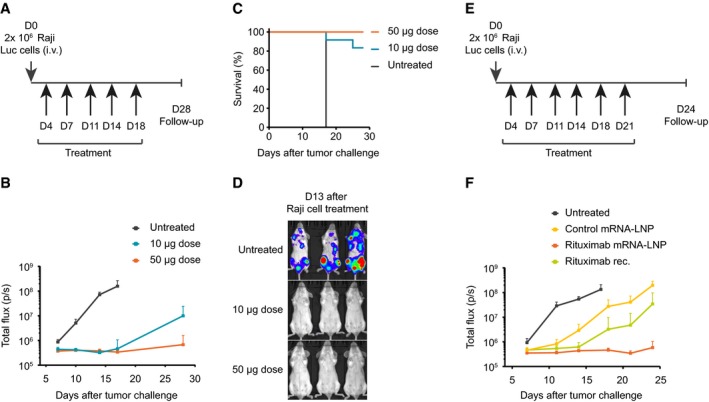
- In a Raji Luc tumor model, repeated rituximab mRNA-LNP doses of 50 or 10 μg strongly decelerated or abolished tumor growth; all high-dose animals and all but two low-dose animals survived to day 28, whereas untreated controls were euthanized about 17 days after inoculation.
Methods
- Proof-of-principle preclinical mouse study using chemically unmodified mRNA encoding IgG mAbs (anti-rabies S057/CR57, anti-influenza B CR8033, anti-HIV VRC01, rituximab) or VHH-based VNAs (anti-BoNT/A, anti-Stx2), formulated in lipid nanoparticles and administered intravenously; heavy- and light-chain mRNAs were mixed at approximately 1.5:1.
- In vitro expression and function were tested in BHK, HepG2, primary mouse hepatocytes, HeLa, Raji, Vero, and reporter cells; in vivo studies used NIH Swiss albino, CD1, BALB/c, and NOD/SCID mice, with challenge models for rabies (5 × LD50 IM), BoNT/A (4 × LD50 IV), and Raji Luc lymphoma (2 × 10^6 cells IV).
- Analyses included Western blot, IgG- or antigen-specific ELISA, FACS, rabies FAVN neutralization, HIV Magi R5-tropic entry assay, SNAP25 cleavage inhibition, Stx2 toxicity assay, whole-body luminescence imaging, survival monitoring, and GraphPad Prism statistics; ADA correlation used two-tailed nonparametric Spearman correlation.
Limitations
- The paper states that applicability will have to be confirmed case-by-case; rabies will probably require intramuscular administration, and it remains to be demonstrated that this route enables protective expression levels. It also notes that the constructs used a fixed, previously approved mRNA design rather than individually optimized mRNAs, likely explaining differences in peak expression.
- The paper reports that about half of mice receiving anti-rabies mAb showed accelerated serum clearance after about 2 weeks, correlating with anti-drug antibody responses attributed to the mismatch between humanized antibody sequence and mouse species, not to mRNA per se.
- Evident from the text: all efficacy data are from mouse models, with no human data; challenge studies used small groups (e.g., 6–12 mice per group), and control survival in rabies experiments varied from 0% to 40%, which the authors interpret as natural variation under the challenge conditions.
Model-written summary. Check it against the paper before relying on it.
Integrity signals
Registry
Cites
Statistics
Figures
Verification
Claims the paper makes
63 Own result · 37 Own interpretation · 13 Supported · 13 Own method · 8 Partly supported · 8 No full text of the sources · 8 No basis given · 2 Sources not found · 1 Not checked yet · accuracy not yet measured
The cited sources support only part of this claim — read each source’s verdict below.
In the paper
“there is ample evidence that it is possible to generate protective mAbs against many viruses and microorganisms (Teitelbaum et al, 1998; Nosanchuk et al, 2003; Both et al, 2013).”
§ mRNA mediates passive vaccination against infectious agents, toxins, and tumors > Introduction
What the sources say
- Not checked — no full text of the sourcecites Teitelbaum et al, 1998 source
- Supportedcites Nosanchuk et al, 2003 source
The Abstract reports that generated monoclonal antibodies prolonged survival in mice infected with Histoplasma capsulatum, a microorganism. This paper supplies one example for the broader statement supported by the sentence’s multiple citations; it need not independently cover viruses or many organisms. (LLM, conf=0.90)
- Partly supportedcites Both et al, 2013 sourceExperimental — accuracy not yet measured
The Development of monoclonal antibodies section reports that many antiviral mAbs have been developed, and the Antiviral immunity section describes protection in mAb-treated mice. The paper supports the claim for viruses, but the passages do not establish it for other microorganisms (searched: bacteria, fungi, parasites, and nonviral pathogens). No page numbers are available in our copy. (LLM, conf=0.87)
boosted- Asserted: passes — The authors put it forward as true.
- Checkable: passes — It can be checked against evidence.
- Load-bearing: passes — The paper’s conclusions depend on it.
- Based: passes — The paper gives a reason why it holds.
The cited sources support only part of this claim — read each source’s verdict below.
In the paper
“Protection afforded by currently licensed vaccines is primarily based on induction of a humoral immune response (Amanna & Slifka, 2011).”
§ mRNA mediates passive vaccination against infectious agents, toxins, and tumors > Introduction
What the sources say
- Partly supportedcites Amanna & Slifka, 2011 sourceExperimental — accuracy not yet measured
The section “Persisting antibody following vaccination; the first line of defense against infection” says antibody responses are the probable basis of efficacy for many of today’s most successful vaccines. But the Abstract and Conclusions say the relative contribution of humoral immunity depends on the vaccine and pathogen, and that protection often also involves cellular immunity. The claim extends the antibody-based account to currently licensed vaccines generally. (LLM, conf=0.85)
plaindirect- Asserted: passes — The authors put it forward as true.
- Checkable: passes — It can be checked against evidence.
- Load-bearing: passes — The paper’s conclusions depend on it.
- Based: passes — The paper gives a reason why it holds.
- Partly supported
Every source the paper cites for this claim was checked and supports it.
In the paper
“In 2003, a cocktail of mAbs was developed which protected Syrian hamsters from lethal challenges with a highly virulent rabies virus strain in post‐exposure scenarios (Prosniak et al, 2003).”
§ mRNA mediates passive vaccination against infectious agents, toxins, and tumors > Results > In vitro expression and functionality of mRNA‐encoded antibodies
What the sources say
- Supportedcites Prosniak et al, 2003 source
The hamster postexposure-prophylaxis passage identifies two-month-old female Syrian hamsters challenged with a lethal dose of a coyote-associated rabies virus strain. The following passage reports that treatment with the monoclonal-antibody cocktail began four hours after inoculation and that all 10 treated hamsters survived, while all 10 untreated controls died. (LLM, conf=0.94)
plaindirect- Asserted: passes — The authors put it forward as true.
- Checkable: passes — It can be checked against evidence.
- Load-bearing: passes — The paper’s conclusions depend on it.
- Based: passes — The paper gives a reason why it holds.
- Supported
Every source the paper cites for this claim was checked and supports it.
In the paper
“Physiological responses elicited in primates and domestic pigs treated with an mRNA‐encoded hormone have suggested the feasibility of mRNA for large animal therapies (Thess et al, 2015).”
§ mRNA mediates passive vaccination against infectious agents, toxins, and tumors > Introduction
What the sources say
- Supportedcites Thess et al, 2015 source
The Results section reports increased EPO levels, reticulocyte counts, and hematocrit in treated domestic pigs and nonhuman primates. The Discussion explicitly describes these findings as evidence that mRNA-based therapies are feasible in large animals. (LLM, conf=0.94)
hedgedconditional- Asserted: passes — The authors put it forward as true.
- Checkable: passes — It can be checked against evidence.
- Load-bearing: unclear — It is unclear whether the paper’s conclusions depend on it.
- Based: passes — The paper gives a reason why it holds.
- Supported
The cited sources support only part of this claim — read each source’s verdict below.
In the paper
“Conclusive data have also been presented for mRNA as a platform for protein (replacement) therapies (Kormann et al, 2011; Kariko et al, 2012; Zangi et al, 2013; Thess et al, 2015; Balmayor et al, 2016).”
§ mRNA mediates passive vaccination against infectious agents, toxins, and tumors > Introduction
What the sources say
- Not checked — no full text of the sourcecites Kormann et al, 2011 source
- Supportedcites Kariko et al, 2012 source
The Discussion reports that the study demonstrates the feasibility of using mRNA to express therapeutic proteins in vivo. Its EPO-encoding mRNA experiments increased blood EPO and reticulocyte counts in mice, providing data for the cited platform claim. (LLM, conf=0.88)
- Partly supportedcites Zangi et al, 2013 sourceExperimental — accuracy not yet measured
The Abstract and Results report that VEGF-A modRNA produced a therapeutic protein and improved cardiac outcomes in a mouse model of myocardial infarction. This supports mRNA as a potential platform for protein-based therapy, but the paper does not demonstrate protein replacement therapy specifically or establish conclusive efficacy across such therapies. Page numbers were not supplied in our copy. (LLM, conf=0.85)
boosteddirect- Asserted: passes — The authors put it forward as true.
- Checkable: passes — It can be checked against evidence.
- Load-bearing: unclear — It is unclear whether the paper’s conclusions depend on it.
- Based: passes — The paper gives a reason why it holds.
Every source the paper cites for this claim was checked and supports it.
In the paper
“In B cells, solitary heavy chains are retained at the endoplasmic reticulum by the chaperone binding immunoglobulin protein (BiP) (Hendershot et al, 1987).”
§ mRNA mediates passive vaccination against infectious agents, toxins, and tumors > Results > In vitro expression and functionality of mRNA‐encoded antibodies
What the sources say
- Supportedcites Hendershot et al, 1987 source
The Introduction (pp. 761–762) says BiP remains associated with heavy chains when light chains are absent and that those heavy chains are not transported to the Golgi or secreted. It also proposes that BiP holds heavy chains in the ER until assembly is complete; the paper's secretion experiments support that role. (LLM, conf=0.91)
plaindirect- Asserted: passes — The authors put it forward as true.
- Checkable: passes — It can be checked against evidence.
- Load-bearing: passes — The paper’s conclusions depend on it.
- Based: passes — The paper gives a reason why it holds.
- Supported
The cited sources support only part of this claim — read each source’s verdict below.
In the paper
“we selected the monoclonal antibody S057, also well known as CR57, one component of the published mAb cocktail, because it provides broad neutralization of a variety of rabies virus strains via binding to glycoprotein G.”
§ mRNA mediates passive vaccination against infectious agents, toxins, and tumors > Results > In vitro expression and functionality of mRNA‐encoded antibodies
What the sources say
- Partly supportedcites Prosniak et al, 2003 sourceExperimental — accuracy not yet measured
The passage labeled Abstract and Table 1 identify SO57 as a cocktail component and report neutralization of several fixed and street rabies-virus strains. Our copy does not identify SO57 as CR57 or say that its neutralization occurs through binding to rabies-virus glycoprotein G; its glycoprotein discussion concerns the expression vector instead. Page numbers were not supplied. (LLM, conf=0.86)
boosteddirect- Asserted: passes — The authors put it forward as true.
- Checkable: passes — It can be checked against evidence.
- Load-bearing: passes — The paper’s conclusions depend on it.
- Based: passes — The paper gives a reason why it holds.
- Partly supported
Every source the paper cites for this claim was checked and supports it.
In the paper
“For both VNAs, serum half‐lives were calculated to be in the range of 24–36 h which is in line with a previous report (Mukherjee et al, 2014).”
§ mRNA mediates passive vaccination against infectious agents, toxins, and tumors > Results > Expression of mRNA‐encoded antibodies in vivo
What the sources say
- Supportedcites Mukherjee et al, 2014 source
The Results section (‘Prolonging serum persistence of antitoxin VNAs’; page unavailable) estimates an effective half-life of 1–2 days for an albumin-binding VNA in mice. That is consistent with the citing authors’ 24–36-hour estimates. The cited paper supplies the previous comparison; it is not presented as the source of the citing authors’ measurements for both VNAs. (LLM, conf=0.90)
plain- Asserted: passes — The authors put it forward as true.
- Checkable: passes — It can be checked against evidence.
- Load-bearing: unclear — It is unclear whether the paper’s conclusions depend on it.
- Based: passes — The paper gives a reason why it holds.
- Supported
Every source the paper cites for this claim was checked and supports it.
In the paper
“By contrast, short‐lived proteins can significantly profit by being expressed from mRNA (Kariko et al, 2012; Thess et al, 2015).”
§ mRNA mediates passive vaccination against infectious agents, toxins, and tumors > Discussion
What the sources say
- Supportedcites Kariko et al, 2012 source
The Results (page unavailable) report that injected recombinant EPO was undetectable after six hours, whereas EPO levels remained elevated for up to four days after EPO-encoding mRNA injection. The authors attribute the prolonged levels to sustained translation, supporting the claim that mRNA expression can benefit a short-lived protein. (LLM, conf=0.90)
- Supportedcites Thess et al, 2015 source
The Results section ('Unmodified mRNA allows repeated treatments'; page unavailable) describes EPO as having a very short serum half-life and reports that mRNA-treated mice had substantially higher hematocrits than mice given recombinant EPO protein. This short-lived protein provides an example of a significant benefit from mRNA-based expression. (LLM, conf=0.85)
plaindirect- Asserted: passes — The authors put it forward as true.
- Checkable: passes — It can be checked against evidence.
- Load-bearing: passes — The paper’s conclusions depend on it.
- Based: passes — The paper gives a reason why it holds.
- Supported
Every source the paper cites for this claim was checked and supports it.
In the paper
“Thirdly, in light of previous findings, it is likely that target‐specific mRNA optimizations and further improvements to the formulation can substantially increase efficacy (Thess et al, 2015).”
§ mRNA mediates passive vaccination against infectious agents, toxins, and tumors > Discussion
What the sources say
- Supportedcites Thess et al, 2015 source
The Results (page unavailable) describe optimizing mRNA sequences in a target- and application-specific manner, and the Discussion calls sequence engineering important to biological efficacy. The Discussion also reports that formulations differ and that one formulation appeared more effective than another in pigs. Together, these findings support the citing sentence’s hedged expectation that further optimization could substantially improve efficacy. (LLM, conf=0.84)
hedgedconditional- Asserted: passes — The authors put it forward as true.
- Checkable: passes — It can be checked against evidence.
- Load-bearing: unclear — It is unclear whether the paper’s conclusions depend on it.
- Based: passes — The paper gives a reason why it holds.
- Supported
Every source the paper cites for this claim was checked and supports it.
In the paper
“An earlier study on a different secreted protein, erythropoietin, revealed that findings in a murine model translated to larger animals such as domestic pigs as well as to primates (Thess et al, 2015).”
§ mRNA mediates passive vaccination against infectious agents, toxins, and tumors > Discussion
What the sources say
- Supportedcites Thess et al, 2015 source
The Results sections report EPO expression and physiological effects in mice, then show that weight-adjusted EPO mRNA doses produced substantial effects in domestic pigs and cynomolgus monkeys. The Discussion explicitly describes this as good transferability between species. (LLM, conf=0.94)
plaindirect- Asserted: passes — The authors put it forward as true.
- Checkable: passes — It can be checked against evidence.
- Load-bearing: passes — The paper’s conclusions depend on it.
- Based: passes — The paper gives a reason why it holds.
- Supported
The cited sources support only part of this claim — read each source’s verdict below.
In the paper
“Accordingly, VNAs with an estimated serum half‐life of 1–2 days (with albumin‐binding) should benefit from being encoded by mRNA (Mukherjee et al, 2014).”
§ mRNA mediates passive vaccination against infectious agents, toxins, and tumors > Discussion
What the sources say
- Partly supportedcites Mukherjee et al, 2014 sourceExperimental — accuracy not yet measured
The Discussion (page not provided) estimates a 1–2-day serum half-life for the albumin-binding VNA in mice and says continuous genetic expression can improve VNA serum levels. The Introduction mentions RNA as a possible delivery vehicle, but the study tested adenoviral DNA delivery, not mRNA-encoded VNAs; it does not establish the claimed benefit of mRNA encoding. (LLM, conf=0.85)
hedgedconditional- Asserted: passes — The authors put it forward as true.
- Checkable: passes — It can be checked against evidence.
- Load-bearing: unclear — It is unclear whether the paper’s conclusions depend on it.
- Based: passes — The paper gives a reason why it holds.
- Partly supported
Every source the paper cites for this claim was checked and supports it.
In the paper
“Moreover, expression of therapeutic proteins can also be achieved by intramuscular administration (Schlake et al, 2012).”
§ mRNA mediates passive vaccination against infectious agents, toxins, and tumors > Discussion
What the sources say
- Supportedcites Schlake et al, 2012 source
In “Formulation of mRNA,” the authors report that a single intramuscular injection of mRNA encoding erythropoietin produced a biologically relevant effect in mice. They also describe the resulting Epo-mRNA effects as therapeutic, supporting the claim that intramuscular administration can achieve expression of a therapeutic protein. (LLM, conf=0.93)
plaindirect- Asserted: passes — The authors put it forward as true.
- Checkable: passes — It can be checked against evidence.
- Load-bearing: passes — The paper’s conclusions depend on it.
- Based: passes — The paper gives a reason why it holds.
- Supported
A result the paper reports from its own data — it cites no other source for it, so there is none to check. The quote shows it is in the paper.
In the paper
“thereby enabling both prophylactic and therapeutic protection against lethal rabies infection or botulinum intoxication.”
§ mRNA mediates passive vaccination against infectious agents, toxins, and tumors > Abstract
plaindirect- Asserted: passes — The authors put it forward as true.
- Checkable: passes — It can be checked against evidence.
- Load-bearing: passes — The paper’s conclusions depend on it.
- Based: passes — The paper gives a reason why it holds.
A result the paper reports from its own data — it cites no other source for it, so there is none to check. The quote shows it is in the paper.
In the paper
“Single injections of mRNA–lipid nanoparticle (LNP) were sufficient to establish rapid, strong, and long‐lasting serum antibody titers in vivo”
§ mRNA mediates passive vaccination against infectious agents, toxins, and tumors > Abstract
plaindirect- Asserted: passes — The authors put it forward as true.
- Checkable: passes — It can be checked against evidence.
- Load-bearing: passes — The paper’s conclusions depend on it.
- Based: passes — The paper gives a reason why it holds.
The paper states this without a source or data behind it here, so there is nothing to check it against. The quote shows it is in the paper.
In the paper
“thereby enabling both prophylactic and therapeutic protection against lethal rabies infection or botulinum intoxication.”
§ mRNA mediates passive vaccination against infectious agents, toxins, and tumors > Abstract
plaindirect- Asserted: passes — The authors put it forward as true.
- Checkable: passes — It can be checked against evidence.
- Load-bearing: passes — The paper’s conclusions depend on it.
- Based: passes — The paper gives a reason why it holds.
A result the paper reports from its own data — it cites no other source for it, so there is none to check. The quote shows it is in the paper.
In the paper
“Moreover, therapeutic mRNA‐mediated antibody expression allowed mice to survive an otherwise lethal tumor challenge.”
§ mRNA mediates passive vaccination against infectious agents, toxins, and tumors > Abstract
plaindirect- Asserted: passes — The authors put it forward as true.
- Checkable: passes — It can be checked against evidence.
- Load-bearing: passes — The paper’s conclusions depend on it.
- Based: passes — The paper gives a reason why it holds.
A result the paper reports from its own data — it cites no other source for it, so there is none to check. The quote shows it is in the paper.
In the paper
“The flexibility of the mRNA technology was further illustrated by complementary data from additional indications, including the demonstration of therapeutic efficacy in a tumor model.”
§ mRNA mediates passive vaccination against infectious agents, toxins, and tumors > Introduction
boosteddirect- Asserted: passes — The authors put it forward as true.
- Checkable: passes — It can be checked against evidence.
- Load-bearing: passes — The paper’s conclusions depend on it.
- Based: passes — The paper gives a reason why it holds.
A result the paper reports from its own data — it cites no other source for it, so there is none to check. The quote shows it is in the paper.
In the paper
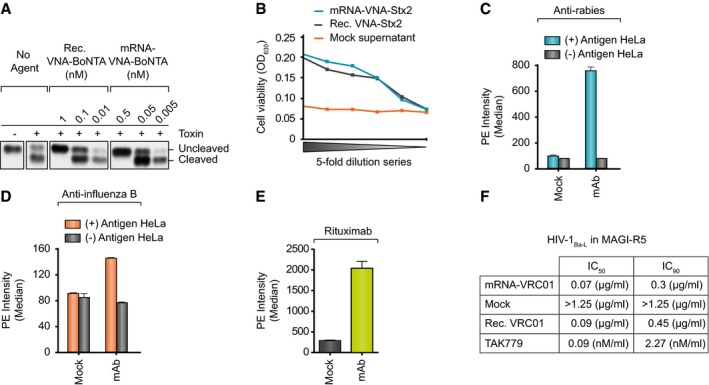
“Finally, supernatants containing mRNA‐encoded VNA‐Stx2 proved capable to protect cell viability in the presence of Shiga toxin with potency comparable to recombinant VNA‐Stx2 (Fig 2B).”
§ mRNA mediates passive vaccination against infectious agents, toxins, and tumors > Results > In vitro expression and functionality of mRNA‐encoded antibodies
plaindirect- Asserted: passes — The authors put it forward as true.
- Checkable: passes — It can be checked against evidence.
- Load-bearing: passes — The paper’s conclusions depend on it.
- Based: passes — The paper gives a reason why it holds.
A result the paper reports from its own data — it cites no other source for it, so there is none to check. The quote shows it is in the paper.
In the paper
“In contrast, light chains were also secreted in the absence of heavy chains.”
§ mRNA mediates passive vaccination against infectious agents, toxins, and tumors > Results > In vitro expression and functionality of mRNA‐encoded antibodies
plain- Asserted: passes — The authors put it forward as true.
- Checkable: passes — It can be checked against evidence.
- Load-bearing: passes — The paper’s conclusions depend on it.
- Based: passes — The paper gives a reason why it holds.
A result the paper reports from its own data — it cites no other source for it, so there is none to check. The quote shows it is in the paper.
In the paper
“The estimated serum half‐life of this antibody was also about 1 week.”
§ mRNA mediates passive vaccination against infectious agents, toxins, and tumors > Results > Expression of mRNA‐encoded antibodies in vivo
hedged- Asserted: passes — The authors put it forward as true.
- Checkable: passes — It can be checked against evidence.
- Load-bearing: unclear — It is unclear whether the paper’s conclusions depend on it.
- Based: passes — The paper gives a reason why it holds.
A result the paper reports from its own data — it cites no other source for it, so there is none to check. The quote shows it is in the paper.
In the paper
“Thus, early kinetics appeared similar for mAbs and VNAs.”
§ mRNA mediates passive vaccination against infectious agents, toxins, and tumors > Results > Expression of mRNA‐encoded antibodies in vivo
hedged- Asserted: passes — The authors put it forward as true.
- Checkable: passes — It can be checked against evidence.
- Load-bearing: unclear — It is unclear whether the paper’s conclusions depend on it.
- Based: passes — The paper gives a reason why it holds.
A result the paper reports from its own data — it cites no other source for it, so there is none to check. The quote shows it is in the paper.
In the paper
“Specific activity of mRNA‐derived anti‐HIV mAb was demonstrated to be comparable to the respective recombinant protein by measuring the inhibition of virus entry into reporter cells (Fig 2F and Appendix Fig S6).”
§ mRNA mediates passive vaccination against infectious agents, toxins, and tumors > Results > In vitro expression and functionality of mRNA‐encoded antibodies
boosted- Asserted: passes — The authors put it forward as true.
- Checkable: passes — It can be checked against evidence.
- Load-bearing: passes — The paper’s conclusions depend on it.
- Based: passes — The paper gives a reason why it holds.
A result the paper reports from its own data — it cites no other source for it, so there is none to check. The quote shows it is in the paper.
In the paper
“However, serum titers dropped much faster for VNAs than for mAbs after day 2.”
§ mRNA mediates passive vaccination against infectious agents, toxins, and tumors > Results > Expression of mRNA‐encoded antibodies in vivo
plaincorrelational- Asserted: passes — The authors put it forward as true.
- Checkable: passes — It can be checked against evidence.
- Load-bearing: passes — The paper’s conclusions depend on it.
- Based: passes — The paper gives a reason why it holds.
A result the paper reports from its own data — it cites no other source for it, so there is none to check. The quote shows it is in the paper.
In the paper
“Peak serum levels were reached 6–24 h after administration.”
§ mRNA mediates passive vaccination against infectious agents, toxins, and tumors > Results > Expression of mRNA‐encoded antibodies in vivo
plain- Asserted: passes — The authors put it forward as true.
- Checkable: passes — It can be checked against evidence.
- Load-bearing: unclear — It is unclear whether the paper’s conclusions depend on it.
- Based: passes — The paper gives a reason why it holds.
A result the paper reports from its own data — it cites no other source for it, so there is none to check. The quote shows it is in the paper.
In the paper
“Heavy‐chain retention for mRNA‐mediated expression was confirmed in overexpressing non‐B cells, including a hepatic cell line that may mimic in vivo conditions in the liver, our target organ for in vivo delivery (Appendix Fig S1).”
§ mRNA mediates passive vaccination against infectious agents, toxins, and tumors > Results > In vitro expression and functionality of mRNA‐encoded antibodies
plain- Asserted: passes — The authors put it forward as true.
- Checkable: passes — It can be checked against evidence.
- Load-bearing: passes — The paper’s conclusions depend on it.
- Based: passes — The paper gives a reason why it holds.
A result the paper reports from its own data — it cites no other source for it, so there is none to check. The quote shows it is in the paper.
In the paper
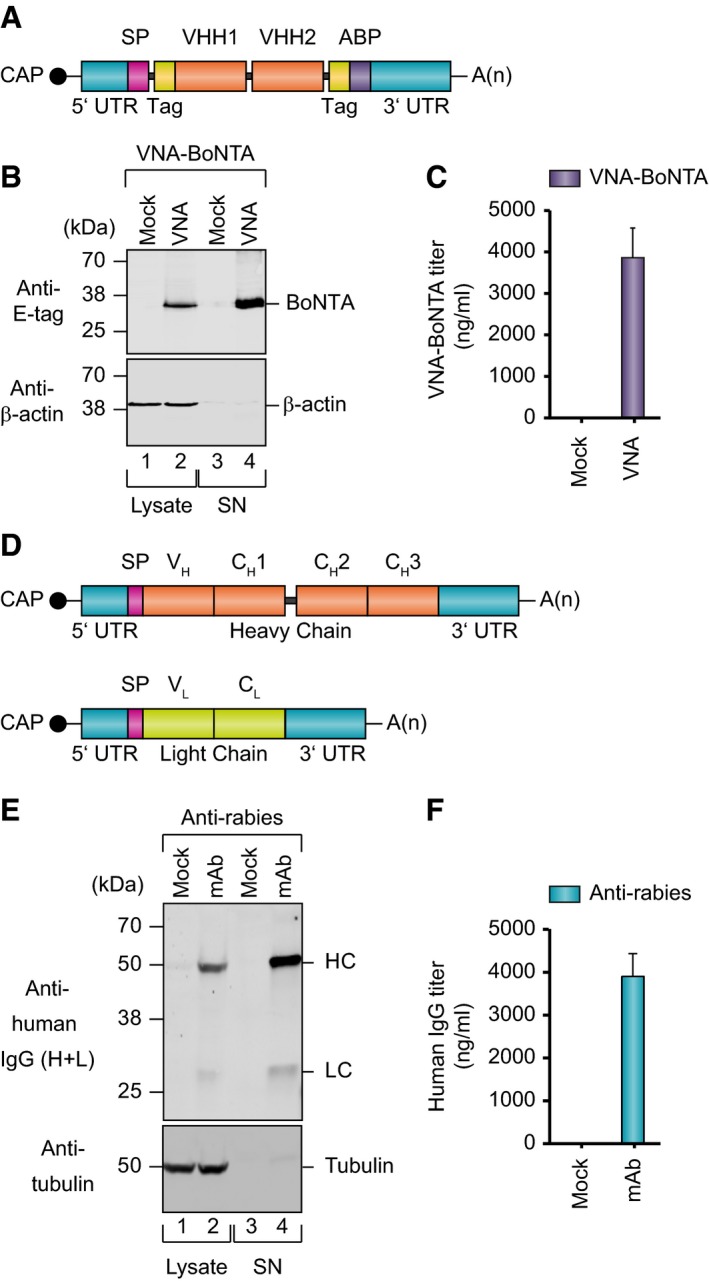
“Specific antigen binding of mAbs against rabies, influenza, and human CD20 was verified by staining of antigen‐expressing target cells (Fig 2C–E and Appendix Fig S5).”
§ mRNA mediates passive vaccination against infectious agents, toxins, and tumors > Results > In vitro expression and functionality of mRNA‐encoded antibodies
plain- Asserted: passes — The authors put it forward as true.
- Checkable: passes — It can be checked against evidence.
- Load-bearing: passes — The paper’s conclusions depend on it.
- Based: passes — The paper gives a reason why it holds.
A result the paper reports from its own data — it cites no other source for it, so there is none to check. The quote shows it is in the paper.
In the paper
“VNA‐BoNTA functionality was confirmed by a SNAP25 cleavage inhibition assay demonstrating that supernatants containing mRNA‐encoded VNA‐BoNTA had neutralizing potency comparable to a recombinant VNA‐BoNTA protein standard (Fig 2A).”
§ mRNA mediates passive vaccination against infectious agents, toxins, and tumors > Results > In vitro expression and functionality of mRNA‐encoded antibodies
boosted- Asserted: passes — The authors put it forward as true.
- Checkable: passes — It can be checked against evidence.
- Load-bearing: passes — The paper’s conclusions depend on it.
- Based: passes — The paper gives a reason why it holds.
A result the paper reports from its own data — it cites no other source for it, so there is none to check. The quote shows it is in the paper.
In the paper
“In both disease models, high levels of in vivo serum expression were obtained that conferred full protection in pre‐ and post‐exposure scenarios.”
§ mRNA mediates passive vaccination against infectious agents, toxins, and tumors > Introduction
plaindirect- Asserted: passes — The authors put it forward as true.
- Checkable: passes — It can be checked against evidence.
- Load-bearing: passes — The paper’s conclusions depend on it.
- Based: passes — The paper gives a reason why it holds.
A result the paper reports from its own data — it cites no other source for it, so there is none to check. The quote shows it is in the paper.
In the paper
“In vitro antibody mRNA half‐life in primary mouse hepatocytes was approximately 15 h (Appendix Fig S4A).”
§ mRNA mediates passive vaccination against infectious agents, toxins, and tumors > Results > In vitro expression and functionality of mRNA‐encoded antibodies
plain- Asserted: passes — The authors put it forward as true.
- Checkable: passes — It can be checked against evidence.
- Load-bearing: unclear — It is unclear whether the paper’s conclusions depend on it.
- Based: passes — The paper gives a reason why it holds.
A result the paper reports from its own data — it cites no other source for it, so there is none to check. The quote shows it is in the paper.
In the paper
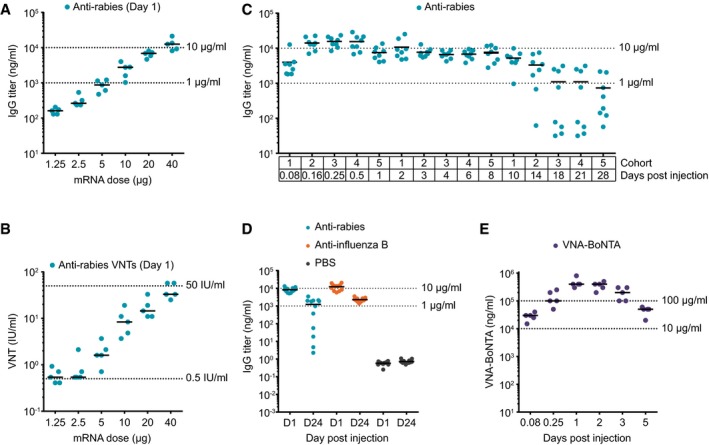
“In contrast, mice that received mRNA coding for anti‐influenza mAb all revealed the same high serum levels after 24 days (Fig 3D).”
§ mRNA mediates passive vaccination against infectious agents, toxins, and tumors > Results > Expression of mRNA‐encoded antibodies in vivo
plain- Asserted: passes — The authors put it forward as true.
- Checkable: passes — It can be checked against evidence.
- Load-bearing: passes — The paper’s conclusions depend on it.
- Based: passes — The paper gives a reason why it holds.
A result the paper reports from its own data — it cites no other source for it, so there is none to check. The quote shows it is in the paper.
In the paper
“A single injection of increasing mRNA‐LNP doses induced rising serum levels of antibody without reaching peak levels up to the highest doses tested in this study (Fig 3A and Appendix Fig S7A).”
§ mRNA mediates passive vaccination against infectious agents, toxins, and tumors > Results > Expression of mRNA‐encoded antibodies in vivo
plaindirect- Asserted: passes — The authors put it forward as true.
- Checkable: passes — It can be checked against evidence.
- Load-bearing: unclear — It is unclear whether the paper’s conclusions depend on it.
- Based: passes — The paper gives a reason why it holds.
A result the paper reports from its own data — it cites no other source for it, so there is none to check. The quote shows it is in the paper.
In the paper
“Likewise, expression of VNAs against botulinum neurotoxin serotype A (VNA‐BoNTA) and Shiga toxin 2 (Stx2) from E. coli (O157:H7) (VNA‐Stx2) was readily detected by Western blot and antigen‐specific ELISA (Fig 1B and C, and Appendix Fig S3G and H).”
§ mRNA mediates passive vaccination against infectious agents, toxins, and tumors > Results > In vitro expression and functionality of mRNA‐encoded antibodies
plain- Asserted: passes — The authors put it forward as true.
- Checkable: passes — It can be checked against evidence.
- Load-bearing: passes — The paper’s conclusions depend on it.
- Based: passes — The paper gives a reason why it holds.
A result the paper reports from its own data — it cites no other source for it, so there is none to check. The quote shows it is in the paper.
In the paper
“The highest levels observed were in the low two‐digit μg/ml range for both antibodies.”
§ mRNA mediates passive vaccination against infectious agents, toxins, and tumors > Results > Expression of mRNA‐encoded antibodies in vivo
plain- Asserted: passes — The authors put it forward as true.
- Checkable: passes — It can be checked against evidence.
- Load-bearing: unclear — It is unclear whether the paper’s conclusions depend on it.
- Based: passes — The paper gives a reason why it holds.
A result the paper reports from its own data — it cites no other source for it, so there is none to check. The quote shows it is in the paper.
In the paper
“High expression was obtained over a broad range of molar ratios (heavy:light chain) (Appendix Fig S2).”
§ mRNA mediates passive vaccination against infectious agents, toxins, and tumors > Results > In vitro expression and functionality of mRNA‐encoded antibodies
plain- Asserted: passes — The authors put it forward as true.
- Checkable: passes — It can be checked against evidence.
- Load-bearing: unclear — It is unclear whether the paper’s conclusions depend on it.
- Based: passes — The paper gives a reason why it holds.
A result the paper reports from its own data — it cites no other source for it, so there is none to check. The quote shows it is in the paper.
In the paper
“Constructs for IgG mAbs against rabies glycoprotein G (S057), influenza B hemagglutinin (CR8033; Dreyfus et al, 2012), HIV gp120 (VRC01; Wu et al, 2010), and human CD20 (rituximab) all revealed strong in vitro expression upon mRNA transfection of BHK cells as measured by Western blot analysis and IgG‐specific ELISA (Fig 1E and F, and Appendix Fig S3A–F).”
§ mRNA mediates passive vaccination against infectious agents, toxins, and tumors > Results > In vitro expression and functionality of mRNA‐encoded antibodies
boosteddirect- Asserted: passes — The authors put it forward as true.
- Checkable: passes — It can be checked against evidence.
- Load-bearing: passes — The paper’s conclusions depend on it.
- Based: passes — The paper gives a reason why it holds.
A result the paper reports from its own data — it cites no other source for it, so there is none to check. The quote shows it is in the paper.
In the paper
“For VNA‐BoNTA and VNA‐Stx2, considerable titers were measured as early as 2 h post‐injection (Fig 3E and Appendix Fig S7B).”
§ mRNA mediates passive vaccination against infectious agents, toxins, and tumors > Results > Expression of mRNA‐encoded antibodies in vivo
plain- Asserted: passes — The authors put it forward as true.
- Checkable: passes — It can be checked against evidence.
- Load-bearing: unclear — It is unclear whether the paper’s conclusions depend on it.
- Based: passes — The paper gives a reason why it holds.
A result the paper reports from its own data — it cites no other source for it, so there is none to check. The quote shows it is in the paper.
In the paper
“During the following days, titers slowly decreased with a half‐life of approximately 1 week.”
§ mRNA mediates passive vaccination against infectious agents, toxins, and tumors > Results > Expression of mRNA‐encoded antibodies in vivo
plain- Asserted: passes — The authors put it forward as true.
- Checkable: passes — It can be checked against evidence.
- Load-bearing: passes — The paper’s conclusions depend on it.
- Based: passes — The paper gives a reason why it holds.
A result the paper reports from its own data — it cites no other source for it, so there is none to check. The quote shows it is in the paper.
In the paper
“nor did we observe any dose‐limiting toxicity.”
§ mRNA mediates passive vaccination against infectious agents, toxins, and tumors > Discussion
plain- Asserted: passes — The authors put it forward as true.
- Checkable: passes — It can be checked against evidence.
- Load-bearing: passes — The paper’s conclusions depend on it.
- Based: passes — The paper gives a reason why it holds.
The paper states this without a source or data behind it here, so there is nothing to check it against. The quote shows it is in the paper.
In the paper
“Indeed, estimated half‐lives of VNA serum titers at one to 3 days after treatment were on average 1.5‐fold higher than from day 3 on, even without a target‐specific mRNA optimization.”
§ mRNA mediates passive vaccination against infectious agents, toxins, and tumors > Discussion
hedgedcorrelational- Asserted: passes — The authors put it forward as true.
- Checkable: passes — It can be checked against evidence.
- Load-bearing: unclear — It is unclear whether the paper’s conclusions depend on it.
- Based: passes — The paper gives a reason why it holds.
A result the paper reports from its own data — it cites no other source for it, so there is none to check. The quote shows it is in the paper.
In the paper
“Serum half‐life for two different proteins turned out to be in the range of 1 week.”
§ mRNA mediates passive vaccination against infectious agents, toxins, and tumors > Discussion
plain- Asserted: passes — The authors put it forward as true.
- Checkable: passes — It can be checked against evidence.
- Load-bearing: passes — The paper’s conclusions depend on it.
- Based: passes — The paper gives a reason why it holds.
A result the paper reports from its own data — it cites no other source for it, so there is none to check. The quote shows it is in the paper.
In the paper
“repeated intravenous administration of either 50 or 10 μg of mRNA‐LNP for rituximab strongly decelerated or even abolished tumor cell growth.”
§ mRNA mediates passive vaccination against infectious agents, toxins, and tumors > Results > Prophylaxis and therapy with mRNA‐encoded antibodies in mice
boosteddirect- Asserted: passes — The authors put it forward as true.
- Checkable: passes — It can be checked against evidence.
- Load-bearing: passes — The paper’s conclusions depend on it.
- Based: passes — The paper gives a reason why it holds.
A result the paper reports from its own data — it cites no other source for it, so there is none to check. The quote shows it is in the paper.
In the paper
“while all control mice died.”
§ mRNA mediates passive vaccination against infectious agents, toxins, and tumors > Results > Prophylaxis and therapy with mRNA‐encoded antibodies in mice
plain- Asserted: passes — The authors put it forward as true.
- Checkable: passes — It can be checked against evidence.
- Load-bearing: passes — The paper’s conclusions depend on it.
- Based: passes — The paper gives a reason why it holds.
A result the paper reports from its own data — it cites no other source for it, so there is none to check. The quote shows it is in the paper.
In the paper
“treatment with recombinant antibody at a dose which has been widely used in mouse studies on rituximab clearly suppressed tumor growth.”
§ mRNA mediates passive vaccination against infectious agents, toxins, and tumors > Results > Prophylaxis and therapy with mRNA‐encoded antibodies in mice
boosteddirect- Asserted: passes — The authors put it forward as true.
- Checkable: passes — It can be checked against evidence.
- Load-bearing: passes — The paper’s conclusions depend on it.
- Based: passes — The paper gives a reason why it holds.
A result the paper reports from its own data — it cites no other source for it, so there is none to check. The quote shows it is in the paper.
In the paper
“Secondly, up to the doses tested so far, we found that the dose–response curve for mRNA‐mediated antibody expression did not reveal any saturation”
§ mRNA mediates passive vaccination against infectious agents, toxins, and tumors > Discussion
plain- Asserted: passes — The authors put it forward as true.
- Checkable: passes — It can be checked against evidence.
- Load-bearing: passes — The paper’s conclusions depend on it.
- Based: passes — The paper gives a reason why it holds.
A result the paper reports from its own data — it cites no other source for it, so there is none to check. The quote shows it is in the paper.
In the paper
“however, these mice displayed moderate clinical signs.”
§ mRNA mediates passive vaccination against infectious agents, toxins, and tumors > Results > Prophylaxis and therapy with mRNA‐encoded antibodies in mice
plain- Asserted: passes — The authors put it forward as true.
- Checkable: passes — It can be checked against evidence.
- Load-bearing: passes — The paper’s conclusions depend on it.
- Based: passes — The paper gives a reason why it holds.
A result the paper reports from its own data — it cites no other source for it, so there is none to check. The quote shows it is in the paper.
In the paper
“Control animals all revealed strong tumor cell proliferation and had to be euthanized 17 days after inoculation due to severe symptoms (Fig 5B–D).”
- Also stated in: § Prophylaxis and therapy with mRNA‐encoded antibodies in mice · hedged
“untreated control mice revealed fast tumor progression leading to euthanization after about 17 days.”
§ mRNA mediates passive vaccination against infectious agents, toxins, and tumors > Results > Prophylaxis and therapy with mRNA‐encoded antibodies in mice
plain- Asserted: passes — The authors put it forward as true.
- Checkable: passes — It can be checked against evidence.
- Load-bearing: passes — The paper’s conclusions depend on it.
- Based: passes — The paper gives a reason why it holds.
- Also stated in: § Prophylaxis and therapy with mRNA‐encoded antibodies in mice · hedged
A result the paper reports from its own data — it cites no other source for it, so there is none to check. The quote shows it is in the paper.
In the paper
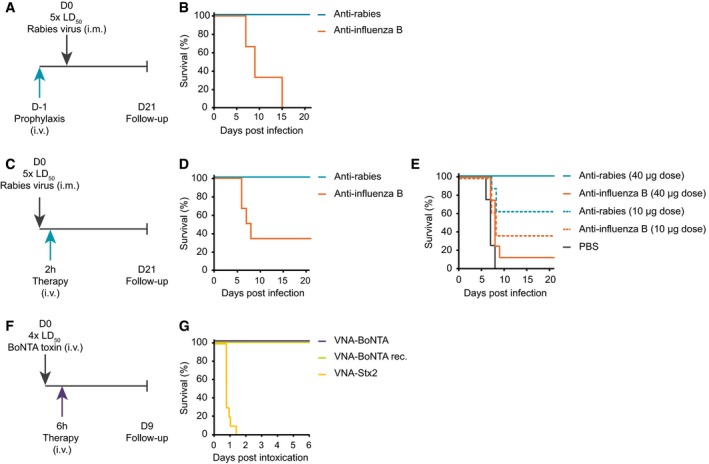
“Mice treated 6 h post‐intoxication with VNA‐BoNTA mRNA or recombinant VNA‐BoNTA also survived (Fig 4G)”
§ mRNA mediates passive vaccination against infectious agents, toxins, and tumors > Results > Prophylaxis and therapy with mRNA‐encoded antibodies in mice
plaindirect- Asserted: passes — The authors put it forward as true.
- Checkable: passes — It can be checked against evidence.
- Load-bearing: passes — The paper’s conclusions depend on it.
- Based: passes — The paper gives a reason why it holds.
A result the paper reports from its own data — it cites no other source for it, so there is none to check. The quote shows it is in the paper.
In the paper
“A fourfold lower dose gave rise to just partial protection.”
§ mRNA mediates passive vaccination against infectious agents, toxins, and tumors > Results > Prophylaxis and therapy with mRNA‐encoded antibodies in mice
plaindirect- Asserted: passes — The authors put it forward as true.
- Checkable: passes — It can be checked against evidence.
- Load-bearing: passes — The paper’s conclusions depend on it.
- Based: passes — The paper gives a reason why it holds.
A result the paper reports from its own data — it cites no other source for it, so there is none to check. The quote shows it is in the paper.
In the paper
“The pharmacokinetics data for an anti‐rabies antibody indeed appeared to suggest an induction of an ADA response as about half of the animals revealed accelerated serum clearance after about 2 weeks (Fig 3C and D).”
§ mRNA mediates passive vaccination against infectious agents, toxins, and tumors > Discussion
hedgedcorrelational- Asserted: passes — The authors put it forward as true.
- Checkable: passes — It can be checked against evidence.
- Load-bearing: passes — The paper’s conclusions depend on it.
- Based: passes — The paper gives a reason why it holds.
A result the paper reports from its own data — it cites no other source for it, so there is none to check. The quote shows it is in the paper.
In the paper
“Again, all mice which received the negative control, mRNA‐LNP encoding VNA‐Stx2, succumbed within 36 h.”
§ mRNA mediates passive vaccination against infectious agents, toxins, and tumors > Results > Prophylaxis and therapy with mRNA‐encoded antibodies in mice
plain- Asserted: passes — The authors put it forward as true.
- Checkable: passes — It can be checked against evidence.
- Load-bearing: passes — The paper’s conclusions depend on it.
- Based: passes — The paper gives a reason why it holds.
A result the paper reports from its own data — it cites no other source for it, so there is none to check. The quote shows it is in the paper.
In the paper
“In contrast, serum clearance maintained its slow initial rate during the whole observation period for a humanized anti‐HA antibody (Fig 3D).”
§ mRNA mediates passive vaccination against infectious agents, toxins, and tumors > Discussion
plain- Asserted: passes — The authors put it forward as true.
- Checkable: passes — It can be checked against evidence.
- Load-bearing: passes — The paper’s conclusions depend on it.
- Based: passes — The paper gives a reason why it holds.
The paper states this without a source or data behind it here, so there is nothing to check it against. The quote shows it is in the paper.
In the paper
“Animals treated with irrelevant antibody mRNA appeared to show delayed tumor growth kinetics.”
§ mRNA mediates passive vaccination against infectious agents, toxins, and tumors > Results > Prophylaxis and therapy with mRNA‐encoded antibodies in mice
hedgedcorrelational- Asserted: passes — The authors put it forward as true.
- Checkable: passes — It can be checked against evidence.
- Load-bearing: unclear — It is unclear whether the paper’s conclusions depend on it.
- Based: passes — The paper gives a reason why it holds.
A result the paper reports from its own data — it cites no other source for it, so there is none to check. The quote shows it is in the paper.
In the paper
“we utilized mRNA‐LNPs encoding the short‐lived hormone erythropoietin, suggesting a half‐life of roughly 15 h (Appendix Fig S4B), which is in good accordance with in vitro measurements.”
§ mRNA mediates passive vaccination against infectious agents, toxins, and tumors > Results > Expression of mRNA‐encoded antibodies in vivo
hedged- Asserted: passes — The authors put it forward as true.
- Checkable: passes — It can be checked against evidence.
- Load-bearing: unclear — It is unclear whether the paper’s conclusions depend on it.
- Based: passes — The paper gives a reason why it holds.
The paper states this without a source or data behind it here, so there is nothing to check it against. The quote shows it is in the paper.
In the paper
“Nevertheless, antibodies could inhibit infection up to 4 h post‐exposure.”
§ mRNA mediates passive vaccination against infectious agents, toxins, and tumors > Discussion
hedgeddirect- Asserted: passes — The authors put it forward as true.
- Checkable: passes — It can be checked against evidence.
- Load-bearing: passes — The paper’s conclusions depend on it.
- Based: passes — The paper gives a reason why it holds.
A result the paper reports from its own data — it cites no other source for it, so there is none to check. The quote shows it is in the paper.
In the paper
“1 out of 12 mice treated with 40 μg of mRNA for the irrelevant anti‐influenza mAb survived”
§ mRNA mediates passive vaccination against infectious agents, toxins, and tumors > Results > Prophylaxis and therapy with mRNA‐encoded antibodies in mice
plainn = 12- Asserted: passes — The authors put it forward as true.
- Checkable: passes — It can be checked against evidence.
- Load-bearing: passes — The paper’s conclusions depend on it.
- Based: passes — The paper gives a reason why it holds.
A result the paper reports from its own data — it cites no other source for it, so there is none to check. The quote shows it is in the paper.
In the paper
“While all animals receiving just buffer succumbed to rabies infection”
§ mRNA mediates passive vaccination against infectious agents, toxins, and tumors > Results > Prophylaxis and therapy with mRNA‐encoded antibodies in mice
plain- Asserted: passes — The authors put it forward as true.
- Checkable: passes — It can be checked against evidence.
- Load-bearing: passes — The paper’s conclusions depend on it.
- Based: passes — The paper gives a reason why it holds.
A result the paper reports from its own data — it cites no other source for it, so there is none to check. The quote shows it is in the paper.
In the paper
“We did not observe any adverse events throughout the present studies.”
§ mRNA mediates passive vaccination against infectious agents, toxins, and tumors > Results > Expression of mRNA‐encoded antibodies in vivo
plain- Asserted: passes — The authors put it forward as true.
- Checkable: passes — It can be checked against evidence.
- Load-bearing: passes — The paper’s conclusions depend on it.
- Based: passes — The paper gives a reason why it holds.
A result the paper reports from its own data — it cites no other source for it, so there is none to check. The quote shows it is in the paper.
In the paper
“Obviously, the individual clearance rates strongly correlated with the development of a humoral response against the anti‐rabies antibody (Appendix Fig S8), thus perfectly explaining the divergent kinetics.”
§ mRNA mediates passive vaccination against infectious agents, toxins, and tumors > Results > Expression of mRNA‐encoded antibodies in vivo
boostedcorrelational- Asserted: passes — The authors put it forward as true.
- Checkable: passes — It can be checked against evidence.
- Load-bearing: passes — The paper’s conclusions depend on it.
- Based: passes — The paper gives a reason why it holds.
A result the paper reports from its own data — it cites no other source for it, so there is none to check. The quote shows it is in the paper.
In the paper
“animals that received a fourfold lower dose of influenza mRNA again showed a survival rate of about 40%.”
§ mRNA mediates passive vaccination against infectious agents, toxins, and tumors > Results > Prophylaxis and therapy with mRNA‐encoded antibodies in mice
plain- Asserted: passes — The authors put it forward as true.
- Checkable: passes — It can be checked against evidence.
- Load-bearing: unclear — It is unclear whether the paper’s conclusions depend on it.
- Based: passes — The paper gives a reason why it holds.
A result the paper reports from its own data — it cites no other source for it, so there is none to check. The quote shows it is in the paper.
In the paper
“Again, all mice receiving 40 μg of mRNA for anti‐rabies mAb survived (Fig 4E).”
§ mRNA mediates passive vaccination against infectious agents, toxins, and tumors > Results > Prophylaxis and therapy with mRNA‐encoded antibodies in mice
plaindirect- Asserted: passes — The authors put it forward as true.
- Checkable: passes — It can be checked against evidence.
- Load-bearing: passes — The paper’s conclusions depend on it.
- Based: passes — The paper gives a reason why it holds.
A result the paper reports from its own data — it cites no other source for it, so there is none to check. The quote shows it is in the paper.
In the paper
“Full survival with no clinical signs was observed when animals were treated at 2 or 4 h after intoxication with either VNA‐BoNTA mRNA or recombinant VNA‐BoNTA (Appendix Fig S10A and B)”
§ mRNA mediates passive vaccination against infectious agents, toxins, and tumors > Results > Prophylaxis and therapy with mRNA‐encoded antibodies in mice
plaindirect- Asserted: passes — The authors put it forward as true.
- Checkable: passes — It can be checked against evidence.
- Load-bearing: passes — The paper’s conclusions depend on it.
- Based: passes — The paper gives a reason why it holds.
A result the paper reports from its own data — it cites no other source for it, so there is none to check. The quote shows it is in the paper.
In the paper
“Histopathology of liver, the target organ of mRNA‐LNPs, did not reveal any signs of abnormality or inflammation (Appendix Fig S9).”
§ mRNA mediates passive vaccination against infectious agents, toxins, and tumors > Results > Expression of mRNA‐encoded antibodies in vivo
plain- Asserted: passes — The authors put it forward as true.
- Checkable: passes — It can be checked against evidence.
- Load-bearing: passes — The paper’s conclusions depend on it.
- Based: passes — The paper gives a reason why it holds.
A result the paper reports from its own data — it cites no other source for it, so there is none to check. The quote shows it is in the paper.
In the paper
“This drop of serum titers correlated with elevated ADA levels 4 weeks after treatment (Appendix Fig S8).”
§ mRNA mediates passive vaccination against infectious agents, toxins, and tumors > Discussion
plaincorrelational- Asserted: passes — The authors put it forward as true.
- Checkable: passes — It can be checked against evidence.
- Load-bearing: passes — The paper’s conclusions depend on it.
- Based: passes — The paper gives a reason why it holds.
A result the paper reports from its own data — it cites no other source for it, so there is none to check. The quote shows it is in the paper.
In the paper
“Protection against death was achieved even with a 6 h post‐exposure treatment.”
§ mRNA mediates passive vaccination against infectious agents, toxins, and tumors > Discussion
plaindirect- Asserted: passes — The authors put it forward as true.
- Checkable: passes — It can be checked against evidence.
- Load-bearing: passes — The paper’s conclusions depend on it.
- Based: passes — The paper gives a reason why it holds.
A result the paper reports from its own data — it cites no other source for it, so there is none to check. The quote shows it is in the paper.
In the paper
“In vitro and in vivo experiments revealed efficient expression of functional antibodies from exogenous mRNA.”
§ mRNA mediates passive vaccination against infectious agents, toxins, and tumors > Conflict of interest > Results
plaindirect- Asserted: passes — The authors put it forward as true.
- Checkable: passes — It can be checked against evidence.
- Load-bearing: passes — The paper’s conclusions depend on it.
- Based: passes — The paper gives a reason why it holds.
A result the paper reports from its own data — it cites no other source for it, so there is none to check. The quote shows it is in the paper.
In the paper
“Protection was obtained in pre‐ and post‐exposure treatment scenarios.”
§ mRNA mediates passive vaccination against infectious agents, toxins, and tumors > Conflict of interest > Results
plaindirect- Asserted: passes — The authors put it forward as true.
- Checkable: passes — It can be checked against evidence.
- Load-bearing: passes — The paper’s conclusions depend on it.
- Based: passes — The paper gives a reason why it holds.
A result the paper reports from its own data — it cites no other source for it, so there is none to check. The quote shows it is in the paper.
In the paper
“In vivo, LNP–mRNA‐mediated antibody expression protected mice against diverse biological threats such as virus, toxin, and neoplastic cell growth.”
- Also stated in: § Impact · plain
“The present study reveals that mRNA‐mediated antibody expression can confer protection against diverse biological threats.”
§ mRNA mediates passive vaccination against infectious agents, toxins, and tumors > Conflict of interest > Results
plaindirect- Asserted: passes — The authors put it forward as true.
- Checkable: passes — It can be checked against evidence.
- Load-bearing: passes — The paper’s conclusions depend on it.
- Based: passes — The paper gives a reason why it holds.
- Also stated in: § Impact · plain
The paper states this without a source or data behind it here, so there is nothing to check it against. The quote shows it is in the paper.
In the paper
“As expected, half‐lives of serum titers were much shorter for VNAs compared to mAbs.”
§ mRNA mediates passive vaccination against infectious agents, toxins, and tumors > Discussion
plain- Asserted: passes — The authors put it forward as true.
- Checkable: passes — It can be checked against evidence.
- Load-bearing: unclear — It is unclear whether the paper’s conclusions depend on it.
- Based: passes — The paper gives a reason why it holds.
The paper states this without a source or data behind it here, so there is nothing to check it against. The quote shows it is in the paper.
In the paper
“As a consequence, the efficacy of mRNA was comparable to recombinant antibody therapy in a particularly challenging post‐exposure scenario for intoxication.”
§ mRNA mediates passive vaccination against infectious agents, toxins, and tumors > Conflict of interest > Results
plain- Asserted: passes — The authors put it forward as true.
- Checkable: passes — It can be checked against evidence.
- Load-bearing: passes — The paper’s conclusions depend on it.
- Based: passes — The paper gives a reason why it holds.
A result the paper reports from its own data — it cites no other source for it, so there is none to check. The quote shows it is in the paper.
In the paper
“mRNA revealed a favorable expression kinetics giving rise to immediately elevated antibody serum titers.”
§ mRNA mediates passive vaccination against infectious agents, toxins, and tumors > Conflict of interest > Results
plaindirect- Asserted: passes — The authors put it forward as true.
- Checkable: passes — It can be checked against evidence.
- Load-bearing: passes — The paper’s conclusions depend on it.
- Based: passes — The paper gives a reason why it holds.
A result the paper reports from its own data — it cites no other source for it, so there is none to check. The quote shows it is in the paper.
In the paper
“Flexibility of the technology was demonstrated by the expression of different antibodies and antibody formats such as classical IgG‐based monoclonal antibodies (mAbs) or heavy‐chain‐only neutralizing agents (VNAs).”
§ mRNA mediates passive vaccination against infectious agents, toxins, and tumors > Conflict of interest > Results
boosteddirect- Asserted: passes — The authors put it forward as true.
- Checkable: passes — It can be checked against evidence.
- Load-bearing: unclear — It is unclear whether the paper’s conclusions depend on it.
- Based: passes — The paper gives a reason why it holds.
A conclusion the paper draws from its own results — it cites no other source for it, so there is none to check. The quote shows it is in the paper.
In the paper
“Hence, passive immunization, by transferring either serum or purified antibodies, is a potent means to confer immediate protection against various threats.”
§ mRNA mediates passive vaccination against infectious agents, toxins, and tumors > Introduction
boosteddirect- Asserted: passes — The authors put it forward as true.
- Checkable: passes — It can be checked against evidence.
- Load-bearing: unclear — It is unclear whether the paper’s conclusions depend on it.
- Based: passes — The paper gives a reason why it holds.
A conclusion the paper draws from its own results — it cites no other source for it, so there is none to check. The quote shows it is in the paper.
In the paper
“In conclusion, the present study demonstrates the utility of formulated mRNA as a potent novel technology for passive immunization.”
§ mRNA mediates passive vaccination against infectious agents, toxins, and tumors > Abstract
boosteddirect- Asserted: passes — The authors put it forward as true.
- Checkable: passes — It can be checked against evidence.
- Load-bearing: passes — The paper’s conclusions depend on it.
- Based: passes — The paper gives a reason why it holds.
In the paper
“It has been demonstrated that neutralizing antibodies are sufficient to prevent dissemination of many diseases within populations (Plotkin, 2010).”
§ mRNA mediates passive vaccination against infectious agents, toxins, and tumors > Introduction
What the sources say
- Not checked — no full text of the sourcecites Plotkin, 2010 source
boosteddirect- Asserted: passes — The authors put it forward as true.
- Checkable: passes — It can be checked against evidence.
- Load-bearing: passes — The paper’s conclusions depend on it.
- Based: passes — The paper gives a reason why it holds.
What the paper did — it cites no source for this, so there is none to check. The quote shows it is in the paper.
In the paper
“This bipartite kinetics was confirmed in a second independent study.”
§ mRNA mediates passive vaccination against infectious agents, toxins, and tumors > Results > Expression of mRNA‐encoded antibodies in vivo
plain- Asserted: passes — The authors put it forward as true.
- Checkable: passes — It can be checked against evidence.
- Load-bearing: unclear — It is unclear whether the paper’s conclusions depend on it.
- Based: passes — The paper gives a reason why it holds.
A conclusion the paper draws from its own results — it cites no other source for it, so there is none to check. The quote shows it is in the paper.
In the paper
“Thus, mRNA‐based antibodies for passive immunization may be produced at competitive costs even in cases where the product is only required in emergencies such as an influenza pandemic.”
§ mRNA mediates passive vaccination against infectious agents, toxins, and tumors > Introduction
hedgedconditional- Asserted: passes — The authors put it forward as true.
- Checkable: passes — It can be checked against evidence.
- Load-bearing: passes — The paper’s conclusions depend on it.
- Based: passes — The paper gives a reason why it holds.
A conclusion the paper draws from its own results — it cites no other source for it, so there is none to check. The quote shows it is in the paper.
In the paper
“However, this effect is not related to the necessity of correctly assembling heavy and light chains and the separation of both on distinct mRNA molecules, since the nonlinearity is equal or even more pronounced for the single‐chain VNA constructs.”
§ mRNA mediates passive vaccination against infectious agents, toxins, and tumors > Results > Expression of mRNA‐encoded antibodies in vivo
plain- Asserted: passes — The authors put it forward as true.
- Checkable: passes — It can be checked against evidence.
- Load-bearing: unclear — It is unclear whether the paper’s conclusions depend on it.
- Based: passes — The paper gives a reason why it holds.
A conclusion the paper draws from its own results — it cites no other source for it, so there is none to check. The quote shows it is in the paper.
In the paper
“Compared to DNA‐based approaches, mRNA benefits from fewer safety issues due to its non‐integrative and transient nature”
§ mRNA mediates passive vaccination against infectious agents, toxins, and tumors > Introduction
plaindirect- Asserted: passes — The authors put it forward as true.
- Checkable: passes — It can be checked against evidence.
- Load-bearing: passes — The paper’s conclusions depend on it.
- Based: passes — The paper gives a reason why it holds.
- Rests on an assumption: DNA-based passive immunization suffers from the risk of genomic integration, potentially causing fatal mutations.
A conclusion the paper draws from its own results — it cites no other source for it, so there is none to check. The quote shows it is in the paper.
In the paper
“Thus, our work establishes the foundation for development of novel passive immunization therapies.”
§ mRNA mediates passive vaccination against infectious agents, toxins, and tumors > Introduction
plaindirect- Asserted: passes — The authors put it forward as true.
- Checkable: passes — It can be checked against evidence.
- Load-bearing: passes — The paper’s conclusions depend on it.
- Based: passes — The paper gives a reason why it holds.
A claim is checked only against the cited paper’s full text, never its abstract, and none is available for its sources.
In the paper
“Following initial studies in the early 1990s demonstrating that exogenous mRNA can direct protein expression in vivo, mRNA has emerged as a promising drug platform technology in recent years (Wolff et al, 1990; Jirikowski et al, 1992).”
§ mRNA mediates passive vaccination against infectious agents, toxins, and tumors > Introduction
What the sources say
boosteddirect- Asserted: passes — The authors put it forward as true.
- Checkable: passes — It can be checked against evidence.
- Load-bearing: passes — The paper’s conclusions depend on it.
- Based: passes — The paper gives a reason why it holds.
A conclusion the paper draws from its own results — it cites no other source for it, so there is none to check. The quote shows it is in the paper.
In the paper
“Taken together, mRNA proved to be an efficient means to express diverse antibodies and antibody formats in vitro.”
§ mRNA mediates passive vaccination against infectious agents, toxins, and tumors > Results > In vitro expression and functionality of mRNA‐encoded antibodies
plaindirect- Asserted: passes — The authors put it forward as true.
- Checkable: passes — It can be checked against evidence.
- Load-bearing: passes — The paper’s conclusions depend on it.
- Based: passes — The paper gives a reason why it holds.
A conclusion the paper draws from its own results — it cites no other source for it, so there is none to check. The quote shows it is in the paper.
In the paper
“Hence, as for in vitro expression, mRNA‐mediated mAb expression in vivo efficiently produced functional antibodies.”
§ mRNA mediates passive vaccination against infectious agents, toxins, and tumors > Results > Expression of mRNA‐encoded antibodies in vivo
plaindirect- Asserted: passes — The authors put it forward as true.
- Checkable: passes — It can be checked against evidence.
- Load-bearing: passes — The paper’s conclusions depend on it.
- Based: passes — The paper gives a reason why it holds.
In the paper
“According to in vitro data, the virus enters cells within 20 min after inoculation (Dietzschold et al, 1985).”
§ mRNA mediates passive vaccination against infectious agents, toxins, and tumors > Discussion
What the sources say
- Not checked — no full text of the sourcecites Dietzschold et al, 1985 source
plain- Asserted: passes — The authors put it forward as true.
- Checkable: passes — It can be checked against evidence.
- Load-bearing: passes — The paper’s conclusions depend on it.
- Based: passes — The paper gives a reason why it holds.
A conclusion the paper draws from its own results — it cites no other source for it, so there is none to check. The quote shows it is in the paper.
In the paper
“thereby highlighting the highly favorable kinetics of mRNA‐based antibody expression onset”
§ mRNA mediates passive vaccination against infectious agents, toxins, and tumors > Results > Prophylaxis and therapy with mRNA‐encoded antibodies in mice
plain- Asserted: passes — The authors put it forward as true.
- Checkable: passes — It can be checked against evidence.
- Load-bearing: passes — The paper’s conclusions depend on it.
- Based: passes — The paper gives a reason why it holds.
A conclusion the paper draws from its own results — it cites no other source for it, so there is none to check. The quote shows it is in the paper.
In the paper
“In summary, mRNA‐encoded antibodies appear to represent a viable therapeutic option for various biological threats, including (viral) infections, intoxication, and cancer.”
§ mRNA mediates passive vaccination against infectious agents, toxins, and tumors > Results > Prophylaxis and therapy with mRNA‐encoded antibodies in mice
hedgedconditional- Asserted: passes — The authors put it forward as true.
- Checkable: passes — It can be checked against evidence.
- Load-bearing: passes — The paper’s conclusions depend on it.
- Based: passes — The paper gives a reason why it holds.
A conclusion the paper draws from its own results — it cites no other source for it, so there is none to check. The quote shows it is in the paper.
In the paper
“Of note, mRNA appears to be at no (substantial) disadvantage compared to DNA with respect to serum levels.”
§ mRNA mediates passive vaccination against infectious agents, toxins, and tumors > Discussion
hedged- Asserted: passes — The authors put it forward as true.
- Checkable: passes — It can be checked against evidence.
- Load-bearing: unclear — It is unclear whether the paper’s conclusions depend on it.
- Based: unclear — It is unclear why the paper says it holds.
A conclusion the paper draws from its own results — it cites no other source for it, so there is none to check. The quote shows it is in the paper.
In the paper
“Taken together, mRNA was at no disadvantage compared to recombinant protein in a post‐intoxication setting”
§ mRNA mediates passive vaccination against infectious agents, toxins, and tumors > Results > Prophylaxis and therapy with mRNA‐encoded antibodies in mice
plain- Asserted: passes — The authors put it forward as true.
- Checkable: passes — It can be checked against evidence.
- Load-bearing: passes — The paper’s conclusions depend on it.
- Based: passes — The paper gives a reason why it holds.
A conclusion the paper draws from its own results — it cites no other source for it, so there is none to check. The quote shows it is in the paper.
In the paper
“Thus, a further dose escalation appears to be feasible if even higher serum antibody levels are desirable.”
§ mRNA mediates passive vaccination against infectious agents, toxins, and tumors > Discussion
hedgedconditional- Asserted: passes — The authors put it forward as true.
- Checkable: passes — It can be checked against evidence.
- Load-bearing: passes — The paper’s conclusions depend on it.
- Based: passes — The paper gives a reason why it holds.
A conclusion the paper draws from its own results — it cites no other source for it, so there is none to check. The quote shows it is in the paper.
In the paper
“Thus, the use of a previously approved design for the various constructs instead of having individually optimized mRNA formats is most likely responsible for the different outcomes.”
§ mRNA mediates passive vaccination against infectious agents, toxins, and tumors > Discussion
hedgedconditional- Asserted: passes — The authors put it forward as true.
- Checkable: passes — It can be checked against evidence.
- Load-bearing: unclear — It is unclear whether the paper’s conclusions depend on it.
- Based: unclear — It is unclear why the paper says it holds.
A conclusion the paper draws from its own results — it cites no other source for it, so there is none to check. The quote shows it is in the paper.
In the paper
“Using diverse disease models, mRNA‐mediated antibody expression proved capable of providing therapeutic benefit.”
§ mRNA mediates passive vaccination against infectious agents, toxins, and tumors > Discussion
plaindirect- Asserted: passes — The authors put it forward as true.
- Checkable: passes — It can be checked against evidence.
- Load-bearing: passes — The paper’s conclusions depend on it.
- Based: passes — The paper gives a reason why it holds.
A conclusion the paper draws from its own results — it cites no other source for it, so there is none to check. The quote shows it is in the paper.
In the paper
“In summary, we could demonstrate that mRNA‐LNP enables a rapid and strong expression of mRNA‐encoded mAbs and VNAs.”
§ mRNA mediates passive vaccination against infectious agents, toxins, and tumors > Results > Expression of mRNA‐encoded antibodies in vivo
boosteddirect- Asserted: passes — The authors put it forward as true.
- Checkable: passes — It can be checked against evidence.
- Load-bearing: passes — The paper’s conclusions depend on it.
- Based: passes — The paper gives a reason why it holds.
A conclusion the paper draws from its own results — it cites no other source for it, so there is none to check. The quote shows it is in the paper.
In the paper
“Overall, with regard to antibody titers, mRNA appears to be applicable to a broad range of indications.”
§ mRNA mediates passive vaccination against infectious agents, toxins, and tumors > Discussion
hedgedcorrelational- Asserted: passes — The authors put it forward as true.
- Checkable: passes — It can be checked against evidence.
- Load-bearing: passes — The paper’s conclusions depend on it.
- Based: passes — The paper gives a reason why it holds.
A conclusion the paper draws from its own results — it cites no other source for it, so there is none to check. The quote shows it is in the paper.
In the paper
“On the one hand, this means that efficacy of this specific antibody is limited, at least requiring titers in the upper single digit μg/ml range for full protection.”
§ mRNA mediates passive vaccination against infectious agents, toxins, and tumors > Results > Prophylaxis and therapy with mRNA‐encoded antibodies in mice
hedgeddirect- Asserted: passes — The authors put it forward as true.
- Checkable: passes — It can be checked against evidence.
- Load-bearing: passes — The paper’s conclusions depend on it.
- Based: passes — The paper gives a reason why it holds.
A conclusion the paper draws from its own results — it cites no other source for it, so there is none to check. The quote shows it is in the paper.
In the paper
“Moreover, sustained protein availability was not compromised by in situ expression via mRNA.”
§ mRNA mediates passive vaccination against infectious agents, toxins, and tumors > Results > Expression of mRNA‐encoded antibodies in vivo
plain- Asserted: passes — The authors put it forward as true.
- Checkable: passes — It can be checked against evidence.
- Load-bearing: passes — The paper’s conclusions depend on it.
- Based: passes — The paper gives a reason why it holds.
A conclusion the paper draws from its own results — it cites no other source for it, so there is none to check. The quote shows it is in the paper.
In the paper
“Thus, the present data suggest that mRNA‐encoded antibodies offer a therapeutic option in humans as well.”
§ mRNA mediates passive vaccination against infectious agents, toxins, and tumors > Discussion
hedgedconditional- Asserted: passes — The authors put it forward as true.
- Checkable: passes — It can be checked against evidence.
- Load-bearing: passes — The paper’s conclusions depend on it.
- Based: passes — The paper gives a reason why it holds.
A conclusion the paper draws from its own results — it cites no other source for it, so there is none to check. The quote shows it is in the paper.
In the paper
“Obviously, this difference cannot be simply attributed to the distinct antibody designs, since Stx2 VNA expression produced antibody titers at the same level as the anti‐rabies mAb.”
§ mRNA mediates passive vaccination against infectious agents, toxins, and tumors > Discussion
plain- Asserted: passes — The authors put it forward as true.
- Checkable: passes — It can be checked against evidence.
- Load-bearing: passes — The paper’s conclusions depend on it.
- Based: passes — The paper gives a reason why it holds.
A conclusion the paper draws from its own results — it cites no other source for it, so there is none to check. The quote shows it is in the paper.
In the paper
“Hence, survival rates of 0–40% rather appear to represent the natural variation of spontaneous survival under the challenge conditions used here.”
§ mRNA mediates passive vaccination against infectious agents, toxins, and tumors > Results > Prophylaxis and therapy with mRNA‐encoded antibodies in mice
hedgedn = 12- Asserted: passes — The authors put it forward as true.
- Checkable: passes — It can be checked against evidence.
- Load-bearing: passes — The paper’s conclusions depend on it.
- Based: passes — The paper gives a reason why it holds.
A conclusion the paper draws from its own results — it cites no other source for it, so there is none to check. The quote shows it is in the paper.
In the paper
“In consequence, mRNA may be the ideal platform for applications where combination of both passive and active immunization is of advantage or even required such as for rabies post‐exposure prophylaxis.”
§ mRNA mediates passive vaccination against infectious agents, toxins, and tumors > Discussion
hedgedconditional- Asserted: passes — The authors put it forward as true.
- Checkable: unclear — It is unclear whether it could be checked against evidence.
- Load-bearing: passes — The paper’s conclusions depend on it.
- Based: passes — The paper gives a reason why it holds.
- Rests on an assumption: Any passive vaccination platform needs to provide effective antibody levels soon after drug administration.
A conclusion the paper draws from its own results — it cites no other source for it, so there is none to check. The quote shows it is in the paper.
In the paper
“Therefore, a merging of administration routes for passive and active immunization appears to be possible, if necessary or desirable.”
§ mRNA mediates passive vaccination against infectious agents, toxins, and tumors > Discussion
hedgedconditional- Asserted: passes — The authors put it forward as true.
- Checkable: passes — It can be checked against evidence.
- Load-bearing: passes — The paper’s conclusions depend on it.
- Based: passes — The paper gives a reason why it holds.
A conclusion the paper draws from its own results — it cites no other source for it, so there is none to check. The quote shows it is in the paper.
In the paper
“Taken together, the findings of the present study suggest mRNA to be a promising novel platform for antibody therapies.”
§ mRNA mediates passive vaccination against infectious agents, toxins, and tumors > Discussion
hedged- Asserted: passes — The authors put it forward as true.
- Checkable: passes — It can be checked against evidence.
- Load-bearing: passes — The paper’s conclusions depend on it.
- Based: passes — The paper gives a reason why it holds.
- Rests on an assumption: Any passive vaccination platform needs to provide effective antibody levels soon after drug administration.
A claim is checked only against the cited paper’s full text, never its abstract, and none is available for its sources.
In the paper
“It has been demonstrated that mRNA active vaccination can use both the intramuscular as well as the intravenous route (Petsch et al, 2012; Kranz et al, 2016).”
§ mRNA mediates passive vaccination against infectious agents, toxins, and tumors > Discussion
What the sources say
boosteddirect- Asserted: passes — The authors put it forward as true.
- Checkable: passes — It can be checked against evidence.
- Load-bearing: passes — The paper’s conclusions depend on it.
- Based: passes — The paper gives a reason why it holds.
A conclusion the paper draws from its own results — it cites no other source for it, so there is none to check. The quote shows it is in the paper.
In the paper
“Thus, mRNA appears to represent an appropriate platform for antibody expression.”
§ mRNA mediates passive vaccination against infectious agents, toxins, and tumors > Discussion
hedged- Asserted: passes — The authors put it forward as true.
- Checkable: passes — It can be checked against evidence.
- Load-bearing: passes — The paper’s conclusions depend on it.
- Based: passes — The paper gives a reason why it holds.
- Rests on an assumption: Any protein therapy has the inherent risk of inducing an anti-drug antibody (ADA) response which may limit drug efficacy, particularly over time.
- Rests on an assumption: The probability of an ADA response is especially high for proteins that are foreign to the body.
- Rests on an assumption: The risk of ADA response may be further increased if the protein is encoded by a nucleic acid which may trigger an innate immune response via diverse cellular sensors.
A conclusion the paper draws from its own results — it cites no other source for it, so there is none to check. The quote shows it is in the paper.
In the paper
“Here, we present evidence that mRNA can act as an appropriate platform for passive immunization.”
§ mRNA mediates passive vaccination against infectious agents, toxins, and tumors > Discussion
plain- Asserted: passes — The authors put it forward as true.
- Checkable: passes — It can be checked against evidence.
- Load-bearing: passes — The paper’s conclusions depend on it.
- Based: passes — The paper gives a reason why it holds.
- Rests on an assumption: Any passive vaccination platform needs to provide effective antibody levels soon after drug administration.
- It may state two separate claims as one. 28
- Probably not a substantial claim. 23
The cited sources support only part of this claim — read each source’s verdict below.
In the paper
“both serum‐ and mAb‐based therapeutics are costly to produce, store, and deliver as they require a cold supply chain and are often administered intravenously (Chames et al, 2009; Keizer et al, 2010).”
§ mRNA mediates passive vaccination against infectious agents, toxins, and tumors > Introduction
What the sources say
- Partly supportedcites Chames et al, 2009 sourceExperimental — accuracy not yet measured
The Current limitations section (page unavailable) says therapeutic mAbs have extremely high production costs and are injected in large amounts. It does not establish that serum-based therapeutics share those costs, or that either type requires a cold supply chain, is costly to store and deliver, or is often administered intravenously. (LLM, conf=0.88)
- Not checked — no full text of the sourcecites Keizer et al, 2010 source
plaindirect- Asserted: passes — The authors put it forward as true.
- Checkable: passes — It can be checked against evidence.
- Load-bearing: passes — The paper’s conclusions depend on it.
- Based: passes — The paper gives a reason why it holds.
It may state two separate claims as one.
- Partly supported
Every source the paper cites for this claim was checked and supports it.
In the paper
“The use of parenterally administered VNAs that potently neutralize botulinum neurotoxin serotype A (BoNT/A) has been previously reported (Mukherjee et al, 2014).”
§ mRNA mediates passive vaccination against infectious agents, toxins, and tumors > Results > In vitro expression and functionality of mRNA‐encoded antibodies
What the sources say
- Supportedcites Mukherjee et al, 2014 source
The Results section (“Ad/VNA-BoNTA protects mice from BoNT/A1 challenge when administered post-intoxication”; page unavailable) reports that mice given recombinant VNA-BoNTA protein after a 100 LD50 BoNT/A1 challenge survived without symptoms. The Discussion (page unavailable) also describes protection following administration of purified VNA protein. These passages support the reported potent protection, although the copy does not specify the purified protein’s administration route. (LLM, conf=0.85)
plain- Asserted: passes — The authors put it forward as true.
- Checkable: passes — It can be checked against evidence.
- Load-bearing: fails — The paper’s conclusions may not depend on it.
- Based: passes — The paper gives a reason why it holds.
Probably not a substantial claim. The paper’s conclusions may not depend on it.
- Supported
The cited sources support only part of this claim — read each source’s verdict below.
In the paper
“Using viral vectors, sustained expression of low to mid microgram per milliliter levels was obtained in different models and conferred protection against influenza and RSV challenges (Lewis et al, 2002; Skaricic et al, 2008; Balazs et al, 2011).”
§ mRNA mediates passive vaccination against infectious agents, toxins, and tumors > Introduction
What the sources say
- Not checked — no full text of the sourcecites Lewis et al, 2002 source
- Not checked — no full text of the sourcecites Skaricic et al, 2008 source
- Partly supportedcites Balazs et al, 2011 sourceExperimental — accuracy not yet measured
The Abstract reports sustained antibody expression after AAV-vector administration and protection at 8.3 and 34 µg/mL. But its challenge experiments used HIV, not influenza or RSV, so it does not support that part of the citing sentence. (LLM, conf=0.88)
plaindirect- Asserted: passes — The authors put it forward as true.
- Checkable: passes — It can be checked against evidence.
- Load-bearing: unclear — It is unclear whether the paper’s conclusions depend on it.
- Based: passes — The paper gives a reason why it holds.
It may state two separate claims as one.
Every source the paper cites for this claim was checked and supports it.
In the paper
“For the anti‐rabies mAb, the dose–response relationship was confirmed by analyzing virus neutralization titers which were comparable to those from an earlier active immunization study and above the protective level of 0.5 IU/ml as defined for humans at all mRNA doses tested but the lowest (Fig 3B; Schnee et al, 2016).”
§ mRNA mediates passive vaccination against infectious agents, toxins, and tumors > Results > Expression of mRNA‐encoded antibodies in vivo
What the sources say
- Supportedcites Schnee et al, 2016 source
The cited paper is the earlier active-immunization study: its Results section reports virus-neutralizing titers after RABV-G mRNA vaccination in mice. The same section identifies ≥0.5 IU/ml as a level considered protective in humans. The anti-rabies mAb dose results are presented as the citing paper’s own Fig. 3B results, not as findings of Schnee et al. (LLM, conf=0.91)
plaincorrelational- Asserted: passes — The authors put it forward as true.
- Checkable: passes — It can be checked against evidence.
- Load-bearing: passes — The paper’s conclusions depend on it.
- Based: passes — The paper gives a reason why it holds.
It may state two separate claims as one.
- Supported
The cited sources support only part of this claim — read each source’s verdict below.
In the paper
“for safety reasons, transient vectors or regulated expression would be preferred for clinical use (Deal & Balazs, 2015).”
§ mRNA mediates passive vaccination against infectious agents, toxins, and tumors > Introduction
What the sources say
- Partly supportedcites Deal & Balazs, 2015 sourceExperimental — accuracy not yet measured
The “Vectored Antibody Delivery for Cancer” section (page unavailable) says clinical translation of vectored antibody delivery for cancer will require transient vectors or regulated mAb delivery. The claim extends that recommendation to clinical use generally and gives safety as the reason, which the passage does not explicitly state. (LLM, conf=0.86)
hedged- Asserted: passes — The authors put it forward as true.
- Checkable: fails — It may be too vague to check against evidence.
- Load-bearing: fails — The paper’s conclusions may not depend on it.
- Based: passes — The paper gives a reason why it holds.
Probably not a substantial claim. It may be too vague to check against evidence. The paper’s conclusions may not depend on it.
- Partly supported
Every source the paper cites for this claim was checked and supports it.
In the paper
“While the present manuscript was under review, the feasibility of using mRNA for passive vaccination was independently confirmed in an HIV model (Pardi et al, 2017).”
§ mRNA mediates passive vaccination against infectious agents, toxins, and tumors > Discussion
What the sources say
- Supportedcites Pardi et al, 2017 source
The Abstract reports that a single injection of antibody-encoding mRNA protected humanized mice from HIV-1 challenge. It describes this as demonstrating a viable platform for passive immunotherapy against HIV-1, supporting the citing sentence’s claim of feasibility in an HIV model. (LLM, conf=0.92)
plaindirect- Asserted: passes — The authors put it forward as true.
- Checkable: passes — It can be checked against evidence.
- Load-bearing: fails — The paper’s conclusions may not depend on it.
- Based: passes — The paper gives a reason why it holds.
Probably not a substantial claim. The paper’s conclusions may not depend on it.
- Supported
Every source the paper cites for this claim was checked and supports it.
In the paper
“Fourthly, the effective dose of an antibody is strongly dependent on its characteristics, that is, potential limitations may be overcome with the right protein (De Benedictis et al, 2016).”
§ mRNA mediates passive vaccination against infectious agents, toxins, and tumors > Discussion
What the sources say
- Supportedcites De Benedictis et al, 2016 source
The Discussion (page unavailable) links the high potency of RVC20 and RVC58 to the small amount needed for protection, and identifies potency and breadth as important antibody characteristics. The Results (page unavailable) report that their cocktail protected hamsters at a dose 440 times lower than the HRIG dose, supporting the point that selecting suitable antibodies can overcome dosing limitations in rabies post-exposure prophylaxis. (LLM, conf=0.88)
boostedconditional- Asserted: passes — The authors put it forward as true.
- Checkable: passes — It can be checked against evidence.
- Load-bearing: unclear — It is unclear whether the paper’s conclusions depend on it.
- Based: passes — The paper gives a reason why it holds.
It may state two separate claims as one.
- Supported
Every source the paper cites for this claim was checked and supports it.
In the paper
“This clearly suggests that our chemically unmodified mRNA does not stimulate a suppressive immune response per se which is in line with a previous report on erythropoietin (Thess et al, 2015).”
§ mRNA mediates passive vaccination against infectious agents, toxins, and tumors > Discussion
What the sources say
- Supportedcites Thess et al, 2015 source
In Results (‘Unmodified mRNA allows repeated treatments’; page not provided), the paper reports no substantial cytokine release or detectable anti-EPO antibodies in mice given its sequence-engineered, chemically unmodified EPO mRNA. It also attributes attenuation of the reticulocyte response to physiological limits rather than side effects of the mRNA therapy. This supports the cited comparison, within the conditions studied. (LLM, conf=0.90)
boosted- Asserted: passes — The authors put it forward as true.
- Checkable: passes — It can be checked against evidence.
- Load-bearing: passes — The paper’s conclusions depend on it.
- Based: passes — The paper gives a reason why it holds.
It may state two separate claims as one.
- Rests on an assumption: Any protein therapy has the inherent risk of inducing an anti-drug antibody (ADA) response which may limit drug efficacy, particularly over time.
- Rests on an assumption: The probability of an ADA response is especially high for proteins that are foreign to the body.
- Rests on an assumption: The risk of ADA response may be further increased if the protein is encoded by a nucleic acid which may trigger an innate immune response via diverse cellular sensors.
- Supported
The paper states this without a source or data behind it here, so there is nothing to check it against. The quote shows it is in the paper.
In the paper
“Interestingly, there appears to be more than a strictly linear increase of serum titers with mRNA doses for mAbs.”
§ mRNA mediates passive vaccination against infectious agents, toxins, and tumors > Results > Expression of mRNA‐encoded antibodies in vivo
hedgedcorrelational- Asserted: passes — The authors put it forward as true.
- Checkable: passes — It can be checked against evidence.
- Load-bearing: fails — The paper’s conclusions may not depend on it.
- Based: passes — The paper gives a reason why it holds.
Probably not a substantial claim. The paper’s conclusions may not depend on it.
A result the paper reports from its own data — it cites no other source for it, so there is none to check. The quote shows it is in the paper.
In the paper
“For the anti‐rabies mAb, serum titers were readily detectable 2 h after treatment and peaked 6–12 h post‐injection (Fig 3C).”
§ mRNA mediates passive vaccination against infectious agents, toxins, and tumors > Results > Expression of mRNA‐encoded antibodies in vivo
plain- Asserted: passes — The authors put it forward as true.
- Checkable: passes — It can be checked against evidence.
- Load-bearing: passes — The paper’s conclusions depend on it.
- Based: passes — The paper gives a reason why it holds.
It may state two separate claims as one.
A result the paper reports from its own data — it cites no other source for it, so there is none to check. The quote shows it is in the paper.
In the paper
“While maximum expression levels observed for VNA‐Stx2 were almost the same as for the mAbs according to an antigen‐specific ELISA of sera, VNA‐BoNTA gave rise to about 20‐fold higher protein serum titers (Fig 3E and Appendix Fig S7B–D).”
§ mRNA mediates passive vaccination against infectious agents, toxins, and tumors > Results > Expression of mRNA‐encoded antibodies in vivo
plaincorrelational- Asserted: passes — The authors put it forward as true.
- Checkable: passes — It can be checked against evidence.
- Load-bearing: unclear — It is unclear whether the paper’s conclusions depend on it.
- Based: passes — The paper gives a reason why it holds.
It may state two separate claims as one.
A result the paper reports from its own data — it cites no other source for it, so there is none to check. The quote shows it is in the paper.
In the paper
“While this half‐life remained unchanged in about 50% of the animals during the observation period of 4 weeks, the remaining mice revealed an accelerated drop of antibody serum titers from day 10 after treatment on.”
§ mRNA mediates passive vaccination against infectious agents, toxins, and tumors > Results > Expression of mRNA‐encoded antibodies in vivo
plain- Asserted: passes — The authors put it forward as true.
- Checkable: passes — It can be checked against evidence.
- Load-bearing: unclear — It is unclear whether the paper’s conclusions depend on it.
- Based: passes — The paper gives a reason why it holds.
It may state two separate claims as one.
A result the paper reports from its own data — it cites no other source for it, so there is none to check. The quote shows it is in the paper.
In the paper
“There was a transient weak increase of some cytokines in circulation (Appendix Table S1), which obviously did not hamper high protein expression.”
§ mRNA mediates passive vaccination against infectious agents, toxins, and tumors > Results > Expression of mRNA‐encoded antibodies in vivo
plain- Asserted: passes — The authors put it forward as true.
- Checkable: passes — It can be checked against evidence.
- Load-bearing: passes — The paper’s conclusions depend on it.
- Based: passes — The paper gives a reason why it holds.
It may state two separate claims as one.
A result the paper reports from its own data — it cites no other source for it, so there is none to check. The quote shows it is in the paper.
In the paper
“Until the end of the study 28 days after tumor cell inoculation, all animals in the high‐dose group and all but two mice in the low‐dose group survived.”
§ mRNA mediates passive vaccination against infectious agents, toxins, and tumors > Results > Prophylaxis and therapy with mRNA‐encoded antibodies in mice
plain- Asserted: passes — The authors put it forward as true.
- Checkable: passes — It can be checked against evidence.
- Load-bearing: passes — The paper’s conclusions depend on it.
- Based: passes — The paper gives a reason why it holds.
It may state two separate claims as one.
A result the paper reports from its own data — it cites no other source for it, so there is none to check. The quote shows it is in the paper.
In the paper
“Hence, we chose a 2 h post‐exposure scenario for the mRNA and could demonstrate full protection.”
§ mRNA mediates passive vaccination against infectious agents, toxins, and tumors > Discussion
boosteddirect- Asserted: passes — The authors put it forward as true.
- Checkable: passes — It can be checked against evidence.
- Load-bearing: passes — The paper’s conclusions depend on it.
- Based: passes — The paper gives a reason why it holds.
It may state two separate claims as one.
A result the paper reports from its own data — it cites no other source for it, so there is none to check. The quote shows it is in the paper.
In the paper
“We now demonstrate herein that our mRNA technology enables the in vivo synthesis of antibodies displaying favorable pharmacokinetics with substantial antibody titers already detectable as early as 2 h after treatment.”
§ mRNA mediates passive vaccination against infectious agents, toxins, and tumors > Discussion
boosteddirect- Asserted: passes — The authors put it forward as true.
- Checkable: passes — It can be checked against evidence.
- Load-bearing: passes — The paper’s conclusions depend on it.
- Based: passes — The paper gives a reason why it holds.
It may state two separate claims as one.
A result the paper reports from its own data — it cites no other source for it, so there is none to check. The quote shows it is in the paper.
In the paper
“All animals receiving mRNA‐LNP encoding anti‐rabies mAb were protected, whereas all control animals receiving mRNA‐LNP encoding the negative control anti‐influenza mAb succumbed (Fig 4B).”
§ mRNA mediates passive vaccination against infectious agents, toxins, and tumors > Results > Prophylaxis and therapy with mRNA‐encoded antibodies in mice
plaindirect- Asserted: passes — The authors put it forward as true.
- Checkable: passes — It can be checked against evidence.
- Load-bearing: passes — The paper’s conclusions depend on it.
- Based: passes — The paper gives a reason why it holds.
It may state two separate claims as one.
The paper states this without a source or data behind it here, so there is nothing to check it against. The quote shows it is in the paper.
In the paper
“The anti‐tumor effect of 50 μg of mRNA‐LNP for rituximab was even more pronounced and as strong as in the first study.”
§ mRNA mediates passive vaccination against infectious agents, toxins, and tumors > Results > Prophylaxis and therapy with mRNA‐encoded antibodies in mice
plaindirect- Asserted: passes — The authors put it forward as true.
- Checkable: passes — It can be checked against evidence.
- Load-bearing: passes — The paper’s conclusions depend on it.
- Based: passes — The paper gives a reason why it holds.
It may state two separate claims as one.
A result the paper reports from its own data — it cites no other source for it, so there is none to check. The quote shows it is in the paper.
In the paper
“All mice expressing the anti‐rabies mAb survived, whereas the majority of control animals which received anti‐influenza mAb mRNA succumbed (Fig 4D).”
§ mRNA mediates passive vaccination against infectious agents, toxins, and tumors > Results > Prophylaxis and therapy with mRNA‐encoded antibodies in mice
plaindirect- Asserted: passes — The authors put it forward as true.
- Checkable: passes — It can be checked against evidence.
- Load-bearing: passes — The paper’s conclusions depend on it.
- Based: passes — The paper gives a reason why it holds.
It may state two separate claims as one.
A result the paper reports from its own data — it cites no other source for it, so there is none to check. The quote shows it is in the paper.
In the paper
“It conferred full protection against intoxication and virus challenge and could eradicate neoplastic cells in a murine tumor model.”
§ mRNA mediates passive vaccination against infectious agents, toxins, and tumors > Discussion
plaindirect- Asserted: passes — The authors put it forward as true.
- Checkable: passes — It can be checked against evidence.
- Load-bearing: passes — The paper’s conclusions depend on it.
- Based: passes — The paper gives a reason why it holds.
It may state two separate claims as one.
In the paper
“post‐exposure treatment of rabies as recommended by the World Health Organization consists of the immediate treatment with anti‐rabies immunoglobulins in combination with a rabies vaccine (Steele, 1988).”
§ mRNA mediates passive vaccination against infectious agents, toxins, and tumors > Introduction
What the sources say
- Not checked — no full text of the sourcecites Steele, 1988 source
plain- Asserted: passes — The authors put it forward as true.
- Checkable: passes — It can be checked against evidence.
- Load-bearing: fails — The paper’s conclusions may not depend on it.
- Based: passes — The paper gives a reason why it holds.
Probably not a substantial claim. The paper’s conclusions may not depend on it.
In the paper
“As further example, botulism is treated with immune serum (Pediatrics, 1997).”
§ mRNA mediates passive vaccination against infectious agents, toxins, and tumors > Introduction
What the sources say
- Not matchedcites Pediatrics, 1997
Couldn’t be matched to a paper in Crossref, so it can’t be checked.
plaindirect- Asserted: passes — The authors put it forward as true.
- Checkable: passes — It can be checked against evidence.
- Load-bearing: fails — The paper’s conclusions may not depend on it.
- Based: passes — The paper gives a reason why it holds.
Probably not a substantial claim. The paper’s conclusions may not depend on it.
- Not matched
None of the sources cited for this claim have been checked yet.
In the paper
“Clinical benefit was demonstrated for invasive bacterial infections (Casadevall & Scharff, 1994), for various viral diseases (Janeway, 1945; Hammon et al, 1953), as well as for anti‐fungal therapy (Bugli et al, 2013)”
§ mRNA mediates passive vaccination against infectious agents, toxins, and tumors > Introduction
What the sources say
- Not checked — no full text of the sourcecites Casadevall & Scharff, 1994 source
- Not checked — no full text of the sourcecites Janeway, 1945
- Not matchedcites Hammon et al, 1953
Couldn’t be matched to a paper in Crossref, so it can’t be checked.
boosteddirect- Asserted: passes — The authors put it forward as true.
- Checkable: passes — It can be checked against evidence.
- Load-bearing: unclear — It is unclear whether the paper’s conclusions depend on it.
- Based: passes — The paper gives a reason why it holds.
It may state two separate claims as one.
A conclusion the paper draws from its own results — it cites no other source for it, so there is none to check. The quote shows it is in the paper.
In the paper
“In contrast to the manufacturing of many recombinant antibodies, mRNA has cost advantages, since different sequences, and as a consequence proteins, can be produced by a generic process.”
§ mRNA mediates passive vaccination against infectious agents, toxins, and tumors > Introduction
plaindirect- Asserted: passes — The authors put it forward as true.
- Checkable: passes — It can be checked against evidence.
- Load-bearing: fails — The paper’s conclusions may not depend on it.
- Based: passes — The paper gives a reason why it holds.
Probably not a substantial claim. The paper’s conclusions may not depend on it.
A claim is checked only against the cited paper’s full text, never its abstract, and none is available for its sources.
In the paper
“In general, VNAs offer some advantages over classical antibodies such as ease to engineer, improved heat and pH stability, and better tissue penetration (Hamers‐Casterman et al, 1993; van der Linden et al, 1999; Tillib et al, 2013).”
§ mRNA mediates passive vaccination against infectious agents, toxins, and tumors > Results > In vitro expression and functionality of mRNA‐encoded antibodies
What the sources say
plaincorrelational- Asserted: passes — The authors put it forward as true.
- Checkable: passes — It can be checked against evidence.
- Load-bearing: unclear — It is unclear whether the paper’s conclusions depend on it.
- Based: passes — The paper gives a reason why it holds.
It may state two separate claims as one.
A claim is checked only against the cited paper’s full text, never its abstract, and none is available for its sources.
In the paper
“Several studies have demonstrated the utility of mRNA as the basis of vaccines in cancer immunotherapy as well as to promote prophylactic protection from infectious diseases (Hoerr et al, 2000; Fotin‐Mleczek et al, 2011; Petsch et al, 2012; Kubler et al, 2015; Kranz et al, 2016).”
§ mRNA mediates passive vaccination against infectious agents, toxins, and tumors > Introduction
What the sources say
boosteddirect- Asserted: passes — The authors put it forward as true.
- Checkable: passes — It can be checked against evidence.
- Load-bearing: passes — The paper’s conclusions depend on it.
- Based: passes — The paper gives a reason why it holds.
It may state two separate claims as one.
In the paper
“exposure to botulinum toxin demands immediate anti‐toxin therapy which is currently an antiserum (Pediatrics, 1997).”
§ mRNA mediates passive vaccination against infectious agents, toxins, and tumors > Results > In vitro expression and functionality of mRNA‐encoded antibodies
What the sources say
- Not matchedcites Pediatrics, 1997
Couldn’t be matched to a paper in Crossref, so it can’t be checked.
plaindirect- Asserted: passes — The authors put it forward as true.
- Checkable: passes — It can be checked against evidence.
- Load-bearing: fails — The paper’s conclusions may not depend on it.
- Based: passes — The paper gives a reason why it holds.
Probably not a substantial claim. The paper’s conclusions may not depend on it. It may state two separate claims as one.
- Not matched
A conclusion the paper draws from its own results — it cites no other source for it, so there is none to check. The quote shows it is in the paper.
In the paper
“This temporal profile is primarily determined by the half‐life of the antibody, since longevity of IgG proteins substantially exceeds that of mRNA.”
§ mRNA mediates passive vaccination against infectious agents, toxins, and tumors > Discussion
plaindirect- Asserted: passes — The authors put it forward as true.
- Checkable: passes — It can be checked against evidence.
- Load-bearing: passes — The paper’s conclusions depend on it.
- Based: passes — The paper gives a reason why it holds.
It may state two separate claims as one.
A conclusion the paper draws from its own results — it cites no other source for it, so there is none to check. The quote shows it is in the paper.
In the paper
“Thus, although mRNA clearly cannot act as fast as an infused recombinant antibody, our data suggest that mRNA may meet the requirements of at least most indications, if not all.”
§ mRNA mediates passive vaccination against infectious agents, toxins, and tumors > Discussion
hedgedconditional- Asserted: passes — The authors put it forward as true.
- Checkable: passes — It can be checked against evidence.
- Load-bearing: passes — The paper’s conclusions depend on it.
- Based: passes — The paper gives a reason why it holds.
It may state two separate claims as one.
- Rests on an assumption: Any passive vaccination platform needs to provide effective antibody levels soon after drug administration.
A conclusion the paper draws from its own results — it cites no other source for it, so there is none to check. The quote shows it is in the paper.
In the paper
“In general, in case of long‐lived proteins, the use of an mRNA expression platform has no apparent impact on the duration of the therapeutic effect, but mRNA half‐life does contribute to peak level expression.”
§ mRNA mediates passive vaccination against infectious agents, toxins, and tumors > Discussion
hedgeddirect- Asserted: passes — The authors put it forward as true.
- Checkable: passes — It can be checked against evidence.
- Load-bearing: passes — The paper’s conclusions depend on it.
- Based: passes — The paper gives a reason why it holds.
It may state two separate claims as one.
A conclusion the paper draws from its own results — it cites no other source for it, so there is none to check. The quote shows it is in the paper.
In the paper
“While during the first phase mRNA and protein half‐lives both contribute to the kinetics of serum titers, the kinetics during the second phase is almost exclusively determined by the protein's properties.”
§ mRNA mediates passive vaccination against infectious agents, toxins, and tumors > Discussion
plaindirect- Asserted: passes — The authors put it forward as true.
- Checkable: passes — It can be checked against evidence.
- Load-bearing: passes — The paper’s conclusions depend on it.
- Based: passes — The paper gives a reason why it holds.
It may state two separate claims as one.
A conclusion the paper draws from its own results — it cites no other source for it, so there is none to check. The quote shows it is in the paper.
In the paper
“Moreover, indications such as rabies will probably require intramuscular administration in the light of approved therapies.”
§ mRNA mediates passive vaccination against infectious agents, toxins, and tumors > Discussion
hedgedconditional- Asserted: passes — The authors put it forward as true.
- Checkable: fails — It may be too vague to check against evidence.
- Load-bearing: fails — The paper’s conclusions may not depend on it.
- Based: passes — The paper gives a reason why it holds.
Probably not a substantial claim. It may be too vague to check against evidence. The paper’s conclusions may not depend on it.
A conclusion the paper draws from its own results — it cites no other source for it, so there is none to check. The quote shows it is in the paper.
In the paper
“The presence of clinical signs indicates that 6 h is near the end of the treatment window, since antitoxins cannot neutralize toxin once it has entered and paralyzed motor neurons.”
§ mRNA mediates passive vaccination against infectious agents, toxins, and tumors > Results > Prophylaxis and therapy with mRNA‐encoded antibodies in mice
hedgeddirect- Asserted: passes — The authors put it forward as true.
- Checkable: passes — It can be checked against evidence.
- Load-bearing: passes — The paper’s conclusions depend on it.
- Based: passes — The paper gives a reason why it holds.
It may state two separate claims as one.
A conclusion the paper draws from its own results — it cites no other source for it, so there is none to check. The quote shows it is in the paper.
In the paper
“In contrast, DNA has the potential to elicit longer bioavailability which may be of advantage in pandemic scenarios, but may be considered disadvantageous, if persistent antibody expression is neither required nor desired.”
§ mRNA mediates passive vaccination against infectious agents, toxins, and tumors > Discussion
hedgedconditional- Asserted: passes — The authors put it forward as true.
- Checkable: passes — It can be checked against evidence.
- Load-bearing: fails — The paper’s conclusions may not depend on it.
- Based: passes — The paper gives a reason why it holds.
Probably not a substantial claim. The paper’s conclusions may not depend on it. It may state two separate claims as one.
A conclusion the paper draws from its own results — it cites no other source for it, so there is none to check. The quote shows it is in the paper.
In the paper
“On the other hand, this clearly indicates that the VNT guidelines for humans cannot be simply transferred to mice, since 10 μg of mRNA gave VNTs well above the 0.5 IU/ml threshold (Fig 3B).”
§ mRNA mediates passive vaccination against infectious agents, toxins, and tumors > Results > Prophylaxis and therapy with mRNA‐encoded antibodies in mice
boosteddirect- Asserted: passes — The authors put it forward as true.
- Checkable: passes — It can be checked against evidence.
- Load-bearing: unclear — It is unclear whether the paper’s conclusions depend on it.
- Based: passes — The paper gives a reason why it holds.
It may state two separate claims as one.
What the paper did — it cites no source for this, so there is none to check. The quote shows it is in the paper.
In the paper
“In both studies, animals were randomized using matched pair distribution method, based on body weight.”
§ mRNA mediates passive vaccination against infectious agents, toxins, and tumors > Materials and Methods > Challenge experiments
plain- Asserted: passes — The authors put it forward as true.
- Checkable: passes — It can be checked against evidence.
- Load-bearing: fails — The paper’s conclusions may not depend on it.
- Based: passes — The paper gives a reason why it holds.
Probably not a substantial claim. The paper’s conclusions may not depend on it.
What the paper did — it cites no source for this, so there is none to check. The quote shows it is in the paper.
In the paper
“Sample size was estimated based on previous unpublished data on toxin challenge and mRNA‐encoded antibody expression.”
§ mRNA mediates passive vaccination against infectious agents, toxins, and tumors > Materials and Methods > Challenge experiments
hedged- Asserted: passes — The authors put it forward as true.
- Checkable: passes — It can be checked against evidence.
- Load-bearing: fails — The paper’s conclusions may not depend on it.
- Based: passes — The paper gives a reason why it holds.
Probably not a substantial claim. The paper’s conclusions may not depend on it.
What the paper did — it cites no source for this, so there is none to check. The quote shows it is in the paper.
In the paper
“Sample size was estimated based on prior virus stock titration and considered the likelihood of spontaneous survivors.”
§ mRNA mediates passive vaccination against infectious agents, toxins, and tumors > Materials and Methods > Challenge experiments
hedged- Asserted: passes — The authors put it forward as true.
- Checkable: passes — It can be checked against evidence.
- Load-bearing: fails — The paper’s conclusions may not depend on it.
- Based: passes — The paper gives a reason why it holds.
Probably not a substantial claim. The paper’s conclusions may not depend on it.
What the paper did — it cites no source for this, so there is none to check. The quote shows it is in the paper.
In the paper
“Sample size was estimated on previous experience on the efficacy of tumor cell engraftment.”
§ mRNA mediates passive vaccination against infectious agents, toxins, and tumors > Materials and Methods > Challenge experiments
plain- Asserted: passes — The authors put it forward as true.
- Checkable: passes — It can be checked against evidence.
- Load-bearing: fails — The paper’s conclusions may not depend on it.
- Based: passes — The paper gives a reason why it holds.
Probably not a substantial claim. The paper’s conclusions may not depend on it.
What the paper did — it cites no source for this, so there is none to check. The quote shows it is in the paper.
In the paper
“For quantification of rituximab in supernatants, recombinant rituximab (MabThera, Roche, PZN‐8709896) served as a control.”
§ mRNA mediates passive vaccination against infectious agents, toxins, and tumors > Materials and Methods > FACS analysis
plain- Asserted: passes — The authors put it forward as true.
- Checkable: passes — It can be checked against evidence.
- Load-bearing: fails — The paper’s conclusions may not depend on it.
- Based: passes — The paper gives a reason why it holds.
Probably not a substantial claim. The paper’s conclusions may not depend on it.
What the paper did — it cites no source for this, so there is none to check. The quote shows it is in the paper.
In the paper
“In all experiments, baseline human IgG titers were below the detection limit.”
§ mRNA mediates passive vaccination against infectious agents, toxins, and tumors > Materials and Methods > Animal experiments
plain- Asserted: passes — The authors put it forward as true.
- Checkable: passes — It can be checked against evidence.
- Load-bearing: fails — The paper’s conclusions may not depend on it.
- Based: passes — The paper gives a reason why it holds.
Probably not a substantial claim. The paper’s conclusions may not depend on it.
What the paper did — it cites no source for this, so there is none to check. The quote shows it is in the paper.
In the paper
“Sample size was estimated using previous unpublished data in order to enable detection of twofold differences in expression and analysis of the kinetics.”
§ mRNA mediates passive vaccination against infectious agents, toxins, and tumors > Materials and Methods > Animal experiments
plain- Asserted: passes — The authors put it forward as true.
- Checkable: passes — It can be checked against evidence.
- Load-bearing: fails — The paper’s conclusions may not depend on it.
- Based: passes — The paper gives a reason why it holds.
Probably not a substantial claim. The paper’s conclusions may not depend on it.
A conclusion the paper draws from its own results — it cites no other source for it, so there is none to check. The quote shows it is in the paper.
In the paper
“Instead, the ADA response is triggered by the mismatch between antibody sequence and species and strongly dependent on the protein's identity.”
§ mRNA mediates passive vaccination against infectious agents, toxins, and tumors > Discussion
boosteddirect- Asserted: passes — The authors put it forward as true.
- Checkable: passes — It can be checked against evidence.
- Load-bearing: passes — The paper’s conclusions depend on it.
- Based: passes — The paper gives a reason why it holds.
It may state two separate claims as one.
- Rests on an assumption: Any protein therapy has the inherent risk of inducing an anti-drug antibody (ADA) response which may limit drug efficacy, particularly over time.
- Rests on an assumption: The probability of an ADA response is especially high for proteins that are foreign to the body.
- Rests on an assumption: The risk of ADA response may be further increased if the protein is encoded by a nucleic acid which may trigger an innate immune response via diverse cellular sensors.
What the paper did — it cites no source for this, so there is none to check. The quote shows it is in the paper.
In the paper
“Six‐ to eight‐week‐old female CD1 mice (Charles River Labs, Wilmington, USA) were randomized based on body weight and received single intravenous injections of LNP‐formulated mRNA into the tail vein.”
§ mRNA mediates passive vaccination against infectious agents, toxins, and tumors > Materials and Methods > Animal experiments
plain- Asserted: passes — The authors put it forward as true.
- Checkable: passes — It can be checked against evidence.
- Load-bearing: fails — The paper’s conclusions may not depend on it.
- Based: passes — The paper gives a reason why it holds.
Probably not a substantial claim. The paper’s conclusions may not depend on it.
What the paper did — it cites no source for this, so there is none to check. The quote shows it is in the paper.
In the paper
“Recombinant VNA proteins were used as positive controls in both assays.”
§ mRNA mediates passive vaccination against infectious agents, toxins, and tumors > Materials and Methods > VNA functional testing
plain- Asserted: passes — The authors put it forward as true.
- Checkable: passes — It can be checked against evidence.
- Load-bearing: fails — The paper’s conclusions may not depend on it.
- Based: passes — The paper gives a reason why it holds.
Probably not a substantial claim. The paper’s conclusions may not depend on it.
What the paper did — it cites no source for this, so there is none to check. The quote shows it is in the paper.
In the paper
“Animals were housed in standard isolator cages and randomized based on body weight.”
§ mRNA mediates passive vaccination against infectious agents, toxins, and tumors > Materials and Methods > Challenge experiments
plain- Asserted: passes — The authors put it forward as true.
- Checkable: passes — It can be checked against evidence.
- Load-bearing: fails — The paper’s conclusions may not depend on it.
- Based: passes — The paper gives a reason why it holds.
Probably not a substantial claim. The paper’s conclusions may not depend on it.
What the paper did — it cites no source for this, so there is none to check. The quote shows it is in the paper.
In the paper
“Sample size was estimated using previous unpublished data in order to enable analysis of the kinetics.”
§ mRNA mediates passive vaccination against infectious agents, toxins, and tumors > Materials and Methods > Animal experiments
plain- Asserted: passes — The authors put it forward as true.
- Checkable: passes — It can be checked against evidence.
- Load-bearing: fails — The paper’s conclusions may not depend on it.
- Based: passes — The paper gives a reason why it holds.
Probably not a substantial claim. The paper’s conclusions may not depend on it.
A claim is checked only against the cited paper’s full text, never its abstract, and none is available for its sources.
In the paper
“In addition, it has been previously demonstrated that mRNA represents a potent vaccine technology (Kreiter et al, 2010; Fotin‐Mleczek et al, 2011).”
§ mRNA mediates passive vaccination against infectious agents, toxins, and tumors > Discussion
What the sources say
boosteddirect- Asserted: passes — The authors put it forward as true.
- Checkable: passes — It can be checked against evidence.
- Load-bearing: fails — The paper’s conclusions may not depend on it.
- Based: passes — The paper gives a reason why it holds.
Probably not a substantial claim. The paper’s conclusions may not depend on it.
What the paper did — it cites no source for this, so there is none to check. The quote shows it is in the paper.
In the paper
“Scoring was done by two individual operators without any information on treatment.”
§ mRNA mediates passive vaccination against infectious agents, toxins, and tumors > Materials and Methods > Challenge experiments
plainn = 2- Asserted: passes — The authors put it forward as true.
- Checkable: passes — It can be checked against evidence.
- Load-bearing: fails — The paper’s conclusions may not depend on it.
- Based: passes — The paper gives a reason why it holds.
Probably not a substantial claim. The paper’s conclusions may not depend on it.
The paper relies on this without support.
Passive immunization confers only a relatively short duration of protection compared to vaccines.
“Moreover, passive immunization confers only a relatively short duration of protection compared to vaccines.”
The paper relies on this without support.
DNA-based passive immunization suffers from the risk of genomic integration, potentially causing fatal mutations.
“In general, however, DNA‐based passive immunization suffers from the risk of genomic integration, potentially causing fatal mutations.”
The paper relies on this without support.
Immunogenicity of virus particles is a main obstacle for the use of viral vectors for DNA-mediated passive immunization.
“In addition, immunogenicity of virus particles has to be considered a main obstacle for the use of this type of vectors for DNA‐mediated passive immunization.”
The paper relies on this without support.
Efficacious treatment with therapeutic proteins depends on both timely delivery and achieving protective levels.
“Efficacious treatment with therapeutic proteins depends on both timely delivery and achieving protective levels.”
The paper relies on this without support.
The time window for efficacious rabies treatment is limited by the time it takes until the virus reaches the brain.
“The time window for an efficacious treatment is limited by the time it takes until the virus finally reaches the brain.”
The paper relies on this without support.
In mice, rabies infection proceeds rapidly.
“In mice, rabies infection is believed to proceed rapidly.”
The paper relies on this without support.
The intramuscular route resembles the most common route of rabies infection.
“Since this route resembles the most common route of rabies infection, IM challenge was used throughout the present study.”
The paper relies on this without support.
Therapeutic doses of today's recombinant antibodies are often quite high.
“However, therapeutic doses of today's recombinant antibodies are often quite high.”
The paper relies on this without support.
In vivo, many anti-rabies antibodies become ineffective after the virus has entered the CNS.
“In vivo, many anti‐rabies antibodies become ineffective after the virus has entered the CNS.”
The paper relies on this without support.
The time window for efficacious antibody intervention has not been defined for mice for which a very fast progress of the disease has been reported.
“Furthermore, the time window for efficacious antibody intervention has not been defined for mice for which a very fast progress of the disease has been reported.”
The paper relies on this without support.
Any protein therapy has the inherent risk of inducing an anti-drug antibody (ADA) response which may limit drug efficacy, particularly over time.
“Any protein therapy has the inherent risk of inducing an anti‐drug antibody (ADA) response which may limit drug efficacy, particularly over time.”
The paper relies on this without support.
The probability of an ADA response is especially high for proteins that are foreign to the body.
“The probability of an ADA response is especially high for proteins that are foreign to the body.”
The paper relies on this without support.
The risk of ADA response may be further increased if the protein is encoded by a nucleic acid which may trigger an innate immune response via diverse cellular sensors.
“The risk may be further increased, if the protein is encoded by a nucleic acid which may trigger an innate immune response via diverse cellular sensors.”
The paper relies on this without support.
Any passive vaccination platform needs to provide effective antibody levels soon after drug administration.
“Any passive vaccination platform needs to provide effective antibody levels soon after drug administration.”
The paper relies on this without support.
There are only three approved monoclonal antibodies against infectious diseases today.
“there are only three approved monoclonal antibodies against infectious diseases today”
The paper relies on this without support.
Antibodies are at a disadvantage compared to antibiotics and vaccines, predominantly for economic reasons.
“Thus far, antibodies are at a disadvantage compared to antibiotics and vaccines, predominantly for economic reasons.”
The paper relies on this without support.
There is a strong demand for cost-effective alternatives to the administration of recombinant proteins.
“Hence, there is a strong demand for cost‐effective alternatives to the administration of recombinant proteins.”
The paper relies on this without support.
DNA-based antibody expression reaches protective serum titers in various preclinical models.
“DNA‐based antibody expression proved to reach protective serum titers in various preclinical models.”
The paper relies on this without support.
Permanent or at least long-lasting expression is often undesired for passive immunization.
“However, permanent or at least long‐lasting expression is often undesired for passive immunization, thus requiring sophisticated approaches for the clinic.”
The paper relies on this without support.
Transience is inherent to mRNA.
“By contrast, transience is inherent to another nucleic acid, mRNA.”
The paper relies on this without support.
Recent studies suggested mRNA as a means for molecular therapies requiring the delivery of functional proteins.
“Moreover, a number of recent intriguing studies principally suggested mRNA as a means for molecular therapies requiring the delivery of functional proteins.”
Claims other papers make about this one
Each is checked against this paper’s own text: does it say what the citing paper says it does?
In the citing paper
“In addition, lipid nanoparticle–mRNA formulations have been applied to produce therapeutic proteins or antibodies39,75,145,146, to edit virus genomes105 and to engineer immune cells136.”
From Lipid nanoparticles for mRNA delivery (2021) · cites this paper as [146]
In the citing paper
“Lipid nanoparticle–mRNA formulations have also been investigated for ex vivo engineering of CAR T cells217 and for the production of antibodies, such as anti-CD20 (ref.146), anti-human epidermal growth factor receptor 2 (HER2)95 and anti-CD3/claudin 6 (ref.147).”
From Lipid nanoparticles for mRNA delivery (2021) · cites this paper as [146]
In the citing paper
“To give two examples, Thran et al. evaluated an LNP formulation of sequence-engineered mRNA coding for prophylactic or therapeutic antibodies.This could provide protection against rabies infection, botulinum intoxication, and tumors [201].”
From Three decades of messenger RNA vaccine development (2019) · cites this paper as [201]
Self-check
Percentages, sums and reported differences re-computed from the paper’s own numbers.
Each contradiction between two passages listed here was confirmed by an independent check.
Rated minor: it would not touch a result — a value no result rests on, a p-value that stays on the same side of the significance level, or a conflict that is clerical, resolved elsewhere in the paper, or outside its own findings.
In the paper
§ mRNA mediates passive vaccination against infectious agents, toxins, and tumors > Results > In vitro expression and functionality of mRNA‐encoded antibodies
“Binding of mRNA‐encoded rituximab expressed in BHK cells to Raji cells.”
§ mRNA mediates passive vaccination against infectious agents, toxins, and tumors > Materials and Methods > FACS analysis
“For anti‐CD20 staining, supernatants of HEK293T cells, transfected with rituximab as described above, were added.”
Rated minor: it would not touch a result — a value no result rests on, a p-value that stays on the same side of the significance level, or a conflict that is clerical, resolved elsewhere in the paper, or outside its own findings.
In the paper
§ mRNA mediates passive vaccination against infectious agents, toxins, and tumors > Results > Prophylaxis and therapy with mRNA‐encoded antibodies in mice
“1 out of 12 mice treated with 40 μg of mRNA for the irrelevant anti‐influenza mAb survived”
§ mRNA mediates passive vaccination against infectious agents, toxins, and tumors > Results > Prophylaxis and therapy with mRNA‐encoded antibodies in mice
“Survival curve of mice that were treated according to schedule (C) but received different doses of mRNA‐LNP as well as buffer as further control. A total of eight mice per group were challenged.”
Rated minor: it would not touch a result — a value no result rests on, a p-value that stays on the same side of the significance level, or a conflict that is clerical, resolved elsewhere in the paper, or outside its own findings.
In the paper
§ mRNA mediates passive vaccination against infectious agents, toxins, and tumors > Results > In vitro expression and functionality of mRNA‐encoded antibodies
“Specific activity of mRNA‐derived anti‐HIV mAb was demonstrated to be comparable to the respective recombinant protein by measuring the inhibition of virus entry into reporter cells (Fig 2F and Appendix Fig S6).”
§ mRNA mediates passive vaccination against infectious agents, toxins, and tumors > Results > In vitro expression and functionality of mRNA‐encoded antibodies
“Individual inhibition curves are shown in Appendix Fig S5.”
Citations
Cites
Continuous cultures of fused cells secreting antibody of predefined specificity
Köhler, G., & Milstein, C. (1975) · Nature · doi:10.1038/256495a0 · Cited by 17,200 · cited 1×
“Antibody therapies were revolutionized by the development of the hybridoma technology for the production of monoclonal antibodies (mAbs) (Kohler & Milstein, 1975).”
BackgroundDirect Gene Transfer into Mouse Muscle in Vivo
Wolff, J. A., Malone, R. W., Williams, P., Chong, W., Acsadi, G., Jani, A., & Felgner, P. L. (1990) · Science · doi:10.1126/science.1690918 · Cited by 4,173 · cited 1×
“Following initial studies in the early 1990s demonstrating that exogenous mRNA can direct protein expression in vivo, mRNA has emerged as a promising drug platform technology in recent years (Wolff et al, 1990; Jirikowski et al, 1992).”
BackgroundInfluentialNaturally occurring antibodies devoid of light chains
Hamers-Casterman, C., Atarhouch, T., Muyldermans, S., Robinson, G., Hammers, C., Songa, E. B., Bendahman, N., & Hammers, R. (1993) · Nature · doi:10.1038/363446a0 · Cited by 3,241 · cited 1×
“In general, VNAs offer some advantages over classical antibodies such as ease to engineer, improved heat and pH stability, and better tissue penetration (Hamers-Casterman et al, 1993; van der Linden et al, 1999; Tillib et al, 2013).”
BackgroundReport of the Committee on Infectious Diseases
Nider, H. (1989) · Archives of Dermatology · doi:10.1001/archderm.1989.01670190156031 · Cited by 1,911
Systemic RNA delivery to dendritic cells exploits antiviral defence for cancer immunotherapy
Kranz, L. M., Diken, M., Haas, H., Kreiter, S., Loquai, C., Reuter, K. C., Meng, M., Fritz, D., Vascotto, F., Hefesha, H., et al. (2016) · Nature · doi:10.1038/nature18300 · Cited by 1,819 · cited 2×
“It has been demonstrated that mRNA active vaccination can use both the intramuscular as well as the intravenous route (Petsch et al, 2012; Kranz et al, 2016).”
BackgroundCorrelates of protection induced by vaccination
Plotkin, S. A. (2010) · Clinical and Vaccine Immunology · doi:10.1128/cvi.00131-10 · Cited by 1,745 · cited 2×
“It has been demonstrated that neutralizing antibodies are sufficient to prevent dissemination of many diseases within populations (Plotkin, 2010).”
BackgroundRational Design of Envelope Identifies Broadly Neutralizing Human Monoclonal Antibodies to HIV-1
Wu, X., Yang, Z., Li, Y., Högerkorp, C., Schief, W. R., Seaman, M. S., Zhou, T., Schmidt, S. D., Wu, L., Xu, L., et al. (2010) · Science · doi:10.1126/science.1187659 · Cited by 1,724 · cited 2×
“Constructs for IgG mAbs against rabies glycoprotein G (S057), influenza B hemagglutinin (CR8033; Dreyfus et al, 2012), HIV gp120 (VRC01; Wu et al, 2010), and human CD20 (rituximab) all revealed strong in vitro expression upon mRNA transfection of BHK cells as measured by Western blot analysis and…”
MethodRed Book: 2024–2027 Report of the Committee on Infectious Diseases
Committee on Infectious Diseases, A. A. O. P. (2024) · doi:10.1542/9781610027359 · Cited by 1,569
Therapeutic antibodies: successes, limitations and hopes for the future
Chames, P., Van Regenmortel, M., Weiss, E., & Baty, D. (2009) · British Journal of Pharmacology · doi:10.1111/j.1476-5381.2009.00190.x · Cited by 1,382
Pardi, N., Tuyishime, S., Muramatsu, H., Kariko, K., Mui, B. L., Tam, Y. K., Madden, T. D., Hope, M. J., & Weissman, D. (2015) · Journal of Controlled Release · doi:10.1016/j.jconrel.2015.08.007 · Cited by 1,014 · cited 1×
“It has been specifically developed for delivery into the liver and has previously been shown to be very effective in that respect, thus providing robust protein expression (Pardi et al, 2015; Thess et al, 2015).”
BackgroundSelf-citation
Cited by
Sorted by citations
mRNA vaccines — a new era in vaccinology
Pardi, N., Hogan, M. J., Porter, F. W., & Weissman, D. (2018) · Nature Reviews Drug Discovery · doi:10.1038/nrd.2017.243 · Cited by 4,667
Lipid nanoparticles for mRNA delivery
Hou, X., Zaks, T., Langer, R., & Dong, Y. (2021) · Nature Reviews Materials · doi:10.1038/s41578-021-00358-0 · Cited by 4,076
mRNA-based therapeutics: powerful and versatile tools to combat diseases
Qin, S., Tang, X., Chen, Y., Chen, K., Fan, N., Xiao, W., Zheng, Q., Li, G., Teng, Y., Wu, M., et al. (2022) · Signal Transduction and Targeted Therapy · doi:10.1038/s41392-022-01007-w · Cited by 852
“Various mRNA-based antibodies against cancer were designed and induced rapid and sustained serum antibody titers in vivo, which allowed mice to survive the challenge of non-Hodgkin’s lymphoma tumor incubation.(257) Anti-HER2 antibody (trastuzumab) was systemically delivered using IVT mRNA LNPs and synthesized in vivo,…”
Nanomaterial Delivery Systems for mRNA Vaccines
Buschmann, M. D., Carrasco, M. J., Alishetty, S., Paige, M., Alameh, M. G., & Weissman, D. (2021) · Vaccines · doi:10.3390/vaccines9010065 · Cited by 582
“The feasibility of therapeutic non-modified mRNA-encoded antibodies was confirmed in a study by CureVac, also using Acuitas LNPs [25], where an IgG mAb with broad neutralization ability for a variety of rabies strains was chosen, as well as a heavy chain-only Vh domain-based (VHH) neutralizing agent against the botuli…”
BackgroundLipid Nanoparticle (LNP) Enables mRNA Delivery for Cancer Therapy
Zong, Y., Lin, Y., Wei, T., & Cheng, Q. (2023) · Advanced Materials · doi:10.1002/adma.202303261 · Cited by 506
Metadata
- Authors
- Thran, M., Mukherjee, J., Pönisch, M., Fiedler, K., Thess, A., Mui, B. L., Hope, M. J., Tam, Y. K., Horscroft, N., Heidenreich, R., Fotin‐Mleczek, M., Shoemaker, C. B., & Schlake, T.
- Affiliations
- CureVac (Germany) (DE)
- Tufts University (US)
- Acuitas Therapeutics (Canada) (CA)
- Corresponding author
- Schlake, Thomas
- ORCID
- Venue
- EMBO Molecular Medicine
- Published
- 2017-08-09
- Volume
- 9
- Issue
- 10
- Pages
- 1434-1447
- ISSN
- 1757-4676 (ISSN-L)
- 1757-4684
- PMC
- PMC5623855
- OpenAlex
- W2742522266
- Cited by
- 166
- References
- 56
- Citations by year
- 2026: 9 · 2025: 19 · 2024: 30 · 2023: 24 · 2022: 25 · 2021: 25 · 2020: 20 · 2019: 8 · 2018: 6
- FWCI
- 3.31
- Type
- journal article
- Language
- en
- Open access
- gold
- doi.org
- Locations
- EMBO Molecular Medicine (publishedVersion, other-oa)
- PubMed (publishedVersion)
- Europe PMC (PubMed Central) (submittedVersion, cc-by)
- PubMed Central (submittedVersion, cc-by)
- DOAJ (DOAJ: Directory of Open Access Journals) (submittedVersion)
- Topics
- Life Sciences › Biochemistry, Genetics and Molecular Biology › Molecular Biology › RNA Interference and Gene Delivery
- Life Sciences › Immunology and Microbiology › Immunology › Immunotherapy and Immune Responses
- Life Sciences › Immunology and Microbiology › Immunology › Monoclonal and Polyclonal Antibodies Research
- Keywords
- mRNA vaccines, passive immunization, lipid nanoparticle delivery, rabies virus, botulinum toxin, cancer immunotherapy, therapeutic antibodies, prophylactic vaccination, antibody titers
- MeSH terms
- Animals, Antibodies, Viral, Botulinum Antitoxin, Botulism, Dose-Response Relationship, Immunologic, Female, Humans, Immunization, Passive, Mice, Inbred BALB C, Rabies, Rabies Vaccines, Rabies virus, RNA, Messenger, Mice, Nanoparticles, Post-Exposure Prophylaxis
About these checks
Registry, retraction, Cites and statistics results are computed, not judged, with one exception: a printed reference that no index lists is read once by a model before it counts as a citation error. Claims are extracted by a model and kept only when their quote appears verbatim in the text; each cited source is then checked, with a model’s help, for whether it says what the claim relies on. Those verdicts can be wrong — read the claim’s quote and the cited source before relying on one.
A language model drew the claims from the paper on 2026-10-11, under version 3 of the claim definition (model deepseek-v4.1-flash, prompt extract-v3).
A second model labelled each claim on 2026-10-11 (model jev-1.13-20260917, definition revision gold-guideline-v0.2).
Cited sources are checked with a language model’s help (gpt-6-sol).
Statistics and arithmetic are recomputed, not judged.
Confidence bands are shown only for fields calibrated on our annotated test set. None is calibrated yet, so no band is shown.
What counts as a claim ›How we measure confidence ›How we check this ›
Are you an author, or do you see a problem with this page? Request a review
