

The DOI matches its Crossref record; 82 of the 84 references it cites were found in a registry or an index; none of the 55 sources its claims cite is checked for support yet.
The dark side of internet: Preliminary evidence for the associations of dark personality traits with specific online activities and problematic internet use
Open accessAbstract
Background and aims: Research has shown that personality traits play an important role in problematic internet use (PIU). However, the relationship between dark personality traits (i.e., Machiavellianism, psychopathy, narcissism, sadism, and spitefulness) and PIU has yet to be investigated. Consequently, the objectives of this study were to investigate the relationships of dark traits with specific online activities (i.e., social media, gaming, gambling, shopping, and sex) and PIU. Methods: A total of 772 university students completed a self-report survey, including the Dark Triad Dirty Dozen Scale, Short Sadistic Impulse Scale, Spitefulness Scale, and an adapted version of the Bergen Facebook Addiction Scale. Results: Hierarchical regression analysis and a multiple mediation model indicated that being male was positively associated with higher online gaming, online sex, and online gambling, and negatively associated with social media and online shopping. Narcissism was related to higher social media use; Machiavellianism was related to higher online gaming, online sex, and online gambling; sadism was related to online sex; and spitefulness was associated with online sex, online gambling, and online shopping. Finally, Machiavellianism and spitefulness were directly and indirectly associated with PIU via online gambling, online gaming, and online shopping, and narcissism was indirectly associated with PIU through social media use. Discussion: Findings of this preliminary study show that individuals high in dark personality traits may be more vulnerable in developing problematic online use and that further research is warranted to examine the associations of dark personality traits with specific types of problematic online activities.
Overview
AI snapshot
Written from the paper’s full text.
TL;DR
This cross-sectional study of 772 Turkish university students found that dark personality traits were differentially linked to specific online activities, and some traits were directly and indirectly associated with problematic internet use through those activities. Machiavellianism and spitefulness had direct and indirect associations with PIU via gambling/gaming or gambling/shopping, while narcissism was indirectly associated via social media.
Key findings
- Being male was positively associated with online gaming (β = 0.35, p < .001), online sex (β = 0.42, p < .001), and online gambling (β = 0.19, p < .001), and negatively with social media (β = −0.16, p < .001) and online shopping (β = −0.13, p < .001); age was associated only with social media use (β = −0.16, p < .001).
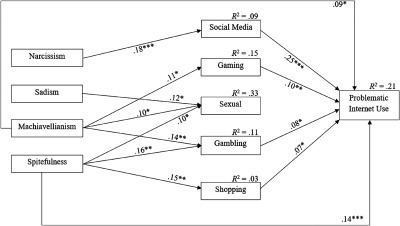
- Narcissism was related to social media use (β = 0.18, p < .001); Machiavellianism was associated with online gaming (β = 0.11, p < .05), online sex (β = 0.09, p < .05), and online gambling (β = 0.14, p < .01); sadism was associated with online sex (β = 0.12, p < .01); spitefulness was associated with online sex (β = 0.10, p < .05), online gambling (β = 0.16, p < .001), and online shopping (β = 0.15, p < .01). Psychopathy was not significantly associated with any specific online activity in the reported hierarchical regressions.
- In the mediation model, Machiavellianism was directly and indirectly associated with PIU through online gambling and online gaming (total β = 0.12, p < .05); narcissism was indirectly associated with PIU through social media use (β = 0.09, p < .05); spitefulness was directly and indirectly associated with PIU through online gambling and online shopping (β = 0.18, p < .001). The model explained 21% of the variance in PIU.
- H1 and H3 were partially supported, while findings were not in line with H2.
Methods
- Cross-sectional, paper-and-pencil self-report survey of 772 Turkish university students (64% female), aged 18–28 years (mean = 20.72, SD = 2.30).
- Measures included the Dark Triad Dirty Dozen Scale, Short Sadistic Impulse Scale, Spitefulness Scale, and an adapted version of the Bergen Facebook Addiction Scale (Bergen Internet Addiction Scale); a personal information form assessed online gambling, gaming, shopping, social media, and sex use.
- Analyses used hierarchical regression to predict specific online activities while controlling for gender and age, and a saturated multiple mediation model in AMOS with 5,000 bootstrapped samples and 95% bias-corrected confidence intervals.
Limitations
- The paper states that data came from self-report questionnaires in a self-selected sample, which are prone to well-known biases; the cross-sectional design prevents drawing causal relationships; and the sample was Turkish undergraduates from a single university, limiting generalizability.
- The paper also states that most effect sizes between variables were small and describes the study as preliminary.
- Evident from the text: psychopathy was included in the models but showed no significant associations in the reported regression or mediation results, and the mediation findings cannot establish temporal ordering beyond the authors’ cross-sectional design limitation.
Model-written summary. Check it against the paper before relying on it.
Integrity signals
Registry
Cites
Statistics
Figures
Verification
Claims the paper makes
40 Own result · 35 Not checked yet · 9 Own method · 4 Own interpretation · 2 No basis given
A result the paper reports from its own data — it cites no other source for it, so there is none to check. The quote shows it is in the paper.
In the paper
“online gambling (β = 0.16, p < .001)”
- Also stated in: § Results · plain
“spitefulness was associated with online sex, online gambling, and online shopping”
§ The dark side of internet: Preliminary evidence for the associations of dark personality traits with specific online activities and problematic internet use > Results
plaincorrelational- Asserted: passes — The authors put it forward as true.
- Checkable: passes — It can be checked against evidence.
- Load-bearing: passes — The paper’s conclusions depend on it.
- Based: passes — The paper gives a reason why it holds.
- Also stated in: § Results · plain
A result the paper reports from its own data — it cites no other source for it, so there is none to check. The quote shows it is in the paper.
In the paper
“Being male was positively associated with online gaming (β = 0.35, p < .001)”
- Also stated in: § Results · plain
“being male was positively associated with higher online gaming, online sex, and online gambling”
§ The dark side of internet: Preliminary evidence for the associations of dark personality traits with specific online activities and problematic internet use > Results
plaincorrelational- Asserted: passes — The authors put it forward as true.
- Checkable: passes — It can be checked against evidence.
- Load-bearing: unclear — It is unclear whether the paper’s conclusions depend on it.
- Based: passes — The paper gives a reason why it holds.
- Also stated in: § Results · plain
A result the paper reports from its own data — it cites no other source for it, so there is none to check. The quote shows it is in the paper.
In the paper
“Machiavellianism was associated with online gaming (β = 0.11, p < .05)”
- Also stated in: § Results · plain
“Machiavellianism was related to higher online gaming, online sex, and online gambling”
§ The dark side of internet: Preliminary evidence for the associations of dark personality traits with specific online activities and problematic internet use > Results
plaincorrelational- Asserted: passes — The authors put it forward as true.
- Checkable: passes — It can be checked against evidence.
- Load-bearing: passes — The paper’s conclusions depend on it.
- Based: passes — The paper gives a reason why it holds.
- Also stated in: § Results · plain
A result the paper reports from its own data — it cites no other source for it, so there is none to check. The quote shows it is in the paper.
In the paper
“Finally, spitefulness was directly and indirectly associated with PIU through online gambling and online shopping (β = 0.18, p < .001; 95% CI [0.10, 0.26]).”
§ The dark side of internet: Preliminary evidence for the associations of dark personality traits with specific online activities and problematic internet use > Results
plaincorrelational- Asserted: passes — The authors put it forward as true.
- Checkable: passes — It can be checked against evidence.
- Load-bearing: passes — The paper’s conclusions depend on it.
- Based: passes — The paper gives a reason why it holds.
A result the paper reports from its own data — it cites no other source for it, so there is none to check. The quote shows it is in the paper.
In the paper
“and online shopping (β = −0.13, p < .001)”
- Also stated in: § Results · plain
“negatively associated with social media and online shopping”
§ The dark side of internet: Preliminary evidence for the associations of dark personality traits with specific online activities and problematic internet use > Results
plaincorrelational- Asserted: passes — The authors put it forward as true.
- Checkable: passes — It can be checked against evidence.
- Load-bearing: unclear — It is unclear whether the paper’s conclusions depend on it.
- Based: passes — The paper gives a reason why it holds.
- Also stated in: § Results · plain
A result the paper reports from its own data — it cites no other source for it, so there is none to check. The quote shows it is in the paper.
In the paper
“Machiavellianism was directly and indirectly associated with PIU through online gambling and online gaming (β = 0.12, p < .05; 95% CI [0.02, 0.21]).”
§ The dark side of internet: Preliminary evidence for the associations of dark personality traits with specific online activities and problematic internet use > Results
plaincorrelational- Asserted: passes — The authors put it forward as true.
- Checkable: passes — It can be checked against evidence.
- Load-bearing: passes — The paper’s conclusions depend on it.
- Based: passes — The paper gives a reason why it holds.
A result the paper reports from its own data — it cites no other source for it, so there is none to check. The quote shows it is in the paper.
In the paper
“and online sex (β = 0.09, p < .05)”
- Also stated in: § Results · plain
“Machiavellianism was related to higher online gaming, online sex, and online gambling”
§ The dark side of internet: Preliminary evidence for the associations of dark personality traits with specific online activities and problematic internet use > Results
plaincorrelational- Asserted: passes — The authors put it forward as true.
- Checkable: passes — It can be checked against evidence.
- Load-bearing: passes — The paper’s conclusions depend on it.
- Based: passes — The paper gives a reason why it holds.
- Also stated in: § Results · plain
A result the paper reports from its own data — it cites no other source for it, so there is none to check. The quote shows it is in the paper.
In the paper
“Age was associated only with social media use (β = −0.16, p < .001).”
§ The dark side of internet: Preliminary evidence for the associations of dark personality traits with specific online activities and problematic internet use > Results
plaincorrelational- Asserted: passes — The authors put it forward as true.
- Checkable: passes — It can be checked against evidence.
- Load-bearing: unclear — It is unclear whether the paper’s conclusions depend on it.
- Based: passes — The paper gives a reason why it holds.
A result the paper reports from its own data — it cites no other source for it, so there is none to check. The quote shows it is in the paper.
In the paper
“Those high in spitefulness scored higher on online sex (β = 0.10, p < .05)”
- Also stated in: § Results · plain
“spitefulness was associated with online sex, online gambling, and online shopping”
§ The dark side of internet: Preliminary evidence for the associations of dark personality traits with specific online activities and problematic internet use > Results
plaincorrelational- Asserted: passes — The authors put it forward as true.
- Checkable: passes — It can be checked against evidence.
- Load-bearing: passes — The paper’s conclusions depend on it.
- Based: passes — The paper gives a reason why it holds.
- Also stated in: § Results · plain
A result the paper reports from its own data — it cites no other source for it, so there is none to check. The quote shows it is in the paper.
In the paper
“Finally, spitefulness was directly and indirectly associated with PIU through online gambling and online shopping”
- Also stated in: § Results · plain
“Machiavellianism and spitefulness were directly and indirectly associated with PIU via online gambling, online gaming, and online shopping”
§ The dark side of internet: Preliminary evidence for the associations of dark personality traits with specific online activities and problematic internet use > Results
plaincorrelational- Asserted: passes — The authors put it forward as true.
- Checkable: passes — It can be checked against evidence.
- Load-bearing: passes — The paper’s conclusions depend on it.
- Based: passes — The paper gives a reason why it holds.
- Also stated in: § Results · plain
- It may state two separate claims as one. 18
- The quote only partly states this claim. 1
- Not yet classified. 1
- Probably not a substantial claim. 15
A result the paper reports from its own data — it cites no other source for it, so there is none to check. The quote shows it is in the paper.
In the paper
“Narcissism → Problematic internet use (direct effect) | 0.05 (0.04) | 56”
§ The dark side of internet: Preliminary evidence for the associations of dark personality traits with specific online activities and problematic internet use > Results
plaindirect- Asserted: passes — The authors put it forward as true.
- Checkable: passes — It can be checked against evidence.
- Load-bearing: unclear — It is unclear whether the paper’s conclusions depend on it.
- Based: passes — The paper gives a reason why it holds.
It may state two separate claims as one.
A result the paper reports from its own data — it cites no other source for it, so there is none to check. The quote shows it is in the paper.
In the paper
“Machiavellianism → Problematic internet use (total indirect effect) | 0.03 (0.02) | 25”
§ The dark side of internet: Preliminary evidence for the associations of dark personality traits with specific online activities and problematic internet use > Results
plain- Asserted: passes — The authors put it forward as true.
- Checkable: passes — It can be checked against evidence.
- Load-bearing: unclear — It is unclear whether the paper’s conclusions depend on it.
- Based: passes — The paper gives a reason why it holds.
It may state two separate claims as one. The quote only partly states this claim.
In the paper
“The Turkish form of the scale previously reported high validity and reliability (Kircaburun, Jonason, & Griffiths, 2018b).”
§ The dark side of internet: Preliminary evidence for the associations of dark personality traits with specific online activities and problematic internet use > Methods > Measures
What the sources say
- Not checked yetcites Kircaburun, Jonason, & Griffiths, 2018b
Not yet classified.
What the paper did — it cites no source for this, so there is none to check. The quote shows it is in the paper.
In the paper
“The scale had good internal consistency in this study (α = .77).”
§ The dark side of internet: Preliminary evidence for the associations of dark personality traits with specific online activities and problematic internet use > Methods > Measures
plain- Asserted: passes — The authors put it forward as true.
- Checkable: passes — It can be checked against evidence.
- Load-bearing: fails — The paper’s conclusions may not depend on it.
- Based: passes — The paper gives a reason why it holds.
Probably not a substantial claim. The paper’s conclusions may not depend on it.
In the paper
“The Turkish form of the scale previously reported high validity and reliability (Özsoy, Rauthmann, Jonason, & Ardıç, 2017).”
§ The dark side of internet: Preliminary evidence for the associations of dark personality traits with specific online activities and problematic internet use > Methods > Measures
What the sources say
- Not checked yetcites Özsoy, Rauthmann, Jonason, & Ardıç, 2017
plain- Asserted: passes — The authors put it forward as true.
- Checkable: passes — It can be checked against evidence.
- Load-bearing: fails — The paper’s conclusions may not depend on it.
- Based: passes — The paper gives a reason why it holds.
Probably not a substantial claim. The paper’s conclusions may not depend on it.
In the paper
“A cross-sectional study reported a significant relationship between PIU and HEXACO personality dimensions of conscientiousness, honesty–humility, and emotionality (Kopuničová & Baumgartner, 2016).”
§ The dark side of internet: Preliminary evidence for the associations of dark personality traits with specific online activities and problematic internet use > Introduction
What the sources say
- Not checked yetcites Kopuničová & Baumgartner, 2016
plaincorrelational- Asserted: passes — The authors put it forward as true.
- Checkable: passes — It can be checked against evidence.
- Load-bearing: fails — The paper’s conclusions may not depend on it.
- Based: passes — The paper gives a reason why it holds.
Probably not a substantial claim. The paper’s conclusions may not depend on it.
In the paper
“PIU was associated with higher neuroticism, lower extraversion, lower conscientiousness, lower openness to experience, and lower agreeableness (Kayiş et al., 2016).”
§ The dark side of internet: Preliminary evidence for the associations of dark personality traits with specific online activities and problematic internet use > Introduction
What the sources say
- Not checked yetcites Kayiş et al., 2016
plaincorrelational- Asserted: passes — The authors put it forward as true.
- Checkable: passes — It can be checked against evidence.
- Load-bearing: fails — The paper’s conclusions may not depend on it.
- Based: passes — The paper gives a reason why it holds.
Probably not a substantial claim. The paper’s conclusions may not depend on it. It may state two separate claims as one.
In the paper
“Other studies have found higher PIU to be associated with novelty-seeking, fun-seeking, low self-concept, and negative emotion avoidance (Kuss et al., 2014).”
§ The dark side of internet: Preliminary evidence for the associations of dark personality traits with specific online activities and problematic internet use > Introduction
What the sources say
- Not checked yetcites Kuss et al., 2014
plaincorrelational- Asserted: passes — The authors put it forward as true.
- Checkable: passes — It can be checked against evidence.
- Load-bearing: fails — The paper’s conclusions may not depend on it.
- Based: passes — The paper gives a reason why it holds.
Probably not a substantial claim. The paper’s conclusions may not depend on it.
What the paper did — it cites no source for this, so there is none to check. The quote shows it is in the paper.
In the paper
“Before carrying out hierarchical multiple regression analysis, skewness, kurtosis, VIF, and tolerance values were examined to make sure that abnormal distribution and multicollinearity were not detected.”
§ The dark side of internet: Preliminary evidence for the associations of dark personality traits with specific online activities and problematic internet use > Results
plain- Asserted: passes — The authors put it forward as true.
- Checkable: passes — It can be checked against evidence.
- Load-bearing: passes — The paper’s conclusions depend on it.
- Based: passes — The paper gives a reason why it holds.
It may state two separate claims as one.
What the paper did — it cites no source for this, so there is none to check. The quote shows it is in the paper.
In the paper
“First, the research data were collected via self-report questionnaires in a self-selected sample that are prone to well-known biases and limitations.”
§ The dark side of internet: Preliminary evidence for the associations of dark personality traits with specific online activities and problematic internet use > Discussion
boosted- Asserted: passes — The authors put it forward as true.
- Checkable: passes — It can be checked against evidence.
- Load-bearing: fails — The paper’s conclusions may not depend on it.
- Based: passes — The paper gives a reason why it holds.
Probably not a substantial claim. The paper’s conclusions may not depend on it.
None of the sources cited for this claim have been checked yet.
In the paper
“Machiavellianism, which refers to being deceptive, manipulative, ambitious, and exploitative (Christie & Geis, 1970), has been associated with problematic social media use (Kircaburun, Demetrovics, et al., 2018), trolling in online games (Ladanyi & Doyle-Portillo, 2017), online self-monitoring, and self-promotion (Abell & Brewer, 2014).”
§ The dark side of internet: Preliminary evidence for the associations of dark personality traits with specific online activities and problematic internet use > Introduction > Dark personality traits and PIU
What the sources say
- Not checked yetcites Kircaburun, Demetrovics, et al., 2018
- Not checked yetcites Ladanyi & Doyle-Portillo, 2017
- Not checked yetcites Abell & Brewer, 2014
plaincorrelational- Asserted: passes — The authors put it forward as true.
- Checkable: passes — It can be checked against evidence.
- Load-bearing: passes — The paper’s conclusions depend on it.
- Based: passes — The paper gives a reason why it holds.
It may state two separate claims as one.
None of the sources cited for this claim have been checked yet.
In the paper
“Similar to Machiavellianism, psychopathy has also been associated with emotion dysregulation and lower positive mood (Egan et al., 2014; Zeigler-Hill & Vonk, 2015).”
§ The dark side of internet: Preliminary evidence for the associations of dark personality traits with specific online activities and problematic internet use > Introduction > Dark personality traits and PIU
What the sources say
- Not checked yetcites Egan et al., 2014
- Not checked yetcites Zeigler-Hill & Vonk, 2015
plaincorrelational- Asserted: passes — The authors put it forward as true.
- Checkable: passes — It can be checked against evidence.
- Load-bearing: unclear — It is unclear whether the paper’s conclusions depend on it.
- Based: passes — The paper gives a reason why it holds.
It may state two separate claims as one.
A conclusion the paper draws from its own results — it cites no other source for it, so there is none to check. The quote shows it is in the paper.
In the paper
“Machiavellianism was associated with online gaming and online gambling, and in turn, online gaming and online gambling led to higher PIU.”
§ The dark side of internet: Preliminary evidence for the associations of dark personality traits with specific online activities and problematic internet use > Discussion
plaindirect- Asserted: passes — The authors put it forward as true.
- Checkable: passes — It can be checked against evidence.
- Load-bearing: passes — The paper’s conclusions depend on it.
- Based: passes — The paper gives a reason why it holds.
It may state two separate claims as one.
In the paper
“According to the Interaction of Person-Affect-Cognition-Execution model (I-PACE), which is one of the theoretical frameworks proposed to explain underlying mechanisms of PIU (Brand, Young, Laier, Wölfling, & Potenza, 2016), personality, social cognitions, biopsychological constitution, and specific online use motives are among the core factors that are associated with the development and main”
§ The dark side of internet: Preliminary evidence for the associations of dark personality traits with specific online activities and problematic internet use > Introduction
What the sources say
- Not checked yetcites Brand, Young, Laier, Wölfling, & Potenza, 2016
plaincorrelational- Asserted: passes — The authors put it forward as true.
- Checkable: passes — It can be checked against evidence.
- Load-bearing: passes — The paper’s conclusions depend on it.
- Based: passes — The paper gives a reason why it holds.
Probably not a substantial claim.
What the paper did — it cites no source for this, so there is none to check. The quote shows it is in the paper.
In the paper
“Second, the cross-sectional design prevents the drawing of causal relationships.”
§ The dark side of internet: Preliminary evidence for the associations of dark personality traits with specific online activities and problematic internet use > Discussion
plain- Asserted: passes — The authors put it forward as true.
- Checkable: passes — It can be checked against evidence.
- Load-bearing: passes — The paper’s conclusions depend on it.
- Based: passes — The paper gives a reason why it holds.
Probably not a substantial claim.
None of the sources cited for this claim have been checked yet.
In the paper
“However, these differences also support the notion that (despite their overlap to some extent) specific types of problematic online use (e.g., gaming and social media) and PIU are conceptually different behaviors and separate nosological entities that may have different personality predictors (Brand et al., 2016; Király et al., 2014; Montag et al., 2015).”
§ The dark side of internet: Preliminary evidence for the associations of dark personality traits with specific online activities and problematic internet use > Discussion
What the sources say
- Not checked yetcites Brand et al., 2016
- Not checked yetcites Király et al., 2014
- Not checked yetcites Montag et al., 2015
hedged- Asserted: passes — The authors put it forward as true.
- Checkable: passes — It can be checked against evidence.
- Load-bearing: passes — The paper’s conclusions depend on it.
- Based: passes — The paper gives a reason why it holds.
It may state two separate claims as one.
None of the sources cited for this claim have been checked yet.
In the paper
“Dark personality traits have been associated with antisocial online behaviors including odd status updates, cyberbullying, and online trolling, as well as fulfilling various psychological needs using different platforms (Craker & March, 2016; Garcia & Sikström, 2014; Panek, Nardis, & Konrath, 2013).”
§ The dark side of internet: Preliminary evidence for the associations of dark personality traits with specific online activities and problematic internet use > Introduction
What the sources say
- Not checked yetcites Craker & March, 2016
- Not checked yetcites Garcia & Sikström, 2014
- Not checked yetcites Panek, Nardis, & Konrath, 2013
plaincorrelational- Asserted: passes — The authors put it forward as true.
- Checkable: passes — It can be checked against evidence.
- Load-bearing: passes — The paper’s conclusions depend on it.
- Based: passes — The paper gives a reason why it holds.
It may state two separate claims as one.
None of the sources cited for this claim have been checked yet.
In the paper
“The internet is a medium that facilitates use of different behaviors and activities, such as using social media, gaming, gambling, shopping, and sex (Griffiths, 2000; Montag et al., 2015).”
§ The dark side of internet: Preliminary evidence for the associations of dark personality traits with specific online activities and problematic internet use > Introduction > The role of specific online activities
What the sources say
- Not checked yetcites Griffiths, 2000
- Not checked yetcites Montag et al., 2015
plaindirect- Asserted: passes — The authors put it forward as true.
- Checkable: passes — It can be checked against evidence.
- Load-bearing: fails — The paper’s conclusions may not depend on it.
- Based: passes — The paper gives a reason why it holds.
Probably not a substantial claim. The paper’s conclusions may not depend on it.
None of the sources cited for this claim have been checked yet.
In the paper
“Some empirical evidence appears to support this assumption via reporting significant relationships of online gaming, gambling, and pornography viewing with PIU (Alexandraki, Stavropoulos, Burleigh, King, & Griffiths, 2018; Critselis et al., 2013; Stavropoulos, Kuss, Griffiths, Wilson, & Motti-Stefanidi, 2017).”
§ The dark side of internet: Preliminary evidence for the associations of dark personality traits with specific online activities and problematic internet use > Introduction > The role of specific online activities
What the sources say
- Not checked yetcites Alexandraki, Stavropoulos, Burleigh, King, & Griffiths, 2018
- Not checked yetcites Critselis et al., 2013
- Not checked yetcites Stavropoulos, Kuss, Griffiths, Wilson, & Motti-Stefanidi, 2017
hedgedcorrelational- Asserted: passes — The authors put it forward as true.
- Checkable: passes — It can be checked against evidence.
- Load-bearing: passes — The paper’s conclusions depend on it.
- Based: passes — The paper gives a reason why it holds.
It may state two separate claims as one.
What the paper did — it cites no source for this, so there is none to check. The quote shows it is in the paper.
In the paper
“Third, the study sample comprised Turkish undergraduates from a single university; therefore, generalizability of the results is limited.”
§ The dark side of internet: Preliminary evidence for the associations of dark personality traits with specific online activities and problematic internet use > Discussion
plain- Asserted: passes — The authors put it forward as true.
- Checkable: passes — It can be checked against evidence.
- Load-bearing: unclear — It is unclear whether the paper’s conclusions depend on it.
- Based: passes — The paper gives a reason why it holds.
It may state two separate claims as one.
None of the sources cited for this claim have been checked yet.
In the paper
“Narcissism, which refers to a grandiose sense of self-importance, superiority, dominance, and entitlement (Corry, Merritt, Mrug, & Pamp, 2008), has been associated with a higher involvement in problematic social media use (Andreassen, Pallesen, & Griffiths, 2017; Kircaburun, Demetrovics, et al., 2018), problematic online game use (Kim, Namkoong, Ku, & Kim, 2008), and PIU (Pantic et al., 2017).”
§ The dark side of internet: Preliminary evidence for the associations of dark personality traits with specific online activities and problematic internet use > Introduction > Dark personality traits and PIU
What the sources say
- Not checked yetcites Andreassen, Pallesen, & Griffiths, 2017
- Not checked yetcites Kircaburun, Demetrovics, et al., 2018
- Not checked yetcites Kim, Namkoong, Ku, & Kim, 2008
plaincorrelational- Asserted: passes — The authors put it forward as true.
- Checkable: passes — It can be checked against evidence.
- Load-bearing: passes — The paper’s conclusions depend on it.
- Based: passes — The paper gives a reason why it holds.
It may state two separate claims as one.
In the paper
“However, in addition to online gaming, online social media use has also been found to predict higher PIU, while problematic gaming was only associated with online gaming (Király et al., 2014).”
§ The dark side of internet: Preliminary evidence for the associations of dark personality traits with specific online activities and problematic internet use > Introduction > The role of specific online activities
What the sources say
- Not checked yetcites Király et al., 2014
plaindirect- Asserted: passes — The authors put it forward as true.
- Checkable: passes — It can be checked against evidence.
- Load-bearing: passes — The paper’s conclusions depend on it.
- Based: passes — The paper gives a reason why it holds.
It may state two separate claims as one.
In the paper
“Moreover, a recent study found and argued that Machiavellianism and narcissism were positively associated with problematic social media use, which may be about fulfilling antisocial needs of individuals high on these traits (Kircaburun, Demetrovics, & Tosuntaş, 2018).”
§ The dark side of internet: Preliminary evidence for the associations of dark personality traits with specific online activities and problematic internet use > Introduction
What the sources say
- Not checked yetcites Kircaburun, Demetrovics, & Tosuntaş, 2018
plaincorrelational- Asserted: passes — The authors put it forward as true.
- Checkable: passes — It can be checked against evidence.
- Load-bearing: fails — The paper’s conclusions may not depend on it.
- Based: passes — The paper gives a reason why it holds.
Probably not a substantial claim. The paper’s conclusions may not depend on it.
In the paper
“Therefore, it is possible that individuals’ offline behaviors can migrate into online ones in an attempt to compensate unmet offline needs (Kardefelt-Winther, 2014), such as gaming, gambling, sex, shopping, and communication.”
§ The dark side of internet: Preliminary evidence for the associations of dark personality traits with specific online activities and problematic internet use > Introduction > The role of specific online activities
What the sources say
- Not checked yetcites Kardefelt-Winther, 2014
hedgedconditional- Asserted: passes — The authors put it forward as true.
- Checkable: passes — It can be checked against evidence.
- Load-bearing: fails — The paper’s conclusions may not depend on it.
- Based: passes — The paper gives a reason why it holds.
Probably not a substantial claim. The paper’s conclusions may not depend on it.
In the paper
“For instance, while this study reported a direct relationship between Machiavellianism and PIU, Machiavellianism was a direct predictor of problematic social media use among university students in a previous study (Kircaburun, Demetrovics, et al., 2018), and it was irrelevant in another study examining problematic online gaming (Kircaburun et al., 2018b).”
§ The dark side of internet: Preliminary evidence for the associations of dark personality traits with specific online activities and problematic internet use > Discussion
What the sources say
- Not checked yetcites Kircaburun et al., 2018b
plain- Asserted: passes — The authors put it forward as true.
- Checkable: passes — It can be checked against evidence.
- Load-bearing: fails — The paper’s conclusions may not depend on it.
- Based: passes — The paper gives a reason why it holds.
Probably not a substantial claim. The paper’s conclusions may not depend on it.
In the paper
“Given that individuals high in Machiavellianism have been shown to have competitive feelings and do not comply with moral and ethical behavior in achieving their goals (Clempner, 2017), they may have engaged in grief play to overcome other players and these attempts and efforts may turn into longer times spent gaming online.”
§ The dark side of internet: Preliminary evidence for the associations of dark personality traits with specific online activities and problematic internet use > Discussion
What the sources say
- Not checked yetcites Clempner, 2017
boostedcorrelational- Asserted: passes — The authors put it forward as true.
- Checkable: passes — It can be checked against evidence.
- Load-bearing: passes — The paper’s conclusions depend on it.
- Based: passes — The paper gives a reason why it holds.
It may state two separate claims as one.
In the paper
“Spiteful behaviors are motivated by envious and entitlement emotions (Marcus et al., 2014) and individuals high in spitefulness have higher levels of vulnerable narcissism and lower self-esteem (Marcus et al., 2014), which have been associated with higher pathological online use (Andreassen et al., 2017; Casale, Fioravanti, & Rugai, 2016).”
§ The dark side of internet: Preliminary evidence for the associations of dark personality traits with specific online activities and problematic internet use > Discussion
What the sources say
- Not checked yetcites Marcus et al., 2014
plaincorrelational- Asserted: passes — The authors put it forward as true.
- Checkable: passes — It can be checked against evidence.
- Load-bearing: unclear — It is unclear whether the paper’s conclusions depend on it.
- Based: passes — The paper gives a reason why it holds.
It may state two separate claims as one.
None of the sources cited for this claim have been checked yet.
In the paper
“Similar to Machiavellianism, spitefulness has been associated with higher emotion dysregulation (Zeigler-Hill & Vonk, 2015), detachment, and disinhibition (Zeigler-Hill & Noser, 2018) – associations that may result in fulfilling social needs with online gratifications (Gervasi et al., 2017; Niemz, Griffiths, & Banyard, 2005).”
§ The dark side of internet: Preliminary evidence for the associations of dark personality traits with specific online activities and problematic internet use > Discussion
What the sources say
- Not checked yetcites Zeigler-Hill & Vonk, 2015
- Not checked yetcites Zeigler-Hill & Noser, 2018
plaincorrelational- Asserted: passes — The authors put it forward as true.
- Checkable: passes — It can be checked against evidence.
- Load-bearing: unclear — It is unclear whether the paper’s conclusions depend on it.
- Based: passes — The paper gives a reason why it holds.
It may state two separate claims as one.
None of the sources cited for this claim have been checked yet.
In the paper
“Spiteful behaviors are motivated by envious and entitlement emotions (Marcus et al., 2014) and individuals high in spitefulness have higher levels of vulnerable narcissism and lower self-esteem (Marcus et al., 2014), which have been associated with higher pathological online use (Andreassen et al., 2017; Casale, Fioravanti, & Rugai, 2016).”
§ The dark side of internet: Preliminary evidence for the associations of dark personality traits with specific online activities and problematic internet use > Discussion
What the sources say
- Not checked yetcites Andreassen et al., 2017
- Not checked yetcites Casale, Fioravanti, & Rugai, 2016
plaincorrelational- Asserted: passes — The authors put it forward as true.
- Checkable: passes — It can be checked against evidence.
- Load-bearing: unclear — It is unclear whether the paper’s conclusions depend on it.
- Based: passes — The paper gives a reason why it holds.
It may state two separate claims as one.
In the paper
“For instance, while this study reported a direct relationship between Machiavellianism and PIU, Machiavellianism was a direct predictor of problematic social media use among university students in a previous study (Kircaburun, Demetrovics, et al., 2018), and it was irrelevant in another study examining problematic online gaming (Kircaburun et al., 2018b).”
§ The dark side of internet: Preliminary evidence for the associations of dark personality traits with specific online activities and problematic internet use > Discussion
What the sources say
- Not checked yetcites Kircaburun, Demetrovics, et al., 2018
plaindirect- Asserted: passes — The authors put it forward as true.
- Checkable: passes — It can be checked against evidence.
- Load-bearing: fails — The paper’s conclusions may not depend on it.
- Based: passes — The paper gives a reason why it holds.
Probably not a substantial claim. The paper’s conclusions may not depend on it.
In the paper
“Online gaming and online gambling are two of the most popular specific activities for using the internet and can easily transform into problematic online engagement for some users (Brand et al., 2016).”
§ The dark side of internet: Preliminary evidence for the associations of dark personality traits with specific online activities and problematic internet use > Discussion
What the sources say
- Not checked yetcites Brand et al., 2016
plainconditional- Asserted: passes — The authors put it forward as true.
- Checkable: passes — It can be checked against evidence.
- Load-bearing: fails — The paper’s conclusions may not depend on it.
- Based: passes — The paper gives a reason why it holds.
Probably not a substantial claim. The paper’s conclusions may not depend on it. It may state two separate claims as one.
In the paper
“Previous studies have associated Machiavellianism with grief play (i.e., trolling in online games), which may present an explanation for this relationship (Ladanyi & Doyle-Portillo, 2017).”
§ The dark side of internet: Preliminary evidence for the associations of dark personality traits with specific online activities and problematic internet use > Discussion
What the sources say
- Not checked yetcites Ladanyi & Doyle-Portillo, 2017
plaincorrelational- Asserted: passes — The authors put it forward as true.
- Checkable: passes — It can be checked against evidence.
- Load-bearing: fails — The paper’s conclusions may not depend on it.
- Based: passes — The paper gives a reason why it holds.
Probably not a substantial claim. The paper’s conclusions may not depend on it.
The authors state this as an assumption.
Engaging in online activities relates to higher problematic internet use and accounts for the relationships between dark personality traits and problematic internet use.
“Therefore, it may be that engaging in these aforementioned online activities relate to higher PIU and account for the relationships between dark personality traits and PIU. Some empirical evidence appears to support this assumption”
The paper relies on this without support.
No study has ever considered five different traits (the Dark Triad plus sadism and spitefulness) with uses of different online activities and problematic internet use simultaneously.
“However, no study has ever considered five different traits (i.e., the Dark Triad in addition to sadism and spitefulness) with uses of different online activities and PIU simultaneously.”
The paper relies on this without support.
The relationship between dark personality traits and problematic internet use has yet to be investigated.
“However, the relationship between dark personality traits (i.e., Machiavellianism, psychopathy, narcissism, sadism, and spitefulness) and PIU has yet to be investigated.”
The authors state this as an assumption.
This study is the first to investigate the direct and indirect associations of dark personality traits with problematic Internet use through specific online activities.
“To the best of authors’ knowledge, this is the first study to investigate the direct and indirect associations of dark personality traits (i.e., Machiavellianism, psychopathy, narcissism, sadism, and spitefulness) with PIU through specific online activities (i.e., social media, online gaming, online gambling, online shopping, and online sex).”
“Despite the limitations, this is the first study to examine the relationships between dark personality traits, specific online activities, and PIU.”
Claims other papers make about this one
Each is checked against this paper’s own text: does it say what the citing paper says it does?
The source backs part of the claim, not all of it — or backs it for a different population, condition or comparison.
In the citing paper
“They also tend to engage in antisocial online behaviors such as cyberbullying, trolling, cyberstalking intimate partners, and playing violent games [9,20,32].”
From Dark Personality Traits and Online Behaviors: Portuguese Versions of Cyberstalking, Online Harassment, Flaming and Trolling Scales (2023) · cites this paper as [32]
Experimental — accuracy not yet measuredThe source backs part of the claim, not all of it — or backs it for a different population, condition or comparison.
In the citing paper
“Several researches reveal that dark triad’s personality traits seem to be positively associated with the problematic addition to the Internet [32] and with online antisocial behaviors, particularly cyberstalking [9,16], online trolling [10,33,34] and cyberbullying [35].”
From Dark Personality Traits and Online Behaviors: Portuguese Versions of Cyberstalking, Online Harassment, Flaming and Trolling Scales (2023) · cites this paper as [32]
Experimental — accuracy not yet measuredThe source backs part of the claim, not all of it — or backs it for a different population, condition or comparison.
In the citing paper
“Psychopathy has been associated with cyberbullying, trolling, intimate partner cyberbullying, and violent gaming [9,20,32].”
From Dark Personality Traits and Online Behaviors: Portuguese Versions of Cyberstalking, Online Harassment, Flaming and Trolling Scales (2023) · cites this paper as [32]
Experimental — accuracy not yet measuredThe cited source says what the claim attributes to it.
In the citing paper
“Narcissism is associated with a great involvement with problematic use of the Internet and social networks [20,32,38,39].”
From Dark Personality Traits and Online Behaviors: Portuguese Versions of Cyberstalking, Online Harassment, Flaming and Trolling Scales (2023) · cites this paper as [32]
The cited source says what the claim attributes to it.
In the citing paper
“Machiavellianism has been associated with problematic use of social media, trolling in online games, and online self-promotion.”
From Dark Personality Traits and Online Behaviors: Portuguese Versions of Cyberstalking, Online Harassment, Flaming and Trolling Scales (2023) · cites this paper as [32]
The cited source says what the claim attributes to it.
In the citing paper
“In turn, psychopathy is associated with emotional dysregulation and a low level of positive mood.”
From Dark Personality Traits and Online Behaviors: Portuguese Versions of Cyberstalking, Online Harassment, Flaming and Trolling Scales (2023) · cites this paper as [32]
The cited source says what the claim attributes to it.
In the citing paper
“For its part, narcissism is associated with online self-promotion behaviors and trying to be more popular, which can cause problematic Internet use [20,32,38,39]; this coincides with our results.”
From Dark Personality Traits and Online Behaviors: Portuguese Versions of Cyberstalking, Online Harassment, Flaming and Trolling Scales (2023) · cites this paper as [32]
The cited source says what the claim attributes to it.
In the citing paper
“These associations reinforce the behavioral characteristics of these individuals and how they may behave on the Internet, allowing us to suggest that dimensions of the dark triad of personality explain online behaviors [4,9,10,16,20,32,34,35,38,39,63].”
From Dark Personality Traits and Online Behaviors: Portuguese Versions of Cyberstalking, Online Harassment, Flaming and Trolling Scales (2023) · cites this paper as [32]
Self-check
Percentages, sums and reported differences re-computed from the paper’s own numbers.
Each contradiction between two passages listed here was confirmed by an independent check.
Rated minor: it would not touch a result — a value no result rests on, a p-value that stays on the same side of the significance level, or a conflict that is clerical, resolved elsewhere in the paper, or outside its own findings.
In the paper
§ The dark side of internet: Preliminary evidence for the associations of dark personality traits with specific online activities and problematic internet use > Results
“| M | 16.67 | 4.23 | 2.29 | 1.52 | 1.56 | 2.74 | 9.43 | 9.83 | 16.25 | 11.29 | 16.60 | 20.72 | | SD | 5.34 | 1.01 | 1.27 | 0.90 | 0.99 | 1.11 | 6.15 | 5.75 | 9.06 | 1.82 | 6.66 | 2.30 | | Skewness | 0.17 | 1.80 | 0.69 | 0.20 | −1.45 | 1.75 | 1.55 | 1.52 | 0.31 | 2.17 | 1.82 | 1.38 |”
§ The dark side of internet: Preliminary evidence for the associations of dark personality traits with specific online activities and problematic internet use > Methods > Measures
“Participants used a 5-point Likert scale from “never” to “always” in order to indicate their online use of gambling”
Citations
Cites
Tabachnick, B. G., & Fidell, L. S. (1983) · Cited by 79,882
(1998) · Cited by 36,049
Diagnostic and Statistical Manual of Mental Disorders, 5th ed.
Carter, M. J. (2014) · Therapeutic Recreation Journal · Cited by 15,154
Structural Equation Modeling: Concepts, Issues, and Applications.
Smith, M. D., & Hoyle, R. H. (1996) · Journal of the Royal Statistical Society Series D (The Statistician) · doi:10.2307/2988418 · Cited by 6,875
(2011) · Cited by 5,290
The dark triad of personality: Narcissism, Machiavellianism, and psychopathy
Paulhus, D. L., & Williams, K. M. (2002) · Journal of Research in Personality · doi:10.1016/s0092-6566(02)00505-6 · Cited by 5,265 · cited 1×
“The Dark Triad is the constellation of three overlapping undesirable and antisocial personality constructs: Machia-vellianism, psychopathy, and narcissism (Paulhus & Williams, 2002).”
BackgroundA “components” model of addiction within a biopsychosocial framework
Griffiths, M. (2005) · Journal of Substance Use · doi:10.1080/14659890500114359 · Cited by 3,088
Self-citationChristie, R., & Geis, F. L. (1970) · Elsevier eBooks · doi:10.1016/c2013-0-10497-7 · Cited by 2,943
Kardefelt-Winther, D. (2014) · Computers in Human Behavior · doi:10.1016/j.chb.2013.10.059 · Cited by 2,519
Brand, M., Young, K. S., Laier, C., Wölfling, K., & Potenza, M. N. (2016) · Neuroscience & Biobehavioral Reviews · doi:10.1016/j.neubiorev.2016.08.033 · Cited by 2,416 · cited 4×
“…their overlap to some extent) specific types of problematic online use (e.g., gaming and social media) and PIU are conceptually different behaviors and separate nosological entities that may have different personality predictors (Brand et al., 2016; Király et al., 2014; Montag et al., 2015).”
BackgroundMethodInfluential
Research works printed but not linked: 80
- James, 2014, The Dark Triad, schadenfreude, and sensational interests: Dark personalities, dark emotions, and dark behaviors, Personality and Individual Differences,, 68,, 211, 10.1016/j.paid.2014.04.020 · DOI
- Gaskin, 2016, Gaskination’s statistics
- Griffiths, 2000, Internet addiction – Time to be taken seriously?, Addiction Research,, 8, 413, 10.3109/16066350009005587 · DOI · Paper page
- Stavropoulos, 2017, MMORPG gaming and hostility predict Internet addiction symptoms in adolescents: An empirical multilevel longitudinal study, Addictive Behaviors,, 64,, 294, 10.1016/j.addbeh.2015.09.001 · DOI
- Kayiş, 2016, Big Five-personality trait and Internet addiction: A meta-analytic review, Computers in Human Behavior,, 63,, 35, 10.1016/j.chb.2016.05.012 · DOI · Paper page
- Kopuničová, 2016, Personality, depression and problematic Internet use, Psychology and its Contexts,, 7, 81
- Gaskin, 2016, Gaskination’s statistics
- Griffiths, 2005, A ‘components’ model of addiction within a biopsychosocial framework, Journal of Substance Use,, 10, 191, 10.1080/14659890500114359 · DOI · Paper page
- Vitacco, 2001, Predictors of adolescent psychopathy: The role of impulsivity, hyperactivity, and sensation seeking, Journal of the American Academy of Psychiatry and the Law,, 29, 374
- Greitemeyer, 2017, The longitudinal relationship between everyday sadism and the amount of violent video game play, Personality and Individual Differences,, 104,, 238, 10.1016/j.paid.2016.08.021 · DOI
- van Geel, 2017, Which personality traits are related to traditional bullying and cyberbullying? A study with the Big Five, Dark Triad and sadism, Personality and Individual Differences,, 106,, 231, 10.1016/j.paid.2016.10.063 · DOI
- Kırcaburun, 2018, Problematic online behaviors among adolescents and emerging adults: Associations between cyberbullying perpetration, problematic social media use, and psychosocial factors, International Journal of Mental Health and Addiction
- Jonason, 2013, The emotional deficits associated with the Dark Triad traits: Cognitive empathy, affective empathy, and alexithymia, Personality and Individual Differences,, 55, 532, 10.1016/j.paid.2013.04.027 · DOI · Paper page
- Dalbudak, 2014, The severity of Internet addiction risk and its relationship with the severity of borderline personality features, childhood traumas, dissociative experiences, depression and anxiety symptoms among Turkish university students, Psychiatry Research,, 219, 577, 10.1016/j.psychres.2014.02.032 · DOI · Paper page
- Tosuntaş, 2018, A new phenomenon among emerging adults: Sofalizing and its relationship with social media addiction and psychosocial risk factors
- George, 2010, SPSS for windows step by step: A simple guide and reference, 17.0 update
- Mann, 2017, Behavioural addictions: Classification and consequences, European Psychiatry,, 44,, 187, 10.1016/j.eurpsy.2017.04.008 · DOI
- Jonason, 2010, The dirty dozen: A concise measure of the Dark Triad, Psychological Assessment,, 22, 420, 10.1037/a0019265 · DOI · Paper page
- Gervasi, 2017, Maladaptive personality traits and Internet addiction symptoms among young adults: A study based on the alternative DSM-5 model for personality disorders, Clinical Neuropsychiatry,, 14, 20
- Christie, 1970, Studies in Machiavellianism
- Tabachnick, 2001, Using multivariate statistics
- Buckels, 2014, Trolls just want to have fun, Personality and Individual Differences,, 67,, 97, 10.1016/j.paid.2014.01.016 · DOI · Paper page
- Casale, 2016, Grandiose and vulnerable narcissists: Who is at higher risk for social networking addiction?, Cyberpsychology, Behavior, and Social Networking,, 19, 510, 10.1089/cyber.2016.0189 · DOI
- Marcus, 2014, The psychology of spite and the measurement of spitefulness, Psychological Assessment,, 26, 563, 10.1037/a0036039 · DOI
- Alexandraki, 2018, Internet pornography viewing preference as a risk factor for adolescent Internet addiction: The moderating role of classroom personality factors, Journal of Behavioral Addictions,, 7, 423, 10.1556/2006.7.2018.34 · DOI
- Shim, 2007, Who responds to unsolicited sexually explicit materials on the Internet? The role of individual differences, CyberPsychology & Behavior,, 10, 71, 10.1089/cpb.2006.9990 · DOI
- Zeigler-Hill, 2018, Characterizing spitefulness in terms of the DSM-5 model of pathological personality traits, Current Psychology,, 37, 14, 10.1007/s12144-016-9484-5 · DOI
- Kardefelt-Winther, 2014, A conceptual and methodological critique of Internet addiction research: Towards a model of compensatory Internet use, Computers in Human Behavior,, 31,, 351, 10.1016/j.chb.2013.10.059 · DOI · Paper page
- O’Meara, 2011, The psychometric properties and utility of the Short Sadistic Impulse Scale (SSIS), Psychological Assessment,, 23,, 523, 10.1037/a0022400 · DOI
- Kircaburun, 2018b, The Dark Tetrad traits and problematic online gaming: The mediating role of online gaming motives and moderating role of game types, Personality and Individual Differences,, 135,, 298, 10.1016/j.paid.2018.07.038 · DOI
- Tran, 2018, “I’ll teach you differences”: Taxometric analysis of the Dark Triad, trait sadism, and the Dark Core of personality, Personality and Individual Differences,, 126,, 19, 10.1016/j.paid.2018.01.015 · DOI
- Arpaci, 2018, The moderating effect of gender in the relationship between narcissism and selfie-posting behavior, Personality and Individual Differences,, 134,, 71, 10.1016/j.paid.2018.06.006 · DOI · Paper page
- Birkás, 2015, Nothing ventured nothing gained: Strong associations between reward sensitivity and two measures of Machiavellianism, Personality and Individual Differences,, 74,, 112, 10.1016/j.paid.2014.09.046 · DOI
- Smoker, 2017, Predicting perpetration of intimate partner cyberstalking: Gender and the Dark Tetrad, Computers in Human Behavior,, 72,, 390, 10.1016/j.chb.2017.03.012 · DOI · Paper page
- Garcia, 2014, The dark side of Facebook: Semantic representations of status updates predict the Dark Triad of personality, Personality and Individual Differences,, 67,, 92, 10.1016/j.paid.2013.10.001 · DOI · Paper page
- Zeigler-Hill, 2015, Spitefulness and moral values, Personality and Individual Differences,, 77,, 86, 10.1016/j.paid.2014.12.050 · DOI
- Ostovar, 2016, Internet addiction and its psychosocial risks (depression, anxiety, stress and loneliness) among Iranian adolescents and young adults: A structural equation model in a cross-sectional study, International Journal of Mental Health and Addiction,, 14, 257, 10.1007/s11469-015-9628-0 · DOI
- West, 1995, Structural equation models with nonnormal variables: Problems and remedies, 56
- Richardson, 2016, Offensive defenses: The mind beneath the mask of the Dark Triad traits, Personality and Individual Differences,, 92,, 148, 10.1016/j.paid.2015.12.039 · DOI
- Kircaburun, 2018a, The Dark Tetrad traits and problematic social media use: The mediating role of cyberbullying and cybertrolling, Personality and Individual Differences,, 135,, 264, 10.1016/j.paid.2018.07.034 · DOI
- Andreassen, 2012, Development of a Facebook Addiction Scale, Psychological Reports,, 110, 501, 10.2466/02.09.18.pr0.110.2.501-517 · DOI · Paper page
- Austin, 2007, Emotional intelligence, Machiavellianism and emotional manipulation: Does EI have a dark side?, Personality and Individual Differences,, 43, 179, 10.1016/j.paid.2006.11.019 · DOI · Paper page
- Abell, 2014, Machiavellianism, self-monitoring, self-promotion and relational aggression on Facebook, Computers in Human Behavior,, 36,, 258, 10.1016/j.chb.2014.03.076 · DOI · Paper page
- Lin, 2002, Sensation seeking and Internet dependence of Taiwanese high school adolescents, Computers in Human Behavior,, 18, 411, 10.1016/s0747-5632(01)00056-5 · DOI
- Anderson, 2017, Internet use and problematic Internet use: A systematic review of longitudinal research trends in adolescence and emergent adulthood, International Journal of Adolescence and Youth,, 22, 430, 10.1080/02673843.2016.1227716 · DOI · Paper page
- Panek, 2013, Mirror or megaphone?: How relationships between narcissism and social networking site use differ on Facebook and Twitter, Computers in Human Behavior,, 29, 2004, 10.1016/j.chb.2013.04.012 · DOI
- Ladanyi, 2017, The development and validation of the Grief Play Scale (GPS) in MMORPGs, Personality and Individual Differences,, 114,, 125, 10.1016/j.paid.2017.03.062 · DOI
- Baughman, 2014, Four shades of sexual fantasies linked to the Dark Triad, Personality and Individual Differences,, 67,, 47, 10.1016/j.paid.2014.01.034 · DOI
- Vrabel, 2017, Spitefulness and humor styles, Personality and Individual Differences,, 105,, 238, 10.1016/j.paid.2016.10.001 · DOI
- Jonason, 2013, Different routes to limited empathy in the sexes: Examining the links between the Dark Triad and empathy, Personality and Individual Differences,, 54, 572, 10.1016/j.paid.2012.11.009 · DOI
- Andreassen, 2017, The relationship between addictive use of social media, narcissism, and self-esteem: Findings from a large national survey, Addictive Behaviors,, 64,, 287, 10.1016/j.addbeh.2016.03.006 · DOI · Paper page
- Craker, 2016, The dark side of Facebook®: The Dark Tetrad, negative social potency, and trolling behaviours, Personality and Individual Differences,, 102,, 79, 10.1016/j.paid.2016.06.043 · DOI
- Lu, 2017, Relationship between borderline personality symptoms and Internet addiction: The mediating effects of mental health problems, Journal of Behavioral Addictions,, 6, 434, 10.1556/2006.6.2017.053 · DOI
- Brand, 2016, Integrating psychological and neurobiological considerations regarding the development and maintenance of specific Internet-use disorders: An Interaction of Person-Affect-Cognition-Execution (I-PACE) model, Neuroscience and Biobehavioral Reviews,, 71,, 252, 10.1016/j.neubiorev.2016.08.033 · DOI · Paper page
- Jonason, 2017, Good v. evil: Predicting sinning with dark personality traits and moral foundations, Personality and Individual Differences,, 104,, 180, 10.1016/j.paid.2016.08.002 · DOI
- Király, 2014, Problematic Internet use and problematic online gaming are not the same: Findings from a large nationally representative adolescent sample, Cyberpsychology, Behavior, and Social Networking,, 17, 749, 10.1089/cyber.2014.0475 · DOI · Paper page
- Paulhus, 2002, The Dark Triad of personality: Narcissism, Machiavellianism, and psychopathy, Journal of Research in Personality,, 36, 556, 10.1016/s0092-6566(02)00505-6 · DOI · Paper page
- Jones, 2013, The core of darkness: Uncovering the heart of the Dark Triad, European Journal of Personality,, 27, 521, 10.1002/per.1893 · DOI
- Pantic, 2017, Association between physiological oscillations in self-esteem, narcissism and Internet addiction: A cross-sectional study, Psychiatry Research,, 258,, 239, 10.1016/j.psychres.2017.08.044 · DOI · Paper page
- Kuss, 2014, Internet addiction: A systematic review of epidemiological research for the last decade, Current Pharmaceutical Design,, 20, 4026, 10.2174/13816128113199990617 · DOI · Paper page
- Tosuntaş, 2018, A new phenomenon among emerging adults: Sofalizing and its relationship with social media addiction and psychosocial risk factors
- Kircaburun, 2018, Analyzing the links between problematic social media use, Dark Triad traits, and self-esteem, International Journal of Mental Health and Addiction
- Niemz, 2005, Prevalence of pathological Internet use among university students and correlations with self-esteem, the General Health Questionnaire (GHQ), and disinhibition, CyberPsychology & Behavior,, 8, 562, 10.1089/cpb.2005.8.562 · DOI
- Corry, 2008, The factor structure of the Narcissistic Personality Inventory, Journal of Personality Assessment,, 90, 593, 10.1080/00223890802388590 · DOI
- Kline, 2011, Principles and practices of structural equation modeling
- Spada, 2014, An overview of problematic Internet use, Addictive Behaviors,, 39, 3, 10.1016/j.addbeh.2013.09.007 · DOI
- Fox, 2015, The Dark Triad and trait self-objectification as predictors of men’s use and self-presentation behaviors on social networking sites, Personality and Individual Differences,, 76,, 161, 10.1016/j.paid.2014.12.017 · DOI · Paper page
- Douglas, 2012, Distinguishing the Dark Triad: Evidence from the five-factor model and the Hogan development survey, Psychology,, 3, 237, 10.4236/psych.2012.33033 · DOI
- Kim, 2008, The relationship between online game addiction and aggression, self-control and narcissistic personality traits, European Psychiatry,, 23, 212, 10.1016/j.eurpsy.2007.10.010 · DOI
- Kircaburun, 2018, Uses and gratifications of problematic social media use among university students: A simultaneous examination of the Big Five of personality traits, social media platforms, and social media use motives, International Journal of Mental Health and Addiction
- Clempner, 2017, A game theory model for manipulation based on Machiavellianism: Moral and ethical behavior, Journal of Artificial Societies & Social Simulation,, 20, 1, 10.18564/jasss.3301 · DOI
- Rauthmann, 2011, Acquisitive or protective self-presentation of dark personalities? Associations among the Dark Triad and self-monitoring, Personality and Individual Differences,, 51, 502, 10.1016/j.paid.2011.05.008 · DOI
- Marcus, 2018, A network of dark personality traits: What lies at the heart of darkness?, Journal of Research in Personality,, 73,, 56, 10.1016/j.jrp.2017.11.003 · DOI
- Montag, 2015, Is it meaningful to distinguish between generalized and specific Internet addiction? Evidence from a cross-cultural study from Germany, Sweden, Taiwan and China, Asia-Pacific Psychiatry,, 7, 20, 10.1111/appy.12122 · DOI · Paper page
- Özsoy, 2017, Reliability and validity of the Turkish versions of Dark Triad Dirty Dozen (DTDD-T), Short Dark Triad (SD3-T), and Single Item Narcissism Scale (SINS-T), Personality and Individual Differences,, 117,, 11, 10.1016/j.paid.2017.05.019 · DOI
- Zeigler-Hill, 2015, Dark personality features and emotion dysregulation, Journal of Social and Clinical Psychology,, 34, 692, 10.1521/jscp.2015.34.8.692 · DOI
- Egan, 2014, The Dark Triad, happiness and subjective well-being, Personality and Individual Differences,, 67,, 17, 10.1016/j.paid.2014.01.004 · DOI · Paper page
- Critselis, 2013, Internet gambling is a predictive factor of Internet addictive behavior among Cypriot adolescents, Journal of Behavioral Addictions,, 2, 224, 10.1556/jba.2.2013.4.5 · DOI
- Trumello, 2018, Relationship with parents, emotion regulation, and callous-unemotional traits in adolescents’ Internet addiction, BioMed Research International,, 2018,, 1, 10.1155/2018/7914261 · DOI
- Casale, 2018, Why narcissists are at risk for developing Facebook addiction: The need to be admired and the need to belong, Addictive Behaviors,, 76,, 312, 10.1016/j.addbeh.2017.08.038 · DOI
Cited by
Sorted by citations
Fineberg, N. A., Menchón, J. M., Hall, N., Dell’Osso, B. M., Brand, M., Potenza, M. N., Chamberlain, S. R., Cirnigliaro, G., Löchner, C., Billieux, J., et al. (2022) · Comprehensive Psychiatry · doi:10.1016/j.comppsych.2022.152346 · Cited by 276
Self-citationMoor, L., & Anderson, J. R. (2019) · Personality and Individual Differences · doi:10.1016/j.paid.2019.02.027 · Cited by 231
Hussain, Z., & Griffiths, M. D. (2018) · Frontiers in Psychiatry · doi:10.3389/fpsyt.2018.00686 · Cited by 203
Self-citationBurleigh, T. L., Griffiths, M. D., Sumich, A. L., Stavropoulos, V., & Kuss, D. J. (2019) · Current Addiction Reports · doi:10.1007/s40429-019-00279-7 · Cited by 135
Self-citationProblematic Internet use (PIU) in youth: a brief literature review of selected topics
Ruckwongpatr, K., Paratthakonkun, C., Ghavifekr, S., Gan, W. Y., Tung, S. E. H., Nurmala, I., Nadhiroh, S. R., Pramukti, I., & Lin, C. (2022) · Current Opinion in Behavioral Sciences · doi:10.1016/j.cobeha.2022.101150 · Cited by 131
Aznar-Díaz, I., Romero-Rodríguez, J.-M., García-González, A., & Ramírez-Montoya, M.-S. (2020) · PLOS ONE · doi:10.1371/journal.pone.0233655 · Cited by 113
Considering sadism in the shadow of the Dark Triad traits: A meta-analytic review of the Dark Tetrad
Bonfá-Araujo, B., Lima-Costa, A. R., Hauck-Filho, N., & Jonason, P. K. (2022) · Personality and Individual Differences · doi:10.1016/j.paid.2022.111767 · Cited by 104
Kırcaburun, K., Yurdagül, C., Kuss, D. J., Emirtekin, E., & Griffiths, M. D. (2020) · International Journal of Mental Health and Addiction · doi:10.1007/s11469-020-00309-w · Cited by 95
Self-citationAddiction and the Dark Triad of personality
Jauk, E., & Dieterich, R. (2019) · Frontiers in Psychiatry · doi:10.3389/fpsyt.2019.00662 · Cited by 92
The dark side of mobile money: Perspectives from an emerging economy
Mogaji, E., & Nguyen, N. P. (2022) · Technological Forecasting and Social Change · doi:10.1016/j.techfore.2022.122045 · Cited by 93
Müller, S. M., Wegmann, E., Stolze, D., & Brand, M. (2020) · Computers in Human Behavior · doi:10.1016/j.chb.2020.106296 · Cited by 76
Sánchez-Fernández, M., Mas, M. D. L. M. B., & Mora-Merchán, J. A. (2022) · Computers in Human Behavior · doi:10.1016/j.chb.2022.107532 · Cited by 81
The interplay of gaming disorder, gaming motivations, and the dark triad
Tang, W. Y., Reer, F., & Quandt, T. (2020) · Journal of Behavioral Addictions · doi:10.1556/2006.2020.00013 · Cited by 58
Childhood Emotional Abuse and Cyberbullying Perpetration: The Role of Dark Personality Traits
Kırcaburun, K., Jonason, P. K., Griffiths, M. D., Aslanargün, E., Emirtekin, E., Tosuntaş, Ş. B., & Billieux, J. (2019) · Journal of Interpersonal Violence · doi:10.1177/0886260519889930 · Cited by 56
Self-citationAstleitner, H., Bains, A., & Hörmann, S. (2022) · Computers in Human Behavior · doi:10.1016/j.chb.2022.107436 · Cited by 73
Monacis, L., Griffiths, M. D., Limone, P., Sinatra, M., & Servidio, R. (2020) · International Journal of Environmental Research and Public Health · doi:10.3390/ijerph17165738 · Cited by 50
Self-citationVaid, S. S., & Harari, G. M. (2020) · Journal of Research in Personality · doi:10.1016/j.jrp.2020.104005 · Cited by 46
Thomas, L., & Egan, V. (2022) · Aggression and Violent Behavior · doi:10.1016/j.avb.2022.101750 · Cited by 45
Gavurová, B., Khouri, S., Ivanková, V., Rigelský, M., & Mudarri, T. (2022) · Frontiers in Public Health · doi:10.3389/fpubh.2022.893845 · Cited by 50
The relationship between narcissism, intensity of Facebook use, Facebook flow and Facebook addiction
Brailovskaia, J., Bierhoff, H.-W., Rohmann, E., Raeder, F., & Margraf, J. (2020) · Addictive Behaviors Reports · doi:10.1016/j.abrep.2020.100265 · Cited by 41
Dark personality traits and problematic smartphone use: The mediating role of fearful attachment
Balta, S., Jonason, P. K., Denes, A., Emirtekin, E., Tosuntaş, Ş. B., Kırcaburun, K., & Griffiths, M. D. (2019) · Personality and Individual Differences · doi:10.1016/j.paid.2019.06.005 · Cited by 47
Self-citationWongpakaran, N., Wongpakaran, T., Pinyopornpanish, M., Simcharoen, S., & Kuntawong, P. (2021) · BMC Psychiatry · doi:10.1186/s12888-021-03457-y · Cited by 39
Rogowska, A. M., & Cincio, A. (2024) · Journal of Clinical Medicine · doi:10.3390/jcm13051247 · Cited by 52
The Dark Triad of Personality in the Context of Health Behaviors: Ally or Enemy?
Dębska, M., Dębski, P. G., Polechoński, J., Rozpara, M., & Tomik, R. (2021) · International Journal of Environmental Research and Public Health · doi:10.3390/ijerph18084113 · Cited by 29
Lin, M., & Kim, Y. (2019) · Addictive Behaviors · doi:10.1016/j.addbeh.2019.04.019 · Cited by 25
Study addiction and ‘dark’ personality traits: a cross-sectional survey study among emerging adults
Kırcaburun, K., Süral, İ., March, E., Balta, S., Emirtekin, E., & Griffiths, M. D. (2021) · Journal of Addictive Diseases · doi:10.1080/10550887.2021.1872469 · Cited by 25
Self-citationRoos, J. M., & Kazemi, A. (2022) · Cogent Psychology · doi:10.1080/23311908.2021.2024640 · Cited by 26
Müller, A., Claes, L., Birlin, A., Georgiadou, E., Laskowski, N. M., Steins‐Loeber, S., Brand, M., & de Zwaan, M. (2020) · European Addiction Research · doi:10.1159/000511078 · Cited by 23
Leite, Â., Cardoso, S., & Monteiro, A. P. (2023) · International Journal of Environmental Research and Public Health · doi:10.3390/ijerph20126136 · Cited by 21
“For its part, narcissism is associated with online self-promotion behaviors and trying to be more popular, which can cause problematic Internet use [20,32,38,39]; this coincides with our results.”
BackgroundResultInfluentialPredicting internet addiction with the dark triad: Beyond the five-factor model.
Lee, S. L., & Lim, S. X. (2020) · Psychology of Popular Media · doi:10.1037/ppm0000336 · Cited by 22
Perfectionism Patterns, Dark Personality, and Exercise Addiction Trend in High-Intensity Sports
Hernández, J. G., Baños, R., Sánchez, R. M., Pineda-Espejel, H. A., & Chamorro, J. M. L. (2021) · International Journal of Mental Health and Addiction · doi:10.1007/s11469-021-00595-y · Cited by 21
Determinants of online shopping addiction among Vietnamese university students
Duong, X.-L., & Liaw, S. (2021) · Journal of Human Behavior in the Social Environment · doi:10.1080/10911359.2021.1901824 · Cited by 24
Xu, X., Gao, L., Lian, S.-L., Chen, Q., & Zhou, Z. (2022) · Current Psychology · doi:10.1007/s12144-022-03996-x · Cited by 26
The Machiavellian, Narcissistic, and Psychopathic Consumers: A Systematic Review of Dark Triad
Khan, F. M., Khan, A. A., Ahmed, S. S., Naz, A., Salim, M., Zaheer, A., & Rashid, U. (2025) · International Journal of Consumer Studies · doi:10.1111/ijcs.70018 · Cited by 22
I tweet, therefore I am: a systematic review on social media use and disorders of the social brain
Yang, N. Y., & Crespi, B. J. (2025) · BMC Psychiatry · doi:10.1186/s12888-025-06528-6 · Cited by 22
Breaking bad online: A synthesis of the darker sides of social networking sites
Demetis, D. S. (2019) · European Management Journal · doi:10.1016/j.emj.2019.12.013 · Cited by 21
Nwufo, J. I., & Ike, O. O. (2024) · International Journal of Environmental Research and Public Health · doi:10.3390/ijerph21050520 · Cited by 15
Problematic Internet Use in Emerging Adulthood
Benzi, I. M. A., Carone, N., Fontana, A., & Barone, L. (2023) · Journal of Media Psychology Theories Methods and Applications · doi:10.1027/1864-1105/a000386 · Cited by 16
Sarcastic and Deviant Trolling in Turkey: Associations With Dark Triad and Aggression
Manuoğlu, E., & Öner-Özkan, B. (2022) · Social Media + Society · doi:10.1177/20563051221126053 · Cited by 13
Kızıloğlu, M., Kırcaburun, K., Özsoy, E., & Griffiths, M. D. (2022) · International Journal of Mental Health and Addiction · doi:10.1007/s11469-022-00973-0 · Cited by 13
Self-citationUso problemático del smartphone: el papel de los Cinco Grandes, la Tríada Oscura y la impulsividad
Hidalgo-Fuentes, S. (2021) · Aloma: revista de psicologia, ciències de l'educació i de l'esport Blanquerna · doi:10.51698/aloma.2021.39.1.17-26 · Cited by 19
Ali, F., Tauni, M. Z., Ashfaq, M., Zhang, Q., & Ahsan, T. (2023) · Information Technology and People · doi:10.1108/itp-01-2021-0057 · Cited by 17
Galushko, V., & Riabchyk, A. (2024) · PLoS ONE · doi:10.1371/journal.pone.0295538 · Cited by 14
Resett, S., González Caino, P., & Mesurado, B. (2022) · Revista CES Psicología · doi:10.21615/cesp.6132 · Cited by 12
Rodríguez‐Ruiz, J., Espejo‐Siles, R., & Marín‐López, I. (2024) · Deviant Behavior · doi:10.1080/01639625.2024.2388256 · Cited by 11
Gotta take my avatar shopping: impacts of interactive virtual shopping in esports
Hwang, Y., Gupta, K., & Ock, D. (2025) · Internet Research · doi:10.1108/intr-03-2024-0346 · Cited by 11
Tatlı, C. E., & Ergin, D. A. (2022) · Current Psychology · doi:10.1007/s12144-022-03384-5 · Cited by 11
Kırcaburun, K., March, E., Balta, S., Emirtekin, E., Kışla, T., & Griffiths, M. D. (2022) · SAGE Open · doi:10.1177/21582440221085006 · Cited by 12
Self-citationFactors Associated with the Problematic Use of Video Games in Adolescents and Young People
Bernaldo‐de‐Quirós, M., Sánchez‐Iglesias, I., González-Alvarez, M., Labrador, F. J., Estupiñá, F. J., Fernández‐Arias, I., & Labrador, M. (2021) · International Journal of Mental Health and Addiction · doi:10.1007/s11469-021-00543-w · Cited by 10
Ubaradka, A., & Khanganba, S. P. (2024) · Scientific Reports · doi:10.1038/s41598-024-60203-6 · Cited by 14
Psychometric Assessment of the Motives for Online Gaming Questionnaire Among Iranian Gamers
Hamzehzadeh, M., Sangchooli, A., Farnam, R., Rafiemanesh, H., Shadloo, B., Ghani, K., Jobehdar, M. M., Amin‐Esmaeili, M., Rahimi, J., Demetrovics, Z., et al. (2022) · Psychiatry Investigation · doi:10.30773/pi.2021.0185 · Cited by 10
Mejía-Suazo, C. J., Landa–Blanco, M., Mejía-Suazo, G. A., & Martínez, C. A. M. (2021) · doi:10.31234/osf.io/dp659 · Cited by 10
Grubbs, J. B., Tahk, R., Fernandez, D. P., Fernandez, E. F., & Ley, D. (2023) · Journal of Research in Personality · doi:10.1016/j.jrp.2023.104419 · Cited by 9
Psychopathy: Cybercrime and cyber abuse
March, E. (2021) · Elsevier eBooks · doi:10.1016/b978-0-12-811419-3.00015-7 · Cited by 11
Narcissistic traits and problematic internet use among youths: A latent change score model approach
Fontana, A., Benzi, I. M. A., Ghezzi, V., Cianfanelli, B., & Sideli, L. (2023) · Personality and Individual Differences · doi:10.1016/j.paid.2023.112265 · Cited by 11
The Dark Triad and Honesty-Humility: A Preliminary Study on the Relations to Pornography Use
Muris, P., Otgaar, H., Meesters, C. M. G., Papasileka, E., & Pineda, D. (2020) · Dignity A Journal of Analysis of Exploitation and Violence · doi:10.23860/dignity.2020.05.01.03 · Cited by 9
Problematic internet use profiles and their associated factors among adolescents
Piqueras, J. A., Rico‐Bordera, P., Galán, M., García‐Oliva, C., Marzo, J. C., & Pineda, D. (2024) · Journal of Research on Adolescence · doi:10.1111/jora.13014 · Cited by 9
Buchholz, V. N., Mühle, C., Factors, C. S. O. S. U. R., Kornhuber, J., & Lenz, B. (2021) · Frontiers in Psychiatry · doi:10.3389/fpsyt.2021.517411 · Cited by 8
Zemestani, M., Niakan, F., Shafeizadeh, K., & Griffiths, M. D. (2021) · Current Psychology · doi:10.1007/s12144-021-01839-9 · Cited by 9
Self-citationBunker, C. J., & Kwan, V. S. Y. (2023) · Cyberpsychology Behavior and Social Networking · doi:10.1089/cyber.2022.0372 · Cited by 8
Liu, T., Xia, Y., & Ma, Z. (2025) · Psychiatric Quarterly · doi:10.1007/s11126-025-10196-w · Cited by 6
Smith, N. D. L., & Cottler, L. B. (2019) · Current Opinion in Psychiatry · doi:10.1097/yco.0000000000000558 · Cited by 7
Villavicencio-Ayub, E. (2021) · Psicología Iberoamericana · doi:10.48102/pi.v29i1.176 · Cited by 15
Wang, M., Su, Y., Yang, S., Xu, K., Zhang, S., Hong, X., & Zuo, S. (2025) · International Journal of Mental Health and Addiction · doi:10.1007/s11469-024-01425-7 · Cited by 6
Zapcic, I. (2024) · Personal Relationships · doi:10.1111/pere.12557 · Cited by 5
Sex drive among the Dark Tetrad
Trapnell, P. D., Poulter, M. M. L., & Paulhus, D. L. (2024) · Personality and Individual Differences · doi:10.1016/j.paid.2024.112835 · Cited by 6
Appreciation of achievement and a behavioural preference to view failure: Schadenfreude online
Phillips, J. G., Landhuis, C. E., & Wood, J. K. (2020) · Personality and Individual Differences · doi:10.1016/j.paid.2020.110597 · Cited by 5
Psychological shadows: The Dark Tetrad and fraudulent shopping practices
Cohen, A. G. (2025) · Personality and Individual Differences · doi:10.1016/j.paid.2025.113103 · Cited by 5
How Spiteful Are We? Validation of the Spitefulness Scale in Spaniards
Pineda, D., Rico‐Bordera, P., Ballester‐Pascual, M., Piqueras, J. A., & Galán, M. (2024) · Aggressive Behavior · doi:10.1002/ab.70008 · Cited by 3
Predicting Online Gambling Addiction with the Dark Triad Traits
Öztekin, G. G. (2024) · Erzincan Üniversitesi Eğitim Fakültesi Dergisi · doi:10.17556/erziefd.1473418 · Cited by 3
Cohen, A. G., & Özsoy, E. (2025) · Psychological Reports · doi:10.1177/00332941251329829 · Cited by 3
Mejía-Suazo, C. J., Landa–Blanco, M., Mejía-Suazo, G. A., & Martínez‐Martínez, C. A. (2025) · Frontiers in Public Health · doi:10.3389/fpubh.2025.1485264 · Cited by 22
Fatima, T., & Kashif, M. (2024) · International Journal of Research Publication and Reviews · doi:10.55248/gengpi.5.0324.0612 · Cited by 3
Li, X., Song, X., Wenqing, L. I., Zhao, Y., Yang, C., Zhang, Y., & Tian, X. (2026) · Personality and Individual Differences · doi:10.1016/j.paid.2026.113646 · Cited by 2
Desolda, G., Greco, F., Lanzilotti, R., & Tucci, C. (2026) · ACM Transactions on Computer-Human Interaction · doi:10.1145/3829371 · Cited by 5
Paulino, S., Mesquita, B., Fraga, A. M., Gomes, H. S., & Madeira, L. (2023) · Cyberpsychology Journal of Psychosocial Research on Cyberspace · doi:10.5817/cp2023-1-3 · Cited by 3
International Student Profiling Framework
Rengasamy, R., Hamid, S. B., & Gani, A. (2023) · IEEE Access · doi:10.1109/access.2023.3323416 · Cited by 2
Benefit perceptions of risk, dark triad personality traits, and gambling behavior
Refaie, N., Wuth, A., & Mishra, S. (2024) · International Gambling Studies · doi:10.1080/14459795.2024.2307047 · Cited by 3
Jamshidi, S., Noferesti, A., & Farahani, H. (2024) · Journal of Assessment and Research in Applied Counseling · doi:10.61838/kman.jarac.6.1.13 · Cited by 2
The effect of new media literacy on problematic mobile phone usage among Russian university students
ZHELTUKHINA, M. R., Kondakchian, N. A., Rudavin, D. A., Sergeeva, O. V., Sokolova, E. I., & Kunitsyna, M. L. (2025) · Online Journal of Communication and Media Technologies · doi:10.30935/ojcmt/16203 · Cited by 2
Adicción a las redes sociales y habilidades sociales en estudiantes de secundaria
Agreda, D. I., & Salas-Blas, E. (2024) · Propósitos y Representaciones · doi:10.20511/pyr2024.v12.2023 · Cited by 5
Salinas, A. C., González, M. L. G., Cano-Escoriaza, J., & Denoni-Buján, M. (2025) · Computers in Human Behavior Reports · doi:10.1016/j.chbr.2025.100716 · Cited by 2
Pan, Y., Liang, S., Yang, C., Chen, C., Lin, X., & Dong, Z. (2025) · School Mental Health · doi:10.1007/s12310-025-09779-6 · Cited by 2
de Almeida, G. A., Pinochet, L. H. C., Pardim, V. I., de Azevedo, M. C., & Onusic, L. M. (2023) · Procedia Computer Science · doi:10.1016/j.procs.2023.08.002 · Cited by 2
A Comparative Study of Personality Traits Between Dark Web and Surface Web Users
Yaqoob, A., Shah, R. I., Irfan, H., Nadeem, A., & Ali, M. (2025) · Journal of Political Stability Archive · doi:10.63468/jpsa.3.3.11 · Cited by 1
Yavuz, M., & Kahraman, S. (2025) · ShodhVichar Journal of Media and Mass Communication · doi:10.29121/shodhvichar.v1.i2.2025.28 · Cited by 1
Galán, M., Rico‐Bordera, P., Pineda, D., Bøckmann, E., & Piqueras, J. A. (2025) · Sexual Health & Compulsivity · doi:10.1080/10720162.2025.2598471 · Cited by 1
An International Collection of Multidisciplinary Approaches to Violence and Aggression
Lewis, C. (2022) · IntechOpen eBooks · doi:10.5772/intechopen.100654 · Cited by 2
Pierce, Z. P. (2022) · IntechOpen eBooks · doi:10.5772/intechopen.106436 · Cited by 2
French, D. C., Lanquart, J., Rotsaert, M., & Loas, G. (2022) · Annales Médico-psychologiques revue psychiatrique · doi:10.1016/j.amp.2022.01.006 · Cited by 1
The “Well-Dressed Snake Personality”: An Insight into Narcissistic/Psychopathic Personalities
Orsolini, L., Cicolini, A., Salvi, V., & Volpe, U. (2022) · Journal of Psychology and Psychotherapy Research · doi:10.12974/2313-1047.2022.09.5 · Cited by 1
Lambongang, J. M. (2023) · Texila international journal of management · doi:10.21522/tijmg.2015.09.01.art004 · Cited by 1
Dark web and internet freedom: navigating the duality to facilitate digital democracy
Radivojevic, K., Connolly, K., Klempay, A., & Brenner, P. R. (2024) · Journal of Cyber Policy · doi:10.1080/23738871.2024.2413464 · Cited by 2
NOVEL, EDUCATIONAL AND LEGAL RESPONSES TO TECHNOLOGY-FACILITATED SEXUAL VIOLENCE
Sameshima, P., Katz, R., Shariff, S., & Dietzel, C. (2020) · AoIR Selected Papers of Internet Research · doi:10.5210/spir.v2020i0.11146 · Cited by 1
Cyber-Psychopathy Trait as Predictor of Cybersex Addiction among University Students
Bilal, A., Nadeem, A., & Saleem, M. (2022) · Pakistan Journal of Humanities and Social Sciences · doi:10.52131/pjhss.2022.1001.0170
Factors Affecting Problematic Internet Shopping
Duong, X.-L., Liaw, S., & Nguyen, T. G. (2022) · International Journal of Cyber Behavior Psychology and Learning · doi:10.4018/ijcbpl.298689
Mustafa, R. A., & Jameel, H. A. (2022) · Journal of Raparin University · doi:10.26750/vol(9).no(5).paper16
The Role of Machiavellianism and Interdependent Agency in Facebook Intrusion
Błachnio, A., Przepiórka, A., Cudo, A., Sękowski, A. E., & Pantic, I. V. (2023) · Psychological Reports · doi:10.1177/00332941231153321
Influence of Instagram Exposure on People Happiness and Self Esteem
Siddiqa, A., Seçim, G., & Mukhtar, H. (2024) · Pakistan Journal of Humanities and Social Sciences · doi:10.52131/pjhss.2024.v12i1.1941
The bright and dark sides of social media and its countermeasures
Ali, M., Semma, A., Suwardi, Ahmadiansah, R., & Hermawan, A. (2024) · THE 8TH INTERNATIONAL CONFERENCE ON TECHNOLOGY AND VOCATIONAL TEACHERS 2022 · doi:10.1063/5.0212272 · Cited by 2
Metadata
- Authors
- Kircaburun, K., & Griffiths, M. D.
- Affiliations
- 1 Faculty of Education, Department of Computer and Instructional Technologies, Duzce University, Duzce, Turkey
- Nottingham Trent University (GB)
- ORCID
- Griffiths, Mark D.
- Venue
- Journal of Behavioral Addictions
- Publisher
- Akademiai Kiado Zrt.
- Published
- 2018-11-14
- Volume
- 7
- Issue
- 4
- Pages
- 993-1003
- ISSN
- 2062-5871 (ISSN-L)
- 2063-5303
- PMC
- PMC6376394
- OpenAlex
- W2900814476
- Semantic Scholar
- ed7facb6071eff9828e7f4cefc2a6b4382ea2b6a
- Cited by
- 117
- References
- 84
- Citations by year
- 2026: 9 · 2025: 16 · 2024: 18 · 2023: 16 · 2022: 23 · 2021: 14 · 2020: 12 · 2019: 8 · 2018: 1
- FWCI
- 19.91
- Type
- journal article
- Language
- en
- Open access
- gold
- doi.org
- Locations
- Journal of Behavioral Addictions (publishedVersion)
- Europe PMC (PubMed Central) (publishedVersion, cc-by-nc)
- PubMed Central (publishedVersion, cc-by-nc)
- PubMed (publishedVersion)
- Nottingham Trent University's Institutional Repository (Nottingham Trent Repository) (acceptedVersion)
- Repository of the Academy's Library (Library of the Hungarian Academy of Sciences) (acceptedVersion)
- DSpace - Düzce (Duzce University) (submittedVersion, cc-by-nc-nd)
- Topics
- Social Sciences › Sociology and Political Science › Impact of Technology on Adolescents
- Social Sciences › Psychology › Clinical Psychology › Personality Traits and Psychology
- Social Sciences › Psychology › Clinical Psychology › Sexuality, Behavior, and Technology
- Keywords
- dark personality traits, Machiavellianism, psychopathy, narcissism, sadism, spitefulness, problematic internet use, online games, online gambling, online sex, social media use, online shopping, sexual addiction, gender differences, university students
- MeSH terms
- Adolescent, Adult, Antisocial Personality Disorder, Consumer Behavior, Female, Gambling, Humans, Machiavellianism, Male, Narcissism, Sadism, Sexual Behavior, Sex Factors, Students, Turkey, Universities, Behavior, Addictive, Video Games, Internet, Young Adult, Social Media
About these checks
Registry, retraction, Cites and statistics results are computed, not judged, with one exception: a printed reference that no index lists is read once by a model before it counts as a citation error. Claims are extracted by a model and kept only when their quote appears verbatim in the text; each cited source is then checked, with a model’s help, for whether it says what the claim relies on. Those verdicts can be wrong — read the claim’s quote and the cited source before relying on one.
A language model drew the claims from the paper on 2026-10-08, under version 3 of the claim definition (model deepseek-v4.1-flash, prompt extract-v3).
A second model labelled each claim on 2026-10-08 (model jev-1.13-20260917, definition revision gold-guideline-v0.2).
Statistics and arithmetic are recomputed, not judged.
Confidence bands are shown only for fields calibrated on our annotated test set. None is calibrated yet, so no band is shown.
What counts as a claim ›How we measure confidence ›How we check this ›
Are you an author, or do you see a problem with this page? Request a review
