

From a Hobby to a Business: Drifting through Paradox While the Business Accelerates
Open accessThe DOI matches its Crossref record; 75 of the 76 references it cites were found in a registry or an index; 2 of the 21 sources its claims cite were checked for support.
Abstract
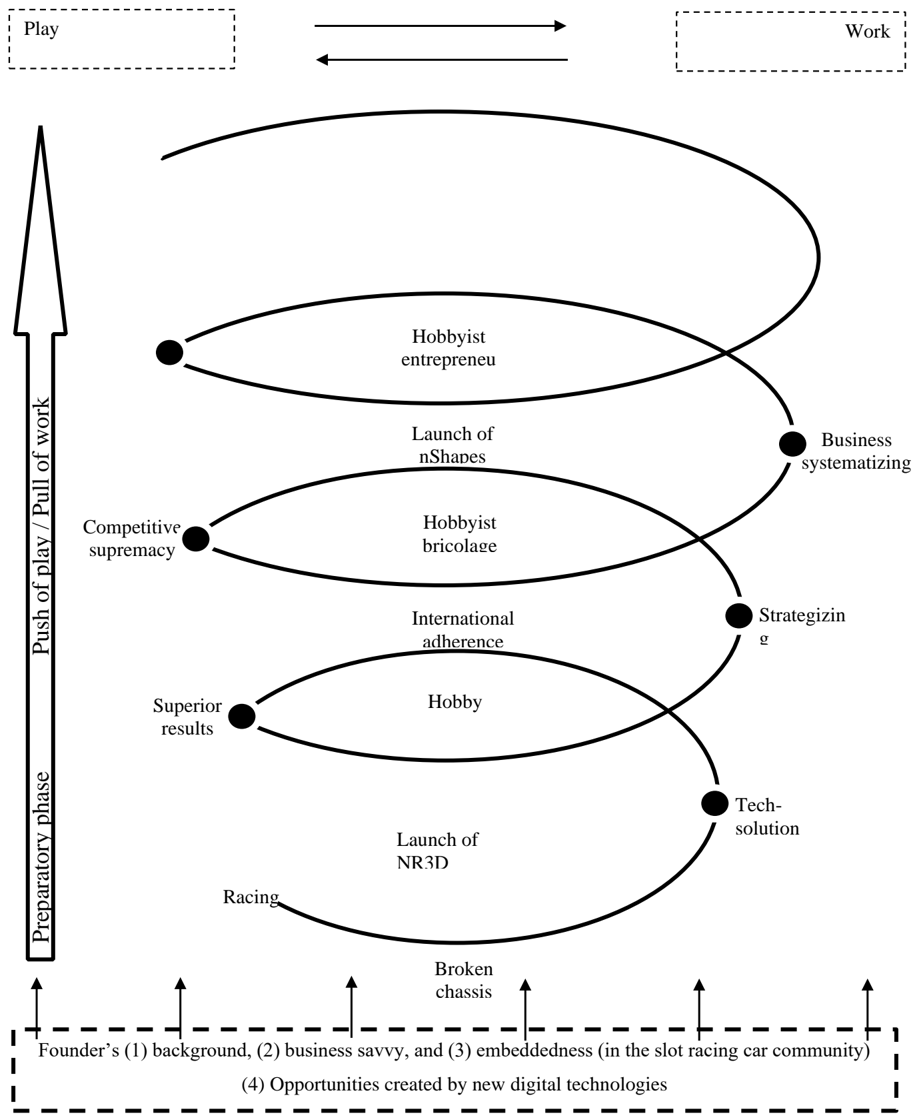
Our longitudinal case study investigates the emergence of an embryonic business from a hobby. As the hobby evolved to become an entrepreneurial venture, the dimensions of play and work engaged in a paradoxical tension that dynamically persisted, spiraling, as the business unfolded. The process of turning a hobby into a business progressively imbricated two opposing disciplines, those of play and work. As a result, inherent tensions between them have to be managed. Turning these tensions into a source of vitality to be nurtured, rather than framing the tension as a dichotomy to be solved, is seen to be vital to the continuation of the venture.
Overview
CoChat Summary
TL;DR
This longitudinal single-case study of NR3D, a Lisbon slot-car chassis venture founded in 2015, traces how a hobby became a business and how play/work paradoxes emerged and dynamically persisted. The authors argue the tension was navigated as a generative, normal part of entrepreneuring rather than a dichotomy to be resolved.
Key findings
- The hobby-to-business transition generated a play/work paradox that persisted but changed form; the founders treated the tension as normal and welcome, not as strain requiring defensive responses.
- NR3D’s market traction: by February 2017, the top three contenders in the AESlot Club used NR3D chassis, eight other top-25 contenders also used them, and seven of the national top 10 racers used NR3D chassis; NR3D sells B2C regularly to 30 to 50 global customers and does B2B through digital marketplaces and resellers.
- The paper offers three contributions: paradoxical tensions are anchored in practices; balance between paradoxical poles is fragile; and events—such as the broken chassis, the first order from New Zealand, good racing results, and sustained international demand—trigger oscillatory moves.
- Self-reported work/leisure percentages shifted over time: Vasco reported 10% work in 2015 and 75% in 2019; Rafael reported 0% in 2015 and 40% in 2019 (Table 4).
Methods
- Single explanatory longitudinal case study of NR3D, founded in 2015 in Lisbon, Portugal; followed informally from the beginning and systematically from December 2017 until Spring 2020, ending at conceptual saturation and two key moments: the launch of nShapes and the Covid-19 interruption of races.
- Multiple data sources: informal interactions; 15 formal interviews plus nine informal directed interactions (as stated in the text; Table 2 lists a kick-off interview plus 23 focused interviews); 74 electronic messages; documents; observation of two racing events (December 2019, 4 hours; January 2020, 7 hours); 16 individuals consulted.
- Analysis followed grounded-theory logic in three steps: mapping the case chronology, analyzing grand themes of background/play/work, and abstract conceptualization of the play-business spiraling; interpretations were cross-checked with the founder and informants.
Limitations
- The authors state the study is a single case of a micro-venture involving only two people, a father and son; the mission and psychological safety may be difficult to replicate, imposing a boundary condition, and the case is difficult to generalize.
- The authors note the case captures only the start-up/embryonic phase; time may extinguish “the fire of passion,” and an overemphasis on work may neutralize fun.
- The authors also note that self-reported work/leisure percentages are difficult to quantify because the separation is often unclear (note 2); the text makes evident that data collection ended in Spring 2020 and Covid-19 interrupted races, so later evolution is not fully captured.
Model-written summary. Check it against the paper before relying on it.
Integrity signals
Registry
Cites
Statistics
Figures


Verification
Claims the paper makes
1 Valid · 4 Not valid · 18 Not checked · 94 Own results and interpretations
The cited sources support only part of this claim — read each source’s verdict below.
In the paper
“Much is known about existing paradoxes but not about their origin and inception; hence, we ask: how do entrepreneurial paradoxes emerge -in this case from the combination of work and play - and how are they navigated over time?”
What the sources say
- Not matchedcites Gaim, Clegg, Cunha & Berti, 2022
More than one paper fits this citation.
- Partly supportedcites Smith & Lewis, 2011 matched to “Toward a Theory of Paradox: A Dynamic equilibrium Model of Organizing” (2011) sourceExperimental — accuracy not yet measured
The introduction and 'Toward a Theory of Paradox' describe an extensive body of paradox research, while 'Remaining Gaps' identifies an unresolved debate about whether tensions are inherent or socially constructed. But 'Paradoxical Tensions: Latent and Salient' also explains how organizing creates tensions and how latent tensions become salient. The source therefore supports an origin-related gap, not the broader assertion that little is known about paradoxes’ origin or inception. (LLM, conf=0.81)
- Partly supportedcites Pradies et al., 2023 matched to “A Figure is Worth a Thousand Words: The role of visualization in paradox theorizing” (2023) sourceExperimental — accuracy not yet measured
The section “Paradox theory: rich in reflexivity, yet blind to the use of visuals” (p. 6 onward) describes extensive research on paradox definitions, dynamics, and responses. But neither that section nor the Discussion passages located in our copy say that little is known about the origin or inception of paradoxes; the paper identifies gaps concerning how paradoxes are visualized instead. (LLM, conf=0.80)
plain- Asserted: passes — The authors put it forward as true.
- Checkable: passes — It can be checked against evidence.
- Load-bearing: passes — The paper’s conclusions depend on it.
- Based: passes — The paper gives a reason why it holds.
- Not matched
A result the paper states — it cites no source for it, so there is none to check. The quote shows it is in the paper.
In the paper
“Eight other contenders in the Club's top 25 also used NR3D chassis.”
plain- Asserted: passes — The authors put it forward as true.
- Checkable: passes — It can be checked against evidence.
- Load-bearing: unclear — It is unclear whether the paper’s conclusions depend on it.
- Based: passes — The paper gives a reason why it holds.
- Rests on an assumption not shown here.
A result the paper reports from its own data — it cites no other source for it, so there is none to check. The quote shows it is in the paper.
In the paper
“Our case reveals something different: the tension was perceived as normal and welcome.”
plainSingle case- Asserted: passes — The authors put it forward as true.
- Checkable: passes — It can be checked against evidence.
- Load-bearing: passes — The paper’s conclusions depend on it.
- Based: passes — The paper gives a reason why it holds.
- Rests on an assumption not shown here.
A result the paper reports from its own data — it cites no other source for it, so there is none to check. The quote shows it is in the paper.
In the paper
“In the garage, a father and son, Vasco (who later founded NR3D) and Rafael (Vasco's son), were slot car aficionados whose hobby turned into accidental entrepreneurship.”
plainstates a causeSingle case- Asserted: passes — The authors put it forward as true.
- Checkable: passes — It can be checked against evidence.
- Load-bearing: passes — The paper’s conclusions depend on it.
- Based: passes — The paper gives a reason why it holds.
- Rests on an assumption not shown here.
A result the paper states — it cites no source for it, so there is none to check. The quote shows it is in the paper.
In the paper
“The hobbyists became innovative users, observed by competitors in the slot car races in which they participated.”
plainstates a causeSingle case- Asserted: passes — The authors put it forward as true.
- Checkable: passes — It can be checked against evidence.
- Load-bearing: passes — The paper’s conclusions depend on it.
- Based: passes — The paper gives a reason why it holds.
54 more claims
Create a free account to see all 117 claims and every source verdict.
- Probably not a substantial claim. 28
- It may state two separate claims as one. 38
- The quote only partly states this claim. 2
Self-check
Percentages, sums and reported differences re-computed from the paper’s own numbers.
Each contradiction between two passages listed here was confirmed by an independent check.
Rated minor: it would not touch a result — a value no result rests on, a p-value that stays on the same side of the significance level, or a conflict that is clerical, resolved elsewhere in the paper, or outside its own findings.
In the paper
§ Data sources and data collection
“These informal sources were complemented by 15 formal interviews”
§ Data sources and data collection
“23 interviews (15 to 100 minutes each). [#2 and #3 conducted in 2018; #4 to #17 in 2019; #18 to #24 in 2020]”
Citations
Cites
(1994) · Journal of the American Dietetic Association · doi:10.1016/0002-8223(94)92216-0 · Cited by 45,910
Theory Building From Cases: Opportunities And Challenges
Eisenhardt, K. M., & Graebner, M. E. (2007) · Academy of Management Journal · doi:10.5465/amj.2007.24160888 · Cited by 16,670
Seeking Qualitative Rigor in Inductive Research: Notes on the Gioia Methodology
Gioia, D. A., Corley, K. G., & Hamilton, A. L. (2013) · Organizational Research Methods · doi:10.1177/1094428112452151 · Cited by 13,227
Strategies for Theorizing from Process Data
Langley, A. (1999) · The Academy of Management Review · doi:10.5465/amr.1999.2553248 · Cited by 9,370
Creating Something from Nothing: Resource Construction through Entrepreneurial Bricolage
Baker, T., & Nelson, R. E. (2005) · Administrative Science Quarterly · doi:10.2189/asqu.2005.50.3.329 · Cited by 4,060
Making fast strategic decisions in high-velocity environments
Eisenhardt, K. M. (1989) · Academy of Management Journal · doi:10.2307/256434 · Cited by 3,818
Evolution and Revolution as Organizations Grow
Greiner, L. E. (1989) · Readings in Strategic Management · doi:10.1007/978-1-349-20317-8_25 · Cited by 2,421
Fina, A. D. (2019) · The Routledge Handbook of Linguistic Ethnography · doi:10.4324/9781315675824-12 · Cited by 2,119
The nature and experience of entrepreneurial passion
Cardon, M. S., Wincent, J., Singh, J., & Drnovsek, M. (2009) · Academy of Management Review · doi:10.5465/amr.2009.40633190 · Cited by 1,922
Digital affordances, spatial affordances, and the genesis of entrepreneurial ecosystems
Autio, E., Nambisan, S., Thomas, L. D. W., & Wright, M. (2018) · Strategic Entrepreneurship Journal · doi:10.1002/sej.1266 · Cited by 1,738
Toward a Theory of Paradox: A Dynamic equilibrium Model of Organizing
Smith, W. K., & Lewis, M. W. (2011) · Academy of Management Review · doi:10.5465/amr.2009.0223 · Cited by 1,631
Paradox research in management science: Looking back to move forward
Schad, J., Lewis, M. W., Raisch, S., & Smith, W. K. (2016) · Academy of Management Annals · doi:10.5465/19416520.2016.1162422 · Cited by 1,385
Ambiguity and Choice in Organizations
Axelsson, R., March, J. G., & Olsen, J. P. (1977) · The Scandinavian Journal of Economics · doi:10.2307/3439574 · Cited by 1,331
The accidental entrepreneur: the emergent and collective process of user entrepreneurship
Shah, S. K., & Tripsas, M. (2007) · Strategic Entrepreneurship Journal · doi:10.1002/sej.15 · Cited by 796
Evolution and Revolution as Organizations GrowPreprint
Greiner, L. E. (1972) · SSRN Electronic Journal · Cited by 786
Leadership for organizational adaptability: A theoretical synthesis and integrative framework
Uhl-Bien, M., & Arena, M. (2018) · The Leadership Quarterly · doi:10.1016/j.leaqua.2017.12.009 · Cited by 767
Oldenburg, R., & Brissett, D. (1982) · Qualitative Sociology · doi:10.1007/bf00986754 · Cited by 634
Digital Technologies as External Enablers of New Venture Creation in the IT Hardware Sector
von Briel, F., Davidsson, P., & Recker, J. (2018) · Entrepreneurship Theory and Practice · doi:10.1177/1042258717732779 · Cited by 589
Horizontal innovation networks--by and for users
von Hippel, E. (2007) · Industrial and Corporate Change · doi:10.1093/icc/dtm005 · Cited by 568
The Accidental Entrepreneur: The Emergent and Collective Process of User EntrepreneurshipPreprint
Shah, S., & Tripsas, M. (2007) · SSRN Electronic Journal · doi:10.2139/ssrn.1022358 · Cited by 551
Management paradoxes: A relational view
Clegg, S. R., da Cunha, J. V., & e Cunha, M. P. (2002) · Human Relations · doi:10.1177/0018726702555001 · Cited by 498
Self-citationThe Coming of Age for Qualitative Research: Embracing the Diversity of Qualitative Methods
Bansal, P. (., & Corley, K. (2011) · Academy of Management Journal · doi:10.5465/amj.2011.60262792 · Cited by 486
Growing on Steroids: Rapidly Scaling the User Base of Digital Ventures Through Digital Innovaton1
Huang, J., Henfridsson, O., Liu, M. J., & Newell, S. (2017) · MIS Quarterly · doi:10.25300/misq/2017/41.1.16 · Cited by 478
Vince, R., & Broussine, M. (1996) · Organization Studies · doi:10.1177/017084069601700101 · Cited by 450
A Theories-in-Use Approach to Building Marketing Theory
Zeithaml, V. A., Jaworski, B. J., Kohli, A. K., Tuli, K. R., Ulaga, W., & Zaltman, G. (2020) · Journal of Marketing · doi:10.1177/0022242919888477 · Cited by 392
Managing the Tradition and Innovation Paradox in Family Firms: A Family Imprinting Perspective
Erdogan, I., Rondi, E., & De Massis, A. (2020) · Entrepreneurship Theory and Practice · doi:10.1177/1042258719839712 · Cited by 387
The Changing Nature of Work: Careers, Identities, and Work Lives in the 21 st Century
Barley, S. R., Bechky, B. A., & Milliken, F. J. (2017) · Academy of Management Discoveries · doi:10.5465/amd.2017.0034 · Cited by 345
Ideas are Born in Fields of Play: Towards a Theory of Play and Creativity in Organizational Settings
Mainemelis, C., & Ronson, S. (2006) · Research in Organizational Behavior · doi:10.1016/s0191-3085(06)27003-5 · Cited by 294
Seeing the Forest and the Trees: How a Systems Perspective Informs Paradox Research
Schad, J., & Bansal, P. (2018) · Journal of Management Studies · doi:10.1111/joms.12398 · Cited by 266
Co-creation and user innovation: The role of online 3D printing platforms
Rayna, T., Striukova, L., & Darlington, J. (2015) · Journal of Engineering and Technology Management · doi:10.1016/j.jengtecman.2015.07.002 · Cited by 249
CROSSROADS—Identifying Viable “Need–Solution Pairs”: Problem Solving Without Problem Formulation
von Hippel, E., & von Krogh, G. (2016) · Organization Science · doi:10.1287/orsc.2015.1023 · Cited by 239
Garud, R. (2008) · Journal of Management Studies · doi:10.1111/j.1467-6486.2008.00783.x · Cited by 236
Demystifying Grounded Theory for Business Research
O’Reilly, K., Paper, D., & Marx, S. (2012) · Organizational Research Methods · doi:10.1177/1094428111434559 · Cited by 225
(2023) · Research and Evaluation for Busy Students and Practitioners · doi:10.56687/9781447366263-015 · Cited by 211
Hienerth, C., Lettl, C., & Keinz, P. (2014) · Journal of Product Innovation Management · doi:10.1111/jpim.12127 · Cited by 207
Conquering Relevance: Entrepreneurship Research's Grand Challenge
Wiklund, J., Wright, M., & Zahra, S. A. (2019) · Entrepreneurship Theory and Practice · doi:10.1177/1042258718807478 · Cited by 204
The Dynamics of Intuition and Analysis in Managerial and Organizational Decision Making
Hodgkinson, G. P., & Sadler-Smith, E. (2018) · Academy of Management Perspectives · doi:10.5465/amp.2016.0140 · Cited by 199
Paradox, Dialectics or Trade‐Offs? A Double Loop Model of Paradox
Berti, M., & Cunha, M. P. E. (2022) · Journal of Management Studies · doi:10.1111/joms.12899 · Cited by 187
Self-citationParadoxes and Innovation in Family Firms: The Role of Paradoxical Thinking
Ingram, A. E., Lewis, M. W., Barton, S., & Gartner, W. B. (2016) · Entrepreneurship Theory and Practice · doi:10.1111/etap.12113 · Cited by 176
Editor's Comments: Publishing Theory
Kilduff, M. (2006) · Academy of Management Review · doi:10.5465/amr.2006.20208678 · Cited by 176
A Garage and an Idea: What More Does an Entrepreneur Need?
Audia, P. G., & Rider, C. I. (2005) · California Management Review · doi:10.2307/41166325 · Cited by 168
Presenting Findings from Qualitative Research: One Size Does Not Fit All!
Reay, T., Zafar, A., Monteiro, P., & Glaser, V. (2019) · Emerald Group Publishing Limited eBooks · doi:10.1108/s0733-558x20190000059011 · Cited by 167
Accidental Innovation: Supporting Valuable Unpredictability in the Creative Process
Austin, R. D., Devin, L., & Sullivan, E. E. (2012) · Organization Science · doi:10.1287/orsc.1110.0681 · Cited by 165
Just for fun! How experimental spaces stimulate innovation in institutionalized fields
Cartel, M. A., Boxenbaum, E., & Aggeri, F. (2018) · Organization Studies · doi:10.1177/0170840617736937 · Cited by 127
Editors’ Comments: There Is Nothing So Theoretical As Good Practice—A Call for Phenomenal Theory
Ployhart, R. E., & Bartunek, J. M. (2019) · Academy of Management Review · doi:10.5465/amr.2019.0087 · Cited by 114
Examination of relationships among serendipity, the environment, and individual differences
McCay‐Peet, L., Toms, E. G., & Kelloway, E. K. (2015) · Information Processing & Management · doi:10.1016/j.ipm.2015.02.004 · Cited by 111
Ramoglou, S. (2021) · Journal of Business Venturing · doi:10.1016/j.jbusvent.2020.106090 · Cited by 106
Discovery, Capitalism, and Distributive Justice
Gonce, R. A., & Kirzner, I. M. (1990) · Southern Economic Journal · doi:10.2307/1060640 · Cited by 100
Revolutionizing Innovation: Users, Communities, and Open Innovation
Harhoff, D., & Lakhani, K. R. (2016) · Cited by 100
Liminal Entrepreneuring: The Creative Practices of Nascent Necessity Entrepreneurs
Garcia-Lorenzo, L., Donnelly, P., Sell-Trujillo, L., & Imas, J. M. (2018) · Organization Studies · doi:10.1177/0170840617727778 · Cited by 97
Toward a social practice theory of relational competing
Jarzabkowski, P. A., & Bednarek, R. (2017) · Strategic Management Journal · doi:10.1002/smj.2724 · Cited by 94
Encompassing Stability and Novelty in Organization Studies: An Events-based Approach
Hussenot, A., & Missonier, S. (2015) · Organization Studies · doi:10.1177/0170840615604497 · Cited by 89
Peripheral Vision: Sensing and Acting on Weak Signals
Day, G. S., & Schoemaker, P. J. H. (2004) · Long Range Planning · doi:10.1016/j.lrp.2004.01.003 · Cited by 88
Lead-User Research for Breakthrough Innovation
Eisenberg, I. (2011) · Research-Technology Management · doi:10.1080/08956308.2011.11657673 · Cited by 85
Elgar Introduction to Organizational Paradox Theory
Berti, M., Simpson, A., Cunha, M. P., & Clegg, S. R. (2021) · Edward Elgar Publishing eBooks · doi:10.4337/9781839101144 · Cited by 78
Self-citationPop-up to professional: Emerging entrepreneurial identity and evolving vocabularies of motive
Demetry, D. (2017) · Academy of Management Discoveries · doi:10.5465/amd.2015.0152 · Cited by 77
The Roles of Material Artifacts in Managing the Learning–Performance Paradox: The Kaizen Case
Aoki, K. (2019) · Academy of Management Journal · doi:10.5465/amj.2017.0967 · Cited by 77
Organizational Creativity as an Attributional Process: The Case of Haute Cuisine
Koch, J., Wenzel, M., Senf, N. N., & Maibier, C. (2017) · Organization Studies · doi:10.1177/0170840617727779 · Cited by 74
Qualitative Research in I-O Psychology: Maps, Myths, and Moving Forward
Pratt, M. G., & Bonaccio, S. (2016) · Industrial and Organizational Psychology · doi:10.1017/iop.2016.92 · Cited by 72
Gaim, M., Clegg, S. R., Cunha, M. P. E., & Berti, M. (2022) · Cambridge University Press eBooks · doi:10.1017/9781009128155 · Cited by 70
Self-citationToo Close or Optimally Positioned? The Value of Personally Relevant Research
Jones, E. B., & Bartunek, J. M. (2019) · Academy of Management Perspectives · doi:10.5465/amp.2018.0009 · Cited by 70
When Do User-Innovators Start Firms? A Theory of User Entrepreneurship
Shah, S., & Tripsas, M. (2016) · The MIT Press eBooks · doi:10.7551/mitpress/9439.003.0020 · Cited by 68
(2019) · Emerald Group Publishing Limited eBooks · doi:10.1108/s0733-558x201959 · Cited by 66
Love and Organization Studies: Moving beyond the Perspective of Avoidance
Tasselli, S. (2018) · Organization Studies · doi:10.1177/0170840617747924 · Cited by 51
In Praise of Paradox Persistence: Evidence from the Sydney Opera House Project
Gaim, M., Clegg, S. R., & Cunha, M. P. E. (2022) · Project Management Journal · doi:10.1177/87569728221094834 · Cited by 49
Self-citationHow to Catalyze Innovation in Your Organization
Arena, M. J., Cross, R., Sims, J., & Uhl‐Bien, M. (2018) · The MIT Press eBooks · doi:10.7551/mitpress/11858.003.0004 · Cited by 43
A Figure is Worth a Thousand Words: The role of visualization in paradox theorizing
Pradies, C., Berti, M., Pina e Cunha, M., Rego, A., Tunarosa, A., & Clegg, S. (2023) · Organization Studies · doi:10.1177/01708406231161998 · Cited by 26
Self-citationThe governance paradox: Preferences of small vulnerable firms in the homebuilding industry
Dewald, J. R., Hall, J., Chrisman, J. J., & Kellermanns, F. W. (2007) · Entrepreneurship Theory and Practice · doi:10.1111/j.1540-6520.2007.00173.x · Cited by 17
Toward a Chance Management View of Organizational Change
Jing, R., & de Ven, A. H. V. (2017) · Management and Organization Review · doi:10.1017/mor.2017.32 · Cited by 16
Ideas are feelings first: epiphanies in everyday workplace creativity
van Iterson, A., Clegg, S. R., & Carlsen, A. (2017) · M n gement · doi:10.3917/mana.203.0221 · Cited by 15
Self-citationStudying Paradox as Process and Practice
Jarzabkowski, P., Bednarek, R., & Lê, J. K. (2018) · Oxford Scholarship Online · doi:10.1093/oso/9780198827436.003.0009 · Cited by 14
An exploratory study of factors that relate to burnout in hobby‐jobs
Volpone, S. D., Perry, S. J., & Rubino, C. (2013) · Applied Psychology · doi:10.1111/j.1464-0597.2012.00502.x · Cited by 12
Rethinking Organizations and Society from Paradoxes
Cunha, M. P. E. (2022) · Organizações & Sociedade · doi:10.1590/1984-92302022v29n0008en · Cited by 8
Self-citationFickle Rooster Productions: Making a Business from a Hobby
Frith, K. (2007) · The International Journal of Entrepreneurship and Innovation · doi:10.5367/000000007780808011 · Cited by 6
Kilduff, M. (2007) · Academy of Management Review · doi:10.5465/amr.2007.23463588
Research works printed but not linked: 3
- Schleicher, R. 2008. Slot car racing in the digital age . Voyageur Press.
- Van Alstyne, M. W., Parker, G. G., & Choudarys, S. P. (2016). Pipelines, platforms, and the role of the new rules of strategy. Harvard Business Review , 94(4), 5462.
- Yin, R. K. (1994). Case study research (2nd ed.). Sage.
Cited by
Moonlighting and the transition to full-time entrepreneurship
Graff, N. (2026) · Small Business Economics · doi:10.1007/s11187-026-01268-7 · Cited by 1
THE ROLE OF DIGITIZATION IN BRAND STRATEGY: IMPACT ON BRAND PERFORMANCE IN THE HOBBY INDUSTRY
Dašić, T., Mihić, S., & Spasić, K. (2025) · SCIENCE International Journal · doi:10.35120/sciencej040473d
“Digitalization enabled access to global markets, and brought opportunities for distributed and collaborative initiatives that would not exist without such technologies, which transformed hobbies from mere pastimes into viable and profitable industry (Cunha et al., 2024).”
Metadata
- Authors
- Cunha, M. P. E., Rego, A., Giustiniano, L., & Clegg, S.
- Affiliations
- NOVA University of Lisbon, Portugal
- University of Lisbon (PT)
- Luiss University, Italy
- The University of Sydney (AU)
- Venue
- Organizações & Sociedade
- Publisher
- FapUNIFESP (SciELO)
- Published
- 2024-01
- Volume
- 31
- Issue
- 108
- Pages
- 88-116
- ISSN
- 1413-585X (ISSN-L)
- 1984-9230
- OpenAlex
- W4398150612
- Semantic Scholar
- 3a52ae6ca208754ba26e511572d21b42665d45fa
- Cited by
- 2
- References
- 76
- Citations by year
- 2026: 1 · 2025: 1
- FWCI
- 0.88
- Type
- journal article
- Language
- en
- Open access
- diamond
- doi.org
- Licence
- cc-by
- creativecommons.org/licenses/by/4.0/ (vor)
- creativecommons.org/licenses/by/4.0/ (am)
- creativecommons.org/licenses/by/4.0/ (tdm)
- Locations
- Organizações & Sociedade (publishedVersion, cc-by)
- IRIS - Institutional Research Information System (Libera Università Internazionale degli Studi Sociali Guido Carli) (submittedVersion, cc-by)
- Topics
- Social Sciences › Business, Management and Accounting › Management of Technology and Innovation › Entrepreneurship Studies and Influences
- Social Sciences › Business, Management and Accounting › Organizational Behavior and Human Resource Management › Management and Organizational Studies
- Social Sciences › Business, Management and Accounting › Strategy and Management › Business Strategies and Innovation
- Keywords
- work and play, paradox, tension management, business acceleration, entrepreneurial vitality, longitudinal case study
About these checks
Registry, retraction, Cites and statistics results are computed, not judged, with one exception: a printed reference that no index lists is read once by a model before it counts as a citation error. Claims are extracted by a model and kept only when their quote appears verbatim in the text; each cited source is then checked, with a model’s help, for whether it says what the claim relies on. Those verdicts can be wrong — read the claim’s quote and the cited source before relying on one.
The claim verdicts this report counts are experimental: their accuracy is not yet measured.
A language model drew the claims from the paper on 2026-09-30, under version 3 of the claim definition (model deepseek-v4.1-flash, prompt extract-v3).
A second model labelled each claim on 2026-09-30 (model jev-1.13-20260917, definition revision gold-guideline-v0.2).
Cited sources are checked with a language model’s help (gpt-6-sol).
Statistics and arithmetic are recomputed, not judged.
Confidence bands are shown only for fields calibrated on our annotated test set. None is calibrated yet, so no band is shown.
What counts as a claim ›How we measure confidence ›How we check this ›
Are you an author, or do you see a problem with this page? Request a review
Data sources
Bibliographic data: Semantic Scholar, OpenAlex, Crossref.
Contains information from the Semantic Scholar Academic Graph Datasets, made available under the ODC Attribution License (ODC-BY 1.0).
Semantic Scholar’s data is described in: Kinney, R., et al. (2023). The Semantic Scholar Open Data Platform. arXiv:2301.10140.
