

Artificial intelligence in the diagnosis and management of dysphagia: a scoping review
Open accessThe DOI matches its Crossref record; 74 of the 74 references it cites were found in a registry or an index; 57 of the 95 sources its claims cite were checked for support.
Abstract
Purpose This scoping review aimed to map and synthesize evidence on technological advancements using Artificial Intelligence in the diagnosis and management of dysphagia. We followed the PRISMA guidelines and those of the Joanna Briggs Institute, focusing on research about technological innovations in dysphagia. Research strategies The protocol was registered on the Open Science Framework platform. The databases consulted included EMBASE, Latin American and Caribbean Health Sciences Literature (LILACS), Livivo, PubMed/Medline, Scopus, Cochrane Library, Web of Science, and grey literature. Selection criteria The acronym 'PCC' was used to consider the eligibility of studies for this review. Data analysis After removing duplicates, 56 articles were initially selected. A subsequent update resulted in 205 articles, of which 61 were included after applying the selection criteria. Results Videofluoroscopy of swallowing was used as the reference examination in most studies. Regarding the underlying diseases present in the patients who participated in the studies, there was a predominance of various neurological conditions. The algorithms used varied across the categories of Machine Learning, Deep Learning, and Computer Vision, with a predominance in the use of Deep Learning. Conclusion Technological advancements in artificial intelligence for the diagnosis and management of dysphagia have been mapped, highlighting the predominance and applicability of Deep Learning in examinations such as videofluoroscopy. The findings suggest significant potential to improve diagnostic accuracy and clinical management effectiveness, particularly in neurological patients. Identified research gaps require further investigations to solidify the clinical applicability and impact of these technologies.
Overview
CoChat Summary
## TL;DR
This scoping review mapped 61 studies on artificial intelligence for diagnosing and managing dysphagia, with videofluoroscopy (VFSS) the most common reference exam and deep learning the most prevalent AI approach. The paper concludes that AI shows strong potential to improve diagnostic accuracy and clinical management, especially in neurological patients, but that generalizability and standardization remain unresolved.
## Key findings
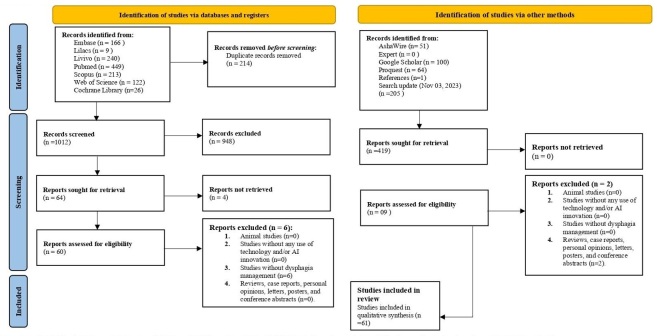
- After screening, the review included 61 studies for qualitative synthesis and results mapping; the search retrieved 1,225 articles initially, 1,012 remained after deduplication, and 69 studies were read in full text.
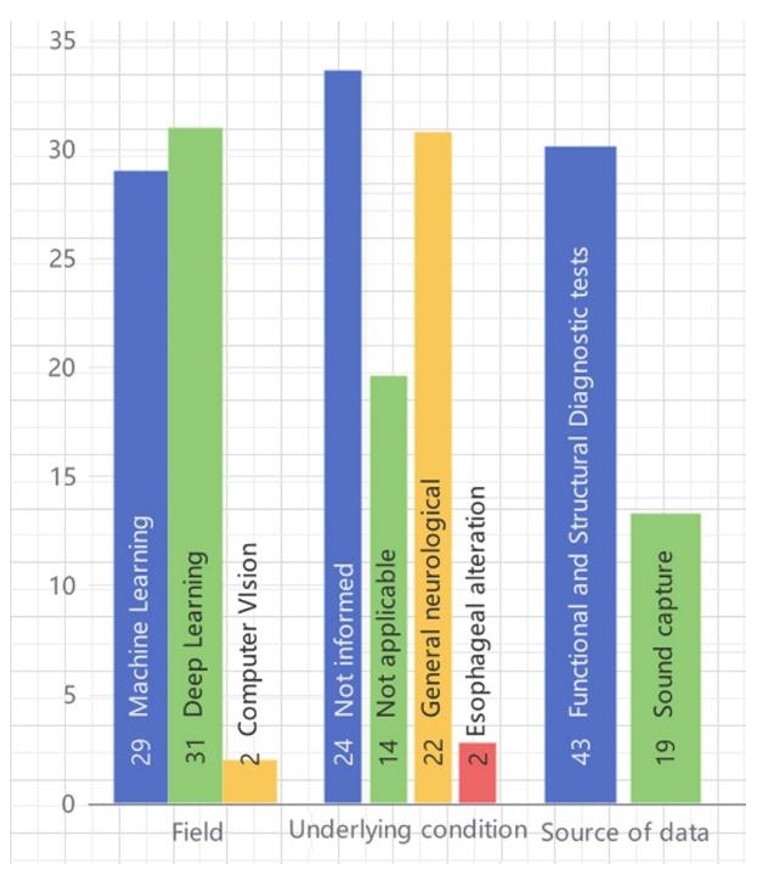
- VFSS was used as the reference examination in most studies; FEES appeared in 2 studies, high-resolution manometry alongside VFSS in 4 studies, and electromyography in 2 studies.
- The most common underlying conditions were neurological diseases, with stroke cited in 12 studies; Parkinson’s disease appeared in 3 studies, and pediatric cerebral palsy was the most cited condition in the pediatric subgroup.
- AI methods spanned Machine Learning, Deep Learning, and Computer Vision, with Deep Learning predominating; the paper reports some models achieving F1 scores > 0.9, accuracy of 97.8%, sensitivity and specificity > 90%, and cervical auscultation accuracy up to 98% for distinguishing safe from unsafe swallows.
## Methods
- This was a scoping review conducted according to PRISMA-ScR and Joanna Briggs Institute guidance, and it was registered on the Open Science Framework.
- The review used the PCC framework: humans of any age (Population), use of AI (Concept), and aid in diagnosis/treatment of dysphagia (Context).
- Searches covered 7 electronic databases (EMBASE, LILACS, LIVIVO, PubMed/Medline, Scopus, Cochrane Library, Web of Science) plus grey literature; two reviewers screened studies in two phases and extracted study characteristics, population characteristics, AI techniques, evaluation metrics, and outcomes.
## Limitations
- The paper explicitly states that there are research gaps and that further investigations are needed to “solidify the clinical applicability and impact” of these technologies.
- It also states that limited generalizability, need for standardized protocols, and variability in clinical settings remain barriers to widespread adoption.
- Evident from the text: many included studies had incomplete reporting of pathology or no applicability due to research methodology, and several AI systems still rely on human judgment or imaging validation, indicating the evidence base is not yet fully autonomous or standardized.
Model-written summary. Check it against the paper before relying on it.
Integrity signals
Registry
Cites
Statistics
Figures
Verification
Claims the paper makes
22 Valid · 1 Not valid · 7 Not checked · 27 Own results and interpretations
The cited sources support only part of this claim — read each source’s verdict below.
In the paper
“Videofluoroscopy of swallowing was used as the reference examination in most studies.”
- Also stated in: § Characteristics of sources of evidence · plain
“Videofluoroscopy swallowing study (VFSS) was utilized in studies(16,23-28)”
§ Artificial intelligence in the diagnosis and management of dysphagia: a scoping review > Abstract > Results
What the sources say
- Partly supportedcites [16] Park D Son SI Kim MS Kim TY Choi JH Lee SE et al Machine learning predictive model for aspiration screening in hospitalized patients with acute stroke Sci Rep 2023 13 1 7835 10.1038/s41598-023-34999-8 37188793 PMC10185509 sourceExperimental — accuracy not yet measured
The Introduction describes VFSS as widely used to confirm aspiration, and the Methods use it to define aspiration in this study. The paper does not establish that VFSS was the reference examination in most studies; it reports no count or comparison of included studies supporting that qualifier. The passages have no page numbers in our copy. (LLM, conf=0.86)
- Supportedcites [23] Lee SJ Ko JY Kim HI Choi S-I Automatic detection of airway invasion from videofluoroscopy via deep learning technology Appl Sci 2020 10 18 6179 10.3390/app10186179 source
Our copy shows Lee et al. (2020) is exactly such a study: the Introduction (p.1) states that 'The VFSS ... is regarded as the gold standard for the evaluation of dysphagia and is the examination method that is most commonly used by clinicians', and the Dataset section (2.1) shows the reference labels were established by expert reading of the VFSS recordings ('All video files were reviewed and confirmed for the presence or absence of airway invasion by two physiatrists experienced in VFSS analysis'; each frame 'labeled ... in the same way'). The deep-learning model's performance (Discussion, 4) is then reported against that VFSS-based reference (accuracy 97.2% per frame, 93.2% per swallow, Cohen's kappa 0.86 vs human raters). The 'in most studies' quantifier is the citing review's own synthesis over its included studies and is not this source's burden; what is attributed here — that VFSS served as the reference examination — is clearly borne out. (LLM, conf=0.78)
- Not checked — no full text of the sourcecites [24] Lee JT Park E Detection of the pharyngeal phase in the videofluoroscopic swallowing study using inflated 3D convolutional networks. Shi Y Suk HI Liu M Machine learning in medical imaging. Cham Springer 2018 328 336 Lecture Notes in Computer Science 10.1007/978-3-030-00919-9_38 source
- Partly supportedcites [25] Donohue C Khalifa Y Mao S Perera S Sejdic E Coyle JL Establishing reference values for temporal kinematic swallow events across the lifespan in healthy community dwelling adults using high-resolution cervical auscultation Dysphagia 2022 37 3 664 675 10.1007/s00455-021-10317-0 34018024 PMC10312069 sourceExperimental — accuracy not yet measured
The Introduction (page unavailable) calls VFSS a gold-standard examination, and the Methods (page unavailable) report using it alongside HRCA in this study. The paper does not establish that VFSS was the reference examination in most of the citing document’s included studies. (LLM, conf=0.85)
- Not checked — no full text of the sourcecites [26] Coyle JL Sejdic E High-resolution cervical auscultation and data science: new tools to address an old problem Am J Speech Lang Pathol 2020 29 2S 992 1000 10.1044/2020_AJSLP-19-00155 32650655 PMC7844341 source
- Not checked — no full text of the sourcecites [27] Kritas S Dejaeger E Tack J Omari T Rommel N Objective prediction of pharyngeal swallow dysfunction in dysphagia through artificial neural network modeling Neurogastroenterol Motil 2016 28 3 336 344 10.1111/nmo.12730 26891061 source
- Partly supportedcites [28] Donohue C Khalifa Y Perera S Sejdic E Coyle JL A preliminary investigation of whether HRCA signals can differentiate between swallows from healthy people and swallows from people with neurodegenerative diseases Dysphagia 2021 36 4 635 643 10.1007/s00455-020-10177-0 32889627 PMC7933315 sourceExperimental — accuracy not yet measured
The Introduction calls videofluoroscopy one of the gold standards for assessing swallowing physiology, and Methods > Equipment and Procedures reports that both groups in this study underwent VFSS. This is a single study; it does not assess whether VFSS was the reference examination in most studies. (LLM, conf=0.84)
plain- Asserted: passes — The authors put it forward as true.
- Checkable: passes — It can be checked against evidence.
- Load-bearing: unclear — It is unclear whether the paper’s conclusions depend on it.
- Based: passes — The paper gives a reason why it holds.
- Also stated in: § Characteristics of sources of evidence · plain
The cited sources support only part of this claim — read each source’s verdict below.
In the paper
“Studies on AI in dysphagia primarily rely on imaging resources such as VFSS for comparative analysis due to its high reliability(16,23-28).”
§ Artificial intelligence in the diagnosis and management of dysphagia: a scoping review > RESULTS > Results of individual sources of evidence
What the sources say
- Partly supportedcites [16] Park D Son SI Kim MS Kim TY Choi JH Lee SE et al Machine learning predictive model for aspiration screening in hospitalized patients with acute stroke Sci Rep 2023 13 1 7835 10.1038/s41598-023-34999-8 37188793 PMC10185509 sourceExperimental — accuracy not yet measured
The Introduction (page unavailable) says VFSS is widely used to confirm aspiration because it permits accurate visualization, and the Methods use VFSS to define the outcome for this machine-learning study. This supports the paper as an example, but it does not establish that AI studies in dysphagia primarily rely on imaging resources for comparison. (LLM, conf=0.83)
- Partly supportedcites [23] Lee SJ Ko JY Kim HI Choi S-I Automatic detection of airway invasion from videofluoroscopy via deep learning technology Appl Sci 2020 10 18 6179 10.3390/app10186179 sourceExperimental — accuracy not yet measured
Our copy supports the general thrust that AI work in dysphagia is built on VFSS imagery and that VFSS 'is regarded as the gold standard for the evaluation of dysphagia and is the examination method that is most commonly used by clinicians' (Introduction), and the Discussion (p. 4) notes that previous deep-learning studies 'attempted fully automated analysis of VFSS images' with 'considerably high accuracy'. However, the paper nowhere states that such studies rely on VFSS 'for comparative analysis', and it does not attribute high reliability to VFSS: the Introduction (p. 1) states that 'analysis of VFSS data is vulnerable to human bias' and that 'intra-rater and inter-rater reliability have been reported to be only poor to fair (inter-rater k = 0.01~0.56)', with the Discussion (p. 4) again citing human inter-observer reliability of 0.3~0.8 for penetration/aspiration. The 'high reliability' rationale is therefore the part this source does not support. (LLM, conf=0.72)
- Not checked — no full text of the sourcecites [24] Lee JT Park E Detection of the pharyngeal phase in the videofluoroscopic swallowing study using inflated 3D convolutional networks. Shi Y Suk HI Liu M Machine learning in medical imaging. Cham Springer 2018 328 336 Lecture Notes in Computer Science 10.1007/978-3-030-00919-9_38 source
- Partly supportedcites [25] Donohue C Khalifa Y Mao S Perera S Sejdic E Coyle JL Establishing reference values for temporal kinematic swallow events across the lifespan in healthy community dwelling adults using high-resolution cervical auscultation Dysphagia 2022 37 3 664 675 10.1007/s00455-021-10317-0 34018024 PMC10312069 sourceExperimental — accuracy not yet measured
The Introduction (page unavailable) says this paper’s HRCA machine-learning studies collect VFSS images alongside sensor signals and compare results with VFSS-based expert judgments as the “ground truth.” That supports VFSS as a comparator in this line of research, but the paper does not establish that AI studies in dysphagia generally rely primarily on imaging, or explicitly attribute that practice to VFSS’s high reliability. (LLM, conf=0.85)
- Not checked — no full text of the sourcecites [26] Coyle JL Sejdic E High-resolution cervical auscultation and data science: new tools to address an old problem Am J Speech Lang Pathol 2020 29 2S 992 1000 10.1044/2020_AJSLP-19-00155 32650655 PMC7844341 source
- Not checked — no full text of the sourcecites [27] Kritas S Dejaeger E Tack J Omari T Rommel N Objective prediction of pharyngeal swallow dysfunction in dysphagia through artificial neural network modeling Neurogastroenterol Motil 2016 28 3 336 344 10.1111/nmo.12730 26891061 source
- Partly supportedcites [28] Donohue C Khalifa Y Perera S Sejdic E Coyle JL A preliminary investigation of whether HRCA signals can differentiate between swallows from healthy people and swallows from people with neurodegenerative diseases Dysphagia 2021 36 4 635 643 10.1007/s00455-020-10177-0 32889627 PMC7933315 sourceExperimental — accuracy not yet measured
The Introduction (page unavailable) calls videofluoroscopy one of the gold standards for assessing swallowing physiology. The Methods: Data Analysis section (page unavailable) uses VFSS image labels as ground truth for evaluating this study’s machine-learning classifiers. The paper does not establish that AI studies in dysphagia primarily rely on VFSS, or that high reliability is their reason for doing so. (LLM, conf=0.86)
plainstates a cause- Asserted: passes — The authors put it forward as true.
- Checkable: passes — It can be checked against evidence.
- Load-bearing: unclear — It is unclear whether the paper’s conclusions depend on it.
- Based: passes — The paper gives a reason why it holds.
- Partly supported
The cited sources support only part of this claim — read each source’s verdict below.
In the paper
“In the pediatric population, cerebral palsy was the most cited condition in studies focusing on this age group(20,37,49).”
§ Artificial intelligence in the diagnosis and management of dysphagia: a scoping review > RESULTS > Results of individual sources of evidence
What the sources say
- Partly supportedcites [20] Frakking TT Chang AB Carty C Newing J Weir KA Schwerin B et al Using an automated speech recognition approach to differentiate between normal and aspirating swallowing sounds recorded from digital cervical auscultation in children Dysphagia 2022 37 6 1482 1492 10.1007/s00455-022-10410-y 35092488 PMC9643257 sourceExperimental — accuracy not yet measured
The Methods > Participants section (page unavailable) lists cerebral palsy as an example of a diagnosis among children with feeding disorders. The paper does not compare how often conditions were cited across pediatric studies, so it does not support the claim that cerebral palsy was the most cited. (LLM, conf=0.82)
- Supportedcites [37] Merey C Kushki A Sejdić E Berall G Chau T Quantitative classification of pediatric swallowing through accelerometry J Neuroeng Rehabil 2012 9 1 34 10.1186/1743-0003-9-34 22682474 PMC3453511 source
The Methods (Data acquisition and swallow identification) describe a pediatric swallowing study and list cerebral palsy among the neurological conditions associated with its participants. The Background also discusses cerebral palsy in relation to pediatric dysphagia. The ‘most cited’ ranking is the citing authors’ synthesis across studies, not a finding attributed to this individual paper. (LLM, conf=0.85)
- Not checked — no full text of the sourcecites [49] Roldan-Vasco S Orozco-Duque A Suarez-Escudero JC Orozco-Arroyave JR Machine learning based analysis of speech dimensions in functional oropharyngeal dysphagia Comput Methods Programs Biomed 2021 208 106248 10.1016/j.cmpb.2021.106248 34260973 source
plain- Asserted: passes — The authors put it forward as true.
- Checkable: passes — It can be checked against evidence.
- Load-bearing: unclear — It is unclear whether the paper’s conclusions depend on it.
- Based: passes — The paper gives a reason why it holds.
- Partly supported
The cited sources support only part of this claim — read each source’s verdict below.
In the paper
“deep learning models like U-Net and CNNs have achieved performance metrics such as F1 scores exceeding 0.9 and accuracy rates of 97.8%, indicating their robustness in detecting swallowing events and anatomical structures.”
§ Artificial intelligence in the diagnosis and management of dysphagia: a scoping review > RESULTS > Characteristics of sources of evidence
What the sources say
- Partly supportedcites [51] Lee HH Kwon BM Yang CK Yeh CY Lee J Measurement of laryngeal elevation by automated segmentation using Mask R-CNN Medicine 2021 100 51 e28112 10.1097/MD.0000000000028112 34941054 PMC8702111 sourceExperimental — accuracy not yet measured
The Abstract (page not specified) reports that Mask R-CNN segmented anatomical structures in swallowing-study videos, supporting that part of the claim. It reports recall rates of 86.8% and 99.8%, not F1 scores above 0.9 or 97.8% accuracy. The paper does not report using U-Net or evaluating detection of swallowing events. (LLM, conf=0.88)
- Partly supportedcites [68] Ariji Y Gotoh M Fukuda M Watanabe S Nagao T Katsumata A et al A preliminary deep learning study on automatic segmentation of contrast-enhanced bolus in videofluorography of swallowing Sci Rep 2022 12 1 18754 10.1038/s41598-022-21530-8 36335226 PMC9637105 sourceExperimental — accuracy not yet measured
The Results (Evaluation of trained model; page unavailable) report Sørensen–Dice scores of 0.94 and 0.96 for U-Net segmentation of the contrast bolus, supporting the claim of scores above 0.9. The paper does not report 97.8% accuracy or evaluate detection of anatomical structures; its model segments the bolus and visualizes areas involved in aspiration. (LLM, conf=0.88)
- Partly supportedcites [69] Bandini A Smaoui S Steele CM Automated pharyngeal phase detection and bolus localization in videofluoroscopic swallowing study: killing two birds with one stone? Comput Methods Programs Biomed 2022 225 107058 10.1016/j.cmpb.2022.107058 35961072 PMC9983708 sourceExperimental — accuracy not yet measured
The Results (Pharyngeal phase detection; page unavailable) report F1 scores of 0.909 and 0.906 for CNN models detecting the pharyngeal phase. Our copy does not report 97.8% accuracy or results from a U-Net detecting anatomical structures; the Discussion (Limitations and future work; page unavailable) mentions U-Net only in connection with future bolus-segmentation comparisons. (LLM, conf=0.88)
- Partly supportedcites [75] Zhang Z Mao S Coyle J Sejdic E Automatic annotation of cervical vertebrae in videofluoroscopy images via deep learning Med Image Anal 2021 74 102218 10.1016/j.media.2021.102218 34487983 PMC8560570 sourceExperimental — accuracy not yet measured
The Abstract (page unavailable) reports that a two-stage convolutional neural network localized cervical vertebral landmarks in swallowing videos, supporting the anatomical-structure portion of the claim. It reports 93% of predicted points within five pixels of annotations, not an F1 score above 0.9 or 97.8% accuracy. The paper does not report U-Net performance or its model detecting swallowing events. (LLM, conf=0.88)
hedged- Asserted: passes — The authors put it forward as true.
- Checkable: passes — It can be checked against evidence.
- Load-bearing: unclear — It is unclear whether the paper’s conclusions depend on it.
- Based: passes — The paper gives a reason why it holds.
- Partly supported
The cited sources support only part of this claim — read each source’s verdict below.
In the paper
“Other methods, including support vector machines (SVM) and Mask-RCNN, have demonstrated high accuracy in classifying swallowing events, with metrics like sensitivity and specificity reaching over 90%.”
§ Artificial intelligence in the diagnosis and management of dysphagia: a scoping review > RESULTS > Characteristics of sources of evidence
What the sources say
- Partly supportedcites [51] Lee HH Kwon BM Yang CK Yeh CY Lee J Measurement of laryngeal elevation by automated segmentation using Mask R-CNN Medicine 2021 100 51 e28112 10.1097/MD.0000000000028112 34941054 PMC8702111 sourceExperimental — accuracy not yet measured
The Results (Table 3; page unavailable) report Mask R-CNN recall of 99.8% for C1 spinous-process segmentation, but 86.8% for thyroid cartilage and vocal-fold complex segmentation. The paper evaluates anatomical segmentation for measuring laryngeal elevation, not classification of swallowing events; it does not report SVM performance or specificity above 90%. (LLM, conf=0.88)
- Partly supportedcites [68] Ariji Y Gotoh M Fukuda M Watanabe S Nagao T Katsumata A et al A preliminary deep learning study on automatic segmentation of contrast-enhanced bolus in videofluorography of swallowing Sci Rep 2022 12 1 18754 10.1038/s41598-022-21530-8 36335226 PMC9637105 sourceExperimental — accuracy not yet measured
The Introduction reports that Mask R-CNN was used for bolus detection in swallowing images, but gives its Jaccard index as 0.71. The Results report sensitivity of 0.95 for this paper’s U-Net bolus-segmentation model, not for Mask R-CNN or SVM. Our copy reports neither SVM results nor specificity above 90%, and it does not establish those metrics for classifying swallowing events. (LLM, conf=0.87)
- Partly supportedcites [69] Bandini A Smaoui S Steele CM Automated pharyngeal phase detection and bolus localization in videofluoroscopic swallowing study: killing two birds with one stone? Comput Methods Programs Biomed 2022 225 107058 10.1016/j.cmpb.2022.107058 35961072 PMC9983708 sourceExperimental — accuracy not yet measured
The Results (Pharyngeal phase detection; page unavailable) report F1-scores above 0.90 for ResNet50 and VGG16, supporting high performance in detecting the pharyngeal phase. They do not report sensitivity or specificity above 90% for SVM or Mask-RCNN. The References identify Mask-RCNN in a separate study of bolus detection, not as a swallowing-event classifier evaluated here. (LLM, conf=0.82)
- Could not verifycites [75] Zhang Z Mao S Coyle J Sejdic E Automatic annotation of cervical vertebrae in videofluoroscopy images via deep learning Med Image Anal 2021 74 102218 10.1016/j.media.2021.102218 34487983 PMC8560570 sourceExperimental — accuracy not yet measured
The Abstract and Results describe a two-stage convolutional network that localizes cervical vertebrae in swallowing videos; the reported measures concern landmark location, not sensitivity or specificity for classifying swallowing events. Searches for SVM, Mask-RCNN, and sensitivity and specificity over 90% found no passage addressing that claim in our copy. (LLM, conf=0.76)
boostedstates an association- Asserted: passes — The authors put it forward as true.
- Checkable: passes — It can be checked against evidence.
- Load-bearing: unclear — It is unclear whether the paper’s conclusions depend on it.
- Based: passes — The paper gives a reason why it holds.
- Partly supported
18 more claims · 9 with their cited sources checked
Create a free account to see all 57 claims and to verify the 6 references still open.
- It may state two separate claims as one. 24
- Probably not a substantial claim. 19
Citations
Cites
The PRISMA 2020 statement: An updated guideline for reporting systematic reviews
Page, M. J., McKenzie, J. E., Bossuyt, P. M., Boutron, I., Hoffmann, T. C., Mulrow, C. D., Shamseer, L., Tetzlaff, J. M., Akl, E. A., Brennan, S. E., et al. (2021) · BMJ · doi:10.1136/bmj.n71 · Cited by 108,283
JBI Manual for Evidence Synthesis
(2024) · doi:10.46658/jbimes-24-01 · Cited by 2,483
Deep learning in cancer diagnosis, prognosis and treatment selection
Tran, K. A., Kondrashova, O., Bradley, A., Williams, E. D., Pearson, J. V., & Waddell, N. (2021) · Genome Medicine · doi:10.1186/s13073-021-00968-x · Cited by 932
Baijens, L. W., Clavé, P., Cras, P., Ekberg, O., Forster, A., Kolb, G., Leners, J. C., Masiero, S., Mateos del Nozal, J., Ortega, O., et al. (2016) · Clinical Interventions in Aging · doi:10.2147/cia.s107750 · Cited by 773 · cited 1×
“The prevalence can be as high as 60% in intensive care or home nursing settings, with rates varying based on associated comorbidities (1,2) .”
Haddaway, N. R., Grainger, M. J., & Gray, C. T. (2022) · Research Synthesis Methods · doi:10.1002/jrsm.1563 · Cited by 604 · cited 1×
“The reference lists of all included articles were checked using the web application Citation Chaser (11) , searching for both the citations used by these studies and the articles that cited them.”
Artificial intelligence in oncology
Shimizu, H., & Nakayama, K. I. (2020) · Cancer Science · doi:10.1111/cas.14377 · Cited by 388
Best practices in modified barium swallow studies
Martin-Harris, B., Canon, C. L., Bonilha, H. S., Murray, J., Davidson, K., & Lefton-Greif, M. A. (2020) · American Journal of Speech-Language Pathology · doi:10.1044/2020_ajslp-19-00189 · Cited by 129 · cited 2×
“Although both VFSS and FEES have high sensitivity and specificity, the need for human interpretation in defining results raises questions and inspires possibilities for creating algorithms that can automate evaluation and contribute to the analysis of specific structures (4,5,32,57,66) .”
Machine Learning na Medicina: Revisão e Aplicabilidade
Paixao, G. M., Santos, B. C., de Araujo, R. M., Ribeiro, M. H., de Moraes, J. L., & Ribeiro, A. L. P. (2022) · Arquivos Brasileiros de Cardiologia · doi:10.36660/abc.20200596 · Cited by 102 · cited 1×
“This distinction is particularly relevant in tasks involving large volumes of unstructured data, such as images, audio, and text, with audio and images being the most common data types in studies (77,78) .”
Machine Learning for Medical Imaging
Fu, G.-S., Levin-Schwartz, Y., Lin, Q.-H., & Zhang, D. (2019) · Journal of Healthcare Engineering · doi:10.1155/2019/9874591 · Cited by 91
Khalifa, Y., Coyle, J. L., & Sejdić, E. (2020) · Scientific Reports · doi:10.1038/s41598-020-65492-1 · Cited by 82 · cited 2×
“Literature search flowchart and selection criteria cited in 12 studies (16,18,21,22,27,32,36,40,46,48-51) , neurodegenerative diseases like Parkinson’s were present in 3 studies (22,24,27) , and two studies mentioned esophageal alterations (42,52) .”
Hybrid fuzzy logic committee neural networks for recognition of swallow acceleration signals
Das, A., Reddy, N. P., & Narayanan, J. (2001) · Computer Methods and Programs in Biomedicine · doi:10.1016/s0169-2607(00)00099-7 · Cited by 82
Development of a novel prognostic model to predict 6-month swallowing recovery after ischemic stroke
Lee, W. H., Lim, M. H., Seo, H. G., Seong, M. Y., Oh, B.-M., & Kim, S. (2020) · Stroke · doi:10.1161/strokeaha.119.027439 · Cited by 72 · cited 2×
“Literature search flowchart and selection criteria cited in 12 studies (16,18,21,22,27,32,36,40,46,48-51) , neurodegenerative diseases like Parkinson’s were present in 3 studies (22,24,27) , and two studies mentioned esophageal alterations (42,52) .”
Artificial Intelligence-Assisted Throat Sensor Using Ionic Polymer–Metal Composite (IPMC) Material
Lee, J.-H., Chee, P. S., Lim, E.-H., & Tan, C. H. (2021) · Polymers · doi:10.3390/polym13183041 · Cited by 50
Khalifa, Y., Donohue, C., Coyle, J. L., & Sejdic, E. (2021) · IEEE Journal of Biomedical and Health Informatics · doi:10.1109/jbhi.2020.3000057 · Cited by 49 · cited 3×
“Sound resources as an auxiliary method in evaluation were also used (17,21,25,26,28,34-46) .”
Lee, J. T., Park, E., Hwang, J.-M., Jung, T.-D., & Park, D. (2020) · Scientific Reports · doi:10.1038/s41598-020-71713-4 · Cited by 49 · cited 1×
“However, the images generated by the examination are still analyzed by human judgment (38,61,63,65) .”
Machine learning based analysis of speech dimensions in functional oropharyngeal dysphagia
Roldan-Vasco, S., Orozco-Duque, A., Suarez-Escudero, J. C., & Orozco-Arroyave, J. R. (2021) · Computer Methods and Programs in Biomedicine · doi:10.1016/j.cmpb.2021.106248 · Cited by 49 · cited 1×
“In the pediatric population, cerebral palsy was the most cited condition in studies focusing on this age group (20,37,49) .”
Neck sensor-supported hyoid bone movement tracking during swallowing
Mao, S., Zhang, Z., Khalifa, Y., Donohue, C., Coyle, J. L., & Sejdic, E. (2019) · Royal Society Open Science · doi:10.1098/rsos.181982 · Cited by 47 · cited 4×
“Since the swallowing process is considered complex, each structure contributes uniquely, with the hyoid bone being one of the most studied (21,22,50) .”
InfluentialHoffman, M. R., Jones, C. A., Geng, Z., Abelhalim, S. M., Walczak, C. C., Mitchell, A. R., Jiang, J. J., & McCulloch, T. M. (2013) · Otolaryngology–Head and Neck Surgery · doi:10.1177/0194599813489506 · Cited by 45 · cited 2×
“The algorithms used varied within the classification of Machine Learning (2,3,16,20,25-28,30, 32, 35, 37, 39, Despite the considered effective results, all highlighted the need for further studies in the area.”
Methods for using Bing’s AI-powered search engine for data extraction for a systematic review
Hill, J. E., Harris, C., & Clegg, A. (2024) · Research Synthesis Methods · doi:10.1002/jrsm.1689 · Cited by 45 · cited 1×
“All relevant information was extracted and mapped, with extraction performed by the two main reviewers, followed by final data verification using the Bing AI tool (13) .”
Zhang, D., Chen, Z., Xiao, L., Zhu, B., Wu, R., Ou, C., Ma, Y., Xie, L., & Jiang, H. (2023) · Microsystems & Nanoengineering · doi:10.1038/s41378-023-00591-3 · Cited by 43 · cited 3×
“Videofluoroscopy swallowing study (VFSS) was utilized in studies (16,23-28) , with four of them concurrently using high-resolution manometry (27,29-31) , only two studies (32,33) used fiberoptic endoscopic evaluation of swallowing (FEES), and 2 studies reported electromyography use (3,17) .”
Donohue, C., Khalifa, Y., Perera, S., Sejdić, E., & Coyle, J. L. (2021) · Dysphagia · doi:10.1007/s00455-020-10177-0 · Cited by 41 · cited 4×
“Sound resources as an auxiliary method in evaluation were also used (17,21,25,26,28,34-46) .”
InfluentialMartín, A., Miró, J., Amadó, C., Ruz, F., Ruíz, A., Ortega, O., & Clavé, P. (2022) · Dysphagia · doi:10.1007/s00455-022-10547-w · Cited by 41
Swallow segmentation with artificial neural networks and multi-sensor fusion
Lee, J., Steele, C. M., & Chau, T. (2009) · Medical Engineering & Physics · doi:10.1016/j.medengphy.2009.07.001 · Cited by 40
Quantitative classification of pediatric swallowing through accelerometry
Celeste, M., Azadeh, K., Sejdić, E., Berall, G., & Chau, T. (2012) · Journal of NeuroEngineering and Rehabilitation · doi:10.1186/1743-0003-9-34 · Cited by 37 · cited 3×
“In the pediatric population, cerebral palsy was the most cited condition in studies focusing on this age group (20,37,49) .”
O’Brien, M. K., Botonis, O. K., Larkin, E., Carpenter, J., Martin-Harris, B., Maronati, R., Lee, K., Cherney, L. R., Hutchison, B., Xu, S., et al. (2021) · Digital Biomarkers · doi:10.1159/000517144 · Cited by 37 · cited 2×
“Literature search flowchart and selection criteria cited in 12 studies (16,18,21,22,27,32,36,40,46,48-51) , neurodegenerative diseases like Parkinson’s were present in 3 studies (22,24,27) , and two studies mentioned esophageal alterations (42,52) .”
Automated classification of swallowing and breadth sounds
Aboofazeli, M., & Moussavi, Z. (2005) · The 26th Annual International Conference of the IEEE Engineering in Medicine and Biology Society · doi:10.1109/iembs.2004.1404069 · Cited by 37 · cited 1×
“Although both VFSS and FEES have high sensitivity and specificity, the need for human interpretation in defining results raises questions and inspires possibilities for creating algorithms that can automate evaluation and contribute to the analysis of specific structures (4,5,32,57,66) .”
Jones, C. A., Hoffman, M. R., Lin, L., Abdelhalim, S., Jiang, J. J., & McCulloch, T. M. (2018) · Neurogastroenterology & Motility · doi:10.1111/nmo.13236 · Cited by 35
Artificial neural network classification of pharyngeal high‐resolution manometry with impedance data
Hoffman, M. R., Mielens, J. D., Omari, T. I., Rommel, N., Jiang, J. J., & McCulloch, T. M. (2013) · The Laryngoscope · doi:10.1002/lary.23655 · Cited by 34 · cited 4×
“Videofluoroscopy swallowing study (VFSS) was utilized in studies (16,23-28) , with four of them concurrently using high-resolution manometry (27,29-31) , only two studies (32,33) used fiberoptic endoscopic evaluation of swallowing (FEES), and 2 studies reported electromyography use (3,17) .”
InfluentialClassifying Dysphagic Swallowing Sounds with Support Vector Machines
Miyagi, S., Sugiyama, S., Kozawa, K., Moritani, S., Sakamoto, S., & Sakai, O. (2020) · Healthcare · doi:10.3390/healthcare8020103 · Cited by 32 · cited 2×
“The algorithms used varied within the classification of Machine Learning (2,3,16,20,25-28,30, 32, 35, 37, 39, Despite the considered effective results, all highlighted the need for further studies in the area.”
Weng, W., Imaizumi, M., Murono, S., & Zhu, X. (2022) · Scientific Reports · doi:10.1038/s41598-022-25618-z · Cited by 32 · cited 1×
“Videofluoroscopy swallowing study (VFSS) was utilized in studies (16,23-28) , with four of them concurrently using high-resolution manometry (27,29-31) , only two studies (32,33) used fiberoptic endoscopic evaluation of swallowing (FEES), and 2 studies reported electromyography use (3,17) .”
Automatic Diagnosis of High-Resolution Esophageal Manometry Using Artificial Intelligence
Popa, S., Blaga, T. S., Dumitrascu, D. L., Chiarioni, G., Savarino, E. V., David, L., Ismaiel, A., Leucuta, D., Zsigmond, I., Sebestyen, G., et al. (2022) · Journal of Gastrointestinal and Liver Diseases · doi:10.15403/jgld-4525 · Cited by 32
Deep Learning-Based Swallowing Monitor for Realtime Detection of Swallow Duration
Kuramoto, N., Ichimura, K., Jayatilake, D., Shimokakimoto, T., Hidaka, K., & Suzuki, K. (2020) · Annual International Conference of the IEEE Engineering in Medicine and Biology Society (EMBC) · doi:10.1109/embc44109.2020.9176721 · Cited by 32
Prospectively-validated deep learning model for segmenting swallowing and chewing structures in CT
Iyer, A., Thor, M., Onochie, I., Hesse, J., Zakeri, K., LoCastro, E., Jiang, J., Veeraraghavan, H., Elguindi, S., Lee, N. Y., et al. (2022) · Physics in Medicine and Biology · doi:10.1088/1361-6560/ac4000 · Cited by 29
High-resolution cervical auscultation and data science: new tools to address an old problem
Coyle, J. L., & Sejdić, E. (2020) · American Journal of Speech-Language Pathology · doi:10.1044/2020_ajslp-19-00155 · Cited by 28 · cited 3×
“Sejdi ć (26) Utilization The study confirms the effectiveness and superiority of the detection technique.”
Automatic detection of airway invasion from videofluoroscopy via deep learning technology
Lee, S. J., Ko, J. Y., Kim, H. I., & Choi, S.-I. (2020) · Applied Sciences · doi:10.3390/app10186179 · Cited by 28 · cited 2×
“Videofluoroscopy swallowing study (VFSS) was utilized in studies (16,23-28) , with four of them concurrently using high-resolution manometry (27,29-31) , only two studies (32,33) used fiberoptic endoscopic evaluation of swallowing (FEES), and 2 studies reported electromyography use (3,17) .”
Inoue, K., Yoshioka, M., Yagi, N., Nagami, S., & Oku, Y. (2018) · IEEE Transactions on Biomedical Engineering · doi:10.1109/tbme.2018.2807487 · Cited by 27 · cited 1×
“The algorithms used varied within the classification of Machine Learning (2,3,16,20,25-28,30, 32, 35, 37, 39, Despite the considered effective results, all highlighted the need for further studies in the area.”
Lee, K.-S., Lee, E., Choi, B., & Pyun, S.-B. (2021) · Diagnostics · doi:10.3390/diagnostics11020300 · Cited by 25 · cited 1×
“Sound resources as an auxiliary method in evaluation were also used (17,21,25,26,28,34-46) .”
Suzuki, K., Shimizu, Y., Ohshimo, S., Oue, K., Saeki, N., Sadamori, T., Tsutsumi, Y. M., Irifune, M., & Shime, N. (2022) · Clinical and Experimental Dental Research · doi:10.1002/cre2.531 · Cited by 24
Frakking, T. T., Chang, A. B., Carty, C., Newing, J., Weir, K. A., Schwerin, B., & So, S. (2022) · Dysphagia · doi:10.1007/s00455-022-10410-y · Cited by 23 · cited 4×
“In the pediatric population, cerebral palsy was the most cited condition in studies focusing on this age group (20,37,49) .”
InfluentialLee, D., Lee, W. H., Seo, H. G., Oh, B.-M., Lee, J. C., & Kim, H. C. (2020) · IEEE Access · doi:10.1109/access.2020.3019532 · Cited by 22 · cited 3×
“Since the swallowing process is considered complex, each structure contributes uniquely, with the hyoid bone being one of the most studied (21,22,50) .”
Hashimoto, H., Kameda, S., Maezawa, H., Oshino, S., Tani, N., Khoo, H. M., Yanagisawa, T., Yoshimine, T., Kishima, H., & Hirata, M. (2020) · International Journal of Neural Systems · doi:10.1142/s0129065720500562 · Cited by 22
Automated Chicago Classification for esophageal motility disorder diagnosis using machine learning
Surdea-Blaga, T., Sebestyen, G., Czako, Z., Hangan, A., Dumitrascu, D. L., Ismaiel, A., David, L., Zsigmond, I., Chiarioni, G., Savarino, E., et al. (2022) · Sensors · doi:10.3390/s22145227 · Cited by 22 · cited 1×
“Literature search flowchart and selection criteria cited in 12 studies (16,18,21,22,27,32,36,40,46,48-51) , neurodegenerative diseases like Parkinson’s were present in 3 studies (22,24,27) , and two studies mentioned esophageal alterations (42,52) .”
Ariji, Y., Gotoh, M., Fukuda, M., Watanabe, S., Nagao, T., Katsumata, A., & Ariji, E. (2022) · Scientific Reports · doi:10.1038/s41598-022-21530-8 · Cited by 19
Automated Bolus Detection in Videofluoroscopic Images of Swallowing Using Mask-RCNN
Caliskan, H., Mahoney, A. S., Coyle, J. L., & Sejdic, E. (2020) · 2020 42nd Annual International Conference of the IEEE Engineering in Medicine & Biology Society (EMBC) · doi:10.1109/embc44109.2020.9176664 · Cited by 19
Kritas, S., Dejaeger, E., Tack, J., Omari, T., & Rommel, N. (2016) · Neurogastroenterology & Motility · doi:10.1111/nmo.12730 · Cited by 18 · cited 4×
“Videofluoroscopy swallowing study (VFSS) was utilized in studies (16,23-28) , with four of them concurrently using high-resolution manometry (27,29-31) , only two studies (32,33) used fiberoptic endoscopic evaluation of swallowing (FEES), and 2 studies reported electromyography use (3,17) .”
InfluentialSabry, A., Mahoney, A. S., Mao, S., Khalifa, Y., Sejdić, E., & Coyle, J. L. (2020) · Perspectives of the ASHA Special Interest Groups · doi:10.1044/2020_persp-20-00073 · Cited by 18
Automatic annotation of cervical vertebrae in videofluoroscopy images via deep learning
Zhang, Z., Mao, S., Coyle, J., & Sejdić, E. (2021) · Medical Image Analysis · doi:10.1016/j.media.2021.102218 · Cited by 18
Lai, D. K.-H., Cheng, E. S.-W., So, B. P.-H., Mao, Y.-J., Cheung, S. M.-Y., Cheung, D. S. K., Wong, D. W.-C., & Cheung, J. C.-W. (2023) · Mathematics · doi:10.3390/math11143081 · Cited by 18 · cited 2×
“Literature search flowchart and selection criteria cited in 12 studies (16,18,21,22,27,32,36,40,46,48-51) , neurodegenerative diseases like Parkinson’s were present in 3 studies (22,24,27) , and two studies mentioned esophageal alterations (42,52) .”
Applying Machine Learning Algorithms for Automatic Detection of Swallowing from Sound
Santoso, L. F., Baqai, F., Gwozdz, M. L., Lange, J., Rosenberger, M. G., Sulzer, J. S., & Paydarfar, D. (2019) · Annual International Conference of the IEEE Engineering in Medicine and Biology Society (EMBC) · doi:10.1109/embc.2019.8857937 · Cited by 18
Park, D., Son, S. I., Kim, M. S., Kim, T. Y., Choi, J. H., Lee, S.-E., Hong, D., & Kim, M.-C. (2023) · Scientific Reports · doi:10.1038/s41598-023-34999-8 · Cited by 17 · cited 4×
“Videofluoroscopy swallowing study (VFSS) was utilized in studies (16,23-28) , with four of them concurrently using high-resolution manometry (27,29-31) , only two studies (32,33) used fiberoptic endoscopic evaluation of swallowing (FEES), and 2 studies reported electromyography use (3,17) .”
InfluentialBandini, A., Smaoui, S., & Steele, C. M. (2022) · Computer Methods and Programs in Biomedicine · doi:10.1016/j.cmpb.2022.107058 · Cited by 16 · cited 1×
“This highlights the potential of AI not just in diagnostics but also in automating labor-intensive aspects of analysis (65,69) .”
Artificial intelligence and dysphagia: novel solutions to old problems
SEJDIĆ, E., KHALIFA, Y., MAHONEY, A. S., & COYLE, J. L. (2020) · Arquivos de Gastroenterologia · doi:10.1590/s0004-2803.202000000-66 · Cited by 15 · cited 2×
“These technologies contribute to the emergence of new hypotheses, discoveries, and task optimization in healthcare, aiming for a safer and more efficient approach (5-8) .”
Donohue, C., Khalifa, Y., Mao, S., Perera, S., Sejdić, E., & Coyle, J. L. (2021) · Journal of Speech, Language, and Hearing Research · doi:10.1044/2021_jslhr-21-00134 · Cited by 15 · cited 2×
“Although both VFSS and FEES have high sensitivity and specificity, the need for human interpretation in defining results raises questions and inspires possibilities for creating algorithms that can automate evaluation and contribute to the analysis of specific structures (4,5,32,57,66) .”
Dysphagia diagnosis system with integrated speech analysis from throat vibration
Zhao, H., Jiang, Y., Wang, S., He, F., Ren, F., Zhang, Z., Yang, X., Zhu, C., Yue, J., Li, Y., et al. (2022) · Expert Systems with Applications · doi:10.1016/j.eswa.2022.117496 · Cited by 15 · cited 1×
“The prevalence can be as high as 60% in intensive care or home nursing settings, with rates varying based on associated comorbidities (1,2) .”
Chang, M. W., Lin, E., & Hwang, J.-N. (1999) · Dysphagia · doi:10.1007/pl00009609 · Cited by 14 · cited 1×
“The included studies were published from 1999 (15) to 2023 (16-19) .”
Computer-assisted detection of swallowing difficulty
Lee, J. C., Seo, H. G., Lee, W. H., Kim, H. C., Han, T. R., & Oh, B.-M. (2016) · Computer Methods and Programs in Biomedicine · doi:10.1016/j.cmpb.2016.07.010 · Cited by 14 · cited 1×
“Since the swallowing process is considered complex, each structure contributes uniquely, with the hyoid bone being one of the most studied (21,22,50) .”
Donohue, C., Khalifa, Y., Perera, S., Sejdić, E., & Coyle, J. L. (2021) · Dysphagia · doi:10.1007/s00455-021-10368-3 · Cited by 14
Donohue, C., Khalifa, Y., Mao, S., Perera, S., Sejdić, E., & Coyle, J. L. (2022) · Dysphagia · doi:10.1007/s00455-021-10317-0 · Cited by 12 · cited 2×
“Sound resources as an auxiliary method in evaluation were also used (17,21,25,26,28,34-46) .”
Kim, Y., Kim, H.-I., Park, G. S., Kim, S. Y., Choi, S.-I., & Lee, S. J. (2021) · Journal of Clinical Medicine · doi:10.3390/jcm10122681 · Cited by 12 · cited 1×
“However, the images generated by the examination are still analyzed by human judgment (38,61,63,65) .”
A Deep Learning Approach to Video Fluoroscopic Swallowing Exam Classification
Wilhelm, P., Reinhardt, J. M., & Daele, D. J. V. (2020) · IEEE International Symposium on Biomedical Imaging (ISBI) · doi:10.1109/isbi45749.2020.9098510 · Cited by 12
Use of deep learning to segment bolus during videofluoroscopic swallow studies
Shaheen, N., Burdick, R., Peña-Chávez, R., Ulmschneider, C., Yee, J., Kurosu, A., Rogus-Pulia, N., & Bednarz, B. (2024) · Biomedical Physics & Engineering Express · doi:10.1088/2057-1976/ad0bb3 · Cited by 10
Cuadros-Acosta, J., & Orozco-Duque, A. (2022) · Biomedical Signal Processing and Control · doi:10.1016/j.bspc.2021.103122 · Cited by 9 · cited 3×
“Videofluoroscopy swallowing study (VFSS) was utilized in studies (16,23-28) , with four of them concurrently using high-resolution manometry (27,29-31) , only two studies (32,33) used fiberoptic endoscopic evaluation of swallowing (FEES), and 2 studies reported electromyography use (3,17) .”
Enz, V. C. Q., Vaz, A. R. C., Nunes, M. C. D. A., Rosa, M. D. O., Nunes, J. D. A., Marques, J. M., & Santos, R. S. (2022) · Dysphagia · doi:10.1007/s00455-021-10358-5 · Cited by 9 · cited 6×
“The algorithms used varied within the classification of Machine Learning (2,3,16,20,25-28,30, 32, 35, 37, 39, Despite the considered effective results, all highlighted the need for further studies in the area.”
InfluentialSelf-citationMeasurement of laryngeal elevation by automated segmentation using Mask R-CNN
Lee, H. H., Kwon, B. M., Yang, C.-K., Yeh, C.-Y., & Lee, J. (2021) · Medicine · doi:10.1097/md.0000000000028112 · Cited by 9 · cited 2×
“Literature search flowchart and selection criteria cited in 12 studies (16,18,21,22,27,32,36,40,46,48-51) , neurodegenerative diseases like Parkinson’s were present in 3 studies (22,24,27) , and two studies mentioned esophageal alterations (42,52) .”
Fujinaka, A., Mekata, K., Takizawa, H., & Kudo, H. (2020) · Journal of Signal Processing Systems · doi:10.1007/s11265-019-01498-x · Cited by 8
Swallowing Events Recognition Method Based on Complex Impedance Pharyngography and Nyquist Plots
Zhang, F., Yu, S., Chen, P., Li, C., Lin, H., Li, J., Wu, Y., & Yang, Y. (2022) · IEEE Sensors Journal · doi:10.1109/jsen.2022.3196033 · Cited by 7
Lee, J. T., & Park, E. (2018) · Lecture Notes in Computer Science · doi:10.1007/978-3-030-00919-9_38 · Cited by 7 · cited 2×
“Literature search flowchart and selection criteria cited in 12 studies (16,18,21,22,27,32,36,40,46,48-51) , neurodegenerative diseases like Parkinson’s were present in 3 studies (22,24,27) , and two studies mentioned esophageal alterations (42,52) .”
Classification of normal and dysphagia in patients with GERD using swallowing sound analysis
Basiri, B., Vali, M., & Agah, S. (2017) · 2017 Artificial Intelligence and Signal Processing Conference (AISP) · doi:10.1109/aisp.2017.8324095 · Cited by 6
Smart Dysphagia Detection System with Adaptive Boosting Analysis of Throat Signals
Wang, S., Jiang, Y., Zhao, H., Yang, X., Zhang, Z., Zhu, C., Li, Y., & Liu, Y. (2021) · IEEE International Symposium on Circuits and Systems proceedings · doi:10.1109/iscas51556.2021.9401353 · Cited by 5
Neural networks for recognition of acceleration patterns during swallowing and coughing
Prabhu, D., Reddy, N. P., & Canilang, E. P. (1994) · Annual International Conference of the IEEE Engineering in Medicine and Biology Society (EMBC) · doi:10.1109/iembs.1994.415345 · Cited by 4
Automatic demarcation for videofluoroscopy swallowing study
García, M. L. (2012) · LA Referencia (Red Federada de Repositorios Institucionales de Publicaciones Científicas) · Cited by 1
The attempt of swallowing discrimination by heart rate variability using machine learning
Egashira, Y., Bando, S., Oiwa, K., et al. (2017) · IEEJ Transactions on Electrical and Electronic Engineering · doi:10.1002/tee.22572 · Cited by 1
Dias, V., & Bolzan, G. D. P. (2021) · Audiology - Communication Research · doi:10.1590/2317-6431-2021-2498 · Cited by 1 · cited 1×
“Despite these advances, challenges remain regarding the generalizability of these tools across different patient populations and clinical environments (76) .”
Wang, Z., & Wang, R. (2021) · Brachytherapy · doi:10.1016/j.brachy.2021.06.137
Research works printed but not linked: 4
- Lee SJ Application of artificial intelligence in the area of dysphagia J Rehabil Med 2019 51 12 1 9
- Freed M Burns B Heller A Sanchez D Beaumont-Bowman S A prototype intelligent assistant to help dysphagia patients eat safely at home. IJCAI’16: Twenty-Fifth International Joint Conference on Artificial Intelligence 2016 New York USA Proceedings New York ACM 2016
- Cesarini V Casiddu N Porfirione C Massazza G Saggio G Costantini G A machine learning-based voice analysis for the detection of dysphagia biomarkers 2021 IEEE International Workshop on Metrology for Industry 4.0 and IoT 2021 Proceedings New York IEEE 2021 407 411
- Hosaki GY Ribeiro DF Deep-learning: ensinando a aprender Rev Gest Estratég 2021 3 1 1 15
Cited by
Artificial intelligence tools for the assessment and management of dysphagia: a scoping review
Sreedevi, E. V., Subramania Iyer, K., Thankappan, K., Roe, J. W. G., Karuveettil, V., Janakiram, C., Guntha, R., Sanjeevi, G., Menon, J., & Pathinarupothi, R. K. (2026) · BMJ Open · doi:10.1136/bmjopen-2026-119582 · Cited by 1
“17 22 28 Given the substantial differences between paediatric and adult dysphagia in terms of aetiology, pathophysiology, a focused synthesis of AI applications in adult dysphagia is warranted.”
Innovative Approaches in Dysphagia: From Assessment to Therapy
Düzenli‐Öztürk, S., YILDIRIM, C., & Cengiz, E. (2026) · IGI Global eBooks · doi:10.4018/979-8-3373-6405-6.ch004
Andrabi, S. E., & Mittal, S. O. (2026) · Annals of Movement Disorders · doi:10.4103/aomd.aomd_77_25
Amadó, C., Guidotti, L., Castañeda-Maldonado, J. I., Viñas, P., Martín, A., Muchová, J., Giménez, N., Clavé, P., & Ortega, O. (2026) · Dysphagia · doi:10.1007/s00455-026-10963-2
Papadopoulou, S. L., Megari, K., Katsarou, D. V., & Toki, E. I. (2026) · IGI Global eBooks · doi:10.4018/979-8-2600-3311-1.ch002
Metadata
- Authors
- Silva, R. D. D., Almeida, S. B., Gonçalves, F. M., Zeigelboim, B. S., Stechman-Neto, J., Schroder, A. G. D., Nascimento, W. V., Santos, R. S., & Araujo, C. M. D.
- Affiliations
- Universidade Tuiuti do Paraná (BR)
- Universidade Tuiuti do Paraná, Brasil; Universidade Tuiuti do Paraná, Brasil
- Universidade Tuiuti do Paraná, Brasil; Universidade Tuiuti do Paraná, Brasil; Universidade Tuiuti do Paraná, Brasil
- Corresponding author
- Silva, Rayane Délcia da
- ORCID
- Venue
- CoDAS
- Publisher
- FapUNIFESP (SciELO)
- Published
- 2025
- Volume
- 37
- Issue
- 4
- Pages
- e20240305-e20240305
- ISSN
- 2317-1782 (ISSN-L)
- PMC
- PMC12337716
- OpenAlex
- W4412937545
- Semantic Scholar
- 7f81fb246f78a7e307b1726b3becefa6075cbfaa
- Cited by
- 6
- References
- 64
- Citations by year
- 2026: 6
- FWCI
- 8.45
- Type
- journal article
- Language
- en
- Open access
- diamond
- doi.org
- Licence
- cc-by
- creativecommons.org/licenses/by/4.0/ (vor)
- creativecommons.org/licenses/by/4.0/ (am)
- creativecommons.org/licenses/by/4.0/ (tdm)
- Locations
- CoDAS (publishedVersion, cc-by)
- PubMed Central (publishedVersion, cc-by)
- PubMed (publishedVersion)
- DOAJ (DOAJ: Directory of Open Access Journals) (submittedVersion)
- Topics
- Health Sciences › Health Professions › Speech and Hearing › Dysphagia Assessment and Management
- Health Sciences › Medicine › Health Informatics › Artificial Intelligence in Healthcare and Education
- Health Sciences › Health Professions › Speech and Hearing › Voice and Speech Disorders
- Keywords
- dysphagia, artificial intelligence, deep learning, machine learning, computer vision, videofluoroscopy, swallowing assessment, dysphagia diagnosis, dysphagia management, neurological disorders, diagnostic accuracy
- MeSH terms
- Artificial Intelligence, Deglutition Disorders, Humans
About these checks
Registry, retraction, Cites and statistics results are computed, not judged, with one exception: a printed reference that no index lists is read once by a model before it counts as a citation error. Claims are extracted by a model and kept only when their quote appears verbatim in the text; each cited source is then checked, with a model’s help, for whether it says what the claim relies on. Those verdicts can be wrong — read the claim’s quote and the cited source before relying on one.
The claim verdicts this report counts are experimental: their accuracy is not yet measured.
A language model drew the claims from the paper on 2026-10-01, under version 3 of the claim definition (model deepseek-v4.1-flash, prompt extract-v3).
A second model labelled each claim on 2026-10-01 (model jev-1.13-20260917, definition revision gold-guideline-v0.2).
Cited sources are checked with a language model’s help (gpt-6-sol and qwen3.8-omni-flash).
Statistics and arithmetic are recomputed, not judged.
Confidence bands are shown only for fields calibrated on our annotated test set. None is calibrated yet, so no band is shown.
What counts as a claim ›How we measure confidence ›How we check this ›
Are you an author, or do you see a problem with this page? Request a review
Data sources
Bibliographic data: Semantic Scholar, OpenAlex, Crossref.
Contains information from the Semantic Scholar Academic Graph Datasets, made available under the ODC Attribution License (ODC-BY 1.0).
Semantic Scholar’s data is described in: Kinney, R., et al. (2023). The Semantic Scholar Open Data Platform. arXiv:2301.10140.
