

Men Also Like Shopping: Reducing Gender Bias Amplification using Corpus-level Constraints
Open accessThe DOI matches its Crossref record; 30 of the 30 references it cites were found in a registry or an index.
Abstract
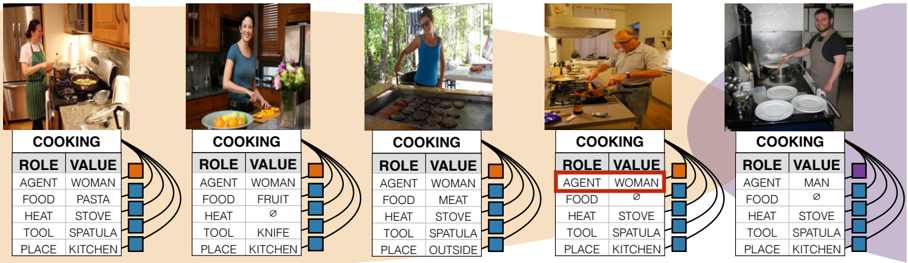
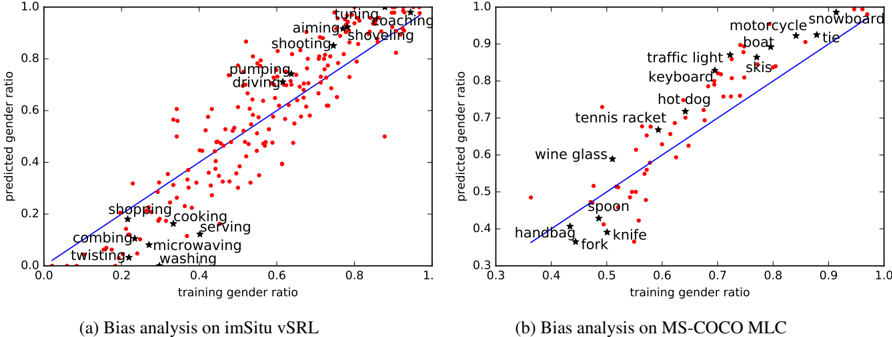
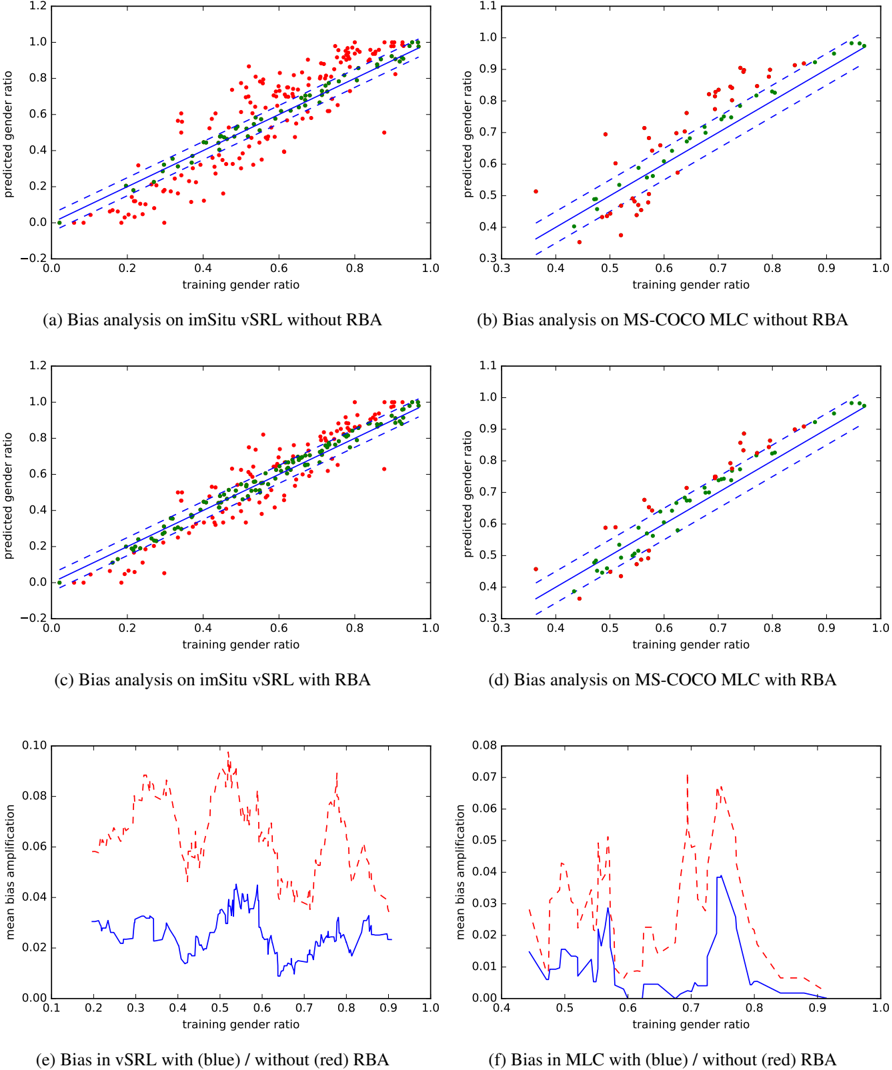
Language is increasingly being used to define rich visual recognition problems with supporting image collections sourced from the web.Structured prediction models are used in these tasks to take advantage of correlations between co-occurring labels and visual input but risk inadvertently encoding social biases found in web corpora.In this work, we study data and models associated with multilabel object classification and visual semantic role labeling.We find that (a) datasets for these tasks contain significant gender bias and (b) models trained on these datasets further amplify existing bias.For example, the activity cooking is over 33% more likely to involve females than males in a training set, and a trained model further amplifies the disparity to 68% at test time.We propose to inject corpus-level constraints for calibrating existing structured prediction models and design an algorithm based on Lagrangian relaxation for collective inference.Our method results in almost no performance loss for the underlying recognition task but decreases the magnitude of bias amplification by 47.5% and 40.5% for multilabel classification and visual semantic role labeling, respectively.
Overview
The claims and statistics of this paper haven’t been checked yet.
Free: it reads the open-access text and checks the first 5 claims that cite a source we can check. Create a free account to check every claim.
Integrity signals
Registry
Cites
Statistics
Figures
Verification
Claims the paper makes
The claims and statistics of this paper haven’t been checked yet.
Free: it reads the open-access text and checks the first 5 claims that cite a source we can check. Create a free account to check every claim.
Claims other papers make about this one
Each is checked against this paper’s own text: does it say what the citing paper says it does?
The source backs part of the claim, not all of it — or backs it for a different population, condition or comparison.
In the citing paper
“and processes of creating resources and technologies may further entrench such disparities [25, 38, 144].”
From Data Governance in the Age of Large-Scale Data-Driven Language Technology (2022) · cites this paper as [144]
Experimental — accuracy not yet measuredThe source backs part of the claim, not all of it — or backs it for a different population, condition or comparison.
In the citing paper
“It is well-documented that LMs learn the biases, prejudices, and racism present in the language they are trained on35–38.”
From Large language models to identify social determinants of health in electronic health records (2024) · cites this paper as [36]
Experimental — accuracy not yet measuredThe source backs part of the claim, not all of it — or backs it for a different population, condition or comparison.
In the citing paper
“Neural networks are prone to learning biases from training data and amplifying them at test time50, giving rise to a much discussed aspect of AI behaviour: fairness51.”
From The METRIC-framework for assessing data quality for trustworthy AI in medicine: A systematic review (2024) · cites this paper as [50]
Experimental — accuracy not yet measuredThe cited source says what the claim attributes to it.
In the citing paper
“It is well acknowledged that machine learning models, such as those ofered by the API providers, are prone to exhibiting various kinds of discriminatory behaviours, including diferent error rates across demographic groups [22,126,127], stereotyping [64,163] or minority groups under-representation [134,137].”
From Out of Context: Investigating the Bias and Fairness Concerns of “Artificial Intelligence as a Service” (2023) · cites this paper as [163]
Self-check
Percentages, sums and reported differences re-computed from the paper’s own numbers.
The self-check needs the paper’s full text.
Citations
Cites
Very Deep Convolutional Networks for Large-Scale Image Recognition
Simonyan, K., & Zisserman, A. (2014) · arXiv · doi:10.48550/arxiv.1409.1556 · Cited by 114,148 · cited 1×
“where each potential value in the CRF for subpart x, is computed using features fi from the VGG convolutional neural network (Simonyan and Zisserman, 2014) on an input image, as follows:”
MethodMicrosoft COCO: Common Objects in Context
Lin, T.-Y., Maire, M., Belongie, S., Hays, J., Perona, P., Ramanan, D., Dollár, P., & Zitnick, C. L. (2014) · Lecture Notes in Computer Science · doi:10.1007/978-3-319-10602-1_48 · Cited by 45,460 · cited 2×
“For MLC, we use MS-COCO (Lin et al., 2014; Chen et al., 2015), a recognition task covering 80 object classes.”
MethodShow and tell: A neural image caption generator
Vinyals, O., Toshev, A., Bengio, S., & Erhan, D. (2015) · 2015 IEEE Conference on Computer Vision and Pattern Recognition (CVPR) · doi:10.1109/cvpr.2015.7298935 · Cited by 6,318 · cited 2×
“Visual recognition tasks involving language, such as captioning (Vinyals et al., 2015), visual question answering (Antol et al.”
BackgroundVQA: Visual Question Answering
Antol, S., Agrawal, A., Lu, J., Mitchell, M., Batra, D., Zitnick, C. L., & Parikh, D. (2015) · 2015 IEEE International Conference on Computer Vision (ICCV) · doi:10.1109/iccv.2015.279 · Cited by 4,487
Dwork, C., Hardt, M., Pitassi, T., Reingold, O., & Zemel, R. (2012) · Proceedings of the 3rd Innovations in Theoretical Computer Science Conference · doi:10.1145/2090236.2090255 · Cited by 3,501 · cited 1×
“Various approaches have been proposed to make a “fair” binary classification (Baro-cas and Selbst, 2014; Dwork et al., 2012; Feldman et al., 2015; Zliobaite, 2015).”
BackgroundBarocas, S., & Selbst, A. D. (2014) · doi:10.2139/ssrn.2477899 · Cited by 3,048
Semantics derived automatically from language corpora contain human-like biases
Caliskan, A., Bryson, J. J., & Narayanan, A. (2017) · Science · doi:10.1126/science.aal4230 · Cited by 2,887 · cited 2×
“Such issues have been demonstrated in various learning systems, including online advertisement systems (Sweeney, 2013), word embedding models (Bolukbasi et al., 2016; Caliskan et al., 2017), online news (Ross and Carter, 2011), web search (Kay et al., 2015), and credit score (Hardt et al., 2016).”
BackgroundEquality of Opportunity in Supervised Learning
Hardt, M., Price, E., & Srebro, N. (2016) · arXiv · doi:10.48550/arxiv.1610.02413 · Cited by 2,536 · cited 1×
“Such issues have been demonstrated in various learning systems, including online advertisement systems (Sweeney, 2013), word embedding models (Bolukbasi et al., 2016; Caliskan et al., 2017), online news (Ross and Carter, 2011), web search (Kay et al., 2015), and credit score (Hardt et al., 2016).”
BackgroundBaker, C. F., Fillmore, C. J., & Lowe, J. B. (1998) · Proceedings of the 36th annual meeting on Association for Computational Linguistics - · doi:10.3115/980845.980860 · Cited by 2,518 · cited 2×
“Dataset We evaluate on imSitu (Yatskar et al., 2016) where activity classes are drawn from verbs and roles in FrameNet (Baker et al., 1998) and noun categories are drawn from WordNet (Miller et al., 1990).”
BackgroundMethodCertifying and Removing Disparate Impact
Feldman, M., Friedler, S. A., Moeller, J., Scheidegger, C., & Venkatasubramanian, S. (2015) · Proceedings of the 21th ACM SIGKDD International Conference on Knowledge Discovery and Data Mining · doi:10.1145/2783258.2783311 · Cited by 1,827 · cited 2×
“e cost of making mistakes on samples in the minority class can be neglected. Various approaches have been proposed to make a “fair” binary classification (Barocas and Selbst, 2014; Dwork et al., 2012; Feldman et al., 2015; Zliobaite, 2015). For structured prediction tasks the effect is harder to quantify and we are the…”
Background
Research works printed but not linked: 4
- Stanislaw Antol, Aishwarya Agrawal, Jiasen Lu, Mar- garet Mitchell, Dhruv Batra, C Lawrence Zitnick, and Devi Parikh. 2015. Vqa: Visual question an- swering. In Proceedings of the IEEE International Conference on Computer Vision, pages 2425-2433.
- Tolga Bolukbasi, Kai-Wei Chang, James Y Zou, Venkatesh Saligrama, and Adam T Kalai. 2016. Man is to computer programmer as woman is to homemaker? debiasing word embeddings. In The Conference on Advances in Neural Information Pro- cessing Systems (NIPS), pages 4349-4357.
- Bernhard Korte and Jens Vygen. 2008. Combinatorial Optimization: Theory and Application. Springer Verlag.
- G. Miller, R. Beckwith, C. Fellbaum, D. Gross, and K.J. Miller. 1990. Wordnet: An on-line lexical database. International Journal of Lexicography, 3(4):235-312.
Cited by
Items 401–500 of 834
The Influences of Task Design on Crowdsourced Judgement: A Case Study of Recidivism Risk Evaluation
Duan, X., Ho, C.-J., & Yin, M. (2022) · International World Wide Web Conference (WWW) · doi:10.1145/3485447.3512239 · Cited by 16
Measuring Social Biases of Crowd Workers using Counterfactual QueriesPreprint
Ghai, B., Liao, Q. V., Zhang, Y., & Mueller, K. D. (2020) · arXiv (Cornell University) · doi:10.48550/arxiv.2004.02028 · Cited by 12
“have been found to contain significant social biases [5].”
BackgroundMitigate Gender Bias Using Negative Multi-task Learning
Gao, L., Zhan, H., Chen, A., & Sheng, V. S. (2023) · Neural Processing Letters · doi:10.1007/s11063-023-11368-0 · Cited by 18
“Models trained from the source data not only encode but even amplify the bias present in dataset [6].”
BackgroundExtracting or Guessing? Improving Faithfulness of Event Temporal Relation Extraction
Wang, H., Zhang, H., Deng, Y., Gardner, J. R., Roth, D., & Chen, M. (2023) · Conference of the European Chapter of the Association for Computational Linguistics · doi:10.18653/v1/2023.eacl-main.39 · Cited by 29
Comparing Biases and the Impact of Multilingual Training across Multiple Languages
Levy, S., John, N. A., Liu, L., Vyas, Y., Ma, J., Fujinuma, Y., Ballesteros, M., Castelli, V., & Roth, D. (2023) · Conference on Empirical Methods in Natural Language Processing (EMNLP) · doi:10.18653/v1/2023.emnlp-main.634 · Cited by 64
Tu, G., Jing, R., Liang, B., Yang, M., Wong, K., & Xu, R. (2023) · Conference on Empirical Methods in Natural Language Processing (EMNLP) · doi:10.18653/v1/2023.emnlp-main.967 · Cited by 19
A Survey on the Impact of Pre-Trained Language Models in Sentiment Classification Task
Gautam, H., Gaur, A., & Yadav, D. K. (2025) · International Journal of Data Science and Analytics · doi:10.1007/s41060-025-00805-z · Cited by 26
Epistemic Uncertainty-Weighted Loss for Visual Bias Mitigation
Stone, R. S., Ravikumar, N., Bulpitt, A. J., & Hogg, D. (2022) · IEEE/CVF Conference on Computer Vision and Pattern Recognition Workshops (CVPRW) · doi:10.1109/cvprw56347.2022.00327 · Cited by 22
“• Bias amplification score [35] proposed first in a natural language processing setting and generalised for the CIFAR-10S dataset in Equation 6 as suggested in [31].”
MethodUnbiasedNets: a dataset diversification framework for robustness bias alleviation in neural networks
Naseer, M., Prabakaran, B. S., Hasan, O., & Shafique, M. (2023) · Machine Learning · doi:10.1007/s10994-023-06314-z · Cited by 12
“…bias analysis (Alvi et al., 2018; Gat et al., 2020; Kim et al., 2019; Nam et al., 2020; Li et al., 2018; Li & Vasconcelos, 2019; Zhang et al., 2019; Zhao et al., 2017) focus (often solely) on NNs working on visual datasets—this comes to no surprise since a bias in these datasets is visually…”
BackgroundInfluentialImproving Fairness using Vision-Language Driven Image Augmentation
Moreno D’Incà, Tzelepis, C., Patras, I., & Sebe, N. (2024) · IEEE Winter Conference on Applications of Computer Vision · doi:10.1109/wacv57701.2024.00463 · Cited by 15
Parallax: Visualizing and Understanding the Semantics of Embedding Spaces via Algebraic Formulae
Molino, P., Wang, Y., & Zhang, J. (2019) · Annual Meeting of the Association for Computational Linguistics: System Demonstrations (ACL Demo) · doi:10.18653/v1/p19-3028 · Cited by 11
“Studies have shown how embeddings incorporate gender and ethnic biases ((Garg et al., 2018; Bolukbasi et al., 2016; Islam et al., 2017)), while other studies focused on warping spaces in order to de-bias the resulting embeddings ((Bolukbasi et al., 2016; Zhao et al., 2017)).”
BackgroundJourdan, F., Kaninku, T. T., Asher, N. M., Loubes, J., & Risser, L. (2023) · Algorithms · doi:10.3390/a16030174 · Cited by 17
Bias in Pruned Vision Models: In-Depth Analysis and Countermeasures
Iofinova, E., Peşte, A., & Alistarh, D. (2023) · IEEE Computer Society Conference on Computer Vision and Pattern Recognition/Proceedings - IEEE Computer Society Conference on Computer Vision and Pattern Recognition/Proceedings · doi:10.1109/cvpr52729.2023.02334 · Cited by 21
Collect, Measure, Repeat: Reliability Factors for Responsible AI Data Collection
Inel, O., Draws, T., & Aroyo, L. M. (2023) · Proceedings of the AAAI Conference on Human Computation and Crowdsourcing · doi:10.1609/hcomp.v11i1.27547 · Cited by 25
Artificial intelligence in medical education: Typologies and ethical approaches
Pręgowska, A., & Perkins, M. D. (2024) · Ethics & bioethics · doi:10.2478/ebce-2024-0004 · Cited by 16
A comprehensive analysis of gender, racial, and prompt-induced biases in large language models
Torres, N., Ulloa, C., Araya, I., Ayala, M., & Jara, S. (2024) · International Journal of Data Science and Analytics · doi:10.1007/s41060-024-00696-6 · Cited by 20
Revealing Gender Bias from Prompt to Image in Stable Diffusion
Wu, Y., Nakashima, Y., & García, N. (2025) · Journal of Imaging · doi:10.3390/jimaging11020035 · Cited by 24
“(3) Bias Score Following [78], we compute the bias score BS ( o ) for a certain object o as BS ( o ) ranges from 0 to 1, with 1 meaning the object is skewed towards masculine prompts and 0 towards feminine prompts.”
Inferring Human Traits from Facebook Statuses
Cutler, A., & Kulis, B. (2018) · Lecture notes in computer science · doi:10.1007/978-3-030-01129-1_11 · Cited by 10
“Cooking videos elicit female pronouns in machine-generated captions 68% more than male pronouns, even though the training shows only 33% more women cooking [71].”
BackgroundBias and Discrimination in Artificial Intelligence: Emergence and Impact in E-Business
Weyerer, J. C., & Langer, P. F. (2020) · Advances in e-business research series · doi:10.4018/978-1-7998-1879-3.ch011 · Cited by 14
Measuring Societal Biases from Text Corpora with Smoothed First-Order Co-occurrence
Rekabsaz, N., West, R., Henderson, J., & Hanbury, A. (2021) · Proceedings of the International AAAI Conference on Web and Social Media · doi:10.1609/icwsm.v15i1.18083 · Cited by 29
“Gender bias is also studied in various downstream tasks, such as sentiment analysis (Kiritchenko and Mohammad 2018), visual semantic role labeling (Zhao et al. 2017), coreference resolution (Zhao et al. 2018a; Rudinger et al. 2018), and text classification (Dixon et al. 2018; Barrett et al. 2019;…”
BackgroundResolving Ambiguities in Text-to-Image Generative Models
Mehrabi, N., Goyal, P., Verma, A., Dhamala, J., Kumar, V., Hu, Q., Chang, K.-W., Zemel, R. S., Galstyan, A., & Gupta, R. (2023) · Proceedings of the conference - Association for Computational Linguistics. Meeting · doi:10.18653/v1/2023.acl-long.804 · Cited by 42
“to static images in TAB, (iii) including fairness prompts in TAB that cover different activities (Zhao et al., 2017) and occupations (Nadeem et al.”
BackgroundInfluentialSelf-citationModel-Agnostic Gender Debiased Image Captioning
Hirota, Y., Nakashima, Y., & García, N. (2023) · IEEE Computer Society Conference on Computer Vision and Pattern Recognition/Proceedings - IEEE Computer Society Conference on Computer Vision and Pattern Recognition/Proceedings · doi:10.1109/cvpr52729.2023.01458 · Cited by 31
“Note that most of the publicly available pretrained models are trained on the training set of the Karpathy split [21] that uses the training and validation sets of MSCOCO for training.”
MethodFace Hallucination Revisited: An Exploratory Study on Dataset Bias
Grm, K., Pernuš, M., Cluzel, L., Scheirer, W. J., Dobrišek, S., & Štruc, V. (2019) · IEEE/CVF Conference on Computer Vision and Pattern Recognition Workshops (CVPRW) · doi:10.1109/cvprw.2019.00295 · Cited by 13
“[46] show that datasets for semantic role labeling tasks, contain significant gender bias and introduce strong associations between gender labels and verbs/objects (e.”
BackgroundWhat Makes an Image Tagger Fair?
Barlas, P., Kleanthous, S., Kyriakou, K., & Otterbacher, J. (2019) · ACM Conference on User Modeling, Adaptation and Personalization (UMAP) · doi:10.1145/3320435.3320442 · Cited by 18
“Zhao and colleagues [26] documented evidence of gender-based”
BackgroundInterrater disagreement resolution: A systematic procedure to reach consensus in annotation tasks
Oortwijn, Y., Ossenkoppele, T., & Betti, A. (2021) · UvA-DARE (University of Amsterdam) · Cited by 10
Does Data Repair Lead to Fair Models? Curating Contextually Fair Data To Reduce Model Bias
Agarwal, S., Muku, S., Anand, S., & Arora, C. (2022) · IEEE Winter Conference on Applications of Computer Vision · doi:10.1109/wacv51458.2022.00395 · Cited by 19
“To obtain gender annotations in COCO, we considered the dataset suggested by [55], and use ground truth captions given for each image to annotate an instance of a person as a man or a woman.”
BackgroundMethodCan We Improve Model Robustness through Secondary Attribute Counterfactuals?
Balashankar, A., Wang, X., Packer, B., Thain, N., Ed, H., & Beutel, A. (2021) · Conference on Empirical Methods in Natural Language Processing (EMNLP) · doi:10.18653/v1/2021.emnlp-main.386 · Cited by 17
“We approximate this constraint over with the synthetic, balanced counterfactually augmented data ˜ D (CDA) by minimizing the EO gap (Zhao et al., 2017) with respect to the primary variable (Eqn 5) and denote it by the baseline “EO+CDA”.”
MethodDataset bias: A case study for visual question answering
Das, A., Anjum, S., & Gurari, D. (2019) · Proceedings of the Association for Information Science and Technology · doi:10.1002/pra2.7 · Cited by 13
Mind the GAP: A Balanced Corpus of Gendered Ambiguous PronounsPreprint
Webster, K., Recasens, M. V., Axelrod, V., & Baldridge, J. (2018) · arXiv (Cornell University) · doi:10.48550/arxiv.1810.05201 · Cited by 9
Proceedings of the First Workshop on Storytelling
(2018) · doi:10.18653/v1/w18-15 · Cited by 11
Now you see me, now you don’t: an exploration of religious exnomination in DALL-E
Alfano, M., Abedin, E., Reimann, R., Ferreira, M., & Cheong, M. (2024) · Ethics and Information Technology · doi:10.1007/s10676-024-09760-y · Cited by 17
“…& Phan, 2022), and there is ample evidence that the training methods used in many AI systems drive a positive feedback loop that exacerbates positive discrimination in favor of those who are already favored, called bias amplification in the literature (Seshadri et al., 2023; Zhao et al., 2017).”
BackgroundLuo, J., Cherry, C., & Foster, G. F. (2024) · Transactions of the Association for Computational Linguistics · doi:10.1162/tacl_a_00645 · Cited by 32
“This trend contributes to the over-all conservative nature of MT predictions, favoring one-to-one alignments at the expense of the other (more uncertain) categories.”
BackgroundAuditing Image-based NSFW Classifiers for Content Filtering
Leu, W., Nakashima, Y., & García, N. (2024) · ACM Conference on Fairness, Accountability, and Transparency (FAccT) · doi:10.1145/3630106.3658963 · Cited by 21
“Models trained on unbalanced datasets not only mirror the biases present in the original data but also have the potential to amplify them [24, 27, 64, 66, 70, 72], leading to the generation of skewed predictions at elevated rates.”
BackgroundContrastive adversarial gender debiasing
Torres, N. (2024) · Natural Language Processing Journal · doi:10.1016/j.nlp.2024.100092 · Cited by 12
Fairness, Bias, and Ethics in AI: Exploring the Factors Affecting Student Performance
Gordon, N. A., Aljaber, T., & Omughelli, D. (2024) · Journal of Intelligent Communication · doi:10.54963/jic.v4i1.306 · Cited by 10
Vargas-Veleda, Y., Rodríguez-González, M. D. M., & Castillo, Í. M. (2025) · Journalism and Media · doi:10.3390/journalmedia6030110 · Cited by 21
Can AI with High Reasoning Ability Replicate Human-like Decision Making in Economic Experiments?
Kitadai, A., Lugo, S. D. R., Tsurusaki, Y., Fukasawa, Y., & Nishino, N. (2025) · Group Decision and Negotiation · doi:10.1007/s10726-025-09946-9 · Cited by 29
“As a result, we found a suitable setting to reproduce the distribution of the original data for the proposer side, but could not for the responder side [13].”
A Survey on Bias in Machine Learning Research
Mikołajczyk, A., & Grochowski, M. (2025) · IEEE Access · doi:10.1109/access.2025.3649998 · Cited by 12
Langer, P. F., & Weyerer, J. C. (2020) · Springer eBooks · doi:10.1007/978-3-658-30997-8_11 · Cited by 15
Peyrard, M., Ghotra, S., Josifoski, M., Agarwal, V., Patra, B., Carignan, D., Kıcıman, E., Tiwary, S., & West, R. (2022) · Conference on Empirical Methods in Natural Language Processing (EMNLP) · doi:10.18653/v1/2022.emnlp-main.387 · Cited by 16
“Alternatively, data preprocessing (Zhao et al., 2017; Zhou et al., 2021) or manipulation such as counterfacual data-augmentation (Lu et al., 2018) can yield datasets where undesired correlations are less present.”
BackgroundLatent Space Smoothing for Individually Fair Representations
Peychev, M., Ruoss, A., Balunović, M., Baader, M., & Vechev, M. (2022) · Lecture notes in computer science · doi:10.1007/978-3-031-19778-9_31 · Cited by 20
“Importantly, these models not only learn but also amplify the biases of the training data [29,91], even for balanced datasets [81].”
BackgroundMedia Bias Characterization in Brazilian Presidential Elections
Sales, A., Marinho, L. B., & Veloso, A. (2019) · ACM Conference on Hypertext and Social Media (HT) · doi:10.1145/3342220.3343656 · Cited by 10
Dialect Diversity in Text Summarization on Twitter
Keswani, V., & Celis, L. E. (2021) · International World Wide Web Conference (WWW) · doi:10.1145/3442381.3450108 · Cited by 32
“Considering the significance of these language tasks, techniques to mitigate biases in some of the above NLP applications have been proposed [6, 11, 69, 73, 74].”
BackgroundUnderstanding Social Biases Behind Location Names in Contextual Word Embedding Models
Wu, F., Du, M., Fan, C. H., Tang, R., Yang, Y., Mostafavi, A., & Hu, X. (2021) · IEEE Transactions on Computational Social Systems · doi:10.1109/tcss.2021.3106003 · Cited by 11
Co-segmentation inspired attention module for video-based computer vision tasks
Subramaniam, A., Vaidya, J., Ameen, M., Nambiar, A., & Mittal, A. (2022) · Computer Vision and Image Understanding · doi:10.1016/j.cviu.2022.103532 · Cited by 10
“…networks exhibit different types of biases due to factors such as background, color, racial (Gwilliam et al. (2021)), gender (Tang et al. (2021); Zhao et al. (2017)), contextual (Singh et al. (2020)), co-occurrence (Petsiuk et al. (2021)), spatial noise, dataset (Tommasi et al. (2017)) and…”
BackgroundPark, J., Artin, M. G., Lee, E., May, B. L., Park, M. K., Hur, C., & Tatonetti, N. P. (2022) · Patterns · doi:10.1016/j.patter.2022.100636 · Cited by 13
The Sins of the Parents Are to Be Laid Upon the Children: Biased Humans, Biased Data, Biased Models
Osborne, M. R., Omrani, A., & Dehghani, M. (2023) · Perspectives on Psychological Science · doi:10.1177/17456916231180099 · Cited by 10
Statistical learning from biased training samples
Clémençon, S., & Laforgue, P. (2022) · Electronic Journal of Statistics · doi:10.1214/22-ejs2084 · Cited by 14
“As recently highlighted by [4], [51] or [6] among others, representativeness issues do not vanish simply under the effect of the size of the training set.”
BackgroundGender Slopes: Counterfactual Fairness for Computer Vision Models by Attribute ManipulationPreprint
Joo, J., & Kärkkäinen, K. (2020) · arXiv (Cornell University) · doi:10.48550/arxiv.2005.10430 · Cited by 9
“Many studies have reported skewed classification accuracy of existing computer vision models and APIs between gender and racial groups (Buolamwini and Gebru, 2018; Kyriakou et al., 2019; Kärkkäinen and Joo, 2019; Zhao et al., 2017).”
BackgroundBalancing out Bias: Achieving Fairness Through Training Reweighting.Preprint
Han, X., Baldwin, T., & Cohn, T. (2021) · arXiv (Cornell University) · Cited by 9
Detecting and Mitigating Bias in LLMs through Knowledge Graph-Augmented Training
Kumar, R., Kumar, H., & Shalini, K. (2025) · International Conference on Artificial Intelligence and Data Engineering (AIDE) · doi:10.1109/aide64228.2025.10987418 · Cited by 9
“Traditional methods, such as data augmentation, adversarial training, and fairness-based algorithms, have shown promise, but often struggle with the complex nature of bias in LLMs [5], [6].”
The Root Shapes the Fruit: On the Persistence of Gender-Exclusive Harms in Aligned Language Models
Ovalle, A., Pavasovic, K. L., Martin, L., Zettlemoyer, L., Smith, E. M., Chang, K.-W., Williams, A., & Sagun, L. (2025) · ACM Conference on Fairness, Accountability, and Transparency (FAccT) · doi:10.1145/3715275.3732196 · Cited by 19
“Guided by our findings, we offer recommendations contextualized to both bias evaluation and alignment procedures to better understand and address these harms (§6).”
Self-citationA comprehensive survey on deep learning approaches for image captioning: a systematic review
Al-Malla, M. A., Hamdoun, O., & Ghneim, N. (2026) · Journal Of Big Data · doi:10.1186/s40537-026-01377-w · Cited by 12
A critical analysis of the study of gender and technology in government
Feeney, M. K., & Fusi, F. (2021) · Information Polity · doi:10.3233/ip-200303 · Cited by 15
Fairness-aware training of face attribute classifiers via adversarial robustness
Zeng, H., Yue, Z., Kou, Z., Zhang, Y., Shang, L., & Wang, D. (2023) · Knowledge-Based Systems · doi:10.1016/j.knosys.2023.110356 · Cited by 13
Bias Analysis in Healthcare Time Series (BAHT) Decision Support Systems from Meta Data
Dakshit, S., Dakshit, S., Khargonkar, N., & Prabhakaran, B. (2023) · Journal of Healthcare Informatics Research · doi:10.1007/s41666-023-00133-6 · Cited by 14
“In this section, we demonstrate the presence of algorithmic bias by showing bias amplification [32].”
BackgroundBayesian nonparametric mixture modeling for temporal dynamics of gender stereotypes
Iorio, M. D., Favaro, S., Guglielmi, A., & Ye, L. (2023) · The Annals of Applied Statistics · doi:10.1214/22-aoas1717 · Cited by 8
The role of cognitive computing in NLP
Orynbay, L., Bekmanova, G., Yergesh, B., Omarbekova, A., Sairanbekova, A., & Sharipbay, A. (2025) · Frontiers in Computer Science · doi:10.3389/fcomp.2024.1486581 · Cited by 20
Exploiting Transferable Knowledge for Fairness-Aware Image Classification
Hwang, S., Park, S., Lee, P., Jeon, S., Kim, D., & Byun, H. (2021) · Lecture notes in computer science · doi:10.1007/978-3-030-69538-5_2 · Cited by 10
“, while captions for images with women are biased towards shopping or cooking, those for images with men are inclined towards driving or shooting [7].”
BackgroundHuman-Guided Modality Informativeness for Affective States
Wörtwein, T., Sheeber, L., Allen, N. B., Cohn, J. F., & Morency, L. (2021) · INTERNATIONAL CONFERENCE ON MULTIMODAL INTERACTION · doi:10.1145/3462244.3481004 · Cited by 8
Easy Adaptation to Mitigate Gender Bias in Multilingual Text Classification
Huang, X. (2022) · Conference of the North American Chapter of the Association for Computational Linguistics: Human Language Technologies (NAACL-HLT) · doi:10.18653/v1/2022.naacl-main.52 · Cited by 15
The Box Size Confidence Bias Harms Your Object Detector
Gilg, J., Teepe, T., Herzog, F., & Rigoll, G. (2023) · IEEE Winter Conference on Applications of Computer Vision · doi:10.1109/wacv56688.2023.00152 · Cited by 14
Bipol: A novel multi-axes bias evaluation metric with explainability for NLP
Alkhaled, L., Adewumi, T., & Sabry, S. S. (2023) · Natural Language Processing Journal · doi:10.1016/j.nlp.2023.100030 · Cited by 18
Anarte, L. F. (2023) · Revista Internacional de Pensamiento Político · doi:10.46661/rev.int.pensampolit..8778 · Cited by 31
Social Cues, Social Biases: Stereotypes in Annotations on People Images
Otterbacher, J. (2018) · Proceedings of the AAAI Conference on Human Computation and Crowdsourcing · doi:10.1609/hcomp.v6i1.13320 · Cited by 13
“These stereotypes would then be carried downstream into the algorithms that are trained on this data (Zhao et al. 2017).”
BackgroundCrank up the volume: preference bias amplification in collaborative recommendationPreprint
Lin, K., Sonboli, N., Mobasher, B., & Burke, R. (2019) · arXiv (Cornell University) · doi:10.48550/arxiv.1909.06362 · Cited by 37
“For the purpose of this analysis, we use bias disparity, a recently introduced group-based metric[24, 26].”
MethodRevealing Neural Network Bias to Non-Experts Through Interactive Counterfactual ExamplesPreprint
Myers, C. M., Freed, E., Pardo, L. L., Furqan, A., Risi, S., & Zhu, J. (2020) · arXiv (Cornell University) · doi:10.48550/arxiv.2001.02271 · Cited by 17
“Related Work Bias occurs in a variety of domains such as emotion recognition [17], word embeddings [6, 14], and object classification [35].”
BackgroundIdentifying Race and Gender Bias in Latent Diffusion AI Image GenerationPreprint
Anand, T., Chauhan, A., Jauhari, T., Shah, A., Singh, R., Liang, B., & Dutta, R. (2023) · SSRN Electronic Journal · doi:10.2139/ssrn.4602033 · Cited by 9
Gebru, T., & Denton, E. (2024) · Foundations and Trends® in Computer Graphics and Vision · doi:10.1561/0600000102 · Cited by 16
Winslow, B. D., Garibay, Ö. Ö., Goyal, T., Koon, S., Margetis, G., Salvendy, G., Shneiderman, B., Tayebi, A., & Vardoulakis, L. (2026) · International Journal of Human-Computer Interaction · doi:10.1080/10447318.2026.2641703 · Cited by 17
Das, D., Talon, D., Mancini, M., Wang, Y., & Ricci, E. (2025) · IEEE Winter Conference on Applications of Computer Vision · doi:10.1109/wacv61041.2025.00550 · Cited by 12
“However, this strategy does not take into account the inherent biases of the dataset on the type of questions and the fact that generative models not only reflect but also exaggerate such biases [28, 59].”
Morello, S. L., Rogus‐Pulia, N. M., Branchaw, J. L., Bräuer, M., Schwakopf, J. M., & Carnes, M. L. (2021) · Journal of Veterinary Medical Education · doi:10.3138/jvme-2020-0143 · Cited by 9
“39 As background for performing this study, we conducted simple Google image searches for the terms veterinary , veterinary medicine , and veterinarian .”
MethodFair Representation Learning in Knowledge-aware Recommendation
Xu, B., Cui, Y., Sun, Z., Deng, L., & Zheng, K. (2021) · IEEE International Conference on Big Knowledge (ICBK) · doi:10.1109/ickg52313.2021.00058 · Cited by 10
Text Analysis in Python for Social Scientists: Prediction and Classification
Hovy, D. (2022) · Cambridge University Press eBooks · doi:10.1017/9781108960885 · Cited by 21
Unsupervised Mitigating Gender Bias by Character Components: A Case Study of Chinese Word Embedding
Chen, X., Li, M., Yan, R., Gao, X., & Zhang, X. (2022) · Workshop on Gender Bias in Natural Language Processing (GeBNLP) · doi:10.18653/v1/2022.gebnlp-1.14 · Cited by 7
“Notable examples also include visual SRL (cooking is stereotypically done by women, construction workers are stereotypically men, (Zhao et al., 2017)), lexical semantics (“man is to computer programmer as woman is to homemaker”, (Bolukbasi et al., 2016)) and so on.”
BackgroundTowards Better Detection of Biased Language with Scarce, Noisy, and Biased Annotations
Li, Z., Lu, Z., & Yin, M. (2022) · Proceedings of the AAAI/ACM Conference on AI Ethics and Society · doi:10.1145/3514094.3534142 · Cited by 14
“For debiased text generation, some works [6, 32, 65, 66] consider it as the style transfer task [14, 17], which aim to reduce the “bias” dimension in the sentence style embedding through the supervised training with parallel corpus.”
BackgroundFairLib: A Unified Framework for Assessing and Improving Fairness
Han, X., Shen, A., Li, Y., Frermann, L., Baldwin, T., & Cohn, T. (2022) · Conference on Empirical Methods in Natural Language Processing: System Demonstrations (EMNLP) · doi:10.18653/v1/2022.emnlp-demos.7 · Cited by 20
“PreBD (Zhao et al., 2017) Equalize the size of protected groups.”
BackgroundMethodInfluentialLearning Debiased Representations via Conditional Attribute Interpolation
Zhang, Y., Wang, Q., Zhan, D., & Ye, H.-J. (2023) · IEEE Computer Society Conference on Computer Vision and Pattern Recognition/Proceedings - IEEE Computer Society Conference on Computer Vision and Pattern Recognition/Proceedings · doi:10.1109/cvpr52729.2023.00734 · Cited by 15
“such as recommendation system [8, 35, 53, 59] and neural language processing [13, 14, 33, 41, 56].”
BackgroundMeasuring Sentiment Bias in Machine Translation
Hartung, K., Herygers, A., Kurlekar, S. V., Zakaria, K., Volkan, T., Gröttrup, S., & Georges, M. (2023) · Lecture notes in computer science · doi:10.1007/978-3-031-40498-6_8 · Cited by 18
The Daunting Task of Real-World Textual Style Transfer Auto-EvaluationPreprint
Pang, R. Y. (2019) · arXiv (Cornell University) · doi:10.48550/arxiv.1910.03747 · Cited by 10
Towards Debiasing Sentence RepresentationsPreprint
Liang, P. P., Li, I., Zheng, E., Lim, Y. C., Salakhutdinov, R., & Morency, L. (2020) · arXiv (Cornell University) · doi:10.48550/arxiv.2007.08100 · Cited by 81
“Systems that incorporate these embeddings can further amplify biases [24, 34, 3] and unfairly discriminate against users, particularly those from disadvantaged social groups.”
BackgroundEquitable Allocation of Healthcare Resources with Fair Cox ModelsPreprint
Keya, K. N., Islam, R., Pan, S., Stockwell, I., & Foulds, J. R. (2020) · arXiv (Cornell University) · doi:10.13016/m2linh-rxcx · Cited by 14
Spennemann, D. H. R. (2025) · SSRN Electronic Journal · doi:10.2139/ssrn.5393987 · Cited by 9
A General Framework for Implicit and Explicit Debiasing of Distributional Word Vector Spaces
Lauscher, A., Glavaš, G., Ponzetto, S. P., & Vulić, I. (2020) · Proceedings of the AAAI Conference on Artificial Intelligence · doi:10.1609/aaai.v34i05.6325 · Cited by 41
“…analyses (Garg et al. 2018), they (1) raise ethical issues, since biases are amplified by machine learning models using embeddings as input (Zhao et al. 2017), and (2) impede tasks like coreference resolution (Zhao et al. 2018a; Rudinger et al. 2018) and abusive language detection (Park,…”
BackgroundIs Gender-Neutral AI the Correct Solution to Gender Bias? Using Speech-Based Conversational Agents
Yeon, J., Park, Y., & Kim, D. (2023) · Archives of Design Research · doi:10.15187/adr.2023.05.36.2.63 · Cited by 8
ImageCaptioner2: Image Captioner for Image Captioning Bias Amplification Assessment
Abdelrahman, E., Sun, P., Li, L. E., & Elhoseiny, M. (2024) · Proceedings of the AAAI Conference on Artificial Intelligence · doi:10.1609/aaai.v38i19.30080 · Cited by 15
Creative ML Assemblages: The Interactive Politics of People, Processes, and Products
Shelby, R., Srinivasan, R., Burgdorf, K., Lena, J. C., & Rostamzadeh, N. (2024) · Proceedings of the ACM on Human-Computer Interaction · doi:10.1145/3637315 · Cited by 6
“Achilleos described how her creative process offered critical commentary on both Baker’s Orientalist gaze and continued colonialism in digital and ML imagery [2].”
MethodAn Overview of Fairness in Data – Illuminating the Bias in Data Pipeline
Kumar, B. S., Chandrabose, A., & Chakravarthi, B. R. (2021) · Cited by 17
Predicting Visual Political Bias Using Webly Supervised Data and an Auxiliary Task
Thomas, C., & Kovashka, A. (2021) · International Journal of Computer Vision · doi:10.1007/s11263-021-01506-3 · Cited by 23
“This bias over human qualities is evident in data that can be used to train machine learning algorithms, and has thus been tackled in a few prior works (Burns et al., 2018; Zhao et al., 2017; Ryu et al., 2017; Bechavod and Ligett, 2017; Bolukbasi et al., 2016).”
BackgroundAn Empirical Study on the Fairness of Pre-trained Word Embeddings
Sesari, E., Hort, M., & Sarro, F. (2022) · Workshop on Gender Bias in Natural Language Processing (GeBNLP) · doi:10.18653/v1/2022.gebnlp-1.15 · Cited by 11
“It has been discovered that word embeddings do not only reflect but also have the tendency to amplify the biases present in the data they are trained on (Wang and Russakovsky, 2021) which can lead to the spread of unfavourable stereotypes (Zhao et al., 2017).”
BackgroundIndigenous Language Revitalization and the Dilemma of Gender Bias
Hansal, O., Le, N. T., & Sadat, F. (2022) · Workshop on Gender Bias in Natural Language Processing (GeBNLP) · doi:10.18653/v1/2022.gebnlp-1.25 · Cited by 15
“Sometimes, for example, when visual recognition tasks fail to recognize female doctors (Zhao et al., 2017; Rudinger et al., 2018), image caption models do not detect women sitting next to the machine (Hendricks et al., 2018); and automatic speech recognition works best with male voices (Tatman,…”
BackgroundData journeys: Explaining AI workflows through abstraction
Daga, E., & Groth, P. (2023) · Semantic Web · doi:10.3233/sw-233407 · Cited by 13
“This is because any biases in the training data or data preparation can have significant down stream impacts [60,71].”
BackgroundBack Deduction Based Testing for Word Sense Disambiguation Ability of Machine Translation Systems
Wang, J., Li, Y., Huang, X., Chen, L., Zhang, X., & Zhou, Y. (2023) · ACM SIGSOFT International Symposium on Software Testing and Analysis (ISSTA) · doi:10.1145/3597926.3598081 · Cited by 7
“Machine translation systems usually employ neural machine translation [27], relying on large-scale training data, which contains inevitable biases and stereotypes [4, 20, 23, 35].”
BackgroundReinforced Sequence Training based Subjective Bias Correction
Madanagopal, K., & Caverlee, J. (2023) · Conference of the European Chapter of the Association for Computational Linguistics · doi:10.18653/v1/2023.eacl-main.189 · Cited by 13
“The majority of research to address bias correction in text has focused on demographic bias like gender bias (Manzini et al., 2019; Zhao et al., 2017, 2019; Bordia and Bowman, 2019; Wang et al., 2018).”
BackgroundGender Biases in Automatic Evaluation Metrics for Image Captioning
Qiu, H., Dou, Z.-Y., Wang, T., Çelikyılmaz, A., & Peng, N. (2023) · Conference on Empirical Methods in Natural Language Processing (EMNLP) · doi:10.18653/v1/2023.emnlp-main.520 · Cited by 25
“It has been pointed out (Bolukbasi et al., 2016; Zhao et al., 2017; Bender et al., 2021) that there are societal biases encoded in the model training data, and models pretrained on these data can amplify the biases and potentially harm marginalized populations.”
BackgroundSelf-citationThe dangers of automating social programs
Shein, E. (2018) · Communications of the ACM · doi:10.1145/3264627 · Cited by 6
Matsangidou, M., & Otterbacher, J. (2019) · Lecture notes in computer science · doi:10.1007/978-3-030-29390-1_14 · Cited by 8
“A convincing example was given by a study where a photo of either a “beautiful” or an “unattractive” woman was given to a heterosexual man, along with biographical information [51].”
BackgroundThrough a Fair Looking-Glass: Mitigating Bias in Image Datasets
Rajabi, A., Yazdani-Jahromi, M., Garibay, Ö. Ö., & Sukthankar, G. (2023) · Lecture notes in computer science · doi:10.1007/978-3-031-35891-3_27 · Cited by 9
Metadata
- Authors
- Zhao, J., Wang, T., Yatskar, M., Ordonez, V., & Chang, K.-W.
- Affiliations
- University of Virginia (US)
- University of Washington (US)
- Venue
- Proceedings of the 2017 Conference on Empirical Methods in Natural Language Processing
- Published
- 2017
- Pages
- 2979-2989
- OpenAlex
- W2962787423
- Semantic Scholar
- 135bafc83e9a73c88e759f98a28edfdb5c02f81d
- Cited by
- 829
- References
- 30
- Citations by year
- 2026: 36 · 2025: 86 · 2024: 82 · 2023: 133 · 2022: 122 · 2021: 114 · 2020: 108 · 2019: 97 · 2018: 48 · 2017: 3
- FWCI
- 174.43
- Type
- conference paper
- Language
- en
- Open access
- hybrid
- doi.org
- Licence
- cc-by
- Locations
- Conference on Empirical Methods in Natural Language Processing (EMNLP) (publishedVersion, cc-by)
- arXiv (Cornell University) (submittedVersion)
- arXiv (Cornell University)
- Funders
- National Science Foundation (1657193)
- Nvidia
- Topics
- Physical Sciences › Computer Science › Artificial Intelligence › Ethics and Social Impacts of AI
- Physical Sciences › Computer Science › Computer Vision and Pattern Recognition › Advanced Neural Network Applications
- Physical Sciences › Computer Science › Computer Vision and Pattern Recognition › Multimodal Machine Learning Applications
- Keywords
- gender bias, bias amplification, structured prediction, Lagrangian relaxation, collective inference, image collections, cooking
About these checks
Registry, retraction, Cites and statistics results are computed, not judged, with one exception: a printed reference that no index lists is read once by a model before it counts as a citation error. Claims are extracted by a model and kept only when their quote appears verbatim in the text; each cited source is then checked, with a model’s help, for whether it says what the claim relies on. Those verdicts can be wrong — read the claim’s quote and the cited source before relying on one.
Statistics and arithmetic are recomputed, not judged.
Confidence bands are shown only for fields calibrated on our annotated test set. None is calibrated yet, so no band is shown.
What counts as a claim ›How we measure confidence ›How we check this ›
Are you an author, or do you see a problem with this page? Request a review
Data sources
Bibliographic data: Semantic Scholar, OpenAlex, Crossref.
Contains information from the Semantic Scholar Academic Graph Datasets, made available under the ODC Attribution License (ODC-BY 1.0).
Semantic Scholar’s data is described in: Kinney, R., et al. (2023). The Semantic Scholar Open Data Platform. arXiv:2301.10140.
