

Men Also Like Shopping: Reducing Gender Bias Amplification using Corpus-level Constraints
Open accessThe DOI matches its Crossref record; 30 of the 30 references it cites were found in a registry or an index.
Abstract
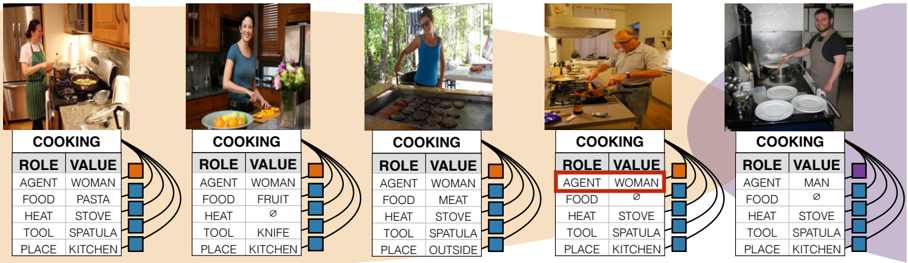
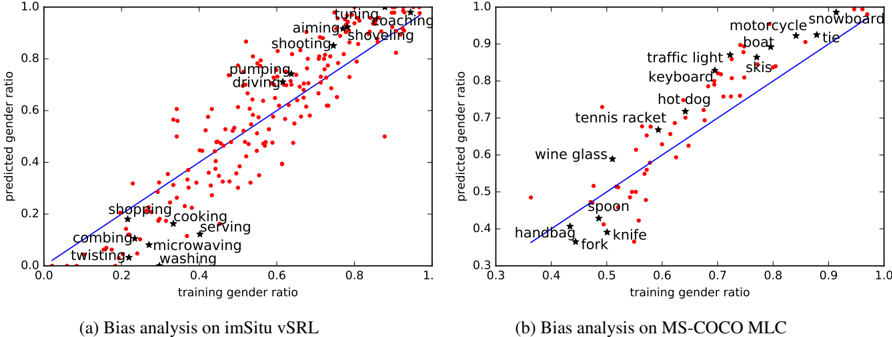
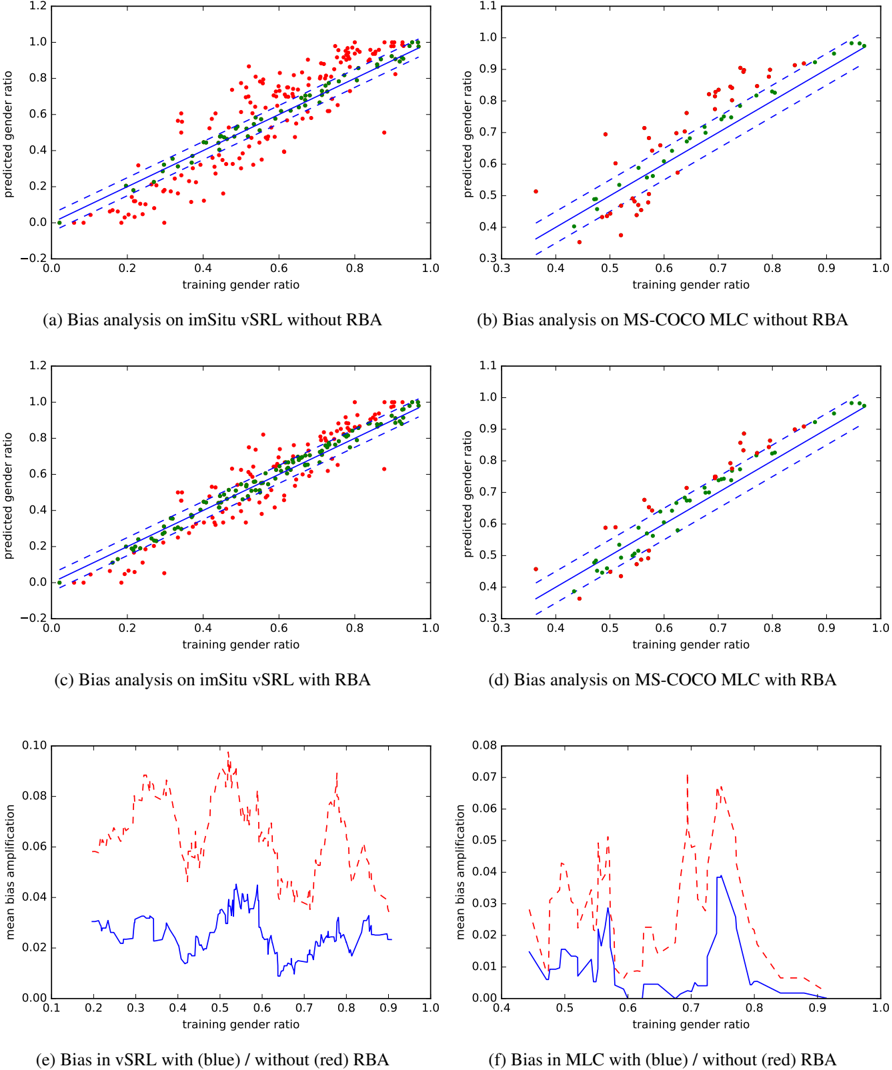
Language is increasingly being used to define rich visual recognition problems with supporting image collections sourced from the web.Structured prediction models are used in these tasks to take advantage of correlations between co-occurring labels and visual input but risk inadvertently encoding social biases found in web corpora.In this work, we study data and models associated with multilabel object classification and visual semantic role labeling.We find that (a) datasets for these tasks contain significant gender bias and (b) models trained on these datasets further amplify existing bias.For example, the activity cooking is over 33% more likely to involve females than males in a training set, and a trained model further amplifies the disparity to 68% at test time.We propose to inject corpus-level constraints for calibrating existing structured prediction models and design an algorithm based on Lagrangian relaxation for collective inference.Our method results in almost no performance loss for the underlying recognition task but decreases the magnitude of bias amplification by 47.5% and 40.5% for multilabel classification and visual semantic role labeling, respectively.
Overview
The claims and statistics of this paper haven’t been checked yet.
Free: it reads the open-access text and checks the first 5 claims that cite a source we can check. Create a free account to check every claim.
Integrity signals
Registry
Cites
Statistics
Figures
Verification
Claims the paper makes
The claims and statistics of this paper haven’t been checked yet.
Free: it reads the open-access text and checks the first 5 claims that cite a source we can check. Create a free account to check every claim.
Claims other papers make about this one
Each is checked against this paper’s own text: does it say what the citing paper says it does?
The source backs part of the claim, not all of it — or backs it for a different population, condition or comparison.
In the citing paper
“and processes of creating resources and technologies may further entrench such disparities [25, 38, 144].”
From Data Governance in the Age of Large-Scale Data-Driven Language Technology (2022) · cites this paper as [144]
Experimental — accuracy not yet measuredThe source backs part of the claim, not all of it — or backs it for a different population, condition or comparison.
In the citing paper
“It is well-documented that LMs learn the biases, prejudices, and racism present in the language they are trained on35–38.”
From Large language models to identify social determinants of health in electronic health records (2024) · cites this paper as [36]
Experimental — accuracy not yet measuredThe source backs part of the claim, not all of it — or backs it for a different population, condition or comparison.
In the citing paper
“Neural networks are prone to learning biases from training data and amplifying them at test time50, giving rise to a much discussed aspect of AI behaviour: fairness51.”
From The METRIC-framework for assessing data quality for trustworthy AI in medicine: A systematic review (2024) · cites this paper as [50]
Experimental — accuracy not yet measuredThe cited source says what the claim attributes to it.
In the citing paper
“It is well acknowledged that machine learning models, such as those ofered by the API providers, are prone to exhibiting various kinds of discriminatory behaviours, including diferent error rates across demographic groups [22,126,127], stereotyping [64,163] or minority groups under-representation [134,137].”
From Out of Context: Investigating the Bias and Fairness Concerns of “Artificial Intelligence as a Service” (2023) · cites this paper as [163]
Self-check
Percentages, sums and reported differences re-computed from the paper’s own numbers.
The self-check needs the paper’s full text.
Citations
Cites
Very Deep Convolutional Networks for Large-Scale Image Recognition
Simonyan, K., & Zisserman, A. (2014) · arXiv · doi:10.48550/arxiv.1409.1556 · Cited by 114,148 · cited 1×
“where each potential value in the CRF for subpart x, is computed using features fi from the VGG convolutional neural network (Simonyan and Zisserman, 2014) on an input image, as follows:”
MethodMicrosoft COCO: Common Objects in Context
Lin, T.-Y., Maire, M., Belongie, S., Hays, J., Perona, P., Ramanan, D., Dollár, P., & Zitnick, C. L. (2014) · Lecture Notes in Computer Science · doi:10.1007/978-3-319-10602-1_48 · Cited by 45,460 · cited 2×
“For MLC, we use MS-COCO (Lin et al., 2014; Chen et al., 2015), a recognition task covering 80 object classes.”
MethodShow and tell: A neural image caption generator
Vinyals, O., Toshev, A., Bengio, S., & Erhan, D. (2015) · 2015 IEEE Conference on Computer Vision and Pattern Recognition (CVPR) · doi:10.1109/cvpr.2015.7298935 · Cited by 6,318 · cited 2×
“Visual recognition tasks involving language, such as captioning (Vinyals et al., 2015), visual question answering (Antol et al.”
BackgroundVQA: Visual Question Answering
Antol, S., Agrawal, A., Lu, J., Mitchell, M., Batra, D., Zitnick, C. L., & Parikh, D. (2015) · 2015 IEEE International Conference on Computer Vision (ICCV) · doi:10.1109/iccv.2015.279 · Cited by 4,487
Dwork, C., Hardt, M., Pitassi, T., Reingold, O., & Zemel, R. (2012) · Proceedings of the 3rd Innovations in Theoretical Computer Science Conference · doi:10.1145/2090236.2090255 · Cited by 3,501 · cited 1×
“Various approaches have been proposed to make a “fair” binary classification (Baro-cas and Selbst, 2014; Dwork et al., 2012; Feldman et al., 2015; Zliobaite, 2015).”
BackgroundBarocas, S., & Selbst, A. D. (2014) · doi:10.2139/ssrn.2477899 · Cited by 3,048
Semantics derived automatically from language corpora contain human-like biases
Caliskan, A., Bryson, J. J., & Narayanan, A. (2017) · Science · doi:10.1126/science.aal4230 · Cited by 2,887 · cited 2×
“Such issues have been demonstrated in various learning systems, including online advertisement systems (Sweeney, 2013), word embedding models (Bolukbasi et al., 2016; Caliskan et al., 2017), online news (Ross and Carter, 2011), web search (Kay et al., 2015), and credit score (Hardt et al., 2016).”
BackgroundEquality of Opportunity in Supervised Learning
Hardt, M., Price, E., & Srebro, N. (2016) · arXiv · doi:10.48550/arxiv.1610.02413 · Cited by 2,536 · cited 1×
“Such issues have been demonstrated in various learning systems, including online advertisement systems (Sweeney, 2013), word embedding models (Bolukbasi et al., 2016; Caliskan et al., 2017), online news (Ross and Carter, 2011), web search (Kay et al., 2015), and credit score (Hardt et al., 2016).”
BackgroundBaker, C. F., Fillmore, C. J., & Lowe, J. B. (1998) · Proceedings of the 36th annual meeting on Association for Computational Linguistics - · doi:10.3115/980845.980860 · Cited by 2,518 · cited 2×
“Dataset We evaluate on imSitu (Yatskar et al., 2016) where activity classes are drawn from verbs and roles in FrameNet (Baker et al., 1998) and noun categories are drawn from WordNet (Miller et al., 1990).”
BackgroundMethodCertifying and Removing Disparate Impact
Feldman, M., Friedler, S. A., Moeller, J., Scheidegger, C., & Venkatasubramanian, S. (2015) · Proceedings of the 21th ACM SIGKDD International Conference on Knowledge Discovery and Data Mining · doi:10.1145/2783258.2783311 · Cited by 1,827 · cited 2×
“e cost of making mistakes on samples in the minority class can be neglected. Various approaches have been proposed to make a “fair” binary classification (Barocas and Selbst, 2014; Dwork et al., 2012; Feldman et al., 2015; Zliobaite, 2015). For structured prediction tasks the effect is harder to quantify and we are the…”
Background
Research works printed but not linked: 4
- Stanislaw Antol, Aishwarya Agrawal, Jiasen Lu, Mar- garet Mitchell, Dhruv Batra, C Lawrence Zitnick, and Devi Parikh. 2015. Vqa: Visual question an- swering. In Proceedings of the IEEE International Conference on Computer Vision, pages 2425-2433.
- Tolga Bolukbasi, Kai-Wei Chang, James Y Zou, Venkatesh Saligrama, and Adam T Kalai. 2016. Man is to computer programmer as woman is to homemaker? debiasing word embeddings. In The Conference on Advances in Neural Information Pro- cessing Systems (NIPS), pages 4349-4357.
- Bernhard Korte and Jens Vygen. 2008. Combinatorial Optimization: Theory and Application. Springer Verlag.
- G. Miller, R. Beckwith, C. Fellbaum, D. Gross, and K.J. Miller. 1990. Wordnet: An on-line lexical database. International Journal of Lexicography, 3(4):235-312.
Cited by
Items 801–834 of 834
Ordonnancement par similarité pour la biométrie : théorie et pratique
Vogel, R. (2020) · theses.fr (ABES) · doi:10.70675/5bdaaedcz78d8z48aczb5e6zc178ffa29310
Deep Multimodal Learning for Vision and Language Processing
Cadène, R. (2020) · theses.fr (ABES) · doi:10.70675/674b1e7aza957z4fc5za03czde9aab142a84 · Cited by 1
On Subjectivity, Bias and Fairness in Language Model Learning
Gaci, Y. (2023) · theses.fr (ABES) · doi:10.70675/dca82074za0c4z46d1z8a6bz96ce30bea3b6 · Cited by 3
Vers des explications narratives pour des recommandations au sein d’un territoire augmenté
Marchal, F. (2024) · theses.fr (ABES) · doi:10.70675/0c77dc58z59a1z4042za7e7z9baf8170fee7
Advancing fairness in natural language processing : from traditional methods to explainability
Jourdan, F. (2024) · theses.fr (ABES) · doi:10.70675/b8535a05z82f1z46f7z9688z3cd35cea8381 · Cited by 5
Prouteau, T. (2024) · theses.fr (ABES) · doi:10.70675/ee88c2aaz77caz4746z8207z9263b8d9c722 · Cited by 1
Study of the multimodal understanding of vision-language transformer models
Salin, E. (2023) · theses.fr (ABES) · doi:10.70675/2beca704z5d3bz421dzbf61z61e00610aaeb
Szakonyi, A., & Koursaris, C. M. (2026) · Advances in computational intelligence and robotics book series · doi:10.4018/979-8-2600-1016-7.ch004
MongoTalk: An Agentic AI Framework for Conversational and Autonomous No-Code MongoDB Management
Patle, A., Ajalkar, D. A., Siddheshwar, S., Vijay, V., & Shirsath, D. (2025) · Joint International Conference on Data Science & Management of Data (CODS-COMAD) · doi:10.1145/3799830.3799881
Nair, R., Tokas, B., & Kerner, H. (2026) · IEEE Winter Conference on Applications of Computer Vision · doi:10.1109/wacv61042.2026.00033
“Bias Amplification Zhao et al. [40] proposed the first bias amplification metric, BA MALS , for machine learning models, specifically for multi-label object classification and visual semantic role labeling models.”
SHaSaM: Submodular Hard Sample Mining for Fair Facial Attribute Recognition
Majee, A., & Iyer, R. (2026) · IEEE/CVF Winter Conference on Applications of Computer Vision (WACV) · doi:10.1109/wacv61042.2026.00720
“To address gender bias in facial recognition, Zhao et al. [56] proposed a debiasing technique that generates gender-neutral face embeddings, significantly improving fairness.”
Predicting the impact of scientific articles through semantic analysis of abstracts
Süzen, N., Gorban, A. N., Levesley, J., & Mirkes, E. M. (2026) · Scientometrics · doi:10.1007/s11192-026-05647-5 · Cited by 5
BiasField: Interactive Bias Probing of Machine Learning Datasets
Li, Z., Yang, W., Shu, X., Zhu, J., Zhang, H., & Liu, S. (2026) · IEEE Transactions on Visualization and Computer Graphics · doi:10.1109/tvcg.2026.3694439 · Cited by 1
“[64] showed that in the MS-COCO dataset, kitchen objects like “knife” and “fork” had strong associations with women.”
Leveraging Cross-Modal Information to Reduce Gender Bias in Facial Analysis Systems
Dominguez-Catena, I., Paternain, D., Jurío, A., & Galar, M. (2026) · IEEE Conference on Artificial Intelligence (CAI) · doi:10.1109/cai68641.2026.11536269
“This is exacerbated by societal stereotypes regarding how different genders express emotion [23], which can lead models to amplify existing biases found in the training data [24].”
Aljedaani, W., Alsulaymi, R., Alqahtani, G., & Feng, Y. (2026) · International Web for All Conference (W4A) · doi:10.1145/3800424.3800454
“Research on caption reliability and bias further indicates that even state-of-the-art systems frequently encode stereotypical assumptions or omit socially salient details, undermining user trust [20, 88].”
Towards Ethical AI for Hinglish Sentiment Classification: Performance, and Bias Mitigation
Satpathy, A., Tiwari, A., & Chatterjee, P. (2026) · International Conference on Emerging Trends in Advancements and Applications of Computational Intelligence Techniques (ETAACT) · doi:10.1109/etaact69135.2026.11541482
“Debi-asing strategies range from modifying word embeddings [13], [17], applying data augmentation [18], to fairness-aware model training [19].”
Multi-dimensional bias and fairness assessment framework for hate speech detection models
Shukla, S., Nagpal, S., & Sabharwal, S. (2026) · AIP conference proceedings · doi:10.1063/5.0327167
Esmaeili, M., & Sabeti, V. (2025) · International Conference on Signal Processing and Intelligent Systems (ICSPIS) · doi:10.1109/icspis68676.2025.11551654
“In this formulation, the Kullback–Leibler (KL) divergence term, weighted by the hyperparameter 9 , penalizes deviations of the predicted gender posterior 0 / |(cid:4)(cid:12) from the uniform distribution U(0.5, 0.5) [15].”
InfluentialFairness in vision-language text-to-image retrieval: Natural biases and adversarial threats
Lazzaro, D., Ciná, A. E., Roli, F., Anguita, D., Biggio, B., Laurita, G., & Oneto, L. (2026) · Computers & Electrical Engineering · doi:10.1016/j.compeleceng.2026.111385
Linde, F., Ali, D., & Papakyriakopoulos, O. (2026) · Cambridge University Press eBooks · doi:10.1017/9781009625180.007
Safety-Critical Bias: Assessing Demographic Disparities in SAM2 for Autonomous Vehicle Applications
Aziz, J., & El-Messiry, H. (2026) · doi:10.1109/sm69703.2026.11614115
“Prior work has demonstrated demographic bias in face recognition [1], image captioning [2], and object detection [3].”
Rethinking Software Ethics in the Age of Artificial Intelligence
Nigsch, K. (2026) · Studies in applied philosophy, epistemology and rational ethics · doi:10.1007/978-3-032-31732-2_7
Towards Responsible Generation of Synthetic Datasets with Large Language Models
Franzoni, V. (2025) · IEEE/WIC/ACM International Conference on Web Intelligence and Intelligent Agent Technology (WI-IAT) · doi:10.1109/wi-iat67162.2025.00123 · Cited by 1
“Additionally, bias amplification has been documented in practical applications, e.g., gender stereotypes in vision models [14], emphasizing the need for implementing explicit safeguards.”
Data for Machine Learning: A Human-Centered Perspective of Crowdsourcing
Law, E., & Yin, M. (2026) · Cambridge University Press eBooks · doi:10.1017/9781108872225.008
Doing Human-Centered Machine Learning
Fiebrink, R., Gillies, M. F. P., & Ramos, G. (2026) · Cambridge University Press eBooks · doi:10.1017/9781108872225.006
Architectural Vulnerability Mapping and Ethical Risk Taxonomy in Vision‐Language Models
Bakır, Ç., & Gezer, A. (2026) · Journal of Software Evolution and Process · doi:10.1002/smr.70169
Akinwumi, P. O., & Qian, M. (2026) · Frontiers in Artificial Intelligence · doi:10.3389/frai.2026.1934329
“Prior work has shown that imbalanced training corpora and uneven linguistic representation can contribute to differential system behavior (Zhao et al., 2017); however, the existence of such risks does not mean that every observed group difference constitutes algorithmic bias.”
Fair Curriculum Learning for Concept Bottleneck Models in Dermatology
Cockayne, M. J., Ortolani, M., & Al‐Bander, B. (2026) · Lecture notes in computer science · doi:10.1007/978-3-032-38079-1_26
Üretken Yapay Zekâda Dil ve Konum Farklarının Görsel Söyleme Etkisi: DALL-E 3 Örneği
Taşkıran, M. S., & KULLUK, R. (2026) · Kültür ve İletişim · doi:10.18691/kulturveiletisim.1951815
Hashiguti, S. T., Ferreira, S. R., Maia, H. D. A., Benedito, M. E. D. A., Nardo, J. D. S., Fagundes, I. Z. Z., Amado, G. E., Brito, C. C. D. P., Ângelo, R. D. C., Silva, S. T. D. A. E., et al. (2026) · Trabalhos em Linguística Aplicada · doi:10.1590/01031813v65020268684688
Algorithmic Beauty as Communication Infrastructure: AI Systems and Unequal Professional Visibility
Mariita, P. M. (2026) · IEEE International Professional Communication Conference (ProComm) · doi:10.1109/procomm69759.2026.00044 · Cited by 1
Just a Simulation? A Review of Large Language Models as Subjects in Experimental EconomicsPreprint
Kitadai, A., & Nishino, N. (2026) · SSRN Electronic Journal · doi:10.2139/ssrn.7613458
RUBi: Reducing Unimodal Biases for Visual Question Answering
(2019) · HAL · Cited by 50
Metadata
- Authors
- Zhao, J., Wang, T., Yatskar, M., Ordonez, V., & Chang, K.-W.
- Affiliations
- University of Virginia (US)
- University of Washington (US)
- Venue
- Proceedings of the 2017 Conference on Empirical Methods in Natural Language Processing
- Published
- 2017
- Pages
- 2979-2989
- OpenAlex
- W2962787423
- Semantic Scholar
- 135bafc83e9a73c88e759f98a28edfdb5c02f81d
- Cited by
- 829
- References
- 30
- Citations by year
- 2026: 36 · 2025: 86 · 2024: 82 · 2023: 133 · 2022: 122 · 2021: 114 · 2020: 108 · 2019: 97 · 2018: 48 · 2017: 3
- FWCI
- 174.43
- Type
- conference paper
- Language
- en
- Open access
- hybrid
- doi.org
- Licence
- cc-by
- Locations
- Conference on Empirical Methods in Natural Language Processing (EMNLP) (publishedVersion, cc-by)
- arXiv (Cornell University) (submittedVersion)
- arXiv (Cornell University)
- Funders
- National Science Foundation (1657193)
- Nvidia
- Topics
- Physical Sciences › Computer Science › Artificial Intelligence › Ethics and Social Impacts of AI
- Physical Sciences › Computer Science › Computer Vision and Pattern Recognition › Advanced Neural Network Applications
- Physical Sciences › Computer Science › Computer Vision and Pattern Recognition › Multimodal Machine Learning Applications
- Keywords
- gender bias, bias amplification, structured prediction, Lagrangian relaxation, collective inference, image collections, cooking
About these checks
Registry, retraction, Cites and statistics results are computed, not judged, with one exception: a printed reference that no index lists is read once by a model before it counts as a citation error. Claims are extracted by a model and kept only when their quote appears verbatim in the text; each cited source is then checked, with a model’s help, for whether it says what the claim relies on. Those verdicts can be wrong — read the claim’s quote and the cited source before relying on one.
Statistics and arithmetic are recomputed, not judged.
Confidence bands are shown only for fields calibrated on our annotated test set. None is calibrated yet, so no band is shown.
What counts as a claim ›How we measure confidence ›How we check this ›
Are you an author, or do you see a problem with this page? Request a review
Data sources
Bibliographic data: Semantic Scholar, OpenAlex, Crossref.
Contains information from the Semantic Scholar Academic Graph Datasets, made available under the ODC Attribution License (ODC-BY 1.0).
Semantic Scholar’s data is described in: Kinney, R., et al. (2023). The Semantic Scholar Open Data Platform. arXiv:2301.10140.
