

Men Also Like Shopping: Reducing Gender Bias Amplification using Corpus-level Constraints
Open accessThe DOI matches its Crossref record; 30 of the 30 references it cites were found in a registry or an index.
Abstract
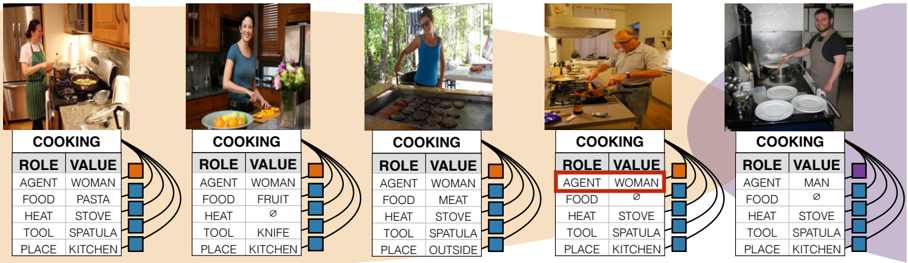
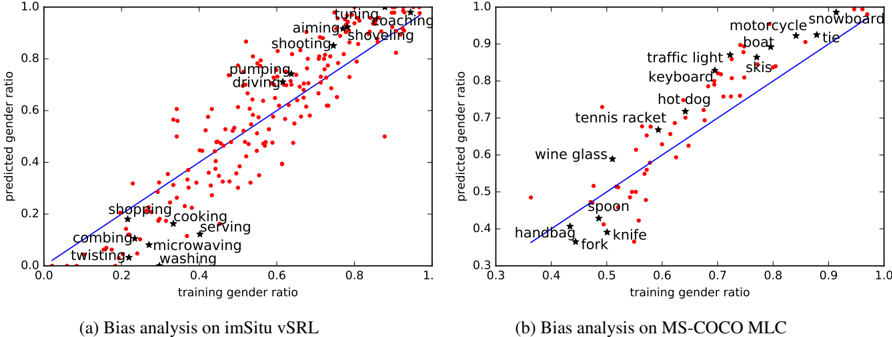
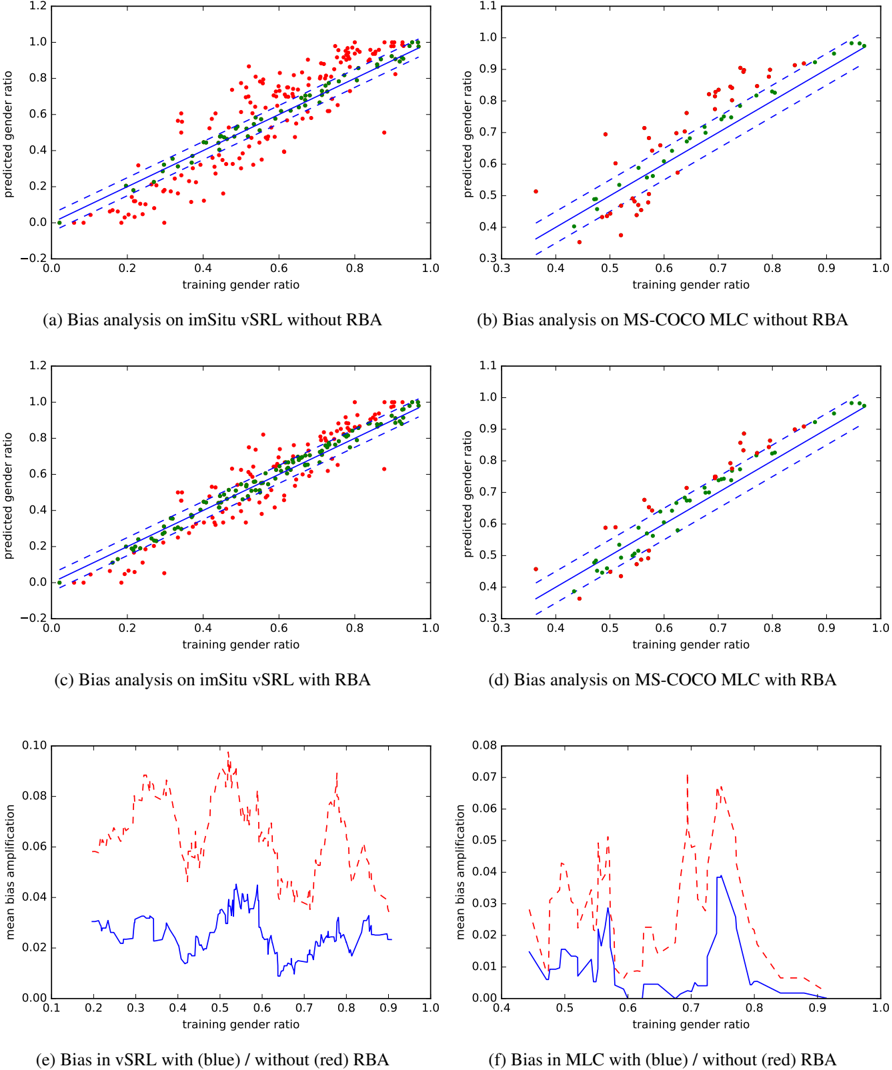
Language is increasingly being used to define rich visual recognition problems with supporting image collections sourced from the web.Structured prediction models are used in these tasks to take advantage of correlations between co-occurring labels and visual input but risk inadvertently encoding social biases found in web corpora.In this work, we study data and models associated with multilabel object classification and visual semantic role labeling.We find that (a) datasets for these tasks contain significant gender bias and (b) models trained on these datasets further amplify existing bias.For example, the activity cooking is over 33% more likely to involve females than males in a training set, and a trained model further amplifies the disparity to 68% at test time.We propose to inject corpus-level constraints for calibrating existing structured prediction models and design an algorithm based on Lagrangian relaxation for collective inference.Our method results in almost no performance loss for the underlying recognition task but decreases the magnitude of bias amplification by 47.5% and 40.5% for multilabel classification and visual semantic role labeling, respectively.
Overview
The claims and statistics of this paper haven’t been checked yet.
Free: it reads the open-access text and checks the first 5 claims that cite a source we can check. Create a free account to check every claim.
Integrity signals
Registry
Cites
Statistics
Figures
Verification
Claims the paper makes
The claims and statistics of this paper haven’t been checked yet.
Free: it reads the open-access text and checks the first 5 claims that cite a source we can check. Create a free account to check every claim.
Claims other papers make about this one
Each is checked against this paper’s own text: does it say what the citing paper says it does?
The source backs part of the claim, not all of it — or backs it for a different population, condition or comparison.
In the citing paper
“and processes of creating resources and technologies may further entrench such disparities [25, 38, 144].”
From Data Governance in the Age of Large-Scale Data-Driven Language Technology (2022) · cites this paper as [144]
Experimental — accuracy not yet measuredThe source backs part of the claim, not all of it — or backs it for a different population, condition or comparison.
In the citing paper
“It is well-documented that LMs learn the biases, prejudices, and racism present in the language they are trained on35–38.”
From Large language models to identify social determinants of health in electronic health records (2024) · cites this paper as [36]
Experimental — accuracy not yet measuredThe source backs part of the claim, not all of it — or backs it for a different population, condition or comparison.
In the citing paper
“Neural networks are prone to learning biases from training data and amplifying them at test time50, giving rise to a much discussed aspect of AI behaviour: fairness51.”
From The METRIC-framework for assessing data quality for trustworthy AI in medicine: A systematic review (2024) · cites this paper as [50]
Experimental — accuracy not yet measuredThe cited source says what the claim attributes to it.
In the citing paper
“It is well acknowledged that machine learning models, such as those ofered by the API providers, are prone to exhibiting various kinds of discriminatory behaviours, including diferent error rates across demographic groups [22,126,127], stereotyping [64,163] or minority groups under-representation [134,137].”
From Out of Context: Investigating the Bias and Fairness Concerns of “Artificial Intelligence as a Service” (2023) · cites this paper as [163]
Self-check
Percentages, sums and reported differences re-computed from the paper’s own numbers.
The self-check needs the paper’s full text.
Citations
Cites
Very Deep Convolutional Networks for Large-Scale Image Recognition
Simonyan, K., & Zisserman, A. (2014) · arXiv · doi:10.48550/arxiv.1409.1556 · Cited by 114,148 · cited 1×
“where each potential value in the CRF for subpart x, is computed using features fi from the VGG convolutional neural network (Simonyan and Zisserman, 2014) on an input image, as follows:”
MethodMicrosoft COCO: Common Objects in Context
Lin, T.-Y., Maire, M., Belongie, S., Hays, J., Perona, P., Ramanan, D., Dollár, P., & Zitnick, C. L. (2014) · Lecture Notes in Computer Science · doi:10.1007/978-3-319-10602-1_48 · Cited by 45,460 · cited 2×
“For MLC, we use MS-COCO (Lin et al., 2014; Chen et al., 2015), a recognition task covering 80 object classes.”
MethodShow and tell: A neural image caption generator
Vinyals, O., Toshev, A., Bengio, S., & Erhan, D. (2015) · 2015 IEEE Conference on Computer Vision and Pattern Recognition (CVPR) · doi:10.1109/cvpr.2015.7298935 · Cited by 6,318 · cited 2×
“Visual recognition tasks involving language, such as captioning (Vinyals et al., 2015), visual question answering (Antol et al.”
BackgroundVQA: Visual Question Answering
Antol, S., Agrawal, A., Lu, J., Mitchell, M., Batra, D., Zitnick, C. L., & Parikh, D. (2015) · 2015 IEEE International Conference on Computer Vision (ICCV) · doi:10.1109/iccv.2015.279 · Cited by 4,487
Dwork, C., Hardt, M., Pitassi, T., Reingold, O., & Zemel, R. (2012) · Proceedings of the 3rd Innovations in Theoretical Computer Science Conference · doi:10.1145/2090236.2090255 · Cited by 3,501 · cited 1×
“Various approaches have been proposed to make a “fair” binary classification (Baro-cas and Selbst, 2014; Dwork et al., 2012; Feldman et al., 2015; Zliobaite, 2015).”
BackgroundBarocas, S., & Selbst, A. D. (2014) · doi:10.2139/ssrn.2477899 · Cited by 3,048
Semantics derived automatically from language corpora contain human-like biases
Caliskan, A., Bryson, J. J., & Narayanan, A. (2017) · Science · doi:10.1126/science.aal4230 · Cited by 2,887 · cited 2×
“Such issues have been demonstrated in various learning systems, including online advertisement systems (Sweeney, 2013), word embedding models (Bolukbasi et al., 2016; Caliskan et al., 2017), online news (Ross and Carter, 2011), web search (Kay et al., 2015), and credit score (Hardt et al., 2016).”
BackgroundEquality of Opportunity in Supervised Learning
Hardt, M., Price, E., & Srebro, N. (2016) · arXiv · doi:10.48550/arxiv.1610.02413 · Cited by 2,536 · cited 1×
“Such issues have been demonstrated in various learning systems, including online advertisement systems (Sweeney, 2013), word embedding models (Bolukbasi et al., 2016; Caliskan et al., 2017), online news (Ross and Carter, 2011), web search (Kay et al., 2015), and credit score (Hardt et al., 2016).”
BackgroundBaker, C. F., Fillmore, C. J., & Lowe, J. B. (1998) · Proceedings of the 36th annual meeting on Association for Computational Linguistics - · doi:10.3115/980845.980860 · Cited by 2,518 · cited 2×
“Dataset We evaluate on imSitu (Yatskar et al., 2016) where activity classes are drawn from verbs and roles in FrameNet (Baker et al., 1998) and noun categories are drawn from WordNet (Miller et al., 1990).”
BackgroundMethodCertifying and Removing Disparate Impact
Feldman, M., Friedler, S. A., Moeller, J., Scheidegger, C., & Venkatasubramanian, S. (2015) · Proceedings of the 21th ACM SIGKDD International Conference on Knowledge Discovery and Data Mining · doi:10.1145/2783258.2783311 · Cited by 1,827 · cited 2×
“e cost of making mistakes on samples in the minority class can be neglected. Various approaches have been proposed to make a “fair” binary classification (Barocas and Selbst, 2014; Dwork et al., 2012; Feldman et al., 2015; Zliobaite, 2015). For structured prediction tasks the effect is harder to quantify and we are the…”
Background
Research works printed but not linked: 4
- Stanislaw Antol, Aishwarya Agrawal, Jiasen Lu, Mar- garet Mitchell, Dhruv Batra, C Lawrence Zitnick, and Devi Parikh. 2015. Vqa: Visual question an- swering. In Proceedings of the IEEE International Conference on Computer Vision, pages 2425-2433.
- Tolga Bolukbasi, Kai-Wei Chang, James Y Zou, Venkatesh Saligrama, and Adam T Kalai. 2016. Man is to computer programmer as woman is to homemaker? debiasing word embeddings. In The Conference on Advances in Neural Information Pro- cessing Systems (NIPS), pages 4349-4357.
- Bernhard Korte and Jens Vygen. 2008. Combinatorial Optimization: Theory and Application. Springer Verlag.
- G. Miller, R. Beckwith, C. Fellbaum, D. Gross, and K.J. Miller. 1990. Wordnet: An on-line lexical database. International Journal of Lexicography, 3(4):235-312.
Cited by
Items 701–800 of 834
Report on the first workshop on bias in automatic knowledge graph construction at AKBC 2020
Safavi, T., Meij, E., Özcan, F., Реди, М., Demartini, G., & Xiong, C. (2020) · ACM SIGIR Forum · doi:10.1145/3483382.3483393 · Cited by 2
“…and word embeddings, covering a GLoVE-based model that learns embeddings without gendered information, new resources for understanding bias in multilingual word embeddings, and gender biases in deep contextualized language models, using ELMo as a case study [Zhao et al., 2017, 2018b, 2019].”
MethodDer Artificial Intelligence Act – eine Praxisanalyse am Beispiel von Gesichtserkennungssoftware
Wudel, A., & Schulz, M. (2022) · HMD Praxis der Wirtschaftsinformatik · doi:10.1365/s40702-022-00854-z · Cited by 1
“Gender als Diskriminierungskriterium wird im Folgenden näher untersucht, da eine Vielzahl von Quellen auf das Gender Data Gap aufmerksam machen und somit auf weiteren Forschungsbedarf hinweisen (Kwon 2010; Bolukbasi et al. 2016; Zhao et al. 2017; Criado-Perez 2020).”
BackgroundCausalNLP Tutorial: An Introduction to Causality for Natural Language Processing
Jin, Z., Feder, A., & Zhang, K. (2022) · doi:10.18653/v1/2022.emnlp-tutorials.4 · Cited by 9
“Here, we will identify and highlight existing limitations in NLP meth-ods, and will propose three application areas where causal ideas might help: interpretability (Guidotti et al., 2018), robustness (e.g., McCoy et al., 2019) and fairness (e.g., Zhao et al., 2017).”
BackgroundMeasuring Gender Bias in West Slavic Language Models
Martinková, S., Stańczak, K., & Augenstein, I. (2023) · Workshop on Slavic Natural Language Processing (SlavicNLP) · doi:10.18653/v1/2023.bsnlp-1.17 · Cited by 18
Women also Snowboard: Overcoming Bias in Captioning Models (Extended Abstract)Preprint
Hendricks, L. A., Burns, K., Saenko, K., Darrell, T., & Rohrbach, A. (2018) · arXiv (Cornell University) · doi:10.48550/arxiv.1807.00517 · Cited by 1
Metamorphic Testing of a Deep Learning based ForecasterPreprint
Dwarakanath, A., Ahuja, M., Podder, S., Vinu, S., Naskar, A., & Mv, K. (2019) · arXiv (Cornell University) · doi:10.48550/arxiv.1907.06632 · Cited by 1
“Efforts have been made to detect & mitigate instances of bias in training data [21] and an ML algorithm [12].”
MethodTopics to Avoid: Demoting Latent Confounds in Text ClassificationPreprint
Kumar, S., Wintner, S., Smith, N. A., & Tsvetkov, Y. (2019) · arXiv (Cornell University) · doi:10.48550/arxiv.1909.00453 · Cited by 9
“Zhao et al. (2017) showed that visual semantic role labeling models implicitly capture actions stereotypically associated with men or women (e.”
BackgroundMachines Learn Appearance Bias in Face Recognition.Preprint
Steed, R., & Caliskan, A. (2020) · arXiv (Cornell University) · Cited by 1
Towards classification parity across cohortsPreprint
Patel, A., Gupta, R., Harakere, M., Krishna, S., Alok, A., & Liu, P. (2020) · arXiv (Cornell University) · doi:10.48550/arxiv.2005.08033 · Cited by 1
“This has led to several debiasing algorithms on word embeddings (Qian et al. (2019) , Bolukbasi et al. (2016)), coreference resolution (Zhao et al. (2018a)), semantic role labeling (Zhao et al. (2017)), etc.”
BackgroundReducing Overlearning through Disentangled Representations by Suppressing Unknown TasksPreprint
Panwar, N., Tater, T., Sankaran, A., & Mani, S. (2020) · arXiv (Cornell University) · doi:10.48550/arxiv.2005.10220 · Cited by 1
Dev, S. (2020) · arXiv (Cornell University) · doi:10.48550/arxiv.2011.12465 · Cited by 2
“It is a reflection of the stereotypes that preexist in society that often get amplified[50, 105] and perpetuated by resulting in unfair associations of attributes with groups of people.”
BackgroundProceedings of the CSCW 2021 Workshop -- Investigating and Mitigating Biases in Crowdsourced DataPreprint
Hettiachchi, D., Sanderson, M., Gonçalves, J., Hosio, S. J., Kazai, G., Lease, M., Schaekermann, M., & Yılmaz, E. (2021) · arXiv (Cornell University) · doi:10.48550/arxiv.2111.14322 · Cited by 1
“Even worse, these biases could have downstream effects and lead to negative and discriminatory outcomes that hurt the society [2, 3, 36].”
BackgroundBojić, L., & Davidovic, J. (2023) · Research Square · doi:10.21203/rs.3.rs-3126307/v1 · Cited by 1
Writing with AI Can Reduce Gender Bias in Hiring Evaluations
Liu, A. T. H., Lee, M., & Bai, X. (2026) · CHI Conference on Human Factors in Computing Systems · doi:10.1145/3772318.3791136 · Cited by 1
“Existing Biases in LLMs. AI writing tools may inadvertently worsen gender biases as AI systems often reflect and spread the biases found in their training data [175, 200].”
Maintaining The Humanity of Our ModelsPreprint
Bhatt, U. (2017) · arXiv (Cornell University) · doi:10.48550/arxiv.1711.05791
TFW, DamnGina, Juvie, and Hotsie-Totsie: On the Linguistic and Social Aspects of Internet SlangPreprint
Kulkarni, V., & Wang, W. Y. (2017) · arXiv (Cornell University) · doi:10.48550/arxiv.1712.08291 · Cited by 15
Generating Contradictory, Neutral, and Entailing SentencesPreprint
Shen, Y., Tan, S., Huang, C.-W., & Courville, A. C. (2018) · arXiv (Cornell University) · doi:10.48550/arxiv.1803.02710 · Cited by 3
“The model also have some bias while generating premise (e.g. when hypothesis mention “a baby”, the premise automatically mention “a woman”), which aligns with the recent discovery that visual recognition tasks model tend to output biased predictions (Zhao et al., 2017).”
BackgroundExperimental Analysis of Representation Learning Systems
Carmona, S., & Ivan, V. (2018) · UCL Discovery (University College London)
Detecting and Reducing Bias in a High Stakes DomainPreprint
Zhong, R., Chen, Y., Patton, D. U., Selous, C., & McKeown, K. (2019) · arXiv (Cornell University) · doi:10.48550/arxiv.1908.11474 · Cited by 2
“Biases might be based on gender (Bolukbasi et al., 2016; Zhao et al., 2017), race (Kiritchenko and Mohammad, 2018; Rudinger et al., 2017), writing styles (Madnani et al., 2017), or other factors.”
BackgroundTarget Language-Aware Constrained Inference for Cross-lingual Dependency ParsingPreprint
Meng, T., Peng, N., & Chang, K.-W. (2019) · arXiv (Cornell University) · doi:10.48550/arxiv.1909.01482
“Zhao et al. (2017) incorporate corpus-level constraints to avoid amplifying gender bias on visual semantic role labeling and multilabel classification.”
MethodSelf-citationPapachristou, I. A. (2019) · UPCommons institutional repository (Universitat Politècnica de Catalunya) · doi:10.5821/dissertation-2117-177803
P ≈ NP, at least in Visual Question Answering
Jolly, S., Palacio, S., Folz, J., Raue, F., Hees, J., & Dengel, A. R. (2021) · Proceedings - International Conference on Pattern Recognition/Proceedings/International Conference on Pattern Recognition · doi:10.1109/icpr48806.2021.9412774
P $\approx$ NP, at least in Visual Question AnsweringPreprint
Jolly, S., Palacio, S., Folz, J., Raue, F., Hees, J., & Dengel, A. R. (2020) · arXiv (Cornell University) · doi:10.48550/arxiv.2003.11844
Gender Classification and Bias Mitigation in Facial ImagesPreprint
Wu, W., Protopapas, P., Yang, Z., & Michalatos, P. (2020) · arXiv (Cornell University) · doi:10.48550/arxiv.2007.06141 · Cited by 2
“e current algorithm is 33% more likely to predict females to be involved in a cooking activity than male [9].”
BackgroundNeural Fair Collaborative FilteringPreprint
Islam, R., Keya, K. N., Zeng, Z., et al. (2021) · arXiv (Cornell University) · doi:10.13016/m2qykz-krvh
“Typical collaborative filtering methods can suffer from overfitting in this scenario, and overfitting often amplifies unfairness or bias in the data such as harmful stereotypes (Zhao et al., 2017; Foulds et al., 2018b).”
BackgroundHuman biases in government algorithms
Thurnay, L., & Lampoltshammer, T. J. (2020) · International Conference on Theory and Practice of Electronic Governance · doi:10.1145/3428502.3428529 · Cited by 1
“…based on other characteristics or dimensions of text, much like it is proven to manifest with other machine learning solutions, for example in the cases of gender bias in topics of interests [7,48], racial equality of opportunities [7,20], and filter bubbles based on political orientation [38].”
BackgroundOn the Basis of Sex: A Review of Gender Bias in Machine Learning Applications.Preprint
Feldman, T., & Peake, A. (2021) · arXiv (Cornell University) · Cited by 2
[Re] Don't Judge an Object by Its Context: Learning to Overcome Contextual BiasPreprint
Kim, S. S. Y., Zhang, S., Meister, N., et al. (2021) · arXiv (Cornell University) · doi:10.5281/zenodo.4834352
“Note that this definition of bias requires a trainedmodel, unlike themore common definition of bias that only requires co-occurrence counts in a dataset [9].”
BackgroundUnderstanding Natural Language with Commonsense Knowledge Representation, Reasoning, and Simulation
Bosselut, A. (2020) · ResearchWorks at the University of Washington (University of Washington)
Stark, D., & Ritter, K. (2021) · Springer eBooks · doi:10.1007/978-3-030-58080-3_244-1
Toward Deconfounding the Influence of Entity Demographics for Question Answering AccuracyPreprint
Gor, M., Webster, K., & Boyd-Graber, J. L. (2021) · arXiv (Cornell University) · doi:10.48550/arxiv.2104.07571
“Given the many findings of gender bias in NLU (Zhao et al., 2017; Webster et al., 2018; Zhao et al., 2018; Stanovsky et al., 2019), this is surprising.”
BackgroundAdversarial Examples Generation for Reducing Implicit Gender Bias in Pre-trained ModelsPreprint
Ye, W., Xu, F., Huang, Y., Huang, C., & Ji, A. (2021) · arXiv (Cornell University) · doi:10.48550/arxiv.2110.01094 · Cited by 2
“Zhao et al. (2017) showed the model can amplify the bias without appropriate adjustments.”
Vision Matters When It Should: Sanity Checking Multimodal Machine Translation ModelsPreprint
Li, J., Ataman, D., & Sennrich, R. (2021) · arXiv (Cornell University) · doi:10.48550/arxiv.2109.03415 · Cited by 1
Testing DNN image classifiers for confusion & bias errors
Tian, Y., Zhong, Z., Ordóñez, V., et al. (2020) · ACM/IEEE International Conference on Software Engineering: Companion Proceedings (ICSE-Companion) · doi:10.1145/3377812.3390799
“For example, Zhao et al. in their paper “Men also like shopping” [16], find classification bias in favor of women on activities like shopping, cooking, washing, etc.”
BackgroundStark, D., & Ritter, K. (2022) · Springer eBooks · doi:10.1007/978-3-030-64573-1_244
Analyzing Sentiments of German Job References
(2020) · International Journal of Humanized Computing and Communication · doi:10.35708/hcc1868-148362
Darney, H. (2020) · Open Access Victoria University of Wellington | Te Herenga Waka (Figshare) · doi:10.26686/wgtn.17151377.v1 · Cited by 1
Minimally-Supervised Joint Learning of Event Volitionality and Subject Animacy Classification
Kiyomaru, H., & Kurohashi, S. (2022) · Journal of Natural Language Processing · doi:10.5715/jnlp.29.807
RealPatch: A Statistical Matching Framework for Model Patching with Real Samples
Romiti, S., Inskip, C., Sharmanska, V., & Quadrianto, N. (2022) · Lecture notes in computer science · doi:10.1007/978-3-031-19806-9_9 · Cited by 3
Castelló, V. O., Pérez‐Benito, F. J., Catalá, O. D. T., Igual, I. S., Llobet, R., & Pérez-Cortés, J.-C. (2022) · IEEE Access · doi:10.1109/access.2022.3221936
“Nonetheless, in the following Figures 8, 9, 10 and 11, it can be seen that DBSCAN cannot be properly used for the EAPP score.”
BackgroundRothöhler, S. (2018) · Brill | Fink eBooks · doi:10.30965/9783846763513_013
Fic Graph - Quantifying Fairness with Sensitive AttributePreprint
Akintande, O. J., & Olubusoye, O. E. (2023) · SSRN Electronic Journal · doi:10.2139/ssrn.4352107
Mujeres, datos y poder. Una mirada al interior de la economía de las plataformas
Gutiérrez, M. (2023) · Feminismo/s · doi:10.14198/fem.2023.42.01 · Cited by 2
12 Moderne Sprachassistenten zwischen Datenhunger und Datenschutz
Zarcone, A., & Leschanowsky, A. (2023) · De Gruyter eBooks · doi:10.1515/9783111034706-012 · Cited by 1
Reducing cohort bias in natural language understanding systems with targeted self-training scheme
Le, D.-T., Hernandez, G., Chen, B., & Bradford, M. (2023) · Proceedings of the conference - Association for Computational Linguistics. Meeting · doi:10.18653/v1/2023.acl-industry.53
“Most of the related literature is focused on social bias, specially gender and race (Zhao et al., 2017) (Manzini et al.”
BackgroundGatto, M. (2023) · Springer eBooks · doi:10.1007/978-3-031-15482-9_3
Rothöhler, S., Hendrickson, D., & _, _. (2023) · Brill | Fink eBooks · doi:10.30965/9783846767771_008
Evaluating and Improving the Coreference Capabilities of Machine Translation Models
Yehudai, A., Cattan, A., Abend, O., & Stanovsky, G. (2023) · Conference of the European Chapter of the Association for Computational Linguistics · doi:10.18653/v1/2023.eacl-main.69 · Cited by 4
Finding Spurious Correlations with Function-Semantic Contrast Analysis
Bykov, K., Kopf, L., & Höhne, M. (2023) · Communications in computer and information science · doi:10.1007/978-3-031-44067-0_28 · Cited by 7
Cheema, G. S., Hakimov, S., Kastner, M. A., & García, N. (2023) · ACM International Conference on Information and Knowledge Management (CIKM) · doi:10.1145/3583780.3615310
“Second, large automatically curated multimodal datasets often introduce biases into model learning [6, 24, 32] and downstream tasks [11, 25, 31], which makes models’ use quite limited and possibly harmful.”
BackgroundTargeted data augmentation for improving modelrobustness against systematic biasPreprint
Mikołajczyk, A., Ferlin, M. A., & Grochowski, M. (2024) · Research Square · doi:10.21203/rs.3.rs-3953661/v1
(2024) · Transcultural Journal of Humanities and Social Sciences/Transcultural Journal of Humanities and Social Sciences · doi:10.21608/tjhss.2024.349565
TorchQL: A Programming Framework for Integrity Constraints in Machine Learning
Naik, A., Stein, A., Wu, Y., Naik, M., & Wong, E. (2024) · Proceedings of the ACM on Programming Languages · doi:10.1145/3649841 · Cited by 4
“Large language models (LLMs) are known to exhibit biases that can be potentially harmful [Havaldar et al. 2023; Liang et al. 2021; Zhao et al. 2017].”
BackgroundThe hard problem of the androcentric context of AI: challenges for EU policy agendas
González-Martín, J. A. (2024) · Elsevier eBooks · doi:10.1016/b978-0-443-18851-0.00013-5 · Cited by 2
Algorithmic Bias and Non-Discrimination in Argentina
Farinella, F. (2022) · Lex genetica. · doi:10.17803/lexgen-2022-1-1-63-74 · Cited by 1
Kastner, M. A., Cheema, G. S., Hakimov, S., & García, N. (2024) · International Conference on Multimedia Retrieval · doi:10.1145/3652583.3658893
OxonFair: A Flexible Toolkit for Algorithmic FairnessPreprint
Delaney, E. D., Fu, Z., Wachter, S., Mittelstadt, B., & Russell, C. (2024) · SSRN Electronic Journal · doi:10.2139/ssrn.4894794 · Cited by 9
Bojić, L., & Davidovic, J. (2024) · Etnoantropološki problemi / Issues in Ethnology and Anthropology · doi:10.21301/eap.v19i2.14 · Cited by 2
Bias Unveiled: Enhancing Fairness in German Word Embeddings with Large Language Models
Saeid, Y., & Kopinski, T. (2024) · Lecture notes in computer science · doi:10.1007/978-3-031-78014-1_23
Chaturvedi, A., Tiwari, R. V., Agrawal, S., & Kamble, S. (2024) · Advances in finance, accounting, and economics book series · doi:10.4018/979-8-3693-7580-8.ch019
From features to functions : leveraging protein feature architectures in comparative genomics
Dosch, J. (2024) · Publication Server of Goethe University Frankfurt am Main (Goethe University Frankfurt) · doi:10.21248/gups.88130
Societal Bias in Image Captioning: Identifying and Measuring Bias Amplification
HIROTA, Y., Nakashima, Y., & García, N. (2025) · IEICE Transactions on Information and Systems · doi:10.1587/transinf.2024edp7116 · Cited by 2
Mitigating Gender Bias Amplification in Image Captioning
HIROTA, Y., Nakashima, Y., & García, N. (2025) · IEICE Transactions on Information and Systems · doi:10.1587/transinf.2024edp7164
Uncovering Bias in Medical Data Synthesis Through Visualization Technique
Li, S., Li, Z., Lei, N., Liu, S., & Luo, X. (2024) · doi:10.1109/isdh64927.2024.00066
“To address the above bias problem, some existing debiasing methods utilize a priori knowledge to mitigate generation bias, such as injecting corpus-level constraints to calibrate existing structured prediction models [10], and utilizing textual cues to reduce the bias of generated samples [11].”
Vision LLMs: Bridging Language and Visual Understanding - Case study of IndoAI
Gujar, V. (2025) · International Journal of Science and Research (IJSR) · doi:10.21275/sr25331222304
“Studies like those by [44] on gender bias in visual datasets demonstrate how co-occurrences in training data (e.g., "woman" and "cooking") lead models to overgeneralize these patterns, even when they don’t hold universally.”
Gender and Race Bias in Consumer Product Recommendations by Large Language Models
Xu, K., Potka, S., & Thomo, A. (2025) · Lecture notes on data engineering and communications technologies · doi:10.1007/978-3-031-87766-7_22
“LLMs, trained on vast datasets, often reflect and amplify biases, perpetuating stereotypes [1, 3, 12].”
FALCON: Fair Active Learning for Content Moderation
Wang, Z., Sajeev, S., Mittal, G. K., Hall, M., Yu, Y., Yin, Z., & Chen, M. (2025) · Lecture notes in computer science · doi:10.1007/978-3-031-92648-8_1 · Cited by 2
Social Bias in Vision Transformers: A Comparative Study Across Architectures and Learning Paradigms
Tsurumi, T., & Beretta, E. (2025) · ACM Conference on Fairness, Accountability, and Transparency (FAccT) · doi:10.1145/3715275.3732189 · Cited by 1
Lin, Z., Trogrlić, G., de Vreese, C. H., & Helberger, N. (2025) · ACM Conference on Fairness, Accountability, and Transparency (FAccT) · doi:10.1145/3715275.3732065 · Cited by 3
“A typical example is when the models predicted the same word for different identity groups [50], yet the connotations perceived by annotators varied widely.”
User Engagement Prediction via Multi-Modal Emotion Analysis in Static and Dynamic Media
Thomas, L., Shilpa, K. C., Shilpa, M., & Tejaswini, N. D. (2025) · International Conference on Advances in Modern Age Technologies for Health and Engineering Science (AMATHE) · doi:10.1109/amathe65477.2025.11081217 · Cited by 1
“• Fairness-Aware Loss Functions: Adjusting loss functions to reduce bias in misclassification rates across demographic groups [25].”
Gender and Artificial Intelligence: Challenges and Imminent Possibilities
Souto-Romero, M., Arias-Oliva, M., Murata, K., & Rua, O. L. (2024) · Investigaciones Feministas · doi:10.5209/infe.98150 · Cited by 1
Older LGBTQ+ and blockchain in healthcare: A value sensitive design perspective
Poulsen, A., & Fosch‐Villaronga, E. (2025) · Open Health · doi:10.1515/ohe-2025-0071
Evaluating Dataset Bias in Biometric ResearchPreprint
Heleen, B. (2025) · Preprints.org · doi:10.20944/preprints202508.1479.v1
Zhou, Y., Zhou, R., Zhou, D. M., & Yang, A. (2025) · Lecture notes in networks and systems · doi:10.1007/978-3-031-94898-5_50
Synthetic Data: Representation and/vs Representativeness
Devinney, H., Harrison, K., Gautam, V., & Shklovski, I. (2025) · Decennial Aarhus Conference · doi:10.1145/3737609.3747095 · Cited by 1
“…both “representativeness,” which describes quantitative metrics of how many instances of a particular kind or grouping are in a dataset (see, e.g., [4, 5, 19, 22]), and “rep-resentation,” which concerns the qualities that tend to be assigned to groups and individuals (see, e.g., [2, 6, 8, 29]).”
FairFLRep: Fairness-Aware Fault Localization and Repair of Deep Neural Networks
Openja, M., Arcaini, P., Khomh, F., & Ishikawa, F. (2026) · ACM Transactions on Software Engineering and Methodology · doi:10.1145/3766890 · Cited by 4
Responsible AI in Action: Navigating the Ethical Landscape of ChatGPT
Tiwari, A., & Kumar, P. (2025) · IGI Global eBooks · doi:10.4018/979-8-3373-0877-7.ch008
Knowledge prompting: How knowledge engineers use generative AI
Koutsiana, E., Walker, J., Nwachukwu, M., Zhang, B., Meroño-Peñuela, A., & Simperl, E. P. B. (2025) · Journal of Web Semantics · doi:10.1016/j.websem.2025.100873 · Cited by 13
“SRL, which analyses predicate-argument structures for input sentences, also exhibits demographic biases, such as gender and race bias [197], and commonsense biases, failing to account for basic commonsense knowledge [89].”
Financial advice behavior: humans versus AIPreprint
Baeckström, Y., & Matkovskyy, R. (2025) · SSRN Electronic Journal · doi:10.2139/ssrn.5626138
Retracted: Responsible AI-Enhanced Labor Market Forecasting System for Policy Decision Support
Sharma, R. C., Sankar, A., Hussein, A. A., Al-Hussein, R. K. A., Manimalathi, P., & Siddiqua, A. (2025) · International Conference on Recent Innovation in Science Engineering and Technology (ICRISET) · doi:10.1109/icriset64803.2025.11252056
“The method provides a guarantee that features which have been picked can be easily understood and used in policies as well as be statistically significant [3].”
RetractedPark, S., Cho, E., Jung, C. Y., Kang, W. C., Kim, T., Park, E., & Song, S. (2025) · Scientific Data · doi:10.1038/s41597-025-06344-3
Feitosa, A., Carneiro, É., & Guedes, G. P. (2025) · doi:10.5753/kdmile.2025.247589
“This phenomenon of bias amplification has been empirically demonstrated in NLP tasks such as co-reference and sentiment analysis [Zhao et al. 2017], where models trained on biased data exaggerated demographic associations beyond the original corpus.”
Overview of the NLPCC 2025 Shared Task: Gender Bias Mitigation Challenge
Li, Y., Zhang, G., Hong, H., Wang, Y., & Lin, C. (2025) · Lecture notes in computer science · doi:10.1007/978-981-95-3352-7_38 · Cited by 1
Styger, S. A., Kloots, M. D. H., van der Wal, O., & Russo, F. (2025) · Synthese Library/Synthese library · doi:10.1007/978-3-032-03083-2_15 · Cited by 1
Bias-Aware Method for Combining Audio and Video Data in Personality Assessment AI Models
Kandage, M. P., & Lakmal, H. K. I. S. (2025) · SLAAI International Conference on Artificial Intelligence (SLAAI-ICAI) · doi:10.1109/slaai-icai68534.2025.11318477
“Equally, such hybrid deep fusion models such as those studied by [22]in the ChaLearn First Impressions dataset separately learn audio and visual representations and then combined the audio and visual features together.”
WIP: Bias Beneath the Surface: AI-Driven Gender Representation Analysis in Academic Communications
Kondapalli, K. S., Nottonson, B., Rodgers, D. J., & Sayadi, H. (2025) · IEEE Frontiers in Education Conference (FIE) · doi:10.1109/fie63693.2025.11328710
“Gender bias in communication remains a critical issue in modern society, despite notable strides towards inclusivity [1], [2].”
Raj, R. G. S. A., & Sandesh, B. J. (2026) · SN Computer Science · doi:10.1007/s42979-025-04680-0
“…Leveraging cross-modal embeddings, where features from different modalities (e.g., text, audio, video) are projected into a common space, can improve the richness and accuracy of the generated captions by better capturing the relationships between visual elements and textual descriptions [65] [63].”
InfluentialA Universal and Dynamically Aware Multi-Attack Adversarial Patch Generation Framework
Wang, Y., Cao, S., & Zhang, X. (2025) · IEEE International Conference on Parallel and Distributed Systems (ICPADS) · doi:10.1109/icpads67057.2025.11322888
“Data poisoning attacks implant backdoors by contaminating training data (e.g., Anydoor, Liu et al., 2024) [20] or generate biased responses through bias amplification (Bias Amplification, Chen et al., 2024) [21], but these attacks tend to have significant triggering delays.”
Detecting and Evaluating Bias in Large Language Models: Concepts, Methods, and Challenges
Gao, Z., Tong, L., & Zhang, Z. J. (2026) · Journal of Behavioral Data Science · doi:10.35566/jbds/gao · Cited by 4
Davda, Y., Gaikwad, S., Somkunwar, R., Deshmukh, R. V., & Puranik, B. S. (2026) · IGI Global eBooks · doi:10.4018/979-8-3373-3191-1.ch002
Fairness without Labels: Pseudo-Balancing for Bias Mitigation in Face Gender Classification
Dong, H., Rodriguez, A. M., Guinaudeau, C., & Satoh, S. (2025) · IEEE International Conference on Computer Vision Workshops · doi:10.1109/iccvw69036.2025.00796 · Cited by 1
“…at disproportionate rates [12], while commercial systems frequently reinforce harmful stereotypes by associating women with domestic activities [36] and being mis-gendered by automatic gender recognition systems (AGR) could lead to a greater insult due to the perceived objectivity of computer…”
Debias Your Large Multi-Modal Model at Test-Time via Non-Contrastive Visual Attribute Steering
Ratzlaff, N., Olson, M., Hinck, M., Tseng, S.-Y., Lal, V., & Howard, P. (2025) · IEEE International Conference on Computer Vision Workshops · doi:10.1109/iccvw69036.2025.00651 · Cited by 4
“Deep neural networks are well known to exhibit a myriad of societal biases learned from their training datasets [6, 42].”
J., R. V., & Manu, Y. M. (2026) · Discover Artificial Intelligence · doi:10.1007/s44163-026-01055-z · Cited by 1
Bias Detection and Correction in Text Using Bert Language Model
Narmadha, R. P., Rithicka, R., Sanjay, S., et al. (2026) · International Conference on Mobile Computing and Sustainable Informatics (ICMCSI) · doi:10.1109/icmcsi67283.2026.11412498
“Corpus-level analyses also show how bias at the dataset level can increase stereotypes during model training [11].”
Not a statistical accident: framing bias as a semiotic property of image datasets
Fabbrizzi, S., Papadopoulos, S., Ntoutsi, E., & Kompatsiaris, I. Y. (2026) · AI & Society · doi:10.1007/s00146-026-02948-4
“For instance, Zhao et al. (2017) found evidence of biased framing of gender roles in the popular benchmark dataset MS-COCO (Lin et al. 2014), which tends to associate women more often with kitchen tools and men with out-door activities.”
Detecting and Mitigating Social Bias in Transformer Language Models
Dahatonde, R. T., Rashmi, R., Motghare, M., Shelke, N. M., Ashtankar, N., & Guda, S. (2025) · IEEE Global Conference on Wireless Computing and Networking (GCWCN) · doi:10.1109/gcwcn66157.2025.11448494
“They appear across dimensions, including gender (64), race (37), regional identity (17), and socioeconomic status (18).”
Bhatti, G. S., Talekar, P. S., Shukla, A., & Harshini, R. (2025) · International Conference on Advancement in Futuristic Technologies (ICAFT) · doi:10.1109/icaft66710.2025.11453093
Achab, M. (2020) · theses.fr (ABES) · doi:10.70675/b1501209z5cb8z4688z96eczd44e7c361461 · Cited by 1
Deep kernel representation learning for complex data and reliability issues
Laforgue, P. (2020) · theses.fr (ABES) · doi:10.70675/e8c2e6ccz9ff4z451cza8a2zf31fdf4eabd5
Metadata
- Authors
- Zhao, J., Wang, T., Yatskar, M., Ordonez, V., & Chang, K.-W.
- Affiliations
- University of Virginia (US)
- University of Washington (US)
- Venue
- Proceedings of the 2017 Conference on Empirical Methods in Natural Language Processing
- Published
- 2017
- Pages
- 2979-2989
- OpenAlex
- W2962787423
- Semantic Scholar
- 135bafc83e9a73c88e759f98a28edfdb5c02f81d
- Cited by
- 829
- References
- 30
- Citations by year
- 2026: 36 · 2025: 86 · 2024: 82 · 2023: 133 · 2022: 122 · 2021: 114 · 2020: 108 · 2019: 97 · 2018: 48 · 2017: 3
- FWCI
- 174.43
- Type
- conference paper
- Language
- en
- Open access
- hybrid
- doi.org
- Licence
- cc-by
- Locations
- Conference on Empirical Methods in Natural Language Processing (EMNLP) (publishedVersion, cc-by)
- arXiv (Cornell University) (submittedVersion)
- arXiv (Cornell University)
- Funders
- National Science Foundation (1657193)
- Nvidia
- Topics
- Physical Sciences › Computer Science › Artificial Intelligence › Ethics and Social Impacts of AI
- Physical Sciences › Computer Science › Computer Vision and Pattern Recognition › Advanced Neural Network Applications
- Physical Sciences › Computer Science › Computer Vision and Pattern Recognition › Multimodal Machine Learning Applications
- Keywords
- gender bias, bias amplification, structured prediction, Lagrangian relaxation, collective inference, image collections, cooking
About these checks
Registry, retraction, Cites and statistics results are computed, not judged, with one exception: a printed reference that no index lists is read once by a model before it counts as a citation error. Claims are extracted by a model and kept only when their quote appears verbatim in the text; each cited source is then checked, with a model’s help, for whether it says what the claim relies on. Those verdicts can be wrong — read the claim’s quote and the cited source before relying on one.
Statistics and arithmetic are recomputed, not judged.
Confidence bands are shown only for fields calibrated on our annotated test set. None is calibrated yet, so no band is shown.
What counts as a claim ›How we measure confidence ›How we check this ›
Are you an author, or do you see a problem with this page? Request a review
Data sources
Bibliographic data: Semantic Scholar, OpenAlex, Crossref.
Contains information from the Semantic Scholar Academic Graph Datasets, made available under the ODC Attribution License (ODC-BY 1.0).
Semantic Scholar’s data is described in: Kinney, R., et al. (2023). The Semantic Scholar Open Data Platform. arXiv:2301.10140.
