

Men Also Like Shopping: Reducing Gender Bias Amplification using Corpus-level Constraints
Open accessThe DOI matches its Crossref record; 30 of the 30 references it cites were found in a registry or an index.
Abstract
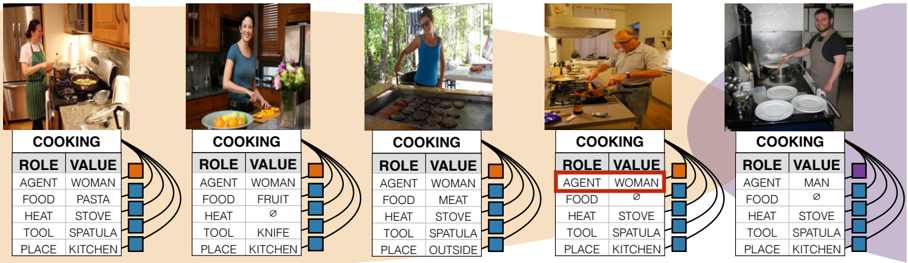
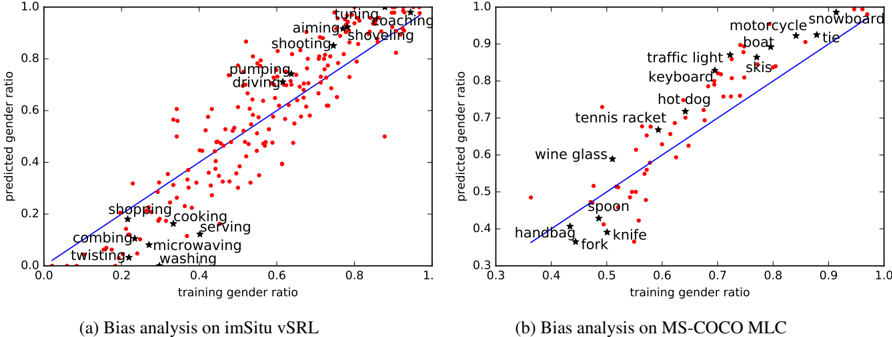
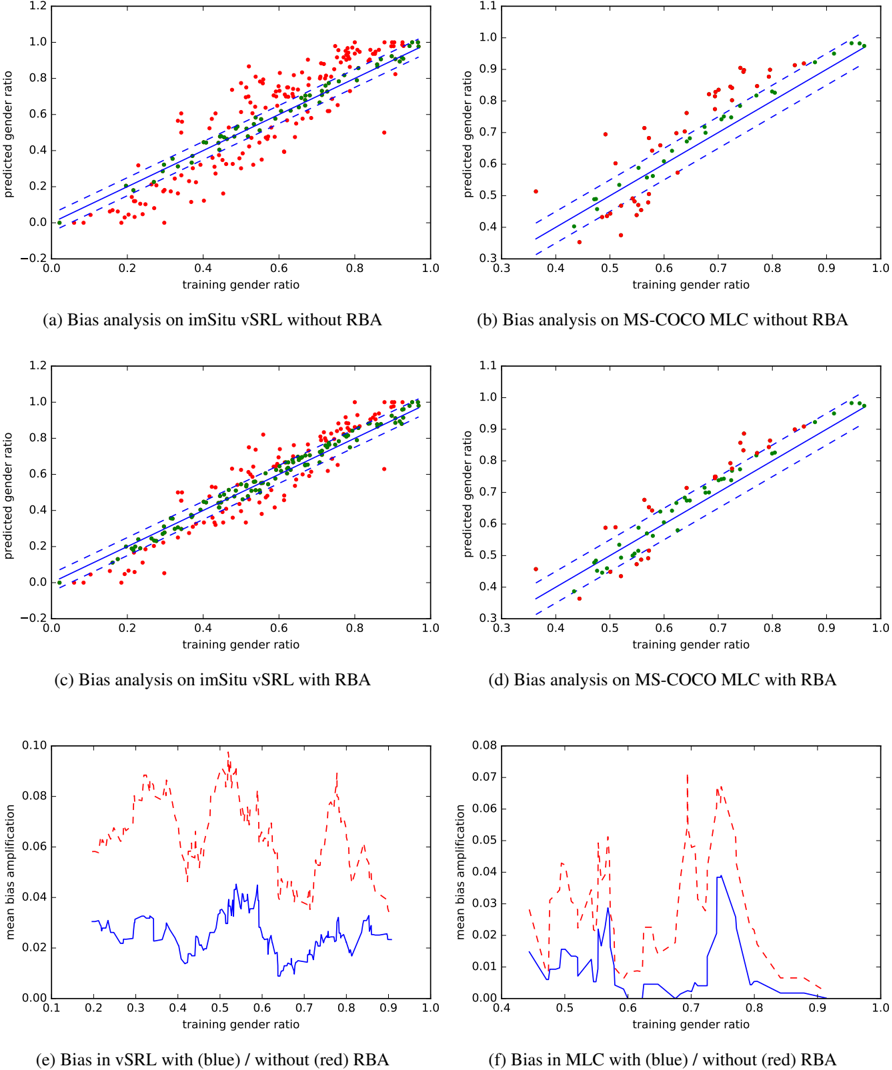
Language is increasingly being used to define rich visual recognition problems with supporting image collections sourced from the web.Structured prediction models are used in these tasks to take advantage of correlations between co-occurring labels and visual input but risk inadvertently encoding social biases found in web corpora.In this work, we study data and models associated with multilabel object classification and visual semantic role labeling.We find that (a) datasets for these tasks contain significant gender bias and (b) models trained on these datasets further amplify existing bias.For example, the activity cooking is over 33% more likely to involve females than males in a training set, and a trained model further amplifies the disparity to 68% at test time.We propose to inject corpus-level constraints for calibrating existing structured prediction models and design an algorithm based on Lagrangian relaxation for collective inference.Our method results in almost no performance loss for the underlying recognition task but decreases the magnitude of bias amplification by 47.5% and 40.5% for multilabel classification and visual semantic role labeling, respectively.
Overview
The claims and statistics of this paper haven’t been checked yet.
Free: it reads the open-access text and checks the first 5 claims that cite a source we can check. Create a free account to check every claim.
Integrity signals
Registry
Cites
Statistics
Figures
Verification
Claims the paper makes
The claims and statistics of this paper haven’t been checked yet.
Free: it reads the open-access text and checks the first 5 claims that cite a source we can check. Create a free account to check every claim.
Claims other papers make about this one
Each is checked against this paper’s own text: does it say what the citing paper says it does?
The source backs part of the claim, not all of it — or backs it for a different population, condition or comparison.
In the citing paper
“and processes of creating resources and technologies may further entrench such disparities [25, 38, 144].”
From Data Governance in the Age of Large-Scale Data-Driven Language Technology (2022) · cites this paper as [144]
Experimental — accuracy not yet measuredThe source backs part of the claim, not all of it — or backs it for a different population, condition or comparison.
In the citing paper
“It is well-documented that LMs learn the biases, prejudices, and racism present in the language they are trained on35–38.”
From Large language models to identify social determinants of health in electronic health records (2024) · cites this paper as [36]
Experimental — accuracy not yet measuredThe source backs part of the claim, not all of it — or backs it for a different population, condition or comparison.
In the citing paper
“Neural networks are prone to learning biases from training data and amplifying them at test time50, giving rise to a much discussed aspect of AI behaviour: fairness51.”
From The METRIC-framework for assessing data quality for trustworthy AI in medicine: A systematic review (2024) · cites this paper as [50]
Experimental — accuracy not yet measuredThe cited source says what the claim attributes to it.
In the citing paper
“It is well acknowledged that machine learning models, such as those ofered by the API providers, are prone to exhibiting various kinds of discriminatory behaviours, including diferent error rates across demographic groups [22,126,127], stereotyping [64,163] or minority groups under-representation [134,137].”
From Out of Context: Investigating the Bias and Fairness Concerns of “Artificial Intelligence as a Service” (2023) · cites this paper as [163]
Self-check
Percentages, sums and reported differences re-computed from the paper’s own numbers.
The self-check needs the paper’s full text.
Citations
Cites
Very Deep Convolutional Networks for Large-Scale Image Recognition
Simonyan, K., & Zisserman, A. (2014) · arXiv · doi:10.48550/arxiv.1409.1556 · Cited by 114,148 · cited 1×
“where each potential value in the CRF for subpart x, is computed using features fi from the VGG convolutional neural network (Simonyan and Zisserman, 2014) on an input image, as follows:”
MethodMicrosoft COCO: Common Objects in Context
Lin, T.-Y., Maire, M., Belongie, S., Hays, J., Perona, P., Ramanan, D., Dollár, P., & Zitnick, C. L. (2014) · Lecture Notes in Computer Science · doi:10.1007/978-3-319-10602-1_48 · Cited by 45,460 · cited 2×
“For MLC, we use MS-COCO (Lin et al., 2014; Chen et al., 2015), a recognition task covering 80 object classes.”
MethodShow and tell: A neural image caption generator
Vinyals, O., Toshev, A., Bengio, S., & Erhan, D. (2015) · 2015 IEEE Conference on Computer Vision and Pattern Recognition (CVPR) · doi:10.1109/cvpr.2015.7298935 · Cited by 6,318 · cited 2×
“Visual recognition tasks involving language, such as captioning (Vinyals et al., 2015), visual question answering (Antol et al.”
BackgroundVQA: Visual Question Answering
Antol, S., Agrawal, A., Lu, J., Mitchell, M., Batra, D., Zitnick, C. L., & Parikh, D. (2015) · 2015 IEEE International Conference on Computer Vision (ICCV) · doi:10.1109/iccv.2015.279 · Cited by 4,487
Dwork, C., Hardt, M., Pitassi, T., Reingold, O., & Zemel, R. (2012) · Proceedings of the 3rd Innovations in Theoretical Computer Science Conference · doi:10.1145/2090236.2090255 · Cited by 3,501 · cited 1×
“Various approaches have been proposed to make a “fair” binary classification (Baro-cas and Selbst, 2014; Dwork et al., 2012; Feldman et al., 2015; Zliobaite, 2015).”
BackgroundBarocas, S., & Selbst, A. D. (2014) · doi:10.2139/ssrn.2477899 · Cited by 3,048
Semantics derived automatically from language corpora contain human-like biases
Caliskan, A., Bryson, J. J., & Narayanan, A. (2017) · Science · doi:10.1126/science.aal4230 · Cited by 2,887 · cited 2×
“Such issues have been demonstrated in various learning systems, including online advertisement systems (Sweeney, 2013), word embedding models (Bolukbasi et al., 2016; Caliskan et al., 2017), online news (Ross and Carter, 2011), web search (Kay et al., 2015), and credit score (Hardt et al., 2016).”
BackgroundEquality of Opportunity in Supervised Learning
Hardt, M., Price, E., & Srebro, N. (2016) · arXiv · doi:10.48550/arxiv.1610.02413 · Cited by 2,536 · cited 1×
“Such issues have been demonstrated in various learning systems, including online advertisement systems (Sweeney, 2013), word embedding models (Bolukbasi et al., 2016; Caliskan et al., 2017), online news (Ross and Carter, 2011), web search (Kay et al., 2015), and credit score (Hardt et al., 2016).”
BackgroundBaker, C. F., Fillmore, C. J., & Lowe, J. B. (1998) · Proceedings of the 36th annual meeting on Association for Computational Linguistics - · doi:10.3115/980845.980860 · Cited by 2,518 · cited 2×
“Dataset We evaluate on imSitu (Yatskar et al., 2016) where activity classes are drawn from verbs and roles in FrameNet (Baker et al., 1998) and noun categories are drawn from WordNet (Miller et al., 1990).”
BackgroundMethodCertifying and Removing Disparate Impact
Feldman, M., Friedler, S. A., Moeller, J., Scheidegger, C., & Venkatasubramanian, S. (2015) · Proceedings of the 21th ACM SIGKDD International Conference on Knowledge Discovery and Data Mining · doi:10.1145/2783258.2783311 · Cited by 1,827 · cited 2×
“e cost of making mistakes on samples in the minority class can be neglected. Various approaches have been proposed to make a “fair” binary classification (Barocas and Selbst, 2014; Dwork et al., 2012; Feldman et al., 2015; Zliobaite, 2015). For structured prediction tasks the effect is harder to quantify and we are the…”
Background
Research works printed but not linked: 4
- Stanislaw Antol, Aishwarya Agrawal, Jiasen Lu, Mar- garet Mitchell, Dhruv Batra, C Lawrence Zitnick, and Devi Parikh. 2015. Vqa: Visual question an- swering. In Proceedings of the IEEE International Conference on Computer Vision, pages 2425-2433.
- Tolga Bolukbasi, Kai-Wei Chang, James Y Zou, Venkatesh Saligrama, and Adam T Kalai. 2016. Man is to computer programmer as woman is to homemaker? debiasing word embeddings. In The Conference on Advances in Neural Information Pro- cessing Systems (NIPS), pages 4349-4357.
- Bernhard Korte and Jens Vygen. 2008. Combinatorial Optimization: Theory and Application. Springer Verlag.
- G. Miller, R. Beckwith, C. Fellbaum, D. Gross, and K.J. Miller. 1990. Wordnet: An on-line lexical database. International Journal of Lexicography, 3(4):235-312.
Cited by
Items 501–600 of 834
Generating Clues for Gender based Occupation De-biasing in TextPreprint
Madaan, N., Singh, G., Mehta, S., Chetan, A., & Joshi, B. (2018) · arXiv (Cornell University) · doi:10.48550/arxiv.1804.03839 · Cited by 6
“(Zhao et al., 2017) have pointed to the presence of gender bias in structured prediction from images.”
BackgroundUnsupervised Vision-and-Language Pre-training Without Parallel Images and CaptionsPreprint
Li, L. H., You, H., Wang, Z., Zareian, A., Chang, S., & Chang, K.-W. (2020) · arXiv (Cornell University) · doi:10.48550/arxiv.2010.12831 · Cited by 6
Self-citationBias, machine learning, and conceptual engineering
Rudolph, R. E., Shech, E., & Tamir, M. (2025) · Philosophical Studies · doi:10.1007/s11098-024-02273-w · Cited by 8
“For example, Zhao et al. (2017) describe the case of one data set of images where the activity of cooking is over 33% more likely to involve females than males; however, a trained model based on that data set amplified the disparity to 68%.”
Scheuerman, M. K., Woodruff, A., & Brubaker, J. R. (2025) · Proceedings of the ACM on Human-Computer Interaction · doi:10.1145/3757481 · Cited by 11
Joseph, K., Chen, H.-Y. W., Ionescu, S., Du, Y., Sankhe, P., Hannák, A., & Rudra, A. (2022) · Applied Network Science · doi:10.1007/s41109-022-00486-8 · Cited by 7
“These gender biases emerge in other NLP tools that use the output from these gender-biased models to, for example, caption images (Zhao et al. 2017).”
BackgroundDong, X., Zhu, Z., Wang, Z., Teleki, M., & Caverlee, J. (2023) · Findings of the Association for Computational Linguistics: EMNLP (Findings of EMNLP) · doi:10.18653/v1/2023.findings-emnlp.390 · Cited by 28
Evaluating Bias and Fairness in Gender-Neutral Pretrained Vision-and-Language Models
Piqueras, L. C., Bugliarello, E., Brandl, S., & Elliott, D. (2023) · Conference on Empirical Methods in Natural Language Processing (EMNLP) · doi:10.18653/v1/2023.emnlp-main.525 · Cited by 23
Distribution-aware fairness test generation
Rajan, S. S., Soremekun, E., Traon, Y. L., & Chattopadhyay, S. (2024) · Journal of Systems and Software · doi:10.1016/j.jss.2024.112090 · Cited by 7
“, dark-skinned people were more likely to be misclassified [27] and women were usually associated with activities such as cooking, shopping etc [56].”
BackgroundA cross-lingual syntactic investigation of gender bias and stereotyping in GPT-4o: English vs Hindi
Arora, S., & Srivastava, A. (2024) · AI and Ethics · doi:10.1007/s43681-024-00565-9 · Cited by 6
“[8, 10, 26, 28, 30, 36, 39, 40] The discerned gender biases within ChatGPT’s responses across a spectrum of prompts raise critical questions about the implications of such biases within artificial intelligence systems.”
FairViT: Fair Vision Transformer via Adaptive Masking
Tian, B., Du, R., & Shen, Y. (2024) · Lecture notes in computer science · doi:10.1007/978-3-031-73650-6_26 · Cited by 7
Bias in Federated Learning: Factors, Effects, Mitigations, and Open Issues
Benmalek, M., & Seddiki, A. (2024) · Ingénierie des systèmes d information · doi:10.18280/isi.290605 · Cited by 13
“For instance, commonly used performance metrics like accuracy implicitly assume class balance and can optimize for the majority groups, disadvantaging minorities [124].”
Éthique des Learning Analytics
Gras, B. (2019) · Distances et médiations des savoirs · doi:10.4000/dms.3768 · Cited by 10
Examining potential gender bias in automated-job alerts in the Spanish market
Martínez, N., Vinas, A., & Matute, H. (2021) · PLoS ONE · doi:10.1371/journal.pone.0260409 · Cited by 10
“Among the technical proposals, there are approaches to introduce learning models for the control and protection of discrimination [63], algorithms for calibration and correction bias [66], and tools to audit data using significance tests [41].”
MethodKwako, A., Wan, Y., Zhao, J., Chang, K.-W., Cai, L., & Hansen, M. H. (2022) · Workshop on Innovative Use of NLP for Building Educational Applications · doi:10.18653/v1/2022.bea-1.1 · Cited by 11
“In the broader field of natural language processing (NLP), research has demonstrated that transformer-based models can propagate and, in some cases, exacerbate gender and racial prejudice (e.g. Zhao et al., 2017; Kir-itchenko and Mohammad, 2018).”
BackgroundSelf-citationOn Adversarial Robustness of Demographic Fairness in Face Attribute Recognition
Zeng, H., Yue, Z., Shang, L., Zhang, Y., & Wang, D. (2023) · International Joint Conference on Artificial Intelligence · doi:10.24963/ijcai.2023/59 · Cited by 6
Mitigating bias in facial analysis systems by incorporating label diversity
Kolling, C., Araujo, V., Veloso, A., & Musse, S. R. (2023) · Computers & Graphics · doi:10.1016/j.cag.2023.08.021 · Cited by 7
Distilling Fair Representations From Fair Teachers
Tian, H., Liu, B., Zhu, T., Zhou, W., & Yu, P. S. (2024) · IEEE Transactions on Big Data · doi:10.1109/tbdata.2024.3460532 · Cited by 7
“Bias amplification (BA) from [25] requires equal results of truepositivepredictionsacrossallsubgroups.”
Slyman, E., Lee, S., Cohen, S. D., & Kafle, K. (2024) · IEEE Computer Society Conference on Computer Vision and Pattern Recognition/Proceedings - IEEE Computer Society Conference on Computer Vision and Pattern Recognition/Proceedings · doi:10.1109/cvpr52733.2024.01319 · Cited by 22
“To better understand and reduce these potential harms, there is increased interest in analyzing the composition of these datasets and their downstream effects on trained models [5, 23, 77].”
BackgroundGender Bias Hidden Behind Chinese Word Embeddings: The Case of Chinese Adjectives
Jiao, M., & Luo, Z. (2021) · Workshop on Gender Bias in Natural Language Processing (GeBNLP) · doi:10.18653/v1/2021.gebnlp-1.2 · Cited by 12
“Therefore, the investigation of gender bias in word embeddings is necessary and accordingly attracts scholars’ attention in recent years (Bolukbasi et al., 2016; Zhao et al., 2017).”
BackgroundMulti-objective Few-shot Learning for Fair Classification
Mondal, I., Sen, P., & Ganguly, D. (2021) · ACM International Conference on Information and Knowledge Management (CIKM) · doi:10.1145/3459637.3482146 · Cited by 5
“Ensuring ethical decisions is particularly challenging for deep (datadriven) models because these systems are reported to be vulnerable to cognitive biases present within the data [4, 14], e.”
BackgroundProtected attribute guided representation learning for bias mitigation in limited data
Mazumder, P., & Singh, P. P. (2022) · Knowledge-Based Systems · doi:10.1016/j.knosys.2022.108449 · Cited by 5
Recover Fair Deep Classification Models via Altering Pre-trained Structure
Zhang, Y., Gao, S., & Huang, H. (2022) · Lecture notes in computer science · doi:10.1007/978-3-031-19778-9_28 · Cited by 8
“[54] 0 .”
MethodIs Nike female? Exploring the role of sound symbolism in predicting brand name gender
Moorthy, S., Pogacar, R., Khan, S., & Xu, Y. (2018) · Conference on Empirical Methods in Natural Language Processing (EMNLP) · doi:10.18653/v1/d18-1142 · Cited by 5
“Although recent work has examined gender issues in web-crawled data (Zhao et al., 2017) and historical corpora (Garg et al.”
BackgroundAlways Lurking: Understanding and Mitigating Bias in Online Human Trafficking DetectionPreprint
Hundman, K., Gowda, T., Kejriwal, M., et al. (2017) · arXiv (Cornell University) · doi:10.48550/arxiv.1712.00846 · Cited by 5
Behavior Analysis of NLI Models: Uncovering the Influence of Three Factors on RobustnessPreprint
Carmona, V. I. S., Mitchell, J., & Riedel, S. (2018) · arXiv (Cornell University) · doi:10.48550/arxiv.1805.04212 · Cited by 5
Peterson, J. C., Soulos, P., Nematzadeh, A., & Griffiths, T. L. (2018) · arXiv (Cornell University) · doi:10.48550/arxiv.1805.07647 · Cited by 8
Jigsaw-VAE: Towards Balancing Features in Variational AutoencodersPreprint
Taghanaki, S. A., Havaei, M., Lamb, A., Sanghi, A., Danielyan, A., & Custis, T. (2020) · arXiv (Cornell University) · doi:10.48550/arxiv.2005.05496 · Cited by 9
“a representation bias [23, 36] in general) in variational models, particularly VAEs, seems to be more complex than supervised and non-variational models [41, 12, 21, 16, 11, 25, 7, 22] where they have access to the prior information/distribution of features or they specify a target feature (e.”
BackgroundArtificial Intelligence, Machine Learning, and Gender Bias
Weidner, N. U. (2020) · The International Encyclopedia of Gender, Media, and Communication · doi:10.1002/9781119429128.iegmc316 · Cited by 5
Counterfactual Generation and Fairness Evaluation Using Adversarially Learned InferencePreprint
Dash, S., & Sharma, A. K. (2020) · arXiv (Cornell University) · Cited by 7
Addressing Fairness, Bias and Class Imbalance in Machine Learning: the FBI-lossPreprint
Ferrari, E., & Bacciu, D. (2021) · arXiv (Cornell University) · doi:10.48550/arxiv.2105.06345 · Cited by 12
“The definition of calibration is instead less explored and it is usually implemented through post-processing meth-ods which produce calibrated outputs from classification algorithms (J. Zhao et al., 2017; Hardt et al., 2016).”
MethodSociolinguistic Properties of Word EmbeddingsPreprint
Arseniev‐Koehler, A., & Foster, J. G. (2020) · SocArXiv (OSF Preprints) · doi:10.31235/osf.io/b8kud · Cited by 8
Zhou, D., Gallagher, J. R., & Sterman, S. (2025) · Creativity and Cognition · doi:10.1145/3698061.3726907 · Cited by 9
“…effort in machine learning research is dedicated to improving language model output, such as by debiasing word embeddings [11] and injecting corpus-level constraints to follow a particular distribution [128], in order to prevent bias amplification and influence on one’s writing and stance.”
Doudkin, A. A., Pataranutaporn, P., & Maes, P. (2025) · ACM Conference on Conversational User Interfaces (CUI) · doi:10.1145/3719160.3736610 · Cited by 11
Berger, U., Stanovsky, G., Abend, O., & Frermann, L. (2025) · Transactions of the Association for Computational Linguistics · doi:10.1162/tacl.a.52 · Cited by 16
Evaluating the Social Impact of Generative AI Systems
Solaiman, I., Talat, Z., Agnew, W. S., Ahmad, L., Baker, D., Blodgett, S. L., Chen, C., Daumé, H., Dodge, J., Duan, I., et al. (2025) · Oxford University Press eBooks · doi:10.1093/oxfordhb/9780198940272.013.0025 · Cited by 10
Mirror, Mirror, on the Wall, Who's the Fairest of Them All?
Xiang, A. (2024) · Daedalus · doi:10.1162/daed_a_02058 · Cited by 12
“24 Similar stereotypical trends have been found in word embeddings from large text corpora that can be used to train language models.”
BackgroundAssessing large language model performance related to aging in genetic conditions
Othman, A. A., Flaharty, K. A., Hanchard, S. E. L., Hu, P., Duong, D., Waikel, R. L., & Solomon, B. D. (2025) · npj Aging · doi:10.1038/s41514-025-00226-z · Cited by 8
“LLMscanproduceunintentionalageorsex-relatedbiasesintheirresponses simplybecauseofdisproportionallydistributedtrainingdatasetswith respecttothesourceforthesebiases 19,20 .”
Slovene and Croatian word embeddings in terms of gender occupational analogies
Ulčar, M., Supej, A., Robnik‐Šikonja, M., & Pollak, S. (2021) · Slovenščina 2 0 empirične aplikativne in interdisciplinarne raziskave · doi:10.4312/slo2.0.2021.1.26-59 · Cited by 8
“Biases can have negative consequences in the coreference resolution task (Zhao et al., 2018) and can perpetuate biases held towards certain groups (see examples in Zhao et al., 2017).”
BackgroundVision-Language Pretraining: Current Trends and the Future
Agrawal, A., Teney, D., & Nematzadeh, A. (2022) · doi:10.18653/v1/2022.acl-tutorials.7 · Cited by 9
“• Shortcomings of vision-language models (Agrawal et al., 2016; Rohrbach et al., 2018; Gan et al., 2020; Ross et al., 2020; van Mil-tenburg, 2016; Misra et al., 2015; Raji et al., 2020; Zhao et al., 2017a).”
Gao, L., Zhan, H., Chen, A., et al. (2023) · Proceedings of the AAAI Conference on Artificial Intelligence · doi:10.1609/aaai.v37i13.26967 · Cited by 4
“Models trained from the source data not only encode but even amplify the bias present in the dataset (Zhao et al. 2017).”
BackgroundSahoo, N., Mallela, N., & Bhattacharyya, P. (2023) · Findings of the Association for Computational Linguistics: ACL (Findings of ACL) · doi:10.18653/v1/2023.findings-acl.842 · Cited by 16
Fair Text Classification with Wasserstein Independence
Leteno, T., Gourru, A., Laclau, C., Emonet, R., & Gravier, C. (2023) · Conference on Empirical Methods in Natural Language Processing (EMNLP) · doi:10.18653/v1/2023.emnlp-main.978 · Cited by 9
Partition-and-Debias: Agnostic Biases Mitigation via A Mixture of Biases-Specific Experts
Li, J., Vo, D. M., & Nakayama, H. (2023) · IEEE/CVF International Conference on Computer Vision (ICCV) · doi:10.1109/iccv51070.2023.00454 · Cited by 4
“One of the reasons for poor generalization in image classification is the presence of biased features in training data [21, 33, 15], which distracts the model from learning the target features associated with the classification objects.”
BackgroundUsing ChatGPT to Generate Gendered Language
Soundararajan, S., Jeyaraj, M. N., & Delany, S. J. (2023) · Irish Conference on Artificial Intelligence and Cognitive Science (AICS) · doi:10.1109/aics60730.2023.10470830 · Cited by 12
“LLMs have been shown to have gender bias [30], [31], [45] which is evident if the behaviour of the system is different for men than for women.”
BackgroundBerg-Postweiler, J., Decker, M., & Leicht-Scholten, C. (2024) · Springer eBooks · doi:10.1007/978-3-031-54700-3_15 · Cited by 5
Ding, S., Zhang, S., Hu, X., & Zou, N. (2024) · Journal of Biomedical Informatics · doi:10.1016/j.jbi.2024.104671 · Cited by 10
Zeng, H., Yue, Z., Jiang, Q., Zhang, Y., Shang, L., Zong, R., & Wang, D. (2024) · IEEE International Conference on Distributed Computing Systems (ICDCS) · doi:10.1109/icdcs60910.2024.00078 · Cited by 4
“One stream of the solutions focus on learning fair data representations and suppressing the shortcut learning phenomenon via adversarial learning [14], [20] or fairness regularization [15].”
BackgroundGenerated Bias: Auditing Internal Bias Dynamics of Text-to-Image Generative Models
Mandal, A., Leavy, S., & Little, S. (2025) · Lecture notes in computer science · doi:10.1007/978-3-031-92089-9_7 · Cited by 9
Learning about Word Vector Representations and Deep Learning through Implementing Word2vec
Jurgens, D. (2021) · Workshop on Teaching NLP (TeachingNLP) · doi:10.18653/v1/2021.teachingnlp-1.19 · Cited by 4
“Once this bias is discovered, students can discuss various methods for mitigating it (e.g., Bolukbasi et al., 2016; Zhao et al., 2017) and how their method might be adapted to avoid other forms of bias.”
MethodMagnus, P. D. (2022) · Metaphilosophy · doi:10.1111/meta.12536 · Cited by 4
“For example, a network trained on pictures in which two-thirds of the people cooking are women learns to strongly associate cooking with women (Zhao et al. 2017).”
BackgroundInformation-Theoretic Bias Assessment Of Learned Representations Of Pretrained Face Recognition
Li, J., & AbdAlmageed, W. (2021) · International Conference on Automatic Face and Gesture Recognition · doi:10.1109/fg52635.2021.9667053 · Cited by 8
“According to the definition (a) Bias (bias amplification [45]).”
BackgroundMethodInfluentialFair Facial Attribute Classification via Causal Graph-Based Attribute Translation
Kang, S., Kim, G., & Yoo, C. D. (2022) · Sensors · doi:10.3390/s22145271 · Cited by 6
“Several image captioning and VQA models [27,33,34] have been noted to exaggerate biases [27,34] that lead to incorrect captions due to over-reliance on prejudicial context.”
BackgroundCAT: Controllable Attribute Translation for Fair Facial Attribute Classification
Li, J., & AbdAlmageed, W. (2023) · Lecture notes in computer science · doi:10.1007/978-3-031-25085-9_21 · Cited by 9
Reducing Sentiment Bias in Pre-trained Sentiment Classification via Adaptive Gumbel Attack
Tian, J., Chen, S., Zhang, X., Wang, X., & Feng, Z. (2023) · Proceedings of the AAAI Conference on Artificial Intelligence · doi:10.1609/aaai.v37i11.26599 · Cited by 6
“Bias in Natural Language Processing It is common for machine learning models to inadvertently capture and even amplify unintended dataset biases, which may hurt the generalization of classification models (Qian et al. 2021; Zhao et al. 2017).”
BackgroundEqui-Tuning: Group Equivariant Fine-Tuning of Pretrained Models
Basu, S., Sattigeri, P., Ramamurthy, K. N., Chenthamarakshan, V., Varshney, K. R., Varshney, L. R., & Das, P. (2023) · Proceedings of the AAAI Conference on Artificial Intelligence · doi:10.1609/aaai.v37i6.25832 · Cited by 30
Distance Correlation GAN: Fair Tabular Data Generation with Generative Adversarial Networks
Rajabi, A., & Garibay, Ö. Ö. (2023) · Lecture notes in computer science · doi:10.1007/978-3-031-35891-3_26 · Cited by 4
Characterizing gender stereotypes in popular fiction: A machine learning approach
Zhang, C., & Wu, B. (2023) · Online Journal of Communication and Media Technologies · doi:10.30935/ojcmt/13644 · Cited by 7
Vision-Language Models Performing Zero-Shot Tasks Exhibit Disparities Between Gender Groups
Hall, M. A., Gustafson, L., Adcock, A., Misra, I., & Ross, C. (2023) · IEEE International Conference on Computer Vision Workshops · doi:10.1109/iccvw60793.2023.00294 · Cited by 44
Assessing Bias Removal from Word Embeddings
Arrington, C. (2019) · Cited by 4
Avoiding Bias in Students’ Intrinsic Motivation Detection
Santos, P. B., Bhowmik, C. V., & Gurevych, I. (2020) · Lecture notes in computer science · doi:10.1007/978-3-030-49663-0_12 · Cited by 9
Evaluating Gender-Neutral Training Data for Automated Image Captioning
Amend, J. J., Wazzan, A., & Souvenir, R. (2021) · IEEE International Conference on Big Data (BigData) · doi:10.1109/bigdata52589.2021.9671774 · Cited by 5
A Computational Acquisition Model for Multimodal Word Categorization
Berger, U., Stanovsky, G., Abend, O., & Frermann, L. (2022) · Conference of the North American Chapter of the Association for Computational Linguistics: Human Language Technologies (NAACL-HLT) · doi:10.18653/v1/2022.naacl-main.280 · Cited by 8
Mitigating Representation Bias in Action Recognition: Algorithms and Benchmarks
Duan, H., Zhao, Y., Chen, K., Xiong, Y., & Lin, D. (2023) · Lecture notes in computer science · doi:10.1007/978-3-031-25069-9_36 · Cited by 10
Analyzing Sentiments of German Job References
Folkerts, F., Schreck, V., Riazy, S., & Simbeck, K. (2019) · doi:10.1109/hcc46620.2019.00009 · Cited by 6
“It turned out that one particular training data set contained 33% more pictures with women associated with the activity cooking than men, which amplifies the reproduction of gender based stereotypes when models trained with this data set are being used [11].”
MethodMadaan, N., Mehta, S., Mittal, S., & Suvarna, A. (2018) · arXiv (Cornell University) · doi:10.48550/arxiv.1807.10615 · Cited by 10
“(Zhao et al., 2017) have pointed to the presence of gender bias in structured prediction from images.”
BackgroundViBE: A Tool for Measuring and Mitigating Bias in Image DatasetsPreprint
Wang, A., Narayanan, A., & Russakovsky, O. (2020) · arXiv (Cornell University) · Cited by 5
Don’t 'Research Fast and Break Things': On the Ethics of Computational Social SciencePreprint
Leslie, D. (2022) · SSRN Electronic Journal · doi:10.2139/ssrn.4134621 · Cited by 4
Proceedings of The ACM Collective Intelligence Conference
(2023) · doi:10.1145/3582269 · Cited by 4
Li, H., Lan, T., Fu, Z., Cai, D., Liu, L., Collier, N., Watanabe, T., & Su, Y. (2023) · Advances in Neural Information Processing Systems 36 · doi:10.52202/075280-3187 · Cited by 4
Gender and Age Bias in Commercial Machine Translation
Bianchi, F., Fornaciari, T., Hovy, D., & Nozza, D. (2023) · Machine translation · doi:10.1007/978-3-031-14689-3_9 · Cited by 11
A Comparative Analysis of Bias Mitigation Methods in Machine Learning
Malhotra, A., & Thulal, A. N. (2024) · International Conference on Reliability, Infocom Technologies and Optimization (Trends and Future Directions) (ICRITO) · doi:10.1109/icrito61523.2024.10522401 · Cited by 5
Human intelligence and artificial intelligence and the challenges of biases in ai algorithms
Fernandes, E. R., & Graglia, M. A. V. (2024) · Journal on Innovation and Sustainability RISUS · doi:10.23925/2179-3565.2023v15i1p133-142 · Cited by 3
Comparing Methods For Detecting And Mitigating Bias In Machine Learning Models
Bhise, A., Mali, S., Joshi, P., Mohabe, S., Chikmurge, D. V., & Barve, S. (2023) · International Conference on Advances in Electronics Computers and Communications · doi:10.1109/icaecc59324.2023.10560210 · Cited by 3
“The authors argue that their approach can be used to address bias in a variety of domains beyond image classification, such as natural language processing and healthcare [7].”
BackgroundUnbiased Image Synthesis via Manifold Guidance in Diffusion Models
Su, X., Jia, D., Wu, F., Zhao, J., Zheng, C., & Qiang, W. (2024) · IEEE International Conference on Multimedia and Expo (ICME) · doi:10.1109/icme57554.2024.10687809 · Cited by 9
Self-citationResearch on Algorithmic Ethics in Artificial Intelligence
Xu, X. (2024) · International Conference on Internet of Things, Automation and Artificial Intelligence (IoTAAI) · doi:10.1109/iotaai62601.2024.10692746 · Cited by 5
“…reference algorithm based on Lagrangian relaxation to reduce the impact of bias amplification in multi-label categorization and visual-semantic role labeling [19]; fair causal inference is an inference method aimed at addressing bias and uncertainty in the estimation of intervention effects.”
MethodEfficient Bias Mitigation Without Privileged Information
Zarlenga, M. E., Sankaranarayanan, S., Andrews, J. T. A., Shams, Z., Jamnik, M., & Xiang, A. (2024) · Lecture notes in computer science · doi:10.1007/978-3-031-73220-1_9 · Cited by 16
“Nevertheless, in visual datasets, arguably the driving force of several consumer-facing AI models, such biases have been long known to be exploited and amplified by models trained on their data [84, 93].”
BackgroundWang, A., Bai, X., Barocas, S., & Blodgett, S. L. (2025) · ACM Conference on Fairness, Accountability, and Transparency (FAccT) · doi:10.1145/3715275.3732046 · Cited by 17
“Thus, one might imagine trying to automate the determination of which labels are stereotypes, rather than soliciting judgments from human anno-tators.”
InfluentialO meio é a mediação: uma visão pós-fenomenológica da mediação datacrática
Radfahrer, L. (2018) · Matrizes · doi:10.11606/issn.1982-8160.v12i1p131-153 · Cited by 5
In Situ Digital Image Analysis in Direct Ink Writing
Friedrich, L. M., & Begley, M. R. (2019) · ACS symposium series · doi:10.1021/bk-2019-1315.ch008 · Cited by 3
Zhang, Y., Bao, R., Pei, J., & Huang, H. (2022) · Proceedings · doi:10.1109/icdm54844.2022.00174 · Cited by 15
“[19] 0 .”
Identity Term Sampling for Measuring Gender Bias in Training Data
Sobhani, N., & Delany, S. J. (2023) · Communications in computer and information science · doi:10.1007/978-3-031-26438-2_18 · Cited by 5
Otterbacher, J. (2023) · ACM Conference on User Modeling, Adaptation and Personalization (UMAP) · doi:10.1145/3563359.3597381 · Cited by 5
“For instance, it has been shown that CV algorithms are more likely to recognize a person’s gender correctly when they are pictured in a gender stereotypecongruent context [9] or activity [67].”
BackgroundRun Like a Girl! Sport-Related Gender Bias in Language and Vision
Harrison, S., Gualdoni, E., & Boleda, G. (2023) · Findings of the Association for Computational Linguistics: ACL (Findings of ACL) · doi:10.18653/v1/2023.findings-acl.886 · Cited by 20
Visual Semantic Relatedness Dataset for Image Captioning
Sabir, A., Moreno-Noguer, F., & Padró, L. (2023) · IEEE/CVF Conference on Computer Vision and Pattern Recognition Workshops (CVPRW) · doi:10.1109/cvprw59228.2023.00592 · Cited by 4
“COCO Captions is a gender bias dataset towards men [18, 46], and our visual context dataset suffers from the same bias.”
BackgroundSaliency Guided Debiasing: Detecting and mitigating biases in LMs using feature attribution
Joshi, R. K., Chatterjee, A., & Ekbal, A. (2023) · Neurocomputing · doi:10.1016/j.neucom.2023.126851 · Cited by 4
Hooftman, D., Ziabari, S. S. M., & Snijder, J. (2023) · Lecture notes in computer science · doi:10.1007/978-3-031-47665-5_3 · Cited by 5
Women Wearing Lipstick: Measuring the Bias Between an Object and Its Related Gender
Sabir, A., & Padró, L. (2023) · Findings of the Association for Computational Linguistics: EMNLP (Findings of EMNLP) · doi:10.18653/v1/2023.findings-emnlp.279 · Cited by 7
Kumar, D. P. (2023) · IFIP advances in information and communication technology · doi:10.1007/978-3-031-50188-3_8 · Cited by 4
Singh, P. (2023) · doi:10.18653/v1/2023.ijcnlp-srw.3 · Cited by 9
“In NLP, such biases have been observed in different forms: Bolukbasi et al. (2016) found that word embeddings exhibit gender stereotypes, Zhao et al. (2017) observed that models for visual semantic role labelling aggrandize existing gender bias present in data, similar biased behaviour had been…”
BackgroundGender Representation Across Online Retail Products
Pessach, D., & Poblete, B. (2024) · ACM Conference on Fairness, Accountability, and Transparency (FAccT) · doi:10.1145/3630106.3658947 · Cited by 5
“Examples of biased results from derived applications, have been found in machine translation [23, 31, 73], coreference resolution [65, 79, 81], sentence encoding [51], semantic role labeling [80], and recommender systems [26, 69].”
BackgroundÉTICA Y GÉNERO EN LA IA: IDENTIFICAR SESGOS DE GÉNERO EN IA MEDIANTE PENSAMIENTO COMPLEJO
Pérez, M. N. V. (2024) · Revista Iberoamericana de Complejidad y Ciencias Económicas · doi:10.48168/ricce.v2n2p49 · Cited by 6
Using Counterfactual Information for Breast Classification Diagnosis
Cardoso, M., Santiago, C., & Nascimento, J. C. (2024) · IEEE/CVF Conference on Computer Vision and Pattern Recognition Workshops (CVPRW) · doi:10.1109/cvprw63382.2024.00505 · Cited by 5
“With the use of CFEs it is possible to overpass the limitations of DL models, namely, its susceptibility to learn spurious correlation [23] and amplifying biases [19].”
MethodAnik, A. I., & Bunt, A. (2024) · IEEE Symposium on Visual Languages and Human-Centric Computing (VL/HCC) · doi:10.1109/vl/hcc60511.2024.00024 · Cited by 6
“Therefore, problems and biases present in the training data tend to be later reflected in the system’s behaviour [15], [16], [17], [18].”
BackgroundDSAP: Analyzing bias through demographic comparison of datasets
Dominguez-Catena, I., Paternain, D., & Galar, M. (2024) · Information Fusion · doi:10.1016/j.inffus.2024.102760 · Cited by 12
“• Similarly, we define p g as the proportion of samples from the population X that belong to g : Previous works [12], [39], [40], [41], [42] have explored metrics for most of the types of bias presented in Section II-A.”
Gitonga, C. K., Murithi, D., & Too, E. C. (2025) · European Journal of Artificial Intelligence and Machine Learning · doi:10.24018/ejai.2025.4.2.51 · Cited by 4
“[19] proposed a method to mitigate bias in facial recognition datasets.”
Bias Silhouette Analysis: Towards Assessing the Quality of Bias Metrics for Word Embedding Models
Spliethöver, M., & Wachsmuth, H. (2021) · International Joint Conference on Artificial Intelligence · doi:10.24963/ijcai.2021/77 · Cited by 6
“These models further tend to exaggerate patterns of stereotypes in the underlying training data and thus amplify existing biases [Zhao et al. , 2017; Shwartz and Choi, 2020].”
BackgroundGender bias recognition in political news articles
Davis, S. R., Worsnop, C. J., & Hand, E. (2022) · Machine Learning with Applications · doi:10.1016/j.mlwa.2022.100304 · Cited by 11
Natural language guided object retrieval in images
Ostovar, A., Bensch, S., & Hellström, T. (2021) · Acta Informatica · doi:10.1007/s00236-021-00400-2 · Cited by 3
“In particular, the authors in [41] describe the bias found in visual language grounding.”
BackgroundRepairing confusion and bias errors for DNN-based image classifiers
Tian, Y. (2020) · ACM Joint European Software Engineering Conference and Symposium on the Foundations of Software Engineering (ESEC/FSE) · doi:10.1145/3368089.3418776 · Cited by 2
Metadata
- Authors
- Zhao, J., Wang, T., Yatskar, M., Ordonez, V., & Chang, K.-W.
- Affiliations
- University of Virginia (US)
- University of Washington (US)
- Venue
- Proceedings of the 2017 Conference on Empirical Methods in Natural Language Processing
- Published
- 2017
- Pages
- 2979-2989
- OpenAlex
- W2962787423
- Semantic Scholar
- 135bafc83e9a73c88e759f98a28edfdb5c02f81d
- Cited by
- 829
- References
- 30
- Citations by year
- 2026: 36 · 2025: 86 · 2024: 82 · 2023: 133 · 2022: 122 · 2021: 114 · 2020: 108 · 2019: 97 · 2018: 48 · 2017: 3
- FWCI
- 174.43
- Type
- conference paper
- Language
- en
- Open access
- hybrid
- doi.org
- Licence
- cc-by
- Locations
- Conference on Empirical Methods in Natural Language Processing (EMNLP) (publishedVersion, cc-by)
- arXiv (Cornell University) (submittedVersion)
- arXiv (Cornell University)
- Funders
- National Science Foundation (1657193)
- Nvidia
- Topics
- Physical Sciences › Computer Science › Artificial Intelligence › Ethics and Social Impacts of AI
- Physical Sciences › Computer Science › Computer Vision and Pattern Recognition › Advanced Neural Network Applications
- Physical Sciences › Computer Science › Computer Vision and Pattern Recognition › Multimodal Machine Learning Applications
- Keywords
- gender bias, bias amplification, structured prediction, Lagrangian relaxation, collective inference, image collections, cooking
About these checks
Registry, retraction, Cites and statistics results are computed, not judged, with one exception: a printed reference that no index lists is read once by a model before it counts as a citation error. Claims are extracted by a model and kept only when their quote appears verbatim in the text; each cited source is then checked, with a model’s help, for whether it says what the claim relies on. Those verdicts can be wrong — read the claim’s quote and the cited source before relying on one.
Statistics and arithmetic are recomputed, not judged.
Confidence bands are shown only for fields calibrated on our annotated test set. None is calibrated yet, so no band is shown.
What counts as a claim ›How we measure confidence ›How we check this ›
Are you an author, or do you see a problem with this page? Request a review
Data sources
Bibliographic data: Semantic Scholar, OpenAlex, Crossref.
Contains information from the Semantic Scholar Academic Graph Datasets, made available under the ODC Attribution License (ODC-BY 1.0).
Semantic Scholar’s data is described in: Kinney, R., et al. (2023). The Semantic Scholar Open Data Platform. arXiv:2301.10140.
