

Men Also Like Shopping: Reducing Gender Bias Amplification using Corpus-level Constraints
Open accessThe DOI matches its Crossref record; 30 of the 30 references it cites were found in a registry or an index.
Abstract
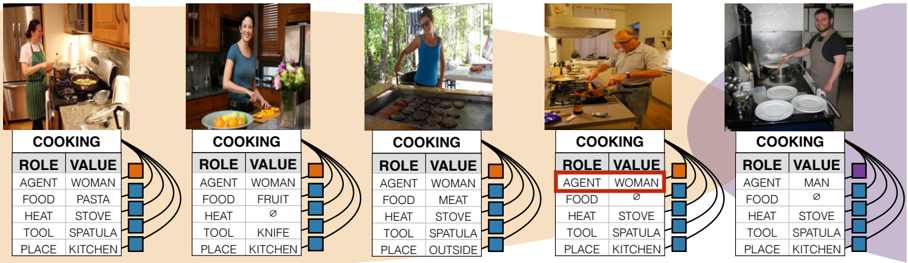
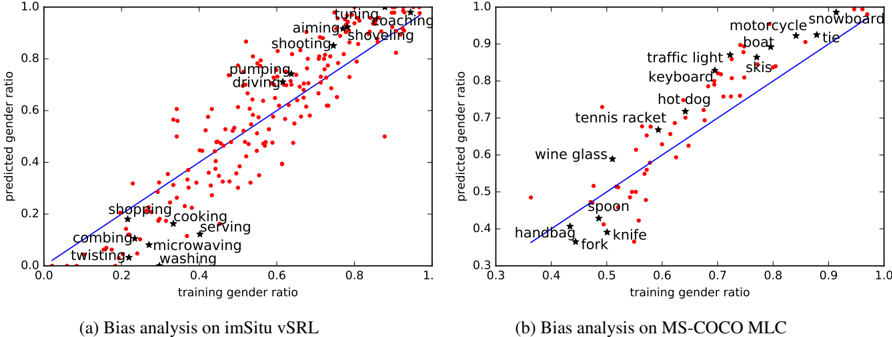
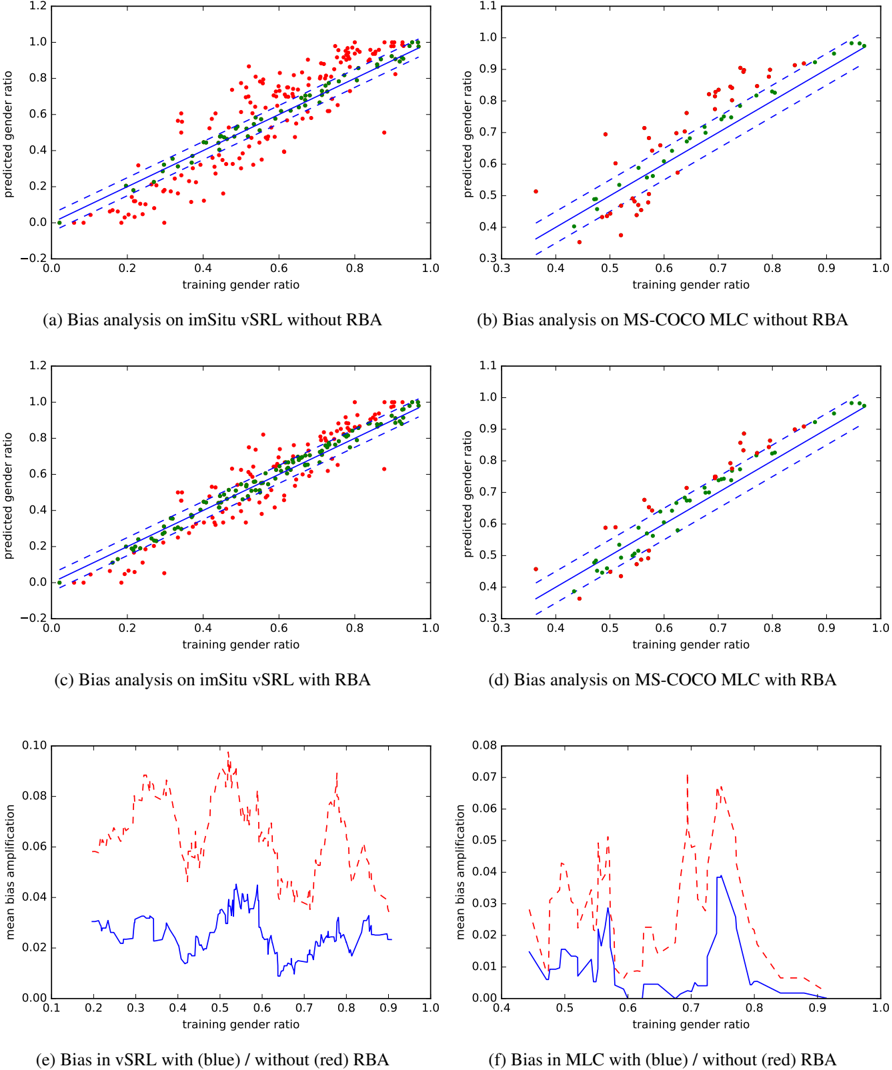
Language is increasingly being used to define rich visual recognition problems with supporting image collections sourced from the web.Structured prediction models are used in these tasks to take advantage of correlations between co-occurring labels and visual input but risk inadvertently encoding social biases found in web corpora.In this work, we study data and models associated with multilabel object classification and visual semantic role labeling.We find that (a) datasets for these tasks contain significant gender bias and (b) models trained on these datasets further amplify existing bias.For example, the activity cooking is over 33% more likely to involve females than males in a training set, and a trained model further amplifies the disparity to 68% at test time.We propose to inject corpus-level constraints for calibrating existing structured prediction models and design an algorithm based on Lagrangian relaxation for collective inference.Our method results in almost no performance loss for the underlying recognition task but decreases the magnitude of bias amplification by 47.5% and 40.5% for multilabel classification and visual semantic role labeling, respectively.
Overview
The claims and statistics of this paper haven’t been checked yet.
Free: it reads the open-access text and checks the first 5 claims that cite a source we can check. Create a free account to check every claim.
Integrity signals
Registry
Cites
Statistics
Figures
Verification
Claims the paper makes
The claims and statistics of this paper haven’t been checked yet.
Free: it reads the open-access text and checks the first 5 claims that cite a source we can check. Create a free account to check every claim.
Claims other papers make about this one
Each is checked against this paper’s own text: does it say what the citing paper says it does?
The source backs part of the claim, not all of it — or backs it for a different population, condition or comparison.
In the citing paper
“and processes of creating resources and technologies may further entrench such disparities [25, 38, 144].”
From Data Governance in the Age of Large-Scale Data-Driven Language Technology (2022) · cites this paper as [144]
Experimental — accuracy not yet measuredThe source backs part of the claim, not all of it — or backs it for a different population, condition or comparison.
In the citing paper
“It is well-documented that LMs learn the biases, prejudices, and racism present in the language they are trained on35–38.”
From Large language models to identify social determinants of health in electronic health records (2024) · cites this paper as [36]
Experimental — accuracy not yet measuredThe source backs part of the claim, not all of it — or backs it for a different population, condition or comparison.
In the citing paper
“Neural networks are prone to learning biases from training data and amplifying them at test time50, giving rise to a much discussed aspect of AI behaviour: fairness51.”
From The METRIC-framework for assessing data quality for trustworthy AI in medicine: A systematic review (2024) · cites this paper as [50]
Experimental — accuracy not yet measuredThe cited source says what the claim attributes to it.
In the citing paper
“It is well acknowledged that machine learning models, such as those ofered by the API providers, are prone to exhibiting various kinds of discriminatory behaviours, including diferent error rates across demographic groups [22,126,127], stereotyping [64,163] or minority groups under-representation [134,137].”
From Out of Context: Investigating the Bias and Fairness Concerns of “Artificial Intelligence as a Service” (2023) · cites this paper as [163]
Self-check
Percentages, sums and reported differences re-computed from the paper’s own numbers.
The self-check needs the paper’s full text.
Citations
Cites
Very Deep Convolutional Networks for Large-Scale Image Recognition
Simonyan, K., & Zisserman, A. (2014) · arXiv · doi:10.48550/arxiv.1409.1556 · Cited by 114,148 · cited 1×
“where each potential value in the CRF for subpart x, is computed using features fi from the VGG convolutional neural network (Simonyan and Zisserman, 2014) on an input image, as follows:”
MethodMicrosoft COCO: Common Objects in Context
Lin, T.-Y., Maire, M., Belongie, S., Hays, J., Perona, P., Ramanan, D., Dollár, P., & Zitnick, C. L. (2014) · Lecture Notes in Computer Science · doi:10.1007/978-3-319-10602-1_48 · Cited by 45,460 · cited 2×
“For MLC, we use MS-COCO (Lin et al., 2014; Chen et al., 2015), a recognition task covering 80 object classes.”
MethodShow and tell: A neural image caption generator
Vinyals, O., Toshev, A., Bengio, S., & Erhan, D. (2015) · 2015 IEEE Conference on Computer Vision and Pattern Recognition (CVPR) · doi:10.1109/cvpr.2015.7298935 · Cited by 6,318 · cited 2×
“Visual recognition tasks involving language, such as captioning (Vinyals et al., 2015), visual question answering (Antol et al.”
BackgroundVQA: Visual Question Answering
Antol, S., Agrawal, A., Lu, J., Mitchell, M., Batra, D., Zitnick, C. L., & Parikh, D. (2015) · 2015 IEEE International Conference on Computer Vision (ICCV) · doi:10.1109/iccv.2015.279 · Cited by 4,487
Dwork, C., Hardt, M., Pitassi, T., Reingold, O., & Zemel, R. (2012) · Proceedings of the 3rd Innovations in Theoretical Computer Science Conference · doi:10.1145/2090236.2090255 · Cited by 3,501 · cited 1×
“Various approaches have been proposed to make a “fair” binary classification (Baro-cas and Selbst, 2014; Dwork et al., 2012; Feldman et al., 2015; Zliobaite, 2015).”
BackgroundBarocas, S., & Selbst, A. D. (2014) · doi:10.2139/ssrn.2477899 · Cited by 3,048
Semantics derived automatically from language corpora contain human-like biases
Caliskan, A., Bryson, J. J., & Narayanan, A. (2017) · Science · doi:10.1126/science.aal4230 · Cited by 2,887 · cited 2×
“Such issues have been demonstrated in various learning systems, including online advertisement systems (Sweeney, 2013), word embedding models (Bolukbasi et al., 2016; Caliskan et al., 2017), online news (Ross and Carter, 2011), web search (Kay et al., 2015), and credit score (Hardt et al., 2016).”
BackgroundEquality of Opportunity in Supervised Learning
Hardt, M., Price, E., & Srebro, N. (2016) · arXiv · doi:10.48550/arxiv.1610.02413 · Cited by 2,536 · cited 1×
“Such issues have been demonstrated in various learning systems, including online advertisement systems (Sweeney, 2013), word embedding models (Bolukbasi et al., 2016; Caliskan et al., 2017), online news (Ross and Carter, 2011), web search (Kay et al., 2015), and credit score (Hardt et al., 2016).”
BackgroundBaker, C. F., Fillmore, C. J., & Lowe, J. B. (1998) · Proceedings of the 36th annual meeting on Association for Computational Linguistics - · doi:10.3115/980845.980860 · Cited by 2,518 · cited 2×
“Dataset We evaluate on imSitu (Yatskar et al., 2016) where activity classes are drawn from verbs and roles in FrameNet (Baker et al., 1998) and noun categories are drawn from WordNet (Miller et al., 1990).”
BackgroundMethodCertifying and Removing Disparate Impact
Feldman, M., Friedler, S. A., Moeller, J., Scheidegger, C., & Venkatasubramanian, S. (2015) · Proceedings of the 21th ACM SIGKDD International Conference on Knowledge Discovery and Data Mining · doi:10.1145/2783258.2783311 · Cited by 1,827 · cited 2×
“e cost of making mistakes on samples in the minority class can be neglected. Various approaches have been proposed to make a “fair” binary classification (Barocas and Selbst, 2014; Dwork et al., 2012; Feldman et al., 2015; Zliobaite, 2015). For structured prediction tasks the effect is harder to quantify and we are the…”
Background
Research works printed but not linked: 4
- Stanislaw Antol, Aishwarya Agrawal, Jiasen Lu, Mar- garet Mitchell, Dhruv Batra, C Lawrence Zitnick, and Devi Parikh. 2015. Vqa: Visual question an- swering. In Proceedings of the IEEE International Conference on Computer Vision, pages 2425-2433.
- Tolga Bolukbasi, Kai-Wei Chang, James Y Zou, Venkatesh Saligrama, and Adam T Kalai. 2016. Man is to computer programmer as woman is to homemaker? debiasing word embeddings. In The Conference on Advances in Neural Information Pro- cessing Systems (NIPS), pages 4349-4357.
- Bernhard Korte and Jens Vygen. 2008. Combinatorial Optimization: Theory and Application. Springer Verlag.
- G. Miller, R. Beckwith, C. Fellbaum, D. Gross, and K.J. Miller. 1990. Wordnet: An on-line lexical database. International Journal of Lexicography, 3(4):235-312.
Cited by
Items 101–200 of 834
Text and Causal Inference: A Review of Using Text to Remove Confounding from Causal Estimates
Keith, K. A., Jensen, D. D., & O’Connor, B. (2020) · Proceedings of the conference - Association for Computational Linguistics. Meeting · doi:10.18653/v1/2020.acl-main.474 · Cited by 172
“, 2015), and exhibit racial and gender disparity (Blodgett and O’Connor, 2017; Zhao et al., 2017).”
BackgroundAnik, A. I., & Bunt, A. (2021) · Proceedings of the 2021 CHI Conference on Human Factors in Computing Systems · doi:10.1145/3411764.3445736 · Cited by 103
“For example, if the training dataset is not representative of the target population, certain groups can be disadvantaged [3], and any biases in the training data [81] are ultimately reflected and aggravated in the deployed system [3,106].”
BackgroundFairness Testing: A Comprehensive Survey and Analysis of Trends
Chen, Z., Zhang, J. M., Hort, M., Harman, M., & Sarro, F. (2024) · ACM Transactions on Software Engineering and Methodology · doi:10.1145/3652155 · Cited by 204
“Zhao et al. [149] used the fairness measurements calculated based on training data as their baseline against which to evaluate.”
BackgroundMethodRechkemmer, A., & Yin, M. (2022) · CHI Conference on Human Factors in Computing Systems · doi:10.1145/3491102.3501967 · Cited by 97
“Many different factors have been identified as influencing people’s trust in ML, such as people’s understanding of how the model works [19, 37] and people’s perceptions on whether the model is biased [9, 62].”
BackgroundDeep Structural Causal Models for Tractable Counterfactual InferencePreprint
Pawlowski, N., Castro, D. C., & Glocker, B. (2020) · arXiv (Cornell University) · doi:10.48550/arxiv.2006.06485 · Cited by 374
Characterising Bias in Compressed Models
Hooker, S., Moorosi, N., Clark, G., Bengio, S., & Denton, E. (2020) · arXiv (Cornell University) · doi:10.48550/arxiv.2010.03058 · Cited by 41
“…income and non-Western regions (Shankar et al., 2017; DeVries et al., 2019), activity recognition datasets exhibit stereotype-aligned gender biases (Zhao et al., 2017), and word co-occurrences within text datasets frequently reflect social biases relating to gender, race and disability (Garg et…”
BackgroundExploring gender biases in ML and AI academic research through systematic literature review
Shrestha, S., & Das, S. (2022) · Frontiers in Artificial Intelligence · doi:10.3389/frai.2022.976838 · Cited by 95
Gradient Starvation: A Learning Proclivity in Neural Networks
Pezeshki, M., Kaba, S.-O., Bengio, Y., Courville, A. C., Precup, D., & Lajoie, G. (2021) · neural information processing systems · doi:10.48550/arxiv.2011.09468 · Cited by 187
“An analogous phenomenon has been noticed when training neural networks (e.g. Ribeiro et al., 2016; Zhao et al., 2017; Jo and Bengio, 2017; Heinze-Deml and Meinshausen, 2017; Belinkov and Bisk, 2017; Baker et al., 2018; Gururangan et al., 2018; Jacobsen et al., 2018; Zech et al., 2018; Niven and Kao, 2019; Ilyas et al.…”
BackgroundEqualizing Gender Bias in Neural Machine Translation with Word Embeddings Techniques
Escudé Font, J., & Costa-jussà, M. R. (2019) · Proceedings of the First Workshop on Gender Bias in Natural Language Processing · doi:10.18653/v1/w19-3821 · Cited by 93
“(Zhao et al., 2017) shows that gender bias is learned and amplified in models trained from data sets containing web images”
MethodMitigating face recognition bias via group adaptive classifier
Gong, S., Liu, X., & Jain, A. K. (2021) · 2021 IEEE/CVF Conference on Computer Vision and Pattern Recognition (CVPR) · doi:10.1109/cvpr46437.2021.00342 · Cited by 92
“…prevent machine learning models from utilizing statistical bias in training data, including adversarial training [2, 25, 69, 48], subgroup constraint optimization [34, 81, 70], data pre-processing ( e.g. , weighted sampling [21], and data transformation [4]), and algorithm post-processing [36, 54].”
BackgroundHONEST: Measuring Hurtful Sentence Completion in Language Models
Nozza, D., Bianchi, F., & Hovy, D. (2021) · Proceedings of the 2021 Conference of the North American Chapter of the Association for Computational Linguistics: Human Language Technologies · doi:10.18653/v1/2021.naacl-main.191 · Cited by 95
Explicit Bias Discovery in Visual Question Answering Models
Manjunatha, V., Saini, N., & Davis, L. S. (2019) · 2019 IEEE/CVF Conference on Computer Vision and Pattern Recognition (CVPR) · doi:10.1109/cvpr.2019.00979 · Cited by 87
“[43] explores data as well as models associated with object classification and visual semantic role labeling for identifying gender biases and their amplification.”
MethodA Study of Face Obfuscation in ImageNet
Yang, K., Yau, J., Fei-Fei, L., Deng, J. H., & Russakovsky, O. (2021) · arXiv (Cornell University) · doi:10.48550/arxiv.2103.06191 · Cited by 64
“A prominent issue is imbalanced representation, e.g., underrepresentation of certain demographic groups in data for face recognition (Buo-lamwini & Gebru, 2018), activity recognition (Zhao et al., 2017), and image captioning (Hendricks et al., 2018).”
BackgroundInterpretable clinical prediction via attention-based neural network
Chen, P., Dong, W., Wang, J., Lu, X., Kaymak, U., & Huang, Z. (2020) · BMC Medical Informatics and Decision Making · doi:10.1186/s12911-020-1110-7 · Cited by 86
“There are also other reasons for the requirement of interpretability, such as legislation (the right to explanation in EU ’ s GDPR (General Data Protection Regulation)) [15], reducing bias and capturing causality [16].”
BackgroundGender Bias in Coreference Resolution: Evaluation and Debiasing Methods
Zhao, J., Wang, T., Yatskar, M., Ordóñez, V., & Chang, K.-W. (2018) · arXiv (Cornell University) · doi:10.48550/arxiv.1804.06876 · Cited by 85
“For structured prediction, the work of Zhao et al. (2017) reduces bias by using corpus level constraints, but is only practical for models with specialized structure.”
MethodResultSelf-citationReducing Language Biases in Visual Question Answering with Visually-Grounded Question Encoder
Gouthaman, K. V., & Mittal, A. (2020) · Lecture notes in computer science · doi:10.1007/978-3-030-58601-0_2 · Cited by 104
“For instance, some methods focused on the biases in captioning models [17], gender biases in multi-label object classification [45], biases in ConvNets and ImageNet [38], etc.”
MethodUnderstanding and Evaluating Racial Biases in Image Captioning
Zhao, D., Wang, A., & Russakovsky, O. (2021) · 2021 IEEE/CVF International Conference on Computer Vision (ICCV) · doi:10.1109/iccv48922.2021.01456 · Cited by 83
“Comparing collected gender annotations with automatically derived ones [80].”
BackgroundResultInfluentialLazard, T., Bataillon, G., Naylor, P., Popova, T., Bidard, F.-C., Stoppa-Lyonnet, D., Stern, M.-H., Decencière, E., Walter, T., & Vincent-Salomon, A. (2022) · Cell Reports Medicine · doi:10.1016/j.xcrm.2022.100872 · Cited by 82
“These results are corroborated using the bias-amplification (BA) measure, a metric widely used in the machine learning fairness literature: 39,42 on the in-house dataset, correcting for c 1 and c 2 lowers the BA from (cid:1) 0.02 to (cid:1) 0.05; on TCGA dataset, the subtype correction lowers the BA…”
MethodInfluentialDon’t Judge an Object by Its Context: Learning to Overcome Contextual Bias
Singh, K. K., Mahajan, D. K., Grauman, K. L., Lee, Y. J., Feiszli, M., & Ghadiyaram, D. (2020) · IEEE Computer Society Conference on Computer Vision and Pattern Recognition/Proceedings - IEEE Computer Society Conference on Computer Vision and Pattern Recognition/Proceedings · doi:10.1109/cvpr42600.2020.01108 · Cited by 136
“Recent research has identified far more serious mistakes made by trained models due to inherent biases in both language and vision datasets – learning correlations between ethnicity and certain sport activities [29], gender and profession [5, 16, 37], and age and gender of celebrities [2].”
BackgroundDebiasing Career Recommendations with Neural Fair Collaborative Filtering
Islam, R., Keya, K. N., Zeng, Z., Pan, S., & Foulds, J. R. (2021) · International World Wide Web Conference (WWW) · doi:10.1145/3442381.3449904 · Cited by 115
“Typical collaborative filtering methods can suffer from overfitting in this scenario that often amplifies unfairness or demographic bias in the data [22, 57].”
A Survey of Race, Racism, and Anti-Racism in NLP
Field, A., Blodgett, S. L., Waseem, Z., & Tsvetkov, Y. (2021) · Proceedings of the 59th Annual Meeting of the Association for Computational Linguistics and the 11th International Joint Conference on Natural Language Processing (Volume 1: Long Papers) · doi:10.18653/v1/2021.acl-long.149 · Cited by 74
“Data A substantial amount of prior work has already shown how NLP systems, especially word embeddings and language models, can absorb and amplify social biases in data sets (Bolukbasi et al., 2016; Zhao et al., 2017).”
BackgroundWebly Supervised Joint Embedding for Cross-Modal Image-Text Retrieval
Mithun, N. C., Panda, R., Papalexakis, E. E., & Roy-Chowdhury, A. K. (2018) · Proceedings of the 26th ACM international conference on Multimedia · doi:10.1145/3240508.3240712 · Cited by 77
Adversarial Regularization for Visual Question Answering: Strengths, Shortcomings, and Side Effects
Grand, G., & Belinkov, Y. (2019) · Proceedings of the Second Workshop on Shortcomings in Vision and Language · doi:10.18653/v1/w19-1801 · Cited by 76
“For instance, the Commmon Objects in Context (COCO) image dataset (Lin et al., 2014), which is used in VQA, has been shown to contain prominent gender biases (Zhao et al., 2017; Hendricks et al., 2018).”
BackgroundCounterfactual Inference for Text Classification Debiasing
Chen, Q., Feng, F., Wen, L., Ma, C., & Xie, P. (2021) · doi:10.18653/v1/2021.acl-long.422 · Cited by 124
“…to design model-level balancing mechanisms, including unbiased embedding (Bolukbasi et al., 2016; Kaneko and Bol-legala, 2019), threshold correction (Kang et al., 2020; Provost, 2000; Calders and Verwer, 2010) and instance weighting (Zhang et al., 2020; Zhao et al., 2017; Jiang and Zhai, 2007).”
BackgroundMethodInfluentialREVISE: A Tool for Measuring and Mitigating Bias in Visual Datasets
Wang, A., Liu, A., Zhang, R., Kleiman, A., Kim, L., Zhao, D., Shirai, I., Narayanan, A., & Russakovsky, O. (2022) · International Journal of Computer Vision · doi:10.1007/s11263-022-01625-5 · Cited by 77
“This analysis is done by (1) extracting FC7 features from AlexNet (Krizhevsky et al., 2012) pretrained on Places (Zhou et al., 2017) on a randomly sampled subset of the images to get scene-level features, (2) projecting them into √ number of samples dimensions (as is recommended in (Hua et al., 2005; Jain and Waller,…”
BackgroundMethodInfluentialData Governance in the Age of Large-Scale Data-Driven Language Technology
Jernite, Y., Nguyen, H., Biderman, S., Rogers, A., Masoud, M., Danchev, V., Tan, S., Luccioni, A. S., Subramani, N., Johnson, I., et al. (2022) · 2022 ACM Conference on Fairness Accountability and Transparency · doi:10.1145/3531146.3534637 · Cited by 75
“Unsurprisingly, gendered and racial disparities have been documented in a number of language technologies [37, 79, 141], and processes of creating resources and technologies may further entrench such disparities [25, 38, 144].”
BackgroundPetersen, E., Potdevin, Y., Mohammadi, E., Zidowitz, S., Breyer, S., Nowotka, D., Henn, S., Pechmann, L., Leucker, M., Rostalski, P., et al. (2022) · IEEE Access · doi:10.1109/access.2022.3178382 · Cited by 113
“Thebiased data problem is very hard to solve because learning algorithms often amplify even subtle correlations in superficially balanced datasets, an effect known as bias amplification [121], [297], [407].”
BackgroundNew Information Technology and Implicit Bias
Elsbach, K. D., & Stigliani, I. (2019) · Academy of Management Perspectives · doi:10.5465/amp.2017.0079 · Cited by 74
Lost in Translation: Loss and Decay of Linguistic Richness in Machine TranslationPreprint
Vanmassenhove, E., Shterionov, D., & Way, A. (2019) · arXiv (Cornell University) · doi:10.48550/arxiv.1906.12068 · Cited by 118
“Although, in the context of gender, some researchers have already alluded to the existence of so-called ‘algorithmic bias’ (Zhao et al., 2017; Prates et al., 2019), no empirical evidence has been provided so far.”
BackgroundREVISE: A Tool for Measuring and Mitigating Bias in Visual Datasets
Wang, A., Narayanan, A., & Russakovsky, O. (2020) · Lecture notes in computer science · doi:10.1007/978-3-030-58580-8_43 · Cited by 102
Probing Toxic Content in Large Pre-Trained Language Models
Ousidhoum, N., Zhao, X., Fang, T., Song, Y., & Yeung, D.-Y. (2021) · Proceedings of the 59th Annual Meeting of the Association for Computational Linguistics and the 11th International Joint Conference on Natural Language Processing (Volume 1: Long Papers) · doi:10.18653/v1/2021.acl-long.329 · Cited by 69
“, 2020), model overamplification (Zhao et al., 2017), and semantic bias (Garg et al.”
BackgroundLütz, F. (2022) · ERA Forum · doi:10.1007/s12027-022-00709-6 · Cited by 85
“55 Regarding gender equality and non-discrimination, the Artificial Intelligence Act complements the existing legislative framework 56 but includes gender equality and non-discrimination to the extent of prohibiting certain artificial intelligence applications and defining high-risk artificial…”
Generative Artificial Intelligence for Software Engineering - a Research Agenda
NguyenDuc, A., Cabrero-Daniel, B., Arora, C., Przybylek, A., Khanna, D., Herda, T., Rafiq, U., Melegati, J., Guerra, E., Kemell, K.-K., et al. (2023) · doi:10.2139/ssrn.4622517 · Cited by 71
Diversity and Inclusion in Artificial Intelligence
Fosch‐Villaronga, E., & Poulsen, A. (2022) · Information technology and law series/Information technology & law series · doi:10.1007/978-94-6265-523-2_6 · Cited by 119
Going Beyond XAI: A Systematic Survey for Explanation-Guided Learning
Gao, Y., Gu, S., Jiang, J., Hong, S.-S., Yu, D., & Zhao, L. (2024) · ACM Computing Surveys · doi:10.1145/3644073 · Cited by 121
“At the end of the day, from the perspective of model accuracy and FaccT, a railroad should not the reason for predicting a train [85], a snowboard cannot be a male class [64], and a shopping cart should not only belong to a woman class [178].”
BackgroundBias in Multimodal AI: Testbed for Fair Automatic Recruitment
Pena, A., Serna, I., Morales, A., & Fierrez, J. (2020) · 2020 IEEE/CVF Conference on Computer Vision and Pattern Recognition Workshops (CVPRW) · doi:10.1109/cvprw50498.2020.00022 · Cited by 64
“In this scenario, machine learning models have the capacity to replicate, or even amplify human biases present in the data [1, 13, 26, 35].”
BackgroundMetrics for Dataset Demographic Bias: A Case Study on Facial Expression Recognition
Dominguez-Catena, I., Paternain, D., & Galar, M. (2024) · IEEE Transactions on Pattern Analysis and Machine Intelligence · doi:10.1109/tpami.2024.3361979 · Cited by 106
“Other works [7], [12] employ metrics based on information theory and statistics, such as the Mutual Information, to quantify bias in the source datasets, usually as part of a bias mitigation methodology.”
BackgroundMethodInfluentialLehr, S. A., Caliskan, A., Liyanage, S., & Banaji, M. R. (2024) · Proceedings of the National Academy of Sciences · doi:10.1073/pnas.2404328121 · Cited by 66
“This may reflect the troubling tendency for AI systems to amplify biases in their training data ( 43 – 45 ).”
Using Explainability to Help Children UnderstandGender Bias in AI
Melsión, G. I., Torre, I., Vidal, E., & Leite, I. (2021) · Interaction Design and Children · doi:10.1145/3459990.3460719 · Cited by 65
Mitigating Language-Dependent Ethnic Bias in BERT
Ahn, J., & Oh, A. (2021) · Proceedings of the 2021 Conference on Empirical Methods in Natural Language Processing · doi:10.18653/v1/2021.emnlp-main.42 · Cited by 64
“A third method is re-training with some constraints which can mitigate bias (Zhao et al., 2017; Zhang et al., 2018; Jia et al., 2020; Liu et al., 2020), but these come with the difficulty of re-training.”
Lau, V. W.-Y., Scott, V. L., Warren, M. A., & Bligh, M. C. (2022) · Journal of Organizational Behavior · doi:10.1002/job.2654 · Cited by 101
Cruz, B. G. S., Husch, A., & Hertel, F. (2023) · Frontiers in Aging Neuroscience · doi:10.3389/fnagi.2023.1216163 · Cited by 92
“Moreover, it is essential to address the issue of unwanted biases in the data used for current AI systems, as these systems not only have the risk of making incorrect predictions, but also of perpetuating and amplifying biases present in the data (Zhao et al., 2017).”
BackgroundMultilingual Twitter Corpus and Baselines for Evaluating Demographic Bias in Hate Speech Recognition
Huang, X., Xing, L., Dernoncourt, F., & Paul, M. J. (2020) · arXiv (Cornell University) · doi:10.48550/arxiv.2002.10361 · Cited by 21
Reducing Gender Bias in Word-Level Language Models with a Gender-Equalizing Loss Function
Qian, Y., Muaz, U., Zhang, B., & Hyun, J. W. (2019) · Proceedings of the 57th Annual Meeting of the Association for Computational Linguistics: Student Research Workshop · doi:10.18653/v1/p19-2031 · Cited by 63
“Bolukbasi et al. (2016) and Zhao et al. (2017) defined gender bias as a projection of gender-neutral words on a gender subspace and removed bias by minimizing this projection.”
BackgroundMethodInfluentialMitigating Demographic Bias in Facial Datasets with Style-Based Multi-attribute Transfer
Georgopoulos, M., Oldfield, J. P., Nicolaou, M. A., Panagakis, Y., & Pantić, M. (2021) · International Journal of Computer Vision · doi:10.1007/s11263-021-01448-w · Cited by 83
“…‘Male’ and ‘Female’, and therefore it is common practice in both the face analysis (Ng et al. 2012; Dantcheva et al. 2015) and fairness literature (Buolamwini and Gebru 2018; Quadrianto et al. 2019; Zhao et al. 2017; Hendricks et al. 2018) to use these available labels under this categorization.”
BackgroundMultilingualism and AI: The Regimentation of Language in the Age of Digital Capitalism
Schneider, B. (2022) · Signs and Society · doi:10.1086/721757 · Cited by 115
Equity Beyond Bias in Language Technologies for Education
Mayfield, E., Madaio, M., Prabhumoye, S., Gerritsen, D., McLaughlin, B., Dixon-Román, E., & Black, A. W. (2019) · Proceedings of the Fourteenth Workshop on Innovative Use of NLP for Building Educational Applications · doi:10.18653/v1/w19-4446 · Cited by 62
“Early work on “de-biasing” NLP has begun, seeking to reduce the amplifica-tion of bias in dense word embeddings (Boluk-basi et al., 2016; Zhao et al., 2017, 2018b); but early results still leave room for improvement (Go-nen and Goldberg, 2019).”
BackgroundData and its (dis)contents: A survey of dataset development and use in machine learning research
Paullada, A., Raji, I. D., Bender, E. M., Denton, E., & Hanna, A. (2021) · Patterns · doi:10.1016/j.patter.2021.100336 · Cited by 548
Detecting Bias with Generative Counterfactual Face Attribute AugmentationPreprint
Denton, E., Hutchinson, B., Mitchell, M., & Gebru, T. (2019) · arXiv (Cornell University) · Cited by 75
Generative Artificial Intelligence for Software Engineering—A Research Agenda
Nguyen‐Duc, A., Cabrero‐Daniel, B., Przybylek, A., Arora, C., Khanna, D., Herda, T., Rafiq, U., Melegati, J., Guerra, E., Kemell, K., et al. (2025) · Software: Practice and Experience · doi:10.1002/spe.70005 · Cited by 60
“On top of that, there is a gender gap in technology-related study fields [200, 202] and a soft skills gap [197, 203] that make it even harder to find professionals and have balanced teams able to detect and correct unfair biases, for example, caused by the selection of data sources [204].”
Williams, N. W., Casas, A., & Wilkerson, J. (2020) · Cambridge University Press eBooks · doi:10.1017/9781108860741 · Cited by 91
A Transparent Framework for Evaluating Unintended Demographic Bias in Word Embeddings
Sweeney, C., & Najafian, M. (2019) · Proceedings of the 57th Annual Meeting of the Association for Computational Linguistics · doi:10.18653/v1/p19-1162 · Cited by 57
“Much of the focus for mitigating unintended bias in NLP is either targeted at reducing gender stereotypes in text (Bolukbasi et al., 2016b,a; Zhao et al., 2017; Zhang et al., 2018), or inequality of sentiment or toxicity for various protected groups (Caliskan-Islam et al., 2016; Bakarov, 2018;…”
BackgroundZhang, G., Bai, B., Zhang, J., Bai, K., Zhu, C., & Zhao, T. (2020) · Proceedings of the 58th Annual Meeting of the Association for Computational Linguistics · doi:10.18653/v1/2020.acl-main.380 · Cited by 54
“Recent works have found that ML models can capture, utilize, and even amplify the unintended biases (Zhao et al., 2017), which has raised lots of concerns about the discrimination problem in NLP models (Sun et al., 2019).”
BackgroundIdentifying and Mitigating the Security Risks of Generative AI
Barrett, C., Boyd, B., Bursztein, E., Carlini, N., Chen, B., Choi, J., Chowdhury, A. R., Christodorescu, M., Datta, A., Feizi, S., et al. (2023) · Foundations and Trends® in Privacy and Security · doi:10.1561/3300000041 · Cited by 57
“For instance, LLMs have revolutionized the task of open-domain question answering, but in doing so, they introduce distributional shifts that make the model more brittle and susceptible to novel adversarial attacks.”
BackgroundFairness in Deep Learning: A Survey on Vision and Language Research
Parraga, O., Móre, M. D., Mattjie, C., Gavenski, N. S., Kupssinskü, L. S., Medronha, A., de Moura, L. V., Simões, G. S., & Barros, R. C. (2025) · ACM Computing Surveys · doi:10.1145/3637549 · Cited by 125
“Aside from proposing novel loss functions, it is possible to employ an algorithm to inject constraints during model training to ensure a fair distribution of predictions for the training data [115, 220].”
InfluentialProtein language models are biased by unequal sequence sampling across the tree of life
Ding, F., & Steinhardt, J. (2024) · doi:10.1101/2024.03.07.584001 · Cited by 57
“Various papers have studied how re-weighting or curating datasets can mitigate these biases (Zhao et al., 2017; Ryu et al., 2017; Tschandl et al., 2018; Yang et al., 2020), even finding that overall performance is improved by over-weighting minority groups and actively increasing diversity in…”
BackgroundOn Measuring Gender Bias in Translation of Gender-neutral Pronouns
Cho, W. I., Kim, J. W., Kim, S. M., & Kim, N. S. (2019) · Proceedings of the First Workshop on Gender Bias in Natural Language Processing · doi:10.18653/v1/w19-3824 · Cited by 53
Human-Centric Multimodal Machine Learning: Recent Advances and Testbed on AI-Based Recruitment
Peña, A., Serna, I., Morales, A., Fiérrez, J., Ortega, A., Sánchez, A. H., Saéz, M. A., & Ortega-García, J. (2023) · SN Computer Science · doi:10.1007/s42979-023-01733-0 · Cited by 98
“We can find examples of such unfair treatment in various fields, such as healthcare [10, 29], ad delivery systems [7, 8, 30], hiring [16, 18], and both facial analysis [5, 12, 13] and NLP technologies [31, 32].”
BackgroundShrestha, Y. R., & Yang, Y. (2019) · Algorithms · doi:10.3390/a12090199 · Cited by 55
“In the similar line, Zhao et al. [75] investigated various datasets and models associated with multilabel object classification and visual semantic role labeling, and found that various datasets for these tasks contain significant gender bias which are amplified by the models trained on these datasets.”
BackgroundStereotypical Gender Associations in Language Have Decreased Over Time
Jones, J. J., Amin, M. R., Kim, J., & Skiena, S. (2020) · Sociological Science · doi:10.15195/v7.a1 · Cited by 79
“Similar racial and gender biases have been demonstrated in computer-analyzed visual images (Buolamwini and Gebru 2018; Zhao et al. 2017).”
BackgroundUnderstanding the Failure Modes of Out-of-Distribution Generalization
Nagarajan, V., Andreassen, A., & Neyshabur, B. (2020) · arXiv · doi:10.48550/arxiv.2010.15775 · Cited by 55
“It can also lead to unfair biases and poor performance on minority groups (Dixon et al., 2018; Zhao et al., 2017; Sagawa et al., 2020b).”
BackgroundSelecting Directors Using Machine Learning
Erel, I., Stern, L. H., Tan, C., & Weisbach, M. S. (2018) · National Bureau of Economic Research · doi:10.3386/w24435 · Cited by 71
Towards a pragmatist dealing with algorithmic bias in medical machine learning
Starke, G., De Clercq, E., & Elger, B. S. (2021) · Medicine, Health Care and Philosophy · doi:10.1007/s11019-021-10008-5 · Cited by 54
“While this may run counter to preferences in the machine learning community to focus on ex-ante mechanisms to ensure fairness, such an approach has been proven to be highly efficient in addressing discriminatory behaviour of algorithms, based for example on gender ste-reotypes (Zhao et al. 2017).”
BackgroundBhimdiwala, A., Neri, R. C., & Gomez, L. M. (2022) · International Journal of Artificial Intelligence in Education · doi:10.1007/s40593-021-00278-8 · Cited by 54
“Outside of education, the reproduction of historical biases and inequities in AI systems has become a growing concern for our society (e.g. Ferguson, 2017; Zhao et al., 2017).”
BackgroundTomalin, M., Byrne, B., Concannon, S. J., Saunders, D., & Ullmann, S. (2021) · Ethics and Information Technology · doi:10.1007/s10676-021-09583-1 · Cited by 77
“Such issues are even more important given the attested phenomenon of ‘bias amplification’, which occurs when automated systems manifest biases that are even greater than those present in the data on which they were trained (Lloyd 2018; Zhao et al. 2017).”
BackgroundOn Scaling Up a Multilingual Vision and Language Model
Chen, X., Djolonga, J., Padlewski, P., Mustafa, B., Changpinyo, S., Wu, J., Riquelme, C., Goodman, S., Wang, X., Tay, Y., et al. (2024) · IEEE Computer Society Conference on Computer Vision and Pattern Recognition/Proceedings - IEEE Computer Society Conference on Computer Vision and Pattern Recognition/Proceedings · doi:10.1109/cvpr52733.2024.01368 · Cited by 383
“Large models, if left unchecked, have the potential to in-flict harm on society – such as amplifying biases [72–75], causing disparities [74, 76, 77], or encoding narrow cultural perspectives [78, 79].”
BackgroundOn Measuring Bias in Online Information
Pitoura, E., Tsaparas, P., Flouris, G., Fundulaki, I., Papadakos, P., Abiteboul, S., & Weikum, G. (2018) · ACM SIGMOD Record · doi:10.1145/3186549.3186553 · Cited by 68
“accountable algorithms(7), for auditing algorithms by detecting discrimination [7, 26] and for debiasing approaches [1, 37].”
BackgroundTowards Explainability for AI Fairness
Zhou, J., Chen, F., & Holzinger, A. (2022) · Lecture Notes in Computer Science · doi:10.1007/978-3-031-04083-2_18 · Cited by 43
Mitigating Gender Bias in Captioning Systems
Tang, R., Du, M., Li, Y., Liu, Z., Zou, N., & Hu, X. (2021) · Proceedings of the Web Conference 2021 · doi:10.1145/3442381.3449950 · Cited by 50
Are Gender-Neutral Queries Really Gender-Neutral? Mitigating Gender Bias in Image Search
Wang, J., Liu, Y., & Wang, X. (2021) · Proceedings of the 2021 Conference on Empirical Methods in Natural Language Processing · doi:10.18653/v1/2021.emnlp-main.151 · Cited by 50
“Inspired by Kay et al. (2015) and Zhao et al. (2017), we measure gender bias in image search by comparing the proportions of masculine and feminine images in search results.”
BackgroundMethodInfluentialFairPrune: Achieving Fairness Through Pruning for Dermatological Disease Diagnosis
Wu, Y., Zeng, D., Xu, X., Shi, Y., & Hu, J. (2022) · Lecture notes in computer science · doi:10.1007/978-3-031-16431-6_70 · Cited by 95
Lyu, L., He, X., & Li, Y. (2020) · Findings of the Association for Computational Linguistics: EMNLP 2020 · doi:10.18653/v1/2020.findings-emnlp.213 · Cited by 51
“Recently, fairness concern has gained lots of attention in NLP community (Bolukbasi et al., 2016; Zhao et al., 2017; Chang et al., 2019; Lu et al., 2018; Sun et al., 2019).”
BackgroundQuantifying Societal Bias Amplification in Image Captioning
Hirota, Y., Nakashima, Y., & García, N. (2022) · IEEE Computer Society Conference on Computer Vision and Pattern Recognition/Proceedings - IEEE Computer Society Conference on Computer Vision and Pattern Recognition/Proceedings · doi:10.1109/cvpr52688.2022.01309 · Cited by 92
“being correlated with the gender [38, 40, 47], 2) the gender of the person in the image [8], and 3) the language model itself [3, 6].”
BackgroundMethodInfluentialEvaluating and Mitigating Bias in Image Classifiers: A Causal Perspective Using Counterfactuals
Dash, S., Balasubramanian, V. N., & Sharma, A. (2022) · IEEE Winter Conference on Applications of Computer Vision · doi:10.1109/wacv51458.2022.00393 · Cited by 102
“A growing number of studies have uncovered biases in image classifiers, particularly against marginalized demographic groups [3, 15, 43, 2].”
BackgroundBias in Machine Learning -- What is it Good for?
Hellström, T., Dignum, V., & Bensch, S. (2020) · arXiv (Cornell University) · doi:10.48550/arxiv.2004.00686 · Cited by 48
“The authors of [52] show that in a certain data set, the label cooking co-occurs unproportionally often with woman, as compared to man.”
BackgroundCao, Y. T., & Daumé, H. (2021) · Computational Linguistics · doi:10.1162/coli_a_00413 · Cited by 47
“These results echo and extend previous observations made by Zhao et al. (2018a),”
ResultUsing fair AI to predict students’ math learning outcomes in an online platform
Li, C., Xing, W., & Leite, W. (2024) · Interactive Learning Environments · doi:10.1080/10494820.2022.2115076 · Cited by 47
“Studies have identi fi ed AI bias that systematically generates errors for participants in speci fi c demographic groups (e.g. gender, race) in medicine, business hiring, and policing (Binns, 2018; Bolukbasi et al., 2016; Giang, 2018; Zhao et al., 2017).”
BackgroundRetrieval-augmented Image Captioning
Ramos, R., Elliott, D., & Martins, B. (2023) · Proceedings of the 17th Conference of the European Chapter of the Association for Computational Linguistics · doi:10.18653/v1/2023.eacl-main.266 · Cited by 43
Silva, A., Tambwekar, P., & Gombolay, M. (2021) · Proceedings of the 2021 Conference of the North American Chapter of the Association for Computational Linguistics: Human Language Technologies · doi:10.18653/v1/2021.naacl-main.189 · Cited by 46
“After the seminal work of Bolukbasi et al. (2016), bias has been found ubiquitous in word embedding models (Amorim et al., 2018; Brunet et al., 2018; Rudinger et al., 2018; Zhao et al., 2017; Costa-jussà et al., 2019; Silva et al., 2020).”
BackgroundWhat You See Is What You Get? The Impact of Representation Criteria on Human Bias in Hiring
Peng, A., Nushi, B., Kıcıman, E., Inkpen, K., Suri, S., & Kamar, E. (2019) · Proceedings of the AAAI Conference on Human Computation and Crowdsourcing · doi:10.1609/hcomp.v7i1.5281 · Cited by 41
“Does this statistical correlation mean that people hold an internal preference for men as programmers or do the current skewed world distributions, of which AI systems only serve to accentuate (Zhao et al. 2017), create biased decision outcomes?”
BackgroundEqualizing Gender Biases in Neural Machine Translation with Word Embeddings Techniques
Font, J. E., & Costa‐jussà, M. R. (2019) · arXiv (Cornell University) · doi:10.48550/arxiv.1901.03116 · Cited by 44
“(Zhao et al., 2017) shows that gender bias is learned and amplified in models trained from data sets containing web images”
MethodKenton, Z., Everitt, T., Weidinger, L., Gabriel, I., Mikulik, V., & Irving, G. (2021) · arXiv · doi:10.48550/arxiv.2103.14659 · Cited by 45
“Language agents may give harmful and biased outputs, producing discriminatory content relating to people’s protected characteristics and other sensitive attributes such as someone’s socio-economic status, see e.g. (Jentzsch et al., 2019; Lu et al., 2020; Zhao et al., 2017).”
BackgroundArtificial intelligence and machine learning in cell-free-DNA-based diagnostics
Tsui, W., Ding, S. C., Jiang, P., & Lo, Y. M. D. (2025) · Genome Research · doi:10.1101/gr.278413.123 · Cited by 57
Inclusive GAN: Improving Data and Minority Coverage in Generative Models
Yu, N., Li, K., Zhou, P., Malik, J., Davis, L., & Fritz, M. (2020) · Lecture notes in computer science · doi:10.1007/978-3-030-58542-6_23 · Cited by 67
“Bias in machine learning results from data imbalance, which can be detected and alleviated by three categories of approaches: The pre-process approaches that purify data from bias before training [7,13,14,53], the in-process approaches that enforce fairness during training with constraints or regularization in the obj…”
BackgroundAnticipating Safety Issues in E2E Conversational AI: Framework and Tooling
Dinan, E., Abercrombie, G., Bergman, A. S., Spruit, S., Hovy, D., Boureau, Y.-L., & Rieser, V. (2021) · arXiv · doi:10.48550/arxiv.2107.03451 · Cited by 44
“(2021), can make matters worse by overamplifying existing data bias (Zhao et al., 2017; Shah et al., 2020).”
BackgroundUncurated Image-Text Datasets: Shedding Light on Demographic Bias
Garcia, N., Hirota, Y., Wu, Y., & Nakashima, Y. (2023) · 2023 IEEE/CVF Conference on Computer Vision and Pattern Recognition (CVPR) · doi:10.1109/cvpr52729.2023.00672 · Cited by 43
A Survey of Attacks on Large Vision–Language Models: Resources, Advances, and Future Trends
Liu, D., Yang, M., Qu, X., Zhou, P., Cheng, Y., & Hu, W. (2025) · IEEE Transactions on Neural Networks and Learning Systems · doi:10.1109/tnnls.2025.3592935 · Cited by 227
“Besides, subliminal manipulation attack [141] is also a promising way to develop methods to subtly influence the model’s behavior without direct adversarial input, such as through the introduction of imperceptible biases during training that affect the model’s decision-making processes in specific,…”
MethodThe Importance of Calibration for Estimating Proportions from Annotations
Card, D., & Smith, N. A. (2018) · Conference of the North American Chapter of the Association for Computational Linguistics: Human Language Technologies (NAACL-HLT) · doi:10.18653/v1/n18-1148 · Cited by 62
“Particularly in the case of unbalanced labels, a standard classifier is likely to be biased, overestimating the probability of the more common labels, and vice versa (Zhao et al., 2017).”
BackgroundGender in Danger? Evaluating Speech Translation Technology on the MuST-SHE Corpus
Bentivogli, L., Savoldi, B., Negri, M., Gangi, M. A. D., Cattoni, R., & Turchi, M. (2020) · Proceedings of the conference - Association for Computational Linguistics. Meeting · doi:10.18653/v1/2020.acl-main.619 · Cited by 111
Domain Knowledge Empowered Structured Neural Net for End-to-End Event Temporal Relation Extraction
Han, R., Zhou, Y., & Peng, N. (2020) · Conference on Empirical Methods in Natural Language Processing (EMNLP) · doi:10.18653/v1/2020.emnlp-main.461 · Cited by 54
“Lagrangian Relaxation has been applied in a variety NLP tasks, as described by Rush and Collins (2011, 2012) and Zhao et al. (2017).”
Proceedings of the First Workshop on Gender Bias in Natural Language Processing
(2019) · doi:10.18653/v1/w19-38 · Cited by 45
“, 2018), to over-amplification of demographic differences in language generation (Yatskar et al., 2016; Zhao et al., 2017), to diverging implicit associations between words or concepts within embeddings or language models (Bolukbasi et al.”
SELFEXPLAIN: A Self-Explaining Architecture for Neural Text Classifiers
Rajagopal, D., Balachandran, V., Hovy, E. H., & Tsvetkov, Y. (2021) · Proceedings of the 2021 Conference on Empirical Methods in Natural Language Processing · doi:10.18653/v1/2021.emnlp-main.64 · Cited by 40
“There has been ample evidence that such models overfit to spurious artifacts (Gu-rurangan et al., 2018; McCoy et al., 2019; Kumar et al., 2019) and amplify biases in data (Zhao et al., 2017; Sun et al., 2019).”
BackgroundFairness in Proprietary Image Tagging Algorithms: A Cross-Platform Audit on People Images
Kyriakou, K., Barlas, P., Kleanthous, S., & Otterbacher, J. (2019) · Proceedings of the International AAAI Conference on Web and Social Media · doi:10.1609/icwsm.v13i01.3232 · Cited by 39
“Zhao and colleagues (Zhao et al. 2017) found that certain activity labels (e.”
BackgroundChallenges and Prospects in Vision and Language Research
Kafle, K., Shrestha, R., & Kanan, C. (2019) · Frontiers in Artificial Intelligence · doi:10.3389/frai.2019.00028 · Cited by 52
“Recent studies (Zhao et al., 2017a) have shown that algorithms not only mirror the dataset bias in their predictions, but in fact amplify the effects of bias (see Figure 2).”
BackgroundInfluentialTowards Robustifying NLI Models Against Lexical Dataset Biases
Zhou, X., & Bansal, M. (2020) · Proceedings of the conference - Association for Computational Linguistics. Meeting · doi:10.18653/v1/2020.acl-main.773 · Cited by 62
“Zhao et al. (2017) reduced gender bias in visual recognition using corpus-level constraints.”
Barlas, P., Kyriakou, K., Guest, O., Kleanthous, S., & Otterbacher, J. (2021) · Proceedings of the ACM on Human-Computer Interaction · doi:10.1145/3432931 · Cited by 40
“, “shopping” or “cooking” on images of women; “golfing” or “snowboarding” on images depicting men) [50, 108].”
The Gender Gap Tracker: Using Natural Language Processing to measure gender bias in media
Asr, F. T., Mazraeh, M., Lopes, A., Gautam, V., Gonzales, J., Rao, P. P., & Taboada, M. (2021) · PLoS ONE · doi:10.1371/journal.pone.0245533 · Cited by 76
“Gender biases have also been found in coreference resolution [65, 66], visual semantic role labelling [67], and machine translation [68, 69].”
BackgroundGarimella, A., Banea, C., Hovy, D., & Mihalcea, R. (2019) · Proceedings of the 57th Annual Meeting of the Association for Computational Linguistics · doi:10.18653/v1/p19-1339 · Cited by 41
“…by accounting for demographics, and can even improve classification performance (Volkova et al., 2013; Hovy, 2015; Bolukbasi et al., 2016; Benton et al., 2017; Zhao et al., 2017; Lynn et al., 2017), there is still little understanding on the amount and sources of bias in most training sets.”
BackgroundInfluentialTesting DNN image classifiers for confusion & bias errors
Tian, Y., Zhong, Z., Ordóñez, V., Kaiser, G. E., & Ray, B. (2020) · ACM/IEEE International Conference on Software Engineering: Companion Proceedings (ICSE-Companion) · doi:10.1145/3377811.3380400 · Cited by 58
“73* Multi-label COCO gender[92] 81 ResNet-50[22] 26,560 53 Conv 0.”
BackgroundMethodInfluentialSelf-citationTalpur, B. A., & O’Sullivan, D. (2020) · Informatics · doi:10.3390/informatics7040052 · Cited by 39
“The algorithmic biasness due to this vocabulary could possibly create systematic and repeatable errors that could eventually create unfair outcomes, such as privileging one arbitrary group of users over others [97,98].”
Background
Metadata
- Authors
- Zhao, J., Wang, T., Yatskar, M., Ordonez, V., & Chang, K.-W.
- Affiliations
- University of Virginia (US)
- University of Washington (US)
- Venue
- Proceedings of the 2017 Conference on Empirical Methods in Natural Language Processing
- Published
- 2017
- Pages
- 2979-2989
- OpenAlex
- W2962787423
- Semantic Scholar
- 135bafc83e9a73c88e759f98a28edfdb5c02f81d
- Cited by
- 829
- References
- 30
- Citations by year
- 2026: 36 · 2025: 86 · 2024: 82 · 2023: 133 · 2022: 122 · 2021: 114 · 2020: 108 · 2019: 97 · 2018: 48 · 2017: 3
- FWCI
- 174.43
- Type
- conference paper
- Language
- en
- Open access
- hybrid
- doi.org
- Licence
- cc-by
- Locations
- Conference on Empirical Methods in Natural Language Processing (EMNLP) (publishedVersion, cc-by)
- arXiv (Cornell University) (submittedVersion)
- arXiv (Cornell University)
- Funders
- National Science Foundation (1657193)
- Nvidia
- Topics
- Physical Sciences › Computer Science › Artificial Intelligence › Ethics and Social Impacts of AI
- Physical Sciences › Computer Science › Computer Vision and Pattern Recognition › Advanced Neural Network Applications
- Physical Sciences › Computer Science › Computer Vision and Pattern Recognition › Multimodal Machine Learning Applications
- Keywords
- gender bias, bias amplification, structured prediction, Lagrangian relaxation, collective inference, image collections, cooking
About these checks
Registry, retraction, Cites and statistics results are computed, not judged, with one exception: a printed reference that no index lists is read once by a model before it counts as a citation error. Claims are extracted by a model and kept only when their quote appears verbatim in the text; each cited source is then checked, with a model’s help, for whether it says what the claim relies on. Those verdicts can be wrong — read the claim’s quote and the cited source before relying on one.
Statistics and arithmetic are recomputed, not judged.
Confidence bands are shown only for fields calibrated on our annotated test set. None is calibrated yet, so no band is shown.
What counts as a claim ›How we measure confidence ›How we check this ›
Are you an author, or do you see a problem with this page? Request a review
Data sources
Bibliographic data: Semantic Scholar, OpenAlex, Crossref.
Contains information from the Semantic Scholar Academic Graph Datasets, made available under the ODC Attribution License (ODC-BY 1.0).
Semantic Scholar’s data is described in: Kinney, R., et al. (2023). The Semantic Scholar Open Data Platform. arXiv:2301.10140.
