

End-to-end Sequence Labeling via Bi-directional LSTM-CNNs-CRF
Open accessThe DOI matches its Crossref record; 64 of the 65 references it cites were found in a registry or an index.
Abstract
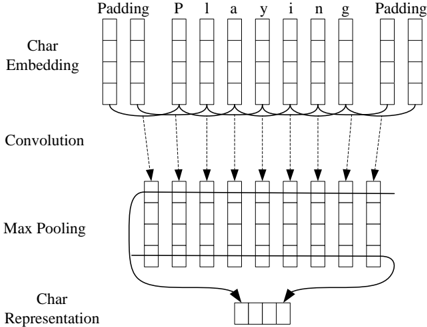
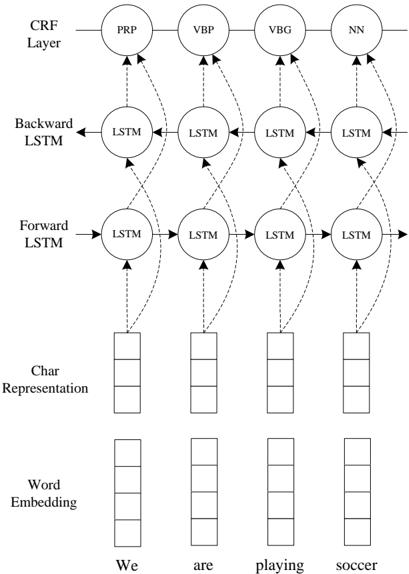
State-of-the-art sequence labeling systems traditionally require large amounts of taskspecific knowledge in the form of handcrafted features and data pre-processing.In this paper, we introduce a novel neutral network architecture that benefits from both word-and character-level representations automatically, by using combination of bidirectional LSTM, CNN and CRF.Our system is truly end-to-end, requiring no feature engineering or data preprocessing, thus making it applicable to a wide range of sequence labeling tasks.We evaluate our system on two data sets for two sequence labeling tasks -Penn Treebank WSJ corpus for part-of-speech (POS) tagging and CoNLL 2003 corpus for named entity recognition (NER).We obtain state-of-the-art performance on both datasets -97.55% accuracy for POS tagging and 91.21% F1 for NER.
Overview
The claims and statistics of this paper haven’t been checked yet.
Free: it reads the open-access text and checks the first 5 claims that cite a source we can check. Create a free account to check every claim.
Integrity signals
Registry
Cites
Statistics
Figures
Verification
Claims the paper makes
The claims and statistics of this paper haven’t been checked yet.
Free: it reads the open-access text and checks the first 5 claims that cite a source we can check. Create a free account to check every claim.
Claims other papers make about this one
Each is checked against this paper’s own text: does it say what the citing paper says it does?
The cited source says what the claim attributes to it.
In the citing paper
“Empirically, for those token [81] or span [30] prediction tasks (e.g., NER), prompt decomposition can be considered, while for those span relation prediction [66] tasks (e.g., entity coreference), prompts composition would be a better choice.”
From Pre-train, Prompt, and Predict: A Systematic Survey of Prompting Methods in Natural Language Processing (2023) · cites this paper as [81]
Self-check
Percentages, sums and reported differences re-computed from the paper’s own numbers.
The self-check needs the paper’s full text.
Citations
Cites
Hochreiter, S., & Schmidhuber, J. (1997) · Neural Computation · doi:10.1162/neco.1997.9.8.1735 · Cited by 102,318 · cited 2×
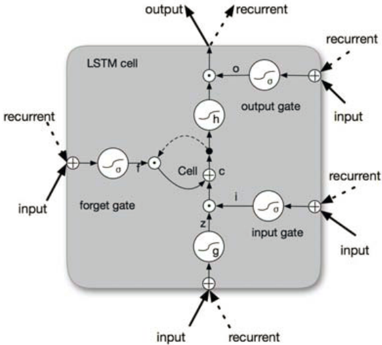
“Recently, recurrent neural networks (RNN) (Goller and Kuchler, 1996), together with its variants such as long-short term memory (LSTM) (Hochreiter and Schmidhuber, 1997; Gers et al., 2000) and gated recurrent unit (GRU) (Cho et al., 2014), have shown great success in modeling sequential data.”
BackgroundAdam: A Method for Stochastic Optimization
Kingma, D. P., & Ba, J. (2014) · arXiv · doi:10.48550/arxiv.1412.6980 · Cited by 98,946
Glove: Global Vectors for Word Representation
Pennington, J., Socher, R., & Manning, C. (2014) · Proceedings of the 2014 Conference on Empirical Methods in Natural Language Processing (EMNLP) · doi:10.3115/v1/d14-1162 · Cited by 34,071 · cited 1×
“glove/ trained on 6 billion words from Wikipedia and web text (Pennington et al., 2014)”
Background(2014) · Cited by 33,419
Distributed Representations of Words and Phrases and their Compositionality
Mikolov, T., Sutskever, I., Chen, K., Corrado, G., & Dean, J. (2013) · arXiv · doi:10.48550/arxiv.1310.4546 · Cited by 24,533 · cited 2×
“, 2011), and Google’s Word2Vec 300 dimensional embeddings3 trained on 100 billion words from Google News (Mikolov et al., 2013).”
BackgroundDelving Deep into Rectifiers: Surpassing Human-Level Performance on ImageNet Classification
He, K., Zhang, X., Ren, S., & Sun, J. (2015) · 2015 IEEE International Conference on Computer Vision (ICCV) · doi:10.1109/iccv.2015.123 · Cited by 19,741 · cited 1×
“To test the effectiveness of pretrained word embeddings, we experimented with randomly initialized embeddings with 100 dimensions, where embeddings are uniformly sampled from range [ − where dim is the dimension of embeddings (He et al., 2015).”
Method(2010) · Cited by 14,134
Backpropagation Applied to Handwritten Zip Code Recognition
LeCun, Y., Boser, B., Denker, J. S., Henderson, D., Howard, R. E., Hubbard, W., & Jackel, L. D. (1989) · Neural Computation · doi:10.1162/neco.1989.1.4.541 · Cited by 11,891 · cited 2×
“We first use convolutional neural networks (CNNs) (LeCun et al., 1989) to encode character-level information of a word into its character-level representation.”
MethodSpeech recognition with deep recurrent neural networks
Graves, A., Mohamed, A.-R., & Hinton, G. (2013) · 2013 IEEE International Conference on Acoustics, Speech and Signal Processing · doi:10.1109/icassp.2013.6638947 · Cited by 8,893 · cited 4×
“Several RNN-based neural network models have been proposed to solve sequence labeling tasks like speech recognition (Graves et al., 2013), POS tagging (Huang et al., 2015) and NER (Chiu and Nichols, 2015; Hu et al., 2016), achieving competitive performance against traditional models.”
MethodInfluentialLearning long-term dependencies with gradient descent is difficult
Bengio, Y., Simard, P., & Frasconi, P. (1994) · IEEE Transactions on Neural Networks · doi:10.1109/72.279181 · Cited by 8,542 · cited 2×
“Though, in theory, RNNs are capable to capturing long-distance dependencies, in practice, they fail due to the gradient varnishing/exploding problems (Bengio et al., 1994; Pascanu et al., 2012).”
Background
Research works printed but not linked: 6
- [3]3. James Bergstra, Olivier Breuleux, Frédéric Bastien, Pascal Lamblin, Razvan Pascanu, Guillaume Des- jardins, Joseph Turian, David Warde-Farley, and Yoshua Bengio. 2010. Theano: a cpu and gpu math expression compiler. In Proceedings of the Python for scientific computing conference (SciPy), volume 4, page 3. Austin, TX.
- [15]15. Felix A Gers, Nicol N Schraudolph, and Jürgen Schmidhuber. 2003. Learning precise timing with lstm recurrent networks. The Journal of Machine Learning Research, 3:115-143.
- [37]37. Xuezhe Ma and Hai Zhao. 2012a. Fourth-order depen- dency parsing. In Proceedings of COLING 2012: Posters, pages 785-796, Mumbai, India, December.
- [43]43. Tomas Mikolov, Ilya Sutskever, Kai Chen, Greg S Cor- rado, and Jeff Dean. 2013. Distributed representa- tions of words and phrases and their compositional- ity. In Advances in neural information processing systems, pages 3111-3119.
- [58]58. Erik F. Tjong Kim Sang and Jorn Veenstra. 1999. Rep- resenting text chunks. In Proceedings of EACL'99, pages 173-179. Bergen, Norway.
- [59]59. Kristina Toutanova, Dan Klein, Christopher D Man- ning, and Yoram Singer. 2003. Feature-rich part- of-speech tagging with a cyclic dependency net- work. In Proceedings of NAACL-HLT-2003, Volume 1, pages 173-180.
Cited by
Items 1,001–1,008 of 1,008
A Joint Model for Named Entity Recognition With Sentence-Level Entity Type Attentions
Tao, Q., Zhang, M., Lou, Y., & Hua, D. (2021) · IEEE/ACM Transactions on Audio Speech and Language Processing · doi:10.1109/taslp.2021.3069295 · Cited by 21
Hendawi, R., Alian, S., & Li, J. (2022) · JMIR Formative Research · doi:10.2196/35069 · Cited by 19
“MediReader uses the so-called BiLSTM-CNN-CRF deep learning neural tagging network based on works of Lample et al [27] and Ma et al [28].”
MethodTsubota, T., Bollegala, D., Zhao, Y., Jin, Y., & Kozu, T. (2022) · Journal of Biomedical Informatics · doi:10.1016/j.jbi.2022.104185 · Cited by 11
Automated invoice processing: Machine learning-based information extraction for long tail suppliers
Krieger, F., Drews, P., & Funk, B. (2023) · Intelligent Systems with Applications · doi:10.1016/j.iswa.2023.200285 · Cited by 11
Tri-Train: Automatic Pre-Fine Tuning between Pre-Training and Fine-Tuning for SciNER
Zeng, Q., Yu, W., Yu, M., Jiang, T., Weninger, T., & Jiang, M. (2020) · Findings of the Association for Computational Linguistics: EMNLP 2020 · doi:10.18653/v1/2020.findings-emnlp.429 · Cited by 10
“5 Related Work 5.1 SciNER: Scientific Entity Recognition NER is typically cast as a sequence labeling problem by integrating LSTMs, CRF, and language models (Lample et al., 2016; Ma and Hovy, 2016; Liu et al., 2018).”
BackgroundInfluentialEvolving Long Short-Term Memory Networks
Lobo Neto, V. C., Passos, L. A., & Papa, J. P. (2020) · Lecture Notes in Computer Science · doi:10.1007/978-3-030-50417-5_25 · Cited by 9
“To handle such ambiguous meanings, one can make use of the Part-of-Speech tagging process.”
Azab, M., Dadian, S., Nastase, V., An, L., & Mihalcea, R. (2019) · Proceedings of the 2019 Conference on Empirical Methods in Natural Language Processing and the 9th International Joint Conference on Natural Language Processing (EMNLP-IJCNLP) · doi:10.18653/v1/d19-1122 · Cited by 5
“Sequence labelling approaches have proved successful for such problems (Ramshaw and Marcus, 1995; Lample et al., 2016; Ma and Hovy, 2016; Chiu and Nichols, 2016).”
BackgroundOptimal Hyperparameters for Deep LSTM-Networks for Sequence Labeling Tasks
Reimers, N., & Gurevych, I. (2017) · arXiv · doi:10.48550/arxiv.1707.06799
“, 2015), the BiLSTM-CNN-CRF (Ma and Hovy, 2016) architecture and the BiLSTM-LSTM-CRF architecture (Lample et al.”
BackgroundMethodInfluential
Metadata
- Authors
- Ma, X., & Hovy, E.
- Affiliations
- Carnegie Mellon University (US)
- Venue
- Proceedings of the 54th Annual Meeting of the Association for Computational Linguistics (Volume 1: Long Papers)
- Published
- 2016
- Pages
- 1064-1074
- ISSN
- 0736-587X (ISSN-L)
- OpenAlex
- W2962902328
- Cited by
- 2,567
- References
- 65
- Citations by year
- 2026: 63 · 2025: 120 · 2024: 153 · 2023: 271 · 2022: 291 · 2021: 408 · 2020: 424 · 2019: 434 · 2018: 280 · 2017: 96 · 2016: 26
- FWCI
- 150.15
- Type
- conference paper
- Language
- en
- Open access
- hybrid
- doi.org
- Licence
- cc-by
- Locations
- Proceedings of the conference - Association for Computational Linguistics. Meeting (publishedVersion, cc-by)
- Funders
- Defense Advanced Research Projects Agency (FA8750, FA8750-12-2-0342)
- Topics
- Physical Sciences › Computer Science › Artificial Intelligence › Natural Language Processing Techniques
- Physical Sciences › Computer Science › Artificial Intelligence › Topic Modeling
- Physical Sciences › Computer Science › Computer Vision and Pattern Recognition › Handwritten Text Recognition Techniques
- Keywords
- sequence labeling, end-to-end learning, bidirectional LSTM, convolutional neural networks, conditional random fields, part-of-speech tagging, named entity recognition, CoNLL-2003
About these checks
Registry, retraction, Cites and statistics results are computed, not judged, with one exception: a printed reference that no index lists is read once by a model before it counts as a citation error. Claims are extracted by a model and kept only when their quote appears verbatim in the text; each cited source is then checked, with a model’s help, for whether it says what the claim relies on. Those verdicts can be wrong — read the claim’s quote and the cited source before relying on one.
Statistics and arithmetic are recomputed, not judged.
Confidence bands are shown only for fields calibrated on our annotated test set. None is calibrated yet, so no band is shown.
What counts as a claim ›How we measure confidence ›How we check this ›
Are you an author, or do you see a problem with this page? Request a review
Data sources
Bibliographic data: Semantic Scholar, OpenAlex, Crossref.
Contains information from the Semantic Scholar Academic Graph Datasets, made available under the ODC Attribution License (ODC-BY 1.0).
Semantic Scholar’s data is described in: Kinney, R., et al. (2023). The Semantic Scholar Open Data Platform. arXiv:2301.10140.
