

End-to-end Sequence Labeling via Bi-directional LSTM-CNNs-CRF
Open accessThe DOI matches its Crossref record; 64 of the 65 references it cites were found in a registry or an index.
Abstract
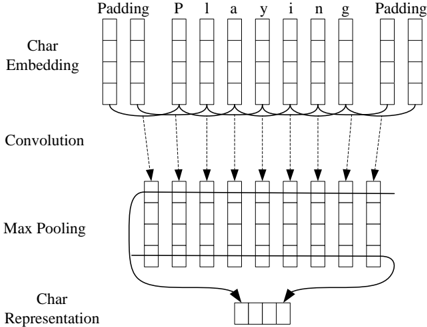
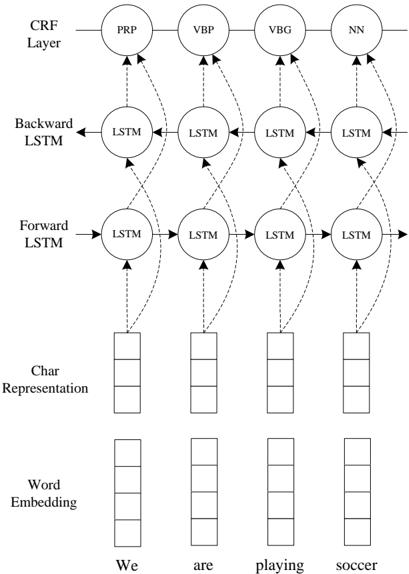
State-of-the-art sequence labeling systems traditionally require large amounts of taskspecific knowledge in the form of handcrafted features and data pre-processing.In this paper, we introduce a novel neutral network architecture that benefits from both word-and character-level representations automatically, by using combination of bidirectional LSTM, CNN and CRF.Our system is truly end-to-end, requiring no feature engineering or data preprocessing, thus making it applicable to a wide range of sequence labeling tasks.We evaluate our system on two data sets for two sequence labeling tasks -Penn Treebank WSJ corpus for part-of-speech (POS) tagging and CoNLL 2003 corpus for named entity recognition (NER).We obtain state-of-the-art performance on both datasets -97.55% accuracy for POS tagging and 91.21% F1 for NER.
Overview
The claims and statistics of this paper haven’t been checked yet.
Free: it reads the open-access text and checks the first 5 claims that cite a source we can check. Create a free account to check every claim.
Integrity signals
Registry
Cites
Statistics
Figures
Verification
Claims the paper makes
The claims and statistics of this paper haven’t been checked yet.
Free: it reads the open-access text and checks the first 5 claims that cite a source we can check. Create a free account to check every claim.
Claims other papers make about this one
Each is checked against this paper’s own text: does it say what the citing paper says it does?
The cited source says what the claim attributes to it.
In the citing paper
“Empirically, for those token [81] or span [30] prediction tasks (e.g., NER), prompt decomposition can be considered, while for those span relation prediction [66] tasks (e.g., entity coreference), prompts composition would be a better choice.”
From Pre-train, Prompt, and Predict: A Systematic Survey of Prompting Methods in Natural Language Processing (2023) · cites this paper as [81]
Self-check
Percentages, sums and reported differences re-computed from the paper’s own numbers.
The self-check needs the paper’s full text.
Citations
Cites
Hochreiter, S., & Schmidhuber, J. (1997) · Neural Computation · doi:10.1162/neco.1997.9.8.1735 · Cited by 102,318 · cited 2×
“Recently, recurrent neural networks (RNN) (Goller and Kuchler, 1996), together with its variants such as long-short term memory (LSTM) (Hochreiter and Schmidhuber, 1997; Gers et al., 2000) and gated recurrent unit (GRU) (Cho et al., 2014), have shown great success in modeling sequential data.”
BackgroundAdam: A Method for Stochastic Optimization
Kingma, D. P., & Ba, J. (2014) · arXiv · doi:10.48550/arxiv.1412.6980 · Cited by 98,946
Glove: Global Vectors for Word Representation
Pennington, J., Socher, R., & Manning, C. (2014) · Proceedings of the 2014 Conference on Empirical Methods in Natural Language Processing (EMNLP) · doi:10.3115/v1/d14-1162 · Cited by 34,071 · cited 1×
“glove/ trained on 6 billion words from Wikipedia and web text (Pennington et al., 2014)”
Background(2014) · Cited by 33,419
Distributed Representations of Words and Phrases and their Compositionality
Mikolov, T., Sutskever, I., Chen, K., Corrado, G., & Dean, J. (2013) · arXiv · doi:10.48550/arxiv.1310.4546 · Cited by 24,533 · cited 2×
“, 2011), and Google’s Word2Vec 300 dimensional embeddings3 trained on 100 billion words from Google News (Mikolov et al., 2013).”
BackgroundDelving Deep into Rectifiers: Surpassing Human-Level Performance on ImageNet Classification
He, K., Zhang, X., Ren, S., & Sun, J. (2015) · 2015 IEEE International Conference on Computer Vision (ICCV) · doi:10.1109/iccv.2015.123 · Cited by 19,741 · cited 1×
“To test the effectiveness of pretrained word embeddings, we experimented with randomly initialized embeddings with 100 dimensions, where embeddings are uniformly sampled from range [ − where dim is the dimension of embeddings (He et al., 2015).”
Method(2010) · Cited by 14,134
Conditional Random Fields: Probabilistic Models for Segmenting and Labeling Sequence Data
Lafferty, J., McCallum, A., & Pereira, F. C. N. (2001) · ScholarlyCommons (University of Pennsylvania) · Cited by 12,935
Backpropagation Applied to Handwritten Zip Code Recognition
LeCun, Y., Boser, B., Denker, J. S., Henderson, D., Howard, R. E., Hubbard, W., & Jackel, L. D. (1989) · Neural Computation · doi:10.1162/neco.1989.1.4.541 · Cited by 11,891 · cited 2×
“We first use convolutional neural networks (CNNs) (LeCun et al., 1989) to encode character-level information of a word into its character-level representation.”
MethodSpeech recognition with deep recurrent neural networks
Graves, A., Mohamed, A.-R., & Hinton, G. (2013) · 2013 IEEE International Conference on Acoustics, Speech and Signal Processing · doi:10.1109/icassp.2013.6638947 · Cited by 8,893 · cited 4×
“Several RNN-based neural network models have been proposed to solve sequence labeling tasks like speech recognition (Graves et al., 2013), POS tagging (Huang et al., 2015) and NER (Chiu and Nichols, 2015; Hu et al., 2016), achieving competitive performance against traditional models.”
MethodInfluential
Research works printed but not linked: 6
- [3]3. James Bergstra, Olivier Breuleux, Frédéric Bastien, Pascal Lamblin, Razvan Pascanu, Guillaume Des- jardins, Joseph Turian, David Warde-Farley, and Yoshua Bengio. 2010. Theano: a cpu and gpu math expression compiler. In Proceedings of the Python for scientific computing conference (SciPy), volume 4, page 3. Austin, TX.
- [15]15. Felix A Gers, Nicol N Schraudolph, and Jürgen Schmidhuber. 2003. Learning precise timing with lstm recurrent networks. The Journal of Machine Learning Research, 3:115-143.
- [37]37. Xuezhe Ma and Hai Zhao. 2012a. Fourth-order depen- dency parsing. In Proceedings of COLING 2012: Posters, pages 785-796, Mumbai, India, December.
- [43]43. Tomas Mikolov, Ilya Sutskever, Kai Chen, Greg S Cor- rado, and Jeff Dean. 2013. Distributed representa- tions of words and phrases and their compositional- ity. In Advances in neural information processing systems, pages 3111-3119.
- [58]58. Erik F. Tjong Kim Sang and Jorn Veenstra. 1999. Rep- resenting text chunks. In Proceedings of EACL'99, pages 173-179. Bergen, Norway.
- [59]59. Kristina Toutanova, Dan Klein, Christopher D Man- ning, and Yoram Singer. 2003. Feature-rich part- of-speech tagging with a cyclic dependency net- work. In Proceedings of NAACL-HLT-2003, Volume 1, pages 173-180.
Cited by
Items 501–600 of 1,008
Medical Dialogue System: A Survey of Categories, Methods, Evaluation and Challenges
Shi, X., Liu, Z., Du, L., Wang, Y., Wang, H., Guo, Y., Ruan, T., Xu, J., Zhang, X., & Zhang, S. (2024) · Findings of the Association for Computational Linguistics: ACL (Findings of ACL) · doi:10.18653/v1/2024.findings-acl.167 · Cited by 51
Goyal, N., & Singh, N. (2024) · Neurocomputing · doi:10.1016/j.neucom.2024.129171 · Cited by 51
Li, Y., Du, G., Xiang, Y., Li, S., Ma, L., Shao, D., Wang, X., & Chen, H. (2020) · Journal of Biomedical Informatics · doi:10.1016/j.jbi.2020.103435 · Cited by 50
End-to-End Argument Mining as Biaffine Dependency Parsing
Ye, Y., & Teufel, S. (2021) · Conference of the European Chapter of the Association for Computational Linguistics · doi:10.18653/v1/2021.eacl-main.55 · Cited by 50
“Besides DP, Eger et al. (2017) also study other approaches to neural end-to-end AM, including sequence tagging (Ma and Hovy, 2016), multi-task tagging (Søgaard and Goldberg, 2016), and relation extraction (Miwa and Bansal, 2016).”
BackgroundLearn and Review: Enhancing Continual Named Entity Recognition via Reviewing Synthetic Samples
Xia, Y., Wang, Q., Lyu, Y., Yong, Z., Wu, W., Li, S., & Dai, D. (2022) · Findings of the Association for Computational Linguistics: ACL (Findings of ACL) · doi:10.18653/v1/2022.findings-acl.179 · Cited by 50
“Traditional Named Entity Recognition (NER) aims at extracting mentions from a given text and classifying them into a fixed set of pre-defined entity types such as Person, Location, Organization, etc (Ma and Hovy, 2016).”
BackgroundNamed Entity Recognition with Small Strongly Labeled and Large Weakly Labeled Data
Jiang, H., Zhang, D., Cao, T., Yin, B., & Zhao, T. (2021) · doi:10.18653/v1/2021.acl-long.140 · Cited by 49
“approaches mainly train the model from scratch (Ma and Hovy, 2016; Huang et al., 2015), and rely on large amounts of labeled training data.”
Backgroundner and pos when nothing is capitalized
Mayhew, S., Tsygankova, T., & Roth, D. (2019) · Conference on Empirical Methods in Natural Language Processing (EMNLP) · doi:10.18653/v1/d19-1650 · Cited by 50
“We use a neural POS tagging model built with a BiLSTM-CRF (Ma and Hovy, 2016), and GloVe embeddings (Pennington et al.”
MethodInfluentialFu, X., Ouyang, T., Chen, J., & Luo, X. (2020) · Information Processing & Management · doi:10.1016/j.ipm.2020.102236 · Cited by 49
A deep neural network-based model for named entity recognition for Hindi language
Sharma, R., Morwal, S., Agarwal, B., Chandra, R., & Khan, M. S. (2020) · Neural Computing and Applications · doi:10.1007/s00521-020-04881-z · Cited by 49
“Similarly, Ma and Hovy [31] designed a NER model for English which was a combination of deep learning techniques, i.e., Bi-LSTM–CNN–CRF.”
Li, L., Xu, W., & Yu, H. (2020) · Neurocomputing · doi:10.1016/j.neucom.2020.07.027 · Cited by 49
Adversarial Attack and Defense of Structured Prediction Models
Han, W., Zhang, L., Jiang, Y., & Tu, K. (2020) · Conference on Empirical Methods in Natural Language Processing (EMNLP) · doi:10.18653/v1/2020.emnlp-main.182 · Cited by 49
Centimeter-Scale Lithology and Facies Prediction in Cored Wells Using Machine Learning
Martin, T., Meyer, R., & Jobe, Z. (2021) · Frontiers in Earth Science · doi:10.3389/feart.2021.659611 · Cited by 49
“This method is also commonly used for machine-learning analysis of time series data (Ma and Hovy, 2016; Zeng et al., 2016).”
MethodKnowledge Enhanced Person-Job Fit for Talent Recruitment
Yao, K., Zhang, J., Qin, C., Wang, P., Zhu, H., & Xiong, H. (2022) · IEEE International Conference on Data Engineering (ICDE) · doi:10.1109/icde53745.2022.00325 · Cited by 50
Hussain, S., Afzal, H., Saeed, R., Iltaf, N., & Umair, M. Y. (2021) · Computational and Mathematical Methods in Medicine · doi:10.1155/2021/5589829 · Cited by 48
“In [32, 33], combination of CNN, LSTM, and CRF has been proposed where word embeddings are augmented using character level CNN.”
MethodPlanarized sentence representation for nested named entity recognition
Geng, R., Chen, Y., Huang, R., Qin, Y., & Zheng, Q. (2023) · Information Processing & Management · doi:10.1016/j.ipm.2023.103352 · Cited by 48
Deep Affix Features Improve Neural Named Entity Recognizers
Yadav, V., Sharp, R., & Bethard, S. J. (2018) · Joint Conference on Lexical and Computational Semantics · doi:10.18653/v1/s18-2021 · Cited by 48
“RNN architecture, first over characters of a word and second over the words of a sentence (Ma and Hovy, 2016; Lample et al., 2016).”
BackgroundArgumentative Link Prediction using Residual Networks and Multi-Objective Learning
Galassi, A., Lippi, M., & Torroni, P. (2018) · Workshop on Argument Mining (ArgMining) · doi:10.18653/v1/w18-5201 · Cited by 49
“These include neural parsers (Dyer et al., 2015; Kiperwasser and Goldberg, 2016), LSTMs for joint entity and relation extraction (LSTM-ER) (Miwa and Bansal, 2016), and Bidirectional LSTM coupled with Conditional Random Fields and Convolutional Neural Networks (BLCC) (Ma and Hovy, 2016) in a multi-task learning framewo…”
MethodCombining Spans into Entities: A Neural Two-Stage Approach for Recognizing Discontiguous Entities
Wang, B., & Lu, W. (2019) · Conference on Empirical Methods in Natural Language Processing (EMNLP) · doi:10.18653/v1/d19-1644 · Cited by 48
“As neural models (Collobert et al., 2011; Lample et al., 2016; Huang et al., 2015; Chiu and Nichols, 2016; Ma and Hovy, 2016) are proven effective for NER, there have been several neural systems recently proposed to handle entities of overlapping structures (Ju et al.”
MethodA Bayesian Approach for Sequence Tagging with Crowds
Simpson, E., & Gurevych, I. (2019) · Conference on Empirical Methods in Natural Language Processing (EMNLP) · doi:10.18653/v1/d19-1101 · Cited by 48
“Current methods for sequence tagging, a core task in NLP, use deep neural networks that require tens of thousands of labelled documents for training (Ma and Hovy, 2016; Lample et al., 2016).”
MethodEnhancing Entity Boundary Detection for Better Chinese Named Entity Recognition
Chen, C., & Kong, F. (2021) · doi:10.18653/v1/2021.acl-short.4 · Cited by 48
“As is well known, most researches cast the NER task as a traditional sequence labelling problem, and many models extending the Bi-LSTM+CRF architecture are proposed (Huang et al., 2015; Chiu and Nichols, 2016; Dong et al., 2016; Lample et al., 2016; Ma and Hovy, 2016).”
UAMNer: uncertainty-aware multimodal named entity recognition in social media posts
Liu, L., Wang, M., Zhang, M., Qing, L., & He, X. (2021) · Applied Intelligence · doi:10.1007/s10489-021-02546-5 · Cited by 48
A Deep Learning Architecture for De-identification of Patient Notes: Implementation and EvaluationPreprint
Khin, K., Burckhardt, P., & Padman, R. (2018) · arXiv (Cornell University) · doi:10.48550/arxiv.1810.01570 · Cited by 48
“As such, Ma et al. [16] have used Convolutional Neural Networks (CNN) while Lample et al. [17] have used Bi-LSTMs to produce character-enhanced representations of each unique token.”
BackgroundProceedings of the Third Arabic Natural Language Processing Workshop
(2017) · doi:10.18653/v1/w17-13 · Cited by 48
Graph Convolution for Multimodal Information Extraction from Visually Rich DocumentsPreprint
Liu, X., Gao, F., Zhang, Q., & Zhao, H. (2019) · arXiv (Cornell University) · doi:10.48550/arxiv.1903.11279 · Cited by 48
“However, most works focus on plain text documents (Peng et al., 2017; Lample et al., 2016; Ma and Hovy, 2016; Chiu and Nichols, 2016).”
BackgroundExtracting Time Expressions and Named Entities with Constituent-Based Tagging Schemes
Zhong, X., Cambria, E., & Hussain, A. (2020) · Cognitive Computation · doi:10.1007/s12559-020-09714-8 · Cited by 47
“In the deep learning era, many researchers use neural networks and word embeddings to develop variants of models on CoNLL03 dataset [14, 15, 26, 31, 35, 38, 42, 43, 55, 62, 68, 72].”
BackgroundHamoud, A. A., Hoenig, A., & Roy, K. (2022) · Journal of King Saud University - Computer and Information Sciences · doi:10.1016/j.jksuci.2022.07.014 · Cited by 48
Recognizing irregular entities in biomedical text via deep neural networks
Li, F., Zhang, M., Tian, B., Chen, B., Fu, G., & Ji, D. (2017) · Pattern Recognition Letters · doi:10.1016/j.patrec.2017.06.009 · Cited by 47
Improving Clinical Named Entity Recognition with Global Neural Attention
Xu, G., Wang, C., & He, X. (2018) · Lecture notes in computer science · doi:10.1007/978-3-319-96893-3_20 · Cited by 47
Fixed That for You: Generating Contrastive Claims with Semantic Edits
Hidey, C., & McKeown, K. (2019) · Conference of the North American Chapter of the Association for Computational Linguistics: Human Language Technologies (NAACL-HLT) · doi:10.18653/v1/n19-1174 · Cited by 47
“We tried the bi-directional LSTM-CNN-CRF model of Ma and Hovy (2016)”
MethodNamed-Entity Recognition on Indonesian Tweets using Bidirectional LSTM-CRF
Wintaka, D. C., Bijaksana, M. A., & Asror, I. (2019) · Procedia Computer Science · doi:10.1016/j.procs.2019.08.161 · Cited by 47
Improving software bug-specific named entity recognition with deep neural network
Zhou, C., Li, B., & Sun, X. (2020) · Journal of Systems and Software · doi:10.1016/j.jss.2020.110572 · Cited by 47
Korean clinical entity recognition from diagnosis text using BERT
Kim, Y.-M., & Lee, T.-H. (2020) · BMC Medical Informatics and Decision Making · doi:10.1186/s12911-020-01241-8 · Cited by 47
“The recent developments of long-short term memory (LSTM) variants such as bidirectional LSTM-CRF [12] and bi-LSTM-CNNs-CRF [13] have achieved a success in both NER and biomedical NER [14, 15].”
BackgroundWu, H.-Q., Shen, G., Lin, X., Li, M.-L., & Li, C. Z. (2021) · Automation in Construction · doi:10.1016/j.autcon.2021.103608 · Cited by 38
Pan, Z., Su, C., Deng, Y., & Cheng, J. C. P. (2021) · Automation in Construction · doi:10.1016/j.autcon.2021.103617 · Cited by 47
Intent Classification and Slot Filling for Privacy Policies
Ahmad, W. U., Chi, J., Le, T., Norton, T. B., Tian, Y., & Chang, K.-W. (2021) · doi:10.18653/v1/2021.acl-long.340 · Cited by 48
SpanProto: A Two-stage Span-based Prototypical Network for Few-shot Named Entity Recognition
Wang, J., Wang, C., Tan, C., Qiu, M., Huang, S., Huang, J. G., & Gao, M. (2022) · Conference on Empirical Methods in Natural Language Processing (EMNLP) · doi:10.18653/v1/2022.emnlp-main.227 · Cited by 47
Ma, X. (2020) · arXiv (Cornell University) · doi:10.48550/arxiv.2009.13586 · Cited by 48
“Indeed, in many natural language processing (NLP) and computer vision (CV) tasks (He et al., 2016; Ma & Hovy, 2016; Luo et al., 2019), SGD (with momentum) is chosen as the optimizer, benefiting from its stable and efficient training and outstanding generalization.”
BackgroundSelf-citationA pre-training and self-training approach for biomedical named entity recognition
Gao, S., Kotevska, O., Sorokine, A., & Christian, J. B. (2021) · PLOS ONE · doi:10.1371/journal.pone.0246310 · Cited by 46
Regularizing deep networks with prior knowledge: A constraint-based approach
Roychowdhury, S., Diligenti, M., & Gori, M. (2021) · Knowledge-Based Systems · doi:10.1016/j.knosys.2021.106989 · Cited by 46
A Holistic Feature Selection Method for Enhanced Short-term Load Forecasting of Power System
Jiang, B., Liu, Y., Geng, H., Wang, Y., Zeng, H., & Ding, J. (2022) · IEEE Transactions on Instrumentation and Measurement · doi:10.1109/tim.2022.3219499 · Cited by 46
“It has been widely applied to machine translation [30], [31], knowledge map construction [32], speech recognition [33], and time series data prediction [1], [34], [35].”
MethodDialogue Act Sequence Labeling Using Hierarchical Encoder With CRF
Kumar, H., Agarwal, A. K., Dasgupta, R., & Joshi, S. (2018) · Proceedings of the AAAI Conference on Artificial Intelligence · doi:10.1609/aaai.v32i1.11701 · Cited by 46
TP-DDI: Transformer-based pipeline for the extraction of Drug-Drug Interactions
Zaikis, D., & Vlahavas, I. P. (2021) · Artificial Intelligence in Medicine · doi:10.1016/j.artmed.2021.102153 · Cited by 46
Online eye-movement classification with temporal convolutional networks
Elmadjian, C., Gonzales, C., da Costa, R. L., & Morimoto, C. H. (2022) · Behavior Research Methods · doi:10.3758/s13428-022-01978-2 · Cited by 46
“In the domain of sequential problems, recurrent networks have been extensively and successfully applied to natural language processing (Fu et al., 2018; Ma and Hovy, 2016; Li et al., 2016) and speech recognition (Zhang et al., 2018; Wang et al., 2019) problems.”
BackgroundMulti-level Representations for Fine-Grained Typing of Knowledge Base Entities
Yaghoobzadeh, Y., & Schütze, H. (2017) · Conference of the European Chapter of the Association for Computational Linguistics · doi:10.18653/v1/e17-1055 · Cited by 46
Evaluating the Utility of Hand-crafted Features in Sequence Labelling
Wu, M., Liu, F., & Cohn, T. (2018) · Conference on Empirical Methods in Natural Language Processing (EMNLP) · doi:10.18653/v1/d18-1310 · Cited by 46
“Of particular interest to this paper is the work by Ma and Hovy (2016) introduce a strong end-to-end model combining a bi-directional Long Short-Term Memory (Bi-LSTM) network with Convolutional Neural Network (CNN) character encoding in a Conditional Random Field (CRF).”
BackgroundMethodInfluentialNeural Reranking for Named Entity Recognition
Yang, J., Zhang, Y., & Dong, F. (2017) · International conference Recent advances in natural language processing · doi:10.26615/978-954-452-049-6_101 · Cited by 46
“As shown in Figure 4(a), we follow Ma and Hovy (2016) by utilizing CNN to extract character-level representation 2 .”
BackgroundMethodInfluentialOpen Intent Extraction from Natural Language Interactions
Vedula, N., Lipka, N., Maneriker, P., & Parthasarathy, S. (2020) · International World Wide Web Conference (WWW) · doi:10.1145/3366423.3380268 · Cited by 46
“Implementation:Weuse the 300-dimensional GloVe embeddings [50] pre-trained on the Common Crawl dataset3, and character embeddings as perMa et al [42].”
BackgroundMethodStructure-Level Knowledge Distillation For Multilingual Sequence Labeling
Wang, X., Jiang, Y., Bách, N., Wang, T., Huang, F., & Tu, K. (2020) · Proceedings of the conference - Association for Computational Linguistics. Meeting · doi:10.18653/v1/2020.acl-main.304 · Cited by 45
Yang, C., Zhao, Z., & Hu, S. (2020) · Computer Assisted Surgery · doi:10.1080/24699322.2020.1801842 · Cited by 46
Method and dataset entity mining in scientific literature: A CNN + BiLSTM model with self-attention
Hou, L., Zhang, J., Wu, O., Yu, T., Wang, Z., Li, Z., Gao, J., Ye, Y., & Yao, R. (2021) · Knowledge-Based Systems · doi:10.1016/j.knosys.2021.107621 · Cited by 47
Maximal overlap discrete wavelet-packet transform aided microwave nondestructive testing
Shrifan, N. H. M. M., Akbar, M. F., & Isa, N. A. M. (2021) · NDT & E International · doi:10.1016/j.ndteint.2021.102414 · Cited by 46
Vieira, S. T., Rosa, R. L., Rodríguez, D. Z., Ramírez, M. A., Saadi, M., & Wuttisittikulkij, L. (2021) · Sensors · doi:10.3390/s21051880 · Cited by 46
Asghar, J., Akbar, S., Asghar, M. Z., Ahmad, B., Al-Rakhami, M. S., & Gumaei, A. (2021) · Computational and Mathematical Methods in Medicine · doi:10.1155/2021/5512241 · Cited by 46
“It has assisted in overcoming the limitation of Conventional RNN, which can only retain information for a short time interval, and unidirectional LSTM keeps track of only past context [31].”
Andreadis, S. T., Antzoulatos, G. S., Mavropoulos, T., Giannakeris, P., Tzionis, G., Pantelidis, N., Ioannidis, K., Καρακώστας, Α., Gialampoukidis, I., Vrochidis, S., et al. (2021) · Online Social Networks and Media · doi:10.1016/j.osnem.2021.100134 · Cited by 46
“While all of the chosen models rely on biLSTM-based architectures, various implementations have been tested (BiLSTM-CRF[39], BiGRU-CRF[40], BiLSTM-CNNs-CRF[41], BiLSTM-CNN[42]) to determine the best possible outcome.”
Part-of-Speech Tagging with Rule-Based Data Preprocessing and Transformer
Li, H., Mao, H., & Wang, J. (2021) · Electronics · doi:10.3390/electronics11010056 · Cited by 47
“In recent years, methods for POS tagging have mainly been based on Bi-LSTM since this is a powerful model that captures time dynamics via recurrence [16].”
MethodDistilling Causal Effect from Miscellaneous Other-Class for Continual Named Entity Recognition
Zheng, J., Liang, Z., Chen, H., & Ma, Q. (2022) · Conference on Empirical Methods in Natural Language Processing (EMNLP) · doi:10.18653/v1/2022.emnlp-main.236 · Cited by 46
Improved Sentence Modeling using Suffix Bidirectional LSTMPreprint
Brahma, S. (2018) · arXiv (Cornell University) · doi:10.48550/arxiv.1805.07340 · Cited by 46
“…component in several state-of-the-art neural models for NLP tasks like language modeling [Melis et al. 2018, Merity et al. 2018], textual entailment [Chen et al. 2017], question answering [Seo et al. 2017], semantic role labeling [He et al. 2017] and named entity recognition [Ma and Hovy 2016].”
BackgroundMethodInfluential$k$NN-NER: Named Entity Recognition with Nearest Neighbor SearchPreprint
Wang, S., Li, X., Meng, Y., Zhang, T., Ouyang, R., Li, J., & Wang, G. (2022) · arXiv (Cornell University) · doi:10.48550/arxiv.2203.17103 · Cited by 46
“The most widely employed strategy for the NER task is to train a sequential labeling model based on a labeled dataset, and this model learns to assign named entities to each token (Chiu and Nichols, 2016; Ma and Hovy, 2016; Devlin et al., 2018).”
BackgroundMethodInfluentialEfficient Contextualized Representation: Language Model Pruning for Sequence Labeling
Liu, L., Ren, X., Shang, J., Gu, X., Peng, J., & Han, J. (2018) · Proceedings of the 2018 Conference on Empirical Methods in Natural Language Processing · doi:10.18653/v1/d18-1153 · Cited by 45
“Many attempts have been made to conduct end-to-end learning and build reliable models without handcrafted features (Chiu and Nichols, 2016; Lample et al., 2016; Ma and Hovy, 2016).”
BackgroundPretraining to Recognize PICO Elements from Randomized Controlled Trial Literature.
Tian, K., Shirui, Z., & Chunhua, W. (2019) · Studies in Health Technology and Informatics · doi:10.3233/shti190209 · Cited by 45
“The base model is similar to [14], and is also used in EBM-NLP corpus paper to generate task baseline for identifying PICO span.”
MethodDong, X., Chowdhury, S., Qian, L., Li, X., Guan, Y., Yang, J., & Yu, Q. (2019) · PLoS ONE · doi:10.1371/journal.pone.0216046 · Cited by 45
Ding, C., Aye, H. T. Z., Pa, W. P., Nwet, K. T., Soe, K. M., Utiyama, M., & Sumita, E. (2019) · ACM Transactions on Asian and Low-Resource Language Information Processing · doi:10.1145/3325885 · Cited by 45
“As for the related works on morphology analysis, typical studies include Chen et al. [4] and Ma and Hovy [26] on LSTM-based approaches for Chinese word segmentation.”
BackgroundMethodApplication of CNN‐LSTM in Gradual Changing Fault Diagnosis of Rod Pumping System
He, Y., Liu, Y., Shao, S., Zhao, X., Liu, G., Kong, X., & Liu, L. (2019) · Mathematical Problems in Engineering · doi:10.1155/2019/4203821 · Cited by 45
“In the system application stage, trained CNN-LSTM is used for gradual changing fault identification, and the CNN-LSTM outputs are classified using the corresponding softmax classifiers, which are combined to determine the category of the input indicator diagram [13].”
MethodResume Information Extraction with A Novel Text Block Segmentation Algorithm
Zu, S., & Wang, X. (2019) · International Journal on Natural Language Computing · doi:10.5121/ijnlc.2019.8503 · Cited by 45
Neural Modeling for Named Entities and Morphology (NEMO2)
Bareket, D., & Tsarfaty, R. (2021) · Transactions of the Association for Computational Linguistics · doi:10.1162/tacl_a_00404 · Cited by 45
Li, Y., Wang, X., Hui, L., Zou, L., Li, H., Luo, X., & Liu, W. (2020) · JMIR Medical Informatics · doi:10.2196/19848 · Cited by 45
“On the basis of the word-based baseline model, the character-level embedding of words or subsequences was introduced [8].”
MethodLee, L., & Lu, Y. (2021) · IEEE Journal of Biomedical and Health Informatics · doi:10.1109/jbhi.2020.3048700 · Cited by 45
He, J., Nguyen, D. Q., Akhondi, S. A., Druckenbrodt, C., Thorne, C., Hoessel, R., Afzal, Z., Zhai, Z., Fang, B., Yoshikawa, H., et al. (2021) · Frontiers in Research Metrics and Analytics · doi:10.3389/frma.2021.654438 · Cited by 45
Low-Resource Named Entity Recognition via the Pre-Training Model
Chen, S., Pei, Y., Ke, Z., & Silamu, W. (2021) · Symmetry · doi:10.3390/sym13050786 · Cited by 45
“CNN-LSTM : A CNN [35] and LSTM [36] combination model.”
MethodMulti-task learning for toxic comment classification and rationale extraction
Nelatoori, K. B., & Bindu, K. H. (2022) · Journal of Intelligent Information Systems · doi:10.1007/s10844-022-00726-4 · Cited by 45
“CRF benefits from considering the correlations between labels/tags in the neighborhood as a discriminant graphical model, which is extensively utilized in sequence labelling or tagging applications (Ma & Hovy, 2016).”
MethodAutomatic Skill-Oriented Question Generation and Recommendation for Intelligent Job Interviews
Qin, C., Zhu, H., Shen, D., Sun, Y., Yao, K., Wang, P., & Xiong, H. (2023) · ACM Transactions on Information Systems · doi:10.1145/3604552 · Cited by 47
A neural network approach to chemical and gene/protein entity recognition in patents
Luo, L., Yang, Z., Yang, P., Zhang, Y., Wang, L., Wang, J., & Lin, H. (2018) · Journal of Cheminformatics · doi:10.1186/s13321-018-0318-3 · Cited by 44
“For the NER task in general domain (such as news domain), several similar neural network architectures [11–13] have been proposed and exhibit promising results.”
BackgroundWhere are we in Named Entity Recognition from Speech?
Caubrière, A., Rosset, S., Estève, Y., Laurent, A., & Morin, E. (2020) · HAL · doi:10.63317/2ba8c9nppwpb · Cited by 44
Multi-Domain Named Entity Recognition with Genre-Aware and Agnostic Inference
Wang, J., Kulkarni, M., & Preoțiuc-Pietro, D. (2020) · Proceedings of the conference - Association for Computational Linguistics. Meeting · doi:10.18653/v1/2020.acl-main.750 · Cited by 44
“The current dominant approach to the NER task consists of neural architectures based on recurrent neural networks with different choices of input representations (Huang et al., 2015; Ma and Hovy, 2016; Lample et al., 2016; Peters et al., 2018; Akbik et al., 2018, 2019).”
MethodA Residual BiLSTM Model for Named Entity Recognition
Yang, G., & Xu, H. (2020) · IEEE Access · doi:10.1109/access.2020.3046253 · Cited by 44
“[21] and [22] combined LSTM with CNN which is used to encode English characters.”
MethodNamed entity recognition on bio-medical literature documents using hybrid based approach
Ramachandran, R., & Arutchelvan, K. (2021) · Journal of Ambient Intelligence and Humanized Computing · doi:10.1007/s12652-021-03078-z · Cited by 45
“The most of ML tools were developed to identify entities automatically, yet they did not produce 100% accuracy and needs domain expert to validate and retrain (Ma X et.al.”
MethodVerlinden, S., Zaporojets, K., Deleu, J., Demeester, T., & Develder, C. (2021) · Findings of the Association for Computational Linguistics: ACL (Findings of ACL) · doi:10.18653/v1/2021.findings-acl.171 · Cited by 45
Syed, M. H., & Chung, S.-T. (2021) · Applied Sciences · doi:10.3390/app11136007 · Cited by 44
“Ma and Hovy [6] introduce a novel neural network architecture that benefits from both GloVe-based word embedding, and character-level features, by using a combination of Bi-LSTM, CNN and CRF. Similarly, Saad et al. [22] presented a deep neural network architecture based on Bi-LSTM and CRF.”
BackgroundNamed-entity recognition for a low-resource language using pre-trained language model
Yohannes, H. M., & Amagasa, T. (2022) · ACM Symposium on Applied Computing · doi:10.1145/3477314.3507066 · Cited by 44
“This model architecture was proposed by [19].”
A Boundary Regression Model for Nested Named Entity Recognition
Chen, Y., Wu, L., Zheng, Q., Huang, R., Liu, J., Deng, L., Yu, J., Qing, Y., Dong, B., & Chen, P. (2022) · Cognitive Computation · doi:10.1007/s12559-022-10058-8 · Cited by 44
“Ma and Hovy [57] used a BiLSTM-CNN-CRF model, that automatically encodes semantic features from words and characters.”
MethodPhandi, P., Silva, A., & Lu, W. (2018) · International Workshop on Semantic Evaluation (SemEval) · doi:10.18653/v1/s18-1113 · Cited by 44
“They model this task as a sequence labeling task and used a hybrid approach with BiLSTM-CNN-CRF following the method of Ma and Hovy (2016).”
MethodDropout with Expectation-linear RegularizationPreprint
Ma, X., Gao, Y., Hu, Z., Yu, Y., Deng, Y., & Hovy, E. H. (2016) · arXiv (Cornell University) · doi:10.48550/arxiv.1609.08017 · Cited by 44
“Simple as it appears to be, dropout has led to several record-breaking performances (Hinton et al., 2012; Ma & Hovy, 2016), and thus spawned a lot of recent interests in analyzing and justifying dropout from the theoretical perspective, and also in further improving dropout from the algorithmic and…”
BackgroundSelf-citationNeural Probabilistic Model for Non-projective MST ParsingPreprint
Ma, X., & Hovy, E. H. (2017) · arXiv (Cornell University) · doi:10.48550/arxiv.1701.00874 · Cited by 44
“, 2010), sequence labeling (Ma and Hovy, 2016) and machine translation (Cho et al.”
BackgroundMethodInfluentialSelf-citationZero-Resource Cross-Lingual Named Entity Recognition
Bari, M. S., Joty, S., & Jwalapuram, P. (2020) · Proceedings of the AAAI Conference on Artificial Intelligence · doi:10.1609/aaai.v34i05.6237 · Cited by 44
Liu, J., Ji, D., Li, J., Xie, D., Teng, C., Zhao, L., & Li, F. (2022) · IEEE/ACM Transactions on Audio Speech and Language Processing · doi:10.1109/taslp.2022.3221009 · Cited by 43
Part-of-Speech Tagging of Odia Language Using Statistical and Deep Learning Based Approaches
Dalai, T., Mishra, T. K., & Sa, P. K. (2023) · ACM Transactions on Asian and Low-Resource Language Information Processing · doi:10.1145/3588900 · Cited by 43
“In English, other European languages, and the majority of South Asian languages, the problem of POS tagging has been thoroughly examined [43][16][23][27].”
BackgroundA knowledge-enhanced network for joint multimodal entity-relation extraction
Huang, S., Cai, Y., Yuan, L., & Wang, J. (2024) · Information Processing & Management · doi:10.1016/j.ipm.2024.104033 · Cited by 43
Chinese Named Entity Recognition Based on CNN-BiLSTM-CRF
Jia, Y., & Xu, X. (2018) · IEEE International Conference on Software Engineering and Service Science (ICSESS) · doi:10.1109/icsess.2018.8663820 · Cited by 43
“There is also a similar method that enhance word representations by extracting character-level features with Convolution Neural Network (CNN) in [3], and obtain state-of-the-art performance on both datasets with 97.55% accuracy for POS tagging and 91.21% F1 for NER respectively.”
MethodInfluentialAdversarial Transfer for Named Entity Boundary Detection with Pointer Networks
Li, J., Ye, D., & Shang, S. (2019) · International Joint Conference on Artificial Intelligence · doi:10.24963/ijcai.2019/702 · Cited by 43
DTranNER: biomedical named entity recognition with deep learning-based label-label transition model
Hong, S., & Lee, J.-G. (2020) · BMC Bioinformatics · doi:10.1186/s12859-020-3393-1 · Cited by 43
“We do not consider additional character-level token embeddings unlike several models [9–12, 14, 20, 21], because ELMo [13] as our contextualized token embedding provider basically includes a character-level CNN model.”
MethodJi, B., Li, S., Yu, J., Ma, J., Tang, J., Wu, Q., Tan, Y., Liu, H., & Ji, Y. F. (2020) · Journal of Biomedical Informatics · doi:10.1016/j.jbi.2020.103395 · Cited by 43
Transition-based Semantic Dependency Parsing with Pointer Networks
Fernández‐González, D., & Gómez‐Rodríguez, C. (2020) · Proceedings of the conference - Association for Computational Linguistics. Meeting · doi:10.18653/v1/2020.acl-main.629 · Cited by 43
A benchmark dataset and case study for Chinese medical question intent classification
Chen, N., Su, X., Liu, T., Qizhi, H., & Wei, M. (2020) · BMC Medical Informatics and Decision Making · doi:10.1186/s12911-020-1122-3 · Cited by 43
“In this project, we use Lattice-LSTM for entity recognition, which is the best performing model on the Chinese named entity recognition task.”
MethodInfluentialNarayanan, S., Mannam, K., Achan, P., Ramesh, M. V., Rangan, P. V., & Rajan, S. P. (2021) · Journal of Biomedical Informatics · doi:10.1016/j.jbi.2021.103960 · Cited by 43
Sequence Embeddings Help Detect Insurance Fraud
Fursov, I., Kovtun, E., Rivera-Castro, R., Zaytsev, A., Khasyanov, R., Spindler, M., & Burnaev, E. V. (2022) · IEEE Access · doi:10.1109/access.2022.3149480 · Cited by 43
“In supervised problems, word and sentence embeddings have proven effective for natural language processing tasks such as part-of-speech tagging, [49], phrase-based machine translation, [50], named-entity recognition, [51], and word sense disambiguation, [48].”
BackgroundEntity-level Interaction via Heterogeneous Graph for Multimodal Named Entity Recognition
Zhao, G., Dong, G., Shi, Y., Yan, H., Xu, W., & Li, S. (2022) · Findings of the Association for Computational Linguistics: EMNLP (Findings of EMNLP) · doi:10.18653/v1/2022.findings-emnlp.473 · Cited by 43
“2) HBiLSTM-CRF (Lample et al., 2016), which is an improvement of CNN-BiLSTM-CRF, replacing of Zhang et al. (2021).”
BackgroundMethodInfluentialTextFlint: Unified Multilingual Robustness Evaluation Toolkit for Natural Language ProcessingPreprint
Gui, T., Wang, X., Zhang, Q., Liu, Q., Zou, Y., Zhou, X., Zheng, R., Zhang, C., Wu, Q., Ye, J., et al. (2021) · arXiv (Cornell University) · doi:10.48550/arxiv.2103.11441 · Cited by 44
Learning Symmetric Embeddings for Equivariant World ModelsPreprint
Park, J. Y., Bíža, O., Zhao, L., van de Meent, J. W., & Walters, R. (2022) · arXiv (Cornell University) · doi:10.48550/arxiv.2204.11371 · Cited by 43
“For this reason, 1D convolutions are commonly used in sequence labeling (Santos & Zadrozny, 2014; Ma & Hovy, 2016).”
MethodProceedings of the 2nd Workshop on Representation Learning for NLP
(2017) · doi:10.18653/v1/w17-26 · Cited by 43
Metadata
- Authors
- Ma, X., & Hovy, E.
- Affiliations
- Carnegie Mellon University (US)
- Venue
- Proceedings of the 54th Annual Meeting of the Association for Computational Linguistics (Volume 1: Long Papers)
- Published
- 2016
- Pages
- 1064-1074
- ISSN
- 0736-587X (ISSN-L)
- OpenAlex
- W2962902328
- Cited by
- 2,567
- References
- 65
- Citations by year
- 2026: 63 · 2025: 120 · 2024: 153 · 2023: 271 · 2022: 291 · 2021: 408 · 2020: 424 · 2019: 434 · 2018: 280 · 2017: 96 · 2016: 26
- FWCI
- 150.15
- Type
- conference paper
- Language
- en
- Open access
- hybrid
- doi.org
- Licence
- cc-by
- Locations
- Proceedings of the conference - Association for Computational Linguistics. Meeting (publishedVersion, cc-by)
- Funders
- Defense Advanced Research Projects Agency (FA8750, FA8750-12-2-0342)
- Topics
- Physical Sciences › Computer Science › Artificial Intelligence › Natural Language Processing Techniques
- Physical Sciences › Computer Science › Artificial Intelligence › Topic Modeling
- Physical Sciences › Computer Science › Computer Vision and Pattern Recognition › Handwritten Text Recognition Techniques
- Keywords
- sequence labeling, end-to-end learning, bidirectional LSTM, convolutional neural networks, conditional random fields, part-of-speech tagging, named entity recognition, CoNLL-2003
About these checks
Registry, retraction, Cites and statistics results are computed, not judged, with one exception: a printed reference that no index lists is read once by a model before it counts as a citation error. Claims are extracted by a model and kept only when their quote appears verbatim in the text; each cited source is then checked, with a model’s help, for whether it says what the claim relies on. Those verdicts can be wrong — read the claim’s quote and the cited source before relying on one.
Statistics and arithmetic are recomputed, not judged.
Confidence bands are shown only for fields calibrated on our annotated test set. None is calibrated yet, so no band is shown.
What counts as a claim ›How we measure confidence ›How we check this ›
Are you an author, or do you see a problem with this page? Request a review
Data sources
Bibliographic data: Semantic Scholar, OpenAlex, Crossref.
Contains information from the Semantic Scholar Academic Graph Datasets, made available under the ODC Attribution License (ODC-BY 1.0).
Semantic Scholar’s data is described in: Kinney, R., et al. (2023). The Semantic Scholar Open Data Platform. arXiv:2301.10140.
