

The DOI matches its Crossref record; 42 of the 43 references it cites were found in a registry or an index.
Psychometric validation of the Perceived Deficits Questionnaire-Depression (PDQ-D) instrument in US and UK respondents with major depressive disorder
Open accessAbstract
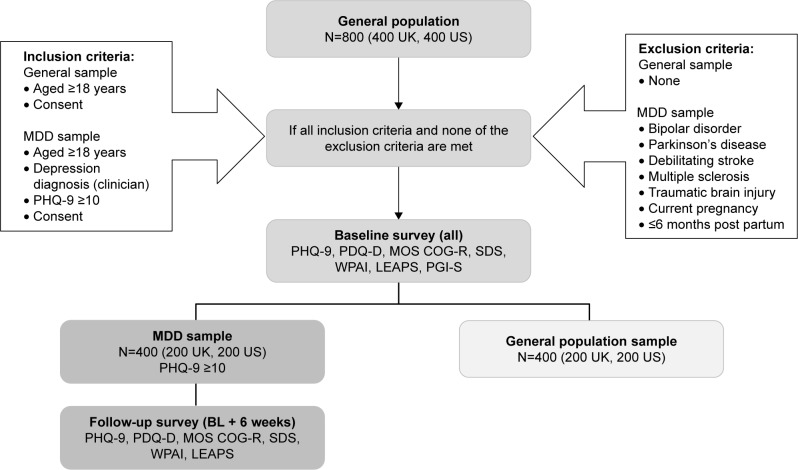
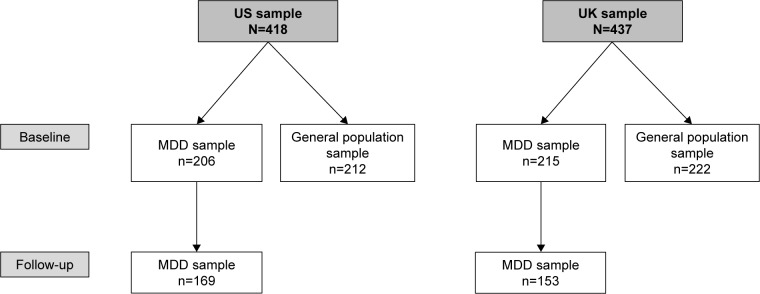
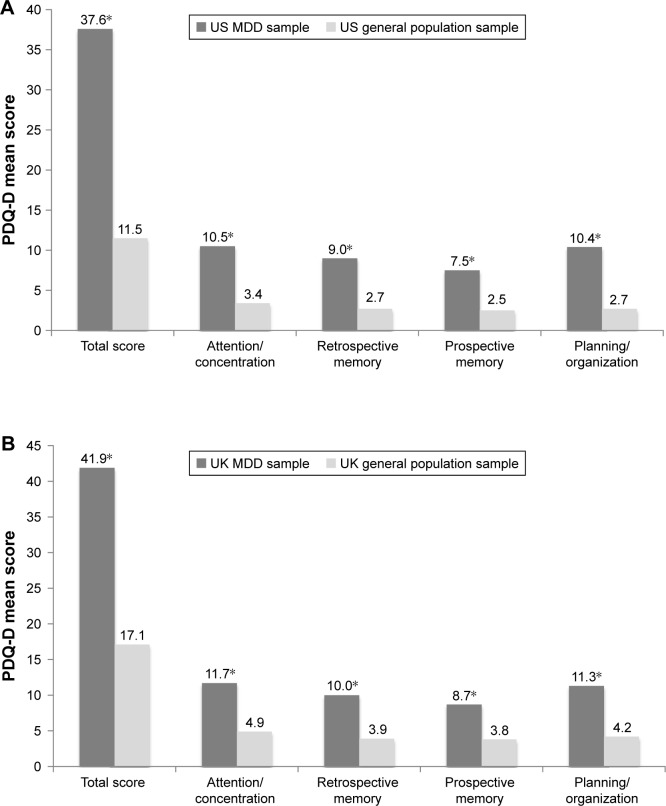
Background: Although depression and cognitive dysfunction are connected, limited tools exist to capture the patient’s perspective on cognitive dysfunction and its impact on major depressive disorder (MDD). We report results of a psychometric validation of the Perceived Deficits Questionnaire-Depression (PDQ-D), a self-report measure of cognitive dysfunction for use in MDD. Methods: A non-interventional, prospective, panel-recruited, online survey was conducted using the PDQ-D in adults with and without MDD in the US and UK. Respondents were assessed at baseline and after 6 weeks (MDD only) (baseline: US n=418, UK n=437, 49% MDD; follow-up: US n=169, UK n=153, all MDD). The criterion measures included: Medical Outcomes Study Cognitive Functioning Scale-Revised-acute form (MOS COG-R), Patient Health Questionnaire-9 (PHQ-9), Patient Global Impression of Severity scale (PGI-Severity), Sheehan Disability Scale (SDS), Work Productivity and Activity Impairment Questionnaire: Specific-Health Problem (WPAI:SHP), and modified Lam Employment Absence and Productivity Scale (LEAPS). US and UK data were analyzed separately. Results: Internal consistency was high for PDQ-D total scale and four subscales (Cronbach’s alpha 0.81–0.96). Convergent validity was good, with strong concordance with MOS COG-R and moderate/small correlations with PHQ-9, SDS, WPAI:SHP, LEAPS, and PGI-Severity. Significant differences (all P <0.001) existed for all PDQ-D subscale and total scores between MDD/non-MDD samples. The PDQ-D was responsive to changes in depression symptom severity. Confirmatory factor analysis supported scoring of a global overall scale for perceived cognitive dysfunction. Conclusion: The PDQ-D provides a reliable and valid measure of subjective cognitive dysfunction in patients with MDD. Keywords: major depressive disorder, cognitive dysfunction, psychometric validation, self-report
Overview
The claims and statistics of this paper haven’t been checked yet.
Run the check — free, no account needed. It reads the open-access text and checks the sources it cites.
Integrity signals
Registry
Cites
Statistics
Figures
Verification
Claims the paper makes
The claims and statistics of this paper haven’t been checked yet.
Run the check — free, no account needed. It reads the open-access text and checks the sources it cites.
Claims other papers make about this one
Each is checked against this paper’s own text: does it say what the citing paper says it does?
In the citing paper
“One additional item assessing self-perceived concentration was taken from the Perceived Deficits Questionnaire—Depression (PDQ-D) [37,38], a measure that assesses subjective cognitive dysfunction in depression.”
From Wearable technology for high-frequency cognitive and mood assessment in major depressive disorder: longitudinal observational study (2019) · cites this paper as [38]
Self-check
Percentages, sums and reported differences re-computed from the paper’s own numbers.
The self-check needs the paper’s full text.
Citations
Cites
Hu, L., & Bentler, P. M. (1999) · Structural Equation Modeling A Multidisciplinary Journal · doi:10.1080/10705519909540118 · Cited by 108,788
Statistical Power Analysis for the Behavioral Sciences
Muller, K. E., & Cohen, J. (1989) · Technometrics · doi:10.2307/1270020 · Cited by 99,603
The PHQ-9: Validity of a brief depression severity measure
Kroenke, K., Spitzer, R. L., & Williams, J. B. W. (2001) · Journal of General Internal Medicine · doi:10.1046/j.1525-1497.2001.016009606.x · Cited by 44,910
Comparative fit indexes in structural models.
Bentler, P. M. (1990) · Psychological Bulletin · doi:10.1037/0033-2909.107.2.238 · Cited by 25,266
Diagnostic and Statistical Manual of Mental Disorders
American Psychiatric Association (2022) · doi:10.1176/appi.books.9780890425787 · Cited by 23,476
Diagnostic and Statistical Manual of Mental Disorders
(2012) · Springer eBooks · doi:10.1007/springerreference_121117 · Cited by 20,772
Nunnally, J. C., & Bernstein, I. H. (1994) · Cited by 9,325
Structural model evaluation and modification: An interval estimation approach
Steiger, J. H. (1990) · Multivariate Behavioral Research · doi:10.1207/s15327906mbr2502_4 · Cited by 7,408
Constructing validity: Basic issues in objective scale development.
Clark, L. A., & Watson, D. (1995) · Psychological Assessment · doi:10.1037/1040-3590.7.3.309 · Cited by 6,567
The size and burden of mental disorders and other disorders of the brain in Europe 2010
Wittchen, H. U., Jacobi, F., Rehm, J., Gustavsson, A., Svensson, M., Jönsson, B., Olesen, J., Allgulander, C., Alonso, J., Faravelli, C., et al. (2011) · European Neuropsychopharmacology · doi:10.1016/j.euroneuro.2011.07.018 · Cited by 3,754
Test Theory: A Unified Treatment
Zwick, R., & McDonald, R. P. (2000) · Journal of the American Statistical Association · doi:10.2307/2669496 · Cited by 3,641
Ferrari, A. J., Charlson, F. J., Norman, R. E., Patten, S. B., Freedman, G., Murray, C. J. L., Vos, T., & Whiteford, H. A. (2013) · PLoS Medicine · doi:10.1371/journal.pmed.1001547 · Cited by 3,115
The Validity and Reproducibility of a Work Productivity and Activity Impairment Instrument
Reilly, M. C., Zbrozek, A. S., & Dukes, E. M. (1993) · PharmacoEconomics · doi:10.2165/00019053-199304050-00006 · Cited by 3,071
Individual-patient monitoring in clinical practice: are available health status surveys adequate?
McHorney, C. A., & Tarlov, A. R. (1995) · Quality of Life Research · doi:10.1007/bf01593882 · Cited by 2,206
Cognitive impairment in depression: a systematic review and meta-analysis
Rock, P. L., Roiser, J. P., Riedel, W. J., & Blackwell, A. D. (2014) · Psychological Medicine · doi:10.1017/s0033291713002535 · Cited by 2,161
Psychometric Evaluation and Calibration of Health-Related Quality of Life Item Banks
Reeve, B. B., Hays, R. D., Bjørner, J. B., Cook, K. F., Crane, P. K., Teresi, J. A., Thissen, D., Revicki, D. A., Weiss, D. J., Hambleton, R. K., et al. (2007) · Medical Care · doi:10.1097/01.mlr.0000250483.85507.04 · Cited by 1,491
Sheehan, D. V., Harnett-Sheehan, K., & Raj, B. A. (1996) · International Clinical Psychopharmacology · doi:10.1097/00004850-199606003-00015 · Cited by 1,440
Cognitive deficits in depression: Possible implications for functional neuropathology
Austin, M.-P., Mitchell, P., & Goodwin, G. M. (2001) · British Journal of Psychiatry · doi:10.1192/bjp.178.3.200 · Cited by 1,154
Kessler, R. C. (2012) · Psychiatric Clinics of North America · doi:10.1016/j.psc.2011.11.005 · Cited by 871
McIntyre, R. S., Cha, D. S., Soczynska, J. K., Woldeyohannes, H. O., Gallaugher, L. A., Kudlow, P., Alsuwaidan, M., & Baskaran, A. (2013) · Depression and Anxiety · doi:10.1002/da.22063 · Cited by 765
Substance Abuse and Mental Health Services Administration
National Cancer Institute (2020) · Definitions · doi:10.32388/2cdmlf · Cited by 528
Cognitive functioning in major depression – a summary
Hammar, Å. (2009) · Frontiers in Human Neuroscience · doi:10.3389/neuro.09.026.2009 · Cited by 491
The role of cognitive impairment in general functioning in major depression
Baune, B. T., Miller, R., McAfoose, J., Johnson, M., Quirk, F., & Mitchell, D. (2010) · Psychiatry Research · doi:10.1016/j.psychres.2008.12.001 · Cited by 378
Ferrari, A. J., Charlson, F. J., Norman, R. E., Flaxman, A. D., Patten, S. B., Vos, T., & Whiteford, H. A. (2013) · PLoS ONE · doi:10.1371/journal.pone.0069637 · Cited by 330
Neurocognition in Depression: Patients on and Off Medication Versus Healthy Comparison Subjects
Gualtieri, C. T., Johnson, L. G., & Benedict, K. B. (2006) · Journal of Neuropsychiatry · doi:10.1176/appi.neuropsych.18.2.217 · Cited by 231
The role of cognitive dysfunction in the symptoms and remission from depression
Gonda, X., Pompili, M., Serafini, G., Carvalho, A. F., Rihmer, Z., & Dome, P. (2015) · Annals of General Psychiatry · doi:10.1186/s12991-015-0068-9 · Cited by 173
Psychological Distress/Well-Being and Cognitive Functioning Measures
Stewart, A. L., Ware, J. E., Sherbourne, C. D., & Wells, K. B. (1992) · Cited by 170
D, M. F. M., Iosifescu, D. V., Pedrelli, P., & Baer, L. (2009) · Psychotherapy and Psychosomatics · doi:10.1159/000201934 · Cited by 137
Sheehan, D. V., Harnett-Sheehan, K., Spann, M. E., Thompson, H. F., & Prakash, A. (2011) · International Clinical Psychopharmacology · doi:10.1097/yic.0b013e328341bb5f · Cited by 124
Hollon, S. D., Shelton, R. C., Wisniewski, S., Warden, D., Biggs, M. M., Friedman, E. S., Husain, M., Kupfer, D. J., Nierenberg, A. A., Petersen, T. J., et al. (2006) · Journal of Psychiatric Research · doi:10.1016/j.jpsychires.2005.07.008 · Cited by 120
Reeve, B., Hays, R., Bjorner, J., Cook, K., Crane, P., Ja, T., Thissen, D., Revicki, D., Weiss, D., Hambleton, R., et al. (2007) · ScholarWorks@UMassAmherst (University of Massachusetts Amherst) · Cited by 99
Patient-centered assessment of cognitive symptoms of depression
Fehnel, S. E., Forsyth, B. H., DiBenedetti, D. B., Danchenko, N., François, C., & Brevig, T. (2016) · CNS Spectrums · doi:10.1017/s1092852913000643 · Cited by 94
Self-citationLam, R. W. M., Michalak, E. E., & Yatham, L. N. (2009) · BMC Psychiatry · doi:10.1186/1471-244x-9-78 · Cited by 90
Self-citationShi, C., Wang, G., Tian, F., Han, X., Sha, S., Xing, X., & Yu, X. (2017) · Psychiatry Research · doi:10.1016/j.psychres.2017.03.021 · Cited by 70
Lovera, J. F., Bagert, B. A., Smoot, K. H., Wild, K. V., Frank, R. M., Bogardus, K., Oken, B., Whitham, R. H., & BOURDETTE, D. N. (2006) · The Journal of Rehabilitation Research and Development · doi:10.1682/jrrd.2004.09.0118 · Cited by 69
Rapid Screening for Perceived Cognitive Impairment in Major Depressive Disorder
Iverson, G. L., & Lam, R. W. M. (2013) · Annals of Clinical Psychiatry · doi:10.1177/104012371302500208 · Cited by 66
Self-citationSachs‐Ericsson, N., Joiner, T. E., & Blazer, D. G. (2008) · Aging & Mental Health · doi:10.1080/13607860801951739 · Cited by 43
Lawrence, C., Roy, A. N., Harikrishnan, V., Yu, S. S., & Dabbous, O. H. (2013) · The Primary Care Companion For CNS Disorders · doi:10.4088/pcc.12m01469 · Cited by 35
Yarlas, A. S., White, M. K., Pierre, D. G. S., & Bjørner, J. B. (2021) · Journal of Patient-Reported Outcomes · doi:10.1186/s41687-021-00311-3 · Cited by 33
Self-citationIdentifying Neurocognitive Impairment in Depression Using Computerized Testing
Iverson, G. L., Brooks, B. L., & Young, A. H. (2009) · Applied Neuropsychology · doi:10.1080/09084280903297594 · Cited by 31
Yarlas, A. S., White, M. K., & Bjørner, J. B. (2013) · Value in Health · doi:10.1016/j.jval.2013.03.194 · Cited by 28
Self-citationKim, J., Hong, J.-P., Kim, S.-D., Kang, H., & Lee, Y.-S. (2016) · Clinical Psychopharmacology and Neuroscience · doi:10.9758/cpn.2016.14.1.26 · Cited by 21
Research works printed but not linked: 7
- [21]Kroenke K Spitzer RL Williams JB The PHQ-9: validity of a brief depression severity measure J Gen Intern Med 2001 16 9 606 613 11556941 PMC1495268
- [22]Stewart A Ware J Jr Sherbourne C Wells K Psychological distress/well-being and cognitive functioning measures Stewart A Ware J Jr Measuring Functioning and Well-being Durham, NC Duke University Press 1992 67 85
- [25]Sheehan DV Harnett-Sheehan K Raj BA The measurement of disability Int Clin Psychopharmacol 1996 11 Suppl 3 89 95 8923116
- [26]Sheehan DV Harnett-Sheehan K Spann ME Thompson HF Prakash A Assessing remission in major depressive disorder and generalized anxiety disorder clinical trials with the discan metric of the Sheehan disability scale Int Clin Psychopharmacol 2011 26 2 75 83 21102344
- [27]Reilly MC Zbrozek AS Dukes EM The validity and reproducibility of a work productivity and activity impairment instrument Pharmacoeconomics 1993 4 5 353 365 10146874
- [28]Lam RW Michalak EE Yatham LN A new clinical rating scale for work absence and productivity: validation in patients with major depressive disorder BMC Psychiatry 2009 9 78 19958540 PMC2793257
- [46]Lam RW Subjective measures of cognitive dysfunction in depression McIntyre RS Cha D Cognitive Dysfunction in Major Depressive Disorder Cambridge, UK Cambridge University Press 2016 242 256
Cited by
Sorted by citations
Discrepancy between objective and subjective cognition in adults with major depressive disorder
Srisurapanont, M., Suttajit, S., Eurviriyanukul, K., & Varnado, P. (2017) · Scientific Reports · doi:10.1038/s41598-017-04353-w · Cited by 130
Matcham, F., Leightley, D., Siddi, S., Lamers, F., White, K. M., Annas, P., de Girolamo, G., Difrancesco, S., Haro, J. M., Horsfall, M., et al. (2022) · BMC Psychiatry · doi:10.1186/s12888-022-03753-1 · Cited by 110
Cormack, F., McCue, M., Taptiklis, N., Skirrow, C., Glazer, E., Panagopoulos, E., van Schaik, T. A., Fehnert, B., King, J., & Barnett, J. H. (2019) · JMIR Mental Health · doi:10.2196/12814 · Cited by 79
Cognitive Dysfunction in Major Depressive Disorder: Assessment, Impact, and Management
Chakrabarty, T., Hadjipavlou, G., & Lam, R. W. (2016) · Focus · doi:10.1176/appi.focus.20150043 · Cited by 84
Self-citationBaune, B. T., & Air, T. (2016) · Frontiers in Psychiatry · doi:10.3389/fpsyt.2016.00150 · Cited by 58
Metadata
- Authors
- Lam, R., Lamy, F.-X., Danchenko, N., Yarlas, A., White, M. K., Rive, B., & Saragoussi, D.
- Affiliations
- University of British Columbia (CA)
- Optum (United States) (US)
- Corresponding author
- Lam, Raymond
- ORCID
- Venue
- Neuropsychiatric Disease and Treatment
- Publisher
- Informa UK Limited
- Published
- 2018-10
- Volume
- Volume 14
- Pages
- 2861-2877
- ISSN
- 1176-6328 (ISSN-L)
- 1178-2021
- PMC
- PMC6211374
- OpenAlex
- W2898124695
- Cited by
- 101
- References
- 43
- Citations by year
- 2026: 11 · 2025: 15 · 2024: 13 · 2023: 9 · 2022: 26 · 2021: 11 · 2020: 5 · 2019: 4 · 2018: 2
- FWCI
- 7.20
- Type
- journal article
- Language
- en
- Open access
- gold
- doi.org
- Licence
- Locations
- Neuropsychiatric Disease and Treatment (publishedVersion, cc-by-nc)
- PubMed Central (publishedVersion, cc-by-nc)
- Europe PMC (PubMed Central) (publishedVersion, cc-by-nc)
- PubMed (publishedVersion)
- Dove Medical Press (Taylor and Francis Group) (submittedVersion, cc-by-nc)
- Funders
- Pfizer
- Movember Foundation
- Fondation Brain Canada
- Canadian Network for Mood and Anxiety Treatments
- H. Lundbeck A/S
- Victoria General Hospital Foundation
- St. Jude Medical
- Allergan
- University Health Network Foundation
- Canadian Institutes of Health Research
- Topics
- Social Sciences › Psychology › Experimental and Cognitive Psychology › Anxiety, Depression, Psychometrics, Treatment, Cognitive Processes
- Health Sciences › Medicine › Pharmacology (medical) › Treatment of Major Depression
- Social Sciences › Decision Sciences › Management Science and Operations Research › Psychometric Methodologies and Testing
- Keywords
- major depressive disorder, cognitive impairment, psychometric validation, self-report measures, perceived cognitive impairment, internal consistency, convergent validity, responsiveness to change, labor productivity, disability, patient perspectives
About these checks
Registry, retraction, Cites and statistics results are computed, not judged, with one exception: a printed reference that no index lists is read once by a model before it counts as a citation error. Claims are extracted by a model and kept only when their quote appears verbatim in the text; each cited source is then checked, with a model’s help, for whether it says what the claim relies on. Those verdicts can be wrong — read the claim’s quote and the cited source before relying on one.
Statistics and arithmetic are recomputed, not judged.
Confidence bands are shown only for fields calibrated on our annotated test set. None is calibrated yet, so no band is shown.
What counts as a claim ›How we measure confidence ›How we check this ›
Are you an author, or do you see a problem with this page? Request a review
