

Mycosporine-Like Amino Acids for Skin Photoprotection
Open accessThe DOI matches its Crossref record; 113 of the 113 references it cites were found in a registry or an index; 18 of the 130 sources its claims cite were checked for support.
Abstract
Background: Excessive human exposure to solar ultraviolet radiation (UVR) continues to be a major public health concern, with skin cancer rates increasing year on year. The major protective measure is the use of synthetic UVR filters formulated into sunscreens, but there is a growing concern that some of these chemicals cause damage to delicate marine ecosystems. One alternative is the use of biocompatible mycosporine-like amino acids (MAA), which occur naturally in a wide range of marine species. Their role within nature is mainly thought to be photoprotective. However, their potential for human photoprotection is largely understudied. Objective: To review the role of MAA in nature and assess their potential as natural sunscreens for human skin photoprotection. Method: A literature review of all relevant papers was conducted. Conclusion: MAA are natural photostable compounds that are thought to offer photoprotection to marine species. Initially thought of as protective based on their absorption properties in the solar UVR spectrum, it is clear that MAA are multifunctional photoprotective compounds acting as chemical and biological anti-oxidants. This suggests that MAA may offer a novel eco-friendly approach to human skin photoprotection. Most studies have been carried out in vitro and current data strongly suggest that MAA have potential for development as natural biocompatible sunscreens that protect against a diverse range of solar UVR induced adverse effects on human health.
Overview
CoChat Summary
TL;DR
This review argues that mycosporine-like amino acids (MAA) are natural, photostable, multifunctional photoprotective compounds with potential as eco-friendly sunscreens for human skin. It synthesizes evidence from marine organisms, chemical assays, and limited in vitro/mouse skin studies, concluding that MAA act by UVR absorption plus antioxidant and Nrf2-related activities, though human data remain scarce.
Key findings
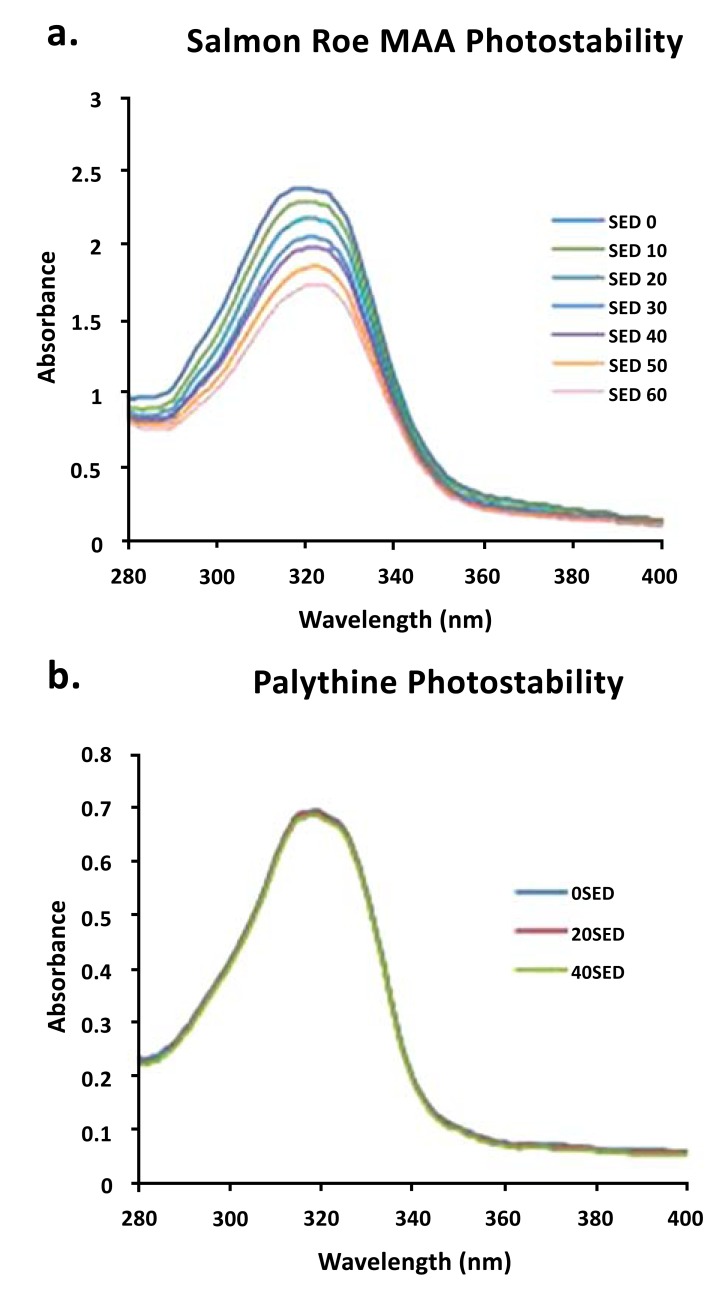
- MAA are small (<400 Da), water-soluble, with over 20 known compounds and λmax between 268–362 nm; porphyra-334 and shinorine dissipate 96–98% of absorbed energy as heat without ROS, and palythine showed only 3% degradation after 40 SED of solar simulated radiation (~60 J/cm²).
- In SKH-1 hairless mice, topical 2% porphyra-334/shinorine (88:12) prevented solar-simulated UVR-induced erythema, stratum corneum thickening, edema, and sunburn cells, with a calculated SPF of 3.71±0.78, though applied at 4 mg/cm², double standard sunscreen testing thickness.
- MAA show antioxidant activity, Nrf2 activation (porphyra-334 reduced IL-6, IL-1β, TNF-α and NF-κB, and increased HMOX-1, GSH, NQO1), and anti-photoageing effects (porphyra-334 inhibited MMP-1/MMP-8, reduced elastase, increased collagen/elastin; shinorine, porphyra-334, and palythine inhibited MMP-2).
- Commercial use is limited: Helioguard 365 contains porphyra-334 and shinorine (11.5:1) but final MAA concentration is 0.0005%, versus 0.5–10% w/v for typical sunscreen filters, and large-scale production is hindered by difficult biosynthesis and chiral synthesis.
Methods
- Design: narrative literature review of all relevant papers on MAA in nature and their potential for human skin photoprotection.
- Data: published studies across marine species, chemical/biological antioxidant assays, in silico Keap1-Nrf2 screening, in vitro skin cells/fibroblasts/keratinocytes, mouse skin, and one human volunteer pilot.
- Analysis: qualitative synthesis of structural, circumstantial, biological, and skin-model evidence; no systematic search strategy or meta-analysis is reported.
Limitations
- Stated: most MAA studies are in vitro; photochemistry is poorly understood with only a few compounds studied; MAA biosynthesis route is contentious; human DNA damage/erythema data are under-researched; biological and chemical antioxidant assay results disagree; exact antioxidant mechanisms remain unclear.
- Stated: the mouse SPF study applied formulation at 4 mg/cm², double standard testing thickness, so the real SPF would likely be at least half; the human collemin A pilot had one volunteer and requires confirmation.
- Evident: as a narrative review, it does not report a systematic search/selection protocol, and many conclusions rely on cited reviews or small, heterogeneous studies; commercial formulation and large-scale production barriers are noted but not experimentally resolved.
Model-written summary. Check it against the paper before relying on it.
Integrity signals
Registry
Cites
Statistics
Figures
Verification
Claims the paper makes
15 Valid · 0 Not valid · 64 Not checked · 19 Own results and interpretations
The cited sources support only part of this claim — read each source’s verdict below.
In the paper
“The cellular concentration and type of MAA vary with species, geographical location and environment (e.g. nitrate concentration) in which they are found.”
§ Mycosporine-Like Amino Acids for Skin Photoprotection > MYCOSPORINE-LIKE AMINO ACIDS
What the sources say
- Not checked yetcites [32] Figueroa F.L. Korbee N. Abdala R. Jerez C.G. López-de la Torre M. Güenaga L. Larrubia M.A. Gómez-Pinchetti J.L. Biofiltration of fishpond effluents and accumulation of N-compounds (phycobiliproteins and mycosporine-like amino acids) versus C-compounds (polysaccharides) in Hydropuntia cornea (Rhodophyta). Mar. Pollut. Bull. 2012 64 2 310 318 22169735 source
- Not checked yetcites [33] Barufi J.B. Mata M.T. Oliveira M.C. Figueroa F.L. Nitrate reduces the negative effect of UV radiation on photosynthesis and pigmentation in Gracilaria tenuistipitata (Rhodophyta): the photoprotection role of mycosporine-like amino acids. Phycologia 2012 51 6 636 648 source
- Not checked yetcites [34] Barufi J.B. Korbee N. Oliveira M.C. Figueroa F.L. Effects of N supply on the accumulation of photosynthetic pigments and photoprotectors in Gracilaria tenuistipitata (Rhodophyta) cultured under UV radiation. J. Appl. Phycol. 2011 23 3 457 466 source
- Not checked yetcites [35] Korbee N. Huovinen P. Figueroa F.L. Aguilera J. Karsten U. Availability of ammonium influences photosynthesis and the accumulation of mycosporine-like amino acids in two Porphyra species (Bangiales, Rhodophyta). Mar. Biol. 2005 146 4 645 654 source
- Partly supportedcites [36] Peinado N.K. Diaz R.T. Figueroa F.L. Helbling E.W. Ammonium and UV radiation stimulate the accumulation of mycosporine-like amino acids in Porphyra columbina (Rhodophyta) from Patagonia, Argentina. J. Phycol. 2004 40 2 248 259 sourceExperimental — accuracy not yet measured
Our copy supports most of the breadth of the claim: the Introduction (p. 1) states that besides solar radiation MAA accumulation 'can be affected by other environmental variables such as salinity, temperature, or nutrient availability', the Discussion (p. 8) reports that high ammonium significantly increased MAA content in P. columbina, and the latitude/water-column ('different latitudes'; intertidal vs subtidal) point appears in the Discussion (p. 6), though credited to earlier work (Karsten et al. 1998a, Franklin et al. 2001, Hoyer et al. 2001). Species-level variation is only implicit: the Introduction (p. 1) notes Porphyra spp. contain high levels of MAAs, 'mainly porphyra-334', and the highest concentrations among red macroalgae analysed, and the Results (p. 4) list five MAAs in P. columbina with porphyra-334 ~80% and shinorine ~20%. The claim's specific example 'nitrate concentration' is not supported: this paper manipulated ammonium (0, 50, 300 microM NH4Cl) and explicitly says there is 'scarce information on the effect of nitrogen availability on the synthesis and accumulation of MAAs'. (LLM, conf=0.72)
- Not checked yetcites [37] Huovinen P. Gomez I. Figueroa F.L. Ulloa N. Morales V. Lovengreen C. Ultraviolet-absorbing mycosporine-like amino acids in red macroalgae from Chile. Bot. Mar. 2004 47 1 21 29 source
- Not checked yetcites [38] Hoyer K. Karsten U. Wiencke C. Induction of sunscreen compounds in Antarctic macroalgae by different radiation conditions. Mar. Biol. 2002 141 4 619 627 source
- Not checked yetcites [39] Karsten U. Sawall T. Hanelt D. Bischof K. Figueroa F.L. Flores-Moya A. Wiencke C. An inventory of UV-absorbing mycosporine-like amino acids in macroalgae from polar to warm-temperate regions. Bot. Mar. 1998 41 5 443 453 source
plainstates an association- Asserted: passes — The authors put it forward as true.
- Checkable: passes — It can be checked against evidence.
- Load-bearing: unclear — It is unclear whether the paper’s conclusions depend on it.
- Based: passes — The paper gives a reason why it holds.
The cited sources support only part of this claim — read each source’s verdict below.
In the paper
“Species show seasonal variation in MAA concentration. In winter months, they have a lower concentration compared to summer months when UVR exposure is highest as demonstrated in plankton growing in lake environments [65, 66].”
§ Mycosporine-Like Amino Acids for Skin Photoprotection > PHOTOPROTECTIVE ROLE OF MAA IN NATURE > Circumstantial Evidence for Photoprotection
What the sources say
- Supportedcites [65] Tartarotti B. Sommaruga R. Seasonal and ontogenetic changes of mycosporine-like amino acids in planktonic organisms from an alpine lake. Limnol. Oceanogr. 2006 51 3 1530 1541 21258624 PMC3024532 source
The Discussion section on seasonal patterns reports that MAA concentrations in lake phytoplankton and zooplankton were low to almost undetectable during ice cover and highest during the ice-free season. It also states that incident solar UVR is highest during that ice-free period and lowest in winter. (LLM, conf=0.94)
- Partly supportedcites [66] Ha S-Y. Lee Y. Kim M-S. Kumar K.S. Shin K-H. Seasonal Changes in Mycosporine-Like Amino Acid Production Rate with Respect to Natural Phytoplankton Species Composition. Mar. Drugs 2015 13 11 6740 6758 26561820 PMC4663551 sourceExperimental — accuracy not yet measured
Results §2.2 reports seasonal variation in MAA concentration in two lakes, but the measurements run from March to November and do not establish a winter–summer comparison. Concentrations peaked in September at Lake Cheongpyeong and October at Lake Paldang, rather than during the summer UVR peak. The source therefore supports seasonal variation, not the claimed winter-low, summer-high pattern. (LLM, conf=0.88)
boostedstates an association- Asserted: passes — The authors put it forward as true.
- Checkable: passes — It can be checked against evidence.
- Load-bearing: unclear — It is unclear whether the paper’s conclusions depend on it.
- Based: passes — The paper gives a reason why it holds.
- Supported
The sources with a verdict support this claim; the rest weren’t checked yet, have no full text we could read, or their verdicts aren’t rated yet.
In the paper
“This hypothesis has since been investigated and the role of MAA in prevention from osmotic stress supported [77, 85-88].”
§ Mycosporine-Like Amino Acids for Skin Photoprotection > PHOTOPROTECTIVE ROLE OF MAA IN NATURE > Additional Protective Roles of MAA in Nature
What the sources say
- Not checked yetcites [77] Oren A. Gunde-Cimerman N. Mycosporines and mycosporine-like amino acids: UV protectants or multipurpose secondary metabolites? FEMS Microbiol. Lett. 2007 269 1 1 10 17286572 source
- Not checked yetcites [85] Portwich A. Garcia-Pichel F. Ultraviolet and osmotic stresses induce and regulate the synthesis of mycosporines in the cyanobacterium chlorogloeopsis PCC 6912. Arch. Microbiol. 1999 172 4 187 192 10525734 source
- Not checked yetcites [86] Kogej T. Gostinčar C. Volkmann M. Gorbushina A.A. Gunde-Cimerman N. Mycosporines in Extremophilic Fungi—Novel Complementary Osmolytes? Environ. Chem. 2006 3 2 105 110 source
- Not checked yetcites [87] Singh S.P. Klisch M. Sinha R.P. Häder D.P. Effects of abiotic stressors on synthesis of the mycosporine-like amino acid shinorine in the Cyanobacterium Anabaena variabilis PCC 7937. Photochem. Photobiol. 2008 84 6 1500 1505 18557824 source
- Supportedcites [88] Waditee-Sirisattha R. Kageyama H. Sopun W. Tanaka Y. Takabe T. Identification and upregulation of biosynthetic genes required for accumulation of Mycosporine-2-glycine under salt stress conditions in the halotolerant cyanobacterium Aphanothece halophytica. Appl. Environ. Microbiol. 2014 80 5 1763 1769 24375141 PMC3957624 source
The DISCUSSION (p. of passage 1) states directly that 'the present results support the notion that MAAs can play a role not only as an UV-absorbing compound but also as an osmoprotectant in response to salt stress.' This is grounded in the paper's own in vivo data: RESULTS (passage 2) show salt upshock (0.5 to 2.5 M NaCl) raised mycosporine-2-glycine from 0.35 to 31.97 μmol/g, more than UV-B exposure, and the Abstract and transformed-strain data (passages 5, 7) repeat the salt-driven accumulation. The INTRODUCTION (passage 3) likewise notes MAAs are synthesized under osmotic stress. The citing sentence's weaker hedge ('supported') matches the source's own framing. (LLM, conf=0.87)
plainstates a cause- Asserted: passes — The authors put it forward as true.
- Checkable: passes — It can be checked against evidence.
- Load-bearing: unclear — It is unclear whether the paper’s conclusions depend on it.
- Based: passes — The paper gives a reason why it holds.
Every source the paper cites for this claim was checked and supports it.
In the paper
“Porphyra-334 has also shown have no effect on cell viability of human skin fibroblasts at concentrations up to 200μM [93].”
§ Mycosporine-Like Amino Acids for Skin Photoprotection > PHOTOPROTECTION OF THE SKIN > Cell Viability/Proliferation
What the sources say
- Supportedcites [93] Ryu J. Park S.J. Kim I.H. Choi Y.H. Nam T.J. Protective effect of porphyra-334 on UVA-induced photoaging in human skin fibroblasts. Int. J. Mol. Med. 2014 34 3 796 803 24946848 PMC4121349 source
The ‘Effect of porphyra-334 on cell viability’ section reports that human skin fibroblasts treated with 0–200 µM porphyra-334 showed no significant toxicity after 24 hours. Figure 2A likewise states that this concentration range did not exert cytotoxic effects on fibroblasts. (LLM, conf=0.93)
plain- Asserted: passes — The authors put it forward as true.
- Checkable: passes — It can be checked against evidence.
- Load-bearing: unclear — It is unclear whether the paper’s conclusions depend on it.
- Based: passes — The paper gives a reason why it holds.
- Supported
Every source the paper cites for this claim was checked and supports it.
In the paper
“Porphyra-334, the most widely studied MAA, has also demonstrated a dose dependent reduction in oxidative stress in skin fibroblasts, when added post exposure, again suggesting antioxidant capability [93].”
§ Mycosporine-Like Amino Acids for Skin Photoprotection > PHOTOPROTECTION OF THE SKIN > Oxidative Stress
What the sources say
- Supportedcites [93] Ryu J. Park S.J. Kim I.H. Choi Y.H. Nam T.J. Protective effect of porphyra-334 on UVA-induced photoaging in human skin fibroblasts. Int. J. Mol. Med. 2014 34 3 796 803 24946848 PMC4121349 source
The Discussion reports a dose-dependent decrease in UVA-induced intracellular ROS in human skin fibroblasts. The “UVA irradiation and treatment” section specifies that porphyra-334 was added after irradiation, supporting the post-exposure timing. (LLM, conf=0.93)
boostedstates a cause- Asserted: passes — The authors put it forward as true.
- Checkable: passes — It can be checked against evidence.
- Load-bearing: passes — The paper’s conclusions depend on it.
- Based: passes — The paper gives a reason why it holds.
- Supported
50 more claims · 6 with their cited sources checked
Create a free account to see all 98 claims and to verify the 112 references still open.
- It may state two separate claims as one. 37
- Probably not a substantial claim. 11
- The quote only partly states this claim. 2
Claims other papers make about this one
Each is checked against this paper’s own text: does it say what the citing paper says it does?
The source backs part of the claim, not all of it — or backs it for a different population, condition or comparison.
In the citing paper
“most formulations of sunscreens with MAAs currently contain only a very small percentage of this active ingredient, and it functions as an adjuvant to UV filters and other sources of photoprotection [83].”
From Sunscreens and Photoaging: A Review of Current Literature (2021) · cites this paper as [83]
Experimental — accuracy not yet measured
Citations
Cites
Molecular Mechanisms of Stress-Responsive Changes in Collagen and Elastin Networks in Skin
Aziz, J., Shezali, H., Radzi, Z., Yahya, N. A., Abu Kassim, N. H., Czernuszka, J., & Rahman, M. T. (2016) · Skin Pharmacology and Physiology · doi:10.1159/000447017 · Cited by 7,323
The epidemiology of UV induced skin cancer
Armstrong, B. K., & Kricker, A. (2001) · Journal of Photochemistry and Photobiology B: Biology · doi:10.1016/s1011-1344(01)00198-1 · Cited by 1,811
Molecular basis of sun-induced premature skin ageing and retinoid antagonism
Fisher, G. J., Datta, S. C., Talwar, H. S., Wang, Z.-Q., Varani, J., Kang, S., & Voorhees, J. J. (1996) · Nature · doi:10.1038/379335a0 · Cited by 1,410
Oxidative Stress in the Pathogenesis of Skin Disease
Bickers, D. R., & Athar, M. (2006) · Journal of Investigative Dermatology · doi:10.1038/sj.jid.5700340 · Cited by 1,092
Metabolites from algae with economical impact
Cardozo, K. H. M., Guaratini, T., Barros, M. P., Falcão, V. R., Tonon, A. P., Lopes, N. P., Campos, S., Torres, M. A., Souza, A. O., Colepicolo, P., et al. (2007) · Comparative Biochemistry and Physiology Part C: Toxicology & Pharmacology · doi:10.1016/j.cbpc.2006.05.007 · Cited by 957
Reduced melanoma after regular sunscreen use: randomized trial follow-up
Green, A. C., Williams, G. M., Logan, V., & Strutton, G. M. (2011) · Journal of Clinical Oncology · doi:10.1200/jco.2010.28.7078 · Cited by 799
Shick, J. M., & Dunlap, W. C. (2002) · Annual Review of Physiology · doi:10.1146/annurev.physiol.64.081501.155802 · Cited by 676
Sunscreens cause coral bleaching by promoting viral infections
Danovaro, R., Bongiorni, L., Corinaldesi, C., Giovannelli, D., Damiani, E., Astolfi, P., Greci, L., & Pusceddu, A. (2008) · Environmental Health Perspectives · doi:10.1289/ehp.10966 · Cited by 611
Chemiexcitation of melanin derivatives induces DNA photoproducts long after UV exposure
Premi, S., Wallisch, S., Mano, C. M., Weiner, A. B., Bacchiocchi, A., Wakamatsu, K., Bechara, E. J. H., Halaban, R., Douki, T., & Brash, D. E. (2015) · Science · doi:10.1126/science.1256022 · Cited by 550
UV wavelength-dependent DNA damage and human non-melanoma and melanoma skin cancer
Pfeifer, G. P., & Besaratinia, A. (2012) · Photochemical & Photobiological Sciences · doi:10.1039/c1pp05144j · Cited by 473
Mycosporines and mycosporine-like amino acids: UV protectants or multipurpose secondary metabolites?
Oren, A., & Gunde-Cimerman, N. (2007) · FEMS Microbiology Letters · doi:10.1111/j.1574-6968.2007.00650.x · Cited by 461
The Genetic and Molecular Basis for Sunscreen Biosynthesis in Cyanobacteria
Balskus, E. P., & Walsh, C. T. (2010) · Science · doi:10.1126/science.1193637 · Cited by 380
Penetration of Ultraviolet Radiation in the Marine Environment. A Review
Tedetti, M., & Sempéré, R. (2006) · Photochemistry and Photobiology · doi:10.1562/2005-11-09-ir-733 · Cited by 369
Dunlap, W. C., & Shick, J. M. (1998) · Journal of Phycology · doi:10.1046/j.1529-8817.1998.340418.x · Cited by 360
Mycosporines: are they nature’s sunscreens?
M. Bandaranayake, W. (1998) · Natural Product Reports · doi:10.1039/a815159y · Cited by 336
de la Coba, F., Aguilera, J., Figueroa, F. L., de Gálvez, M. V., & Herrera, E. (2009) · Journal of Applied Phycology · doi:10.1007/s10811-008-9345-1 · Cited by 302
Mycosporine-Like Amino Acids and Their Derivatives as Natural Antioxidants
Wada, N., Sakamoto, T., & Matsugo, S. (2015) · Antioxidants · doi:10.3390/antiox4030603 · Cited by 283
Marine Natural Products as Novel Antioxidant Prototypes
Takamatsu, S., Hodges, T. W., Rajbhandari, I., Gerwick, W. H., Hamann, M. T., & Nagle, D. G. (2003) · Journal of Natural Products · doi:10.1021/np0204038 · Cited by 278
Conde, F. R., Churio, M. S., & Previtali, C. M. (2000) · Journal of Photochemistry and Photobiology B: Biology · doi:10.1016/s1011-1344(00)00066-x · Cited by 252
First Determination of UV Filters in Marine Mammals. Octocrylene Levels in Franciscana Dolphins
Gago-Ferrero, P., Alonso, M. B., Bertozzi, C. P., Marigo, J., Barbosa, L., Cremer, M., Secchi, E. R., Azevedo, A., Lailson-Brito Jr., J., Torres, J. P. M., et al. (2013) · Environmental Science & Technology · doi:10.1021/es400675y · Cited by 242
United Nations Environment Programme, E. E. A. P. (2012) · Photochemical & Photobiological Sciences · doi:10.1039/c1pp90033a · Cited by 240
An overview of UV-absorbing compounds (organic UV filters) in aquatic biota
Gago-Ferrero, P., Díaz-Cruz, M. S., & Barceló, D. (2012) · Analytical and Bioanalytical Chemistry · doi:10.1007/s00216-012-6067-7 · Cited by 238
Young, A. R., Harrison, G. I., Chadwick, C. A., Nikaido, O., Ramsden, J., & Potten, C. S. (1998) · Journal of Investigative Dermatology · doi:10.1046/j.1523-1747.1998.00436.x · Cited by 235
Self-citationKarsten, U., Sawall, T., Hanelt, D., Bischof, K., Figueroa, F. L., Flores-Moya, A., & Wiencke, C. (1998) · Botanica Marina · doi:10.1515/botm.1998.41.1-6.443 · Cited by 219
Shick, J. M., Romaine-Lioud, S., Romaine-Lioud, S., Ferrier-Pagès, C., & Gattuso, J.-P. (1999) · Limnology and Oceanography · doi:10.4319/lo.1999.44.7.1667 · Cited by 211
Osterwalder, U., Sohn, M., & Herzog, B. (2014) · Photodermatology, Photoimmunology & Photomedicine · doi:10.1111/phpp.12112 · Cited by 207
Peinado, N. K., Abdala Díaz, R. T., Figueroa, F. L., & Helbling, E. W. (2004) · Journal of Phycology · doi:10.1046/j.1529-8817.2004.03013.x · Cited by 203 · cited 1×
“Table 1 shows some examples of the different MAA and their concentrations produced by different species, and some treatments used to increase the yield of MAA [32-39].”
MethodValencia, A., & Kochevar, I. E. (2008) · Journal of Investigative Dermatology · doi:10.1038/sj.jid.5700960 · Cited by 194
Mycosporine‐like amino acids as osmotic solutes in a community of halophilic cyanobacteria
Oren, A. (1997) · Geomicrobiology Journal · doi:10.1080/01490459709378046 · Cited by 191
Dunlap, W. C., Chalker, B. E., & Oliver, J. K. (1986) · Journal of Experimental Marine Biology and Ecology · doi:10.1016/0022-0981(86)90108-5 · Cited by 190
Suh, S.-S., Hwang, J., Park, M., Seo, H., Kim, H.-S., Lee, J., Moh, S., & Lee, T.-K. (2014) · Marine Drugs · doi:10.3390/md12105174 · Cited by 189
Effects of the UV filter benzophenone-2 on reproduction in fish
Weisbrod, C. J., Kunz, P. Y., Zenker, A. K., & Fent, K. (2007) · Toxicology and Applied Pharmacology · doi:10.1016/j.taap.2007.08.004 · Cited by 184
Protective effect of porphyra-334 on UVA-induced photoaging in human skin fibroblasts
RYU, J., PARK, S.-J., KIM, I.-H., CHOI, Y. H., & NAM, T.-J. (2014) · International Journal of Molecular Medicine · doi:10.3892/ijmm.2014.1815 · Cited by 172
Singh, S. P., Kumari, S., Rastogi, R. P., Singh, K. L., & Sinha, R. P. (2008) · PubMed · Cited by 171
Metal oxide sunscreens protect skin by absorption, not by reflection or scattering
Cole, C., Shyr, T., & Ou‐Yang, H. (2016) · Photodermatology, Photoimmunology & Photomedicine · doi:10.1111/phpp.12214 · Cited by 170
Conde, F. R., Churio, M. S., & Previtali, C. M. (2004) · Photochemical & Photobiological Sciences · doi:10.1039/b405782a · Cited by 169
Rastogi, R. P., & Incharoensakdi, A. (2014) · FEMS Microbiology Ecology · doi:10.1111/1574-6941.12220 · Cited by 168
Adams, N. L., & Shick, J. M. (1996) · Photochemistry and Photobiology · doi:10.1111/j.1751-1097.1996.tb02435.x · Cited by 167
Biosynthesis of mycosporines: Mycosporine glutaminol in Trichothecium roseum
Favre-Bonvin, J., Bernillon, J., Salin, N., & Arpin, N. (1987) · Phytochemistry · doi:10.1016/s0031-9422(00)83866-2 · Cited by 155
Saw, C. L., Huang, M., Liu, Y., Khor, T. O., Conney, A. H., & Kong, A. (2011) · Molecular Carcinogenesis · doi:10.1002/mc.20725 · Cited by 148
Courdavault, S., Baudouin, C., Charveron, M., Favier, A., Cadet, J., & Douki, T. (2004) · Mutation Research - Fundamental and Molecular Mechanisms of Mutagenesis · doi:10.1016/j.mrfmmm.2004.07.011 · Cited by 145
Reactive Molecule Species and Antioxidative Mechanisms in Normal Skin and Skin Aging
Wölfle, U., Seelinger, G., Bauer, G., Meinke, M. C., Lademann, J., & Schempp, C. M. (2014) · Skin Pharmacology and Physiology · doi:10.1159/000360092 · Cited by 142
ULTRAVIOLET-ABSORBING SUBSTANCES ASSOCIATED WITH LIGHT-INDUCED SPORULATION IN FUNGI
Leach, C. M. (1965) · Canadian Journal of Botany · doi:10.1139/b65-024 · Cited by 141
Mycosporine and mycosporine-like amino acids: A paramount tool against ultra violet irradiation
bhatia, S., Sharma, K., Sharma, A., Garg, A., Kumar, S., & Purohit, A. (2011) · Pharmacognosy Reviews · doi:10.4103/0973-7847.91107 · Cited by 140
Starcevic, A., Akthar, S., Dunlap, W. C., Shick, J. M., Hranueli, D., Cullum, J., & Long, P. F. (2008) · Proceedings of the National Academy of Sciences · doi:10.1073/pnas.0707388105 · Cited by 138
Self-citationKorbee, N., Huovinen, P., Figueroa, F. L., Aguilera, J., & Karsten, U. (2005) · Marine Biology · doi:10.1007/s00227-004-1484-6 · Cited by 138
Photodegradation and photosensitization of mycosporine-like amino acids
Whitehead, K., & Hedges, J. I. (2005) · Journal of Photochemistry and Photobiology B: Biology · doi:10.1016/j.jphotobiol.2005.03.008 · Cited by 137
Porphyra-334, a potential natural source for UVA protective sunscreens
Torres, A., Enk, C. D., Hochberg, M., & Srebnik, M. (2006) · Photochemical & Photobiological Sciences · doi:10.1039/b517330m · Cited by 136
de la Coba, F., Aguilera, J., de Gálvez, M. V., Álvarez, M., Gallego, E., Figueroa, F. L., & Herrera, E. (2009) · Journal of Dermatological Science · doi:10.1016/j.jdermsci.2009.06.004 · Cited by 133
The cyanobacterial UV-absorbing pigment scytonemin displays radical-scavenging activity
Matsui, K., Nazifi, E., Hirai, Y., Wada, N., Matsugo, S., & Sakamoto, T. (2012) · The Journal of General and Applied Microbiology · doi:10.2323/jgam.58.137 · Cited by 133
(2013) · Choice Reviews Online · doi:10.5860/choice.50-3271 · Cited by 133
Kim, S., & Seock, Y. (2009) · International Journal of Consumer Studies · doi:10.1111/j.1470-6431.2009.00817.x · Cited by 131
Singh, S. P., Klisch, M., Sinha, R. P., & Häder, D. (2009) · Genomics · doi:10.1016/j.ygeno.2009.10.002 · Cited by 130
Wright, D. J., Smith, S. C., Joardar, V., Scherer, S., Jervis, J., Warren, A., Helm, R. F., & Potts, M. (2005) · Journal of Biological Chemistry · doi:10.1074/jbc.m505961200 · Cited by 130
Adams, N. L., & Shick, J. M. (2001) · Marine Biology · doi:10.1007/s002270000463 · Cited by 125
Mycosporines in Extremophilic Fungi—Novel Complementary Osmolytes?
Kogej, T., Gostincar, C., Volkmann, M., Gorbushina, A. A., & Gunde-Cimerman, N. (2006) · Environmental Chemistry · doi:10.1071/en06012 · Cited by 124
Chalker, B. E., Dunlap, W. C., & Oliver, J. K. (1983) · Journal of Experimental Marine Biology and Ecology · doi:10.1016/0022-0981(83)90004-7 · Cited by 124
Sunscreens as a Source of Hydrogen Peroxide Production in Coastal Waters
Sánchez-Quiles, D., & Tovar-Sánchez, A. (2014) · Environmental Science & Technology · doi:10.1021/es5020696 · Cited by 122
Some Marine Ecological Phenomena: Chemical Basis and Biomedical Potential
Scheuer, P. J. (1990) · Science · doi:10.1126/science.2183350 · Cited by 120
Effects of sunscreen on skin cancer and photoaging
Iannacone, M. R., Hughes, M. C. B., & Green, A. C. (2014) · Photodermatology, Photoimmunology & Photomedicine · doi:10.1111/phpp.12109 · Cited by 118
Portwich, A., & Garcia-Pichel, F. (1999) · Archives of Microbiology · doi:10.1007/s002030050759 · Cited by 118
Misonou, T., Saitoh, J., Oshiba, S., Tokitomo, Y., Maegawa, M., Inoue, Y., Hori, H., & Sakurai, T. (2003) · Marine Biotechnology · doi:10.1007/s10126-002-0065-2 · Cited by 117
Sunscreen Use and Subsequent Melanoma Risk: A Population-Based Cohort Study
Ghiasvand, R., Weiderpass, E., Green, A. C., Lund, E., & Veierød, M. B. (2016) · Journal of Clinical Oncology · doi:10.1200/jco.2016.67.5934 · Cited by 117 · cited 1×
“ing [16], however this is contested [17] and their ability to prevent malignant melanoma (MM) is yet to be fully established [18, 19].”
BackgroundPortwich, A., & Garcia-Pichel, F. (2003) · Phycologia · doi:10.2216/i0031-8884-42-4-384.1 · Cited by 115
Oyamada, C., Kaneniwa, M., Ebitani, K., Murata, M., & Ishihara, K. (2008) · Marine Biotechnology · doi:10.1007/s10126-007-9043-z · Cited by 115
Tao, S., Justiniano, R., Zhang, D. D., & Wondrak, G. T. (2013) · Redox Biology · doi:10.1016/j.redox.2013.10.004 · Cited by 103
Induction of sunscreen compounds in Antarctic macroalgae by different radiation conditions
K., H., U., K., & C., W. (2002) · Marine Biology · doi:10.1007/s00227-002-0871-0 · Cited by 102
Gao, Q., & Garcia-Pichel, F. (2011) · Journal of Bacteriology · doi:10.1128/jb.05730-11 · Cited by 102
Inhibition of Collagenase by Mycosporine-like Amino Acids from Marine Sources
Hartmann, A., Gostner, J. M., Fuchs, J. E., Chaita, E., Aligiannis, N., Skaltsounis, A., & Ganzera, M. (2015) · Planta Medica · doi:10.1055/s-0035-1546105 · Cited by 101 · cited 1×
“Shinorine, porphyra-334, and palythine significantly inhibited MMP-2 activity in an in vitro fluorogenic assay, which was hypothesised to be due to competitive inhibition by binding to the active site determined using computer modelling [109].”
MethodSingh, S. P., Klisch, M., Sinha, R. P., & Häder, D. (2008) · Photochemistry and Photobiology · doi:10.1111/j.1751-1097.2008.00376.x · Cited by 100
Ultraviolet-absorbing mycosporine-like amino acids in red macroalgae from Chile
Huovinen, P., Gómez, I., Figueroa, F. L., Ulloa, N., Morales, V., & Lovengreen, C. (2004) · Botanica Marina · doi:10.1515/bot.2004.003 · Cited by 96
Waditee-Sirisattha, R., Kageyama, H., Sopun, W., Tanaka, Y., & Takabe, T. (2014) · Applied and Environmental Microbiology · doi:10.1128/aem.03729-13 · Cited by 96
Sun protection for preventing basal cell and squamous cell skin cancers
Sánchez, G., Nova, J., Rodriguez-Hernandez, A. E., Medina, R. D., Solorzano-Restrepo, C., Gonzalez, J., Olmos, M., Godfrey, K., & Arevalo-Rodriguez, I. (2016) · Cochrane Database of Systematic Reviews · doi:10.1002/14651858.cd011161.pub2 · Cited by 95 · cited 1×
“ing [16], however this is contested [17] and their ability to prevent malignant melanoma (MM) is yet to be fully established [18, 19].”
BackgroundConde, F. R., Churio, M. S., & Previtali, C. M. (2007) · Photochemical & Photobiological Sciences · doi:10.1039/b618314j · Cited by 94
Fernandes, S. C. M., Alonso-Varona, A., Palomares, T., Zubillaga, V., Labidi, J., & Bulone, V. (2015) · ACS Applied Materials & Interfaces · doi:10.1021/acsami.5b04064 · Cited by 93
Barufi, J. B., Korbee, N., Oliveira, M. C., & Figueroa, F. L. (2011) · Journal of Applied Phycology · doi:10.1007/s10811-010-9603-x · Cited by 92
Tartarotti, B., Laurion, I., & Sommaruga, R. (2001) · Limnology and Oceanography · doi:10.4319/lo.2001.46.6.1546 · Cited by 91
Rational Design and Synthesis of Efficient Sunscreens To Boost the Solar Protection Factor
Losantos, R., Funes‐Ardoiz, I., Aguilera, J. M., Herrera‐Ceballos, E., García‐Iriepa, C., Campos, P. J., & Sampedro, D. (2017) · Angewandte Chemie International Edition · doi:10.1002/anie.201611627 · Cited by 87
Tartarotti, B., & Sommaruga, R. (2006) · Limnology and Oceanography · doi:10.4319/lo.2006.51.3.1530 · Cited by 86
McAdam, E., Brem, R., & Karran, P. (2016) · Molecular Cancer Research · doi:10.1158/1541-7786.mcr-16-0053 · Cited by 86
Mason, D. S., Schafer, F., Shick, J. M., & Dunlap, W. C. (1998) · Comparative Biochemistry and Physiology Part A: Molecular & Integrative Physiology · doi:10.1016/s1095-6433(98)10069-7 · Cited by 83
Zhang, L., Li, L., & Wu, Q. (2006) · Journal of Photochemistry and Photobiology B Biology · doi:10.1016/j.jphotobiol.2006.10.006 · Cited by 81
Torres, A., Hochberg, M., Pergament, I., Smoum, R., Niddam, V., Dembitsky, V. M., Temina, M., Dor, I., Lev, O., Srebnik, M., et al. (2004) · European Journal of Biochemistry · doi:10.1111/j.1432-1033.2004.03981.x · Cited by 80 · cited 3×
“cell viability, demonstrating a filtering effect [95].”
BackgroundResultInfluentialSunscreen use and failures — on site observations on a sun-holiday
Petersen, B., Datta, P., Philipsen, P. A., & Wulf, H. C. (2012) · Photochemical & Photobiological Sciences · doi:10.1039/c2pp25127b · Cited by 77
Katoch, M., Mazmouz, R., Chau, R., Pearson, L. A., Pickford, R., & Neilan, B. A. (2016) · Applied and Environmental Microbiology · doi:10.1128/aem.01632-16 · Cited by 76
Sinha, R. P., Ambasht, N. K., Sinha, J. P., & Häder, D. (2003) · Photochemical & Photobiological Sciences · doi:10.1039/b204167g · Cited by 74
Kunz, P. Y., Gries, T., & Fent, K. (2006) · Toxicological Sciences · doi:10.1093/toxsci/kfl070 · Cited by 72
Glycosylated Porphyra-334 and Palythine-Threonine from the Terrestrial Cyanobacterium Nostoc commune
Nazifi, E., Wada, N., Yamaba, M., Asano, T., Nishiuchi, T., Matsugo, S., & Sakamoto, T. (2013) · Marine Drugs · doi:10.3390/md11093124 · Cited by 68
D’Agostino, P. M., Javalkote, V. S., Mazmouz, R., Pickford, R., Puranik, P. R., & Neilan, B. A. (2016) · Applied and Environmental Microbiology · doi:10.1128/aem.01633-16 · Cited by 65
Pope, M. A., Spence, E., Seralvo, V., Gacesa, R., Heidelberger, S., Weston, A. J., Dunlap, W. C., Shick, J. M., & Long, P. F. (2015) · ChemBioChem · doi:10.1002/cbic.201402516 · Cited by 64
Self-citationPoint: Sunscreen Use Is a Safe and Effective Approach to Skin Cancer Prevention
Green, A. C., & Williams, G. M. (2007) · Cancer Epidemiology, Biomarkers & Prevention · doi:10.1158/1055-9965.epi-07-0477 · Cited by 62
Choi, Y.-H., Yang, D., Kulkarni, A., Moh, S., & Kim, K. (2015) · Marine Drugs · doi:10.3390/md13127056 · Cited by 61
Rastogi, R. P., Madamwar, D., & Incharoensakdi, A. (2015) · Journal of Applied Microbiology · doi:10.1111/jam.12879 · Cited by 55
Redundant Pathways of Sunscreen Biosynthesis in a Cyanobacterium
Spence, E., Dunlap, W. C., Shick, J. M., & Long, P. F. (2012) · ChemBioChem · doi:10.1002/cbic.201100737 · Cited by 52
Self-citationKim, S., You, D. H., Han, T., & Choi, E.-M. (2014) · Journal of Photochemistry and Photobiology B: Biology · doi:10.1016/j.jphotobiol.2014.10.012 · Cited by 49
Hartmann, A., Holzinger, A., Ganzera, M., & Karsten, U. (2016) · Planta · doi:10.1007/s00425-015-2396-z · Cited by 45 · cited 1×
“The first MAA were discovered in fungi species in 1965 [30] and a recent study found a terrestrial alga containing MAA [31].”
BackgroundTorregiani, J. H., & Lesser, M. P. (2007) · Journal of Experimental Marine Biology and Ecology · doi:10.1016/j.jembe.2006.09.004 · Cited by 43
Asamizu, S., Xie, P., Brumsted, C. J., Flatt, P. M., & Mahmud, T. (2012) · Journal of the American Chemical Society · doi:10.1021/ja3041866 · Cited by 42
Ryu, J., Kwon, M.-J., & Nam, T.-J. (2015) · Marine Drugs · doi:10.3390/md13084721 · Cited by 39
Rosic, N. N. (2012) · Applied Microbiology and Biotechnology · doi:10.1007/s00253-012-3925-3 · Cited by 39
UVA Photoprotective Activity of Brown Macroalgae Sargassum cristafolium
Prasedya, E. S., Syafitri, S. M., Geraldine, B. A. F. D., Hamdin, C. D., Frediansyah, A., Miyake, M., Kobayashi, D., Hazama, A., & Sunarpi, H. (2019) · Biomedicines · doi:10.3390/biomedicines7040077 · Cited by 39
Feng, Y.-N., Zhang, Z., Feng, J., & Qiu, B. (2012) · Applied and Environmental Microbiology · doi:10.1128/aem.01427-12 · Cited by 37
Physiological Roles of a Substance 334 in Algae
Sivalingam, P. M., Ikawa, T., & Nisizawa, K. (1976) · Botanica Marina · doi:10.1515/botm.1976.19.1.9 · Cited by 37 · cited 1×
“ronments of significant irradiance, suggesting photosynthetic wavelengths are in abundance [77, 89].”
BackgroundStarcevic, A., Dunlap, W. C., Cullum, J., Shick, J. M., Hranueli, D., & Long, P. F. (2010) · PLoS ONE · doi:10.1371/journal.pone.0013975 · Cited by 36
Self-citationHuman 8-oxoguanine-DNA glycosylase-1 is downregulated in human basal cell carcinoma
Huang, X., Scolyer, R. A., Abubakar, A., & Halliday, G. M. (2012) · Molecular Genetics and Metabolism · doi:10.1016/j.ymgme.2012.02.017 · Cited by 33
Figueroa, F. L., Korbee, N., Abdala, R., Jerez, C. G., López-de la Torre, M., Güenaga, L., Larrubia, M. A., & Gómez-Pinchetti, J. L. (2012) · Marine Pollution Bulletin · doi:10.1016/j.marpolbul.2011.11.012 · Cited by 32
Barufi, J. B., Mata, M. T., Oliveira, M. C., & Figueroa, F. L. (2012) · Phycologia · doi:10.2216/10.77.1 · Cited by 30
Bioinformatics analyses provide insight into distant homology of the Keap1–Nrf2 pathway
Gaćeša, R., Dunlap, W. C., & Long, P. F. (2015) · Free Radical Biology and Medicine · doi:10.1016/j.freeradbiomed.2015.06.015 · Cited by 26 · cited 1×
“Nrf2 activation, of which three were MAA: mycosporine-glycine, mycosporine-glycine-valine and porphyra-334 [103].”
BackgroundSelf-citationOlsson-Francis, K., Watson, J. S., & Cockell, C. S. (2013) · International Journal of Astrobiology · doi:10.1017/s1473550413000104 · Cited by 22
Andreguetti, D., Stein, E. M., Pereira, C. M. P., Pinto, E., & Colepicolo, P. (2013) · Journal of Biochemical and Molecular Toxicology · doi:10.1002/jbt.21489 · Cited by 21
Ha, S.-Y., Lee, Y., Kim, M.-S., Kumar, K., & Shin, K.-H. (2015) · Marine Drugs · doi:10.3390/md13116740 · Cited by 15
Hartmann, A., Gostner, J., Becker, K., & Ganzera, M. (2015) · Planta Medica · doi:10.1055/s-0035-1565472 · Cited by 10
Tosato, M. G., Orallo, D. E., Churio, M. S., Martin, A. A., Soto, C. A. T., & Dicelio, L. E. (2014) · Biorheology · doi:10.3233/bir-14014 · Cited by 3
Research works printed but not linked: 1
- Peinado N.K. Abdala Díaz R.T. Figueroa F.L. Helbling E.W. Ammonium and UV radiation stimulate the accumulation of mycosporine-like amino acids in porphyra Columbina (rhodophta) from Patagonia Argentina. J. Phycol. 2004 40 2 248 259 · DOI · Paper page
Cited by
Seaweed Phenolics: From Extraction to Applications
Cotas, J., Leandro, A., Monteiro, P., Pacheco, D., Figueirinha, A., Gonçalves, A. M. M., da Silva, G. J., & Pereira, L. (2020) · Marine Drugs · doi:10.3390/md18080384 · Cited by 525
Bais, A. F., Lucas, R. M., Bornman, J. F., Williamson, C. E., Sulzberger, B., Austin, A. T., Wilson, S. R., Andrady, A. L., Bernhard, G., McKenzie, R. L., et al. (2018) · Photochemical & Photobiological Sciences · doi:10.1039/c7pp90043k · Cited by 350
Self-citationGalasso, C., Gentile, A., Orefice, I., Ianora, A., Bruno, A., Noonan, D. M., Sansone, C., Albini, A., & Brunet, C. (2019) · Nutrients · doi:10.3390/nu11061226 · Cited by 295
“MAAs are water soluble, low molecular weight and polar compounds [53] that have been shown to protect cells from UV-induced damage due to the presence of double bonds, providing them with antioxidant properties and photostability [54].”
BackgroundSunscreens and Photoaging: A Review of Current Literature
Guan, L. L., Lim, H. W., & Mohammad, T. F. (2021) · American Journal of Clinical Dermatology · doi:10.1007/s40257-021-00632-5 · Cited by 313
“With controversies around chemical sunscreens and their effects on marine life, algae-derived sunscreens may provide a future solution for eco-friendly photoprotection; however, most formulations of sunscreens with MAAs currently contain only a very small percentage of this active ingredient, and it functions as an ad…”
BackgroundLucas, R. M., Yazar, S., Young, A. R., Norval, M., de Gruijl, F. R., Takizawa, Y., Rhodes, L. E., Sinclair, C. A., & Neale, R. E. (2019) · Photochemical & Photobiological Sciences · doi:10.1039/c8pp90060d · Cited by 233
Self-citation
Metadata
- Authors
- Lawrence, K. P., Long, P. F., & Young, A. R.
- Affiliations
- King's College London (GB)
- Corresponding author
- Young, Antony R.
- Venue
- Current Medicinal Chemistry
- Publisher
- Bentham Science Publishers Ltd.
- Published
- 2019-01-21
- Volume
- 25
- Issue
- 40
- Pages
- 5512-5527
- ISSN
- 0929-8673 (ISSN-L)
- PMC
- PMC6446518
- OpenAlex
- W2618895543
- Semantic Scholar
- ccc352ad65aa4c44bf2f6f23952170d95384abc2
- Cited by
- 157
- References
- 112
- Citations by year
- 2026: 10 · 2025: 21 · 2024: 12 · 2023: 22 · 2022: 19 · 2021: 32 · 2020: 12 · 2019: 16
- FWCI
- 1.91
- Type
- journal article
- Language
- en
- Open access
- green
- www.ncbi.nlm.nih.gov
- Licence
- cc-by-nc
- Locations
- Current Medicinal Chemistry (publishedVersion)
- Europe PMC (PubMed Central) (publishedVersion, cc-by-nc)
- PubMed Central (publishedVersion, cc-by-nc)
- PubMed (publishedVersion)
- Research Portal (King's College London) (submittedVersion)
- Topics
- Health Sciences › Medicine › Dermatology › Skin Protection and Aging
- Life Sciences › Biochemistry, Genetics and Molecular Biology › Cell Biology › melanin and skin pigmentation
- Physical Sciences › Materials Science › Materials Chemistry › Photochromic and Fluorescence Chemistry
- Keywords
- mycosporine-like amino acids, skin photoprotection, ultraviolet radiation, natural sunscreen, antioxidants, photostability, marine organisms, skin cancer prevention
- MeSH terms
- Amino Acids, Animals, Humans, Radiation Protection, Skin, Ultraviolet Rays
About these checks
Registry, retraction, Cites and statistics results are computed, not judged, with one exception: a printed reference that no index lists is read once by a model before it counts as a citation error. Claims are extracted by a model and kept only when their quote appears verbatim in the text; each cited source is then checked, with a model’s help, for whether it says what the claim relies on. Those verdicts can be wrong — read the claim’s quote and the cited source before relying on one.
The claim verdicts this report counts are experimental: their accuracy is not yet measured.
A language model drew the claims from the paper on 2026-10-05, under version 3 of the claim definition (model deepseek-v4.1-flash, prompt extract-v3).
A second model labelled each claim on 2026-10-05 (model jev-1.13-20260917, definition revision gold-guideline-v0.2).
Cited sources are checked with a language model’s help (qwen3.8-omni-flash and gpt-6-sol).
Statistics and arithmetic are recomputed, not judged.
Confidence bands are shown only for fields calibrated on our annotated test set. None is calibrated yet, so no band is shown.
What counts as a claim ›How we measure confidence ›How we check this ›
Are you an author, or do you see a problem with this page? Request a review
Data sources
Bibliographic data: Semantic Scholar, OpenAlex, Crossref.
Contains information from the Semantic Scholar Academic Graph Datasets, made available under the ODC Attribution License (ODC-BY 1.0).
Semantic Scholar’s data is described in: Kinney, R., et al. (2023). The Semantic Scholar Open Data Platform. arXiv:2301.10140.
