

The DOI matches its Crossref record; 16 of the 16 references it cites were found in a registry or an index.
A Systematic Review and Meta-analysis of the Association Between Depression and Insulin Resistance
Abstract
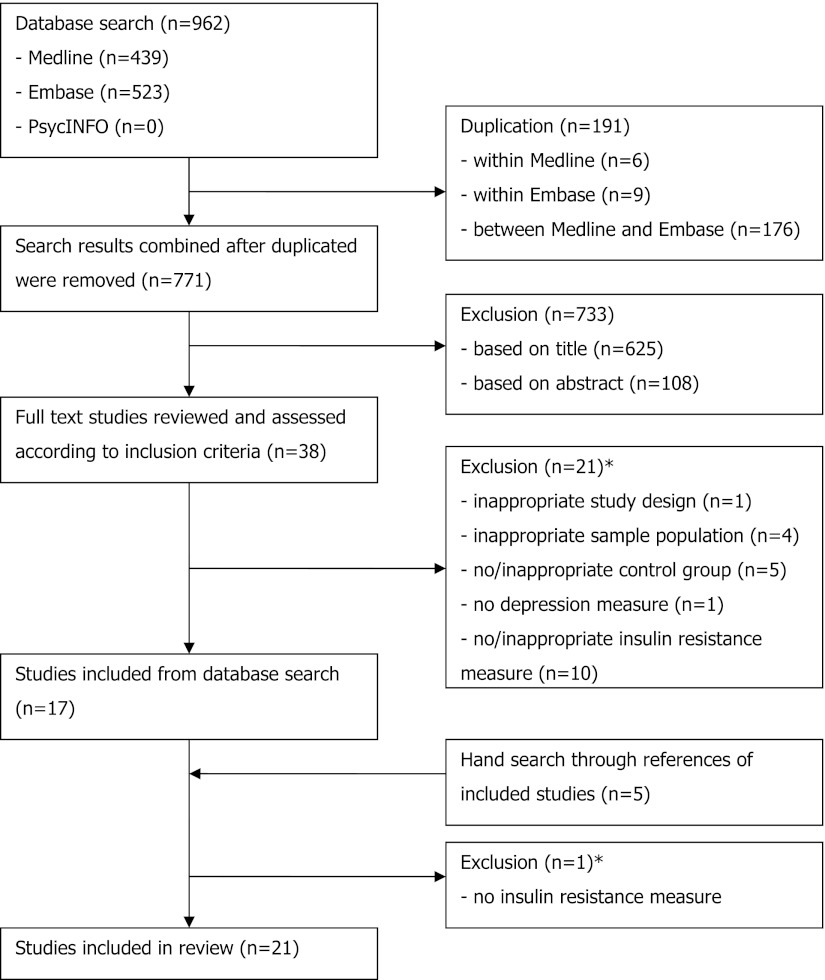
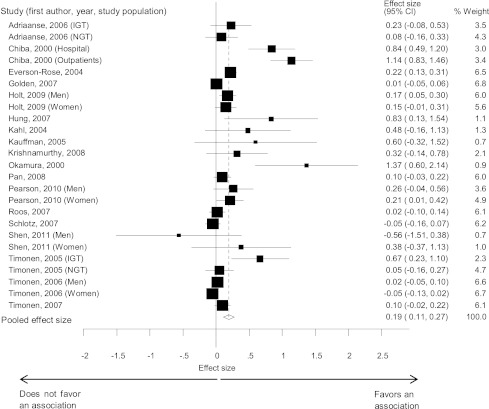
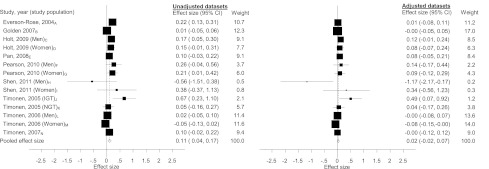
OBJECTIVE: Depression is associated with the onset of type 2 diabetes. A systematic review and meta-analysis of observational studies, controlled trials, and unpublished data was conducted to examine the association between depression and insulin resistance (IR). RESEARCH DESIGN AND METHODS: Medline, EMBASE, and PsycINFO were searched for studies published up to September 2011. Two independent reviewers assessed the eligibility of each report based on predefined inclusion criteria (study design and measure of depression and IR, excluding prevalent cases of diabetes). Individual effect sizes were standardized, and a meta-analysis was performed to calculate a pooled effect size using random effects. Subgroup analyses and meta-regression were conducted to explore any potential source of heterogeneity between studies. RESULTS: Of 967 abstracts reviewed, 21 studies met the inclusion criteria of which 18 studies had appropriate data for the meta-analysis (n = 25,847). The pooled effect size (95% CI) was 0.19 (0.11–0.27) with marked heterogeneity (I2 = 82.2%) using the random-effects model. Heterogeneity between studies was not explained by age or sex, but could be partly explained by the methods of depression and IR assessments. CONCLUSIONS: A small but significant cross-sectional association was observed between depression and IR, despite heterogeneity between studies. The pathophysiology mechanisms and direction of this association need further study using a purposively designed prospective or intervention study in samples at high risk for diabetes.
Overview
The claims and statistics of this paper haven’t been checked yet.
Run the check — free, no account needed. It reads the open-access text and checks the sources it cites.
Integrity signals
Registry
Cites
Statistics
Figures
Verification
Claims the paper makes
The claims and statistics of this paper haven’t been checked yet.
Run the check — free, no account needed. It reads the open-access text and checks the sources it cites.
Claims other papers make about this one
Each is checked against this paper’s own text: does it say what the citing paper says it does?
In the citing paper
“while the association between depression and pre-diabetes is found to be weaker after adjustment (Kan et al., 2013).”
From The syndemics of diabetes and depression in Brazil – An epidemiological analysis (2019) · cites this paper as Kan et al., 2013
In the citing paper
“Many cross-sectional studies have in search for a causal relationship between the disorders adjusted for these potential confounders and have still found higher prevalence of depression among diabetics”
From The syndemics of diabetes and depression in Brazil – An epidemiological analysis (2019) · cites this paper as Kan et al., 2013
Self-check
Percentages, sums and reported differences re-computed from the paper’s own numbers.
The self-check needs the paper’s full text.
Citations
Cites
Matthews, D. R., Hosker, J. P., Rudenski, A. S., Naylor, B. A., Treacher, D. F., & Turner, R. C. (1985) · Diabetologia · doi:10.1007/bf00280883 · Cited by 31,502
Cochrane Handbook for Systematic Reviews of Interventions: Cochrane Book Series
(2008) · doi:10.1002/9780470712184 · Cited by 25,048
Meta-analysis of Observational Studies in Epidemiology<SUBTITLE>A Proposal for Reporting</SUBTITLE>
Stroup, D. F. (2000) · JAMA · doi:10.1001/jama.283.15.2008 · Cited by 20,623
Operating characteristics of a rank correlation test for publication bias
Begg, C. B., & Mazumdar, M. (1994) · Biometrics · doi:10.2307/2533446 · Cited by 16,955
Borenstein, M., Hedges, L. V., Higgins, J. P. T., & Rothstein, H. R. (2021) · doi:10.1002/9781119558378 · Cited by 9,799
The Prevalence of Comorbid Depression in Adults With Diabetes
Anderson, R. J., Freedland, K. E., Clouse, R. E., & Lustman, P. J. (2001) · Diabetes Care · doi:10.2337/diacare.24.6.1069 · Cited by 3,926
Assessing the quality of controlled clinical trials
Jüni, P., Altman, D. G., & Egger, M. (2001) · BMJ · doi:10.1136/bmj.323.7303.42 · Cited by 3,309 · cited 1×
“The quality of the studies was not summarized with a score, as this approach has been criticized for allocating equal weight to different aspects of methodology (10), but a formal assessment of the risk of bias and strength of evidences according to the Agency for Healthcare Research and Quality (AHRQ) guidelines was…”
MethodAssociations of depression with C-reactive protein, IL-1, and IL-6: a meta-analysis.
Howren, M. B., Lamkin, D. M., & Suls, J. (2009) · Psychosomatic Medicine · doi:10.1097/psy.0b013e3181907c1b · Cited by 2,766
Association of depression and diabetes complications: a meta-analysis
de Groot, M., Anderson, R., Freedland, K. E., Clouse, R. E., & Lustman, P. J. (2001) · Psychosomatic Medicine · doi:10.1097/00006842-200107000-00015 · Cited by 1,799 · cited 1×
“Depression is at least twice as common among those with diabetes compared with the general population (1) and is associated with adverse effects on diabetes outcomes including suboptimal glycemic control (2), complications (3), and higher rates of mortality (4,5).”
BackgroundDepression and Type 2 Diabetes Over the Lifespan
Mezuk, B., Eaton, W. W., Albrecht, S., & Golden, S. H. (2008) · Diabetes Care · doi:10.2337/dc08-0985 · Cited by 1,558
Self-citation
Research works printed but not linked: 36
- Lustman, 2005, Depression in diabetic patients: the relationship between mood and glycemic control, J Diabetes Complications, 19, 113
- Ismail, 2007, A cohort study of people with diabetes and their first foot ulcer: the role of depression on mortality, Diabetes Care, 30, 1473, 10.2337/dc06-2313 · DOI
- Moher, 2009, Preferred reporting items for systematic reviews and meta-analyses: the PRISMA statement, PLoS Med, 6, e1000097, 10.1371/journal.pmed.1000097 · DOI · Paper page
- Morris, 2012, The association between depression and leptin is mediated by adiposity, Psychosom Med, 74, 483, 10.1097/PSY.0b013e31824f5de0 · DOI
- Owens, 2010, AHRQ series paper 5: grading the strength of a body of evidence when comparing medical interventions—agency for healthcare research and quality and the effective health-care program, J Clin Epidemiol, 63, 513, 10.1016/j.jclinepi.2009.03.009 · DOI · Paper page
- Gilpin, 1993, Table for conversion of Kendall's Tau to Spearman's Rho within the context of measures of magnitude of effect for meta-analysis, Educ Psychol Meas, 53, 87, 10.1177/0013164493053001007 · DOI
- Shen Q, 2011, Major depressive disorder and insulin resistance in nondiabetic young adults in the United States: the National Health and Nutrition Examination Survey, 1999-2002, Biol Res Nurs, 13, 175, 10.1177/1099800410384501 · DOI
- Higgins, 2003, Measuring inconsistency in meta-analyses, BMJ, 327, 557, 10.1136/bmj.327.7414.557 · DOI · Paper page
- Thompson, 1999, Explaining heterogeneity in meta-analysis: a comparison of methods, Stat Med, 18, 2693, 10.1002/(SICI)1097-0258(19991030)18:20<2693::AID-SIM235>3.0.CO;2-V · DOI
- Egger, 1997, Bias in meta-analysis detected by a simple, graphical test, BMJ, 315, 629, 10.1136/bmj.315.7109.629 · DOI · Paper page
- Gilbey, 2011, Prevalence and treatment of depression are differentially associated with insulin resistance and obesity. 1st Joint Meeting of the International Society for Autonomic Neuroscience and the American Autonomic Society (ISAN/AAS 2011), Buzios, Rio de Janeiro, Brazil, September 12–16, 2011( Abstracts), Clin Auton Res, 21, 215
- Lawlor, 2003, Association of insulin resistance with depression: cross sectional findings from the British Women’s Heart and Health Study, BMJ, 327, 1383, 10.1136/bmj.327.7428.1383 · DOI
- Lawlor, 2005, Insulin resistance and depressive symptoms in middle aged men: findings from the Caerphilly prospective cohort study, BMJ, 330, 705, 10.1136/bmj.38377.616921.F7 · DOI
- Chiba, 2000, Tyrosine hydroxylase gene microsatellite polymorphism associated with insulin resistance in depressive disorder, Metabolism, 49, 1145, 10.1053/meta.2000.8611 · DOI
- Timonen, 2005, Insulin resistance and depression: cross sectional study, BMJ, 330, 17, 10.1136/bmj.38313.513310.F71 · DOI
- Adriaanse, 2006, Associations between depressive symptoms and insulin resistance: the Hoorn Study, Diabetologia, 49, 2874, 10.1007/s00125-006-0500-4 · DOI
- Holt, 2009, The relationship between depression and diabetes mellitus: findings from the Hertfordshire Cohort Study, Diabet Med, 26, 641, 10.1111/j.1464-5491.2009.02742.x · DOI
- Timonen, 2006, Depressive symptoms and insulin resistance in young adult males: results from the Northern Finland 1966 birth cohort, Mol Psychiatry, 11, 929, 10.1038/sj.mp.4001838 · DOI
- Pearson, 2010, Depression and insulin resistance: cross-sectional associations in young adults, Diabetes Care, 33, 1128, 10.2337/dc09-1940 · DOI
- Everson-Rose, 2004, Depressive symptoms, insulin resistance, and risk of diabetes in women at midlife, Diabetes Care, 27, 2856, 10.2337/diacare.27.12.2856 · DOI
- Hung, 2007, Insulin sensitivity, proinflammatory markers and adiponectin in young males with different subtypes of depressive disorder, Clin Endocrinol (Oxf), 67, 784, 10.1111/j.1365-2265.2007.02963.x · DOI
- Kauffman, 2005, Impact of the selective serotonin reuptake inhibitor citalopram on insulin sensitivity, leptin and basal cortisol secretion in depressed and non-depressed euglycemic women of reproductive age, Gynecol Endocrinol, 21, 129, 10.1080/09513590500216800 · DOI
- Kahl, 2005, Visceral fat deposition and insulin sensitivity in depressed women with and without comorbid borderline personality disorder, Psychosom Med, 67, 407, 10.1097/01.psy.0000160458.95955.f4 · DOI
- Okamura, 2000, Insulin resistance in patients with depression and its changes during the clinical course of depression: minimal model analysis, Metabolism, 49, 1255, 10.1053/meta.2000.9515 · DOI
- Golden, 2007, Depression and type 2 diabetes mellitus: the multiethnic study of atherosclerosis, Psychosom Med, 69, 529, 10.1097/PSY.0b013e3180f61c5c · DOI
- Krishnamurthy, 2008, Glucocorticoid receptor gene polymorphisms in premenopausal women with major depression, Horm Metab Res, 40, 194, 10.1055/s-2007-1004541 · DOI
- Pan, 2008, Insulin resistance and depressive symptoms in middle-aged and elderly Chinese: findings from the Nutrition and Health of Aging Population in China Study, J Affect Disord, 109, 75, 10.1016/j.jad.2007.11.002 · DOI
- Roos, 2007, Insulin resistance and self-rated symptoms of depression in Swedish women with risk factors for diabetes: the Women’s Health in the Lund Area study, Metabolism, 56, 825, 10.1016/j.metabol.2007.01.013 · DOI
- Schlotz, 2007, Specific associations of insulin resistance with impaired health-related quality of life in the Hertfordshire Cohort Study, Qual Life Res, 16, 429, 10.1007/s11136-006-9129-5 · DOI
- Timonen, 2007, Insulin resistance and depressive symptoms in young adult males: findings from Finnish military conscripts, Psychosom Med, 69, 723, 10.1097/PSY.0b013e318157ad2e · DOI
- Nouwen, 2010, Type 2 diabetes mellitus as a risk factor for the onset of depression: a systematic review and meta-analysis, Diabetologia, 53, 2480, 10.1007/s00125-010-1874-x · DOI · Paper page
- Musselman, 2003, Relationship of depression to diabetes types 1 and 2: epidemiology, biology, and treatment, Biol Psychiatry, 54, 317, 10.1016/S0006-3223(03)00569-9 · DOI
- DiMatteo, 2000, Depression is a risk factor for noncompliance with medical treatment: meta-analysis of the effects of anxiety and depression on patient adherence, Arch Intern Med, 160, 2101, 10.1001/archinte.160.14.2101 · DOI · Paper page
- McDowell, 1987, Measuring Health: A Guide to Rating Scales and Questionnaires
- Rabasa-Lhoret, 2003, Modified quantitative insulin sensitivity check index is better correlated to hyperinsulinemic glucose clamp than other fasting-based index of insulin sensitivity in different insulin-resistant states, J Clin Endocrinol Metab, 88, 4917, 10.1210/jc.2002-030316 · DOI
- Cobelli, 1999, Minimal model SG overestimation and SI underestimation: improved accuracy by a Bayesian two-compartment model, Am J Physiol, 277, E481
Cited by
Sorted by citations
The WHO-5 well-being index: A systematic review of the literature
Topp, C. W., Østergaard, S. D., Søndergaard, S., & Bech, P. (2015) · Psychotherapy and Psychosomatics · doi:10.1159/000376585 · Cited by 4,708
Depression and obesity: evidence of shared biological mechanisms
Milaneschi, Y., Simmons, W. K., van Rossum, E. F. C., & Penninx, B. W. (2019) · Molecular Psychiatry · doi:10.1038/s41380-018-0017-5 · Cited by 1,073
Trends in insulin resistance: insights into mechanisms and therapeutic strategy
Li, M., Chi, X., Wang, Y., Setrerrahmane, S., Xie, W., & Xu, H. (2022) · Signal Transduction and Targeted Therapy · doi:10.1038/s41392-022-01073-0 · Cited by 939
The link between depression and diabetes: the search for shared mechanisms
Moulton, C. D., Pickup, J. C., & Ismail, K. (2015) · The Lancet Diabetes & Endocrinology · doi:10.1016/s2213-8587(15)00134-5 · Cited by 670
Self-citationCooney, L. G., Lee, I., Sammel, M. D., & Dokras, A. (2017) · Human Reproduction · doi:10.1093/humrep/dex044 · Cited by 631
Biomarkers for depression: recent insights, current challenges and future prospects
Strawbridge, R., Young, A. H., & Cleare, A. J. (2017) · Neuropsychiatric Disease and Treatment · doi:10.2147/ndt.s114542 · Cited by 415
Zhao, X.-H., & Zhang, Z.-H. (2020) · Asian Journal of Psychiatry · doi:10.1016/j.ajp.2020.102353 · Cited by 357
Khaledi, M., Haghighatdoost, F., Feizi, A., & Aminorroaya, A. (2019) · Acta Diabetologica · doi:10.1007/s00592-019-01295-9 · Cited by 359
Metabolic disturbances connecting obesity and depression
Hryhorczuk, C., Sharma, S., & Fulton, S. E. (2013) · Frontiers in Neuroscience · doi:10.3389/fnins.2013.00177 · Cited by 322
Peripheral Markers of Depression
Nobis, A., Zalewski, D., & Waszkiewicz, N. (2020) · Journal of Clinical Medicine · doi:10.3390/jcm9123793 · Cited by 197
Role of Adiposity-Driven Inflammation in Depressive Morbidity
Capuron, L., Lasselin, J., & Castanon, N. (2017) · Neuropsychopharmacology · doi:10.1038/npp.2016.123 · Cited by 182
Huang, Y., Wei, X., Wu, T., Chen, R., & Guo, A. (2013) · BMC Psychiatry · doi:10.1186/1471-244x-13-260 · Cited by 183
Dokras, A., Sarwer, D. B., Allison, K. C., Milman, L., Kris-Etherton, P. M., Kunselman, A. R., Stetter, C. M., Williams, N. I., Gnatuk, C. L., Estes, S. J., et al. (2016) · The Journal of Clinical Endocrinology & Metabolism · doi:10.1210/jc.2016-1896 · Cited by 161
Cooney, L. G., Milman, L. W., Hantsoo, L., Kornfield, S., Sammel, M. D., Allison, K. C., Epperson, C. N., & Dokras, A. (2018) · Fertility and Sterility · doi:10.1016/j.fertnstert.2018.03.028 · Cited by 117
Circadian depression: A mood disorder phenotype
Carpenter, J. S., Crouse, J. J., Scott, E. M., Naismith, S. L., Wilson, C., Scott, J., Merikangas, K. R., & Hickie, I. B. (2021) · Neuroscience & Biobehavioral Reviews · doi:10.1016/j.neubiorev.2021.02.045 · Cited by 114
The association between sarcopenic obesity and depressive symptoms in older Japanese adults
Ishii, S., Chang, C., Tanaka, T., Kuroda, A., Tsuji, T., Akishita, M., & Iijima, K. (2016) · PLOS ONE · doi:10.1371/journal.pone.0162898 · Cited by 95
Allostasis, action and affect in depression: Insights from the theory of constructed emotion
Shaffer, C., Westlin, C., Quigley, K. S., Whitfield-Gabrieli, S., & Barrett, L. F. (2022) · Annual Review of Clinical Psychology · doi:10.1146/annurev-clinpsy-081219-115627 · Cited by 94
Measures of depression and risk of type 2 diabetes: A systematic review and meta-analysis
Graham, E. A., Deschênes, S. S., Khalil, M. N., Danna, S., Filion, K. B., & Schmitz, N. (2020) · Journal of Affective Disorders · doi:10.1016/j.jad.2020.01.053 · Cited by 94
Sen, Z. D., Danyeli, L. V., Woelfer, M., Lamers, F., Wagner, G., Sobanski, T., & Walter, M. (2021) · Brain, Behavior, and Immunity · doi:10.1016/j.bbi.2020.12.020 · Cited by 65
Liu, C., Carvalho, A., & McIntyre, R. (2015) · CNS & Neurological Disorders - Drug Targets · doi:10.2174/1871527313666141130204031 · Cited by 61
Demakakos, P., Zaninotto, P., & Nouwen, A. (2014) · Psychosomatic Medicine · doi:10.1097/psy.0000000000000082 · Cited by 58
Insulin modulates emotional behavior through a serotonin-dependent mechanism
Martin, H., Bullich, S., Martinat, M., Chataigner, M., Di Miceli, M., Simon, V., Clark, S., Butler, J., Schell, M., Chopra, S., et al. (2024) · Molecular Psychiatry · doi:10.1038/s41380-022-01812-3 · Cited by 50
The syndemics of diabetes and depression in Brazil – An epidemiological analysis
Diderichsen, F., & Andersen, I. (2019) · SSM - Population Health · doi:10.1016/j.ssmph.2018.11.002 · Cited by 44
Kahl, K. G., Georgi, K., Bleich, S., Muschler, M., Hillemacher, T., Hilfiker-Kleinert, D., Schweiger, U., Ding, X., Kotsiari, A., & Frieling, H. (2016) · Journal of Psychiatric Research · doi:10.1016/j.jpsychires.2016.02.002 · Cited by 44
Brouwer, A., van Raalte, D. H., Nguyen, H.-T., Rutters, F., van de Ven, P. M., Elders, P. J. M., Moll, A. C., Van Someren, E. J. W., Snoek, F. J., Beekman, A. T. F., et al. (2019) · Diabetes Care · doi:10.2337/dc18-1732 · Cited by 42
Mental health and body image in polycystic ovary syndrome.
Lee, I., & Dokras, A. (2020) · Current Opinion in Endocrine and Metabolic Research · doi:10.1016/j.coemr.2020.04.004 · Cited by 18
Metadata
- Authors
- Kan, C., Silva, N., Golden, S. H., Rajala, U., Timonen, M., Stahl, D., & Ismail, K.
- Affiliations
- Institute of Psychiatry, King’s College London, London, U.K.
- Department of Medicine, Johns Hopkins School of Medicine, Baltimore, Maryland
- Institute of Health Sciences, University of Oulu, Oulu, Finland
- Department of Biostatistics, Institute of Psychiatry, King’s College London, London, U.K.
- Venue
- Diabetes Care
- Publisher
- American Diabetes Association
- Published
- 2013-01-17
- Volume
- 36
- Issue
- 2
- Pages
- 480-489
- ISSN
- 0149-5992
- 1935-5548
- PMC
- PMC3554272
- Cited by
- 322
- References
- 16
- Language
- en
About these checks
Registry, retraction, Cites and statistics results are computed, not judged, with one exception: a printed reference that no index lists is read once by a model before it counts as a citation error. Claims are extracted by a model and kept only when their quote appears verbatim in the text; each cited source is then checked, with a model’s help, for whether it says what the claim relies on. Those verdicts can be wrong — read the claim’s quote and the cited source before relying on one.
Statistics and arithmetic are recomputed, not judged.
Confidence bands are shown only for fields calibrated on our annotated test set. None is calibrated yet, so no band is shown.
What counts as a claim ›How we measure confidence ›How we check this ›
Are you an author, or do you see a problem with this page? Request a review
