

Simulation-Based Learning in Higher Education: A Meta-Analysis
Open accessThe DOI matches its Crossref record; 172 of the 173 references it cites were found in a registry or an index; 3 of the 59 sources its claims cite were checked for support.
Abstract
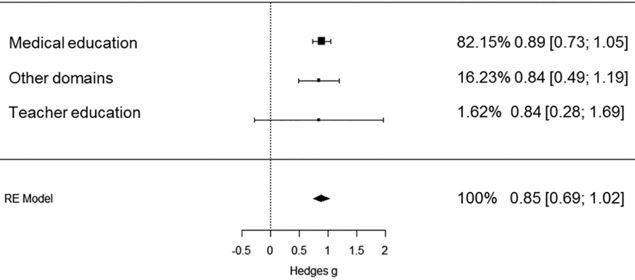
Simulation-based learning offers a wide range of opportunities to practice complex skills in higher education and to implement different types of scaffolding to facilitate effective learning. This meta-analysis includes 145 empirical studies and investigates the effectiveness of different scaffolding types and technology in simulation-based learning environments to facilitate complex skills. The simulations had a large positive overall effect: g = 0.85, SE = 0.08; CIs [0.69, 1.02]. Technology use and scaffolding had positive effects on learning. Learners with high prior knowledge benefited more from reflection phases; learners with low prior knowledge learned better when supported by examples. Findings were robust across different higher education domains (e.g., medical and teacher education, management). We conclude that (1) simulations are among the most effective means to facilitate learning of complex skills across domains and (2) different scaffolding types can facilitate simulation-based learning during different phases of the development of knowledge and skills.
Overview
CoChat Summary
TL;DR
This meta-analysis of 145 studies (10,532 participants) finds that simulation-based learning in higher education has a large positive overall effect on complex skills (g = 0.85, 95% CI [0.69, 1.02]). Effects vary by simulation features and prior knowledge, with examples/prompts helping lower-prior-knowledge learners and reflection phases helping higher-prior-knowledge learners.
Key findings
- Overall effect: g = 0.85, SE = 0.08, 95% CI [0.69, 1.02], N = 145 studies, 10,532 participants; heterogeneity was high: Q(409) = 4213.93, p < .0001, τ² = 1.2, I² = 95.86%.
- By complex skill: technical performance g = 1.06 (SE = 0.15), general problem solving g = 0.88 (SE = 0.11), diagnosing g = 0.82 (SE = 0.21), management g = 0.72 (SE = 0.30), teamwork g = 0.50 (SE = 0.08), communication g = 0.44 (SE = 0.15).
- Simulation features: live model g = 2.27 (N = 3), mixed g = 1.56, mannequin g = 0.96, virtual object g = 0.75, role play g = 0.63, document g = 0.31; technology: simulator g = 1.07, virtual reality g = 0.85, screen-based g = 0.68, no technology g = 0.74; high authenticity g = 0.86 vs low g = 0.58; duration: <1 hr g = 0.65, hours g = 0.81, days g = 0.80, >1 month g = 1.31 (N = 4).
- Scaffolding × prior knowledge: examples helped low-education learners (g = 1.15 vs high-education g = 0.56); prompts helped unfamiliar contexts (g = 0.85 vs no prompts g = 0.63) but not familiar contexts (g = 0.33 vs no prompts g = 0.96); reflection phases helped postgraduate learners (g = 1.10 vs no reflection g = 0.86) but not graduate/undergraduate learners (g = 0.52 vs no reflection g = 0.81).
Methods
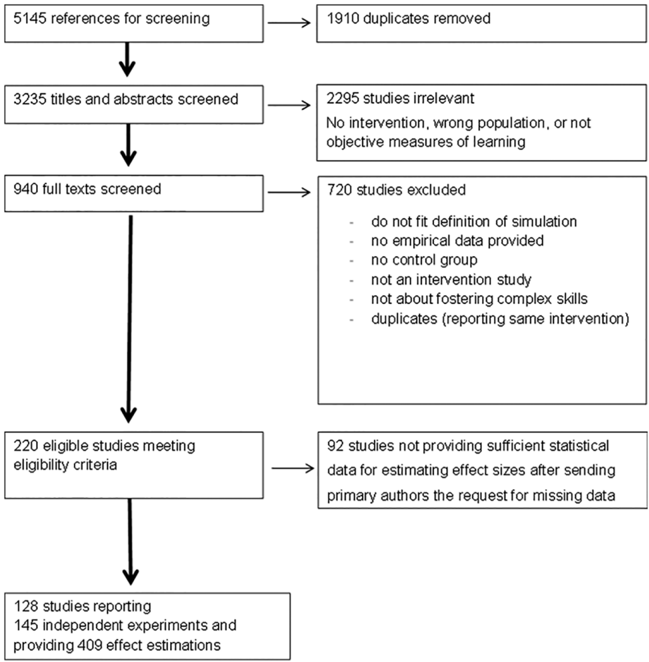
- Meta-analysis of 145 empirical studies (from 128 articles, 1979–2018) yielding 409 effect estimates and 10,532 participants; searched PsycINFO, PsycARTICLES, ERIC, and MEDLINE through April 2018; included experimental/quasi-experimental or within-subject pre-post studies with a control condition and objective measures of complex skills.
- Coded moderators included simulation type, technology use, duration, authenticity, scaffolding (examples, prompts, reflection phases), knowledge convey, prior knowledge (familiarity of context, level of education), complex skill type, domain, study design, and publication type.
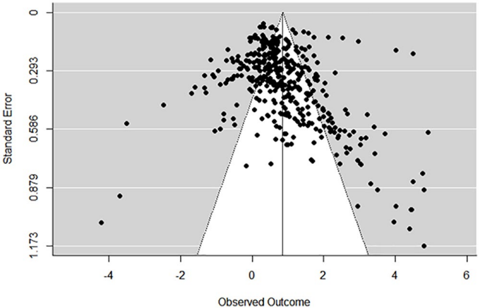
- Used Hedges’ g, random-effects models, robust variance estimation for correlated effects, pretest adjustment when available, heterogeneity Q/I², and publication-bias checks (Egger’s test, trim and fill); metaregression on control variables.
Limitations
- Stated: the focus is on complex skills involving interaction with people, so findings do not straightforwardly generalize to STEM domains such as science, mathematics, engineering, or informatics; a large proportion of findings come from medical education, so caution is needed for other domains, especially regarding technology, simulation type, outcome measures, and moderators.
- Stated: many primary studies gave little treatment description, insufficient for coding some moderators or finer distinctions; many implemented multiple instructional support measures, making specific effects hard to determine; the scaffolding framework may omit other supports such as feedback or fading/adding instruction; combinations could only be partially investigated; prior knowledge operationalization had drawbacks and explained only 4% of heterogeneity; implementation quality was assumed similar; large unexplained heterogeneity requires caution.
- Evident from the text: heterogeneity was very high (I² = 95.86%, τ² = 1.2), and several moderator estimates rest on very small numbers (e.g., live model N = 3, all scaffolding types N = 2, duration >1 month N = 4), so subgroup effects are unstable; presence/absence comparisons for examples, prompts, and reflections often did not reach significance.
Model-written summary. Check it against the paper before relying on it.
Integrity signals
Registry
Cites
Statistics
Figures

Verification
Claims the paper makes
1 Valid · 3 Not valid · 48 Not checked · 181 Own results and interpretations
At least one cited source doesn’t support this claim or points to a different paper, and none confirmed it — see the verdicts below.
In the paper
“However, they only focused on comparing simulations with a duration of more than 1 day with simulations of less than 1 day.”
§ Simulation-Based Learning in Higher Education: A Meta-Analysis > Simulations in Educational Contexts
What the sources say
- Disputedcites Cook et al., 2013 sourceExperimental — accuracy not yet measured
Our copy of Cook et al. (2013) contains no duration contrast whatsoever: searches for 'simulation duration more than one day versus less than one day' and related phrasings returned only the study-coding tables. Those tables (sections 'List of all included studies, sorted by year of publication, with validity evidence and QUADAS-2 ratings (N=417 except for QUADAS-2)', pp. 17, 21, 23, 27, 32-35, and the parallel full-citation list, pp. 4-14) show the review's actual focus: charting validity evidence (content/response/process, internal structure, relations to other variables, consequences, reliability), methodological quality (MERSQI, selection/flow indices, RoB indices, QUADAS-2) and reporting across 417 technology-enhanced simulation assessment studies spanning many topics and instruments. That is contrary to the claim that the review 'only focused on comparing simulations with a duration of more than 1 day with simulations of less than 1 day'. Our copy is truncated at the end, but the retrieved structure of the review already contradicts the characterization; no alternative source for the duration comparison is named in our copy. (LLM, conf=0.72)
Checked by a reasoning model — may be wrong.
plain- Asserted: passes — The authors put it forward as true.
- Checkable: passes — It can be checked against evidence.
- Load-bearing: passes — The paper’s conclusions depend on it.
- Based: passes — The paper gives a reason why it holds.
- Disputed
The cited sources that could be checked couldn’t confirm or dispute this claim.
In the paper
“In their meta-analysis, Cook et al. (2013) provided supportive evidence of the effectiveness of distributed and repetitive practice (effects above .60)in the acquisition of complex skills in medical education.”
§ Simulation-Based Learning in Higher Education: A Meta-Analysis > Simulations in Educational Contexts
What the sources say
- Could not verifycites Cook et al., 2013 sourceExperimental — accuracy not yet measured
Our copy of Cook et al. (2013) contains only the appendix material — the 'List of all included studies, sorted by year of publication, with full journal citation' (pp. 2-16) and the parallel table 'with validity evidence and QUADAS-2 ratings (N=417)' (pp. 20-35), which catalogue simulation-based ASSESSMENT validation studies with MERSQI scores, not pooled effects. Searches for 'distributed and repetitive practice', 'meta-analysis', 'effect size / Hedges g / random-effects', 'learning principles / repetition', and the paper's objective returned no narrative text at all, so nothing in our copy reports an effectiveness meta-analysis or effect magnitudes above .60. The copy is also flagged truncated, so the results/discussion where such a finding would appear may be missing; absence here is not evidence of a contrary statement, and no alternative source is named in the passages we hold. (LLM, conf=0.68)
plainstates a cause- Asserted: passes — The authors put it forward as true.
- Checkable: passes — It can be checked against evidence.
- Load-bearing: unclear — It is unclear whether the paper’s conclusions depend on it.
- Based: passes — The paper gives a reason why it holds.
- Could not verify
The cited sources support only part of this claim — read each source’s verdict below.
In the paper
“All these scaffolding measures were found to be beneficial for developing diagnostic competences (Chernikova et al., 2019).”
§ Simulation-Based Learning in Higher Education: A Meta-Analysis > Added Value of Instructional Support
What the sources say
- Partly supportedcites Chernikova et al., 2019 sourceExperimental — accuracy not yet measured
The meta-analysis does state broadly that all scaffolding types help ('as long as learners are able to practice problem-solving, all of the different types of scaffolding are beneficial', Theoretical Significance; echoed in Summary and Conclusion: roles, prompts and reflection phases 'have clear positive effects', with 'no indication for different effect sizes of different types of scaffolding'). But the claim drops the source's binding condition — the benefit holds only where learners' own problem-solving is preserved — and the source's results are not uniformly significant: in Effect of Scaffolding, settings with vs. without examples 'did not reach statistical significance' (Q(1,35)=2.85, p=.06), and Limitations warns that 'conclusions about the effectiveness of each scaffolding type should be made with caution'. So the flat 'all these scaffolding measures were found to be beneficial' overstates an explicitly conditional and hedged finding. (LLM, conf=0.72)
plainstates a cause- Asserted: passes — The authors put it forward as true.
- Checkable: passes — It can be checked against evidence.
- Load-bearing: passes — The paper’s conclusions depend on it.
- Based: passes — The paper gives a reason why it holds.
- Partly supported
A result the paper reports from its own data — it cites no other source for it, so there is none to check. The quote shows it is in the paper.
In the paper
“The 145 eligible studies (from 128 articles published in the period 1979-2018) provided 409 effect estimations (Figure 1).”
§ Simulation-Based Learning in Higher Education: A Meta-Analysis > Results of Literature Search
plainn = 10,532- Asserted: passes — The authors put it forward as true.
- Checkable: passes — It can be checked against evidence.
- Load-bearing: passes — The paper’s conclusions depend on it.
- Based: passes — The paper gives a reason why it holds.
A result the paper reports from its own data — it cites no other source for it, so there is none to check. The quote shows it is in the paper.
In the paper
“The most frequent combinations of instructional support measures were knowledge convey together with examples (82 effects), knowledge convey with reflection phases (62 effects), and examples with reflection phases (43 effects).”
§ Simulation-Based Learning in Higher Education: A Meta-Analysis > Results of Literature Search
plain- Asserted: passes — The authors put it forward as true.
- Checkable: passes — It can be checked against evidence.
- Load-bearing: unclear — It is unclear whether the paper’s conclusions depend on it.
- Based: passes — The paper gives a reason why it holds.
120 more claims
Create a free account to see all 233 claims and to verify the 43 references still open.
- It may state two separate claims as one. 61
- Probably not a substantial claim. 61
Claims other papers make about this one
Each is checked against this paper’s own text: does it say what the citing paper says it does?
In the citing paper
“Chernikova and colleagues have demonstrated in a meta-analysis that simulations of professional situations, such as interactions in a classroom for teachers, can be a beneficial tool during teacher training as they expose teachers to authentic problems in their fields51.”
From On opportunities and challenges of large multimodal foundation models in education (2025) · cites this paper as [51]
In the citing paper
“Meta-analytic findings indicate that simulations are among the most effective means to facilitate the learning of complex skills across domains, with technology-based and scaffolded simulations showing robust positive effects on learning outcomes [11].”
In the citing paper
“While several earlier reviews have examined the general benefits of simulation in nursing education [17], few have focused specifically on its role in bridging the theory–practice gap.”
From The impact of clinical simulation on bridging the theory–practice gap in nursing education: a systematic review (2025) · cites this paper as [17]
In the citing paper
“High-fidelity simulations were particularly associated with enhanced clinical judgment and decision-making accuracy [17, 29, 30].”
From The impact of clinical simulation on bridging the theory–practice gap in nursing education: a systematic review (2025) · cites this paper as [17]
In the citing paper
“These findings are supported by meta-analytic evidence from Chernikova et al., who concluded that simulation-based learning substantially improves decision-making and problem-solving skills in higher education, especially when paired with active learning strategies and structured debriefing [17].”
From The impact of clinical simulation on bridging the theory–practice gap in nursing education: a systematic review (2025) · cites this paper as [17]
Statistics recomputed
Every reported test result, recomputed from its test statistic and degrees of freedom. A result shows as not adding up only once an independent check has confirmed it.
- ConsistentQ(409) = 4213.93reported p < .0001 · recomputed p < .001
“Q (409) = 4213.93,p < .0001”
Self-check
Percentages, sums and reported differences re-computed from the paper’s own numbers.
Each contradiction between two passages listed here was confirmed by an independent check.
Rated major: it would touch a result — a value a result rests on, reported and recomputed p-values on opposite sides of the significance level, two passages that conflict with no sign which is right, or a cited work retracted before this paper was published.
In the paper
§ Simulation-Based Learning in Higher Education: A Meta-Analysis > Discussion
“However, the effects are greater if learners are unfamiliar with the context and the task.”
§ Simulation-Based Learning in Higher Education: A Meta-Analysis > Prior Professional Knowledge
“learners showed a lower increase of complex skills in an unfamiliar context (g = 0.67, SE = 0.10) than in a familiar context (g = 0.83, SE = 0.13)”
Rated minor: it would not touch a result — a value no result rests on, a p-value that stays on the same side of the significance level, or a conflict that is clerical, resolved elsewhere in the paper, or outside its own findings.
In the paper
§ Simulation-Based Learning in Higher Education: A Meta-Analysis > Results of Literature Search
“Most studies focused on general problem solving (51) or the technical performance of a particular complex procedure (56); the other outcomes were communication skills (24), diagnosing (18), managing critical situations (18), and collaboration and teamwork (5).”
§ Simulation-Based Learning in Higher Education: A Meta-Analysis > Conclusion
“2,493 (27) 0.46 91.03% | 911 (18) 0.76 92.02% | 6,010 (58) 0.47 91.23% | 2,543 (21) 1.04 97.15% | 810 (5) 0.03 66.07% | 2,933 (63) 1.25 91.10%”
Rated minor: it would not touch a result — a value no result rests on, a p-value that stays on the same side of the significance level, or a conflict that is clerical, resolved elsewhere in the paper, or outside its own findings.
In the paper
“(2) prompts as the only scaffolding method (N = 11)”
§ Simulation-Based Learning in Higher Education: A Meta-Analysis > Level of Education as an Indicator of Prior Knowledge and Experience
Reported 11 · recomputed 12
Rated minor: it would not touch a result — a value no result rests on, a p-value that stays on the same side of the significance level, or a conflict that is clerical, resolved elsewhere in the paper, or outside its own findings.
In the paper
§ Simulation-Based Learning in Higher Education: A Meta-Analysis > Discussion
“Despite these differences, simulations had effects that can be categorized as large positive effects for all but one type of skill.The exception is teamwork, where the meta-analysis found a medium positive effect only.”
§ Simulation-Based Learning in Higher Education: A Meta-Analysis > Overall Effect of Simulation-Based Learning on Complex Skills (Research Question 1)
“Communication and collaboration skills (teamwork) are only moderately facilitated by simulation-based learning (g = 0.44, SE = 0.15, and g = 0.50, SE = 0.08, respectively)”
Rated minor: it would not touch a result — a value no result rests on, a p-value that stays on the same side of the significance level, or a conflict that is clerical, resolved elsewhere in the paper, or outside its own findings.
In the paper
§ Simulation-Based Learning in Higher Education: A Meta-Analysis > Level of Education as an Indicator of Prior Knowledge and Experience
“however, introducing prompts was related to higher learning outcomes in the high-level group.”
§ Simulation-Based Learning in Higher Education: A Meta-Analysis > Level of Education as an Indicator of Prior Knowledge and Experience
“Similarly, introducing prompts for a high (postgraduate learners and practitioners) level (g = 0.50, SE = 0.36) was not beneficial for learning compared with simulations without prompts (g = 0.91, SE = 0.11).”
Citations
Cites
Measuring inconsistency in meta-analyses
Higgins, J. P. T., Thompson, S. G., Deeks, J. J., & Altman, D. G. (2003) · BMJ · doi:10.1136/bmj.327.7414.557 · Cited by 63,139 · cited 1×
“The thresholds suggested by Higgins et al. (2003) were used to interpret the I 2 (25% for low heterogeneity, 50% for medium, 75% for high heterogeneity).”
MethodBorenstein, M., Hedges, L. V., Higgins, J. P. T., & Rothstein, H. R. (2009) · doi:10.1002/9780470743386 · Cited by 14,225
Hattie, J., & Timperley, H. (2007) · Review of Educational Research · doi:10.3102/003465430298487 · Cited by 12,905
THE ROLE OF TUTORING IN PROBLEM SOLVING *
Wood, D., Bruner, J. S., & Ross, G. (1976) · Journal of Child Psychology and Psychiatry · doi:10.1111/j.1469-7610.1976.tb00381.x · Cited by 8,851 · cited 1×
“Scaffolding enables a learner to solve problems through modifying tasks and reducing possible pathways, and through hints helping the learner to coordinate the steps in problem solving or interaction (Quintana et al., 2004), by taking over some elements of learning material (Wood et al., 1976).”
BackgroundKirschner, P. A., Sweller, J., & Clark, R. E. (2006) · Educational Psychologist · doi:10.1207/s15326985ep4102_1 · Cited by 7,776 · cited 2×
“…suggesting that including simulations in a later phase of a higher education program after students already know theoretical concepts is promising in order to not overwhelm learners and block too much of their cognitive capacity for solving a problem in a simulation (e.g., Kirschner et al., 2006).”
BackgroundFunnel plots for detecting bias in meta-analysis
Sterne, J. A. C., & Egger, M. (2001) · Journal of Clinical Epidemiology · doi:10.1016/s0895-4356(01)00377-8 · Cited by 3,779 · cited 1×
“We have a relatively small sample of empirical studies and apply a range of techniques to identify possible biases (Egger’s test, trim and fill) and improve the generalizability of the results (Sterne & Egger, 2001).”
MethodEducational Psychology: A Cognitive View
Gagné, R. M., Ausubel, D. P., & Gagné, R. M. (1969) · American Educational Research Journal · doi:10.3102/00028312006002287 · Cited by 3,302
Educational Psychology: A Cognitive View
Gagné, R. M., Ausubel, D. P., & Gagne, R. M. (1969) · American Educational Research Journal · doi:10.2307/1161899 · Cited by 3,278
HMELO-SILVER, C. E., DUNCAN, R. G., & CHINN, C. A. (2007) · Educational Psychologist · doi:10.1080/00461520701263368 · Cited by 2,641 · cited 1×
“…problems, especially in early stages of expertise development, should be accompanied by scaffolding to maximize learning and avoid cognitive overload, distraction, or focusing on superficial features of a situation (see the discussions of Hmelo-Silver et al., 2007; Kirschner et al., 2006).”
BackgroundReflection and reflective practice in health professions education: a systematic review
Mann, K., Gordon, J., & MacLeod, A. (2009) · Advances in Health Sciences Education · doi:10.1007/s10459-007-9090-2 · Cited by 2,175 · cited 1×
“Reflection phases, on the other hand, allow learners to think about goals, analyze their own performance, and plan further steps (e.g., Mann et al., 2009), but they do not provide much guidance during the problem solving.”
BackgroundKalyuga, S., Ayres, P., Chandler, P., & Sweller, J. (2003) · Educational Psychologist · doi:10.1207/s15326985ep3801_4 · Cited by 1,927
Scaffolding in Teacher–Student Interaction: A Decade of Research
van de Pol, J., Volman, M., & Beishuizen, J. (2010) · Educational Psychology Review · doi:10.1007/s10648-010-9127-6 · Cited by 1,873 · cited 1×
“Scaffolding can be presented during or after the learning situation, be present all the time, or be added or faded gradually (e.g., Belland et al., 2017; Van de Pol et al., 2010).”
BackgroundEffects of problem-based learning: a meta-analysis
Dochy, F., Segers, M., Van den Bossche, P., & Gijbels, D. (2003) · Learning and Instruction · doi:10.1016/s0959-4752(02)00025-7 · Cited by 1,713 · cited 2×
“Quite strong empirical evidence supports learning through problem solving in postsecondary education in general (Belland et al., 2017; Dochy et al., 2003).”
BackgroundResultTeaching Practice: A Cross-Professional Perspective
Grossman, P., Compton, C., Igra, D., Ronfeldt, M., Shahan, E., & Williamson, P. W. (2009) · Teachers College Record: The Voice of Scholarship in Education · doi:10.1177/016146810911100905 · Cited by 1,508 · cited 4×
“According to Grossman et al. (2009), simulation can be viewed as a simplified version of practice and be used to engage novices in practices that are more or less proximal to the practices of a profession.”
BackgroundInfluentialAn introduction to case-based reasoning
Kolodner, J. L. (1992) · Artificial Intelligence Review · doi:10.1007/bf00155578 · Cited by 1,040
Tamim, R. M., Bernard, R. M., Borokhovski, E., Abrami, P. C., & Schmid, R. F. (2011) · Review of Educational Research · doi:10.3102/0034654310393361 · Cited by 1,029 · cited 2×
“Empirical research on the effects of technology use on learning (comparing the use of computers in the classroom with no technology) provides some supportive evidence of small to moderate positive effects of technology use on learning and achievement (Hattie, 2003; Tamim et al., 2011).”
BackgroundA Scaffolding Design Framework for Software to Support Science Inquiry
Quintana, C., Reiser, B. J., Davis, E. A., Krajcik, J., Fretz, E., Duncan, R. G., Kyza, E., Edelson, D., & Soloway, E. (2004) · Journal of the Learning Sciences · doi:10.1207/s15327809jls1303_4 · Cited by 1,015 · cited 2×
“Scaffolding enables a learner to solve problems through modifying tasks and reducing possible pathways, and through hints helping the learner to coordinate the steps in problem solving or interaction (Quintana et al., 2004), by taking over some elements of learning material (Wood et al., 1976).”
BackgroundThinking, Problem Solving, Cognition
D., C. P., & Mayer, R. E. (1984) · The American Journal of Psychology · doi:10.2307/1422612 · Cited by 992 · cited 1×
“According to Mayer (1992), problem solving in a broader sense is cognitive processing aimed at achieving a goal when no solution path or method is obvious.”
BackgroundAhlberg, G., Enochsson, L., Gallagher, A. G., Hedman, L., Hogman, C., McClusky, D. A., Ramel, S., Smith, C. D., & Arvidsson, D. (2007) · The American Journal of Surgery · doi:10.1016/j.amjsurg.2006.06.050 · Cited by 693 · cited 1×
“One more type that requires complex technology is virtual reality, which is likely to facilitate immersion (e.g., Ahlberg et al., 2007).”
BackgroundReconsidering Fidelity in Simulation-Based Training
Hamstra, S. J., Brydges, R., Hatala, R., Zendejas, B., & Cook, D. A. (2014) · Academic Medicine · doi:10.1097/acm.0000000000000130 · Cited by 624 · cited 3×
“In line with recommendations given by this group of authors (Hamstra et al., 2014), we focus on functional correspondence between a simulated scenario or the simulator itself and the context of real situations.”
BackgroundHow expertise develops in medicine: knowledge encapsulation and illness script formation
Schmidt, H. G., & Rikers, R. M. J. P. (2007) · Medical Education · doi:10.1111/j.1365-2923.2007.02915.x · Cited by 619 · cited 1×
“Other considerations suggest including simulations at a very early point because this supports the process of restructuring knowledge into higher order concepts that can be used directly to solve problems (e.g., Boshuizen & Schmidt, 2008; Schmidt & Boshuizen, 1993; Schmidt & Rikers, 2007).”
BackgroundClinical reasoning in the health professions
Oehme, F. W. (1996) · Toxicology Letters · doi:10.1016/s0378-4274(96)90055-7 · Cited by 615
Help Seeking and Help Design in Interactive Learning Environments
Aleven, V., Stahl, E., Schworm, S., Fischer, F., & Wallace, R. (2003) · Review of Educational Research · doi:10.3102/00346543073003277 · Cited by 609 · cited 1×
“A more fine-grained analysis in the primary studies would be needed to test hypotheses stating that learners prefer trying without help instead of using assistance (see Aleven et al., 2003) also for the context of simulations in higher education.”
BackgroundSelf-citationCorrecting for Bias in Psychology: A Comparison of Meta-Analytic Methods
Carter, E. C., Schönbrodt, F. D., Gervais, W. M., & Hilgard, J. (2019) · Advances in Methods and Practices in Psychological Science · doi:10.1177/2515245919847196 · Cited by 588 · cited 2×
“We expect high effects of simulation-based learning (i.e., Cook, 2014) and do not expect high publication bias; however, we expect high heterogeneity of the effects, which according to Carter et al. (2017) can hinder some types of analysis (e.g., p-curve analysis).”
BackgroundMethodVanLehn, K. (1996) · Annual Review of Psychology · doi:10.1146/annurev.psych.47.1.513 · Cited by 515
Alinier, G., Hunt, B., Gordon, R., & Harwood, C. (2006) · Journal of Advanced Nursing · doi:10.1111/j.1365-2648.2006.03810.x · Cited by 515 · cited 1×
“…reflection phases in the medical context introduced in the primary studies usually involved reflecting on positive and negative aspects or strategies used in the demonstration, in the own performance or a peer’s performance (e.g., Alinier et al., 2006; Cuisinier et al., 2015; Douglas et al., 2016).”
Toward an Instructionally Oriented Theory of Example‐Based Learning
Renkl, A. (2014) · Cognitive Science · doi:10.1111/cogs.12086 · Cited by 509 · cited 1×
“In this framework, examples provide solutions or model target behavior (e.g., Renkl, 2014) and can be positioned at a high level of instructional guidance and therefore less self-regulation.”
BackgroundThe use of simulation for training teamwork skills in health care: how low can you go?
Beaubien, J. M. (2004) · Quality and Safety in Health Care · doi:10.1136/qshc.2004.009845 · Cited by 432 · cited 1×
“Beaubien and Baker (2004) define a simulation as a tool that reproduces the real-life characteristics of an event or situation.”
BackgroundHandling Complex Meta-analytic Data Structures Using Robust Variance Estimates: a Tutorial in R
Tanner-Smith, E. E., Tipton, E., & Polanin, J. R. (2016) · Journal of Developmental and Life-Course Criminology · doi:10.1007/s40865-016-0026-5 · Cited by 390 · cited 1×
“Second, as multiple studies reported multiple outcomes and used several treatment and/or control conditions, the correlated effect sizes were handled by using robust variance estimation correction coefficients, as suggested by Tanner-Smith et al. (2016).”
BackgroundSCHMIDT, H. G., LOYENS, S. M. M., VAN GOG, T., & PAAS, F. (2007) · Educational Psychologist · doi:10.1080/00461520701263350 · Cited by 382 · cited 1×
“Nonetheless, it seems rather obvious that learners with less theoretical prior knowledge may need more instructional guidance than more advanced learners in order to still possess enough cognitive resources for learning (e.g., Schmidt et al., 2007).”
BackgroundOn acquiring expertise in medicine
Schmidt, H. G., & Boshuizen, H. P. A. (1993) · Educational Psychology Review · doi:10.1007/bf01323044 · Cited by 381 · cited 1×
“Other considerations suggest including simulations at a very early point because this supports the process of restructuring knowledge into higher order concepts that can be used directly to solve problems (e.g., Boshuizen & Schmidt, 2008; Schmidt & Boshuizen, 1993; Schmidt & Rikers, 2007).”
BackgroundSynthesizing Results From Empirical Research on Computer-Based Scaffolding in STEM Education
Belland, B. R., Walker, A. E., Kim, N. J., & Lefler, M. (2017) · Review of Educational Research · doi:10.3102/0034654316670999 · Cited by 346 · cited 5×
“Belland et al. (2017) found moderate to large effects of scaffolding in computer-based learning environments.”
BackgroundResultInfluentialTraining wheels in a user interface
Carroll, J. M., & Carrithers, C. (1984) · Communications of the ACM · doi:10.1145/358198.358218 · Cited by 345 · cited 1×
“This may be seen as trivial, as the training wheel effects of scaffolding had been established a long time ago (Carroll & Carrithers, 1984).”
BackgroundPredictors of well‐structured and ill‐structured problem solving in an astronomy simulation
Shin, N., Jonassen, D. H., & McGee, S. (2003) · Journal of Research in Science Teaching · doi:10.1002/tea.10058 · Cited by 341 · cited 3×
“Shin et al. (2003) emphasize the differences between well-and ill-structured problems.”
BackgroundInfluentialA co-evolutionary model for supporting the emergence of authenticity
Barab, S. A., Squire, K. D., & Dueber, W. (2000) · Educational Technology Research and Development · doi:10.1007/bf02313400 · Cited by 300
Cook, D. A., Brydges, R., Zendejas, B., Hamstra, S. J., & Hatala, R. (2013) · Academic Medicine · doi:10.1097/acm.0b013e31828ffdcf · Cited by 267 · cited 5×
“A more specific definition suggested by Cook et al. (2013) stated that simulation is an “educational tool or device with which the learner physically interacts to mimic real life” and in which they emphasize “the necessity of inter-acting with authentic objects” (p. 876).”
BackgroundInfluentialDubovi, I., Levy, S. T., & Dagan, E. (2017) · Computers & Education · doi:10.1016/j.compedu.2017.05.009 · Cited by 213
Simulation-based training for nurses: Systematic review and meta-analysis
Hegland, P. A., Aarlie, H., Strømme, H., & Jamtvedt, G. (2017) · Nurse Education Today · doi:10.1016/j.nedt.2017.04.004 · Cited by 203 · cited 2×
“A lot of research has been done in the field of medical education (Cook, 2014; Cook et al., 2013; Hegland et al., 2017), where simulations are used to advance diagnostic competences and motor and technical skills of prospective doctors, nurses, and emergency teams.”
BackgroundSimulations for STEM learning: Systematic review and meta-analysis
D’Angelo, C. M., Rutstein, D. W., Harris, C. R., Bernard, R. M., Borokhovski, E., & Haertel, G. D. (2014) · Cited by 194
How much evidence does it take? A cumulative meta‐analysis of outcomes of simulation‐based education
Cook, D. A. (2014) · Medical Education · doi:10.1111/medu.12473 · Cited by 182 · cited 7×
“The potential of simulations for learning has been known for a while in medical education (e.g., Cook, 2014) but is now increasingly transferred (and sometimes reinvented) to other domains of higher education (see Heitzmann et al., 2019).”
BackgroundInfluentialCannon, W. D., Garrett, W. E., Hunter, R. E., Sweeney, H. J., Eckhoff, D. G., Nicandri, G. T., Hutchinson, M. R., Johnson, D. D., Bisson, L. J., Bedi, A., et al. (2014) · The Journal of Bone and Joint Surgery-American Volume · doi:10.2106/jbjs.n.00058 · Cited by 180
Keleekai, N. L., Schuster, C. A., Murray, C. L., King, M. A., Stahl, B. R., Labrozzi, L. J., Gallucci, S., LeClair, M. W., & Glover, K. R. (2016) · Simulation in Healthcare: The Journal of the Society for Simulation in Healthcare · doi:10.1097/sih.0000000000000186 · Cited by 162
Vicarious learning during simulations: is it more effective than hands‐on training?
Stegmann, K., Pilz, F., Siebeck, M., & Fischer, F. (2012) · Medical Education · doi:10.1111/j.1365-2923.2012.04344.x · Cited by 151
Self-citationDankbaar, M. E. W., Alsma, J., Jansen, E. E. H., van Merrienboer, J. J. G., van Saase, J. L. C. M., & Schuit, S. C. E. (2016) · Advances in Health Sciences Education · doi:10.1007/s10459-015-9641-x · Cited by 147 · cited 1×
“…the simulation environment, which suggested actions or allowed to revisit the conceptual level during the exploration of the simulation (e.g., Dankbaar et al., 2016; Kumar & Sherwood, 2007); another form of prompting are questions that may lead the learner to further actions (Alfred & Chung,…”
BackgroundLiaw, S. Y., Chan, S. W.-C., Chen, F.-G., Hooi, S. C., & Siau, C. (2014) · Journal of Medical Internet Research · doi:10.2196/jmir.3322 · Cited by 147
Directed self‐regulated learning versus instructor‐regulated learning in simulation training
Brydges, R., Nair, P., Ma, I., Shanks, D., & Hatala, R. (2012) · Medical Education · doi:10.1111/j.1365-2923.2012.04268.x · Cited by 139
Clayton, J. M., Butow, P. N., Waters, A., Laidsaar-Powell, R. C., O’Brien, A., Boyle, F., Back, A. L., Arnold, R. M., Tulsky, J. A., & Tattersall, M. H. (2013) · Palliative Medicine · doi:10.1177/0269216312449683 · Cited by 138
The Educational Intervention "GRIEV_ING" Improves the Death Notification Skills of Residents
Hobgood, C., Harward, D. H., Newton, K., & Davis, W. (2005) · Academic Emergency Medicine · doi:10.1197/j.aem.2004.12.008 · Cited by 135
Heitzmann, N., Seidel, T., Hetmanek, A., Wecker, C., Fischer, M. R., Ufer, S., Schmidmaier, R., Neuhaus, B., Siebeck, M., Stürmer, K., et al. (2019) · Frontline Learning Research · doi:10.14786/flr.v7i4.384 · Cited by 134
Self-citationImproving operative performance using a laparoscopic hernia simulator
Hamilton, E. C., Scott, D. J., Kapoor, A., Nwariaku, F. E., Bergen, P. C., Rege, R. V., Tesfay, S. T., & Jones, D. B. (2001) · The American Journal of Surgery · doi:10.1016/s0002-9610(01)00800-5 · Cited by 133
Sørensen, J. L., van der Vleuten, C. P. M., Rosthøj, S., Østergaard, D., LeBlanc, V. R., Johansen, M., Ekelund, K., Starkopf, L., Lindschou, J., Gluud, C. N., et al. (2015) · BMJ Open · doi:10.1136/bmjopen-2015-008344 · Cited by 133
Digital simulation‐based training: A meta‐analysis
Gegenfurtner, A., Quesada‐Pallarès, C., & Knogler, M. (2014) · British Journal of Educational Technology · doi:10.1111/bjet.12188 · Cited by 126 · cited 1×
“In meta-analyses, scaffolding has been shown to have medium effects on various learning outcomes (e.g., Gegenfurtner et al., 2014).”
BackgroundDFG Research group COSIMA, Chernikova, O., Heitzmann, N., Fink, M. C., Timothy, V., Seidel, T., & Fischer, F. (2020) · Educational Psychology Review · doi:10.1007/s10648-019-09492-2 · Cited by 124 · cited 12×
“The meta-analysis by Chernikova et al. (2019) reported positive effects of different scaffolding types (e.g., role taking, prompts, reflection phases) on the development of diagnostic competences in medical and teacher education.”
BackgroundMethodResultInfluentialSelf-citationGrover, S. C., Garg, A., Scaffidi, M. A., Yu, J. J., Plener, I. S., Yong, E., Cino, M., Grantcharov, T., & Walsh, C. M. (2015) · Gastrointestinal Endoscopy · doi:10.1016/j.gie.2015.04.008 · Cited by 111
Liaw, S. Y., Wong, L. F., Chan, S. W.-C., Ho, J. T. Y., Mordiffi, S. Z., Ang, S. B. L., Goh, P. S., & Ang, E. N. K. (2015) · Journal of Medical Internet Research · doi:10.2196/jmir.3853 · Cited by 92
VIRTUAL URETEROSCOPY PREDICTS URETEROSCOPIC PROFICIENCY OF MEDICAL STUDENTS ON A CADAVER
Ogan, K., Jacomides, L., Shulman, M. J., Roehrborn, C. G., Cadeddu, J. A., & Pearle, M. S. (2004) · The Journal of Urology · doi:10.1097/01.ju.0000131631.60022.d9 · Cited by 92
Liaw, S. Y., Rethans, J., Scherpbier, A. J. J. A., & Klainin‐Yobas, P. (2011) · Resuscitation · doi:10.1016/j.resuscitation.2011.04.014 · Cited by 91
Does simulation booster impact retention of resuscitation procedural skills and teamwork?
Bender, J., Kennally, K., Shields, R., & Overly, F. L. (2014) · Journal of Perinatology · doi:10.1038/jp.2014.72 · Cited by 89
Wenk, M., Waurick, R., Schotes, D., Wenk, M., Gerdes, C., Van Aken, H. K., & Pöpping, D. M. (2009) · Advances in Health Sciences Education · doi:10.1007/s10459-008-9098-2 · Cited by 88
Burton, K. S., Pendergrass, T. L., Byczkowski, T. L., Taylor, R. G., Moyer, M. R., Falcone, R. A., & Geis, G. L. (2011) · Simulation in Healthcare The Journal of the Society for Simulation in Healthcare · doi:10.1097/sih.0b013e31821dfcea · Cited by 83
Chen, R., Grierson, L., & Norman, G. R. (2015) · Medical Education · doi:10.1111/medu.12653 · Cited by 82 · cited 1×
“The examples across all domains were usually represented by live or recorded demonstrations of how to deal with the simulated environment, particular tool, or situation (e.g., Chen et al., 2015; Damle et al., 2015; Overbaugh, 1995).”
BackgroundFleming, M., Olsen, D., Stathes, H., Boteler, L., Grossberg, P., Pfeifer, J., Schiro, S., Banning, J., & Skochelak, S. (2009) · The Journal of the American Board of Family Medicine · doi:10.3122/jabfm.2009.04.080208 · Cited by 82
Nelissen, E., Ersdal, H., Mduma, E., Evjen-Olsen, B., Broerse, J., van Roosmalen, J., & Stekelenburg, J. (2015) · BMC Pregnancy and Childbirth · doi:10.1186/s12884-015-0612-2 · Cited by 78
Evans, K. H., Daines, W., Tsui, J., Strehlow, M. C., Maggio, P. M., & Shieh, L. Y. (2014) · Academic Medicine · doi:10.1097/acm.0000000000000611 · Cited by 78
Does a surgical simulator improve resident operative performance of laparoscopic tubal ligation?
Banks, E. H., Chudnoff, S., Karmin, I., Wang, C., & Pardanani, S. (2007) · American Journal of Obstetrics and Gynecology · doi:10.1016/j.ajog.2007.07.028 · Cited by 76 · cited 1×
“The biggest effect sizes were obtained for tasks related to technical performance that mainly come from medicine (Araújo et al., 2014; Banks et al., 2007), followed by problem-solving and -diagnosing skills.”
BackgroundMaertens, H., Aggarwal, R. K., Moreels, N., Vermassen, F. E. G., & HERZEELE, I. V. (2017) · European Journal of Vascular and Endovascular Surgery · doi:10.1016/j.ejvs.2017.06.011 · Cited by 73
Foster, A. E., Chaudhary, N., Murphy, J. P., Lok, B. C. L., Waller, J. L., & Buckley, P. F. (2014) · Academic Psychiatry · doi:10.1007/s40596-014-0185-9 · Cited by 72
Benefits of computer screen‐based simulation in learning cardiac arrest procedures
Bonnetain, E., Boucheix, J., Hamet, M., & Freysz, M. (2010) · Medical Education · doi:10.1111/j.1365-2923.2010.03708.x · Cited by 72
Are Live Ultrasound Models Replaceable? Traditional vs. Simulated Education Module for FAST Exam
Bentley, S., Mudan, G., Strother, C. G., & Wong, N. L. (2015) · Western Journal of Emergency Medicine · doi:10.5811/westjem.2015.9.27276 · Cited by 72
Lavelle, M., Attoe, C., Tritschler, C., & Cross, S. (2017) · Nurse Education Today · doi:10.1016/j.nedt.2017.09.009 · Cited by 71
Fisher, N., Eisen, L. A., Bayya, J., Dulu, A. O., Bernstein, P. S., Merkatz, I. R., & Goffman, D. (2011) · American Journal of Obstetrics and Gynecology · doi:10.1016/j.ajog.2011.06.012 · Cited by 68
Brunckhorst, O., Shahid, S., Aydın, A., McIlhenny, C., Khan, S., Raza, S. J., Sahai, A., Brewin, J., Bello, F., Kneebone, R. L., et al. (2014) · Surgical Endoscopy · doi:10.1007/s00464-014-3996-6 · Cited by 65
Ahn, H., & Kim, H.-Y. (2015) · Nurse Education Today · doi:10.1016/j.nedt.2015.01.021 · Cited by 64
Traditions to Transformations: The Forced Evolution of Higher Education
Rogers, P. L. (2001) · AACE journal · Cited by 62
Technology-enhanced stem (science, technology, engineering, and mathematics) education
Wu, Y., & Anderson, O. R. (2015) · Journal of Computers in Education · doi:10.1007/s40692-015-0041-2 · Cited by 62 · cited 1×
“In STEM (science, technology, engineering, and mathematics) education (e.g., D’Angelo et al., 2014; Wu & Anderson, 2015), they are used to facilitate a deeper understanding of concepts and relationships between them, advance inquiry, problem solving, and decision making.”
BackgroundE-Learning with virtual teammates: A novel approach to interprofessional education
Djukic, M., Adams, J., Fulmer, T. T., Szyld, D., Lee, S., Oh, S.-Y., & Triola, M. M. (2015) · Journal of Interprofessional Care · doi:10.3109/13561820.2015.1030068 · Cited by 61
DURMAZ, A., DICLE, A., CAKAN, E., & CAKIR, Ş. (2012) · CIN: Computers, Informatics, Nursing · doi:10.1097/ncn.0b013e3182419134 · Cited by 60
Exploring the Efficacy of the Cook School District Simulation
Girod, M., & Girod, G. R. (2006) · Journal of Teacher Education · doi:10.1177/0022487106293742 · Cited by 60 · cited 1×
“…& Newell, 2018), or (2) to fill in worksheets, reflecting on their actions in the simulated environment and the consequences of these actions (e.g., Girod & Girod, 2006) or to reflect on the case scenario and discuss the action plan with peers and supervisors (e.g., Broadbent & Neehan, 1971).”
BackgroundTeaching Palatoplasty Using a High-Fidelity Cleft Palate Simulator
Cheng, H., Podolsky, D. J., Fisher, D. M., Wong, K. W., Lorenz, H. P., Khosla, R. K., Drake, J. M., & Forrest, C. R. (2017) · Plastic & Reconstructive Surgery · doi:10.1097/prs.0000000000003957 · Cited by 60
Simulation-based training improves applied clinical placement of ultrasound-guided PICCs
Andreatta, P., Chen, Y., Marsh, M., & Cho, K. (2010) · Supportive Care in Cancer · doi:10.1007/s00520-010-0849-2 · Cited by 59
(2014) · doi:10.14786/flr.v2i2.96 · Cited by 58
Self-citationHeskin, L., Mansour, E. A., Lane, B., Kavanagh, D. O., Dicker, P., Ryan, D. M., Gildea-Byrne, K., Pawlikowska, T. R. B., Tierney, S., & Traynor, O. J. (2015) · The American Journal of Surgery · doi:10.1016/j.amjsurg.2014.12.046 · Cited by 56
The effects of e-simulation interview training on teachers’ use of open-ended questions
Brubacher, S. P., Powell, M. B., Skouteris, H., & Guadagno, B. L. (2015) · Child Abuse & Neglect · doi:10.1016/j.chiabu.2015.02.004 · Cited by 55 · cited 1×
“Simulation-based learning also occurs in other fields, such as teacher education, engineering, and management (e.g., Alfred & Chung, 2011; Brubacher et al., 2015).”
BackgroundChin, K. L., Yap, Y. L., Lee, W. L., & Soh, Y. C. (2014) · American Journal of Pharmaceutical Education · doi:10.5688/ajpe788153 · Cited by 55
Liao, W.-C., Leung, J., Wang, H.-P., Chang, W.-H., Chu, C.-H., Lin, J.-T., Wilson, R., Lim, B., & Leung, F. (2013) · Endoscopy · doi:10.1055/s-0033-1344224 · Cited by 54
Madan, A. K., Caruso, B., Lopes, J. E., & Gracely, E. J. (1998) · American Journal of Preventive Medicine · doi:10.1016/s0749-3797(98)00026-9 · Cited by 54
Using Simulation to Improve the Medication Administration Skills of Undergraduate Nursing Students
Harris, M., Pittiglio, L. I., Newton, S. E., & Moore, G. (2013) · Nursing Education Perspectives · doi:10.5480/11-552.1 · Cited by 54
Effects of modelling examples in complex procedural skills training: a randomised study
Bjerrum, A. S., Hilberg, O., van Gog, T., Charles, P., & Eika, B. (2013) · Medical Education · doi:10.1111/medu.12199 · Cited by 52 · cited 1×
“Screen-based simulations require computer-supported interfaces and some software, which allows the interaction (e.g., Biese et al., 2009).”
MethodKiersma, M. E., Darbishire, P. L., Plake, K. S. I., Oswald, C., & Walters, B. M. (2009) · American Journal of Pharmaceutical Education · doi:10.5688/aj730699 · Cited by 52
Pucher, P. H., Aggarwal, R., Qurashi, M., Singh, P., & Darzi, A. (2014) · British Journal of Surgery · doi:10.1002/bjs.9654 · Cited by 52
Using a formative simulated patient exercise for curriculum evaluation
Solomon, D. J., Laird-Fick, H., Keefe, C., Thompson, M., & Noel, M. (2004) · BMC Medical Education · doi:10.1186/1472-6920-4-8 · Cited by 51
Teaching Digital Rectal Examinations to Medical Students: An Evaluation Study of Teaching Methods
Popadiuk, C. M., Pottle, M., & Curran, V. R. (2002) · Academic Medicine · doi:10.1097/00001888-200211000-00017 · Cited by 50
Haak, R., Rosenbohm, J., Koerfer, A., Obliers, R., & Wicht, M. J. (2008) · European Journal Of Dental Education · doi:10.1111/j.1600-0579.2008.00521.x · Cited by 49
Bachmann, C., Barzel, A., Roschlaub, S., Ehrhardt, M., & Scherer, M. (2013) · Patient Education and Counseling · doi:10.1016/j.pec.2013.05.019 · Cited by 48
Ortner, C. M., Richebé, P., Bollag, L. A., ROSS, B. K., & Landau, R. (2014) · International Journal of Obstetric Anesthesia · doi:10.1016/j.ijoa.2014.04.008 · Cited by 47
Martin, K. D., Patterson, D. P., Phisitkul, P., Cameron, K. L., Femino, J. E., & Amendola, A. (2015) · Foot & Ankle International · doi:10.1177/1071100715576369 · Cited by 47
Blackwood, J., Duff, J. P., Nettel‐Aguirre, A., Djogovic, D., & Joynt, C. (2014) · Pediatric Critical Care Medicine · doi:10.1097/pcc.0000000000000100 · Cited by 46
Eyck, R. P. T., Tews, M. C., Ballester, J. M., & Hamilton, G. C. (2010) · Simulation in Healthcare The Journal of the Society for Simulation in Healthcare · doi:10.1097/sih.0b013e3181cca544 · Cited by 46
Fallucco, E. M., Conlon, M. K., Gale, G., Constantino, J. N., & Glowinski, A. L. (2012) · Journal of Adolescent Health · doi:10.1016/j.jadohealth.2011.12.026 · Cited by 44
Effectiveness of a Clinical Skills Workshop for drug-dosage calculation in a nursing program
Grugnetti, A. M., Bagnasco, A., Rosa, F., & Sasso, L. (2013) · Nurse Education Today · doi:10.1016/j.nedt.2013.05.021 · Cited by 44
Training With Virtual Patients in Transcultural Psychiatry: Do the Learners Actually Learn?
Pantziaras, I., Fors, U., & Ekblad, S. (2015) · Journal of Medical Internet Research · doi:10.2196/jmir.3497 · Cited by 43
Learning clinical communication skills: outcomes of a program for professional practitioners.
Carvalho, I., Pais, V., Almeida, S., Ribeiro-Silva, R., Figueiredo-Braga, M., Teles, A., Castro-Vale, I., & Mota-Cardoso, R. (2011) · Patient Education and Counseling · doi:10.1016/j.pec.2010.05.010 · Cited by 43
Sauter, T. C., Hautz, W. E., Hostettler, S., Maeder, M. B., Martinolli, L., Lehmann, B., Exadaktylos, A. K., & Haider, D. G. (2016) · Scandinavian Journal of Trauma Resuscitation and Emergency Medicine · doi:10.1186/s13049-016-0291-7 · Cited by 43
Chao, C., Chalouhi, G. E., Bouhanna, P., Ville, Y. G., & Dommergues, M. (2015) · Journal of Ultrasound in Medicine · doi:10.7863/ultra.15.14.09063 · Cited by 42
Aper, L., Reniers, J., Koole, S., Valcke, M., & Derese, A. (2012) · Medical Teacher · doi:10.3109/0142159x.2012.668627 · Cited by 42
Lehmann, R., Bosse, H. M., Simon, A., Nikendei, C., & Huwendiek, S. (2013) · BMC Medical Education · doi:10.1186/1472-6920-13-23 · Cited by 41 · cited 2×
“, 2016) or virtual reality (Lehmann et al., 2013)—might have greater effects on learning.”
BackgroundMethodReis, S. P., Sagi, D., Eisenberg, O., Kuchnir, Y., Azuri, J., Shalev, V., & Ziv, A. (2013) · Patient Education and Counseling · doi:10.1016/j.pec.2013.08.007 · Cited by 41
Should simulator-based endovascular training be integrated into general surgery residency programs?
Passman, M. A., Fleser, P. S., Dattilo, J. B., Guzman, R. J., & Naslund, T. C. (2007) · The American Journal of Surgery · doi:10.1016/j.amjsurg.2006.11.029 · Cited by 41
Ditton-Phare, P., Sandhu, H., Kelly, B. J., Kissane, D. W., & Loughland, C. M. (2016) · Academic Psychiatry · doi:10.1007/s40596-016-0560-9 · Cited by 39
Bongers, P. J., van Hove, P. D., Stassen, L. P. S., Dankelman, J., & Schreuder, H. W. R. (2014) · Journal of surgical education · doi:10.1016/j.jsurg.2014.09.004 · Cited by 38
Sperl-Hillen, J., O’Connor, P. J., Ekstrom, H. L., Rush, W. A., Asche, S. E., Fernandes, O. D., Appana, D., Amundson, G. H., Johnson, P. E., & Curran, D. M. (2014) · Academic Medicine · doi:10.1097/acm.0000000000000406 · Cited by 38
Kumar, D. D., & Sherwood, R. D. (2007) · Journal of Science Education and Technology · doi:10.1007/s10956-007-9049-3 · Cited by 38 · cited 1×
“…the simulation environment, which suggested actions or allowed to revisit the conceptual level during the exploration of the simulation (e.g., Dankbaar et al., 2016; Kumar & Sherwood, 2007); another form of prompting are questions that may lead the learner to further actions (Alfred & Chung, 2011).”
BackgroundYeh, M., & Chen, H.-H. (2004) · International Journal of Nursing Studies · doi:10.1016/j.ijnurstu.2004.06.008 · Cited by 38
Computer-Based Virtual Reality Colonoscopy Simulation Improves Patient-Based Colonoscopy Performance
McIntosh, K. S., Gregor, J. C., & Khanna, N. V. (2014) · Canadian Journal of Gastroenterology and Hepatology · doi:10.1155/2014/804367 · Cited by 37
Roter, D., Cole, K. A., Kern, D., Barker, L., & Grayson, M. (1990) · Journal of general internal medicine · doi:10.1007/bf02600404 · Cited by 36
Retention Curves for Pediatric and Neonatal Intubation Skills After Simulation-Based Training
Andreatta, P., Dooley‐Hash, S., Klotz, J. J., Hauptman, J. G., Biddinger, B., & House, J. B. (2016) · Pediatric Emergency Care · doi:10.1097/pec.0000000000000603 · Cited by 36
DTkid: Interactive Simulation Software for Training Tutors of Children with Autism
Randell, T., Hall, M. R., Bizo, L. A., & Remington, B. (2006) · Journal of Autism and Developmental Disorders · doi:10.1007/s10803-006-0193-z · Cited by 35
Khatib, M., Hald, N., Brenton, H., Barakat, M. F., Sarker, S. K., Standfield, N. J., Ziprin, P., Kneebone, R. L., & Bello, F. (2014) · The American Journal of Surgery · doi:10.1016/j.amjsurg.2013.12.007 · Cited by 35
Scott, L., Swartzentruber, D. A., Davis, C. A., Maddux, P. T., Schnellman, J., & Wahlquist, A. E. (2013) · Prehospital and Disaster Medicine · doi:10.1017/s1049023x13000368 · Cited by 34
Using Screen‐Based Simulation to Improve Performance During Pediatric Resuscitation
Biese, K., Moro‐Sutherland, D., Furberg, R., Downing, B., Glickman, L. T., Murphy, A., Jackson, C., Snyder, G., & Hobgood, C. (2009) · Academic Emergency Medicine · doi:10.1111/j.1553-2712.2009.00590.x · Cited by 34 · cited 1×
“Screen-based simulations require computer-supported interfaces and some software, which allows the interaction (e.g., Biese et al., 2009).”
MethodOverbaugh, R. C. (1995) · Computers in Human Behavior · doi:10.1016/0747-5632(95)80014-y · Cited by 33 · cited 1×
“The examples across all domains were usually represented by live or recorded demonstrations of how to deal with the simulated environment, particular tool, or situation (e.g., Chen et al., 2015; Damle et al., 2015; Overbaugh, 1995).”
BackgroundStudying the Effect of a Competitive Game Show in a Learning by Teaching Environment
Matsuda, N., Yarzebinski, E., Keiser, V., Raizada, R., Stylianides, G. J., & Koedinger, K. R. (2013) · International Journal of Artificial Intelligence in Education · doi:10.1007/s40593-013-0009-1 · Cited by 32
An Approach to Moderate Sedation Simulation Training
Tobin, C., Clark, C. A., McEvoy, M. D., Reves, J. G., Schaefer, J. J., Wolf, B. J., & Reeves, S. T. (2013) · Simulation in Healthcare The Journal of the Society for Simulation in Healthcare · doi:10.1097/sih.0b013e3182786209 · Cited by 32
Chung, C. E., Cooper, S. J., Cant, R., Connell, C. J., McKay, A., Kinsman, L., Gazula, S., Boyle, J., Cameron, A., Cash, P., et al. (2018) · Nurse Education Today · doi:10.1016/j.nedt.2018.01.037 · Cited by 32
Research on Scaffolding in the Learning Sciences
Tabak, I., & Kyza, E. Α. (2018) · Routledge eBooks · doi:10.4324/9781315617572-19 · Cited by 31 · cited 1×
“The framework relies on defining scaffolding as support during working on a task connected with a temporary shift of control over the learning process from a learner to a teacher or learning environment (e.g., Tabak & Kyza, 2018).”
MethodKoparan, T., & Yılmaz, G. K. (2015) · Universal Journal of Educational Research · doi:10.13189/ujer.2015.031101 · Cited by 31
E. A. Araujo, S., P. Delaney, C., E. Seid, V., R. Imperiale, A., B. Bertoncini, A., C. Nahas, S., & Cecconello, I. (2014) · Surgical Endoscopy · doi:10.1007/s00464-014-3500-3 · Cited by 27 · cited 1×
“The biggest effect sizes were obtained for tasks related to technical performance that mainly come from medicine (Araújo et al., 2014; Banks et al., 2007), followed by problem-solving and -diagnosing skills.”
BackgroundAhmad, R. G., Alhashmi, G. H., Ajlan, A. M., & Eldeek, B. (2014) · Academic Radiology · doi:10.1016/j.acra.2014.09.006 · Cited by 27
Atayee, R. S., Awdishu, L., & Namba, J. M. (2016) · American Journal of Pharmaceutical Education · doi:10.5688/ajpe80586 · Cited by 27
Ahlqvist, J. B., Nilsson, T. A., Hedman, L., Desser, T. S., Dev, P., Johansson, M., Youngblood, P., Cheng, R. P., & Gold, G. E. (2013) · Simulation in Healthcare The Journal of the Society for Simulation in Healthcare · doi:10.1097/sih.0b013e3182a60a48 · Cited by 25
Kwon, S. Y., Hong, S. H., Kim, E. S., Park, H. J., You, Y., & Kim, Y.-H. (2015) · Pain Medicine · doi:10.1111/pme.12870 · Cited by 25
Developing Strategic Management Goal-Setting Skills
Wheatley, W. J., Hornaday, R. W., & Hunt, T. G. (1988) · Simulation & Games · doi:10.1177/104687818801900205 · Cited by 24
Auten, J. D., Ross, E. M., French, M. A., Li, I. Z., Robinson, L., Brown, N., King, K. J., & Tanen, D. A. (2014) · Journal of Emergency Medicine · doi:10.1016/j.jemermed.2014.09.032 · Cited by 24 · cited 1×
“(2014) suggested a framework of epistemic activities that is relevant to a broad range of problem-solving and decision-making procedures across domains: identifying the problem, questioning, generating hypotheses, constructing artifacts, generalizing and evaluating evidence, drawing conclusions, and communicating proc…”
BackgroundHecimovich, M. D., & Volet, S. (2014) · BMC Medical Education · doi:10.1186/s12909-014-0253-6 · Cited by 23
Basic Cardiac Surgery Skills on Sale for $22.50: An Aortic Anastomosis Simulation Curriculum
Helder, M. R. K., Rowse, P. G., Ruparel, R. K., Li, Z., Farley, D. R., Joyce, L. D., & Stulak, J. M. (2015) · The Annals of Thoracic Surgery · doi:10.1016/j.athoracsur.2015.08.005 · Cited by 23
Simulation-based paediatric intensive care unit central venous line maintenance bundle training
Hebbar, K., Cunningham, C., McCracken, C., Kamat, P., & Fortenberry, J. D. (2014) · Intensive and Critical Care Nursing · doi:10.1016/j.iccn.2014.10.003 · Cited by 22
Johnson, T. R., Lyons, R., Kopper, R., Johnsen, K., Lok, B. C. L., & Cendan, J. C. (2014) · Medical Teacher · doi:10.3109/0142159x.2014.890702 · Cited by 22
Quantitative Feedback Facilitates Acquisition of Skills in Focused Cardiac Ultrasound
Skinner, A. A., Freeman, R. V., & Sheehan, F. H. (2016) · Simulation in Healthcare The Journal of the Society for Simulation in Healthcare · doi:10.1097/sih.0000000000000132 · Cited by 22
Douglas, S. R., de Andrade, A. R. V., Boyd, S. D., Leslie, M., Webb, L. E., Davis, L., Fraine, M. C., Frazer, N. L., Hargraves, R., & Bickman, L. (2016) · Patient Education and Counseling · doi:10.1016/j.pec.2016.01.018 · Cited by 21 · cited 2×
“…reflection phases in the medical context introduced in the primary studies usually involved reflecting on positive and negative aspects or strategies used in the demonstration, in the own performance or a peer’s performance (e.g., Alinier et al., 2006; Cuisinier et al., 2015; Douglas et al., 2016).”
BackgroundThe Relationship of Simulator Fidelity to Task and Performance Variables
Allen, J. A., Buffardi, L. C., & Hays, R. (1991) · Defense Technical Information Center (DTIC) · doi:10.21236/ada238941 · Cited by 21 · cited 1×
“Therefore, it is important to consider the extent to which simulation represents the actual practice in terms of demands set on the learner, the nature of the simulated situation, and the environment and/or the participants involved (e.g., Allen et al., 1991).”
BackgroundDumont, T., Hakim, J. C.-E., Black, A., & Fleming, N. A. (2015) · Journal of Pediatric and Adolescent Gynecology · doi:10.1016/j.jpag.2015.10.015 · Cited by 21 · cited 1×
“With regard to types of simulation, the analysis shows that combining several types of simulation over the treatment time—for example, role play with practice on a model (Dumont et al., 2016) or virtual reality (Lehmann et al., 2013)—might have greater effects on learning.”
MethodO’Sullivan, O. P., Iohom, G., OʼDonnell, B. D., & Shorten, G. (2014) · BMC Anesthesiology · doi:10.1186/1471-2253-14-110 · Cited by 21
A brief simulation intervention increasing basic science and clinical knowledge
Sheakley, M. L., Gilbert, G. E., Leighton, K., Hall, M., Callender, D., & Pederson, D. (2016) · Medical Education Online · doi:10.3402/meo.v21.30744 · Cited by 21
Brown, D. C., Mišković, D., Tang, B., & Hanna, G. B. (2009) · Surgical Endoscopy · doi:10.1007/s00464-009-0792-9 · Cited by 20
The Effect of Model Fidelity on Colonoscopic Skills Acquisition. A Randomized Controlled Study
Ahad, S., Boehler, M., Schwind, C. J., & Hassan, I. (2013) · Journal of Surgical Education · doi:10.1016/j.jsurg.2013.02.010 · Cited by 20 · cited 1×
“Some evidence of no particular effects of technology use comes from medical education comparing high-and low-fidelity simulations for learning (e.g., Ahad et al., 2013).”
BackgroundACGME competencies in neurology: Web-based objective simulated computerized clinical encounters
Kash, K. M., Leas, B. F., Clough, J., Dodick, D. W., Capobianco, D. J., Nash, D. B., & Bance, L. (2009) · Neurology · doi:10.1212/01.wnl.0000344164.98457.bf · Cited by 19
Rajan, S., Khanna, A. K., ARGALIOUS, M. Y., Kimatian, S. J., Mascha, E. J., Makarova, N., Nada, E., Elsharkawy, H. A., Firoozbakhsh, F., & Avitsian, R. (2015) · Journal of Clinical Anesthesia · doi:10.1016/j.jclinane.2015.08.003 · Cited by 19
Performance-Based Comparison of Neonatal Intubation Training Outcomes
Andreatta, P., Klotz, J. J., Dooley‐Hash, S., Hauptman, J. G., Biddinger, B., & House, J. B. (2015) · Advances in Neonatal Care · doi:10.1097/anc.0000000000000130 · Cited by 18
DeWaay, D. J., McEvoy, M. D., Alexander, L., Kern, D. H., & Nietert, P. J. (2013) · The American Journal of the Medical Sciences · doi:10.1097/maj.0b013e3182a562d7 · Cited by 17
Alfred, M., & Chung, C. A. (2011) · Science and Engineering Ethics · doi:10.1007/s11948-011-9284-0 · Cited by 16 · cited 2×
“Simulation-based learning also occurs in other fields, such as teacher education, engineering, and management (e.g., Alfred & Chung, 2011; Brubacher et al., 2015).”
BackgroundEffects of discussion and role-play activities in the acquisition of consultant interview skills.
Errek, H. K., & Randolph, D. L. (1982) · Journal of Counseling Psychology · doi:10.1037//0022-0167.29.3.304 · Cited by 14
Improving Bariatric Patient Transport and Care with Simulation
Gable, B. D., Gardner, A. K., Celik, D. H., Bhalla, M. C., & Ahmed, R. A. (2014) · Western Journal of Emergency Medicine · doi:10.5811/westjem.2013.12.18855 · Cited by 14
Effects of online genetics education on physician assistant interviewing skills
ROTER, D. L., Edelman, E. A., Larson, S., McNellis, R. J., Erby, L. H., Massa, M., RACKOVER, M. A., & McInerney, J. D. (2012) · JAAPA · doi:10.1097/01720610-201208000-00007 · Cited by 14
Cardiac examination and the effect of dual-processing instruction in a cardiopulmonary simulator
Sibbald, M., McKinney, J., Cavalcanti, R. B., Yu, E., Wood, D. A., Nair, P., Eva, K. W., & Hatala, R. A. (2012) · Advances in Health Sciences Education · doi:10.1007/s10459-012-9388-6 · Cited by 13
Damle, L. F., Tefera, E. A., McAfee, J., Loyd, M. K., Jackson, A. M., Auguste, T., & Gomez‐Lobo, V. (2014) · Journal of Pediatric and Adolescent Gynecology · doi:10.1016/j.jpag.2014.07.008 · Cited by 13 · cited 1×
“The examples across all domains were usually represented by live or recorded demonstrations of how to deal with the simulated environment, particular tool, or situation (e.g., Chen et al., 2015; Damle et al., 2015; Overbaugh, 1995).”
BackgroundAn experiential teaching session on the anesthesia machine check improves resident performance
Chiu, M., Arab, A. A., Elliott, R., & Naik, V. N. (2011) · Canadian Journal of Anesthesia/Journal canadien d anesthésie · doi:10.1007/s12630-011-9649-5 · Cited by 13
Ainsworth, H. R., Gilchrist, M., Grant, C., Hewitt, C. E., Ford, S., Petrie, M., Torgerson, C. J., & Torgerson, D. J. (2011) · Educational Studies · doi:10.1080/03055698.2011.598668 · Cited by 12
Cuisinier, A., Schilte, C., Decléty, P., Picard, J., Berger, K., Bouzat, P., Falcon, D., Bosson, J., Payen, J., & Albaladejo, P. (2015) · Anaesthesia Critical Care & Pain Medicine · doi:10.1016/j.accpm.2015.06.009 · Cited by 12 · cited 1×
“…reflection phases in the medical context introduced in the primary studies usually involved reflecting on positive and negative aspects or strategies used in the demonstration, in the own performance or a peer’s performance (e.g., Alinier et al., 2006; Cuisinier et al., 2015; Douglas et al., 2016).”
Two methods for teaching basic upper airway sonography
Boncyk, C. S., Schroeder, K. M., Anderson, B. M., & Galgon, R. E. (2016) · Journal of Clinical Anesthesia · doi:10.1016/j.jclinane.2016.01.040 · Cited by 10
Cumulative evaluation data: pediatric airway management simulation courses for pediatric residents
Alyousef, S., Marwa, H., Alnojaidi, N., Lababidi, H. M., & Bashir, M. S. (2017) · Advances in Simulation · doi:10.1186/s41077-017-0044-3 · Cited by 9
Eghbali‐Babadi, M., & Ashouri, E. (2014) · PubMed Central · Cited by 9
The Effects of a Human Patient Simulator vs. a CD-ROM on Performance
Johnson, D., Corrigan, T., Gulickson, G., Holshouser, E., & Johnson, S. N. (2012) · Military Medicine · doi:10.7205/milmed-d-12-00179 · Cited by 9
Saraf, S., Bayya, J., Weedon, J., Minkoff, H., & Fisher, N. (2014) · Journal of Perinatal Medicine · doi:10.1515/jpm-2013-0247 · Cited by 8
Davidsson, P., & Verhagen, H. (2017) · Understanding complex systems · doi:10.1007/978-3-319-66948-9_3 · Cited by 8 · cited 2×
“In class, role plays, simulated discussions, and communication with standardized patients can be seen as simulations without technology use, as no software or hardware is necessary to initiate the interaction (e.g., Davidsson & Verhagen, 2017).”
BackgroundInteractive Video Negotiator Training: A Preliminary Evaluation of the McGill Negotiation Simulator
Ross, W. H., Pollman, W., Perry, D. E., Welty, J., & Jones, K. (2001) · Simulation & Gaming · doi:10.1177/104687810103200402 · Cited by 7
Outcomes From Two Forms of Training for First-Responder Competency in Cholinergic Crisis Management
Andreatta, P., Klotz, J. J., Madsen, J. M., Hurst, C. G., & Talbot, T. B. (2015) · Military Medicine · doi:10.7205/milmed-d-14-00290 · Cited by 7
The impact of content area focus on the effectiveness of a web‐based simulation
Adcock, A. B., Duggan, M. H., Watson, G. S., & Belfore, L. A. (2009) · British Journal of Educational Technology · doi:10.1111/j.1467-8535.2009.00947.x · Cited by 7
Jones, J., Staub, J., Seymore, A., & Scott, L. (2014) · Prehospital and Disaster Medicine · doi:10.1017/s1049023x14001058 · Cited by 7
The Effect of Computer Simulation Training on Ability to Administer an Informal Reading Inventory
Henney, M., & Boysen, V. (1979) · The Journal of Educational Research · doi:10.1080/00220671.1979.10885168 · Cited by 6
Etezadi, F., Najafi, A., Pourfakhr, P., Moharari, R. S., Khajavi, M. R., Imani, F., & Barzin, G. (2016) · Anesthesiology and Pain Medicine · doi:10.5812/aapm.39184 · Cited by 5
Analyzing the Effect of Consultation Training on the Development of Consultation Competence
Newell, M. L., & Newell, T. S. (2017) · Contemporary School Psychology · doi:10.1007/s40688-017-0151-0 · Cited by 3 · cited 1×
“…phases were focused on asking learners (1) to write a report, documenting the process and problems occurring and evaluating own actions (e.g., Newell & Newell, 2018), or (2) to fill in worksheets, reflecting on their actions in the simulated environment and the consequences of these actions…”
BackgroundChung, G. K. W. K., Gyllenhammer, R. G., & Baker, E. L. (2011) · National Center for Research on Evaluation, Standards, and Student Testing · Cited by 2
Sorensen, J. L., van der Vleuten, C. P. M., & Rosthoj, S. (2017) · BMJ Open · doi:10.1136/bmjopen-2015-008344corr1
Research works printed but not linked: 5
- Funke J. (Ed.). (2006). Denken und Problemlösen (pp. 375−446). Hogrefe.
- Henninger M., 2000, Die Kluft zwischen Wissen und Handeln, 197
- Raven J., 2000, Review of Psychology, 7, 51
- Rogers P. L., 2001, AACE Journal, 9, 47
- Veritas Health Innovation. (2019). Covidence systematic review software (online version) [Computer software]. https://www.covidence.org
Cited by
Sailer, M., Schultz-Pernice, F., & Fischer, F. (2021) · Computers in Human Behavior · doi:10.1016/j.chb.2021.106794 · Cited by 222
Self-citationAlt, D., Naamati-Schneider, L., & Weishut, D. J. N. (2023) · Studies in Higher Education · doi:10.1080/03075079.2023.2217203 · Cited by 195
“Simulation-based learning is suggested (Chernikova et al. 2020) as a powerful competency-based educational tool that mimics real-life situations, allowing learners to overcome the limitations of learning in real-life contexts.”
BackgroundAlharbi, A., Nurfianti, A., Mullen, R. F., McClure, J. D., & Miller, W. H. (2024) · BMC Medical Education · doi:10.1186/s12909-024-06080-z · Cited by 188
“Simulation-Based Learning (SBL) is an educational approach which has been widely adopted in nursing and medical education [1].”
BackgroundWörner, S., Kühn, J., & Scheiter, K. (2022) · Review of Educational Research · doi:10.3102/00346543221079417 · Cited by 170
“…can serve as an effective tool for scaffolding the processes during inquiry learning. de Jong and van Joolingen (1998) in their review and Chernikova et al. (2020) in their meta-analysis emphasize the importance of additional guidance during the inquiry learning processes with…”
BackgroundMethodInfluentialAI-based avatars are changing the way we learn and teach: benefits and challenges
Fink, M. C., Robinson, S. A., & Ertl, B. (2024) · Frontiers in Education · doi:10.3389/feduc.2024.1416307 · Cited by 136
Metadata
- Authors
- Chernikova, O., Heitzmann, N., Stadler, M., Holzberger, D., Seidel, T., & Fischer, F.
- Affiliations
- Ludwig-Maximilians-Universität München (DE)
- Technical University of Munich (DE)
- Venue
- Review of Educational Research
- Published
- 2020-06-15
- Volume
- 90
- Issue
- 4
- Pages
- 499-541
- ISSN
- 0034-6543 (ISSN-L)
- 1935-1046
- OpenAlex
- W3039587732
- Semantic Scholar
- af60f6e1157bbec85ef6f0012608e01e0a6bd6a9
- Cited by
- 1,072
- References
- 171
- Citations by year
- 2026: 206 · 2025: 267 · 2024: 214 · 2023: 174 · 2022: 129 · 2021: 69 · 2020: 10
- FWCI
- 32.44
- Type
- journal article
- Language
- en
- Open access
- hybrid
- doi.org
- Locations
- Review of Educational Research (publishedVersion, cc-by)
- Open access LMU (Ludwid Maxmilian's Universitat Munchen) (submittedVersion, cc-by)
- mediaTUM – the media and publications repository of the Technical University Munich (Technical University Munich) (submittedVersion, other-oa)
- mediaTUM – the media and publications repository of the Technical University Munich (Technical University Munich) (submittedVersion)
- Funders
- Deutsche Forschungsgemeinschaft (DFG 2385)
- Topics
- Social Sciences › Education › Innovative Teaching Methodologies in Social Sciences
- Social Sciences › Education › Simulation-Based Education in Healthcare
- Social Sciences › Psychology › Developmental and Educational Psychology › Innovative Teaching and Learning Methods
- Keywords
- simulation-based training, scaffolding, complex skills, higher education, prior knowledge, reflection, examples, educational technology, medical education, teacher professional development, management education
About these checks
Registry, retraction, Cites and statistics results are computed, not judged, with one exception: a printed reference that no index lists is read once by a model before it counts as a citation error. Claims are extracted by a model and kept only when their quote appears verbatim in the text; each cited source is then checked, with a model’s help, for whether it says what the claim relies on. Those verdicts can be wrong — read the claim’s quote and the cited source before relying on one.
The claim verdicts this report counts are experimental: their accuracy is not yet measured.
A language model drew the claims from the paper on 2026-11-16, under version 3 of the claim definition (model deepseek-v4.1-flash, prompt extract-v3).
A second model labelled each claim on 2026-11-16 (model jev-1.13-20260917, definition revision gold-guideline-v0.2).
Cited sources are checked with a language model’s help (qwen3.8-omni-flash).
Statistics and arithmetic are recomputed, not judged.
Confidence bands are shown only for fields calibrated on our annotated test set. None is calibrated yet, so no band is shown.
What counts as a claim ›How we measure confidence ›How we check this ›
Are you an author, or do you see a problem with this page? Request a review
Data sources
Bibliographic data: Semantic Scholar, OpenAlex, Crossref.
Contains information from the Semantic Scholar Academic Graph Datasets, made available under the ODC Attribution License (ODC-BY 1.0).
Semantic Scholar’s data is described in: Kinney, R., et al. (2023). The Semantic Scholar Open Data Platform. arXiv:2301.10140.
