

Simulation-Based Learning in Higher Education: A Meta-Analysis
Open accessThe DOI matches its Crossref record; 172 of the 173 references it cites were found in a registry or an index; 3 of the 59 sources its claims cite were checked for support.
Abstract
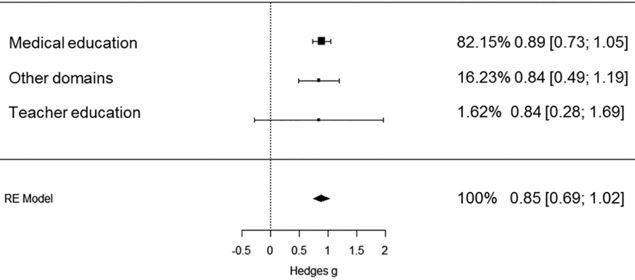
Simulation-based learning offers a wide range of opportunities to practice complex skills in higher education and to implement different types of scaffolding to facilitate effective learning. This meta-analysis includes 145 empirical studies and investigates the effectiveness of different scaffolding types and technology in simulation-based learning environments to facilitate complex skills. The simulations had a large positive overall effect: g = 0.85, SE = 0.08; CIs [0.69, 1.02]. Technology use and scaffolding had positive effects on learning. Learners with high prior knowledge benefited more from reflection phases; learners with low prior knowledge learned better when supported by examples. Findings were robust across different higher education domains (e.g., medical and teacher education, management). We conclude that (1) simulations are among the most effective means to facilitate learning of complex skills across domains and (2) different scaffolding types can facilitate simulation-based learning during different phases of the development of knowledge and skills.
Overview
CoChat Summary
TL;DR
This meta-analysis of 145 studies (10,532 participants) finds that simulation-based learning in higher education has a large positive overall effect on complex skills (g = 0.85, 95% CI [0.69, 1.02]). Effects vary by simulation features and prior knowledge, with examples/prompts helping lower-prior-knowledge learners and reflection phases helping higher-prior-knowledge learners.
Key findings
- Overall effect: g = 0.85, SE = 0.08, 95% CI [0.69, 1.02], N = 145 studies, 10,532 participants; heterogeneity was high: Q(409) = 4213.93, p < .0001, τ² = 1.2, I² = 95.86%.
- By complex skill: technical performance g = 1.06 (SE = 0.15), general problem solving g = 0.88 (SE = 0.11), diagnosing g = 0.82 (SE = 0.21), management g = 0.72 (SE = 0.30), teamwork g = 0.50 (SE = 0.08), communication g = 0.44 (SE = 0.15).
- Simulation features: live model g = 2.27 (N = 3), mixed g = 1.56, mannequin g = 0.96, virtual object g = 0.75, role play g = 0.63, document g = 0.31; technology: simulator g = 1.07, virtual reality g = 0.85, screen-based g = 0.68, no technology g = 0.74; high authenticity g = 0.86 vs low g = 0.58; duration: <1 hr g = 0.65, hours g = 0.81, days g = 0.80, >1 month g = 1.31 (N = 4).
- Scaffolding × prior knowledge: examples helped low-education learners (g = 1.15 vs high-education g = 0.56); prompts helped unfamiliar contexts (g = 0.85 vs no prompts g = 0.63) but not familiar contexts (g = 0.33 vs no prompts g = 0.96); reflection phases helped postgraduate learners (g = 1.10 vs no reflection g = 0.86) but not graduate/undergraduate learners (g = 0.52 vs no reflection g = 0.81).
Methods
- Meta-analysis of 145 empirical studies (from 128 articles, 1979–2018) yielding 409 effect estimates and 10,532 participants; searched PsycINFO, PsycARTICLES, ERIC, and MEDLINE through April 2018; included experimental/quasi-experimental or within-subject pre-post studies with a control condition and objective measures of complex skills.
- Coded moderators included simulation type, technology use, duration, authenticity, scaffolding (examples, prompts, reflection phases), knowledge convey, prior knowledge (familiarity of context, level of education), complex skill type, domain, study design, and publication type.
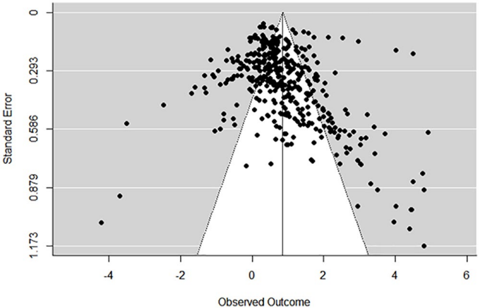
- Used Hedges’ g, random-effects models, robust variance estimation for correlated effects, pretest adjustment when available, heterogeneity Q/I², and publication-bias checks (Egger’s test, trim and fill); metaregression on control variables.
Limitations
- Stated: the focus is on complex skills involving interaction with people, so findings do not straightforwardly generalize to STEM domains such as science, mathematics, engineering, or informatics; a large proportion of findings come from medical education, so caution is needed for other domains, especially regarding technology, simulation type, outcome measures, and moderators.
- Stated: many primary studies gave little treatment description, insufficient for coding some moderators or finer distinctions; many implemented multiple instructional support measures, making specific effects hard to determine; the scaffolding framework may omit other supports such as feedback or fading/adding instruction; combinations could only be partially investigated; prior knowledge operationalization had drawbacks and explained only 4% of heterogeneity; implementation quality was assumed similar; large unexplained heterogeneity requires caution.
- Evident from the text: heterogeneity was very high (I² = 95.86%, τ² = 1.2), and several moderator estimates rest on very small numbers (e.g., live model N = 3, all scaffolding types N = 2, duration >1 month N = 4), so subgroup effects are unstable; presence/absence comparisons for examples, prompts, and reflections often did not reach significance.
Model-written summary. Check it against the paper before relying on it.
Integrity signals
Registry
Cites
Statistics
Figures

Verification
Claims the paper makes
1 Valid · 3 Not valid · 48 Not checked · 181 Own results and interpretations
At least one cited source doesn’t support this claim or points to a different paper, and none confirmed it — see the verdicts below.
In the paper
“However, they only focused on comparing simulations with a duration of more than 1 day with simulations of less than 1 day.”
§ Simulation-Based Learning in Higher Education: A Meta-Analysis > Simulations in Educational Contexts
What the sources say
- Disputedcites Cook et al., 2013 matched to “Technology-Enhanced Simulation to Assess Health Professionals: A Systematic Review of Validity Evidence, Research Methods, and Reporting Quality” (2013) sourceExperimental — accuracy not yet measured
Our copy of Cook et al. (2013) contains no duration contrast whatsoever: searches for 'simulation duration more than one day versus less than one day' and related phrasings returned only the study-coding tables. Those tables (sections 'List of all included studies, sorted by year of publication, with validity evidence and QUADAS-2 ratings (N=417 except for QUADAS-2)', pp. 17, 21, 23, 27, 32-35, and the parallel full-citation list, pp. 4-14) show the review's actual focus: charting validity evidence (content/response/process, internal structure, relations to other variables, consequences, reliability), methodological quality (MERSQI, selection/flow indices, RoB indices, QUADAS-2) and reporting across 417 technology-enhanced simulation assessment studies spanning many topics and instruments. That is contrary to the claim that the review 'only focused on comparing simulations with a duration of more than 1 day with simulations of less than 1 day'. Our copy is truncated at the end, but the retrieved structure of the review already contradicts the characterization; no alternative source for the duration comparison is named in our copy. (LLM, conf=0.72)
Checked by a reasoning model — may be wrong.
plain- Asserted: passes — The authors put it forward as true.
- Checkable: passes — It can be checked against evidence.
- Load-bearing: passes — The paper’s conclusions depend on it.
- Based: passes — The paper gives a reason why it holds.
- Disputed
The cited sources that could be checked couldn’t confirm or dispute this claim.
In the paper
“In their meta-analysis, Cook et al. (2013) provided supportive evidence of the effectiveness of distributed and repetitive practice (effects above .60)in the acquisition of complex skills in medical education.”
§ Simulation-Based Learning in Higher Education: A Meta-Analysis > Simulations in Educational Contexts
What the sources say
- Could not verifycites Cook et al., 2013 matched to “Technology-Enhanced Simulation to Assess Health Professionals: A Systematic Review of Validity Evidence, Research Methods, and Reporting Quality” (2013) sourceExperimental — accuracy not yet measured
Our copy of Cook et al. (2013) contains only the appendix material — the 'List of all included studies, sorted by year of publication, with full journal citation' (pp. 2-16) and the parallel table 'with validity evidence and QUADAS-2 ratings (N=417)' (pp. 20-35), which catalogue simulation-based ASSESSMENT validation studies with MERSQI scores, not pooled effects. Searches for 'distributed and repetitive practice', 'meta-analysis', 'effect size / Hedges g / random-effects', 'learning principles / repetition', and the paper's objective returned no narrative text at all, so nothing in our copy reports an effectiveness meta-analysis or effect magnitudes above .60. The copy is also flagged truncated, so the results/discussion where such a finding would appear may be missing; absence here is not evidence of a contrary statement, and no alternative source is named in the passages we hold. (LLM, conf=0.68)
plainstates a cause- Asserted: passes — The authors put it forward as true.
- Checkable: passes — It can be checked against evidence.
- Load-bearing: unclear — It is unclear whether the paper’s conclusions depend on it.
- Based: passes — The paper gives a reason why it holds.
- Could not verify
The cited sources support only part of this claim — read each source’s verdict below.
In the paper
“All these scaffolding measures were found to be beneficial for developing diagnostic competences (Chernikova et al., 2019).”
§ Simulation-Based Learning in Higher Education: A Meta-Analysis > Added Value of Instructional Support
What the sources say
- Partly supportedcites Chernikova et al., 2019 matched to “Facilitating Diagnostic Competences in Higher Education—a Meta-Analysis in Medical and Teacher Education” (2020) sourceExperimental — accuracy not yet measured
The meta-analysis does state broadly that all scaffolding types help ('as long as learners are able to practice problem-solving, all of the different types of scaffolding are beneficial', Theoretical Significance; echoed in Summary and Conclusion: roles, prompts and reflection phases 'have clear positive effects', with 'no indication for different effect sizes of different types of scaffolding'). But the claim drops the source's binding condition — the benefit holds only where learners' own problem-solving is preserved — and the source's results are not uniformly significant: in Effect of Scaffolding, settings with vs. without examples 'did not reach statistical significance' (Q(1,35)=2.85, p=.06), and Limitations warns that 'conclusions about the effectiveness of each scaffolding type should be made with caution'. So the flat 'all these scaffolding measures were found to be beneficial' overstates an explicitly conditional and hedged finding. (LLM, conf=0.72)
plainstates a cause- Asserted: passes — The authors put it forward as true.
- Checkable: passes — It can be checked against evidence.
- Load-bearing: passes — The paper’s conclusions depend on it.
- Based: passes — The paper gives a reason why it holds.
- Partly supported
A result the paper reports from its own data — it cites no other source for it, so there is none to check. The quote shows it is in the paper.
In the paper
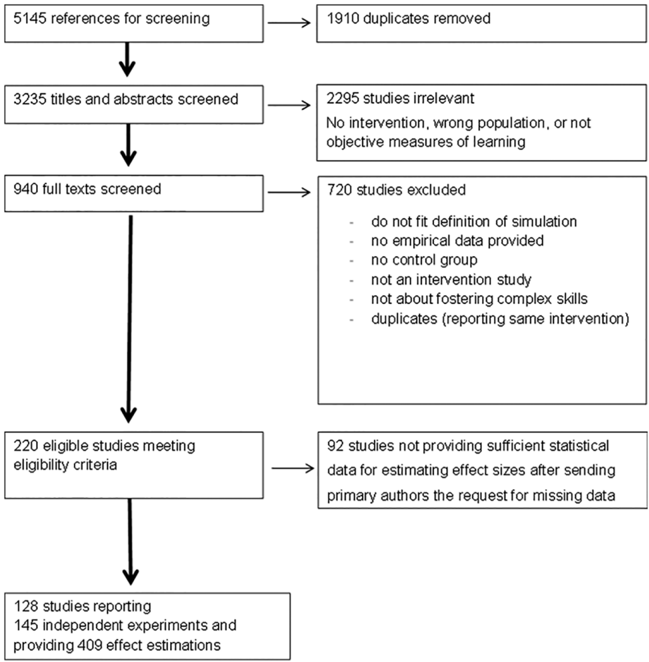
“The 145 eligible studies (from 128 articles published in the period 1979-2018) provided 409 effect estimations (Figure 1).”
§ Simulation-Based Learning in Higher Education: A Meta-Analysis > Results of Literature Search
plainn = 10,532- Asserted: passes — The authors put it forward as true.
- Checkable: passes — It can be checked against evidence.
- Load-bearing: passes — The paper’s conclusions depend on it.
- Based: passes — The paper gives a reason why it holds.
A result the paper reports from its own data — it cites no other source for it, so there is none to check. The quote shows it is in the paper.
In the paper
“The most frequent combinations of instructional support measures were knowledge convey together with examples (82 effects), knowledge convey with reflection phases (62 effects), and examples with reflection phases (43 effects).”
§ Simulation-Based Learning in Higher Education: A Meta-Analysis > Results of Literature Search
plain- Asserted: passes — The authors put it forward as true.
- Checkable: passes — It can be checked against evidence.
- Load-bearing: unclear — It is unclear whether the paper’s conclusions depend on it.
- Based: passes — The paper gives a reason why it holds.
120 more claims
Create a free account to see all 233 claims and to verify the 44 references still open.
- It may state two separate claims as one. 61
- Probably not a substantial claim. 61
Claims other papers make about this one
Each is checked against this paper’s own text: does it say what the citing paper says it does?
In the citing paper
“Chernikova and colleagues have demonstrated in a meta-analysis that simulations of professional situations, such as interactions in a classroom for teachers, can be a beneficial tool during teacher training as they expose teachers to authentic problems in their fields51.”
From On opportunities and challenges of large multimodal foundation models in education (2025) · cites this paper as [51]
In the citing paper
“Meta-analytic findings indicate that simulations are among the most effective means to facilitate the learning of complex skills across domains, with technology-based and scaffolded simulations showing robust positive effects on learning outcomes [11].”
In the citing paper
“While several earlier reviews have examined the general benefits of simulation in nursing education [17], few have focused specifically on its role in bridging the theory–practice gap.”
From The impact of clinical simulation on bridging the theory–practice gap in nursing education: a systematic review (2025) · cites this paper as [17]
In the citing paper
“High-fidelity simulations were particularly associated with enhanced clinical judgment and decision-making accuracy [17, 29, 30].”
From The impact of clinical simulation on bridging the theory–practice gap in nursing education: a systematic review (2025) · cites this paper as [17]
In the citing paper
“These findings are supported by meta-analytic evidence from Chernikova et al., who concluded that simulation-based learning substantially improves decision-making and problem-solving skills in higher education, especially when paired with active learning strategies and structured debriefing [17].”
From The impact of clinical simulation on bridging the theory–practice gap in nursing education: a systematic review (2025) · cites this paper as [17]
Statistics recomputed
Every reported test result, recomputed from its test statistic and degrees of freedom. A result shows as not adding up only once an independent check has confirmed it.
- ConsistentQ(409) = 4213.93reported p < .0001 · recomputed p < .001
“Q (409) = 4213.93,p < .0001”
Self-check
Percentages, sums and reported differences re-computed from the paper’s own numbers.
Each contradiction between two passages listed here was confirmed by an independent check.
Rated major: it would touch a result — a value a result rests on, reported and recomputed p-values on opposite sides of the significance level, two passages that conflict with no sign which is right, or a cited work retracted before this paper was published.
In the paper
§ Simulation-Based Learning in Higher Education: A Meta-Analysis > Discussion
“However, the effects are greater if learners are unfamiliar with the context and the task.”
§ Simulation-Based Learning in Higher Education: A Meta-Analysis > Prior Professional Knowledge
“learners showed a lower increase of complex skills in an unfamiliar context (g = 0.67, SE = 0.10) than in a familiar context (g = 0.83, SE = 0.13)”
Rated minor: it would not touch a result — a value no result rests on, a p-value that stays on the same side of the significance level, or a conflict that is clerical, resolved elsewhere in the paper, or outside its own findings.
In the paper
§ Simulation-Based Learning in Higher Education: A Meta-Analysis > Results of Literature Search
“Most studies focused on general problem solving (51) or the technical performance of a particular complex procedure (56); the other outcomes were communication skills (24), diagnosing (18), managing critical situations (18), and collaboration and teamwork (5).”
§ Simulation-Based Learning in Higher Education: A Meta-Analysis > Conclusion
“2,493 (27) 0.46 91.03% | 911 (18) 0.76 92.02% | 6,010 (58) 0.47 91.23% | 2,543 (21) 1.04 97.15% | 810 (5) 0.03 66.07% | 2,933 (63) 1.25 91.10%”
Rated minor: it would not touch a result — a value no result rests on, a p-value that stays on the same side of the significance level, or a conflict that is clerical, resolved elsewhere in the paper, or outside its own findings.
In the paper
“(2) prompts as the only scaffolding method (N = 11)”
§ Simulation-Based Learning in Higher Education: A Meta-Analysis > Level of Education as an Indicator of Prior Knowledge and Experience
Reported 11 · recomputed 12
Rated minor: it would not touch a result — a value no result rests on, a p-value that stays on the same side of the significance level, or a conflict that is clerical, resolved elsewhere in the paper, or outside its own findings.
In the paper
§ Simulation-Based Learning in Higher Education: A Meta-Analysis > Discussion
“Despite these differences, simulations had effects that can be categorized as large positive effects for all but one type of skill.The exception is teamwork, where the meta-analysis found a medium positive effect only.”
§ Simulation-Based Learning in Higher Education: A Meta-Analysis > Overall Effect of Simulation-Based Learning on Complex Skills (Research Question 1)
“Communication and collaboration skills (teamwork) are only moderately facilitated by simulation-based learning (g = 0.44, SE = 0.15, and g = 0.50, SE = 0.08, respectively)”
Rated minor: it would not touch a result — a value no result rests on, a p-value that stays on the same side of the significance level, or a conflict that is clerical, resolved elsewhere in the paper, or outside its own findings.
In the paper
§ Simulation-Based Learning in Higher Education: A Meta-Analysis > Level of Education as an Indicator of Prior Knowledge and Experience
“however, introducing prompts was related to higher learning outcomes in the high-level group.”
§ Simulation-Based Learning in Higher Education: A Meta-Analysis > Level of Education as an Indicator of Prior Knowledge and Experience
“Similarly, introducing prompts for a high (postgraduate learners and practitioners) level (g = 0.50, SE = 0.36) was not beneficial for learning compared with simulations without prompts (g = 0.91, SE = 0.11).”
Citations
Cites
Measuring inconsistency in meta-analyses
Higgins, J. P. T., Thompson, S. G., Deeks, J. J., & Altman, D. G. (2003) · BMJ · doi:10.1136/bmj.327.7414.557 · Cited by 63,139 · cited 1×
“The thresholds suggested by Higgins et al. (2003) were used to interpret the I 2 (25% for low heterogeneity, 50% for medium, 75% for high heterogeneity).”
MethodBorenstein, M., Hedges, L. V., Higgins, J. P. T., & Rothstein, H. R. (2009) · doi:10.1002/9780470743386 · Cited by 14,225
Hattie, J., & Timperley, H. (2007) · Review of Educational Research · doi:10.3102/003465430298487 · Cited by 12,905
THE ROLE OF TUTORING IN PROBLEM SOLVING *
Wood, D., Bruner, J. S., & Ross, G. (1976) · Journal of Child Psychology and Psychiatry · doi:10.1111/j.1469-7610.1976.tb00381.x · Cited by 8,851 · cited 1×
“Scaffolding enables a learner to solve problems through modifying tasks and reducing possible pathways, and through hints helping the learner to coordinate the steps in problem solving or interaction (Quintana et al., 2004), by taking over some elements of learning material (Wood et al., 1976).”
BackgroundKirschner, P. A., Sweller, J., & Clark, R. E. (2006) · Educational Psychologist · doi:10.1207/s15326985ep4102_1 · Cited by 7,776 · cited 2×
“…suggesting that including simulations in a later phase of a higher education program after students already know theoretical concepts is promising in order to not overwhelm learners and block too much of their cognitive capacity for solving a problem in a simulation (e.g., Kirschner et al., 2006).”
BackgroundFunnel plots for detecting bias in meta-analysis
Sterne, J. A. C., & Egger, M. (2001) · Journal of Clinical Epidemiology · doi:10.1016/s0895-4356(01)00377-8 · Cited by 3,779 · cited 1×
“We have a relatively small sample of empirical studies and apply a range of techniques to identify possible biases (Egger’s test, trim and fill) and improve the generalizability of the results (Sterne & Egger, 2001).”
MethodEducational Psychology: A Cognitive View
Gagné, R. M., Ausubel, D. P., & Gagné, R. M. (1969) · American Educational Research Journal · doi:10.3102/00028312006002287 · Cited by 3,302
Educational Psychology: A Cognitive View
Gagné, R. M., Ausubel, D. P., & Gagne, R. M. (1969) · American Educational Research Journal · doi:10.2307/1161899 · Cited by 3,278
HMELO-SILVER, C. E., DUNCAN, R. G., & CHINN, C. A. (2007) · Educational Psychologist · doi:10.1080/00461520701263368 · Cited by 2,641 · cited 1×
“…problems, especially in early stages of expertise development, should be accompanied by scaffolding to maximize learning and avoid cognitive overload, distraction, or focusing on superficial features of a situation (see the discussions of Hmelo-Silver et al., 2007; Kirschner et al., 2006).”
BackgroundReflection and reflective practice in health professions education: a systematic review
Mann, K., Gordon, J., & MacLeod, A. (2009) · Advances in Health Sciences Education · doi:10.1007/s10459-007-9090-2 · Cited by 2,175 · cited 1×
“Reflection phases, on the other hand, allow learners to think about goals, analyze their own performance, and plan further steps (e.g., Mann et al., 2009), but they do not provide much guidance during the problem solving.”
Background
Research works printed but not linked: 4
- Funke, J. (Ed.). (2006). Denken und Problemlösen (pp. 375-446).
- Henninger, M., & Mandl, H. (2000). Vom Wissen zum Handeln-ein Ansatz zur Förderung kommunikativen Handelns [From knowledge to action-An approach for fostering communicative behavior]. In H. Mandl & J. Gerstenmaier (Eds.), Die Kluft zwischen Wissen und Handeln (pp. 197-219).
- Raven, J. (2000). Psychometrics, cognitive ability, and occupational performance. Review of Psychology, 7(1-2), 51-74.
- Veritas Health Innovation. (2019). Covidence systematic review software (online ver- sion) [Computer software]. https://www.covidence.org
Cited by
Sailer, M., Schultz-Pernice, F., & Fischer, F. (2021) · Computers in Human Behavior · doi:10.1016/j.chb.2021.106794 · Cited by 222
Self-citationAlt, D., Naamati-Schneider, L., & Weishut, D. J. N. (2023) · Studies in Higher Education · doi:10.1080/03075079.2023.2217203 · Cited by 195
“Simulation-based learning is suggested (Chernikova et al. 2020) as a powerful competency-based educational tool that mimics real-life situations, allowing learners to overcome the limitations of learning in real-life contexts.”
BackgroundAlharbi, A., Nurfianti, A., Mullen, R. F., McClure, J. D., & Miller, W. H. (2024) · BMC Medical Education · doi:10.1186/s12909-024-06080-z · Cited by 188
“Simulation-Based Learning (SBL) is an educational approach which has been widely adopted in nursing and medical education [1].”
BackgroundWörner, S., Kühn, J., & Scheiter, K. (2022) · Review of Educational Research · doi:10.3102/00346543221079417 · Cited by 177
“…can serve as an effective tool for scaffolding the processes during inquiry learning. de Jong and van Joolingen (1998) in their review and Chernikova et al. (2020) in their meta-analysis emphasize the importance of additional guidance during the inquiry learning processes with…”
BackgroundMethodInfluentialAI-based avatars are changing the way we learn and teach: benefits and challenges
Fink, M. C., Robinson, S. A., & Ertl, B. (2024) · Frontiers in Education · doi:10.3389/feduc.2024.1416307 · Cited by 196
Daneshfar, M., & Moonaghi, H. K. (2025) · BMC Medical Education · doi:10.1186/s12909-025-07790-8 · Cited by 131
“While several earlier reviews have examined the general benefits of simulation in nursing education [17], few have focused specifically on its role in bridging the theory–practice gap.”
Ballouk, R., Mansour, V., Dalziel, B., McDonald, J. L., & Hegazi, I. (2022) · Medical Education Online · doi:10.1080/10872981.2022.2029336 · Cited by 127
“These studies collectively reported that enhancing students’ learning occurs through the modification and adjustment of their learning behaviour using various innovative blended teaching models and strategies, and regular feedback [19,23].”
BackgroundDai, C.-P., Ke, F., Pan, Y., Moon, J., & Liu, Z. (2024) · Educational Psychology Review · doi:10.1007/s10648-024-09855-4 · Cited by 116
“Although computer-based simulation for learning was found to be overall effective in higher education settings (Chernikova et al., 2020), Merchant et al.’s (2014) findings reported that simulation games were more effective than virtual reality and virtual worlds.”
InfluentialVirtual vs. traditional learning in higher education: A systematic review of comparative studies
Santilli, T., Ceccacci, S., Mengoni, M., & Giaconi, C. (2024) · Computers & Education · doi:10.1016/j.compedu.2024.105214 · Cited by 122
de la Torre, R., Onggo, B. S., Corlu, C. G., Nogal, M., & Juan, A. A. (2021) · Energies · doi:10.3390/en14041138 · Cited by 129
“In addition, SBL can be applied from the beginning of students’ academic life and allows them to adapt to their difficulties (both for beginners and advanced learners) [90].”
BackgroundSailer, M., Bauer, E., Hofmann, R., Kiesewetter, J., Glas, J., Gurevych, I., & Fischer, F. (2023) · Learning and Instruction · doi:10.1016/j.learninstruc.2022.101620 · Cited by 106
Self-citationClassroom complexity affects student teachers’ behavior in a VR classroom
Huang, Y., Richter, E., Kleickmann, T., Wiepke, A., & Richter, D. (2020) · Computers & Education · doi:10.1016/j.compedu.2020.104100 · Cited by 107
“Second, simulation-based learning has been found to be one of the most effective ways of acquiring complex skills in various domains (Chernikova et al., 2020).”
BackgroundArrogante, Ó., González-Romero, G. M., López-Torre, E. M., Carrión-García, L., & Polo, A. (2021) · BMC Nursing · doi:10.1186/s12912-021-00614-2 · Cited by 108
Dai, C., Ke, F., Dai, Z., & Pachman, M. (2022) · British Journal of Educational Technology · doi:10.1111/bjet.13296 · Cited by 97
Stenseth, H. V., Steindal, S. A., Solberg, M. T., Ølnes, M. A., Sørensen, A. L., Strandell‐Laine, C., Olaussen, C., Aure, C. F., Pedersen, I., Zlámal, J., et al. (2025) · Journal of Medical Internet Research · doi:10.2196/58744 · Cited by 103
“Critical thinking skills empower nurses to manage the uncertainties inherent in nursing practice, thus contributing to safe, effective care across diverse clinical settings [1-4].”
Artificial Intelligence and Education
Rios-Campos, C., Cánova, E. S. M., Zaquinaula, I. R. A., Zaquinaula, H. E. A., Vargas, D. J. C., Peña, W. S., Idrogo, C. E. T., & Arteaga, R. M. Y. (2023) · South Florida Journal of Development · doi:10.46932/sfjdv4n2-001 · Cited by 44
Jansen, T., & Møller, J. (2021) · Teaching and Teacher Education · doi:10.1016/j.tate.2021.103616 · Cited by 90
Simulation as a pedagogical model for deep learning in teacher education
Levin, O. (2024) · Teaching and Teacher Education · doi:10.1016/j.tate.2024.104571 · Cited by 85
Asmri, M. A., Haque, S. M., & Parle, J. (2023) · BMC Medical Education · doi:10.1186/s12909-023-04033-6 · Cited by 77
“The learning effectiveness of simulation-based medical education is well-established in the literature [18, 19].”
BackgroundLiu, J. Y. W., Yin, Y.-H., Kor, P. P. K., Cheung, D. S. K., Zhao, I. Y., Wang, S., Su, J. J., Christensen, M., Tyrovolas, S., & Leung, A. Y. M. (2023) · Journal of Medical Internet Research · doi:10.2196/39989 · Cited by 75
“Simulation-based learning facilitates a deeper understanding of theoretical knowledge, relationships between different concepts, advanced inquiry, problem-solving, and decision-making [7].”
Popov, V., Mateju, N., Jeske, C., & Lewis, K. O. (2024) · Annals of Medicine · doi:10.1080/07853890.2024.2424450 · Cited by 83
“This is consistent with other reviews showing online learning as an effective supplement, rather than a replacement, for in-person instruction [110,111].”
Huang, Y., Richter, E., Kleickmann, T., & Richter, D. (2023) · Edition ZfE · doi:10.1007/978-3-658-37895-0_16 · Cited by 83
Tong, L. K., Li, Y. Y., Au, M. L., Ng, W. I., Wang, S. C., Liu, Y., Shen, Y., Zhong, L., & Qiu, X. (2024) · BMC Nursing · doi:10.1186/s12912-024-02069-7 · Cited by 70
“This educational approach not only supports the development of various competencies [2, 4], including knowledge, skill, interprofessional collaboration, critical thinking, caring, and interest in learning, but also enables students to apply learned concepts to complex and challenging situations [5].”
BackgroundBauer, E., Sailer, M., Niklas, F., Greiff, S., Sarbu‐Rothsching, S., Zottmann, J. M., Kiesewetter, J., Stadler, M., Fischer, M. R., Seidel, T., et al. (2025) · Journal of Computer Assisted Learning · doi:10.1111/jcal.13123 · Cited by 44
Self-citationNickl, M., Huber, S. A., Sommerhoff, D., Codreanu, E., Ufer, S., & Seidel, T. (2022) · International Journal of Educational Technology in Higher Education · doi:10.1186/s41239-022-00351-9 · Cited by 70
“The effectiveness of knowledge acquisition when using video can be further improved when videos are embedded in more interactive, individualized, and adaptive formats, such as video-based simulations (Chernikova et al., 2020a, 2020b; Derry et al., 2014; Plass & Pawar, 2020).”
BackgroundSelf-citationCan reflective interventions improve students’ academic achievement? A meta-analysis
Zhai, N., Huang, Y., Ma, X., & Chen, J. (2023) · Thinking Skills and Creativity · doi:10.1016/j.tsc.2023.101373 · Cited by 75
AI Agents and Education: Simulated Practice at ScalePreprint
Mollick, E., Mollick, L., Bach, N., Ciccarelli, L., Przystanski, B., & Ravipinto, D. (2024) · SSRN Electronic Journal · doi:10.2139/ssrn.4871171 · Cited by 65
Fung, J. T. C., Zhang, W., Yeung, M. N., Pang, M. T. H., Lam, V. S. F., Chan, B. K. Y., & Wong, J. Y. H. (2021) · Nursing Open · doi:10.1002/nop2.1017 · Cited by 68
Cheng, L., Wang, X., & Ritzhaupt, A. D. (2022) · Journal of Educational Computing Research · doi:10.1177/07356331221114183 · Cited by 64
“…consistent with existing literature that suggests positive effects of educational interventions including simulation (e.g., D ’ Angelo et al., 2016; Chernikova et al., 2020), block-based programing (e.g., Xu et al., 2019; Weintrop & Wilensky, 2017), and maker activities (e.g., Lindstrom et al.,…”
BackgroundTabriz, E. R., Sadeghi, M., Tavana, E., Miri, H. H., & Nabavi, F. H. (2024) · Heliyon · doi:10.1016/j.heliyon.2024.e27347 · Cited by 75
“Identifying and formulating these strategies is a significant challenge for nursing educators seeking to enhance nursing students ’ skills, self-confidence, and knowledge [13].”
BackgroundFischer, F., Bauer, E., Seidel, T., Schmidmaier, R., Radkowitsch, A., Neuhaus, B. J., Hofer, S. I., Sommerhoff, D., Ufer, S., Kuhn, J., et al. (2022) · Information and Learning Sciences · doi:10.1108/ils-06-2022-0076 · Cited by 47
Self-citationHigher Education for Sustainability: A Critical Review of the Empirical Evidence 2013–2020
Probst, L. (2022) · Sustainability · doi:10.3390/su14063402 · Cited by 66
Sommerhoff, D., Codreanu, E., Nickl, M., Ufer, S., & Seidel, T. (2022) · Learning and Instruction · doi:10.1016/j.learninstruc.2022.101689 · Cited by 60
Self-citationNavarro, C., Arias‐Calderón, M., Henríquez, C. A., & Riquelme, P. (2024) · Education Sciences · doi:10.3390/educsci14030243 · Cited by 60
Innab, A., Alammar, K., Alqahtani, N., Aldawood, F., Kerari, A., & Alenezi, A. (2022) · BMC Nursing · doi:10.1186/s12912-022-01028-4 · Cited by 51
“The use of simulation in educational programs has been found to boost learning experiences, leading to improved self-efficacy, learner satisfaction, and self-confidence [13, 14], and simulations have been used to advance healthcare providers’ diagnostic abilities as well as their motor and technical capabilities [15].”
BackgroundHashish, E. A. A., & Bajbeir, E. (2022) · SAGE Open Nursing · doi:10.1177/23779608221127952 · Cited by 51
“Obtaining constructive feedback, support, time for reflection, and sharing individual experiences during simulation and training enhances communication and students’ engagement in learning (Abou Hashish, 2019; Chernikova et al., 2020; Khalil and Abou Hashish, 2022).”
BackgroundThe role of indoor positioning analytics in assessment of simulation‐based learning
Yan, L., Martínez‐Maldonado, R., Zhao, L., Dix, S., Jaggard, H., Wotherspoon, R., Li, X., & Gašević, D. (2022) · British Journal of Educational Technology · doi:10.1111/bjet.13262 · Cited by 56
Gabbouj, S. B., Zedini, C., & Naija, W. (2024) · Advances in Medical Education and Practice · doi:10.2147/amep.s477309 · Cited by 60
“40,41 Again, several authors emphasized that nursing students’ problem-solving skills improved significantly with simulation training.”
Telelife: The Future of Remote Living
Orlosky, J., Sra, M., Bektaş, K., Peng, H., Kim, J., Kosmyna, N., Höllerer, T., Steed, A. J., Kiyokawa, K., & Akşit, K. (2021) · Frontiers in Virtual Reality · doi:10.3389/frvir.2021.763340 · Cited by 55
“Several recent survey papers review the state of the art in immersive learning opportunities, experiments, and bene fi ts (Chernikova et al., 2020; Pellas et al., 2020; Hamilton et al., 2021; Kaviyaraj and Uma, 2021).”
BackgroundStriking gold: navigating the education massification maze for work readiness
Enstroem, R., & Schmaltz, R. M. (2024) · Journal of Work-Applied Management · doi:10.1108/jwam-10-2023-0100 · Cited by 52
The links between experiential learning and 4E cognition
Lebert, A., & Vilarroya, Ó. (2024) · Annals of the New York Academy of Sciences · doi:10.1111/nyas.15238 · Cited by 57
On opportunities and challenges of large multimodal foundation models in education
Küchemann, S., Avila, K. E., Dinc, Y., Hortmann, C., Revenga, N., Ruf, V., Stausberg, N., Steinert, S., Fischer, F., Fischer, M., et al. (2025) · npj Science of Learning · doi:10.1038/s41539-025-00301-w · Cited by 47
“Chernikova and colleagues have demonstrated in a meta-analysis that simulations of professional situations, such as interactions in a classroom for teachers, can be a bene fi cial tool during teacher training as they expose teachers to authentic problems in their fi elds 51 .”
Self-citationHofmann, R., Curran, S., & Dickens, S. (2021) · Studies In Educational Evaluation · doi:10.1016/j.stueduc.2021.101093 · Cited by 51
Artificial Intelligence applied to teaching and learning processes
Cano, C. A. G., & Troya, A. L. C. (2023) · LatIA · doi:10.62486/latia20232 · Cited by 52
Cain, M., Campbell, C., & Coleman, K. S. (2022) · The Australian Educational Researcher · doi:10.1007/s13384-022-00552-1 · Cited by 53
“At the same time, there has been a purposeful move towards student-centred learning (Ryan et al., 2022), and a focus on active and problem-based learning strategies (Chernikova et al., 2020; Lee et al., 2014).”
BackgroundRadiography education in 2022 and beyond - Writing the history of the present: A narrative review
Tay, Y. X., & McNulty, J. P. (2023) · Radiography · doi:10.1016/j.radi.2023.01.014 · Cited by 47
Frei-Landau, R., & Levin, O. (2023) · Frontiers in Psychology · doi:10.3389/fpsyg.2023.1149576 · Cited by 51
“Simulation-based learning Simulation-based learning is a novel methodology that evolved from health disciplines (Zhong and Zhang, 2021), and authentically simulates the conditions of the professional arena at hand for learning purposes such as teaching skills (Chernikova et al., 2020; Ross and Atkinson, 2020; Malone a…”
MethodWeimer, J., Widmer, N., Strelow, K.-U. R., Hopf, P., Buggenhagen, H., Dirks, K., Künzel, J., Börner, N., Weimer, A., Lorenz, L.-A., et al. (2023) · Tomography · doi:10.3390/tomography9040104 · Cited by 46
Teaching via LLM-enhanced simulations: Authenticity and barriers to suspension of disbelief
Zheng, L., Jiang, F., Gu, X., Li, Y., Wang, G., & Zhang, H. (2024) · The Internet and Higher Education · doi:10.1016/j.iheduc.2024.100990 · Cited by 58
Peechapol, C. (2021) · International Journal of Emerging Technologies in Learning (iJET) · doi:10.3991/ijet.v16i20.23561 · Cited by 52
Jawabreh, N., Hamdan-Mansour, A., Harazne, L., & Ayed, A. (2025) · BMC Nursing · doi:10.1186/s12912-025-03300-9 · Cited by 44
“Simulation, broadly defined, involves replicating real-life tasks, relationships, and decision-making processes [18].”
Yasin, N., Gilani, S. A. M., Contu, D., & Fayaz, M. J. (2022) · Springer eBooks · doi:10.1007/978-3-030-84292-5_2 · Cited by 46
Simulation-Based Learning via Cisco Packet Tracer to Enhance the Teaching of Computer Networks
Allison, J. (2022) · ACM Conference on Innovation and Technology in Computer Science Education (ITiCSE) · doi:10.1145/3502718.3524739 · Cited by 44
Chernikova, O., Holzberger, D., Heitzmann, N., Stadler, M. J., Seidel, T., & Fischer, F. (2023) · Zeitschrift für Pädagogische Psychologie · doi:10.1024/1010-0652/a000357 · Cited by 48
Self-citationProfessional competence of mathematics teachers in dealing with tasks in lesson planning
Hammer, S., & Ufer, S. (2023) · Teaching and Teacher Education · doi:10.1016/j.tate.2023.104246 · Cited by 51
La Realidad Virtual como herramienta de innovación educativa
Palma, J. K. T., Mera, J. L. A., Loor, J. M. Q., & Santana-Vergara, M. I. (2020) · EPISTEME KOINONIA · doi:10.35381/e.k.v3i5.835 · Cited by 44
“Likewise, (Hsieh & Yeehsieh, 2004) point out that school knowledge can be deepened to the extent that it relies on technological resources, enabling a pedagogical exercise in line with current trends (Chernikova, et al., 2020).”
Arrogante, O., López-Torre, E. M., Carrión-García, L., Polo, A., & Jiménez-Rodríguez, D. (2021) · Healthcare · doi:10.3390/healthcare9030355 · Cited by 40
Systematic Literature Review of Simulation-Based Learning for Developing Teacher SEL
Kasperski, R., Levin, O., & Hemi, M. E. (2025) · Education Sciences · doi:10.3390/educsci15020129 · Cited by 50
Khalil, A. I., Hantira, N. Y., & Alnajjar, H. A. (2023) · Cureus · doi:10.7759/cureus.44152 · Cited by 42
“However, there is a gap in the literature regarding whether stimulation can be used to teach family assessment and communication skills to undergraduate nursing students [6].”
BackgroundThe perceived affordances of simulation-based learning: online student teachers’ perspectives
Dittrich, L., Aagaard, T., & Hjukse, H. (2022) · International Journal of Educational Technology in Higher Education · doi:10.1186/s41239-022-00366-2 · Cited by 44
“Still, more knowledge is needed in the teacher education field to understand the potential and pitfalls of SBL (Chernikova et al., 2020).”
BackgroundSchnitzler, K., Holzberger, D., & Seidel, T. (2020) · Frontiers in Education · doi:10.3389/feduc.2020.602470 · Cited by 46
Self-citationLevin, O., & Muchnik-Rozanov, Y. (2022) · Journal of Education for Teaching International Research and Pedagogy · doi:10.1080/02607476.2022.2048176 · Cited by 44
“Although the use of simulations is very common in fields such as medical and health education (Chernikova et al. 2020; Issenberg et al. 2005), the use of simulation in the field of teacher education is still in its early stages (Dieker et al. 2014; Levin and Flavian, 2020; McGarr 2020).”
BackgroundMethodChu, X., Wang, M., Spector, J. M., Chen, N., Chai, C. S., Hwang, G., & Zhai, X. (2025) · Educational Technology Research and Development · doi:10.1007/s11423-025-10457-2 · Cited by 44
“The affordances offered by AIGM in revitalizing FCM serve as more effective scaffolding for learners with limited prior knowledge since AI virtual teachers can provide supplementary explanations and examples, as highlighted by Chernikova et al. (2020).”
Thomann, H., & Deutscher, V. (2025) · Educational Research Review · doi:10.1016/j.edurev.2025.100686 · Cited by 40
Zahn, E.-M., Schöbel, S., Saqr, M., & Söllner, M. (2024) · Studies in Higher Education · doi:10.1080/03075079.2024.2361831 · Cited by 48
“Soft skills also include basic digital skills in conjunction with other skills, such as problem-solving in simulated online environments (Chernikova et al. 2020), which are becoming increasingly prevalent in higher education with its increasing reliance on digital resources.”
Duchatelet, D., Jossberger, H., & Rausch, A. (2022) · Studies In Educational Evaluation · doi:10.1016/j.stueduc.2022.101210 · Cited by 40
Hard and soft skill needs: Higher education and the Fintech sector
Doherty, O., & Stephens, S. (2023) · Journal of Education and Work · doi:10.1080/13639080.2023.2174954 · Cited by 39
“…there is an expectation that higher education will deliver graduates with the necessary knowledge and skills to help companies compete in a knowledge-based economy (Pavlin, Svetlik, and Pavlin and Ivan Svetlik 2014; Wall 2017; Durazzi 2019; Chernikova et al. 2020; Trinidad, Raz, and Magsalin 2021).”
BackgroundGuerrero, J. G., Sacro‐Rosales, N., & Tungpalan-Castro, G. M. (2022) · Nursing Open · doi:10.1002/nop2.1343 · Cited by 45
“…that is comparable to real- life clinical practice, (2) evaluate multidisciplinary professional skills and (3) present standard clinical scenarios compared to other traditional assessment methods, such as written or oral tests (Cant & Cooper, 2010; Chernikova et al., 2020; Kim et al., 2016).”
BackgroundA bibliometric analysis of global research on education in the Scopus database, 2013–2022
Maral, M. (2024) · Global Knowledge, Memory and Communication · doi:10.1108/gkmc-01-2024-0039 · Cited by 46
Abulibdeh, A. O. (2025) · Sustainable Futures · doi:10.1016/j.sftr.2025.101033 · Cited by 47
Game-Based Learning and Service-Learning to Teach Inclusive Education in Higher Education
Rodríguez-Ferrer, J. M., León, A. M., & Aguilar-Parra, J. M. (2023) · International Journal of Environmental Research and Public Health · doi:10.3390/ijerph20043285 · Cited by 47
Osorio, C., Fuster, N., Chen, W., Men, Y., & Juan, A. A. (2024) · Information · doi:10.3390/info15080430 · Cited by 46
“Real-life contexts may not consistently provide sufficient or timely opportunities to practice and evaluate the outcomes of decisions, especially in critical situations where consequences unfold slowly or sporadically [51].”
BackgroundPark, H. Y., & Yeom, I. (2025) · Nurse Education Today · doi:10.1016/j.nedt.2025.106675 · Cited by 48
A scientometric analysis of global scientific literature on learning resources in higher education
Gomis, M. K. S., Oladinrin, O. T., Saini, M. S., Pathirage, C., & Arif, M. (2023) · Heliyon · doi:10.1016/j.heliyon.2023.e15438 · Cited by 45
“The COVID pandemic has forced digital and virtual learning into mainstream global higher education curricula [31,32].”
BackgroundDuchatelet, D., Spooren, P., Bursens, P., Gijbels, D., & Donche, V. (2021) · Studies in Educational Evaluation · doi:10.1016/j.stueduc.2020.100940 · Cited by 37
Fink, M. C., Sosa, D., Eisenlauer, V., & Ertl, B. (2023) · Frontiers in Education · doi:10.3389/feduc.2023.969966 · Cited by 42
“In this regard, the match between the functions educational virtual environments provide and the situations they represent (Chernikova et al., 2020) could be an important characteristic.”
BackgroundDiprossimo, L., Ushakova, A., Zoski, J. L., Gamble, H., Irey, R. C., & Cain, K. (2023) · Contemporary Educational Psychology · doi:10.1016/j.cedpsych.2023.102165 · Cited by 45
Understanding and managing the complexities in situated learning in immersive virtual environments
Wang, M., Dede, C., Grotzer, T. A., & Chen, J. (2025) · Educational Technology Research and Development · doi:10.1007/s11423-025-10519-5 · Cited by 46
“…of classroom settings in offering situated learning, virtual and simulation environments such as virtual worlds and video games have been applied to expand the opportunities for learning in authentic settings (Chernikova et al., 2020; Dawley & Dede, 2014; Jacobson et al., 2016; Spector, 2002).”
Exploring Science and Technology Teachers’ Experiences with Integrating Simulation-Based Learning
Singh-Pillay, A. (2024) · Education Sciences · doi:10.3390/educsci14080803 · Cited by 36
Fink, M. C., Reitmeier, V., Stadler, M., Siebeck, M., Fischer, F., & Fischer, M. R. (2021) · Journal of Medical Internet Research · doi:10.2196/21196 · Cited by 36
“A meta-analysis on simulation-based learning of complex skills [12] added to this framework that authenticity should also be explored as an important moderator in assessment and learning.”
BackgroundSelf-citationEcheverría, V., Yan, L., Zhao, L., Abel, S., Alfredo, R., Dix, S., Jaggard, H., Wotherspoon, R., Osborne, A., Shum, S. B., et al. (2024) · International Conference on Learning Analytics and Knowledge (LAK) · doi:10.1145/3636555.3636857 · Cited by 43
“These high-fidelity simulations often occur in a fully immersive, simulated environment, replicating clinical scenarios that students might face in their professional practice, using high-fidelity manikins instead of real patients [10].”
BackgroundInfluentialThe authenticity dilemma: towards a theory on the conditions and effects of authentic learning
Nachtigall, V., Shaffer, D. W., & Rummel, N. (2024) · European Journal of Psychology of Education · doi:10.1007/s10212-024-00892-9 · Cited by 41
“Consequently, most of the studies included in the meta-analysis on the effects of simulation-based learning in higher education conducted by Chernikova et al. (2020) implemented instructional support (only 12% of the treatments tested in the included studies did not incorporate any instructional…”
InfluentialAlruwaili, A. N., Alshammari, A. M., Alhaiti, A., Elsharkawy, N. B., Ali, S. I., & Ramadan, O. M. E. (2025) · BMC Nursing · doi:10.1186/s12912-025-03038-4 · Cited by 42
Learners’ adjustment strategies following impasses in simulations - Effects of prior knowledge
Heitzmann, N., Stadler, M. J., Richters, C., Radkowitsch, A., Schmidmaier, R., Weidenbusch, M. J., & Fischer, M. R. (2022) · Learning and Instruction · doi:10.1016/j.learninstruc.2022.101632 · Cited by 40
Self-citationCreating authenticity in simulation-based learning scenarios in teacher education
Levin, O., Frei-Landau, R., Flavian, H., & Miller, E. C. (2023) · European Journal of Teacher Education · doi:10.1080/02619768.2023.2175664 · Cited by 36
“Simulations were developed as a tool for effectively practicing and coping with complex situations that professionals encounter in their daily work (Chernikova et al. 2020).”
InfluentialLefrid, M., Çavuşoğlu, M., Richardson, S. A., & Donnelly, C. (2023) · Journal of Hospitality & Tourism Education · doi:10.1080/10963758.2023.2188217 · Cited by 38
“Also, obtaining data for this study through one provider of SBL, knowl-edgematters.com, resulted in convenience sampling.”
InfluentialImmersive simulation in nursing and midwifery education: a systematic review
Yahya, L. B., Naciri, A., Radid, M., & Chemsi, G. (2024) · Journal of Educational Evaluation for Health Professions · doi:10.3352/jeehp.2024.21.19 · Cited by 39
Frei-Landau, R., Orland‐Barak, L., & Muchnik-Rozanov, Y. (2022) · Teaching and Teacher Education · doi:10.1016/j.tate.2022.103682 · Cited by 35
Frei-Landau, R., & Levin, O. (2022) · Teaching and Teacher Education · doi:10.1016/j.tate.2022.103798 · Cited by 35
Bach, K. M., Hofer, S. I., & Bichler, S. (2025) · Learning and Individual Differences · doi:10.1016/j.lindif.2025.102781 · Cited by 36
Alshammari, A. M., Alshammari, F. F., Thomran, M., & Altwaiji, M. (2023) · Sustainability · doi:10.3390/su152215956 · Cited by 34
Yoong, S. Q., Schmidt, L. T., Chao, F. F. T., Devi, M. K., Wang, W., & Zhang, H. (2024) · Nurse Education Today · doi:10.1016/j.nedt.2024.106103 · Cited by 33
Tasantab, J. C., Gajendran, T., Owi, T., & Raju, E. (2021) · International Journal of Disaster Resilience in the Built Environment · doi:10.1108/ijdrbe-04-2021-0045 · Cited by 39
Incorporating AR/VR-assisted learning into informal science institutions: A systematic review
Chen, J., Zhou, Y., & Zhai, J. (2023) · Virtual Reality · doi:10.1007/s10055-023-00789-w · Cited by 35
“In formal school settings, the opportunity for learners to engage in valuable and authentic experiments is limited due to the risks involved, ethical issues, or the long response time required for a cause to result in its subsequent effect (Chernikova et al. 2020).”
BackgroundDental and skeletal relationships to attritional occlusion.
Fishman, L. S. (1976) · PubMed · doi:10.1043/0003-3219(1976)046<0051:dasrta>2.0.co;2 · Cited by 41
Feijoo‐Garcia, M. A., Holstrom, M. S., Magana, A. J., & Newell, B. (2024) · Sustainability · doi:10.3390/su16072633 · Cited by 35
“Simulation-based learning offers teaching and learning opportunities by (a) approximating practice, (b) allowing limitations of learning in real-life situations to be overcome, and (c) developing complex skills [17].”
BackgroundMethodInfluentialImplementing digital pedagogy in TVET: A Connectivist perspective
Chen, X., & Chan, S. (2024) · Vocation Technology & Education · doi:10.54844/vte.2024.0595 · Cited by 32
Promoting Expertise Through Simulation (PETS): A conceptual framework
Jossberger, H., Breckwoldt, J., & Gruber, H. G. (2022) · Learning and Instruction · doi:10.1016/j.learninstruc.2022.101686 · Cited by 33
Bauer, E., Heitzmann, N., & Fischer, F. (2022) · Studies In Educational Evaluation · doi:10.1016/j.stueduc.2022.101213 · Cited by 45
Self-citationYoong, S. Q., Schmidt, L. T., Devi, M. K., & Zhang, H. (2023) · Nurse Education Today · doi:10.1016/j.nedt.2023.105923 · Cited by 33
Metadata
- Authors
- Chernikova, O., Heitzmann, N., Stadler, M., Holzberger, D., Seidel, T., & Fischer, F.
- Affiliations
- Ludwig-Maximilians-Universität München (DE)
- Technical University of Munich (DE)
- Venue
- Review of Educational Research
- Published
- 2020-06-15
- Volume
- 90
- Issue
- 4
- Pages
- 499-541
- ISSN
- 0034-6543 (ISSN-L)
- 1935-1046
- OpenAlex
- W3039587732
- Semantic Scholar
- af60f6e1157bbec85ef6f0012608e01e0a6bd6a9
- Cited by
- 1,072
- References
- 171
- Citations by year
- 2026: 206 · 2025: 267 · 2024: 214 · 2023: 174 · 2022: 129 · 2021: 69 · 2020: 10
- FWCI
- 32.44
- Type
- journal article
- Language
- en
- Open access
- hybrid
- doi.org
- Locations
- Review of Educational Research (publishedVersion, cc-by)
- Open access LMU (Ludwid Maxmilian's Universitat Munchen) (submittedVersion, cc-by)
- mediaTUM – the media and publications repository of the Technical University Munich (Technical University Munich) (submittedVersion, other-oa)
- mediaTUM – the media and publications repository of the Technical University Munich (Technical University Munich) (submittedVersion)
- Funders
- Deutsche Forschungsgemeinschaft (DFG 2385)
- Topics
- Social Sciences › Education › Innovative Teaching Methodologies in Social Sciences
- Social Sciences › Education › Simulation-Based Education in Healthcare
- Social Sciences › Psychology › Developmental and Educational Psychology › Innovative Teaching and Learning Methods
- Keywords
- simulation-based training, scaffolding, complex skills, higher education, prior knowledge, reflection, examples, educational technology, medical education, teacher professional development, management education
About these checks
Registry, retraction, Cites and statistics results are computed, not judged, with one exception: a printed reference that no index lists is read once by a model before it counts as a citation error. Claims are extracted by a model and kept only when their quote appears verbatim in the text; each cited source is then checked, with a model’s help, for whether it says what the claim relies on. Those verdicts can be wrong — read the claim’s quote and the cited source before relying on one.
The claim verdicts this report counts are experimental: their accuracy is not yet measured.
A language model drew the claims from the paper on 2026-11-16, under version 3 of the claim definition (model deepseek-v4.1-flash, prompt extract-v3).
A second model labelled each claim on 2026-11-16 (model jev-1.13-20260917, definition revision gold-guideline-v0.2).
Cited sources are checked with a language model’s help (qwen3.8-omni-flash).
Statistics and arithmetic are recomputed, not judged.
Confidence bands are shown only for fields calibrated on our annotated test set. None is calibrated yet, so no band is shown.
What counts as a claim ›How we measure confidence ›How we check this ›
Are you an author, or do you see a problem with this page? Request a review
Data sources
Bibliographic data: Semantic Scholar, OpenAlex, Crossref.
Contains information from the Semantic Scholar Academic Graph Datasets, made available under the ODC Attribution License (ODC-BY 1.0).
Semantic Scholar’s data is described in: Kinney, R., et al. (2023). The Semantic Scholar Open Data Platform. arXiv:2301.10140.
