

The frontoparietal network: function, electrophysiology, and importance of individual precision mapping
Open accessThe DOI matches its Crossref record; 63 of the 63 references it cites were found in a registry or an index.
Abstract
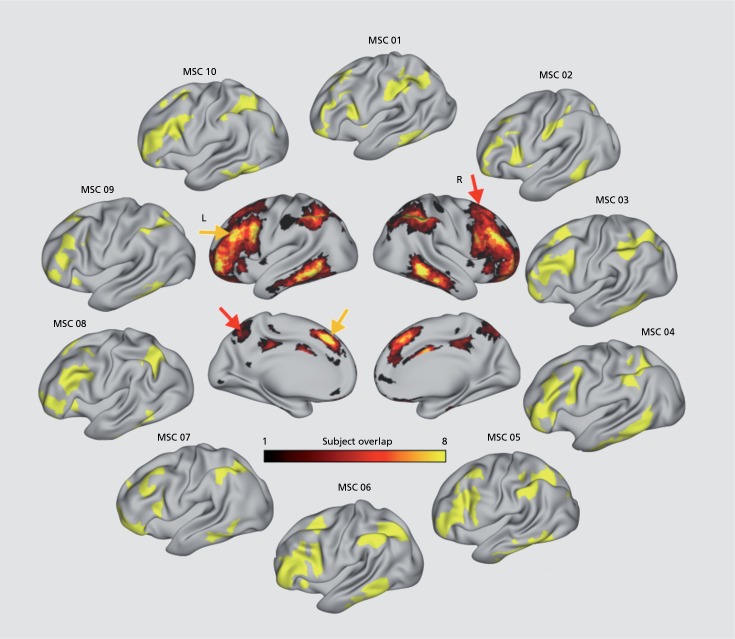
The frontoparietal network is critical for our ability to coordinate behavior in a rapid, accurate, and flexible goal-driven manner. In this review, we outline support for the framing of the frontoparietal network as a distinct control network, in part functioning to flexibly interact with and alter other functional brain networks. This network coordination likely occurs in a 4 Hz to 73 Hz θ/α rhythm, both during resting state and task state. Precision mapping of individual human brains has revealed that the functional topography of the frontoparietal network is variable between individuals, underscoring the notion that group-average studies of the frontoparietal network may be obscuring important typical and atypical features. Many forms of psychopathology implicate the frontoparietal network, such as schizophrenia and attention-deficit/hyperactivity disorder. Given the interindividual variability in frontoparietal network organization, clinical studies will likely benefit greatly from acquiring more individual subject data to accurately characterize resting-state networks compromised in psychopathology.
Overview
The claims and statistics of this paper haven’t been checked yet.
Free: it reads the open-access text and checks the first 5 claims that cite a source we can check. Create a free account to check every claim.
Integrity signals
Registry
Cites
Statistics
Figures
Verification
Claims the paper makes
The claims and statistics of this paper haven’t been checked yet.
Free: it reads the open-access text and checks the first 5 claims that cite a source we can check. Create a free account to check every claim.
Claims other papers make about this one
Each is checked against this paper’s own text: does it say what the citing paper says it does?
The source backs part of the claim, not all of it — or backs it for a different population, condition or comparison.
In the citing paper
“These dorsal cognitive regions connect to inferior parietal regions, forming the frontoparietal network [162–163]”
From Toward a neurocircuit-based taxonomy to guide treatment of obsessive-compulsive disorder (2021) · cites this paper as [162]
Experimental — accuracy not yet measuredIn the citing paper
“The most common target in MDD has been left dorsolateral prefrontal cortex (DLPFC), which is generally considered to be a node in the cognitive control network, albeit one that interfaces with the fronto-parietal attention network130.”
From Paying attention to attention in depression (2019) · cites this paper as [130]
Self-check
Percentages, sums and reported differences re-computed from the paper’s own numbers.
The self-check needs the paper’s full text.
Citations
Cites
The attention system of the human brain
Posner, M. I., & Petersen, S. E. (1990) · Annual Review of Neuroscience · doi:10.1146/annurev.ne.13.030190.000325 · Cited by 8,070
Saliency, switching, attention and control: a network model of insula function
Menon, V., & Uddin, L. Q. (2010) · Brain Structure and Function · doi:10.1007/s00429-010-0262-0 · Cited by 5,592
A mechanism for cognitive dynamics: neuronal communication through neuronal coherence.
Fries, P. (2005) · Trends in Cognitive Sciences · doi:10.1016/j.tics.2005.08.011 · Cited by 4,284
Functional Network Organization of the Human Brain
Power, J. D., Cohen, A. L., Nelson, S. M., Wig, G. S., Barnes, K. A., Church, J. A., Vogel, A. C., Laumann, T. O., Miezin, F. M., Schlaggar, B. L., et al. (2011) · Neuron · doi:10.1016/j.neuron.2011.09.006 · Cited by 4,124
EEG alpha oscillations: The inhibition–timing hypothesis
Klimesch, W., Sauseng, P., & Hanslmayr, S. (2007) · Brain Research Reviews · doi:10.1016/j.brainresrev.2006.06.003 · Cited by 3,891
Conflict monitoring and anterior cingulate cortex: an update
Botvinick, M. M., Cohen, J. D., & Carter, C. S. (2004) · Trends in Cognitive Sciences · doi:10.1016/j.tics.2004.10.003 · Cited by 3,623
The attention system of the human brain: 20 years after
Petersen, S. E., & Posner, M. I. (2012) · Annual Review of Neuroscience · doi:10.1146/annurev-neuro-062111-150525 · Cited by 3,439
Toward the future of psychiatric diagnosis: the seven pillars of RDoC
Cuthbert, B. N., & Insel, T. R. (2013) · BMC Medicine · doi:10.1186/1741-7015-11-126 · Cited by 3,053
Sridharan, D., Levitin, D. J., & Menon, V. (2008) · Proceedings of the National Academy of Sciences · doi:10.1073/pnas.0800005105 · Cited by 2,892
Neurocognitive deficit in schizophrenia: A quantitative review of the evidence.
Heinrichs, R. W., & Zakzanis, K. K. (1998) · Neuropsychology · doi:10.1037/0894-4105.12.3.426 · Cited by 2,798
Cited by
Items 801–837 of 837
Dimitriadis, S. I. (2026) · Brain Sciences · doi:10.3390/brainsci16080824
Omar, H., Hamid, A. I. A., Rahman, M. A., Noh, N. A., Yaacob, H. S., Chai, W. J., Idris, Z., Ahmad, A. H., Fitzrol, D. N., Ghani, A. R. I., et al. (2026) · PeerJ · doi:10.7717/peerj.21593
“Though this connection appears beneficial, nTBI participants still score significantly lower than HC, indicating persistent deficits in visual memory and cognitive control ( Corbetta, 2012 ; Marek & Dosenbach, 2018 ).”
Li, H., Ma, S., Yuan, X., Zhou, Z., Zhang, X., & Zhen, Z. (2026) · Research Square · doi:10.21203/rs.3.rs-10366368/v1
Chen, J., Wang, F., Dai, X., Jin, L., Wang, Z., Dang, L., Nianzha, D., Yang, J., Li, W., Wang, W., et al. (2026) · MedScience · doi:10.1007/s11684-026-1245-8
Sex differences in connectivity-based prediction of working memory and its neural organization
Zhuo, L., Xiong, R., Zhang, T., Wei, X., Zhang, J., Jin, Z., & Li, L. (2026) · Cognitive Neurodynamics · doi:10.1007/s11571-026-10525-0
“…whereas the frontoparietal network is more strongly involved in goal maintenance and cognitive control, this dissociation may reflect differences in task-related cognitive strategy rather than overall working memory ability (De La Vega et al. 2016 ; Marek and Dosenbach 2018; Chen et al. 2023 ).”
Ross, B. M. (2026) · Journal of Psychedelic Studies · doi:10.1556/2054.2026.00517
Liu, Y., Liu, H., & Kang, P. (2026) · Journal of Intelligence · doi:10.3390/jintelligence14080187
“At the neural-mechanism level, spatial representation encoding, maintenance, up-dating, retrieval, and strategy selection depend on distributed prefrontal, frontoparietal, hippocampal, retrosplenial, and sensorimotor systems (Bhattacharjee et al., 2021; Marek & Dosenbach, 2018; Murphy et al., 2020).”
Multiscale entropy is related to iron status in resting state EEG dataPreprint
Newbolds, S. F., & Wenger, M. J. (2026) · bioRxiv (Cold Spring Harbor Laboratory) · doi:10.64898/2026.08.11.744270
“Dopamine plays a central role in the frontalparietal control network (FPCN), which is heavily implicated in a variety of aspects of cognition (Dang, O’Neil, & Jagust, 2012; Marek & Dosenbach, 2018; Menon & D’Esposito, 2022).”
Abstract Representations of Sensorimotor Transformations in Human Premotor CortexPreprint
Kang, S., Trach, J. E., & McDougle, S. D. (2026) · bioRxiv (Cold Spring Harbor Laboratory) · doi:10.64898/2026.08.12.744241 · Cited by 1
“But abstract transformation-context encoding painted a different picture: in addition to premotor areas, the transformation searchlight map, while showing expectedly weaker effects, highlighted a collection of regions that resembled (in broad strokes) the fronto-parietal network (FPN) 55 .”
Márquez, A. C., Ampatzoglou, A., Rojas-Rincón, J., Fernández-Cardellach, C., Garcia-Casanovas, A., Fernández-Capo, M., Gámiz, M., Garolera, M., & Porras-García, B. (2026) · Depression and Anxiety · doi:10.1155/da/1162692 · Cited by 1
Shao, Y., Wu, B., Zhang, X., Zhang, Q., Zhang, B., Xu, K., Jiang, L., Roberts, N., & Jia, Z. (2026) · European Child & Adolescent Psychiatry · doi:10.1007/s00787-026-03174-5
Precuneus-Centered Network Reorganization Underlies Depressive Symptoms in Chronic Insomnia DisorderPreprint
chen, Y., Liu, D., He, Y., li, H., 王俊堯, zhong, S., Zhou, W., Xu, R., Gong, L., & Xi, C. (2026) · Research Square · doi:10.21203/rs.3.rs-9996627/v1
Longitudinal Brain Correlates of Cognitive Performance in Early PsychosisPreprint
Mignondje, K. A., Connolly, J. G., Beermann, A., Crabtree, E., Vandekar, S., Roeske, M. J., Biernacki, K., Coleman, M. J., Shenton, M. E., Brady, R. O., et al. (2026) · medRxiv · doi:10.64898/2026.08.28.26361680
“From a network perspective, the DMPFC serves as an important hub that links the frontoparietal and cingulo-opercular networks (43), networks critical for top-down cognitive control and tonic attention, respectively (45,46).”
Xu, X., Fu, Z., Xu, H., Zhang, K., Cong, J., Yang, H., Li, Y., Zhao, Y., Zheng, X., Keller, A. S., et al. (2026) · Nature Biomedical Engineering · doi:10.1038/s41551-026-01779-4
Punishment sensitivity and self-control: the role of motivation
Huang, J., Chen, L., Yao, Y., Feng, T., & Feng, P. (2026) · Cerebral Cortex · doi:10.1093/cercor/bhag134
Pham, M., Odutola, S., Pable, H., Chhabra, R., & D’Angiulli, A. (2026) · Journal of Integrative Neuroscience · doi:10.31083/jin52511
Wang, J., Lin, Y., Zhang, T., Xu, P., Lei, S., Yang, H., & Chen, Z. (2026) · CNS Neuroscience & Therapeutics · doi:10.1002/cns.71144
“The frontoparietal control network governs attention regulation and goal-directed behavior [39].”
Büchel, D., Blaschke, S. J., Krampe, L., Prockl, V., Klatt, S., & Wollesen, B. (2026) · Experimental Brain Research · doi:10.1007/s00221-026-07392-w
Kroupi, E., Araujo, H., Oosterveld, C., Timmermann, C., Rosas, F. E., Carhart-Harris, R. L., Ruffini, G., & Soria‐Frisch, A. (2026) · Brain Research · doi:10.1016/j.brainres.2026.150530 · Cited by 1
Neuroimaging in Hypertension: A Multifaceted Approach to Investigate the Brain
Ferla, S. L., & Carnevale, L. (2026) · Hypertension · doi:10.1161/hypertensionaha.126.26773
Guo, C., Long, Y., Wei, C., Nie, Z., Zhang, Y., Li, Y., Liu, C., & Shi, B. (2026) · Frontiers in Psychology · doi:10.3389/fpsyg.2026.1865823
“The FPN controls coordinated behavior in a rapid, accurate, and flexible goal-driven manner (Marek and Dosenbach, 2018).”
Li, Q., Xing, Y., Shan, Y., Yin, Y., Tang, Y., & Lu, J. (2026) · American Journal of Alzheimer s Disease & Other Dementias® · doi:10.1177/15333175261491804
Wong-Si-Kwie, S.-M., Köhler, R., Riley, S., Rodríguez, L., Babaeianjelodar, M., Cheng, A., Horien, C., Greene, A. S., Constable, R. T., Yip, S. W., et al. (2026) · Developmental Cognitive Neuroscience · doi:10.1016/j.dcn.2026.101823
“Prior literature suggests that the frontoparietal network, which is often implicated in working memory (Constantinidis and Klingberg, 2016; Rosenberg et al., 2020; Rottschy et al., 2012), is responsible for flexibly modulating cognitive control (Marek and Dosenbach, 2018).”
Ali, S. A., Demeter, D. V., Baim, A. R., Ahern, J., Ahn, J. H. B., Chang, S. E., Koithan, E. M., Park, S., Smarr, B. L., & Greene, D. J. (2026) · Frontiers in Network Physiology · doi:10.3389/fnetp.2026.1881914
“The FPN supports top-down regulatory control over motor output and goal-directed behavior (Marek and Dosenbach, 2018), and its apparent weaker coupling during periods of higher RMSSD in TS individuals may relate to reduced executive modulation of action-mode and somato-cognitive circuitry when…”
Xiao, Z., Xiao, X., Lu, J., Yang, Z., Jia, Y., & Zheng, Y. (2026) · Brain Sciences · doi:10.3390/brainsci16101021
“This network supports adaptive operations such as task switching, attentional reallocation, and goal-directed planning [43,46].”
RAAS/HPA axis abnormalities and hypothalamic connectivity in hypertension: A multimodal MRI study
Huang, R.-R., Lu, J.-J., Li, J., Ma, J., Jia-jia, W., Jin, J., Li, J.-L., Meng, F.-L., Fu, D., Hua, X., et al. (2026) · Brain Research Bulletin · doi:10.1016/j.brainresbull.2026.112140
Huang, K., Zhao, L., Wang, F., Li, Z., Gao, J., Ren, L., Chen, Y., Fu, Y., & Li, T. (2026) · Brain Sciences · doi:10.3390/brainsci16101024
“The correspondence between FPN representations and the three EEG frequency bands exhibited distinct temporal patterns, suggesting that the FPN may support functionally differentiated processes across different oscillatory frequencies [64,65].”
Ren, Y., Shao, T., Zhao, H., Huang, J., Yang, C., Xiong, Z., Shen, H., Zhang, Z., Liu, Y., Feng, T., et al. (2026) · Behavioural Brain Research · doi:10.1016/j.bbr.2026.116502
Psychedelics Restructure the Global Workspace of ConsciousnessPreprint
Yousefi, P., Shinozuka, K., Vizeli, P., Holze, F., Becker, A., Müller, F., Liechti, M. E., Hasler, G., Rodríguez, C. I., Luppi, A. I., et al. (2026) · bioRxiv (Cold Spring Harbor Laboratory) · doi:10.64898/2026.09.28.755172
“64,65 Importantly, the FPN was predominantly composed of broadcasters in our reference HCP data.”
Executive functions as a transdiagnostic endophenotype in developmental psychopathology
Braithwaite, E., Fielder, J. C., & Steinbeis, N. (2026) · Molecular Psychiatry · doi:10.1038/s41380-026-03916-6
Xu, Y., Yang, Z., Ouyang, G., He, Q., & Xu, M. (2026) · Developmental Cognitive Neuroscience · doi:10.1016/j.dcn.2026.101834
“…adolescence, however, individual differences in response inhibition may depend less on a single low-frequency spectral feature and more on the coordinated maturation of the prefrontal cortex and broader control networks (Constantinidis and Luna, 2019; Marek and Dosenbach, 2018; Ojha et al., 2022).”
Schulze, M., Manteufel, V., Aslan, B., Lux, S., & Philipsen, A. (2026) · European Archives of Psychiatry and Clinical Neuroscience · doi:10.1007/s00406-026-02409-5
Watters, H. N., Rashid, A. A., Suppiah, S., LaGrow, T. J., Hlinka, J., & Keilholz, S. D. (2026) · Frontiers in Neuroscience · doi:10.3389/fnins.2026.1948718
“…the executive control or control network (Witt et al., 2021) is associated with executive function and information selection (Scolari et al., 2015; Marek and Dosenbach, 2018), and has demonstrated reduced activity during distractor tasks among smartphone addicted subjects, with corresponding…”
Ali, A. M. S., Gorter, M., Zakaria, R., Jenkinson, M. D., Frank, B., Klein, M., Hamer, P. C. D. W., & Douw, L. (2026) · Brain stimulation · doi:10.1016/j.brs.2026.103226
Salameh, H., Muffel, T., Serhan, Y., Samara, M., Nenning, K., Hertz, U., Villringer, A., Sehm, B., & Ovadia‐Caro, S. (2026) · Scientific Reports · doi:10.1038/s41598-026-75450-y
“The motor network and the control network are known to constantly interact during both motor execution 49–51 and motor learning 52–55 to support effortless goal-directed behavior 51,56 .”
Shao, H., Zhou, Z., Huang, X., Zhang, L., Hu, X., Gao, Y., Li, H., Kuang, W., Qiyong, G. O. N. G., & Huang, X. (2026) · Progress in Neuro-Psychopharmacology and Biological Psychiatry · doi:10.1016/j.pnpbp.2026.111986
Yang, L., He, F., Yuan, D., Yang, T., Zhang, L., Chen, Y., Luo, J., Li, Y., Yang, X., & Li, Z. (2026) · ALPHA PSYCHIATRY · doi:10.31083/ap51187
Metadata
- Authors
- Marek, S., & Dosenbach, N. U. F.
- Affiliations
- Washington University in St. Louis (US)
- Corresponding author
- Marek, Scott
- Venue
- Dialogues in Clinical Neuroscience
- Publisher
- Informa UK Limited
- Published
- 2018-06-30
- Volume
- 20
- Issue
- 2
- Pages
- 133-140
- ISSN
- 1294-8322 (ISSN-L)
- 1958-5969
- PMC
- PMC6136121
- OpenAlex
- W2989074529
- Cited by
- 836
- References
- 63
- Citations by year
- 2026: 136 · 2025: 142 · 2024: 131 · 2023: 113 · 2022: 124 · 2021: 93 · 2020: 77 · 2019: 17 · 2018: 2
- FWCI
- 28.14
- Type
- journal article
- Language
- en
- Open access
- diamond
- doi.org
- Licence
- Locations
- Dialogues in Clinical Neuroscience (publishedVersion, cc-by-nc-nd)
- Europe PMC (PubMed Central) (publishedVersion, cc-by-nc-nd)
- PubMed Central (publishedVersion, cc-by-nc-nd)
- PubMed (publishedVersion)
- Funders
- National Institutes of Health (UL1TR000448, UL1TR002345)
- National Institute of Mental Health (T32MH100019)
- National Institute of Neurological Disorders and Stroke (K23NS088590, P30NS098577)
- National Center for Advancing Translational Sciences
- Eunice Kennedy Shriver National Institute of Child Health and Human Development (U54HD087011)
- Topics
- Life Sciences › Neuroscience › Cognitive Neuroscience › Functional Brain Connectivity Studies
- Life Sciences › Neuroscience › Cognitive Neuroscience › Neural and Behavioral Psychology Studies
- Life Sciences › Neuroscience › Cognitive Neuroscience › Neural dynamics and brain function
- Keywords
- frontoparietal network, control network, interindividual variability, theta-alpha oscillations, resting-state networks, schizophrenia, attention deficit hyperactivity disorder, functional topography, electrophysiology
- MeSH terms
- Animals, Attention Deficit Disorder with Hyperactivity, Brain, Brain Mapping, Humans, Nerve Net, Neural Pathways, Electrophysiological Phenomena
About these checks
Registry, retraction, Cites and statistics results are computed, not judged, with one exception: a printed reference that no index lists is read once by a model before it counts as a citation error. Claims are extracted by a model and kept only when their quote appears verbatim in the text; each cited source is then checked, with a model’s help, for whether it says what the claim relies on. Those verdicts can be wrong — read the claim’s quote and the cited source before relying on one.
Statistics and arithmetic are recomputed, not judged.
Confidence bands are shown only for fields calibrated on our annotated test set. None is calibrated yet, so no band is shown.
What counts as a claim ›How we measure confidence ›How we check this ›
Are you an author, or do you see a problem with this page? Request a review
Data sources
Bibliographic data: Semantic Scholar, OpenAlex, Crossref.
Contains information from the Semantic Scholar Academic Graph Datasets, made available under the ODC Attribution License (ODC-BY 1.0).
Semantic Scholar’s data is described in: Kinney, R., et al. (2023). The Semantic Scholar Open Data Platform. arXiv:2301.10140.
