

The frontoparietal network: function, electrophysiology, and importance of individual precision mapping
Open accessThe DOI matches its Crossref record; 63 of the 63 references it cites were found in a registry or an index.
Abstract
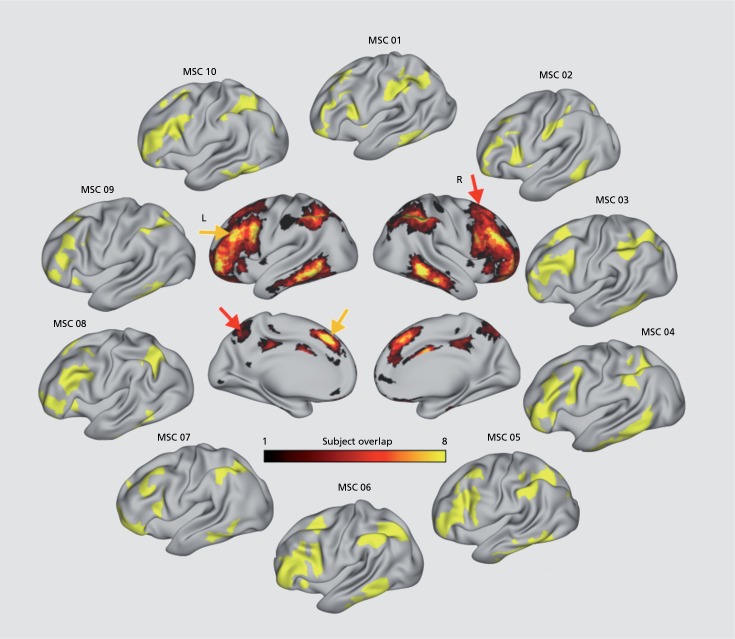
The frontoparietal network is critical for our ability to coordinate behavior in a rapid, accurate, and flexible goal-driven manner. In this review, we outline support for the framing of the frontoparietal network as a distinct control network, in part functioning to flexibly interact with and alter other functional brain networks. This network coordination likely occurs in a 4 Hz to 73 Hz θ/α rhythm, both during resting state and task state. Precision mapping of individual human brains has revealed that the functional topography of the frontoparietal network is variable between individuals, underscoring the notion that group-average studies of the frontoparietal network may be obscuring important typical and atypical features. Many forms of psychopathology implicate the frontoparietal network, such as schizophrenia and attention-deficit/hyperactivity disorder. Given the interindividual variability in frontoparietal network organization, clinical studies will likely benefit greatly from acquiring more individual subject data to accurately characterize resting-state networks compromised in psychopathology.
Overview
The claims and statistics of this paper haven’t been checked yet.
Free: it reads the open-access text and checks the first 5 claims that cite a source we can check. Create a free account to check every claim.
Integrity signals
Registry
Cites
Statistics
Figures
Verification
Claims the paper makes
The claims and statistics of this paper haven’t been checked yet.
Free: it reads the open-access text and checks the first 5 claims that cite a source we can check. Create a free account to check every claim.
Claims other papers make about this one
Each is checked against this paper’s own text: does it say what the citing paper says it does?
The source backs part of the claim, not all of it — or backs it for a different population, condition or comparison.
In the citing paper
“These dorsal cognitive regions connect to inferior parietal regions, forming the frontoparietal network [162–163]”
From Toward a neurocircuit-based taxonomy to guide treatment of obsessive-compulsive disorder (2021) · cites this paper as [162]
Experimental — accuracy not yet measuredIn the citing paper
“The most common target in MDD has been left dorsolateral prefrontal cortex (DLPFC), which is generally considered to be a node in the cognitive control network, albeit one that interfaces with the fronto-parietal attention network130.”
From Paying attention to attention in depression (2019) · cites this paper as [130]
Self-check
Percentages, sums and reported differences re-computed from the paper’s own numbers.
The self-check needs the paper’s full text.
Citations
Cites
The attention system of the human brain
Posner, M. I., & Petersen, S. E. (1990) · Annual Review of Neuroscience · doi:10.1146/annurev.ne.13.030190.000325 · Cited by 8,070
Saliency, switching, attention and control: a network model of insula function
Menon, V., & Uddin, L. Q. (2010) · Brain Structure and Function · doi:10.1007/s00429-010-0262-0 · Cited by 5,592
A mechanism for cognitive dynamics: neuronal communication through neuronal coherence.
Fries, P. (2005) · Trends in Cognitive Sciences · doi:10.1016/j.tics.2005.08.011 · Cited by 4,284
Functional Network Organization of the Human Brain
Power, J. D., Cohen, A. L., Nelson, S. M., Wig, G. S., Barnes, K. A., Church, J. A., Vogel, A. C., Laumann, T. O., Miezin, F. M., Schlaggar, B. L., et al. (2011) · Neuron · doi:10.1016/j.neuron.2011.09.006 · Cited by 4,124
EEG alpha oscillations: The inhibition–timing hypothesis
Klimesch, W., Sauseng, P., & Hanslmayr, S. (2007) · Brain Research Reviews · doi:10.1016/j.brainresrev.2006.06.003 · Cited by 3,891
Conflict monitoring and anterior cingulate cortex: an update
Botvinick, M. M., Cohen, J. D., & Carter, C. S. (2004) · Trends in Cognitive Sciences · doi:10.1016/j.tics.2004.10.003 · Cited by 3,623
The attention system of the human brain: 20 years after
Petersen, S. E., & Posner, M. I. (2012) · Annual Review of Neuroscience · doi:10.1146/annurev-neuro-062111-150525 · Cited by 3,439
Toward the future of psychiatric diagnosis: the seven pillars of RDoC
Cuthbert, B. N., & Insel, T. R. (2013) · BMC Medicine · doi:10.1186/1741-7015-11-126 · Cited by 3,053
Sridharan, D., Levitin, D. J., & Menon, V. (2008) · Proceedings of the National Academy of Sciences · doi:10.1073/pnas.0800005105 · Cited by 2,892
Neurocognitive deficit in schizophrenia: A quantitative review of the evidence.
Heinrichs, R. W., & Zakzanis, K. K. (1998) · Neuropsychology · doi:10.1037/0894-4105.12.3.426 · Cited by 2,798
Frontal theta as a mechanism for cognitive control
Cavanagh, J. F., & Frank, M. J. (2014) · Trends in Cognitive Sciences · doi:10.1016/j.tics.2014.04.012 · Cited by 2,726
Rhythms for cognition: communication through coherence
Fries, P. (2015) · Neuron · doi:10.1016/j.neuron.2015.09.034 · Cited by 2,725
Distinct brain networks for adaptive and stable task control in humans
Dosenbach, N. U. F., Fair, D. A., Miezin, F. M., Cohen, A. L., Wenger, K. K., Dosenbach, R. A. T., Fox, M. D., Snyder, A. Z., Vincent, J. L., Raichle, M. E., et al. (2007) · Proceedings of the National Academy of Sciences · doi:10.1073/pnas.0704320104 · Cited by 2,632
Self-citationThe expected value of control: an integrative theory of anterior cingulate cortex function
Shenhav, A., Botvinick, M. M., & Cohen, J. D. (2013) · Neuron · doi:10.1016/j.neuron.2013.07.007 · Cited by 2,321
Salience processing and insular cortical function and dysfunction
Uddin, L. Q. (2015) · Nature Reviews Neuroscience · doi:10.1038/nrn3857 · Cited by 2,083
A dual-networks architecture of top-down control
Dosenbach, N. U. F., Fair, D. A., Cohen, A. L., Schlaggar, B. L., & Petersen, S. E. (2008) · Trends in Cognitive Sciences · doi:10.1016/j.tics.2008.01.001 · Cited by 1,931
Self-citationA Core System for the Implementation of Task Sets
Dosenbach, N. U. F., Visscher, K. M., Palmer, E. D., Miezin, F. M., Wenger, K. K., Kang, H. C., Burgund, E. D., Grimes, A. L., Schlaggar, B. L., & Petersen, S. E. (2006) · Neuron · doi:10.1016/j.neuron.2006.04.031 · Cited by 1,772
Self-citationMulti-task connectivity reveals flexible hubs for adaptive task control
Cole, M. W., Reynolds, J. R., Power, J. D., Repovs, G., Anticevic, A., & Braver, T. S. (2013) · Nature Neuroscience · doi:10.1038/nn.3470 · Cited by 1,704
Intrinsic and task-evoked network architectures of the human brain
Cole, M. W., Bassett, D. S., Power, J. D., Braver, T. S., & Petersen, S. E. (2014) · Neuron · doi:10.1016/j.neuron.2014.05.014 · Cited by 1,564
von Stein, A., & Sarnthein, J. (2000) · International Journal of Psychophysiology · doi:10.1016/s0167-8760(00)00172-0 · Cited by 1,553
Top-down modulation: bridging selective attention and working memory
Gazzaley, A., & Nobre, A. C. (2012) · Trends in Cognitive Sciences · doi:10.1016/j.tics.2011.11.014 · Cited by 1,404
Precision Functional Mapping of Individual Human Brains
Gordon, E. M., Laumann, T. O., Gilmore, A. W., Newbold, D. J., Greene, D. J., Berg, J. J., Ortega, M., Hoyt-Drazen, C., Gratton, C., Sun, H., et al. (2017) · Neuron · doi:10.1016/j.neuron.2017.07.011 · Cited by 1,335
Self-citationLarge-scale cortical correlation structure of spontaneous oscillatory activity
Hipp, J. F., Hawellek, D. J., Corbetta, M., Siegel, M., & Engel, A. K. (2012) · Nature Neuroscience · doi:10.1038/nn.3101 · Cited by 1,113
Cortical parvalbumin interneurons and cognitive dysfunction in schizophrenia
Lewis, D. A., Curley, A. A., Glausier, J. R., & Volk, D. W. (2012) · Trends in Neurosciences · doi:10.1016/j.tins.2011.10.004 · Cited by 1,071
Functional system and areal organization of a highly sampled individual human brain
Laumann, T. O., Gordon, E. M., Adeyemo, B., Snyder, A. Z., Joo, S. J., Chen, M.-Y., Gilmore, A. W., McDermott, K. B., Nelson, S. M., Dosenbach, N. U. F., et al. (2015) · Neuron · doi:10.1016/j.neuron.2015.06.037 · Cited by 911
Self-citationNeural mechanisms of transient and sustained cognitive control during task switching.
Braver, T. S., Reynolds, J. R., & Donaldson, D. I. (2003) · Neuron · doi:10.1016/s0896-6273(03)00466-5 · Cited by 826
Evidence for hubs in human functional brain networks
Power, J. D., Schlaggar, B. L., Lessov-Schlaggar, C. N., & Petersen, S. E. (2013) · Neuron · doi:10.1016/j.neuron.2013.07.035 · Cited by 716
Causal role of the prefrontal cortex in top-down modulation of visual processing and working memory
Zanto, T. P., Rubens, M. T., Thangavel, A., & Gazzaley, A. (2011) · Nature Neuroscience · doi:10.1038/nn.2773 · Cited by 661
The Contribution of the Anterior Cingulate Cortex to Executive Processes in Cognition
Carter, C. S., Botvinick, M. M., & Cohen, J. D. (1999) · Reviews in the Neurosciences · doi:10.1515/revneuro.1999.10.1.49 · Cited by 626
Ptak, R. (2012) · The Neuroscientist · doi:10.1177/1073858411409051 · Cited by 597
Neurophysiology of the BOLD fMRI Signal in Awake Monkeys
Goense, J. B. M., & Logothetis, N. K. (2008) · Current Biology · doi:10.1016/j.cub.2008.03.054 · Cited by 583
Identifying the brain's most globally connected regions
Cole, M. W., Pathak, S., & Schneider, W. (2010) · NeuroImage · doi:10.1016/j.neuroimage.2009.11.001 · Cited by 565
The functional architecture of the infant brain as revealed by resting-state fMRI
Fransson, P., Åden, U., Blennow, M., & Lagercrantz, H. (2011) · Cerebral Cortex · doi:10.1093/cercor/bhq071 · Cited by 542
Cognitive Control Deficits in Schizophrenia: Mechanisms and Meaning
Lesh, T. A., Niendam, T. A., Minzenberg, M. J., & Carter, C. S. (2011) · Neuropsychopharmacology · doi:10.1038/npp.2010.156 · Cited by 506
Functional Roles of Alpha-Band Phase Synchronization in Local and Large-Scale Cortical Networks
Palva, S., & Palva, J. M. (2011) · Frontiers in Psychology · doi:10.3389/fpsyg.2011.00204 · Cited by 474
IQ and risk for schizophrenia: a population-based cohort study
DAVID, A. S., MALMBERG, A., BRANDT, L., ALLEBECK, P., & LEWIS, G. (1997) · Psychological Medicine · doi:10.1017/s0033291797005680 · Cited by 467
The Frontoparietal Control System: A Central Role in Mental Health
Cole, M. W., Repovš, G., & Anticevic, A. (2014) · The Neuroscientist · doi:10.1177/1073858414525995 · Cited by 461
A framework for local cortical oscillation patterns
Donner, T. H., & Siegel, M. (2011) · Trends in Cognitive Sciences · doi:10.1016/j.tics.2011.03.007 · Cited by 444
Grayson, D. S., & Fair, D. A. (2017) · NeuroImage · doi:10.1016/j.neuroimage.2017.01.079 · Cited by 411
Development of human brain cortical network architecture during infancy
Gao, W., Alcauter, S., Smith, J. K., Gilmore, J. H., & Lin, W. (2015) · Brain Structure and Function · doi:10.1007/s00429-014-0710-3 · Cited by 356
The contribution of network organization and integration to the development of cognitive control
Marek, S., Hwang, K., Foran, W., Hallquist, M. N., & Luna, B. (2015) · PLOS Biology · doi:10.1371/journal.pbio.1002328 · Cited by 337
Self-citationOscillatory Dynamics of Prefrontal Cognitive Control
Helfrich, R. F., & Knight, R. T. (2016) · Trends in Cognitive Sciences · doi:10.1016/j.tics.2016.09.007 · Cited by 315
Brain Network Connectivity in Individuals with Schizophrenia and Their Siblings
Repovs, G., Csernansky, J. G., & Barch, D. M. (2011) · Biological Psychiatry · doi:10.1016/j.biopsych.2010.11.009 · Cited by 292
Ploran, E. J., Nelson, S. M., Velanova, K., Donaldson, D. I., Petersen, S. E., & Wheeler, M. E. (2007) · The Journal of Neuroscience · doi:10.1523/jneurosci.3522-07.2007 · Cited by 282
Haegens, S., Osipova, D., Oostenveld, R., & Jensen, O. (2010) · Human Brain Mapping · doi:10.1002/hbm.20842 · Cited by 272
Alpha-Band Phase Synchrony Is Related to Activity in the Fronto-Parietal Adaptive Control Network
Sadaghiani, S., Scheeringa, R., Lehongre, K., Morillon, B., Giraud, A.-L., D'Esposito, M., & Kleinschmidt, A. (2012) · The Journal of Neuroscience · doi:10.1523/jneurosci.1358-12.2012 · Cited by 262
Task Switching and Novelty Processing Activate a Common Neural Network for Cognitive Control
Barcelo, F., Escera, C., Corral, M. J., & Periáñez, J. A. (2006) · Journal of Cognitive Neuroscience · doi:10.1162/jocn.2006.18.10.1734 · Cited by 235
Variable Global Dysconnectivity and Individual Differences in Schizophrenia
Cole, M. W., Anticevic, A., Repovs, G., & Barch, D. (2011) · Biological Psychiatry · doi:10.1016/j.biopsych.2011.02.010 · Cited by 227
Functional brain networks related to individual differences in human intelligence at rest
Hearne, L. J., Mattingley, J. B., & Cocchi, L. (2016) · Scientific Reports · doi:10.1038/srep32328 · Cited by 207
Frontoparietal and Cingulo-opercular Networks Play Dissociable Roles in Control of Working Memory
Wallis, G., Stokes, M., Cousijn, H., Woolrich, M., & Nobre, A. C. (2015) · Journal of Cognitive Neuroscience · doi:10.1162/jocn_a_00838 · Cited by 205
Think differently: a brain orienting response to task novelty
Barcel??, F., Peri????ez, J. A., & Knight, R. T. (2002) · NeuroReport · doi:10.1097/00001756-200210280-00011 · Cited by 201
Fronto-parietal and cingulo-opercular network integrity and cognition in health and schizophrenia
Sheffield, J. M., Repovs, G., Harms, M. P., Carter, C. S., Gold, J. M., MacDonald III, A. W., Daniel Ragland, J., Silverstein, S. M., Godwin, D., & Barch, D. M. (2015) · Neuropsychologia · doi:10.1016/j.neuropsychologia.2015.05.006 · Cited by 187
Top–Down Attentional Deficits in Macaques with Lesions of Lateral Prefrontal Cortex
Rossi, A. F., Bichot, N. P., Desimone, R., & Ungerleider, L. G. (2007) · The Journal of Neuroscience · doi:10.1523/jneurosci.2939-07.2007 · Cited by 172
Wang, L., Saalmann, Y. B., Pinsk, M. A., Arcaro, M. J., & Kastner, S. (2012) · Neuron · doi:10.1016/j.neuron.2012.09.033 · Cited by 158
Frequency-specific electrophysiologic correlates of resting state fMRI networks
Hacker, C. D., Snyder, A. Z., Pahwa, M., Corbetta, M., & Leuthardt, E. C. (2017) · NeuroImage · doi:10.1016/j.neuroimage.2017.01.054 · Cited by 148
Transdiagnostic Associations Between Functional Brain Network Integrity and Cognition
Sheffield, J. M., Kandala, S., Tamminga, C. A., Pearlson, G. D., Keshavan, M. S., Sweeney, J. A., Clementz, B. A., Lerman-Sinkoff, D. B., Hill, S. K., & Barch, D. M. (2017) · JAMA Psychiatry · doi:10.1001/jamapsychiatry.2017.0669 · Cited by 127
Anticevic, A., Repovs, G., & Barch, D. M. (2013) · Schizophrenia Bulletin · doi:10.1093/schbul/sbr107 · Cited by 115
Lateral Prefrontal Cortex Contributes to Fluid Intelligence Through Multinetwork Connectivity
Cole, M. W., Ito, T., & Braver, T. S. (2015) · Brain Connectivity · doi:10.1089/brain.2015.0357 · Cited by 100
Evolution of brain network dynamics in neurodevelopment
Chai, L. R., Khambhati, A. N., Ciric, R., Moore, T. M., Gur, R. C., Gur, R. E., Satterthwaite, T. D., & Bassett, D. S. (2017) · Network Neuroscience · doi:10.1162/netn_a_00001 · Cited by 100
Koch, S. P., Werner, P., Steinbrink, J., Fries, P., & Obrig, H. (2009) · The Journal of Neuroscience · doi:10.1523/jneurosci.1402-09.2009 · Cited by 87
Knekt, P., Lindfors, O., Sares‐Jäske, L., Virtala, E. T., & Härkänen, T. (2012) · Nordic Journal of Psychiatry · doi:10.3109/08039488.2012.680910 · Cited by 87
Sylvester, C. M., Barch, D. M., Corbetta, M., Power, J. D., Schlaggar, B. L., & Luby, J. L. (2013) · Journal of the American Academy of Child & Adolescent Psychiatry · doi:10.1016/j.jaac.2013.10.001 · Cited by 78
Cole, M. W., Braver, T. S., & Meiran, N. (2017) · Neuroscience & Biobehavioral Reviews · doi:10.1016/j.neubiorev.2017.02.009 · Cited by 66
Cited by
Paying attention to attention in depression
Keller, A. S., Leikauf, J. E., Holt-Gosselin, B., Staveland, B. R., & Williams, L. M. (2019) · Translational Psychiatry · doi:10.1038/s41398-019-0616-1 · Cited by 329
Spatial and Temporal Organization of the Individual Human Cerebellum
Marek, S., Siegel, J. S., Gordon, E. M., Raut, R. V., Gratton, C., Newbold, D. J., Ortega, M., Laumann, T. O., Adeyemo, B., Miller, D. B., et al. (2018) · Neuron · doi:10.1016/j.neuron.2018.10.010 · Cited by 289
Self-citationIndividual Variation in Functional Topography of Association Networks in Youth
Cui, Z., Li, H., Xia, C. H., Larsen, B., Adebimpe, A., Baum, G. L., Cieslak, M., Gur, R. E., Gur, R. C., Moore, T. M., et al. (2020) · Neuron · doi:10.1016/j.neuron.2020.01.029 · Cited by 269
Global waves synchronize the brain’s functional systems with fluctuating arousal
Raut, R. V., Snyder, A. Z., Mitra, A., Yellin, D., Fujii, N., Malach, R., & Raichle, M. E. (2021) · Science Advances · doi:10.1126/sciadv.abf2709 · Cited by 260
“Thus, FC most strongly distinguishes between two major, distributed functional brain systems (12, 17): an extrinsic system comprising sensorimotor and “task-positive” (44) regions and an intrinsic system comprising the default mode network (“task-negative”) and frontoparietal regions that preferentially respond to cha…”
BackgroundToward a neurocircuit-based taxonomy to guide treatment of obsessive-compulsive disorder
Shephard, E., Stern, E. R., van den Heuvel, O. A., Costa, D. L. C., Batistuzzo, M. C., Godoy, P. B. G., Lopes, A. C., Brunoni, A. R., Hoexter, M. Q., Shavitt, R. G., et al. (2021) · Molecular Psychiatry · doi:10.1038/s41380-020-01007-8 · Cited by 250
Metadata
- Authors
- Marek, S., & Dosenbach, N. U. F.
- Affiliations
- Washington University in St. Louis (US)
- Corresponding author
- Marek, Scott
- Venue
- Dialogues in Clinical Neuroscience
- Publisher
- Informa UK Limited
- Published
- 2018-06-30
- Volume
- 20
- Issue
- 2
- Pages
- 133-140
- ISSN
- 1294-8322 (ISSN-L)
- 1958-5969
- PMC
- PMC6136121
- OpenAlex
- W2989074529
- Cited by
- 836
- References
- 63
- Citations by year
- 2026: 136 · 2025: 142 · 2024: 131 · 2023: 113 · 2022: 124 · 2021: 93 · 2020: 77 · 2019: 17 · 2018: 2
- FWCI
- 28.14
- Type
- journal article
- Language
- en
- Open access
- diamond
- doi.org
- Licence
- Locations
- Dialogues in Clinical Neuroscience (publishedVersion, cc-by-nc-nd)
- Europe PMC (PubMed Central) (publishedVersion, cc-by-nc-nd)
- PubMed Central (publishedVersion, cc-by-nc-nd)
- PubMed (publishedVersion)
- Funders
- National Institutes of Health (UL1TR000448, UL1TR002345)
- National Institute of Mental Health (T32MH100019)
- National Institute of Neurological Disorders and Stroke (K23NS088590, P30NS098577)
- National Center for Advancing Translational Sciences
- Eunice Kennedy Shriver National Institute of Child Health and Human Development (U54HD087011)
- Topics
- Life Sciences › Neuroscience › Cognitive Neuroscience › Functional Brain Connectivity Studies
- Life Sciences › Neuroscience › Cognitive Neuroscience › Neural and Behavioral Psychology Studies
- Life Sciences › Neuroscience › Cognitive Neuroscience › Neural dynamics and brain function
- Keywords
- frontoparietal network, control network, interindividual variability, theta-alpha oscillations, resting-state networks, schizophrenia, attention deficit hyperactivity disorder, functional topography, electrophysiology
- MeSH terms
- Animals, Attention Deficit Disorder with Hyperactivity, Brain, Brain Mapping, Humans, Nerve Net, Neural Pathways, Electrophysiological Phenomena
About these checks
Registry, retraction, Cites and statistics results are computed, not judged, with one exception: a printed reference that no index lists is read once by a model before it counts as a citation error. Claims are extracted by a model and kept only when their quote appears verbatim in the text; each cited source is then checked, with a model’s help, for whether it says what the claim relies on. Those verdicts can be wrong — read the claim’s quote and the cited source before relying on one.
Statistics and arithmetic are recomputed, not judged.
Confidence bands are shown only for fields calibrated on our annotated test set. None is calibrated yet, so no band is shown.
What counts as a claim ›How we measure confidence ›How we check this ›
Are you an author, or do you see a problem with this page? Request a review
Data sources
Bibliographic data: Semantic Scholar, OpenAlex, Crossref.
Contains information from the Semantic Scholar Academic Graph Datasets, made available under the ODC Attribution License (ODC-BY 1.0).
Semantic Scholar’s data is described in: Kinney, R., et al. (2023). The Semantic Scholar Open Data Platform. arXiv:2301.10140.
