

The relationship of muscle oxygen saturation analyzer with other monitoring and quantification tools in a maximal incremental treadmill test
Open accessThe DOI matches its Crossref record; 38 of the 41 references it cites were found in a registry or an index; 6 of the 33 sources its claims cite were checked for support.
Abstract
Introduction: The study aims to explore whether NIRS derived data can be used to identify the second ventilatory threshold (VT2) during a maximal incremental treadmill test in non-professional runners and to determine if there is a correlation between SmO 2 and other valid and reliable exercise performance assessment measures or parameters for maximal incremental test, such as lactate concentration (LT), RPE, HR, and running power (W). Methods: 24 participants were recruited for the study (5 women and 19 men). The devices used consisted of the following: i) a muscle oxygen saturation analyzer placed on the vastus lateralis of the right leg, ii) the Stryd power meter for running, iii) the Polar H7 heart rate band; and iv) the lactate analyzer. In addition, a subjective perceived exertion scale (RPE 1-10) was used. All of the previously mentioned devices were used in a maximal incremental treadmill test, which began at a speed of 8 km/h with a 1% slope and a speed increase of 1.2 km/h every 3 min. This was followed by a 30-s break to collect the lactate data between each 3-min stage. Spearman correlation was carried out and the level of significance was set at p < 0.05. Results: The VT2 was observed at 87,41 ± 6,47% of the maximal aerobic speed (MAS) of each participant. No relationship between lactate data and SmO 2 values (p = 0.076; r = −0.156) at the VT2 were found. No significant correlations were found between the SmO 2 variables and the other variables (p > 0.05), but a high level of significance and strong correlations were found between all the following variables: power data (W), heart rate (HR), lactate concentration (LT) and RPE (p < 0.05; r > 0.5). Discussion: SmO 2 data alone were not enough to determine the VT2, and there were no significant correlations between SmO 2 and the other studied variables during the maximal incremental treadmill test. Only 8 subjects had a breakpoint at the VT2 determined by lactate data. Conclusion: The NIRS tool, Humon Hex, does not seem to be useful in determining VT2 and it does not correlate with the other variables in a maximal incremental treadmill test.
Overview
CoChat Summary
TL;DR
In 21 non-professional runners, the Humon Hex NIRS-derived muscle oxygen saturation (SmO2) did not identify the second ventilatory threshold (VT2) during a maximal incremental treadmill test and showed no significant correlations with lactate, heart rate, running power, or RPE. In contrast, lactate, heart rate, running power, and RPE were strongly intercorrelated.
Key findings
- VT2 occurred at 87.41 ± 6.47% of maximal aerobic speed (MAS), corresponding to 12.62 ± 1.87 km/h, RPE 6.58 ± 1.77, heart rate 177.74 ± 12.63 bpm, power 252.79 ± 32.94 W, and SmO2 60.47 ± 8.25.
- SmO2 did not correlate with lactate at VT2 (p = 0.076; r = −0.156) or with HR (r = −0.028; p = 0.752), running power (r = 0.047; p = 0.593), RPE (r = 0.035; p = 0.692), or lactate overall (r = −0.118; p = 0.177).
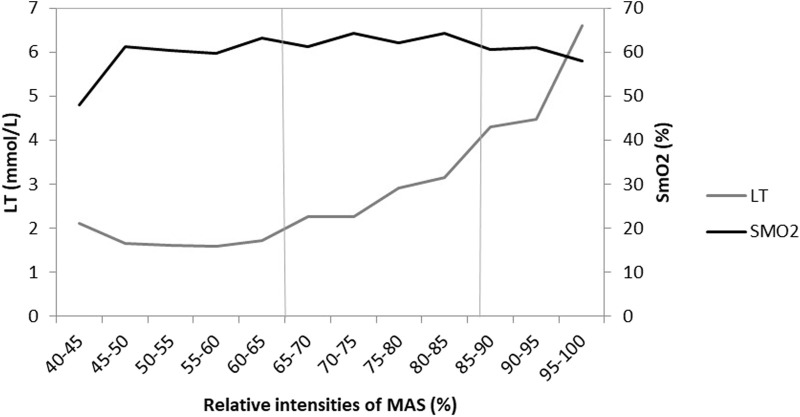
- Only 8 of 21 participants had an SmO2 breakpoint at the VT2 determined by lactate data; 10 had no inflection point and 3 did not reach 4 mmol/L to determine VT2.
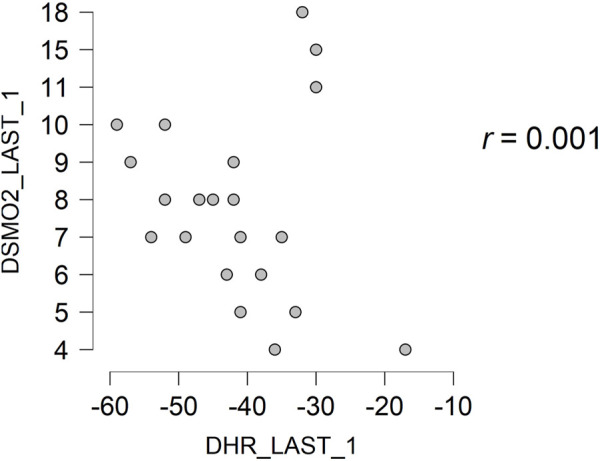
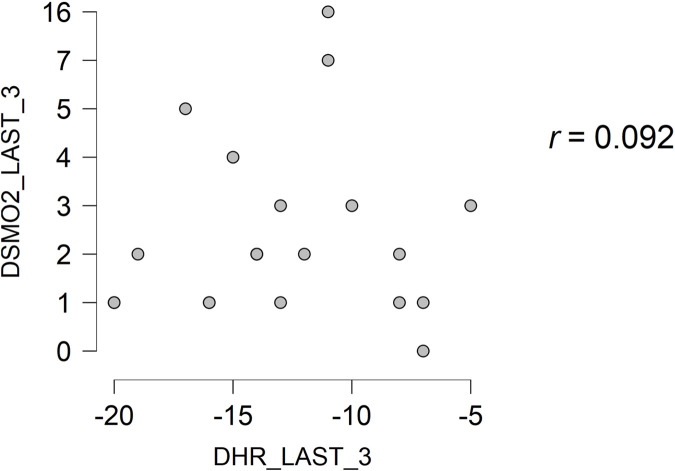
- Running power, HR, lactate, and RPE were significantly correlated (p < 0.05; r > 0.5), including W–RPE r = 0.808, HR–RPE r = 0.776, LT–RPE r = 0.769, HR–LT r = 0.717, W–LT r = 0.716, and HR–W r = 0.598; recovery SmO2 vs HR correlations were null (last step to first minute: r = 0.001, p = 0.997; first minute to 3 minutes: r = 0.092, p = 0.690).
Methods
- Cross-sectional study; 24 participants recruited, 3 excluded for erroneous SmO2 measurements, leaving 21 (5 women, 16 men; age 23.19 ± 4.18 years, weight 68.93 ± 10.99 kg, height 1.75 ± 0.12 m). Inclusion required moderate exercise ≥3 days/week for 30 min over the last 6 months and no injury/disease; athletics license was exclusionary.
- Maximal incremental treadmill test began at 8 km/h with 1% slope, increased 1.2 km/h every 3 min, with a 30-s stop between stages for lactate collection; test ended after 10 stages or volitional fatigue, followed by 3 min recovery at 6 km/h. Devices: Humon Hex on right vastus lateralis, Stryd power meter on right shoe laces, Polar H7 heart rate band, Lactate Pro 2 from right earlobe, and RPE 1–10.
- Normality assessed with Shapiro-Wilk (p > 0.05); Spearman correlations used, significance set at p < 0.05; analyses performed in JASP 0.14.1.0; descriptive data as mean ± SD.
Limitations
- Stated in the paper: small sample size (n = 21), only 5 women, and subcutaneous tissue could not be measured.
- Stated/discussed in the paper: the 30-s break between stages may have allowed muscle recovery and affected threshold determination; 3 participants were excluded due to erroneous SmO2 measurements from device movement or a device limitation; NIRS measures only a local muscle, and running-related factors such as oscillation, muscle contractions, impact, and sweat may affect accuracy.
- Evident from the text: VT2 was determined using lactate thresholds rather than direct ventilatory gas exchange, and no gas analyzer data are reported; the cross-sectional design cannot establish causality.
Model-written summary. Check it against the paper before relying on it.
Integrity signals
Registry
Cites
Statistics
Figures
Verification
Claims the paper makes
4 Valid · 1 Not valid · 17 Not checked · 34 Own results and interpretations
A result the paper reports from its own data — it cites no other source for it, so there is none to check. The quote shows it is in the paper.
In the paper
“Most of the participants have their second lactate threshold between stage 4 and 5, and these stages have a speed of 11.6 km/h and 12.8 km/h.”
§ The relationship of muscle oxygen saturation analyzer with other monitoring and quantification tools in a maximal incremental treadmill test > 4 Results
plain- Asserted: passes — The authors put it forward as true.
- Checkable: passes — It can be checked against evidence.
- Load-bearing: unclear — It is unclear whether the paper’s conclusions depend on it.
- Based: passes — The paper gives a reason why it holds.
A result the paper reports from its own data — it cites no other source for it, so there is none to check. The quote shows it is in the paper.
In the paper
“SmO2 = 60.47 ± 8.25.”
§ The relationship of muscle oxygen saturation analyzer with other monitoring and quantification tools in a maximal incremental treadmill test > 4 Results
plain- Asserted: passes — The authors put it forward as true.
- Checkable: passes — It can be checked against evidence.
- Load-bearing: unclear — It is unclear whether the paper’s conclusions depend on it.
- Based: passes — The paper gives a reason why it holds.
- Rests on 2 assumptions not shown here.
A result the paper reports from its own data — it cites no other source for it, so there is none to check. The quote shows it is in the paper.
In the paper
“No relationship between lactate data and SmO2 values (p = 0.076; r = −0.156) at the VT2 were found.”
§ The relationship of muscle oxygen saturation analyzer with other monitoring and quantification tools in a maximal incremental treadmill test > Abstract
plain- Asserted: passes — The authors put it forward as true.
- Checkable: passes — It can be checked against evidence.
- Load-bearing: passes — The paper’s conclusions depend on it.
- Based: passes — The paper gives a reason why it holds.
- Rests on 2 assumptions not shown here.
A result the paper reports from its own data — it cites no other source for it, so there is none to check. The quote shows it is in the paper.
In the paper
“In the comparison between the results of lactate and SmO2 in Figure 1 (p = 0.076; r = −0.156), we can see that there is no inflection point in the lactate thresholds with fixed concentrations (2 mmol/L and 4 mmol/L) and SmO2.”
§ The relationship of muscle oxygen saturation analyzer with other monitoring and quantification tools in a maximal incremental treadmill test > 4 Results
plain- Asserted: passes — The authors put it forward as true.
- Checkable: passes — It can be checked against evidence.
- Load-bearing: passes — The paper’s conclusions depend on it.
- Based: passes — The paper gives a reason why it holds.
A result the paper reports from its own data — it cites no other source for it, so there is none to check. The quote shows it is in the paper.
In the paper
“but a high level of significance and strong correlations were found between all the following variables: power data (W), heart rate (HR), lactate concentration (LT) and RPE (p < 0.05; r > 0.5).”
§ The relationship of muscle oxygen saturation analyzer with other monitoring and quantification tools in a maximal incremental treadmill test > Abstract
boostedstates an association- Asserted: passes — The authors put it forward as true.
- Checkable: passes — It can be checked against evidence.
- Load-bearing: unclear — It is unclear whether the paper’s conclusions depend on it.
- Based: passes — The paper gives a reason why it holds.
17 more claims
Create a free account to see all 56 claims and every source verdict.
- It may state two separate claims as one. 16
- Probably not a substantial claim. 22
- The quote only partly states this claim. 1
Claims other papers make about this one
Each is checked against this paper’s own text: does it say what the citing paper says it does?
The source backs part of the claim, not all of it — or backs it for a different population, condition or comparison.
In the citing paper
“Vastus lateralis was the muscle most assessed16,25,26,40–44,46, although other muscles such as gastrocnemius44,45,47,49, rectus femoris17, biceps femoris44, lateral deltoid43 or intercostal39 were also evaluated.”
From Reliability of threshold determination using portable muscle oxygenation monitors during exercise testing: a systematic review and meta-analysis (2023) · cites this paper as [40]
Experimental — accuracy not yet measuredThe source backs part of the claim, not all of it — or backs it for a different population, condition or comparison.
In the citing paper
“The remaining studies also compared gas exchange with muscle oxygenation in the second threshold in cycling16,39,42,43 and running16,40.”
From Reliability of threshold determination using portable muscle oxygenation monitors during exercise testing: a systematic review and meta-analysis (2023) · cites this paper as [40]
Experimental — accuracy not yet measured
Citations
Cites
Progressive Statistics for Studies in Sports Medicine and Exercise Science
HOPKINS, W. G., MARSHALL, S. W., BATTERHAM, A. M., & HANIN, J. (2009) · Medicine & Science in Sports & Exercise · doi:10.1249/mss.0b013e31818cb278 · Cited by 9,128
Borg's Perceived Exertion and Pain Scales
Borg, G. A. V. (1998) · Cited by 3,366
Justification of the 4-mmol/l lactate threshold
Heck, H., Mader, A., Hess, G., Mücke, S., Müller, R., & Hollmann, W. (1985) · International Journal of Sports Medicine · doi:10.1055/s-2008-1025824 · Cited by 888 · cited 1×
“It should be noted that, according to the fixed lactate concentration model, ventilatory thresholds are typically located at lactate thresholds ranging from 2 to 4 mmol/L (Kindermann et al., 1979; Heck et al., 1985; Corrales-Gil et al., 2013).”
BackgroundLactate Threshold Concepts: How Valid are They?
Faude, O., Kindermann, W., & Meyer, T. (2009) · Sports Medicine · doi:10.2165/00007256-200939060-00003 · Cited by 882
Kindermann, W., Simon, G., & Keul, J. (1979) · European Journal of Applied Physiology and Occupational Physiology · doi:10.1007/bf00421101 · Cited by 699
Validation of near-infrared spectroscopy in humans
Mancini, D. M., Bolinger, L., Li, H., Kendrick, K., Chance, B., & Wilson, J. R. (1994) · Journal of Applied Physiology · doi:10.1152/jappl.1994.77.6.2740 · Cited by 669
Haddad, M., Stylianides, G., Djaoui, L., Dellal, A., & Chamari, K. (2017) · Frontiers in Neuroscience · doi:10.3389/fnins.2017.00612 · Cited by 530
Understanding near infrared spectroscopy and its application to skeletal muscle research
Barstow, T. J. (2019) · Journal of Applied Physiology · doi:10.1152/japplphysiol.00166.2018 · Cited by 470 · cited 2×
“We also found that SmO2 had significant variability between subjects, which could be a result of the limitations of the NIRS tool due to subcutaneous tissue (Barstow, 1985), but we cannot confirm it as this has not been measured.”
BackgroundMethodFerrari, M., Muthalib, M., & Quaresima, V. (2011) · Philosophical Transactions of the Royal Society A: Mathematical, Physical and Engineering Sciences · doi:10.1098/rsta.2011.0230 · Cited by 450 · cited 2×
“SmO2 reflects the dynamic balance between oxygen supply and consumption (Ferrari et al., 2011).”
BackgroundMethodBentley, D. J., Newell, J., & Bishop, D. (2007) · Sports Medicine · doi:10.2165/00007256-200737070-00002 · Cited by 404 · cited 5×
“It was recommended that each stage last at least 3 min in order to be more reliable (Bentley et al., 2007).”
BackgroundMethodInfluentialMethodological aspects of maximal lactate steady state-implications for performance testing
Beneke, R. (2003) · European Journal of Applied Physiology · doi:10.1007/s00421-002-0783-1 · Cited by 264 · cited 2×
“In endurance sports, exercise intensity in the maximal lactate steady state is generally considered the “gold standard” to assess the athlete’s aerobic and endurance capacity, in addition to being able to prescribe training based on this variable (Beneke, 2003).”
BackgroundMuscle Oximetry in Sports Science: A Systematic Review
Perrey, S., & Ferrari, M. (2018) · Sports Medicine · doi:10.1007/s40279-017-0820-1 · Cited by 220 · cited 4×
“NIRS has been used in various training scenarios such as a long time trial, repeated sprints, a constant workload or in an incremental test (Perrey and Ferrari, 2018).”
BackgroundMethodResultInfluentialValidity and reliability of the Moxy oxygen monitor during incremental cycling exercise
Crum, E. M., O'Connor, W. J., Van Loo, L., Valckx, M., & Stannard, S. R. (2017) · European Journal of Sport Science · doi:10.1080/17461391.2017.1330899 · Cited by 206 · cited 2×
“According to other studies (Thiel et al., 2011; Crum et al., 2017), it is shown that at higher intensity there is a greater standard deviation of SmO2, obtaining high values of standard deviation during the entire test on all the different relative intensities.”
BackgroundValidity of Wearable Activity Monitors during Cycling and Resistance Exercise
BOUDREAUX, B. D., HEBERT, E. P., HOLLANDER, D. B., WILLIAMS, B. M., CORMIER, C. L., NAQUIN, M. R., GILLAN, W. W., GUSEW, E. E., & KRAEMER, R. R. (2018) · Medicine & Science in Sports & Exercise · doi:10.1249/mss.0000000000001471 · Cited by 205 · cited 2×
“HR accuracy during physical exercise is important for monitoring and quantifying exercise intensity (Boudreaux et al., 2018).”
BackgroundMethodPaton, C. D., & Hopkins, W. G. (2001) · Sports Medicine · doi:10.2165/00007256-200131070-00004 · Cited by 178
Jamnick, N. A., Botella, J., Pyne, D. B., & Bishop, D. J. (2018) · PLOS ONE · doi:10.1371/journal.pone.0199794 · Cited by 178 · cited 1×
“, in the variables of: total duration, duration of each stage, change in intensity of each stage, and total number of stages or incremental stages (Bentley et al., 2007; Jamnick et al., 2018).”
BackgroundMuscle Oxygenation Trends During Dynamic Exercise Measured by Near Infrared Spectroscopy
Bhambhani, Y. N. (2004) · Canadian Journal of Applied Physiology · doi:10.1139/h04-033 · Cited by 149 · cited 1×
“…resting baseline values iii) leveling off when the participant reaches maximal volitional fatigue during this incremental test, being these results the lowest and below the resting baseline values and, and iv) an increase over baseline values during the first minutes of recovery (Bhambhani, 2004).”
BackgroundInfluence of Step Rate on Shin Injury and Anterior Knee Pain in High School Runners
Luedke, L. E., Heiderscheit, B. C., Williams, D. S. B., & Rauh, M. J. (2016) · Medicine & Science in Sports & Exercise · doi:10.1249/mss.0000000000000890 · Cited by 114 · cited 1×
“These functions make it very useful for optimizing performance and preventing injuries (Luedke et al., 2016).”
BackgroundFarzam, P., Starkweather, Z., & Franceschini, M. A. (2018) · Physiological Reports · doi:10.14814/phy2.13664 · Cited by 107 · cited 1×
“Monitoring and quantification in sports is necessary in order to improve sports performance, such as the muscle oxygen saturation variable, which is of great interest to both improve performance and to prevent the risk of injury in athletes (Farzam et al., 2018).”
BackgroundBillat, V. L., Renoux, J. C., Pinoteau, J., Petit, B., & Koralsztein, J. P. (1994) · European Journal of Applied Physiology · doi:10.1007/bf01094801 · Cited by 99 · cited 1×
“Maximal aerobic speed (MAS) is defined as the minimum running speed necessary to attain maximal oxygen uptake (V_O2 max) during an incremental treadmill running test (Billat et al., 1994).”
Backgroundvan der Zwaard, S., Jaspers, R. T., Blokland, I. J., Achterberg, C., Visser, J. M., den Uil, A. R., Hofmijster, M. J., Levels, K., Noordhof, D. A., de Haan, A., et al. (2016) · PLOS ONE · doi:10.1371/journal.pone.0162914 · Cited by 95
Van Schuylenbergh, R., Vanden Eynde, B., & Hespel, P. (2004) · International Journal of Sports Medicine · doi:10.1055/s-2004-819942 · Cited by 79
Racinais, S., Buchheit, M., & Girard, O. (2014) · Frontiers in Physiology · doi:10.3389/fphys.2014.00142 · Cited by 77 · cited 2×
“This result is consistent with a previous study using a maximal cycle-ergometer ramp test with 25 cyclists (Racinais et al., 2014).”
BackgroundResultValidity of the Stryd power meter in measuring running parameters at submaximal speeds
Imbach, F., Candau, R., Chailan, R., & Perrey, S. (2020) · Sports · doi:10.3390/sports8070103 · Cited by 72 · cited 3×
“In addition, SmO2 also did not present correlations with variables such as power (W) and RPE, as these variables were previously validated for maximal incremental efforts (Haddad et al., 2017; Imbach et al., 2020).”
BackgroundMethodLactate and gas exchange responses to incremental and steady state running.
Haverty, M., Kenney, W. L., & Hodgson, J. L. (1988) · British Journal of Sports Medicine · doi:10.1136/bjsm.22.2.51 · Cited by 65 · cited 1×
“It is also a precise variable in the sports performance of endurance athletes (Haverty et al., 1988).”
BackgroundFontana, F. Y., Keir, D. A., Bellotti, C., De Roia, G. F., Murias, J. M., & Pogliaghi, S. (2015) · Journal of Science and Medicine in Sport · doi:10.1016/j.jsams.2014.07.016 · Cited by 63
Born, D.-P., Stöggl, T., Swarén, M., & Björklund, G. (2017) · International Journal of Sports Physiology and Performance · doi:10.1123/ijspp.2016-0101 · Cited by 59 · cited 6×
“For future research studies, use of the Humon Hex device is highly recommended for variable intensity or changing terrain activities, where it has been shown to have greater usefulness and validity in its measurements (Born et al., 2017).”
BackgroundMethodInfluentialReliability of near-infrared spectroscopy for determining muscle oxygen saturation during exercise
Austin, K. G., Daigle, K. A., Patterson, P., Cowman, J., Chelland, S., & Haymes, E. M. (2005) · Research Quarterly for Exercise and Sport · doi:10.1080/02701367.2005.10599317 · Cited by 58 · cited 7×
“Therefore, these results suggest that Humon Hex is not useful for determining lactate thresholds, as has already been observed in other studies that determined that there is no correlation between lactate and SmO2, nor can thresholds be estimated (Austin et al., 2005; Perrey and Ferrari, 2018).”
BackgroundMethodResultInfluentialGarcía‐Pinillos, F., Román, P. Á. L., Roche-Seruendo, L. E., & García‐Ramos, A. (2018) · Gait & Posture · doi:10.1016/j.gaitpost.2018.11.037 · Cited by 50
Reliability and validity of the lactate Pro 2 analyzer
Crotty, N. M., Boland, M., Mahony, N., Donne, B., & Fleming, N. (2021) · Measurement in Physical Education and Exercise Science · doi:10.1080/1091367x.2020.1865966 · Cited by 50 · cited 1×
“The lactate analyzer (Lactate Pro 2) was verified as reliable in research using a graded incremental rowing test, comparing it with a laboratory-based analyzer (Crotty et al., 2021).”
MethodMuscle Oxygen Saturation Breakpoints Reflect Ventilatory Thresholds in Both Cycling and Running
Feldmann, A., Ammann, L., Gächter, F., Zibung, M., & Erlacher, D. (2022) · Journal of Human Kinetics · doi:10.2478/hukin-2022-0054 · Cited by 41 · cited 2×
“However, other studies using incremental tests in cycling or running have observed correlations between one or both ventilatory thresholds and SmO2 (Austin et al., 2005; Fontana et al., 2015; van der Zwaard et al., 2016; Feldmann et al., 2022), which may be due to different NIRS devices used or certain differences in…”
BackgroundAbe, D., Yoshida, T., Ueoka, H., Sugiyama, K., & Fukuoka, Y. (2015) · BMC Sports Science Medicine and Rehabilitation · doi:10.1186/2052-1847-7-5 · Cited by 35 · cited 1×
“These findings have already been found in many other studies (Montagu, 1962; Paton and Hopkins, 2001; Van Schuylenbergh et al., 2004; Corrales-Gil et al., 2013; Abe et al., 2015; Haddad et al., 2017; García-Pinillos et al., 2019).”
ResultReproducibility of muscle oxygen saturation
Thiel, C., Vogt, L., Himmelreich, H., Hübscher, M., & Banzer, W. (2011) · International Journal of Sports Medicine · doi:10.1055/s-0030-1269922 · Cited by 27 · cited 1×
“According to other studies (Thiel et al., 2011; Crum et al., 2017), it is shown that at higher intensity there is a greater standard deviation of SmO2, obtaining high values of standard deviation during the entire test on all the different relative intensities.”
BackgroundDetermination of Second Lactate Threshold Using Near-infrared Spectroscopy in Elite Cyclists
Salas-Montoro, J.-A., Mateo-March, M., Sánchez-Muñoz, C., & Zabala, M. (2022) · International Journal of Sports Medicine · doi:10.1055/a-1738-0252 · Cited by 27
Lin, C.-W., Huang, C.-F., Wang, J.-S., Fu, L.-L., & Mao, T.-Y. (2020) · Saudi Journal of Biological Sciences · doi:10.1016/j.sjbs.2020.03.005 · Cited by 20 · cited 1×
“Some studies had good results to determine ventilatory thresholds during graded exercise test with a bicycle ergometer; these results could differ with this study due to the different type of exercise and a different maximal incremental test, because in our study it has a 30 s stop between steps, which could change th…”
ResultQuadriceps muscle oxygenation during a maximum stress test in middle-aged athletes
University of Murcia, U. I. F. R. I. A., Paredes-Ruiz, M.-J., Jodar-Reverte, M., University of Murcia, U. I. F. R. I. A., Ferrer-Lopez, V., University of Murcia, U. I. F. R. I. A., Martínez- González-Moro, I., & University of Murcia, U. I. F. R. I. A. (2020) · Montenegrin Journal of Sports Science and Medicine · doi:10.26773/mjssm.200908 · Cited by 8 · cited 1×
“, 2017), while it does not seem to be a great indicator of effort for incremental efforts (Paredes-Ruiz et al., 2020).”
BackgroundJaén-Carrillo, D., Roche-Seruendo, L. E., Cartón-Llorente, A., & García-Pinillos, F. (2022) · Proceedings of the Institution of Mechanical Engineers, Part P: Journal of Sports Engineering and Technology · doi:10.1177/17543371211015764 · Cited by 6 · cited 1×
“Also, Humon Hex seems to be a good device to measure SmO2 in the vastus lateralis in endurance runners for submaximal 60 min run-to-exhaustion treadmill running test (Jaén-Carrillo et al., 2022).”
MethodAdaptive value of labor pains.
MONTAGU, A. (1962) · PubMed · Cited by 2
Montagu (1962) · doi:10.1001/jama.1962.03050110055011 · Cited by 2
(2017) · PubliCE Premium
Research works printed but not linked: 1
- Corrales-Gil A. Hendrinkson-Gómez A. Coronel-Puchaeisela F. (2013). Reyes-Janeiro I. Valoración de la frecuencia cardíaca y el lactato durante el test escalonado en corredores de medio fondo. Rev. IMD 8 (1). Available at: http://www.revmedep.sld.cu/index.php/medep/article/view/219 (accessed at 06 16, 2022).
Cited by
Sendra-Pérez, C., Sanchez-Jimenez, J. L., Marzano-Felisatti, J. M., Encarnación-Martínez, A., Salvador-Palmer, R., & Priego-Quesada, J. I. (2023) · Scientific Reports · doi:10.1038/s41598-023-39651-z · Cited by 52
“The articles included in this systematic review use different methods for determining thresholds: BSX Insight (20%, N = 3) 45,47,49 , double linear regression (46%, N = 7) 16,26,39,41–44 , visual method 17,25,40 , Dmax or modified Dmax 46 and applications of devices Humon Beta 48 .”
BackgroundMethodMachine learning prediction of pulmonary oxygen uptake from muscle oxygen in cycling
Li, N., Hu, W., Ma, Y., & Xiang, H. (2024) · Journal of Sports Sciences · doi:10.1080/02640414.2024.2388996 · Cited by 6
“In fact, it has been mentioned in studies that due to significant individual differences, it is not recommended to estimate the respiratory compensation point (RCP) (Yogev et al., 2022) or VT 2 (Osmani et al., 2023) using MO 2 breakpoints during ramp incremental tests.”
Romero‐Arenas, S., Quero-Calero, C. D., Abellán‐Aynés, O., Andreu‐Caravaca, L., Fernandez-Calero, M., Manonelles, P., & López-Plaza, D. (2023) · Sports · doi:10.3390/sports11110212 · Cited by 2
“Two experienced researchers verified the values of both measurement methods, resolving conflicts by consensus [7,15].”
MethodMuscle Oxygen Saturation to Determine Lactate Thresholds in Spinal Cord Injury Population
Sánchez‐Jiménez, J. L., Sendra‐Pérez, C., de Anda, R. M. C.-O., Vazquez-Fariñas, M., Priego‐Quesada, J. I., & Aparicio, I. (2025) · International Journal of Sports Medicine · doi:10.1055/a-2637-7212 · Cited by 1
Babity, M., Zámodics, M., Kovács, É., Bucskó-Varga, Á., Kulcsár, P., Boroncsok, D., Benkő, R., Fábián, A., Horváth, M., Balla, D., et al. (2025) · Journal of Functional Morphology and Kinesiology · doi:10.3390/jfmk10040464
Metadata
- Authors
- Osmani, F., Lago-Fuentes, C., Alemany-Iturriaga, J., & Barcala-Furelos, M.
- Affiliations
- Universidad Europea del Atlántico (ES)
- Corresponding author
- Osmani, Florent
- Venue
- Frontiers in Physiology
- Publisher
- Frontiers Media SA
- Published
- 2023-05-18
- Volume
- 14
- Pages
- 1155037-1155037
- ISSN
- 1664-042X (ISSN-L)
- PMC
- PMC10232742
- OpenAlex
- W4377108297
- Semantic Scholar
- cb8b838a699b756afe2fae8b960132d501bff37c
- Cited by
- 8
- References
- 41
- Citations by year
- 2026: 2 · 2025: 3 · 2024: 1 · 2023: 2
- FWCI
- 1.22
- Type
- journal article
- Language
- en
- Open access
- gold
- doi.org
- Licence
- Locations
- Frontiers in Physiology (publishedVersion, cc-by)
- PubMed Central (publishedVersion, cc-by)
- PubMed (publishedVersion)
- DOAJ (DOAJ: Directory of Open Access Journals) (submittedVersion, cc-by-sa)
- Topics
- Health Sciences › Medicine › Physiology (medical) › Cardiovascular and exercise physiology
- Health Sciences › Medicine › Orthopedics and Sports Medicine › Sports Performance and Training
- Physical Sciences › Engineering › Biomedical Engineering › Lower Extremity Biomechanics and Pathologies
- Keywords
- muscle oxygen saturation, near-infrared spectroscopy, second ventilatory threshold, running performance, blood lactate, heart rate, perceived exertion, running power, vastus lateralis
About these checks
Registry, retraction, Cites and statistics results are computed, not judged, with one exception: a printed reference that no index lists is read once by a model before it counts as a citation error. Claims are extracted by a model and kept only when their quote appears verbatim in the text; each cited source is then checked, with a model’s help, for whether it says what the claim relies on. Those verdicts can be wrong — read the claim’s quote and the cited source before relying on one.
The claim verdicts this report counts are experimental: their accuracy is not yet measured.
A language model drew the claims from the paper on 2026-10-13, under version 3 of the claim definition (model deepseek-v4.1-flash, prompt extract-v3).
A second model labelled each claim on 2026-10-13 (model jev-1.13-20260917, definition revision gold-guideline-v0.2).
Statistics and arithmetic are recomputed, not judged.
Confidence bands are shown only for fields calibrated on our annotated test set. None is calibrated yet, so no band is shown.
What counts as a claim ›How we measure confidence ›How we check this ›
Are you an author, or do you see a problem with this page? Request a review
Data sources
Bibliographic data: Semantic Scholar, OpenAlex, Crossref.
Contains information from the Semantic Scholar Academic Graph Datasets, made available under the ODC Attribution License (ODC-BY 1.0).
Semantic Scholar’s data is described in: Kinney, R., et al. (2023). The Semantic Scholar Open Data Platform. arXiv:2301.10140.
