

The DOI matches its Crossref record; 73 of the 73 references it cites were found in a registry or an index; 2 of the 73 sources its claims cite were checked for support.
A review of empirical evidence on different uncanny valley hypotheses: support for perceptual mismatch as one road to the valley of eeriness
Open accessAbstract
The uncanny valley hypothesis, proposed already in the 1970s, suggests that almost but not fully humanlike artificial characters will trigger a profound sense of unease. This hypothesis has become widely acknowledged both in the popular media and scientific research. Surprisingly, empirical evidence for the hypothesis has remained inconsistent. In the present article, we reinterpret the original uncanny valley hypothesis and review empirical evidence for different theoretically motivated uncanny valley hypotheses. The uncanny valley could be understood as the naïve claim that any kind of human-likeness manipulation will lead to experienced negative affinity at close-to-realistic levels. More recent hypotheses have suggested that the uncanny valley would be caused by artificial-human categorization difficulty or by a perceptual mismatch between artificial and human features. Original formulation also suggested that movement would modulate the uncanny valley. The reviewed empirical literature failed to provide consistent support for the naïve uncanny valley hypothesis or the modulatory effects of movement. Results on the categorization difficulty hypothesis were still too scarce to allow drawing firm conclusions. In contrast, good support was found for the perceptual mismatch hypothesis. Taken together, the present review findings suggest that the uncanny valley exists only under specific conditions. More research is still needed to pinpoint the exact conditions under which the uncanny valley phenomenon manifests itself.
Overview
AI snapshot
Written from the paper’s full text.
TL;DR
This systematic review reinterprets Mori’s uncanny valley hypothesis as several testable hypotheses and reviews empirical evidence for each. It finds little support for the naïve claim that any human-likeness manipulation produces the uncanny valley, but good support for perceptual mismatch explanations, especially inconsistent realism and atypical features on humanlike characters.
Key findings
- The naïve uncanny valley proper (H1a) received almost no support: 1 of 8 studies supported it, while the general linear human-likeness prediction (H1b) was supported in 7 of 9 studies.
- Movement hypotheses were not supported: H2a had 0 of 2 studies in favor, H2b had 2 of 2, and no studies addressing movement modulation (H2c) survived selection.
- Categorization ambiguity evidence was mixed: categorical perception of morphed human-likeness continua was supported (H3a 4/4; H3b 3/3), but negative affinity at the category boundary was not (H3c 0/2; H3d 0/3; H3e 0/1).
- Perceptual mismatch hypotheses received good support: inconsistent human-likeness (H4a) was supported in 4 of 4 studies, and atypicality (H4b) in 3 of 4 studies.
Methods
- Systematic review of empirical uncanny valley studies. Searches in Scopus (N = 273), PubMed (N = 23), Science Direct (N = 134), and Web of Science (N = 114), augmented by 6 other articles, yielded an initial list of N = 550; after screening N = 125, the final selected list was N = 17 articles.
- Studies were evaluated against inclusion criteria and validity threats adapted from Shadish et al. (2002), covering statistical conclusion, internal, construct, and external validity.
- Because studies were heterogeneous and most did not report effect sizes, the authors used a “box score” count of significant and non-significant findings rather than quantitative meta-analysis, with a 30% threshold for considering positive findings supportive.
Limitations
- The authors state that their conceptual analysis relied on the English translation and secondary sources rather than Mori’s original Japanese article.
- The review included only studies using self-report affinity measures, omitting physiological and behavioral studies such as gaze tracking and haemodynamic response measurements; the authors also note that heterogeneous self-report items reduced comparability across studies.
- The authors state that their evaluation criteria are open to subjective interpretation, do not cover all aspects of experimental validity, and should not be taken as evidence for the validity of the evaluated studies themselves; they also note that only categorization ambiguity and perceptual mismatch explanations were reviewed, leaving other explanations aside.
Model-written summary. Check it against the paper before relying on it.
Integrity signals
Registry
Cites
Statistics
Figures
Verification
Claims the paper makes
53 Not checked yet · 41 Own interpretation · 21 No basis given · 14 Own result · 6 Own method · 1 Supported
A result the paper reports from its own data — it cites no other source for it, so there is none to check. The quote shows it is in the paper.
In the paper
“Results on the categorization difficulty hypothesis were still too scarce to allow drawing firm conclusions.”
§ A review of empirical evidence on different uncanny valley hypotheses: support for perceptual mismatch as one road to the valley of eeriness > Abstract
plain- Asserted: passes — The authors put it forward as true.
- Checkable: passes — It can be checked against evidence.
- Load-bearing: passes — The paper’s conclusions depend on it.
- Based: passes — The paper gives a reason why it holds.
The paper states this without a source or data behind it here, so there is nothing to check it against. The quote shows it is in the paper.
In the paper
“Surprisingly, empirical evidence for the hypothesis has remained inconsistent.”
- Also stated in: § Introduction · hedged
“Against this background, it is surprising that empirical evidence for the uncanny valley hypothesis is still ambiguous if not non-existent.”
§ A review of empirical evidence on different uncanny valley hypotheses: support for perceptual mismatch as one road to the valley of eeriness > Abstract
plain- Asserted: passes — The authors put it forward as true.
- Checkable: passes — It can be checked against evidence.
- Load-bearing: passes — The paper’s conclusions depend on it.
- Based: passes — The paper gives a reason why it holds.
- Also stated in: § Introduction · hedged
A result the paper reports from its own data — it cites no other source for it, so there is none to check. The quote shows it is in the paper.
In the paper
“In contrast, good support was found for the perceptual mismatch hypothesis.”
§ A review of empirical evidence on different uncanny valley hypotheses: support for perceptual mismatch as one road to the valley of eeriness > Abstract
plaincorrelational- Asserted: passes — The authors put it forward as true.
- Checkable: passes — It can be checked against evidence.
- Load-bearing: passes — The paper’s conclusions depend on it.
- Based: passes — The paper gives a reason why it holds.
A result the paper reports from its own data — it cites no other source for it, so there is none to check. The quote shows it is in the paper.
In the paper
“The reviewed empirical literature failed to provide consistent support for the naïve uncanny valley hypothesis or the modulatory effects of movement.”
§ A review of empirical evidence on different uncanny valley hypotheses: support for perceptual mismatch as one road to the valley of eeriness > Abstract
plain- Asserted: passes — The authors put it forward as true.
- Checkable: passes — It can be checked against evidence.
- Load-bearing: passes — The paper’s conclusions depend on it.
- Based: passes — The paper gives a reason why it holds.
In the paper
“This study demonstrated an uncanny curve for experienced discomfort (measured as a dichotomous variable) across video game and film characters that represented different human-likeness levels.”
§ A review of empirical evidence on different uncanny valley hypotheses: support for perceptual mismatch as one road to the valley of eeriness > Review of empirical evidence > Naïve and morbidity hypotheses
What the sources say
- Not checked yetcites Flach et al., 2012
boostedcorrelational- Asserted: passes — The authors put it forward as true.
- Checkable: passes — It can be checked against evidence.
- Load-bearing: passes — The paper’s conclusions depend on it.
- Based: passes — The paper gives a reason why it holds.
A result the paper reports from its own data — it cites no other source for it, so there is none to check. The quote shows it is in the paper.
In the paper
“No studies addressing the modulatory effect of movement (H2c) survived the initial selection and further evaluation.”
§ A review of empirical evidence on different uncanny valley hypotheses: support for perceptual mismatch as one road to the valley of eeriness > Review of empirical evidence > Movement hypotheses
plain- Asserted: passes — The authors put it forward as true.
- Checkable: passes — It can be checked against evidence.
- Load-bearing: unclear — It is unclear whether the paper’s conclusions depend on it.
- Based: passes — The paper gives a reason why it holds.
None of the sources cited for this claim have been checked yet.
In the paper
“We were able to identify only two studies (Thompson et al., 2011; Piwek et al., 2014) that could be taken as evidence for the independent movement hypotheses H2a and H2b (Table 4).”
§ A review of empirical evidence on different uncanny valley hypotheses: support for perceptual mismatch as one road to the valley of eeriness > Review of empirical evidence > Movement hypotheses
What the sources say
hedged- Asserted: passes — The authors put it forward as true.
- Checkable: passes — It can be checked against evidence.
- Load-bearing: unclear — It is unclear whether the paper’s conclusions depend on it.
- Based: passes — The paper gives a reason why it holds.
The paper states this without a source or data behind it here, so there is nothing to check it against. The quote shows it is in the paper.
In the paper
“The opposite prediction that discrimination performance would be the poorest in the vicinity of category boundary (H3d) was not supported by any study.”
§ A review of empirical evidence on different uncanny valley hypotheses: support for perceptual mismatch as one road to the valley of eeriness > Review of empirical evidence > Categorization ambiguity hypotheses
plain- Asserted: passes — The authors put it forward as true.
- Checkable: passes — It can be checked against evidence.
- Load-bearing: passes — The paper’s conclusions depend on it.
- Based: passes — The paper gives a reason why it holds.
A result the paper reports from its own data — it cites no other source for it, so there is none to check. The quote shows it is in the paper.
In the paper
“Whereas the results clearly confirmed that affinity increased linearly across increasing human-likeness (H1b; 7 out of 9 studies), the predicted uncanny valley proper (H1a) received almost no support (1 out of 8 studies).”
§ A review of empirical evidence on different uncanny valley hypotheses: support for perceptual mismatch as one road to the valley of eeriness > Review of empirical evidence > Naïve and morbidity hypotheses
boosteddirect- Asserted: passes — The authors put it forward as true.
- Checkable: passes — It can be checked against evidence.
- Load-bearing: passes — The paper’s conclusions depend on it.
- Based: passes — The paper gives a reason why it holds.
- Probably not a substantial claim. 45
- It may state two separate claims as one. 17
Every source the paper cites for this claim was checked and supports it.
In the paper
“The scale has already been applied in at least two studies (Mitchell et al., 2011; MacDorman et al., 2013).”
§ A review of empirical evidence on different uncanny valley hypotheses: support for perceptual mismatch as one road to the valley of eeriness > An interpretation of the uncanny valley > What is affinity?
What the sources say
- Supportedcites Mitchell et al., 2011 source
The experiment description in the Abstract says participants completed the validated humanness, eeriness, and warmth indices of Ho and MacDorman (2010). This establishes Mitchell et al. (2011) as one study that applied the scale; the second cited study is not attributed to this source. (LLM, conf=0.93)
- Supportedcites MacDorman et al., 2013 source
Section 2.3.2 (page unavailable) says participants in Experiments 1–3 rated characters using scales selected from Ho and MacDorman’s (2010) animacy and eeriness indices. This confirms that the cited 2013 study applied the scale; the other study named in the citing sentence is outside this source’s scope. (LLM, conf=0.93)
plain- Asserted: passes — The authors put it forward as true.
- Checkable: passes — It can be checked against evidence.
- Load-bearing: fails — The paper’s conclusions may not depend on it.
- Based: passes — The paper gives a reason why it holds.
Probably not a substantial claim. The paper’s conclusions may not depend on it.
- Supported
None of the sources cited for this claim have been checked yet.
In the paper
“In practice, previous uncanny valley studies have employed at least 11 evenly distributed human-likeness steps along the human-likeness continuum (e.g., Looser and Wheatley, 2010; Cheetham et al., 2011, 2014).”
§ A review of empirical evidence on different uncanny valley hypotheses: support for perceptual mismatch as one road to the valley of eeriness > A framework of uncanny valley hypotheses > Refined hypotheses
What the sources say
plain- Asserted: passes — The authors put it forward as true.
- Checkable: passes — It can be checked against evidence.
- Load-bearing: fails — The paper’s conclusions may not depend on it.
- Based: passes — The paper gives a reason why it holds.
Probably not a substantial claim. The paper’s conclusions may not depend on it.
None of the sources cited for this claim have been checked yet.
In the paper
“Furthermore, these studies provided conflicting evidence: the former reported a significant increase and the latter a significant decrease in negative affinity for the moving characters.”
§ A review of empirical evidence on different uncanny valley hypotheses: support for perceptual mismatch as one road to the valley of eeriness > Review of empirical evidence > Movement hypotheses
What the sources say
plaindirect- Asserted: passes — The authors put it forward as true.
- Checkable: passes — It can be checked against evidence.
- Load-bearing: unclear — It is unclear whether the paper’s conclusions depend on it.
- Based: passes — The paper gives a reason why it holds.
It may state two separate claims as one.
None of the sources cited for this claim have been checked yet.
In the paper
“Two studies demonstrated modulatory movement effects; however, these effects were specific to plausible outlier characters (ill-looking face in McDonnell et al., 2012; and zombie character in Piwek et al., 2014).”
§ A review of empirical evidence on different uncanny valley hypotheses: support for perceptual mismatch as one road to the valley of eeriness > Review of empirical evidence > Movement hypotheses
What the sources say
boostedcorrelational- Asserted: passes — The authors put it forward as true.
- Checkable: passes — It can be checked against evidence.
- Load-bearing: unclear — It is unclear whether the paper’s conclusions depend on it.
- Based: passes — The paper gives a reason why it holds.
It may state two separate claims as one.
A result the paper reports from its own data — it cites no other source for it, so there is none to check. The quote shows it is in the paper.
In the paper
“In contrast, we managed to identify only two studies that tested affinity responses elicited by categorization ambiguity (H3c); neither of which could be taken as evidence in favor of this hypothesis.”
§ A review of empirical evidence on different uncanny valley hypotheses: support for perceptual mismatch as one road to the valley of eeriness > Review of empirical evidence > Categorization ambiguity hypotheses
plain- Asserted: passes — The authors put it forward as true.
- Checkable: passes — It can be checked against evidence.
- Load-bearing: unclear — It is unclear whether the paper’s conclusions depend on it.
- Based: passes — The paper gives a reason why it holds.
It may state two separate claims as one.
The paper states this without a source or data behind it here, so there is nothing to check it against. The quote shows it is in the paper.
In the paper
“refined uncanny valley hypotheses (see below) have up to date been studied using only static stimuli”
§ A review of empirical evidence on different uncanny valley hypotheses: support for perceptual mismatch as one road to the valley of eeriness > Discussion > Evidence for different kinds of uncanny valleys
plain- Asserted: passes — The authors put it forward as true.
- Checkable: passes — It can be checked against evidence.
- Load-bearing: fails — The paper’s conclusions may not depend on it.
- Based: fails — The paper may give no reason why it holds.
Probably not a substantial claim. The paper’s conclusions may not depend on it. The paper may give no reason why it holds.
In the paper
“Consistently, two participants in this study had reported spontaneously after the experiment that “they [had] evaluated the likability of the images based on the presence or absence of morphing noise” (ibid., 4).”
§ A review of empirical evidence on different uncanny valley hypotheses: support for perceptual mismatch as one road to the valley of eeriness > Review of empirical evidence > Categorization ambiguity hypotheses
What the sources say
- Not checked yetcites Yamada et al., 2013 source
plainn = 2- Asserted: passes — The authors put it forward as true.
- Checkable: passes — It can be checked against evidence.
- Load-bearing: fails — The paper’s conclusions may not depend on it.
- Based: passes — The paper gives a reason why it holds.
Probably not a substantial claim. The paper’s conclusions may not depend on it.
In the paper
“Contrary to H4b, one other study (Burleigh et al., 2013) failed to demonstrate higher eeriness or unpleasantness for increasingly realistic faces.”
§ A review of empirical evidence on different uncanny valley hypotheses: support for perceptual mismatch as one road to the valley of eeriness > Review of empirical evidence > Perceptual mismatch hypotheses
What the sources say
- Not checked yetcites Burleigh et al., 2013 source
plain- Asserted: passes — The authors put it forward as true.
- Checkable: passes — It can be checked against evidence.
- Load-bearing: unclear — It is unclear whether the paper’s conclusions depend on it.
- Based: passes — The paper gives a reason why it holds.
It may state two separate claims as one.
A conclusion the paper draws from its own results — it cites no other source for it, so there is none to check. The quote shows it is in the paper.
In the paper
“Given that the location of category boundary cannot be known in advance, the minimum number of required stimulus levels for testing this hypothesis cannot be determined precisely.”
§ A review of empirical evidence on different uncanny valley hypotheses: support for perceptual mismatch as one road to the valley of eeriness > A framework of uncanny valley hypotheses > Refined hypotheses
plaindirect- Asserted: passes — The authors put it forward as true.
- Checkable: fails — It may be too vague to check against evidence.
- Load-bearing: fails — The paper’s conclusions may not depend on it.
- Based: fails — The paper may give no reason why it holds.
Probably not a substantial claim. It may be too vague to check against evidence. The paper’s conclusions may not depend on it. The paper may give no reason why it holds. It may state two separate claims as one.
A conclusion the paper draws from its own results — it cites no other source for it, so there is none to check. The quote shows it is in the paper.
In the paper
“Notably, this suggestion itself does not yet consider whether the human-likeness dimension of the uncanny valley is perceived continuously or categorically—that is, some intermediate characters could be difficult to categorize regardless of whether increasing human-likeness were perceived as a gradual continuum or discretely as artificial and human categories.”
§ A review of empirical evidence on different uncanny valley hypotheses: support for perceptual mismatch as one road to the valley of eeriness > A framework of uncanny valley hypotheses > Refined hypotheses
hedged- Asserted: passes — The authors put it forward as true.
- Checkable: passes — It can be checked against evidence.
- Load-bearing: fails — The paper’s conclusions may not depend on it.
- Based: passes — The paper gives a reason why it holds.
Probably not a substantial claim. The paper’s conclusions may not depend on it.
A conclusion the paper draws from its own results — it cites no other source for it, so there is none to check. The quote shows it is in the paper.
In the paper
“However, this hypothesis is simplistic because it assumes that all imaginable human-likeness manipulations are equally relevant for the uncanny valley.”
§ A review of empirical evidence on different uncanny valley hypotheses: support for perceptual mismatch as one road to the valley of eeriness > A framework of uncanny valley hypotheses > Naïve hypotheses
plain- Asserted: passes — The authors put it forward as true.
- Checkable: passes — It can be checked against evidence.
- Load-bearing: fails — The paper’s conclusions may not depend on it.
- Based: passes — The paper gives a reason why it holds.
Probably not a substantial claim. The paper’s conclusions may not depend on it.
In the paper
“Although positive and negative affinity could be considered separately (e.g., Ho and MacDorman, 2010), emotional valence is an established psychological concept (e.g., Russell, 2003) that is able to incorporate both of them.”
§ A review of empirical evidence on different uncanny valley hypotheses: support for perceptual mismatch as one road to the valley of eeriness > An interpretation of the uncanny valley > What is affinity?
What the sources say
- Not checked yetcites Russell, 2003 source
boosted- Asserted: passes — The authors put it forward as true.
- Checkable: passes — It can be checked against evidence.
- Load-bearing: fails — The paper’s conclusions may not depend on it.
- Based: passes — The paper gives a reason why it holds.
Probably not a substantial claim. The paper’s conclusions may not depend on it.
None of the sources cited for this claim have been checked yet.
In the paper
“The two most commonly agreed upon criteria for experimental demonstrations of categorical perception are category identification and perceptual discrimination (Repp, 1984; Harnad, 1987).”
§ A review of empirical evidence on different uncanny valley hypotheses: support for perceptual mismatch as one road to the valley of eeriness > A framework of uncanny valley hypotheses > Refined hypotheses
What the sources say
- Not checked yetcites Repp, 1984
- Not checked yetcites Harnad, 1987
plain- Asserted: passes — The authors put it forward as true.
- Checkable: passes — It can be checked against evidence.
- Load-bearing: passes — The paper’s conclusions depend on it.
- Based: passes — The paper gives a reason why it holds.
Probably not a substantial claim.
A conclusion the paper draws from its own results — it cites no other source for it, so there is none to check. The quote shows it is in the paper.
In the paper
“Because the human-likeness is difficult to operationalize, confounding factors and other alternative explanations could also limit the conclusions that can be drawn from individual studies.”
§ A review of empirical evidence on different uncanny valley hypotheses: support for perceptual mismatch as one road to the valley of eeriness > Introduction
hedgedconditional- Asserted: passes — The authors put it forward as true.
- Checkable: passes — It can be checked against evidence.
- Load-bearing: passes — The paper’s conclusions depend on it.
- Based: passes — The paper gives a reason why it holds.
Probably not a substantial claim.
A conclusion the paper draws from its own results — it cites no other source for it, so there is none to check. The quote shows it is in the paper.
In the paper
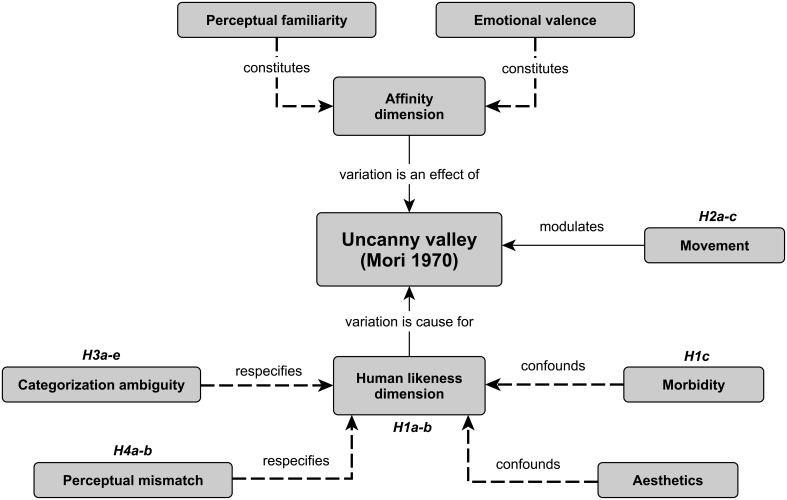
“A closer inspection of these terms would suggest that all of them refer to various aspects of perceptual familiarity and emotional valence.”
§ A review of empirical evidence on different uncanny valley hypotheses: support for perceptual mismatch as one road to the valley of eeriness > An interpretation of the uncanny valley > What is affinity?
hedged- Asserted: passes — The authors put it forward as true.
- Checkable: passes — It can be checked against evidence.
- Load-bearing: fails — The paper’s conclusions may not depend on it.
- Based: passes — The paper gives a reason why it holds.
Probably not a substantial claim. The paper’s conclusions may not depend on it.
A conclusion the paper draws from its own results — it cites no other source for it, so there is none to check. The quote shows it is in the paper.
In the paper
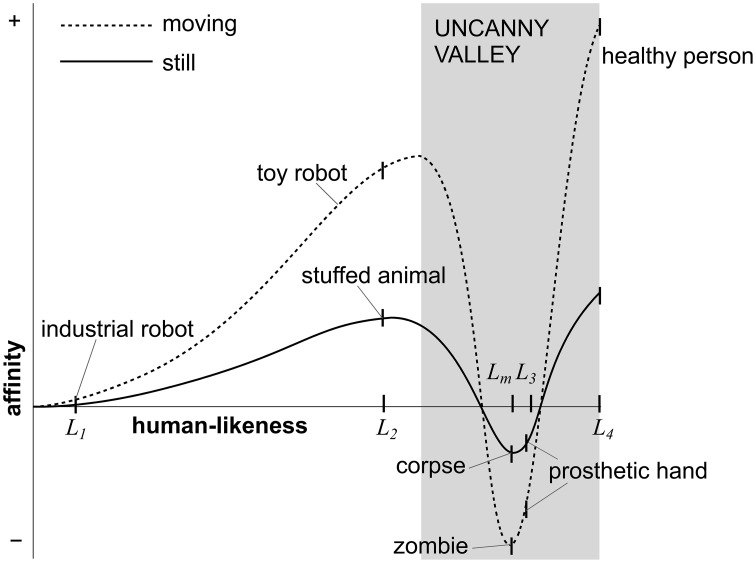
“First, stuffed animals and toy robots could elicit positive reactions not only because they appear somewhat humanlike but because they have been purposefully designed to appear aesthetic.”
§ A review of empirical evidence on different uncanny valley hypotheses: support for perceptual mismatch as one road to the valley of eeriness > An interpretation of the uncanny valley > What is human-likeness?
hedgeddirect- Asserted: passes — The authors put it forward as true.
- Checkable: passes — It can be checked against evidence.
- Load-bearing: fails — The paper’s conclusions may not depend on it.
- Based: fails — The paper may give no reason why it holds.
Probably not a substantial claim. The paper’s conclusions may not depend on it. The paper may give no reason why it holds. It may state two separate claims as one.
A conclusion the paper draws from its own results — it cites no other source for it, so there is none to check. The quote shows it is in the paper.
In the paper
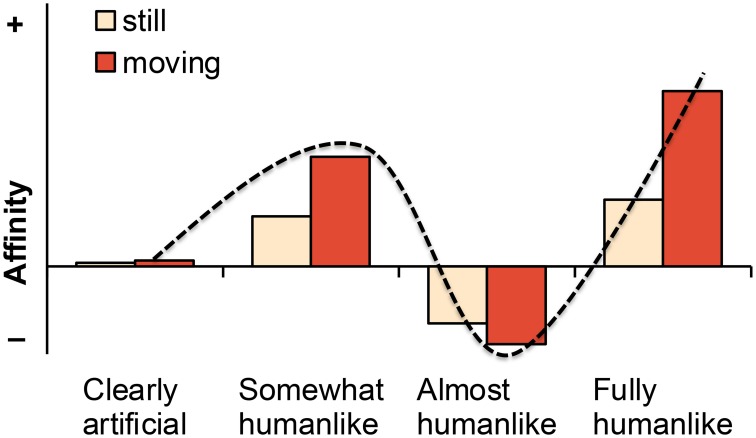
“Because almost humanlike characters would need to be compared to both more artificial and more humanlike characters, the bare minimum for testing this prediction would be three human-likeness levels (cf. Figure 3).”
§ A review of empirical evidence on different uncanny valley hypotheses: support for perceptual mismatch as one road to the valley of eeriness > A framework of uncanny valley hypotheses > Naïve hypotheses
plain- Asserted: passes — The authors put it forward as true.
- Checkable: passes — It can be checked against evidence.
- Load-bearing: fails — The paper’s conclusions may not depend on it.
- Based: passes — The paper gives a reason why it holds.
Probably not a substantial claim. The paper’s conclusions may not depend on it.
A conclusion the paper draws from its own results — it cites no other source for it, so there is none to check. The quote shows it is in the paper.
In the paper
“Human-likeness is not a single quality of artificial characters that could be traced back to specific static, dynamic, or behavioral features—instead, human-likeness could be varied in an almost infinite number of different ways.”
§ A review of empirical evidence on different uncanny valley hypotheses: support for perceptual mismatch as one road to the valley of eeriness > An interpretation of the uncanny valley > What is human-likeness?
hedged- Asserted: passes — The authors put it forward as true.
- Checkable: fails — It may be too vague to check against evidence.
- Load-bearing: fails — The paper’s conclusions may not depend on it.
- Based: fails — The paper may give no reason why it holds.
Probably not a substantial claim. It may be too vague to check against evidence. The paper’s conclusions may not depend on it. The paper may give no reason why it holds.
A conclusion the paper draws from its own results — it cites no other source for it, so there is none to check. The quote shows it is in the paper.
In the paper
“Although purposefully morbid characters could be adopted from the original uncanny valley formulation (Mori, 2012) and used in empirical uncanny valley studies, such characters would confound the more interesting effects of varying human-likeness (Section What is Human-Likeness?).”
§ A review of empirical evidence on different uncanny valley hypotheses: support for perceptual mismatch as one road to the valley of eeriness > A framework of uncanny valley hypotheses > Morbidity hypothesis
hedgeddirect- Asserted: passes — The authors put it forward as true.
- Checkable: fails — It may be too vague to check against evidence.
- Load-bearing: fails — The paper’s conclusions may not depend on it.
- Based: fails — The paper may give no reason why it holds.
Probably not a substantial claim. It may be too vague to check against evidence. The paper’s conclusions may not depend on it. The paper may give no reason why it holds.
A conclusion the paper draws from its own results — it cites no other source for it, so there is none to check. The quote shows it is in the paper.
In the paper
“Similarly, human corpses, whether still or animate, would certainly not evoke negative reactions only because they appear humanlike but because they are morbid and horrifying.”
§ A review of empirical evidence on different uncanny valley hypotheses: support for perceptual mismatch as one road to the valley of eeriness > An interpretation of the uncanny valley > What is human-likeness?
boosteddirect- Asserted: passes — The authors put it forward as true.
- Checkable: passes — It can be checked against evidence.
- Load-bearing: fails — The paper’s conclusions may not depend on it.
- Based: fails — The paper may give no reason why it holds.
Probably not a substantial claim. The paper’s conclusions may not depend on it. The paper may give no reason why it holds.
A conclusion the paper draws from its own results — it cites no other source for it, so there is none to check. The quote shows it is in the paper.
In the paper
“These levels constitute the minimal set of human-likeness levels that could be used to capture the most relevant aspects of the original uncanny curve.”
§ A review of empirical evidence on different uncanny valley hypotheses: support for perceptual mismatch as one road to the valley of eeriness > A framework of uncanny valley hypotheses > Naïve hypotheses
plain- Asserted: passes — The authors put it forward as true.
- Checkable: fails — It may be too vague to check against evidence.
- Load-bearing: fails — The paper’s conclusions may not depend on it.
- Based: fails — The paper may give no reason why it holds.
Probably not a substantial claim. It may be too vague to check against evidence. The paper’s conclusions may not depend on it. The paper may give no reason why it holds.
A conclusion the paper draws from its own results — it cites no other source for it, so there is none to check. The quote shows it is in the paper.
In the paper
“Because the two major dimensions of the uncanny valley—the human-likeness of stimuli and the observers' experience of affinity for them—were not defined clearly in the original uncanny valley formulation, these dimensions could be operationalized in various different ways.”
§ A review of empirical evidence on different uncanny valley hypotheses: support for perceptual mismatch as one road to the valley of eeriness > Introduction
hedged- Asserted: passes — The authors put it forward as true.
- Checkable: passes — It can be checked against evidence.
- Load-bearing: passes — The paper’s conclusions depend on it.
- Based: passes — The paper gives a reason why it holds.
Probably not a substantial claim. It may state two separate claims as one.
A conclusion the paper draws from its own results — it cites no other source for it, so there is none to check. The quote shows it is in the paper.
In the paper
“Although it is quite trivial that such characters should evoke negative affinity, we have nevertheless formulated the following hypothesis to help separate morbidity effects from those of other hypotheses.”
§ A review of empirical evidence on different uncanny valley hypotheses: support for perceptual mismatch as one road to the valley of eeriness > A framework of uncanny valley hypotheses > Morbidity hypothesis
boosteddirect- Asserted: fails — The authors may not put it forward as true.
- Checkable: passes — It can be checked against evidence.
- Load-bearing: fails — The paper’s conclusions may not depend on it.
- Based: fails — The paper may give no reason why it holds.
Probably not a substantial claim. The authors may not put it forward as true. The paper’s conclusions may not depend on it. The paper may give no reason why it holds.
In the paper
“Because the original uncanny valley hypothesis was intended as a broadly applicable guideline rather than an explicit experimental hypothesis (cf. Pollick, 2010), it is likely to be consistent with several more specific hypotheses.”
§ A review of empirical evidence on different uncanny valley hypotheses: support for perceptual mismatch as one road to the valley of eeriness > Introduction
What the sources say
- Not checked yetcites Pollick, 2010 source
hedged- Asserted: passes — The authors put it forward as true.
- Checkable: passes — It can be checked against evidence.
- Load-bearing: passes — The paper’s conclusions depend on it.
- Based: passes — The paper gives a reason why it holds.
It may state two separate claims as one.
A conclusion the paper draws from its own results — it cites no other source for it, so there is none to check. The quote shows it is in the paper.
In the paper
“Third, familiarity items were not considered in the study, although familiarity would seem to be an integral part of the uncanny valley.”
§ A review of empirical evidence on different uncanny valley hypotheses: support for perceptual mismatch as one road to the valley of eeriness > An interpretation of the uncanny valley > What is affinity?
hedged- Asserted: passes — The authors put it forward as true.
- Checkable: passes — It can be checked against evidence.
- Load-bearing: fails — The paper’s conclusions may not depend on it.
- Based: passes — The paper gives a reason why it holds.
Probably not a substantial claim. The paper’s conclusions may not depend on it. It may state two separate claims as one.
A conclusion the paper draws from its own results — it cites no other source for it, so there is none to check. The quote shows it is in the paper.
In the paper
“First, some of the questionnaire items are not necessarily ideal for measuring their intended constructs in all contexts.”
§ A review of empirical evidence on different uncanny valley hypotheses: support for perceptual mismatch as one road to the valley of eeriness > An interpretation of the uncanny valley > What is affinity?
hedged- Asserted: passes — The authors put it forward as true.
- Checkable: passes — It can be checked against evidence.
- Load-bearing: fails — The paper’s conclusions may not depend on it.
- Based: passes — The paper gives a reason why it holds.
Probably not a substantial claim. The paper’s conclusions may not depend on it.
In the paper
“However, assuming that the uncanny valley proper is thought of as coinciding with the category boundary and that this boundary is considered in terms of the categorical perception framework, it follows (as in Cheetham et al., 2014) that perceptual discrimination performance should actually be easier for characters at or in the close vicinity of the category boundary and not more difficult.”
§ A review of empirical evidence on different uncanny valley hypotheses: support for perceptual mismatch as one road to the valley of eeriness > A framework of uncanny valley hypotheses > Refined hypotheses
What the sources say
- Not checked yetcites Cheetham et al., 2014 source
plain- Asserted: passes — The authors put it forward as true.
- Checkable: passes — It can be checked against evidence.
- Load-bearing: passes — The paper’s conclusions depend on it.
- Based: passes — The paper gives a reason why it holds.
Probably not a substantial claim.
- The authors state this as an assumption: The uncanny valley proper coincides with the category boundary between 'artificial' and 'human' categories.
A conclusion the paper draws from its own results — it cites no other source for it, so there is none to check. The quote shows it is in the paper.
In the paper
“Second, negative affinity could of course be caused by some other mechanisms in addition to (or instead of) categorization ambiguity or categorical perception.”
§ A review of empirical evidence on different uncanny valley hypotheses: support for perceptual mismatch as one road to the valley of eeriness > A framework of uncanny valley hypotheses > Refined hypotheses
hedgedconditional- Asserted: passes — The authors put it forward as true.
- Checkable: passes — It can be checked against evidence.
- Load-bearing: fails — The paper’s conclusions may not depend on it.
- Based: fails — The paper may give no reason why it holds.
Probably not a substantial claim. The paper’s conclusions may not depend on it. The paper may give no reason why it holds.
In the paper
“Second, although the identified eeriness factors are consistent with Mori's original terms, their constituent items (e.g., “numbing—freaky” and “unemotional—hair-rising”) do not resemble items in typical emotion self-report questionnaires (cf. self-report items in Bradley and Lang, 1994).”
§ A review of empirical evidence on different uncanny valley hypotheses: support for perceptual mismatch as one road to the valley of eeriness > An interpretation of the uncanny valley > What is affinity?
What the sources say
- Not checked yetcites Bradley and Lang, 1994 source
plain- Asserted: passes — The authors put it forward as true.
- Checkable: passes — It can be checked against evidence.
- Load-bearing: fails — The paper’s conclusions may not depend on it.
- Based: passes — The paper gives a reason why it holds.
Probably not a substantial claim. The paper’s conclusions may not depend on it.
A conclusion the paper draws from its own results — it cites no other source for it, so there is none to check. The quote shows it is in the paper.
In the paper
“Although future empirical studies might be useful for refining this scale, this work is an important step toward developing a common metric for the affinity dimension.”
§ A review of empirical evidence on different uncanny valley hypotheses: support for perceptual mismatch as one road to the valley of eeriness > An interpretation of the uncanny valley > What is affinity?
plain- Asserted: passes — The authors put it forward as true.
- Checkable: fails — It may be too vague to check against evidence.
- Load-bearing: fails — The paper’s conclusions may not depend on it.
- Based: passes — The paper gives a reason why it holds.
Probably not a substantial claim. It may be too vague to check against evidence. The paper’s conclusions may not depend on it.
A conclusion the paper draws from its own results — it cites no other source for it, so there is none to check. The quote shows it is in the paper.
In the paper
“Hence, categorization ambiguity could lead to negative affinity even in the absence of categorical perception (i.e., when only H3a but not H3b holds true).”
§ A review of empirical evidence on different uncanny valley hypotheses: support for perceptual mismatch as one road to the valley of eeriness > A framework of uncanny valley hypotheses > Refined hypotheses
hedgeddirect- Asserted: passes — The authors put it forward as true.
- Checkable: passes — It can be checked against evidence.
- Load-bearing: fails — The paper’s conclusions may not depend on it.
- Based: fails — The paper may give no reason why it holds.
Probably not a substantial claim. The paper’s conclusions may not depend on it. The paper may give no reason why it holds.
In the paper
“Hence, it is possible that the lower pleasantness ratings for intermediate morphs could have resulted from morphing artifacts rather than intermediate human-likeness level.”
§ A review of empirical evidence on different uncanny valley hypotheses: support for perceptual mismatch as one road to the valley of eeriness > Review of empirical evidence > Naïve and morbidity hypotheses
What the sources say
- Not checked yetcites Yamada et al., 2013 source
hedgedconditional- Asserted: passes — The authors put it forward as true.
- Checkable: passes — It can be checked against evidence.
- Load-bearing: passes — The paper’s conclusions depend on it.
- Based: passes — The paper gives a reason why it holds.
Probably not a substantial claim.
In the paper
“As suggested recently by Cheetham et al. (2014), the original uncanny valley hypothesis is based on the implicit assumption that perceptual discrimination is the most difficult for characters in the uncanny valley.”
§ A review of empirical evidence on different uncanny valley hypotheses: support for perceptual mismatch as one road to the valley of eeriness > A framework of uncanny valley hypotheses > Refined hypotheses
What the sources say
- Not checked yetcites Cheetham et al., 2014 source
hedged- Asserted: passes — The authors put it forward as true.
- Checkable: passes — It can be checked against evidence.
- Load-bearing: passes — The paper’s conclusions depend on it.
- Based: passes — The paper gives a reason why it holds.
Probably not a substantial claim.
In the paper
“We considered this evidence tentative because no statistical tests had been used; furthermore, the human-likeness range was somewhat constrained by the use of only CG characters.”
§ A review of empirical evidence on different uncanny valley hypotheses: support for perceptual mismatch as one road to the valley of eeriness > Review of empirical evidence > Naïve and morbidity hypotheses
What the sources say
- Not checked yetcites Flach et al., 2012
plain- Asserted: passes — The authors put it forward as true.
- Checkable: passes — It can be checked against evidence.
- Load-bearing: unclear — It is unclear whether the paper’s conclusions depend on it.
- Based: passes — The paper gives a reason why it holds.
It may state two separate claims as one.
In the paper
“The reported positive uncanny valley finding is nevertheless important in the present context, because it could be interpreted as evidence that some human-likeness manipulations can lead to the uncanny valley.”
§ A review of empirical evidence on different uncanny valley hypotheses: support for perceptual mismatch as one road to the valley of eeriness > Review of empirical evidence > Categorization ambiguity hypotheses
What the sources say
- Not checked yetcites Burleigh et al., 2013 source
hedgedconditional- Asserted: passes — The authors put it forward as true.
- Checkable: passes — It can be checked against evidence.
- Load-bearing: fails — The paper’s conclusions may not depend on it.
- Based: passes — The paper gives a reason why it holds.
Probably not a substantial claim. The paper’s conclusions may not depend on it.
What the paper did — it cites no source for this, so there is none to check. The quote shows it is in the paper.
In the paper
“Two other studies demonstrating favorable evidence for H3c were excluded from the total count because of plausible threats to validity.”
§ A review of empirical evidence on different uncanny valley hypotheses: support for perceptual mismatch as one road to the valley of eeriness > Review of empirical evidence > Categorization ambiguity hypotheses
plainn = 2- Asserted: passes — The authors put it forward as true.
- Checkable: passes — It can be checked against evidence.
- Load-bearing: fails — The paper’s conclusions may not depend on it.
- Based: passes — The paper gives a reason why it holds.
Probably not a substantial claim. The paper’s conclusions may not depend on it.
In the paper
“Although this non-significant finding was included in the total count, it is possible that this result could have been specific to the atypical feature (rolled-back eye) used in the study.”
§ A review of empirical evidence on different uncanny valley hypotheses: support for perceptual mismatch as one road to the valley of eeriness > Review of empirical evidence > Perceptual mismatch hypotheses
What the sources say
- Not checked yetcites Burleigh et al., 2013 source
hedgedconditional- Asserted: passes — The authors put it forward as true.
- Checkable: passes — It can be checked against evidence.
- Load-bearing: fails — The paper’s conclusions may not depend on it.
- Based: passes — The paper gives a reason why it holds.
Probably not a substantial claim. The paper’s conclusions may not depend on it.
A conclusion the paper draws from its own results — it cites no other source for it, so there is none to check. The quote shows it is in the paper.
In the paper
“These results strengthen the view that individuals are more sensitive and less tolerant to deviations from typical norms when judging human faces.”
§ A review of empirical evidence on different uncanny valley hypotheses: support for perceptual mismatch as one road to the valley of eeriness > Review of empirical evidence > Perceptual mismatch hypotheses
plaincorrelational- Asserted: passes — The authors put it forward as true.
- Checkable: passes — It can be checked against evidence.
- Load-bearing: passes — The paper’s conclusions depend on it.
- Based: passes — The paper gives a reason why it holds.
It may state two separate claims as one.
In the paper
“We have suggested that Mori used corpses and zombies only as metaphorical examples when discussing threat avoidance as a possible explanation for the uncanny valley.”
§ A review of empirical evidence on different uncanny valley hypotheses: support for perceptual mismatch as one road to the valley of eeriness > Discussion > Evidence for different kinds of uncanny valleys
What the sources say
- Not checked yetcites Mori, 2012
hedged- Asserted: passes — The authors put it forward as true.
- Checkable: passes — It can be checked against evidence.
- Load-bearing: passes — The paper’s conclusions depend on it.
- Based: passes — The paper gives a reason why it holds.
Probably not a substantial claim.
In the paper
“This finding was not included as additional evidence for the hypothesis H1a, however, because several other human-likeness manipulations in this study (Burleigh et al., 2013) did not lead to similar findings.”
§ A review of empirical evidence on different uncanny valley hypotheses: support for perceptual mismatch as one road to the valley of eeriness > Review of empirical evidence > Categorization ambiguity hypotheses
What the sources say
- Not checked yetcites Burleigh et al., 2013 source
plain- Asserted: passes — The authors put it forward as true.
- Checkable: passes — It can be checked against evidence.
- Load-bearing: fails — The paper’s conclusions may not depend on it.
- Based: passes — The paper gives a reason why it holds.
Probably not a substantial claim. The paper’s conclusions may not depend on it.
In the paper
“One image morphing study (Yamada et al., 2013) demonstrated that the slowest identification task response times and the most negative likability evaluations coincided with each other; however, these results were excluded because the likability evaluations could plausibly have been influenced by morphing artifacts (cf. Section Naïve and Morbidity Hypotheses).”
§ A review of empirical evidence on different uncanny valley hypotheses: support for perceptual mismatch as one road to the valley of eeriness > Review of empirical evidence > Categorization ambiguity hypotheses
What the sources say
- Not checked yetcites Yamada et al., 2013 source
boostedcorrelationaln = 2- Asserted: passes — The authors put it forward as true.
- Checkable: passes — It can be checked against evidence.
- Load-bearing: unclear — It is unclear whether the paper’s conclusions depend on it.
- Based: passes — The paper gives a reason why it holds.
It may state two separate claims as one.
What the paper did — it cites no source for this, so there is none to check. The quote shows it is in the paper.
In the paper
“The present conclusions depend on the adopted evaluation criteria, which are to some extent open to subjective interpretations.”
§ A review of empirical evidence on different uncanny valley hypotheses: support for perceptual mismatch as one road to the valley of eeriness > Discussion > Limitations
hedged- Asserted: passes — The authors put it forward as true.
- Checkable: fails — It may be too vague to check against evidence.
- Load-bearing: fails — The paper’s conclusions may not depend on it.
- Based: passes — The paper gives a reason why it holds.
Probably not a substantial claim. It may be too vague to check against evidence. The paper’s conclusions may not depend on it.
In the paper
“although these items are consistent with the original formulation, they are not necessarily theoretically justified.”
§ A review of empirical evidence on different uncanny valley hypotheses: support for perceptual mismatch as one road to the valley of eeriness > Discussion > Open research questions
What the sources say
- Not checked yetcites Mori's (1970) source
hedged- Asserted: passes — The authors put it forward as true.
- Checkable: passes — It can be checked against evidence.
- Load-bearing: fails — The paper’s conclusions may not depend on it.
- Based: passes — The paper gives a reason why it holds.
Probably not a substantial claim. The paper’s conclusions may not depend on it. It may state two separate claims as one.
What the paper did — it cites no source for this, so there is none to check. The quote shows it is in the paper.
In the paper
“Given our inclusion criteria, we have only considered studies that have operationalized affinity by self-report measures.”
§ A review of empirical evidence on different uncanny valley hypotheses: support for perceptual mismatch as one road to the valley of eeriness > Discussion > Limitations
plain- Asserted: passes — The authors put it forward as true.
- Checkable: passes — It can be checked against evidence.
- Load-bearing: passes — The paper’s conclusions depend on it.
- Based: passes — The paper gives a reason why it holds.
Probably not a substantial claim.
A conclusion the paper draws from its own results — it cites no other source for it, so there is none to check. The quote shows it is in the paper.
In the paper
“Such conditions could originate, at least, from inconsistent realism levels between individual features (e.g., artificial eyes on a humanlike face) or from the presence of atypical features (e.g., atypically large eyes) on an otherwise humanlike character.”
§ A review of empirical evidence on different uncanny valley hypotheses: support for perceptual mismatch as one road to the valley of eeriness > Conclusion
hedgedconditional- Asserted: passes — The authors put it forward as true.
- Checkable: passes — It can be checked against evidence.
- Load-bearing: passes — The paper’s conclusions depend on it.
- Based: passes — The paper gives a reason why it holds.
It may state two separate claims as one.
In the paper
“Although previous reviews have presented categorization difficulty and perceptual mismatch hypotheses separately (e.g., Pollick, 2010)”
§ A review of empirical evidence on different uncanny valley hypotheses: support for perceptual mismatch as one road to the valley of eeriness > Discussion > Evidence for different kinds of uncanny valleys
What the sources say
- Not checked yetcites Pollick, 2010 source
plain- Asserted: passes — The authors put it forward as true.
- Checkable: passes — It can be checked against evidence.
- Load-bearing: passes — The paper’s conclusions depend on it.
- Based: passes — The paper gives a reason why it holds.
Probably not a substantial claim.
What the paper did — it cites no source for this, so there is none to check. The quote shows it is in the paper.
In the paper
“Although we have considered only the categorization ambiguity and perceptual mismatch explanations for the uncanny valley”
§ A review of empirical evidence on different uncanny valley hypotheses: support for perceptual mismatch as one road to the valley of eeriness > Discussion > Limitations
plain- Asserted: passes — The authors put it forward as true.
- Checkable: passes — It can be checked against evidence.
- Load-bearing: fails — The paper’s conclusions may not depend on it.
- Based: passes — The paper gives a reason why it holds.
Probably not a substantial claim. The paper’s conclusions may not depend on it.
A conclusion the paper draws from its own results — it cites no other source for it, so there is none to check. The quote shows it is in the paper.
In the paper
“The lack of universally agreed upon operational definition for the affinity dimension is a critical issue for uncanny valley studies.”
§ A review of empirical evidence on different uncanny valley hypotheses: support for perceptual mismatch as one road to the valley of eeriness > Discussion > Open research questions
plain- Asserted: passes — The authors put it forward as true.
- Checkable: passes — It can be checked against evidence.
- Load-bearing: fails — The paper’s conclusions may not depend on it.
- Based: passes — The paper gives a reason why it holds.
Probably not a substantial claim. The paper’s conclusions may not depend on it.
A conclusion the paper draws from its own results — it cites no other source for it, so there is none to check. The quote shows it is in the paper.
In the paper
“the level of visual distortions produced by morphing would hence increase toward the middle of the generated human-likeness continua.”
§ A review of empirical evidence on different uncanny valley hypotheses: support for perceptual mismatch as one road to the valley of eeriness > Discussion > Open research questions
hedgeddirect- Asserted: fails — The authors may not put it forward as true.
- Checkable: passes — It can be checked against evidence.
- Load-bearing: fails — The paper’s conclusions may not depend on it.
- Based: passes — The paper gives a reason why it holds.
Probably not a substantial claim. The authors may not put it forward as true. The paper’s conclusions may not depend on it.
- The authors state this as an assumption: Morphing artifacts are a realistic concern.
What the paper did — it cites no source for this, so there is none to check. The quote shows it is in the paper.
In the paper
“These minimal levels should hence not be taken as practical guidelines for empirical studies.”
§ A review of empirical evidence on different uncanny valley hypotheses: support for perceptual mismatch as one road to the valley of eeriness > Discussion > Limitations
plain- Asserted: passes — The authors put it forward as true.
- Checkable: passes — It can be checked against evidence.
- Load-bearing: fails — The paper’s conclusions may not depend on it.
- Based: passes — The paper gives a reason why it holds.
Probably not a substantial claim. The paper’s conclusions may not depend on it.
A conclusion the paper draws from its own results — it cites no other source for it, so there is none to check. The quote shows it is in the paper.
In the paper
“Taken together, the present review suggested that although not any kind of human-likeness manipulation leads to the uncanny valley, the uncanny valley could be caused by more specific perceptual mismatch conditions.”
§ A review of empirical evidence on different uncanny valley hypotheses: support for perceptual mismatch as one road to the valley of eeriness > Conclusion
hedgedconditional- Asserted: passes — The authors put it forward as true.
- Checkable: passes — It can be checked against evidence.
- Load-bearing: passes — The paper’s conclusions depend on it.
- Based: passes — The paper gives a reason why it holds.
It may state two separate claims as one.
In the paper
“A plausible limitation related to our conceptual analysis of the original uncanny valley formulation (Mori, 2012) is that we have relied on its English translation and other secondary sources instead of the original article written in Japanese.”
§ A review of empirical evidence on different uncanny valley hypotheses: support for perceptual mismatch as one road to the valley of eeriness > Discussion > Limitations
What the sources say
- Not checked yetcites Mori, 2012
plain- Asserted: passes — The authors put it forward as true.
- Checkable: passes — It can be checked against evidence.
- Load-bearing: fails — The paper’s conclusions may not depend on it.
- Based: passes — The paper gives a reason why it holds.
Probably not a substantial claim. The paper’s conclusions may not depend on it.
What the paper did — it cites no source for this, so there is none to check. The quote shows it is in the paper.
In the paper
“Because all possible aspects of experimental validity were not covered, the adopted criteria cannot and should not be taken as evidence for the experimental validity of the evaluated studies themselves.”
§ A review of empirical evidence on different uncanny valley hypotheses: support for perceptual mismatch as one road to the valley of eeriness > Discussion > Limitations
plain- Asserted: passes — The authors put it forward as true.
- Checkable: fails — It may be too vague to check against evidence.
- Load-bearing: fails — The paper’s conclusions may not depend on it.
- Based: passes — The paper gives a reason why it holds.
Probably not a substantial claim. It may be too vague to check against evidence. The paper’s conclusions may not depend on it. It may state two separate claims as one.
A conclusion the paper draws from its own results — it cites no other source for it, so there is none to check. The quote shows it is in the paper.
In the paper
“these constructs are clearly separate from each other”
§ A review of empirical evidence on different uncanny valley hypotheses: support for perceptual mismatch as one road to the valley of eeriness > Discussion > Open research questions
boosted- Asserted: passes — The authors put it forward as true.
- Checkable: passes — It can be checked against evidence.
- Load-bearing: fails — The paper’s conclusions may not depend on it.
- Based: fails — The paper may give no reason why it holds.
Probably not a substantial claim. The paper’s conclusions may not depend on it. The paper may give no reason why it holds.
In the paper
“Burleigh and Schoenherr (2015) extend this idea by demonstrating that categorization ambiguity and the frequency of exposure to specific within-category stimuli contribute independently to the uncanny valley.”
§ A review of empirical evidence on different uncanny valley hypotheses: support for perceptual mismatch as one road to the valley of eeriness > Discussion > Limitations
What the sources say
- Not checked yetcites Burleigh and Schoenherr (2015)
boosteddirect- Asserted: passes — The authors put it forward as true.
- Checkable: passes — It can be checked against evidence.
- Load-bearing: fails — The paper’s conclusions may not depend on it.
- Based: passes — The paper gives a reason why it holds.
Probably not a substantial claim. The paper’s conclusions may not depend on it. It may state two separate claims as one.
The authors state this as an assumption.
The uncanny valley proper coincides with the category boundary between 'artificial' and 'human' categories.
“assuming that the uncanny valley proper is thought of as coinciding with the category boundary”
The authors state this as an assumption.
Identification uncertainty at the category boundary leads to negative affinity.
“The most straightforward assumption would be that identification uncertainty at the category boundary (“categorization ambiguity”) leads to negative affinity.”
The authors state this as an assumption.
Perceptual discrimination is more difficult for characters in the uncanny valley.
“Assuming that perceptual discrimination would be more difficult for characters in the uncanny valley, this difficulty should also be associated with negative affinity.”
The authors state this as an assumption.
Morphing artifacts are a realistic concern.
“Assuming that morphing artifacts were a realistic concern”
The paper relies on this without support.
The experimental stimuli clearly represented phenomena that would be likely to exist also in the real world.
“given that the experimental stimuli clearly represented phenomena that would be likely to exist also in the real world”
The paper relies on this without support.
This article is the first systematic review of the empirical evidence for the uncanny valley.
“to our knowledge, this article is the first systematic review of the empirical evidence for the uncanny valley.”
The paper relies on this without support.
No prior distinction has been made between different perceptual mismatch hypotheses.
“we are not aware that a further distinction would have been made between different perceptual mismatch hypotheses.”
The paper relies on this without support.
The original uncanny valley formulation proposed that movement would amplify the characteristic uncanny curve.
“The original uncanny valley formulation proposed that movement would amplify the characteristic uncanny curve.”
Claims other papers make about this one
Each is checked against this paper’s own text: does it say what the citing paper says it does?
In the citing paper
“While the CASA paradigm assumes that humans can develop positive social relations with computer systems as the human familiarity of the system increases, the UVE argues that too much human familiarity would bring feelings of eeriness and discomfort.”
Citations
Cites
(2002) · Cited by 13,211
Measuring emotion: The self-assessment manikin and the semantic differential
Bradley, M. M., & Lang, P. J. (1994) · Journal of Behavior Therapy and Experimental Psychiatry · doi:10.1016/0005-7916(94)90063-9 · Cited by 9,538
Core affect and the psychological construction of emotion.
Russell, J. A. (2003) · Psychological Review · doi:10.1037/0033-295x.110.1.145 · Cited by 6,113
The Uncanny Valley [From the Field]
Mori, M., MacDorman, K., & Kageki, N. (2012) · IEEE Robotics & Automation Magazine · doi:10.1109/mra.2012.2192811 · Cited by 3,542
Bukimi no tani [the uncanny valley]
Mori, M. (1970) · Energy · Cited by 1,485
Categorical Perception: The Groundwork of Cognition
Harnad, S. R. (1990) · Medical Entomology and Zoology · Cited by 1,434
Attractive Faces Are Only Average
Langlois, J. H., & Roggman, L. A. (1990) · Psychological Science · doi:10.1111/j.1467-9280.1990.tb00079.x · Cited by 1,339
Feeling robots and human zombies: Mind perception and the uncanny valley
Gray, K., & Wegner, D. M. (2012) · Cognition · doi:10.1016/j.cognition.2012.06.007 · Cited by 941 · cited 1×
“Another study (Gray and Wegner, 2012) with conceptual stimuli demonstrated that machines with characteristically human experiences (i.e., capability to feel) and humans without such experiences were considered unnerving.”
BackgroundThe uncanny advantage of using androids in cognitive and social science research
MacDorman, K. F., & Ishiguro, H. (2006) · Interaction Studies Social Behaviour and Communication in Biological and Artificial Systems · doi:10.1075/is.7.3.03mac · Cited by 658
The Uncanny Valley: Effect of Realism on the Impression of Artificial Human Faces
Seyama, J., & Nagayama, R. S. (2007) · PRESENCE Virtual and Augmented Reality · doi:10.1162/pres.16.4.337 · Cited by 583
Research works printed but not linked: 6
- Brenton, 2005, The uncanny valley: does it exist?
- Hanson, 2005, Expanding the aesthetic possibilities for humanoid robots,
- Hanson, 2006, Exploring the aesthetic range for humanoid robots,, 16
- Harnad, 1987, Introduction: psychophysical and cognitive aspects of categorical perception: a critical overview,, 1
- Ishiguro, 2006, Android science—toward a new cross-interdisciplinary framework, Interact. Stud, 7, 297, 10.1075/is.7.03mac · DOI
- Ramey, 2005, The uncanny valley of similarities concerning abortion, baldness, heaps of sand, and humanlike robot,
Cited by
Sorted by citations
Mende, M., Scott, M. L., van Doorn, J., Grewal, D., & Shanks, I. (2019) · Journal of Marketing Research · doi:10.1177/0022243718822827 · Cited by 1,197
Blut, M., Wang, C., Wünderlich, N. V., & Brock, C. (2021) · Journal of the Academy of Marketing Science · doi:10.1007/s11747-020-00762-y · Cited by 1,194
Authentically Fake? How Consumers Respond to the Influence of Virtual Influencers
Lou, C., Kiew, S. T. J., Chen, T., Lee, T. Y. M., Ong, J. E. C., & Phua, Z. (2023) · Journal of Advertising · doi:10.1080/00913367.2022.2149641 · Cited by 506
Navigating a social world with robot partners: A quantitative cartography of the Uncanny Valley
Mathur, M. B., & Reichling, D. B. (2016) · Cognition · doi:10.1016/j.cognition.2015.09.008 · Cited by 439
Zhang, J., Oh, Y. J., Lange, P., Yu, Z., & Fukuoka, Y. (2020) · Journal of Medical Internet Research · doi:10.2196/22845 · Cited by 363
The Uncanny Valley: Existence and Explanations
Wang, S., Lilienfeld, S. O., & Rochat, P. (2015) · Review of General Psychology · doi:10.1037/gpr0000056 · Cited by 357
What makes you continuously use chatbot services? Evidence from chinese online travel agencies
Li, L., Lee, K. Y., Emokpae, E., & Yang, S. (2021) · Electronic Markets · doi:10.1007/s12525-020-00454-z · Cited by 335
Robots As Intentional Agents: Using Neuroscientific Methods to Make Robots Appear More Social
Wiese, E., Giorgio Metta, B., & Wykowska, A. (2017) · Frontiers in Psychology · doi:10.3389/fpsyg.2017.01663 · Cited by 307
Measuring the Uncanny Valley Effect
Ho, C.-C., & MacDorman, K. F. (2016) · International Journal of Social Robotics · doi:10.1007/s12369-016-0380-9 · Cited by 248
The uncanny of mind in a machine: Humanoid robots as tools, agents, and experiencers
Appel, M., Izydorczyk, D., Weber, S., Mara, M., & Lischetzke, T. (2019) · Computers in Human Behavior · doi:10.1016/j.chb.2019.07.031 · Cited by 211
Highly automated job interviews: Acceptance under the influence of stakes
Langer, M., König, C. J., & Papathanasiou, M. (2019) · International Journal of Selection and Assessment · doi:10.1111/ijsa.12246 · Cited by 203
Self-efficacy and acceptance of robots
Latikka, R., Turja, T., & Oksanen, A. (2019) · Computers in Human Behavior · doi:10.1016/j.chb.2018.12.017 · Cited by 200
Yogeeswaran, K., Złotowski, J. A., Livingstone, M., Bartneck, C., Sumioka, H., & Ishiguro, H. (2016) · Journal of Human-Robot Interaction · doi:10.5898/jhri.5.2.yogeeswaran · Cited by 191
Ahn, R. J., Cho, S. Y., & Tsai, W. S. (2022) · Journal of Interactive Advertising · doi:10.1080/15252019.2022.2111242 · Cited by 173
Zibrek, K., Kokkinara, E., & McDonnell, R. (2018) · IEEE Transactions on Visualization and Computer Graphics · doi:10.1109/tvcg.2018.2794638 · Cited by 158
Spatola, N., Kühnlenz, B., & Cheng, G. (2021) · International Journal of Social Robotics · doi:10.1007/s12369-020-00667-4 · Cited by 167
Abubshait, A., & Wiese, E. (2017) · Frontiers in Psychology · doi:10.3389/fpsyg.2017.01393 · Cited by 164
Hand Tracking for Immersive Virtual Reality: Opportunities and Challenges
Buckingham, G. (2021) · Frontiers in Virtual Reality · doi:10.3389/frvir.2021.728461 · Cited by 140
Seymour, M., Yuan, L., Dennis, A. R., & Riemer, K. (2021) · Journal of the Association for Information Systems · doi:10.17705/1jais.00674 · Cited by 155
Weidner, F., Boettcher, G., Arboleda, S. A., Diao, C., Sinani, L., Kunert, C., Gerhardt, C., Broll, W., & Raake, A. (2023) · IEEE Transactions on Visualization and Computer Graphics · doi:10.1109/tvcg.2023.3247072 · Cited by 134
Sundar, S. S., Jung, E. H., Waddell, T. F., & Kim, K. J. (2016) · International Journal of Human-Computer Studies · doi:10.1016/j.ijhcs.2016.08.006 · Cited by 139
The effect of different types of virtual influencers on consumers’ emotional attachment
Yan, J., Xia, S., Jiang, A., & Lin, Z. (2024) · Journal of Business Research · doi:10.1016/j.jbusres.2024.114646 · Cited by 146
Söderlund, M., & Oikarinen, E.-L. (2021) · European Journal of Marketing · doi:10.1108/ejm-09-2019-0748 · Cited by 120
Liu, F., & Wang, R. (2024) · Journal of Business Research · doi:10.1016/j.jbusres.2024.115024 · Cited by 107
Keijsers, M., & Bartneck, C. (2018) · ACM/IEEE International Conference on Human-Robot Interaction (HRI) · doi:10.1145/3171221.3171266 · Cited by 103
Paetzel, M., Perugia, G., & Castellano, G. (2020) · Proceedings of the 2020 ACM/IEEE International Conference on Human-Robot Interaction · doi:10.1145/3319502.3374786 · Cited by 99
Sharma, M., Joshi, S., Luthra, S., & Kumar, A., V (2022) · Information Systems Frontiers · doi:10.1007/s10796-022-10339-5 · Cited by 112
A Meta-analysis of the Uncanny Valley's Independent and Dependent Variables
Diel, A., Weigelt, S., & MacDorman, K. F. (2021) · ACM Transactions on Human-Robot Interaction · doi:10.1145/3470742 · Cited by 102
Schindler, S., Zell, E., Botsch, M., & Kissler, J. (2017) · Scientific Reports · doi:10.1038/srep45003 · Cited by 90
Anthropomorphism in hospitality and tourism: A systematic review and agenda for future research
Ding, A., Lee, R. H., Legendre, T. S., & Madera, J. (2022) · Journal of Hospitality and Tourism Management · doi:10.1016/j.jhtm.2022.07.018 · Cited by 96
Uncanny but not confusing: Multisite study of perceptual category confusion in the Uncanny Valley
Mathur, M. B., Reichling, D. B., Lunardini, F., Geminiani, A., Antonietti, A., Ruijten, P. A. M., Levitan, C., Nave, G., Manfredi, D., Bessette-Symons, B. A., et al. (2019) · Computers in Human Behavior · doi:10.1016/j.chb.2019.08.029 · Cited by 93
Introducing and Testing the Creepiness of Situation Scale (CRoSS)
Langer, M., & König, C. J. (2018) · Frontiers in Psychology · doi:10.3389/fpsyg.2018.02220 · Cited by 100
Singh, S., Olson, E. D., & Tsai, C.-H. K. (2021) · Journal of Hospitality and Tourism Management · doi:10.1016/j.jhtm.2021.10.014 · Cited by 95
Kätsyri, J., Mäkäräinen, M., & Takala, T. (2016) · International Journal of Human-Computer Studies · doi:10.1016/j.ijhcs.2016.09.010 · Cited by 91
Self-citationGuingrich, R. E., & Graziano, M. S. A. (2024) · Frontiers in Psychology · doi:10.3389/fpsyg.2024.1322781 · Cited by 87
Mind Perception of Robots Varies With Their Economic Versus Social Function
Wang, X., & Krumhuber, E. G. (2018) · Frontiers in Psychology · doi:10.3389/fpsyg.2018.01230 · Cited by 85
Liu, X., Wan, L. C., & Yi, X. (2022) · Annals of Tourism Research · doi:10.1016/j.annals.2022.103383 · Cited by 85
Gonçalves, A., & Biro, D. (2018) · Philosophical Transactions of the Royal Society B Biological Sciences · doi:10.1098/rstb.2017.0263 · Cited by 90
Huq, S. M., Maskeliūnas, R., & Damaševičius, R. (2022) · Disability and Rehabilitation Assistive Technology · doi:10.1080/17483107.2022.2146768 · Cited by 85
Kim, B., de Visser, E. J., & Phillips, E. K. (2022) · Computers in Human Behavior · doi:10.1016/j.chb.2022.107340 · Cited by 83
Dashed expectations in service experiences. Effects of robots human-likeness on customers’ responses
Grazzini, L., Viglia, G., & Nunan, D. (2023) · European Journal of Marketing · doi:10.1108/ejm-03-2021-0220 · Cited by 89
Looi, J., & Kahlor, L. A. (2024) · Journal of Interactive Advertising · doi:10.1080/15252019.2024.2313721 · Cited by 106
Pozharliev, R., Angelis, M. D., Rossi, D., Romani, S., Verbeke, W., & Cherubino, P. (2021) · Psychology and Marketing · doi:10.1002/mar.21475 · Cited by 83
Service robots with (perceived) theory of mind: An examination of humans’ reactions
Söderlund, M. (2022) · Journal of Retailing and Consumer Services · doi:10.1016/j.jretconser.2022.102999 · Cited by 89
Individualized gamification elements: The impact of avatar and feedback design on reuse intention
Jahn, K., Kordyaka, B., Machulska, A., Eiler, T. J., Gruenewald, A., Klucken, T., Brueck, R., Gethmann, C. F., & Niehaves, B. (2021) · Computers in Human Behavior · doi:10.1016/j.chb.2021.106702 · Cited by 82
The Influence of robot personality on the development of uncanny feelings
Paetzel, M., Perugia, G., & Castellano, G. (2021) · Computers in Human Behavior · doi:10.1016/j.chb.2021.106756 · Cited by 75
How humanlike is enough?: Uncover the underlying mechanism of virtual influencer endorsement
Ma, Y., & Li, J.-R. (2023) · Comput. Hum. Behav. Artif. Humans · doi:10.1016/j.chbah.2023.100037 · Cited by 81
“Danger, Will Robinson!” The challenges of social robots for intergroup relations
Vanman, E. J., & Kappas, A. (2019) · Social and Personality Psychology Compass · doi:10.1111/spc3.12489 · Cited by 75
Human-Like Robots and the Uncanny Valley
Mara, M., Appel, M., & Gnambs, T. (2022) · Zeitschrift für Psychologie · doi:10.1027/2151-2604/a000486 · Cited by 95
Is there an uncanny valley of virtual animals? A quantitative and qualitative investigation
Schwind, V., Leicht, K., Jäger, S., Wolf, K., & Henze, N. (2017) · International Journal of Human-Computer Studies · doi:10.1016/j.ijhcs.2017.11.003 · Cited by 69
Kulms, P., & Kopp, S. (2019) · Proceedings of Mensch und Computer 2019 · doi:10.1145/3340764.3340793 · Cited by 68
Familiar faces rendered strange: Why inconsistent realism drives characters into the uncanny valley
Chattopadhyay, D., & MacDorman, K. F. (2016) · Journal of Vision · doi:10.1167/16.11.7 · Cited by 67
Artificial Emotions and Love and Sex Doll Service Workers
Belk, R. (2022) · Journal of Service Research · doi:10.1177/10946705211063692 · Cited by 63
Highly automated interviews: applicant reactions and the organizational context
Langer, M., König, C. J., Sanchez, D. R., & Samadi, S. (2019) · Journal of Managerial Psychology · doi:10.1108/jmp-09-2018-0402 · Cited by 82
Strait, M. K., Aguillon, C., Contreras, V., & Garcia, N. (2017) · IEEE RO-MAN · doi:10.1109/roman.2017.8172490 · Cited by 64
The Uncanny Valley Effect in Zoomorphic Robots
Löffler, D., Dörrenbächer, J., & Hassenzahl, M. (2020) · ACM/IEEE International Conference on Human-Robot Interaction (HRI) · doi:10.1145/3319502.3374788 · Cited by 61
Kätsyri, J., de Gelder, B., & Takala, T. (2019) · Perception · doi:10.1177/0301006619869134 · Cited by 59
Self-citationParmar, D., Ólafsson, S., Utami, D., Murali, P., & Bickmore, T. (2022) · Autonomous Agents and Multi-Agent Systems · doi:10.1007/s10458-021-09539-1 · Cited by 60
A Literature Review of the Research on the Uncanny Valley
Zhang, J., Li, S., Zhang, J., Du, F., Qi, Y., & Liu, X. (2020) · Lecture notes in computer science · doi:10.1007/978-3-030-49788-0_19 · Cited by 59
Shen, Z. (2024) · Humanities and Social Sciences Communications · doi:10.1057/s41599-024-02698-y · Cited by 59
Prosocial behavior toward machines
Nielsen, Y. A., Pfattheicher, S., & Keijsers, M. (2021) · Current Opinion in Psychology · doi:10.1016/j.copsyc.2021.08.004 · Cited by 58
Pan, Y., & Steed, A. J. (2019) · Frontiers in Robotics and AI · doi:10.3389/frobt.2019.00104 · Cited by 59
Strait, M. K., Floerke, V. A., Ju, W. G., Maddox, K. B., Remedios, J. D., Jung, M. F., & Urry, H. L. (2017) · Frontiers in Psychology · doi:10.3389/fpsyg.2017.01366 · Cited by 57
Emotional communication by service robots: a research agenda
Becker, M., Efendić, E., & Odekerken‐Schröder, G. (2022) · Journal of service management · doi:10.1108/josm-10-2021-0403 · Cited by 57
Social media users’ affective, attitudinal, and behavioral responses to virtual human emotions
Li, S., Ham, J., & Eastin, M. S. (2023) · Telematics and Informatics · doi:10.1016/j.tele.2023.102084 · Cited by 60
It matters to me if you are human - Examining categorical perception in human and nonhuman agents
Wiese, E., & Weis, P. P. (2019) · International Journal of Human-Computer Studies · doi:10.1016/j.ijhcs.2019.08.002 · Cited by 55
MacDorman, K. F. (2019) · Computers in Human Behavior · doi:10.1016/j.chb.2019.01.011 · Cited by 55
Parental Acceptance of Children’s Storytelling Robots: A Projection of the Uncanny Valley of AI
Lin, C., Šabanović, S., Dombrowski, L. S., Miller, A., Brady, E. L., & MacDorman, K. F. (2021) · Frontiers in Robotics and AI · doi:10.3389/frobt.2021.579993 · Cited by 62
Avoidance of Novelty Contributes to the Uncanny Valley
Sasaki, K., Ihaya, K., & Yamada, Y. (2017) · Frontiers in Psychology · doi:10.3389/fpsyg.2017.01792 · Cited by 52
Cross-Cultural Differences in Comfort with Humanlike Robots
Castelo, N., & Sárváry, M. (2022) · International Journal of Social Robotics · doi:10.1007/s12369-022-00920-y · Cited by 58
Abadie, A., Chowdhury, S., & Mangla, S. K. (2024) · Technological Forecasting and Social Change · doi:10.1016/j.techfore.2023.123202 · Cited by 59
Virtual reality and the new psychophysics
de Gelder, B., Kätsyri, J., & de Borst, A. W. (2018) · British Journal of Psychology · doi:10.1111/bjop.12308 · Cited by 51
Self-citationZibrek, K., Kokkinara, E., & McDonnell, R. (2017) · ACM Symposium on Applied Perception · doi:10.1145/3119881.3119887 · Cited by 49
Feng, S., Wang, X., Wang, Q., Fang, J., Wu, Y., Yi, L., & Wei, K. (2018) · PLoS ONE · doi:10.1371/journal.pone.0206343 · Cited by 50
Natale, A. F. D., Simonetti, M. E., Rocca, S. L., & Bricolo, E. (2023) · Computers in Human Behavior Reports · doi:10.1016/j.chbr.2023.100288 · Cited by 50
Lay, S., Brace, N. A., Pike, G. E., & Pollick, F. E. (2016) · i-Perception · doi:10.1177/2041669516681309 · Cited by 47
Teaching ASL Signs using Signing Avatars and Immersive Learning in Virtual Reality
Quandt, L. C. (2020) · International ACM SIGACCESS Conference on Computers and Accessibility (ASSETS) · doi:10.1145/3373625.3418042 · Cited by 46
The robot-to-robot service encounter: an examination of the impact of inter-robot warmth
Söderlund, M. (2021) · Journal of Services Marketing · doi:10.1108/jsm-01-2021-0006 · Cited by 50
Perception of virtual characters
Zell, E., Zibrek, K., & McDonnell, R. (2019) · ACM SIGGRAPH Courses · doi:10.1145/3305366.3328101 · Cited by 44
Diel, A., & MacDorman, K. F. (2021) · Journal of Vision · doi:10.1167/jov.21.4.1 · Cited by 47
Zourrig, H., Park, J., & Becheur, I. (2025) · International Journal of Consumer Studies · doi:10.1111/ijcs.70013 · Cited by 46
Fraser, A., Branson, I., Hollett, R. C., Speelman, C. P., & Rogers, S. (2024) · Computers in Human Behavior Artificial Humans · doi:10.1016/j.chbah.2024.100082 · Cited by 53
Pupillary Responses to Robotic and Human Emotions: The Uncanny Valley and Media Equation Confirmed
Reuten, A. J. C., van Dam, M., & Naber, M. (2018) · Frontiers in Psychology · doi:10.3389/fpsyg.2018.00774 · Cited by 46
Age-Related Differences in the Uncanny Valley Effect
Tu, Y., Chien, S.-E., & Yeh, S. (2020) · Gerontology · doi:10.1159/000507812 · Cited by 42
Ascending from the valley: Can state-of-the-art photorealism avoid the uncanny?
Higgins, D., Egan, D., Fribourg, R., Cowan, B. R., & McDonnell, R. (2021) · ACM Symposium on Applied Perception · doi:10.1145/3474451.3476242 · Cited by 42
Evaluating the replicability of the uncanny valley effect
Palomäki, J., Kunnari, A., Drosinou, M., Koverola, M., Lehtonen, N., Halonen, J., Repo, M., & Laakasuo, M. (2018) · Heliyon · doi:10.1016/j.heliyon.2018.e00939 · Cited by 42
Ayanoğlu, H., & Sequeira, J. S. (2019) · Human-computer interaction series · doi:10.1007/978-3-319-96722-6_3 · Cited by 41
Communicate like humans? Anthropomorphism and hotel consumers’ willingness to pay a premium price
Li, F. S., Su, Q., Guan, J., & Zhang, G. (2023) · Journal of Hospitality and Tourism Management · doi:10.1016/j.jhtm.2023.08.008 · Cited by 41
Cognitive Conflict as Possible Origin of the Uncanny Valley
Weis, P. P., & Wiese, E. (2017) · Proceedings of the Human Factors and Ergonomics Society Annual Meeting · doi:10.1177/1541931213601763 · Cited by 40
Gelbrich, K., Roschk, H., Miederer, S., & Kerath, A. (2026) · Journal of Marketing · doi:10.1177/00222429251344139 · Cited by 38
Xiao, C., & Zhao, L. (2022) · International Journal of Social Robotics · doi:10.1007/s12369-022-00896-9 · Cited by 42
Scoping review of the neural evidence on the uncanny valley
Vaitonyté, J., Alimardani, M., & Louwerse, M. M. (2022) · Computers in Human Behavior Reports · doi:10.1016/j.chbr.2022.100263 · Cited by 41
Swiping right: face perception in the age of Tinder
Rosa, A. O. L., Tobón, O. E. A., & Ingram, G. (2019) · Heliyon · doi:10.1016/j.heliyon.2019.e02949 · Cited by 39
Mind the Machines: Applying Implicit Measures of Mind Perception to Social Robotics
Li, Z., Terfurth, L., Woller, J. P., & Wiese, E. (2022) · ACM/IEEE International Conference on Human-Robot Interaction (HRI) · doi:10.1109/hri53351.2022.9889356 · Cited by 40
Bartl, A., Wenninger, S., Wolf, E., Botsch, M., & Latoschik, M. E. (2021) · Frontiers in Virtual Reality · doi:10.3389/frvir.2021.694617 · Cited by 36
The Evaluation Simulator: A New Approach to Training Music Performance Assessment
Waddell, G., Perkins, R., & Williamon, A. (2019) · Frontiers in Psychology · doi:10.3389/fpsyg.2019.00557 · Cited by 35
Miller, S. A. (2022) · doi:10.1093/oso/9780197573174.001.0001 · Cited by 37
Strait, M. K., Ramos, A. S., Contreras, V., & Garcia, N. (2018) · IEEE RO-MAN · doi:10.1109/roman.2018.8525610 · Cited by 39
Lischetzke, T., Izydorczyk, D., Hüller, C., & Appel, M. (2017) · Journal of Research in Personality · doi:10.1016/j.jrp.2017.02.001 · Cited by 36
Human Perception of Animacy in Light of the Uncanny Valley Phenomenon
Wang, S., & Rochat, P. (2017) · Perception · doi:10.1177/0301006617722742 · Cited by 33
Metadata
- Authors
- Kätsyri, J., Förger, K., Mäkäräinen, M., & Takala, T.
- Affiliations
- Aalto University (FI)
- ORCID
- Takala, Tapio
- Venue
- Frontiers in Psychology
- Publisher
- Frontiers Media SA
- Published
- 2015-04-10
- Volume
- 6
- Pages
- 390-390
- ISSN
- 1664-1078 (ISSN-L)
- PMC
- PMC4392592
- OpenAlex
- W2094482505
- Semantic Scholar
- af7b3323c7f3b80c3da6c0be78a85475aad1354a
- Cited by
- 500
- References
- 73
- Citations by year
- 2026: 71 · 2025: 67 · 2024: 76 · 2023: 36 · 2022: 65 · 2021: 47 · 2020: 27 · 2019: 35 · 2018: 34 · 2017: 21 · 2016: 16 · 2015: 3
- FWCI
- 3.85
- Type
- journal article
- Language
- en
- Open access
- gold
- doi.org
- Licence
- cc-by
- Locations
- Frontiers in Psychology (publishedVersion, cc-by)
- Europe PMC (PubMed Central) (publishedVersion, cc-by)
- PubMed Central (publishedVersion, cc-by)
- PubMed (publishedVersion)
- Aaltodoc (Aalto University) (submittedVersion, cc-by)
- DOAJ (DOAJ: Directory of Open Access Journals) (submittedVersion)
- Topics
- Social Sciences › Psychology › Social Psychology › Social Robot Interaction and HRI
- Physical Sciences › Computer Science › Human-Computer Interaction › Virtual Reality Applications and Impacts
- Life Sciences › Neuroscience › Cognitive Neuroscience › Face Recognition and Perception
- Keywords
- uncanny valley, eeriness, anthropomorphism
About these checks
Registry, retraction, Cites and statistics results are computed, not judged, with one exception: a printed reference that no index lists is read once by a model before it counts as a citation error. Claims are extracted by a model and kept only when their quote appears verbatim in the text; each cited source is then checked, with a model’s help, for whether it says what the claim relies on. Those verdicts can be wrong — read the claim’s quote and the cited source before relying on one.
A language model drew the claims from the paper on 2026-10-09, under version 3 of the claim definition (model deepseek-v4.1-flash, prompt extract-v3).
A second model labelled each claim on 2026-10-09 (model jev-1.13-20260917, definition revision gold-guideline-v0.2).
Cited sources are checked with a language model’s help (gpt-6-sol).
Statistics and arithmetic are recomputed, not judged.
Confidence bands are shown only for fields calibrated on our annotated test set. None is calibrated yet, so no band is shown.
What counts as a claim ›How we measure confidence ›How we check this ›
Are you an author, or do you see a problem with this page? Request a review
