

The DOI matches its Crossref record; 80 of the 80 references it cites were found in a registry or an index; 1 of the 37 sources its claims cite were checked for support.
Defining spirituality in healthcare: a systematic review and conceptual framework.
Open accessAbstract
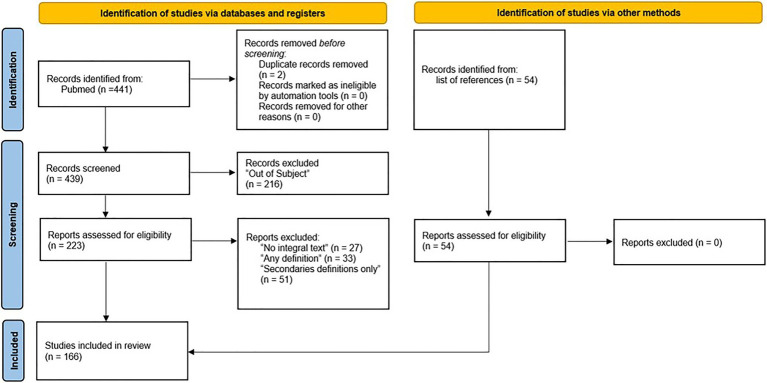
Objective: To investigate the definitions of spirituality in the healthcare field, identifying its main dimensions and proposing a framework that operationalizes the understanding of this concept. Methods: This is a systematic review following the PRISMA guideline (PROSPERO: CRD42021262091), searching for spirituality definitions published in scientific journals. Searches were carried out in PubMed (all articles listed up to October 2020) and in the reference lists of the articles found in the database, followed by selection under specific eligibility criteria. Results: From a total of 493 articles, 166 were included in the final analysis, showing that there is a large body of scientific literature proposing and analyzing spirituality definitions. In these articles, 24 spirituality dimensions were found, most commonly related to the connectedness and meaning of life. Spirituality was presented as a human and individual aspect. These findings led us to construct a framework that represents spirituality as a quantifiable construct. Conclusions: Understanding spirituality is an important aspect for healthcare research and clinical practice. This proposed framework may help to better understand the complexity of this topic, where advances are desirable, given the relevance it has acquired for integral health care.
Overview
AI snapshot
Written from the paper’s full text.
TL;DR
This systematic review analyzed 166 spirituality definitions in healthcare and identified 24 dimensions, most commonly connection/relation and meaning/purpose. It proposes a three-axis framework to operationalize spirituality as a quantifiable construct for research and clinical practice.
Key findings
- From 493 screened articles, 166 were included in the final analysis, and 24 spirituality dimensions were identified.
- The most frequent dimensions were connection/relation (53.01%), meaning/purpose (51.80%), divine/God/higher power (39.75%), transcendence/immaterial (38.55%), others/community relationship (37.95%), beliefs (29.51%), self connection (25.90%), nature connection (24.09%), and values (23.49%).
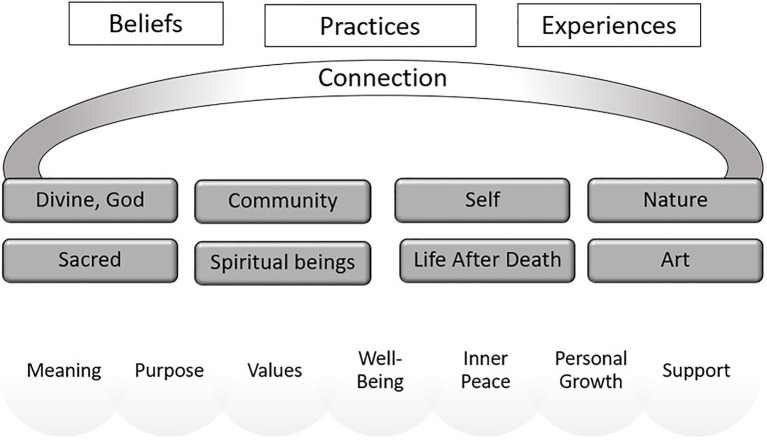
- Spirituality was presented as a human and individual aspect; the framework organizes dimensions into three axes: beliefs, practices, and experiences that promote connection; possible connected aspects such as sacred, life after death, spiritual beings, divine/God, self, community, nature, and art; and outcomes such as values, personal growth, meaning, purpose, well-being, support, and inner peace.
- The authors conclude spirituality is a human individual, dynamic characteristic expressed through beliefs, practices, and experiences in the search for connection with something that promotes meaning and personal growth.
Methods
- Systematic review following PRISMA, registered in PROSPERO (CRD42021262091), searching PubMed up to October 1, 2020, with the Boolean expression “spirituality [title] AND (concept OR definition)” plus reference-list scanning.
- Eligibility included articles addressing the meaning, concept, or definition of spirituality in healthcare; no language or date restrictions were applied. Selection proceeded through title/abstract screening, full-text reading, and dimension analysis.
- Definitions were analyzed for repeated terms/expressions to identify dimensions; each use was scored, percentages were calculated with 166 definitions as 100%, and terms appearing in fewer than 3 definitions (less than 2%) were excluded. The results were used to construct a framework.
Limitations
- The paper states that only PubMed was included, the Boolean search was narrow, and most articles were from the United States in English, creating possible Anglo-Saxon, Western, and Judeo-Christian bias.
- The paper states the framework is newly proposed and still lacks validation by other studies; credibility of included references was assessed by full-text reading and citation counts, and funders’ roles were not evaluated.
- The paper states insufficient consideration was given to how definitions were developed (conceptual versus empirical approaches), and further research is needed on language and multicultural representativeness.
Model-written summary. Check it against the paper before relying on it.
Integrity signals
Registry
Cites
Statistics
Figures
Verification
Claims the paper makes
31 Own result · 22 Not checked yet · 20 Own interpretation · 12 Own method · 6 No basis given · 1 Partly supported · accuracy not yet measured
A result the paper reports from its own data — it cites no other source for it, so there is none to check. The quote shows it is in the paper.
In the paper
“as a dynamic process (4.81%)”
- Also stated in: § Study Selection and Characteristics · plain
“Dynamic process | 4.81%”
§ Defining Spirituality in Healthcare: A Systematic Review and Conceptual Framework > Results > Synthesized Findings
plain- Asserted: passes — The authors put it forward as true.
- Checkable: passes — It can be checked against evidence.
- Load-bearing: unclear — It is unclear whether the paper’s conclusions depend on it.
- Based: passes — The paper gives a reason why it holds.
- Also stated in: § Study Selection and Characteristics · plain
A result the paper reports from its own data — it cites no other source for it, so there is none to check. The quote shows it is in the paper.
In the paper
“It could be felt as a power or inner energy (13.85%)”
- Also stated in: § Study Selection and Characteristics · plain
“Power, force, inner energy | 13.85%”
§ Defining Spirituality in Healthcare: A Systematic Review and Conceptual Framework > Results > Synthesized Findings
plain- Asserted: passes — The authors put it forward as true.
- Checkable: passes — It can be checked against evidence.
- Load-bearing: unclear — It is unclear whether the paper’s conclusions depend on it.
- Based: passes — The paper gives a reason why it holds.
- Also stated in: § Study Selection and Characteristics · plain
A result the paper reports from its own data — it cites no other source for it, so there is none to check. The quote shows it is in the paper.
In the paper
“Most of the publications considered spirituality as a “connection” or “relation” (53.01%)”
- Also stated in: § Study Selection and Characteristics · plain
“Connection/Relation | 53001%”
§ Defining Spirituality in Healthcare: A Systematic Review and Conceptual Framework > Results > Synthesized Findings
plain- Asserted: passes — The authors put it forward as true.
- Checkable: passes — It can be checked against evidence.
- Load-bearing: passes — The paper’s conclusions depend on it.
- Based: passes — The paper gives a reason why it holds.
- Also stated in: § Study Selection and Characteristics · plain
None of the sources cited for this claim have been checked yet.
In the paper
“revealing a clear lack of consensus on the understanding of what spirituality is”
- Also stated in: § Introduction · boosted
“there is no clear consensus about its definition”
§ Defining Spirituality in Healthcare: A Systematic Review and Conceptual Framework > Discussion
boosted- Asserted: passes — The authors put it forward as true.
- Checkable: passes — It can be checked against evidence.
- Load-bearing: passes — The paper’s conclusions depend on it.
- Based: passes — The paper gives a reason why it holds.
- Also stated in: § Introduction · boosted
A result the paper reports from its own data — it cites no other source for it, so there is none to check. The quote shows it is in the paper.
In the paper
“development of peace and well-being feelings (15.06%)”
- Also stated in: § Study Selection and Characteristics · plain
“Peace/well-being | 15.06%”
§ Defining Spirituality in Healthcare: A Systematic Review and Conceptual Framework > Results > Synthesized Findings
plain- Asserted: passes — The authors put it forward as true.
- Checkable: passes — It can be checked against evidence.
- Load-bearing: unclear — It is unclear whether the paper’s conclusions depend on it.
- Based: passes — The paper gives a reason why it holds.
- Also stated in: § Study Selection and Characteristics · plain
A result the paper reports from its own data — it cites no other source for it, so there is none to check. The quote shows it is in the paper.
In the paper
“as a life after death belief and attribute (1.80%)”
- Also stated in: § Study Selection and Characteristics · plain
“Life after death | 1.80%”
§ Defining Spirituality in Healthcare: A Systematic Review and Conceptual Framework > Results > Synthesized Findings
plain- Asserted: passes — The authors put it forward as true.
- Checkable: passes — It can be checked against evidence.
- Load-bearing: unclear — It is unclear whether the paper’s conclusions depend on it.
- Based: passes — The paper gives a reason why it holds.
- Also stated in: § Study Selection and Characteristics · plain
A result the paper reports from its own data — it cites no other source for it, so there is none to check. The quote shows it is in the paper.
In the paper
“in relation to something transcendent (38.55%)”
- Also stated in: § Study Selection and Characteristics · plain
“Transcendence/immaterial | 38.55%”
§ Defining Spirituality in Healthcare: A Systematic Review and Conceptual Framework > Results > Synthesized Findings
plain- Asserted: passes — The authors put it forward as true.
- Checkable: passes — It can be checked against evidence.
- Load-bearing: unclear — It is unclear whether the paper’s conclusions depend on it.
- Based: passes — The paper gives a reason why it holds.
- Also stated in: § Study Selection and Characteristics · plain
A result the paper reports from its own data — it cites no other source for it, so there is none to check. The quote shows it is in the paper.
In the paper
“as a subjective, individual, and particular aspect (19.87%)”
- Also stated in: § Study Selection and Characteristics · plain
“Individual/personal | 19.87%”
§ Defining Spirituality in Healthcare: A Systematic Review and Conceptual Framework > Results > Synthesized Findings
plain- Asserted: passes — The authors put it forward as true.
- Checkable: passes — It can be checked against evidence.
- Load-bearing: unclear — It is unclear whether the paper’s conclusions depend on it.
- Based: passes — The paper gives a reason why it holds.
- Also stated in: § Study Selection and Characteristics · plain
A result the paper reports from its own data — it cites no other source for it, so there is none to check. The quote shows it is in the paper.
In the paper
“24 spirituality dimensions were found (Table 3)”
- Also stated in: § Abstract · plain
“In these articles, 24 spirituality dimensions were found”
§ Defining Spirituality in Healthcare: A Systematic Review and Conceptual Framework > Results > Study Selection and Characteristics
plain- Asserted: passes — The authors put it forward as true.
- Checkable: passes — It can be checked against evidence.
- Load-bearing: passes — The paper’s conclusions depend on it.
- Based: passes — The paper gives a reason why it holds.
- Also stated in: § Abstract · plain
A result the paper reports from its own data — it cites no other source for it, so there is none to check. The quote shows it is in the paper.
In the paper
“The most cited reference from an article included in our review comes from Hill and Pargament (2003)”
§ Defining Spirituality in Healthcare: A Systematic Review and Conceptual Framework > Discussion
plain- Asserted: passes — The authors put it forward as true.
- Checkable: passes — It can be checked against evidence.
- Load-bearing: unclear — It is unclear whether the paper’s conclusions depend on it.
- Based: passes — The paper gives a reason why it holds.
- It may state two separate claims as one. 25
- Probably not a substantial claim. 42
- The quote only partly states this claim. 1
The cited sources support only part of this claim — read each source’s verdict below.
In the paper
“patients want their doctors to address spirituality and most doctors and nurses consider important to integrate this aspect into their practice (Baetz et al., 2004).”
§ Defining Spirituality in Healthcare: A Systematic Review and Conceptual Framework > Introduction
What the sources say
- Partly supportedcites Baetz et al., 2004 sourceExperimental — accuracy not yet measured
In “Beliefs and Practices of Psychiatrists and Patients” (page unavailable), 53% of patients said it was important to have spirituality or religion addressed in treatment. The paper surveyed psychiatrists, not nurses, and found that 47% of psychiatrists said spirituality or religion often or always has a role in psychiatric care. It therefore does not support the claim that most doctors and nurses consider integration important. (LLM, conf=0.88)
plain- Asserted: passes — The authors put it forward as true.
- Checkable: passes — It can be checked against evidence.
- Load-bearing: passes — The paper’s conclusions depend on it.
- Based: passes — The paper gives a reason why it holds.
It may state two separate claims as one.
- Partly supported
A result the paper reports from its own data — it cites no other source for it, so there is none to check. The quote shows it is in the paper.
In the paper
“Immanence | 5.42%”
§ Defining Spirituality in Healthcare: A Systematic Review and Conceptual Framework > Results > Study Selection and Characteristics
plain- Asserted: passes — The authors put it forward as true.
- Checkable: passes — It can be checked against evidence.
- Load-bearing: fails — The paper’s conclusions may not depend on it.
- Based: passes — The paper gives a reason why it holds.
Probably not a substantial claim. The paper’s conclusions may not depend on it.
The paper states this without a source or data behind it here, so there is nothing to check it against. The quote shows it is in the paper.
In the paper
“However, due to the lack of consensus on the term and the existing cultural gaps, we propose a new spirituality framework, based on a systematic review of the literature”
§ Defining Spirituality in Healthcare: A Systematic Review and Conceptual Framework > Conclusion
plain- Asserted: passes — The authors put it forward as true.
- Checkable: passes — It can be checked against evidence.
- Load-bearing: passes — The paper’s conclusions depend on it.
- Based: passes — The paper gives a reason why it holds.
Probably not a substantial claim. It may state two separate claims as one.
The paper states this without a source or data behind it here, so there is nothing to check it against. The quote shows it is in the paper.
In the paper
“We present a spirituality framework proposition (Figure 2) that organizes all the dimensions found, except “human aspect,” “individual aspect,” “dynamic process,” and “necessity” because they can be understood as dimensions about the general spirituality nature, permeating all axes and cannot be dissociated and allocated to a single axis or dimension.”
§ Defining Spirituality in Healthcare: A Systematic Review and Conceptual Framework > Proposed Framework for Spirituality in Healthcare
plain- Asserted: passes — The authors put it forward as true.
- Checkable: passes — It can be checked against evidence.
- Load-bearing: passes — The paper’s conclusions depend on it.
- Based: passes — The paper gives a reason why it holds.
Probably not a substantial claim.
The paper states this without a source or data behind it here, so there is nothing to check it against. The quote shows it is in the paper.
In the paper
“The first axis (upper white section) is composed of beliefs, practices, and experiences that promote connection.”
§ Defining Spirituality in Healthcare: A Systematic Review and Conceptual Framework > Proposed Framework for Spirituality in Healthcare
plain- Asserted: passes — The authors put it forward as true.
- Checkable: passes — It can be checked against evidence.
- Load-bearing: passes — The paper’s conclusions depend on it.
- Based: passes — The paper gives a reason why it holds.
Probably not a substantial claim.
The paper states this without a source or data behind it here, so there is nothing to check it against. The quote shows it is in the paper.
In the paper
“The third axis (lower gray section) refers to the development of values, personal growth, and sensations of meaning, purpose in life, well-being, support, and inner peace through connection with something that can affect the behavior of the individual.”
§ Defining Spirituality in Healthcare: A Systematic Review and Conceptual Framework > Proposed Framework for Spirituality in Healthcare
plaindirect- Asserted: passes — The authors put it forward as true.
- Checkable: passes — It can be checked against evidence.
- Load-bearing: passes — The paper’s conclusions depend on it.
- Based: passes — The paper gives a reason why it holds.
Probably not a substantial claim.
The paper states this without a source or data behind it here, so there is nothing to check it against. The quote shows it is in the paper.
In the paper
“Although there are some frameworks proposals on the concept of spirituality as seen above, there are still many aspects of this concept that remain unaddressed, indicating the need for a new, more comprehensive approach that may fit into the diverse cultural and religious contexts discussed in this research.”
§ Defining Spirituality in Healthcare: A Systematic Review and Conceptual Framework > Proposed Framework for Spirituality in Healthcare
hedged- Asserted: passes — The authors put it forward as true.
- Checkable: fails — It may be too vague to check against evidence.
- Load-bearing: passes — The paper’s conclusions depend on it.
- Based: passes — The paper gives a reason why it holds.
Probably not a substantial claim. It may be too vague to check against evidence. It may state two separate claims as one.
The paper states this without a source or data behind it here, so there is nothing to check it against. The quote shows it is in the paper.
In the paper
“In the second axis (middle dark gray section) are the possible aspects that can be connected through spiritual beliefs, practices, or experiences. They are classified as:”
§ Defining Spirituality in Healthcare: A Systematic Review and Conceptual Framework > Proposed Framework for Spirituality in Healthcare
plain- Asserted: passes — The authors put it forward as true.
- Checkable: passes — It can be checked against evidence.
- Load-bearing: passes — The paper’s conclusions depend on it.
- Based: passes — The paper gives a reason why it holds.
Probably not a substantial claim. It may state two separate claims as one. The quote only partly states this claim.
A conclusion the paper draws from its own results — it cites no other source for it, so there is none to check. The quote shows it is in the paper.
In the paper
“To our knowledge, this is the first study that systematically evaluated the most important and highly cited spirituality definitions under the healthcare field, instead of focusing on one specific area such as nursing or palliative care.”
§ Defining Spirituality in Healthcare: A Systematic Review and Conceptual Framework > Discussion
hedged- Asserted: passes — The authors put it forward as true.
- Checkable: passes — It can be checked against evidence.
- Load-bearing: passes — The paper’s conclusions depend on it.
- Based: passes — The paper gives a reason why it holds.
Probably not a substantial claim.
A conclusion the paper draws from its own results — it cites no other source for it, so there is none to check. The quote shows it is in the paper.
In the paper
“Broader definitions tend to consider spirituality as experiences of connection with nature, social relations, and art, while narrower definitions place spirituality in a more theistic approach”
§ Defining Spirituality in Healthcare: A Systematic Review and Conceptual Framework > Discussion > Connection: Narrower or Broader
plaincorrelational- Asserted: passes — The authors put it forward as true.
- Checkable: passes — It can be checked against evidence.
- Load-bearing: passes — The paper’s conclusions depend on it.
- Based: passes — The paper gives a reason why it holds.
It may state two separate claims as one.
A conclusion the paper draws from its own results — it cites no other source for it, so there is none to check. The quote shows it is in the paper.
In the paper
“From our results, we recognize that spirituality and religiosity are related and overlapping, varying according to the cultural context and to the dynamic quality of the spirituality itself.”
§ Defining Spirituality in Healthcare: A Systematic Review and Conceptual Framework > Discussion > Connection: Narrower or Broader
plaincorrelational- Asserted: passes — The authors put it forward as true.
- Checkable: passes — It can be checked against evidence.
- Load-bearing: passes — The paper’s conclusions depend on it.
- Based: passes — The paper gives a reason why it holds.
It may state two separate claims as one.
In the paper
“Historically, the term spirituality was used to describe the practices of people who dedicated their lives into religious services or exemplify the teachings of their faith traditions (Koenig, 2008).”
§ Defining Spirituality in Healthcare: A Systematic Review and Conceptual Framework > Introduction
What the sources say
- Not checked yetcites Koenig, 2008 source
plain- Asserted: passes — The authors put it forward as true.
- Checkable: passes — It can be checked against evidence.
- Load-bearing: fails — The paper’s conclusions may not depend on it.
- Based: passes — The paper gives a reason why it holds.
Probably not a substantial claim. The paper’s conclusions may not depend on it.
None of the sources cited for this claim have been checked yet.
In the paper
“Spirituality is a broad and complex concept which varies its understanding according to different cultural, religious and academic backgrounds (i.e., religious persons, scientists, or lay persons; Koenig, 2008; la Cour and Götke, 2012).”
§ Defining Spirituality in Healthcare: A Systematic Review and Conceptual Framework > Introduction
What the sources say
- Not checked yetcites Koenig, 2008 source
- Not checked yetcites la Cour and Götke, 2012
plaincorrelational- Asserted: passes — The authors put it forward as true.
- Checkable: passes — It can be checked against evidence.
- Load-bearing: passes — The paper’s conclusions depend on it.
- Based: passes — The paper gives a reason why it holds.
Probably not a substantial claim. It may state two separate claims as one.
In the paper
“there is a remarkable debate regarding the most accurate meaning, and regarding the possibility of having a single universal consensual definition for this concept (Peng-Keller, 2019).”
§ Defining Spirituality in Healthcare: A Systematic Review and Conceptual Framework > Introduction
What the sources say
- Not checked yetcites Peng-Keller, 2019 source
plain- Asserted: passes — The authors put it forward as true.
- Checkable: passes — It can be checked against evidence.
- Load-bearing: passes — The paper’s conclusions depend on it.
- Based: passes — The paper gives a reason why it holds.
Probably not a substantial claim. It may state two separate claims as one.
What the paper did — it cites no source for this, so there is none to check. The quote shows it is in the paper.
In the paper
“Terms that did not appear in at least 3 definitions were excluded, as they corresponded to less than 2% appearance in the definitions.”
§ Defining Spirituality in Healthcare: A Systematic Review and Conceptual Framework > Materials and Methods > Data Extraction and Analysis
plain- Asserted: passes — The authors put it forward as true.
- Checkable: passes — It can be checked against evidence.
- Load-bearing: passes — The paper’s conclusions depend on it.
- Based: passes — The paper gives a reason why it holds.
Probably not a substantial claim.
In the paper
“This is a systematic review based on the PRISMA statement for reporting systematic reviews and meta-analyses (Page et al., 2021).”
§ Defining Spirituality in Healthcare: A Systematic Review and Conceptual Framework > Materials and Methods
What the sources say
- Not checked yetcites Page et al., 2021 source
plain- Asserted: passes — The authors put it forward as true.
- Checkable: passes — It can be checked against evidence.
- Load-bearing: fails — The paper’s conclusions may not depend on it.
- Based: passes — The paper gives a reason why it holds.
Probably not a substantial claim. The paper’s conclusions may not depend on it.
What the paper did — it cites no source for this, so there is none to check. The quote shows it is in the paper.
In the paper
“After identifying all dimensions, from all selected definitions, a second author looked up into each definition in order to confirm and unify all chosen dimensions.”
§ Defining Spirituality in Healthcare: A Systematic Review and Conceptual Framework > Materials and Methods > Data Extraction and Analysis
plaindirect- Asserted: passes — The authors put it forward as true.
- Checkable: passes — It can be checked against evidence.
- Load-bearing: fails — The paper’s conclusions may not depend on it.
- Based: passes — The paper gives a reason why it holds.
Probably not a substantial claim. The paper’s conclusions may not depend on it.
What the paper did — it cites no source for this, so there is none to check. The quote shows it is in the paper.
In the paper
“The protocol was registered in the PROSPERO international prospective registry of systematic reviews (registration number: CRD42021262091).”
§ Defining Spirituality in Healthcare: A Systematic Review and Conceptual Framework > Materials and Methods
plain- Asserted: passes — The authors put it forward as true.
- Checkable: passes — It can be checked against evidence.
- Load-bearing: fails — The paper’s conclusions may not depend on it.
- Based: passes — The paper gives a reason why it holds.
Probably not a substantial claim. The paper’s conclusions may not depend on it.
A conclusion the paper draws from its own results — it cites no other source for it, so there is none to check. The quote shows it is in the paper.
In the paper
“We present a spirituality framework proposition (Figure 2) that organizes all the dimensions found, except “human aspect,” “individual aspect,” “dynamic process,” and “necessity” because they can be understood as dimensions about the general spirituality nature, permeating all axes and cannot be dissociated and allocated to a single axis or dimension.”
§ Defining Spirituality in Healthcare: A Systematic Review and Conceptual Framework > Proposed Framework for Spirituality in Healthcare
plain- Asserted: passes — The authors put it forward as true.
- Checkable: passes — It can be checked against evidence.
- Load-bearing: passes — The paper’s conclusions depend on it.
- Based: passes — The paper gives a reason why it holds.
Probably not a substantial claim.
What the paper did — it cites no source for this, so there is none to check. The quote shows it is in the paper.
In the paper
“Seventh, we gave insufficient consideration to the manner in which the definitions of spirituality were developed (e.g., conceptual versus empirical approaches to definition and measurement) and it should be considered in further research.”
§ Defining Spirituality in Healthcare: A Systematic Review and Conceptual Framework > Limitations
plain- Asserted: passes — The authors put it forward as true.
- Checkable: passes — It can be checked against evidence.
- Load-bearing: fails — The paper’s conclusions may not depend on it.
- Based: passes — The paper gives a reason why it holds.
Probably not a substantial claim. The paper’s conclusions may not depend on it.
A conclusion the paper draws from its own results — it cites no other source for it, so there is none to check. The quote shows it is in the paper.
In the paper
“The experiences compose the subjective aspect, based on the individual perception of the presence of elements of interaction with the connecting object of spirituality, going beyond the bond through the intellect.”
§ Defining Spirituality in Healthcare: A Systematic Review and Conceptual Framework > Discussion > Beliefs, Practices, and Experiences
plain- Asserted: passes — The authors put it forward as true.
- Checkable: fails — It may be too vague to check against evidence.
- Load-bearing: passes — The paper’s conclusions depend on it.
- Based: fails — The paper may give no reason why it holds.
Probably not a substantial claim. It may be too vague to check against evidence. The paper may give no reason why it holds.
A conclusion the paper draws from its own results — it cites no other source for it, so there is none to check. The quote shows it is in the paper.
In the paper
“in which spirituality (1) is a human individual, dynamic characteristic;”
§ Defining Spirituality in Healthcare: A Systematic Review and Conceptual Framework > Conclusion
plain- Asserted: passes — The authors put it forward as true.
- Checkable: fails — It may be too vague to check against evidence.
- Load-bearing: passes — The paper’s conclusions depend on it.
- Based: passes — The paper gives a reason why it holds.
Probably not a substantial claim. It may be too vague to check against evidence.
In the paper
“This perception is a concern for some religious faiths, to enhance this feeling that can be called “spiritual well-being” (Moberg, 1984).”
§ Defining Spirituality in Healthcare: A Systematic Review and Conceptual Framework > Proposed Framework for Spirituality in Healthcare
What the sources say
- Not checked yetcites Moberg, 1984 source
plain- Asserted: passes — The authors put it forward as true.
- Checkable: passes — It can be checked against evidence.
- Load-bearing: fails — The paper’s conclusions may not depend on it.
- Based: passes — The paper gives a reason why it holds.
Probably not a substantial claim. The paper’s conclusions may not depend on it.
A conclusion the paper draws from its own results — it cites no other source for it, so there is none to check. The quote shows it is in the paper.
In the paper
“We believe that the identification of these dimensions can help researchers and health professionals to map how individuals understand and express their spirituality, making it operational.”
§ Defining Spirituality in Healthcare: A Systematic Review and Conceptual Framework > Proposed Framework for Spirituality in Healthcare
plainconditional- Asserted: passes — The authors put it forward as true.
- Checkable: fails — It may be too vague to check against evidence.
- Load-bearing: passes — The paper’s conclusions depend on it.
- Based: fails — The paper may give no reason why it holds.
Probably not a substantial claim. It may be too vague to check against evidence. The paper may give no reason why it holds.
What the paper did — it cites no source for this, so there is none to check. The quote shows it is in the paper.
In the paper
“Third, there is a low multicultural representativeness because most of the articles were from the United States, in English, showing a possible bias of an Anglo-Saxon, Western, and Judeo-Christian culture, which may have impacted the definitions presented in the articles.”
§ Defining Spirituality in Healthcare: A Systematic Review and Conceptual Framework > Limitations
hedgedconditional- Asserted: passes — The authors put it forward as true.
- Checkable: passes — It can be checked against evidence.
- Load-bearing: unclear — It is unclear whether the paper’s conclusions depend on it.
- Based: passes — The paper gives a reason why it holds.
It may state two separate claims as one.
A conclusion the paper draws from its own results — it cites no other source for it, so there is none to check. The quote shows it is in the paper.
In the paper
“and (3) leads to the development of values and positive inner feelings.”
§ Defining Spirituality in Healthcare: A Systematic Review and Conceptual Framework > Conclusion
plaindirect- Asserted: passes — The authors put it forward as true.
- Checkable: fails — It may be too vague to check against evidence.
- Load-bearing: passes — The paper’s conclusions depend on it.
- Based: passes — The paper gives a reason why it holds.
Probably not a substantial claim. It may be too vague to check against evidence.
None of the sources cited for this claim have been checked yet.
In the paper
“While for the social sciences there is no major concerns for the lack of an universal definition of spirituality, medical and health-related sciences need a structure and relative consensus, since most instruments attempt to quantify its intangible construct in order to evaluate its impact and propose health-related interventions (Macdonald and Friedman, 2002; Hill and Pargament, 2008).”
§ Defining Spirituality in Healthcare: A Systematic Review and Conceptual Framework > Introduction
What the sources say
- Not checked yetcites Macdonald and Friedman, 2002
- Not checked yetcites Hill and Pargament, 2008 source
plaindirect- Asserted: passes — The authors put it forward as true.
- Checkable: fails — It may be too vague to check against evidence.
- Load-bearing: passes — The paper’s conclusions depend on it.
- Based: passes — The paper gives a reason why it holds.
Probably not a substantial claim. It may be too vague to check against evidence. It may state two separate claims as one.
In the paper
“Based on learning theories, when content is exposed interconnecting the verbal and the visual, it facilitates the construction of connections, relationships, and understanding in the cognitive structure (Peer et al., 2021).”
§ Defining Spirituality in Healthcare: A Systematic Review and Conceptual Framework > Proposed Framework for Spirituality in Healthcare
What the sources say
- Not checked yetcites Peer et al., 2021 source
plaindirect- Asserted: passes — The authors put it forward as true.
- Checkable: passes — It can be checked against evidence.
- Load-bearing: fails — The paper’s conclusions may not depend on it.
- Based: passes — The paper gives a reason why it holds.
Probably not a substantial claim. The paper’s conclusions may not depend on it.
In the paper
“Research over the last decades has been growing substantially in the field of “Spirituality and Health,” showing a significant influence of spiritual and religious beliefs on both mental and physical health outcomes (Damiano et al., 2016)”
§ Defining Spirituality in Healthcare: A Systematic Review and Conceptual Framework > Introduction
What the sources say
- Not checked yetcites Damiano et al., 2016 source
plaincorrelational- Asserted: passes — The authors put it forward as true.
- Checkable: passes — It can be checked against evidence.
- Load-bearing: fails — The paper’s conclusions may not depend on it.
- Based: passes — The paper gives a reason why it holds.
Probably not a substantial claim. The paper’s conclusions may not depend on it. It may state two separate claims as one.
None of the sources cited for this claim have been checked yet.
In the paper
“Spirituality can be analyzed through multiple dimensions, which identification may clarify how individuals interact with their spirituality, and which aspects greater impact more on health and treatment (Lunder et al., 2011; MacDonald et al., 2015).”
§ Defining Spirituality in Healthcare: A Systematic Review and Conceptual Framework > Proposed Framework for Spirituality in Healthcare
What the sources say
hedgedconditional- Asserted: passes — The authors put it forward as true.
- Checkable: passes — It can be checked against evidence.
- Load-bearing: passes — The paper’s conclusions depend on it.
- Based: passes — The paper gives a reason why it holds.
Probably not a substantial claim. It may state two separate claims as one.
What the paper did — it cites no source for this, so there is none to check. The quote shows it is in the paper.
In the paper
“Forth, although English is the main language in the scientific literature, the constructs of this framework need to be made for other languages that have large worldwide representation, since the contents described here may not apply to the linguistic variety in countries like India and China, for example.”
§ Defining Spirituality in Healthcare: A Systematic Review and Conceptual Framework > Limitations
hedged- Asserted: passes — The authors put it forward as true.
- Checkable: passes — It can be checked against evidence.
- Load-bearing: fails — The paper’s conclusions may not depend on it.
- Based: passes — The paper gives a reason why it holds.
Probably not a substantial claim. The paper’s conclusions may not depend on it.
A conclusion the paper draws from its own results — it cites no other source for it, so there is none to check. The quote shows it is in the paper.
In the paper
“The framework was designed as a didactic scheme, presenting the dimensions as a non-hierarchical and non-static construction, which flow according to individual’s context and experiences.”
§ Defining Spirituality in Healthcare: A Systematic Review and Conceptual Framework > Proposed Framework for Spirituality in Healthcare
plain- Asserted: passes — The authors put it forward as true.
- Checkable: passes — It can be checked against evidence.
- Load-bearing: passes — The paper’s conclusions depend on it.
- Based: passes — The paper gives a reason why it holds.
Probably not a substantial claim.
None of the sources cited for this claim have been checked yet.
In the paper
“Some religious/spiritual beliefs are, for example, the existence of a higher, transcendent power or the continuity of life after death.”
§ Defining Spirituality in Healthcare: A Systematic Review and Conceptual Framework > Discussion > Beliefs, Practices, and Experiences
What the sources say
- Not checked yetcites Banks-Wallace and Parks, 2004
- Not checked yetcites Markani et al., 2013 source
plain- Asserted: passes — The authors put it forward as true.
- Checkable: passes — It can be checked against evidence.
- Load-bearing: fails — The paper’s conclusions may not depend on it.
- Based: passes — The paper gives a reason why it holds.
Probably not a substantial claim. The paper’s conclusions may not depend on it. It may state two separate claims as one.
None of the sources cited for this claim have been checked yet.
In the paper
“This process is related to improving patients’ outcomes, manages chronic pain, or deals with a diagnostic as cancer (Breitbart, 2002; Vachon, 2008; Dedeli and Kaptan, 2013; Weber and Pargament, 2014; Bernard et al., 2017).”
§ Defining Spirituality in Healthcare: A Systematic Review and Conceptual Framework > Discussion > Interpretation of Life: Meaning and Purpose
What the sources say
plaincorrelational- Asserted: passes — The authors put it forward as true.
- Checkable: passes — It can be checked against evidence.
- Load-bearing: unclear — It is unclear whether the paper’s conclusions depend on it.
- Based: passes — The paper gives a reason why it holds.
It may state two separate claims as one.
What the paper did — it cites no source for this, so there is none to check. The quote shows it is in the paper.
In the paper
“Fifth, this framework is herein newly proposed, and thus, it still lacks a validation by other studies.”
§ Defining Spirituality in Healthcare: A Systematic Review and Conceptual Framework > Limitations
plain- Asserted: passes — The authors put it forward as true.
- Checkable: passes — It can be checked against evidence.
- Load-bearing: fails — The paper’s conclusions may not depend on it.
- Based: passes — The paper gives a reason why it holds.
Probably not a substantial claim. The paper’s conclusions may not depend on it. It may state two separate claims as one.
What the paper did — it cites no source for this, so there is none to check. The quote shows it is in the paper.
In the paper
“Another important point is that funders role on the manuscripts was not evaluated, posing risks of bias for the adopted definitions of each article.”
§ Defining Spirituality in Healthcare: A Systematic Review and Conceptual Framework > Limitations
plainconditional- Asserted: passes — The authors put it forward as true.
- Checkable: passes — It can be checked against evidence.
- Load-bearing: fails — The paper’s conclusions may not depend on it.
- Based: passes — The paper gives a reason why it holds.
Probably not a substantial claim. The paper’s conclusions may not depend on it. It may state two separate claims as one.
None of the sources cited for this claim have been checked yet.
In the paper
“Spirituality is generally related to diminished numbers of substance use, suicidal attempts and depression prevalence, less hospitalization, better coping with disease, better treatment adherence, and lower mortality rates (Moreira-Almeida et al., 2006; Guimarães and Avezum, 2007; Lucchetti et al., 2011).”
§ Defining Spirituality in Healthcare: A Systematic Review and Conceptual Framework > Introduction
What the sources say
- Not checked yetcites Moreira-Almeida et al., 2006 source
- Not checked yetcites Guimarães and Avezum, 2007
- Not checked yetcites Lucchetti et al., 2011
plaincorrelational- Asserted: passes — The authors put it forward as true.
- Checkable: passes — It can be checked against evidence.
- Load-bearing: passes — The paper’s conclusions depend on it.
- Based: passes — The paper gives a reason why it holds.
It may state two separate claims as one.
What the paper did — it cites no source for this, so there is none to check. The quote shows it is in the paper.
In the paper
“Sixth, the credibility of the included references was assessed by authors reading the full text of each article, as well as assessing the usual scientometric parameters, i.e., number of citations, which could be considered another limitation.”
§ Defining Spirituality in Healthcare: A Systematic Review and Conceptual Framework > Limitations
hedged- Asserted: passes — The authors put it forward as true.
- Checkable: passes — It can be checked against evidence.
- Load-bearing: fails — The paper’s conclusions may not depend on it.
- Based: passes — The paper gives a reason why it holds.
Probably not a substantial claim. The paper’s conclusions may not depend on it.
None of the sources cited for this claim have been checked yet.
In the paper
“several barriers limit addressing R/S, including the lack of training by health professionals and the lack of clear defined concepts (Best et al., 2015; Menegatti-Chequini et al., 2019).”
§ Defining Spirituality in Healthcare: A Systematic Review and Conceptual Framework > Introduction
What the sources say
plaindirect- Asserted: passes — The authors put it forward as true.
- Checkable: passes — It can be checked against evidence.
- Load-bearing: passes — The paper’s conclusions depend on it.
- Based: passes — The paper gives a reason why it holds.
It may state two separate claims as one.
A conclusion the paper draws from its own results — it cites no other source for it, so there is none to check. The quote shows it is in the paper.
In the paper
“Individuality as a dimension of spirituality emphasizes the importance of looking at each person and their subjective experience, pointing to the person-centered care whose goal is a meaningful life”
§ Defining Spirituality in Healthcare: A Systematic Review and Conceptual Framework > Discussion > Spirituality as an Intrinsic Component of Human Beings
plaindirect- Asserted: passes — The authors put it forward as true.
- Checkable: passes — It can be checked against evidence.
- Load-bearing: fails — The paper’s conclusions may not depend on it.
- Based: passes — The paper gives a reason why it holds.
Probably not a substantial claim. The paper’s conclusions may not depend on it. It may state two separate claims as one.
In the paper
“The definitions of spirituality are multifactorial, including religious heritage, culture, generation, and nationality (Gall et al., 2011).”
§ Defining Spirituality in Healthcare: A Systematic Review and Conceptual Framework > Proposed Framework for Spirituality in Healthcare
What the sources say
- Not checked yetcites Gall et al., 2011 source
plaincorrelational- Asserted: passes — The authors put it forward as true.
- Checkable: passes — It can be checked against evidence.
- Load-bearing: passes — The paper’s conclusions depend on it.
- Based: passes — The paper gives a reason why it holds.
Probably not a substantial claim.
A conclusion the paper draws from its own results — it cites no other source for it, so there is none to check. The quote shows it is in the paper.
In the paper
“Practices correspond to the dimension of behavior, being social or individual, public or private, that requires the engagement of the individual to perform activities such as meditating, praying, or going to meetings of the group that shares his/her spiritual/religious beliefs.”
§ Defining Spirituality in Healthcare: A Systematic Review and Conceptual Framework > Discussion > Beliefs, Practices, and Experiences
plain- Asserted: passes — The authors put it forward as true.
- Checkable: passes — It can be checked against evidence.
- Load-bearing: passes — The paper’s conclusions depend on it.
- Based: passes — The paper gives a reason why it holds.
Probably not a substantial claim.
A conclusion the paper draws from its own results — it cites no other source for it, so there is none to check. The quote shows it is in the paper.
In the paper
“It can be understood as a spirituality starter point.”
§ Defining Spirituality in Healthcare: A Systematic Review and Conceptual Framework > Proposed Framework for Spirituality in Healthcare
plain- Asserted: passes — The authors put it forward as true.
- Checkable: passes — It can be checked against evidence.
- Load-bearing: fails — The paper’s conclusions may not depend on it.
- Based: passes — The paper gives a reason why it holds.
Probably not a substantial claim. The paper’s conclusions may not depend on it.
A conclusion the paper draws from its own results — it cites no other source for it, so there is none to check. The quote shows it is in the paper.
In the paper
“In this sense, what we herein propose is a common ground where elements of different components of spirituality, which are not usually associated, can be understood in a coherent scenario, helping researchers to better design and comprehend their findings, as well readers to build a common ground of knowledge.”
§ Defining Spirituality in Healthcare: A Systematic Review and Conceptual Framework > Conclusion
plaindirect- Asserted: passes — The authors put it forward as true.
- Checkable: fails — It may be too vague to check against evidence.
- Load-bearing: passes — The paper’s conclusions depend on it.
- Based: passes — The paper gives a reason why it holds.
Probably not a substantial claim. It may be too vague to check against evidence. It may state two separate claims as one.
None of the sources cited for this claim have been checked yet.
In the paper
“Spirituality can be considered a source of coping to handle crisis and stressful moments, and related to positive meanings in face of challenges, such as in health problems.”
§ Defining Spirituality in Healthcare: A Systematic Review and Conceptual Framework > Discussion > Interpretation of Life: Meaning and Purpose
What the sources say
plaincorrelational- Asserted: passes — The authors put it forward as true.
- Checkable: passes — It can be checked against evidence.
- Load-bearing: passes — The paper’s conclusions depend on it.
- Based: passes — The paper gives a reason why it holds.
It may state two separate claims as one.
What the paper did — it cites no source for this, so there is none to check. The quote shows it is in the paper.
In the paper
“First, we only included one database and, for this reason, articles indexed only in other databases were not included; PubMed was chosen because this is a medical database and the definitions of spirituality included in these articles were more likely to be related to healthcare.”
§ Defining Spirituality in Healthcare: A Systematic Review and Conceptual Framework > Limitations
hedgedcorrelational- Asserted: passes — The authors put it forward as true.
- Checkable: passes — It can be checked against evidence.
- Load-bearing: passes — The paper’s conclusions depend on it.
- Based: passes — The paper gives a reason why it holds.
Probably not a substantial claim.
- Rests on an assumption: Definitions of spirituality in articles indexed in PubMed are more likely to be related to healthcare.
A conclusion the paper draws from its own results — it cites no other source for it, so there is none to check. The quote shows it is in the paper.
In the paper
“Beliefs can be considered as the cognitive dimension of spirituality, an affirmation of something considered real, which varies according to the culture.”
§ Defining Spirituality in Healthcare: A Systematic Review and Conceptual Framework > Discussion > Beliefs, Practices, and Experiences
plain- Asserted: passes — The authors put it forward as true.
- Checkable: passes — It can be checked against evidence.
- Load-bearing: passes — The paper’s conclusions depend on it.
- Based: passes — The paper gives a reason why it holds.
Probably not a substantial claim. It may state two separate claims as one.
What the paper did — it cites no source for this, so there is none to check. The quote shows it is in the paper.
In the paper
“First, we only included one database and, for this reason, articles indexed only in other databases were not included; PubMed was chosen because this is a medical database and the definitions of spirituality included in these articles were more likely to be related to healthcare.”
§ Defining Spirituality in Healthcare: A Systematic Review and Conceptual Framework > Limitations
plaindirect- Asserted: passes — The authors put it forward as true.
- Checkable: passes — It can be checked against evidence.
- Load-bearing: passes — The paper’s conclusions depend on it.
- Based: passes — The paper gives a reason why it holds.
It may state two separate claims as one.
A conclusion the paper draws from its own results — it cites no other source for it, so there is none to check. The quote shows it is in the paper.
In the paper
““Meaning” as a dimension of spirituality may exist in religious or non-religious individuals, pointing to an universal characteristic that can be used to assess the patient’s spirituality”
§ Defining Spirituality in Healthcare: A Systematic Review and Conceptual Framework > Discussion > Interpretation of Life: Meaning and Purpose
hedgedcorrelational- Asserted: passes — The authors put it forward as true.
- Checkable: passes — It can be checked against evidence.
- Load-bearing: passes — The paper’s conclusions depend on it.
- Based: passes — The paper gives a reason why it holds.
It may state two separate claims as one.
A conclusion the paper draws from its own results — it cites no other source for it, so there is none to check. The quote shows it is in the paper.
In the paper
“Even though spirituality can be understood as a characteristic common to all humans, it is a particular expression of each one.”
§ Defining Spirituality in Healthcare: A Systematic Review and Conceptual Framework > Discussion > Spirituality as an Intrinsic Component of Human Beings
plain- Asserted: passes — The authors put it forward as true.
- Checkable: passes — It can be checked against evidence.
- Load-bearing: fails — The paper’s conclusions may not depend on it.
- Based: passes — The paper gives a reason why it holds.
Probably not a substantial claim. The paper’s conclusions may not depend on it. It may state two separate claims as one.
A conclusion the paper draws from its own results — it cites no other source for it, so there is none to check. The quote shows it is in the paper.
In the paper
“(2) is expressed through beliefs, practices, and experiences in the search for connection with something that promotes meaning and personal growth;”
§ Defining Spirituality in Healthcare: A Systematic Review and Conceptual Framework > Conclusion
plain- Asserted: passes — The authors put it forward as true.
- Checkable: fails — It may be too vague to check against evidence.
- Load-bearing: passes — The paper’s conclusions depend on it.
- Based: passes — The paper gives a reason why it holds.
Probably not a substantial claim. It may be too vague to check against evidence.
A conclusion the paper draws from its own results — it cites no other source for it, so there is none to check. The quote shows it is in the paper.
In the paper
“Spirituality identified as a plural construct in a visual structure organization can guarantee an understanding of the complexity of this phenomenon.”
§ Defining Spirituality in Healthcare: A Systematic Review and Conceptual Framework > Proposed Framework for Spirituality in Healthcare
plaindirect- Asserted: passes — The authors put it forward as true.
- Checkable: fails — It may be too vague to check against evidence.
- Load-bearing: passes — The paper’s conclusions depend on it.
- Based: passes — The paper gives a reason why it holds.
Probably not a substantial claim. It may be too vague to check against evidence.
The paper relies on this without support.
The field of spirituality has considerably changed in recent decades with a large number of publications and ongoing research.
“in the last decades, the field of spirituality has considerably changed with a large number of publications and ongoing researches.”
The paper relies on this without support.
Several articles were published with new definitions and concepts.
“Likewise, several articles were published with new definitions and concepts.”
The paper relies on this without support.
Definitions of spirituality in articles indexed in PubMed are more likely to be related to healthcare.
“PubMed was chosen because this is a medical database and the definitions of spirituality included in these articles were more likely to be related to healthcare.”
Claims other papers make about this one
Each is checked against this paper’s own text: does it say what the citing paper says it does?
The source backs part of the claim, not all of it — or backs it for a different population, condition or comparison.
In the citing paper
“However, its role is complex and multifaceted; spirituality is not a monolithic construct, and different spiritual practices may exert distinct psychological and neurobiological effects (de Brito Sena et al., 2021; Lucchetti and Lucchetti, 2014).”
From From use to abuse: psychological, neurobiological, and spiritual pathways in relational harm and recovery (2026) · cites this paper as de Brito Sena et al., 2021
Experimental — accuracy not yet measuredThe cited source says what the claim attributes to it.
In the citing paper
“Within this context, spirituality has increasingly been recognized as a potential pathway for healing and recovery.”
From From use to abuse: psychological, neurobiological, and spiritual pathways in relational harm and recovery (2026) · cites this paper as de Brito Sena et al., 2021
Self-check
Percentages, sums and reported differences re-computed from the paper’s own numbers.
Each contradiction between two passages listed here was confirmed by an independent check.
Rated minor: it would not touch a result — a value no result rests on, a p-value that stays on the same side of the significance level, or a conflict that is clerical, resolved elsewhere in the paper, or outside its own findings.
In the paper
§ Defining Spirituality in Healthcare: A Systematic Review and Conceptual Framework > Results > Study Selection and Characteristics
“| Connection/Relation | 53001% |”
§ Defining Spirituality in Healthcare: A Systematic Review and Conceptual Framework > Discussion > Connection: Narrower or Broader
“Connection (or relationship) could be considered as a central aspect of spirituality, as found in 88 definitions (53.01%).”
Citations
Cites
The PRISMA 2020 statement: An updated guideline for reporting systematic reviews
Page, M. J., McKenzie, J. E., Bossuyt, P. M., Boutron, I., Hoffmann, T. C., Mulrow, C. D., Shamseer, L., Tetzlaff, J. M., Akl, E. A., Brennan, S. E., et al. (2021) · BMJ · doi:10.1136/bmj.n71 · Cited by 108,283
Personal religious orientation and prejudice.
Āllport, G. W., & Ross, J. M. (1967) · Journal of Personality and Social Psychology · doi:10.1037/h0021212 · Cited by 4,177
Handbook of Religion and Health
Koenig, H., McCullough, M., & Larson, D. (2001) · doi:10.1093/acprof:oso/9780195118667.001.0001 · Cited by 2,581
Hill, P. C., & Pargament, K. I. (2003) · American Psychologist · doi:10.1037/0003-066x.58.1.64 · Cited by 1,948
Conceptualizing religion and spirituality: points of commonality, points of departure
Hill, P. C., Pargament, K. I., Hood, R. W., McCullough, Jr., Swyers, J. P., Larson, D. B., & Zinnbauer, B. J. (2000) · Journal for the Theory of Social Behaviour · doi:10.1111/1468-5914.00119 · Cited by 1,623
Religion and spirituality: unfuzzying the fuzzy
Zinnbauer, B. J., Pargament, K. I., Cole, B., Rye, M. S., Butter, E. M., Belavich, T. G., Hipp, K. M., Scott, A. B., & Kadar, J. L. (1997) · Journal for the Scientific Study of Religion · doi:10.2307/1387689 · Cited by 1,543
The Duke University Religion Index (DUREL): A Five-Item Measure for Use in Epidemological Studies
Koenig, H. G., & Büssing, A. (2010) · Religions · doi:10.3390/rel1010078 · Cited by 1,113
Puchalski, C. M., Vitillo, R., Hull, S. K., & Reller, N. (2014) · Journal of Palliative Medicine · doi:10.1089/jpm.2014.9427 · Cited by 1,108
Personal Religious Orientation and Prejudice.
Āllport, G. W., & Ross, J. M. (1967) · Journal of Personality and Social Psychology · doi:10.1037/0022-3514.5.4.432 · Cited by 836
Religiousness and mental health: a review
Moreira-Almeida, A., Lotufo Neto, F., & Koenig, H. G. (2006) · Revista Brasileira de Psiquiatria · doi:10.1590/s1516-44462006005000006 · Cited by 835
Research works printed but not linked: 3
- Eliade, 2018, O Sagrado e o Profano – A Essência das Religiões.
- Lucchetti, 2011, Religiosidade, Espiritualidade e Doenças Cardiovasculares, Rev Bras Cardiol., 24, 55
- Van Der Veer, 2008, Spirituality in modern society, 1097
Cited by
Sorted by citations
Items 101–200 of 262
Bitēna, D. K., Salmane-Kuļikovska, I., Duhovská, J., Znotiņa, I., Lejniece, S., & Mārtinsone, K. (2026) · Journal of Religion and Health · doi:10.1007/s10943-025-02550-w · Cited by 2
Spiritual Experiences in Ecotherapy: A Systematic Review
Kang, M., & Hanley, T. (2026) · Ecopsychology · doi:10.1177/19429347251413153 · Cited by 2
El Concepto de Espiritualidad: Posturas Críticas Hacia su Utilidad en la Psicología
Martínez‐Taboas, A. (2026) · Revista Caribeña de Psicología · doi:10.37226/rcp.v10i1.18399 · Cited by 2
Rangel, T. L., Timmerman, R. A., Bock, D., Keller, M., & Long, J. D. (2024) · Western Journal of Nursing Research · doi:10.1177/01939459241247802 · Cited by 2
Exploring Coping and Religiosity in an Indian Ashram for Older Adults
Das, A., Chaudhary, A., & Tyagi, L. (2023) · Journal of Cross-Cultural Gerontology · doi:10.1007/s10823-023-09484-4 · Cited by 2
NURSES SPIRITUAL SELF-CARE: A CONCEPT ANALYSIS BY WALKER AND AVANT'S APPROACH
Taghlili, F., Shahboulaghi, F. M., Khankeh, H. R., & Tabrizi, K. N. (2023) · Nursing and Midwifery Journal · doi:10.61186/unmf.21.7.547 · Cited by 2
Lucchetti, G., Lucchetti, A. L. G., Vitorino, L. M., Martin, E. Z., Almeida, P. O. D. A., Damiano, B. B. F., Alvarenga, W. D. A., & Damiano, R. F. (2024) · Journal of Religion and Health · doi:10.1007/s10943-024-02086-5 · Cited by 2
Self-citationWhat Does Spirituality Look Like?
Sarracino, R. (2024) · The Journal of Bahá’í Studies · doi:10.31581/jbs-33.4.520(2023 · Cited by 2
Lundmark, M. (2025) · Journal of Advanced Nursing · doi:10.1111/jan.16738 · Cited by 2
Mohammadi, F., Hosseiny, S. M. M., Khazaei, S., Esfahani, H., Soltani, K., & Masumi, S. M. (2025) · BMC Psychology · doi:10.1186/s40359-025-03179-w · Cited by 2
Wnuk, M., & Charzyńska, E. (2025) · Journal of Religion and Health · doi:10.1007/s10943-025-02431-2 · Cited by 2
Validation of the spiritual screening tool ConnecTo
Lepherd, L., Hampton, I., Knight, B. G., Graham, C. J., & Egan, R. (2023) · Journal of Religion Spirituality & Aging · doi:10.1080/15528030.2023.2203422 · Cited by 2
Lebaka, M. E. K. (2022) · European Journal of Interdisciplinary Studies · doi:10.2478/ejis-2022-0001 · Cited by 2
Bhardwaj, S., Ali, A., & Paul, F. A. (2026) · Frontiers in Behavioral Neuroscience · doi:10.3389/fnbeh.2026.1805594 · Cited by 1
“However, its role is complex and multifaceted; spirituality is not a monolithic construct, and dierent spiritual practices may exert distinct psychological and neurobiological eects (de Brito Sena et al., 2021; Lucchetti and Lucchetti, 2014).”
Spiritual Care Interventions for Adult Patients in Intensive Care Units: A Scoping Review Protocol
Gomes, A. J. F., Rosinhas, A., da Silva, R. C. G., Riklikienė, O., Alves, E., & Sampaio, F. (2024) · Journal of Religion and Health · doi:10.1007/s10943-024-02223-0 · Cited by 1
Tshitenge, S., Molebatsi, K. P., Moeng, L., Mothule, R. S., Moeti, B., Manko, R. O. B., & Moses, M. M. (2025) · BMC Medical Education · doi:10.1186/s12909-025-06786-8 · Cited by 1
Amin, R. (2025) · Frontiers in Psychology · doi:10.3389/fpsyg.2025.1552678 · Cited by 1
Philosophical aspects of migraine: Headache treatment is a human-to-human service
Emmenegger, M., & Gantenbein, A. R. (2025) · Cephalalgia · doi:10.1177/03331024251343225 · Cited by 1
Added value of spiritual well-being and coping in the compliance of people living with HIV
Roussiau, N., Ameline, A., Doue, C. M., & Lanoix, J. P. (2025) · Applied Psychology Research · doi:10.59400/apr2340 · Cited by 1
Xin, S., Liang, G., Miao, Q., Lyu, W., Fan, S., Ning, H., & Zhang, J. (2025) · Frontiers in Psychiatry · doi:10.3389/fpsyt.2025.1615027 · Cited by 1
Spirituality and giftedness: a brief review
Çiftçi, M. (2025) · International Journal of Children s Spirituality · doi:10.1080/1364436x.2025.2552128 · Cited by 1
Solorzano, C. S., Frick, E., Porteri, C., Pignoli, M., Zanon, S., Zorzella, L., Recchia, D. R., & Büssing, A. (2025) · Journal of Religion and Health · doi:10.1007/s10943-025-02468-3 · Cited by 1
Chan, W. Y. A., Tulloch, G., & Patrick, M. (2025) · Journal of Disability & Religion · doi:10.1080/23312521.2025.2594216 · Cited by 1
Luca, E. D., Saba, A., Bertarini, L., Brusini, A., Artioli, G., & Dellafiore, F. (2026) · BMJ Open · doi:10.1136/bmjopen-2025-114259 · Cited by 1
Figueiredo, S. M., Oliveira, E., Baker, B., McCall, T. C., Koch, U., & Ennis-Durstine, K. (2026) · Journal of Health Care Chaplaincy · doi:10.1080/08854726.2026.2663700 · Cited by 1
Healing the mind through spiritual wisdom of the Bhagavad Gita
Bhagwandas, K., Mahadevan, J., & Satish, L. (2026) · Mental Health Religion & Culture · doi:10.1080/13674676.2025.2513962 · Cited by 1
Wills, R. J. (2024) · Global Journal of Educational Studies · doi:10.5296/gjes.v10i1.21658 · Cited by 1
Gurzyńska, Z., Sobczak, K., & Lachowicz, M. (2024) · Palliative Medicine in Practice · doi:10.5603/pmp.98092 · Cited by 1
Existential Distress at the End of Life
Ferrell, B., & Borneman, T. R. (2024) · Springer eBooks · doi:10.1007/978-3-031-50864-6_23 · Cited by 1
Munawwaroh, S. M. (2025) · Jurnal Iman dan Spiritualitas · doi:10.15575/jis.v5i1.43572 · Cited by 1
Rakotomalala, S., Anis, K., Hillis, S. D., Tucker, S., Li, X., & Stok, F. M. (2025) · Frontiers in Public Health · doi:10.3389/fpubh.2025.1656760 · Cited by 2
Gaignard, M., Martin, D., Stanić, J., Hilfiker, R., Bodmer, A., Ljuslin, M., Zaman, K., Labidi‐Galy, S. I., Sarivalasis, A., Carlson, L. E., et al. (2025) · Psycho-Oncology · doi:10.1002/pon.70334 · Cited by 1
Lomba, N. A. F., Queiroz, A. C. L., Martins, O. B. L., Ramos, D. M., Alcântara, L. F., Azevedo, M. D. C., Melo, C. C., & Baracho, M. N. L. (2025) · Aracê. · doi:10.56238/arev7n12-012 · Cited by 1
Spiritual well-being as a protective factor for endothelial dysfunction in clinically healthy adults
Casarsa, A., de Medeiros, P. B., Tolentino, J., Guimaraes, I. D. S., Cruz, K., dos Santos, L. S., Tinoco, M. N., Dias, M. D. F. M. G., Gjorup, A., & Schmidt, S. (2025) · PLoS ONE · doi:10.1371/journal.pone.0339676
Exploring spirituality in palliative care services: an All-Ireland survey
Quinn, B. G., Wonnacott, J., Thamanam, N., Galligan, N., Graham, A. J., Somers, F., Murphy, D., Cousins, R., & McCarthy, B. (2026) · BMC Palliative Care · doi:10.1186/s12904-025-01964-3 · Cited by 1
Gerundt, M., Rickert, J., Schupp, R., & Büssing, A. (2026) · Zeitschrift für Palliativmedizin · doi:10.1055/a-2739-5072 · Cited by 1
Kubitza, J., Haußmann, A., & Frick, E. (2026) · Spiritual Care · doi:10.1515/spircare-2025-0103 · Cited by 1
Greek version of the Nurse Spiritual Care Therapeutics Scale (NSCTS-GR)
Kyranou, M., Μangoulia, P., Fradelos, Ε. C., Papageorgiou, D., Sofia, D., Kontziali, S., Mavridi, M., Taylor, E. J., Asimakopoulou, E., & Liamopoulou, P. (2026) · Journal for the Study of Spirituality · doi:10.1080/20440243.2025.2607078 · Cited by 1
Grove, G. L., Lovell, M. R., Hughes, I. P., & Best, M. C. (2026) · Journal of Religion and Health · doi:10.1007/s10943-026-02607-4 · Cited by 1
Cooper, K. L., Hinge, R., Alsharaydeh, E., Shishehgar, S., Endrawes, G., Chinellato, M., & Murphy, G. (2026) · Nurse Education Today · doi:10.1016/j.nedt.2026.107253 · Cited by 1
Cultural Continuity and Disruption: Social Media’s Role in Intergenerational Value Transmission
Jauhari, A., & Safitri, G. (2024) · Education Jurnal Sosial Humaniora dan Pendidikan · doi:10.51903/zj9eeb02 · Cited by 1
Gyorfi, M. J. (2023) · Springer eBooks · doi:10.1007/978-3-031-36484-6_18 · Cited by 1
Desarrollo y Validación de una Escala de Espiritualidad para uso en Servicios de Salud Mental
Granada, J. M. G., & Ramirez, O. M. C. (2024) · Ciencia Latina Revista Científica Multidisciplinar · doi:10.37811/cl_rcm.v8i1.10220 · Cited by 2
Badnava, S., Moshki, M., Pakdaman, M., & Sahebdel, H. (2024) · Journal of Research and Health · doi:10.32598/jrh.14.4.2391.1 · Cited by 1
The Advantages of Entrepreneurial Holism: A Possible Path to Better and More Sustainable Performance
Arend, R. J. (2024) · Administrative Sciences · doi:10.3390/admsci14090228 · Cited by 1
Jordán, A. D. P. W., Caminha, M. D. F. C., & Barbosa, L. N. F. (2025) · Journal of Religion and Health · doi:10.1007/s10943-025-02328-0 · Cited by 1
Zainiyah, Z., Hapsari, V. D., Fitriah, F., & Hasinuddin, M. (2025) · JURNAL KEBIDANAN · doi:10.31983/jkb.v15i1.11921 · Cited by 1
The role of spirituality in women with breast cancer: an integrative literature review
Kerr, H., & Fangidae, E. (2022) · Cancer Nursing Practice · doi:10.7748/cnp.2022.e1811 · Cited by 1
Huang, M. F. D. C. (2022) · Digital Library of Theses and Dissertations (Universidade de São Paulo) · doi:10.11606/t.47.2022.tde-28042022-155953 · Cited by 1
The Intersection of Religion, Spirituality, and Diversity: Pathways to Inclusive Practices
Bertola, L. (2025) · Springer eBooks · doi:10.1007/978-3-031-32257-0_174-1 · Cited by 1
Egan, R., Gross, J., Cameron, C., Hobbs, L., & Patterson, T. (2022) · Journal of Religion and Health · doi:10.1007/s10943-022-01674-7
Afiliação religiosa e decisões de cuidado à saúde
Borges, M. (2022) · Digital Library of Theses and Dissertations (Universidade de São Paulo) · doi:10.11606/d.5.2022.tde-18012023-183154
Spirituality and depression in mothers of children with leukemia
Khazaeli, K., Hosseini, S. A., Sortiji, H., & Saberi, F. (2023) · Journal of Spirituality in Mental Health · doi:10.1080/19349637.2023.2184289
Psychosocial Correlates of Women with Breast Cancer during Chemotherapy: A Scoping Review
Santos, A., & Silva, I. (2023) · International journal of psychological research · doi:10.21500/20112084.5800
Manifestações psicopatológicas e cognitivas associadas à infecção pelo vírus SARS-CoV-2
Damiano, R. F. (2023) · Digital Library of Theses and Dissertations (Universidade de São Paulo) · doi:10.11606/t.5.2023.tde-29082023-114208
Self-citationWei, S. H. I., & Xian Ping, M. E. N. G. (2024) · Revista de Cercetare si Interventie Sociala · doi:10.33788/rcis.84.6
Lombi, L., & Vanzo, M. (2024) · SALUTE E SOCIETÀ · doi:10.3280/ses2024-001005
Espiritualidade à luz da epistemologia axiológica de Marià Corbí
Faria, F., & Senra, F. (2024) · Reflexão · doi:10.24220/2447-6803v49a2024e10599
exercício da capelania hospitalar
Claro, S., Vieira, N. V., & Cândido, V. C. (2024) · Poliética Revista de Ética e Filosofia Política · doi:10.23925/politica.v12i2.68296
Substance Use Disorder Treatment and Recovery with LGBTQ+ Populations
Chaney, M., Brubaker, M. D., & Perera, D. M. (2024) · Cambridge University Press eBooks · doi:10.1017/9781009342407.013
Enhancing resilience in later life: the role of spirituality
Daniilidou, A., & Xanthopoulou, E. (2024) · Journal of Religion Spirituality & Aging · doi:10.1080/15528030.2024.2435663 · Cited by 1
O impacto das crenças religiosas e espirituais na saúde mental da população brasileira
Parente, N. T. (2024) · Digital Library of Theses and Dissertations (Universidade de São Paulo) · doi:10.11606/t.5.2024.tde-02122024-133532
Enlightened Joy and Love, Selflessness and Beyond
Freimann, A., & Berkovich‐Ohana, A. (2024) · IntechOpen eBooks · doi:10.5772/intechopen.1007429
Leaver, L. (2025) · Journal of Beliefs and Values · doi:10.1080/13617672.2025.2460005
Nardini-Bubols, M., Serra, J. G., Olinto, M. F. H., & Irigaray, T. Q. (2025) · International Journal of Latin American Religions · doi:10.1007/s41603-025-00281-0
Spirituality and Cardiovascular Health in the HANDLS Study: Evidence for Within-race Differences
Ashe, J. J., Waldstein, S. R., Singh, R., Vieytes, C. A. M., Beydoun, M. A., Mode, N. A., Gamaldo, A. A., Hampton, M., Buxton, O. M., Evans, M. K., et al. (2025) · Psychosomatic Medicine · doi:10.1097/psy.0000000000001376
Arata, K. A., Daher, N. S., & Hollister, J. (2025) · Perspectives of the ASHA Special Interest Groups · doi:10.1044/2025_persp-24-00069
Spiritual Support as a Component of the Whole Approach in Healthcare
Saad, M., & de Medeiros, R. (2025) · IntechOpen eBooks · doi:10.5772/intechopen.1010156
La revanche spirituelle de Jean Watson. Succès d’une théorie de soins infirmiers
Buchter, S. (2024) · RELIER Revue interdisciplinaire d’études religieuses · doi:10.7202/1117911ar
Ballano, V. O. (2025) · Springer eBooks · doi:10.1007/978-981-96-5973-9_1
Kelley, B., He, Q., Mennillo, L. G., Roseman, J. L., & Anandarajah, G. (2025) · Family Practice · doi:10.1093/fampra/cmaf063
Saberi, A., Kolahdozan, S. A., Moghimian, M., Jabalameli, S., & Mosavizadeh, R. (2025) · Research Square · doi:10.21203/rs.3.rs-7162366/v1
Xu, G., & Johnson, N. L. (2025) · Journal of Interpersonal Violence · doi:10.1177/08862605251365661
The God Who Answers by Fire (1 Kings 18:20–39)
Wabyanga, R. K. (2025) · Springer eBooks · doi:10.1007/978-3-031-62891-7_10-1
Bir İlçede Din Görevlilerine Yöneltilen Sağlık Sorunlarının Analizi: Nitel Çalışma
Aksungur, A., Uğrak, U., & Akyüz, S. (2025) · Afyon Kocatepe Üniversitesi Sosyal Bilimler Dergisi · doi:10.32709/akusosbil.1425465
Pessoa sem afiliação religiosa e adoecimento
Faria, F. (2025) · Ciencias Sociales y Religión · doi:10.20396/csr.v27i00.8678987
What do we know about spiritual growth in healthcare literature? A scoping review
Shapira, R., Afonso, A., Sitefane, S., & Caldeira, S. (2025) · Journal for the Study of Spirituality · doi:10.1080/20440243.2025.2540621
Religiousness, spirituality, and mental health in Brazilian medical students
de Freitas, L. J., Lucchetti, G., Maia, M., Machado, G. M., & Vitorino, L. M. (2025) · Journal of Spirituality in Mental Health · doi:10.1080/19349637.2025.2570235
Self-citationMalak, M. Z., Shehadeh, A., Zahran, H., Nadi, M., Omar, W. M., & Bani-Hani, M. A. (2025) · Journal of Transcultural Nursing · doi:10.1177/10436596251384878
Çobanoğlu, A. (2025) · Journal of Research Development in Nursing and Midwifery · doi:10.61882/jgbfnm.22.1.36
Susmerano, E. B., & Hodge, D. R. (2025) · Families in Society The Journal of Contemporary Social Services · doi:10.1177/10443894251377495
Fifty years of scholarship: the evolving landscape of spirituality studies, 1975–2025
Kaushik, V. (2025) · Journal of Spirituality in Mental Health · doi:10.1080/19349637.2025.2596064
Shehadeh, A., Malak, M. Z., Harazni, L., & Mousa, F. A. (2025) · Dementia · doi:10.1177/14713012251408700
Pour, S. R., Ahmadi, M., & Dadanjani, A. (2025) · Journal of Medical Education Development · doi:10.61882/edcj.18.4.73
Spirituality: Opportunities and Challenges of Conceptualization and Measurement
Busygina, N. P., & Verezey, Y. N. (2025) · Journal of Modern Foreign Psychology · doi:10.17759/jmfp.2025140416
Testoni, I., Branca, G. M., Gazzo, M., Iacona, E., & Lenzo, V. (2026) · Mortality · doi:10.1080/13576275.2025.2610972
Nunes, A. P. D. A., Lucchetti, A., de Oliveira, R. G., Firmino, A. J. D. F., Ezequiel, O. D. S., & Lucchetti, G. (2026) · European journal of dental education · doi:10.1111/eje.70090
Self-citationEftekhari, A., Bagheri, S., & Baghian, N. (2026) · BMC Psychology · doi:10.1186/s40359-026-04028-0
Intersection of Religion, Spirituality, and Diversity, The: Pathways to Inclusive Practices
Bertola, L. (2026) · Springer eBooks · doi:10.1007/978-3-031-76750-0_174
Gotsis, G. N., & Grimani, A. (2026) · Springer eBooks · doi:10.1007/978-3-031-76750-0_198
Cooper, K. L., Alsharaydeh, E., Shishehgar, S., Endrawes, G., Hinge, R., & Murphy, G. (2026) · International Nursing Review · doi:10.1111/inr.70158
Bhat, N., Iqbal, M., & Paul, F. A. (2026) · Journal of Religion and Health · doi:10.1007/s10943-026-02588-4
Thomas, H., O'Callaghan, C., Best, M., Bräutigam, M., Kimber, T. R., Wade, T., & Sturman, N. (2026) · Frontiers in Psychology · doi:10.3389/fpsyg.2026.1764418
Educational Tourism Activity Plan
Rahayu, M., Gunawan, I., Munir, B. A. W. P., Muchlis, N. F. F., & Bakty, A. F. M. A. (2026) · Journal La Sociale · doi:10.37899/journal-la-sociale.v7i1.2763
Lo, H.-F., Tsai, J., Tung, C.-Y., & Chang, C.-C. (2026) · BMC Medical Education · doi:10.1186/s12909-026-08852-1
Exploring Indigenous Creative Practice in Contemporary Post-Colonial Society
Morris, N., & Crooke, A. H. D. (2026) · Voices A World Forum for Music Therapy · doi:10.15845/voices.v26i1.4766
Levin, J., Bradshaw, M., & Johnson, B. L. (2025) · Mental Health Religion & Culture · doi:10.1080/13674676.2025.2532642
The spiritual dimension: What gives meaning to patients with life-limiting illness?
Romarheim, E., & Ellingsen, S. (2026) · International Journal of Palliative Nursing · doi:10.12968/ijpn.2025.0020
Rabinowitz, J. A., Masyn, K. E., Thomas, N., Kahn, G. D., Grimm, K. J., Ellis, J. D., Hochheimer, M., Strickland, J. C., Ramdin, C., Piccirillo, M. L., et al. (2026) · Drug and Alcohol Dependence · doi:10.1016/j.drugalcdep.2026.113116
Defining Spiritual Wellbeing in Survivors of Stroke: A Convergent Parallel Mixed Methods Study
Choksi, D., Craven, M., McVeigh, T., Mallick, A., Ranman, T., Kourkoulis, C. E., Constantinescu, S., Kitagawa, R., Egger, E. E., Rosenfeld, L. E., et al. (2026) · Journal of the American Heart Association · doi:10.1161/jaha.125.044155
Metadata
- Authors
- de Brito Sena, M. A., Damiano, R. F., Lucchetti, G., & Peres, M. F. P.
- Affiliations
- Universidade de São Paulo (BR)
- Universidade Federal de Juiz de Fora (BR)
- Venue
- Frontiers in Psychology
- Publisher
- Frontiers Media SA
- Published
- 2021-11-18
- Volume
- 12
- Pages
- 756080-756080
- ISSN
- 1664-1078 (ISSN-L)
- PMC
- PMC8637184
- OpenAlex
- W3211526039
- Semantic Scholar
- 74b0ceec94fd320fc75546da428b44ea959962d1
- Cited by
- 238
- References
- 78
- Citations by year
- 2026: 71 · 2025: 84 · 2024: 46 · 2023: 26 · 2022: 11
- FWCI
- 2.25
- Type
- journal article
- Language
- en
- Open access
- gold
- doi.org
- Licence
- Locations
- Frontiers in Psychology (publishedVersion, cc-by)
- PubMed Central (publishedVersion, cc-by)
- PubMed (publishedVersion)
- DOAJ (DOAJ: Directory of Open Access Journals) (submittedVersion, cc-by-sa)
- Topics
- Social Sciences › Health › Religion, Spirituality, and Psychology
- Social Sciences › Business, Management and Accounting › Organizational Behavior and Human Resource Management › Workplace Spirituality and Leadership
- Social Sciences › Arts and Humanities › Philosophy › Study and Philosophy of Religion
- Keywords
- spirituality, health care, definitions of spirituality, conceptual framework, connectedness, meaning of life, comprehensive care
About these checks
Registry, retraction, Cites and statistics results are computed, not judged, with one exception: a printed reference that no index lists is read once by a model before it counts as a citation error. Claims are extracted by a model and kept only when their quote appears verbatim in the text; each cited source is then checked, with a model’s help, for whether it says what the claim relies on. Those verdicts can be wrong — read the claim’s quote and the cited source before relying on one.
A language model drew the claims from the paper on 2026-10-09, under version 3 of the claim definition (model deepseek-v4.1-flash, prompt extract-v3).
A second model labelled each claim on 2026-10-09 (model jev-1.13-20260917, definition revision gold-guideline-v0.2).
Cited sources are checked with a language model’s help (gpt-6-sol).
Statistics and arithmetic are recomputed, not judged.
Confidence bands are shown only for fields calibrated on our annotated test set. None is calibrated yet, so no band is shown.
What counts as a claim ›How we measure confidence ›How we check this ›
Are you an author, or do you see a problem with this page? Request a review
