

The DOI matches its Crossref record; 80 of the 80 references it cites were found in a registry or an index; 1 of the 37 sources its claims cite were checked for support.
Defining spirituality in healthcare: a systematic review and conceptual framework.
Open accessAbstract
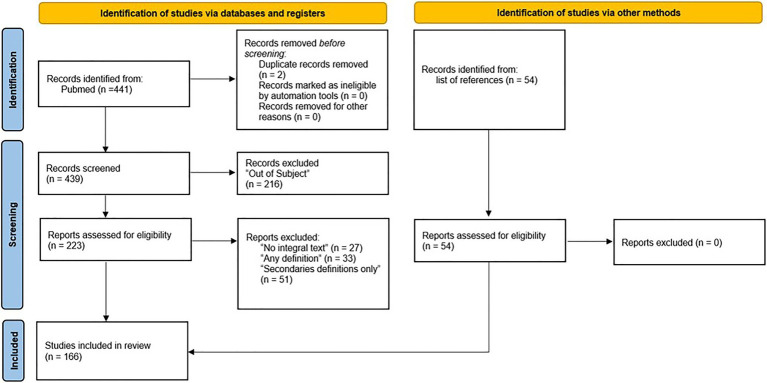
Objective: To investigate the definitions of spirituality in the healthcare field, identifying its main dimensions and proposing a framework that operationalizes the understanding of this concept. Methods: This is a systematic review following the PRISMA guideline (PROSPERO: CRD42021262091), searching for spirituality definitions published in scientific journals. Searches were carried out in PubMed (all articles listed up to October 2020) and in the reference lists of the articles found in the database, followed by selection under specific eligibility criteria. Results: From a total of 493 articles, 166 were included in the final analysis, showing that there is a large body of scientific literature proposing and analyzing spirituality definitions. In these articles, 24 spirituality dimensions were found, most commonly related to the connectedness and meaning of life. Spirituality was presented as a human and individual aspect. These findings led us to construct a framework that represents spirituality as a quantifiable construct. Conclusions: Understanding spirituality is an important aspect for healthcare research and clinical practice. This proposed framework may help to better understand the complexity of this topic, where advances are desirable, given the relevance it has acquired for integral health care.
Overview
AI snapshot
Written from the paper’s full text.
TL;DR
This systematic review analyzed 166 spirituality definitions in healthcare and identified 24 dimensions, most commonly connection/relation and meaning/purpose. It proposes a three-axis framework to operationalize spirituality as a quantifiable construct for research and clinical practice.
Key findings
- From 493 screened articles, 166 were included in the final analysis, and 24 spirituality dimensions were identified.
- The most frequent dimensions were connection/relation (53.01%), meaning/purpose (51.80%), divine/God/higher power (39.75%), transcendence/immaterial (38.55%), others/community relationship (37.95%), beliefs (29.51%), self connection (25.90%), nature connection (24.09%), and values (23.49%).
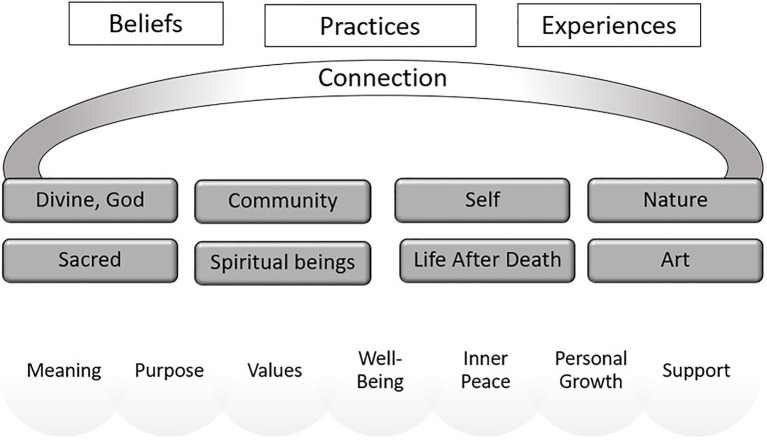
- Spirituality was presented as a human and individual aspect; the framework organizes dimensions into three axes: beliefs, practices, and experiences that promote connection; possible connected aspects such as sacred, life after death, spiritual beings, divine/God, self, community, nature, and art; and outcomes such as values, personal growth, meaning, purpose, well-being, support, and inner peace.
- The authors conclude spirituality is a human individual, dynamic characteristic expressed through beliefs, practices, and experiences in the search for connection with something that promotes meaning and personal growth.
Methods
- Systematic review following PRISMA, registered in PROSPERO (CRD42021262091), searching PubMed up to October 1, 2020, with the Boolean expression “spirituality [title] AND (concept OR definition)” plus reference-list scanning.
- Eligibility included articles addressing the meaning, concept, or definition of spirituality in healthcare; no language or date restrictions were applied. Selection proceeded through title/abstract screening, full-text reading, and dimension analysis.
- Definitions were analyzed for repeated terms/expressions to identify dimensions; each use was scored, percentages were calculated with 166 definitions as 100%, and terms appearing in fewer than 3 definitions (less than 2%) were excluded. The results were used to construct a framework.
Limitations
- The paper states that only PubMed was included, the Boolean search was narrow, and most articles were from the United States in English, creating possible Anglo-Saxon, Western, and Judeo-Christian bias.
- The paper states the framework is newly proposed and still lacks validation by other studies; credibility of included references was assessed by full-text reading and citation counts, and funders’ roles were not evaluated.
- The paper states insufficient consideration was given to how definitions were developed (conceptual versus empirical approaches), and further research is needed on language and multicultural representativeness.
Model-written summary. Check it against the paper before relying on it.
Integrity signals
Registry
Cites
Statistics
Figures
Verification
Claims the paper makes
31 Own result · 22 Not checked yet · 20 Own interpretation · 12 Own method · 6 No basis given · 1 Partly supported · accuracy not yet measured
A result the paper reports from its own data — it cites no other source for it, so there is none to check. The quote shows it is in the paper.
In the paper
“as a dynamic process (4.81%)”
- Also stated in: § Study Selection and Characteristics · plain
“Dynamic process | 4.81%”
§ Defining Spirituality in Healthcare: A Systematic Review and Conceptual Framework > Results > Synthesized Findings
plain- Asserted: passes — The authors put it forward as true.
- Checkable: passes — It can be checked against evidence.
- Load-bearing: unclear — It is unclear whether the paper’s conclusions depend on it.
- Based: passes — The paper gives a reason why it holds.
- Also stated in: § Study Selection and Characteristics · plain
A result the paper reports from its own data — it cites no other source for it, so there is none to check. The quote shows it is in the paper.
In the paper
“It could be felt as a power or inner energy (13.85%)”
- Also stated in: § Study Selection and Characteristics · plain
“Power, force, inner energy | 13.85%”
§ Defining Spirituality in Healthcare: A Systematic Review and Conceptual Framework > Results > Synthesized Findings
plain- Asserted: passes — The authors put it forward as true.
- Checkable: passes — It can be checked against evidence.
- Load-bearing: unclear — It is unclear whether the paper’s conclusions depend on it.
- Based: passes — The paper gives a reason why it holds.
- Also stated in: § Study Selection and Characteristics · plain
A result the paper reports from its own data — it cites no other source for it, so there is none to check. The quote shows it is in the paper.
In the paper
“Most of the publications considered spirituality as a “connection” or “relation” (53.01%)”
- Also stated in: § Study Selection and Characteristics · plain
“Connection/Relation | 53001%”
§ Defining Spirituality in Healthcare: A Systematic Review and Conceptual Framework > Results > Synthesized Findings
plain- Asserted: passes — The authors put it forward as true.
- Checkable: passes — It can be checked against evidence.
- Load-bearing: passes — The paper’s conclusions depend on it.
- Based: passes — The paper gives a reason why it holds.
- Also stated in: § Study Selection and Characteristics · plain
None of the sources cited for this claim have been checked yet.
In the paper
“revealing a clear lack of consensus on the understanding of what spirituality is”
- Also stated in: § Introduction · boosted
“there is no clear consensus about its definition”
§ Defining Spirituality in Healthcare: A Systematic Review and Conceptual Framework > Discussion
boosted- Asserted: passes — The authors put it forward as true.
- Checkable: passes — It can be checked against evidence.
- Load-bearing: passes — The paper’s conclusions depend on it.
- Based: passes — The paper gives a reason why it holds.
- Also stated in: § Introduction · boosted
A result the paper reports from its own data — it cites no other source for it, so there is none to check. The quote shows it is in the paper.
In the paper
“development of peace and well-being feelings (15.06%)”
- Also stated in: § Study Selection and Characteristics · plain
“Peace/well-being | 15.06%”
§ Defining Spirituality in Healthcare: A Systematic Review and Conceptual Framework > Results > Synthesized Findings
plain- Asserted: passes — The authors put it forward as true.
- Checkable: passes — It can be checked against evidence.
- Load-bearing: unclear — It is unclear whether the paper’s conclusions depend on it.
- Based: passes — The paper gives a reason why it holds.
- Also stated in: § Study Selection and Characteristics · plain
A result the paper reports from its own data — it cites no other source for it, so there is none to check. The quote shows it is in the paper.
In the paper
“as a life after death belief and attribute (1.80%)”
- Also stated in: § Study Selection and Characteristics · plain
“Life after death | 1.80%”
§ Defining Spirituality in Healthcare: A Systematic Review and Conceptual Framework > Results > Synthesized Findings
plain- Asserted: passes — The authors put it forward as true.
- Checkable: passes — It can be checked against evidence.
- Load-bearing: unclear — It is unclear whether the paper’s conclusions depend on it.
- Based: passes — The paper gives a reason why it holds.
- Also stated in: § Study Selection and Characteristics · plain
A result the paper reports from its own data — it cites no other source for it, so there is none to check. The quote shows it is in the paper.
In the paper
“in relation to something transcendent (38.55%)”
- Also stated in: § Study Selection and Characteristics · plain
“Transcendence/immaterial | 38.55%”
§ Defining Spirituality in Healthcare: A Systematic Review and Conceptual Framework > Results > Synthesized Findings
plain- Asserted: passes — The authors put it forward as true.
- Checkable: passes — It can be checked against evidence.
- Load-bearing: unclear — It is unclear whether the paper’s conclusions depend on it.
- Based: passes — The paper gives a reason why it holds.
- Also stated in: § Study Selection and Characteristics · plain
A result the paper reports from its own data — it cites no other source for it, so there is none to check. The quote shows it is in the paper.
In the paper
“as a subjective, individual, and particular aspect (19.87%)”
- Also stated in: § Study Selection and Characteristics · plain
“Individual/personal | 19.87%”
§ Defining Spirituality in Healthcare: A Systematic Review and Conceptual Framework > Results > Synthesized Findings
plain- Asserted: passes — The authors put it forward as true.
- Checkable: passes — It can be checked against evidence.
- Load-bearing: unclear — It is unclear whether the paper’s conclusions depend on it.
- Based: passes — The paper gives a reason why it holds.
- Also stated in: § Study Selection and Characteristics · plain
A result the paper reports from its own data — it cites no other source for it, so there is none to check. The quote shows it is in the paper.
In the paper
“24 spirituality dimensions were found (Table 3)”
- Also stated in: § Abstract · plain
“In these articles, 24 spirituality dimensions were found”
§ Defining Spirituality in Healthcare: A Systematic Review and Conceptual Framework > Results > Study Selection and Characteristics
plain- Asserted: passes — The authors put it forward as true.
- Checkable: passes — It can be checked against evidence.
- Load-bearing: passes — The paper’s conclusions depend on it.
- Based: passes — The paper gives a reason why it holds.
- Also stated in: § Abstract · plain
A result the paper reports from its own data — it cites no other source for it, so there is none to check. The quote shows it is in the paper.
In the paper
“The most cited reference from an article included in our review comes from Hill and Pargament (2003)”
§ Defining Spirituality in Healthcare: A Systematic Review and Conceptual Framework > Discussion
plain- Asserted: passes — The authors put it forward as true.
- Checkable: passes — It can be checked against evidence.
- Load-bearing: unclear — It is unclear whether the paper’s conclusions depend on it.
- Based: passes — The paper gives a reason why it holds.
- It may state two separate claims as one. 25
- Probably not a substantial claim. 42
- The quote only partly states this claim. 1
The cited sources support only part of this claim — read each source’s verdict below.
In the paper
“patients want their doctors to address spirituality and most doctors and nurses consider important to integrate this aspect into their practice (Baetz et al., 2004).”
§ Defining Spirituality in Healthcare: A Systematic Review and Conceptual Framework > Introduction
What the sources say
- Partly supportedcites Baetz et al., 2004 sourceExperimental — accuracy not yet measured
In “Beliefs and Practices of Psychiatrists and Patients” (page unavailable), 53% of patients said it was important to have spirituality or religion addressed in treatment. The paper surveyed psychiatrists, not nurses, and found that 47% of psychiatrists said spirituality or religion often or always has a role in psychiatric care. It therefore does not support the claim that most doctors and nurses consider integration important. (LLM, conf=0.88)
plain- Asserted: passes — The authors put it forward as true.
- Checkable: passes — It can be checked against evidence.
- Load-bearing: passes — The paper’s conclusions depend on it.
- Based: passes — The paper gives a reason why it holds.
It may state two separate claims as one.
- Partly supported
A result the paper reports from its own data — it cites no other source for it, so there is none to check. The quote shows it is in the paper.
In the paper
“Immanence | 5.42%”
§ Defining Spirituality in Healthcare: A Systematic Review and Conceptual Framework > Results > Study Selection and Characteristics
plain- Asserted: passes — The authors put it forward as true.
- Checkable: passes — It can be checked against evidence.
- Load-bearing: fails — The paper’s conclusions may not depend on it.
- Based: passes — The paper gives a reason why it holds.
Probably not a substantial claim. The paper’s conclusions may not depend on it.
The paper states this without a source or data behind it here, so there is nothing to check it against. The quote shows it is in the paper.
In the paper
“However, due to the lack of consensus on the term and the existing cultural gaps, we propose a new spirituality framework, based on a systematic review of the literature”
§ Defining Spirituality in Healthcare: A Systematic Review and Conceptual Framework > Conclusion
plain- Asserted: passes — The authors put it forward as true.
- Checkable: passes — It can be checked against evidence.
- Load-bearing: passes — The paper’s conclusions depend on it.
- Based: passes — The paper gives a reason why it holds.
Probably not a substantial claim. It may state two separate claims as one.
The paper states this without a source or data behind it here, so there is nothing to check it against. The quote shows it is in the paper.
In the paper
“We present a spirituality framework proposition (Figure 2) that organizes all the dimensions found, except “human aspect,” “individual aspect,” “dynamic process,” and “necessity” because they can be understood as dimensions about the general spirituality nature, permeating all axes and cannot be dissociated and allocated to a single axis or dimension.”
§ Defining Spirituality in Healthcare: A Systematic Review and Conceptual Framework > Proposed Framework for Spirituality in Healthcare
plain- Asserted: passes — The authors put it forward as true.
- Checkable: passes — It can be checked against evidence.
- Load-bearing: passes — The paper’s conclusions depend on it.
- Based: passes — The paper gives a reason why it holds.
Probably not a substantial claim.
The paper states this without a source or data behind it here, so there is nothing to check it against. The quote shows it is in the paper.
In the paper
“The first axis (upper white section) is composed of beliefs, practices, and experiences that promote connection.”
§ Defining Spirituality in Healthcare: A Systematic Review and Conceptual Framework > Proposed Framework for Spirituality in Healthcare
plain- Asserted: passes — The authors put it forward as true.
- Checkable: passes — It can be checked against evidence.
- Load-bearing: passes — The paper’s conclusions depend on it.
- Based: passes — The paper gives a reason why it holds.
Probably not a substantial claim.
The paper states this without a source or data behind it here, so there is nothing to check it against. The quote shows it is in the paper.
In the paper
“The third axis (lower gray section) refers to the development of values, personal growth, and sensations of meaning, purpose in life, well-being, support, and inner peace through connection with something that can affect the behavior of the individual.”
§ Defining Spirituality in Healthcare: A Systematic Review and Conceptual Framework > Proposed Framework for Spirituality in Healthcare
plaindirect- Asserted: passes — The authors put it forward as true.
- Checkable: passes — It can be checked against evidence.
- Load-bearing: passes — The paper’s conclusions depend on it.
- Based: passes — The paper gives a reason why it holds.
Probably not a substantial claim.
The paper states this without a source or data behind it here, so there is nothing to check it against. The quote shows it is in the paper.
In the paper
“Although there are some frameworks proposals on the concept of spirituality as seen above, there are still many aspects of this concept that remain unaddressed, indicating the need for a new, more comprehensive approach that may fit into the diverse cultural and religious contexts discussed in this research.”
§ Defining Spirituality in Healthcare: A Systematic Review and Conceptual Framework > Proposed Framework for Spirituality in Healthcare
hedged- Asserted: passes — The authors put it forward as true.
- Checkable: fails — It may be too vague to check against evidence.
- Load-bearing: passes — The paper’s conclusions depend on it.
- Based: passes — The paper gives a reason why it holds.
Probably not a substantial claim. It may be too vague to check against evidence. It may state two separate claims as one.
The paper states this without a source or data behind it here, so there is nothing to check it against. The quote shows it is in the paper.
In the paper
“In the second axis (middle dark gray section) are the possible aspects that can be connected through spiritual beliefs, practices, or experiences. They are classified as:”
§ Defining Spirituality in Healthcare: A Systematic Review and Conceptual Framework > Proposed Framework for Spirituality in Healthcare
plain- Asserted: passes — The authors put it forward as true.
- Checkable: passes — It can be checked against evidence.
- Load-bearing: passes — The paper’s conclusions depend on it.
- Based: passes — The paper gives a reason why it holds.
Probably not a substantial claim. It may state two separate claims as one. The quote only partly states this claim.
A conclusion the paper draws from its own results — it cites no other source for it, so there is none to check. The quote shows it is in the paper.
In the paper
“To our knowledge, this is the first study that systematically evaluated the most important and highly cited spirituality definitions under the healthcare field, instead of focusing on one specific area such as nursing or palliative care.”
§ Defining Spirituality in Healthcare: A Systematic Review and Conceptual Framework > Discussion
hedged- Asserted: passes — The authors put it forward as true.
- Checkable: passes — It can be checked against evidence.
- Load-bearing: passes — The paper’s conclusions depend on it.
- Based: passes — The paper gives a reason why it holds.
Probably not a substantial claim.
A conclusion the paper draws from its own results — it cites no other source for it, so there is none to check. The quote shows it is in the paper.
In the paper
“Broader definitions tend to consider spirituality as experiences of connection with nature, social relations, and art, while narrower definitions place spirituality in a more theistic approach”
§ Defining Spirituality in Healthcare: A Systematic Review and Conceptual Framework > Discussion > Connection: Narrower or Broader
plaincorrelational- Asserted: passes — The authors put it forward as true.
- Checkable: passes — It can be checked against evidence.
- Load-bearing: passes — The paper’s conclusions depend on it.
- Based: passes — The paper gives a reason why it holds.
It may state two separate claims as one.
A conclusion the paper draws from its own results — it cites no other source for it, so there is none to check. The quote shows it is in the paper.
In the paper
“From our results, we recognize that spirituality and religiosity are related and overlapping, varying according to the cultural context and to the dynamic quality of the spirituality itself.”
§ Defining Spirituality in Healthcare: A Systematic Review and Conceptual Framework > Discussion > Connection: Narrower or Broader
plaincorrelational- Asserted: passes — The authors put it forward as true.
- Checkable: passes — It can be checked against evidence.
- Load-bearing: passes — The paper’s conclusions depend on it.
- Based: passes — The paper gives a reason why it holds.
It may state two separate claims as one.
In the paper
“Historically, the term spirituality was used to describe the practices of people who dedicated their lives into religious services or exemplify the teachings of their faith traditions (Koenig, 2008).”
§ Defining Spirituality in Healthcare: A Systematic Review and Conceptual Framework > Introduction
What the sources say
- Not checked yetcites Koenig, 2008 source
plain- Asserted: passes — The authors put it forward as true.
- Checkable: passes — It can be checked against evidence.
- Load-bearing: fails — The paper’s conclusions may not depend on it.
- Based: passes — The paper gives a reason why it holds.
Probably not a substantial claim. The paper’s conclusions may not depend on it.
None of the sources cited for this claim have been checked yet.
In the paper
“Spirituality is a broad and complex concept which varies its understanding according to different cultural, religious and academic backgrounds (i.e., religious persons, scientists, or lay persons; Koenig, 2008; la Cour and Götke, 2012).”
§ Defining Spirituality in Healthcare: A Systematic Review and Conceptual Framework > Introduction
What the sources say
- Not checked yetcites Koenig, 2008 source
- Not checked yetcites la Cour and Götke, 2012
plaincorrelational- Asserted: passes — The authors put it forward as true.
- Checkable: passes — It can be checked against evidence.
- Load-bearing: passes — The paper’s conclusions depend on it.
- Based: passes — The paper gives a reason why it holds.
Probably not a substantial claim. It may state two separate claims as one.
In the paper
“there is a remarkable debate regarding the most accurate meaning, and regarding the possibility of having a single universal consensual definition for this concept (Peng-Keller, 2019).”
§ Defining Spirituality in Healthcare: A Systematic Review and Conceptual Framework > Introduction
What the sources say
- Not checked yetcites Peng-Keller, 2019 source
plain- Asserted: passes — The authors put it forward as true.
- Checkable: passes — It can be checked against evidence.
- Load-bearing: passes — The paper’s conclusions depend on it.
- Based: passes — The paper gives a reason why it holds.
Probably not a substantial claim. It may state two separate claims as one.
What the paper did — it cites no source for this, so there is none to check. The quote shows it is in the paper.
In the paper
“Terms that did not appear in at least 3 definitions were excluded, as they corresponded to less than 2% appearance in the definitions.”
§ Defining Spirituality in Healthcare: A Systematic Review and Conceptual Framework > Materials and Methods > Data Extraction and Analysis
plain- Asserted: passes — The authors put it forward as true.
- Checkable: passes — It can be checked against evidence.
- Load-bearing: passes — The paper’s conclusions depend on it.
- Based: passes — The paper gives a reason why it holds.
Probably not a substantial claim.
In the paper
“This is a systematic review based on the PRISMA statement for reporting systematic reviews and meta-analyses (Page et al., 2021).”
§ Defining Spirituality in Healthcare: A Systematic Review and Conceptual Framework > Materials and Methods
What the sources say
- Not checked yetcites Page et al., 2021 source
plain- Asserted: passes — The authors put it forward as true.
- Checkable: passes — It can be checked against evidence.
- Load-bearing: fails — The paper’s conclusions may not depend on it.
- Based: passes — The paper gives a reason why it holds.
Probably not a substantial claim. The paper’s conclusions may not depend on it.
What the paper did — it cites no source for this, so there is none to check. The quote shows it is in the paper.
In the paper
“After identifying all dimensions, from all selected definitions, a second author looked up into each definition in order to confirm and unify all chosen dimensions.”
§ Defining Spirituality in Healthcare: A Systematic Review and Conceptual Framework > Materials and Methods > Data Extraction and Analysis
plaindirect- Asserted: passes — The authors put it forward as true.
- Checkable: passes — It can be checked against evidence.
- Load-bearing: fails — The paper’s conclusions may not depend on it.
- Based: passes — The paper gives a reason why it holds.
Probably not a substantial claim. The paper’s conclusions may not depend on it.
What the paper did — it cites no source for this, so there is none to check. The quote shows it is in the paper.
In the paper
“The protocol was registered in the PROSPERO international prospective registry of systematic reviews (registration number: CRD42021262091).”
§ Defining Spirituality in Healthcare: A Systematic Review and Conceptual Framework > Materials and Methods
plain- Asserted: passes — The authors put it forward as true.
- Checkable: passes — It can be checked against evidence.
- Load-bearing: fails — The paper’s conclusions may not depend on it.
- Based: passes — The paper gives a reason why it holds.
Probably not a substantial claim. The paper’s conclusions may not depend on it.
A conclusion the paper draws from its own results — it cites no other source for it, so there is none to check. The quote shows it is in the paper.
In the paper
“We present a spirituality framework proposition (Figure 2) that organizes all the dimensions found, except “human aspect,” “individual aspect,” “dynamic process,” and “necessity” because they can be understood as dimensions about the general spirituality nature, permeating all axes and cannot be dissociated and allocated to a single axis or dimension.”
§ Defining Spirituality in Healthcare: A Systematic Review and Conceptual Framework > Proposed Framework for Spirituality in Healthcare
plain- Asserted: passes — The authors put it forward as true.
- Checkable: passes — It can be checked against evidence.
- Load-bearing: passes — The paper’s conclusions depend on it.
- Based: passes — The paper gives a reason why it holds.
Probably not a substantial claim.
What the paper did — it cites no source for this, so there is none to check. The quote shows it is in the paper.
In the paper
“Seventh, we gave insufficient consideration to the manner in which the definitions of spirituality were developed (e.g., conceptual versus empirical approaches to definition and measurement) and it should be considered in further research.”
§ Defining Spirituality in Healthcare: A Systematic Review and Conceptual Framework > Limitations
plain- Asserted: passes — The authors put it forward as true.
- Checkable: passes — It can be checked against evidence.
- Load-bearing: fails — The paper’s conclusions may not depend on it.
- Based: passes — The paper gives a reason why it holds.
Probably not a substantial claim. The paper’s conclusions may not depend on it.
A conclusion the paper draws from its own results — it cites no other source for it, so there is none to check. The quote shows it is in the paper.
In the paper
“The experiences compose the subjective aspect, based on the individual perception of the presence of elements of interaction with the connecting object of spirituality, going beyond the bond through the intellect.”
§ Defining Spirituality in Healthcare: A Systematic Review and Conceptual Framework > Discussion > Beliefs, Practices, and Experiences
plain- Asserted: passes — The authors put it forward as true.
- Checkable: fails — It may be too vague to check against evidence.
- Load-bearing: passes — The paper’s conclusions depend on it.
- Based: fails — The paper may give no reason why it holds.
Probably not a substantial claim. It may be too vague to check against evidence. The paper may give no reason why it holds.
A conclusion the paper draws from its own results — it cites no other source for it, so there is none to check. The quote shows it is in the paper.
In the paper
“in which spirituality (1) is a human individual, dynamic characteristic;”
§ Defining Spirituality in Healthcare: A Systematic Review and Conceptual Framework > Conclusion
plain- Asserted: passes — The authors put it forward as true.
- Checkable: fails — It may be too vague to check against evidence.
- Load-bearing: passes — The paper’s conclusions depend on it.
- Based: passes — The paper gives a reason why it holds.
Probably not a substantial claim. It may be too vague to check against evidence.
In the paper
“This perception is a concern for some religious faiths, to enhance this feeling that can be called “spiritual well-being” (Moberg, 1984).”
§ Defining Spirituality in Healthcare: A Systematic Review and Conceptual Framework > Proposed Framework for Spirituality in Healthcare
What the sources say
- Not checked yetcites Moberg, 1984 source
plain- Asserted: passes — The authors put it forward as true.
- Checkable: passes — It can be checked against evidence.
- Load-bearing: fails — The paper’s conclusions may not depend on it.
- Based: passes — The paper gives a reason why it holds.
Probably not a substantial claim. The paper’s conclusions may not depend on it.
A conclusion the paper draws from its own results — it cites no other source for it, so there is none to check. The quote shows it is in the paper.
In the paper
“We believe that the identification of these dimensions can help researchers and health professionals to map how individuals understand and express their spirituality, making it operational.”
§ Defining Spirituality in Healthcare: A Systematic Review and Conceptual Framework > Proposed Framework for Spirituality in Healthcare
plainconditional- Asserted: passes — The authors put it forward as true.
- Checkable: fails — It may be too vague to check against evidence.
- Load-bearing: passes — The paper’s conclusions depend on it.
- Based: fails — The paper may give no reason why it holds.
Probably not a substantial claim. It may be too vague to check against evidence. The paper may give no reason why it holds.
What the paper did — it cites no source for this, so there is none to check. The quote shows it is in the paper.
In the paper
“Third, there is a low multicultural representativeness because most of the articles were from the United States, in English, showing a possible bias of an Anglo-Saxon, Western, and Judeo-Christian culture, which may have impacted the definitions presented in the articles.”
§ Defining Spirituality in Healthcare: A Systematic Review and Conceptual Framework > Limitations
hedgedconditional- Asserted: passes — The authors put it forward as true.
- Checkable: passes — It can be checked against evidence.
- Load-bearing: unclear — It is unclear whether the paper’s conclusions depend on it.
- Based: passes — The paper gives a reason why it holds.
It may state two separate claims as one.
A conclusion the paper draws from its own results — it cites no other source for it, so there is none to check. The quote shows it is in the paper.
In the paper
“and (3) leads to the development of values and positive inner feelings.”
§ Defining Spirituality in Healthcare: A Systematic Review and Conceptual Framework > Conclusion
plaindirect- Asserted: passes — The authors put it forward as true.
- Checkable: fails — It may be too vague to check against evidence.
- Load-bearing: passes — The paper’s conclusions depend on it.
- Based: passes — The paper gives a reason why it holds.
Probably not a substantial claim. It may be too vague to check against evidence.
None of the sources cited for this claim have been checked yet.
In the paper
“While for the social sciences there is no major concerns for the lack of an universal definition of spirituality, medical and health-related sciences need a structure and relative consensus, since most instruments attempt to quantify its intangible construct in order to evaluate its impact and propose health-related interventions (Macdonald and Friedman, 2002; Hill and Pargament, 2008).”
§ Defining Spirituality in Healthcare: A Systematic Review and Conceptual Framework > Introduction
What the sources say
- Not checked yetcites Macdonald and Friedman, 2002
- Not checked yetcites Hill and Pargament, 2008 source
plaindirect- Asserted: passes — The authors put it forward as true.
- Checkable: fails — It may be too vague to check against evidence.
- Load-bearing: passes — The paper’s conclusions depend on it.
- Based: passes — The paper gives a reason why it holds.
Probably not a substantial claim. It may be too vague to check against evidence. It may state two separate claims as one.
In the paper
“Based on learning theories, when content is exposed interconnecting the verbal and the visual, it facilitates the construction of connections, relationships, and understanding in the cognitive structure (Peer et al., 2021).”
§ Defining Spirituality in Healthcare: A Systematic Review and Conceptual Framework > Proposed Framework for Spirituality in Healthcare
What the sources say
- Not checked yetcites Peer et al., 2021 source
plaindirect- Asserted: passes — The authors put it forward as true.
- Checkable: passes — It can be checked against evidence.
- Load-bearing: fails — The paper’s conclusions may not depend on it.
- Based: passes — The paper gives a reason why it holds.
Probably not a substantial claim. The paper’s conclusions may not depend on it.
In the paper
“Research over the last decades has been growing substantially in the field of “Spirituality and Health,” showing a significant influence of spiritual and religious beliefs on both mental and physical health outcomes (Damiano et al., 2016)”
§ Defining Spirituality in Healthcare: A Systematic Review and Conceptual Framework > Introduction
What the sources say
- Not checked yetcites Damiano et al., 2016 source
plaincorrelational- Asserted: passes — The authors put it forward as true.
- Checkable: passes — It can be checked against evidence.
- Load-bearing: fails — The paper’s conclusions may not depend on it.
- Based: passes — The paper gives a reason why it holds.
Probably not a substantial claim. The paper’s conclusions may not depend on it. It may state two separate claims as one.
None of the sources cited for this claim have been checked yet.
In the paper
“Spirituality can be analyzed through multiple dimensions, which identification may clarify how individuals interact with their spirituality, and which aspects greater impact more on health and treatment (Lunder et al., 2011; MacDonald et al., 2015).”
§ Defining Spirituality in Healthcare: A Systematic Review and Conceptual Framework > Proposed Framework for Spirituality in Healthcare
What the sources say
hedgedconditional- Asserted: passes — The authors put it forward as true.
- Checkable: passes — It can be checked against evidence.
- Load-bearing: passes — The paper’s conclusions depend on it.
- Based: passes — The paper gives a reason why it holds.
Probably not a substantial claim. It may state two separate claims as one.
What the paper did — it cites no source for this, so there is none to check. The quote shows it is in the paper.
In the paper
“Forth, although English is the main language in the scientific literature, the constructs of this framework need to be made for other languages that have large worldwide representation, since the contents described here may not apply to the linguistic variety in countries like India and China, for example.”
§ Defining Spirituality in Healthcare: A Systematic Review and Conceptual Framework > Limitations
hedged- Asserted: passes — The authors put it forward as true.
- Checkable: passes — It can be checked against evidence.
- Load-bearing: fails — The paper’s conclusions may not depend on it.
- Based: passes — The paper gives a reason why it holds.
Probably not a substantial claim. The paper’s conclusions may not depend on it.
A conclusion the paper draws from its own results — it cites no other source for it, so there is none to check. The quote shows it is in the paper.
In the paper
“The framework was designed as a didactic scheme, presenting the dimensions as a non-hierarchical and non-static construction, which flow according to individual’s context and experiences.”
§ Defining Spirituality in Healthcare: A Systematic Review and Conceptual Framework > Proposed Framework for Spirituality in Healthcare
plain- Asserted: passes — The authors put it forward as true.
- Checkable: passes — It can be checked against evidence.
- Load-bearing: passes — The paper’s conclusions depend on it.
- Based: passes — The paper gives a reason why it holds.
Probably not a substantial claim.
None of the sources cited for this claim have been checked yet.
In the paper
“Some religious/spiritual beliefs are, for example, the existence of a higher, transcendent power or the continuity of life after death.”
§ Defining Spirituality in Healthcare: A Systematic Review and Conceptual Framework > Discussion > Beliefs, Practices, and Experiences
What the sources say
- Not checked yetcites Banks-Wallace and Parks, 2004
- Not checked yetcites Markani et al., 2013 source
plain- Asserted: passes — The authors put it forward as true.
- Checkable: passes — It can be checked against evidence.
- Load-bearing: fails — The paper’s conclusions may not depend on it.
- Based: passes — The paper gives a reason why it holds.
Probably not a substantial claim. The paper’s conclusions may not depend on it. It may state two separate claims as one.
None of the sources cited for this claim have been checked yet.
In the paper
“This process is related to improving patients’ outcomes, manages chronic pain, or deals with a diagnostic as cancer (Breitbart, 2002; Vachon, 2008; Dedeli and Kaptan, 2013; Weber and Pargament, 2014; Bernard et al., 2017).”
§ Defining Spirituality in Healthcare: A Systematic Review and Conceptual Framework > Discussion > Interpretation of Life: Meaning and Purpose
What the sources say
plaincorrelational- Asserted: passes — The authors put it forward as true.
- Checkable: passes — It can be checked against evidence.
- Load-bearing: unclear — It is unclear whether the paper’s conclusions depend on it.
- Based: passes — The paper gives a reason why it holds.
It may state two separate claims as one.
What the paper did — it cites no source for this, so there is none to check. The quote shows it is in the paper.
In the paper
“Fifth, this framework is herein newly proposed, and thus, it still lacks a validation by other studies.”
§ Defining Spirituality in Healthcare: A Systematic Review and Conceptual Framework > Limitations
plain- Asserted: passes — The authors put it forward as true.
- Checkable: passes — It can be checked against evidence.
- Load-bearing: fails — The paper’s conclusions may not depend on it.
- Based: passes — The paper gives a reason why it holds.
Probably not a substantial claim. The paper’s conclusions may not depend on it. It may state two separate claims as one.
What the paper did — it cites no source for this, so there is none to check. The quote shows it is in the paper.
In the paper
“Another important point is that funders role on the manuscripts was not evaluated, posing risks of bias for the adopted definitions of each article.”
§ Defining Spirituality in Healthcare: A Systematic Review and Conceptual Framework > Limitations
plainconditional- Asserted: passes — The authors put it forward as true.
- Checkable: passes — It can be checked against evidence.
- Load-bearing: fails — The paper’s conclusions may not depend on it.
- Based: passes — The paper gives a reason why it holds.
Probably not a substantial claim. The paper’s conclusions may not depend on it. It may state two separate claims as one.
None of the sources cited for this claim have been checked yet.
In the paper
“Spirituality is generally related to diminished numbers of substance use, suicidal attempts and depression prevalence, less hospitalization, better coping with disease, better treatment adherence, and lower mortality rates (Moreira-Almeida et al., 2006; Guimarães and Avezum, 2007; Lucchetti et al., 2011).”
§ Defining Spirituality in Healthcare: A Systematic Review and Conceptual Framework > Introduction
What the sources say
- Not checked yetcites Moreira-Almeida et al., 2006 source
- Not checked yetcites Guimarães and Avezum, 2007
- Not checked yetcites Lucchetti et al., 2011
plaincorrelational- Asserted: passes — The authors put it forward as true.
- Checkable: passes — It can be checked against evidence.
- Load-bearing: passes — The paper’s conclusions depend on it.
- Based: passes — The paper gives a reason why it holds.
It may state two separate claims as one.
What the paper did — it cites no source for this, so there is none to check. The quote shows it is in the paper.
In the paper
“Sixth, the credibility of the included references was assessed by authors reading the full text of each article, as well as assessing the usual scientometric parameters, i.e., number of citations, which could be considered another limitation.”
§ Defining Spirituality in Healthcare: A Systematic Review and Conceptual Framework > Limitations
hedged- Asserted: passes — The authors put it forward as true.
- Checkable: passes — It can be checked against evidence.
- Load-bearing: fails — The paper’s conclusions may not depend on it.
- Based: passes — The paper gives a reason why it holds.
Probably not a substantial claim. The paper’s conclusions may not depend on it.
None of the sources cited for this claim have been checked yet.
In the paper
“several barriers limit addressing R/S, including the lack of training by health professionals and the lack of clear defined concepts (Best et al., 2015; Menegatti-Chequini et al., 2019).”
§ Defining Spirituality in Healthcare: A Systematic Review and Conceptual Framework > Introduction
What the sources say
plaindirect- Asserted: passes — The authors put it forward as true.
- Checkable: passes — It can be checked against evidence.
- Load-bearing: passes — The paper’s conclusions depend on it.
- Based: passes — The paper gives a reason why it holds.
It may state two separate claims as one.
A conclusion the paper draws from its own results — it cites no other source for it, so there is none to check. The quote shows it is in the paper.
In the paper
“Individuality as a dimension of spirituality emphasizes the importance of looking at each person and their subjective experience, pointing to the person-centered care whose goal is a meaningful life”
§ Defining Spirituality in Healthcare: A Systematic Review and Conceptual Framework > Discussion > Spirituality as an Intrinsic Component of Human Beings
plaindirect- Asserted: passes — The authors put it forward as true.
- Checkable: passes — It can be checked against evidence.
- Load-bearing: fails — The paper’s conclusions may not depend on it.
- Based: passes — The paper gives a reason why it holds.
Probably not a substantial claim. The paper’s conclusions may not depend on it. It may state two separate claims as one.
In the paper
“The definitions of spirituality are multifactorial, including religious heritage, culture, generation, and nationality (Gall et al., 2011).”
§ Defining Spirituality in Healthcare: A Systematic Review and Conceptual Framework > Proposed Framework for Spirituality in Healthcare
What the sources say
- Not checked yetcites Gall et al., 2011 source
plaincorrelational- Asserted: passes — The authors put it forward as true.
- Checkable: passes — It can be checked against evidence.
- Load-bearing: passes — The paper’s conclusions depend on it.
- Based: passes — The paper gives a reason why it holds.
Probably not a substantial claim.
A conclusion the paper draws from its own results — it cites no other source for it, so there is none to check. The quote shows it is in the paper.
In the paper
“Practices correspond to the dimension of behavior, being social or individual, public or private, that requires the engagement of the individual to perform activities such as meditating, praying, or going to meetings of the group that shares his/her spiritual/religious beliefs.”
§ Defining Spirituality in Healthcare: A Systematic Review and Conceptual Framework > Discussion > Beliefs, Practices, and Experiences
plain- Asserted: passes — The authors put it forward as true.
- Checkable: passes — It can be checked against evidence.
- Load-bearing: passes — The paper’s conclusions depend on it.
- Based: passes — The paper gives a reason why it holds.
Probably not a substantial claim.
A conclusion the paper draws from its own results — it cites no other source for it, so there is none to check. The quote shows it is in the paper.
In the paper
“It can be understood as a spirituality starter point.”
§ Defining Spirituality in Healthcare: A Systematic Review and Conceptual Framework > Proposed Framework for Spirituality in Healthcare
plain- Asserted: passes — The authors put it forward as true.
- Checkable: passes — It can be checked against evidence.
- Load-bearing: fails — The paper’s conclusions may not depend on it.
- Based: passes — The paper gives a reason why it holds.
Probably not a substantial claim. The paper’s conclusions may not depend on it.
A conclusion the paper draws from its own results — it cites no other source for it, so there is none to check. The quote shows it is in the paper.
In the paper
“In this sense, what we herein propose is a common ground where elements of different components of spirituality, which are not usually associated, can be understood in a coherent scenario, helping researchers to better design and comprehend their findings, as well readers to build a common ground of knowledge.”
§ Defining Spirituality in Healthcare: A Systematic Review and Conceptual Framework > Conclusion
plaindirect- Asserted: passes — The authors put it forward as true.
- Checkable: fails — It may be too vague to check against evidence.
- Load-bearing: passes — The paper’s conclusions depend on it.
- Based: passes — The paper gives a reason why it holds.
Probably not a substantial claim. It may be too vague to check against evidence. It may state two separate claims as one.
None of the sources cited for this claim have been checked yet.
In the paper
“Spirituality can be considered a source of coping to handle crisis and stressful moments, and related to positive meanings in face of challenges, such as in health problems.”
§ Defining Spirituality in Healthcare: A Systematic Review and Conceptual Framework > Discussion > Interpretation of Life: Meaning and Purpose
What the sources say
plaincorrelational- Asserted: passes — The authors put it forward as true.
- Checkable: passes — It can be checked against evidence.
- Load-bearing: passes — The paper’s conclusions depend on it.
- Based: passes — The paper gives a reason why it holds.
It may state two separate claims as one.
What the paper did — it cites no source for this, so there is none to check. The quote shows it is in the paper.
In the paper
“First, we only included one database and, for this reason, articles indexed only in other databases were not included; PubMed was chosen because this is a medical database and the definitions of spirituality included in these articles were more likely to be related to healthcare.”
§ Defining Spirituality in Healthcare: A Systematic Review and Conceptual Framework > Limitations
hedgedcorrelational- Asserted: passes — The authors put it forward as true.
- Checkable: passes — It can be checked against evidence.
- Load-bearing: passes — The paper’s conclusions depend on it.
- Based: passes — The paper gives a reason why it holds.
Probably not a substantial claim.
- Rests on an assumption: Definitions of spirituality in articles indexed in PubMed are more likely to be related to healthcare.
A conclusion the paper draws from its own results — it cites no other source for it, so there is none to check. The quote shows it is in the paper.
In the paper
“Beliefs can be considered as the cognitive dimension of spirituality, an affirmation of something considered real, which varies according to the culture.”
§ Defining Spirituality in Healthcare: A Systematic Review and Conceptual Framework > Discussion > Beliefs, Practices, and Experiences
plain- Asserted: passes — The authors put it forward as true.
- Checkable: passes — It can be checked against evidence.
- Load-bearing: passes — The paper’s conclusions depend on it.
- Based: passes — The paper gives a reason why it holds.
Probably not a substantial claim. It may state two separate claims as one.
What the paper did — it cites no source for this, so there is none to check. The quote shows it is in the paper.
In the paper
“First, we only included one database and, for this reason, articles indexed only in other databases were not included; PubMed was chosen because this is a medical database and the definitions of spirituality included in these articles were more likely to be related to healthcare.”
§ Defining Spirituality in Healthcare: A Systematic Review and Conceptual Framework > Limitations
plaindirect- Asserted: passes — The authors put it forward as true.
- Checkable: passes — It can be checked against evidence.
- Load-bearing: passes — The paper’s conclusions depend on it.
- Based: passes — The paper gives a reason why it holds.
It may state two separate claims as one.
A conclusion the paper draws from its own results — it cites no other source for it, so there is none to check. The quote shows it is in the paper.
In the paper
““Meaning” as a dimension of spirituality may exist in religious or non-religious individuals, pointing to an universal characteristic that can be used to assess the patient’s spirituality”
§ Defining Spirituality in Healthcare: A Systematic Review and Conceptual Framework > Discussion > Interpretation of Life: Meaning and Purpose
hedgedcorrelational- Asserted: passes — The authors put it forward as true.
- Checkable: passes — It can be checked against evidence.
- Load-bearing: passes — The paper’s conclusions depend on it.
- Based: passes — The paper gives a reason why it holds.
It may state two separate claims as one.
A conclusion the paper draws from its own results — it cites no other source for it, so there is none to check. The quote shows it is in the paper.
In the paper
“Even though spirituality can be understood as a characteristic common to all humans, it is a particular expression of each one.”
§ Defining Spirituality in Healthcare: A Systematic Review and Conceptual Framework > Discussion > Spirituality as an Intrinsic Component of Human Beings
plain- Asserted: passes — The authors put it forward as true.
- Checkable: passes — It can be checked against evidence.
- Load-bearing: fails — The paper’s conclusions may not depend on it.
- Based: passes — The paper gives a reason why it holds.
Probably not a substantial claim. The paper’s conclusions may not depend on it. It may state two separate claims as one.
A conclusion the paper draws from its own results — it cites no other source for it, so there is none to check. The quote shows it is in the paper.
In the paper
“(2) is expressed through beliefs, practices, and experiences in the search for connection with something that promotes meaning and personal growth;”
§ Defining Spirituality in Healthcare: A Systematic Review and Conceptual Framework > Conclusion
plain- Asserted: passes — The authors put it forward as true.
- Checkable: fails — It may be too vague to check against evidence.
- Load-bearing: passes — The paper’s conclusions depend on it.
- Based: passes — The paper gives a reason why it holds.
Probably not a substantial claim. It may be too vague to check against evidence.
A conclusion the paper draws from its own results — it cites no other source for it, so there is none to check. The quote shows it is in the paper.
In the paper
“Spirituality identified as a plural construct in a visual structure organization can guarantee an understanding of the complexity of this phenomenon.”
§ Defining Spirituality in Healthcare: A Systematic Review and Conceptual Framework > Proposed Framework for Spirituality in Healthcare
plaindirect- Asserted: passes — The authors put it forward as true.
- Checkable: fails — It may be too vague to check against evidence.
- Load-bearing: passes — The paper’s conclusions depend on it.
- Based: passes — The paper gives a reason why it holds.
Probably not a substantial claim. It may be too vague to check against evidence.
The paper relies on this without support.
The field of spirituality has considerably changed in recent decades with a large number of publications and ongoing research.
“in the last decades, the field of spirituality has considerably changed with a large number of publications and ongoing researches.”
The paper relies on this without support.
Several articles were published with new definitions and concepts.
“Likewise, several articles were published with new definitions and concepts.”
The paper relies on this without support.
Definitions of spirituality in articles indexed in PubMed are more likely to be related to healthcare.
“PubMed was chosen because this is a medical database and the definitions of spirituality included in these articles were more likely to be related to healthcare.”
Claims other papers make about this one
Each is checked against this paper’s own text: does it say what the citing paper says it does?
The source backs part of the claim, not all of it — or backs it for a different population, condition or comparison.
In the citing paper
“However, its role is complex and multifaceted; spirituality is not a monolithic construct, and different spiritual practices may exert distinct psychological and neurobiological effects (de Brito Sena et al., 2021; Lucchetti and Lucchetti, 2014).”
From From use to abuse: psychological, neurobiological, and spiritual pathways in relational harm and recovery (2026) · cites this paper as de Brito Sena et al., 2021
Experimental — accuracy not yet measuredThe cited source says what the claim attributes to it.
In the citing paper
“Within this context, spirituality has increasingly been recognized as a potential pathway for healing and recovery.”
From From use to abuse: psychological, neurobiological, and spiritual pathways in relational harm and recovery (2026) · cites this paper as de Brito Sena et al., 2021
Self-check
Percentages, sums and reported differences re-computed from the paper’s own numbers.
Each contradiction between two passages listed here was confirmed by an independent check.
Rated minor: it would not touch a result — a value no result rests on, a p-value that stays on the same side of the significance level, or a conflict that is clerical, resolved elsewhere in the paper, or outside its own findings.
In the paper
§ Defining Spirituality in Healthcare: A Systematic Review and Conceptual Framework > Results > Study Selection and Characteristics
“| Connection/Relation | 53001% |”
§ Defining Spirituality in Healthcare: A Systematic Review and Conceptual Framework > Discussion > Connection: Narrower or Broader
“Connection (or relationship) could be considered as a central aspect of spirituality, as found in 88 definitions (53.01%).”
Citations
Cites
The PRISMA 2020 statement: An updated guideline for reporting systematic reviews
Page, M. J., McKenzie, J. E., Bossuyt, P. M., Boutron, I., Hoffmann, T. C., Mulrow, C. D., Shamseer, L., Tetzlaff, J. M., Akl, E. A., Brennan, S. E., et al. (2021) · BMJ · doi:10.1136/bmj.n71 · Cited by 108,283
Personal religious orientation and prejudice.
Āllport, G. W., & Ross, J. M. (1967) · Journal of Personality and Social Psychology · doi:10.1037/h0021212 · Cited by 4,177
Handbook of Religion and Health
Koenig, H., McCullough, M., & Larson, D. (2001) · doi:10.1093/acprof:oso/9780195118667.001.0001 · Cited by 2,581
Hill, P. C., & Pargament, K. I. (2003) · American Psychologist · doi:10.1037/0003-066x.58.1.64 · Cited by 1,948
Conceptualizing religion and spirituality: points of commonality, points of departure
Hill, P. C., Pargament, K. I., Hood, R. W., McCullough, Jr., Swyers, J. P., Larson, D. B., & Zinnbauer, B. J. (2000) · Journal for the Theory of Social Behaviour · doi:10.1111/1468-5914.00119 · Cited by 1,623
Religion and spirituality: unfuzzying the fuzzy
Zinnbauer, B. J., Pargament, K. I., Cole, B., Rye, M. S., Butter, E. M., Belavich, T. G., Hipp, K. M., Scott, A. B., & Kadar, J. L. (1997) · Journal for the Scientific Study of Religion · doi:10.2307/1387689 · Cited by 1,543
The Duke University Religion Index (DUREL): A Five-Item Measure for Use in Epidemological Studies
Koenig, H. G., & Büssing, A. (2010) · Religions · doi:10.3390/rel1010078 · Cited by 1,113
Puchalski, C. M., Vitillo, R., Hull, S. K., & Reller, N. (2014) · Journal of Palliative Medicine · doi:10.1089/jpm.2014.9427 · Cited by 1,108
Personal Religious Orientation and Prejudice.
Āllport, G. W., & Ross, J. M. (1967) · Journal of Personality and Social Psychology · doi:10.1037/0022-3514.5.4.432 · Cited by 836
Religiousness and mental health: a review
Moreira-Almeida, A., Lotufo Neto, F., & Koenig, H. G. (2006) · Revista Brasileira de Psiquiatria · doi:10.1590/s1516-44462006005000006 · Cited by 835
“Same same or different?” A review of reviews of person-centered and patient-centered care
Eklund, J. H., Holmström, I. K., Kumlin, T., Kaminsky, E., Skoglund, K., Höglander, J., Sundler, A. J., Condén, E., & Meranius, M. S. (2018) · Patient Education and Counseling · doi:10.1016/j.pec.2018.08.029 · Cited by 820
Toward a Humanistic-Phenomenological Spirituality
Elkins, D. N., Hedstrom, L. J., Hughes, L. L., Leaf, J. A., & Saunders, C. (1988) · Journal of Humanistic Psychology · doi:10.1177/0022167888284002 · Cited by 753
Taking a Spiritual History Allows Clinicians to Understand Patients More Fully
Puchalski, C. M., & Romer, A. L. (2000) · Journal of Palliative Medicine · doi:10.1089/jpm.2000.3.129 · Cited by 746
Concerns about measuring spirituality in research
Koenig, H. G. (2008) · Journal of Nervous & Mental Disease · doi:10.1097/nmd.0b013e31816ff796 · Cited by 730
Spirituality and Health: What We Know, What We Need to Know
George, L. K., Larson, D. B., Koenig, H. G., & McCullough, M. E. (2000) · Journal of Social and Clinical Psychology · doi:10.1521/jscp.2000.19.1.102 · Cited by 702
The Preamble of the Constitution of the World Health Organization.
Grad, F. P. (2002) · Europe PMC (PubMed Central) · Cited by 685
Towards clarification of the meaning of spirituality.
Tanyi, R. (2002) · Journal of Advanced Nursing · doi:10.1046/j.1365-2648.2002.02315.x · Cited by 674
Anandarajah, G., & Hight, E. S. (2001) · Journal of Osteopathic Medicine · doi:10.1016/s1443-8461(01)80044-7 · Cited by 636
Hill, P. C., & Pargament, K. I. (2008) · Psychology of Religion and Spirituality · doi:10.1037/1941-1022.s.1.3 · Cited by 480
Breitbart, W. (2002) · Supportive Care in Cancer · doi:10.1007/s005200100289 · Cited by 466
Spirituality, religiosity, aging and health in global perspective: A review
Zimmer, Z., Jagger, C., Chiu, C., Ofstedal, M. B., Rojo, F., & Saito, Y. (2016) · SSM - Population Health · doi:10.1016/j.ssmph.2016.04.009 · Cited by 429
The role of religion and spirituality in mental health
Weber, S. R., & Pargäment, K. I. (2014) · Current Opinion in Psychiatry · doi:10.1097/yco.0000000000000080 · Cited by 427
An emerging paradigm for the investigation of spirituality in nursing
Reed, P. G. (1992) · Research in Nursing & Health · doi:10.1002/nur.4770150505 · Cited by 424
Religion, spirituality, and health: a review and update.
Koenig, H. G. (2015) · PubMed · Cited by 354
Gureje, O., Nortje, G., Makanjuola, V. A., Oladeji, B. D., Seedat, S., & Jenkins, R. (2015) · The Lancet Psychiatry · doi:10.1016/s2215-0366(15)00013-9 · Cited by 328
Structuring knowledge with cognitive maps and cognitive graphs
Peer, M., Brunec, I. K., Newcombe, N. S., & Epstein, R. A. (2021) · Trends in Cognitive Sciences · doi:10.1016/j.tics.2020.10.004 · Cited by 283
Do patients want doctors to talk about spirituality? A systematic literature review
Best, M., Butow, P., & Olver, I. (2015) · Patient Education and Counseling · doi:10.1016/j.pec.2015.04.017 · Cited by 279
Developing curricula in spirituality and medicine
Puchalski, C. M., & Larson, D. B. (1998) · Academic Medicine · doi:10.1097/00001888-199809000-00015 · Cited by 277
An integrative review of the concept of spirituality in the health sciences
Chiu, L., Emblen, J. D., Van Hofwegen, L., Sawatzky, R., & Meyerhoff, H. (2004) · Western Journal of Nursing Research · doi:10.1177/0193945904263411 · Cited by 269
The language of spirituality: an emerging taxonomy
McSherry, W., & Cash, K. (2003) · International Journal of Nursing Studies · doi:10.1016/s0020-7489(03)00114-7 · Cited by 220
From Spiritual Emergency to Spiritual Problem: the Transpersonal Roots of the New DSM-IV Category
Lukoff, D., Lu, F., & Turner, R. (1998) · Journal of Humanistic Psychology · doi:10.1177/00221678980382003 · Cited by 179
Spirituality and Religiosity and Its Role in Health and Diseases
Mishra, S. K., Togneri, E., Tripathi, B., & Trikamji, B. (2015) · Journal of Religion and Health · doi:10.1007/s10943-015-0100-z · Cited by 172
Spirituality, religion, and health: over the last 15 years of field research (1999-2013).
Lucchetti, G., & Lucchetti, A. L. G. (2014) · The International Journal of Psychiatry in Medicine · doi:10.2190/pm.48.3.e · Cited by 155
Self-citationBernard, M., Strasser, F., Gamondi, C., Braunschweig, G., Forster, M., Kaspers-Elekes, K., Veri, S., Borasio, G. D., Pralong, G., Pralong, J., et al. (2017) · Journal of Pain and Symptom Management · doi:10.1016/j.jpainsymman.2017.07.019 · Cited by 147
Spirituality and religiousness: a diversity of definitions
Gall, T. L., Malette, J., & Guirguis-Younger, M. (2011) · Journal of Spirituality in Mental Health · doi:10.1080/19349637.2011.593404 · Cited by 144
Spirituality in Nursing and Health-Related Literature: A Concept Analysis
Sessanna, L., Finnell, D., & Jezewski, M. A. (2007) · Journal of Holistic Nursing · doi:10.1177/0898010107303890 · Cited by 141
Subjective measures of spiritual well-being
Moberg, D. O. (1984) · Review of Religious Research · doi:10.2307/3511368 · Cited by 125
Hyman, C., & Handal, P. J. (2006) · Journal of Religion and Health · doi:10.1007/s10943-006-9015-z · Cited by 120
Spirituality as a scientific construct: testing its universality across cultures and languages
MacDonald, D. A., Friedman, H. L., Brewczynski, J., Holland, D., Salagame, K. K. K., Mohan, K. K., Gubrij, Z. O., & Cheong, H. W. (2015) · PLoS ONE · doi:10.1371/journal.pone.0117701 · Cited by 120
Meaning, spirituality, and wellness in cancer survivors
Vachon, M. L. S. (2008) · Seminars in Oncology Nursing · doi:10.1016/j.soncn.2008.05.010 · Cited by 119
O impacto da espiritualidade na saúde física
Guimarães, H. P., & Avezum, Á. (2007) · Archives of Clinical Psychiatry (São Paulo) · doi:10.1590/s0101-60832007000700012 · Cited by 112
Assessment of Humanistic, Transpersonal, and Spiritual Constructs: State of the Science
MacDonald, D. A., & Friedman, H. L. (2002) · Journal of Humanistic Psychology · doi:10.1177/002216702237126 · Cited by 104
Spiritual health scale 2011: Defining and measuring 4 th dimension of health
Dhar, N., Sk, C., & Nandan, D. (2011) · Indian Journal of Community Medicine · doi:10.4103/0970-0218.91329 · Cited by 100
The psychology of life after death.
Siegel, R. K. (1980) · American Psychologist · doi:10.1037/0003-066x.35.10.911 · Cited by 99
Spirituality in Medical Education: Global Reality?
Lucchetti, G., Lucchetti, A., & Puchalski, C. (2012) · Journal of religion and health · doi:10.1007/s10943-011-9557-6 · Cited by 96
Self-citationIT'SALLSACRED: AFRICAN AMERICAN WOMEN'S PERSPECTIVES ON SPIRITUALITY
Banks‐Wallace, J., & Parks, L. (2004) · Issues in Mental Health Nursing · doi:10.1080/01612840490249028-22 · Cited by 93
Spirituality and Religion in Pain and Pain Management.
Dedeli, O., & Kaptan, G. (2013) · Health Psychology Research · doi:10.4081/hpr.2013.1448 · Cited by 93
Spirituality and mental health
Kao, L. E., Peteet, J. R., & Cook, C. C. H. (2020) · Journal for the Study of Spirituality · doi:10.1080/20440243.2020.1726048 · Cited by 93
The psychology of life after death.
Siegel, R. K. (1980) · American Psychologist · doi:10.1037//0003-066x.35.10.911 · Cited by 92
Spirituality and psychiatry in Canada: psychiatric practice compared with patient expectations
Baetz, M., Griffin, R., Bowen, R., & Marcoux, G. (2004) · The Canadian Journal of Psychiatry · doi:10.1177/070674370404900407 · Cited by 90
Integrating spirituality into patient care: an essential element of person‑centered care
Puchalski, C. M. (2013) · Polskie Archiwum Medycyny Wewnętrznej · doi:10.20452/pamw.1893 · Cited by 89
Speck, B. W. (2005) · New Directions for Teaching and Learning · doi:10.1002/tl.207 · Cited by 88
Being spiritual but not religious
Wixwat, M., & Saucier, G. (2020) · Current Opinion in Psychology · doi:10.1016/j.copsyc.2020.09.003 · Cited by 79
Patient Perspectives about Spirituality and Spiritual Care
Fitch, M., & Bartlett, R. (2019) · Asia-Pacific Journal of Oncology Nursing · doi:10.4103/apjon.apjon_62_18 · Cited by 71
Prusak, J. (2016) · Psychiatria Polska · doi:10.12740/pp/59115 · Cited by 70
The 3 H and BMSEST Models for Spirituality in Multicultural Whole-Person Medicine
Anandarajah, G. (2008) · The Annals of Family Medicine · doi:10.1370/afm.864 · Cited by 67
Brazilian scientific articles on “Spirituality, Religion and Health”
Damiano, R. F., Costa, L. A., Viana, M. T. S. A., Moreira-Almeida, A., Lucchetti, A. L. G., & Lucchetti, G. (2016) · Archives of Clinical Psychiatry (São Paulo) · doi:10.1590/0101-60830000000073 · Cited by 61
Self-citationDeveloping a spiritual care competency framework for pre-registration nurses and midwives
Attard, J., Ross, D. L., & Weeks, K. W. (2019) · Nurse Education in Practice · doi:10.1016/j.nepr.2019.07.010 · Cited by 54
Hu, X.-Y. M., Lorenc, A., Kemper, K. J., Liu, J., Adams, J., & Robinson, N. (2015) · European Journal of Integrative Medicine · doi:10.1016/j.eujim.2014.11.006 · Cited by 50
Marshall, J., & Olson, D. V. A. (2018) · Review of Religious Research · doi:10.1007/s13644-018-0342-9 · Cited by 49
Mooney, B., & Timmins, F. (2006) · Nurse Education in Practice · doi:10.1016/j.nepr.2006.09.001 · Cited by 45
Spiritual needs assessments and measurements
Lunder, U., Furlan, M., & Simonič, A. (2011) · Current Opinion in Supportive & Palliative Care · doi:10.1097/spc.0b013e3283499b20 · Cited by 37
Genealogies of spirituality: an historical analysis of a travelling term
Peng-Keller, S. (2019) · Journal for the Study of Spirituality · doi:10.1080/20440243.2019.1658261 · Cited by 37 · cited 1×
“In this context, there is a remarkable debate regarding the most accurate meaning, and regarding the possibility of having a single universal consensual definition for this concept (Peng-Keller, 2019).”
BackgroundAtas do espírito: a Organização Mundial da Saúde e suas formas de instituir a espiritualidade
Toniol, R. F. (2017) · Anuário Antropológico · doi:10.4000/aa.2330 · Cited by 35
Spirituality as experienced by muslim oncology nurses in Iran
Markani, A. K., Yaghmaei, F., & Fard, M. K. (2013) · British Journal of Nursing · doi:10.12968/bjon.2013.22.sup2.s22 · Cited by 29
Evolutionary Concept Analysis of Spirituality
Ko, I. S., Choi, S. Y., & Kim, J. S. (2017) · Journal of Korean Academy of Nursing · doi:10.4040/jkan.2017.47.2.242 · Cited by 29
Menegatti-Chequini, M. C., Maraldi, E. D. O., Peres, M. F. P., Leão, F. C., & Vallada, H. (2019) · Brazilian Journal of Psychiatry · doi:10.1590/1516-4446-2017-2447 · Cited by 28
Self-citationConceptual overlap of spirituality and religion: An item content analysis of several common measures
Bauer, A. S., & Johnson, T. J. (2018) · Journal of Spirituality in Mental Health · doi:10.1080/19349637.2018.1437004 · Cited by 25
Ethnic and Gender Variation in Religious Involvement: Patterns of Expression in Young Adulthood
Jones, J. M., Peter, J., Fernandes, S. J., Herrenkohl, T. I., Kosterman, R., & Hawkins, J. D. (2011) · Review of Religious Research · doi:10.1007/s13644-011-0006-5 · Cited by 23
Frequency of Faith and Spirituality Discussion in Health Care
Bergamo, D., & White, D. M. (2015) · Journal of Religion and Health · doi:10.1007/s10943-015-0065-y · Cited by 22
Mou, Y. (2016) · Journal of Religion and Health · doi:10.1007/s10943-016-0299-3 · Cited by 20
Spirituality: Concept Analysis
Withers, A., Zuniga, K., & Sell, S. L. V. (2017) · International Journal of Nursing & Clinical Practices · doi:10.15344/2394-4978/2017/234 · Cited by 20
Jones, S., Sutton, K., & Isaacs, A. N. (2018) · Journal of Religion and Health · doi:10.1007/s10943-018-0673-4 · Cited by 20
Antropologia Médica Vitalista: uma ampliação ao entendimento do processo de adoecimento humano
Teixeira, M. Z. (2017) · Revista de Medicina · doi:10.11606/issn.1679-9836.v96i3p145-158 · Cited by 19
What GPs mean by 'spirituality' and how they apply this concept with patients: a qualitative study
Appleby, A., Swinton, J., & Wilson, P. (2018) · BJGP Open · doi:10.3399/bjgpopen18x101469 · Cited by 14
la Cour, P., & Götke, P. (2012) · Journal of Health Care Chaplaincy · doi:10.1080/08854726.2012.720543 · Cited by 13
Ayurvedic medicine: an introduction for nurses
Narayanasamy, A., & Narayanasamy, M. (2006) · British Journal of Nursing · doi:10.12968/bjon.2006.15.21.22378 · Cited by 12
Martins, L. B., & Zangari, W. (2012) · Archives of Clinical Psychiatry (São Paulo) · doi:10.1590/s0101-60832012000600004 · Cited by 8
Wolfteich, C. E. (1998) · The Journal of Religion · doi:10.1086/490260 · Cited by 1
Celtic and Aboriginal Pathways toward a Contemporary Ecospirituality
Effa, A. L. (2016) · International Bulletin of Mission Research · doi:10.1177/2396939316658602 · Cited by 1
Research works printed but not linked: 3
- Eliade, 2018, O Sagrado e o Profano – A Essência das Religiões.
- Lucchetti, 2011, Religiosidade, Espiritualidade e Doenças Cardiovasculares, Rev Bras Cardiol., 24, 55
- Van Der Veer, 2008, Spirituality in modern society, 1097
Cited by
Sorted by citations
Religion, Spirituality and Health Research: Warning of Contaminated Scales
Koenig, H. G., & Carey, L. B. (2024) · Journal of Religion and Health · doi:10.1007/s10943-024-02112-6 · Cited by 186
Koenig, H. G., & Carey, L. B. (2025) · Journal of Religion and Health · doi:10.1007/s10943-025-02249-y · Cited by 89
Ross, L. A., Giske, T., Boughey, A. J., van Leeuwen, R., Attard, J., Kleiven, T., & McSherry, W. (2022) · Nurse Education Today · doi:10.1016/j.nedt.2022.105403 · Cited by 51
Yousofvand, V., Torabi, M., Oshvandi, K., Kazemi, S., Khazaei, S., Khazaei, M., & Azizi, A. (2023) · Complementary Therapies in Medicine · doi:10.1016/j.ctim.2023.102981 · Cited by 43
Ott, T., Heckel, M., Öhl, N., Steigleder, T., Albrecht, N. C., Ostgathe, C., & Dabrock, P. (2023) · BMC Palliative Care · doi:10.1186/s12904-023-01174-9 · Cited by 33
Metadata
- Authors
- de Brito Sena, M. A., Damiano, R. F., Lucchetti, G., & Peres, M. F. P.
- Affiliations
- Universidade de São Paulo (BR)
- Universidade Federal de Juiz de Fora (BR)
- Venue
- Frontiers in Psychology
- Publisher
- Frontiers Media SA
- Published
- 2021-11-18
- Volume
- 12
- Pages
- 756080-756080
- ISSN
- 1664-1078 (ISSN-L)
- PMC
- PMC8637184
- OpenAlex
- W3211526039
- Semantic Scholar
- 74b0ceec94fd320fc75546da428b44ea959962d1
- Cited by
- 238
- References
- 78
- Citations by year
- 2026: 71 · 2025: 84 · 2024: 46 · 2023: 26 · 2022: 11
- FWCI
- 2.25
- Type
- journal article
- Language
- en
- Open access
- gold
- doi.org
- Licence
- Locations
- Frontiers in Psychology (publishedVersion, cc-by)
- PubMed Central (publishedVersion, cc-by)
- PubMed (publishedVersion)
- DOAJ (DOAJ: Directory of Open Access Journals) (submittedVersion, cc-by-sa)
- Topics
- Social Sciences › Health › Religion, Spirituality, and Psychology
- Social Sciences › Business, Management and Accounting › Organizational Behavior and Human Resource Management › Workplace Spirituality and Leadership
- Social Sciences › Arts and Humanities › Philosophy › Study and Philosophy of Religion
- Keywords
- spirituality, health care, definitions of spirituality, conceptual framework, connectedness, meaning of life, comprehensive care
About these checks
Registry, retraction, Cites and statistics results are computed, not judged, with one exception: a printed reference that no index lists is read once by a model before it counts as a citation error. Claims are extracted by a model and kept only when their quote appears verbatim in the text; each cited source is then checked, with a model’s help, for whether it says what the claim relies on. Those verdicts can be wrong — read the claim’s quote and the cited source before relying on one.
A language model drew the claims from the paper on 2026-10-09, under version 3 of the claim definition (model deepseek-v4.1-flash, prompt extract-v3).
A second model labelled each claim on 2026-10-09 (model jev-1.13-20260917, definition revision gold-guideline-v0.2).
Cited sources are checked with a language model’s help (gpt-6-sol).
Statistics and arithmetic are recomputed, not judged.
Confidence bands are shown only for fields calibrated on our annotated test set. None is calibrated yet, so no band is shown.
What counts as a claim ›How we measure confidence ›How we check this ›
Are you an author, or do you see a problem with this page? Request a review
