

The Interrelated Multifactorial Actions of Cortisol and Klotho: Potential Implications in the Pathogenesis of Parkinson’s Disease
Open accessThe DOI matches its Crossref record; 211 of the 213 references it cites were found in a registry or an index.
Abstract
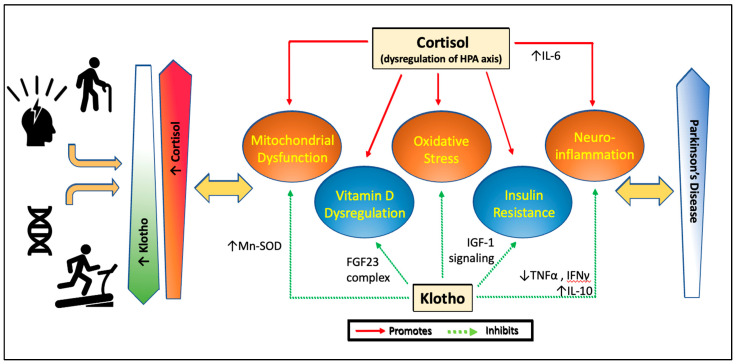
The pathogenesis of Parkinson’s disease (PD) is complex, multilayered, and not fully understood, resulting in a lack of effective disease-modifying treatments for this prevalent neurodegenerative condition. Symptoms of PD are heterogenous, including motor impairment as well as non-motor symptoms such as depression, cognitive impairment, and circadian disruption. Aging and stress are important risk factors for PD, leading us to explore pathways that may either accelerate or protect against cellular aging and the detrimental effects of stress. Cortisol is a much-studied hormone that can disrupt mitochondrial function and increase oxidative stress and neuroinflammation, which are recognized as key underlying disease mechanisms in PD. The more recently discovered klotho protein, considered a general aging-suppressor, has a similarly wide range of actions but in the opposite direction to cortisol: promoting mitochondrial function while reducing oxidative stress and inflammation. Both hormones also converge on pathways of vitamin D metabolism and insulin resistance, also implicated to play a role in PD. Interestingly, aging, stress and PD associate with an increase in cortisol and decrease in klotho, while physical exercise and certain genetic variations lead to a decrease in cortisol response and increased klotho. Here, we review the interrelated opposite actions of cortisol and klotho in the pathogenesis of PD. Together they impact powerful and divergent mechanisms that may go on to influence PD-related symptoms. Better understanding of these hormones in PD would facilitate the design of effective interventions that can simultaneously impact the multiple systems involved in the pathogenesis of PD.
Overview
The claims and statistics of this paper haven’t been checked yet.
Free: it reads the open-access text and checks the first 5 claims that cite a source we can check. Create a free account to check every claim.
Integrity signals
Registry
Cites
Statistics
Figures
Verification
Claims the paper makes
The claims and statistics of this paper haven’t been checked yet.
Free: it reads the open-access text and checks the first 5 claims that cite a source we can check. Create a free account to check every claim.
Claims other papers make about this one
Each is checked against this paper’s own text: does it say what the citing paper says it does?
The cited source doesn’t support the claim as written.
In the citing paper
“Neurodegeneration occurs in critical brain areas, such as the hippocampus and substantia nigra (two of the crucial brain areas implicated in AD and PD, respectively), and leads to an increase in oxidative stress, mitochondrial dysfunction, and metabolic changes [73].”
From The Role of Cortisol in Chronic Stress, Neurodegenerative Diseases, and Psychological Disorders (2023) · cites this paper as [73]
Checked by a reasoning model — may be wrong.
Experimental — accuracy not yet measuredThe source backs part of the claim, not all of it — or backs it for a different population, condition or comparison.
In the citing paper
“Increased oxidative stress and mitochondrial dysfunction, which are mentioned above and occur in critical brain areas to cause neurodegeneration implicated in diseases, such as AD and PD [73], occur due to insulin resistance in T2DM [75].”
From The Role of Cortisol in Chronic Stress, Neurodegenerative Diseases, and Psychological Disorders (2023) · cites this paper as [73]
Experimental — accuracy not yet measured
Self-check
Percentages, sums and reported differences re-computed from the paper’s own numbers.
The self-check needs the paper’s full text.
Citations
Cites
Effects of stress throughout the lifespan on the brain, behaviour and cognition
Lupien, S. J., McEwen, B. S., Gunnar, M. R., & Heim, C. (2009) · Nature Reviews Neuroscience · doi:10.1038/nrn2639 · Cited by 6,256
Stress and the brain: from adaptation to disease
de Kloet, E. R., Joëls, M., & Holsboer, F. (2005) · Nature Reviews Neuroscience · doi:10.1038/nrn1683 · Cited by 4,621
Chronic Inflammation (Inflammaging) and Its Potential Contribution to Age-Associated Diseases
Franceschi, C., & Campisi, J. (2014) · The Journals of Gerontology Series A: Biological Sciences and Medical Sciences · doi:10.1093/gerona/glu057 · Cited by 3,891
Mutation of the mouse klotho gene leads to a syndrome resembling ageing
Kuro-o, M., Matsumura, Y., Aizawa, H., Kawaguchi, H., Suga, T., Utsugi, T., Ohyama, Y., Kurabayashi, M., Kaname, T., Kume, E., et al. (1997) · Nature · doi:10.1038/36285 · Cited by 3,837
Tracey, K. J. (2002) · Nature · doi:10.1038/nature01321 · Cited by 3,728
Geroscience: Linking Aging to Chronic Disease
Kennedy, B. K., Berger, S. L., Brunet, A., Campisi, J., Cuervo, A. M., Epel, E. S., Franceschi, C., Lithgow, G. J., Morimoto, R. I., Pessin, J. E., et al. (2014) · Cell · doi:10.1016/j.cell.2014.10.039 · Cited by 2,764
The Roles of PINK1, Parkin, and Mitochondrial Fidelity in Parkinson’s Disease
Pickrell, A. M., & Youle, R. J. (2015) · Neuron · doi:10.1016/j.neuron.2014.12.007 · Cited by 2,310
Feigin, V. L., Abajobir, A. A., Abate, K. H., Abd-Allah, F., Abdulle, A. M., Abera, S. F., Abyu, G. Y., Ahmed, M. B., Aichour, A. N., Aichour, I., et al. (2017) · The Lancet Neurology · doi:10.1016/s1474-4422(17)30299-5 · Cited by 2,275
Non-motor features of Parkinson disease
Schapira, A. H. V., Chaudhuri, K. R., & Jenner, P. (2017) · Nature Reviews Neuroscience · doi:10.1038/nrn.2017.62 · Cited by 2,053
Suppression of Aging in Mice by the Hormone Klotho
Kurosu, H., Yamamoto, M., Clark, J. D., Pastor, J. V., Nandi, A., Gurnani, P., McGuinness, O. P., Chikuda, H., Yamaguchi, M., Kawaguchi, H., et al. (2005) · Science · doi:10.1126/science.1112766 · Cited by 1,935
Klotho converts canonical FGF receptor into a specific receptor for FGF23
Urakawa, I., Yamazaki, Y., Shimada, T., Iijima, K., Hasegawa, H., Okawa, K., Fujita, T., Fukumoto, S., & Yamashita, T. (2006) · Nature · doi:10.1038/nature05315 · Cited by 1,850 · cited 1×
“are complex and multidimensional—it suppresses insulin and Wnt signaling [42,43], regulates ion channel clustering and transport [44], modulates N-methyl-D-aspartate receptor (NMDAR) signaling [18] and promotes fibroblast growth factor (FGF) function [45].”
BackgroundDistribution of the vitamin D receptor and 1α-hydroxylase in human brain
Eyles, D. W., Smith, S., Kinobe, R., Hewison, M., & McGrath, J. J. (2005) · Journal of Chemical Neuroanatomy · doi:10.1016/j.jchemneu.2004.08.006 · Cited by 1,444
Oxidative stress, insulin signaling, and diabetes
Rains, J. L., & Jain, S. K. (2011) · Free Radical Biology and Medicine · doi:10.1016/j.freeradbiomed.2010.12.006 · Cited by 1,435
Chronic stress, glucocorticoid receptor resistance, inflammation, and disease risk
Cohen, S., Janicki-Deverts, D., Doyle, W. J., Miller, G. E., Frank, E., Rabin, B. S., & Turner, R. B. (2012) · Proceedings of the National Academy of Sciences · doi:10.1073/pnas.1118355109 · Cited by 1,419 · cited 1×
“In settings of chronic stress, excessive cortisol secretion leads to compensatory down-regulation or resistance of the GR and its anti-inflammatory actions, resulting instead in a pro-inflammatory milieu facilitating a wide range of disease risks including neurotoxicity [12,13].”
BackgroundThe Parkinson Pandemic—A Call to Action
Dorsey, E. R., & Bloem, B. R. (2018) · JAMA Neurology · doi:10.1001/jamaneurol.2017.3299 · Cited by 1,091 · cited 2×
“Fueled by aging, the number of people with PD is expected to exceed 12 million by 2040 [1].”
BackgroundThe stress system in the human brain in depression and neurodegeneration
Swaab, D. F., Bao, A.-M., & Lucassen, P. J. (2005) · Ageing Research Reviews · doi:10.1016/j.arr.2005.03.003 · Cited by 984 · cited 1×
“The hippocampus has extensive distribution of GRs and plays a crucial role in the biological effects of chronic stress [94,95].”
BackgroundDynamic adaptation of large-scale brain networks in response to acute stressors
Hermans, E. J., Henckens, M. J. A. G., Joëls, M., & Fernández, G. (2014) · Trends in Neurosciences · doi:10.1016/j.tins.2014.03.006 · Cited by 949 · cited 1×
“A wide brain network involving the hippocampus, amygdala, prefrontal cortex and brainstem nuclei are involved in HPA axis activation in response to acute or chronic stress [20].”
BackgroundAgeing and Parkinson's disease: Why is advancing age the biggest risk factor?
Reeve, A., Simcox, E., & Turnbull, D. (2014) · Ageing Research Reviews · doi:10.1016/j.arr.2014.01.004 · Cited by 947 · cited 1×
“Aging is the most critical risk factor for PD [7,76], yet the relationship between molecular/cellular processes of healthy aging and those of PD pathogenesis remain unclear.”
BackgroundMitochondrial dysfunction and oxidative stress in Parkinson's disease
Subramaniam, S. R., & Chesselet, M.-F. (2013) · Progress in Neurobiology · doi:10.1016/j.pneurobio.2013.04.004 · Cited by 913
Vgontzas, A. N., Bixler, E. O., Lin, H.-M., Prolo, P., Mastorakos, G., Vela-Bueno, A., Kales, A., & Chrousos, G. P. (2001) · The Journal of Clinical Endocrinology & Metabolism · doi:10.1210/jcem.86.8.7778 · Cited by 884
Mitochondrial dysfunction in Parkinson's disease
Bose, A., & Beal, M. F. (2016) · Journal of Neurochemistry · doi:10.1111/jnc.13731 · Cited by 841
Witkovsky, P. (2004) · Documenta Ophthalmologica · doi:10.1023/b:doop.0000019487.88486.0a · Cited by 809
Stress Hormones, Th1/Th2 patterns, Pro/Anti-inflammatory Cytokines and Susceptibility to Disease
Elenkov, I. J., & Chrousos, G. P. (1999) · Trends in Endocrinology & Metabolism · doi:10.1016/s1043-2760(99)00188-5 · Cited by 804
Major depressive disorder and hypothalamic-pituitary-adrenal axis activity
Vreeburg, S. A., Hoogendijk, W. J. G., van Pelt, J., DeRijk, R. H., Verhagen, J. C. M., van Dyck, R., Smit, J. H., Zitman, F. G., & Penninx, B. W. J. H. (2009) · Archives of General Psychiatry · doi:10.1001/archgenpsychiatry.2009.50 · Cited by 792
Inflammation in Parkinson’s Disease: Mechanisms and Therapeutic Implications
Pajares, M., I. Rojo, A., Manda, G., Boscá, L., & Cuadrado, A. (2020) · Cells · doi:10.3390/cells9071687 · Cited by 779
Augmented Wnt signaling in a mammalian model of accelerated aging
Liu, H., Fergusson, M. M., Castilho, R. M., Liu, J., Cao, L., Chen, J., Malide, D., Rovira, I. I., Schimel, D., Kuo, C. J., et al. (2007) · Science · doi:10.1126/science.1143578 · Cited by 755 · cited 1×
“are complex and multidimensional—it suppresses insulin and Wnt signaling [42,43], regulates ion channel clustering and transport [44], modulates N-methyl-D-aspartate receptor (NMDAR) signaling [18] and promotes fibroblast growth factor (FGF) function [45].”
BackgroundBrain metabolism in health, aging, and neurodegeneration
Camandola, S., & Mattson, M. P. (2017) · The EMBO Journal · doi:10.15252/embj.201695810 · Cited by 752
The brain and the stress axis: the neural correlates of cortisol regulation in response to stress
Dedovic, K., Duchesne, A., Andrews, J., Engert, V., & Pruessner, J. C. (2009) · NeuroImage · doi:10.1016/j.neuroimage.2009.05.074 · Cited by 699 · cited 1×
“It is a powerful steroid hormone that can pass into every cell of the body, with genomic and non-genomic actions affecting mitochondrial, immune, and metabolic function [19].”
BackgroundChronic stress, cognitive functioning and mental health
Marin, M.-F., Lord, C., Andrews, J., Juster, R.-P., Sindi, S., Arsenault-Lapierre, G., Fiocco, A. J., & Lupien, S. J. (2011) · Neurobiology of Learning and Memory · doi:10.1016/j.nlm.2011.02.016 · Cited by 654 · cited 1×
“Stress is known to affect functions of the limbic system such as learning, memory and emotions [93].”
BackgroundEpidemiology of parkinson’s disease
Tanner, C. M., & Goldman, S. M. (1996) · Neurologic Clinics · doi:10.1016/s0733-8619(05)70259-0 · Cited by 640 · cited 1×
“Aging is the most critical risk factor for PD [7,76], yet the relationship between molecular/cellular processes of healthy aging and those of PD pathogenesis remain unclear.”
BackgroundThe ß-Glucuronidase Klotho Hydrolyzes and Activates the TRPV5 Channel
Chang, Q., Hoefs, S., van der Kemp, A. W., Topala, C. N., Bindels, R. J., & Hoenderop, J. G. (2005) · Science · doi:10.1126/science.1114245 · Cited by 622 · cited 1×
“are complex and multidimensional—it suppresses insulin and Wnt signaling [42,43], regulates ion channel clustering and transport [44], modulates N-methyl-D-aspartate receptor (NMDAR) signaling [18] and promotes fibroblast growth factor (FGF) function [45].”
BackgroundRecombinant interleukin-6 activates the hypothalamic-pituitary-adrenal axis in humans.
Mastorakos, G., Chrousos, G. P., & Weber, J. S. (1993) · The Journal of Clinical Endocrinology & Metabolism · doi:10.1210/jcem.77.6.8263159 · Cited by 591
Yoga, mindfulness-based stress reduction and stress-related physiological measures: A meta-analysis.
Pascoe, M. C., Thompson, D. R., & Ski, C. F. (2017) · Psychoneuroendocrinology · doi:10.1016/j.psyneuen.2017.08.008 · Cited by 570
Sleep, Plasticity and Memory from Molecules to Whole-Brain Networks
Abel, T., Havekes, R., Saletin, J. M., & Walker, M. P. (2013) · Current Biology · doi:10.1016/j.cub.2013.07.025 · Cited by 552
Chen, C.-D., Podvin, S., Gillespie, E., Leeman, S. E., & Abraham, C. R. (2007) · Proceedings of the National Academy of Sciences · doi:10.1073/pnas.0709805104 · Cited by 548
FGF21 regulates metabolism and circadian behavior by acting on the nervous system
Bookout, A. L., de Groot, M. H. M., Owen, B. M., Lee, S., Gautron, L., Lawrence, H. L., Ding, X., Elmquist, J. K., Takahashi, J. S., Mangelsdorf, D. J., et al. (2013) · Nature Medicine · doi:10.1038/nm.3249 · Cited by 545 · cited 1×
“Klotho linked with FGF21 is involved in stimulation of the starvation response, activating the HPA axis and sympathetic nervous system, as well as increasing intracellular klotho expression in the SCN within the hypothalamus [52].”
An energetic view of stress: Focus on mitochondria
Picard, M., McEwen, B. S., Epel, E. S., & Sandi, C. (2018) · Frontiers in Neuroendocrinology · doi:10.1016/j.yfrne.2018.01.001 · Cited by 542
Doi, S., Zou, Y., Togao, O., Pastor, J. V., John, G. B., Wang, L., Shiizaki, K., Gotschall, R., Schiavi, S., Yorioka, N., et al. (2011) · Journal of Biological Chemistry · doi:10.1074/jbc.m110.174037 · Cited by 532
Tsujikawa, H., Kurotaki, Y., Fujimori, T., Fukuda, K., & Nabeshima, Y.-I. (2003) · Molecular Endocrinology · doi:10.1210/me.2003-0048 · Cited by 491
Yamazaki, Y., Imura, A., Urakawa, I., Shimada, T., Murakami, J., Aono, Y., Hasegawa, H., Yamashita, T., Nakatani, K., Saito, Y., et al. (2010) · Biochemical and Biophysical Research Communications · doi:10.1016/j.bbrc.2010.06.110 · Cited by 489 · cited 1×
“In contrast, klotho levels are highest at birth in humans, with levels 7-fold higher than adulthood levels, and decline after age 40 [85,86].”
BackgroundCardoso, A. L., Fernandes, A., Aguilar-Pimentel, J. A., de Angelis, M. H., Guedes, J. R., Brito, M. A., Ortolano, S., Pani, G., Athanasopoulou, S., Gonos, E. S., et al. (2018) · Ageing Research Reviews · doi:10.1016/j.arr.2018.07.004 · Cited by 475 · cited 1×
“Klotho has also recently been included in a panel of biomarkers that may predict frailty in the elderly [88].”
BackgroundHigh Cortisol and the Risk of Dementia and Alzheimer’s Disease: A Review of the Literature
Ouanes, S., & Popp, J. (2019) · Frontiers in Aging Neuroscience · doi:10.3389/fnagi.2019.00043 · Cited by 470 · cited 1×
“There is a growing body of evidence that increased cortisol is associated with late-life cognitive decline in normal aging in people with pre-clinical or clinical AD [57,189,190].”
BackgroundInteractions of the circadian CLOCK system and the HPA-axis
Nader, N., Chrousos, G. P., & Kino, T. (2010) · Trends in Endocrinology & Metabolism · doi:10.1016/j.tem.2009.12.011 · Cited by 449 · cited 1×
“The SCN transmits its circadian signal to peripheral clock genes via neural and hormonal mechanisms, with cortisol secretion playing a significant role, synchronizing circadian oscillations throughout the body [21].”
BackgroundAgeing as a primary risk factor for Parkinson's disease: evidence from studies of non-human primates
Collier, T. J., Kanaan, N. M., & Kordower, J. H. (2011) · Nature Reviews Neuroscience · doi:10.1038/nrn3039 · Cited by 449 · cited 1×
“, dopaminergic neurons in substantia nigra pars compacta) undergo localized, accelerated aging [77].”
BackgroundThe FGF23–Klotho axis: endocrine regulation of phosphate homeostasis
Razzaque, M. S. (2009) · Nature Reviews Endocrinology · doi:10.1038/nrendo.2009.196 · Cited by 448
Hoogendijk, W. J. G., Lips, P., Dik, M. G., Deeg, D. J. H., Beekman, A. T. F., & Penninx, B. W. J. H. (2008) · Archives of General Psychiatry · doi:10.1001/archpsyc.65.5.508 · Cited by 445
Lucassen, P. J., Pruessner, J., Sousa, N., Almeida, O. F. X., Van Dam, A. M., Rajkowska, G., Swaab, D. F., & Czéh, B. (2014) · Acta Neuropathologica · doi:10.1007/s00401-013-1223-5 · Cited by 441
Ageing, neurodegeneration and Parkinson's disease
Hindle, J. V. (2010) · Age and Ageing · doi:10.1093/ageing/afp223 · Cited by 430 · cited 2×
“These processes occur in vulnerable brain regions and interplay with genetic and environmental risk factors to contribute to the development and progression of PD [8,10,11].”
BackgroundPang, S. Y.-Y., Ho, P. W.-L., Liu, H.-F., Leung, C.-T., Li, L., Chang, E. E. S., Ramsden, D. B., & Ho, S.-L. (2019) · Translational Neurodegeneration · doi:10.1186/s40035-019-0165-9 · Cited by 427 · cited 1×
“These processes occur in vulnerable brain regions and interplay with genetic and environmental risk factors to contribute to the development and progression of PD [8,10,11].”
BackgroundRatman, D., Vanden Berghe, W., Dejager, L., Libert, C., Tavernier, J., Beck, I. M., & De Bosscher, K. (2013) · Molecular and Cellular Endocrinology · doi:10.1016/j.mce.2012.12.014 · Cited by 411 · cited 1×
“In addition to rapid non-genomic mechanisms, cortisol influences brain functions by activating GR-mediated gene transcription [25].”
BackgroundChronic insomnia and activity of the stress system
Vgontzas, A. N., Tsigos, C., Bixler, E. O., Stratakis, C. A., Zachman, K., Kales, A., Vela-Bueno, A., & Chrousos, G. P. (1998) · Journal of Psychosomatic Research · doi:10.1016/s0022-3999(97)00302-4 · Cited by 401
Lupien, S. J., Juster, R.-P., Raymond, C., & Marin, M.-F. (2018) · Frontiers in Neuroendocrinology · doi:10.1016/j.yfrne.2018.02.001 · Cited by 387 · cited 1×
“In settings of chronic stress, excessive cortisol secretion leads to compensatory down-regulation or resistance of the GR and its anti-inflammatory actions, resulting instead in a pro-inflammatory milieu facilitating a wide range of disease risks including neurotoxicity [12,13].”
BackgroundMadrigal, J. (2001) · Neuropsychopharmacology · doi:10.1016/s0893-133x(00)00208-6 · Cited by 379
Neurodegeneration and Inflammation—An Interesting Interplay in Parkinson’s Disease
Marogianni, C., Sokratous, M., Dardiotis, E., Hadjigeorgiou, G. M., Bogdanos, D., & Xiromerisiou, G. (2020) · International Journal of Molecular Sciences · doi:10.3390/ijms21228421 · Cited by 366
Calabrese, V., Santoro, A., Monti, D., Crupi, R., Di Paola, R., Latteri, S., Cuzzocrea, S., Zappia, M., Giordano, J., Calabrese, E. J., et al. (2018) · Free Radical Biology and Medicine · doi:10.1016/j.freeradbiomed.2017.10.379 · Cited by 356 · cited 1×
“The concept of “inflammaging” has been proposed as a principal mechanism in PD [78] and describes the sustained systemic inflammatory state that develops with advanced age [79].”
BackgroundGlucocorticoids are critical regulators of dendritic spine development and plasticity in vivo
Liston, C., & Gan, W.-B. (2011) · Proceedings of the National Academy of Sciences · doi:10.1073/pnas.1110444108 · Cited by 352 · cited 1×
“Cortisol is necessary for neuronal differentiation, integrity, and growth, as well as synaptic and dendritic plasticity [23,24].”
BackgroundImmunohistochemical Localization of Klotho Protein in Brain, Kidney, and Reproductive Organs of Mice
Li, S.-A., Watanabe, M., Yamada, H., Nagai, A., Kinuta, M., & Takei, K. (2004) · Cell Structure and Function · doi:10.1247/csf.29.91 · Cited by 351
Risk factors for non-motor symptoms in Parkinson's disease
Marinus, J., Zhu, K., Marras, C., Aarsland, D., & van Hilten, J. J. (2018) · The Lancet Neurology · doi:10.1016/s1474-4422(18)30127-3 · Cited by 348
Serum Vitamin D and the Risk of Parkinson Disease
Knekt, P., Kilkkinen, A., Rissanen, H., Marniemi, J., Sääksjärvi, K., & Heliövaara, M. (2010) · Archives of Neurology · doi:10.1001/archneurol.2010.120 · Cited by 337
Review: The role of vitamin D in nervous system health and disease
DeLuca, G. C., Kimball, S. M., Kolasinski, J., Ramagopalan, S. V., & Ebers, G. C. (2013) · Neuropathology and Applied Neurobiology · doi:10.1111/nan.12020 · Cited by 326
Polymorphisms of the Glucocorticoid Receptor Gene and Major Depression
van Rossum, E. F. C., Binder, E. B., Majer, M., Koper, J. W., Ising, M., Modell, S., Salyakina, D., Lamberts, S. W. J., & Holsboer, F. (2006) · Biological Psychiatry · doi:10.1016/j.biopsych.2006.02.007 · Cited by 324
Life Extension Factor Klotho Enhances Cognition
Dubal, D. B., Yokoyama, J. S., Zhu, L., Broestl, L., Worden, K., Wang, D., Sturm, V. E., Kim, D., Klein, E., Yu, G.-Q., et al. (2014) · Cell Reports · doi:10.1016/j.celrep.2014.03.076 · Cited by 321
Hartmann, A. (1997) · Neurobiology of Aging · doi:10.1016/s0197-4580(97)80309-0 · Cited by 318 · cited 2×
“PD-associated changes in HPA axis function leads to a flatter circadian profile for cortisol and signaling to peripheral clock genes is compromised with resultant circadian disorder [65,198].”
BackgroundSleep deprivation and stress: a reciprocal relationship
Nollet, M., Wisden, W., & Franks, N. P. (2020) · Interface Focus · doi:10.1098/rsfs.2019.0092 · Cited by 294 · cited 1×
“Stress and hypercortisolemia also disrupt sleep [96], which exerts powerful effects on the hippocampus and affects initial learning and memory consolidation [97].”
BackgroundRegulation of the HPA axis by cytokines.
Turnbull, A. V., & Rivier, C. (1995) · Brain, Behavior, and Immunity · doi:10.1006/brbi.1995.1026 · Cited by 289
Arking, D. E., Atzmon, G., Arking, A., Barzilai, N., & Dietz, H. C. (2005) · Circulation Research · doi:10.1161/01.res.0000157171.04054.30 · Cited by 274 · cited 1×
“KL-VS heterozygosity is associated with longer lifespan [31], slowed epigenetic age [100], and higher cognitive function [18,108] in most but not all populations.”
BackgroundPlasma Klotho and Cardiovascular Disease in Adults
Semba, R. D., Cappola, A. R., Sun, K., Bandinelli, S., Dalal, M., Crasto, C., Guralnik, J. M., & Ferrucci, L. (2011) · Journal of the American Geriatrics Society · doi:10.1111/j.1532-5415.2011.03558.x · Cited by 266 · cited 1×
“Several studies link klotho to increased lifespan and better health outcomes, including decreased risk for cardiovascular disease and stroke, decreased macrovascular complications in patients with type 2 diabetes, and improved grip strength [33,86,87].”
BackgroundErratum: Non-motor features of Parkinson disease
Schapira, A. H. V., Chaudhuri, K. R., & Jenner, P. (2017) · Nature Reviews Neuroscience · doi:10.1038/nrn.2017.91 · Cited by 264
Fiksdal, A., Hanlin, L., Kuras, Y., Gianferante, D., Chen, X., Thoma, M. V., & Rohleder, N. (2019) · Psychoneuroendocrinology · doi:10.1016/j.psyneuen.2018.11.035 · Cited by 258
KLOTHO Allele Status and the Risk of Early-Onset Occult Coronary Artery Disease
Arking, D. E., Becker, D. M., Yanek, L. R., Fallin, D., Judge, D. P., Moy, T. F., Becker, L. C., & Dietz, H. C. (2003) · The American Journal of Human Genetics · doi:10.1086/375035 · Cited by 253
Hippocampal gene expression changes underlying stress sensitization and recovery
Gray, J. D., Rubin, T. G., Hunter, R. G., & McEwen, B. S. (2014) · Molecular Psychiatry · doi:10.1038/mp.2013.175 · Cited by 242
Cortisol in Hair and the Metabolic Syndrome
Stalder, T., Kirschbaum, C., Alexander, N., Bornstein, S. R., Gao, W., Miller, R., Stark, S., Bosch, J. A., & Fischer, J. E. (2013) · The Journal of Clinical Endocrinology & Metabolism · doi:10.1210/jc.2013-1056 · Cited by 236
Motor and non-motor circuit disturbances in early Parkinson disease: which happens first?
Blesa, J., Foffani, G., Dehay, B., Bezard, E., & Obeso, J. A. (2022) · Nature Reviews Neuroscience · doi:10.1038/s41583-021-00542-9 · Cited by 232 · cited 1×
“, decreased metabolism in the prefrontal, occipital, and parietal cortices as well as changes in the lentiform nucleus, thalamus, pons and cerebellum [3].”
BackgroundCardiovascular Disease and Hair Cortisol: a Novel Biomarker of Chronic Stress
Iob, E., & Steptoe, A. (2019) · Current Cardiology Reports · doi:10.1007/s11886-019-1208-7 · Cited by 209
Plasma Klotho and Mortality Risk in Older Community-Dwelling Adults
Semba, R. D., Cappola, A. R., Sun, K., Bandinelli, S., Dalal, M., Crasto, C., Guralnik, J. M., & Ferrucci, L. (2011) · The Journals of Gerontology Series A: Biological Sciences and Medical Sciences · doi:10.1093/gerona/glr058 · Cited by 202 · cited 2×
“In contrast, klotho levels are highest at birth in humans, with levels 7-fold higher than adulthood levels, and decline after age 40 [85,86].”
BackgroundLife Extension Factor Klotho Prevents Mortality and Enhances Cognition in hAPP Transgenic Mice
Dubal, D. B., Zhu, L., Sanchez, P. E., Worden, K., Broestl, L., Johnson, E., Ho, K., Yu, G.-Q., Kim, D., Betourne, A., et al. (2015) · The Journal of Neuroscience · doi:10.1523/jneurosci.5791-12.2015 · Cited by 197 · cited 1×
“In animal models, klotho overexpression increases long-term potentiation and enhances spatial learning and memory [17].”
BackgroundKlotho in the cerebrospinal fluid of adults with and without Alzheimer's disease
Semba, R. D., Moghekar, A. R., Hu, J., Sun, K., Turner, R., Ferrucci, L., & O’Brien, R. (2014) · Neuroscience Letters · doi:10.1016/j.neulet.2013.10.058 · Cited by 194 · cited 6×
“In PD, KL-VS heterozygotes have higher CSF klotho levels; however, the haplotype itself is associated with shorter interval between onset of PD and progression to MCI and worse motor phenotype [37].”
BackgroundInfluentialVitamin D and Parkinson's disease—A hypothesis
Newmark, H. L., & Newmark, J. (2007) · Movement Disorders · doi:10.1002/mds.21317 · Cited by 183
Feng, X., Zhao, Y., Yang, T., Song, M., Wang, C., Yao, Y., & Fan, H. (2019) · Frontiers in Molecular Neuroscience · doi:10.3389/fnmol.2019.00210 · Cited by 183
Cui, X., Pelekanos, M., Liu, P.-Y., Burne, T. H. J., McGrath, J. J., & Eyles, D. W. (2013) · Neuroscience · doi:10.1016/j.neuroscience.2013.01.035 · Cited by 182
Joëls, M. (2018) · Journal of Endocrinology · doi:10.1530/joe-18-0226 · Cited by 179 · cited 1×
“Stress-induced shifts in cortisol associate with time- and region-dependent changes in neuronal activity to promote the brain’s adaptation to the continuously changing environment in the short and long-term [28].”
BackgroundUtsugi, T., Ohno, T., Ohyama, Y., Uchiyama, T., Saito, Y., Matsumura, Y., Aizawa, H., Itoh, H., Kurabayashi, M., Kawazu, S., et al. (2000) · Metabolism · doi:10.1053/meta.2000.8606 · Cited by 175 · cited 1×
“are complex and multidimensional—it suppresses insulin and Wnt signaling [42,43], regulates ion channel clustering and transport [44], modulates N-methyl-D-aspartate receptor (NMDAR) signaling [18] and promotes fibroblast growth factor (FGF) function [45].”
BackgroundSahu, A., Mamiya, H., Shinde, S. N., Cheikhi, A., Winter, L. L., Vo, N. V., Stolz, D., Roginskaya, V., Tang, W. Y., St. Croix, C., et al. (2018) · Nature Communications · doi:10.1038/s41467-018-07253-3 · Cited by 166
Dementia is associated with Insulin Resistance in patients with Parkinson's Disease
Bosco, D., Plastino, M., Cristiano, D., Colica, C., Ermio, C., De Bartolo, M., Mungari, P., Fonte, G., Consoli, D., Consoli, A., et al. (2012) · Journal of the Neurological Sciences · doi:10.1016/j.jns.2011.12.008 · Cited by 161
Carpenter, T. O., Insogna, K. L., Zhang, J. H., Ellis, B. K., Nieman, S. D., Simpson, C. A., Olear, E. A., & Gundberg, C. M. (2010) · The Journal of Clinical Endocrinology & Metabolism · doi:10.1210/jc.2010-0589 · Cited by 151
Klotho controls the brain-immune system interface in the choroid plexus
Zhu, L., Stein, L. R., Kim, D., Ho, K., Yu, G.-Q., Zhan, L., Larsson, T. E., & Mucke, L. (2018) · Proceedings of the National Academy of Sciences · doi:10.1073/pnas.1808609115 · Cited by 148
Cross‐talk of vitamin D and glucocorticoids in hippocampal cells
Obradovic, D., Gronemeyer, H., Lutz, B., & Rein, T. (2006) · Journal of Neurochemistry · doi:10.1111/j.1471-4159.2005.03579.x · Cited by 144
High Prevalence of Hypovitaminosis D Status in Patients With Early Parkinson Disease
Evatt, M. L. (2011) · Archives of Neurology · doi:10.1001/archneurol.2011.30 · Cited by 144
HPA-axis and inflammatory reactivity to acute stress is related with basal HPA-axis activity
Chen, X., Gianferante, D., Hanlin, L., Fiksdal, A., Breines, J. G., Thoma, M. V., & Rohleder, N. (2017) · Psychoneuroendocrinology · doi:10.1016/j.psyneuen.2017.01.035 · Cited by 143
Caplin, A., Chen, F. S., Beauchamp, M. R., & Puterman, E. (2021) · Psychoneuroendocrinology · doi:10.1016/j.psyneuen.2021.105336 · Cited by 142
Drew, D. A., Katz, R., Kritchevsky, S. B., Ix, J. H., Shlipak, M. G., Gutiérrez, O. M., Newman, A. B., Hoofnagle, A. N., Fried, L. F., Semba, R. D., et al. (2017) · Journal of the American Society of Nephrology · doi:10.1681/asn.2016080828 · Cited by 140
Disturbances in melatonin secretion and circadian sleep-wake regulation in Parkinson disease
Bolitho, S. J., Naismith, S. L., Rajaratnam, S. M. W., Grunstein, R. R., Hodges, J. R., Terpening, Z., Rogers, N., & Lewis, S. J. G. (2014) · Sleep Medicine · doi:10.1016/j.sleep.2013.10.016 · Cited by 139
Circulating cortisol and cognitive and structural brain measures: The Framingham Heart Study
Echouffo-Tcheugui, J. B., Conner, S. C., Himali, J. J., Maillard, P., DeCarli, C. S., Beiser, A. S., Vasan, R. S., & Seshadri, S. (2018) · Neurology · doi:10.1212/wnl.0000000000006549 · Cited by 139
Lim, S. W., Jin, L., Luo, K., Jin, J., Shin, Y. J., Hong, S. Y., & Yang, C. W. (2017) · Cell Death & Disease · doi:10.1038/cddis.2017.365 · Cited by 135
Matsubara, T., Miyaki, A., Akazawa, N., Choi, Y., Ra, S.-G., Tanahashi, K., Kumagai, H., Oikawa, S., & Maeda, S. (2014) · American Journal of Physiology-Heart and Circulatory Physiology · doi:10.1152/ajpheart.00429.2013 · Cited by 134
Ho, R. T. H., Fong, T. C. T., Chan, W. C., Kwan, J. S. K., Chiu, P. K. C., Yau, J. C. Y., & Lam, L. C. W. (2018) · The Journals of Gerontology: Series B · doi:10.1093/geronb/gby145 · Cited by 134
Smolders, J., Schuurman, K. G., Strien, M. E. V., Melief, J., Hendrickx, D., Hol, E. M., Eden, C. V., Luchetti, S., & Huitinga, I. (2013) · Journal of Neuropathology & Experimental Neurology · doi:10.1097/nen.0b013e31827f4fcc · Cited by 129
Smith, L. K., Jadavji, N. M., Colwell, K. L., Katrina Perehudoff, S., & Metz, G. A. (2008) · European Journal of Neuroscience · doi:10.1111/j.1460-9568.2008.06177.x · Cited by 129 · cited 2×
“In PD mouse models, chronic stress exposure worsens motor deficits, aggravates the neurodegeneration of the nigrostriatal system, and completely blocks compensatory recovery of motor tasks [64].”
BackgroundLeon, J., Moreno, A. J., Garay, B. I., Chalkley, R. J., Burlingame, A. L., Wang, D., & Dubal, D. B. (2017) · Cell Reports · doi:10.1016/j.celrep.2017.07.024 · Cited by 123 · cited 3×
“Clinical studies studying klotho in relation to cognition in PD are lacking but initial studies reveal that acute elevation of klotho by peripheral delivery is sufficient to restore cognition in transgenic mouse models of PD [71].”
BackgroundInfluentialvan Rossum, E. F. C., Feelders, R. A., van den Beld, A. W., Uitterlinden, A. G., Janssen, J. A. M. J. L., Ester, W. A., Brinkmann, A. O., Grobbee, D. E., de Jong, F. H., Pols, H. A. P., et al. (2004) · The American Journal of Medicine · doi:10.1016/j.amjmed.2004.01.027 · Cited by 121
Chronic Stress and Diabetes Mellitus: Interwoven Pathologies
Sharma, V. K., & Singh, T. G. (2020) · Current Diabetes Reviews · doi:10.2174/1573399815666191111152248 · Cited by 116
Central nervous system effects of natural and synthetic glucocorticoids
Fietta, P., Fietta, P., & Delsante, G. (2009) · Psychiatry and Clinical Neurosciences · doi:10.1111/j.1440-1819.2009.02005.x · Cited by 111 · cited 1×
“Cortisol is necessary for neuronal differentiation, integrity, and growth, as well as synaptic and dendritic plasticity [23,24].”
BackgroundBelloy, M. E., Napolioni, V., Han, S. S., Le Guen, Y., Greicius, M. D., & Initiative, F. T. A. D. N. (2020) · JAMA Neurology · doi:10.1001/jamaneurol.2020.0414 · Cited by 110
Role of Insulin Resistance in the Alzheimer's Disease Progression
Nguyen, T. T., Ta, Q. T. H., Nguyen, T. T. D., Le, T. T. H., & Giau, V. V. (2020) · Neurochemical Research · doi:10.1007/s11064-020-03031-0 · Cited by 110
Beserra, A. H. N., Kameda, P., Deslandes, A. C., Schuch, F. B., Laks, J., & Moraes, H. S. D. (2018) · Trends in Psychiatry and Psychotherapy · doi:10.1590/2237-6089-2017-0155 · Cited by 108
Stress as a Modulator of Motor System Function and Pathology
Metz, G. A. (2007) · Reviews in the Neurosciences · doi:10.1515/revneuro.2007.18.3-4.209 · Cited by 108 · cited 1×
“Recent evidence shows that stress also modulates motor system function [98].”
BackgroundAntiinflammatory Actions of Klotho: Implications for Therapy of Diabetic Nephropathy
Typiak, M., & Piwkowska, A. (2021) · International Journal of Molecular Sciences · doi:10.3390/ijms22020956 · Cited by 107
Memory, Mood, and Vitamin D in Persons with Parkinson's Disease
Peterson, A. L., Murchison, C., Zabetian, C. P., Leverenz, J. B., Watson, G. S., Montine, T. J., Carney, N., Bowman, G. L., Edwards, K. L., & Quinn, J. F. (2013) · Journal of Parkinson s Disease · doi:10.3233/jpd-130206 · Cited by 106
Increased Serum Levels of Cortisol and Inflammatory Cytokines in People With Depression
Jia, Y., Liu, L., Sheng, C., Cheng, Z., Cui, L., Li, M., Zhao, Y., Shi, T., Yau, T. O., Li, F., et al. (2019) · Journal of Nervous & Mental Disease · doi:10.1097/nmd.0000000000000957 · Cited by 106
Roles of clock genes in the pathogenesis of Parkinson's disease
Shkodina, A. D., Tan, S. C., Hasan, M. M., Abdelgawad, M., Chopra, H., Bilal, M., Boiko, D. I., Tarianyk, K. А., & Alexiou, A. T. (2021) · Ageing Research Reviews · doi:10.1016/j.arr.2021.101554 · Cited by 106
Ageing and inflammation – A central role for mitochondria in brain health and disease
Currais, A. J. M. (2015) · Ageing Research Reviews · doi:10.1016/j.arr.2015.02.001 · Cited by 104
Glucocorticoid receptor polymorphisms and haplotypes and their expression in health and disease
Koper, J. W., van Rossum, E. F. C., & van den Akker, E. L. T. (2014) · Steroids · doi:10.1016/j.steroids.2014.07.015 · Cited by 97 · cited 1×
“Most studies show that BclI and N363S gene variants are associated with clinical measures of increased glucocorticoid sensitivity, while the ER22/23EK and GR-9β are associated with decreased glucocorticoid sensitivity [102].”
BackgroundVitamin D, nervous system and aging
Tuohimaa, P., Keisala, T., Minasyan, A., Cachat, J., & Kalueff, A. V. (2009) · Psychoneuroendocrinology · doi:10.1016/j.psyneuen.2009.07.003 · Cited by 93
Salivary cortisol, brain volumes, and cognition in community-dwelling elderly without dementia
Geerlings, M. I., Sigurdsson, S., Eiriksdottir, G., Garcia, M. E., Harris, T. B., Gudnason, V., & Launer, L. J. (2015) · Neurology · doi:10.1212/wnl.0000000000001931 · Cited by 92
A New Perspective for Parkinson’s Disease: Circadian Rhythm
Li, S., Wang, Y., Wang, F., Hu, L., & Liu, C. (2016) · Neuroscience Bulletin · doi:10.1007/s12264-016-0089-7 · Cited by 91
Lv, L., Tan, X., Peng, X., Bai, R., Xiao, Q., Zou, T., Tan, J., Zhang, H., & Wang, C. (2020) · Translational Neurodegeneration · doi:10.1186/s40035-020-00213-2 · Cited by 91
Variation in longevity gene KLOTHO is associated with greater cortical volumes
Yokoyama, J. S., Sturm, V. E., Bonham, L. W., Klein, E., Arfanakis, K., Yu, L., Coppola, G., Kramer, J. H., Bennett, D. A., Miller, B. L., et al. (2015) · Annals of Clinical and Translational Neurology · doi:10.1002/acn3.161 · Cited by 90
Nuclear localization of Klotho in brain: an anti-aging protein
German, D. C., Khobahy, I., Pastor, J., Kuro-o, M., & Liu, X. (2012) · Neurobiology of Aging · doi:10.1016/j.neurobiolaging.2011.12.018 · Cited by 90 · cited 1×
“Klotho is expressed primarily in the kidneys and choroid plexus [30,38,39].”
BackgroundHui, H., Zhai, Y., Ao, L., Cleveland, J. C., Liu, H., Fullerton, D. A., & Meng, X. (2017) · Oncotarget · doi:10.18632/oncotarget.14933 · Cited by 86
Semba, R. D., Cappola, A. R., Sun, K., Bandinelli, S., Dalal, M., Crasto, C., Guralnik, J. M., & Ferrucci, L. (2012) · European Journal of Applied Physiology · doi:10.1007/s00421-011-2072-3 · Cited by 85 · cited 2×
“When looking at healthy aging populations, cortisol negatively correlates with grip strength [209] while lower levels of klotho associate with decreased grip strength and knee strength [87,117].”
BackgroundAlbrecht, F., Ballarini, T., Neumann, J., & Schroeter, M. L. (2019) · NeuroImage: Clinical · doi:10.1016/j.nicl.2018.11.004 · Cited by 85
Klotho: a novel regulator of calcium and phosphorus homeostasis
Huang, C.-L., & Moe, O. W. (2011) · Pflügers Archiv - European Journal of Physiology · doi:10.1007/s00424-011-0950-5 · Cited by 83
Clinton, S. M., Glover, M. E., Maltare, A., Laszczyk, A. M., Mehi, S. J., Simmons, R. K., & King, G. D. (2013) · Brain Research · doi:10.1016/j.brainres.2013.06.044 · Cited by 82 · cited 1×
“Klotho is expressed primarily in the kidneys and choroid plexus [30,38,39].”
BackgroundTeocchi, M. A., Ferreira, A. É. D., de Oliveira, E. P. D. L., Tedeschi, H., & D’Souza-Li, L. F. R. (2013) · Journal of Neuroinflammation · doi:10.1186/1742-2094-10-53 · Cited by 82
High cortisol levels are associated with cognitive impairment no-dementia (CIND) and dementia
Lara, V. P., Caramelli, P., Teixeira, A. L., Barbosa, M. T., Carmona, K. C., Ferriani, M. D. G. C., Fernandes, A. P., & Gomes, K. B. (2013) · Clinica Chimica Acta · doi:10.1016/j.cca.2013.04.013 · Cited by 81
Longevity factor klotho and chronic psychological stress
Prather, A. A., Epel, E. S., Arenander, J., Broestl, L., Garay, B. I., Wang, D., & Dubal, D. B. (2015) · Translational Psychiatry · doi:10.1038/tp.2015.81 · Cited by 80 · cited 3×
“Lastly, low vitamin D levels are associated with depression and chronic stress, both conditions also linked to decreased klotho and elevated cortisol [60,184,185].”
BackgroundInfluentialStress and Mindfulness in Parkinson's Disease: Clinical Effects and Potential Underlying Mechanisms
van der Heide, A., Meinders, M. J., Speckens, A. E. M., Peerbolte, T. F., Bloem, B. R., & Helmich, R. C. (2021) · Movement Disorders · doi:10.1002/mds.28345 · Cited by 80
Miao, J., Huang, J., Luo, C., Ye, H., Ling, X., Wu, Q., Shen, W., & Zhou, L. (2021) · Physiological Reports · doi:10.14814/phy2.14696 · Cited by 80
Diurnal motor variations to repeated doses of levodopa in Parkinson's disease
Bonuccelli, U., Del Dotto, P., Lucetti, C., Petrozzi, L., Bernardini, S., Gambaccini, G., Rossi, G., & Piccini, P. (2000) · Clinical Neuropharmacology · doi:10.1097/00002826-200001000-00006 · Cited by 79
Hiller, A. L., Murchison, C. F., Lobb, B. M., O’Connor, S., O’Connor, M., & Quinn, J. F. (2018) · PLOS ONE · doi:10.1371/journal.pone.0203637 · Cited by 79
The Role of Vitamin D in Disease Progression in Early Parkinson’s Disease
Sleeman, I., Aspray, T., Lawson, R., Coleman, S., Duncan, G., Khoo, T. K., Schoenmakers, I., Rochester, L., Burn, D., & Yarnall, A. (2017) · Journal of Parkinson’s Disease · doi:10.3233/jpd-171122 · Cited by 78
Longitudinal Change in Cortisol Levels Across the Adult Life Span
Moffat, S. D., An, Y., Resnick, S. M., Diamond, M. P., & Ferrucci, L. (2020) · The Journals of Gerontology: Series A · doi:10.1093/gerona/gly279 · Cited by 72 · cited 1×
“Cortisol levels decrease in decades 20s–30s, are relatively stable in 40-50s, and increase after age 60 [80].”
BackgroundBrobey, R. K. B., German, D. C., Sonsalla, P. K., Gurnani, P., Pastor, J. V., Hsieh, C.-C., Papaconstantinou, J., Foster, P. P., Kuro‐o, M., & Rosenblatt, K. P. (2015) · PLoS ONE · doi:10.1371/journal.pone.0139914 · Cited by 69 · cited 1×
“Klotho-insufficient mice develop neurodegeneration of mesencephalic dopaminergic neurons in substantia nigra and ventral tegmentum area, while klotho overexpression protects dopaminergic neurons against oxidative injury [40,69,70].”
BackgroundCrasto, C., Semba, R. D., Sun, K., Cappola, A. R., Bandinelli, S., & Ferrucci, L. (2012) · Rejuvenation Research · doi:10.1089/rej.2011.1268 · Cited by 68
Yokoyama, J. S., Marx, G., Brown, J. A., Bonham, L. W., Wang, D., Coppola, G., Seeley, W. W., Rosen, H. J., Miller, B. L., Kramer, J. H., et al. (2017) · Brain Imaging and Behavior · doi:10.1007/s11682-016-9598-2 · Cited by 68
Baluchnejadmojarad, T., Eftekhari, S.-M., Jamali-Raeufy, N., Haghani, S., Zeinali, H., & Roghani, M. (2017) · Experimental Gerontology · doi:10.1016/j.exger.2017.10.023 · Cited by 65 · cited 1×
“Klotho-insufficient mice develop neurodegeneration of mesencephalic dopaminergic neurons in substantia nigra and ventral tegmentum area, while klotho overexpression protects dopaminergic neurons against oxidative injury [40,69,70].”
BackgroundCarter, B. S., Meng, F., & Thompson, R. C. (2012) · Physiological Genomics · doi:10.1152/physiolgenomics.00097.2012 · Cited by 64
Degeneration of mesencephalic dopaminergic neurons in klotho mouse related to vitamin D exposure
Kosakai, A., Ito, D., Nihei, Y., Yamashita, S., Okada, Y., Takahashi, K., & Suzuki, N. (2011) · Brain Research · doi:10.1016/j.brainres.2011.01.056 · Cited by 64 · cited 1×
“Klotho-insufficient mice develop neurodegeneration of mesencephalic dopaminergic neurons in substantia nigra and ventral tegmentum area, while klotho overexpression protects dopaminergic neurons against oxidative injury [40,69,70].”
BackgroundAllen, J., Caruncho, H. J., & Kalynchuk, L. E. (2020) · Mitochondrion · doi:10.1016/j.mito.2020.11.010 · Cited by 64
Low Plasma Klotho Concentrations and Decline of Knee Strength in Older Adults
Semba, R. D., Ferrucci, L., Sun, K., Simonsick, E. M., Turner, R. L., Miljkovic, I., Harris, T. B., Schwartz, A. V., Asao, K., Kritchevsky, S. B., et al. (2015) · The Journals of Gerontology Series A · doi:10.1093/gerona/glv077 · Cited by 62
Nexus between mitochondrial function, iron, copper and glutathione in Parkinson's disease
Liddell, J. R., & White, A. R. (2018) · Neurochemistry International · doi:10.1016/j.neuint.2017.05.016 · Cited by 62
Gautam, S., Kumar, U., Kumar, M., Rana, D., & Dada, R. (2021) · Mitochondrion · doi:10.1016/j.mito.2021.03.004 · Cited by 62
The Impact of Stress and Glucocorticoids on Memory
Tatomir, A., Micu, C., & Crivii, C. (2014) · Medicine and Pharmacy Reports · doi:10.15386/cjm.2014.8872.871.at1cm2 · Cited by 60
Chen, H., Huang, X., Fu, C., Wu, X., Peng, Y., Lin, X., & Wang, Y. (2019) · Oxidative Medicine and Cellular Longevity · doi:10.1155/2019/9261565 · Cited by 60
Saghiv, M. S., Sira, D. B., Goldhammer, E., & Sagiv, M. S. (2017) · Journal of Circulating Biomarkers · doi:10.1177/1849454417733388 · Cited by 58
Corticosteroid Action in the Brain: The Potential of Selective Receptor Modulation
Viho, E. M. G., Buurstede, J. C., Mahfouz, A., Koorneef, L. L., van Weert, L. T. C. M., Houtman, R., Hunt, H. J., Kroon, J., & Meijer, O. C. (2019) · Neuroendocrinology · doi:10.1159/000499659 · Cited by 58 · cited 1×
“Cortisol has pleiotropic effects on the brain, affecting mood, behavior, cognition, and programming of the stress response [22].”
BackgroundAmaro‐Gahete, F. J., De‐la‐O, A., Jurado‐Fasoli, L., Espuch-Oliver, A., de Haro, T., Gutiérrez, Á., Ruiz, J. R., & Castillo, M. J. (2019) · Journal of Sports Sciences · doi:10.1080/02640414.2019.1626048 · Cited by 57
Xiang, T., Luo, X., Ye, L., Huang, H., & Wu, Y. (2022) · Epilepsy & Behavior · doi:10.1016/j.yebeh.2021.108509 · Cited by 56
Salivary cortisol levels in Parkinson's disease and its correlation to risk behaviour
Djamshidian, A., O'Sullivan, S. S., Papadopoulos, A., Bassett, P., Shaw, K., Averbeck, B. B., & Lees, A. (2011) · Journal of Neurology, Neurosurgery & Psychiatry · doi:10.1136/jnnp.2011.245746 · Cited by 55
White, D. L., Kunik, M. E., Yu, H. Q., Lin, H. L., Richardson, P., Moore, S., Sarwar, A., Marsh, L., & Jorge, R. E. (2020) · Annals of Neurology · doi:10.1002/ana.25726 · Cited by 55 · cited 1×
“Post-traumatic stress disorder and adjustment disorder, both indicating occurrence of significant stressors, also associated with increased risk of PD, independent of comorbid depression or anxiety [91,92].”
BackgroundImpact of Cortisol on Reduction in Muscle Strength and Mass: A Mendelian Randomization Study
Katsuhara, S., Yokomoto-Umakoshi, M., Umakoshi, H., Matsuda, Y., Iwahashi, N., Kaneko, H., Ogata, M., Fukumoto, T., Terada, E., Sakamoto, R., et al. (2022) · The Journal of Clinical Endocrinology & Metabolism · doi:10.1210/clinem/dgab862 · Cited by 55
Ouanes, S., Castelao, E., Gebreab, S. Z., von Gunten, A., Preisig, M., & Popp, J. (2016) · Neurobiology of Aging · doi:10.1016/j.neurobiolaging.2016.11.014 · Cited by 53
Ji, N., Luan, J., Hu, F., Zhao, Y., Lv, B., Wang, W., Xia, M., Zhao, X., & Lao, K. (2018) · Experimental and Therapeutic Medicine · doi:10.3892/etm.2018.6597 · Cited by 52
Aleagha, M. S. E., Siroos, B., Ahmadi, M., Balood, M., Palangi, A., Haghighi, A. N., & Harirchian, M. H. (2015) · Journal of Neuroimmunology · doi:10.1016/j.jneuroim.2015.02.004 · Cited by 51
Seifried, C., Boehncke, S., Heinzmann, J., Baudrexel, S., Weise, L. M., Gasser, T., Eggert, K. M., Fogel, W., Baas, H. K. J., Badenhoop, K. W. J., et al. (2012) · Neuroendocrinology · doi:10.1159/000343808 · Cited by 49
Unravelling the nonmotor mysteries of Parkinson disease
Chaudhuri, К. R., & Sauerbier, A. (2015) · Nature Reviews Neurology · doi:10.1038/nrneurol.2015.236 · Cited by 46
Molecular Mechanisms Underlying Accelerated Aging by Defects in the FGF23-Klotho System
Kuro‐o, M. (2018) · International Journal of Nephrology · doi:10.1155/2018/9679841 · Cited by 45
Vitamin D as a Biomarker of Ill Health among the Over-50s: A Systematic Review of Cohort Studies
Caristia, S., Filigheddu, N., Barone‐Adesi, F., Sarro, A., Testa, T., Magnani, C., Aimaretti, G., Faggiano, F., & Marzullo, P. (2019) · Nutrients · doi:10.3390/nu11102384 · Cited by 43
Mytych, J., Romerowicz-Misielak, M., & Koziorowski, M. (2018) · Molecular and Cellular Endocrinology · doi:10.1016/j.mce.2017.05.003 · Cited by 42
Activity-dependent neuronal Klotho enhances astrocytic aerobic glycolysis
Mazucanti, C. H., Kawamoto, E. M., Mattson, M. P., Scavone, C., & Camandola, S. (2019) · Journal of Cerebral Blood Flow & Metabolism · doi:10.1177/0271678x18762700 · Cited by 42
The goddess who spins the thread of life: Klotho, psychiatric stress, and accelerated aging
Wolf, E. J., Morrison, F. G., Sullivan, D. R., Logue, M. W., Guetta, R. E., Stone, A., Schichman, S. A., McGlinchey, R. E., Milberg, W. P., & Miller, M. W. (2019) · Brain, Behavior, and Immunity · doi:10.1016/j.bbi.2019.03.007 · Cited by 42 · cited 4×
“KL-VS heterozygosity is associated with longer lifespan [31], slowed epigenetic age [100], and higher cognitive function [18,108] in most but not all populations.”
BackgroundInfluentialKim, H. J., Lee, J., Chae, D., Lee, K., Sung, S. A., Yoo, T., Han, S. H., Ahn, C., & Oh, K. (2019) · BMC Nephrology · doi:10.1186/s12882-019-1297-y · Cited by 42
Zhang, B., Zhang, Y., Xu, T., Yin, Y., Huang, R., Wang, Y., Zhang, J., Huang, D., & Li, W. (2017) · International Immunopharmacology · doi:10.1016/j.intimp.2017.05.039 · Cited by 41
Occupational stress and risk for Parkinson's disease: A nationwide cohort study
Sieurin, J., Andel, R., Tillander, A., Valdés, E. G., Pedersen, N. L., & Wirdefeldt, K. (2018) · Movement Disorders · doi:10.1002/mds.27439 · Cited by 41 · cited 1×
“In one population-based cohort study of over 2 million males, higher job demands and expectations increased PD risk [89].”
BackgroundSwolin‐Eide, D., & Ohlsson, C. (1998) · Journal of Endocrinology · doi:10.1677/joe.0.1560107 · Cited by 40
Stress and cortisol in Parkinson's disease
van Wamelen, D. J., Wan, Y.-M., Chaudhuri, К. R., & Jenner, P. G. (2020) · International review of neurobiology · doi:10.1016/bs.irn.2020.01.005 · Cited by 40
Lovallo, W. R., Enoch, M.-A., Sorocco, K. H., Vincent, A. S., Acheson, A., Cohoon, A. J., Hodgkinson, C. A., & Goldman, D. (2017) · Psychosomatic Medicine · doi:10.1097/psy.0000000000000481 · Cited by 39 · cited 1×
“In particular, individuals with the Met/Met COMT homozygote polymorphisms are more sensitive to stressful events and have higher cortisol responses [105].”
BackgroundLevels of cortisol and neurotrophic factor brain-derived in Parkinson’s disease
Costa, C. M., de Oliveira, G. L., Fonseca, A. C. S., Lana, R. D. C., Polese, J. C., & Pernambuco, A. P. (2019) · Neuroscience Letters · doi:10.1016/j.neulet.2019.134359 · Cited by 39 · cited 1×
“Individuals with PD have elevated cortisol secretion in blood and saliva, especially in the morning [58,65,66].”
BackgroundLiu, W., & Tang, J. (2021) · Brain and Behavior · doi:10.1002/brb3.2082 · Cited by 39
Paroni, G., Seripa, D., Fontana, A., D’Onofrio, G., Gravina, C., Urbano, M., Addante, F., Lozupone, M., Copetti, M., Pilotto, A., et al. (2016) · Molecular Neurobiology · doi:10.1007/s12035-016-9711-y · Cited by 38
High-intensity physical exercise increases serum α -klotho levels in healthy volunteers
Tan, S., Chu, M. M., Toussaint, N. D., Cai, M. M., Hewitson, T. D., & Holt, S. G. (2018) · Journal of Circulating Biomarkers · doi:10.1177/1849454418794582 · Cited by 38
Grigoruţă, M., Martínez-Martínez, A., Dagda, R. Y., & Dagda, R. K. (2019) · Molecular Neurobiology · doi:10.1007/s12035-019-01838-9 · Cited by 38
Non-motor features of Parkinson’s disease in a nested case–control study of US men
Hughes, K. C., Gao, X., Baker, J. M., Stephen, C., Kim, I. Y., Valeri, L., Schwarzschild, M. A., & Ascherio, A. (2018) · Journal of Neurology, Neurosurgery & Psychiatry · doi:10.1136/jnnp-2018-318275 · Cited by 37
Longevity protein klotho is induced by a single bout of exercise
Santos‐Dias, A., MacKenzie, B., Oliveira‐Junior, M. C., Moysés, R. M. A., Consolim‐Colombo, F. M., & Vieira, R. P. (2016) · British Journal of Sports Medicine · doi:10.1136/bjsports-2016-096139 · Cited by 35
Amaro‐Gahete, F. J., De‐la‐O, A., Jurado‐Fasoli, L., Gutiérrez, Á., Ruiz, J. R., & Castillo, M. J. (2019) · Maturitas · doi:10.1016/j.maturitas.2019.02.001 · Cited by 35
Novel functions of circulating Klotho
Hum, J. M., O’Bryan, L. M., Smith, R. C., & White, K. E. (2016) · Bone · doi:10.1016/j.bone.2016.11.025 · Cited by 34
Circadian rhythm of activin A and related parameters of mineral metabolism in normal and uremic rats
Nordholm, A., Egstrand, S., Gravesen, E., Mace, M. L., Morevati, M., Ølgaard, K., & Lewin, E. (2019) · Pflügers Archiv - European Journal of Physiology · doi:10.1007/s00424-019-02291-2 · Cited by 33
Current and future strategies for diagnostic and management of obstructive sleep apnea
Khurana, S., Soda, N., Shiddiky, M. J. A., Nayak, R., & Bose, S. K. (2021) · Expert Review of Molecular Diagnostics · doi:10.1080/14737159.2021.2002686 · Cited by 33
Circadian rhythms of mineral metabolism in chronic kidney disease–mineral bone disorder
Egstrand, S., Ølgaard, K., & Lewin, E. (2020) · Current Opinion in Nephrology & Hypertension · doi:10.1097/mnh.0000000000000611 · Cited by 32
α-Klotho Expression in Mouse Tissues Following Acute Exhaustive Exercise
Rao, Z., Zheng, L., Hu, H., Feng, Y., & Shi, R. (2019) · Frontiers in Physiology · doi:10.3389/fphys.2019.01498 · Cited by 31
The Stressful Life Events and Parkinson's Disease: A Case–Control Study
Vlajinac, H., Grujičić, S. Š., Marinković, J., Ratkov, I., Maksimovic, J. M., Dzoljic, E. D., & Kostić, V. (2012) · Stress and Health · doi:10.1002/smi.2424 · Cited by 30 · cited 1×
“In another study, the risk of PD significantly increased with the number of exposures to stressful events [90].”
BackgroundAcute levodopa administration reduces cortisol release in patients with Parkinson’s disease
Müller, T., Welnic, J., & Muhlack, S. (2006) · Journal of Neural Transmission · doi:10.1007/s00702-006-0552-0 · Cited by 30 · cited 1×
“Administration of levodopa decreases HPA axis activity, thereby decreasing cortisol levels [74,75].”
BackgroundZimmermann, M., Köhler, L., Kovářová, M., Lerche, S., Schulte, C., Wurster, I., Machetanz, G., Deuschle, C., Hauser, A., Gasser, T., et al. (2021) · European Journal of Neurology · doi:10.1111/ene.14733 · Cited by 30 · cited 3×
“In PD, KL-VS heterozygotes have higher CSF klotho levels; however, the haplotype itself is associated with shorter interval between onset of PD and progression to MCI and worse motor phenotype [37].”
BackgroundResultDeischinger, C., Dervić, E., Kaleta, M., Klimek, P., & Kautzky‐Willer, A. (2021) · Journal of Parkinson s Disease · doi:10.3233/jpd-202486 · Cited by 30
Mizobuchi, M., Hineno, T., Kakimoto, Y., & Hiratani, K. (1993) · Brain Research · doi:10.1016/0006-8993(93)91678-l · Cited by 29
Al‐Rawaf, H. A., Alghadir, A. H., & Gabr, S. A. (2021) · Disease Markers · doi:10.1155/2021/3719919 · Cited by 29
Circadian Rhythmicity in Levodopa Pharmacokinetics in Patients With Parkinson Disease
Nyholm, D., Lennernäs, H., Johansson, A., Estrada, M., & Aquilonius, S.-M. (2010) · Clinical Neuropharmacology · doi:10.1097/wnf.0b013e3181e70f7a · Cited by 27
Exercise Time and Intensity: How Much Is Too Much?
Gottschall, J. S., Davis, J. J., Hastings, B., & Porter, H. J. (2020) · International Journal of Sports Physiology and Performance · doi:10.1123/ijspp.2019-0208 · Cited by 27
Acute Levodopa Intake and Associated Cortisol Decrease in Patients With Parkinson Disease
Müller, T., & Muhlack, S. (2007) · Clinical Neuropharmacology · doi:10.1097/01.wnf.0000240954.72186.91 · Cited by 26 · cited 1×
“Administration of levodopa decreases HPA axis activity, thereby decreasing cortisol levels [74,75].”
Backgroundα-Klothoʼs effects on mineral homeostasis are fibroblast growth factor-23 dependent
Erben, R. G. (2018) · Current Opinion in Nephrology & Hypertension · doi:10.1097/mnh.0000000000000415 · Cited by 26
Hoyer, C., Sartorius, A., Aksay, S. S., Bumb, J. M., Janke, C., Thiel, M., Haffner, D., Leifheit‐Nestler, M., & Kranaster, L. (2017) · European Neuropsychopharmacology · doi:10.1016/j.euroneuro.2017.12.012 · Cited by 25
Vitamin D Deficiency in Cushing’s Disease: Before and After Its Supplementation
Guarnotta, V., Gaudio, F. D., & Giordano, C. S. D. S. (2022) · Nutrients · doi:10.3390/nu14050973 · Cited by 25
An update in toxicology of ageing
Račková, L., Mach, M., & Brnoliaková, Z. (2021) · Environmental Toxicology and Pharmacology · doi:10.1016/j.etap.2021.103611 · Cited by 24
Klotho, PTSD, and advanced epigenetic age in cortical tissue
Wolf, E. J., Chen, C.-D., Zhao, X., Zhou, Z., Morrison, F. G., Daskalakis, N. P., Stone, A., Schichman, S. A., Grenier, J. G., Fein‐Schaffer, D., et al. (2020) · Neuropsychopharmacology · doi:10.1038/s41386-020-00884-5 · Cited by 24
Wu, H., Wu, W., Fan, H., Liu, L.-E., Zhan, J., Li, Y.-H., Chen, C., Jiang, S., Xiong, J., Yu, Z.-M., et al. (2022) · Neuropsychopharmacology · doi:10.1038/s41386-022-01323-3 · Cited by 24 · cited 1×
“Mice with chronic stress demonstrate downregulation of klotho in the nucleus accumbens (NAc) and depressive-like behavior [101], responses modulated by Klotho regulation of NMDARs.”
BackgroundSkogar, Ö., Fall, Hällgren, Lökk, J., Carlsson, Lennartsson, Sandbjork, & Törnhage, C. (2011) · International Journal of General Medicine · doi:10.2147/ijgm.s20875 · Cited by 23
Covariation between plasma phosphate and daytime cortisol in early Parkinson's disease
Håglin, L., & Bäckman, L. (2016) · Brain and Behavior · doi:10.1002/brb3.556 · Cited by 23
Hair glucocorticoid levels in Parkinson’s disease
van den Heuvel, L. L., du Plessis, S., Stalder, T., Acker, D., Kirschbaum, C., Carr, J., & Seedat, S. (2020) · Psychoneuroendocrinology · doi:10.1016/j.psyneuen.2020.104704 · Cited by 23
Sang, Y. M., Wang, L. J., Mao, H. X., Lou, X. Y., & Zhu, Y. (2018) · Acta Diabetologica · doi:10.1007/s00592-018-1111-5 · Cited by 22
Adjustment disorder and risk of Parkinson's disease
Svensson, E., Farkas, D. K., Gradus, J. L., Lash, T. L., & Sørensen, H. T. (2016) · European Journal of Neurology · doi:10.1111/ene.12933 · Cited by 21 · cited 1×
“Post-traumatic stress disorder and adjustment disorder, both indicating occurrence of significant stressors, also associated with increased risk of PD, independent of comorbid depression or anxiety [91,92].”
Background
Cited by
The Role of Cortisol in Chronic Stress, Neurodegenerative Diseases, and Psychological Disorders
Knezevic, E., Nenic, K., Milanovic, V., & Knezevic, N. N. (2023) · Cells · doi:10.3390/cells12232726 · Cited by 564
“…and which we delve into below in the section on AD and PD. Increased oxidative stress and mitochondrial dysfunction, which are mentioned above and occur in critical brain areas to cause neurodegeneration implicated in diseases, such as AD and PD [73], occur due to insulin resistance in T2DM [75].”
BackgroundLuo, X., Liu, Y., Balck, A., Klein, C., & Fleming, R. M. T. (2024) · npj Parkinson's Disease · doi:10.1038/s41531-024-00732-z · Cited by 44
Salivary Biomarkers for Parkinson’s Disease: A Systematic Review with Meta-Analysis
Nijakowski, K., Owecki, W., Jankowski, J., & Surdacka, A. (2024) · Cells · doi:10.3390/cells13040340 · Cited by 30
Exercise and the organ-brain axis: Regulation of neurological disorders by emerging exerkines
Dai, Y., Dou, X., Nie, B., Sun, Y., Chen, P., Fu, C., Zhang, X., Chu, Y., Gao, Q., Ge, Y., et al. (2025) · Pharmacological Research · doi:10.1016/j.phrs.2025.107913 · Cited by 29
A systematic review of salivary biomarkers in Parkinson’s disease
Bartolo, M. I. D., Belvisi, D., Mancinelli, R., Costanzo, M., Caturano, C., Leodori, G., Berardelli, A., Fabbrini, G., & Vivacqua, G. (2024) · Neural Regeneration Research · doi:10.4103/nrr.nrr-d-23-01677 · Cited by 29
Metadata
- Authors
- Luthra, N. S., Clow, A., & Corcos, D. M.
- Affiliations
- University of California, San Francisco (US)
- University of Westminster (GB)
- Northwestern University (US)
- Corresponding author
- Luthra, Nijee S.
- Venue
- Brain Sciences
- Publisher
- MDPI AG
- Published
- 2022-12-10
- Volume
- 12
- Issue
- 12
- Pages
- 1695
- ISSN
- 2076-3425 (ISSN-L)
- PMC
- PMC9775285
- OpenAlex
- W4312125442
- Semantic Scholar
- ccfb7c8babb29eb1289c097cd02c44af5d506752
- Cited by
- 20
- References
- 213
- Citations by year
- 2026: 6 · 2025: 6 · 2024: 4 · 2023: 4
- FWCI
- 0.50
- Type
- journal article
- Language
- en
- Open access
- gold
- doi.org
- Licence
- Locations
- Brain Sciences (publishedVersion, cc-by)
- PubMed Central (publishedVersion, cc-by)
- PubMed (publishedVersion)
- DOAJ (DOAJ: Directory of Open Access Journals) (submittedVersion, cc-by-sa)
- WestminsterResearch (University of Westminster) (submittedVersion, cc-by)
- Funders
- National Institute of Neurological Disorders and Stroke of the National Institutes of Health (U01NS113851, UL1TR001422)
- National Institutes of Health’s National Center for Advancing Translational Sciences (U01NS113851, UL1TR001422)
- Topics
- Health Sciences › Medicine › Clinical Neurology › Parkinson's Disease Mechanisms and Treatments
- Life Sciences › Biochemistry, Genetics and Molecular Biology › Molecular Biology › Nuclear Receptors and Signaling
- Health Sciences › Medicine › Clinical Neurology › Deep Brain Stimulation and Movement Disorders
- Keywords
- Parkinson's disease, cortisol, Klotho, neurodegeneration, mitochondrial function, oxidative stress, neuroinflammation, aging, stress, vitamin D metabolism, insulin resistance, physical activity, genetic variation, non-motor symptoms
About these checks
Registry, retraction, Cites and statistics results are computed, not judged, with one exception: a printed reference that no index lists is read once by a model before it counts as a citation error. Claims are extracted by a model and kept only when their quote appears verbatim in the text; each cited source is then checked, with a model’s help, for whether it says what the claim relies on. Those verdicts can be wrong — read the claim’s quote and the cited source before relying on one.
Statistics and arithmetic are recomputed, not judged.
Confidence bands are shown only for fields calibrated on our annotated test set. None is calibrated yet, so no band is shown.
What counts as a claim ›How we measure confidence ›How we check this ›
Are you an author, or do you see a problem with this page? Request a review
Data sources
Bibliographic data: Semantic Scholar, OpenAlex, Crossref.
Contains information from the Semantic Scholar Academic Graph Datasets, made available under the ODC Attribution License (ODC-BY 1.0).
Semantic Scholar’s data is described in: Kinney, R., et al. (2023). The Semantic Scholar Open Data Platform. arXiv:2301.10140.
