

The DOI matches its Crossref record; 40 of the 43 references it cites were found in a registry or an index; 1 of the 106 sources its claims cite were checked for support.
Prevalence of Sedentary Behavior in Older Adults: A Systematic Review
Open accessAbstract
Sedentary behavior is a cluster of behaviors adopted in a sitting or lying posture where little energy is being expended. Sedentary behavior is a risk factor for health independent to inactivity. Currently, there are no published systematic reviews on the prevalence of sedentary behavior objectively measured in, or subjectively reported by, older adults. The aim of this systematic review was to collect and analyze published literature relating to reported prevalence of sedentary behavior, written in English, on human adults, where subjects aged 60 years and over were represented in the study. 23 reports covered data from 18 surveys sourced from seven countries. It was noted that sedentary behavior is defined in different ways by each survey. The majority of surveys included used self-report as a measurement of sedentary behavior. Objective measurements were also captured with the use of body worn accelerometers. Whether measurements are subjective or objective, the majority of older adults are sedentary. Almost 60% of older adult’s reported sitting for more than 4 h per day, 65% sit in front of a screen for more than 3 h daily and over 55% report watching more than 2 h of TV. However, when measured objectively in a small survey, it was found that 67% of the older population were sedentary for more than 8.5 h daily.
Overview
AI snapshot
Written from the paper’s full text.
TL;DR
This systematic review synthesizes 23 reports from 18 surveys in seven countries and finds sedentary behavior highly prevalent in older adults, with about 59% reporting >4 h/day sitting and 67% objectively sedentary >8.5 h/day in one small accelerometry study. Measurement heterogeneity and self-report limitations constrain comparability across surveys.
Key findings
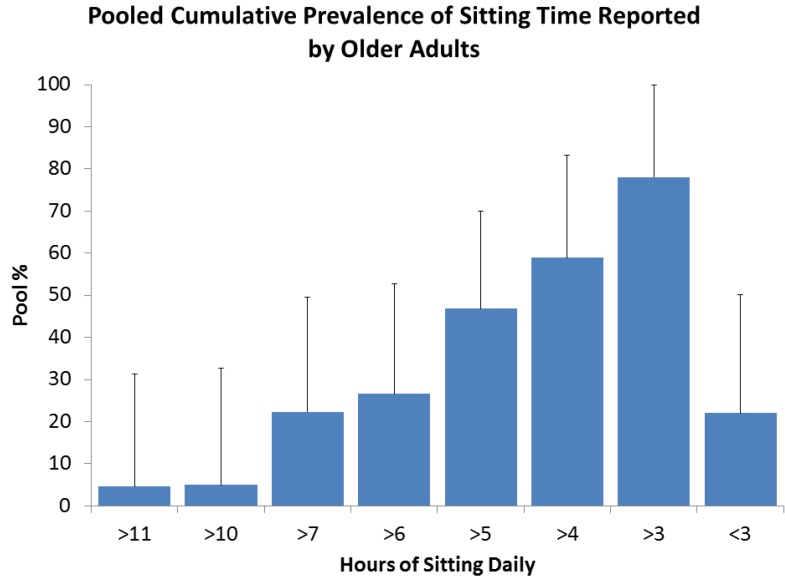
- Across seven sitting surveys (N = 372,550 older adults), meta-prevalence was 58.9% sitting >4 h/day, 26.6% >6 h/day, and 5.0% >10 h/day; 78% reported >3 h/day versus 22% <3 h/day.
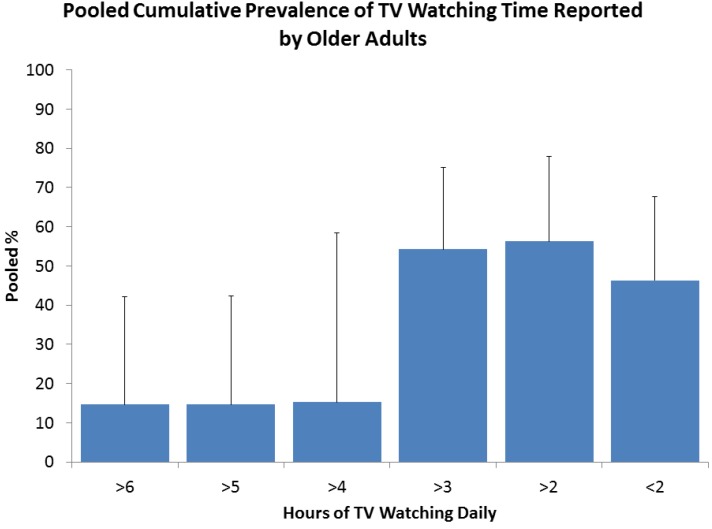
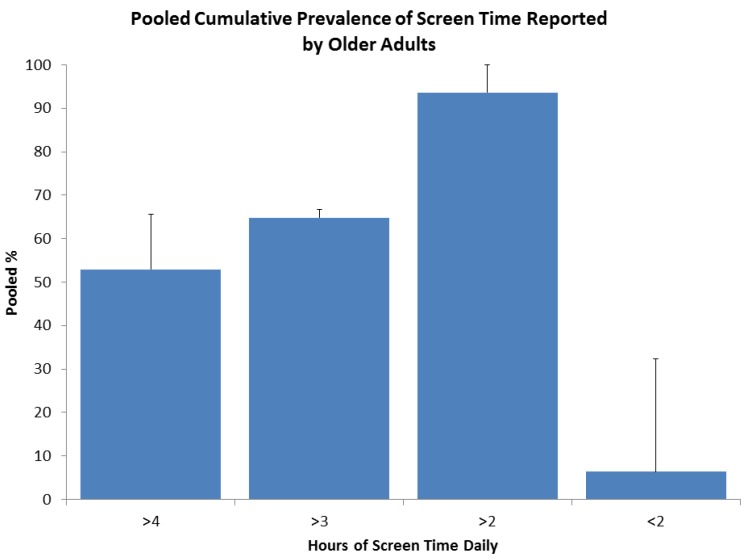
- TV viewing meta-prevalence from nine surveys (N = 275,344) was 56% >2 h/day, 54.2% >3 h/day, and 15.1% >4 h/day; screen-time meta-prevalence from three studies (N = 105,424) was 52.9% >4 h/day and 93.6% >2 h/day.
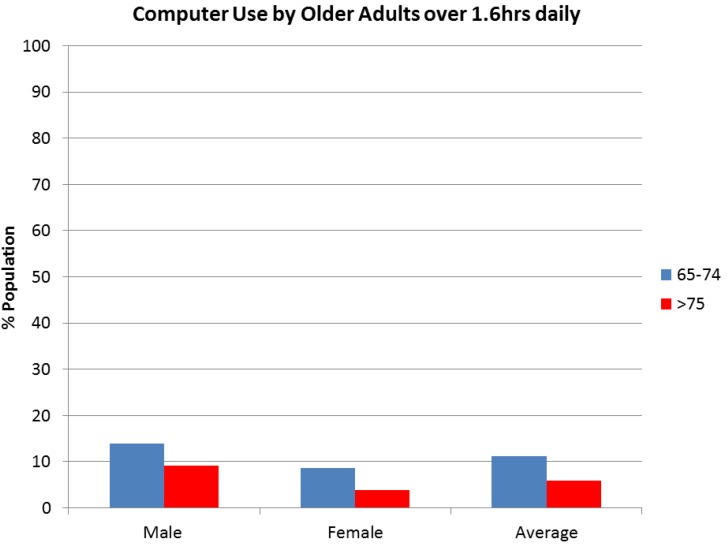
- Computer use was reported by 64.6% of UK older adults, but fewer than 10% of Canadian older adults used a computer for more than 1.6 h daily; use was higher in younger older adults and males.
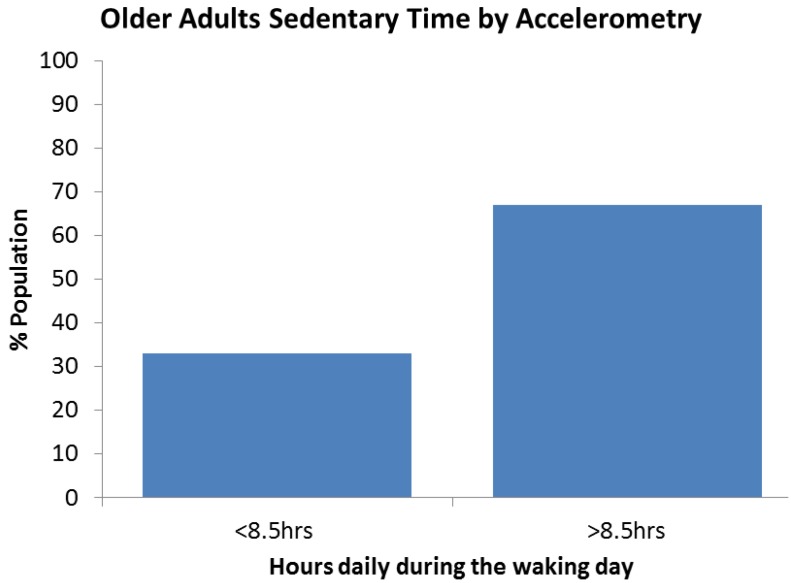
- Objective accelerometry in 649 English older adults found 67% sedentary for more than 8.5 h of the waking day, with only 33% below that threshold; gender differences were small, and sedentary time increased slightly over age 75 except for computer use.
Methods
- Systematic review with electronic searches of AMED, CINAHL, and Medline in August 2013, plus manual journal searches, reference-list checks, and author contact; inclusion required English-language scholarly papers on human adults with participants aged 60+, prevalence of sedentary behavior as a defined outcome, >200 subjects, and at least one day of recording.
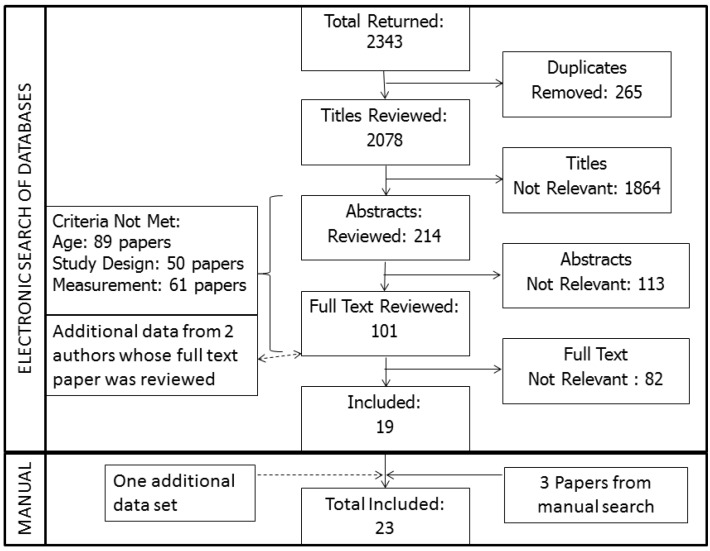
- The search returned 2,343 papers; after duplicates, 2,078 were reviewed, with 1,864 excluded by title, 113 by abstract, and 82 by full text, leaving 19 papers; additional data and manual searching yielded 23 reports from 18 surveys in seven countries, covering over 500,000 older adults.
- Data were converted to hours/day where needed, and prevalence data were pooled into meta-prevalence using the inverse variance method for sitting (7/9 surveys), TV viewing (9/10 surveys), and screen time (3 studies); computer use and accelerometry data were not pooled.
Limitations
- The paper states that inverse variance meta-prevalence has limitations for very high and very low prevalence, tending to overestimate weights for such categories, and that pooled studies used different prevalence categories, so weighting may have been underestimated for some larger time categories.
- The paper states that accelerometry data came from a single study of 649 older adults in one country and may not be generalizable; it also notes that the accelerometer measured lack of activity counts as sedentary rather than sitting, potentially including standing time.
- The paper states that self-report measures have poor accuracy and can underestimate relationships, and the text makes evident that sedentary behavior definitions were not standardized until 2012, most surveys used self-report, and specific data on the oldest old were limited.
Model-written summary. Check it against the paper before relying on it.
Integrity signals
Registry
Cites
Statistics
Figures
Verification
Claims the paper makes
46 Not checked yet · 26 Own result · 7 Own interpretation · 4 No basis given · 3 Own method · 1 Supported
Every source the paper cites for this claim was checked and supports it.
In the paper
“The largest gender difference reported by Wijndaele, et al. [16] where 3.7% more females reported levels of >3.6 h TV viewing daily.”
§ Prevalence of Sedentary Behavior in Older Adults: A Systematic Review > 3. Results > 3.4. Findings on Prevalence of Sedentary Behavior in Older Adults
What the sources say
- Supportedcites [16] Wijndaele, K., Brage, S., Besson, H., Khaw, K.-T., Sharp, S.J., Luben, R., Bhaniani, A., Wareham, N.J., and Ekelund, U. (2011). Television viewing and incident cardiovascular disease: Prospective associations and mediation analysis in the EPIC Norfolk Study. PLoS One, 6. source
Table 2 (Results, Descriptive characteristics; page unavailable) defines the highest viewing tertile as >3.6 hours/day and reports 2,437 of 7,143 women and 1,659 of 5,465 men in it. Those proportions are approximately 34.1% and 30.4%, a difference of 3.7 percentage points. “Largest” is the citing authors’ comparison, not a finding attributed to this paper. (LLM, conf=0.91)
plaincorrelational- Asserted: passes — The authors put it forward as true.
- Checkable: passes — It can be checked against evidence.
- Load-bearing: unclear — It is unclear whether the paper’s conclusions depend on it.
- Based: passes — The paper gives a reason why it holds.
- Rests on an assumption: TV viewing serves as a proxy for sedentary behavior.
- Supported
A result the paper reports from its own data — it cites no other source for it, so there is none to check. The quote shows it is in the paper.
In the paper
“Objective measurements were also captured with the use of body worn accelerometers.”
§ Prevalence of Sedentary Behavior in Older Adults: A Systematic Review > Abstract
plain- Asserted: passes — The authors put it forward as true.
- Checkable: passes — It can be checked against evidence.
- Load-bearing: unclear — It is unclear whether the paper’s conclusions depend on it.
- Based: passes — The paper gives a reason why it holds.
A result the paper reports from its own data — it cites no other source for it, so there is none to check. The quote shows it is in the paper.
In the paper
“over 55% report watching more than 2 h of TV”
§ Prevalence of Sedentary Behavior in Older Adults: A Systematic Review > Abstract
plain- Asserted: passes — The authors put it forward as true.
- Checkable: passes — It can be checked against evidence.
- Load-bearing: unclear — It is unclear whether the paper’s conclusions depend on it.
- Based: passes — The paper gives a reason why it holds.
A result the paper reports from its own data — it cites no other source for it, so there is none to check. The quote shows it is in the paper.
In the paper
“However, when measured objectively in a small survey, it was found that 67% of the older population were sedentary for more than 8.5 h daily.”
§ Prevalence of Sedentary Behavior in Older Adults: A Systematic Review > Abstract
plain- Asserted: passes — The authors put it forward as true.
- Checkable: passes — It can be checked against evidence.
- Load-bearing: unclear — It is unclear whether the paper’s conclusions depend on it.
- Based: passes — The paper gives a reason why it holds.
A result the paper reports from its own data — it cites no other source for it, so there is none to check. The quote shows it is in the paper.
In the paper
“Almost 60% of older adult’s reported sitting for more than 4 h per day”
§ Prevalence of Sedentary Behavior in Older Adults: A Systematic Review > Abstract
plain- Asserted: passes — The authors put it forward as true.
- Checkable: passes — It can be checked against evidence.
- Load-bearing: passes — The paper’s conclusions depend on it.
- Based: passes — The paper gives a reason why it holds.
A result the paper reports from its own data — it cites no other source for it, so there is none to check. The quote shows it is in the paper.
In the paper
“The majority of surveys included used self-report as a measurement of sedentary behavior.”
§ Prevalence of Sedentary Behavior in Older Adults: A Systematic Review > Abstract
plain- Asserted: passes — The authors put it forward as true.
- Checkable: passes — It can be checked against evidence.
- Load-bearing: unclear — It is unclear whether the paper’s conclusions depend on it.
- Based: passes — The paper gives a reason why it holds.
A result the paper reports from its own data — it cites no other source for it, so there is none to check. The quote shows it is in the paper.
In the paper
“65% sit in front of a screen for more than 3 h daily”
§ Prevalence of Sedentary Behavior in Older Adults: A Systematic Review > Abstract
plain- Asserted: passes — The authors put it forward as true.
- Checkable: passes — It can be checked against evidence.
- Load-bearing: unclear — It is unclear whether the paper’s conclusions depend on it.
- Based: passes — The paper gives a reason why it holds.
None of the sources cited for this claim have been checked yet.
In the paper
“It would appear there is little difference in report by gender (1.6 ± 1.6%) [3,17,18].”
§ Prevalence of Sedentary Behavior in Older Adults: A Systematic Review > 3. Results > 3.4. Findings on Prevalence of Sedentary Behavior in Older Adults
What the sources say
- Not checked yetcites [3] Dogra, S., and Stathokostas, L. (2012). Sedentary behavior and physical activity are independent predictors of successful aging in middle-aged and older adults. J. Aging Res. source
- Not checked yetcites [17] Dunstan, 2010, Television viewing time and mortality: The Australian diabetes, obesity and lifestyle study (AusDiab), Circulation source
- Not checked yetcites [18] Banks, 2011, Screen-time, obesity, ageing and disability: Findings from 91,266 participants in the 45 and up study, Public Health Nutr. source
hedged- Asserted: passes — The authors put it forward as true.
- Checkable: passes — It can be checked against evidence.
- Load-bearing: unclear — It is unclear whether the paper’s conclusions depend on it.
- Based: passes — The paper gives a reason why it holds.
A result the paper reports from its own data — it cites no other source for it, so there is none to check. The quote shows it is in the paper.
In the paper
“On average across the studies, 58.9% of older adults reported sitting for over 4 h, 26.6% reported over 6 h and 5.0% reported over 10 h per day.”
§ Prevalence of Sedentary Behavior in Older Adults: A Systematic Review > 3. Results > 3.4. Findings on Prevalence of Sedentary Behavior in Older Adults
plain- Asserted: passes — The authors put it forward as true.
- Checkable: passes — It can be checked against evidence.
- Load-bearing: passes — The paper’s conclusions depend on it.
- Based: passes — The paper gives a reason why it holds.
A result the paper reports from its own data — it cites no other source for it, so there is none to check. The quote shows it is in the paper.
In the paper
“On average across the studies, 58.9% of older adults reported sitting for over 4 h, 26.6% reported over 6 h and 5.0% reported over 10 h per day.”
§ Prevalence of Sedentary Behavior in Older Adults: A Systematic Review > 3. Results > 3.4. Findings on Prevalence of Sedentary Behavior in Older Adults
plain- Asserted: passes — The authors put it forward as true.
- Checkable: passes — It can be checked against evidence.
- Load-bearing: unclear — It is unclear whether the paper’s conclusions depend on it.
- Based: passes — The paper gives a reason why it holds.
- It may state two separate claims as one. 20
- Probably not a substantial claim. 17
A result the paper reports from its own data — it cites no other source for it, so there is none to check. The quote shows it is in the paper.
In the paper
“23 reports covered data from 18 surveys sourced from seven countries.”
- Also stated in: § 3.1. Selection Process Results · plain
“The process of the review resulted in 23 reports of prevalence of sedentary behavior in older adults as illustrated in Figure 1.”
§ Prevalence of Sedentary Behavior in Older Adults: A Systematic Review > Abstract
plain- Asserted: passes — The authors put it forward as true.
- Checkable: passes — It can be checked against evidence.
- Load-bearing: unclear — It is unclear whether the paper’s conclusions depend on it.
- Based: passes — The paper gives a reason why it holds.
It may state two separate claims as one.
- Also stated in: § 3.1. Selection Process Results · plain
A result the paper reports from its own data — it cites no other source for it, so there is none to check. The quote shows it is in the paper.
In the paper
“For TV viewing time data were pooled from 9/10 surveys.”
§ Prevalence of Sedentary Behavior in Older Adults: A Systematic Review > 2. Experimental Section > 2.3. Methods of Data Presentation
plain- Asserted: passes — The authors put it forward as true.
- Checkable: passes — It can be checked against evidence.
- Load-bearing: fails — The paper’s conclusions may not depend on it.
- Based: passes — The paper gives a reason why it holds.
Probably not a substantial claim. The paper’s conclusions may not depend on it.
The paper states this without a source or data behind it here, so there is nothing to check it against. The quote shows it is in the paper.
In the paper
“Some papers included older adults as a group within a larger scale population study; some were specifically designed to describe the behavior of the older population.”
§ Prevalence of Sedentary Behavior in Older Adults: A Systematic Review > 2. Experimental Section > 2.3. Methods of Data Presentation
plain- Asserted: passes — The authors put it forward as true.
- Checkable: passes — It can be checked against evidence.
- Load-bearing: fails — The paper’s conclusions may not depend on it.
- Based: passes — The paper gives a reason why it holds.
Probably not a substantial claim. The paper’s conclusions may not depend on it. It may state two separate claims as one.
A result the paper reports from its own data — it cites no other source for it, so there is none to check. The quote shows it is in the paper.
In the paper
“There is not a consistent definition of older adults in the included papers.”
§ Prevalence of Sedentary Behavior in Older Adults: A Systematic Review > 2. Experimental Section > 2.3. Methods of Data Presentation
plain- Asserted: passes — The authors put it forward as true.
- Checkable: passes — It can be checked against evidence.
- Load-bearing: passes — The paper’s conclusions depend on it.
- Based: passes — The paper gives a reason why it holds.
Probably not a substantial claim.
A result the paper reports from its own data — it cites no other source for it, so there is none to check. The quote shows it is in the paper.
In the paper
“For total sitting time, the data were pooled from 7/9 surveys.”
§ Prevalence of Sedentary Behavior in Older Adults: A Systematic Review > 2. Experimental Section > 2.3. Methods of Data Presentation
plain- Asserted: passes — The authors put it forward as true.
- Checkable: passes — It can be checked against evidence.
- Load-bearing: fails — The paper’s conclusions may not depend on it.
- Based: passes — The paper gives a reason why it holds.
Probably not a substantial claim. The paper’s conclusions may not depend on it.
The paper states this without a source or data behind it here, so there is nothing to check it against. The quote shows it is in the paper.
In the paper
“Over 60 years and over 65 years are the most frequently occurring definitions.”
§ Prevalence of Sedentary Behavior in Older Adults: A Systematic Review > 2. Experimental Section > 2.3. Methods of Data Presentation
plain- Asserted: passes — The authors put it forward as true.
- Checkable: passes — It can be checked against evidence.
- Load-bearing: fails — The paper’s conclusions may not depend on it.
- Based: passes — The paper gives a reason why it holds.
Probably not a substantial claim. The paper’s conclusions may not depend on it.
The paper states this without a source or data behind it here, so there is nothing to check it against. The quote shows it is in the paper.
In the paper
“In this age group there was little difference in results whether the participants’ were asked to report weekday sitting and weekend sitting.”
§ Prevalence of Sedentary Behavior in Older Adults: A Systematic Review > 2. Experimental Section > 2.3. Methods of Data Presentation
plain- Asserted: passes — The authors put it forward as true.
- Checkable: passes — It can be checked against evidence.
- Load-bearing: fails — The paper’s conclusions may not depend on it.
- Based: fails — The paper may give no reason why it holds.
Probably not a substantial claim. The paper’s conclusions may not depend on it. The paper may give no reason why it holds.
The paper states this without a source or data behind it here, so there is nothing to check it against. The quote shows it is in the paper.
In the paper
“It was noted that sedentary behavior is defined in different ways by each survey.”
- Also stated in: § 2.3. Methods of Data Presentation · plain
“Different measurement methods and categorizations were used to define sedentary behavior in the included studies.”
§ Prevalence of Sedentary Behavior in Older Adults: A Systematic Review > Abstract
plain- Asserted: passes — The authors put it forward as true.
- Checkable: passes — It can be checked against evidence.
- Load-bearing: passes — The paper’s conclusions depend on it.
- Based: passes — The paper gives a reason why it holds.
Probably not a substantial claim.
- Also stated in: § 2.3. Methods of Data Presentation · plain
A result the paper reports from its own data — it cites no other source for it, so there is none to check. The quote shows it is in the paper.
In the paper
“Figure 3 Meta-Prevalence of sitting, N = 372,550 older adults, n = 7 from six countries, note time categories of <3 h (22%) and >3 h (78%) is equal to 100%.”
§ Prevalence of Sedentary Behavior in Older Adults: A Systematic Review > 3. Results > 3.4. Findings on Prevalence of Sedentary Behavior in Older Adults
plainn = 372,550- Asserted: passes — The authors put it forward as true.
- Checkable: passes — It can be checked against evidence.
- Load-bearing: passes — The paper’s conclusions depend on it.
- Based: passes — The paper gives a reason why it holds.
It may state two separate claims as one.
A result the paper reports from its own data — it cites no other source for it, so there is none to check. The quote shows it is in the paper.
In the paper
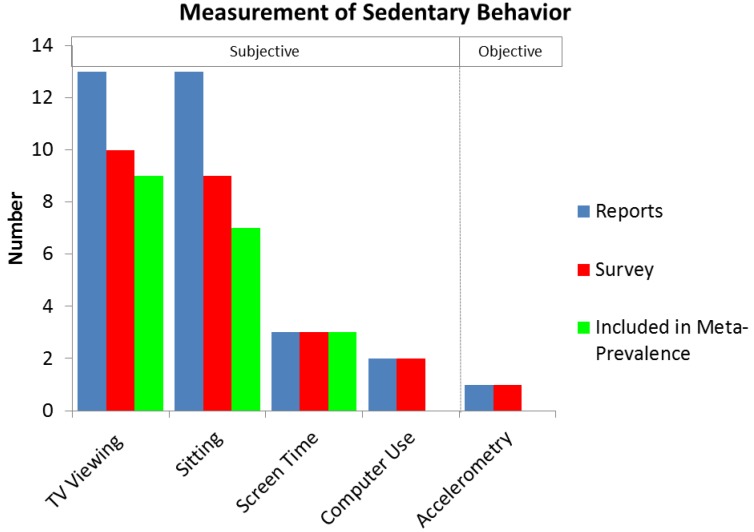
“Two surveys covered two surveys on computer use and one paper covered 1 survey on accelerometry.”
§ Prevalence of Sedentary Behavior in Older Adults: A Systematic Review > 3. Results > 3.2. Information Sources
plain- Asserted: passes — The authors put it forward as true.
- Checkable: passes — It can be checked against evidence.
- Load-bearing: fails — The paper’s conclusions may not depend on it.
- Based: passes — The paper gives a reason why it holds.
Probably not a substantial claim. The paper’s conclusions may not depend on it. It may state two separate claims as one.
A result the paper reports from its own data — it cites no other source for it, so there is none to check. The quote shows it is in the paper.
In the paper
“Screen time data was pooled from 3 studies for meta-prevalence.”
§ Prevalence of Sedentary Behavior in Older Adults: A Systematic Review > 2. Experimental Section > 2.3. Methods of Data Presentation
plain- Asserted: passes — The authors put it forward as true.
- Checkable: passes — It can be checked against evidence.
- Load-bearing: fails — The paper’s conclusions may not depend on it.
- Based: passes — The paper gives a reason why it holds.
Probably not a substantial claim. The paper’s conclusions may not depend on it.
A result the paper reports from its own data — it cites no other source for it, so there is none to check. The quote shows it is in the paper.
In the paper
“The title review excluded 1,864 papers, the abstract review excluded 113 and the full text excluded 82, leaving 19 papers to be included for the study.”
§ Prevalence of Sedentary Behavior in Older Adults: A Systematic Review > 3. Results > 3.1. Selection Process Results
plain- Asserted: passes — The authors put it forward as true.
- Checkable: passes — It can be checked against evidence.
- Load-bearing: fails — The paper’s conclusions may not depend on it.
- Based: passes — The paper gives a reason why it holds.
Probably not a substantial claim. The paper’s conclusions may not depend on it. It may state two separate claims as one.
A result the paper reports from its own data — it cites no other source for it, so there is none to check. The quote shows it is in the paper.
In the paper
“There was not sufficient data to carry out inverse variance on computer use or sedentary time by accelerometry, so they are presented and described as per the papers.”
§ Prevalence of Sedentary Behavior in Older Adults: A Systematic Review > 2. Experimental Section > 2.3. Methods of Data Presentation
plain- Asserted: passes — The authors put it forward as true.
- Checkable: passes — It can be checked against evidence.
- Load-bearing: fails — The paper’s conclusions may not depend on it.
- Based: passes — The paper gives a reason why it holds.
Probably not a substantial claim. The paper’s conclusions may not depend on it.
None of the sources cited for this claim have been checked yet.
In the paper
“On average 61.5% females reported more than 4 h of sitting compared to males at 63.5% [3,17,18].”
§ Prevalence of Sedentary Behavior in Older Adults: A Systematic Review > 3. Results > 3.4. Findings on Prevalence of Sedentary Behavior in Older Adults
What the sources say
- Not checked yetcites [3] Dogra, S., and Stathokostas, L. (2012). Sedentary behavior and physical activity are independent predictors of successful aging in middle-aged and older adults. J. Aging Res. source
- Not checked yetcites [17] Dunstan, 2010, Television viewing time and mortality: The Australian diabetes, obesity and lifestyle study (AusDiab), Circulation source
- Not checked yetcites [18] Banks, 2011, Screen-time, obesity, ageing and disability: Findings from 91,266 participants in the 45 and up study, Public Health Nutr. source
plain- Asserted: passes — The authors put it forward as true.
- Checkable: passes — It can be checked against evidence.
- Load-bearing: unclear — It is unclear whether the paper’s conclusions depend on it.
- Based: passes — The paper gives a reason why it holds.
It may state two separate claims as one.
A result the paper reports from its own data — it cites no other source for it, so there is none to check. The quote shows it is in the paper.
In the paper
“The electronic search returned a total of 2,343 papers (Medline: 732; AMED: 722; CINAHL: 888).”
§ Prevalence of Sedentary Behavior in Older Adults: A Systematic Review > 3. Results > 3.1. Selection Process Results
plain- Asserted: passes — The authors put it forward as true.
- Checkable: passes — It can be checked against evidence.
- Load-bearing: fails — The paper’s conclusions may not depend on it.
- Based: passes — The paper gives a reason why it holds.
Probably not a substantial claim. The paper’s conclusions may not depend on it.
A result the paper reports from its own data — it cites no other source for it, so there is none to check. The quote shows it is in the paper.
In the paper
“With TV viewing 13 papers, covering 10 surveys, nine of which were included in the meta-prevalence.”
§ Prevalence of Sedentary Behavior in Older Adults: A Systematic Review > 3. Results > 3.2. Information Sources
plain- Asserted: passes — The authors put it forward as true.
- Checkable: passes — It can be checked against evidence.
- Load-bearing: unclear — It is unclear whether the paper’s conclusions depend on it.
- Based: passes — The paper gives a reason why it holds.
It may state two separate claims as one.
A result the paper reports from its own data — it cites no other source for it, so there is none to check. The quote shows it is in the paper.
In the paper
“As can be seen from Figure 2, there were 13 papers on sitting, covering nine surveys with seven studies used for the meta-prevalence.”
§ Prevalence of Sedentary Behavior in Older Adults: A Systematic Review > 3. Results > 3.2. Information Sources
plain- Asserted: passes — The authors put it forward as true.
- Checkable: passes — It can be checked against evidence.
- Load-bearing: unclear — It is unclear whether the paper’s conclusions depend on it.
- Based: passes — The paper gives a reason why it holds.
It may state two separate claims as one.
A result the paper reports from its own data — it cites no other source for it, so there is none to check. The quote shows it is in the paper.
In the paper
“After removal of duplicated papers, 2,078 papers were reviewed.”
§ Prevalence of Sedentary Behavior in Older Adults: A Systematic Review > 3. Results > 3.1. Selection Process Results
plain- Asserted: passes — The authors put it forward as true.
- Checkable: passes — It can be checked against evidence.
- Load-bearing: fails — The paper’s conclusions may not depend on it.
- Based: passes — The paper gives a reason why it holds.
Probably not a substantial claim. The paper’s conclusions may not depend on it.
A result the paper reports from its own data — it cites no other source for it, so there is none to check. The quote shows it is in the paper.
In the paper
“Three papers covered three studies, all of which were included in the meta-prevalence for screen time.”
§ Prevalence of Sedentary Behavior in Older Adults: A Systematic Review > 3. Results > 3.2. Information Sources
plain- Asserted: passes — The authors put it forward as true.
- Checkable: passes — It can be checked against evidence.
- Load-bearing: fails — The paper’s conclusions may not depend on it.
- Based: passes — The paper gives a reason why it holds.
Probably not a substantial claim. The paper’s conclusions may not depend on it. It may state two separate claims as one.
In the paper
“This method had been used in several papers and shown to have good reliability as a criterion measure [13].”
§ Prevalence of Sedentary Behavior in Older Adults: A Systematic Review > 2. Experimental Section > 2.3. Methods of Data Presentation
What the sources say
- Not checked yetcites [13] Salmon, 2003, Physical activity and sedentary behavior: A population-based study of barriers, enjoyment, and preference, Health Psychol. source
plain- Asserted: passes — The authors put it forward as true.
- Checkable: passes — It can be checked against evidence.
- Load-bearing: passes — The paper’s conclusions depend on it.
- Based: passes — The paper gives a reason why it holds.
It may state two separate claims as one.
None of the sources cited for this claim have been checked yet.
In the paper
“Recently, an emergence of research in sedentary behavior (SB) has indicated that SB is an independent health risk factor, separate to lack of PA, associated with successful aging, morbidity and mortality [2,3,4].”
- Also stated in: § Abstract · plain
“Sedentary behavior is a risk factor for health independent to inactivity.”
§ Prevalence of Sedentary Behavior in Older Adults: A Systematic Review > 1. Introduction
What the sources say
- Not checked yetcites [2] Katzmarzyk, 2010, Physical activity, sedentary behavior, and health: Paradigm paralysis or paradigm shift?, Diabetes source
- Not checked yetcites [3] Dogra, S., and Stathokostas, L. (2012). Sedentary behavior and physical activity are independent predictors of successful aging in middle-aged and older adults. J. Aging Res. source
- Not checked yetcites [4] Thorp, 2011, Sedentary behaviors and subsequent health outcomes in adults, Am. J. Prev. Med. source
plaincorrelational- Asserted: passes — The authors put it forward as true.
- Checkable: passes — It can be checked against evidence.
- Load-bearing: passes — The paper’s conclusions depend on it.
- Based: passes — The paper gives a reason why it holds.
It may state two separate claims as one.
- Also stated in: § Abstract · plain
What the paper did — it cites no source for this, so there is none to check. The quote shows it is in the paper.
In the paper
“Where conflicting opinions arose with regard to the inclusion decision the paper was included to the next phase for further consideration and excluded when there was agreement on the inclusion of said paper.”
§ Prevalence of Sedentary Behavior in Older Adults: A Systematic Review > 2. Experimental Section > 2.2. Inclusion and Exclusion Criteria
plaindirect- Asserted: passes — The authors put it forward as true.
- Checkable: passes — It can be checked against evidence.
- Load-bearing: fails — The paper’s conclusions may not depend on it.
- Based: passes — The paper gives a reason why it holds.
Probably not a substantial claim. The paper’s conclusions may not depend on it. It may state two separate claims as one.
What the paper did — it cites no source for this, so there is none to check. The quote shows it is in the paper.
In the paper
“The papers were reviewed by three independent researchers using inclusion and exclusion criteria (Table 1).”
§ Prevalence of Sedentary Behavior in Older Adults: A Systematic Review > 2. Experimental Section > 2.2. Inclusion and Exclusion Criteria
plain- Asserted: passes — The authors put it forward as true.
- Checkable: passes — It can be checked against evidence.
- Load-bearing: fails — The paper’s conclusions may not depend on it.
- Based: passes — The paper gives a reason why it holds.
Probably not a substantial claim. The paper’s conclusions may not depend on it.
In the paper
“The accelerometer employed in this case measures lack of counts of activity as sedentary, rather than sitting, thus there could potentially be some standing time included in this sedentary data.”
§ Prevalence of Sedentary Behavior in Older Adults: A Systematic Review > 4. Discussion > 4.3. Measurement of Sedentary Behavior in Surveys
What the sources say
- Not checked yetcites [27] Stamatakis, 2012, Associations between multiple indicators of objectively-measured and self-reported sedentary behaviour and cardiometabolic risk in older adults, Prev. Med. source
hedgedconditional- Asserted: passes — The authors put it forward as true.
- Checkable: passes — It can be checked against evidence.
- Load-bearing: unclear — It is unclear whether the paper’s conclusions depend on it.
- Based: passes — The paper gives a reason why it holds.
It may state two separate claims as one.
In the paper
“The accelerometry data for older adults was based on a study of 649 and a single country, therefore perhaps not generalizable to the population.”
§ Prevalence of Sedentary Behavior in Older Adults: A Systematic Review > 4. Discussion > 4.4. Limitations
What the sources say
- Not checked yetcites [27] Stamatakis, 2012, Associations between multiple indicators of objectively-measured and self-reported sedentary behaviour and cardiometabolic risk in older adults, Prev. Med. source
hedgedconditional- Asserted: passes — The authors put it forward as true.
- Checkable: passes — It can be checked against evidence.
- Load-bearing: unclear — It is unclear whether the paper’s conclusions depend on it.
- Based: passes — The paper gives a reason why it holds.
It may state two separate claims as one.
In the paper
“Younger older adults use computers more than those over 74 years and the activity is more favored by males.”
§ Prevalence of Sedentary Behavior in Older Adults: A Systematic Review > 3. Results > 3.4. Findings on Prevalence of Sedentary Behavior in Older Adults
What the sources say
- Not checked yetcites [21] Shields, 2008, Screen time among Canadian adults: A profile, Health Rep.
plaincorrelationaln = 6,742- Asserted: passes — The authors put it forward as true.
- Checkable: passes — It can be checked against evidence.
- Load-bearing: unclear — It is unclear whether the paper’s conclusions depend on it.
- Based: passes — The paper gives a reason why it holds.
It may state two separate claims as one.
None of the sources cited for this claim have been checked yet.
In the paper
“Those individuals who are less sedentary tend to age more successfully and report better quality of life [3,25].”
§ Prevalence of Sedentary Behavior in Older Adults: A Systematic Review > 4. Discussion > 4.2. Relevance of Sedentary Behavior in Older Adults
What the sources say
- Not checked yetcites [3] Dogra, S., and Stathokostas, L. (2012). Sedentary behavior and physical activity are independent predictors of successful aging in middle-aged and older adults. J. Aging Res. source
- Not checked yetcites [25] Balboa-Castillo, T., León-Muñoz, L.M., Graciani, A., Rodríguez-Artalejo, F., and Guallar-Castillón, P. (2011). Longitudinal association of physical activity and sedentary behavior during leisure time with health-related quality of life in community-dwelling older adults. Health Qual. Life Outcomes, 9. source
hedgedcorrelational- Asserted: passes — The authors put it forward as true.
- Checkable: passes — It can be checked against evidence.
- Load-bearing: unclear — It is unclear whether the paper’s conclusions depend on it.
- Based: passes — The paper gives a reason why it holds.
It may state two separate claims as one.
In the paper
“TV viewing is also associated with other unhealthy habits such as consumption of unhealthy food and drinks or the influence of adverting to encourage these behaviors, therefore may also be a confounding factor with negative health effects of sitting [36].”
§ Prevalence of Sedentary Behavior in Older Adults: A Systematic Review > 4. Discussion > 4.2. Relevance of Sedentary Behavior in Older Adults
What the sources say
- Not checked yetcites [36] Stamatakis, 2012, Sedentary time in relation to cardio-metabolic risk factors: Differential association for self-report vs. accelerometry in working age adults, Int. J. Epidemiol. source
hedgedcorrelational- Asserted: passes — The authors put it forward as true.
- Checkable: passes — It can be checked against evidence.
- Load-bearing: unclear — It is unclear whether the paper’s conclusions depend on it.
- Based: passes — The paper gives a reason why it holds.
It may state two separate claims as one.
None of the sources cited for this claim have been checked yet.
In the paper
“However, association between sitting time and invasive breast cancer risk and risk of renal cell carcinoma has been specifically examined and significant independent association was not shown, although a weak correlation could not be ruled out [31,32].”
§ Prevalence of Sedentary Behavior in Older Adults: A Systematic Review > 4. Discussion > 4.2. Relevance of Sedentary Behavior in Older Adults
What the sources say
- Not checked yetcites [31] George, 2010, Beyond recreational physical activity: Examining occupational and household activity, transportation activity, and sedentary behavior in relation to postmenopausal breast cancer risk, Am. J. Public Health source
- Not checked yetcites [32] George, 2011, A prospective analysis of prolonged sitting time and risk of renal cell carcinoma among 300,000 older adults, Ann. Epidemiol. source
hedged- Asserted: passes — The authors put it forward as true.
- Checkable: passes — It can be checked against evidence.
- Load-bearing: unclear — It is unclear whether the paper’s conclusions depend on it.
- Based: passes — The paper gives a reason why it holds.
It may state two separate claims as one.
What the paper did — it cites no source for this, so there is none to check. The quote shows it is in the paper.
In the paper
“In addition, the studies pooled had different categories of prevalence and while we only considered non overlapping categories it is possible that weighting might have been underestimated for some studies evaluating prevalence of larger categories of time.”
§ Prevalence of Sedentary Behavior in Older Adults: A Systematic Review > 4. Discussion > 4.4. Limitations
hedgedconditional- Asserted: passes — The authors put it forward as true.
- Checkable: passes — It can be checked against evidence.
- Load-bearing: fails — The paper’s conclusions may not depend on it.
- Based: passes — The paper gives a reason why it holds.
Probably not a substantial claim. The paper’s conclusions may not depend on it.
In the paper
“Self-report measures are known to have poor accuracy and lead to an underestimation of the strength of the relationship [37].”
§ Prevalence of Sedentary Behavior in Older Adults: A Systematic Review > 4. Discussion > 4.3. Measurement of Sedentary Behavior in Surveys
What the sources say
- Not checked yetcites [37] Celis-Morales, C.A., Perez-Bravo, F., Ibńez, L., Salas, C., Bailey, M.E.S., and Gill, J.M.R. (2012). Objective vs. self-report physical activity and sedentary time: Effects of measurement method on relationship with risk biomarkers. PLoS One, 7. source
boosteddirect- Asserted: passes — The authors put it forward as true.
- Checkable: passes — It can be checked against evidence.
- Load-bearing: unclear — It is unclear whether the paper’s conclusions depend on it.
- Based: passes — The paper gives a reason why it holds.
It may state two separate claims as one.
A conclusion the paper draws from its own results — it cites no other source for it, so there is none to check. The quote shows it is in the paper.
In the paper
“Both screen time and TV time can be used as proxy measurements of sedentary behavior.”
§ Prevalence of Sedentary Behavior in Older Adults: A Systematic Review > 4. Discussion > 4.1. Summary of Findings
plaincorrelational- Asserted: passes — The authors put it forward as true.
- Checkable: passes — It can be checked against evidence.
- Load-bearing: passes — The paper’s conclusions depend on it.
- Based: passes — The paper gives a reason why it holds.
It may state two separate claims as one.
The paper relies on this without support.
There are no published systematic reviews on the prevalence of sedentary behavior objectively measured in, or subjectively reported by, older adults.
“Currently, there are no published systematic reviews on the prevalence of sedentary behavior objectively measured in, or subjectively reported by, older adults.”
The paper relies on this without support.
TV viewing serves as a proxy for sedentary behavior.
“TV viewing serves as a proxy for sedentary behavior, Figure 4 shows the meta-prevalence of TV viewing reported by older adults.”
Claims other papers make about this one
Each is checked against this paper’s own text: does it say what the citing paper says it does?
In the citing paper
“exercise participation among older adults is low and in a number of older adults may be precluded or limited due to age-related co-morbidities, as well as social and environmental barriers [136–140].”
From Targeting Intramyocellular Lipids to Improve Aging Muscle Function (2025) · cites this paper as [138]
Citations
Cites
The Physical Activity Guidelines for Americans
Piercy, K. L., Troiano, R. P., Ballard, R. M., Carlson, S. A., Fulton, J. E., Galuska, D. A., George, S. M., & Olson, R. D. (2018) · JAMA · doi:10.1001/jama.2018.14854 · Cited by 9,755
Global physical activity levels: surveillance progress, pitfalls, and prospects
Hallal, P. C., Andersen, L. B., Bull, F. C., Guthold, R., Haskell, W., & Ekelund, U. (2012) · The Lancet · doi:10.1016/s0140-6736(12)60646-1 · Cited by 5,711 · cited 1×
“It is well known that physical activity (PA) is an influencing factor for healthy aging and lack of PA has been associated with chronic disease [1].”
BackgroundBarendregt, J. J., Doi, S. A., Lee, Y. Y., Norman, R. E., & Vos, T. (2013) · Journal of Epidemiology and Community Health · doi:10.1136/jech-2013-203104 · Cited by 2,169 · cited 1×
“Studies with low and high prevalence in a category tend to be given an overestimated weight [39].”
BackgroundLetter to the Editor: Standardized use of the terms “sedentary” and “sedentary behaviours”
Networ, S. B. R. (2012) · Applied Physiology, Nutrition, and Metabolism · doi:10.1139/h2012-024 · Cited by 1,873
Sitting time and mortality from all causes, cardiovascular disease, and cancer
KATZMARZYK, P. T., CHURCH, T. S., CRAIG, C. L., & BOUCHARD, C. (2009) · Medicine & Science in Sports & Exercise · doi:10.1249/mss.0b013e3181930355 · Cited by 1,611 · cited 5×
“Katzmarzyk et al. (2009) [14] 3,375 > 60 years/17,013 > 18 years Age and % men not known Data: Daily sitting in 5 time categories.”
BackgroundMethodInfluentialSedentary Behaviors and Subsequent Health Outcomes in Adults
Thorp, A. A., Owen, N., Neuhaus, M., & Dunstan, D. W. (2011) · American Journal of Preventive Medicine · doi:10.1016/j.amepre.2011.05.004 · Cited by 1,455
Evidence-based intervention in physical activity: lessons from around the world
Heath, G. W., Parra, D. C., Sarmiento, O. L., Andersen, L. B., Owen, N., Goenka, S., Montes, F., & Brownson, R. C. (2012) · The Lancet · doi:10.1016/s0140-6736(12)60816-2 · Cited by 1,199 · cited 1×
“Generally, the older adult section of society is underserved in physical activity and sedentary behavior research [6].”
BackgroundSalmon, J., Owen, N., Crawford, D., Bauman, A., & Sallis, J. F. (2003) · Health Psychology · doi:10.1037/0278-6133.22.2.178 · Cited by 915 · cited 1×
“This method had been used in several papers and shown to have good reliability as a criterion measure [13].”
MethodSitting time and all-cause mortality risk in 222,497 Australian adults
van der Ploeg, H. P. (2012) · Archives of Internal Medicine · doi:10.1001/archinternmed.2011.2174 · Cited by 884 · cited 4×
“(2012) [20] 80,547 > 65 years/222,497 > 45 years Age Groups: 65–74 years, >75 years; ♂ 47.”
BackgroundInfluentialDunstan, D. W., Barr, E. L. M., Healy, G. N., Salmon, J., Shaw, J. E., Balkau, B., Magliano, D. J., Cameron, A. J., Zimmet, P. Z., & Owen, N. (2010) · Circulation · doi:10.1161/circulationaha.109.894824 · Cited by 825 · cited 9×
“Two included authors (Dunstan [17] and Banks [18]) provided further data sets to support their paper.”
BackgroundInfluentialAmount of time spent in sedentary behaviors and cause-specific mortality in US adults
Matthews, C. E., George, S. M., Moore, S. C., Bowles, H. R., Blair, A., Park, Y., Troiano, R. P., Hollenbeck, A., & Schatzkin, A. (2012) · The American Journal of Clinical Nutrition · doi:10.3945/ajcn.111.019620 · Cited by 655 · cited 10×
“The identified papers came mostly from developed countries: Australia (4); Canada (3); Japan (2); Norway (1); Spain (2); UK (4); USA (7), and covered information from 18 surveys and reported sedentary behavior of over 500,000 older adults.”
BackgroundInfluentialOfficer, C. M. (2013) · Cited by 624
Leisure time spent sitting in relation to total mortality in a prospective cohort of US adults
Patel, A. V., Bernstein, L., Deka, A., Feigelson, H. S., Campbell, P. T., Gapstur, S. M., Colditz, G. A., & Thun, M. J. (2010) · American Journal of Epidemiology · doi:10.1093/aje/kwq155 · Cited by 604
Celis-Morales, C. A., Perez-Bravo, F., Ibañez, L., Salas, C., Bailey, M. E. S., & Gill, J. M. R. (2012) · PLoS ONE · doi:10.1371/journal.pone.0036345 · Cited by 486 · cited 1×
“Self-report measures are known to have poor accuracy and lead to an underestimation of the strength of the relationship [37].”
BackgroundPhysical activity, sedentary behavior, and health: Paradigm paralysis or paradigm shift?
Katzmarzyk, P. T. (2010) · Diabetes · doi:10.2337/db10-0822 · Cited by 365
Balboa-Castillo, T., León-Muñoz, L. M., Graciani, A., Rodríguez-Artalejo, F., & Guallar-Castillón, P. (2011) · Health and Quality of Life Outcomes · doi:10.1186/1477-7525-9-47 · Cited by 325 · cited 7×
“Those individuals who are less sedentary tend to age more successfully and report better quality of life [3,25].”
BackgroundInfluentialSalmon, J., Bauman, A., Crawford, D., Timperio, A., & Owen, N. (2000) · International Journal of Obesity · doi:10.1038/sj.ijo.0801203 · Cited by 297 · cited 10×
“** English Longitudinal Study of Ageing (ELSA) (2008–2009) Face To Face Interview: Ordinary week (weekday summed, weekend days summed)/7; TV. Asked if they use a computer for internet or e-mails.”
BackgroundInfluentialDogra, S., & Stathokostas, L. (2012) · Journal of Aging Research · doi:10.1155/2012/190654 · Cited by 252 · cited 8×
“Those individuals who are less sedentary tend to age more successfully and report better quality of life [3,25].”
BackgroundInfluentialSharp, C., & Rutherford, L. (2014) · SAGE Publications Ltd eBooks · doi:10.4135/978144627305013501440 · Cited by 215
Bowman, S. (2006) · Europe PMC (PubMed Central) · Cited by 190
Winterfeld, A. (2009) · PubMed · Cited by 189
Stamatakis, E., Davis, M., Stathi, A., & Hamer, M. (2012) · Preventive Medicine · doi:10.1016/j.ypmed.2011.10.009 · Cited by 183 · cited 12×
“The identified papers came mostly from developed countries: Australia (4); Canada (3); Japan (2); Norway (1); Spain (2); UK (4); USA (7), and covered information from 18 surveys and reported sedentary behavior of over 500,000 older adults.”
BackgroundMethodInfluentialChau, J. Y., Grunseit, A., Midthjell, K., Holmen, J., Holmen, T. L., Bauman, A. E., & Van der Ploeg, H. P. (2015) · British Journal of Sports Medicine · doi:10.1136/bjsports-2012-091974 · Cited by 173 · cited 7×
“The identified papers came mostly from developed countries: Australia (4); Canada (3); Japan (2); Norway (1); Spain (2); UK (4); USA (7), and covered information from 18 surveys and reported sedentary behavior of over 500,000 older adults.”
BackgroundInfluentialThe Scottish Health Survey 2003
Bromley, C., Sproston, K. A., & Shelton, N. J. (2005) · Cited by 137
Relationship of Television Time with Accelerometer-Derived Sedentary Time: NHANES
CLARK, B. K., HEALY, G. N., WINKLER, E. A. H., GARDINER, P. A., SUGIYAMA, T., DUNSTAN, D. W., MATTHEWS, C. E., & OWEN, N. (2011) · Medicine & Science in Sports & Exercise · doi:10.1249/mss.0b013e3182019510 · Cited by 136 · cited 3×
“* National Health and Nutrition Examination Survey (NHANES) (2003–2004, 2005–2006) Interview: Last 30 day; Daily; TV. Clark et al. (2011) [34] 2,303 > 60 years/5,738 Age: 70.9 years; % male unknown for OA Data: Daily TV given in 1 time category.”
BackgroundInfluentialHamer, M., & Stamatakis, E. (2013) · PLoS ONE · doi:10.1371/journal.pone.0066222 · Cited by 132 · cited 9×
“These results are reported for a total population of 275,344 older adults, representing nine surveys combining data from Australia, Canada, Japan, Norway, USA and UK [17,19,21,23,24,29,30,33,34].”
BackgroundInfluentialStamatakis, E., Hamer, M., Tilling, K., & Lawlor, D. A. (2012) · International Journal of Epidemiology · doi:10.1093/ije/dys077 · Cited by 128 · cited 3×
“* Health Survey England (HSE) (2008) Self-Completing: last 4 weeks; frequency and duration; TV sitting and non-TV sitting; Accelerometry: 7 days with at least one valid day, <100 counts = SB. Stamatakis et al. (2012) [27] 2,765 > 60 years with 649 accelerometry Aged: 73.2 years; ♂ 45.4% (44.9% in accelerometry group)…”
BackgroundInfluentialInoue, S., Sugiyama, T., Takamiya, T., Oka, K., Owen, N., & Shimomitsu, T. (2012) · Journal of Epidemiology · doi:10.2188/jea.je20110054 · Cited by 128 · cited 2×
“TV viewing has also been well correlated with negative health outcomes, such as cardiovascular disease, mortality and being overweight or obese [16,19,22,30].”
BackgroundWijndaele, K., Brage, S., Besson, H., Khaw, K.-T., Sharp, S. J., Luben, R., Bhaniani, A., Wareham, N. J., & Ekelund, U. (2011) · PLoS ONE · doi:10.1371/journal.pone.0020058 · Cited by 117 · cited 2×
“[16] was excluded due to reporting scale used and is presented separately.”
BackgroundMethodContinued sedentariness, change in sitting time, and mortality in older adults
LEÓN-MUÑOZ, L. M., MARTÍNEZ-GÓMEZ, D., BALBOA-CASTILLO, T., LÓPEZ-GARCÍA, E., GUALLAR-CASTILLÓN, P., & RODRÍGUEZ-ARTALEJO, F. (2013) · Medicine & Science in Sports & Exercise · doi:10.1249/mss.0b013e3182897e87 · Cited by 110 · cited 2×
“León-Muńoz et al. (2013) [26] 2,635 > 60 years Aged: 71.3 years; ♂ 43.6% Data: Sedentariness over time between 2001 and 2003 in 4 categories.”
BackgroundInfluentialBanks, E., Jorm, L., Rogers, K., Clements, M., & Bauman, A. (2011) · Public Health Nutrition · doi:10.1017/s1368980010000674 · Cited by 98 · cited 12×
“6% reported screen time of over 2 h [18,28,35].”
BackgroundInfluentialLead, mercury and cadmium levels in Canadians.
Wong, S. L., & Lye, E. (2008) · PubMed · Cited by 96
Sedentary behaviour and obesity: review of the current scientific evidence
Biddle, S., Cavill, N., Ekelund, U., Gorely, T., Griffiths, M. D., Jago, R., Oppert, J., Raats, M. M., Salmon, J., Stratton, G., et al. (2010) · Nottingham Trent University's Institutional Repository (Nottingham Trent Repository) · Cited by 95
George, S. M., Irwin, M. L., Matthews, C. E., Mayne, S. T., Gail, M. H., Moore, S. C., Albanes, D., Ballard-Barbash, R., Hollenbeck, A. R., Schatzkin, A., et al. (2010) · American Journal of Public Health · doi:10.2105/ajph.2009.180828 · Cited by 85 · cited 4×
“In addition, George et al. (2010) [29] reports—Activity in a routine day, with one sedentary response of “sitting all day”.”
BackgroundInfluentialCorrelates of prolonged television viewing time in older Japanese men and women
Kikuchi, H., Inoue, S., Sugiyama, T., Owen, N., Oka, K., & Shimomitsu, T. (2013) · BMC Public Health · doi:10.1186/1471-2458-13-213 · Cited by 76 · cited 10×
“** English Longitudinal Study of Ageing (ELSA) (2008–2009) Face To Face Interview: Ordinary week (weekday summed, weekend days summed)/7; TV. Asked if they use a computer for internet or e-mails.”
BackgroundInfluentialScreen time among Canadian adults: a profile.
Shields, M. E., & Tremblay, M. S. (2008) · PubMed · Cited by 73
van Uffelen, J. G. Z., Heesch, K. C., Hill, R. L., & Brown, W. J. (2011) · BMC Public Health · doi:10.1186/1471-2458-11-458 · Cited by 60 · cited 1×
“The accuracy of older adults self-reporting sitting time may be more accurate if researchers clarify the sitting domains, ie provide examples relevant to older adults and suggest strategies for formulating responses [38].”
BackgroundFord, E. S. (2012) · BMC Public Health · doi:10.1186/1471-2458-12-70 · Cited by 36 · cited 3×
“Ford (2012) [35] 542 deceased at follow up in 2006 Age: 66.”
BackgroundInfluentialGeorge, S. M., Moore, S. C., Chow, W.-H., Schatzkin, A., Hollenbeck, A. R., & Matthews, C. E. (2011) · Annals of Epidemiology · doi:10.1016/j.annepidem.2011.04.012 · Cited by 28 · cited 3×
“(2011) [32] 1,206 > 50 years Aged: 63 years; ♂ 75.”
BackgroundInfluentialSitting Time and All-Cause Mortality Risk
Peterson, M. D., Sarma, A. V., & Gordon, P. M. (2012) · Archives of Internal Medicine · doi:10.1001/archinternmed.2012.2527 · Cited by 27
Cited by
Sorted by citations
Young, D. R., Hivert, M.-F., Alhassan, S., Camhi, S. M., Ferguson, J. F., Katzmarzyk, P. T., Lewis, C. E., Owen, N., Perry, C. K., Siddique, J., et al. (2016) · Circulation · doi:10.1161/cir.0000000000000440 · Cited by 791
Mercer, K., Giangregorio, L., Schneider, E., Chilana, P., Li, M., & Grindrod, K. (2016) · JMIR mHealth and uHealth · doi:10.2196/mhealth.4225 · Cited by 419
“Physical activity levels often decline with age and over two thirds of adults over the age of 60 sit for more than 8.5 hours of their waking day [1].”
InfluentialMeta‐analysis of the relationship between breaks in sedentary behavior and cardiometabolic health
Chastin, S. F. M., Egerton, T., Leask, C., & Stamatakis, E. (2015) · Obesity · doi:10.1002/oby.21180 · Cited by 363
“National surveys show that on average adults spend 6-10 h sitting each day (2,3).”
BackgroundMethodSelf-citationInterventions with potential to reduce sedentary time in adults: systematic review and meta-analysis
Martin, A., Fitzsimons, C., Jepson, R., Saunders, D. H., van der Ploeg, H. P., Teixeira, P. J., Gray, C. M., & Mutrie, N. (2015) · British Journal of Sports Medicine · doi:10.1136/bjsports-2014-094524 · Cited by 326
“24”
Behavior Change Techniques Present in Wearable Activity Trackers: A Critical Analysis
Mercer, K., Li, M., Giangregorio, L., Burns, C., & Grindrod, K. (2016) · JMIR mHealth and uHealth · doi:10.2196/mhealth.4461 · Cited by 304
“For example, children who watch more than 2 hours of television a day have poorer body composition, physical fitness, self-esteem, prosocial behavior, and academic achievement [7].”
Metadata
- Authors
- Harvey, J., Chastin, S., & Skelton, D.
- Affiliations
- Glasgow Caledonian University (GB)
- Corresponding author
- Harvey, Juliet
- Venue
- International Journal of Environmental Research and Public Health
- Publisher
- MDPI AG
- Published
- 2013-12-02
- Volume
- 10
- Issue
- 12
- Pages
- 6645-6661
- ISSN
- 1660-4601 (ISSN-L)
- PMC
- PMC3881132
- OpenAlex
- W2006256354
- Cited by
- 418
- References
- 43
- Citations by year
- 2026: 15 · 2025: 35 · 2024: 44 · 2023: 40 · 2022: 42 · 2021: 54 · 2020: 40 · 2019: 41 · 2018: 31 · 2017: 29 · 2016: 24 · 2015: 15 · 2014: 8
- FWCI
- 1.72
- Type
- journal article
- Language
- en
- Open access
- gold
- doi.org
- Licence
- Locations
- International Journal of Environmental Research and Public Health (publishedVersion, cc-by)
- Europe PMC (PubMed Central) (publishedVersion, cc-by)
- PubMed Central (publishedVersion, cc-by)
- PubMed (publishedVersion)
- RePEc: Research Papers in Economics (submittedVersion)
- DOAJ (DOAJ: Directory of Open Access Journals) (submittedVersion)
- ResearchOnline (Glasgow Caledonian University) (submittedVersion, cc-by-nc-sa)
- Topics
- Health Sciences › Medicine › Public Health, Environmental and Occupational Health › Physical Activity and Health
- Physical Sciences › Computer Science › Computer Vision and Pattern Recognition › Context-Aware Activity Recognition Systems
- Health Sciences › Medicine › Public Health, Environmental and Occupational Health › Aging, Health, and Disability
- Keywords
- sedentary behavior, older adults, prevalence, sitting time, screen time, television viewing, accelerometry, self-report, physical inactivity, health risk factors
- MeSH terms
- Aged, Humans, Middle Aged, Risk Factors, Prevalence, Sedentary Behavior, Self Report
About these checks
Registry, retraction, Cites and statistics results are computed, not judged, with one exception: a printed reference that no index lists is read once by a model before it counts as a citation error. Claims are extracted by a model and kept only when their quote appears verbatim in the text; each cited source is then checked, with a model’s help, for whether it says what the claim relies on. Those verdicts can be wrong — read the claim’s quote and the cited source before relying on one.
A language model drew the claims from the paper on 2026-10-09, under version 3 of the claim definition (model deepseek-v4.1-flash, prompt extract-v3).
A second model labelled each claim on 2026-10-09 (model jev-1.13-20260917, definition revision gold-guideline-v0.2).
Cited sources are checked with a language model’s help (gpt-6-sol).
Statistics and arithmetic are recomputed, not judged.
Confidence bands are shown only for fields calibrated on our annotated test set. None is calibrated yet, so no band is shown.
What counts as a claim ›How we measure confidence ›How we check this ›
Are you an author, or do you see a problem with this page? Request a review
