

Deepfake Media Forensics: Status and Future Challenges
Open accessThe DOI matches its Crossref record; 205 of the 205 references it cites were found in a registry or an index; 10 of the 14 sources its claims cite were checked for support.
Abstract
The rise of AI-generated synthetic media, or deepfakes, has introduced unprecedented opportunities and challenges across various fields, including entertainment, cybersecurity, and digital communication. Using advanced frameworks such as Generative Adversarial Networks (GANs) and Diffusion Models (DMs), deepfakes are capable of producing highly realistic yet fabricated content, while these advancements enable creative and innovative applications, they also pose severe ethical, social, and security risks due to their potential misuse. The proliferation of deepfakes has triggered phenomena like "Impostor Bias", a growing skepticism toward the authenticity of multimedia content, further complicating trust in digital interactions. This paper is mainly based on the description of a research project called FF4ALL (FF4ALL-Detection of Deep Fake Media and Life-Long Media Authentication) for the detection and authentication of deepfakes, focusing on areas such as forensic attribution, passive and active authentication, and detection in real-world scenarios. By exploring both the strengths and limitations of current methodologies, we highlight critical research gaps and propose directions for future advancements to ensure media integrity and trustworthiness in an era increasingly dominated by synthetic media.
Overview
CoChat Summary
TL;DR
This review/position paper surveys deepfake media forensics within the FF4ALL project, covering generation, detection, attribution, passive/active authentication, continual learning, explainability, and ethics. It argues that detection must adapt to evolving generative models, real-world compression and adversarial conditions, and calls for scalable, interpretable, and ethically governed tools.
Key findings
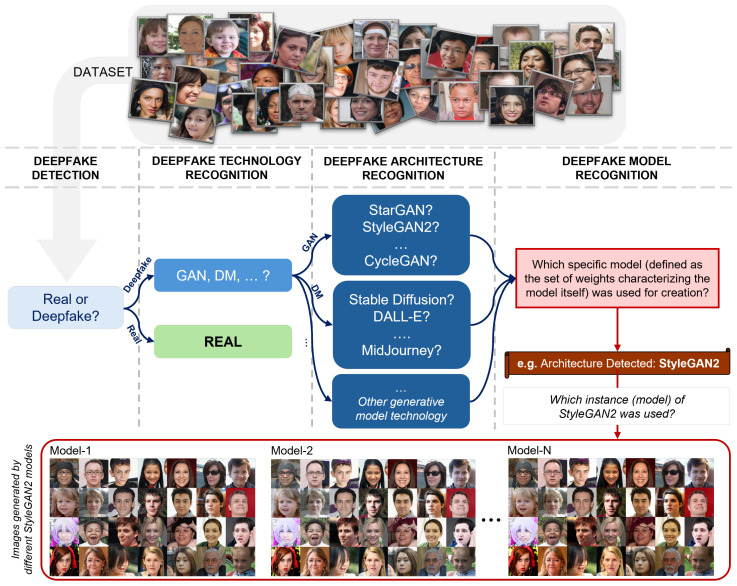
- The paper synthesizes detection approaches including undirected deep learning, visual artifacts, biological artifacts, and texture/spatio-temporal consistency; attribution aims to identify architecture and even model instance, with one cited method using ResNET-18 plus metric learning to distinguish 100 different StyleGAN2-ADA instances.
- It reports dataset scales: WildFake has over 3.6 million images (2.6 M fake and 1 M real); Artifact has over 2.4 million images (1.5 million synthetic from 25 methods); DIFF has over 500,000 images from 13 diffusion models; DFDC has nearly 120,000 videos (100,000 fake); ASVspoof 2019 contains 78 speakers (33 male, 45 female).
- Continual learning results include DFWF achieving an Average Equal Error Rate reduction of 81.63% compared to fine-tuning on ASVspoof 2019, and a Transformer-based continual learning method achieving 90–95% AUC on unseen datasets using ASVspoof datasets and over 2 million synthetic samples.
- Real-world challenges include social media compression degrading forensic traces, adversarial and laundering attacks evading detectors, active authentication via cryptographic signatures/BLS and JPEG Trust, and ethical/privacy risks alongside “Impostor Bias.”
Methods
- Design: review/position paper based on the FF4ALL project, extending previous work and providing a structured comparison of deepfake detection approaches, datasets, continual learning, explainability, attribution, passive/active authentication, and realistic scenarios.
- Data or sample: no new primary dataset or experiment is reported; the paper draws on cited state-of-the-art datasets and methods across image, audio, video, and multimodal modalities.
- Main analysis: narrative synthesis and tables (e.g., Table 1 on project topics, Table 3 comparing detection methods), identifying strengths, weaknesses, research gaps, and future directions.
Limitations
- The paper states that scalability, real-time applicability, and robustness in dynamic environments remain persistent challenges; many state-of-the-art techniques require high computational resources and extensive labeled datasets, suffer latency, and are vulnerable to adversarial/laundering attacks. It also notes the lack of universally accepted benchmarks, sensitivity to media compression, insufficient interpretability for legal/forensic use, and ethical/privacy concerns.
- The provided text makes evident that several sections are empty or truncated (e.g., Introduction, Conclusions, and some subsections), so not all details can be assessed from this version.
Model-written summary. Check it against the paper before relying on it.
Integrity signals
Registry
Cites
Statistics
Figures




Verification
Claims the paper makes
9 Valid · 0 Not valid · 3 Not checked · 13 Own results and interpretations
The cited sources support only part of this claim — read each source’s verdict below.
In the paper
“ASVspoof 2019 [39,40] is a benchmark dataset for synthetic speech detection, containing both real and synthetic audio tracks from 78 speakers (33 male, 45 female) based on the VCTK corpus.”
§ Deepfake Media Forensics: Status and Future Challenges > 4. State-of-the-Art Deepfake Datasets > 4.2. Audio Datasets
What the sources say
- Supportedcites [39] Todisco, M., Wang, X., Vestman, V., Sahidullah, M., Delgado, H., Nautsch, A., Yamagishi, J., Evans, N., Kinnunen, T., and Lee, K.A. (2019, January 15–19). ASVspoof 2019: Future horizons in spoofed and fake audio detection. Proceedings of the International Speech Communication Association Conference (INTERSPEECH), Graz, Austria. source
Section 2 (p. 1) describes the ASVspoof 2019 database as VCTK-derived and lists disjoint training, development and evaluation sets of 20, 10 and 48 speakers—78 in total (33 male, 45 female). Section 2.1 (p. 1) says its logical-access database contains bona fide speech and spoofed speech generated using text-to-speech and voice-conversion systems. (LLM, conf=0.94)
- Partly supportedcites [40] Wang, 2020, ASVspoof 2019: A large-scale public database of synthesized, converted and replayed speech, Comput. Speech Lang. sourceExperimental — accuracy not yet measured
The Introduction (p. 2) describes ASVspoof 2019 as a dataset of bona fide and spoofed speech, including synthetic speech. But §2.1 (p. 3) says it uses utterances from 107 speakers (46 male, 61 female), not 78 speakers (33 male, 45 female). The reported 20 training, 10 development target, and 48 evaluation target speakers sum to 78, but exclude non-target speakers. (LLM, conf=0.90)
- Supported
The cited sources support only part of this claim — read each source’s verdict below.
In the paper
“DeepfakeTIMIT [48] is a video deepfake dataset derived from the VidTIMIT corpus [49], which consists of real audio–video recordings of 43 individuals, each reciting short sentences, resulting in a total of 430 videos.”
§ Deepfake Media Forensics: Status and Future Challenges > 4. State-of-the-Art Deepfake Datasets > 4.3. Video and Multimodal Datasets
What the sources say
- Supportedcites [48] Korshunov, P., and Marcel, S. (2018). Deepfakes: A new threat to face recognition? Assessment and detection. arXiv. source
The Introduction (p. 1) identifies this paper’s dataset as Deepfake videos generated from VidTIMIT. The Deepfake Database section (p. 2) says VidTIMIT has 10 videos for each of 43 subjects, so the citing sentence’s 430 videos refers to the original VidTIMIT corpus, not DeepfakeTIMIT. The Conclusion (p. 4) reports 620 Deepfake videos. (LLM, conf=0.91)
- Not matchedcites [49] Sanderson, C. (2025, January 15). The VidTIMIT database. Technical Report, IDIAP. Available online: https://www.google.com/url?sa=t&source=web&rct=j&opi=89978449&url=https://publications.idiap.ch/downloads/reports/2002/com02-06.pdf&ved=2ahUKEwid9vKeueWLAxVuvokEHTziMbQQFnoECBUQAQ&usg=AOvVaw0kiW0MZbBb8yeSzteosaGP.
Couldn’t be matched to a paper in Crossref, so it can’t be checked.
- Supported
Every source the paper cites for this claim was checked and supports it.
In the paper
“ASVspoof 2021 [41] is an updated version of ASVspoof 2019, released for a subsequent challenge. It includes three evaluation partitions (LA, PA, and DF), with no new training or development data.”
§ Deepfake Media Forensics: Status and Future Challenges > 4. State-of-the-Art Deepfake Datasets > 4.2. Audio Datasets
What the sources say
- Supportedcites [41] Yamagishi, J., Wang, X., Todisco, M., Sahidullah, M., Patino, J., Nautsch, A., Liu, X., Lee, K.A., Kinnunen, T., and Evans, N. (2021, January 16). ASVspoof 2021: Accelerating progress in spoofed and deepfake speech detection. Proceedings of the Automatic Speaker Verification and Spoofing Countermeasures Challenge, Online. source
The Database section (p. 1) explicitly says ASVspoof 2021 has three new evaluation partitions for LA, PA, and DF, and that no new training or development data were released. It says participants were expected to use the ASVspoof 2019 training and development partitions instead. (LLM, conf=0.95)
- Supported
The cited sources support only part of this claim — read each source’s verdict below.
In the paper
“Traditional deep learning approaches assume that training and testing data share a static distribution, which is unrealistic in scenarios where new spoofing attacks emerge regularly [59].”
§ Deepfake Media Forensics: Status and Future Challenges > 5. Continual Learning for Deepfake Detection
What the sources say
- Partly supportedcites [59] Almutairi, Z., and Elgibreen, H. (2022). A Review of Modern Audio Deepfake Detection Methods: Challenges and Future Directions. Algorithms, 15. sourceExperimental — accuracy not yet measured
The Fake Audio Detection Methods table (p. 8) says one deep-learning model overfits synthetic data and cannot generalize to unknown attacks. The Introduction (p. 1) says emerging types of audio deepfake increase the detection challenge. The paper does not state that traditional deep learning assumes a static, shared training-and-testing distribution or that new attacks emerge regularly. (LLM, conf=0.83)
- Partly supported
Every source the paper cites for this claim was checked and supports it.
In the paper
“With over 3.6 million images (2.6 M fake and 1 M real), WildFake provides a comprehensive resource for training and evaluation.”
§ Deepfake Media Forensics: Status and Future Challenges > 4. State-of-the-Art Deepfake Datasets > 4.1. Image Datasets
What the sources say
- Supportedcites [33] Hong, Y., and Zhang, J. (2024). Wildfake: A large-scale challenging dataset for ai-generated images detection. arXiv. source
The Baseline Datasets and §3.3 passages report 3,694,313 images: 2,680,867 fake and 1,013,446 real. They also describe training and testing splits, supporting the cited description of WildFake as a resource for both purposes. (LLM, conf=0.94)
- Supported
20 more claims · 4 with their cited sources checked
Create a free account to see all 25 claims and every source verdict.
Claims other papers make about this one
Each is checked against this paper’s own text: does it say what the citing paper says it does?
The source backs part of the claim, not all of it — or backs it for a different population, condition or comparison.
In the citing paper
“The widespread availability of generative AI has increased the volume of images and videos produced and circulated through online platforms [1][2][3].”
From A Study on Broker-Assisted Blockchain Trust Chains for Provenance and Integrity Verification of Generative Media Using Watermarking, Semantic Fingerprinting, and C2PA (2026) · cites this paper as [2]
Experimental — accuracy not yet measured
Self-check
Percentages, sums and reported differences re-computed from the paper’s own numbers.
Each contradiction between two passages listed here was confirmed by an independent check.
Rated minor: it would not touch a result — a value no result rests on, a p-value that stays on the same side of the significance level, or a conflict that is clerical, resolved elsewhere in the paper, or outside its own findings.
In the paper
§ Deepfake Media Forensics: Status and Future Challenges > Abstract
“a research project called FF4ALL (FF4ALL-Detection of Deep Fake Media and Life-Long Media Authentication)”
§ Deepfake Media Forensics: Status and Future Challenges > 11. Discussion > 11.2. Ff4ll’S Goals in Deepfake Detection and Media Authentication
“The FF4LL project is designed to address the evolving challenges of deepfake detection and media authenticity”
Citations
Cites
Deep Residual Learning for Image Recognition
He, K., Zhang, X., Ren, S., & Sun, J. (2016) · 2016 IEEE Conference on Computer Vision and Pattern Recognition (CVPR) · doi:10.1109/cvpr.2016.90 · Cited by 235,474
Vaswani, A., Shazeer, N., Parmar, N., Uszkoreit, J., Jones, L., Gomez, A. N., Kaiser, L., & Polosukhin, I. (2017) · arXiv · doi:10.48550/arxiv.1706.03762 · Cited by 120,404
A Style-Based Generator Architecture for Generative Adversarial Networks
Karras, T., Laine, S., & Aila, T. (2019) · 2019 IEEE/CVF Conference on Computer Vision and Pattern Recognition (CVPR) · doi:10.1109/cvpr.2019.00453 · Cited by 11,714 · cited 2×
“Unlike its predecessors, StyleGAN [37] and StyleGAN2 [38], which excelled at synthesizing human faces and structured datasets, StyleGAN-XL incorporates Projected GAN training and a progressive growing strategy to enhance stability and scalability.”
Rudin, C. (2019) · Nature Machine Intelligence · doi:10.1038/s42256-019-0048-x · Cited by 10,561 · cited 1×
“Black-box models, despite their high predictive performance, often lack the necessary transparency [76].”
Explaining and Harnessing Adversarial Examples
Goodfellow, I. J., Shlens, J., & Szegedy, C. (2014) · arXiv · doi:10.48550/arxiv.1412.6572 · Cited by 10,381 · cited 1×
“Yet, recent studies [173,174] have shown how easy is to generate adversarial contents capable of deceiving image and video processing techniques based on DL, when the adversary is informed about the details of the tools employed by the analyst.”
Denoising Diffusion Probabilistic Models
Ho, J., Jain, A., & Abbeel, P. (2020) · arXiv · doi:10.48550/arxiv.2006.11239 · Cited by 8,712
Intriguing properties of neural networks
Szegedy, C., Zaremba, W., Sutskever, I., Bruna, J., Erhan, D., Goodfellow, I., & Fergus, R. (2013) · arXiv · doi:10.48550/arxiv.1312.6199 · Cited by 8,143
Overcoming catastrophic forgetting in neural networks
Kirkpatrick, J., Pascanu, R., Rabinowitz, N., Veness, J., Desjardins, G., Rusu, A. A., Milan, K., Quan, J., Ramalho, T., Grabska-Barwinska, A., et al. (2017) · Proceedings of the National Academy of Sciences · doi:10.1073/pnas.1611835114 · Cited by 7,899
Towards Deep Learning Models Resistant to Adversarial Attacks
Madry, A., Makelov, A., Schmidt, L., Tsipras, D., & Vladu, A. (2017) · arXiv · doi:10.48550/arxiv.1706.06083 · Cited by 6,602
Analyzing and Improving the Image Quality of StyleGAN
Karras, T., Laine, S., Aittala, M., Hellsten, J., Lehtinen, J., & Aila, T. (2020) · 2020 IEEE/CVF Conference on Computer Vision and Pattern Recognition (CVPR) · doi:10.1109/cvpr42600.2020.00813 · Cited by 6,332
Analyzing and Improving the Image Quality of StyleGAN
Karras, T., Laine, S., Aittala, M., Hellsten, J., Lehtinen, J., & Aila, T. (2019) · arXiv · doi:10.48550/arxiv.1912.04958 · Cited by 6,332
“Librispeech: an ASR corpus based on public domain audio books,”
Panayotov, V., Chen, G., Povey, D., & Khudanpur, S. (2015) · 2015 IEEE International Conference on Acoustics, Speech and Signal Processing (ICASSP) · doi:10.1109/icassp.2015.7178964 · Cited by 6,072
Attribute-based encryption for fine-grained access control of encrypted data
Goyal, V., Pandey, O., Sahai, A., & Waters, B. (2006) · Proceedings of the 13th ACM conference on Computer and communications security · doi:10.1145/1180405.1180418 · Cited by 5,009
Practical Black-Box Attacks against Machine Learning
Papernot, N., McDaniel, P., Goodfellow, I., Jha, S., Celik, Z. B., & Swami, A. (2017) · Proceedings of the 2017 ACM on Asia Conference on Computer and Communications Security · doi:10.1145/3052973.3053009 · Cited by 3,495
FaceForensics++: Learning to Detect Manipulated Facial Images
Rossler, A., Cozzolino, D., Verdoliva, L., Riess, C., Thies, J., & Niessner, M. (2019) · 2019 IEEE/CVF International Conference on Computer Vision (ICCV) · doi:10.1109/iccv.2019.00009 · Cited by 3,314
Deep Unsupervised Learning using Nonequilibrium Thermodynamics
Sohl-Dickstein, J., Weiss, E. A., Maheswaranathan, N., & Ganguli, S. (2015) · arXiv · doi:10.48550/arxiv.1503.03585 · Cited by 2,637
Catastrophic forgetting in connectionist networks
French, R. (1999) · Trends in Cognitive Sciences · doi:10.1016/s1364-6613(99)01294-2 · Cited by 2,311
VoxCeleb2: Deep Speaker Recognition
Chung, J. S., Nagrani, A., & Zisserman, A. (2018) · Interspeech 2018 · doi:10.21437/interspeech.2018-1929 · Cited by 2,256
Obfuscated gradients give a false sense of security: Circumventing defenses to adversarial examples
Athalye, A., Carlini, N., & Wagner, D. (2018) · arXiv · doi:10.48550/arxiv.1802.00420 · Cited by 2,172 · cited 1×
“Still, no general effective solutions have been found yet [180].”
MesoNet: a Compact Facial Video Forgery Detection Network
Afchar, D., Nozick, V., Yamagishi, J., & Echizen, I. (2018) · 2018 IEEE International Workshop on Information Forensics and Security (WIFS) · doi:10.1109/wifs.2018.8630761 · Cited by 1,872
A Continual Learning Survey: Defying Forgetting in Classification Tasks
Delange, M., Aljundi, R., Masana, M., Parisot, S., Jia, X., Leonardis, A., Slabaugh, G., & Tuytelaars, T. (2021) · IEEE Transactions on Pattern Analysis and Machine Intelligence · doi:10.1109/tpami.2021.3057446 · Cited by 1,647
A continual learning survey: Defying forgetting in classification tasks
De Lange, M., Aljundi, R., Masana, M., Parisot, S., Jia, X., Leonardis, A., Slabaugh, G., & Tuytelaars, T. (2019) · arXiv · doi:10.48550/arxiv.1909.08383 · Cited by 1,647
Deepfake Video Detection Using Recurrent Neural Networks
Guera, D., & Delp, E. J. (2018) · 2018 15th IEEE International Conference on Advanced Video and Signal Based Surveillance (AVSS) · doi:10.1109/avss.2018.8639163 · Cited by 1,285
CNN-Generated Images Are Surprisingly Easy to Spot… for Now
Wang, S.-Y., Wang, O., Zhang, R., Owens, A., & Efros, A. A. (2020) · 2020 IEEE/CVF Conference on Computer Vision and Pattern Recognition (CVPR) · doi:10.1109/cvpr42600.2020.00872 · Cited by 1,210
Exposing Deep Fakes Using Inconsistent Head Poses
Yang, X., Li, Y., & Lyu, S. (2019) · ICASSP 2019 - 2019 IEEE International Conference on Acoustics, Speech and Signal Processing (ICASSP) · doi:10.1109/icassp.2019.8683164 · Cited by 1,196
Training Generative Adversarial Networks with Limited Data
Karras, T., Aittala, M., Hellsten, J., Laine, S., Lehtinen, J., & Aila, T. (2020) · arXiv · doi:10.48550/arxiv.2006.06676 · Cited by 1,170
A Comprehensive Survey of Continual Learning: Theory, Method and Application
Wang, L., Zhang, X., Su, H., & Zhu, J. (2024) · IEEE Transactions on Pattern Analysis and Machine Intelligence · doi:10.1109/tpami.2024.3367329 · Cited by 1,113 · cited 3×
“This makes it necessary to develop methods that are constantly updated through continual-and few-shot learning [62,171].”
In Ictu Oculi: Exposing AI Created Fake Videos by Detecting Eye Blinking
Li, Y., Chang, M.-C., & Lyu, S. (2018) · 2018 IEEE International Workshop on Information Forensics and Security (WIFS) · doi:10.1109/wifs.2018.8630787 · Cited by 1,089
Multi-attentional Deepfake Detection
Zhao, H., Wei, T., Zhou, W., Zhang, W., Chen, D., & Yu, N. (2021) · 2021 IEEE/CVF Conference on Computer Vision and Pattern Recognition (CVPR) · doi:10.1109/cvpr46437.2021.00222 · Cited by 1,019 · cited 1×
“The authors of [138] consider an ensemble of CNNs to detect video face manipulations, while those of [139] introduce multi-head attention and fine-grained classification to detect deepfake videos, showing that the approach is robust to low-quality videos.”
Media Forensics and DeepFakes: An Overview
Verdoliva, L. (2020) · IEEE Journal of Selected Topics in Signal Processing · doi:10.1109/jstsp.2020.3002101 · Cited by 979
A Lip Sync Expert Is All You Need for Speech to Lip Generation In the Wild
Prajwal, K. R., Mukhopadhyay, R., Namboodiri, V. P., & Jawahar, C. V. (2020) · Proceedings of the 28th ACM International Conference on Multimedia · doi:10.1145/3394171.3413532 · Cited by 897 · cited 1×
“To ensure synchronization between the video frames and audio, Wav2Lip [57] is applied.”
Exploiting Visual Artifacts to Expose Deepfakes and Face Manipulations
Matern, F., Riess, C., & Stamminger, M. (2019) · 2019 IEEE Winter Applications of Computer Vision Workshops (WACVW) · doi:10.1109/wacvw.2019.00020 · Cited by 824
Albahri, A. S., Duhaim, A. M., Fadhel, M. A., Alnoor, A., Baqer, N. S., Alzubaidi, L., Albahri, O. S., Alamoodi, A. H., Bai, J., Salhi, A., et al. (2023) · Information Fusion · doi:10.1016/j.inffus.2023.03.008 · Cited by 716
FSGAN: Subject Agnostic Face Swapping and Reenactment
Nirkin, Y., Keller, Y., & Hassner, T. (2019) · 2019 IEEE/CVF International Conference on Computer Vision (ICCV) · doi:10.1109/iccv.2019.00728 · Cited by 706
ASVspoof 2019: Future Horizons in Spoofed and Fake Audio Detection
Todisco, M., Wang, X., Vestman, V., Sahidullah, M., Delgado, H., Nautsch, A., Yamagishi, J., Evans, N., Kinnunen, T., & Lee, K. A. (2019) · arXiv · doi:10.48550/arxiv.1904.05441 · Cited by 688
ASVspoof 2019: Future Horizons in Spoofed and Fake Audio Detection
Todisco, M., Wang, X., Vestman, V., Sahidullah, M., Delgado, H., Nautsch, A., Yamagishi, J., Evans, N., Kinnunen, T. H., & Lee, K. A. (2019) · Interspeech 2019 · doi:10.21437/interspeech.2019-2249 · Cited by 687
Challenges in deploying machine learning: A survey of case studies
Paleyes, A., Urma, R.-G., & Lawrence, N. D. (2023) · ACM Computing Surveys · doi:10.1145/3533378 · Cited by 638 · cited 1×
“Leveraging Machine Learning Operation (MLOp) pipelines, future detection models can achieve continuous updates and seamless integration into real-world workflows, enhancing their robustness against evolving threats [156,157].”
Spatial-Phase Shallow Learning: Rethinking Face Forgery Detection in Frequency Domain
Liu, H., Li, X., Zhou, W., Chen, Y., He, Y., Xue, H., Zhang, W., & Yu, N. (2021) · 2021 IEEE/CVF Conference on Computer Vision and Pattern Recognition (CVPR) · doi:10.1109/cvpr46437.2021.00083 · Cited by 600
Transfer learning from speaker verification to multispeaker text-to-speech synthesis
Jia, Y., Zhang, Y., Weiss, R. J., Wang, Q., Shen, J., Ren, F., Chen, Z., Nguyen, P., Pang, R., Moreno, I. L., et al. (2018) · arXiv · doi:10.48550/arxiv.1806.04558 · Cited by 519 · cited 1×
“The deepfake video frames are created using Faceswap [50] and FSGAN [55], while the synthetic audio is generated using Real-Time Voice Cloning (RTVC) [56].”
ASVspoof 2019: A large-scale public database of synthesized, converted and replayed speech
Wang, X., Yamagishi, J., Todisco, M., Delgado, H., Nautsch, A., Evans, N., Sahidullah, M., Vestman, V., Kinnunen, T., Lee, K. A., et al. (2020) · Computer Speech & Language · doi:10.1016/j.csl.2020.101114 · Cited by 505 · cited 1×
“ASVspoof 2019 [39,40] is a benchmark dataset for synthetic speech detection, containing both real and synthetic audio tracks from 78 speakers (33 male, 45 female) based on the VCTK corpus.”
Fast Face-Swap Using Convolutional Neural Networks
Korshunova, I., Shi, W., Dambre, J., & Theis, L. (2017) · 2017 IEEE International Conference on Computer Vision (ICCV) · doi:10.1109/iccv.2017.397 · Cited by 501
FakeCatcher: Detection of Synthetic Portrait Videos using Biological Signals
Ciftci, U. A., Demir, I., & Yin, L. (2024) · IEEE Transactions on Pattern Analysis and Machine Intelligence · doi:10.1109/tpami.2020.3009287 · Cited by 499
DeepFakes: a New Threat to Face Recognition? Assessment and Detection
Korshunov, P., & Marcel, S. (2018) · arXiv · doi:10.48550/arxiv.1812.08685 · Cited by 497
Deepfake Video Detection through Optical Flow Based CNN
Amerini, I., Galteri, L., Caldelli, R., & Del Bimbo, A. (2019) · 2019 IEEE/CVF International Conference on Computer Vision Workshop (ICCVW) · doi:10.1109/iccvw.2019.00152 · Cited by 424 · cited 1×
“Early forgery detection methods primarily depend on handcrafted features such as facial landmarks [27,132,133], optical flow [134], and various digital image processing techniques designed to enhance the visibility of artifacts [135].”
Self-citationEnd-to-End anti-spoofing with RawNet2
Tak, H., Patino, J., Todisco, M., Nautsch, A., Evans, N., & Larcher, A. (2021) · ICASSP 2021 - 2021 IEEE International Conference on Acoustics, Speech and Signal Processing (ICASSP) · doi:10.1109/icassp39728.2021.9414234 · Cited by 402 · cited 1×
“Alternatively, the authors of [115,116] propose end-to-end networks trained for extracting deep features from speech, while [117] uses Mel-Frequency Cepstral Coefficient (MFCC) features as input of a Support Vector Machine (SVM) classifier.”
AASIST: Audio Anti-Spoofing Using Integrated Spectro-Temporal Graph Attention Networks
Jung, J.-W., Heo, H.-S., Tak, H., Shim, H.-J., Chung, J. S., Lee, B.-J., Yu, H.-J., & Evans, N. (2022) · ICASSP 2022 - 2022 IEEE International Conference on Acoustics, Speech and Signal Processing (ICASSP) · doi:10.1109/icassp43922.2022.9747766 · Cited by 399
Detection of GAN-Generated Fake Images over Social Networks
Marra, F., Gragnaniello, D., Cozzolino, D., & Verdoliva, L. (2018) · 2018 IEEE Conference on Multimedia Information Processing and Retrieval (MIPR) · doi:10.1109/mipr.2018.00084 · Cited by 399 · cited 1×
“An initial study on GAN-generated images [159] shared via Twitter highlights the adverse effects of social network compression on deepfake detectors.”
Koonce, B. (2021) · Apress eBooks · doi:10.1007/978-1-4842-6168-2 · Cited by 389
A comparison of features for synthetic speech detection
Sahidullah, M., Kinnunen, T., & Hanilçi, C. (2015) · Interspeech 2015 · doi:10.21437/interspeech.2015-472 · Cited by 382 · cited 1×
“For instance, the authors of [121] exploit classic audio features inherited from the Music Information Retrieval (MIR) community to detect speech deepfakes.”
ASVspoof 2021: accelerating progress in spoofed and deepfake speech detection
Yamagishi, J., Wang, X., Todisco, M., Sahidullah, M., Patino, J., Nautsch, A., Liu, X., Lee, K. A., Kinnunen, T., Evans, N., et al. (2021) · 2021 Edition of the Automatic Speaker Verification and Spoofing Countermeasures Challenge · doi:10.21437/asvspoof.2021-8 · Cited by 380
DeepFake Detection by Analyzing Convolutional Traces
Guarnera, L., Giudice, O., & Battiato, S. (2020) · 2020 IEEE/CVF Conference on Computer Vision and Pattern Recognition Workshops (CVPRW) · doi:10.1109/cvprw50498.2020.00341 · Cited by 374 · cited 1×
“Current state-of-the-art (SOTA) methods have proven to be very effective in detecting deepfake content generated by GAN architectures [93–95] and Diffusion Models (DMs) [96,97], demonstrating the ability to specialize not only in recognizing the architecture but also in identifying the specific…”
Self-citationWhat Makes Fake Images Detectable? Understanding Properties that Generalize
Chai, L., Bau, D., Lim, S.-N., & Isola, P. (2020) · Lecture Notes in Computer Science · doi:10.1007/978-3-030-58574-7_7 · Cited by 357
StyleGAN-XL: Scaling StyleGAN to Large Diverse Datasets
Sauer, A., Schwarz, K., & Geiger, A. (2022) · Special Interest Group on Computer Graphics and Interactive Techniques Conference Proceedings · doi:10.1145/3528233.3530738 · Cited by 353 · cited 1×
“StyleGAN-XL [36] is an extension of the StyleGAN family, designed to generate high-quality images on diverse and unstructured datasets, particularly ImageNet.”
Detecting digital image forgeries using sensor pattern noise
Lukáš, J., Fridrich, J., & Goljan, M. (2006) · SPIE Proceedings · doi:10.1117/12.640109 · Cited by 328
Emotions Don't Lie: An Audio-Visual Deepfake Detection Method using Affective Cues
Mittal, T., Bhattacharya, U., Chandra, R., Bera, A., & Manocha, D. (2020) · Proceedings of the 28th ACM International Conference on Multimedia · doi:10.1145/3394171.3413570 · Cited by 319 · cited 1×
“For instance, inconsistencies in the display of emotions, measured through valence and arousal, have been shown to indicate synthetic content [26].”
Raising the Bar of AI-generated Image Detection with CLIP
Cozzolino, D., Poggi, G., Corvi, R., Nießner, M., & Verdoliva, L. (2024) · IEEE/CVF Conference on Computer Vision and Pattern Recognition Workshops (CVPRW) · doi:10.1109/cvprw63382.2024.00439 · Cited by 308
ŞAHiN, E., Arslan, N. N., & Özdemir, D. (2025) · Neural Computing and Applications · doi:10.1007/s00521-024-10437-2 · Cited by 278
Deepfake Audio Detection via MFCC features using Machine Learning
Hamza, A., Javed, A. R. R., Iqbal, F., Kryvinska, N., Almadhor, A. S., Jalil, Z., & Borghol, R. (2022) · IEEE Access · doi:10.1109/access.2022.3231480 · Cited by 264 · cited 1×
“Alternatively, the authors of [115,116] propose end-to-end networks trained for extracting deep features from speech, while [117] uses Mel-Frequency Cepstral Coefficient (MFCC) features as input of a Support Vector Machine (SVM) classifier.”
Ito, K. A. (2024) · TIB Data Manager · doi:10.57702/yamk7ojd · Cited by 259
Does Audio Deepfake Detection Generalize?
Müller, N., Czempin, P., Diekmann, F., Froghyar, A., & Böttinger, K. (2022) · Interspeech 2022 · doi:10.21437/interspeech.2022-108 · Cited by 258
Detecting Deep-Fake Videos from Appearance and Behavior
Agarwal, S., Farid, H., El-Gaaly, T., & Lim, S.-N. (2020) · 2020 IEEE International Workshop on Information Forensics and Security (WIFS) · doi:10.1109/wifs49906.2020.9360904 · Cited by 242 · cited 1×
“In [146], the authors establish a mapping between audio and video frames by analyzing the changes in the lip opening degree, while in [32,147,148], the authenticity of a speaker is verified by detecting anomalous correspondences between their facial movements and what they say.”
Human factors in model interpretability: Industry practices, challenges, and needs
Hong, S. R., Hullman, J., & Bertini, E. (2020) · Proceedings of the ACM on Human-Computer Interaction · doi:10.1145/3392878 · Cited by 219 · cited 1×
“Interpretable models provide a common language for these experts by clearly explaining the inner workings of the detection system [80].”
Joint Audio-Visual Deepfake Detection
Zhou, Y., & Lim, S.-N. (2021) · 2021 IEEE/CVF International Conference on Computer Vision (ICCV) · doi:10.1109/iccv48922.2021.01453 · Cited by 217 · cited 2×
“Spatio-temporal coherence methods assess the synchronization between various modalities, such as facial movements, gestures, and audio [32].”
Tan, C., Zhao, Y., Wei, S., Gu, G., Liu, P., & Wei, Y. (2024) · Proceedings of the AAAI Conference on Artificial Intelligence · doi:10.1609/aaai.v38i5.28310 · Cited by 215 · cited 1×
“Methods based on Fourier transforms and wavelet decomposition have proven effective in uncovering these inconsistencies, leveraging the distinct frequency patterns observed in synthetic media [18,19].”
Hu, J., Liao, X., Wang, W., & Qin, Z. (2022) · IEEE Transactions on Circuits and Systems for Video Technology · doi:10.1109/tcsvt.2021.3074259 · Cited by 195
Artificial Fingerprinting for Generative Models: Rooting Deepfake Attribution in Training Data
Yu, N., Skripniuk, V., Abdelnabi, S., & Fritz, M. (2021) · 2021 IEEE/CVF International Conference on Computer Vision (ICCV) · doi:10.1109/iccv48922.2021.01418 · Cited by 195
FoR: A Dataset for Synthetic Speech Detection
Reimao, R., & Tzerpos, V. (2019) · 2019 International Conference on Speech Technology and Human-Computer Dialogue (SpeD) · doi:10.1109/sped.2019.8906599 · Cited by 193
A Review of Modern Audio Deepfake Detection Methods: Challenges and Future Directions
Almutairi, Z., & Elgibreen, H. (2022) · Algorithms · doi:10.3390/a15050155 · Cited by 187 · cited 1×
“Traditional deep learning approaches assume that training and testing data share a static distribution, which is unrealistic in scenarios where new spoofing attacks emerge regularly [59].”
Transcending Forgery Specificity with Latent Space Augmentation for Generalizable Deepfake Detection
Yan, Z., Luo, Y., Lyu, S., Liu, Q., & Wu, B. (2024) · 2024 IEEE/CVF Conference on Computer Vision and Pattern Recognition (CVPR) · doi:10.1109/cvpr52733.2024.00858 · Cited by 166 · cited 1×
“Yan et al. [13] addressed this limitation through Latent Space Data Augmentation (LSDA), a technique designed to enrich the latent space by interpolating diverse samples, thereby enhancing the generalization capabilities of deep learning-based detectors.”
Explainable AI and Law: An Evidential Survey
Richmond, K. M., Muddamsetty, S. M., Gammeltoft‐Hansen, T., Olsen, H. P., & Moeslund, T. B. (2023) · Digital Society · doi:10.1007/s44206-023-00081-z · Cited by 157
Incremental learning for the detection and classification of GAN-generated images
Marra, F., Saltori, C., Boato, G., & Verdoliva, L. (2019) · 2019 IEEE International Workshop on Information Forensics and Security (WIFS) · doi:10.1109/wifs47025.2019.9035099 · Cited by 154
Self-citationAdversarial Attack and Defense: A Survey
Liang, H., He, E., Zhao, Y., Jia, Z., & Li, H. (2022) · Electronics · doi:10.3390/electronics11081283 · Cited by 150
Fighting Deepfake by Exposing the Convolutional Traces on Images
Guarnera, L., Giudice, O., & Battiato, S. (2020) · IEEE Access · doi:10.1109/access.2020.3023037 · Cited by 149
Self-citationA GAN-Based Model of Deepfake Detection in Social Media
Preeti, Kumar, M., & Sharma, H. K. (2023) · Procedia Computer Science · doi:10.1016/j.procs.2023.01.191 · Cited by 125
Faster Than Lies: Real-time Deepfake Detection using Binary Neural Networks
Lanzino, R., Fontana, F., Diko, A., Marini, M. R., & Cinque, L. (2024) · IEEE/CVF Conference on Computer Vision and Pattern Recognition Workshops (CVPRW) · doi:10.1109/cvprw63382.2024.00381 · Cited by 123
Fighting Deepfakes by Detecting GAN DCT Anomalies
Giudice, O., Guarnera, L., & Battiato, S. (2021) · Journal of Imaging · doi:10.3390/jimaging7080128 · Cited by 118
Self-citationFakeAVCeleb: A Novel Audio-Video Multimodal Deepfake Dataset
Khalid, H., Tariq, S., Kim, M., & Woo, S. S. (2021) · arXiv · doi:10.48550/arxiv.2108.05080 · Cited by 116
Deepfake Network Architecture Attribution
Yang, T., Huang, Z., Cao, J., Li, L., & Li, X. (2022) · Proceedings of the AAAI Conference on Artificial Intelligence · doi:10.1609/aaai.v36i4.20391 · Cited by 115
Evaluation of an Audio-Video Multimodal Deepfake Dataset using Unimodal and Multimodal Detectors
Khalid, H., Kim, M., Tariq, S., & Woo, S. S. (2021) · Proceedings of the 1st Workshop on Synthetic Multimedia - Audiovisual Deepfake Generation and Detection · doi:10.1145/3476099.3484315 · Cited by 110
Defense strategies for Adversarial Machine Learning: A survey
Bountakas, P., Zarras, A., Lekidis, A., & Xenakis, C. (2023) · Computer Science Review · doi:10.1016/j.cosrev.2023.100573 · Cited by 106
Channel pattern noise based playback attack detection algorithm for speaker recognition
Wang, Z.-F., Wei, G., & He, Q.-H. (2011) · 2011 International Conference on Machine Learning and Cybernetics · doi:10.1109/icmlc.2011.6016982 · Cited by 101 · cited 1×
“An example of an artifact-based approach is presented in [111], where channel pattern noise analysis is used to secure Automatic Speaker Verification (ASV) systems against physical attacks.”
Speaker Inconsistency Detection in Tampered Video
Korshunov, P., & Marcel, S. (2018) · 2018 26th European Signal Processing Conference (EUSIPCO) · doi:10.23919/eusipco.2018.8553270 · Cited by 97
A Robust Approach to Multimodal Deepfake Detection
Salvi, D., Liu, H., Mandelli, S., Bestagini, P., Zhou, W., Zhang, W., & Tubaro, S. (2023) · Journal of Imaging · doi:10.3390/jimaging9060122 · Cited by 96
Self-citationAudio Deepfake Detection With Self-Supervised WavLM And Multi-Fusion Attentive Classifier
Guo, Y., Huang, H., Chen, X., Zhao, H., & Wang, Y. (2024) · ICASSP 2024 - 2024 IEEE International Conference on Acoustics, Speech and Signal Processing (ICASSP) · doi:10.1109/icassp48485.2024.10447923 · Cited by 95
Media forensics on social media platforms: a survey
Pasquini, C., Amerini, I., & Boato, G. (2021) · EURASIP Journal on Information Security · doi:10.1186/s13635-021-00117-2 · Cited by 90
Self-citationA Comprehensive Survey on Passive Techniques for Digital Video Forgery Detection
Shelke, N. A., & Kasana, S. S. (2021) · Multimedia Tools and Applications · doi:10.1007/s11042-020-09974-4 · Cited by 87 · cited 1×
“Early forensic approaches focus on detecting explicit spatial inconsistencies, such as unnatural lighting, pixel-level anomalies, and compression artifacts [10].”
AVFF: Audio-Visual Feature Fusion for Video Deepfake Detection
Oorloff, T., Koppisetti, S., Bonettini, N., Solanki, D., Colman, B., Yacoob, Y., Shahriyari, A., & Bharaj, G. (2024) · 2024 IEEE/CVF Conference on Computer Vision and Pattern Recognition (CVPR) · doi:10.1109/cvpr52733.2024.02559 · Cited by 85
Detecting Deepfake Voice Using Explainable Deep Learning Techniques
Lim, S.-Y., Chae, D.-K., & Lee, S.-C. (2022) · Applied Sciences · doi:10.3390/app12083926 · Cited by 82
Synthetic speech detection through short-term and long-term prediction traces
Borrelli, C., Bestagini, P., Antonacci, F., Sarti, A., & Tubaro, S. (2021) · EURASIP Journal on Information Security · doi:10.1186/s13635-021-00116-3 · Cited by 80
Self-citationThe face deepfake detection challenge
Guarnera, L., Giudice, O., Guarnera, F., Ortis, A., Puglisi, G., Paratore, A., Bui, L. M. Q., Fontani, M., Coccomini, D. A., Caldelli, R., et al. (2022) · Journal of Imaging · doi:10.3390/jimaging8100263 · Cited by 79 · cited 1×
“Researchers have developed methods [4] to identify inconsistencies and artifacts imperceptible to the human eye but detectable using machine learning algorithms.”
Self-citationDo Deepfakes Feel Emotions? A Semantic Approach to Detecting Deepfakes Via Emotional Inconsistencies
Hosler, B., Salvi, D., Murray, A., Antonacci, F., Bestagini, P., Tubaro, S., & Stamm, M. C. (2021) · 2021 IEEE/CVF Conference on Computer Vision and Pattern Recognition Workshops (CVPRW) · doi:10.1109/cvprw53098.2021.00112 · Cited by 78 · cited 1×
“An example of such an approach is provided in [142], where the authors leverage the incongruity between emotional cues portrayed by audio and visual modalities.”
Self-citationA Contemporary Survey on Deepfake Detection: Datasets, Algorithms, and Challenges
Gong, L. Y., & Li, X. J. (2024) · Electronics · doi:10.3390/electronics13030585 · Cited by 75
Mastering Deepfake Detection: A Cutting-Edge Approach to Distinguish GAN and Diffusion-Model Images
Guarnera, L., Giudice, O., & Battiato, S. (2024) · ACM Transactions on Multimedia Computing, Communications, and Applications · doi:10.1145/3652027 · Cited by 74 · cited 1×
“…(SOTA) methods have proven to be very effective in detecting deepfake content generated by GAN architectures [93–95] and Diffusion Models (DMs) [96,97], demonstrating the ability to specialize not only in recognizing the architecture but also in identifying the specific pattern within the…”
Self-citationMore Real Than Real: A Study on Human Visual Perception of Synthetic Faces [Applications Corner]
Lago, F., Pasquini, C., Bohme, R., Dumont, H., Goffaux, V., & Boato, G. (2022) · IEEE Signal Processing Magazine · doi:10.1109/msp.2021.3120982 · Cited by 73
Self-citationWavelet-packets for deepfake image analysis and detection
Wolter, M., Blanke, F., Heese, R., & Garcke, J. (2022) · Machine Learning · doi:10.1007/s10994-022-06225-5 · Cited by 69
Deepfake Speech Detection Through Emotion Recognition: A Semantic Approach
Conti, E., Salvi, D., Borrelli, C., Hosler, B., Bestagini, P., Antonacci, F., Sarti, A., Stamm, M. C., & Tubaro, S. (2022) · ICASSP 2022 - 2022 IEEE International Conference on Acoustics, Speech and Signal Processing (ICASSP) · doi:10.1109/icassp43922.2022.9747186 · Cited by 69 · cited 1×
“Similarly, the authors of [122] leverage the lack of emotional content in synthetic voices generated via Text-to-Speech (TTS) techniques to recognize them, while those of [123] combine ASV and prosody features for the same task.”
Self-citationGao, J., Micheletto, M., Orrù, G., Concas, S., Feng, X., Marcialis, G. L., & Roli, F. (2024) · Engineering Applications of Artificial Intelligence · doi:10.1016/j.engappai.2024.108450 · Cited by 69
Self-citationDeepFake Detection Based on High-Frequency Enhancement Network for Highly Compressed Content
Gao, J., Xia, Z., Marcialis, G. L., Dang, C., Dai, J., & Feng, X. (2024) · Expert Systems with Applications · doi:10.1016/j.eswa.2024.123732 · Cited by 67
Self-citationTIMIT-TTS: A Text-to-Speech Dataset for Multimodal Synthetic Media Detection
Salvi, D., Hosler, B., Bestagini, P., Stamm, M. C., & Tubaro, S. (2023) · IEEE Access · doi:10.1109/access.2023.3276480 · Cited by 65
Self-citationAn Intelligent Transient Stability Assessment Framework with Continual Learning Ability
Li, X., Yang, Z., Guo, P., & Cheng, J. (2021) · IEEE Transactions on Industrial Informatics · doi:10.1109/tii.2021.3064052 · Cited by 62
Reverse Engineering of Generative Models: Inferring Model Hyperparameters From Generated Images
Asnani, V., Yin, X., Hassner, T., & Liu, X. (2023) · IEEE Transactions on Pattern Analysis and Machine Intelligence · doi:10.1109/tpami.2023.3301451 · Cited by 62
Metric Learning from Relative Comparisons by Minimizing Squared Residual
Liu, E. Y., Guo, Z., Zhang, X., Jojic, V., & Wang, W. W. (2012) · Proceedings · doi:10.1109/icdm.2012.38 · Cited by 58
Contrastive Pseudo Learning for Open-World DeepFake Attribution
Sun, Z., Shen, C., Yao, T., Yin, B., Yi, R., Ding, S., & Ma, L. (2023) · IEEE/CVF International Conference on Computer Vision (ICCV) · doi:10.1109/iccv51070.2023.01909 · Cited by 57
Characteristics and Prevalence of Fake Social Media Profiles with AI-generated Faces
Yang, K.-C., Singh, D., & Menczer, F. (2024) · Journal of Online Trust and Safety · doi:10.54501/jots.v2i4.197 · Cited by 56
Maheshwari, R. U., & Paulchamy, B. (2024) · Automatika · doi:10.1080/00051144.2024.2400640 · Cited by 56
Sanderson, C. (2002) · Infoscience (Ecole Polytechnique Fédérale de Lausanne) · Cited by 56
(2001) · Lecture Notes in Computer Science · doi:10.1007/3-540-45682-1 · Cited by 54
Deepfake attribution: On the source identification of artificially generated images
Khoo, B., Phan, R. C. ‐., & Lim, C. (2022) · WIREs Data Mining and Knowledge Discovery · doi:10.1002/widm.1438 · Cited by 54
Catastrophic Forgetting in Deep Learning: A Comprehensive Taxonomy
Aleixo, E. L., Colonna, J. G., Cristo, M., & Fernandes, E. (2024) · Journal of the Brazilian Computer Society · doi:10.5753/jbcs.2024.3966 · Cited by 54
Catastrophic Forgetting in Deep Learning: A Comprehensive Taxonomy
Aleixo, E. L., Colonna, J. G., Cristo, M., & Fernandes, E. (2023) · arXiv · doi:10.48550/arxiv.2312.10549 · Cited by 54 · cited 1×
“Consequently, these models fail to generalize to unseen data and are highly susceptible to catastrophic forgetting when fine-tuned on new tasks [60].”
Improved DeepFake Detection Using Whisper Features
Kawa, P., Plata, M., Czuba, M., Szymański, P., & Syga, P. (2023) · INTERSPEECH 2023 · doi:10.21437/interspeech.2023-1537 · Cited by 52
Solanke, A. A. (2022) · Forensic Science International: Digital Investigation · doi:10.1016/j.fsidi.2022.301403 · Cited by 52
Guarnera, L., Giudice, O., & Battiato, S. (2024) · Lecture notes in networks and systems · doi:10.1007/978-3-031-66431-1_43 · Cited by 51
Self-citationDeepfake Detection with Deep Learning: Convolutional Neural Networks versus Transformers
Thing, V. L. L. (2023) · 2023 IEEE International Conference on Cyber Security and Resilience (CSR) · doi:10.1109/csr57506.2023.10225004 · Cited by 48
Diffusion Facial Forgery Detection
Cheng, H., Guo, Y., Wang, T., Nie, L., & Kankanhalli, M. (2024) · Proceedings of the 32nd ACM International Conference on Multimedia · doi:10.1145/3664647.3680797 · Cited by 47 · cited 1×
“DIFF [35] is a large-scale dataset specifically designed for detecting diffusion-generated facial forgeries.”
Deepfake Media Forensics: State of the Art and Challenges Ahead
Amerini, I., Barni, M., Battiato, S., Bestagini, P., Boato, G., Bonaventura, T. S., Bruni, V., Caldelli, R., Natale, F. G. B. D., Nicola, R. D., et al. (2025) · Lecture notes in social networks · doi:10.1007/978-3-031-85386-9_3 · Cited by 46
Self-citationAdvances and challenges in learning from experience replay
Neves, D. E., Ishitani, L., & Patrocínio, Z. K. G. (2024) · Artificial Intelligence Review · doi:10.1007/s10462-024-11062-0 · Cited by 45
On the Transferability of Adversarial Examples against CNN-based Image Forensics
Barni, M., Kallas, K., Nowroozi, E., & Tondi, B. (2019) · ICASSP 2019 - 2019 IEEE International Conference on Acoustics, Speech and Signal Processing (ICASSP) · doi:10.1109/icassp.2019.8683772 · Cited by 40
Self-citationJoint Audio-Visual Attention with Contrastive Learning for More General Deepfake Detection
Zhang, Y., Lin, W., & Xu, J. (2024) · ACM Transactions on Multimedia Computing, Communications, and Applications · doi:10.1145/3625100 · Cited by 40 · cited 1×
“Regularization-based continual learning methods mitigate catastrophic forgetting by adding constraints to the loss function, ensuring that updates to the model parameters do not interfere significantly with knowledge learned from previous tasks [68].”
Continual Learning for Fake Audio Detection
Ma, H., Yi, J., Tao, J., Bai, Y., Tian, Z., & Wang, C. (2021) · Interspeech 2021 · doi:10.21437/interspeech.2021-794 · Cited by 39
On the Exploitation of Deepfake Model Recognition
Guarnera, L., Giudice, O., Nießner, M., & Battiato, S. (2022) · IEEE/CVF Conference on Computer Vision and Pattern Recognition Workshops (CVPRW) · doi:10.1109/cvprw56347.2022.00016 · Cited by 39
Self-citationAttributing Fake Images to GANs: Learning and Analyzing GAN Fingerprints
Yu, N., Davis, L. S., & Fritz, M. (2018) · arXiv (Cornell University) · doi:10.48550/arxiv.1811.08180 · Cited by 38
Exploring the Adversarial Robustness of CLIP for AI-generated Image Detection
Rosa, V. D., Guillaro, F., Poggi, G., Cozzolino, D., & Verdoliva, L. (2024) · IEEE International Workshop on Information Forensics and Security · doi:10.1109/wifs61860.2024.10810719 · Cited by 38
Higher-order, adversary-aware, double JPEG-detection via selected training on attacked samples
Barni, M., Nowroozi, E., & Tondi, B. (2017) · European Signal Processing Conference (EUSIPCO) · doi:10.23919/eusipco.2017.8081213 · Cited by 37
Self-citationRahman, M. A., Paul, B., Sarker, N. H., Hakim, Z. I. A., & Fattah, S. A. (2023) · 2023 IEEE International Conference on Image Processing (ICIP) · doi:10.1109/icip49359.2023.10222083 · Cited by 34 · cited 1×
“Artifact [34] is a dataset designed to evaluate the generalizability and robustness of synthetic image detectors.”
Deepfake Detection using Biological Features: A SurveyPreprint
Patil, K., Kale, S., Dhokey, J., & Gulhane, A. A. (2023) · arXiv (Cornell University) · doi:10.48550/arxiv.2301.05819 · Cited by 34
Open Challenges in Synthetic Speech Detection
Cuccovillo, L., Papastergiopoulos, C., Vafeiadis, A., Yaroshchuk, A., Aichroth, P., Votis, K., & Tzovaras, D. (2022) · 2022 IEEE International Workshop on Information Forensics and Security (WIFS) · doi:10.1109/wifs55849.2022.9975433 · Cited by 33
MINTIME: Multi-Identity Size-Invariant Video Deepfake Detection
Coccomini, D. A., Zilos, G. K., Amato, G., Caldelli, R., Falchi, F., Papadopoulos, S., & Gennaro, C. (2024) · IEEE Transactions on Information Forensics and Security · doi:10.1109/tifs.2024.3409054 · Cited by 33
Self-citationWhat to remember: Self-adaptive continual learning for audio deepfake detection
Zhang, X., Yi, J., Wang, C., Zhang, C. Y., Zeng, S., & Tao, J. (2024) · Proceedings of the AAAI Conference on Artificial Intelligence · doi:10.1609/aaai.v38i17.29929 · Cited by 32
WildFake: A Large-Scale and Hierarchical Dataset for AI-Generated Images Detection
Hong, Y., Feng, J., Chen, H., Lan, J., Zhu, H., Wang, W., & Zhang, J. (2025) · Proceedings of the AAAI Conference on Artificial Intelligence · doi:10.1609/aaai.v39i4.32363 · Cited by 31
Casu, M., Guarnera, L., Caponnetto, P., & Battiato, S. (2024) · Forensic Science International: Digital Investigation · doi:10.1016/j.fsidi.2024.301795 · Cited by 30
Self-citationCombining Automatic Speaker Verification and Prosody Analysis for Synthetic Speech Detection
Attorresi, L., Salvi, D., Borrelli, C., Bestagini, P., & Tubaro, S. (2023) · Lecture Notes in Computer Science · doi:10.1007/978-3-031-37742-6_21 · Cited by 30
Self-citationTowards Frequency Band Explainability in Synthetic Speech Detection
Salvi, D., Bestagini, P., & Tubaro, S. (2023) · European Signal Processing Conference (EUSIPCO) · doi:10.23919/eusipco58844.2023.10289804 · Cited by 30
Self-citationMultimodal Approach for DeepFake Detection
Lomnitz, M., Hampel-Arias, Z., Sandesara, V., & Hu, S. (2020) · 2020 IEEE Applied Imagery Pattern Recognition Workshop (AIPR) · doi:10.1109/aipr50011.2020.9425192 · Cited by 30
Acoustic Features Analysis for Explainable Machine Learning-Based Audio Spoofing Detection
Bisogni, C., Loia, V., Nappi, M., & Pero, C. (2024) · Computer Vision and Image Understanding · doi:10.1016/j.cviu.2024.104145 · Cited by 30
Hydara, E., Kikuchi, M., & Ozono, T. (2024) · IEEE Access · doi:10.1109/access.2024.3480320 · Cited by 29
Audio Features Investigation for Singing Voice Deepfake Detection
Gohari, M., Salvi, D., Bestagini, P., & Adami, N. (2025) · IEEE International Conference on Acoustics Speech and Signal Processing · doi:10.1109/icassp49660.2025.10888452 · Cited by 28
Self-citationInformation Forensics and Security: A quarter-century-long journey
Barni, M., Campisi, P., Delp, E. J., Doërr, G., Fridrich, J., Memon, N., Pérez-González, F., Rocha, A., Verdoliva, L., & Wu, M. (2023) · IEEE Signal Processing Magazine · doi:10.1109/msp.2023.3275319 · Cited by 28
Self-citationWatch Those Words: Video Falsification Detection Using Word-Conditioned Facial Motion
Agarwal, S., Hu, L., Ng, E., Darrell, T., Li, H., & Rohrbach, A. (2023) · 2023 IEEE/CVF Winter Conference on Applications of Computer Vision (WACV) · doi:10.1109/wacv56688.2023.00469 · Cited by 28
Video Face Manipulation Detection Through Ensemble of CNNs
Bonettini, N., Cannas, E. D., Mandelli, S., Bondi, L., Bestagini, P., & Tubaro, S. (2021) · 2020 25th International Conference on Pattern Recognition (ICPR) · doi:10.1109/icpr48806.2021.9412711 · Cited by 27
Self-citationSecuring Voice-Driven Interfaces Against Fake (Cloned) Audio Attacks
Malik, H. (2019) · 2019 IEEE Conference on Multimedia Information Processing and Retrieval (MIPR) · doi:10.1109/mipr.2019.00104 · Cited by 27
Deepfake Detection by Exploiting Surface Anomalies: The Surfake Approach
Ciamarra, A., Caldelli, R., Becattini, F., Seidenari, L., & Del Bimbo, A. (2024) · 2024 IEEE/CVF Winter Conference on Applications of Computer Vision Workshops (WACVW) · doi:10.1109/wacvw60836.2024.00112 · Cited by 27
Self-citationUsing Deep Learning to Detecting Deepfakes
Mallet, J., Dave, R., Seliya, N., & Vanamala, M. (2022) · 2022 9th International Conference on Soft Computing & Machine Intelligence (ISCMI) · doi:10.1109/iscmi56532.2022.10068449 · Cited by 26
Exploring the Synthetic Speech Attribution Problem Through Data-Driven Detectors
Salvi, D., Bestagini, P., & Tubaro, S. (2022) · IEEE International Workshop on Information Forensics and Security · doi:10.1109/wifs55849.2022.9975440 · Cited by 26
Self-citationHuang, Z., Li, B., Cai, Y., Wang, R., Guo, S., Fang, L., Chen, J., & Wang, L. (2023) · IEEE/CVF International Conference on Computer Vision (ICCV) · doi:10.1109/iccv51070.2023.00462 · Cited by 26
Durall, R., Keuper, M., & Keuper, J. (2020) · 2020 IEEE/CVF Conference on Computer Vision and Pattern Recognition (CVPR) · doi:10.1109/cvpr42600.2020.00791 · Cited by 26
Rethinking Open-World DeepFake Attribution with Multi-perspective Sensory Learning
Sun, Z., Chen, S., Yao, T., Yi, R., Ding, S., & Ma, L. (2024) · International Journal of Computer Vision · doi:10.1007/s11263-024-02184-7 · Cited by 25
Analyzing temporal coherence for deepfake video detection
Amin, M. A., Hu, Y., & Hu, J. (2024) · Electronic Research Archive · doi:10.3934/era.2024119 · Cited by 24
On the Exploitation of DCT-Traces in the Generative-AI Domain
Pontorno, O., Guarnera, L., & Battiato, S. (2024) · Proceedings - International Conference on Image Processing · doi:10.1109/icip51287.2024.10648013 · Cited by 24
Self-citationTensor-Based Deepfake Detection in Scaled and Compressed Images
Concas, S., Perelli, G., Marcialis, G. L., & Puglisi, G. (2022) · 2022 IEEE International Conference on Image Processing (ICIP) · doi:10.1109/icip46576.2022.9897606 · Cited by 23
Self-citationDetection of Manipulated Face Videos over Social Networks: A Large-Scale Study
Marcon, F., Pasquini, C., & Boato, G. (2021) · Journal of Imaging · doi:10.3390/jimaging7100193 · Cited by 23
Self-citationTampered Speaker Inconsistency Detection with Phonetically Aware Audio-visual Features
Korshunov, P., Halstead, M., Castán, D., Graciarena, M., McLaren, M., Burns, B., Lawson, A., & Marcel, S. (2019) · Infoscience (Ecole Polytechnique Fédérale de Lausanne) · Cited by 23
AI-Generated Faces in the Real World: A Large-Scale Case Study of Twitter Profile Images
Ricker, J., Assenmacher, D., Holz, T., Fischer, A., & Quiring, E. (2024) · The 27th International Symposium on Research in Attacks, Intrusions and Defenses · doi:10.1145/3678890.3678922 · Cited by 22 · cited 2×
“Astonishingly, the authors, following their heuristic, estimate a total of 10,000 active accounts using GAN-generated images of faces per day on X. Similarly, Ricker et al. [167] provided a systematic, large-scale study of AI-generated profile images on X.”
Sicari, S., Rizzardi, A., Dini, G., Perazzo, P., La Manna, M., & Coen-Porisini, A. (2021) · International Journal of Information Security · doi:10.1007/s10207-020-00526-3 · Cited by 21 · cited 1×
“The BLS signature scheme makes use of a novel form of cryptography called pairing-based cryptography, which allows for a plethora of new functionalities like attribute-based encryption [191–193].”
Self-citationTrueFace: a Dataset for the Detection of Synthetic Face Images from Social Networks
Boato, G., Pasquini, C., Stefani, A. L., Verde, S., & Miorandi, D. (2022) · IEEE International Joint Conference on Biometrics (IJCB) · doi:10.1109/ijcb54206.2022.10007988 · Cited by 20
Self-citationReliability Estimation for Synthetic Speech Detection
Salvi, D., Bestagini, P., & Tubaro, S. (2023) · IEEE International Conference on Acoustics Speech and Signal Processing · doi:10.1109/icassp49357.2023.10095524 · Cited by 19
Self-citationABE-Cities: An Attribute-Based Encryption System for Smart Cities
Rasori, M., Perazzo, P., & Dini, G. (2018) · 2018 IEEE International Conference on Smart Computing (SMARTCOMP) · doi:10.1109/smartcomp.2018.00075 · Cited by 18
Self-citationAn explainable deepfake of speech detection method with spectrograms and waveforms
Yu, N., Chen, L., Leng, T., Chen, Z., & Yi, X. (2024) · Journal of Information Security and Applications · doi:10.1016/j.jisa.2024.103720 · Cited by 18
Catalfamo, A., Ruggeri, A., Celesti, A., Fazio, M., & Villari, M. (2021) · 2021 IEEE Symposium on Computers and Communications (ISCC) · doi:10.1109/iscc53001.2021.9631479 · Cited by 18 · cited 1×
“…the flexibility and robustness of smart contracts, allows the combination of the well-known FaaS paradigm with the intrinsic features of data non-repudiation and immutability, replacing the service configuration with a smart contract, guaranteeing protection against distributed cyber-attacks [202].”
Self-citationExplainable Deepfake and Spoofing Detection: An Attack Analysis Using SHapley Additive exPlanations
Ge, W., Todisco, M., & Evans, N. (2022) · The Speaker and Language Recognition Workshop (Odyssey 2022) · doi:10.21437/odyssey.2022-10 · Cited by 18
Human Versus Machine: A Comparative Analysis in Detecting Artificial Intelligence-Generated Images
Maiano, L., Benova, A., Papa, L., Stockner, M., Marchetti, M., Convertino, G., Mazzoni, G. A. L., & Amerini, I. (2024) · IEEE Security & Privacy · doi:10.1109/msec.2024.3390555 · Cited by 16
Self-citationListening Between the Lines: Synthetic Speech Detection Disregarding Verbal Content
Salvi, D., Balcha, T. S., Bestagini, P., & Tubaro, S. (2024) · IEEE International Conference on Acoustics, Speech, and Signal Processing Workshops (ICASSPW) · doi:10.1109/icasspw62465.2024.10669901 · Cited by 16
Self-citationWani, T. M., Qadri, S. A. A., Wani, F. A., & Amerini, I. (2024) · Foundations and Trends® in Privacy and Security · doi:10.1561/3300000048 · Cited by 16
Self-citationDeepfake Detection: A Multi-Algorithmic and Multi-Modal Approach for Robust Detection and Analysis
Nailwal, S., Singhal, S., Singh, N. T., & Raza, A. (2023) · 2023 International Conference on Research Methodologies in Knowledge Management, Artificial Intelligence and Telecommunication Engineering (RMKMATE) · doi:10.1109/rmkmate59243.2023.10369155 · Cited by 15 · cited 1×
“Moreover, the interpretability framework not only clarifies the model’s decision-making process but also serves as a diagnostic tool, enabling researchers to identify and adapt to novel deepfake patterns as they emerge [84].”
Improving the Robustness of Synthetic Images Detection by Means of Print and Scan Augmentation
Purnekar, N., Abady, L., Tondi, B., & Barni, M. (2024) · ACM Workshop on Information Hiding and Multimedia Security (IH&MMSec) · doi:10.1145/3658664.3659635 · Cited by 14
Self-citationLeveraging Mixture of Experts for Improved Speech Deepfake Detection
Negroni, V., Salvi, D., Mezza, A. I., Bestagini, P., & Tubaro, S. (2025) · ICASSP 2025 - 2025 IEEE International Conference on Acoustics, Speech and Signal Processing (ICASSP) · doi:10.1109/icassp49660.2025.10890398 · Cited by 14 · cited 1×
“To enhance the practicality of existing detection methods in real-world scenarios, new strategies have been proposed in [118–120].”
Self-citationNot with My Name! Inferring Artists’ Names of Input Strings Employed by Diffusion Models
Leotta, R., Giudice, O., Guarnera, L., & Battiato, S. (2023) · Lecture notes in computer science · doi:10.1007/978-3-031-43148-7_31 · Cited by 12
Self-citationSynthetic Speech Detection through Audio Folding
Salvi, D., Bestagini, P., & Tubaro, S. (2023) · ACM International Workshop on Multimedia AI against Disinformation (MAD) · doi:10.1145/3592572.3592844 · Cited by 12
Self-citationQuality-based Artifact Modeling for Facial Deepfake Detection in Videos
Concas, S., La Cava, S. M., Casula, R., Orrù, G., Puglisi, G., & Marcialis, G. L. (2024) · 2024 IEEE/CVF Conference on Computer Vision and Pattern Recognition Workshops (CVPRW) · doi:10.1109/cvprw63382.2024.00389 · Cited by 12 · cited 1×
“Intra-face texture analysis examines inconsistencies across different regions of the same face [28].”
Self-citationFairSSD: Understanding Bias in Synthetic Speech Detectors
Singh Yadav, A. K., Bhagtani, K., Salvi, D., Bestagini, P., & Delp, E. J. (2024) · 2024 IEEE/CVF Conference on Computer Vision and Pattern Recognition Workshops (CVPRW) · doi:10.1109/cvprw63382.2024.00445 · Cited by 12
Self-citationComparative Analysis of ASR Methods for Speech Deepfake Detection
Salvi, D., Yadav, A. K. S., Bhagtani, K., Negronil, V., Bestagini, P., & Delp, E. J. (2024) · Asilomar Conference on Signals, Systems and Computers (ACSSC) · doi:10.1109/ieeeconf60004.2024.10942913 · Cited by 12
Self-citationA Platform for Federated Learning on the Edge: a Video Analysis Use Case
Catalfamo, A., Celesti, A., Fazio, M. C., Randazzo, G., & Villari, M. (2022) · IEEE Symposium on Computers and Communications (ISCC) · doi:10.1109/iscc55528.2022.9912968 · Cited by 10
Self-citationFreeze and Learn: Continual Learning with Selective Freezing for Speech Deepfake Detection
Salvi, D., Negroni, V., Bondi, L., Bestagini, P., & Tubaro, S. (2025) · IEEE International Conference on Acoustics Speech and Signal Processing · doi:10.1109/icassp49660.2025.10889357 · Cited by 10
Self-citationReliable Out-of-Distribution Recognition of Synthetic Images
Maier, A., & Rieß, C. (2024) · Journal of Imaging · doi:10.3390/jimaging10050110 · Cited by 9
Are Recent Deepfake Speech Generators Detectable?
Bhagtani, K., Yadav, A. K. S., Bestagini, P., & Delp, E. J. (2024) · Proceedings of the 2024 ACM Workshop on Information Hiding and Multimedia Security · doi:10.1145/3658664.3659658 · Cited by 9 · cited 1×
“Purdue Speech Dataset [45] includes 25,000 synthetic speech tracks generated us-ing five advanced diffusion model-based voice cloning methods (ProDiff, DiffGAN-TTS, ElevenLabs, UnitSpeech, and XTTS).”
Self-citationWeb-Centric Federated Learning over the Cloud-Edge Continuum Leveraging ONNX and WASM
Garofalo, M., Colosi, M., Catalfamo, A., & Villari, M. (2024) · IEEE Symposium on Computers and Communications (ISCC) · doi:10.1109/iscc61673.2024.10733614 · Cited by 9
Self-citationBarrington, S., Bohacek, M., & Farid, H. (2024) · arXiv · doi:10.48550/arxiv.2408.05366 · Cited by 9
Continual-Learning-as-a-Service (CLaaS): On-Demand Efficient Adaptation of Predictive ModelsPreprint
Semola, R., Lomonaco, V., & Bacciu, D. (2022) · arXiv (Cornell University) · doi:10.48550/arxiv.2206.06957 · Cited by 8
Mining Generalized Multi-timescale Inconsistency for Detecting Deepfake Videos
Yu, Y., Ni, R., Yang, S., Ni, Y., Zhao, Y., & Kot, A. C. (2025) · International Journal of Computer Vision · doi:10.1007/s11263-024-02249-7 · Cited by 7 · cited 1×
“Temporal texture evolution extends this analysis by evaluating texture consistency over successive video frames [30].”
Pontorno, O., Guarnera, L., & Battiato, S. (2025) · Lecture Notes in Computer Science · doi:10.1007/978-3-031-78305-0_12 · Cited by 6
Self-citationTemmermans, F., Caldwell, S., Papadopoulos, S., Pereira, F., & Rixhon, P. (2023) · 2023 24th International Conference on Digital Signal Processing (DSP) · doi:10.1109/dsp58604.2023.10167884 · Cited by 6
Evasion Attack on Deepfake Detection via DCT Trace Manipulation
Guarnera, L., Guarnera, F., Ortis, A., Battiato, S., & Puglisi, G. (2025) · Lecture notes in computer science · doi:10.1007/978-3-031-88223-4_12 · Cited by 5
Self-citationConvNext-PNet: An interpretable and explainable deep-learning model for deepfakes detection
Ilyas, H., Javed, A., & Malik, K. M. (2024) · 2024 IEEE International Joint Conference on Biometrics (IJCB) · doi:10.1109/ijcb62174.2024.10744484 · Cited by 5
All-for-One and One-for-All: Deep Learning-Based Feature Fusion for Synthetic Speech Detection
Mari, D., Salvi, D., Bestagini, P., & Milani, S. (2024) · Communications in computer and information science · doi:10.1007/978-3-031-74627-7_39 · Cited by 5
Self-citationFederated Learning for Resource Management in Edge Computing
Abdelgaber, Y. E., Ahmed, Y. A., Salem, M. A. ‐., & Salem, M. A.-G. (2023) · International Conference on Intelligent Computing and Information Systems (ICICIS) · doi:10.1109/icicis58388.2023.10413933 · Cited by 4
FairSSD: Understanding Bias in Synthetic Speech Detectors
(2024) · doi:10.48550/arxiv.2404.10989 · Cited by 4
Self-citationWani, T. M., & Amerini, I. (2024) · Lecture notes in computer science · doi:10.1007/978-3-031-78305-0_14 · Cited by 4
Self-citationToward Open-World Multimedia Forensics Through Media Signature Encoding
Baracchi, D., Boato, G., Natale, F. G. B. D., Iuliani, M., Montibeller, A., Pasquini, C., Piva, A., & Shullani, D. (2024) · IEEE Access · doi:10.1109/access.2024.3391809 · Cited by 3
Self-citationGateway-Based Certification Approach to Include IoT Nodes in a Trusted Edge/Cloud Environment
Lukaj, V., Martella, F., Fazio, M., Galletta, A., Celesti, A., & Villari, M. (2023) · 2023 IEEE/ACM 23rd International Symposium on Cluster, Cloud and Internet Computing Workshops (CCGridW) · doi:10.1109/ccgridw59191.2023.00048 · Cited by 3
Self-citationAdvancing Continual Learning for Robust Deepfake Audio Classification
Dong, F., Tang, Q., Bai, Y., & Wang, Z. (2024) · TENCON 2024 - 2024 IEEE Region 10 Conference (TENCON) · doi:10.1109/tencon61640.2024.10902761 · Cited by 3
WildFake: A Large-scale Challenging Dataset for AI-Generated Images Detection
Hong, Y., & Zhang, J. (2024) · arXiv · doi:10.48550/arxiv.2402.11843 · Cited by 3
Federated Objective: Assessing Client Truthfulness in Federated Learning
Garofalo, M., Catalfamo, A., Colosi, M., & Villari, M. (2024) · 2024 IEEE International Conference on Big Data (BigData) · doi:10.1109/bigdata62323.2024.10825652 · Cited by 2
Self-citationDeepfake Detection Using Transfer Learning
Khan, S. A., & Valles, D. (2024) · 2024 IEEE 15th Annual Ubiquitous Computing, Electronics & Mobile Communication Conference (UEMCON) · doi:10.1109/uemcon62879.2024.10754706 · Cited by 2
Enabling Flower for Federated Learning in Web Browsers in the Cloud-Edge-Client Continuum
Colosi, M., Catalfamo, A., Garofalo, M., & Villari, M. (2024) · IEEE/ACM International Conference on Utility and Cloud Computing (UCC) · doi:10.1109/ucc63386.2024.00048 · Cited by 2
Self-citationAll-for-One and One-For-All: Deep learning-based feature fusion for Synthetic Speech Detection
(2023) · doi:10.48550/arxiv.2307.15555 · Cited by 1
Self-citationFreeze and Learn: Continual Learning with Selective Freezing for Speech Deepfake Detection
(2024) · doi:10.48550/arxiv.2409.17598 · Cited by 1
Self-citationLeveraging Mixture of Experts for Improved Speech Deepfake Detection
(2024) · doi:10.48550/arxiv.2409.16077 · Cited by 1
Self-citationComparative Analysis of ASR Methods for Speech Deepfake Detection
(2024) · doi:10.48550/arxiv.2411.17349 · Cited by 1
Self-citation
Research works printed but not linked: 9
- Goodfellow, I., Pouget-Abadie, J., Mirza, M., Xu, B., Warde-Farley, D., Ozair, S., Courville, A., and Bengio, Y. (2014). Generative Adversarial Nets. Adv. Neural Inf. Process. Syst., 27.
- Dolhansky, B., Bitton, J., Pflaum, B., Lu, J., Howes, R., Wang, M., and Ferrer, C.C. (2020). The deepfake detection challenge (DFDC) dataset. arXiv.
- Barrington, S., Bohacek, M., and Farid, H. (2024). DeepSpeak Dataset v1.0. arXiv.
- Kang, S., Shi, Z., and Zhang, X. (2023, January 23–29). Poisoning Generative Replay in Continual Learning to Promote Forgetting. Proceedings of the International Conference on Machine Learning, PMLR, Honolulu, HI, USA.
- Nguyen Le, T.D., Teh, K.K., and Dat Tran, H. (2024). Continuous Learning of Transformer-based Audio Deepfake Detection. arXiv.
- Zhang, X., Yi, J., and Tao, J. (2024). EVDA: Evolving Deepfake Audio Detection Continual Learning Benchmark. arXiv.
- National Research Council, Policy and Global Affairs, Division on Engineering and Physical Sciences, Committee on Science, Technology, and Law, Committee on Applied and Theoretical Statistics, and Committee on Identifying the Needs of the Forensic Sciences Community (2009). Strengthening Forensic Science in the United States: A path forward, National Academies Press.
- Koopman, M., Rodriguez, A.M., and Geradts, Z. (2018, January 29–31). Detection of DeepFake Video Manipulation. Proceedings of the Irish Machine Vision and Image Processing Conference (IMVIP), Belfast, Northern Ireland.
- Tsipras, D., Santurkar, S., Engstrom, L., and Turner, A. (2018). Robustness May Be at Odds with Accuracy. arXiv.
Cited by
Audio Deepfake Detection: What Has Been Achieved and What Lies Ahead
Zhang, B., Cui, H., Nguyen, V., & Whitty, M. (2025) · Sensors · doi:10.3390/s25071989 · Cited by 72
Furizal, F., Ma’arif, A., Maghfiroh, H., Suwarno, I., Prayogi, D., Kariyamin, K., Lonang, S., & Sharkawy, A. (2025) · Social Sciences & Humanities Open · doi:10.1016/j.ssaho.2025.101882 · Cited by 60
Generative AI and health misinformation: production, propagation, and mitigation—a systematic review
Saeidnia, H. R., Jahani, S., Ghiasi, N., & Keshavarz, H. (2026) · BMC Public Health · doi:10.1186/s12889-025-26148-9 · Cited by 43
Kumru, E., Ugurlu, G., Sevindik, М., Ekinci, F., Güzel, M. S., Açıcı, K., & Akata, İ. (2025) · Biology · doi:10.3390/biology14070816 · Cited by 15
Back-in-Time Diffusion: Unsupervised Detection of Medical Deepfakes
Grabovski, F. M., Yasur, L., Amit, G., & Mirsky, Y. (2025) · ACM Transactions on Intelligent Systems and Technology · doi:10.1145/3744656 · Cited by 19
Metadata
- Authors
- Amerini, I., Barni, M., Battiato, S., Bestagini, P., Boato, G., Bruni, V., Caldelli, R., De Natale, F., De Nicola, R., Guarnera, L., Mandelli, S., Majid, T., Marcialis, G. L., Micheletto, M., Montibeller, A., Orrù, G., Ortis, A., Perazzo, P., Puglisi, G., Purnekar, N., Salvi, D., Tubaro, S., Villari, M., & Vitulano, D.
- Affiliations
- Sapienza University of Rome (IT)
- University of Siena (IT)
- University of Catania (IT)
- Politecnico di Milano (IT)
- University of Trento (IT)
- Consorzio Nazionale Interuniversitario per le Telecomunicazioni (IT)
- Department of Information Engineering and Computer Science, University of Trento, 38123 Trento, Italy
- IMT School for Advanced Studies, 55100 Lucca, Italy
- Department of Computer, Control and Management Engineering, Sapienza University of Rome, 00185 Roma, Italy
- University of Cagliari (IT)
- University of Pisa (IT)
- University of Messina (IT)
- Corresponding author
- Guarnera, Luca
- ORCID
- Amerini, Irene
- Barni, Mauro
- Battiato, Sebastiano
- Bestagini, Paolo
- Boato, Giulia
- Bruni, Vittoria
- Caldelli, Roberto
- De Natale, Francesco
- De Nicola, Rocco
- Guarnera, Luca
- Mandelli, Sara
- Majid, Taiba
- Marcialis, Gian Luca
- Micheletto, Marco
- Montibeller, Andrea
- Orrù, Giulia
- Ortis, Alessandro
- Perazzo, Pericle
- Puglisi, Giovanni
- Purnekar, Nischay
- Salvi, Davide
- Tubaro, Stefano
- Villari, Massimo
- Vitulano, Domenico
- Venue
- Journal of Imaging
- Publisher
- MDPI AG
- Published
- 2025-02-28
- Volume
- 11
- Issue
- 3
- Pages
- 73
- ISSN
- 2313-433X (ISSN-L)
- PMC
- PMC11943306
- OpenAlex
- W4408054937
- Cited by
- 113
- References
- 197
- Citations by year
- 2026: 68 · 2025: 45
- FWCI
- 39.26
- Type
- journal article
- Language
- en
- Open access
- gold
- doi.org
- Licence
- Locations
- Journal of Imaging (publishedVersion, cc-by)
- PubMed Central (publishedVersion, cc-by)
- PubMed (publishedVersion)
- Use Siena air (University of Siena) (submittedVersion, cc-by)
- CINECA IRIS Institutial research information system (University of Pisa) (submittedVersion)
- DOAJ (DOAJ: Directory of Open Access Journals) (submittedVersion)
- UNICA IRIS Institutional Research Information System (University of Cagliari) (submittedVersion, other-oa)
- IRIS Research product catalog (Sapienza University of Rome) (submittedVersion, cc-by)
- Iris (University of Trento) (submittedVersion, cc-by)
- Funders
- SERICS (PE00000014)
- European Union—NextGenerationEU (PE00000014)
- Topics
- Physical Sciences › Computer Science › Computer Vision and Pattern Recognition › Digital Media Forensic Detection
- Social Sciences › Sociology and Political Science › Misinformation and Its Impacts
- Physical Sciences › Computer Science › Computer Vision and Pattern Recognition › Advanced Steganography and Watermarking Techniques
- Keywords
- deepfake detection, synthetic media, generative adversarial networks, diffusion models, media authentication, passive authentication, continuous authentication, media integrity
About these checks
Registry, retraction, Cites and statistics results are computed, not judged, with one exception: a printed reference that no index lists is read once by a model before it counts as a citation error. Claims are extracted by a model and kept only when their quote appears verbatim in the text; each cited source is then checked, with a model’s help, for whether it says what the claim relies on. Those verdicts can be wrong — read the claim’s quote and the cited source before relying on one.
The claim verdicts this report counts are experimental: their accuracy is not yet measured.
A language model drew the claims from the paper on 2026-09-26 (prompt extract-v2).
Cited sources are checked with a language model’s help (gpt-6-sol).
Statistics and arithmetic are recomputed, not judged.
Confidence bands are shown only for fields calibrated on our annotated test set. None is calibrated yet, so no band is shown.
What counts as a claim ›How we measure confidence ›How we check this ›
Are you an author, or do you see a problem with this page? Request a review
Data sources
Bibliographic data: Semantic Scholar, OpenAlex, Crossref.
Contains information from the Semantic Scholar Academic Graph Datasets, made available under the ODC Attribution License (ODC-BY 1.0).
Semantic Scholar’s data is described in: Kinney, R., et al. (2023). The Semantic Scholar Open Data Platform. arXiv:2301.10140.
