

Digital Transformation in International Trade: Opportunities, Challenges, and Policy Implications
Open accessThe DOI matches its Crossref record; 84 of the 87 references it cites were found in a registry or an index, and 2 are not checked yet; 19 of the 62 sources its claims cite were checked for support.
Abstract
This study synthesizes the rapidly expanding evidence on how digital technologies reshape international trade, with a particular focus on small and medium-sized enterprises (SMEs). Guided by two research questions—(RQ1) How do digital tools influence the volume and composition of cross-border trade? and (RQ2) How do these effects vary by countries’ development level and firm size?—we conducted a PRISMA-compliant systematic literature review covering 2010–2024. Searches across eight major databases yielded 1857 records; after duplicate removal, title/abstract screening, full-text assessment, and Mixed Methods Appraisal Tool (MMAT 2018) quality checks, 86 peer-reviewed English-language studies were retained. Findings reveal three dominant technology clusters: (1) e-commerce platforms and cloud services, (2) IoT-enabled supply chain solutions, and (3) emerging AI analytics. E-commerce and cloud adoption consistently raise export intensity—doubling it for digitally mature SMEs—while AI applications are the fastest-growing research strand, particularly in East Asia and Northern Europe. However, benefits are uneven: firms in low-infrastructure settings face higher fixed digital costs, and cybersecurity and regulatory fragmentation remain pervasive obstacles.
Verified 2026-11-22 · 2 references not checked yet
Overview
CoChat Summary
TL;DR
This PRISMA-compliant systematic literature review and bibliometric analysis synthesizes 86 peer-reviewed studies (2010–2023) on how digital technologies reshape international trade, with emphasis on SMEs. It finds that digitalization generally accelerates and improves trade efficiency, but that benefits are contingent on national digital infrastructure, institutional quality, and human capital, and that technology simultaneously increases trade complexity.
Key findings
- Digitalization accelerates internationalization (H1 confirmed): e-commerce and cloud adoption "consistently raise export intensity—doubling it for digitally mature SMEs," and adopting multiple Industry 4.0 technologies raises export intensity by 6–10% in manufacturing SMEs. Macro evidence cited includes B2B e-commerce sales rising nearly 60% to $27 trillion between 2016 and 2022, and an APEC finding that a one-standard-deviation rise in "digital intensity" increases digitally ordered export volumes by 8.5%.
- Global crises both disrupt trade and spur digitization (H2 rejected as stated): during COVID-19, total services exports fell 20% while digitally deliverable services fell only 1.8%, and ICT services exports rose 6%. Resilience evidence cited includes Industry 4.0 tools shortening order-to-ship lead times by 17%, Ukrainian SMEs with high digital adoption being twice as likely to keep exporting after February 2022, digital-twin re-routing cutting delay costs 22% during the 2021 Suez blockage, and IoT tracking letting Japanese automakers restart production 34 days sooner after the 2011 Thailand floods.
- Technology improves efficiency and effectiveness (H3 confirmed) but also increases complexity (H4 confirmed): cited figures include a 90% reduction in trade costs (Baldwin, 2017), up to a 25% reduction in customs procedure time via digital platforms (ITC), over 20% decline in hardware/software costs over ten years with ~5% annual robotic performance gains, and blockchain early adopters experiencing 12% smaller revenue loss during shock events.
- Effects vary by development level and institutions (H5 and H6 supported): only 40% of firms in low-income countries have reliable broadband versus 88% in high-income economies (ITU Global Connectivity Report 2024), and e-commerce reportedly raised the value of international trade by up to 6% in developed countries. The paper characterizes the overall evidence as "mixed," noting contested causal direction, wide variation in magnitude, and conditionality on institutional quality, human capital, and logistics.
Methods
- Design: systematic literature review augmented by bibliometric analysis, following PRISMA guidelines, with quality appraisal via the Mixed Methods Appraisal Tool (MMAT 2018).
- Data: searches across major academic databases (Web of Science, Scopus, IEEE Xplore, and ProQuest BPC are named in Section 3.1, though the abstract states "eight major databases"), restricted to English-language peer-reviewed journal articles from January 2010 to October 2023 addressing at least two central dimensions (digital transformation and GVCs).
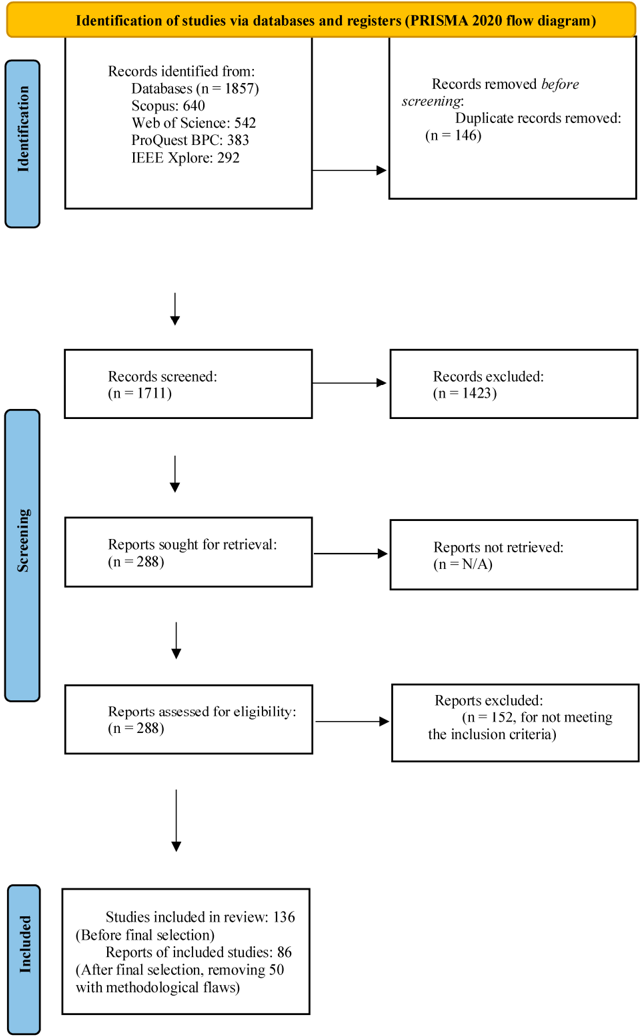
- Selection and analysis: from 1857 initial records, 146 duplicates were removed leaving 1711; title/abstract screening by two independent reviewers yielded 288; full-text review yielded 136; a final set of 86 articles was included. Data were extracted with a standardized form and managed in EndNote and spreadsheets; six hypotheses (H1–H6) were assessed against the synthesized evidence.
Limitations
- Stated by the paper: sources were restricted to peer-reviewed English-language articles from 2010 to 2023, potentially excluding policy reports, non-English scholarship, and recent gray literature; the evidence base remains largely cross-sectional; and the absence of effect-size data precluded formal publication-bias tests (e.g., Egger regression). The paper also lists broader limitations including variable data accuracy across countries, limited generalizability across institutional contexts, measurement error in variables such as digital adoption and trade levels, uneven data availability, and the rapid pace of technological change limiting long-term prediction.
- Evident from the text: the abstract states a 2010–2024 coverage window while the inclusion criteria and conclusions state 2010–2023, and the abstract claims eight databases while only four are named in the methods; several quantitative figures (e.g., the 17% lead-time reduction, 22% delay-cost reduction, 12% revenue-loss figure) are reported without full source detail in the provided text, and some cited references appear mismatched to their claims (e.g., a self-compassion meta-analysis cited for e-commerce export performance).
Model-written summary. Check it against the paper before relying on it.
Integrity signals
Registry
Cites
Statistics
Figures
Verification
Claims the paper makes
13 Valid · 9 Not valid · 42 Not checked · 55 Own results and interpretations
The cited sources support only part of this claim — read each source’s verdict below.
In the paper
“Digital policies can create an environment that is conducive to the development of these new business models, encouraging businesses to engage in international trade (Peng & Tao, 2022).”
§ Digital Transformation in International Trade: Opportunities, Challenges, and Policy Implications > 2.3. Countries and International Businesses
What the sources say
- Partly supportedcites Peng & Tao, 2022 matched to “Can digital transformation promote enterprise performance? —From the perspective of public policy and innovation” (2022) sourceExperimental — accuracy not yet measured
The Literature review (page unavailable) links digital transformation to business-model innovation, and the section on different policy stages reports stronger enterprise innovation and performance during the digital-policy stage. The paper does not establish that digital policies foster business models suited to the global economy or encourage firms to engage in international trade; searches for international trade, exports, and globalization found no such passage. (LLM, conf=0.78)
plainstates a cause- Asserted: passes — The authors put it forward as true.
- Checkable: passes — It can be checked against evidence.
- Load-bearing: unclear — It is unclear whether the paper’s conclusions depend on it.
- Based: passes — The paper gives a reason why it holds.
- Partly supported
The cited sources that could be checked couldn’t confirm or dispute this claim.
In the paper
“research by Purwaningsih et al. (2024) on manufacturing SMEs reveals that adopting multiple Industry 4.0 technologies raises export intensity by 6-10 percent”
§ Digital Transformation in International Trade: Opportunities, Challenges, and Policy Implications > Operational definition of digital transformation (DT):
What the sources say
- Could not verifycites Purwaningsih et al. (2024) matched to “Isolation and quantification of palmatine from Fibraurea tinctoria Lour: In vitro antioxidant activity and in silico antidiabetic activity evaluation” (2024) sourceExperimental — accuracy not yet measured
The Materials and Methods and Discussion passages concern palmatine, antioxidant testing, and molecular docking for antidiabetic activity; they do not address manufacturing SMEs. Searches for Industry 4.0 adoption and export intensity found no passage supporting the claimed 6–10 percent increase. (LLM, conf=0.78)
plainstates a cause- Asserted: passes — The authors put it forward as true.
- Checkable: passes — It can be checked against evidence.
- Load-bearing: unclear — It is unclear whether the paper’s conclusions depend on it.
- Based: passes — The paper gives a reason why it holds.
- Could not verify
The cited sources that could be checked couldn’t confirm or dispute this claim.
In the paper
“Many studies have suggested that the pandemic has broken down the resistance of enterprises to use digital technologies and has accelerated the digitization process (Lauring et al., 2022).”
§ Digital Transformation in International Trade: Opportunities, Challenges, and Policy Implications > 2.2. The Crisis and International Businesses
What the sources say
- Could not verifycites Lauring et al., 2022 matched to “The role of context in overcoming distance-related problems in global virtual teams: An organizational discontinuity theory perspective” (2022) sourceExperimental — accuracy not yet measured
The available Abstract says working at a distance became a hot topic after the COVID-19 outbreak and discusses global virtual teams. Searches for enterprise resistance, digital-technology adoption, and accelerated digitization found no passage addressing those claims. (LLM, conf=0.72)
hedgedstates a cause- Asserted: passes — The authors put it forward as true.
- Checkable: passes — It can be checked against evidence.
- Load-bearing: unclear — It is unclear whether the paper’s conclusions depend on it.
- Based: passes — The paper gives a reason why it holds.
- Could not verify
Every source the paper cites for this claim was checked and supports it.
In the paper
“According to the study of Brieger, S. A. et al., which was conducted based on multilevel modeling on a sample of more than 6000 entrepreneurs from 62 countries, digitalization increases the internationalization of new ventures like start-ups.”
§ Digital Transformation in International Trade: Opportunities, Challenges, and Policy Implications > 4.1. H1: Digitalization Accelerates the Process of International Trade
What the sources say
- Supportedcites Brieger et al., 2022 matched to “Digitalization, institutions and new venture internationalization” (2022) source
The Introduction states that the study found digitalization increases new-venture internationalization, and the Main results report a significant positive relationship. Data collection identifies a sample of 6,165 entrepreneurs from 62 countries; the paper also states that it used multilevel modeling. Here, digitalization specifically means using the internet to sell products or services. (LLM, conf=0.95)
plainstates a cause- Asserted: passes — The authors put it forward as true.
- Checkable: passes — It can be checked against evidence.
- Load-bearing: passes — The paper’s conclusions depend on it.
- Based: passes — The paper gives a reason why it holds.
- Supported
Every source the paper cites for this claim was checked and supports it.
In the paper
“Firms equipped with more digital technologies were less likely to be affected by the operational disruptions caused by the COVID-19 outbreak (J.Zhang & Qi, 2021).”
§ Digital Transformation in International Trade: Opportunities, Challenges, and Policy Implications > 4.2. H2: Global Crises (e.g., the COVID-19 Pandemic and Brexit) Influence Digitization and Might Decrease International Trade
What the sources say
- Supportedcites J.Zhang & Qi, 2021 matched to “Crisis Preparedness of Healthcare Manufacturing Firms during the COVID-19 Outbreak: Digitalization and Servitization” (2021) source
The Discussion (§6.1) states the claim directly as the authors’ result. The study concerns healthcare manufacturing firms, specifically Chinese medical device manufacturers. (LLM, conf=0.95)
plainstates an association- Asserted: passes — The authors put it forward as true.
- Checkable: passes — It can be checked against evidence.
- Load-bearing: passes — The paper’s conclusions depend on it.
- Based: passes — The paper gives a reason why it holds.
- Supported
34 more claims · 3 with their cited sources checked
Create a free account to see all 119 claims and to verify the 5 references still open.
- It may state two separate claims as one. 60
- Probably not a substantial claim. 36
- Borderline: one of the tests for a substantial claim is unclear. 1
Self-check
Percentages, sums and reported differences re-computed from the paper’s own numbers.
Each contradiction between two passages listed here was confirmed by an independent check.
Rated major: it would touch a result — a value a result rests on, reported and recomputed p-values on opposite sides of the significance level, two passages that conflict with no sign which is right, or a cited work retracted before this paper was published.
In the paper
§ Digital Transformation in International Trade: Opportunities, Challenges, and Policy Implications > Abstract
“we conducted a PRISMA-compliant systematic literature review covering 2010-2024.”
§ Digital Transformation in International Trade: Opportunities, Challenges, and Policy Implications > 3.2. Inclusion and Exclusion Criteria
“Time Frame: Publications from January 2010 to October 2023 capture the latest advancements.”
Rated minor: it would not touch a result — a value no result rests on, a p-value that stays on the same side of the significance level, or a conflict that is clerical, resolved elsewhere in the paper, or outside its own findings.
In the paper
§ Digital Transformation in International Trade: Opportunities, Challenges, and Policy Implications > Operational definition of digital transformation (DT):
“At the firm level, research by Purwaningsih et al. (2024) on manufacturing SMEs reveals that adopting multiple Industry 4.0 technologies raises export intensity by 6-10 percent”
§ Digital Transformation in International Trade: Opportunities, Challenges, and Policy Implications > References
“109. Purwaningsih, I., Maksum, I. P., Sumiarsa, D., & Sriwidodo, S. (2024). Isolation and quantification of palmatine from Fibraurea tinctoria Lour: In vitro antioxidant activity and in silico antidiabetic activity evaluation. Drug Design, Development and Therapy, 18, 3443-3459.”
Rated minor: it would not touch a result — a value no result rests on, a p-value that stays on the same side of the significance level, or a conflict that is clerical, resolved elsewhere in the paper, or outside its own findings.
In the paper
§ Digital Transformation in International Trade: Opportunities, Challenges, and Policy Implications > Operational definition of digital transformation (DT):
“Drawing on Vial (2019) and Reis et al. (2021), we define digital transformation as "the process of leveraging interconnected information, communication, and computing technologies to generate fundamental changes in how value is created and captured across organisational and societal levels."”
§ Digital Transformation in International Trade: Opportunities, Challenges, and Policy Implications > References
“113. Reis, N. A., Kowalski, K. C., Mosewich, A. D., & Ferguson, L. J. (2021). 'That's how I am dealing with it-That is dealing with it': Exploring men athletes' self-compassion through the lens of masculinity. Qualitative Research in Sport, Exercise and Health, 14(2), 245-267.”
Rated minor: it would not touch a result — a value no result rests on, a p-value that stays on the same side of the significance level, or a conflict that is clerical, resolved elsewhere in the paper, or outside its own findings.
In the paper
§ Digital Transformation in International Trade: Opportunities, Challenges, and Policy Implications > 4.6. H6: The Impact of Digital Technology on International Trade Varies Depending on the Level of Economic Development and Institutional Context of a Country
“Similarly, a study by Wang et al. (2020) found that institutional quality, digital infrastructure, and international trade are positively correlated in China.”
§ Digital Transformation in International Trade: Opportunities, Challenges, and Policy Implications > References
“132. Wang, C., Pan, R., Wan, X., Tan, Y., Xu, L., McIntyre, R. S., Choo, F. N., Tran, B., Ho, R., Sharma, V. K., & Ho, C. (2020). A longitudinal study on the mental health of general population during the COVID-19 epidemic in China. Brain Behavior and Immunity, 87, 40-48. [CrossRef] PubMed”
Rated minor: it would not touch a result — a value no result rests on, a p-value that stays on the same side of the significance level, or a conflict that is clerical, resolved elsewhere in the paper, or outside its own findings.
In the paper
§ Digital Transformation in International Trade: Opportunities, Challenges, and Policy Implications > 4.5. H5: Countries with Better Digital Infrastructure and Policies Are More Likely to Have Higher Levels of International Trade
“For instance, a study by Liao et al. (2021) found that the effect of e-commerce adoption on export performance is stronger in countries with higher levels of economic development and human capital.”
§ Digital Transformation in International Trade: Opportunities, Challenges, and Policy Implications > References
“88. Liao, K. Y. H., Stead, G. B., & Liao, C. Y. (2021). A meta-analysis of the relation between self-compassion and self-efficacy. Mindfulness, 12, 1878-1891.”
1 more finding
Create a free account to see every finding of this check.
Citations
Cites
PRISMA-P Group, Moher, D., Shamseer, L., Clarke, M., Ghersi, D., Liberati, A., Petticrew, M., Shekelle, P., & Stewart, L. A. (2015) · Systematic Reviews · doi:10.1186/2046-4053-4-1 · Cited by 26,223
How to conduct a bibliometric analysis: An overview and guidelines
Donthu, N., Kumar, S., Mukherjee, D., Pandey, N., & Lim, W. M. (2021) · Journal of Business Research · doi:10.1016/j.jbusres.2021.04.070 · Cited by 14,329
Understanding digital transformation: A review and a research agenda
Vial, G. (2019) · The Journal of Strategic Information Systems · doi:10.1016/j.jsis.2019.01.003 · Cited by 7,337
Innovation, organizational capabilities, and the born-global firm
Knight, G. A., & Cavusgil, S. T. (2004) · Journal of International Business Studies · doi:10.1057/palgrave.jibs.8400071 · Cited by 4,295
Wang, C., Pan, R., Wan, X., Tan, Y., Xu, L., McIntyre, R. S., Choo, F. N., Tran, B., Ho, R., Sharma, V. K., et al. (2020) · Brain, Behavior, and Immunity · doi:10.1016/j.bbi.2020.04.028 · Cited by 2,571
1 Blockchain’s roles in meeting key supply chain management objectives
Kshetri, N. (2018) · International Journal of Information Management · doi:10.1016/j.ijinfomgt.2017.12.005 · Cited by 2,149
Digital transformation by SME entrepreneurs: A capability perspective
Li, L., Su, F., Zhang, W., & Mao, J. (2018) · Information Systems Journal · doi:10.1111/isj.12153 · Cited by 1,396
The Great Convergence: Information Technology and the New Globalization
Baldwin, R. (2016) · doi:10.2307/j.ctv24w655w · Cited by 1,241
The Great Convergence: Information Technology and the New Globalization
Baldwin, R. (2017) · doi:10.4159/9780674972667 · Cited by 1,241
Dwivedi, Y. K., Hughes, D. L., Coombs, C., Constantiou, I., Duan, Y., Edwards, J. S., Gupta, B., Lal, B., Misra, S., Prashant, P., et al. (2020) · International Journal of Information Management · doi:10.1016/j.ijinfomgt.2020.102211 · Cited by 1,232
The concept of project complexity—a review
Baccarini, D. (1996) · International Journal of Project Management · doi:10.1016/0263-7863(95)00093-3 · Cited by 1,192
Hong, Q. N., Gonzalez‐Reyes, A., & Pluye, P. (2018) · Journal of Evaluation in Clinical Practice · doi:10.1111/jep.12884 · Cited by 1,107
Scanning the Industry 4.0: A Literature Review on Technologies for Manufacturing Systems
Alcácer, V., & Cruz-Machado, V. (2019) · Engineering Science and Technology, an International Journal · doi:10.1016/j.jestch.2019.01.006 · Cited by 1,063
COVID-19 and Digitalization: The Great Acceleration
Amankwah-Amoah, J., Khan, Z., Wood, G., & Knight, G. (2021) · Journal of Business Research · doi:10.1016/j.jbusres.2021.08.011 · Cited by 947
Peng, Y., & Tao, C. (2022) · Journal of Innovation & Knowledge · doi:10.1016/j.jik.2022.100198 · Cited by 745
Li, F. (2020) · Technovation · doi:10.1016/j.technovation.2017.12.004 · Cited by 733
Zhao, G., Liu, S., Lopez, C., Lu, H., Elgueta, S., Chen, H., & Boshkoska, B. M. (2019) · Computers in Industry · doi:10.1016/j.compind.2019.04.002 · Cited by 731
Industry 4.0, global value chains and international business
Strange, R., & Zucchella, A. (2017) · Multinational Business Review · doi:10.1108/mbr-05-2017-0028 · Cited by 631
The usage of digital marketing channels in SMEs
Taiminen, H. M., & Karjaluoto, H. (2015) · Journal of Small Business and Enterprise Development · doi:10.1108/jsbed-05-2013-0073 · Cited by 573
Divided by the vote: Affective polarization in the wake of the Brexit referendum
Hobolt, S. B., Leeper, T. J., & Tilley, J. (2021) · British Journal of Political Science · doi:10.1017/s0007123420000125 · Cited by 496
Feliciano-Cestero, M. M., Ameen, N., Kotabe, M., Paul, J., & Signoret, M. (2023) · Journal of Business Research · doi:10.1016/j.jbusres.2022.113546 · Cited by 438
Guo, H., Yang, Z., Huang, R., & Guo, A. (2020) · Frontiers of Business Research in China · doi:10.1186/s11782-020-00087-1 · Cited by 379
Joseph, J., & Gaba, V. (2020) · Academy of Management Annals · doi:10.5465/annals.2017.0103 · Cited by 350
Gölzer, P., & Fritzsche, A. (2017) · Production Planning & Control · doi:10.1080/09537287.2017.1375148 · Cited by 303
International Trade, Foreign Direct Investment, and Technology Spillovers
Keller, W. (2009) · National Bureau of Economic Research · doi:10.3386/w15442 · Cited by 300
International Trade, Foreign Direct Investment, and Technology Spillovers
Keller, W. (2010) · Handbook of the Economics of Innovation · doi:10.1016/s0169-7218(10)02003-4 · Cited by 299
Entrepreneurial universities: A bibliometric analysis within the business and management domains
Forliano, C., De Bernardi, P., & Yahiaoui, D. (2021) · Technological Forecasting and Social Change · doi:10.1016/j.techfore.2020.120522 · Cited by 298
The relationship between digital technologies and internationalisation. Evidence from Italian SMEs
Cassetta, E., Monarca, U., Dileo, I., Di Berardino, C., & Pini, M. (2020) · Industry and Innovation · doi:10.1080/13662716.2019.1696182 · Cited by 263
The impact of e-commerce on international trade and employment
Terzi, N. (2011) · Procedia - Social and Behavioral Sciences · doi:10.1016/j.sbspro.2011.09.010 · Cited by 241
The Governance of the Global Factory: Location and Control of World Economic Activity
Buckley, P. J., & Strange, R. (2015) · Academy of Management Perspectives · doi:10.5465/amp.2013.0113 · Cited by 236
Is the World Really Flat? A Look at Offshoring at an Online Programming Marketplace1
Gefen, D., & Carmel, E. (2008) · MIS Quarterly · doi:10.2307/25148844 · Cited by 231
Zhang, T., Shi, Z.-Z., Shi, Y.-R., & Chen, N.-J. (2022) · Economic Research-Ekonomska Istraživanja · doi:10.1080/1331677x.2021.1980731 · Cited by 218
The Internet of Things: Are you ready for what’s coming?
Saarikko, T., Westergren, U. H., & Blomquist, T. (2017) · Business Horizons · doi:10.1016/j.bushor.2017.05.010 · Cited by 207
Lee, Y. Y., & Falahat, M. (2019) · Technology Innovation Management Review · doi:10.22215/timreview/1281 · Cited by 200
Ho, S. M., Ocasio-Velázquez, M., & Booth, C. (2017) · Computers & Security · doi:10.1016/j.cose.2017.08.004 · Cited by 186
Hervé, A., Schmitt, C., & Baldegger, R. (2020) · Technology Innovation Management Review · doi:10.22215/timreview/1343 · Cited by 172
The complexity of decision-making processes and IoT adoption in accommodation SMEs
Παππάς, Ν., Caputo, A., Pellegrini, M. M., Marzi, G., & Michopoulou, E. (2021) · Journal of Business Research · doi:10.1016/j.jbusres.2021.01.010 · Cited by 153
Assessment of Complexity in Cloud Computing Adoption: a Case Study of Local Governments in Australia
Ali, O., Shrestha, A., Ghasemaghaei, M., & Beydoun, G. (2021) · Information Systems Frontiers · doi:10.1007/s10796-021-10108-w · Cited by 153
The New Economics of Multi-Sided Platforms: A Guide to the VocabularyPreprint
Evans, D. S., & Schmalensee, R. (2016) · SSRN Electronic Journal · doi:10.2139/ssrn.2793021 · Cited by 130
INNOVATORS AND EARLY ADOPTERS IN THE DIFFUSION OF INNOVATIONS: A LITERATURE REVIEW
DEDEHAYIR, O., ORTT, R. J., RIVEROLA, C., & MIRALLES, F. (2017) · International Journal of Innovation Management · doi:10.1142/s1363919617400102 · Cited by 129
Dutta, D. A. (2020) · International Journal of Scientific and Research Publications (IJSRP) · doi:10.29322/ijsrp.10.05.2020.p10169 · Cited by 122
Ameen, N., Tarhini, A., Shah, M. H., Madichie, N., Paul, J., & Choudrie, J. (2021) · Computers in Human Behavior · doi:10.1016/j.chb.2020.106531 · Cited by 122
Impact of Digitalization on the Speed of Internationalization
Lee, Y.-Y., Falahat, M., & Sia, B.-K. (2019) · International Business Research · doi:10.5539/ibr.v12n4p1 · Cited by 116
Queiroz, M. M., Fosso Wamba, S., Machado, M. C., & Telles, R. (2020) · Business Process Management Journal · doi:10.1108/bpmj-03-2019-0134 · Cited by 114
A meta-analysis of the relation between self-compassion and self-efficacy
Liao, K. Y.-H., Stead, G. B., & Liao, C.-Y. (2021) · Mindfulness · doi:10.1007/s12671-021-01626-4 · Cited by 109
Modeling of an IoT-enabled supply chain for perishable food with two-echelon supply hubs
Zhang, Y., Zhao, L., & Qian, C. (2017) · Industrial Management & Data Systems · doi:10.1108/imds-10-2016-0456 · Cited by 108
Introduction to the Handbook on Global Value Chains
Ponte, S., Gereffi, G., & Raj‐Reichert, G. (2019) · Edward Elgar Publishing eBooks · doi:10.4337/9781788113779.00005 · Cited by 107
Peñarroja, V., Sánchez, J., Gamero, N., Orengo, V., & Zornoza, A. M. (2019) · Behaviour & Information Technology · doi:10.1080/0144929x.2018.1564070 · Cited by 104
Costa, E., Soares, A. L., & de Sousa, J. P. (2020) · International Journal of Information Management · doi:10.1016/j.ijinfomgt.2020.102070 · Cited by 100
The Impact Of Digital Economy On International Trade
Ahmedov, I. (2020) · European Journal of Business and Management Research · doi:10.24018/ejbmr.2020.5.4.389 · Cited by 96
Fachrunnisa, O., & Hussain, F. K. (2020) · International Journal of Engineering Business Management · doi:10.1177/1847979020966400 · Cited by 94
Digitalization, institutions and new venture internationalization
Brieger, S. A., Chowdhury, F., Hechavarría, D. M., Muralidharan, E., Pathak, S., & Lam, Y. T. (2022) · Journal of International Management · doi:10.1016/j.intman.2022.100949 · Cited by 69
The birth of new HGEs: internationalization through new digital technologies
Teruel, M., Coad, A., Domnick, C., Flachenecker, F., Harasztosi, P., Janiri, M. L., & Pál, R. (2021) · The Journal of Technology Transfer · doi:10.1007/s10961-021-09861-6 · Cited by 68
Digital technologies and learning within asymmetric alliances: The role of collaborative context
Cherbib, J., Chebbi, H., Yahiaoui, D., Thrassou, A., & Sakka, G. (2020) · Journal of Business Research · doi:10.1016/j.jbusres.2020.11.064 · Cited by 63
Zheng, T., Ardolino, M., Bacchetti, A., & Perona, M. (2021) · Benchmarking An International Journal · doi:10.1108/bij-01-2021-0056 · Cited by 56
Saadeh, M., Sleit, A., Sabri, K. E., & Almobaideen, W. A. (2018) · Journal of Network and Computer Applications · doi:10.1016/j.jnca.2018.07.009 · Cited by 51
What affects digitalization process in developing economies? An evidence from SMEs sector in Oman
Alraja, M. N., Hussein, M. A., & Ahmed, H. M. S. (2021) · Bulletin of Electrical Engineering and Informatics · doi:10.11591/eei.v10i1.2033 · Cited by 49
United Nations Conference on Trade and Development—UNCTAD
Canton, H. (2021) · The Europa Directory of International Organizations 2021 · doi:10.4324/9781003179900-26 · Cited by 49
Pereira, C. S., Veloso, B., Durão, N., & Moreira, F. (2022) · Procedia Computer Science · doi:10.1016/j.procs.2021.11.071 · Cited by 46
Policy Preferences and Policy Legitimacy After Referendums: Evidence from the Brexit Negotiations
HOBOLT, S. B., Tilley, J. R., & Leeper, T. J. (2020) · Political Behavior · doi:10.1007/s11109-020-09639-w · Cited by 44
Zhang, J., & Qi, L. (2021) · International Journal of Environmental Research and Public Health · doi:10.3390/ijerph18105456 · Cited by 42
Döhring, B., Hristov, A., Maier, C., Roeger, W., & Thum-Thysen, A. (2021) · International Economics and Economic Policy · doi:10.1007/s10368-021-00511-8 · Cited by 42
Trade and Development Report 2020
Development, U. N. C. O. T. A. (2020) · Trade and development report · doi:10.18356/aea7b3b9-en · Cited by 42
Complexity in international business: The implications for theory
Casson, M., & Li, Y. (2022) · Journal of International Business Studies · doi:10.1057/s41267-021-00495-2 · Cited by 41
Pan, L., Fu, X., & Li, Y. (2023) · Electronic Commerce Research · doi:10.1007/s10660-022-09539-7 · Cited by 39
Lauring, J., Drogendijk, R., & Kubovcikova, A. (2022) · The International Journal of Human Resource Management · doi:10.1080/09585192.2021.1960584 · Cited by 38
Bilge, E. Ç., & Yaman, H. (2021) · Construction Innovation · doi:10.1108/ci-04-2019-0036 · Cited by 37
Al-Isma’ili, S., Li, M., Shen, J., & He, Q. (2016) · Swinburne figshare (Swinburne University of Technology) · doi:10.48550/arxiv.1606.00745 · Cited by 36
Technological complexity and economic development
Nepelski, D., & Prato, G. D. (2020) · Review of Development Economics · doi:10.1111/rode.12650 · Cited by 35
Global Value Chain Analysis: A Primer (Second Edition)
Gereffi, G., & Fernández-Stark, K. (2018) · Cambridge University Press eBooks · doi:10.1017/9781108559423.012 · Cited by 34
MATARAZZO, M., PENCO, L., & PROFUMO, G. (2021) · Sinergie Italian Journal of Management · doi:10.7433/s113.2020.06 · Cited by 25
Reis, N. A., Kowalski, K. C., Mosewich, A. D., & Ferguson, L. J. (2022) · Qualitative Research in Sport, Exercise and Health · doi:10.1080/2159676x.2021.1920455 · Cited by 24
Великая конвергенция: информационные технологии и Новая глобализация
Baldwin, R., & Левченко, О. (2017) · Journal of Economic Sociology · doi:10.17323/1726-3247-2017-5-40-51 · Cited by 20
Shirkoohi, S. M., & Mohiuddin, M. (2025) · Journal of theoretical and applied electronic commerce research · doi:10.3390/jtaer20020126 · Cited by 18
Self-citationMishra, A., Karmakar, A., Ghatak, A., et al. (2019) · International journal of scientific and technology research · Cited by 12
Enhanced DWT for Denoising Heartbeat Signal in Non-Invasive Detection
Zhu, P., Feng, L., Yu, K., Zhang, Y., Chen, W., & Hao, J. (2025) · Sensors · doi:10.3390/s25061743 · Cited by 12
Sustainable International Business Models in a Digitally Transforming World
Khare, A., Ojala, A., & Baber, W. W. (2022) · Routledge eBooks · doi:10.4324/9781003195986 · Cited by 9
Purwaningsih, I., Maksum, I., Sumiarsa, D., & Sriwidodo, S. (2024) · Drug Design, Development and Therapy · doi:10.2147/dddt.s454091 · Cited by 8
Introduction to the Handbook of Research on Strategic Leadership in the Fourth Industrial Revolution
(2024) · Edward Elgar Publishing eBooks · doi:10.4337/9781802208818.00005 · Cited by 4
Zhu, P., Feng, L., Yu, K., Zhang, Y., Chen, W., & Hao, J. (2025) · Sensors · doi:10.3390/s25103050 · Cited by 3
Interdisciplinary Training and Mentoring for Cyber Security in Companies
Hamburg, I. (2020) · Advances in information security, privacy, and ethics book series · doi:10.4018/978-1-7998-5728-0.ch018 · Cited by 2
The Effect of Brexit on the Management Consulting Industry for UK- and EU-based Firms
McGovern, M. (2023) · Management Consulting Journal · doi:10.2478/mcj-2023-0004 · Cited by 1
Interdisciplinary Training and Mentoring for Cyber Security in Companies
Hamburg, I. (2021) · IGI Global eBooks · doi:10.4018/978-1-6684-3698-1.ch008
(2019) · ADB Annual Reports · doi:10.22617/fls190058
Erratum: Innovation, organizational capabilities, and the born-global firm
Knight, G. A., & Cavusgil, S. T. (2004) · Journal of International Business Studies · doi:10.1057/palgrave.jibs.8400096
(2019) · World Trade Report · doi:10.30875/dad21499-en
Research works printed but not linked: 2
- 22. Brynjolfsson, E., & McAfee, A. (2014). The second machine age: Work, progress, and prosperity in a time of brilliant technologies. W W Norton & Co. Buckley, P. J., & Strange, R. (2015). The governance of the global factory: Location and control of world economic activity. Academy of Management Perspectives, 29(2), 237-249.
- 143. Zhao, T., Zhang, Z., & Liang, S. (2020). Digital economy, entrepreneurship, and high-quality economic development: Empirical evidence from urban China. Journal of Management World, 36(10), 65-76.
Cited by
Alassuli, A., Eltweri, A. A., Thuneibat, N. S. M., Al‐Hajaya, K., & Ismail, S. M. (2026) · Administrative Sciences · doi:10.3390/admsci16030122 · Cited by 20
Leveraging Generative AI for sustainable supply chain: adoption challenges and strategic insights
Maghroor, H. R., Madanchi, F., & O’Neal, T. (2025) · Production Planning & Control · doi:10.1080/09537287.2025.2561967 · Cited by 19
Lai, Z., Sumbal, S., Khaskheli, M. B., & Ying, W. (2025) · Sustainability · doi:10.3390/su172411353 · Cited by 12
The role of digital transformation in the internationalization process – a synthesis and way forward
Singh, P., Anand, A., Shet, S. V., & Cretu, O. (2025) · International Marketing Review · doi:10.1108/imr-10-2024-0422 · Cited by 12
Leveraging AI and blockchain for GVC resilience: a case study approach
Shirkoohi, S. M., & Mohiuddin, M. (2025) · International Journal of Logistics Research and Applications · doi:10.1080/13675567.2025.2584309 · Cited by 7
“…extensively documented AI’s role in improving demand forecasting accuracy, enabling predictive maintenance to reduce asset downtime, and optimising logistics through intelligent routing and inventory management (Baryannis, Dani, and Antoniou 2019; Mirzaye and Mohiuddin 2025; Nandi et al. 2021).”
Self-citation
Metadata
- Authors
- Mirzaye, S., & Mohiuddin, M.
- Affiliations
- Département de Management, Laval University (Université Laval), Pavillon Palasis-Prince, 2325 Rue de la Terrasse, Québec, QC G1V 0A6, Canada
- Université Laval (CA)
- Venue
- Journal of Risk and Financial Management
- Publisher
- MDPI AG
- Published
- 2025-08-01
- Volume
- 18
- Issue
- 8
- Pages
- 421
- ISSN
- 1911-8066 (ISSN-L)
- 1911-8074
- OpenAlex
- W4412932018
- Cited by
- 86
- References
- 77
- Citations by year
- 2026: 67 · 2025: 19
- FWCI
- 83.58
- Type
- journal article
- Language
- en
- Open access
- hybrid
- doi.org
- Licence
- Locations
- Journal of risk and financial management (publishedVersion, cc-by)
- Topics
- Social Sciences › Economics, Econometrics and Finance › General Economics, Econometrics and Finance › Global trade and economics
- Social Sciences › Business, Management and Accounting › Business and International Management › E-commerce and Technology Innovations
- Social Sciences › Business, Management and Accounting › Strategy and Management › Digital Economy and Transformation
- Keywords
- digital transformation, international trade, small and medium-sized enterprises, cross-border trade, e-commerce platforms, cloud services, Internet of Things, artificial intelligence, export intensity, digital infrastructure, cybersecurity, regulatory fragmentation, data governance, digital readiness, internationalization of firms, trade policy
About these checks
Registry, retraction, Cites and statistics results are computed, not judged, with one exception: a printed reference that no index lists is read once by a model before it counts as a citation error. Claims are extracted by a model and kept only when their quote appears verbatim in the text; each cited source is then checked, with a model’s help, for whether it says what the claim relies on. Those verdicts can be wrong — read the claim’s quote and the cited source before relying on one.
The claim verdicts this report counts are experimental: their accuracy is not yet measured.
A language model drew the claims from the paper on 2026-10-10, under version 3 of the claim definition (model deepseek-v4.1-flash, prompt extract-v3).
A second model labelled each claim on 2026-10-10 (model jev-1.13-20260917, definition revision gold-guideline-v0.2).
Cited sources are checked with a language model’s help (gpt-6-sol).
Statistics and arithmetic are recomputed, not judged.
Confidence bands are shown only for fields calibrated on our annotated test set. None is calibrated yet, so no band is shown.
What counts as a claim ›How we measure confidence ›How we check this ›
Are you an author, or do you see a problem with this page? Request a review
Data sources
Bibliographic data: Semantic Scholar, OpenAlex, Crossref.
Contains information from the Semantic Scholar Academic Graph Datasets, made available under the ODC Attribution License (ODC-BY 1.0).
Semantic Scholar’s data is described in: Kinney, R., et al. (2023). The Semantic Scholar Open Data Platform. arXiv:2301.10140.
