

The DOI matches its Crossref record; 62 of the 64 references it cites were found in a registry or an index.
Physical and Psychological Effects Related to Food Habits and Lifestyle Changes Derived from COVID-19 Home Confinement in the Spanish Population
Open accessPublished version of a preprint
Abstract
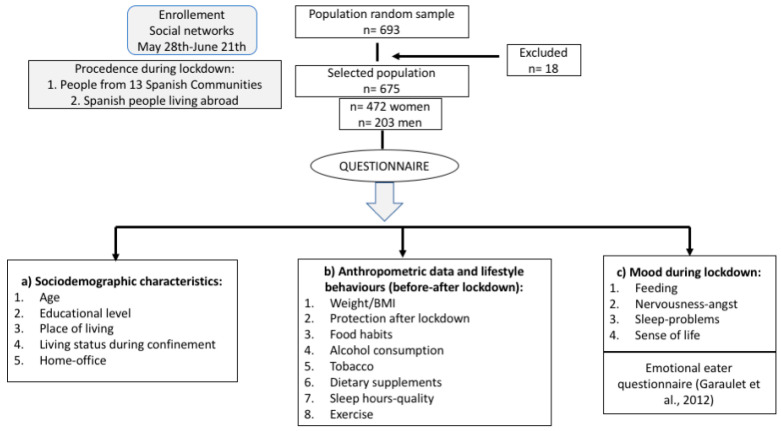
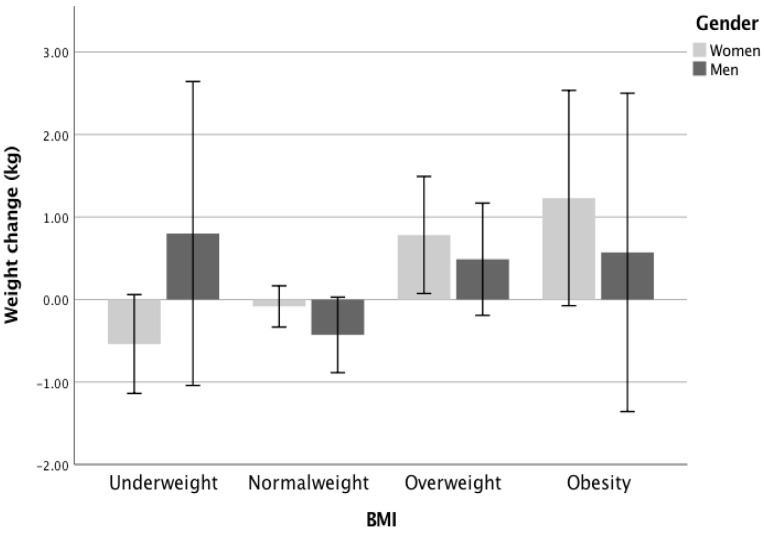
As a consequence of COVID-19, millions of households have suffered mobility restrictions and changes in their lifestyle over several months. The aim of this study is to evaluate the effects of COVID-19 home confinement on the food habits, lifestyle and emotional balance of the Spanish population. This cross-sectional study used data collected via an anonymous online questionnaire during the month before lockdown finished in Spain, with a total of 675 participants. 38.8% of the respondents experienced weight gain while 31.1% lost weight during confinement. The increase in body weight was positively correlated with age (Rs = 0.14, p < 0.05) and BMI (Rs = 0.20, p < 0.05). We also identified that 39.7% reported poorer quality sleep, positively correlated with BMI (Rs = −0.18, p < 0.05) and with age (Rs = −0.21, p < 0.05). 44.7% of the participants had not performed physical exercise during confinement with differences by sex (p < 0.05), by age (p < 0.05), by BMI (p < 0.05) and by sleep quality (p < 0.05). According to an emotional-eater questionnaire, 21.8% and 11% were classified as an emotional eater or a very emotional eater, respectively. We emphasize the importance of adopting a healthy lifestyle, as the COVID-19 pandemic is ongoing.
Overview
The claims and statistics of this paper haven’t been checked yet.
Run the check — free, no account needed. It reads the open-access text and checks the sources it cites.
Integrity signals
Registry
Cites
Statistics
Figures
Verification
Claims the paper makes
The claims and statistics of this paper haven’t been checked yet.
Run the check — free, no account needed. It reads the open-access text and checks the sources it cites.
Claims other papers make about this one
Each is checked against this paper’s own text: does it say what the citing paper says it does?
The source backs part of the claim, not all of it — or backs it for a different population, condition or comparison.
In the citing paper
“Evidence from the early stages of the pandemic also suggests that adults with overweight and obesity were vulnerable to weight gain and changes in eating behaviour (e.g., increased emotional eating) [9–11].”
From Supporting Weight Management during COVID-19 (SWiM-C): twelve-month follow-up of a randomised controlled trial of a web-based, ACT-based, guided self-help intervention (2023) · cites this paper as [9]
Experimental — accuracy not yet measured
Self-check
Percentages, sums and reported differences re-computed from the paper’s own numbers.
The self-check needs the paper’s full text.
Citations
Cites
(2000) · PubMed · Cited by 13,173
Obesity : Preventing and managing the global epidemic
Akram, D. S., Astrup, A. V., Atinmo, T., Boissin, J.-L., Bray, G. A., Carroll, K. N., Chitson, P., Chen, C., Dietz, W. H., Hill, J. O., et al. (2000) · Research at the University of Copenhagen (University of Copenhagen) · Cited by 12,945
Wang, C., Pan, R., Wan, X., Tan, Y., Xu, L., Ho, C. S., & Ho, R. C. (2020) · International Journal of Environmental Research and Public Health · doi:10.3390/ijerph17051729 · Cited by 9,923
Gorbalenya, A. E., Baker, S. C., Baric, R. S., de Groot, R. J., Drosten, C., Gulyaeva, A. A., Haagmans, B. L., Lauber, C., Leontovich, A. M., Neuman, B. W., et al. (2020) · Nature Microbiology · doi:10.1038/s41564-020-0695-z · Cited by 8,745
Wu, C., Chen, X., Cai, Y., Xia, J., Zhou, X., Xu, S., Huang, H., Zhang, L., Zhou, X., Du, C., et al. (2020) · JAMA Internal Medicine · doi:10.1001/jamainternmed.2020.0994 · Cited by 8,249
The psychological impact of the COVID-19 epidemic on college students in China
Cao, W., Fang, Z., Hou, G., Han, M., Xu, X., Dong, J., & Zheng, J. (2020) · Psychiatry Research · doi:10.1016/j.psychres.2020.112934 · Cited by 5,843
Huang, Y., & Zhao, N. (2020) · Psychiatry Research · doi:10.1016/j.psychres.2020.112954 · Cited by 3,736
Estimates of the severity of coronavirus disease 2019: a model-based analysis
Verity, R., Okell, L. C., Dorigatti, I., Winskill, P., Whittaker, C., Imai, N., Cuomo-Dannenburg, G., Thompson, H., Walker, P. G. T., Fu, H., et al. (2020) · The Lancet Infectious Diseases · doi:10.1016/s1473-3099(20)30243-7 · Cited by 3,660
Pappa, S., Ntella, V., Giannakas, T., Giannakoulis, V. G., Papoutsi, E., & Katsaounou, P. (2020) · Brain Behavior and Immunity · doi:10.1016/j.bbi.2020.05.026 · Cited by 3,617 · cited 1×
“9% across five studies) during this outbreak [48].”
BackgroundEating habits and lifestyle changes during COVID-19 lockdown: an Italian survey.
Di Renzo, L., Gualtieri, P., Pivari, F., Soldati, L., Attinà, A., Cinelli, G., Leggeri, C., Caparello, G., Barrea, L., Scerbo, F., et al. (2020) · Journal of Translational Medicine · doi:10.1186/s12967-020-02399-5 · Cited by 2,234
Grant, W. B., Lahore, H., McDonnell, S. L., Baggerly, C. A., French, C., Aliano, J. L., & Bhattoa, H. P. (2020) · Nutrients · doi:10.3390/nu12040988 · Cited by 2,128
Ammar, A., Brach, M., Trabelsi, K., Chtourou, H., Boukhris, O., Masmoudi, L., Bouaziz, B., Bentlage, E., How, D., Ahmed, M., et al. (2020) · Nutrients · doi:10.3390/nu12061583 · Cited by 2,073
Stanton, R., To, Q. G., Khalesi, S., Williams, S. L., Alley, S. J., Thwaite, T. L., Fenning, A. S., & Vandelanotte, C. (2020) · International Journal of Environmental Research and Public Health · doi:10.3390/ijerph17114065 · Cited by 1,386
González-Sanguino, C., Ausín, B., Castellanos, M. Á., Saiz, J., López-Gómez, A., Ugidos, C., & Muñoz, M. (2020) · Brain, Behavior, and Immunity · doi:10.1016/j.bbi.2020.05.040 · Cited by 1,373
Restrained and unrestrained eating1
Herman, C. P., & Mack, D. (1975) · Journal of Personality · doi:10.1111/j.1467-6494.1975.tb00727.x · Cited by 1,295
Chen, P., Mao, L., Nassis, G. P., Harmer, P., Ainsworth, B. E., & Li, F. (2020) · Journal of Sport and Health Science · doi:10.1016/j.jshs.2020.02.001 · Cited by 1,248
Dietary Choices and Habits during COVID-19 Lockdown: Experience from Poland
Sidor, A., & Rzymski, P. (2020) · Nutrients · doi:10.3390/nu12061657 · Cited by 1,178
Changes in sleep pattern, sense of time and digital media use during COVID‐19 lockdown in Italy
Cellini, N., Canale, N., Mioni, G., & Costa, S. (2020) · Journal of Sleep Research · doi:10.1111/jsr.13074 · Cited by 1,079
Ozamiz-Etxebarria, N., Dosil-Santamaria, M., Picaza-Gorrochategui, M., & Idoiaga-Mondragon, N. (2020) · Cadernos de Saúde Pública · doi:10.1590/0102-311x00054020 · Cited by 892
Ruiz-Roso, M. B., Padilha, P. D. C., Mantilla-Escalante, D. C., Natalia Ulloa, M., Brun, P., Acevedo, D., Peres, W. A. F., Martorell, M., Aires, M. T., Cardoso, L. D. O., et al. (2020) · Nutrients · doi:10.3390/nu12061807 · Cited by 757
Casagrande, M., Favieri, F., Tambelli, R., & Forte, G. (2020) · Sleep Medicine · doi:10.1016/j.sleep.2020.05.011 · Cited by 735
Alcohol use and misuse during the COVID-19 pandemic: a potential public health crisis?
Clay, J. M., & Parker, M. O. (2020) · The Lancet Public Health · doi:10.1016/s2468-2667(20)30088-8 · Cited by 617
Changes in Dietary Behaviours during the COVID-19 Outbreak Confinement in the Spanish COVIDiet Study
Rodríguez‐Pérez, C., Molina‐Montes, E., Verardo, V., Artacho, R., García‐Villanova, B., Guerra-Hernández, E. J., & Ruiz‐López, M. D. (2020) · Nutrients · doi:10.3390/nu12061730 · Cited by 581
Ozamiz-Etxebarria, N., Dosil-Santamaria, M., Picaza-Gorrochategui, M., & Idoiaga-Mondragon, N. (2021) · SciELO journals · doi:10.6084/m9.figshare.14280665 · Cited by 575
Scarmozzino, F., & Visioli, F. (2020) · Foods · doi:10.3390/foods9050675 · Cited by 569
The impact of nutrition on COVID-19 susceptibility and long-term consequences
Butler, M. J., & Barrientos, R. M. (2020) · Brain Behavior and Immunity · doi:10.1016/j.bbi.2020.04.040 · Cited by 562
The Perpetual Challenge of Infectious Diseases
Fauci, A. S., & Morens, D. M. (2012) · New England Journal of Medicine · doi:10.1056/nejmra1108296 · Cited by 550
Self-quarantine and weight gain related risk factors during the COVID-19 pandemic
Zachary, Z., Brianna, F., Brianna, L., Garrett, P., Jade, W., Alyssa, D., & Mikayla, K. (2020) · Obesity Research & Clinical Practice · doi:10.1016/j.orcp.2020.05.004 · Cited by 548
Nutritional recommendations for CoVID-19 quarantine
Muscogiuri, G., Barrea, L., Savastano, S., & Colao, A. (2020) · European Journal of Clinical Nutrition · doi:10.1038/s41430-020-0635-2 · Cited by 545
Mattioli, A. V., Sciomer, S., Cocchi, C., Maffei, S., & Gallina, S. (2020) · Nutrition, Metabolism and Cardiovascular Diseases · doi:10.1016/j.numecd.2020.05.020 · Cited by 540
COVID-19 virus outbreak lockdown: What impacts on household food wastage?
Jribi, S., Ben Ismail, H., Doggui, D., & Debbabi, H. (2020) · Environment, Development and Sustainability · doi:10.1007/s10668-020-00740-y · Cited by 473 · cited 1×
“After Severe Acute Respiratory Syndrome (SARS) in 2002 and Ebola and Middle East Respiratory Syndrome (MERS) in 2015, the beginning of 2020 was marked by a novel coronavirus global outbreak [2,3].”
BackgroundMikolajczyk, R. T., El Ansari, W., & Maxwell, A. E. (2009) · Nutrition Journal · doi:10.1186/1475-2891-8-31 · Cited by 418
Eaten up by boredom: consuming food to escape awareness of the bored self
Moynihan, A. B., van Tilburg, W. A. P., Igou, E. R., Wisman, A., Donnelly, A., & Mulcaire, J. (2015) · Frontiers in Psychology · doi:10.3389/fpsyg.2015.00369 · Cited by 415
Obesity ‑ a risk factor for increased COVID‑19 prevalence, severity and lethality (Review)
Petrakis, D., Margina, D. M., Tsarouhas, K., Tekos, F., Stan, M., Nikitovic, D., Kouretas, D., Spandidos, D. A., & Tsatsakis, A. M. (2020) · Molecular Medicine Reports · doi:10.3892/mmr.2020.11127 · Cited by 396
Alcohol Consumption Reported during the COVID-19 Pandemic: The Initial Stage
Chodkiewicz, J., Talarowska, M. E., Miniszewska, J., Nawrocka, N., & Biliński, P. (2020) · International Journal of Environmental Research and Public Health · doi:10.3390/ijerph17134677 · Cited by 353
Grant, W. B., Lahore, H., McDonnell, S. L., et al. (2020) · Preprints.org · doi:10.20944/preprints202003.0235.v2 · Cited by 314
The Role of Exercise in Preventing and Treating Depression
Schuch, F. B., & Stubbs, B. (2019) · Current Sports Medicine Reports · doi:10.1249/jsr.0000000000000620 · Cited by 298
Földi, M., Farkas, N., Kiss, S., Zádori, N., Váncsa, S., Szakó, L., Dembrovszky, F., Solymár, M., Bartalis, E., Szakács, Z., et al. (2020) · Obesity Reviews · doi:10.1111/obr.13095 · Cited by 274
Risk Communication and Public Health
(2010) · doi:10.1093/acprof:oso/9780199562848.001.0001 · Cited by 263
Meals and snacking, diet quality and energy balance
Bellisle, F. (2014) · Physiology & Behavior · doi:10.1016/j.physbeh.2014.03.010 · Cited by 258
Reyes-Olavarría, D., Román, P. Á. L., Guzmán‐Guzmán, I. P., Jerez‐Mayorga, D., Navarrete, F. C., & Delgado‐Floody, P. (2020) · International Journal of Environmental Research and Public Health · doi:10.3390/ijerph17155431 · Cited by 240
Eating Habits and Physical Activity of the Spanish Population during the COVID-19 Pandemic Period
Sánchez-Sánchez, E., Ramírez-Vargas, G., Avellaneda-López, Y., Orellana-Pecino, J. I., García-Marín, E., & Díaz-Jiménez, J. (2020) · Nutrients · doi:10.3390/nu12092826 · Cited by 236
Antunes, R., Frontini, R., Amaro, N., Salvador, R., Matos, R. M. N., Morouço, P., & Rebelo‐Gonçalves, R. (2020) · International Journal of Environmental Research and Public Health · doi:10.3390/ijerph17124360 · Cited by 232
Neuroactive compounds in foods: Occurrence, mechanism and potential health effects
Yılmaz, C., & Gökmen, V. (2019) · Food Research International · doi:10.1016/j.foodres.2019.108744 · Cited by 228
Sleep and circadian rhythm in response to the COVID-19 pandemic
Morin, C. M., Carrier, J., Bastien, C., Godbout, R., & On behalf of the Canadian Sleep and Circadian Network (2020) · Canadian Journal of Public Health · doi:10.17269/s41997-020-00382-7 · Cited by 220
Estimates of the severity of COVID-19 diseasePreprint
Verity, R., Okell, L., Dorigatti, I., Winskill, P., Whittaker, C., Imai, N., Cuomo-Dannenburg, G., Thompson, H. A., Walker, P. G. T., Fu, H. J., et al. (2020) · medRxiv · doi:10.1101/2020.03.09.20033357 · Cited by 192
Dietary Diversity among Chinese Residents during the COVID-19 Outbreak and Its Associated Factors
Zhao, A., Li, Z., Ke, Y., Huo, S., Ma, Y., Zhang, Y., Zhang, J., & Ren, Z. (2020) · Nutrients · doi:10.3390/nu12061699 · Cited by 175
Food craving: new contributions on its assessment, moderators, and consequences
Martin, B., & Meule, A. (2015) · Frontiers in Psychology · doi:10.3389/fpsyg.2015.00021 · Cited by 165
López‐Bueno, R., Calatayud, J., Ezzatvar, Y., Casajús, J. A., Smith, L., Andersen, L. L., & Sánchez, G. F. L. (2020) · Frontiers in Psychiatry · doi:10.3389/fpsyt.2020.00729 · Cited by 157
Outbreak of coronavirus disease 2019
Burki, T. K. (2020) · The Lancet Infectious Diseases · doi:10.1016/s1473-3099(20)30076-1 · Cited by 142
La obesidad como factor de riesgo en personas con COVID-19: posibles mecanismos e implicaciones
Petrova, D., Salamanca‐Fernández, E., Rodríguez‐Barranco, M., Pérez, P. N., Moleón, J. J. J., & Sánchez, M.-J. (2020) · Atención Primaria · doi:10.1016/j.aprim.2020.05.003 · Cited by 136
Garaulet, M., Canteras, M., Morales, E., López‐Guimerà, G., Sánchez‐Carracedo, D., & Corbalán-Tutau, M. D. (2012) · PubMed · doi:10.1590/s0212-16112012000200043 · Cited by 135
Lin, J., Jiang, Y., Wang, G., Meng, M., Zhu, Q., Mei, H., Liu, S., & Jiang, F. (2020) · Obesity Reviews · doi:10.1111/obr.13051 · Cited by 126
Sattar, N., Ho, F. K., Gill, J. M., Ghouri, N., Gray, S. R., Celis-Morales, C. A., Katikireddi, S. V., Berry, C., Pell, J. P., McMurray, J. J., et al. (2020) · Diabetes & Metabolic Syndrome: Clinical Research & Reviews · doi:10.1016/j.dsx.2020.06.060 · Cited by 104
European Association for the Study of Obesity Position Statement on the Global COVID-19 Pandemic
Frühbeck, G., Baker, J. L., Busetto, G. M., Dicker, D., Goossens, G. H., Halford, J. C. G., Handjieva‐Darlenska, T., Hassapidou, M. N., Holm, J., Lehtinen‐Jacks, S., et al. (2020) · Obesity Facts · doi:10.1159/000508082 · Cited by 92
Increased body weight affects academic performance in university students
Anderson, A. S., & Good, D. J. (2016) · Preventive Medicine Reports · doi:10.1016/j.pmedr.2016.12.020 · Cited by 77
Pérez‐Rodrigo, C., Citores, M. G., Bárbara, G. H., Litago, F. R., Sáenz, L. C., Bartrina, J. A., Val, V. A., López-Sobaler, A. M., de Victoria, E. M., Anta, R. M. O., et al. (2020) · Acceda (Universidad de Las Palmas de Gran Canaria) · doi:10.14642/renc.2020.26.2.5213 · Cited by 73
Factors affecting emotional eating and eating palatable food in adults
Bilici, S., Ayhan, B., Karabudak, E., & Köksal, E. (2020) · Nutrition Research and Practice · doi:10.4162/nrp.2020.14.1.70 · Cited by 72
Tilstra-Ferrell, E. L., Watford, T. S., & Braden, A. L. (2019) · Appetite · doi:10.1016/j.appet.2019.104450 · Cited by 45
Recent Understandings Toward Coronavirus Disease 2019 (COVID-19): From Bench to Bedside
Yu, J., Chai, P., Ge, S., & Fan, X. (2020) · Frontiers in Cell and Developmental Biology · doi:10.3389/fcell.2020.00476 · Cited by 45
Marques, A., de Matos, M. G., Bordado, J., Gouveia, É. R., Peralta, M., & Gómez‐Baya, D. (2020) · European Journal of Sport Science · doi:10.1080/17461391.2020.1795273 · Cited by 38
Can vitamins and/or supplements provide hope against coronavirus?
Michienzi, S. M., & Badowski, M. E. (2020) · Drugs in Context · doi:10.7573/dic.2020-5-7 · Cited by 35
Research works printed but not linked: 1
- Andrade, 2013, Abbreviated version in spanish of the POMS questionnaire for adult athletes and general population, Rev. Psicol. Deport., 22, 95
Cited by
Sorted by citations
Chang, J.-J., Ji, Y., Li, Y.-H., Pan, H.-F., & Su, P.-Y. (2021) · Journal of Affective Disorders · doi:10.1016/j.jad.2021.05.109 · Cited by 275
Bakaloudi, D. R., Barazzoni, R., Bischoff, S. C., Breda, J., Wickramasinghe, K. K., & Chourdakis, M. (2021) · Clinical Nutrition · doi:10.1016/j.clnu.2021.04.015 · Cited by 281
Post-COVID-19 acute sarcopenia: physiopathology and management
Piotrowicz, K., Gąsowski, J., Michel, J., & Veronese, N. (2021) · Aging Clinical and Experimental Research · doi:10.1007/s40520-021-01942-8 · Cited by 257
Caroppo, E., Mazza, M., Sannella, A., Marano, G., Avallone, C., Claro, A. E., Janiri, D., Moccia, L., Janiri, L., & Sani, G. (2021) · International Journal of Environmental Research and Public Health · doi:10.3390/ijerph18168433 · Cited by 216
Effect of the COVID-19 pandemic on obesity and its risk factors: a systematic review
Nour, T. Y., & Altıntaş, K. H. (2023) · BMC Public Health · doi:10.1186/s12889-023-15833-2 · Cited by 164
Metadata
- Authors
- López-Moreno, M., López, M. T. I., Miguel, M., & Garcés-Rimón, M.
- Affiliations
- Instituto de Investigación en Ciencias de Alimentación (CIAL; CSIC-UAM), 28049 Madrid, Spain
- Grupo de Investigación en Biotecnología Alimentaria, Universidad Francisco de Vitoria, Pozuelo de Alarcón, 28223 Madrid, Spain
- Instituto de Investigación en Ciencias de la Alimentación (ES)
- Venue
- Nutrients
- Publisher
- MDPI AG
- Published
- 2020-11-10
- Volume
- 12
- Issue
- 11
- Pages
- 3445
- ISSN
- 2072-6643 (ISSN-L)
- PMC
- PMC7696994
- OpenAlex
- W3093451315
- Cited by
- 210
- References
- 64
- Citations by year
- 2026: 2 · 2025: 11 · 2024: 24 · 2023: 46 · 2022: 67 · 2021: 59
- FWCI
- 27.06
- Type
- journal article
- Language
- en
- Open access
- gold
- doi.org
- Licence
- Locations
- Nutrients (publishedVersion, cc-by)
- Preprints.org (acceptedVersion, cc-by)
- PubMed Central (publishedVersion, cc-by)
- PubMed (publishedVersion)
- Deposito Digital UFV (Francisco de Vitoria University) (submittedVersion, cc-by-nc-nd)
- DIGITAL.CSIC (Spanish National Research Council (CSIC)) (submittedVersion, cc-by)
- DOAJ (DOAJ: Directory of Open Access Journals) (submittedVersion, cc-by-sa)
- Funders
- Agencia Estatal de Investigación (AGL2017-89213)
- European Regional Development Fund (AGL2017-89213)
- Topics
- Health Sciences › Nursing › Nutrition and Dietetics › Nutrition, Health and Food Behavior
- Social Sciences › Psychology › Clinical Psychology › COVID-19 and Mental Health
- Health Sciences › Medicine › Public Health, Environmental and Occupational Health › Health and Lifestyle Studies
- Keywords
- COVID-19 lockdown, home confinement, dietary habits, lifestyle modification, weight gain, weight loss, body mass index, sleep quality, physical activity, emotional eating, emotional balance, Spanish population
- MeSH terms
- Betacoronavirus, COVID-19, SARS-CoV-2, Adult, Age Factors, Body Weight, Cross-Sectional Studies, Diet, Emotions, Feeding Behavior, Female, Humans, Life Style, Male, Mental Health, Middle Aged, Pneumonia, Viral, Surveys and Questionnaires, Sex Factors, Sleep, Social Isolation, Spain, Exercise, Body Mass Index, Coronavirus Infections, Sedentary Behavior, Pandemics
About these checks
Registry, retraction, Cites and statistics results are computed, not judged, with one exception: a printed reference that no index lists is read once by a model before it counts as a citation error. Claims are extracted by a model and kept only when their quote appears verbatim in the text; each cited source is then checked, with a model’s help, for whether it says what the claim relies on. Those verdicts can be wrong — read the claim’s quote and the cited source before relying on one.
Statistics and arithmetic are recomputed, not judged.
Confidence bands are shown only for fields calibrated on our annotated test set. None is calibrated yet, so no band is shown.
What counts as a claim ›How we measure confidence ›How we check this ›
Are you an author, or do you see a problem with this page? Request a review
