

The JASP guidelines for conducting and reporting a Bayesian analysis
Open accessThe DOI matches its Crossref record; 60 of the 63 references it cites were found in a registry or an index; 3 of the 43 sources its claims cite were checked for support.
Abstract
Despite the increasing popularity of Bayesian inference in empirical research, few practical guidelines provide detailed recommendations for how to apply Bayesian procedures and interpret the results. Here we offer specific guidelines for four different stages of Bayesian statistical reasoning in a research setting: planning the analysis, executing the analysis, interpreting the results, and reporting the results. The guidelines for each stage are illustrated with a running example. Although the guidelines are geared towards analyses performed with the open-source statistical software JASP, most guidelines extend to Bayesian inference in general.
Overview
CoChat Summary
TL;DR
This paper provides practical guidelines for planning, executing, interpreting, and reporting Bayesian analyses, illustrated with a running stereogram example and focused on JASP. It emphasizes Bayes factors for testing, posterior distributions/credible intervals for estimation, and transparent reporting of priors, robustness, and analysis files.
Key findings
- The guidelines cover four stages: planning, executing, interpreting, and reporting, with recommendations such as preregistration, assumption checks, correct Bayes factor/credible interval interpretation, and sharing annotated `.jasp` files.
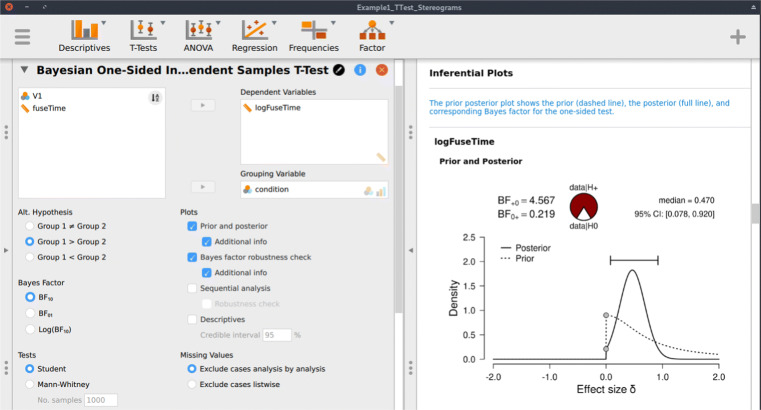
- In the stereogram example, the one-sided Bayesian two-sample t test yielded BF+0 = 4.567, described as moderate evidence; the Bayesian Mann–Whitney U test yielded BF+0 = 5.191.
- For parameter estimation, the two-sided analysis gave a posterior median for δ of 0.47 with a 95% central credible interval from 0.046 to 0.904.
- The paper lists five common pitfalls, including confusing Bayes factors with posterior odds, confusing prior model probabilities with parameter prior distributions, and using credible intervals as hypothesis tests.
Methods
- Design: methodological guidelines for Bayesian statistical reasoning in research, organized into four stages and summarized in Table 1.
- Data/sample: the running example uses Frisby and Clatworthy’s (1975) stereogram data; the original sample had 103 participants, 25 were eliminated for failing an initial stereo-acuity test, leaving 78 participants (43 NV, 35 VV).
- Main analysis: the example applies a one-sided Bayesian two-sample t test for hypothesis testing, a two-sided Bayesian two-sample t test for parameter estimation, a Bayesian Mann–Whitney U test as a robustness check, and a Bayes factor robustness plot; the fuse times were log-transformed after assumption checks.
Limitations
- The paper states that for some frequentist analyses, the Bayesian counterpart has not yet been developed or implemented in JASP.
- It states that some JASP analyses currently provide only a Bayes factor and not visual posterior distributions, and that some analyses are available only with a relatively limited set of prior distributions.
- The text notes these are not principled limitations and that JASP is actively being developed; it also makes evident that the guidelines focus on standard JASP analyses, while more complex models may require custom coding in JAGS, Stan, R, or Python.
Model-written summary. Check it against the paper before relying on it.
Integrity signals
Registry
Cites
Statistics
Figures
Verification
Claims the paper makes
3 Valid · 1 Not valid · 25 Not checked · 53 Own results and interpretations
The cited sources support only part of this claim — read each source’s verdict below.
In the paper
“In Bayesian hypothesis testing, a one-sided hypothesis yields a more diagnostic test than a two-sided alternative (e.g., Jeffreys, 1961; Wetzels, Raaijmakers, Jakab, & Wagenmakers, 2009, p.283).”
§ The JASP guidelines for conducting and reporting a Bayesian analysis > Stage 1: Planning the analysis > Specifying the statistical model.
What the sources say
- Not checked yetcites Jeffreys, 1961
- Partly supportedcites Wetzels, Raaijmakers, Jakab, & Wagenmakers, 2009 matched to “How to quantify support for and against the null hypothesis: A flexible WinBUGS implementation of a default Bayesian t test” (2009) sourceExperimental — accuracy not yet measured
Our copy never states the general comparative principle that a one-sided hypothesis yields a more diagnostic test than a two-sided alternative; its motivation for the one-sided (order-restricted) SD test is applicability — the JZS two-sided test 'does not directly apply' when the alternative is directional (Introduction, p. 1; Bayesian Hypothesis Testing, p. 3). What it does supply is a worked illustration in Extension 1: Order Restrictions (p. 5), where the same data give BF01 = 6.08 under the unrestricted two-sided alternative but BF01 = 13.75 (posterior .93 vs .86) under the order-restricted one-sided alternative, i.e. a sharper quantification. So the example supports part of the claim while the general assertion attributed here is not made by this paper. (LLM, conf=0.65)
plainstates a cause- Asserted: passes — The authors put it forward as true.
- Checkable: passes — It can be checked against evidence.
- Load-bearing: passes — The paper’s conclusions depend on it.
- Based: passes — The paper gives a reason why it holds.
A result the paper reports from its own data — it cites no other source for it, so there is none to check. The quote shows it is in the paper.
In the paper
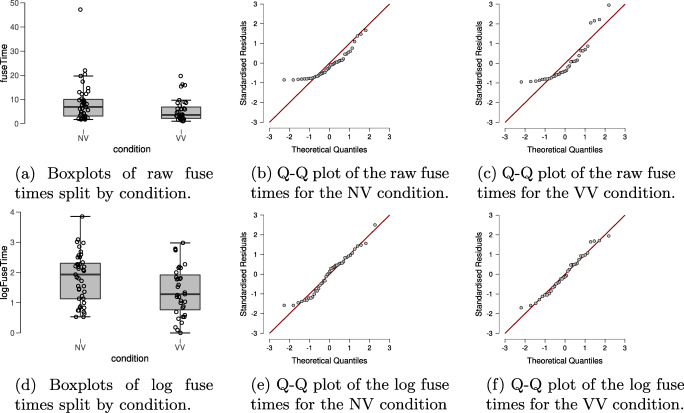
“Visual inspection of the boxplots suggests that the variances of the fuse times may not be equal”
§ The JASP guidelines for conducting and reporting a Bayesian analysis > Stage 2: Executing the analysis > Stereogram example
hedged- Asserted: passes — The authors put it forward as true.
- Checkable: passes — It can be checked against evidence.
- Load-bearing: passes — The paper’s conclusions depend on it.
- Based: passes — The paper gives a reason why it holds.
A result the paper reports from its own data — it cites no other source for it, so there is none to check. The quote shows it is in the paper.
In the paper
“There also appear to be a number of potential outliers in both groups.”
§ The JASP guidelines for conducting and reporting a Bayesian analysis > Stage 2: Executing the analysis > Stereogram example
hedged- Asserted: passes — The authors put it forward as true.
- Checkable: passes — It can be checked against evidence.
- Load-bearing: passes — The paper’s conclusions depend on it.
- Based: passes — The paper gives a reason why it holds.
A result the paper reports from its own data — it cites no other source for it, so there is none to check. The quote shows it is in the paper.
In the paper
“observed standard deviations of the NV and VV groups are 8.085 and 4.802, respectively”
§ The JASP guidelines for conducting and reporting a Bayesian analysis > Stage 2: Executing the analysis > Stereogram example
plain- Asserted: passes — The authors put it forward as true.
- Checkable: passes — It can be checked against evidence.
- Load-bearing: passes — The paper’s conclusions depend on it.
- Based: passes — The paper gives a reason why it holds.
A result the paper reports from its own data — it cites no other source for it, so there is none to check. The quote shows it is in the paper.
In the paper
“Moreover, the Q-Q plots show that the normality assumption of the t test is untenable here.”
§ The JASP guidelines for conducting and reporting a Bayesian analysis > Stage 2: Executing the analysis > Stereogram example
plain- Asserted: passes — The authors put it forward as true.
- Checkable: passes — It can be checked against evidence.
- Load-bearing: passes — The paper’s conclusions depend on it.
- Based: passes — The paper gives a reason why it holds.
25 more claims
Create a free account to see all 82 claims and to verify the 40 references still open.
- It may state two separate claims as one. 33
- Probably not a substantial claim. 29
Claims other papers make about this one
Each is checked against this paper’s own text: does it say what the citing paper says it does?
The cited source says what the claim attributes to it.
In the citing paper
“According to common interpretive guidelines (Van Doorn et al., 2021), a Bayes Factor between 0.33 and 0.10 can be considered moderate evidence for the null, and this result falls at the upper end of that range.”
From This is not the way: global directional cues do not improve spatial learning in an immersive virtual environment (2025) · cites this paper as Van Doorn et al., 2021
Self-check
Percentages, sums and reported differences re-computed from the paper’s own numbers.
Each contradiction between two passages listed here was confirmed by an independent check.
Rated minor: it would not touch a result — a value no result rests on, a p-value that stays on the same side of the significance level, or a conflict that is clerical, resolved elsewhere in the paper, or outside its own findings.
In the paper
§ The JASP guidelines for conducting and reporting a Bayesian analysis > Stage 3: Interpreting the results > Stereogram example
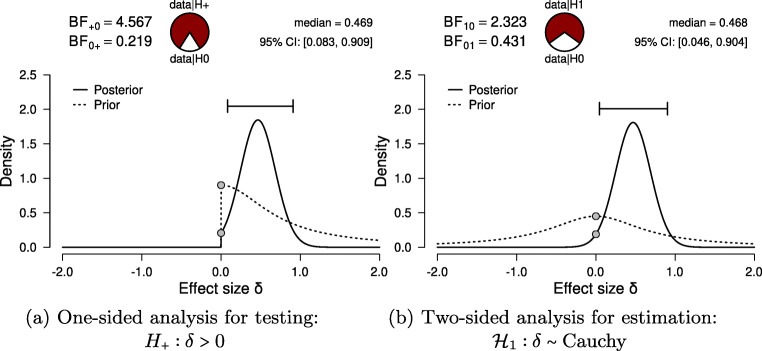
“For parameter estimation, the results of the two-sided t test are presented in Fig. 6a.”
§ The JASP guidelines for conducting and reporting a Bayesian analysis > Stage 3: Interpreting the results > Stereogram example
“The left panel shows the one-sided procedure for hypothesis testing and the right panel shows the two-sided procedure for parameter estimation.”
Citations
Cites
Kass, R. E., & Raftery, A. E. (1995) · Journal of the American Statistical Association · doi:10.1080/01621459.1995.10476572 · Cited by 12,558
Statistical Methods for Research Workers
(1945) · American Journal of Clinical Pathology · doi:10.1093/ajcp/15.11.552b · Cited by 10,880
brms : An R Package for Bayesian Multilevel Models Using Stan
Bürkner, P.-C. (2017) · Journal of Statistical Software · doi:10.18637/jss.v080.i01 · Cited by 9,476 · cited 1×
“Popular packages for conducting Bayesian analyses in R are the BayesFactor package (Morey & Rouder, 2015) and the brms package (B¨urkner, 2017), among others (see https://cran.r-project.org/web/views/Bayesian.html for a more exhaustive list).”
MethodStan : A Probabilistic Programming Language
Carpenter, B., Gelman, A., Hoffman, M. D., Lee, D., Goodrich, B., Betancourt, M., Brubaker, M., Guo, J., Li, P., & Riddell, A. (2017) · Journal of Statistical Software · doi:10.18637/jss.v076.i01 · Cited by 7,754
JAGS: A program for analysis of Bayesian graphical models using Gibbs sampling
Plummer, M. (2003) · Cited by 4,720
Hoeting, J. A., Madigan, D., Raftery, A. E., & Volinsky, C. T. (1999) · Statistical Science · doi:10.1214/ss/1009212519 · Cited by 4,118
Bayesian t tests for accepting and rejecting the null hypothesis
Rouder, J. N., Speckman, P. L., Sun, D., Morey, R. D., & Iverson, G. (2009) · Psychonomic Bulletin & Review · doi:10.3758/pbr.16.2.225 · Cited by 3,688
Probabilistic programming in Python using PyMC3
Salvatier, J., Wiecki, T. V., & Fonnesbeck, C. (2016) · PeerJ Computer Science · doi:10.7717/peerj-cs.55 · Cited by 2,544
Using Bayes to get the most out of non-significant results
Dienes, Z. (2014) · Frontiers in Psychology · doi:10.3389/fpsyg.2014.00781 · Cited by 1,998
Computing Bayes Factors by Combining Simulation and Asymptotic Approximations
Diciccio, T. J., Kass, R. E., Raftery, A., & Wasserman, L. (1997) · Journal of the American Statistical Association · doi:10.1080/01621459.1997.10474045 · Cited by 1,943
Research works printed but not linked: 3
- Jeffreys, H. (1939). Theory of probability, 1st. Oxford University Press.
- Jeffreys, H. (1961). Theory of probability. 3rd. Oxford University Press.
- Wrinch D Jeffreys H On certain fundamental principles of scientific inquiry Philosophical Magazine 1921 42 369 390
Cited by
Items 901–995 of 995
Communicating Adverse Impact Analyses Clearly: A Bayesian Approach
Courey, K. A., & Oswald, F. L. (2022) · Journal of Business and Psychology · doi:10.1007/s10869-022-09862-8
“All error percentages were much less than the 20% rule of thumb (see van Doorn et al., 2021) which indicates that the observed Bayes factors are stable.”
Rodrigues, R. (2022) · Digital Library of Theses and Dissertations (Universidade de São Paulo) · doi:10.11606/d.47.2022.tde-15122022-094649 · Cited by 1
[PhD Dissertation] Good Research PracticesPreprint
Sarafoglou, A. (2022) · PsyArXiv (OSF Preprints) · doi:10.31234/osf.io/7aj5h
Self-citationExamining Measurement Invariance in Bayesian Item Response Theory Models: A Simulation Study
AYVALLI, M., & Kelecioğlu, H. (2023) · Eğitimde ve Psikolojide Ölçme ve Değerlendirme Dergisi · doi:10.21031/epod.1101457
Guillaume, B., Boukbida, H. A., Bakker, G., Bieganowski, A., Brostaux, Y., Cornelis, W., Durner, W., Hartmann, C., Iversen, B. V., Javaux, M., et al. (2023) · doi:10.5194/egusphere-2022-1496-supplement
Meter without rhythmic pattern repetitions increases pre-attentive processing
Gomes, R., de Abreu, R. M. D. R. M., & Silva, S. (2023) · Psychology of Music · doi:10.1177/03057356221129323
Does testing enhance mediation in paired-associate learning?
Vitrano, D. (2023) · Journal of Cognitive Psychology · doi:10.1080/20445911.2022.2162058
Batista, A. R., Catronas, D., Folia, V., & Silva, S. (2023) · Brain Sciences · doi:10.3390/brainsci13030441
Sensory Overlap for Specific Memories Only Matters for Poor Memory Traces
Mille, J., Silvert, L., Versace, R., Izaute, M., & Vallet, G. T. (2023) · Advances in Cognitive Psychology · doi:10.5709/acp-0374-6 · Cited by 1
Testing a Relational Account of Search Templates in Visual ForagingPreprint
Grössle, I., Schubö, A., & Tünnermann, J. (2023) · doi:10.31234/osf.io/gs8n3
Does the threat of COVID-19 modulate automatic imitation?
Roberts, J. W., & Bennett, S. J. (2023) · PLoS ONE · doi:10.1371/journal.pone.0284936
How Prospective Direct and Indirect Reciprocity Influence 4- to 6-Year-Old’s Sharing
Song, Y., Huang, Y. M., Shi, Y., & Zang, F. (2023) · Journal of Educational and Developmental Psychology · doi:10.5539/jedp.v13n2p1
Through the looking glass: Probability theory, frequentist statistics, and Bayesian statistics
Cox, D. J., & Vladescu, J. C. (2023) · Elsevier eBooks · doi:10.1016/b978-0-323-99885-7.00001-5
VI Jornadas de Investigación de la Facultad de Psicología y Logopedia: Libro de contribuciones
Rey, L. (2023) · UMA Editorial eBooks · doi:10.24310/mumaedmumaed.46
Alterations in cortical excitability during pain: A combined TMS-EEG StudyPreprint
Chowdhury, N. S., Chiang, A. K., Millard, S. K., Skippen, P., Chang, W., Seminowicz, D. A., & Schabrun, S. M. (2023) · eLife · doi:10.7554/elife.88567.1 · Cited by 2
Nonword reading by adults who stutter in a transparent orthography
Venkatagiri, H. S., Nataraja, N. P., & Kuriakose, T. (2023) · Journal of Fluency Disorders · doi:10.1016/j.jfludis.2023.105996
Simple and intuitive statistical data analysis and teaching for medical students using JASPPreprint
Panchawagh, S., Kamath, Y., & Siddiqui, A. (2023) · doi:10.36227/techrxiv.24046605
Effect existence of aging on stutter ratio evaluated via Bayesian inference
Inokuchi, S., Nakanishi, H., Takada, A., & Saito, K. (2023) · Forensic Science International Genetics · doi:10.1016/j.fsigen.2023.102933
Double cropping as an adaptation mechanism to climate change patterns in the Carpathian Basin
Láng, V., Dafnaki, D., Balla, I., Czako, I., Csenki, S., Kovács, G. P., Ndue, K., Szlatenyi, D., Vulcz, L., & Bukombe, B. (2023) · Acta Agriculturae Scandinavica Section B - Soil & Plant Science · doi:10.1080/09064710.2023.2257218 · Cited by 2
“…final stage of the analysis, we used selected climate variables in a Bayesian gener-alised linear model (Kruschke 2021; van de Schoot et al. 2021; van Doorn et al. 2021) to assess the effect of climate on sweet corn yield, and whether these variables significantly affect sweet corn growing…”
MethodSex-specific resilience of neocortex to food restrictionPreprint
Padamsey, Z., Katsanevaki, D., Maeso, P. A., Rizzi, M., Osterweil, E. K., & Rochefort, N. L. (2023) · bioRxiv (Cold Spring Harbor Laboratory) · doi:10.1101/2023.10.06.561185
Causal Role of the Frontal Eye Field in Attention-induced Ocular Dominance PlasticityPreprint
Song, F., Dong, X., Zhao, J., Wang, J., Sang, X., He, X., & Bao, M. (2023) · bioRxiv (Cold Spring Harbor Laboratory) · doi:10.1101/2023.10.10.561439
Dilanchian, A. T., & Boot, W. R. (2023) · Research Square · doi:10.21203/rs.3.rs-3433954/v1
Remembering Sets: Capacity Limit and Time Limit of Ensemble Representations in Working Memory
Xu, C., Qian, Y., Chen, H., Shen, M., & Zhou, J. (2023) · Behavioral Sciences · doi:10.3390/bs13100856
Unveiling the Dot-Perspective Task: Integrating Implicit-Mentalistic with Sub-Mentalistic Processes
Fan, C., Susilo, T., & Low, J. (2023) · Psych · doi:10.3390/psych5040078 · Cited by 1
Test Validation Through Rasch Analysis for an Academic Listening CoursePreprint
Rylander, J., Stewart, T., Izumi, E., & Sasao, Y. (2023) · SSRN Electronic Journal · doi:10.2139/ssrn.4642099
Iskandar, A. F., Widjanarko, N. D., Suryatenggara, F. G., Sylfiasari, R., Leonardo, L., Surya, N. D., & Ardianto, C. (2023) · Siriraj Medical Journal/San Sirirat · doi:10.33192/smj.v75i12.265452
eLife Assessment: Sex-specific resilience of neocortex to food restriction
Bathellier, B. (2023) · eLife · doi:10.7554/elife.93052.1.sa3
Sex-specific resilience of neocortex to food restrictionPreprint
Padamsey, Z., Katsanevaki, D., Maeso, P. A., Rizzi, M., Osterweil, E. K., & Rochefort, N. L. (2023) · eLife · doi:10.7554/elife.93052.1 · Cited by 1
Fetaji, M., Ali, M., Fetaji, B., & Ebibi, M. (2023) · Lecture notes of the Institute for Computer Sciences, Social Informatics and Telecommunications Engineering · doi:10.1007/978-3-031-50215-6_7
MacKay, J. R. D., & Wu, S. C. (2023) · Wiley eBooks · doi:10.1002/9781119852865.ch17 · Cited by 6
Gender differences in the relationship between neuroticism and odor memory
Sabiniewicz, A., Sorokowska, A., Palmiero, M., Nicotra, M., & Sorokowski, P. (2024) · Physiology & Behavior · doi:10.1016/j.physbeh.2024.114475 · Cited by 2
Perry, J. C., & Vann, S. D. (2024) · bioRxiv (Cold Spring Harbor Laboratory) · doi:10.1101/2024.02.01.578360
Memory distrust and imagination inflation: A registered report
Dudek, I. A., & Polczyk, R. (2024) · PLoS ONE · doi:10.1371/journal.pone.0297774 · Cited by 1
Malekzadeh, M. Z., Santarremigia, F., Molero, G., Malviya, A., Kapoor, A., Arroyo, R., & Sánchez, T. R. (2024) · Sustainability · doi:10.3390/su16052121
Silva, S., Batista, A. R., Baltos, D., Sousa, J., Torres, N. L., & Folia, V. (2024) · doi:10.31219/osf.io/xw9ct
Verbeek, M. C., van de Bongardt, D., Luijk, M. P. C. M., & Weeland, J. (2024) · doi:10.31234/osf.io/m5ks8
Working memory components modulation of attentional disengagement from evaluative distractor
Yan, M., Tian, Y., Hai, M., Zhang, B., & Chen, A. (2024) · PsyCh Journal · doi:10.1002/pchj.748
“The Bayes factor (BF) was calculated using Bayesian hypothesis testing in JASP (JASP Team, 2018) to assess the evidence for the alternative hypothesis (H 1 ) compared to the null hypothesis (H 0 ) when the results of traditional null hypothesis testing were not significant (van Doorn et al., 2021).”
The influence of diet on glycaemic control, sleep, and cognition
Gaylor, C. M. (2024) · Cronfa (Swansea University) · doi:10.23889/suthesis.66038
Nguyen, R. T. T., & Peterson, M. S. (2024) · Attention Perception & Psychophysics · doi:10.3758/s13414-024-02901-x
“One-tailed one-sample t-tests (Faulkenberry & Wagenmakers, 2020; van Doorn et al., 2021) were conducted against the population mean of 0 in JASP (JASP Team, 2023) using the Bayes factor ( BF + 0 ).”
Nguyen, R. T. T., Peterson, M. S., & Helton, W. S. (2024) · Research Square · doi:10.21203/rs.3.rs-4428156/v1
Sex-specific resilience of neocortex to food restrictionPreprint
Padamsey, Z., Katsanevaki, D., Maeso, P. A., Rizzi, M., Osterweil, E. K., & Rochefort, N. L. (2024) · eLife · doi:10.7554/elife.93052.2
La carga de procesamiento no facilita el acceso a la cantidad en tareas de codificación
García-Orza, J., Calviño, A., & Cepedal, P. C. (2024) · CES Psicología · doi:10.21615/cesp.6609
Spilka, M. J., Robin, J., Nikzad, A. H., Behbehani, L. M., Berretta, S. A., Xu, M., Kane, J. M., Simpson, W., & Tang, S. X. (2024) · PsyArXiv (OSF Preprints) · doi:10.31234/osf.io/zgvyt · Cited by 2
Arslan, B., Göksun, T., & Akçay, Ç. (2024) · Memory & Cognition · doi:10.3758/s13421-024-01595-8
“The inclusion Bayes factors (see van Doorn et al., 2021) show weak to moderate evidence for inclusion the scenario but strong evidence against inclusion of marker type or interaction effect in the models (Table 5).”
Calibration Feedback with the Practical Scoring Rule Does Not Improve Calibration of ConfidencePreprint
Martin, M., & Mandel, D. R. (2024) · doi:10.31234/osf.io/dw89q
Does Interpolated Testing Reduce Proactive Interference
Goldstein, M. (2024) · doi:10.32920/26052910
Does Interpolated Testing Reduce Proactive Interference
Goldstein, M. (2024) · doi:10.32920/26052910.v1
Fight your fears: anxiety, avoidance, and expectancy violation in Anorexia Nervosa
Melles, H. (2024) · Research Publications (Maastricht University) · doi:10.26481/dis.20240704hm · Cited by 1
Inhibition of Return and Learned ValuePreprint
Garre-Frutos, F., & Lupiáñez, J. (2024) · PsyArXiv (OSF Preprints) · doi:10.31234/osf.io/p4m29
Exploring Fonts as Retrieval Cues in Text-Based LearningPreprint
Krieglstein, F., Jansen, S., Meusel, F., Scheller, N., Schmitz, M., Wesenberg, L., & Rey, G. D. (2024) · SSRN Electronic Journal · doi:10.2139/ssrn.4885185
Krieglstein, F., Schmitz, M., Wesenberg, L., Spitzer, M., & Rey, G. D. (2024) · Research Square · doi:10.21203/rs.3.rs-4598970/v1
Chatlaong, M. A., Carter, D. M., Miller, W. M., Davidson, C. J., & Jessee, M. B. (2024) · Journal of Sport Rehabilitation · doi:10.1123/jsr.2023-0424
Lower frequency range of auditory input facilitates stream segregation in older adults
Dinces, E., & Sussman, E. S. (2024) · Hearing Research · doi:10.1016/j.heares.2024.109095
Bartura, K., Gustafsson, H., & Abrahamsen, F. E. (2024) · doi:10.31234/osf.io/svjmc
Aryal, U. R., Bhandari, D., Bista, B., Shrestha, Y. M., Dhimal, M., & Gyanwali, P. (2024) · Population Medicine · doi:10.18332/popmed/191814 · Cited by 1
Functional Connectivity Analysis of Prejudice Among Colombian Armed Conflict Former Actors.
Montealegre, J. J. Q., Quintero-Zea, A., Trujillo, N., & López, J. D. (2024) · International journal of psychological research · doi:10.21500/20112084.7333
“Two popular methods of creating a CI are the highest density CI, which is the narrowest interval containing the specified mass, and the central CI, which involves cutting off 100 − x 2 from each tail of the posterior distribution (van Doorn et al., 2021).”
BackgroundMethodInfluentialSantirocchi, A., Spataro, P., Rossi‐Arnaud, C., Esposito, A., Costanzi, M., Alessi, F., & Cestari, V. (2024) · Scientific Reports · doi:10.1038/s41598-024-74217-7 · Cited by 1
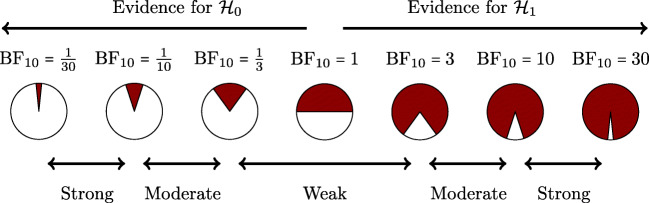
“According to van Doorn et al. 65 , Bayes factors between 1 and 3 indicate weak evidence, Bayes factors between 3 and 10 indicate moderate evidence, and Bayes factors greater than 10 indicate strong evidence.”
BackgroundResearching moral foundations using the Bayesian approach
Rakinić, K. (2024) · Advances in Methodology and Statistics · doi:10.51936/alnb3451
“Indeed, one of the advantages of the Bayes factor is that it allows the assessment of evidence on a continuous scale (van Doorn et al., 2021).”
BackgroundOwens, H., Aronson, R. M., & Short, E. S. (2024) · IEEE RO-MAN · doi:10.1109/ro-man60168.2024.10731239
“We use the interpretation scheme as described in [31], where a BF 10 between 3-10 is moderate evidence in favor of the alternative hypothesis and a BF 01 between 3-10 is moderate evidence in favor of the null hypothesis.”
MethodDecoding cortical chronotopy—Comparing the influence of different cortical organizational schemes
Mecklenbrauck, F., Sepulcre, J., Fehring, J., & Schubotz, R. I. (2024) · NeuroImage · doi:10.1016/j.neuroimage.2024.120914 · Cited by 2
“Generally, evidence ratios > 10 are considered strong evidence for the tested hypothesis (van Doorn et al., 2021).”
Kinematic stability in cardiac locomotor synchronization during regular walking
Kibushi, B. (2024) · Frontiers in Physiology · doi:10.3389/fphys.2024.1487465
Punishing temporal judgement boosts sense of agency and modulates its underlying neural correlates
Hill, C. M., Samnani, N., Barzi, L., & Wilson, M. (2025) · Consciousness and Cognition · doi:10.1016/j.concog.2025.103905
Bayesian Correlation between Cumulative Grade Point Average and Employment
Hakgudener, S. (2024) · The Eurasia Proceedings of Educational and Social Sciences · doi:10.55549/epess.881
Sugano, Y. (2024) · Consciousness and Cognition · doi:10.1016/j.concog.2024.103806
Task difficulty modulates the effect of eye contact on word memory in females
Feng, X., Hu, Q., Ye, C., & Hu, Z. (2025) · BMC Psychology · doi:10.1186/s40359-024-02301-8
A Platform for Manufacturing and Operation of Robot Systems
Demarchi, A., Lang, R. G., & da Silva, I. N. (2024) · Brazilian Symposium on Robotics and Workshop on Robotics in Education (SBR/WRE) · doi:10.1109/sbr/wre63066.2024.10838068
Can attentional biases predict outcome of CBT in children with social anxiety disorder?
Schmidtendorf, S., Asbrand, J., Tuschen‐Caffier, B., & Heinrichs, N. (2025) · Journal of Behavior Therapy and Experimental Psychiatry · doi:10.1016/j.jbtep.2025.102029 · Cited by 1
Kumar, S., Negi, S., Tripathy, S., Beurs, D. P. D., Pandit, D., Wijnen, B. F. M., Vijayakumar, L., Shields‐Zeeman, L., & Pathare, S. (2025) · F1000Research · doi:10.12688/f1000research.159494.1
Glavaš, O. J., Petrić, I. S., & Palijan, G. (2025) · Biology · doi:10.3390/biology14030308
“This value should be below 20%, with lower values indicating a greater numerical stability of the results [41].”
Silva, S., Batista, A. R., Baltos, D., Sousa, J., Torres, N. L., & Folia, V. (2025) · Language Cognition and Neuroscience · doi:10.1080/23273798.2025.2485417
“Following the guidelines outlined by van Doorn et al. (2021), BFs falling between 1 and 3 were categorised as weak, 3 and 10 as moderate, 10 and 30 as strong, and values exceeding 30 indicated very strong evidence in favour of the alternative hypothesis.”
Taylor, G. J., Evans, N. J., & Brown, S. D. (2025) · Psychonomic Bulletin & Review · doi:10.3758/s13423-025-02680-y
“7 The strength of evidence provided by the Bayes factors was interpreted following van Doorn et al. (2020) and Jef-freys (1961).”
Self-citationJointly estimating individual and group networks from fMRI data
van den Bergh, D., Douw, L., van der Pal, Z., Blanken, T. F., Schrantee, A., & Marsman, M. (2025) · Network Neuroscience · doi:10.1162/netn_a_00457
Self-citationCan verbal instructions aimed at being more reflective reduce threat-induced impulsivity?
Fridland, E., & Gladwin, T. E. (2025) · Journal of Cognitive Psychology · doi:10.1080/20445911.2025.2499192
“Aligned with this, the Bayes factor for the null versus alternative hypothesis was 19.50 for the RT contrast and 10.17 for the accuracy contrast, interpreted as strong evidence for the null (van Doorn et al., 2021).”
InfluentialVaras, F. I., Míguez, G., Quezada-Scholz, V. E., Ibáñez-Jiménez, E., Aguilar, C. M. D., Ramírez, S., Badilla, J., Alfaro, F., Bertin, F., Bustamante, J., et al. (2025) · Drug and Alcohol Dependence Reports · doi:10.1016/j.dadr.2025.100344 · Cited by 1
“The results show only anecdotal evidence in favor of the null hypothesis for all the indicators analyzed (van Doorn et al., 2021; see Table S10).”
Not mine, it's yours: Liberal decision threshold underpins self-other memory prioritization
Vella, A. S., Sewell, D. K., Ballard, T., & Kritikos, A. (2025) · Acta Psychologica · doi:10.1016/j.actpsy.2025.105077 · Cited by 1
No Effect of Preceding Smartphone Usage on Mind Wandering and Cognitive PerformancePreprint
Yildirim, B., & Rummel, J. (2025) · Research Square · doi:10.21203/rs.3.rs-6680258/v1
Belonging and bias : how diatonicity and response bias affect pitch memory in a probe tone task
Bostwick, J. M. (2021) · Scholars Archive - University at Albany (University at Albany, State University of New York) · doi:10.54014/bkxr-651k
Affective responses to identical resistance exercises that are prescribed and self-selected
Barton, N. V., Gordy, L. P., Francois, I. J., Russell, B. L., Benns, M. A., & Dankel, S. J. (2025) · Psychology of sport and exercise · doi:10.1016/j.psychsport.2025.102912
Grogans, S. E., DeYoung, K., Hur, J., Anderson, A. S., Islam, S., Kim, H. C., Wedlock, J., Craig, L. E., Tillman, R., Das, S., et al. (2025) · bioRxiv · doi:10.1101/2025.06.11.659182
“To clarify interpretation of the non-significant interaction, we computed standardized Bayesian effect sizes [103].”
Is It About Speech or About Prediction? Testing Between Two Accounts of the Rhythm–Reading Link
Silva, S., Batista, A. R., Torres, N. L., Sousa, J., Liapi, A., Bairami, S., & Folia, V. (2025) · Brain Sciences · doi:10.3390/brainsci15060642
Gowda, H. N., Barton, N. V., Morphew, J. M., Skripko, S. M., Rice, K. A., & Dankel, S. J. (2025) · International Journal of Sport and Exercise Psychology · doi:10.1080/1612197x.2025.2522405
“All statistics were computed using uninformed priors and Bayes Factors (BF 10 ) were used as support for the null (BF 10 < 0.33) or alterative (BF 10 > 3) hypotheses (van Doorn et al., 2021).”
InfluentialAttraction of population receptive fields towards the attended locus is invariant to contrastPreprint
Abdirashid, S. S., Knapen, T. H. J., & Dumoulin, S. O. (2025) · bioRxiv (Cold Spring Harbor Laboratory) · doi:10.1101/2025.07.01.662547
“Bayes Factor (BF 01 ) values between 3 and 10 indicate moderate evidence in favour of the null hypothesis (van Doorn et al., 2021).”
Probing instructed but unnecessary switches of attentional strategy
Kähler, S. T., Wendt, M., Luna‐Rodriguez, A., & Jacobsen, T. (2025) · Psychological Research · doi:10.1007/s00426-025-02147-8 · Cited by 1
Zhang, X., Job, V., & Bauer, C. A. (2025) · British Journal of Psychology · doi:10.1111/bjop.70009 · Cited by 2
Metadata
- Authors
- van Doorn, J., van den Bergh, D., Böhm, U., Dablander, F., Derks, K., Draws, T., Etz, A., Evans, N. J., Gronau, Q. F., Haaf, J. M., Hinne, M., Kucharský, Š., Ly, A., Marsman, M., Matzke, D., Gupta, A. R. K. N., Sarafoglou, A., Stefan, A., Voelkel, J. G., & Wagenmakers, E.-J.
- Affiliations
- University of Amsterdam (NL)
- Nyenrode Business University (NL)
- University of California, Irvine (US)
- Stanford University (US)
- ORCID
- Venue
- Psychonomic Bulletin & Review
- Published
- 2020-10-09
- Volume
- 28
- Issue
- 3
- Pages
- 813-826
- ISSN
- 1069-9384 (ISSN-L)
- 1531-5320
- PMC
- PMC8219590
- OpenAlex
- W3091779368
- Semantic Scholar
- c4bca921d78c0f4fb8569eb9d5c0cb42cbb3ec0b
- Cited by
- 1,114
- References
- 63
- Citations by year
- 2026: 111 · 2025: 169 · 2024: 216 · 2023: 202 · 2022: 177 · 2021: 139 · 2020: 71
- FWCI
- 103.84
- Type
- journal article
- Language
- en
- Open access
- hybrid
- doi.org
- Licence
- cc-by
- creativecommons.org/licenses/by/4.0 (tdm)
- creativecommons.org/licenses/by/4.0 (vor)
- Locations
- Psychonomic Bulletin & Review (publishedVersion, cc-by)
- PubMed Central (publishedVersion, cc-by)
- PubMed (publishedVersion)
- UvA-DARE (University of Amsterdam) (acceptedVersion, cc-by)
- Centrum Wiskunde & Informatica (CWI), the national research institute for mathematics and computer science in the Netherlands (submittedVersion)
- Data Archiving and Networked Services (DANS) (submittedVersion, other-oa)
- Radboud Repository (Radboud University) (submittedVersion)
- PsyArXiv (OSF Preprints) (submittedVersion, cc-by)
- PsyArXiv (OSF Preprints) (submittedVersion)
- Radboud Repository (Radboud University) (submittedVersion, other-oa)
- Funders
- National Science Foundation (1321846)
- Universiteit van Amsterdam
- Nederlandse Organisatie voor Wetenschappelijk Onderzoek (016.Vici.170.083, 406.18.559, 451-17-017)
- Topics
- Physical Sciences › Mathematics › Statistics and Probability › Statistical Methods and Bayesian Inference
- Social Sciences › Decision Sciences › Statistics, Probability and Uncertainty › Meta-analysis and systematic reviews
- Physical Sciences › Computer Science › Artificial Intelligence › Bayesian Modeling and Causal Inference
- Keywords
- Bayesian inference, JASP, reporting guidelines, statistical reporting, open-source statistical software
- MeSH terms
- Bayes Theorem, Data Interpretation, Statistical, Humans, Research Design, Models, Statistical, Guidelines as Topic
About these checks
Registry, retraction, Cites and statistics results are computed, not judged, with one exception: a printed reference that no index lists is read once by a model before it counts as a citation error. Claims are extracted by a model and kept only when their quote appears verbatim in the text; each cited source is then checked, with a model’s help, for whether it says what the claim relies on. Those verdicts can be wrong — read the claim’s quote and the cited source before relying on one.
The claim verdicts this report counts are experimental: their accuracy is not yet measured.
A language model drew the claims from the paper on 2026-10-04, under version 3 of the claim definition (model deepseek-v4.1-flash, prompt extract-v3).
A second model labelled each claim on 2026-10-04 (model jev-1.13-20260917, definition revision gold-guideline-v0.2).
Cited sources are checked with a language model’s help (qwen3.8-omni-flash).
Statistics and arithmetic are recomputed, not judged.
Confidence bands are shown only for fields calibrated on our annotated test set. None is calibrated yet, so no band is shown.
What counts as a claim ›How we measure confidence ›How we check this ›
Are you an author, or do you see a problem with this page? Request a review
Data sources
Bibliographic data: Semantic Scholar, OpenAlex, Crossref.
Contains information from the Semantic Scholar Academic Graph Datasets, made available under the ODC Attribution License (ODC-BY 1.0).
Semantic Scholar’s data is described in: Kinney, R., et al. (2023). The Semantic Scholar Open Data Platform. arXiv:2301.10140.
