

The JASP guidelines for conducting and reporting a Bayesian analysis
Open accessThe DOI matches its Crossref record; 60 of the 63 references it cites were found in a registry or an index; 3 of the 43 sources its claims cite were checked for support.
Abstract
Despite the increasing popularity of Bayesian inference in empirical research, few practical guidelines provide detailed recommendations for how to apply Bayesian procedures and interpret the results. Here we offer specific guidelines for four different stages of Bayesian statistical reasoning in a research setting: planning the analysis, executing the analysis, interpreting the results, and reporting the results. The guidelines for each stage are illustrated with a running example. Although the guidelines are geared towards analyses performed with the open-source statistical software JASP, most guidelines extend to Bayesian inference in general.
Overview
CoChat Summary
TL;DR
This paper provides practical guidelines for planning, executing, interpreting, and reporting Bayesian analyses, illustrated with a running stereogram example and focused on JASP. It emphasizes Bayes factors for testing, posterior distributions/credible intervals for estimation, and transparent reporting of priors, robustness, and analysis files.
Key findings
- The guidelines cover four stages: planning, executing, interpreting, and reporting, with recommendations such as preregistration, assumption checks, correct Bayes factor/credible interval interpretation, and sharing annotated `.jasp` files.
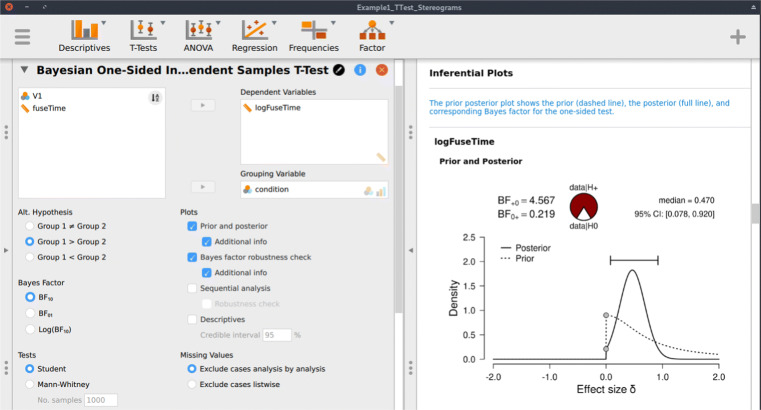
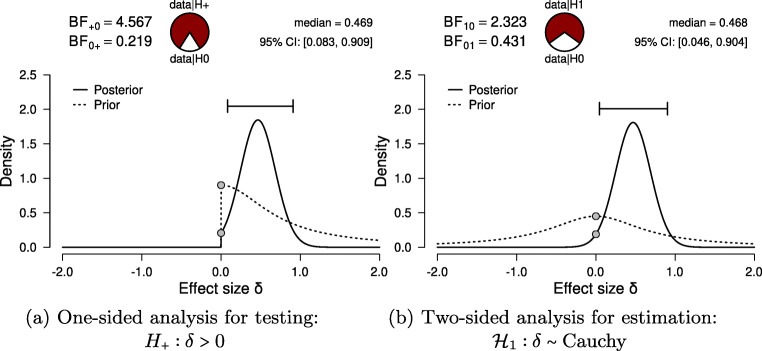
- In the stereogram example, the one-sided Bayesian two-sample t test yielded BF+0 = 4.567, described as moderate evidence; the Bayesian Mann–Whitney U test yielded BF+0 = 5.191.
- For parameter estimation, the two-sided analysis gave a posterior median for δ of 0.47 with a 95% central credible interval from 0.046 to 0.904.
- The paper lists five common pitfalls, including confusing Bayes factors with posterior odds, confusing prior model probabilities with parameter prior distributions, and using credible intervals as hypothesis tests.
Methods
- Design: methodological guidelines for Bayesian statistical reasoning in research, organized into four stages and summarized in Table 1.
- Data/sample: the running example uses Frisby and Clatworthy’s (1975) stereogram data; the original sample had 103 participants, 25 were eliminated for failing an initial stereo-acuity test, leaving 78 participants (43 NV, 35 VV).
- Main analysis: the example applies a one-sided Bayesian two-sample t test for hypothesis testing, a two-sided Bayesian two-sample t test for parameter estimation, a Bayesian Mann–Whitney U test as a robustness check, and a Bayes factor robustness plot; the fuse times were log-transformed after assumption checks.
Limitations
- The paper states that for some frequentist analyses, the Bayesian counterpart has not yet been developed or implemented in JASP.
- It states that some JASP analyses currently provide only a Bayes factor and not visual posterior distributions, and that some analyses are available only with a relatively limited set of prior distributions.
- The text notes these are not principled limitations and that JASP is actively being developed; it also makes evident that the guidelines focus on standard JASP analyses, while more complex models may require custom coding in JAGS, Stan, R, or Python.
Model-written summary. Check it against the paper before relying on it.
Integrity signals
Registry
Cites
Statistics
Figures
Verification
Claims the paper makes
3 Valid · 1 Not valid · 25 Not checked · 53 Own results and interpretations
The cited sources support only part of this claim — read each source’s verdict below.
In the paper
“In Bayesian hypothesis testing, a one-sided hypothesis yields a more diagnostic test than a two-sided alternative (e.g., Jeffreys, 1961; Wetzels, Raaijmakers, Jakab, & Wagenmakers, 2009, p.283).”
§ The JASP guidelines for conducting and reporting a Bayesian analysis > Stage 1: Planning the analysis > Specifying the statistical model.
What the sources say
- Not checked yetcites Jeffreys, 1961
- Partly supportedcites Wetzels, Raaijmakers, Jakab, & Wagenmakers, 2009 matched to “How to quantify support for and against the null hypothesis: A flexible WinBUGS implementation of a default Bayesian t test” (2009) sourceExperimental — accuracy not yet measured
Our copy never states the general comparative principle that a one-sided hypothesis yields a more diagnostic test than a two-sided alternative; its motivation for the one-sided (order-restricted) SD test is applicability — the JZS two-sided test 'does not directly apply' when the alternative is directional (Introduction, p. 1; Bayesian Hypothesis Testing, p. 3). What it does supply is a worked illustration in Extension 1: Order Restrictions (p. 5), where the same data give BF01 = 6.08 under the unrestricted two-sided alternative but BF01 = 13.75 (posterior .93 vs .86) under the order-restricted one-sided alternative, i.e. a sharper quantification. So the example supports part of the claim while the general assertion attributed here is not made by this paper. (LLM, conf=0.65)
plainstates a cause- Asserted: passes — The authors put it forward as true.
- Checkable: passes — It can be checked against evidence.
- Load-bearing: passes — The paper’s conclusions depend on it.
- Based: passes — The paper gives a reason why it holds.
A result the paper reports from its own data — it cites no other source for it, so there is none to check. The quote shows it is in the paper.
In the paper
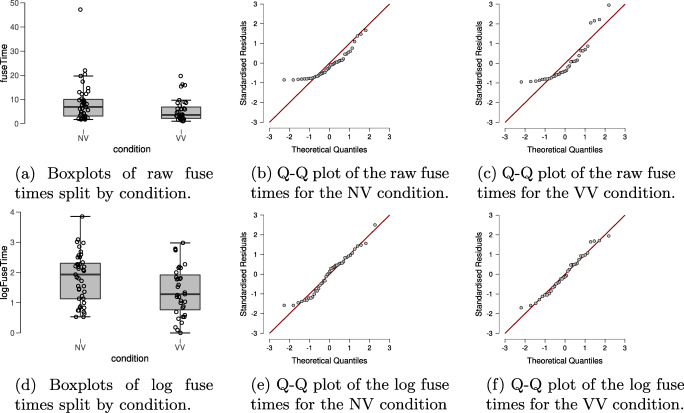
“Visual inspection of the boxplots suggests that the variances of the fuse times may not be equal”
§ The JASP guidelines for conducting and reporting a Bayesian analysis > Stage 2: Executing the analysis > Stereogram example
hedged- Asserted: passes — The authors put it forward as true.
- Checkable: passes — It can be checked against evidence.
- Load-bearing: passes — The paper’s conclusions depend on it.
- Based: passes — The paper gives a reason why it holds.
A result the paper reports from its own data — it cites no other source for it, so there is none to check. The quote shows it is in the paper.
In the paper
“There also appear to be a number of potential outliers in both groups.”
§ The JASP guidelines for conducting and reporting a Bayesian analysis > Stage 2: Executing the analysis > Stereogram example
hedged- Asserted: passes — The authors put it forward as true.
- Checkable: passes — It can be checked against evidence.
- Load-bearing: passes — The paper’s conclusions depend on it.
- Based: passes — The paper gives a reason why it holds.
A result the paper reports from its own data — it cites no other source for it, so there is none to check. The quote shows it is in the paper.
In the paper
“observed standard deviations of the NV and VV groups are 8.085 and 4.802, respectively”
§ The JASP guidelines for conducting and reporting a Bayesian analysis > Stage 2: Executing the analysis > Stereogram example
plain- Asserted: passes — The authors put it forward as true.
- Checkable: passes — It can be checked against evidence.
- Load-bearing: passes — The paper’s conclusions depend on it.
- Based: passes — The paper gives a reason why it holds.
A result the paper reports from its own data — it cites no other source for it, so there is none to check. The quote shows it is in the paper.
In the paper
“Moreover, the Q-Q plots show that the normality assumption of the t test is untenable here.”
§ The JASP guidelines for conducting and reporting a Bayesian analysis > Stage 2: Executing the analysis > Stereogram example
plain- Asserted: passes — The authors put it forward as true.
- Checkable: passes — It can be checked against evidence.
- Load-bearing: passes — The paper’s conclusions depend on it.
- Based: passes — The paper gives a reason why it holds.
25 more claims
Create a free account to see all 82 claims and to verify the 40 references still open.
- It may state two separate claims as one. 33
- Probably not a substantial claim. 29
Claims other papers make about this one
Each is checked against this paper’s own text: does it say what the citing paper says it does?
The cited source says what the claim attributes to it.
In the citing paper
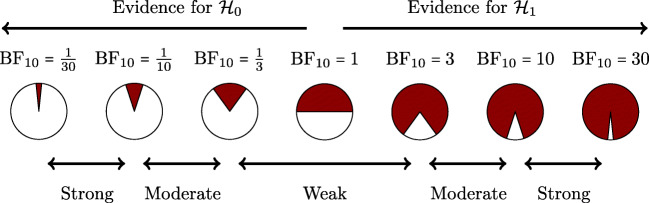
“According to common interpretive guidelines (Van Doorn et al., 2021), a Bayes Factor between 0.33 and 0.10 can be considered moderate evidence for the null, and this result falls at the upper end of that range.”
From This is not the way: global directional cues do not improve spatial learning in an immersive virtual environment (2025) · cites this paper as Van Doorn et al., 2021
Self-check
Percentages, sums and reported differences re-computed from the paper’s own numbers.
Each contradiction between two passages listed here was confirmed by an independent check.
Rated minor: it would not touch a result — a value no result rests on, a p-value that stays on the same side of the significance level, or a conflict that is clerical, resolved elsewhere in the paper, or outside its own findings.
In the paper
§ The JASP guidelines for conducting and reporting a Bayesian analysis > Stage 3: Interpreting the results > Stereogram example
“For parameter estimation, the results of the two-sided t test are presented in Fig. 6a.”
§ The JASP guidelines for conducting and reporting a Bayesian analysis > Stage 3: Interpreting the results > Stereogram example
“The left panel shows the one-sided procedure for hypothesis testing and the right panel shows the two-sided procedure for parameter estimation.”
Citations
Cites
Kass, R. E., & Raftery, A. E. (1995) · Journal of the American Statistical Association · doi:10.1080/01621459.1995.10476572 · Cited by 12,558
Statistical Methods for Research Workers
(1945) · American Journal of Clinical Pathology · doi:10.1093/ajcp/15.11.552b · Cited by 10,880
brms : An R Package for Bayesian Multilevel Models Using Stan
Bürkner, P.-C. (2017) · Journal of Statistical Software · doi:10.18637/jss.v080.i01 · Cited by 9,476 · cited 1×
“Popular packages for conducting Bayesian analyses in R are the BayesFactor package (Morey & Rouder, 2015) and the brms package (B¨urkner, 2017), among others (see https://cran.r-project.org/web/views/Bayesian.html for a more exhaustive list).”
MethodStan : A Probabilistic Programming Language
Carpenter, B., Gelman, A., Hoffman, M. D., Lee, D., Goodrich, B., Betancourt, M., Brubaker, M., Guo, J., Li, P., & Riddell, A. (2017) · Journal of Statistical Software · doi:10.18637/jss.v076.i01 · Cited by 7,754
JAGS: A program for analysis of Bayesian graphical models using Gibbs sampling
Plummer, M. (2003) · Cited by 4,720
Hoeting, J. A., Madigan, D., Raftery, A. E., & Volinsky, C. T. (1999) · Statistical Science · doi:10.1214/ss/1009212519 · Cited by 4,118
Bayesian t tests for accepting and rejecting the null hypothesis
Rouder, J. N., Speckman, P. L., Sun, D., Morey, R. D., & Iverson, G. (2009) · Psychonomic Bulletin & Review · doi:10.3758/pbr.16.2.225 · Cited by 3,688
Probabilistic programming in Python using PyMC3
Salvatier, J., Wiecki, T. V., & Fonnesbeck, C. (2016) · PeerJ Computer Science · doi:10.7717/peerj-cs.55 · Cited by 2,544
Using Bayes to get the most out of non-significant results
Dienes, Z. (2014) · Frontiers in Psychology · doi:10.3389/fpsyg.2014.00781 · Cited by 1,998
Computing Bayes Factors by Combining Simulation and Asymptotic Approximations
Diciccio, T. J., Kass, R. E., Raftery, A., & Wasserman, L. (1997) · Journal of the American Statistical Association · doi:10.1080/01621459.1997.10474045 · Cited by 1,943
Research works printed but not linked: 3
- Jeffreys, H. (1939). Theory of probability, 1st. Oxford University Press.
- Jeffreys, H. (1961). Theory of probability. 3rd. Oxford University Press.
- Wrinch D Jeffreys H On certain fundamental principles of scientific inquiry Philosophical Magazine 1921 42 369 390
Cited by
Items 101–200 of 995
Impact of relative and absolute values on selective attention
Kim, S., & Beck, M. R. (2020) · Psychonomic Bulletin & Review · doi:10.3758/s13423-020-01729-4 · Cited by 30
Toddlers’ Word Learning through Overhearing: Others’ Attention MattersPreprint
Fitch, A., Lieberman, A. M., Luyster, R., & Arunachalam, S. (2019) · PsyArXiv (OSF Preprints) · doi:10.1016/j.jecp.2019.104793 · Cited by 40
From anecdote to evidence: the relationship between personality and need for cognition of developers
Russo, D., Masegosa, A. R., & Stol, K.-J. (2022) · Empirical Software Engineering · doi:10.1007/s10664-021-10106-1 · Cited by 32
Elliott, E. M., Bell, R., Gorin, S., Robinson, N., & Marsh, J. E. (2022) · Journal of Cognitive Psychology · doi:10.1080/20445911.2021.2021924 · Cited by 32
The role of parent-led and child-led home numeracy activities in early mathematical skills
Trickett, J., Batchelor, S., Brittle, B., Foulkes, M., Pickering, J., Slocombe, F., & Gilmore, C. K. (2022) · Cognitive Development · doi:10.1016/j.cogdev.2022.101189 · Cited by 25
The Effects of Company Image and Communication Platform Alignment on Investor Information Processing
Guggenmos, R., & Bennett, G. B. (2021) · Journal of Financial Reporting · doi:10.2308/jfr-2017-0036 · Cited by 27
Instructional Video Design: Investigating the Impact of Monologue- and Dialogue-style Presentations
Lee, B., & Muldner, K. (2020) · Proceedings of the 2020 CHI Conference on Human Factors in Computing Systems · doi:10.1145/3313831.3376845 · Cited by 24
Bolinski, F., Kleiboer, A., Neijenhuijs, K., Karyotaki, E., Wiers, R., de Koning, L., Jacobi, C., Zarski, A.-C., Weisel, K. K., Cuijpers, P., et al. (2022) · Journal of Medical Internet Research · doi:10.2196/40892 · Cited by 24
“Both notations of the BF are reported: BF 10 , indicating support for the alternative over the null hypothesis, and BF 01 , indicating support for the null over the alternative hypothesis [67].”
Whiteford, K. L., Baltzell, L. S., Chiu, M., Cooper, J. K., Faucher, S., Goh, P. Y., Hagedorn, A., Irsik, V. C., Irvine, A., Lim, S.-J., et al. (2025) · Nature Communications · doi:10.1038/s41467-025-62155-5 · Cited by 46
Cognitive reserve and regional brain volume in amyotrophic lateral sclerosis
Temp, A. G. M., Prudlo, J., Vielhaber, S., Machts, J., Hermann, A., Teipel, S. J., & Kasper, E. (2021) · Cortex · doi:10.1016/j.cortex.2021.03.005 · Cited by 26
“…lower-ranked models, the BFM indicating the informativeness of our data given the prior (P(M)) and posterior distributions (P (Mjdata) and the BF01 in comparison to the null model (Van Doorn et al., 2019; Wagenmakers, 2007, 2017; Wagenmakers, Love, et al., 2018; Wagenmakers, Marsman et al., 2018).”
MethodTodd, J., Cardellicchio, P., Swami, V., Cardini, F., & Aspell, J. E. (2021) · Cortex · doi:10.1016/j.cortex.2021.07.006 · Cited by 24
Kelter, R. (2021) · BMC Medical Research Methodology · doi:10.1186/s12874-021-01341-7 · Cited by 33
“[65], a Bayes factor BF10 ≥ 3 should be interpreted as moderate evidence for the alternative H1 relative to the null hypothesis H0, and a Bayes factor BF10 ≥ 10 corresponds to strong evidence for the alternativeH1 relative to H0.”
BackgroundArthur, T., & Harris, D. (2021) · Cortex · doi:10.1016/j.cortex.2021.09.017 · Cited by 28
Lanfranco, R. C., Rivera-Rei, Á. A., Huepe, D., Ibáñez, A. M., & Canales‐Johnson, A. (2021) · NeuroImage · doi:10.1016/j.neuroimage.2021.118282 · Cited by 26
Cognitive reserve protects ALS ‐typical cognitive domains: A longitudinal study.
Temp, A. G. M., Kasper, E., Machts, J., Vielhaber, S., Teipel, S. J., Hermann, A., & Prudlo, J. (2022) · Annals of Clinical and Translational Neurology · doi:10.1002/acn3.51623 · Cited by 24
Decision-Making Underlying Support-Searching in Pea Plants
Wang, Q., Guerra, S., Bonato, B., Simonetti, V., Bulgheroni, M., & Castiello, U. (2023) · Plants · doi:10.3390/plants12081597 · Cited by 23
A tutorial on fitting joint models of M/EEG and behavior to understand cognition
Nunez, M. D., Fernandez, K. A., Srinivasan, R., & Vandekerckhove, J. (2024) · Behavior Research Methods · doi:10.3758/s13428-023-02331-x · Cited by 34
“Note that Bayes factors can describe comparisons of models generally (Etz & Vandekerckhove, 2018; van Doorn et al., 2021).”
BackgroundPittig, A., & Wong, A. H. K. (2021) · Behaviour Research and Therapy · doi:10.1016/j.brat.2020.103797 · Cited by 28
The role of prosody in infants’ preference for speech: A comparison between speech and birdsong
Santolin, C., Russo, S., Calignano, G., Saffran, J. R., & Valenza, E. (2019) · Infancy · doi:10.1111/infa.12295 · Cited by 22
Quantifying body ownership information processing and perceptual bias in the rubber hand illusion
Lanfranco, R. C., Chancel, M., & Ehrsson, H. H. (2023) · Cognition · doi:10.1016/j.cognition.2023.105491 · Cited by 25
Somatosensory Evoked Potentials Reveal Reduced Embodiment of Emotions in Autism
Fanghella, M., Gaigg, S., Candidi, M., Förster, B., & Calvo‐Merino, B. (2022) · Journal of Neuroscience · doi:10.1523/jneurosci.0706-21.2022 · Cited by 29
Engelbert, L. H., van Elk, M., Kandrik, M., Theeuwes, J., & van Vugt, M. (2022) · The Leadership Quarterly · doi:10.1016/j.leaqua.2022.101656 · Cited by 32
Schubatzky, T., Burde, J., Große-Heilmann, R., Haagen‐Schützenhöfer, C., Riese, J., & Weiler, D. (2023) · Computers & Education · doi:10.1016/j.compedu.2023.104900 · Cited by 51
Larkin, F., Schacht, R., Oostenbroek, J., Hayward, E., Fernyhough, C., Centifanti, L. C. M., & Meins, E. (2020) · Infant Mental Health Journal · doi:10.1002/imhj.21901 · Cited by 21
Troncoso, P., & Humphrey, N. (2021) · Journal of School Psychology · doi:10.1016/j.jsp.2021.08.002 · Cited by 28
Assessment of Automatic and Controlled Retrieval Using Verbal Fluency Tasks
Marko, M., Michalko, D., Dragašek, J., Vančová, Z., Jarčušková, D., & Riečanský, I. (2022) · Assessment · doi:10.1177/10731911221117512 · Cited by 28
Maran, M., Numssen, O., Hartwigsen, G., Friederici, A. D., & Zaccarella, E. (2022) · Frontiers in Psychology · doi:10.3389/fpsyg.2022.968836 · Cited by 22
Himmel, N. J., Sakurai, A., Letcher, J. M., Patel, A. A., Bhattacharjee, S., Benson, M. N., Gray, T. R., Cymbalyuk, G., & Cox, D. N. (2023) · eLife · doi:10.7554/elife.76863 · Cited by 20
Childhood maltreatment, alexithymia and eating disorder psychopathology: A mediation model
Barone, E., Carfagno, M., Cascino, G., Landolfi, L., Colangelo, G., Rocca, B. D., & Monteleone, A. M. (2023) · Child Abuse & Neglect · doi:10.1016/j.chiabu.2023.106496 · Cited by 25
Developing digital competencies of controllers: Evidence from the Netherlands
Steens, B., Bots, J. M., & Derks, K. (2023) · International Journal of Accounting Information Systems · doi:10.1016/j.accinf.2023.100667 · Cited by 51
Self-citationDiagnosing the Misuse of the Bayes Factor in Applied Research
Tendeiro, J. N., Kiers, H. A. L., Hoekstra, R., Wong, T. K., & Morey, R. D. (2024) · Advances in Methods and Practices in Psychological Science · doi:10.1177/25152459231213371 · Cited by 41
“…the difference between posterior odds and the Bayes factor, the importance of providing thorough reports of the analyses conducted (Kruschke, 2021; van Doorn et al., 2021), the need to explain the choices made, the disconnect between Bayes factors and effect sizes, and what it takes to establish…”
BackgroundInfluence of gender and culture on the perception of acidic compounds of human body odor
Ferdenzi, C., Razafindrazaka, H., Baldovini, N., Poupon, D., Pierron, D., & Bensafi, M. (2019) · Physiology & Behavior · doi:10.1016/j.physbeh.2019.112561 · Cited by 26
Advancing the Cognitive Science of Religion through Replication and Open Science
Hoogeveen, S., & van Elk, M. (2021) · Journal for the Cognitive Science of Religion · doi:10.1558/jcsr.39039 · Cited by 25
Davis, E. E., Chemnitz, E., Collins, T. K., Geerligs, L., & Campbell, K. L. (2021) · Psychology and Aging · doi:10.1037/pag0000615 · Cited by 28
Little evidence for an effect of the rubber hand illusion on basic movement
Reader, A. T., Trifonova, V. S., & Ehrsson, H. H. (2021) · European Journal of Neuroscience · doi:10.1111/ejn.15444 · Cited by 22
An Introduction to Calculating Bayes Factors in JASP for Speech, Language, and Hearing Research
Brydges, C. R., & Gaeta, L. (2019) · Journal of Speech Language and Hearing Research · doi:10.1044/2019_jslhr-h-19-0183 · Cited by 22
Ideomotor Action: Evidence for Automaticity in Learning, but Not Execution
Sun, D., Custers, R., Marien, H., & Aarts, H. (2020) · Frontiers in Psychology · doi:10.3389/fpsyg.2020.00185 · Cited by 22
Vitrano, D., Altarriba, J., & Leblebici‐Basar, D. (2021) · The Journal of Creative Behavior · doi:10.1002/jocb.498 · Cited by 26
“Van Doorn, J., van den Bergh, D., Bohm, U., Dablander, F., Derks, K., Draws, T., . . . Wagenmakers, E. (2019).”
BackgroundMethodInfluentialIdentification of a neural basis for cold acclimation in Drosophila larvae
Himmel, N. J., Letcher, J. M., Sakurai, A., Gray, T. R., Benson, M. N., Donaldson, K. J., & Cox, D. N. (2021) · iScience · doi:10.1016/j.isci.2021.102657 · Cited by 25
Blue-blocking filters do not alleviate signs and symptoms of digital eye strain
Vera, J., Redondo, B., Ortega‐Sánchez, A., Molina‐Molina, A., Molina, R., Rosenfield, M., & Jiménez, R. (2022) · Clinical and Experimental Optometry · doi:10.1080/08164622.2021.2018914 · Cited by 26
Gavin, L., McChesney, J. E., Tong, A., Sherlock, J., Thompson, L. F., & Tomsa, S. (2022) · Technology Mind and Behavior · doi:10.1037/tmb0000086 · Cited by 23
A global pause generates nonselective response inhibition during selective stopping
Wadsley, C. G., Cirillo, J., Nieuwenhuys, A., & Byblow, W. D. (2023) · Cerebral Cortex · doi:10.1093/cercor/bhad239 · Cited by 20
“The strength of evidence was determined using a standard BF10 classification table (BF10 < 0.3: moderate evidence for null hypothesis; 0.3 ≤ BF10 ≤ 3: inconclusive evidence; BF10 > 3: moderate evidence for alternative hypothesis) (van Doorn et al., 2021).”
MethodInfluentialDunn, D. H., de la Garza, J. D., Jones, D. R., & Sasson, N. J. (2023) · Neurodiversity · doi:10.1177/27546330231203833 · Cited by 21
A Primer on Bayesian Model-Averaged Meta-AnalysisPreprint
Gronau, Q. F., Heck, D. W., Berkhout, S. W., Haaf, J. M., & Wagenmakers, E. (2020) · PsyArXiv (OSF Preprints) · doi:10.31234/osf.io/97qup · Cited by 26
Self-citationGoodhew, S. C., & Edwards, M. (2024) · Psychonomic Bulletin & Review · doi:10.3758/s13423-024-02573-6 · Cited by 30
“The strength of evidence provided by different Bayes factors were interpreted consistent with the recommendations in van Doorn et al. (2021).”
Levlin, M., Wiklund‐Hörnqvist, C., Sandgren, O., Karlsson, S., & Jonsson, B. (2022) · Language Speech and Hearing Services in Schools · doi:10.1044/2021_lshss-21-00101 · Cited by 31
General Pavlovian-to-instrumental transfer in humans: Evidence from Bayesian inference
Degni, L., Dalbagno, D., Starita, F., Benassi, M., di Pellegrino, G., & Garofalo, S. (2022) · Frontiers in Behavioral Neuroscience · doi:10.3389/fnbeh.2022.945503 · Cited by 25
Grace, C., Heinrichs, M., Koval, P., Gorelik, A., von Dawans, B., Terrett, G., Rendell, P. G., & Labuschagne, I. (2022) · Biological Psychology · doi:10.1016/j.biopsycho.2022.108444 · Cited by 24
Examining the validity and fidelity of a virtual reality simulator for basic life support training
Arthur, T., Loveland-Perkins, T., Williams, C., Harris, D., Wilson, M., de Burgh, T., Dhanda, J., & Vine, S. J. (2023) · BMC Digital Health · doi:10.1186/s44247-023-00016-1 · Cited by 26
“3) and are reported alongside a Bayes Factor computation (BF10), which indicates the strength of evidence in favour of a null versus the alternative hypotheses (in accordance with [47]).”
BackgroundThe format of the cognitive map depends on the structure of the environment.
Peer, M., Nadar, C., & Epstein, R. A. (2024) · Journal of Experimental Psychology General · doi:10.1037/xge0001498 · Cited by 27
“Effect strengths were interpreted following standard guidelines (BF10>10 – strong evidence, 10>BF10>3 – moderate evidence; (Van Doorn et al., 2021)).”
MethodTesting Conditional Independence in Psychometric Networks: An Analysis of Three Bayesian Methods
Sekulovski, N., Keetelaar, S., Huth, K. B. S., Wagenmakers, E., van Bork, R., van den Bergh, D., & Marsman, M. (2024) · Multivariate Behavioral Research · doi:10.1080/00273171.2024.2345915 · Cited by 40
“Instead of reporting the full posterior distribution for each element in H 0 , we often report it in terms of a measure of location (i.e., the posterior mean, median, or mode) and spread (i.e., the posterior variance), or in terms of an x % credible interval (see van Doorn et al., 2021).”
Self-citationWang, Y., König, L. M., & Reiterer, H. (2021) · JMIR Formative Research · doi:10.2196/15369 · Cited by 21
“Following the JASP guidelines [62], the posterior median and the 95% CI of the effect size are also reported.”
The ontogeny of early language discrimination: Beyond rhythm
Zacharaki, K., & Sebastián‐Gallés, N. (2021) · Cognition · doi:10.1016/j.cognition.2021.104628 · Cited by 25
Donati, M. A., Beccari, C., Bacherini, A., Capitanucci, D., & Primi, C. (2021) · Addictive Behaviors · doi:10.1016/j.addbeh.2021.106987 · Cited by 27
Strauß, S., Tunnigkeit, I., Eberle, J., Avdullahu, A., & Rummel, N. (2024) · International Journal of Computer-Supported Collaborative Learning · doi:10.1007/s11412-024-09430-7 · Cited by 31
“…(in contrast to inspecting p values to reject a null hypothesis), a rule of thumb suggests the following levels of evidence: BF between 1 and 3, weak evidence; BF between 3 and 10, moderate evidence; aand BF greater than 10, strong evidence (see van Doorn et al., 2021 and Kruschke & Liddell, 2018).”
InfluentialPerceptions of AI engaging in human expression
Bower, A. H., & Steyvers, M. (2021) · Scientific Reports · doi:10.1038/s41598-021-00426-z · Cited by 24
Problem gambling and income as predictors of loot box spending
Garrett, E. P., Sauer, J. D., Drummond, A., & Lowe-Calverley, E. (2022) · International Gambling Studies · doi:10.1080/14459795.2022.2029528 · Cited by 19
“For further information on the benefits of Bayesian analysis over NHST, we refer interested readers to Wagenmakers et al. (2018). 5.”
MethodInfluentialSpinelli, G., Morton, J. B., & Lupker, S. J. (2022) · Psychonomic Bulletin & Review · doi:10.3758/s13423-022-02138-5 · Cited by 18
Medved, T., Podlešek, A., & Možina, K. (2023) · Frontiers in Psychology · doi:10.3389/fpsyg.2023.1107839 · Cited by 27
Mapping cognitive processes in video-based learning by combining trace and think-aloud data
Gijsen, M., Catrysse, L., Mæyer, S. D., & Gijbels, D. (2023) · Learning and Instruction · doi:10.1016/j.learninstruc.2023.101851 · Cited by 27
Schmid, D., & Stanton, N. A. (2019) · Human-Intelligent Systems Integration · doi:10.1007/s42454-020-00012-0 · Cited by 21
“Therefore, we apply them according to the recommended practices from behavioural sciences of Aczel et al. (2020), van den Berg et al. (2019), and van Doorn et al. (2019).”
MethodKelter, R. (2022) · British Journal of Mathematical and Statistical Psychology · doi:10.1111/bmsp.12267 · Cited by 22
Faber, B. (2021) · Local Government Studies · doi:10.1080/03003930.2021.2007081 · Cited by 25
Hutmacher, F., Reichardt, R., & Appel, M. (2024) · Scientific Reports · doi:10.1038/s41598-024-55930-9 · Cited by 23
Modulation of beta oscillatory dynamics in motor and frontal areas during physical fatigue
Matta, P., Baurès, R., Duclay, J., & Alamia, A. (2025) · Communications Biology · doi:10.1038/s42003-025-08122-8 · Cited by 21
Poncin, A., Rinsveld, A. M. V., & Schiltz, C. (2019) · Quarterly Journal of Experimental Psychology · doi:10.1177/1747021819892165 · Cited by 21
Visuo-motor attention during object interaction in children with developmental coordination disorder
Arthur, T., Harris, D., Allen, K., Naylor, C. E., Wood, G., Vine, S., Wilson, M., Tsaneva-Atanasova, K. T., & Buckingham, G. (2021) · Cortex · doi:10.1016/j.cortex.2021.02.013 · Cited by 23
Implicit Learning of True and False Belief Sequences
Ma, Q., Heleven, E., Funghi, G., Pu, M., Baetens, K., Deroost, N., & Overwalle, F. V. (2021) · Frontiers in Psychology · doi:10.3389/fpsyg.2021.643594 · Cited by 19
Du, M., Basyouni, R., & Parkinson, C. M. (2021) · NeuroImage · doi:10.1016/j.neuroimage.2021.118019 · Cited by 21
Hsu, P., Ready, E. A., & Grahn, J. A. (2022) · PLoS ONE · doi:10.1371/journal.pone.0264587 · Cited by 23
Storman, D., Świerz, M. J., Storman, M., Jasińska, K., Jemioło, P., & Bała, M. M. (2022) · Nutrients · doi:10.3390/nu14081592 · Cited by 19
A Broader Application of the Detection Response Task to Cognitive Tasks and Online Environments
Innes, R. J., Evans, N. J., Howard, Z. L., Eidels, A., & Brown, S. D. (2020) · Human Factors The Journal of the Human Factors and Ergonomics Society · doi:10.1177/0018720820936800 · Cited by 19
“All analyses was conducted in the statistical program JASP (JASP Team, 2019; van Doorn et al., 2019), using default priors (set at 0.707).”
MethodInfluentialSelf-citationKönig, L., & Suhr, R. (2023) · Journal of Medical Internet Research · doi:10.2196/46336 · Cited by 16
“Readers not familiar with Bayesian statistical analyses in medical contexts and the statistical software JASP can find introductory material elsewhere [41-43].”
How Experiences Affect Psychological Responses During Supervised Fasting: A Preliminary Study
Ma, Q., Yang, C., Wu, R., Wu, M., Liu, W., Dai, Z., & Li, Y. (2021) · Frontiers in Psychology · doi:10.3389/fpsyg.2021.651760 · Cited by 22
Zhang, Y., Ku, Y., Sun, J., Daskalakis, Z. J., & Yuan, T. (2021) · Psychological Medicine · doi:10.1017/s003329172100430x · Cited by 20
The role of metacognition in monitoring performance and regulating learning in early readers
Taouki, I., Lallier, M., & Soto, D. (2022) · Metacognition and Learning · doi:10.1007/s11409-022-09292-0 · Cited by 30
Flores, R. D., Sanders, C. A., Duan, S. X., Bishop-Chrzanowski, B. M., Oyler, D. L., Shim, H.-J., Clocksin, H. E., Miller, A. P., & Merkle, E. C. (2022) · British Journal of Psychology · doi:10.1111/bjop.12585 · Cited by 21
Schröder, L., Regnath, F., Glasauer, S., Hackenberg, A. E. C., Hente, J. M., Weilenmann, S., Pohl, D., von Känel, R., & Lehnen, N. (2022) · Frontiers in Neuroscience · doi:10.3389/fnins.2022.1029126 · Cited by 25
“In a Bayes rmANOVA, all measuring factors as well as their combinations and interactions are considered as models to explain the dataset (see e.g., Wagenmakers et al., 2018; van Doorn et al., 2021).”
MethodModerate Stability among Delay, Probability, and Effort Discounting in Humans
Escobar, G. G., Chainé, S. M., Haynes, J. M., Velásco, C. S., & Mitchell, S. H. (2023) · The Psychological Record · doi:10.1007/s40732-023-00537-1 · Cited by 22
Spataro, P., Morelli, M., Pirchio, S., Costa, S., & Longobardi, E. (2023) · European Journal of Psychology of Education · doi:10.1007/s10212-023-00749-7 · Cited by 24
“According to van Doorn et al. (2021), Bayes factors between 1 and 3 are considered to be weak evidence, Bayes factors between 3 and 10 are considered moderate, and Bayes factors greater than 10 are considered strong evidence.”
Neige, C., Vassiliadis, P., Zazou, A. A., Dricot, L., Lebon, F., Brees, T., & Derosière, G. (2023) · Cerebral Cortex · doi:10.1093/cercor/bhad370 · Cited by 21
Egan, S. J., Greene, D., Callaghan, T., Raghav, S., Funk, J., Badenbach, T., Talam, S., Kemp, G., McEvoy, P. M., Ehring, T. W., et al. (2024) · Cognitive Behaviour Therapy · doi:10.1080/16506073.2024.2369936 · Cited by 30
“Several Robust Bayesian meta-analysis models account for publication bias, where the predictive utility of the two competing (i.e. effect vs null effect) hypotheses are judged using Bayes factors (BF10; van Doorn et al., 2021).”
Excessive visual crowding effects in developmental dyscalculia
Castaldi, E., Turi, M., Gassama, S., Manuela Piazza, A., & Eger, E. (2020) · Journal of Vision · doi:10.1167/jov.20.8.7 · Cited by 24
The role of dorsal premotor cortex in joint action stopping
Cardellicchio, P., Dolfini, E., & D’Ausilio, A. (2021) · iScience · doi:10.1016/j.isci.2021.103330 · Cited by 14
How to Choose between Different Bayesian Posterior Indices for Hypothesis Testing in Practice
Kelter, R. (2021) · Multivariate Behavioral Research · doi:10.1080/00273171.2021.1967716 · Cited by 20
A Bayesian perspective on Biogen's aducanumab trial
Temp, A. G. M., Ly, A., van Doorn, J. B., Wagenmakers, E., Tang, Y., Lutz, M. W., & Teipel, S. J. (2022) · Alzheimer s & Dementia · doi:10.1002/alz.12615 · Cited by 14
“(16) studynumber+ group+ progressionspeed+ studynumber * group+ studynumber*progressionspeed+ group * progressionspeed 0.”
Self-citationParan, I., Nachmani, H., Salti, M., Shelef, I., & Melzer, I. (2022) · BMC Geriatrics · doi:10.1186/s12877-022-02969-w · Cited by 16
“In addition, we performed a complementary Bayesian null hypothesis testing analysis, using JASP software [40] to compute Bayes factors (BF; see Table 1), using default JZS priors [41, 42].”
MethodGreene, N. R., & Naveh‐Benjamin, M. (2022) · Journal of Memory and Language · doi:10.1016/j.jml.2022.104340 · Cited by 21
No differences between adults with and without autism in audiovisual synchrony perception
Weiland, R. F., Polderman, T. J. C., Smit, D. J. A., Begeer, S., & der Burg, E. V. (2022) · Autism · doi:10.1177/13623613221121414 · Cited by 18
Mining players’ experience in computer games: Immersion affects flow but not presence
Colombo, S., Hansson, P., & Nyström, M. B. T. (2023) · Computers in Human Behavior Reports · doi:10.1016/j.chbr.2023.100334 · Cited by 18
“Since the goal of this research was to ascertain the presence or absence of an effect of immersion on the constructs of presence and flow, Bayes factor hypothesis testing was considered suitable (van Doorn et al., 2021).”
BackgroundMethodResultInfluentialLiu, W., Heij, J., Liu, S., Liebrand, L. C., Caan, M. W. A., van der Zwaag, W., Veltman, D. J., Lü, L., Aghajani, M., & van Wingen, G. A. (2024) · European Archives of Psychiatry and Clinical Neuroscience · doi:10.1007/s00406-024-01874-0 · Cited by 17
“We conducted our statistical analyses using Bayesian statistics as implemented in JASP (version 0.17.1: https:// jasp-stats. org/) [49].”
InfluentialChowdhury, N. S., Millard, S. K., Martino, E. D., Larsen, D. B., Seminowicz, D. A., Schabrun, S. M., de Andrade, D. C., & Graven‐Nielsen, T. (2024) · Pain · doi:10.1097/j.pain.0000000000003488 · Cited by 18
Tönsing, D., Schiller, B., Vehlen, A., Spenthof, I., Domes, G., & Heinrichs, M. (2022) · Scientific Reports · doi:10.1038/s41598-022-25189-z · Cited by 15
McNaughton, K. A., Kirby, L., Warnell, K. R., Alkire, D. R., Merchant, J. S., Moraczewski, D., Yarger, H. A., Thurm, A. E., & Redcay, E. (2023) · Developmental Cognitive Neuroscience · doi:10.1016/j.dcn.2023.101197 · Cited by 17
Kelter, R. (2021) · Behavior Research Methods · doi:10.3758/s13428-021-01613-6 · Cited by 17
Whiteford, K. L., Baltzell, L. S., Chiu, M., Cooper, J. K., Faucher, S., Goh, P. Y., Hagedorn, A., Irsik, V. C., Irvine, A., Lim, S.-J., et al. (2024) · bioRxiv (Cold Spring Harbor Laboratory) · doi:10.1101/2024.09.02.610856 · Cited by 15
“Exploratory Bayes factor (BF) hypothesis tests supplement the direct replication analyses in order to assess the support for the alternative hypothesis (i.e., musicians are better than non-musicians) versus the null hypothesis using the reporting standards outlined in van Doorn et al. (2021) 58 .”
MethodLeichtmann, B., Meneweger, T., Busch, C., Reiterer, B., Meyer, K., Rammer, D., Haring, R., & Mara, M. (2024) · International Journal of Human-Computer Interaction · doi:10.1080/10447318.2024.2331878 · Cited by 19
“Additionally, Bayes Factors (BF) were calculated using the statistic program JASP (JASP Team, 2019; van Doorn et al., 2021).”
Froehlich, E., Madipakkam, A. R., Craffonara, B., Bolte, C., Muth, A.-K., & Park, S. Q. (2021) · Scientific Reports · doi:10.1038/s41598-021-86527-1 · Cited by 24
The impact of cognitive and noncognitive factors on odor discrimination performance
Sabiniewicz, A., Wrage, F., & Hummel, T. R. (2021) · Journal of Sensory Studies · doi:10.1111/joss.12683 · Cited by 15
Widespread imprecision in estimates of the economic costs of invasive alien species worldwide
Hulme, P. E., Ahmed, D. A., Haubrock, P. J., Kaiser, B., Kourantidou, M., Leroy, B., & McDermott, S. M. (2023) · The Science of The Total Environment · doi:10.1016/j.scitotenv.2023.167997 · Cited by 18
Metadata
- Authors
- van Doorn, J., van den Bergh, D., Böhm, U., Dablander, F., Derks, K., Draws, T., Etz, A., Evans, N. J., Gronau, Q. F., Haaf, J. M., Hinne, M., Kucharský, Š., Ly, A., Marsman, M., Matzke, D., Gupta, A. R. K. N., Sarafoglou, A., Stefan, A., Voelkel, J. G., & Wagenmakers, E.-J.
- Affiliations
- University of Amsterdam (NL)
- Nyenrode Business University (NL)
- University of California, Irvine (US)
- Stanford University (US)
- ORCID
- Venue
- Psychonomic Bulletin & Review
- Published
- 2020-10-09
- Volume
- 28
- Issue
- 3
- Pages
- 813-826
- ISSN
- 1069-9384 (ISSN-L)
- 1531-5320
- PMC
- PMC8219590
- OpenAlex
- W3091779368
- Semantic Scholar
- c4bca921d78c0f4fb8569eb9d5c0cb42cbb3ec0b
- Cited by
- 1,114
- References
- 63
- Citations by year
- 2026: 111 · 2025: 169 · 2024: 216 · 2023: 202 · 2022: 177 · 2021: 139 · 2020: 71
- FWCI
- 103.84
- Type
- journal article
- Language
- en
- Open access
- hybrid
- doi.org
- Licence
- cc-by
- creativecommons.org/licenses/by/4.0 (tdm)
- creativecommons.org/licenses/by/4.0 (vor)
- Locations
- Psychonomic Bulletin & Review (publishedVersion, cc-by)
- PubMed Central (publishedVersion, cc-by)
- PubMed (publishedVersion)
- UvA-DARE (University of Amsterdam) (acceptedVersion, cc-by)
- Centrum Wiskunde & Informatica (CWI), the national research institute for mathematics and computer science in the Netherlands (submittedVersion)
- Data Archiving and Networked Services (DANS) (submittedVersion, other-oa)
- Radboud Repository (Radboud University) (submittedVersion)
- PsyArXiv (OSF Preprints) (submittedVersion, cc-by)
- PsyArXiv (OSF Preprints) (submittedVersion)
- Radboud Repository (Radboud University) (submittedVersion, other-oa)
- Funders
- National Science Foundation (1321846)
- Universiteit van Amsterdam
- Nederlandse Organisatie voor Wetenschappelijk Onderzoek (016.Vici.170.083, 406.18.559, 451-17-017)
- Topics
- Physical Sciences › Mathematics › Statistics and Probability › Statistical Methods and Bayesian Inference
- Social Sciences › Decision Sciences › Statistics, Probability and Uncertainty › Meta-analysis and systematic reviews
- Physical Sciences › Computer Science › Artificial Intelligence › Bayesian Modeling and Causal Inference
- Keywords
- Bayesian inference, JASP, reporting guidelines, statistical reporting, open-source statistical software
- MeSH terms
- Bayes Theorem, Data Interpretation, Statistical, Humans, Research Design, Models, Statistical, Guidelines as Topic
About these checks
Registry, retraction, Cites and statistics results are computed, not judged, with one exception: a printed reference that no index lists is read once by a model before it counts as a citation error. Claims are extracted by a model and kept only when their quote appears verbatim in the text; each cited source is then checked, with a model’s help, for whether it says what the claim relies on. Those verdicts can be wrong — read the claim’s quote and the cited source before relying on one.
The claim verdicts this report counts are experimental: their accuracy is not yet measured.
A language model drew the claims from the paper on 2026-10-04, under version 3 of the claim definition (model deepseek-v4.1-flash, prompt extract-v3).
A second model labelled each claim on 2026-10-04 (model jev-1.13-20260917, definition revision gold-guideline-v0.2).
Cited sources are checked with a language model’s help (qwen3.8-omni-flash).
Statistics and arithmetic are recomputed, not judged.
Confidence bands are shown only for fields calibrated on our annotated test set. None is calibrated yet, so no band is shown.
What counts as a claim ›How we measure confidence ›How we check this ›
Are you an author, or do you see a problem with this page? Request a review
Data sources
Bibliographic data: Semantic Scholar, OpenAlex, Crossref.
Contains information from the Semantic Scholar Academic Graph Datasets, made available under the ODC Attribution License (ODC-BY 1.0).
Semantic Scholar’s data is described in: Kinney, R., et al. (2023). The Semantic Scholar Open Data Platform. arXiv:2301.10140.
