

The JASP guidelines for conducting and reporting a Bayesian analysis
Open accessThe DOI matches its Crossref record; 60 of the 63 references it cites were found in a registry or an index; 3 of the 43 sources its claims cite were checked for support.
Abstract
Despite the increasing popularity of Bayesian inference in empirical research, few practical guidelines provide detailed recommendations for how to apply Bayesian procedures and interpret the results. Here we offer specific guidelines for four different stages of Bayesian statistical reasoning in a research setting: planning the analysis, executing the analysis, interpreting the results, and reporting the results. The guidelines for each stage are illustrated with a running example. Although the guidelines are geared towards analyses performed with the open-source statistical software JASP, most guidelines extend to Bayesian inference in general.
Overview
CoChat Summary
TL;DR
This paper provides practical guidelines for planning, executing, interpreting, and reporting Bayesian analyses, illustrated with a running stereogram example and focused on JASP. It emphasizes Bayes factors for testing, posterior distributions/credible intervals for estimation, and transparent reporting of priors, robustness, and analysis files.
Key findings
- The guidelines cover four stages: planning, executing, interpreting, and reporting, with recommendations such as preregistration, assumption checks, correct Bayes factor/credible interval interpretation, and sharing annotated `.jasp` files.
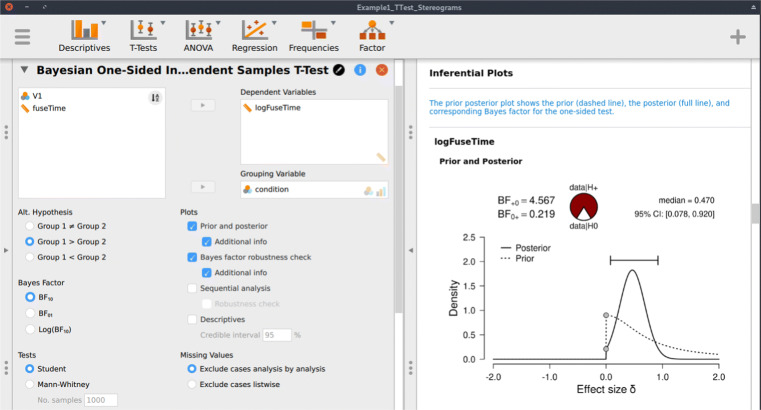
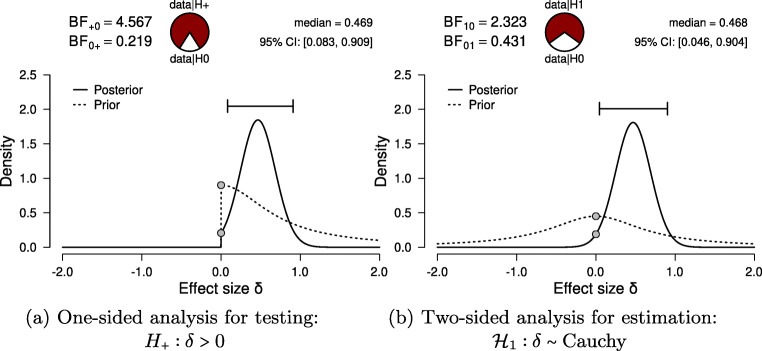
- In the stereogram example, the one-sided Bayesian two-sample t test yielded BF+0 = 4.567, described as moderate evidence; the Bayesian Mann–Whitney U test yielded BF+0 = 5.191.
- For parameter estimation, the two-sided analysis gave a posterior median for δ of 0.47 with a 95% central credible interval from 0.046 to 0.904.
- The paper lists five common pitfalls, including confusing Bayes factors with posterior odds, confusing prior model probabilities with parameter prior distributions, and using credible intervals as hypothesis tests.
Methods
- Design: methodological guidelines for Bayesian statistical reasoning in research, organized into four stages and summarized in Table 1.
- Data/sample: the running example uses Frisby and Clatworthy’s (1975) stereogram data; the original sample had 103 participants, 25 were eliminated for failing an initial stereo-acuity test, leaving 78 participants (43 NV, 35 VV).
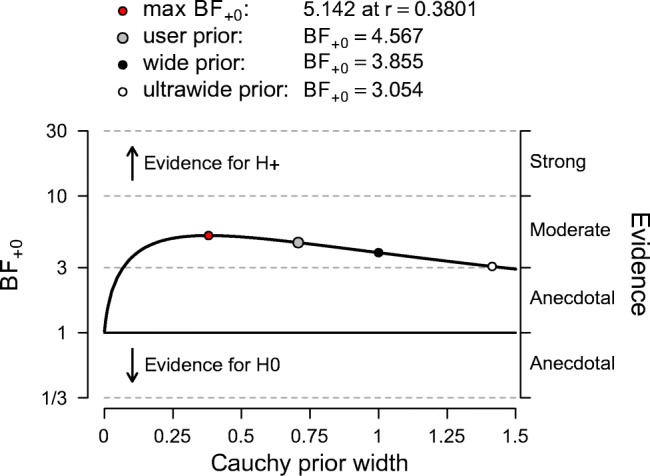
- Main analysis: the example applies a one-sided Bayesian two-sample t test for hypothesis testing, a two-sided Bayesian two-sample t test for parameter estimation, a Bayesian Mann–Whitney U test as a robustness check, and a Bayes factor robustness plot; the fuse times were log-transformed after assumption checks.
Limitations
- The paper states that for some frequentist analyses, the Bayesian counterpart has not yet been developed or implemented in JASP.
- It states that some JASP analyses currently provide only a Bayes factor and not visual posterior distributions, and that some analyses are available only with a relatively limited set of prior distributions.
- The text notes these are not principled limitations and that JASP is actively being developed; it also makes evident that the guidelines focus on standard JASP analyses, while more complex models may require custom coding in JAGS, Stan, R, or Python.
Model-written summary. Check it against the paper before relying on it.
Integrity signals
Registry
Cites
Statistics
Figures
Verification
Claims the paper makes
3 Valid · 1 Not valid · 25 Not checked · 53 Own results and interpretations
The cited sources support only part of this claim — read each source’s verdict below.
In the paper
“In Bayesian hypothesis testing, a one-sided hypothesis yields a more diagnostic test than a two-sided alternative (e.g., Jeffreys, 1961; Wetzels, Raaijmakers, Jakab, & Wagenmakers, 2009, p.283).”
§ The JASP guidelines for conducting and reporting a Bayesian analysis > Stage 1: Planning the analysis > Specifying the statistical model.
What the sources say
- Not checked yetcites Jeffreys, 1961
- Partly supportedcites Wetzels, Raaijmakers, Jakab, & Wagenmakers, 2009 matched to “How to quantify support for and against the null hypothesis: A flexible WinBUGS implementation of a default Bayesian t test” (2009) sourceExperimental — accuracy not yet measured
Our copy never states the general comparative principle that a one-sided hypothesis yields a more diagnostic test than a two-sided alternative; its motivation for the one-sided (order-restricted) SD test is applicability — the JZS two-sided test 'does not directly apply' when the alternative is directional (Introduction, p. 1; Bayesian Hypothesis Testing, p. 3). What it does supply is a worked illustration in Extension 1: Order Restrictions (p. 5), where the same data give BF01 = 6.08 under the unrestricted two-sided alternative but BF01 = 13.75 (posterior .93 vs .86) under the order-restricted one-sided alternative, i.e. a sharper quantification. So the example supports part of the claim while the general assertion attributed here is not made by this paper. (LLM, conf=0.65)
plainstates a cause- Asserted: passes — The authors put it forward as true.
- Checkable: passes — It can be checked against evidence.
- Load-bearing: passes — The paper’s conclusions depend on it.
- Based: passes — The paper gives a reason why it holds.
A result the paper reports from its own data — it cites no other source for it, so there is none to check. The quote shows it is in the paper.
In the paper
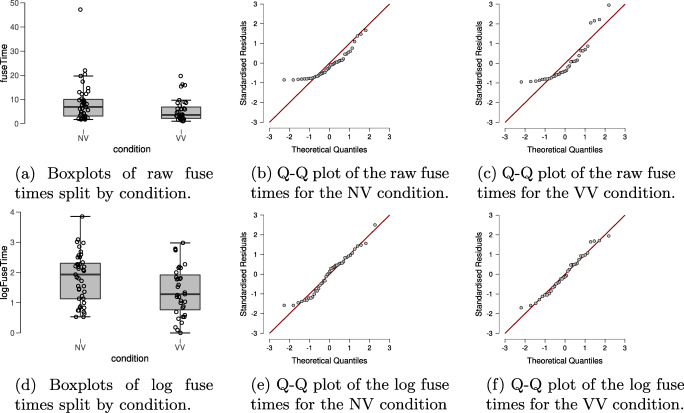
“Visual inspection of the boxplots suggests that the variances of the fuse times may not be equal”
§ The JASP guidelines for conducting and reporting a Bayesian analysis > Stage 2: Executing the analysis > Stereogram example
hedged- Asserted: passes — The authors put it forward as true.
- Checkable: passes — It can be checked against evidence.
- Load-bearing: passes — The paper’s conclusions depend on it.
- Based: passes — The paper gives a reason why it holds.
A result the paper reports from its own data — it cites no other source for it, so there is none to check. The quote shows it is in the paper.
In the paper
“There also appear to be a number of potential outliers in both groups.”
§ The JASP guidelines for conducting and reporting a Bayesian analysis > Stage 2: Executing the analysis > Stereogram example
hedged- Asserted: passes — The authors put it forward as true.
- Checkable: passes — It can be checked against evidence.
- Load-bearing: passes — The paper’s conclusions depend on it.
- Based: passes — The paper gives a reason why it holds.
A result the paper reports from its own data — it cites no other source for it, so there is none to check. The quote shows it is in the paper.
In the paper
“observed standard deviations of the NV and VV groups are 8.085 and 4.802, respectively”
§ The JASP guidelines for conducting and reporting a Bayesian analysis > Stage 2: Executing the analysis > Stereogram example
plain- Asserted: passes — The authors put it forward as true.
- Checkable: passes — It can be checked against evidence.
- Load-bearing: passes — The paper’s conclusions depend on it.
- Based: passes — The paper gives a reason why it holds.
A result the paper reports from its own data — it cites no other source for it, so there is none to check. The quote shows it is in the paper.
In the paper
“Moreover, the Q-Q plots show that the normality assumption of the t test is untenable here.”
§ The JASP guidelines for conducting and reporting a Bayesian analysis > Stage 2: Executing the analysis > Stereogram example
plain- Asserted: passes — The authors put it forward as true.
- Checkable: passes — It can be checked against evidence.
- Load-bearing: passes — The paper’s conclusions depend on it.
- Based: passes — The paper gives a reason why it holds.
25 more claims
Create a free account to see all 82 claims and to verify the 40 references still open.
- It may state two separate claims as one. 33
- Probably not a substantial claim. 29
Claims other papers make about this one
Each is checked against this paper’s own text: does it say what the citing paper says it does?
The cited source says what the claim attributes to it.
In the citing paper
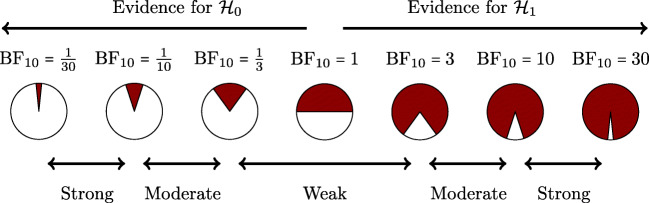
“According to common interpretive guidelines (Van Doorn et al., 2021), a Bayes Factor between 0.33 and 0.10 can be considered moderate evidence for the null, and this result falls at the upper end of that range.”
From This is not the way: global directional cues do not improve spatial learning in an immersive virtual environment (2025) · cites this paper as Van Doorn et al., 2021
Self-check
Percentages, sums and reported differences re-computed from the paper’s own numbers.
Each contradiction between two passages listed here was confirmed by an independent check.
Rated minor: it would not touch a result — a value no result rests on, a p-value that stays on the same side of the significance level, or a conflict that is clerical, resolved elsewhere in the paper, or outside its own findings.
In the paper
§ The JASP guidelines for conducting and reporting a Bayesian analysis > Stage 3: Interpreting the results > Stereogram example
“For parameter estimation, the results of the two-sided t test are presented in Fig. 6a.”
§ The JASP guidelines for conducting and reporting a Bayesian analysis > Stage 3: Interpreting the results > Stereogram example
“The left panel shows the one-sided procedure for hypothesis testing and the right panel shows the two-sided procedure for parameter estimation.”
Citations
Cites
Kass, R. E., & Raftery, A. E. (1995) · Journal of the American Statistical Association · doi:10.1080/01621459.1995.10476572 · Cited by 12,558
Statistical Methods for Research Workers
(1945) · American Journal of Clinical Pathology · doi:10.1093/ajcp/15.11.552b · Cited by 10,880
brms : An R Package for Bayesian Multilevel Models Using Stan
Bürkner, P.-C. (2017) · Journal of Statistical Software · doi:10.18637/jss.v080.i01 · Cited by 9,476 · cited 1×
“Popular packages for conducting Bayesian analyses in R are the BayesFactor package (Morey & Rouder, 2015) and the brms package (B¨urkner, 2017), among others (see https://cran.r-project.org/web/views/Bayesian.html for a more exhaustive list).”
MethodStan : A Probabilistic Programming Language
Carpenter, B., Gelman, A., Hoffman, M. D., Lee, D., Goodrich, B., Betancourt, M., Brubaker, M., Guo, J., Li, P., & Riddell, A. (2017) · Journal of Statistical Software · doi:10.18637/jss.v076.i01 · Cited by 7,754
JAGS: A program for analysis of Bayesian graphical models using Gibbs sampling
Plummer, M. (2003) · Cited by 4,720
Hoeting, J. A., Madigan, D., Raftery, A. E., & Volinsky, C. T. (1999) · Statistical Science · doi:10.1214/ss/1009212519 · Cited by 4,118
Bayesian t tests for accepting and rejecting the null hypothesis
Rouder, J. N., Speckman, P. L., Sun, D., Morey, R. D., & Iverson, G. (2009) · Psychonomic Bulletin & Review · doi:10.3758/pbr.16.2.225 · Cited by 3,688
Probabilistic programming in Python using PyMC3
Salvatier, J., Wiecki, T. V., & Fonnesbeck, C. (2016) · PeerJ Computer Science · doi:10.7717/peerj-cs.55 · Cited by 2,544
Using Bayes to get the most out of non-significant results
Dienes, Z. (2014) · Frontiers in Psychology · doi:10.3389/fpsyg.2014.00781 · Cited by 1,998
Computing Bayes Factors by Combining Simulation and Asymptotic Approximations
Diciccio, T. J., Kass, R. E., Raftery, A., & Wasserman, L. (1997) · Journal of the American Statistical Association · doi:10.1080/01621459.1997.10474045 · Cited by 1,943
Research works printed but not linked: 3
- Jeffreys, H. (1939). Theory of probability, 1st. Oxford University Press.
- Jeffreys, H. (1961). Theory of probability. 3rd. Oxford University Press.
- Wrinch D Jeffreys H On certain fundamental principles of scientific inquiry Philosophical Magazine 1921 42 369 390
Cited by
Items 201–300 of 995
Massaccesi, C., Korb, S., Götzendorfer, S. J., Chiappini, E., Willeit, M., Lundström, J. N., Windischberger, C., Eisenegger, C., & Silani, G. (2024) · Human Brain Mapping · doi:10.1002/hbm.26645 · Cited by 13
“…hypotheses (H1, drug model), using the following thresholds: moderate support for H0 with a BF01 between 3 and 10, strong support for H0 with a BF01 larger than 10, moderate support for H1 with BF01 between 0.3 and 0.1 and strong support for H1 with a BF01 smaller than 0.1 (Van Doorn et al., 2021).”
MethodInfluentialSchubatzky, T., Haagen‐Schützenhöfer, C., Wackermann, R., Wöhlke, C., & Wildbichler, S. (2024) · Science Education · doi:10.1002/sce.21867 · Cited by 23
Wolff, W., Bertrams, A., & Schüler, J. (2019) · Frontiers in Psychology · doi:10.3389/fpsyg.2019.02203 · Cited by 21
tVNS Increases Liking of Orally Sampled Low-Fat Foods: A Pilot Study
Öztürk, L., Büning, P. E., Frangos, E., de Lartigue, G., & Veldhuizen, M. G. (2020) · Frontiers in Human Neuroscience · doi:10.3389/fnhum.2020.600995 · Cited by 14
Litwin, P., Zybura, B., & Motyka, P. (2020) · PLoS ONE · doi:10.1371/journal.pone.0244594 · Cited by 15
“BF analyses were reported and interpreted in accordance with the recent guidelines [41] As common non-parametric methods do not permit the conclusive examination of interaction effects, linear quantile mixed models (LQMM) were used in the complementary analysis [42].”
MethodEffects of electronic cigarette e-liquid flavouring on cigarette craving
Dyer, M. L., Khouja, J. N., Jackson, A., Havill, M. A., Dockrell, M. J., Munafo, M. R., & Attwood, A. S. (2021) · Tobacco Control · doi:10.1136/tobaccocontrol-2021-056769 · Cited by 17
“47 Furthermore, there was no clear evidence of an effect of e-liquid flavouring on cigarettes per day (online supplemental information).”
Dorado, A., Skov, M., Rosselló, J., & Nadal, M. (2022) · British Journal of Psychology · doi:10.1111/bjop.12590 · Cited by 14
Estimating Evidential Value From Analysis of Variance Summaries: A Comment on Ly et al. (2018)
Faulkenberry, T. J. (2019) · Advances in Methods and Practices in Psychological Science · doi:10.1177/2515245919872960 · Cited by 15
“In addition, the calculator provides interpretation of the Bayes factors that are output, which may be useful to users who are new to Bayesian inference (see also van Doorn et al., 2019).”
MethodRelapse of operant behavior after response elimination with an extinction or an omission contingency
Rey, C. N., Thrailkill, E. A., Goldberg, K. L., & Bouton, M. E. (2019) · Journal of the Experimental Analysis of Behavior · doi:10.1002/jeab.568 · Cited by 14
“Where evidence for or against a directional hypothesis is useful in interpreting the results, we report Bayes factors (BF) using a default prior of 0.707 (van Doorn et al., 2019).”
MethodInfluentialLondon, R. E., & Slagter, H. A. (2021) · Journal of Cognitive Neuroscience · doi:10.1162/jocn_a_01679 · Cited by 14
“We used the classification proposed by van Doorn et al. (2020) to label the size of the Bayes factors as weak (1–3), moderate (3–10), or strong (>10).”
MethodImproving statistical reporting in psychology
Schubert, A., Snijder-Steinhilber, M., Kang, H., & Quintana, D. S. (2025) · Communications Psychology · doi:10.1038/s44271-025-00356-w · Cited by 24
Parent-infant interaction quality is related to preterm status and sensory processing
Woolard, A. J., Coleman, A., Johnson, T., Wakely, K., Campbell, L., Mallise, C. A., Whalen, O. M., Murphy, V. E., Karayanidis, F., & Lane, A. E. (2022) · Infant Behavior and Development · doi:10.1016/j.infbeh.2022.101746 · Cited by 18
Friedlander, K. J., Lenton, F. H., & Fine, P. A. (2024) · Psychology of Aesthetics Creativity and the Arts · doi:10.1037/aca0000520 · Cited by 18
Pittig, A., & Wong, A. H. K. (2022) · Journal of Experimental Psychopathology · doi:10.1177/20438087221136424 · Cited by 14
Does the reactivity effect of judgments of learning transfer to learning of new information?
Li, B., Zhao, W., Shi, A., Zhong, Y., Hu, X., Liu, M., Luo, L., & Yang, C. (2023) · Memory · doi:10.1080/09658211.2023.2208792 · Cited by 14
“A Bayesian mixed analysis of variance (ANOVA) was conducted via JASP Version 0.15.0.0 (https://jasp-stats. org), with all parameters set as default (Goss-Sampson, 2019; van Doorn et al., 2021).”
MethodInfluentialZaimah, N. R., Hartanto, E. B., & Zahro, F. (2023) · Mantiqu Tayr Journal of Arabic Language · doi:10.25217/mantiqutayr.v4i1.3951 · Cited by 33
Dienes, Z. P. (2024) · Journal of Experimental Psychology Human Perception & Performance · doi:10.1037/xhp0001202 · Cited by 22
Gamified inoculation reduces susceptibility to misinformation from political ingroups
Traberg, C. S., Roozenbeek, J., & van der Linden, S. (2024) · Harvard Kennedy School Misinformation Review · doi:10.37016/mr-2020-141 · Cited by 26
Cornwell, B. R., Didier, P. R., Grogans, S. E., Anderson, A. S., Islam, S., Kim, H. C., Kuhn, M., Tillman, R. M., Hur, J., Scott, Z. S., et al. (2025) · Journal of Neuroscience · doi:10.1523/jneurosci.2113-24.2025 · Cited by 20
An Exploratory Study of Imagining Sounds and “Hearing” Music in Autism
Bacon, A., Beaman, C. P., & Liu, F. (2019) · Journal of Autism and Developmental Disorders · doi:10.1007/s10803-019-04346-w · Cited by 17
Being mimicked affects inhibitory mechanisms of imitation
Rauchbauer, B., Dunbar, R., & Lamm, C. (2020) · Acta Psychologica · doi:10.1016/j.actpsy.2020.103132 · Cited by 17
The Reflection Effect in Memory-Based Decisions
Weilbächer, R. A., Kraemer, P. M., & Gluth, S. (2020) · Psychological Science · doi:10.1177/0956797620956315 · Cited by 16
“…and Bayesian correlations for the relationship between the memory bias and the risk or ambiguity attitudes were performed in Python (Version 3.6.9; Van Rossum & Drake, 2009) using the NumPy (Version 1.17.2; Harris et al., 2020), pandas (Version 0.25.1; McKinney, 2010), Theano (Version 1.0.4;…”
MethodInfluentialNoordende, J. E. V. '., Kroesbergen, E. H., Leseman, P. P. M., & Volman, M. J. M. (2020) · Journal of Cognition and Development · doi:10.1080/15248372.2020.1858835 · Cited by 17
“…represents a continuous scale and such a classification should therefore “not be misused as an absolute rule for all-or-nothing conclusions” (Van Doorn et al., 2019, p. 17): Bayes Factor between 130 and 1 10 : strong evidence for the null hypothesis Bayes Factor between 110 and 1 3 : moderate…”
BackgroundSomatosensory perception–action binding in Tourette syndrome
Friedrich, J., Spaleck, H., Schappert, R., Kleimaker, M., Verrel, J., Bäumer, T., Beste, C., & Münchau, A. M. (2021) · Scientific Reports · doi:10.1038/s41598-021-92761-4 · Cited by 15
Human sickness detection is not dependent on cultural experience
Arshamian, A., Sundelin, T., Wnuk, E., O’Meara, C., Burenhult, N., Rodríguez, G. G., Lekander, M., Olsson, M. J., Lasselin, J., Axelsson, J., et al. (2021) · Proceedings of the Royal Society B Biological Sciences · doi:10.1098/rspb.2021.0922 · Cited by 17
“We used a Bayesian inference approach for estimating d’, c and Pc across groups where there is no need to prespecify the sample size [34].”
MethodChen, Y., Hsu, J.-H., Tai, D. H.-L., & Yao, Z. (2022) · International Journal of Environmental Research and Public Health · doi:10.3390/ijerph19010468 · Cited by 23
“For instance, a BF10 of 5 indicates that the data are 5 times more likely to occur under the alternative hypothesis than under the null hypothesis [28,29].”
BackgroundEffects of the mu-opioid receptor agonist morphine on facial mimicry and emotion recognition
Massaccesi, C., Korb, S., Willeit, M., Quednow, B. B., & Silani, G. (2022) · Psychoneuroendocrinology · doi:10.1016/j.psyneuen.2022.105801 · Cited by 16
“In contrast, a BF01 between 0.3 and 0.1 is considered moderate, and a BF01 smaller than 0.1 is considered strong evidence for the alternative hypothesis (van Doorn et al., 2021).”
BackgroundMethodInfluentialGilligan-Lee, K. A., Bradbury, A., Bradley, C., Farran, E. K., Herwegen, J. V., Wyse, D., & Outhwaite, L. A. (2023) · Mind Brain and Education · doi:10.1111/mbe.12352 · Cited by 25
“…0.3 and 3 suggests weak support for either hypothesis, a BF 10 of 3–10 indicates moderate (and > 10 indicates strong) support for the experimental hypothesis, while a BF 10 of 0.3 to 0.1 indicates moderate (and < 0.1 indicates strong) support for the null hypothesis (van Doorn et al., 2021).”
ResultInfluentialDo implicitly measured math–anxiety associations play a role in math behavior?
Schmitz, E. A., Jansen, B. R. J., Wiers, R. W. H. J., & Salemink, E. (2019) · Journal of Experimental Child Psychology · doi:10.1016/j.jecp.2019.05.013 · Cited by 17
Kizilirmak, J. M., Fischer, L., Krause, J., Soch, J., Richter, A., & Schott, B. H. (2021) · Frontiers in Aging Neuroscience · doi:10.3389/fnagi.2021.661346 · Cited by 14
Synthetic and natural face identity processing share common mechanisms
Uittenhove, K. L., Shahreza, H. O., Marcel, S., & Ramon, M. (2024) · Computers in Human Behavior Reports · doi:10.1016/j.chbr.2024.100563 · Cited by 16
Amazon forest resistance to drought is increased by diversity in hydraulic traits
Langan, L., Scheiter, S., Hickler, T., & Higgins, S. I. (2025) · Nature Communications · doi:10.1038/s41467-025-63600-1 · Cited by 19
Härpfer, K., Carsten, H. P., Löwisch, K., Westermann, N., & Riesel, A. (2022) · Psychophysiology · doi:10.1111/psyp.14055 · Cited by 16
Zhang, H., & Pan, J. S. (2022) · Journal of Vision · doi:10.1167/jov.22.10.13 · Cited by 13
Reflecting on their mission increases preservice teachers’ growth mindsets
Heyder, A., Steinmayr, R., & Cimpian, A. (2023) · Learning and Instruction · doi:10.1016/j.learninstruc.2023.101770 · Cited by 18
‘United we stand, divided we fall’: intertwining as evidence of joint actions in pea plants
Bonato, B., Wang, Q., Guerra, S., Simonetti, V., Bulgheroni, M., Quaggiotti, S., Ruperti, B., & Castiello, U. (2023) · AoB Plants · doi:10.1093/aobpla/plad088 · Cited by 15
“We choose the default prior defined by a Cauchy distribution centred on a zero-effect size ( δ ) and a scale of 0.707 (van Doorn et al. 2021).”
MethodInfluentialButler, J., Watermeyer, T., Matterson, E., Harper, E. G., & Parra, M. A. (2024) · Digital Health · doi:10.1177/20552076241228416 · Cited by 10
Behavioral perspective on sustainable finance: nudging investors toward SRI
Gupta, A. K., & Goswami, S. (2024) · Asian Journal of Economics and Banking · doi:10.1108/ajeb-05-2023-0043 · Cited by 22
Self-citationFollowing Instructions in Working Memory: Do Older Adults Show the Enactment Advantage?
Coats, R. O., Waterman, A., Ryder, F., Atkinson, A. L., & Allen, R. J. (2020) · The Journals of Gerontology Series B · doi:10.1093/geronb/gbaa214 · Cited by 12
What I like is what I remember: Memory modulation and preferential choice.
Aka, A., & Bhatia, S. (2021) · Journal of Experimental Psychology General · doi:10.1037/xge0001034 · Cited by 15
Kim, S. A., Hamann, S. B., & Kim, S. H. (2021) · NeuroImage · doi:10.1016/j.neuroimage.2021.118333 · Cited by 13
Irving, D., Clark, R. W. A., Lewandowsky, S., & Allen, P. (2022) · Journal of Experimental Psychology Applied · doi:10.1037/xap0000408 · Cited by 19
Czyż, S. H., & Starościak, W. (2022) · PeerJ · doi:10.7717/peerj.12779 · Cited by 13
A Tutorial on Bayesian Multi-Model Linear Regression with BAS and JASPPreprint
van den Bergh, D., Clyde, M. A., Raj, A., de Jong, T., Gronau, Q. F., Marsman, M., Ly, A., & Wagenmakers, E. (2020) · PsyArXiv (OSF Preprints) · doi:10.31234/osf.io/pqju6 · Cited by 16
Self-citationTesting Conditional Independence in Psychometric Networks: An Analysis of Three Bayesian MethodsPreprint
Sekulovski, N., Keetelaar, S., Huth, K. B. S., Wagenmakers, E., van Bork, R., van den Bergh, D., & Marsman, M. (2023) · doi:10.31234/osf.io/ch7a2 · Cited by 12
Self-citationYao, Z., & Hsieh, S. (2021) · Cerebral Cortex · doi:10.1093/cercor/bhab382 · Cited by 14
“For instance, a BF10 of five indicates that the data are five times more likely to occur under the alternative hypothesis than under the null hypothesis (van Doorn et al. 2021).”
BackgroundBayesian method in psychology: A bibliometric analysis
Jevremov, T., & Pajić, D. (2023) · Current Psychology · doi:10.1007/s12144-023-05003-3 · Cited by 10
“JASP program can be considered a leader among them since it is free, open-source, and features a wide range of both classical and Bayesian data analyses (Love et al., 2015; Mulder & Wagenmakers, 2016; van Doorn et al., 2021).”
von Sawitzky, T., Himmels, C., Löcken, A., Grauschopf, T., & Riener, A. (2023) · International Conference on Automotive User Interfaces and Interactive Vehicular Applications (AutomotiveUI) · doi:10.1145/3580585.3606282 · Cited by 13
The bodily self from psychosis to psychedelics
Harduf, A., Panishev, G., Harel, E. V., Stern, Y., & Salomon, R. (2023) · Scientific Reports · doi:10.1038/s41598-023-47600-z · Cited by 14
“Since there was no prior knowledge on the effect between groups, we used the default prior (Cauchy = 0.707) and reported the robustness of the findings (See supplementary Table S3) using a wide prior (Cauchy = 1.414) and a narrow prior (Cauchy = 0.353) 118 .”
MethodInfluentialCamouflaging in autism: A cause or a consequence of mental health difficulties?
van der Putten, W., Mol, A. J. J., Radhoe, T. A., Torenvliet, C., van Rentergem, J. A. A., Groenman, A. P., & Geurts, H. M. (2025) · Autism · doi:10.1177/13623613251347104 · Cited by 14
Wen, Y., Turel, O., Peng, Y., Lv, C., & He, Q. (2019) · Neuroscience Letters · doi:10.1016/j.neulet.2019.134400 · Cited by 12
Henderson, S., Lockhart, H. A., Davis, E. E., Emrich, S. M., & Campbell, K. L. (2020) · Brain Sciences · doi:10.3390/brainsci10080542 · Cited by 17
Rosman, T., & Merk, S. (2021) · AERA Open · doi:10.1177/23328584211028599 · Cited by 15
“To ensure the robustness of our results, we repeated each analysis with 2 ⋅bg and 3 ⋅bg , a procedure called “sensitivity analysis,” which is recommended by several checklists for Bayesian analyses (Depaoli & van de Schoot, 2017; van Doorn et al., 2019).”
MethodEffects of acoustically paced cadence modulation on impact forces in running
Nijs, A., Roerdink, M., & Beek, P. J. (2021) · Gait & Posture · doi:10.1016/j.gaitpost.2021.09.168 · Cited by 10
Waxmonsky, J. G., Fosco, W. D., Waschbusch, D. A., Babinski, D. E., Baweja, R. K., Pegg, S. L., Cao, V. T., Shroff, D. M., & Kujawa, A. (2022) · Research on Child and Adolescent Psychopathology · doi:10.1007/s10802-022-00901-9 · Cited by 13
Ascone, L., Forlim, C. G., Gallinat, J., & Kühn, S. (2022) · Psychological Medicine · doi:10.1017/s0033291722000988 · Cited by 15
“Values between 0.5 and 1.5 can be regarded as inconclusive, BF 01 ⩾ 3 moderate and ⩾ 10 strong evidence for H 0 relative to H 1 (van Doorn et al., 2020).”
BackgroundInfluentialWeinert, T., Bernardoni, F., King, J. A., Steding, J., Boehm, I., Mannigel, M., Ritschel, F., Zepf, F. D., Roessner, V., & Ehrlich, S. (2022) · European Archives of Psychiatry and Clinical Neuroscience · doi:10.1007/s00406-022-01414-8 · Cited by 13
Ma, Q., Pu, M., Li, M., Haihambo, N. P., Baetens, K., Heleven, E., Deroost, N., Baeken, C., & Overwalle, F. V. (2022) · International Journal of Clinical and Health Psychology · doi:10.1016/j.ijchp.2022.100355 · Cited by 12
Bayesian tests of two proportions: A tutorial with R and JASP
Hoffmann, T., Hofman, A. D., & Wagenmakers, E. (2022) · Methodology · doi:10.5964/meth.9263 · Cited by 16
“Specifically, if the data consist of s successes and f failures, the resulting posterior beta distribution equals beta(α + s , β + f ) (Gelman et al., 2013; van Doorn et al., 2020).”
BackgroundSelf-citationSpiering, L., & Dimigen, O. (2024) · Attention Perception & Psychophysics · doi:10.3758/s13414-024-02846-1 · Cited by 12
“Here, lower error percentages reflect a greater stability of the BF. Error percentages below 20% have been suggested as acceptable by van Doorn et al. (2021).”
InfluentialMessages beyond the phone: Processing variable message signs while attending hands-free phone calls
Tejero, P., & Roca, J. (2020) · Accident Analysis & Prevention · doi:10.1016/j.aap.2020.105870 · Cited by 13
Hartmann, H., Riva, F., Rütgen, M., & Lamm, C. (2021) · Cerebral Cortex Communications · doi:10.1093/texcom/tgab039 · Cited by 10
“…moderate evidence; BF10 > 30: strong evidence for H1) or the opposite, evidence for the null vs. the alternative hypothesis (BF01 = 1/BF10; BF01 ≤ 3: weak evidence, BF01 > 3: moderate evidence; BF01 > 30: strong evidence for H0) (Giolla & Ly, 2019; van Doorn et al., 2020; Wagenmakers et al., 2011).”
Backgroundde Paz, C., & Travieso, D. (2023) · Cognitive Research Principles and Implications · doi:10.1186/s41235-023-00495-w · Cited by 13
Does bilingual experience influence statistical language learning?
Aguasvivas, J., Cespón, J., & Carreiras, M. (2023) · Cognition · doi:10.1016/j.cognition.2023.105639 · Cited by 10
Neurochemical Predictors of Generalized Learning Induced by Brain Stimulation and Training
Ehrhardt, S. E., Wards, Y., Rideaux, R., Marjańska, M., Jin, J., Cloos, M. A., Deelchand, D. K., Zöllner, H. J., Saleh, M. G., Hui, S. C. N., et al. (2024) · Journal of Neuroscience · doi:10.1523/jneurosci.1676-23.2024 · Cited by 11
Zhang, Q. (2024) · International Journal of Information Technology · doi:10.1007/s41870-024-01976-x · Cited by 14
“Thus, the author needs (1) to ascertain the presence/ absence of the effects and (2) to determine the size of the present effects, corresponding with the Bayesian analyses involving the Bayes factor, posterior distribution, and cred-ible intervals [30].”
InfluentialImpact of emotional abuse on eating disorder psychopathology: A multiple mediation analysis
Barone, E., Carfagno, M., Marafioti, N., Bello, R., Arsenio, E., Marone, L., Volpicelli, A., Cascino, G., & Monteleone, A. M. (2024) · Comprehensive Psychiatry · doi:10.1016/j.comppsych.2024.152515 · Cited by 16
Is Chinese Dyslexia Similar Across Chinese Societies? Evidence from Hong Kong, Beijing, and Taipei
Cheah, Z. R. E., McBride, C. A., Meng, X., Lee, J. R., & Huo, S. (2024) · Reading Research Quarterly · doi:10.1002/rrq.578 · Cited by 12
“The Bayesian approach was preferred here due to its strength over the frequentist approach, particularly in its ability to provide a measure of evidence to support and oppose both the null and alternative hypothesis (for a review, see Nuzzo, 2017; van Doorn et al., 2021).”
Predictions of bimanual self-touch determine the temporal tuning of somatosensory perception
Cemeljic, N., Job, X., & Kilteni, K. (2024) · iScience · doi:10.1016/j.isci.2024.111643 · Cited by 11
Yu, X., & Lau, E. F. (2025) · Neuroreport · doi:10.1097/wnr.0000000000002132 · Cited by 10
Ripley, N. J., Fahey, J. T., Hassim, N., & Comfort, P. (2025) · Biomechanics · doi:10.3390/biomechanics5020032 · Cited by 12
“The following thresholds were also used: BF 10 = 1.00–0.33, weak; 0.33–0.10, moderate; and 0.09–0.03, strong evidence to support the null hypothesis ( h 0 ) [36].”
InfluentialMolecular Dynamics Simulation of PFAS Adsorption on Graphene for Enhanced Water Purification
Awawdeh, B., D’Alessio, M., Nouranian, S., Al-Ostaz, A., Ucak‐Astarlioglu, M. G., & Alkhateb, H. (2025) · ChemEngineering · doi:10.3390/chemengineering9040083 · Cited by 13
Ben-Zion, D., Gabitov, E., Prior, A., & Bitan, T. (2022) · Neurobiology of Language · doi:10.1162/nol_a_00060 · Cited by 13
“Bayes Factors (BF ) were computed using JASP (version 0.8.6.0; cf. 2017; van Doorn et al., 2020; Wagenmakers et al., 2018).”
MethodInfluentialNisin, Z., Nahari, G., & Goldsmith, M. (2022) · Psychology Crime and Law · doi:10.1080/1068316x.2022.2078825 · Cited by 10
“The main and secondary hypotheses were tested by a two-way between-subjects analysis of variance (ANOVA), Veracity x Warning, on the CEP scores, followed by a corresponding Bayesian ANOVA using the JASP 0.16.1 software package (See van Doorn et al., 2021).”
MethodInfluentialMotion adaptation improves acuity (but perceived size doesn't matter)
Tagoh, S., Hamm, L. M., Schwarzkopf, D. S., & Dakin, S. C. (2022) · Journal of Vision · doi:10.1167/jov.22.11.2 · Cited by 11
“In terms of the interpretation of results, we used the Bayes factors classification system proposed by van Doorn et al. (2021). According to this classification scheme, the Bayes factors connote the following effects in support of either the null hypothesis: (1–0.”
MethodWadsley, C. G., Cirillo, J., Nieuwenhuys, A., & Byblow, W. D. (2023) · Experimental Brain Research · doi:10.1007/s00221-022-06539-9 · Cited by 11
Musical Beat Perception Skills of Autistic and Neurotypical Children
Dahary, H., Rimmer, C., & Quintin, E. (2023) · Journal of Autism and Developmental Disorders · doi:10.1007/s10803-022-05864-w · Cited by 19
“…further assess the presence or absence of an effect of group on musical beat perception within a Bayesian framework (Peter Rosenfeld & Olson, 2021; van Doorn et al., 2021; van den Bergh et al., 2020) A Bayes factor (BF) hypothesis test offers a continuous measure of the strength of evidence in…”
Grounding Graph Theory in Embodied Concreteness with Virtual Reality
Chatain, J., Varga, R., Fayolle, V., Kapur, M., & Sumner, R. W. (2023) · International Conference on Tangible, Embedded, and Embodied Interaction (TEI) · doi:10.1145/3569009.3572733 · Cited by 18
Rauchbauer, B., Jank, G., Dunbar, R., & Lamm, C. (2023) · Scientific Reports · doi:10.1038/s41598-023-30946-9 · Cited by 17
Detecting Symptom Overreporting – Equivalence of the Dutch and German Self-Report Symptom Inventory
Dandachi‐FitzGerald, B., Pienkohs, S., Merten, T., & Merckelbach, H. L. G. J. (2023) · Psychological Test Adaptation and Development · doi:10.1027/2698-1866/a000043 · Cited by 11
Hierarchies and decision-making in groups: experimental evidence
Bessey, D. (2023) · Humanities and Social Sciences Communications · doi:10.1057/s41599-023-01714-x · Cited by 12
Fahrenholtz, I. L., Melin, A., Garthe, I., Wasserfurth, P., Ivarsson, A., Hollekim-Strand, S. M., Koehler, K., Logue, D. M., Madigan, S. M., Gräfnings, M., et al. (2023) · Frontiers in Sports and Active Living · doi:10.3389/fspor.2023.1254210 · Cited by 13
“BFs between 1 and 3 were considered to indicate weak evidence for the alternative hypothesis, BFs between 3 and 10 were considered moderate evidence for the alternative hypothesis, while BFs greater than 10 were considered as strong evidence for the alternative hypothesis (56).”
BackgroundThe influence of experience and modality of presentation (online vs. offline) on hypnotizability
Rasch, B., & Cordi, M. J. (2024) · Frontiers in Psychology · doi:10.3389/fpsyg.2023.1293070 · Cited by 13
Nontarget emotional stimuli must be highly conspicuous to modulate the attentional blink
Santacroce, L. A., Carlos, B. J., Petro, N. M., & Tamber-Rosenau, B. J. (2021) · Attention Perception & Psychophysics · doi:10.3758/s13414-021-02260-x · Cited by 11
Thakar, S., Vidyasagar, K., Nwotchouang, B. S. T., Salem, S. J., Eppelheimer, M. S., Loth, F., Allen, P. A., Aryan, S., & Hegde, A. S. (2021) · World Neurosurgery · doi:10.1016/j.wneu.2021.10.138 · Cited by 10
Romero-Rivas, C., & Costa, A. (2022) · Cortex · doi:10.1016/j.cortex.2022.01.009 · Cited by 11
Phasic Alertness is Unaffected by the Attentional Set for Orienting
Dietze, N., & Poth, C. H. (2022) · Journal of Cognition · doi:10.5334/joc.242 · Cited by 11
Proactive Interhemispheric Disinhibition Supports Response Preparation during Selective Stopping
Wadsley, C. G., Cirillo, J., Nieuwenhuys, A., & Byblow, W. D. (2023) · Journal of Neuroscience · doi:10.1523/jneurosci.1712-22.2022 · Cited by 9
Anderson, A. C., Robinson, A. H., Giddens, E., Hartshorn, B., Allan, E., Rowe, C., Lawrence, T., Chong, T. T. ‐., Lubman, D. I., & Verdejo‐García, A. (2023) · Drug and Alcohol Dependence · doi:10.1016/j.drugalcdep.2023.109846 · Cited by 14
Bayesian inference in numerical cognition: A tutorial using JASPPreprint
Faulkenberry, T. J., Ly, A., & Wagenmakers, E. (2020) · PsyArXiv (OSF Preprints) · doi:10.31234/osf.io/vg9pw · Cited by 11
“Practitioners who desire more guidance on the reporting of such analyses are encouraged to consult van Doorn et al. (2019).”
BackgroundSelf-citationThe effect of incentives on intertemporal choice: Choice, confidence, and eye movements
Yang, X.-L., Chen, S.-T., & Liu, H. (2022) · Frontiers in Psychology · doi:10.3389/fpsyg.2022.989511 · Cited by 9
Zebhauser, P. T., Macchia, A., Gold, E., Salcedo, S., Burum, B., Alonso‐Alonso, M., Gilbert, D. T., Pascual‐Leone, Á., & Brem, A. (2022) · Biomedicines · doi:10.3390/biomedicines10123230 · Cited by 9
“The Bayes factor (BF10) was used to quantify effects in this context and was interpreted as ‘strong’, ‘moderate’, or ‘anecdotal’ evidence according to recent guidelines [40].”
MethodBeros, J. L., King, E., Clarke, D., Jaeschke-Angi, L., Rodger, J., & Tang, A. D. (2024) · Scientific Reports · doi:10.1038/s41598-024-51845-7 · Cited by 10
“Specifically, as the changes in AIS structure are often in the order of a few microns, quantifying the amount of evidence for the observed effect makes the interpretation of seemingly small changes more intuitive than a p-value 31 .”
BackgroundCarfagno, M., Barone, E., Arsenio, E., Bello, R., Marone, L., Volpicelli, A., Cascino, G., & Monteleone, A. M. (2024) · Eating and Weight Disorders - Studies on Anorexia Bulimia and Obesity · doi:10.1007/s40519-024-01673-5 · Cited by 15
“Mediation analyses were conducted by using JASP software [40].”
MethodMonson, A., James, R. J. E., Wootton, R. E., & Newall, P. W. S. (2024) · Psychology of Addictive Behaviors · doi:10.1037/adb0001036 · Cited by 17
Mismatch negativity predicts age-related declines in memory precision
Chow, R., Baker, S., Mo, S., Bugos, J. A., Alain, C., & Rosenbaum, R. S. (2024) · Neurobiology of Aging · doi:10.1016/j.neurobiolaging.2024.11.012 · Cited by 10
He, H., Wang, J., Ren, P., Miao, H., & Chi, L. (2025) · Psychology of sport and exercise · doi:10.1016/j.psychsport.2025.102819 · Cited by 11
Orošnjak, M., Brkljač, N., & Ristić, K. (2025) · Cleaner Production Letters · doi:10.1016/j.clpl.2025.100095 · Cited by 9
Decoupling countermands nonselective response inhibition during selective stopping
Wadsley, C. G., Cirillo, J., Nieuwenhuys, A., & Byblow, W. D. (2021) · Journal of Neurophysiology · doi:10.1152/jn.00495.2021 · Cited by 10
Comparing Visual Search between Physical Environments and VR
van den Oever, F., Gorobets, V., Sætrevik, B., Fjeld, M., & Kunz, A. M. (2022) · IEEE International Symposium on Mixed and Augmented Reality Adjunct (ISMAR-Adjunct) · doi:10.1109/ismar-adjunct57072.2022.00089 · Cited by 11
“We used Bayesian statistics as opposed to frequentist statistics so we could obtain evidence of the absence of effects and categorize the evidence as weak, moderate, or strong [34].”
Method
Metadata
- Authors
- van Doorn, J., van den Bergh, D., Böhm, U., Dablander, F., Derks, K., Draws, T., Etz, A., Evans, N. J., Gronau, Q. F., Haaf, J. M., Hinne, M., Kucharský, Š., Ly, A., Marsman, M., Matzke, D., Gupta, A. R. K. N., Sarafoglou, A., Stefan, A., Voelkel, J. G., & Wagenmakers, E.-J.
- Affiliations
- University of Amsterdam (NL)
- Nyenrode Business University (NL)
- University of California, Irvine (US)
- Stanford University (US)
- ORCID
- Venue
- Psychonomic Bulletin & Review
- Published
- 2020-10-09
- Volume
- 28
- Issue
- 3
- Pages
- 813-826
- ISSN
- 1069-9384 (ISSN-L)
- 1531-5320
- PMC
- PMC8219590
- OpenAlex
- W3091779368
- Semantic Scholar
- c4bca921d78c0f4fb8569eb9d5c0cb42cbb3ec0b
- Cited by
- 1,114
- References
- 63
- Citations by year
- 2026: 111 · 2025: 169 · 2024: 216 · 2023: 202 · 2022: 177 · 2021: 139 · 2020: 71
- FWCI
- 103.84
- Type
- journal article
- Language
- en
- Open access
- hybrid
- doi.org
- Licence
- cc-by
- creativecommons.org/licenses/by/4.0 (tdm)
- creativecommons.org/licenses/by/4.0 (vor)
- Locations
- Psychonomic Bulletin & Review (publishedVersion, cc-by)
- PubMed Central (publishedVersion, cc-by)
- PubMed (publishedVersion)
- UvA-DARE (University of Amsterdam) (acceptedVersion, cc-by)
- Centrum Wiskunde & Informatica (CWI), the national research institute for mathematics and computer science in the Netherlands (submittedVersion)
- Data Archiving and Networked Services (DANS) (submittedVersion, other-oa)
- Radboud Repository (Radboud University) (submittedVersion)
- PsyArXiv (OSF Preprints) (submittedVersion, cc-by)
- PsyArXiv (OSF Preprints) (submittedVersion)
- Radboud Repository (Radboud University) (submittedVersion, other-oa)
- Funders
- National Science Foundation (1321846)
- Universiteit van Amsterdam
- Nederlandse Organisatie voor Wetenschappelijk Onderzoek (016.Vici.170.083, 406.18.559, 451-17-017)
- Topics
- Physical Sciences › Mathematics › Statistics and Probability › Statistical Methods and Bayesian Inference
- Social Sciences › Decision Sciences › Statistics, Probability and Uncertainty › Meta-analysis and systematic reviews
- Physical Sciences › Computer Science › Artificial Intelligence › Bayesian Modeling and Causal Inference
- Keywords
- Bayesian inference, JASP, reporting guidelines, statistical reporting, open-source statistical software
- MeSH terms
- Bayes Theorem, Data Interpretation, Statistical, Humans, Research Design, Models, Statistical, Guidelines as Topic
About these checks
Registry, retraction, Cites and statistics results are computed, not judged, with one exception: a printed reference that no index lists is read once by a model before it counts as a citation error. Claims are extracted by a model and kept only when their quote appears verbatim in the text; each cited source is then checked, with a model’s help, for whether it says what the claim relies on. Those verdicts can be wrong — read the claim’s quote and the cited source before relying on one.
The claim verdicts this report counts are experimental: their accuracy is not yet measured.
A language model drew the claims from the paper on 2026-10-04, under version 3 of the claim definition (model deepseek-v4.1-flash, prompt extract-v3).
A second model labelled each claim on 2026-10-04 (model jev-1.13-20260917, definition revision gold-guideline-v0.2).
Cited sources are checked with a language model’s help (qwen3.8-omni-flash).
Statistics and arithmetic are recomputed, not judged.
Confidence bands are shown only for fields calibrated on our annotated test set. None is calibrated yet, so no band is shown.
What counts as a claim ›How we measure confidence ›How we check this ›
Are you an author, or do you see a problem with this page? Request a review
Data sources
Bibliographic data: Semantic Scholar, OpenAlex, Crossref.
Contains information from the Semantic Scholar Academic Graph Datasets, made available under the ODC Attribution License (ODC-BY 1.0).
Semantic Scholar’s data is described in: Kinney, R., et al. (2023). The Semantic Scholar Open Data Platform. arXiv:2301.10140.
