

The JASP guidelines for conducting and reporting a Bayesian analysis
Open accessThe DOI matches its Crossref record; 60 of the 63 references it cites were found in a registry or an index; 3 of the 43 sources its claims cite were checked for support.
Abstract
Despite the increasing popularity of Bayesian inference in empirical research, few practical guidelines provide detailed recommendations for how to apply Bayesian procedures and interpret the results. Here we offer specific guidelines for four different stages of Bayesian statistical reasoning in a research setting: planning the analysis, executing the analysis, interpreting the results, and reporting the results. The guidelines for each stage are illustrated with a running example. Although the guidelines are geared towards analyses performed with the open-source statistical software JASP, most guidelines extend to Bayesian inference in general.
Overview
CoChat Summary
TL;DR
This paper provides practical guidelines for planning, executing, interpreting, and reporting Bayesian analyses, illustrated with a running stereogram example and focused on JASP. It emphasizes Bayes factors for testing, posterior distributions/credible intervals for estimation, and transparent reporting of priors, robustness, and analysis files.
Key findings
- The guidelines cover four stages: planning, executing, interpreting, and reporting, with recommendations such as preregistration, assumption checks, correct Bayes factor/credible interval interpretation, and sharing annotated `.jasp` files.
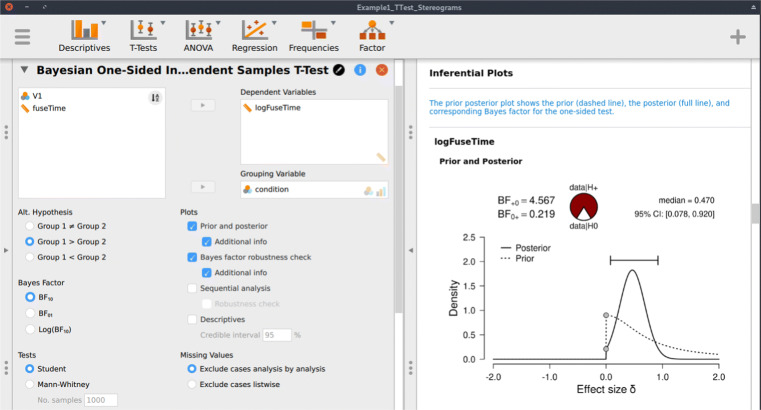
- In the stereogram example, the one-sided Bayesian two-sample t test yielded BF+0 = 4.567, described as moderate evidence; the Bayesian Mann–Whitney U test yielded BF+0 = 5.191.
- For parameter estimation, the two-sided analysis gave a posterior median for δ of 0.47 with a 95% central credible interval from 0.046 to 0.904.
- The paper lists five common pitfalls, including confusing Bayes factors with posterior odds, confusing prior model probabilities with parameter prior distributions, and using credible intervals as hypothesis tests.
Methods
- Design: methodological guidelines for Bayesian statistical reasoning in research, organized into four stages and summarized in Table 1.
- Data/sample: the running example uses Frisby and Clatworthy’s (1975) stereogram data; the original sample had 103 participants, 25 were eliminated for failing an initial stereo-acuity test, leaving 78 participants (43 NV, 35 VV).
- Main analysis: the example applies a one-sided Bayesian two-sample t test for hypothesis testing, a two-sided Bayesian two-sample t test for parameter estimation, a Bayesian Mann–Whitney U test as a robustness check, and a Bayes factor robustness plot; the fuse times were log-transformed after assumption checks.
Limitations
- The paper states that for some frequentist analyses, the Bayesian counterpart has not yet been developed or implemented in JASP.
- It states that some JASP analyses currently provide only a Bayes factor and not visual posterior distributions, and that some analyses are available only with a relatively limited set of prior distributions.
- The text notes these are not principled limitations and that JASP is actively being developed; it also makes evident that the guidelines focus on standard JASP analyses, while more complex models may require custom coding in JAGS, Stan, R, or Python.
Model-written summary. Check it against the paper before relying on it.
Integrity signals
Registry
Cites
Statistics
Figures
Verification
Claims the paper makes
3 Valid · 1 Not valid · 25 Not checked · 53 Own results and interpretations
The cited sources support only part of this claim — read each source’s verdict below.
In the paper
“In Bayesian hypothesis testing, a one-sided hypothesis yields a more diagnostic test than a two-sided alternative (e.g., Jeffreys, 1961; Wetzels, Raaijmakers, Jakab, & Wagenmakers, 2009, p.283).”
§ The JASP guidelines for conducting and reporting a Bayesian analysis > Stage 1: Planning the analysis > Specifying the statistical model.
What the sources say
- Not checked yetcites Jeffreys, 1961
- Partly supportedcites Wetzels, Raaijmakers, Jakab, & Wagenmakers, 2009 matched to “How to quantify support for and against the null hypothesis: A flexible WinBUGS implementation of a default Bayesian t test” (2009) sourceExperimental — accuracy not yet measured
Our copy never states the general comparative principle that a one-sided hypothesis yields a more diagnostic test than a two-sided alternative; its motivation for the one-sided (order-restricted) SD test is applicability — the JZS two-sided test 'does not directly apply' when the alternative is directional (Introduction, p. 1; Bayesian Hypothesis Testing, p. 3). What it does supply is a worked illustration in Extension 1: Order Restrictions (p. 5), where the same data give BF01 = 6.08 under the unrestricted two-sided alternative but BF01 = 13.75 (posterior .93 vs .86) under the order-restricted one-sided alternative, i.e. a sharper quantification. So the example supports part of the claim while the general assertion attributed here is not made by this paper. (LLM, conf=0.65)
plainstates a cause- Asserted: passes — The authors put it forward as true.
- Checkable: passes — It can be checked against evidence.
- Load-bearing: passes — The paper’s conclusions depend on it.
- Based: passes — The paper gives a reason why it holds.
A result the paper reports from its own data — it cites no other source for it, so there is none to check. The quote shows it is in the paper.
In the paper
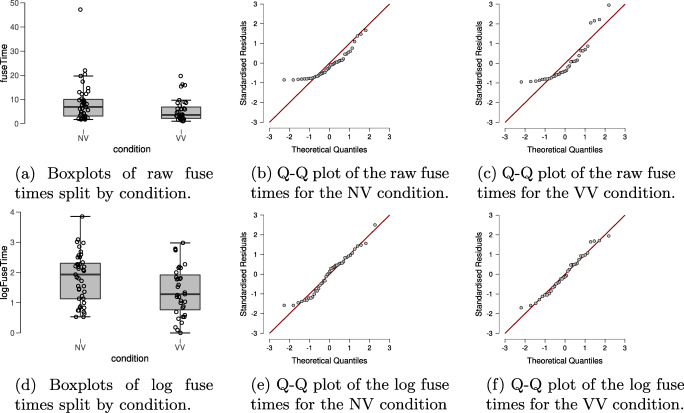
“Visual inspection of the boxplots suggests that the variances of the fuse times may not be equal”
§ The JASP guidelines for conducting and reporting a Bayesian analysis > Stage 2: Executing the analysis > Stereogram example
hedged- Asserted: passes — The authors put it forward as true.
- Checkable: passes — It can be checked against evidence.
- Load-bearing: passes — The paper’s conclusions depend on it.
- Based: passes — The paper gives a reason why it holds.
A result the paper reports from its own data — it cites no other source for it, so there is none to check. The quote shows it is in the paper.
In the paper
“There also appear to be a number of potential outliers in both groups.”
§ The JASP guidelines for conducting and reporting a Bayesian analysis > Stage 2: Executing the analysis > Stereogram example
hedged- Asserted: passes — The authors put it forward as true.
- Checkable: passes — It can be checked against evidence.
- Load-bearing: passes — The paper’s conclusions depend on it.
- Based: passes — The paper gives a reason why it holds.
A result the paper reports from its own data — it cites no other source for it, so there is none to check. The quote shows it is in the paper.
In the paper
“observed standard deviations of the NV and VV groups are 8.085 and 4.802, respectively”
§ The JASP guidelines for conducting and reporting a Bayesian analysis > Stage 2: Executing the analysis > Stereogram example
plain- Asserted: passes — The authors put it forward as true.
- Checkable: passes — It can be checked against evidence.
- Load-bearing: passes — The paper’s conclusions depend on it.
- Based: passes — The paper gives a reason why it holds.
A result the paper reports from its own data — it cites no other source for it, so there is none to check. The quote shows it is in the paper.
In the paper
“Moreover, the Q-Q plots show that the normality assumption of the t test is untenable here.”
§ The JASP guidelines for conducting and reporting a Bayesian analysis > Stage 2: Executing the analysis > Stereogram example
plain- Asserted: passes — The authors put it forward as true.
- Checkable: passes — It can be checked against evidence.
- Load-bearing: passes — The paper’s conclusions depend on it.
- Based: passes — The paper gives a reason why it holds.
25 more claims
Create a free account to see all 82 claims and to verify the 40 references still open.
- It may state two separate claims as one. 33
- Probably not a substantial claim. 29
Claims other papers make about this one
Each is checked against this paper’s own text: does it say what the citing paper says it does?
The cited source says what the claim attributes to it.
In the citing paper
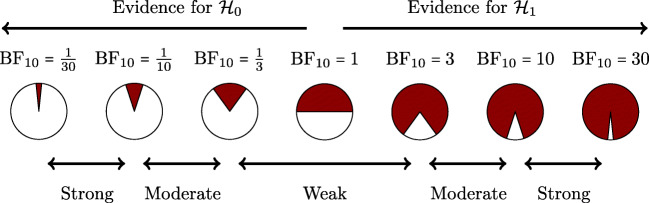
“According to common interpretive guidelines (Van Doorn et al., 2021), a Bayes Factor between 0.33 and 0.10 can be considered moderate evidence for the null, and this result falls at the upper end of that range.”
From This is not the way: global directional cues do not improve spatial learning in an immersive virtual environment (2025) · cites this paper as Van Doorn et al., 2021
Self-check
Percentages, sums and reported differences re-computed from the paper’s own numbers.
Each contradiction between two passages listed here was confirmed by an independent check.
Rated minor: it would not touch a result — a value no result rests on, a p-value that stays on the same side of the significance level, or a conflict that is clerical, resolved elsewhere in the paper, or outside its own findings.
In the paper
§ The JASP guidelines for conducting and reporting a Bayesian analysis > Stage 3: Interpreting the results > Stereogram example
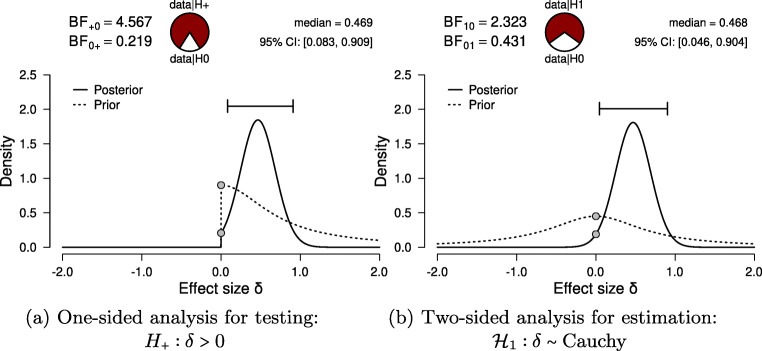
“For parameter estimation, the results of the two-sided t test are presented in Fig. 6a.”
§ The JASP guidelines for conducting and reporting a Bayesian analysis > Stage 3: Interpreting the results > Stereogram example
“The left panel shows the one-sided procedure for hypothesis testing and the right panel shows the two-sided procedure for parameter estimation.”
Citations
Cites
Kass, R. E., & Raftery, A. E. (1995) · Journal of the American Statistical Association · doi:10.1080/01621459.1995.10476572 · Cited by 12,558
Statistical Methods for Research Workers
(1945) · American Journal of Clinical Pathology · doi:10.1093/ajcp/15.11.552b · Cited by 10,880
brms : An R Package for Bayesian Multilevel Models Using Stan
Bürkner, P.-C. (2017) · Journal of Statistical Software · doi:10.18637/jss.v080.i01 · Cited by 9,476 · cited 1×
“Popular packages for conducting Bayesian analyses in R are the BayesFactor package (Morey & Rouder, 2015) and the brms package (B¨urkner, 2017), among others (see https://cran.r-project.org/web/views/Bayesian.html for a more exhaustive list).”
MethodStan : A Probabilistic Programming Language
Carpenter, B., Gelman, A., Hoffman, M. D., Lee, D., Goodrich, B., Betancourt, M., Brubaker, M., Guo, J., Li, P., & Riddell, A. (2017) · Journal of Statistical Software · doi:10.18637/jss.v076.i01 · Cited by 7,754
JAGS: A program for analysis of Bayesian graphical models using Gibbs sampling
Plummer, M. (2003) · Cited by 4,720
Hoeting, J. A., Madigan, D., Raftery, A. E., & Volinsky, C. T. (1999) · Statistical Science · doi:10.1214/ss/1009212519 · Cited by 4,118
Bayesian t tests for accepting and rejecting the null hypothesis
Rouder, J. N., Speckman, P. L., Sun, D., Morey, R. D., & Iverson, G. (2009) · Psychonomic Bulletin & Review · doi:10.3758/pbr.16.2.225 · Cited by 3,688
Probabilistic programming in Python using PyMC3
Salvatier, J., Wiecki, T. V., & Fonnesbeck, C. (2016) · PeerJ Computer Science · doi:10.7717/peerj-cs.55 · Cited by 2,544
Using Bayes to get the most out of non-significant results
Dienes, Z. (2014) · Frontiers in Psychology · doi:10.3389/fpsyg.2014.00781 · Cited by 1,998
Computing Bayes Factors by Combining Simulation and Asymptotic Approximations
Diciccio, T. J., Kass, R. E., Raftery, A., & Wasserman, L. (1997) · Journal of the American Statistical Association · doi:10.1080/01621459.1997.10474045 · Cited by 1,943
Research works printed but not linked: 3
- Jeffreys, H. (1939). Theory of probability, 1st. Oxford University Press.
- Jeffreys, H. (1961). Theory of probability. 3rd. Oxford University Press.
- Wrinch D Jeffreys H On certain fundamental principles of scientific inquiry Philosophical Magazine 1921 42 369 390
Cited by
Visualizations with statistical details: The 'ggstatsplot' approach
Patil, I. (2021) · Journal of Open Source Software · doi:10.21105/joss.03167 · Cited by 1,496
“The defaults are designed to follow best practices in both data visualization (Cleveland, 1985; Grant, 2018; Healy, 2018; Tufte, 2001; Wilke, 2019) and (frequentist/Bayesian) statistical reporting (American Psychological Association, 2019; van Doorn et al., 2020).”
MethodPsychological inoculation improves resilience against misinformation on social media
Roozenbeek, J., van der Linden, S., Goldberg, B., Rathje, S., & Lewandowsky, S. (2022) · Science Advances · doi:10.1126/sciadv.abo6254 · Cited by 472
Bayesian Analysis Reporting Guidelines
Kruschke, J. K. (2021) · Nature Human Behaviour · doi:10.1038/s41562-021-01177-7 · Cited by 440
A Conceptual Introduction to Bayesian Model Averaging
Hinne, M., Gronau, Q. F., van den Bergh, D., & Wagenmakers, E.-J. (2020) · Advances in Methods and Practices in Psychological Science · doi:10.1177/2515245919898657 · Cited by 318
“When one is in doubt, robustness checks can verify that conclusions do not depend on arbitrary choices of priors (van Doorn et al., 2019).”
Self-citationBasol, M., Roozenbeek, J., Berriche, M., Uenal, F., McClanahan, W. P., & Linden, S. V. D. (2021) · Big Data & Society · doi:10.1177/20539517211013868 · Cited by 271
A Tutorial on Conducting and Interpreting a Bayesian ANOVA in JASP
van den Bergh, D., van Doorn, J., Marsman, M., Draws, T., van Kesteren, E.-J., Derks, K., Dablander, F., Gronau, Q. F., Kucharský, Š., Gupta, A. R. K. N., et al. (2020) · L’Année psychologique · doi:10.3917/anpsy1.201.0073 · Cited by 267
Self-citationInterventions reducing affective polarization do not necessarily improve anti-democratic attitudes
Voelkel, J. G., Chu, J., Stagnaro, M. N., Mernyk, J. S., Redekopp, C., Pink, S. L., Druckman, J. N., Rand, D. G., & Willer, R. (2022) · Nature Human Behaviour · doi:10.1038/s41562-022-01466-9 · Cited by 246
Self-citationInterventions Reducing Affective Polarization Do Not Necessarily Improve Anti-Democratic Attitudes
Voelkel, J. G., Chu, J., Stagnaro, M., Mernyk, J. S., Redekopp, C., Pink, S. L., Druckman, J., Rand, D. G., & Willer, R. (2021) · doi:10.31219/osf.io/7evmp · Cited by 247
Self-citationKelter, R. (2020) · BMC Medical Research Methodology · doi:10.1186/s12874-020-00980-6 · Cited by 167
The effects of bilingualism on executive functions: an updated quantitative analysis
Grundy, J. G. (2020) · Journal of Cultural Cognitive Science · doi:10.1007/s41809-020-00062-5 · Cited by 164
How Do I Know What My Theory Predicts?
Dienes, Z. (2019) · Advances in Methods and Practices in Psychological Science · doi:10.1177/2515245919876960 · Cited by 146
Improving self-efficacy and creative self-efficacy to foster creativity and learning in schools
Puozzo, I. C., & Audrin, C. (2021) · Thinking Skills and Creativity · doi:10.1016/j.tsc.2021.100966 · Cited by 236
Microdosing with psilocybin mushrooms: a double-blind placebo-controlled study
Cavanna, F., Muller, S., de la Fuente, L. A., Zamberlan, F., Palmucci, M., Janeckova, L., Kuchar, M., Pallavicini, C., & Tagliazucchi, E. (2022) · Translational Psychiatry · doi:10.1038/s41398-022-02039-0 · Cited by 134
“These differences were supported by the Bayesian analysis, with BF10 values in the very strong (>30) range [54].”
MethodWolf, V., Kühnel, A., Teckentrup, V., Koenig, J., & Kroemer, N. B. (2021) · Psychophysiology · doi:10.1111/psyp.13933 · Cited by 129
Roozenbeek, J., Freeman, A. L. J., & van der Linden, S. (2021) · Psychological Science · doi:10.1177/09567976211024535 · Cited by 121
“…of the focal hypothesis and against the null hypothesis that there would be no difference in truth discernment between the treatment and control groups (van Doorn et al., 2021; see Table S4 in the Supplemental Material).5 We found that—unlike in the target study—an independent-samples t test…”
ResultShared striatal activity in decisions to satisfy curiosity and hunger at the risk of electric shocks
Lau, J. K. L., Ozono, H., Kuratomi, K., Komiya, A., & Murayama, K. (2020) · Nature Human Behaviour · doi:10.1038/s41562-020-0848-3 · Cited by 146
Bovine host genome acts on rumen microbiome function linked to methane emissions
Martínez-Álvaro, M., Auffret, M. D., Duthie, C.-A., Dewhurst, R. J., Cleveland, M. A., Watson, M., & Roehe, R. (2022) · Communications Biology · doi:10.1038/s42003-022-03293-0 · Cited by 137
Bartoš, F., Maier, M., Quintana, D. S., & Wagenmakers, E.-J. (2022) · Advances in Methods and Practices in Psychological Science · doi:10.1177/25152459221109259 · Cited by 109
“For more general reporting guidelines, see van Doorn et al. (2021).”
Self-citationBrivio, E., Serino, S., Cousa, E. N., Zini, A., Riva, G., & Leo, G. D. (2020) · Virtual Reality · doi:10.1007/s10055-020-00453-7 · Cited by 130
A Tutorial on Conducting and Interpreting a Bayesian ANOVA in JASPPreprint
van den Bergh, D., van Doorn, J. B., Marsman, M., Draws, T., van Kesteren, E., Derks, K., Dablander, F., Gronau, Q. F., Kucharský, Š., Raj, A., et al. (2019) · doi:10.31234/osf.io/spreb · Cited by 107
Self-citationAlpha oscillations reflect suppression of distractors with increased perceptual load
Gutteling, T. P., Sillekens, L., Lavie, N., & Jensen, O. B. (2022) · Progress in Neurobiology · doi:10.1016/j.pneurobio.2022.102285 · Cited by 120
Transcranial ultrasound stimulation of the human motor cortex
Zhang, Y., Ren, L., Liu, K., Tong, S., Yuan, T., & Sun, J. (2021) · iScience · doi:10.1016/j.isci.2021.103429 · Cited by 104
“To test the behavior change, the SST was conducted before and after rTUS intervention (Figures 1A and 1B).”
MethodInfluentialBreast-Conserving Surgery or Mastectomy?
Christiansen, P., Mele, M., Bodilsen, A., Rocco, N., & Zachariae, R. H. (2022) · Annals of Surgery Open · doi:10.1097/as9.0000000000000205 · Cited by 99
A review of applications of the Bayes factor in psychological research.
Heck, D. W., Boehm, U., Böing-Messing, F., Bürkner, P., Derks, K., Dienes, Z. P., Fu, Q., Gu, X., Karimova, D., Kiers, H. A. L., et al. (2023) · Psychological Methods · doi:10.1037/met0000454 · Cited by 115
Self-citationA tutorial on Bayesian multi-model linear regression with BAS and JASP
van den Bergh, D., Clyde, M. A., Gupta, A., de Jong, T., Gronau, Q. F., Marsman, M., Ly, A., & Wagenmakers, E. (2021) · Behavior Research Methods · doi:10.3758/s13428-021-01552-2 · Cited by 109
“However, it is generally recommended to investigate the robustness of the results against the choice of prior (van Doorn et al., 2019).”
BackgroundSelf-citationBeato, M., Bigby, A. E. J., de Keijzer, K. L., Nakamura, F. Y., Coratella, G., & McErlain‐Naylor, S. A. (2019) · PLoS ONE · doi:10.1371/journal.pone.0222466 · Cited by 123
“Markov Chain Monte Carlo with Gibbs sampling was used to make inferences (10000 samples) [26].”
MethodTransition to Parenthood and Marital Satisfaction: A Meta-Analysis
Bogdan, I., Turliuc, M. N., & Candel, O. S. (2022) · Frontiers in Psychology · doi:10.3389/fpsyg.2022.901362 · Cited by 145
Greene, D., Demeter, C., & Dolničar, S. (2023) · Journal of Travel Research · doi:10.1177/00472875231183701 · Cited by 98
“The predictive quality of the two competing hypotheses (i.e., effect vs. null-effect) is assessed with Bayes factors (BF 10 ; van Doorn et al., 2021).”
MethodKelter, R. (2020) · BMC Medical Research Methodology · doi:10.1186/s12874-020-00968-2 · Cited by 106
The effect of a virtual reality environment on gaze behaviour and motor skill learning
Harris, D., Buckingham, G., Wilson, M., Brookes, J., Mushtaq, F., Mon-Williams, M. A., & Vine, S. J. (2020) · Psychology of sport and exercise · doi:10.1016/j.psychsport.2020.101721 · Cited by 93
A Primer on Bayesian Model-Averaged Meta-Analysis
Gronau, Q. F., Heck, D. W., Berkhout, S. W., Haaf, J. M., & Wagenmakers, E. (2021) · Advances in Methods and Practices in Psychological Science · doi:10.1177/25152459211031256 · Cited by 99
“In general, we believe that for parameter estimation, it is advisable to not use a truncated prior for the parameter of interest (van Doorn et al., 2019).”
Self-citationAlessandro de, S. I. R. E., Moggio, L., Demeco, A., Fortunato, F., Spanò, R., Aiello, V., Marotta, N., & Ammendolia, A. (2021) · Annals of Physical and Rehabilitation Medicine · doi:10.1016/j.rehab.2021.101602 · Cited by 98
Bayesian inference in numerical cognition: A tutorial using JASP
Faulkenberry, T. J., Ly, A., & Wagenmakers, E. (2020) · Journal of Numerical Cognition · doi:10.5964/jnc.v6i2.288 · Cited by 89
Self-citationDealing with small samples in football research
Hecksteden, A., Kellner, R., & Donath, L. (2021) · Science and Medicine in Football · doi:10.1080/24733938.2021.1978106 · Cited by 153
“This can provide analyses based on a small number of datapoints with a decisive head start (Wagenmakers et al. 2016; Bolstad and Curran 2016; Van de Schoot 2020).”
BackgroundInfluentialMahalingham, T., McEvoy, P. M., & Clarke, P. J. F. (2023) · Computers in Human Behavior · doi:10.1016/j.chb.2022.107567 · Cited by 73
Fine-Grained Mapping of Cortical Somatotopies in Chronic Complex Regional Pain Syndrome
Mancini, F., Wang, A. P., Schira, M. M., Isherwood, Z. J., McAuley, J. H., Iannetti, G. D., Sereno, M. I., Moseley, G. L., & Rae, C. D. (2019) · Journal of Neuroscience · doi:10.1523/jneurosci.2005-18.2019 · Cited by 76
Bayesian Repeated-Measures Analysis of Variance: An Updated Methodology Implemented in JASP
van den Bergh, D., Wagenmakers, E., & Aust, F. (2023) · Advances in Methods and Practices in Psychological Science · doi:10.1177/25152459231168024 · Cited by 120
Self-citationDiscussion points for Bayesian inference
Aczél, B., Hoekstra, R., Gelman, A., Wagenmakers, E., Klugkist, I. G., Rouder, J. N., Vandekerckhove, J., Lee, M. D., Morey, R. D., Vanpaemel, W., et al. (2020) · Nature Human Behaviour · doi:10.1038/s41562-019-0807-z · Cited by 76
Self-citationPittig, A., Boschet, J. M., Glück, V. M., & Schneider, K. (2020) · Depression and Anxiety · doi:10.1002/da.23119 · Cited by 75
Making ERP research more transparent: Guidelines for preregistration
Paul, M., Govaart, G., & Schettino, A. (2021) · International Journal of Psychophysiology · doi:10.1016/j.ijpsycho.2021.02.016 · Cited by 71
How to use and report Bayesian hypothesis tests.
Dienes, Z. P. (2021) · Psychology of Consciousness Theory Research and Practice · doi:10.1037/cns0000258 · Cited by 94
A tutorial on Bayesian model-averaged meta-analysis in JASP
Berkhout, S. W., Haaf, J. M., Gronau, Q. F., Heck, D. W., & Wagenmakers, E. (2023) · Behavior Research Methods · doi:10.3758/s13428-023-02093-6 · Cited by 80
“We follow van Doorn and colleagues’ suggestions for transparent reporting of Bayesian analyses (van Doorn et al., 2021).”
BackgroundSelf-citationThe influence of tDCS intensity on decision-making training and transfer outcomes
Ehrhardt, S. E., Filmer, H. L., Wards, Y., Mattingley, J. B., & Dux, P. E. (2020) · Journal of Neurophysiology · doi:10.1152/jn.00423.2020 · Cited by 68
Gender Differences in Personality Traits of Software Engineers
Russo, D., & Stol, K.-J. (2020) · IEEE Transactions on Software Engineering · doi:10.1109/tse.2020.3003413 · Cited by 74
Pittig, A. (2019) · Behaviour Research and Therapy · doi:10.1016/j.brat.2019.103463 · Cited by 68
Preisig, B. C., Riecke, L., Sjerps, M. J., Kösem, A., Kop, B. R., Bramson, B., Hagoort, P., & Hervais‐Adelman, A. (2021) · Proceedings of the National Academy of Sciences · doi:10.1073/pnas.2015488118 · Cited by 59
“For example, BF10 = 5 means that the data are five times more likely under H1 than under H0 (85).”
BackgroundHuman perceptual and metacognitive decision-making rely on distinct brain networks
Luzio, P. D., Tarasi, L., Silvanto, J., Avenanti, A., & Romei, V. (2022) · PLoS Biology · doi:10.1371/journal.pbio.3001750 · Cited by 62
Patent Ductus Arteriosus and Bronchopulmonary Dysplasia–Associated Pulmonary Hypertension
Villamor, E., van Westering-Kroon, E., González-Luis, G. E., Bartos̆, F., Abman, S. H., & Huizing, M. J. (2023) · JAMA Network Open · doi:10.1001/jamanetworkopen.2023.45299 · Cited by 55
Biddlestone, M., Green, R., Douglas, K. M., Azevedo, F., Sutton, R. M., & Cichocka, A. K. (2022) · doi:10.31234/osf.io/rxjqc · Cited by 55
Is camouflaging unique for autism? A comparison of camouflaging between adults with autism and ADHD
van der Putten, W. J., Mol, A. J. J., Groenman, A. P., Radhoe, T. A., Torenvliet, C., van Rentergem, J. A. A., & Geurts, H. M. (2024) · Autism Research · doi:10.1002/aur.3099 · Cited by 54
“We interpreted the Bayes factors (BF) according to the guidelines described in van Doorn et al. (2021), that is: BF <3 is inconclusive, BF >3 is moderate evidence, BF > 10 is strong evidence.”
MethodstatsExpressions: R Package for Tidy Dataframes and Expressions with Statistical Details
Patil, I. (2021) · The Journal of Open Source Software · doi:10.21105/joss.03236 · Cited by 57
“The random-effects meta-analysis is carried out using metafor (parametric) (Viechtbauer, 2010), metaplus (robust) (Beath, 2016), and metaBMA (Bayesian) (Heck et al., 2019) packages.”
MethodInfluentialBayesian model‐averaged meta‐analysis in medicine
Bartos̆, F., Gronau, Q. F., Timmers, B., Otte, W. M., Ly, A., & Wagenmakers, E. (2021) · Statistics in Medicine · doi:10.1002/sim.9170 · Cited by 62
Self-citationSymptoms of depression change with olfactory function
Sabiniewicz, A., Hoffmann, L., Haehner, A., & Hummel, T. R. (2022) · Scientific Reports · doi:10.1038/s41598-022-09650-7 · Cited by 60
An integrated theory of deciding and acting.
Servant, M., Logan, G. D., Gajdos, T., & Evans, N. J. (2021) · Journal of Experimental Psychology General · doi:10.1037/xge0001063 · Cited by 55
Self-citationObtaining Evidence for No Effect
Dienes, Z. P. (2021) · Collabra Psychology · doi:10.1525/collabra.28202 · Cited by 59
Iglesias, S., Kasper, L., Harrison, S. J., Manka, R., Mathys, C., & Stephan, K. E. (2021) · NeuroImage · doi:10.1016/j.neuroimage.2020.117590 · Cited by 45
Fluyau, D., Mitra, P., Jain, A., Kailasam, V. K., & Pierre, C. G. (2022) · European Journal of Clinical Pharmacology · doi:10.1007/s00228-022-03303-4 · Cited by 60
Bored, distracted, and forgetful: The impact of mind wandering and boredom on memory encoding
Blondé, P., Sperduti, M., Makowski, D., & Piolino, P. (2021) · Quarterly Journal of Experimental Psychology · doi:10.1177/17470218211026301 · Cited by 60
Pragmatic bias impedes women’s access to political leadership
Corbett, C., Voelkel, J. G., Cooper, M., & Willer, R. (2022) · Proceedings of the National Academy of Sciences · doi:10.1073/pnas.2112616119 · Cited by 64
“Because nonsignificant P values cannot be interpreted as evidence in favor of the null hypothesis, we conducted Bayesian analyses using Jeffreys’s Amazing Statistics Program (55, 56) to quantify the evidence in favor of the null hypothesis relative to the alternative hypothesis.”
Self-citationVolfart, A., Yan, X., Maillard, L. G., Colnat‐Coulbois, S., Hossu, G., Rossion, B., & Jonas, J. (2022) · NeuroImage · doi:10.1016/j.neuroimage.2022.118932 · Cited by 47
Griffiths, B., Zaehle, T., Repplinger, S., Schmitt, F. C., Voges, J., Hanslmayr, S., & Staudigl, T. (2022) · Nature Communications · doi:10.1038/s41467-022-31407-z · Cited by 44
Fahrenholtz, I. L., Melin, A. K., Garthe, I., Hollekim-Strand, S. M., Ivarsson, A., Koehler, K., Logue, D., Lundström, P., Madigan, S., Wasserfurth, P., et al. (2023) · Nutrients · doi:10.3390/nu15051082 · Cited by 40
Mothers are sensitive to men's beards as a potential cue of paternal investment
Dixson, B. J. W., Kennedy‐Costantini, S., Lee, A. J., & Nelson, N. L. (2019) · Hormones and Behavior · doi:10.1016/j.yhbeh.2019.04.005 · Cited by 41
Reyes, G., Betancourt, I., Andrade, B., Panchana, F., Román, R., Ochoa, L. S., Trujillo, L. E., & Bayot, B. (2022) · Frontiers in Microbiology · doi:10.3389/fmicb.2022.838640 · Cited by 48
König, L., Marbach-Breitrück, E., Engler, A., & Suhr, R. (2022) · Journal of Medical Internet Research · doi:10.2196/37523 · Cited by 48
Hill, C. M., Stringer, M., Waddell, D. E., & Arco, A. D. (2020) · Frontiers in Human Neuroscience · doi:10.3389/fnhum.2020.00294 · Cited by 44
“All Bayesian statistical analysis was conducted with JASP 0.11.1.0 (van Doorn et al., 2019).”
MethodInfluentialBayesian Repeated-Measures ANOVA: An Updated Methodology Implemented in JASPPreprint
van den Bergh, D., Wagenmakers, E., & Aust, F. (2022) · doi:10.31234/osf.io/fb8zn · Cited by 38
Self-citationMultivariate Intra-Sexual Selection on Men’s Perceptions of Male Facial Morphology
Mefodeva, V., Sidari, M. J., Chau, H., Fitzsimmons, B., Antoine, G., Clarkson, T. R., Pearson, S. G., Lee, A. J., & Dixson, B. J. W. (2020) · Adaptive Human Behavior and Physiology · doi:10.1007/s40750-020-00128-2 · Cited by 41
Zhuang, Q., Zheng, X., Becker, B., Lei, W. I., Xu, X., & Kendrick, K. M. (2021) · Psychoneuroendocrinology · doi:10.1016/j.psyneuen.2021.105412 · Cited by 37
Kelter, R. (2020) · Computational Statistics · doi:10.1007/s00180-020-01034-7 · Cited by 51
“van Doorn et al. (2019, 2020) recently proposed a nonparametric Bayesian version of the two-sample t-test as a Bayesian counterpart to the frequentist Mann–Whitney U test.”
BackgroundMethodInfluentialAssessing Expertise Using Eye Tracking in a Virtual Reality Flight Simulation
Harris, D., Arthur, T., de Burgh, T., Duxbury, M., Lockett-Kirk, R., McBarnett, W., & Vine, S. J. (2023) · The International Journal of Aerospace Psychology · doi:10.1080/24721840.2023.2195428 · Cited by 49
“We adopt the convention that BF 10 > 3 indicates moderate support for the alternative model and BF 10 > 10 indicates strong support (Van Doorn et al., 2019).”
Kofler, M. J., Groves, N. B., Chan, E. S. M., Marsh, C. L., Cole, A. M., Gaye, F., Cibrian, E., Tatsuki, M. O., & Singh, L. J. (2024) · Frontiers in Psychiatry · doi:10.3389/fpsyt.2024.1277583 · Cited by 35
“Tier 2 tested for effects of increasing working memory demands on inhibitory control performance, with one model for speed (DV: RT to correct trials) and one model for accuracy (DV: % correct).”
MethodReeder, R., Pounder, Z., Figueroa, A., Jüllig, A., & Azañón, E. (2024) · Cognition · doi:10.1016/j.cognition.2024.105907 · Cited by 55
“We chose to use default values since we did not have precise effect sizes to inform our priors, thus we did not have a strong justification for any particular prior; JASP guidelines suggest that using default priors is acceptable in such cases (van Doorn et al., 2021).”
MethodTerranova, J. I., Yokose, J., Osanai, H., Ogawa, S. K., & 北村, 貴. (2023) · Nature Communications · doi:10.1038/s41467-023-39718-5 · Cited by 30
Haywood, S., Hasking, P. A., & Boyes, M. E. (2023) · Journal of Affective Disorders · doi:10.1016/j.jad.2023.01.027 · Cited by 47
Parallel model-based and model-free reinforcement learning for card sorting performance
Steinke, A., Lange, F., & Kopp, B. (2020) · Scientific Reports · doi:10.1038/s41598-020-72407-7 · Cited by 39
A Network Analysis of the Relationship among Reading, Spelling and Maths Skills
Zoccolotti, P., Angelelli, P., Marinelli, C. V., & Romano, D. (2021) · Brain Sciences · doi:10.3390/brainsci11050656 · Cited by 36
“The analyses were performed using JASP [47].”
InfluentialCurrent loot box warnings are ineffective for informing consumers
Garrett, E. P., Drummond, A., Lowe-Calverley, E., & Sauer, J. D. (2022) · Computers in Human Behavior · doi:10.1016/j.chb.2022.107534 · Cited by 48
Himmels, C., Venrooij, J., Parduzi, A., Peller, M., & Riener, A. (2024) · Transportation Research Part F Traffic Psychology and Behaviour · doi:10.1016/j.trf.2024.01.007 · Cited by 44
Lisi, M. P., Scattolin, M., Fusaro, M., & Aglioti, S. M. (2021) · PLoS ONE · doi:10.1371/journal.pone.0255598 · Cited by 40
“The BF quantifies the relative predictive performance of two rival hypotheses, and represents the degree to which data require a change in beliefs concerning the relative plausibility hypotheses [55].”
BackgroundInfluentialHoffmann, T., Ye, M., Zino, L., Cao, M., Rauws, W. S., & Bolderdijk, J. W. (2024) · Journal of Environmental Psychology · doi:10.1016/j.jenvp.2023.102221 · Cited by 37
“A Bayes factor of this size is considered extreme evidence (van Doorn et al., 2021).”
Expert agreement in prior elicitation and its effects on Bayesian inference
Stefan, A. M., Katsimpokis, D., Gronau, Q. F., & Wagenmakers, E. (2022) · Psychonomic Bulletin & Review · doi:10.3758/s13423-022-02074-4 · Cited by 42
Self-citationTransdiagnostic fears and avoidance behaviors in self-reported eating disorders
Melles, H., & Jansen, A. (2023) · Journal of Eating Disorders · doi:10.1186/s40337-023-00745-8 · Cited by 30
“The Bayesian ANOVA yields a Bayes factor (BF) that quantifies the relative plausibility of two rival models [74, 75].”
MethodEffects of ChatGPT use on undergraduate students’ creativity: a threat to creative thinking?
Toma, R. B., & Yánez‐Pérez, I. (2024) · Discover Artificial Intelligence · doi:10.1007/s44163-024-00172-x · Cited by 68
Al‐Jaishi, A. A., McIntyre, C. W., Sontrop, J. M., Dixon, S. N., Anderson, S., Bagga, A., Benjamin, D., Berry, D., Blake, P. G., Chambers, L., et al. (2020) · Canadian Journal of Kidney Health and Disease · doi:10.1177/2054358119887988 · Cited by 32
Botanical priming helps overcome plant blindness on a memory task
Zani, G., & Low, J. (2022) · Journal of Environmental Psychology · doi:10.1016/j.jenvp.2022.101808 · Cited by 39
Music-induced emotions influence intertemporal decision making
Zhou, L., Yang, Y., & Li, S. (2021) · Cognition & Emotion · doi:10.1080/02699931.2021.1995331 · Cited by 39
Graat, I., Mocking, R. J. T., Liebrand, L. C., van den Munckhof, P., Bot, M., Schuurman, P. R., Bergfeld, I. O., van Wingen, G. A., & Denys, D. A. J. P. (2022) · Molecular Psychiatry · doi:10.1038/s41380-022-01760-y · Cited by 39
“1 or >10 strong evidence for H0 or H1, respectively [17].”
BackgroundThe effects of creatine supplementation on cognitive performance—a randomised controlled study
Sandkühler, J. F., Kersting, X., Faust, A., Königs, E. K., Altman, G., Ettinger, U., Lux, S., Philipsen, A., Müller, H., & Brauner, J. (2023) · BMC Medicine · doi:10.1186/s12916-023-03146-5 · Cited by 29
The effect of seeing scientists as intellectually humble on trust in scientists and their research
Koetke, J., Schumann, K., Bowes, S. M., & Vaupotič, N. (2024) · Nature Human Behaviour · doi:10.1038/s41562-024-02060-x · Cited by 38
“For all studies, we also present exploratory Bayes factors for null effects using JASP version 0.18.3 and JASP’s default priors 54,55 .”
InfluentialAmbiguity of early warning signals for climate tipping points
Rietkerk, M., Skiba, V., Weinans, E., Hébert, R., & Laepple, T. (2025) · Nature Climate Change · doi:10.1038/s41558-025-02328-8 · Cited by 51
Chen, W., Li, J., Zhang, X., Dong, Y., Shi, P., Luo, P., & Zheng, X. (2021) · Behaviour Research and Therapy · doi:10.1016/j.brat.2021.103831 · Cited by 30
Xu, L., Zheng, X., Yao, S., Li, J., Fu, M., Li, K., Zhao, W., Li, H., Becker, B., & Kendrick, K. M. (2022) · NeuroImage · doi:10.1016/j.neuroimage.2022.119010 · Cited by 30
Harris, D., Arthur, T., Vine, S. J., Liu, J., Rahman, H. R. A., Han, F., & Wilson, M. (2022) · Scientific Reports · doi:10.1038/s41598-022-26544-w · Cited by 49
Action does not enhance but attenuates predicted touch
Job, X., & Kilteni, K. (2023) · eLife · doi:10.7554/elife.90912 · Cited by 32
Löckenhoff, C. E., & Samanez-Larkin, G. R. (2019) · The Journals of Gerontology Series B · doi:10.1093/geronb/gbz097 · Cited by 26
Feeling tired versus feeling relaxed: Two faces of low physiological arousal
Steghaus, S., & Poth, C. H. (2024) · PLoS ONE · doi:10.1371/journal.pone.0310034 · Cited by 30
Sörös, P., & Bantel, C. (2019) · Pain · doi:10.1097/j.pain.0000000000001756 · Cited by 31
“Plots taken from JASP; the reporting of the results follows van Doorn et al.(96)”
MethodThiele, C., Zaehle, T., Haghikia, A., & Ruhnau, P. (2021) · Scientific Reports · doi:10.1038/s41598-021-01482-1 · Cited by 29
Acquisition of predator knowledge from alarm calls via one-trial social learning in monkeys
León, J., Thiriau, C., Bodin, C., Crockford, C., & Zuberbühler, K. (2022) · iScience · doi:10.1016/j.isci.2022.104853 · Cited by 34
Metadata
- Authors
- van Doorn, J., van den Bergh, D., Böhm, U., Dablander, F., Derks, K., Draws, T., Etz, A., Evans, N. J., Gronau, Q. F., Haaf, J. M., Hinne, M., Kucharský, Š., Ly, A., Marsman, M., Matzke, D., Gupta, A. R. K. N., Sarafoglou, A., Stefan, A., Voelkel, J. G., & Wagenmakers, E.-J.
- Affiliations
- University of Amsterdam (NL)
- Nyenrode Business University (NL)
- University of California, Irvine (US)
- Stanford University (US)
- ORCID
- Venue
- Psychonomic Bulletin & Review
- Published
- 2020-10-09
- Volume
- 28
- Issue
- 3
- Pages
- 813-826
- ISSN
- 1069-9384 (ISSN-L)
- 1531-5320
- PMC
- PMC8219590
- OpenAlex
- W3091779368
- Semantic Scholar
- c4bca921d78c0f4fb8569eb9d5c0cb42cbb3ec0b
- Cited by
- 1,114
- References
- 63
- Citations by year
- 2026: 111 · 2025: 169 · 2024: 216 · 2023: 202 · 2022: 177 · 2021: 139 · 2020: 71
- FWCI
- 103.84
- Type
- journal article
- Language
- en
- Open access
- hybrid
- doi.org
- Licence
- cc-by
- creativecommons.org/licenses/by/4.0 (tdm)
- creativecommons.org/licenses/by/4.0 (vor)
- Locations
- Psychonomic Bulletin & Review (publishedVersion, cc-by)
- PubMed Central (publishedVersion, cc-by)
- PubMed (publishedVersion)
- UvA-DARE (University of Amsterdam) (acceptedVersion, cc-by)
- Centrum Wiskunde & Informatica (CWI), the national research institute for mathematics and computer science in the Netherlands (submittedVersion)
- Data Archiving and Networked Services (DANS) (submittedVersion, other-oa)
- Radboud Repository (Radboud University) (submittedVersion)
- PsyArXiv (OSF Preprints) (submittedVersion, cc-by)
- PsyArXiv (OSF Preprints) (submittedVersion)
- Radboud Repository (Radboud University) (submittedVersion, other-oa)
- Funders
- National Science Foundation (1321846)
- Universiteit van Amsterdam
- Nederlandse Organisatie voor Wetenschappelijk Onderzoek (016.Vici.170.083, 406.18.559, 451-17-017)
- Topics
- Physical Sciences › Mathematics › Statistics and Probability › Statistical Methods and Bayesian Inference
- Social Sciences › Decision Sciences › Statistics, Probability and Uncertainty › Meta-analysis and systematic reviews
- Physical Sciences › Computer Science › Artificial Intelligence › Bayesian Modeling and Causal Inference
- Keywords
- Bayesian inference, JASP, reporting guidelines, statistical reporting, open-source statistical software
- MeSH terms
- Bayes Theorem, Data Interpretation, Statistical, Humans, Research Design, Models, Statistical, Guidelines as Topic
About these checks
Registry, retraction, Cites and statistics results are computed, not judged, with one exception: a printed reference that no index lists is read once by a model before it counts as a citation error. Claims are extracted by a model and kept only when their quote appears verbatim in the text; each cited source is then checked, with a model’s help, for whether it says what the claim relies on. Those verdicts can be wrong — read the claim’s quote and the cited source before relying on one.
The claim verdicts this report counts are experimental: their accuracy is not yet measured.
A language model drew the claims from the paper on 2026-10-04, under version 3 of the claim definition (model deepseek-v4.1-flash, prompt extract-v3).
A second model labelled each claim on 2026-10-04 (model jev-1.13-20260917, definition revision gold-guideline-v0.2).
Cited sources are checked with a language model’s help (qwen3.8-omni-flash).
Statistics and arithmetic are recomputed, not judged.
Confidence bands are shown only for fields calibrated on our annotated test set. None is calibrated yet, so no band is shown.
What counts as a claim ›How we measure confidence ›How we check this ›
Are you an author, or do you see a problem with this page? Request a review
Data sources
Bibliographic data: Semantic Scholar, OpenAlex, Crossref.
Contains information from the Semantic Scholar Academic Graph Datasets, made available under the ODC Attribution License (ODC-BY 1.0).
Semantic Scholar’s data is described in: Kinney, R., et al. (2023). The Semantic Scholar Open Data Platform. arXiv:2301.10140.
