

The JASP guidelines for conducting and reporting a Bayesian analysis
Open accessThe DOI matches its Crossref record; 60 of the 63 references it cites were found in a registry or an index; 3 of the 43 sources its claims cite were checked for support.
Abstract
Despite the increasing popularity of Bayesian inference in empirical research, few practical guidelines provide detailed recommendations for how to apply Bayesian procedures and interpret the results. Here we offer specific guidelines for four different stages of Bayesian statistical reasoning in a research setting: planning the analysis, executing the analysis, interpreting the results, and reporting the results. The guidelines for each stage are illustrated with a running example. Although the guidelines are geared towards analyses performed with the open-source statistical software JASP, most guidelines extend to Bayesian inference in general.
Overview
CoChat Summary
TL;DR
This paper provides practical guidelines for planning, executing, interpreting, and reporting Bayesian analyses, illustrated with a running stereogram example and focused on JASP. It emphasizes Bayes factors for testing, posterior distributions/credible intervals for estimation, and transparent reporting of priors, robustness, and analysis files.
Key findings
- The guidelines cover four stages: planning, executing, interpreting, and reporting, with recommendations such as preregistration, assumption checks, correct Bayes factor/credible interval interpretation, and sharing annotated `.jasp` files.
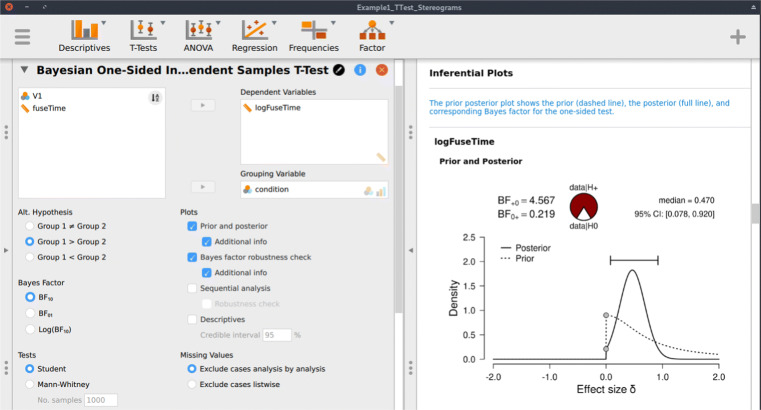
- In the stereogram example, the one-sided Bayesian two-sample t test yielded BF+0 = 4.567, described as moderate evidence; the Bayesian Mann–Whitney U test yielded BF+0 = 5.191.
- For parameter estimation, the two-sided analysis gave a posterior median for δ of 0.47 with a 95% central credible interval from 0.046 to 0.904.
- The paper lists five common pitfalls, including confusing Bayes factors with posterior odds, confusing prior model probabilities with parameter prior distributions, and using credible intervals as hypothesis tests.
Methods
- Design: methodological guidelines for Bayesian statistical reasoning in research, organized into four stages and summarized in Table 1.
- Data/sample: the running example uses Frisby and Clatworthy’s (1975) stereogram data; the original sample had 103 participants, 25 were eliminated for failing an initial stereo-acuity test, leaving 78 participants (43 NV, 35 VV).
- Main analysis: the example applies a one-sided Bayesian two-sample t test for hypothesis testing, a two-sided Bayesian two-sample t test for parameter estimation, a Bayesian Mann–Whitney U test as a robustness check, and a Bayes factor robustness plot; the fuse times were log-transformed after assumption checks.
Limitations
- The paper states that for some frequentist analyses, the Bayesian counterpart has not yet been developed or implemented in JASP.
- It states that some JASP analyses currently provide only a Bayes factor and not visual posterior distributions, and that some analyses are available only with a relatively limited set of prior distributions.
- The text notes these are not principled limitations and that JASP is actively being developed; it also makes evident that the guidelines focus on standard JASP analyses, while more complex models may require custom coding in JAGS, Stan, R, or Python.
Model-written summary. Check it against the paper before relying on it.
Integrity signals
Registry
Cites
Statistics
Figures
Verification
Claims the paper makes
3 Valid · 1 Not valid · 25 Not checked · 53 Own results and interpretations
The cited sources support only part of this claim — read each source’s verdict below.
In the paper
“In Bayesian hypothesis testing, a one-sided hypothesis yields a more diagnostic test than a two-sided alternative (e.g., Jeffreys, 1961; Wetzels, Raaijmakers, Jakab, & Wagenmakers, 2009, p.283).”
§ The JASP guidelines for conducting and reporting a Bayesian analysis > Stage 1: Planning the analysis > Specifying the statistical model.
What the sources say
- Not checked yetcites Jeffreys, 1961
- Partly supportedcites Wetzels, Raaijmakers, Jakab, & Wagenmakers, 2009 matched to “How to quantify support for and against the null hypothesis: A flexible WinBUGS implementation of a default Bayesian t test” (2009) sourceExperimental — accuracy not yet measured
Our copy never states the general comparative principle that a one-sided hypothesis yields a more diagnostic test than a two-sided alternative; its motivation for the one-sided (order-restricted) SD test is applicability — the JZS two-sided test 'does not directly apply' when the alternative is directional (Introduction, p. 1; Bayesian Hypothesis Testing, p. 3). What it does supply is a worked illustration in Extension 1: Order Restrictions (p. 5), where the same data give BF01 = 6.08 under the unrestricted two-sided alternative but BF01 = 13.75 (posterior .93 vs .86) under the order-restricted one-sided alternative, i.e. a sharper quantification. So the example supports part of the claim while the general assertion attributed here is not made by this paper. (LLM, conf=0.65)
plainstates a cause- Asserted: passes — The authors put it forward as true.
- Checkable: passes — It can be checked against evidence.
- Load-bearing: passes — The paper’s conclusions depend on it.
- Based: passes — The paper gives a reason why it holds.
A result the paper reports from its own data — it cites no other source for it, so there is none to check. The quote shows it is in the paper.
In the paper
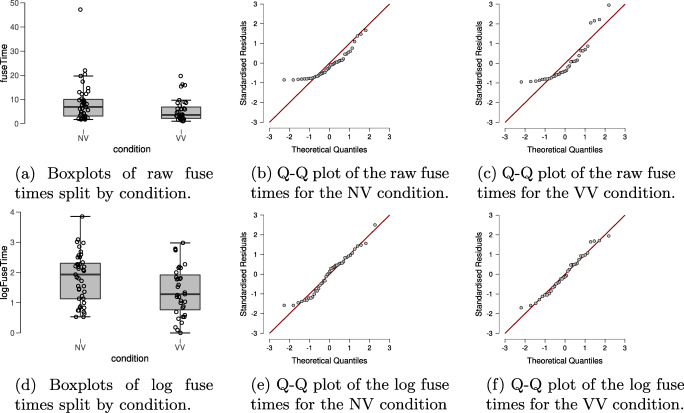
“Visual inspection of the boxplots suggests that the variances of the fuse times may not be equal”
§ The JASP guidelines for conducting and reporting a Bayesian analysis > Stage 2: Executing the analysis > Stereogram example
hedged- Asserted: passes — The authors put it forward as true.
- Checkable: passes — It can be checked against evidence.
- Load-bearing: passes — The paper’s conclusions depend on it.
- Based: passes — The paper gives a reason why it holds.
A result the paper reports from its own data — it cites no other source for it, so there is none to check. The quote shows it is in the paper.
In the paper
“There also appear to be a number of potential outliers in both groups.”
§ The JASP guidelines for conducting and reporting a Bayesian analysis > Stage 2: Executing the analysis > Stereogram example
hedged- Asserted: passes — The authors put it forward as true.
- Checkable: passes — It can be checked against evidence.
- Load-bearing: passes — The paper’s conclusions depend on it.
- Based: passes — The paper gives a reason why it holds.
A result the paper reports from its own data — it cites no other source for it, so there is none to check. The quote shows it is in the paper.
In the paper
“observed standard deviations of the NV and VV groups are 8.085 and 4.802, respectively”
§ The JASP guidelines for conducting and reporting a Bayesian analysis > Stage 2: Executing the analysis > Stereogram example
plain- Asserted: passes — The authors put it forward as true.
- Checkable: passes — It can be checked against evidence.
- Load-bearing: passes — The paper’s conclusions depend on it.
- Based: passes — The paper gives a reason why it holds.
A result the paper reports from its own data — it cites no other source for it, so there is none to check. The quote shows it is in the paper.
In the paper
“Moreover, the Q-Q plots show that the normality assumption of the t test is untenable here.”
§ The JASP guidelines for conducting and reporting a Bayesian analysis > Stage 2: Executing the analysis > Stereogram example
plain- Asserted: passes — The authors put it forward as true.
- Checkable: passes — It can be checked against evidence.
- Load-bearing: passes — The paper’s conclusions depend on it.
- Based: passes — The paper gives a reason why it holds.
25 more claims
Create a free account to see all 82 claims and to verify the 40 references still open.
- It may state two separate claims as one. 33
- Probably not a substantial claim. 29
Claims other papers make about this one
Each is checked against this paper’s own text: does it say what the citing paper says it does?
The cited source says what the claim attributes to it.
In the citing paper
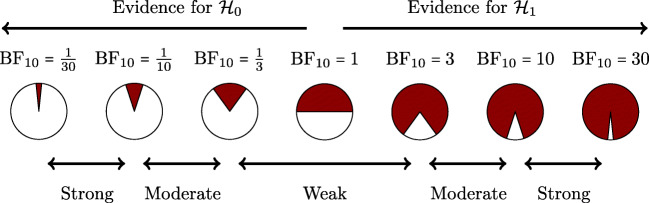
“According to common interpretive guidelines (Van Doorn et al., 2021), a Bayes Factor between 0.33 and 0.10 can be considered moderate evidence for the null, and this result falls at the upper end of that range.”
From This is not the way: global directional cues do not improve spatial learning in an immersive virtual environment (2025) · cites this paper as Van Doorn et al., 2021
Self-check
Percentages, sums and reported differences re-computed from the paper’s own numbers.
Each contradiction between two passages listed here was confirmed by an independent check.
Rated minor: it would not touch a result — a value no result rests on, a p-value that stays on the same side of the significance level, or a conflict that is clerical, resolved elsewhere in the paper, or outside its own findings.
In the paper
§ The JASP guidelines for conducting and reporting a Bayesian analysis > Stage 3: Interpreting the results > Stereogram example
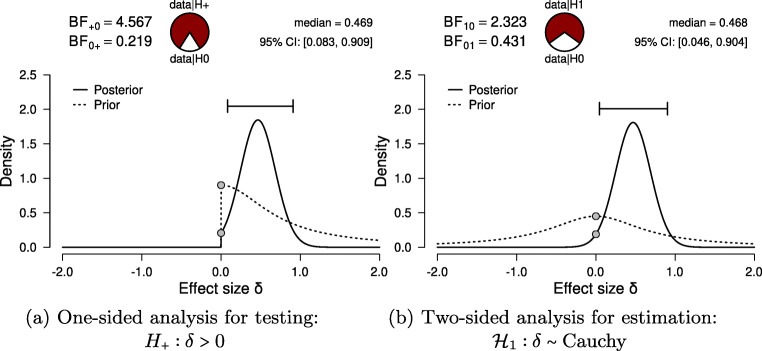
“For parameter estimation, the results of the two-sided t test are presented in Fig. 6a.”
§ The JASP guidelines for conducting and reporting a Bayesian analysis > Stage 3: Interpreting the results > Stereogram example
“The left panel shows the one-sided procedure for hypothesis testing and the right panel shows the two-sided procedure for parameter estimation.”
Citations
Cites
Kass, R. E., & Raftery, A. E. (1995) · Journal of the American Statistical Association · doi:10.1080/01621459.1995.10476572 · Cited by 12,558
Statistical Methods for Research Workers
(1945) · American Journal of Clinical Pathology · doi:10.1093/ajcp/15.11.552b · Cited by 10,880
brms : An R Package for Bayesian Multilevel Models Using Stan
Bürkner, P.-C. (2017) · Journal of Statistical Software · doi:10.18637/jss.v080.i01 · Cited by 9,476 · cited 1×
“Popular packages for conducting Bayesian analyses in R are the BayesFactor package (Morey & Rouder, 2015) and the brms package (B¨urkner, 2017), among others (see https://cran.r-project.org/web/views/Bayesian.html for a more exhaustive list).”
MethodStan : A Probabilistic Programming Language
Carpenter, B., Gelman, A., Hoffman, M. D., Lee, D., Goodrich, B., Betancourt, M., Brubaker, M., Guo, J., Li, P., & Riddell, A. (2017) · Journal of Statistical Software · doi:10.18637/jss.v076.i01 · Cited by 7,754
JAGS: A program for analysis of Bayesian graphical models using Gibbs sampling
Plummer, M. (2003) · Cited by 4,720
Hoeting, J. A., Madigan, D., Raftery, A. E., & Volinsky, C. T. (1999) · Statistical Science · doi:10.1214/ss/1009212519 · Cited by 4,118
Bayesian t tests for accepting and rejecting the null hypothesis
Rouder, J. N., Speckman, P. L., Sun, D., Morey, R. D., & Iverson, G. (2009) · Psychonomic Bulletin & Review · doi:10.3758/pbr.16.2.225 · Cited by 3,688
Probabilistic programming in Python using PyMC3
Salvatier, J., Wiecki, T. V., & Fonnesbeck, C. (2016) · PeerJ Computer Science · doi:10.7717/peerj-cs.55 · Cited by 2,544
Using Bayes to get the most out of non-significant results
Dienes, Z. (2014) · Frontiers in Psychology · doi:10.3389/fpsyg.2014.00781 · Cited by 1,998
Computing Bayes Factors by Combining Simulation and Asymptotic Approximations
Diciccio, T. J., Kass, R. E., Raftery, A., & Wasserman, L. (1997) · Journal of the American Statistical Association · doi:10.1080/01621459.1997.10474045 · Cited by 1,943
Research works printed but not linked: 3
- Jeffreys, H. (1939). Theory of probability, 1st. Oxford University Press.
- Jeffreys, H. (1961). Theory of probability. 3rd. Oxford University Press.
- Wrinch D Jeffreys H On certain fundamental principles of scientific inquiry Philosophical Magazine 1921 42 369 390
Cited by
Items 801–900 of 995
Ang, J. F., Widjanarko, N. D., & Ekaputra, A. (2024) · Tzu Chi Medical Journal · doi:10.4103/tcmj.tcmj_234_23 · Cited by 1
Jou, J., Calma, K. G., Elizondo, L. A., Cruz, J. A., Moreno, S. S., & Chen, P. (2024) · Psychological Research · doi:10.1007/s00426-024-01975-4 · Cited by 1
Searching for Semantic Distance Effects
Winkowski, J., Dotlačil, J., & Nouwen, R. (2024) · Glossa Psycholinguistics · doi:10.5070/g60111681 · Cited by 3
Bessey, D. (2024) · Frontiers in Psychology · doi:10.3389/fpsyg.2024.1361910 · Cited by 1
On the relationship between psychopathic traits and visual attentional breadth
Goodhew, S. C., & Edwards, M. (2024) · Personality and Individual Differences · doi:10.1016/j.paid.2024.112903 · Cited by 3
Richter, J., & Gast, A. (2024) · Journal of Experimental Social Psychology · doi:10.1016/j.jesp.2024.104689 · Cited by 1
Motion in the depth direction appears faster when the target is closer to the observer
Yoshimura, Y., Kizuka, T., & Ono, S. (2024) · Psychological Research · doi:10.1007/s00426-024-02040-w · Cited by 1
“We also calculated Bayes factors (BF 10 ), which indicate the ratio of the likelihood of the alternative hypothesis compared with the null hypothesis, to verify the plausibility of the null or alternative hypothesis (van Doorn et al., 2021 ).”
Marinova, M., & Reynvoet, B. (2024) · Psychological Research · doi:10.1007/s00426-024-02044-6 · Cited by 1
“The latter reflects the predictive strength of the effect for the data by comparing all models that include the effect of interest to those without this effect (Van Den Bergh et al., 2020; van Doorn et al., 2020; Wagenmakers et al., 2018).”
Neuronal correlates of endogenous selective attention in the endbrain of crows
Hahn, L. A., Fongaro, E., & Rose, J. (2025) · Communications Biology · doi:10.1038/s42003-025-07914-2 · Cited by 2
Gaze cues (repeatedly) fail to influence person evaluation
Gregory, S. E. A., Pullinen, V., & Jackson, M. C. (2025) · Quarterly Journal of Experimental Psychology · doi:10.1177/17470218251333425 · Cited by 1
“…using JASPs inbuilt interpretation tables and focusing on BF +0/inc ( BF + 0 refers to the directional hypothesis that Measure 1 > Measure 2; Van Doorn et al., 2020), BF inc relates to the inclusion Bayes Factor for the ANOVA (Van Den Bergh et al., 2020) results are considered anecdotal…”
der Biest, M. V., Verschooren, S., Verbruggen, F., & Braß, M. (2025) · PLoS ONE · doi:10.1371/journal.pone.0319039 · Cited by 2
“18.3, 62], and interpreted according to the JASP guidelines [66].”
InfluentialBiased competition between action representations
Kyllingsbæk, S., Larsen, L. B., Pedersen, J. K., Sangoi, L., & Grünbaum, T. (2025) · Neuropsychologia · doi:10.1016/j.neuropsychologia.2025.109149 · Cited by 1
“We have done all our analyses using Bayes statistics and reporting Bayes Factors (BF; e.g., Schmalz et al., 2023; Van Doorn et al., 2021).”
Verbeek, M. C., van de Bongardt, D., Luijk, M. P. C. M., & Weeland, J. (2025) · Youth · doi:10.3390/youth5020041 · Cited by 3
Optimizing CBCT analysis of the Adenoid region: A deep learning approach
Nihal, A., Selvamanikkam, M., Math, S. Y., Gianoni‐Capenakas, S., Punithakumar, K., Lagravère, M. O., & Pachêco‐Pereira, C. (2025) · Digital Dentistry Journal · doi:10.1016/j.ddj.2025.100013 · Cited by 1
Weinerová, J., Yeung, S. P., Guo, P., Yau, A., Horne, C., Ghinn, M., Curtis, L., Adlard, F., Bhagat, V., Zhang, S., et al. (2025) · Cortex · doi:10.1016/j.cortex.2025.05.019 · Cited by 2
Gallard, A., Brebion, B., Sippel, K., Zaylaa, A., Preissl, H. T., Moghimi, S., Frégier, Y., & Wallois, F. (2025) · Neurophysiologie Clinique · doi:10.1016/j.neucli.2025.103086 · Cited by 3
Borges-Luján, M., Galán-Henríquez, G., Rodríguez-Viera, R. I., Bartos̆, F., González-Luis, G. E., & Villamor, E. (2025) · Children · doi:10.3390/children12060762 · Cited by 1
“We performed the BMA analysis in JASP, which utilizes the RoBMA R package [20].”
Lissone, N. P. A., Hundscheid, T. M., Galán-Henríquez, G., González-Luis, G. E., Bartos̆, F., & Villamor, E. (2025) · Children · doi:10.3390/children12081065 · Cited by 1
“We performed the BMA in JASP (version 0.95.0), which utilizes the RoBMA R package (version 3.5.1) [32,33].”
InfluentialStrauß, S., Tunnigkeit, I., Eberle, J., Avdullahu, A., Block, M., König, M., & Rummel, N. (2025) · International Journal of Educational Technology in Higher Education · doi:10.1186/s41239-025-00553-x · Cited by 3
“For example, a BF 10 = 3.0 indicates that the data collected are three times more likely to occur under H 1 than under H 0 (van Doorn et al., 2021).”
InfluentialNakhlé, G., Tardif, J., Dubois, A., & LeLorier, J. (2025) · Journal of Cardiovascular Translational Research · doi:10.1007/s12265-025-10703-1 · Cited by 1
Study design synopsis: Battle in the stable: Bayesianism versus Frequentism
Detilleux, J. C. (2020) · Equine Veterinary Journal · doi:10.1111/evj.13351 · Cited by 1
Ojeda-Aravena, A., Herrera-Valenzuela, T., Azócar-Gallardo, J., & García‐García, J. M. (2020) · Revista Española de Nutrición Humana y Dietética · doi:10.14306/renhyd.24.4.1239 · Cited by 1
Training Structural Awareness with StatHand: A 1 Year Follow-Up
Allen, P., Fielding, J. L., Westermann, A. H., & Lafratta, A. M. (2021) · Teaching of Psychology · doi:10.1177/0098628320985080 · Cited by 1
Parenting stress in mothers with asthma during the postpartum period
Mallise, C. A., Murphy, V. E., Karayanidis, F., Armstrong, H. C., Whalen, O. M., Woolard, A. J., Gibson, P. G., Mattes, J., Collison, A., Lane, A. E., et al. (2021) · Journal of Asthma · doi:10.1080/02770903.2021.1993246 · Cited by 1
Delayed Auditory Brainstem Responses (ABR) in children after sight-recovery
Martinelli, A., Bianchi, B., Fratini, C., Handjaras, G., Fantoni, M., Trabalzini, F., Polizzi, S., Caputo, R., & Bottari, D. (2021) · Neuropsychologia · doi:10.1016/j.neuropsychologia.2021.108089 · Cited by 2
Group differences in agency modulate error monitoring
Bauer, E., & MacNamara, A. (2022) · Psychophysiology · doi:10.1111/psyp.14011 · Cited by 2
Working Memory Performance for Differentially Conditioned Stimuli
Ward, R. T., Lotfi, S., Stout, D. M., Mattson, S., Lee, H., & Larson, C. L. (2022) · Frontiers in Psychology · doi:10.3389/fpsyg.2021.811233 · Cited by 2
Humanlikeness and Aesthetic Customization's Effect on Trust, Performance, and Affect
Gray, C. E., Chesser, A. F., Atchley, A., Smitherman, R. C., & Tenhundfeld, N. L. (2022) · Systems and Information Engineering Design Symposium · doi:10.1109/sieds55548.2022.9799376 · Cited by 2
The competition between grouping cues can be resolved under inattention
Rashal, E., & Kimchi, R. (2022) · Attention Perception & Psychophysics · doi:10.3758/s13414-022-02576-2 · Cited by 1
“We considered BF10 less than 3 as providing only weak evidence for the H1 hypothesis, and BF10 between 3 and 10, 10 and 30, 30 and 100, and >100 providing moderate, strong, very strong, and extreme evidence, respectively, according to current norms (e.g., Jeffreys, 1961; van Doorn et al., 2021).”
BackgroundGiarratana, A. O., Kaliuzhna, M., Kaiser, S., & Tobler, P. N. (2022) · Scientific Reports · doi:10.1038/s41598-022-24127-3 · Cited by 1
The Correlation Between e-Health Literacy Competencies and Self-management of COVID-19 Disease
Rachmani, E., Haikal, H., Rimawati, E., Yuantari, M. G. C., Arifin, A. N., Pratiwi, P., & Achmad, K. P. (2022) · doi:10.2991/978-94-6463-018-3_4 · Cited by 2
Emotional modulation of gaze cueing does not depend on a global perceptual processing strategy.
Mulckhuyse, M. (2023) · Emotion · doi:10.1037/emo0001208
Basharat, A., & Barnett‐Cowan, M. (2023) · Multisensory Research · doi:10.1163/22134808-bja10085 · Cited by 4
Derksen, M., Zuidinga, B., van der Veer, M., Rhemrev, V., Jolink, L., Reneman, L., Nederveen, A. J., Forstmann, B. U., Feenstra, M. G. P., Willuhn, I., et al. (2023) · Psychiatry Research Neuroimaging · doi:10.1016/j.pscychresns.2023.111611 · Cited by 1
Harris, J. W. C., Yildiz, G. Y., & Chouinard, P. A. (2023) · Attention Perception & Psychophysics · doi:10.3758/s13414-023-02660-1 · Cited by 2
“…2 ) and t -tests (interval scale of 0.707) as they are robust distributions when there is little existing prior distribution knowledge on the topic (van Doorn et al., 2019; Wagenmakers et al., 2018) and have good predictive performance (van Ravenzwaaij & Wagenmakers, 2020; also see, Liang et al.,…”
BackgroundInfluentialThe Active Suppression of a Distractor’s Location Can Be Elusive
Taylor, J. R., & Ivanoff, J. (2023) · Experimental Psychology (formerly Zeitschrift für Experimentelle Psychologie) · doi:10.1027/1618-3169/a000583 · Cited by 1
Sex-specific resilience of neocortex to food restriction
Padamsey, Z., Katsanevaki, D., Maeso, P. A., Rizzi, M., Osterweil, E. K., & Rochefort, N. L. (2024) · eLife · doi:10.7554/elife.93052 · Cited by 4
Kittelberger, S. L., Freund, A. M., & Scholz, U. (2026) · BMC Psychology · doi:10.1186/s40359-026-04591-6 · Cited by 2
Kelter, R. (2019) · arXiv (Cornell University) · doi:10.48550/arxiv.1906.07524 · Cited by 1
Ambient Temperature, Social Perception and Social BehaviorPreprint
Krause, J., Nanninga, G., Ring, P., Schmidt, U., & Schunk, D. (2020) · SSRN Electronic Journal · doi:10.2139/ssrn.3583038 · Cited by 1
LaGue, A., Cazares‐Cervantes, A., Dykeman, C., Muzacz, A. K., & List, A. (2019) · PsyArXiv (OSF Preprints) · doi:10.31234/osf.io/qnsvm · Cited by 1
Meter without rhythmic pattern repetitions increases pre-attentive processingPreprint
Gomes, R. P. D. S., Silva, S., & Abreu, R. (2021) · doi:10.31234/osf.io/m3p9t · Cited by 1
Neige, C., Vassiliadis, P., Zazou, A. A., Dricot, L., Lebon, F., Brees, T., & Derosière, G. (2022) · bioRxiv (Cold Spring Harbor Laboratory) · doi:10.1101/2022.01.18.476729 · Cited by 1
Puri, R., Hinder, M. R., Krüger, M., & Summers, J. J. (2020) · PsyArXiv (OSF Preprints) · doi:10.31234/osf.io/hwzfu · Cited by 1
Does allowing for changes of mind influence initial responses?Preprint
Taylor, G. J., Nguyen, A., & Evans, N. J. (2022) · doi:10.31234/osf.io/cwf35 · Cited by 1
Self-citationCatronas, D., Sousa, J., Batista, A. R., Torres, N. L., Mesquita, A., Folia, V., & Silva, S. (2023) · doi:10.31234/osf.io/rvmye · Cited by 1
Alterations in cortical excitability during pain: A combined TMS-EEG StudyPreprint
Chowdhury, N. S., Chiang, A. K., Millard, S. K., Skippen, P., Chang, W., Seminowicz, D. A., & Schabrun, S. M. (2023) · bioRxiv (Cold Spring Harbor Laboratory) · doi:10.1101/2023.04.20.537735 · Cited by 1
“…and 30-100 indicated “weak”, “moderate”, “strong” and “very strong” evidence for the alternative hypothesis, while BF10’s of 1/3-1, 1/10-1/3, 1/30-1/10 and 1/100-1/30 indicated “anecdotal”, “moderate”, “strong” and “very strong” evidence in favour of the null hypothesis (van Doorn et al., 2021).”
Enhancing Study Success in Dutch Vocational Education
Eegdeman, I. (2023) · doi:10.5463/thesis.100 · Cited by 5
Auditory distractors are processed but do not interfere with visual search of any difficultyPreprint
Mandal, A., Röer, J. P., Liesefeld, A. M., & Liesefeld, H. R. (2023) · doi:10.31234/osf.io/9fv8k · Cited by 1
Veneny, M., Hagemeister, C., & Surrey, C. (2023) · PsyArXiv (OSF Preprints) · doi:10.31234/osf.io/eqkpv
Proactive Behavior Change Techniques (ProBCTs) in Physical Activity and Healthy EatingPreprint
Schüler, J., & Bieleke, M. (2023) · Research Square · doi:10.21203/rs.3.rs-3133092/v1 · Cited by 1
P-Values or Bayes Factors? Whichever, but not BothPreprint
Phylactou, P. (2023) · PsyArXiv (OSF Preprints) · doi:10.31234/osf.io/dthns · Cited by 1
Alterations in cortical excitability during pain: A combined TMS-EEG StudyPreprint
Chowdhury, N. S., Chiang, A. K., Millard, S. K., Skippen, P., Chang, W., Seminowicz, D. A., & Schabrun, S. M. (2023) · eLife · doi:10.7554/elife.88567.2 · Cited by 2
Causal Role of the Frontal Eye Field in Attention-induced Ocular Dominance PlasticityPreprint
Song, F., Dong, X., Zhao, J., Wang, J., Sang, X., He, X., & Bao, M. (2024) · eLife · doi:10.7554/elife.93213.2 · Cited by 1
GABAergic modulation of beta power enhances motor adaptation in frontotemporal lobar degenerationPreprint
Hughes, L. E., Adams, N., Rouse, M. A., Naessens, M., Shaw, A. D., Murley, A. G., Cope, T., Holland, N., Nesbitt, D. J., Street, D., et al. (2024) · medRxiv · doi:10.1101/2024.06.28.24309636 · Cited by 1
Dual-format attentional template during preparation in human visual cortexPreprint
Chen, Y., Liu, T., Jia, K., Theeuwes, J., & Gong, M. (2024) · eLife · doi:10.7554/elife.103425.1 · Cited by 2
Dual-format attentional template during preparation in human visual cortexPreprint
Chen, Y., Liu, T., Jia, K., Theeuwes, J., & Gong, M. (2025) · eLife · doi:10.7554/elife.103425.2 · Cited by 1
Griffiths, B. J., Duecker, K., Fakche, C., Dugué, L., Quinn, A. J., & Jensen, O. B. (2025) · bioRxiv (Cold Spring Harbor Laboratory) · doi:10.1101/2025.11.05.686709 · Cited by 1
Linking Data-Driven Symptom Dimensions to Resting-State EEG Biomarker Candidates in Chronic PainPreprint
Zebhauser, P. T., Bott, F. S., Baki, E., Heitmann, H., Bruna, N., May, E. S., & Ploner, M. (2026) · medRxiv · doi:10.64898/2026.01.23.26344711 · Cited by 1
Kelter, R., & Stern, J. M. (2020) · arXiv (Cornell University) · doi:10.48550/arxiv.2006.03334 · Cited by 1
“However, the resulting Bayes factor BF01 in favour of the null hypothesis H0 : δ = 0 is given as BF01 = 3.71, which signals moderate evidence for the null hypothesis according to van Doorn et al. (2019).”
BackgroundInfluentialPrevious Experiences Drive Attention
Kim, S. (2020) · Louisiana State University · doi:10.31390/gradschool_dissertations.5332
Automatic processing of place-value in kindergarteners
Kong, M. N. K., & Chan, W. W. L. (2021) · European Journal of Developmental Psychology · doi:10.1080/17405629.2020.1854216
“Similarly, Bayes factors ranging from 0.33 to 1 indicate weak evidence for the null hypothesis, while Bayes factors ranging from 0.33 to 0.1 indicate moderate evidence, and Bayes factors smaller than 0.1 indicate strong evidence (Van Doorn et al., 2020).”
BackgroundInfluentialMethods of Clinical Psychology
Rubel, J. A., Hall, M., & Lutz, W. (2021) · Elsevier eBooks · doi:10.1016/b978-0-12-818697-8.00076-5 · Cited by 2
Mechanisms of Anxiety Reduction in Animal-Assisted Interventions for AdolescentsPreprint
Mueller, M. K., Anderson, E., King, E. K., & Urry, H. L. (2020) · PsyArXiv (OSF Preprints) · doi:10.31234/osf.io/etf46
Towards a causal role of Broca’s area in language: A TMS-EEG study on syntactic predictionPreprint
Maran, M., Numssen, O., Hartwigsen, G., Friederici, A. D., & Zaccarella, E. (2021) · bioRxiv (Cold Spring Harbor Laboratory) · doi:10.1101/2021.04.14.439631
The influence of affect on the production of referring expressions
Vonk, P., Goudbeek, M. B., & Krahmer, E. (2021) · Language Cognition and Neuroscience · doi:10.1080/23273798.2021.1955139 · Cited by 1
Bajpai, R. C. (2021) · Osteoporosis International · doi:10.1007/s00198-020-05750-0
“Third, it is recommended to present and elaborate analysis report including relevant tables, figures, assumption checks, and background information related to Bayesian methods [4].”
BackgroundVisual Attention-Related Processing: Perspectives from Ageing, Cognitive Decline and Dementia
Tales, A., & Hanley, C. (2021) · MDPI eBooks · doi:10.3390/books978-3-0365-0985-3
Involuntary responses to facial cues as an indicator of personality type across age and culture
Kannan, C. (2021) · Cronfa (Swansea University) · doi:10.23889/suthesis.58265
A perceptual glitch in serial perception generating temporal distortionsPreprint
Sierra, F., Muralikrishnan, R., Poeppel, D., & Tavano, A. (2021) · bioRxiv (Cold Spring Harbor Laboratory) · doi:10.1101/2021.10.08.463190
Awasthi, B. (2021) · Attention Perception & Psychophysics · doi:10.3758/s13414-021-02384-0
Grobin, W. (1958) · PubMed Central
An integrated application of practical blood flow restriction in resistance trained individuals
Martinez, N., O'halloran, J. F., Kilpatrick, M. W., Campbell, B. I., & Buckner, S. L. (2021) · Journal of Trainology · doi:10.17338/trainology.11.1_1
Aguasvivas, J., Testolin, A., Zorzi, M., & Carreiras, M. (2021) · PsyArXiv (OSF Preprints) · doi:10.31234/osf.io/8tx7p
González‐Burgos, G., Miyamae, T., Reddy, N., Dawkins, S., Chen, C., Hill, A., Enwright, J. F., Ermentrout, B., & Lewis, D. A. (2022) · bioRxiv (Cold Spring Harbor Laboratory) · doi:10.1101/2022.04.26.489470
“As described previously (Keysers et al., 2020; van Doorn et al., 2021), Bayesian tests are considered to produce evidence favoring H1 when BF10 > 3, the evidence becoming stronger the larger BF10 is above 3.”
Pelzer, E. (2021) · OSF Preprints (OSF Preprints) · doi:10.31219/osf.io/t63h4
Escaping from Revulsion - Disgust and Escape in Response to Body-Relevant Autobiographical MemoriesPreprint
von Spreckelsen, P., Wessel, I., Glashouwer, K. A., & de Jong, P. J. (2021) · PsyArXiv (OSF Preprints) · doi:10.31234/osf.io/2yqrc · Cited by 4
Pittig, A. (2021) · PsyArXiv (OSF Preprints) · doi:10.31234/osf.io/5aqdc
Stress May Not Impair Higher Cognitive Functions Via Depleted Cognitive ResourcesPreprint
Qiu, B., Liu, T., Chen, Y., He, X., Zhou, C. L., & Zhang, W. (2022) · Research Square · doi:10.21203/rs.3.rs-753900/v1
Virtual Personal Assistant Design Effects on Memory Encoding
Chesser, A. F., Bramlett, K. N., Atchley, A., Gray, C. E., & Tenhundfeld, N. L. (2022) · Systems and Information Engineering Design Symposium · doi:10.1109/sieds55548.2022.9799387
Granados, R. D. C., & Ruíz, D. M. C. (2022) · Revista Colombiana de Medicina Física y Rehabilitación · doi:10.28957/rcmfr.315
Can Cryptocurrency Be a New Safe-Haven?
Chiangmai, N. N., Naktnasukanjn, N., & Udomwong, P. (2022) · Studies in systems, decision and control · doi:10.1007/978-3-030-97273-8_44
Derks, K., de swart, J., Wagenmakers, E., & Wetzels, R. (2022) · PsyArXiv (OSF Preprints) · doi:10.31234/osf.io/byj2a · Cited by 1
Self-citationFrequentist and Bayesian Hypothesis Testing: An Intuitive Guide for Urologists and Clinicians
Gaona, J. L., Sánchez, D., González, C., Gonzalez, F. A., Rueda, A., & Ortiz, S. (2022) · Revista Urología Colombiana / Colombian Urology Journal · doi:10.1055/s-0042-1756171 · Cited by 3
Is the Inter-Item Association in Working Memory Resource Demanding? Rejecting a Dual-Route ModelPreprint
Zhou, Y., Liu, Y., Pan, J., Shen, Y., Shen, M., & Gao, Z. (2022) · SSRN Electronic Journal · doi:10.2139/ssrn.4200004
Yang, L., Gallant, S. N., Wilkins, L. K., & Dyson, B. (2022) · doi:10.32920/21440832.v1
Yang, L., Gallant, S. N., Wilkins, L. K., & Dyson, B. (2022) · doi:10.32920/21440832
Impact of Sampling Rate and Eye-Condition on Resting Quantitative EEG
Neto, F. S. D. A., & Rosa, J. L. G. (2022) · Signal Processing: Algorithms, Architectures, Arrangements, and Applications · doi:10.23919/spa53010.2022.9927794
“Bayes analysis was conducted using JASP [20]2 for visualization and the same R libraries3 used by JASP to script the algorithms.”
MethodPatil, A. D., Shaikh, S. Z., Karajgi, A., & Ali, M. U. (2022) · The Egyptian Journal of Neurology Psychiatry and Neurosurgery · doi:10.1186/s41983-022-00566-7
“1, 2013, Netherlands) for meta-regression [18].”
Comparable repetition blindness effect in patients with schizophrenia
Wu, C., Dagg, P., & Molgat, C. (2022) · Journal of Behavior Therapy and Experimental Psychiatry · doi:10.1016/j.jbtep.2022.101796
Fox, O., & Ziv, G. (2022) · PeerJ · doi:10.7717/peerj.14439 · Cited by 2
“In addition, Woods et al. (2015) suggested that the larger sample sizes that can be reached in online studies can offset the lack of experimental control and that, compared with online studies, laboratory-based studies do not necessarily allow for more attentive participation.”
Result
Metadata
- Authors
- van Doorn, J., van den Bergh, D., Böhm, U., Dablander, F., Derks, K., Draws, T., Etz, A., Evans, N. J., Gronau, Q. F., Haaf, J. M., Hinne, M., Kucharský, Š., Ly, A., Marsman, M., Matzke, D., Gupta, A. R. K. N., Sarafoglou, A., Stefan, A., Voelkel, J. G., & Wagenmakers, E.-J.
- Affiliations
- University of Amsterdam (NL)
- Nyenrode Business University (NL)
- University of California, Irvine (US)
- Stanford University (US)
- ORCID
- Venue
- Psychonomic Bulletin & Review
- Published
- 2020-10-09
- Volume
- 28
- Issue
- 3
- Pages
- 813-826
- ISSN
- 1069-9384 (ISSN-L)
- 1531-5320
- PMC
- PMC8219590
- OpenAlex
- W3091779368
- Semantic Scholar
- c4bca921d78c0f4fb8569eb9d5c0cb42cbb3ec0b
- Cited by
- 1,114
- References
- 63
- Citations by year
- 2026: 111 · 2025: 169 · 2024: 216 · 2023: 202 · 2022: 177 · 2021: 139 · 2020: 71
- FWCI
- 103.84
- Type
- journal article
- Language
- en
- Open access
- hybrid
- doi.org
- Licence
- cc-by
- creativecommons.org/licenses/by/4.0 (tdm)
- creativecommons.org/licenses/by/4.0 (vor)
- Locations
- Psychonomic Bulletin & Review (publishedVersion, cc-by)
- PubMed Central (publishedVersion, cc-by)
- PubMed (publishedVersion)
- UvA-DARE (University of Amsterdam) (acceptedVersion, cc-by)
- Centrum Wiskunde & Informatica (CWI), the national research institute for mathematics and computer science in the Netherlands (submittedVersion)
- Data Archiving and Networked Services (DANS) (submittedVersion, other-oa)
- Radboud Repository (Radboud University) (submittedVersion)
- PsyArXiv (OSF Preprints) (submittedVersion, cc-by)
- PsyArXiv (OSF Preprints) (submittedVersion)
- Radboud Repository (Radboud University) (submittedVersion, other-oa)
- Funders
- National Science Foundation (1321846)
- Universiteit van Amsterdam
- Nederlandse Organisatie voor Wetenschappelijk Onderzoek (016.Vici.170.083, 406.18.559, 451-17-017)
- Topics
- Physical Sciences › Mathematics › Statistics and Probability › Statistical Methods and Bayesian Inference
- Social Sciences › Decision Sciences › Statistics, Probability and Uncertainty › Meta-analysis and systematic reviews
- Physical Sciences › Computer Science › Artificial Intelligence › Bayesian Modeling and Causal Inference
- Keywords
- Bayesian inference, JASP, reporting guidelines, statistical reporting, open-source statistical software
- MeSH terms
- Bayes Theorem, Data Interpretation, Statistical, Humans, Research Design, Models, Statistical, Guidelines as Topic
About these checks
Registry, retraction, Cites and statistics results are computed, not judged, with one exception: a printed reference that no index lists is read once by a model before it counts as a citation error. Claims are extracted by a model and kept only when their quote appears verbatim in the text; each cited source is then checked, with a model’s help, for whether it says what the claim relies on. Those verdicts can be wrong — read the claim’s quote and the cited source before relying on one.
The claim verdicts this report counts are experimental: their accuracy is not yet measured.
A language model drew the claims from the paper on 2026-10-04, under version 3 of the claim definition (model deepseek-v4.1-flash, prompt extract-v3).
A second model labelled each claim on 2026-10-04 (model jev-1.13-20260917, definition revision gold-guideline-v0.2).
Cited sources are checked with a language model’s help (qwen3.8-omni-flash).
Statistics and arithmetic are recomputed, not judged.
Confidence bands are shown only for fields calibrated on our annotated test set. None is calibrated yet, so no band is shown.
What counts as a claim ›How we measure confidence ›How we check this ›
Are you an author, or do you see a problem with this page? Request a review
Data sources
Bibliographic data: Semantic Scholar, OpenAlex, Crossref.
Contains information from the Semantic Scholar Academic Graph Datasets, made available under the ODC Attribution License (ODC-BY 1.0).
Semantic Scholar’s data is described in: Kinney, R., et al. (2023). The Semantic Scholar Open Data Platform. arXiv:2301.10140.
