

The JASP guidelines for conducting and reporting a Bayesian analysis
Open accessThe DOI matches its Crossref record; 60 of the 63 references it cites were found in a registry or an index; 3 of the 43 sources its claims cite were checked for support.
Abstract
Despite the increasing popularity of Bayesian inference in empirical research, few practical guidelines provide detailed recommendations for how to apply Bayesian procedures and interpret the results. Here we offer specific guidelines for four different stages of Bayesian statistical reasoning in a research setting: planning the analysis, executing the analysis, interpreting the results, and reporting the results. The guidelines for each stage are illustrated with a running example. Although the guidelines are geared towards analyses performed with the open-source statistical software JASP, most guidelines extend to Bayesian inference in general.
Overview
CoChat Summary
TL;DR
This paper provides practical guidelines for planning, executing, interpreting, and reporting Bayesian analyses, illustrated with a running stereogram example and focused on JASP. It emphasizes Bayes factors for testing, posterior distributions/credible intervals for estimation, and transparent reporting of priors, robustness, and analysis files.
Key findings
- The guidelines cover four stages: planning, executing, interpreting, and reporting, with recommendations such as preregistration, assumption checks, correct Bayes factor/credible interval interpretation, and sharing annotated `.jasp` files.
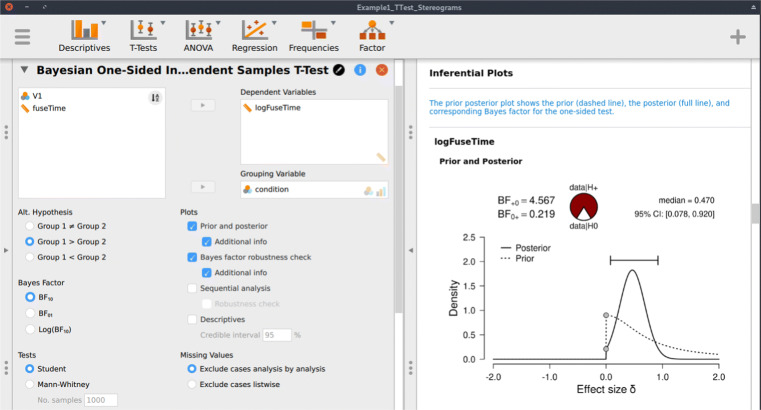
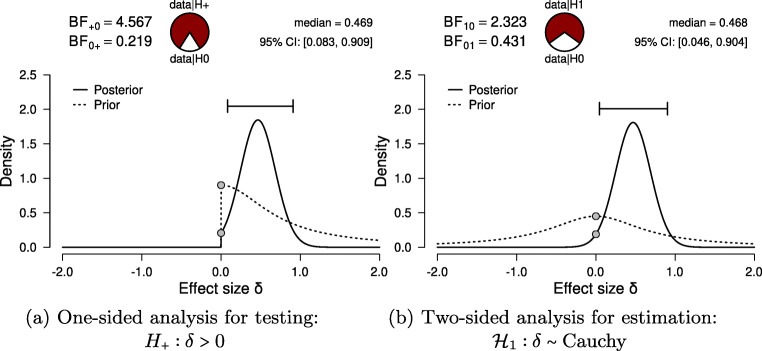
- In the stereogram example, the one-sided Bayesian two-sample t test yielded BF+0 = 4.567, described as moderate evidence; the Bayesian Mann–Whitney U test yielded BF+0 = 5.191.
- For parameter estimation, the two-sided analysis gave a posterior median for δ of 0.47 with a 95% central credible interval from 0.046 to 0.904.
- The paper lists five common pitfalls, including confusing Bayes factors with posterior odds, confusing prior model probabilities with parameter prior distributions, and using credible intervals as hypothesis tests.
Methods
- Design: methodological guidelines for Bayesian statistical reasoning in research, organized into four stages and summarized in Table 1.
- Data/sample: the running example uses Frisby and Clatworthy’s (1975) stereogram data; the original sample had 103 participants, 25 were eliminated for failing an initial stereo-acuity test, leaving 78 participants (43 NV, 35 VV).
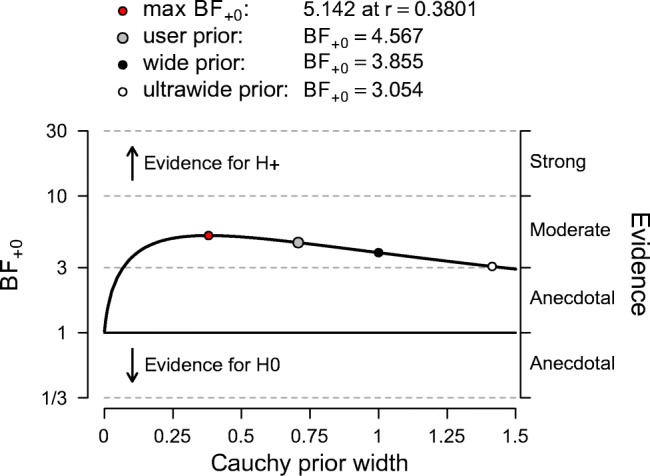
- Main analysis: the example applies a one-sided Bayesian two-sample t test for hypothesis testing, a two-sided Bayesian two-sample t test for parameter estimation, a Bayesian Mann–Whitney U test as a robustness check, and a Bayes factor robustness plot; the fuse times were log-transformed after assumption checks.
Limitations
- The paper states that for some frequentist analyses, the Bayesian counterpart has not yet been developed or implemented in JASP.
- It states that some JASP analyses currently provide only a Bayes factor and not visual posterior distributions, and that some analyses are available only with a relatively limited set of prior distributions.
- The text notes these are not principled limitations and that JASP is actively being developed; it also makes evident that the guidelines focus on standard JASP analyses, while more complex models may require custom coding in JAGS, Stan, R, or Python.
Model-written summary. Check it against the paper before relying on it.
Integrity signals
Registry
Cites
Statistics
Figures
Verification
Claims the paper makes
3 Valid · 1 Not valid · 25 Not checked · 53 Own results and interpretations
The cited sources support only part of this claim — read each source’s verdict below.
In the paper
“In Bayesian hypothesis testing, a one-sided hypothesis yields a more diagnostic test than a two-sided alternative (e.g., Jeffreys, 1961; Wetzels, Raaijmakers, Jakab, & Wagenmakers, 2009, p.283).”
§ The JASP guidelines for conducting and reporting a Bayesian analysis > Stage 1: Planning the analysis > Specifying the statistical model.
What the sources say
- Not checked yetcites Jeffreys, 1961
- Partly supportedcites Wetzels, Raaijmakers, Jakab, & Wagenmakers, 2009 matched to “How to quantify support for and against the null hypothesis: A flexible WinBUGS implementation of a default Bayesian t test” (2009) sourceExperimental — accuracy not yet measured
Our copy never states the general comparative principle that a one-sided hypothesis yields a more diagnostic test than a two-sided alternative; its motivation for the one-sided (order-restricted) SD test is applicability — the JZS two-sided test 'does not directly apply' when the alternative is directional (Introduction, p. 1; Bayesian Hypothesis Testing, p. 3). What it does supply is a worked illustration in Extension 1: Order Restrictions (p. 5), where the same data give BF01 = 6.08 under the unrestricted two-sided alternative but BF01 = 13.75 (posterior .93 vs .86) under the order-restricted one-sided alternative, i.e. a sharper quantification. So the example supports part of the claim while the general assertion attributed here is not made by this paper. (LLM, conf=0.65)
plainstates a cause- Asserted: passes — The authors put it forward as true.
- Checkable: passes — It can be checked against evidence.
- Load-bearing: passes — The paper’s conclusions depend on it.
- Based: passes — The paper gives a reason why it holds.
A result the paper reports from its own data — it cites no other source for it, so there is none to check. The quote shows it is in the paper.
In the paper
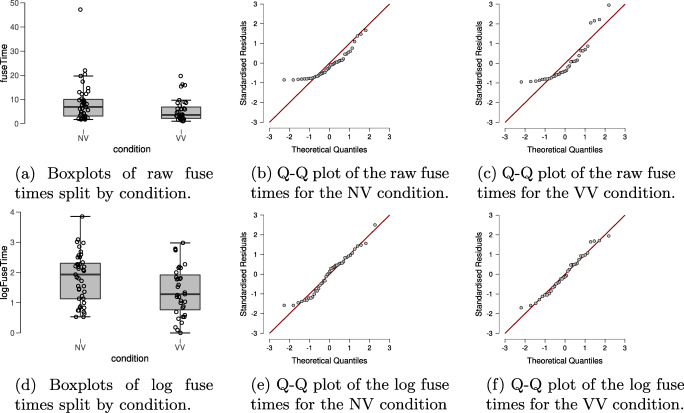
“Visual inspection of the boxplots suggests that the variances of the fuse times may not be equal”
§ The JASP guidelines for conducting and reporting a Bayesian analysis > Stage 2: Executing the analysis > Stereogram example
hedged- Asserted: passes — The authors put it forward as true.
- Checkable: passes — It can be checked against evidence.
- Load-bearing: passes — The paper’s conclusions depend on it.
- Based: passes — The paper gives a reason why it holds.
A result the paper reports from its own data — it cites no other source for it, so there is none to check. The quote shows it is in the paper.
In the paper
“There also appear to be a number of potential outliers in both groups.”
§ The JASP guidelines for conducting and reporting a Bayesian analysis > Stage 2: Executing the analysis > Stereogram example
hedged- Asserted: passes — The authors put it forward as true.
- Checkable: passes — It can be checked against evidence.
- Load-bearing: passes — The paper’s conclusions depend on it.
- Based: passes — The paper gives a reason why it holds.
A result the paper reports from its own data — it cites no other source for it, so there is none to check. The quote shows it is in the paper.
In the paper
“observed standard deviations of the NV and VV groups are 8.085 and 4.802, respectively”
§ The JASP guidelines for conducting and reporting a Bayesian analysis > Stage 2: Executing the analysis > Stereogram example
plain- Asserted: passes — The authors put it forward as true.
- Checkable: passes — It can be checked against evidence.
- Load-bearing: passes — The paper’s conclusions depend on it.
- Based: passes — The paper gives a reason why it holds.
A result the paper reports from its own data — it cites no other source for it, so there is none to check. The quote shows it is in the paper.
In the paper
“Moreover, the Q-Q plots show that the normality assumption of the t test is untenable here.”
§ The JASP guidelines for conducting and reporting a Bayesian analysis > Stage 2: Executing the analysis > Stereogram example
plain- Asserted: passes — The authors put it forward as true.
- Checkable: passes — It can be checked against evidence.
- Load-bearing: passes — The paper’s conclusions depend on it.
- Based: passes — The paper gives a reason why it holds.
25 more claims
Create a free account to see all 82 claims and to verify the 40 references still open.
- It may state two separate claims as one. 33
- Probably not a substantial claim. 29
Claims other papers make about this one
Each is checked against this paper’s own text: does it say what the citing paper says it does?
The cited source says what the claim attributes to it.
In the citing paper
“According to common interpretive guidelines (Van Doorn et al., 2021), a Bayes Factor between 0.33 and 0.10 can be considered moderate evidence for the null, and this result falls at the upper end of that range.”
From This is not the way: global directional cues do not improve spatial learning in an immersive virtual environment (2025) · cites this paper as Van Doorn et al., 2021
Self-check
Percentages, sums and reported differences re-computed from the paper’s own numbers.
Each contradiction between two passages listed here was confirmed by an independent check.
Rated minor: it would not touch a result — a value no result rests on, a p-value that stays on the same side of the significance level, or a conflict that is clerical, resolved elsewhere in the paper, or outside its own findings.
In the paper
§ The JASP guidelines for conducting and reporting a Bayesian analysis > Stage 3: Interpreting the results > Stereogram example
“For parameter estimation, the results of the two-sided t test are presented in Fig. 6a.”
§ The JASP guidelines for conducting and reporting a Bayesian analysis > Stage 3: Interpreting the results > Stereogram example
“The left panel shows the one-sided procedure for hypothesis testing and the right panel shows the two-sided procedure for parameter estimation.”
Citations
Cites
Kass, R. E., & Raftery, A. E. (1995) · Journal of the American Statistical Association · doi:10.1080/01621459.1995.10476572 · Cited by 12,558
Statistical Methods for Research Workers
(1945) · American Journal of Clinical Pathology · doi:10.1093/ajcp/15.11.552b · Cited by 10,880
brms : An R Package for Bayesian Multilevel Models Using Stan
Bürkner, P.-C. (2017) · Journal of Statistical Software · doi:10.18637/jss.v080.i01 · Cited by 9,476 · cited 1×
“Popular packages for conducting Bayesian analyses in R are the BayesFactor package (Morey & Rouder, 2015) and the brms package (B¨urkner, 2017), among others (see https://cran.r-project.org/web/views/Bayesian.html for a more exhaustive list).”
MethodStan : A Probabilistic Programming Language
Carpenter, B., Gelman, A., Hoffman, M. D., Lee, D., Goodrich, B., Betancourt, M., Brubaker, M., Guo, J., Li, P., & Riddell, A. (2017) · Journal of Statistical Software · doi:10.18637/jss.v076.i01 · Cited by 7,754
JAGS: A program for analysis of Bayesian graphical models using Gibbs sampling
Plummer, M. (2003) · Cited by 4,720
Hoeting, J. A., Madigan, D., Raftery, A. E., & Volinsky, C. T. (1999) · Statistical Science · doi:10.1214/ss/1009212519 · Cited by 4,118
Bayesian t tests for accepting and rejecting the null hypothesis
Rouder, J. N., Speckman, P. L., Sun, D., Morey, R. D., & Iverson, G. (2009) · Psychonomic Bulletin & Review · doi:10.3758/pbr.16.2.225 · Cited by 3,688
Probabilistic programming in Python using PyMC3
Salvatier, J., Wiecki, T. V., & Fonnesbeck, C. (2016) · PeerJ Computer Science · doi:10.7717/peerj-cs.55 · Cited by 2,544
Using Bayes to get the most out of non-significant results
Dienes, Z. (2014) · Frontiers in Psychology · doi:10.3389/fpsyg.2014.00781 · Cited by 1,998
Computing Bayes Factors by Combining Simulation and Asymptotic Approximations
Diciccio, T. J., Kass, R. E., Raftery, A., & Wasserman, L. (1997) · Journal of the American Statistical Association · doi:10.1080/01621459.1997.10474045 · Cited by 1,943
Research works printed but not linked: 3
- Jeffreys, H. (1939). Theory of probability, 1st. Oxford University Press.
- Jeffreys, H. (1961). Theory of probability. 3rd. Oxford University Press.
- Wrinch D Jeffreys H On certain fundamental principles of scientific inquiry Philosophical Magazine 1921 42 369 390
Cited by
Items 701–800 of 995
Grazia, A., Dyrba, M., Pomara, N., Temp, A. G. M., Grothe, M. J., & Teipel, S. J. (2025) · The Journal of Prevention of Alzheimer s Disease · doi:10.1016/j.tjpad.2024.100030 · Cited by 2
Menzies, B., Teng, A. Y., D'Rozario, A. L., Williamson, B., & Lah, S. S. (2025) · Child Neuropsychology · doi:10.1080/09297049.2025.2462088 · Cited by 2
“We conducted Bayesian repeated measures ANOVA and independent sample t-tests (Van Doorn et al., 2021).”
Solstad, B. E., Fahrenholtz, I. L., Melin, A., Garthe, I., & Torstveit, M. K. (2025) · Sports Psychiatry · doi:10.1024/2674-0052/a000107 · Cited by 3
Social cognition and driving: Theory of mind is associated with drivers’ hazard perception
Goodhew, S. C., Edwards, M., Choy, C., Neary, P., Hill, A., & Horswill, M. S. (2025) · Transportation Research Part F Traffic Psychology and Behaviour · doi:10.1016/j.trf.2025.06.017 · Cited by 4
Spiller, J. (2025) · International Journal of Behavioral Medicine · doi:10.1007/s12529-025-10381-y · Cited by 5
Informative data visualization with raincloud plots in JASP
Ott, V. L., van den Bergh, D., boutin, B., van Doorn, J. B., Bartos̆, F., Judd, N., van Langen, J., Korthals, L., Kievit, R., Groot, L., et al. (2025) · Behavior Research Methods · doi:10.3758/s13428-025-02773-5 · Cited by 5
“1 in van Doorn et al., 2021).”
Self-citationRudolph, M., Giesen, C. G., & Rothermund, K. (2025) · Consciousness and Cognition · doi:10.1016/j.concog.2025.103936 · Cited by 4
Analytic posterior distribution and bayes factor for pearson partial correlations
Kucharský, Š., Wagenmakers, E., van den Bergh, D., & Ly, A. (2026) · Test · doi:10.1007/s11749-026-01006-x · Cited by 2
“…uniform prior, the posterior distribution is now closer to zero, and Bayes factor is noticeably Instead of picking a single value of the hyperparameter α to explore the robustness of the result, we may report the Bayes factor for a range of possible prior specifications (see, van Doorn et al. 2021).”
Self-citationEbm, C. C., Carfagna, F., Edwards, S., Mantovani, A., & Cecconi, M. (2020) · Journal of Critical Care · doi:10.1016/j.jcrc.2020.12.003 · Cited by 2
Allen, P., Fielding, J. L., East, E. C., Kay, R. H. S., Steele, C. S., & Breen, L. J. (2019) · Scholarship of Teaching and Learning in Psychology · doi:10.1037/stl0000177 · Cited by 2
Early stopping in clinical PET studies: How to reduce expense and exposure
Svensson, J. E., Schain, M., Knudsen, G. M., Ogden, R. T., & Plavén‐Sigray, P. (2021) · Journal of Cerebral Blood Flow & Metabolism · doi:10.1177/0271678x211017796 · Cited by 3
Task-dependent audiovisual temporal sensitivity is not affected by stimulus intensity levels
Scurry, A. N., Lovelady, Z., & Jiang, F. (2021) · Vision Research · doi:10.1016/j.visres.2021.05.006 · Cited by 3
“To understand and interpret any non-statistically significant results (Dienes, 2014; van Doorn et al., 2020), Bayes factors were calculated using the BayesFactor package in R with default priors (Morey, 2018; Rouder et al., 2012).”
MethodDisturbance of neural coupling between upper and lower limbs during gait transition
Kibushi, B., Kihira, N., Moritani, T., & Kouzaki, M. (2021) · Neuroscience Letters · doi:10.1016/j.neulet.2021.136100 · Cited by 2
No evidence of conditioning of pupillary constriction despite overtraining
Niehorster, D. C., Bengtsson, S., Brodin, N. T., & Rasmussen, A. (2022) · PeerJ · doi:10.7717/peerj.12948 · Cited by 3
“The strength of the resulting Bayes Factor is interpreted according to the scheme in Van Doorn et al. (2021)”
MethodThe impact of postexercise blood flow restriction on local muscle endurance of a remote limb
Sandbach, P. J., Carvajal, M. S., Uygur, M., & Dankel, S. J. (2022) · Clinical Physiology and Functional Imaging · doi:10.1111/cpf.12776 · Cited by 2
“A BF10 of >3 or >10 was used as moderate and strong support for the alternate hypothesis, whereas a BF10 of 0.33 or 0.10 was used as moderate and strong support for the null (van Doorn et al., 2021).”
MethodInfluentialLearning limb‐specific contingencies in early infancy
Sen, U., & Gredebäck, G. (2022) · Infancy · doi:10.1111/infa.12506 · Cited by 2
Demichelis, O. P., Grainger, S. A., McKay, K. T., Burr, L. D., Kim, J., & Henry, J. D. (2023) · Scientific Reports · doi:10.1038/s41598-023-28183-1 · Cited by 3
The Impact of Sleep Quality on Mood in Beach Volleyball Athletes: A Cross-Sectional Study
da Silva, G. M., Simim, M. A. D. M., Nakamura, F. Y., Coswig, V. S., Assumpção, C. D. O., & Medeiros, A. I. A. (2023) · Retos · doi:10.47197/retos.v48.96972 · Cited by 6
The benefit of making voluntary choices generalizes across multiple effectors
Luo, X., Wang, L., Gu, J., Zhang, Q., Ma, H., & Zhou, X. (2023) · Psychonomic Bulletin & Review · doi:10.3758/s13423-023-02350-x · Cited by 2
“It is suggested that the Bayes Factor (BF 01 ) between 1 and 3, between 3 and 10, and greater than 10 can be considered as weak, moderate, and strong evidence, respectively, in favor of the null hypothesis over the alternative hypothesis (van Doorn et al., 2021).”
Does context recollection depend on the base-rate of contextual features?
Nieznański, M., Obidziński, M., & Ford, D. (2023) · Cognitive Processing · doi:10.1007/s10339-023-01153-1 · Cited by 2
“Bayesian analyses were conducted in JASP (JASP Team 2019; jasp-stats.org, see: van Doorn et al. 2020).”
MethodThe implicit perception of harm following moral violations in autism
Osler, G., Franchin, L., Guglielmetti, G., Calzolari, S., Micciolo, R., & Surian, L. (2023) · Thinking & Reasoning · doi:10.1080/13546783.2023.2259538 · Cited by 2
“Data were analyzed with JASp (JASp team, 2019; van Doorn et al., 2021). the default Cauchy prior was employed, with a scale of 0.707. the results of these comparisons are reported in table 1.”
MethodInfluentialGing-Jehli, N. R., Arnold, L. E., & Zandt, T. V. (2023) · Cognitive Affective & Behavioral Neuroscience · doi:10.3758/s13415-023-01129-w · Cited by 4
“We report Bayes’ Factors ( BF ) and posterior probabilities ( PP ) as it is common (van Doorn et al., 2021) ; (Andraszewicz et al., 2015).”
BackgroundObligi, L., Bertrand, M., Boivent, M., Corcostegui, S., Coz, P.-E., Derkenne, C., Robert, V. D., Hurpin, V., Hus, J., L’Hermitte, B., et al. (2023) · PLoS ONE · doi:10.1371/journal.pone.0290241 · Cited by 2
Abbruzzese, L., Basagni, B., Damora, A., Salti, G., Martinelli, G., Gambarelli, C., Maietti, A., Scarselli, C., Carlucci, L., Zoccolotti, P., et al. (2024) · Brain Sciences · doi:10.3390/brainsci14030189 · Cited by 2
“Larger values of BF01 indicate more support for H0 (e.g., a BF 01 = 2 means that, given the data, the null hypothesis is two times more likely than the alternative hypothesis) [26].”
BackgroundPerry, J. C., & Vann, S. D. (2024) · Neuroscience · doi:10.1016/j.neuroscience.2024.08.004 · Cited by 2
“In comparison, a BF 10 between 1 and 0.33 is considered anecdotal evidence, between 0.33 and 0.1 is considered moderate evidence and lower than 0.1 can be interpreted as strong evidence, in favour of the null hypothesis, respectively (van Doorn et al., 2021).”
BackgroundInfluentialThe effects of aging and an episodic specificity induction on spontaneous task-unrelated thought
Jordão, M., Pinho, M. S., & Jacques, P. L. S. (2020) · PLoS ONE · doi:10.1371/journal.pone.0237340 · Cited by 4
“23), providing weak support for the null hypothesis (following guidelines in [79]).”
BackgroundTowards a causal role of Broca's area in language: A TMS-EEG study on syntactic prediction
Maran, M., Numssen, O., Hartwigsen, G., Friederici, A. D., & Zaccarella, E. (2021) · Cited by 2
Contextual Information Modulates Pupil Size in Autistic Children
Tortelli, C., Pomè, A., Turi, M., Igliozzi, R., Burr, D. C., & Binda, P. (2022) · Frontiers in Neuroscience · doi:10.3389/fnins.2022.752871 · Cited by 6
Estimating evidential value from ANOVA summaries: A comment on Ly et al. (2018)Preprint
Faulkenberry, T. J. (2019) · doi:10.31234/osf.io/35wyv · Cited by 2
How to minimize time distortionsPreprint
Sierra, F., Poeppel, D., & Tavano, A. (2020) · PsyArXiv (OSF Preprints) · doi:10.31234/osf.io/2w9ev · Cited by 2
Training-dependent transfer within a set of nested tasksPreprint
Rennie, J. P., Jones, J. S., & Astle, D. E. (2020) · PsyArXiv (OSF Preprints) · doi:10.31234/osf.io/n6htd · Cited by 2
Simulation studies for psychometrics
Leventhal, B. C., Ames, A. J., & Thompson, K. N. (2022) · Elsevier eBooks · doi:10.1016/b978-0-12-818630-5.10043-0 · Cited by 2
TMS must not harm participants: guidelines for evaluating TMS protocol safety
Slotnick, S. D. (2023) · Cognitive Neuroscience · doi:10.1080/17588928.2023.2259553 · Cited by 2
“For non-significant results, Bayes factors can easily be computed using JASP software (Wagenmakers et al., 2018a, 2018b; van Doorn et al., 2021).”
MethodKlotzsche, F., Motyka, P., Molak, A., Sahula, V., Darmová, B., Byrnes, C., Fajnerová, I., & Gaebler, M. (2024) · bioRxiv (Cold Spring Harbor Laboratory) · doi:10.1101/2024.01.31.578172 · Cited by 2
“The relative robustness of Bayes factors was further validated in analogous comparisons using different prior widths (narrow, r = 0.354, and wide, r = 1; van Doorn et al., 2021).”
InfluentialPerceived time drives physical fatiguePreprint
Matta, P., Duclay, J., Baurès, R., & Alamia, A. (2025) · bioRxiv (Cold Spring Harbor Laboratory) · doi:10.1101/2025.07.13.664573 · Cited by 2
Configuration perceptual learning and its relationship with element perceptual learning
Gong, X., Wang, Q., & Fang, F. (2022) · Journal of Vision · doi:10.1167/jov.22.13.2 · Cited by 1
Queues, crowds, and angry mobs: Face identification under distraction in a virtual airport
Fysh, M. C., Baker, E., Rockett, J., Allen, J., McCall, C., Burton, A. M., & Bindemann, M. (2023) · Quarterly Journal of Experimental Psychology · doi:10.1177/17470218231203939 · Cited by 2
“Bayesian analyses were also run in JASP using default parameters (JASP Team, 2022) to indicate the relative strength of evidence in favour of the alternative over the null model (Van Doorn et al., 2021).”
MethodEffects of ultra-high field MRI environment on cognitive performance in healthy participants
Wennberg, L., Mårtensson, J., Langensee, L., Sundgren, P. C., Bloch, K. M., & Hansson, B. (2023) · Radiography · doi:10.1016/j.radi.2023.10.006 · Cited by 1
Bertucci, D. R., de Carvalho, C. D., Scariot, P. P. M., Kalva‐Filho, C. A., Luches-Pereira, G., de Arruda, T. B., Alves, I. S., Gardim, C. B., Castiglia, M., Riberto, M., et al. (2024) · European Journal of Applied Physiology · doi:10.1007/s00421-023-05404-z · Cited by 1
“Statistical analyses were performed using JASP (Amsterdam, The Netherlands) software version 0.9 (van Doorn et al. 2020).”
InfluentialTwo validation studies of a performance validity test for autistic adults
Scheeren, A. M., Dubbelink, L. O., Lever, A. G., & Geurts, H. M. (2024) · Applied Neuropsychology Adult · doi:10.1080/23279095.2024.2305206 · Cited by 3
“Even though BFs can be interpreted continuously, a rule of thumb which is often used to categorize evidential strength (see van Doorn et al., 2021) is: BFs between 0.3 and 3 are defined as undecisive (i.e., not reflecting enough evidence for either hypothesis), BFs between 3 and 10 indicate…”
InfluentialTan, S. C., Sardina, A. L., Mogle, J. A., & Gamaldo, A. A. (2024) · Wellbeing Space and Society · doi:10.1016/j.wss.2024.100193 · Cited by 4
Quantifying the impact of COVID-19-related restrictions on antibiotic resistance
Marwick, C., & Ciaccio, L. (2024) · Clinical Microbiology and Infection · doi:10.1016/j.cmi.2024.07.007 · Cited by 1
A comparison of foot and ankle biomechanics during running drills and distance running
Abran, G., Berraz, A., Dardenne, N., Gramage, K., Bornheim, S., Delvaux, F. H., Croisier, J., & Schwartz, C. (2024) · Sports Biomechanics · doi:10.1080/14763141.2024.2382804 · Cited by 2
“Statistical analyses were performed using JASP (version 0.17.3, 2023) (Van Doorn et al., 2021).”
InfluentialZheng, J., Su, N., Fan, T., Li, B., Zhao, W., Hu, X., Yang, C., & Luo, L. (2024) · Journal of Intelligence · doi:10.3390/jintelligence12090091 · Cited by 1
“…of the likelihood of data fitting the alternative hypothesis relative to the null hypothesis, with BF 10 > 1 providing support for the alternative hypothesis over the null hypothesis and BF 10 < 1 providing support for the null hypothesis over the alternative hypothesis (van Doorn et al. 2021).”
BackgroundFostering Creativity: The Role of Operant Variability on Problem-Solving and Insight
Rodrigues, R., & García‐Mijares, M. (2025) · The Psychological Record · doi:10.1007/s40732-024-00626-9 · Cited by 2
Online experience sharing without explicit social interaction does not foster social bonding
Wolf, W., & Dotson, K. (2025) · Cyberpsychology Journal of Psychosocial Research on Cyberspace · doi:10.5817/cp2025-1-3 · Cited by 4
“A Bayesian equivalence test comparing the difference between the joint attention and disjoint attention condition in the full sample showed moderate evidence (van Doorn et al., 2020) for the two conditions being practically equivalent (BF = 5.28).”
InfluentialMazela, M. A., Huff, M. J., & Umanath, S. (2025) · Journal of Cognitive Psychology · doi:10.1080/20445911.2025.2474081 · Cited by 1
“For interpretive criteria of BFs, we describe the values reported by van Doorn et al. (2021).”
High and Low Media Multitaskers Differ on Cued But Not Voluntary Task Switching
Colvett, J. S., Bales, L. C., & Jennings, J. M. (2025) · Experimental Psychology (formerly Zeitschrift für Experimentelle Psychologie) · doi:10.1027/1618-3169/a000639 · Cited by 1
“Analyses were run using the baseline settings 3 of JASP Version 0.17.1 (JASP Team, 2024; Van Doorn et al., 2020).”
InfluentialDoes Mood Change During a Mind-Wandering Task?
Nayda, D. M., & Takarangi, M. K. T. (2025) · Cognitive Therapy and Research · doi:10.1007/s10608-025-10626-w · Cited by 3
Ho, J. W., & Lee, Y.-K. (2025) · Medicine · doi:10.1097/md.0000000000042994 · Cited by 1
“[17,18] free flaps had several advantages, minimal donor site morbidity, ease of design, good flap texture, and superior padding effect, compared to skin grafts.”
The AMP Reflects Gradual Differences in Attitude Extremity, Not Intensity: Initial Evidence
Roscher, O. M., & Neumann, R. (2025) · Social Psychology · doi:10.1027/1864-9335/a000576 · Cited by 1
Distinct neurochemical predictors for different phases of decision-making learning
Gordon, M. S., Ehrhardt, S. E., Rideaux, R., Marjańska, M., Deelchand, D. K., Eftekhari, Z., Dux, P. E., & Filmer, H. L. (2025) · Cerebral Cortex · doi:10.1093/cercor/bhaf144 · Cited by 1
“These parameters were then applied to align the subspectra to a common frequency and phase, following methodologies demonstrated to be highly effective for GABA + quantification (Rideaux et al. 2021).”
InfluentialWu, Z., Sabarwal, S., Basnet, D., Aber, J. L., & Cohen, G. L. (2025) · Social Psychology of Education · doi:10.1007/s11218-025-10097-7 · Cited by 1
Ustulin, M., Vio, D., Targhetta, C., Zanon, C., Ferino, L., Faustini, G., & Franzo, G. (2025) · Scientific Reports · doi:10.1038/s41598-025-13388-3 · Cited by 1
Bernknopf, R. L., Kuwayama, Y., Zaitchik, B. F., Rodell, M., Getirana, A., Thorstensen, A., & Shahreen, S. (2025) · Natural Hazards · doi:10.1007/s11069-025-07499-3 · Cited by 3
“One way to determine if the consolidated message FS 12 is from the same probability distribution as the adjusted current operational forecast FS 1 is using a Mann – Whitney U test (van Doorn et al. 2021 ; Ermakova et al. 2019).”
Prospective memory difficulties in adults aged 60 and above with subjective memory complaints
Kim, M., & Kim, H. (2025) · The Journals of Gerontology Series B · doi:10.1093/geronb/gbaf149 · Cited by 1
Sundermeier, M., Standke, I., Schubotz, R. I., Dannlowski, U., Lencer, R., Mecklenbrauck, F., Trempler, I., & Zahedi, A. (2025) · NeuroImage · doi:10.1016/j.neuroimage.2025.121416 · Cited by 1
Yu, T., Mao, Y., Qiu, J., Zhang, Y., & Liu, J. (2025) · Personality and Individual Differences · doi:10.1016/j.paid.2025.113403 · Cited by 1
Buffering brain aging: education moderates language impairment in Parkinson's disease
Kim, M., & Yoo, K. (2025) · Frontiers in Cellular Neuroscience · doi:10.3389/fncel.2025.1606451 · Cited by 1
The chronology of the Early Neolithic Baraba culture, southwestern Siberia: New radiocarbon evidence
Молодин, В. И., Mylnikova, L. N., Nenakhov, D. А., Menshanov, P. N., & Parkhomchuk, E. V. (2025) · Radiocarbon · doi:10.1017/rdc.2025.10103 · Cited by 2
“…for possible differences between Tartas-1, Vengerovo-2, and Ust-Tartas with a help of the simple between-group factor “ SITES ” , which was followed by Bayesian and traditional two-way mix-design ANCOVA to assess and control for any impact of the “ FACILITY ” covariate (van Doorn et al. 2021).”
Ueno, S., & Takeuchi, O. (2025) · Research Methods in Applied Linguistics · doi:10.1016/j.rmal.2025.100256 · Cited by 1
Volfart, A., McMahon, K. L., Liégeois‐Chauvel, C., Piai, V., & de Zubicaray, G. I. (2025) · Cortex · doi:10.1016/j.cortex.2025.08.010 · Cited by 2
Generating drawings enhances the drawing effect relative to replicating drawings
Namias, J. M., & Huff, M. J. (2025) · Memory · doi:10.1080/09658211.2025.2562002 · Cited by 2
“Several interpretive criteria for BFs have been proposed, though we apply criteria reported by van Doorn et al. (2021).”
Gulassa, D. C. R., Amaral, R., Angelo, D. L., de Oliveira, E. C., de Abreu, C. N., & Tavares, H. (2025) · International Journal of Group Psychotherapy · doi:10.1080/00207284.2025.2551504 · Cited by 1
“Generally, values of error under 10% indicate that the sensitivity to data fluctuations are considered small (Van Doorn et al., 2021).”
Dual-format attentional template during preparation in human visual cortex
Chen, Y. K., Liu, T., Jia, K., Theeuwes, J., & Gong, M. (2024) · eLife · doi:10.7554/elife.103425.4 · Cited by 8
Dionne, M., & Rezzonico, S. (2025) · Behavioral Sciences · doi:10.3390/bs15111536 · Cited by 2
“Jeffreys’s (1961) classification criteria, as reported in Table 2, were used to interpret the value of Bayesian factors in favor of H 1 (BF 10 ) and quantify the strength of evidence (Brydges & Gaeta, 2019; van Doorn et al., 2021).”
Mütze, H., Platz, F., & Busch, V. (2025) · Jahrbuch der Deutschen Gesellschaft für Musikpsychologie/Jahrbuch Musikpsychologie · doi:10.5964/jbdgm.205 · Cited by 1
Beyond performance: A POMDP-based machine learning framework for expert cognition
He, H., & Duan, Y. (2025) · Behavior Research Methods · doi:10.3758/s13428-025-02875-0 · Cited by 3
“Statistical analyses were conducted using JASP 0.17.1 (JASP Team, University of Amsterdam; van Doorn et al., 2021).”
InfluentialAnalysis of mathematical literacy and assessment literacy of mathematics preservice teachers
Nakypbek, Z. Y., Kainbaeva, L. S., Yensebayeva, G. M., Yergalauova, Z. A., Menlikhozhayeva, S. K., & Ibraev, S. S. (2025) · Eurasia Journal of Mathematics Science and Technology Education · doi:10.29333/ejmste/17494 · Cited by 4
“Gender differences in mathematical literacy and assessment literacy dimensions were examined using Bayesian Mann-Whitney U tests due to concerns about distributional assumptions (van Doorn et al., 2021).”
Public trust in regional policymaking and citizen demands for engagement
Fellnhofer, K., Vähämaa, E., & Angelidou, M. (2025) · npj Urban Sustainability · doi:10.1038/s42949-025-00307-8 · Cited by 2
Fiala, V., Perea‐García, J. O., Tureček, P., Wacewicz, S., Leongómez, J. D., Pokorný, Š., Pavlovič, O., Sarıbay, S. A., Pazhoohi, F., Akoko, R. M., et al. (2026) · Behavioral Ecology and Sociobiology · doi:10.1007/s00265-025-03680-7 · Cited by 2
Marcelino, R. (2026) · Frontiers in Education · doi:10.3389/feduc.2025.1741457 · Cited by 1
Effects of ball type and maturity status on U10 tennis players competition load
Rodríguez-Campos, M., Piquer-Piquer, A., Giménez‐Egido, J. M., Ramon-Llin, J. A., Guzmán, J. F., Martínez, B. J. S.-Á., Vučković, G., & Martínez-Gallego, R. (2026) · Frontiers in Psychology · doi:10.3389/fpsyg.2026.1719947 · Cited by 3
Wolfe, T., Gassel, A., Calvert, M. L., Isaac, L., James, G. A., Koscik, T. R., & Kilts, C. (2026) · eNeuro · doi:10.1523/eneuro.0179-25.2025 · Cited by 3
“Furthermore, the effects of age were also evaluated for each parcel among subjects within each age group using the Bayesian – Pearson ’ s correlation method in JASP (van Doorn et al., 2021).”
InfluentialAvoidance of capture by motion onset
Nair, J., Ma, X., & Abrams, R. A. (2026) · Attention Perception & Psychophysics · doi:10.3758/s13414-026-03232-9 · Cited by 1
“…our conclusions, providing moderate evidence for an absence of a difference in reaction times between distractor-present and distractor-absent trials (BF 01 = 3.51), as well as no difference in accuracy between those two conditions (BF 01 = 4.35), according to convention (van Doorn et al., 2021).”
InfluentialAdolescent Perceptions of an Online Safety Chatbot: Survey Study
Charles, M., Sauer, J. D., Roehrer, E., Prichard, J., Watters, P., & Scanlan, J. D. (2026) · JMIR Human Factors · doi:10.2196/71498 · Cited by 4
“For Bayesian t tests, effect size measures are reported as δ , the population equivalent to Cohen d [65].”
Yildirim, B., & Rummel, J. (2026) · Psychological Reports · doi:10.1177/00332941261431151 · Cited by 1
Bengtsson, D., Svensson, E., Hertting, K., Stenling, A., Nygren, J., Ntoumanis, N., & Ivarsson, A. (2026) · Applied Psychology · doi:10.1111/apps.70083 · Cited by 1
“The models were specified with the default prior distribution settings of the rstanarm R package incorporated in JASP (flat-tailed Cauchy distribution; Gelman et al., 2008; van Doorn et al., 2021).”
Young children strategically adapt to unreliable social partners
Shannon, K. A., Conine-Nakano, A., Frankenhuis, W. E., Frank, M. C., & Gweon, H. (2026) · Child Development · doi:10.1093/chidev/aacag012 · Cited by 1
Abran, G., Aguilaniu, A., Dardenne, N., Bornheim, S., Delvaux, F., Croisier, J., & Schwartz, C. (2026) · Journal of Sport Rehabilitation · doi:10.1123/jsr.2025-0384 · Cited by 1
Winarto, W., Misbah, M., Ariyatun, A., Satria, E., Widiyati, E., Jumini, S., Parameswari, P., & Shidiq, G. A. (2026) · European Journal of STEM Education · doi:10.20897/ejsteme/18304 · Cited by 2
“According to the experts, this JASP technique for data analysis could benefit authors as an alternative software that can provide more advanced statistical techniques (Love et al., 2019; Van Doorn et al., 2021).”
A multi-method case study of student and instructor well-being in assessment
Daniels, L. M., Wells, K., West, C., Becker, A., & Poth, C. (2026) · Learning in Context · doi:10.1016/j.lecon.2026.100025 · Cited by 1
Mrakic‐Sposta, S., Cianni, S. D., Lombardi, G., Moccia, E., Meloni, G., Vezzoli, A., Marzola, M., & Giacon, T. A. (2026) · European Journal of Applied Physiology · doi:10.1007/s00421-026-06254-1 · Cited by 1
“In addition, considering the low number of subjects, we also applied Bayesian statistics to further confirm our findings (Keysers et al. 2020; van Doorn et al. 2021).”
Mendes, H. G., Wen, H. K., de Souza, H., Peng, Y., Deshpande, K., Blok, S. G., Tuinman, P. R., Neto, A. S., Schultz, M. J., Malbrain, M. L. N. G., et al. (2026) · Critical Care · doi:10.1186/s13054-026-06172-w · Cited by 3
“A per-protocol Bayesian hierarchical meta-analysis was conducted using arm-level binomial-logit models via brms with the cmdstanr backend, with analyses prespecified and reported in accordance with recommended practices [38, 39].”
Measuring and Comparing QoE of Hybrid VR Applications under Increased Network Load
Doumanis, I., Economou, D., & Argyriou, L. (2021) · International Conference of the Immersive Learning Research Network (iLRN) · doi:10.23919/ilrn52045.2021.9459316 · Cited by 1
Misaligned dynamic faces are processed holistically
Zhou, Y., Lin, J. H., & Zhou, G. (2021) · Vision Research · doi:10.1016/j.visres.2021.107970 · Cited by 1
Azócar-Gallardo, J., Ojeda-Aravena, A., Martín, E. B.-S., & Romero-Steiner, O. (2022) · Retos · doi:10.47197/retos.v45i0.92898 · Cited by 1
Visual similarity with L1 facilitates the neural specialization for scripts of L2
Feng, M., An, L., Wang, P., & Zhang, Y. (2022) · Journal of Neurolinguistics · doi:10.1016/j.jneuroling.2022.101113 · Cited by 2
Blood Flow Restricted Electrical Stimulations to Prevent or Attenuate Symptoms of Muscle Damage
Cintron, H. E., Heyburn, J. J., Sterner, R. L., & Dankel, S. J. (2022) · Research in Sports Medicine · doi:10.1080/15438627.2022.2132862 · Cited by 1
“A BF 10 of 0.33 or 0.10 was used as moderate and strong support for the null, respectively (van Doorn et al., 2021).”
MethodInfluentialBayesian analysis for nurse and midwifery research: statistical, practical and ethical benefits
Malone, H., & Coyne, I. (2023) · Nurse Researcher · doi:10.7748/nr.2023.e1852 · Cited by 1
If you express it in the form of a negation, you can expect an effect similar to misinformation
Dudek, I. A., & Polczyk, R. (2023) · Psychiatry Psychology and Law · doi:10.1080/13218719.2023.2206865 · Cited by 6
“…moderate evidence for the null hypothesis (H0); a factor between 0.3 and 3 indicates weak/inconclusive evidence; a factor between 3 and 10 indicates moderate evidence; while a factor greater than 10 indicates strong evidence in favour of the alternative hypothesis (H1; van Doorn et al., 2021).”
InfluentialFailure of tDCS to impact militarised threat-detection in a military cohort
Willmot, N., Leow, L., Filmer, H. L., & Dux, P. E. (2023) · Imaging Neuroscience · doi:10.1162/imag_a_00004 · Cited by 1
Messner, W. (2023) · Journal of International Management · doi:10.1016/j.intman.2023.101056 · Cited by 3
Baer, T. D., Rice, K. A., Urbina, E., Whitener, D. V., & Dankel, S. J. (2023) · Journal of Medical Ultrasonics · doi:10.1007/s10396-023-01367-y · Cited by 1
“The BF 10 were used as support for either the null hypothesis if they were < 0.33 or support for the alternative hypothesis if > 3 [13].”
InfluentialKasper, E., Temp, A. G. M., Köckritz, V., Meier, L., Machts, J., Vielhaber, S., Hermann, A., & Prudlo, J. (2024) · Amyotrophic Lateral Sclerosis and Frontotemporal Degeneration · doi:10.1080/21678421.2024.2307512 · Cited by 3
“We report our results according to published guidelines for Bayesian analyses (34): P(M) is the prior model probability, P(M j data) is the posterior model probability after our data has been used to update the prior, the posterior distributions of the effects, and the numerical stability of the…”
MethodToddlers do not preferentially transmit generalizable information to others
Karadağ, D., Bazhydai, M., & Westermann, G. (2024) · Developmental Science · doi:10.1111/desc.13479 · Cited by 2
Bello, R. R., Cruz, F. M., & González, T. D. J. (2024) · Collectivus Revista de Ciencias Sociales · doi:10.15648/collectivus.vol11num1.2024.3956 · Cited by 1
Fallon, N. E., Faust, C. E., & Dankel, S. J. (2024) · Research in Sports Medicine · doi:10.1080/15438627.2024.2324262 · Cited by 1
“A BF 10 of 0.33 or 0.10 was used as moderate and strong support for the null, respectively (van Doorn et al., 2021).”
InfluentialThe role of spatial uncertainty in the context-specific proportion congruency effect
Bozkurt, Ö., Mısırlısoy, M., & Atalay, N. B. (2024) · Attention Perception & Psychophysics · doi:10.3758/s13414-024-02865-y · Cited by 1
“The Stroop effect was calculated for mostly congruent and mostly incongruent conditions and submitted to Bayesian paired-sample t test by using JASP software (Version: 0.16.1; JASP Team, 2022; also see Van Doorn et al., 2021).”
InfluentialTime course of attentional guidance by visual and verbal working memory representations
Kawashima, T., & Kabata, T. (2024) · Journal of Cognitive Psychology · doi:10.1080/20445911.2024.2343153 · Cited by 1
“We will follow the JASP guidelines to report the results (van Doorn et al., 2021).”
Method
Metadata
- Authors
- van Doorn, J., van den Bergh, D., Böhm, U., Dablander, F., Derks, K., Draws, T., Etz, A., Evans, N. J., Gronau, Q. F., Haaf, J. M., Hinne, M., Kucharský, Š., Ly, A., Marsman, M., Matzke, D., Gupta, A. R. K. N., Sarafoglou, A., Stefan, A., Voelkel, J. G., & Wagenmakers, E.-J.
- Affiliations
- University of Amsterdam (NL)
- Nyenrode Business University (NL)
- University of California, Irvine (US)
- Stanford University (US)
- ORCID
- Venue
- Psychonomic Bulletin & Review
- Published
- 2020-10-09
- Volume
- 28
- Issue
- 3
- Pages
- 813-826
- ISSN
- 1069-9384 (ISSN-L)
- 1531-5320
- PMC
- PMC8219590
- OpenAlex
- W3091779368
- Semantic Scholar
- c4bca921d78c0f4fb8569eb9d5c0cb42cbb3ec0b
- Cited by
- 1,114
- References
- 63
- Citations by year
- 2026: 111 · 2025: 169 · 2024: 216 · 2023: 202 · 2022: 177 · 2021: 139 · 2020: 71
- FWCI
- 103.84
- Type
- journal article
- Language
- en
- Open access
- hybrid
- doi.org
- Licence
- cc-by
- creativecommons.org/licenses/by/4.0 (tdm)
- creativecommons.org/licenses/by/4.0 (vor)
- Locations
- Psychonomic Bulletin & Review (publishedVersion, cc-by)
- PubMed Central (publishedVersion, cc-by)
- PubMed (publishedVersion)
- UvA-DARE (University of Amsterdam) (acceptedVersion, cc-by)
- Centrum Wiskunde & Informatica (CWI), the national research institute for mathematics and computer science in the Netherlands (submittedVersion)
- Data Archiving and Networked Services (DANS) (submittedVersion, other-oa)
- Radboud Repository (Radboud University) (submittedVersion)
- PsyArXiv (OSF Preprints) (submittedVersion, cc-by)
- PsyArXiv (OSF Preprints) (submittedVersion)
- Radboud Repository (Radboud University) (submittedVersion, other-oa)
- Funders
- National Science Foundation (1321846)
- Universiteit van Amsterdam
- Nederlandse Organisatie voor Wetenschappelijk Onderzoek (016.Vici.170.083, 406.18.559, 451-17-017)
- Topics
- Physical Sciences › Mathematics › Statistics and Probability › Statistical Methods and Bayesian Inference
- Social Sciences › Decision Sciences › Statistics, Probability and Uncertainty › Meta-analysis and systematic reviews
- Physical Sciences › Computer Science › Artificial Intelligence › Bayesian Modeling and Causal Inference
- Keywords
- Bayesian inference, JASP, reporting guidelines, statistical reporting, open-source statistical software
- MeSH terms
- Bayes Theorem, Data Interpretation, Statistical, Humans, Research Design, Models, Statistical, Guidelines as Topic
About these checks
Registry, retraction, Cites and statistics results are computed, not judged, with one exception: a printed reference that no index lists is read once by a model before it counts as a citation error. Claims are extracted by a model and kept only when their quote appears verbatim in the text; each cited source is then checked, with a model’s help, for whether it says what the claim relies on. Those verdicts can be wrong — read the claim’s quote and the cited source before relying on one.
The claim verdicts this report counts are experimental: their accuracy is not yet measured.
A language model drew the claims from the paper on 2026-10-04, under version 3 of the claim definition (model deepseek-v4.1-flash, prompt extract-v3).
A second model labelled each claim on 2026-10-04 (model jev-1.13-20260917, definition revision gold-guideline-v0.2).
Cited sources are checked with a language model’s help (qwen3.8-omni-flash).
Statistics and arithmetic are recomputed, not judged.
Confidence bands are shown only for fields calibrated on our annotated test set. None is calibrated yet, so no band is shown.
What counts as a claim ›How we measure confidence ›How we check this ›
Are you an author, or do you see a problem with this page? Request a review
Data sources
Bibliographic data: Semantic Scholar, OpenAlex, Crossref.
Contains information from the Semantic Scholar Academic Graph Datasets, made available under the ODC Attribution License (ODC-BY 1.0).
Semantic Scholar’s data is described in: Kinney, R., et al. (2023). The Semantic Scholar Open Data Platform. arXiv:2301.10140.
