

The JASP guidelines for conducting and reporting a Bayesian analysis
Open accessThe DOI matches its Crossref record; 60 of the 63 references it cites were found in a registry or an index; 3 of the 43 sources its claims cite were checked for support.
Abstract
Despite the increasing popularity of Bayesian inference in empirical research, few practical guidelines provide detailed recommendations for how to apply Bayesian procedures and interpret the results. Here we offer specific guidelines for four different stages of Bayesian statistical reasoning in a research setting: planning the analysis, executing the analysis, interpreting the results, and reporting the results. The guidelines for each stage are illustrated with a running example. Although the guidelines are geared towards analyses performed with the open-source statistical software JASP, most guidelines extend to Bayesian inference in general.
Overview
CoChat Summary
TL;DR
This paper provides practical guidelines for planning, executing, interpreting, and reporting Bayesian analyses, illustrated with a running stereogram example and focused on JASP. It emphasizes Bayes factors for testing, posterior distributions/credible intervals for estimation, and transparent reporting of priors, robustness, and analysis files.
Key findings
- The guidelines cover four stages: planning, executing, interpreting, and reporting, with recommendations such as preregistration, assumption checks, correct Bayes factor/credible interval interpretation, and sharing annotated `.jasp` files.
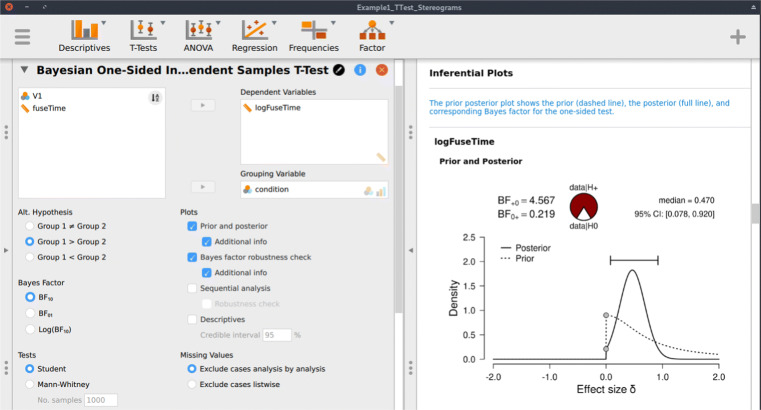
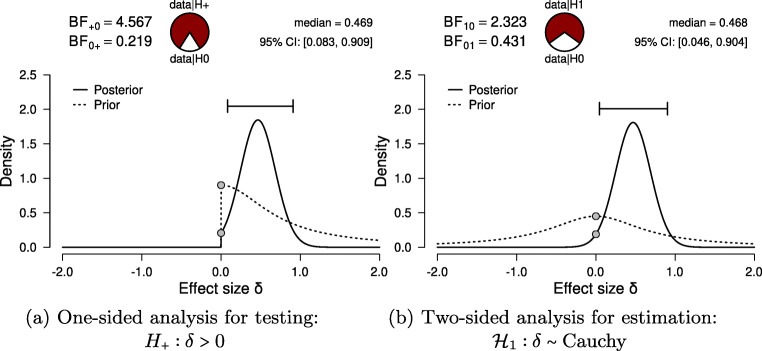
- In the stereogram example, the one-sided Bayesian two-sample t test yielded BF+0 = 4.567, described as moderate evidence; the Bayesian Mann–Whitney U test yielded BF+0 = 5.191.
- For parameter estimation, the two-sided analysis gave a posterior median for δ of 0.47 with a 95% central credible interval from 0.046 to 0.904.
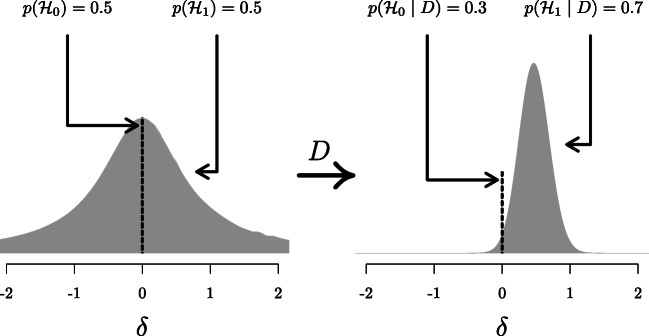
- The paper lists five common pitfalls, including confusing Bayes factors with posterior odds, confusing prior model probabilities with parameter prior distributions, and using credible intervals as hypothesis tests.
Methods
- Design: methodological guidelines for Bayesian statistical reasoning in research, organized into four stages and summarized in Table 1.
- Data/sample: the running example uses Frisby and Clatworthy’s (1975) stereogram data; the original sample had 103 participants, 25 were eliminated for failing an initial stereo-acuity test, leaving 78 participants (43 NV, 35 VV).
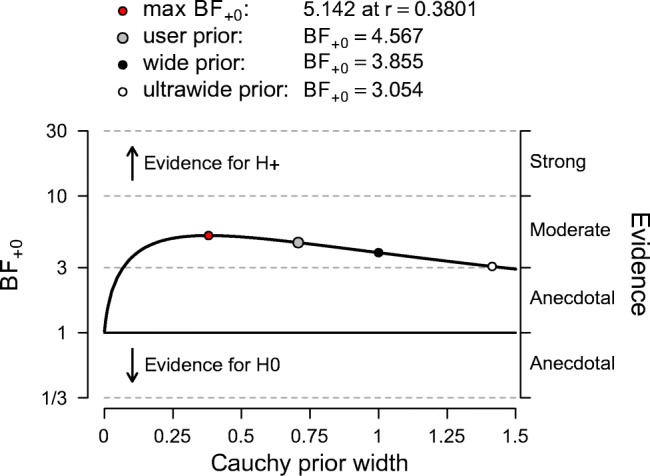
- Main analysis: the example applies a one-sided Bayesian two-sample t test for hypothesis testing, a two-sided Bayesian two-sample t test for parameter estimation, a Bayesian Mann–Whitney U test as a robustness check, and a Bayes factor robustness plot; the fuse times were log-transformed after assumption checks.
Limitations
- The paper states that for some frequentist analyses, the Bayesian counterpart has not yet been developed or implemented in JASP.
- It states that some JASP analyses currently provide only a Bayes factor and not visual posterior distributions, and that some analyses are available only with a relatively limited set of prior distributions.
- The text notes these are not principled limitations and that JASP is actively being developed; it also makes evident that the guidelines focus on standard JASP analyses, while more complex models may require custom coding in JAGS, Stan, R, or Python.
Model-written summary. Check it against the paper before relying on it.
Integrity signals
Registry
Cites
Statistics
Figures
Verification
Claims the paper makes
3 Valid · 1 Not valid · 25 Not checked · 53 Own results and interpretations
The cited sources support only part of this claim — read each source’s verdict below.
In the paper
“In Bayesian hypothesis testing, a one-sided hypothesis yields a more diagnostic test than a two-sided alternative (e.g., Jeffreys, 1961; Wetzels, Raaijmakers, Jakab, & Wagenmakers, 2009, p.283).”
§ The JASP guidelines for conducting and reporting a Bayesian analysis > Stage 1: Planning the analysis > Specifying the statistical model.
What the sources say
- Not checked yetcites Jeffreys, 1961
- Partly supportedcites Wetzels, Raaijmakers, Jakab, & Wagenmakers, 2009 matched to “How to quantify support for and against the null hypothesis: A flexible WinBUGS implementation of a default Bayesian t test” (2009) sourceExperimental — accuracy not yet measured
Our copy never states the general comparative principle that a one-sided hypothesis yields a more diagnostic test than a two-sided alternative; its motivation for the one-sided (order-restricted) SD test is applicability — the JZS two-sided test 'does not directly apply' when the alternative is directional (Introduction, p. 1; Bayesian Hypothesis Testing, p. 3). What it does supply is a worked illustration in Extension 1: Order Restrictions (p. 5), where the same data give BF01 = 6.08 under the unrestricted two-sided alternative but BF01 = 13.75 (posterior .93 vs .86) under the order-restricted one-sided alternative, i.e. a sharper quantification. So the example supports part of the claim while the general assertion attributed here is not made by this paper. (LLM, conf=0.65)
plainstates a cause- Asserted: passes — The authors put it forward as true.
- Checkable: passes — It can be checked against evidence.
- Load-bearing: passes — The paper’s conclusions depend on it.
- Based: passes — The paper gives a reason why it holds.
A result the paper reports from its own data — it cites no other source for it, so there is none to check. The quote shows it is in the paper.
In the paper
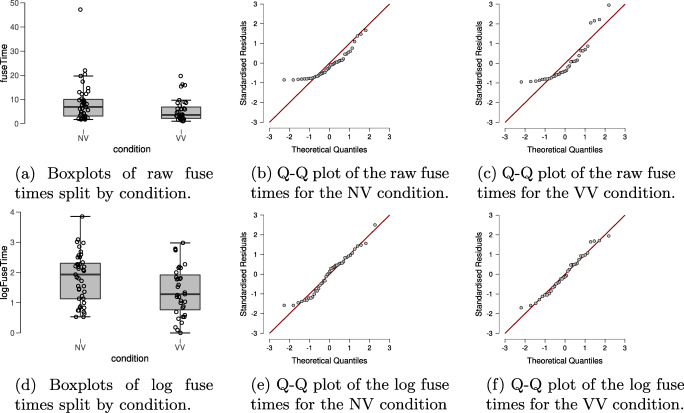
“Visual inspection of the boxplots suggests that the variances of the fuse times may not be equal”
§ The JASP guidelines for conducting and reporting a Bayesian analysis > Stage 2: Executing the analysis > Stereogram example
hedged- Asserted: passes — The authors put it forward as true.
- Checkable: passes — It can be checked against evidence.
- Load-bearing: passes — The paper’s conclusions depend on it.
- Based: passes — The paper gives a reason why it holds.
A result the paper reports from its own data — it cites no other source for it, so there is none to check. The quote shows it is in the paper.
In the paper
“There also appear to be a number of potential outliers in both groups.”
§ The JASP guidelines for conducting and reporting a Bayesian analysis > Stage 2: Executing the analysis > Stereogram example
hedged- Asserted: passes — The authors put it forward as true.
- Checkable: passes — It can be checked against evidence.
- Load-bearing: passes — The paper’s conclusions depend on it.
- Based: passes — The paper gives a reason why it holds.
A result the paper reports from its own data — it cites no other source for it, so there is none to check. The quote shows it is in the paper.
In the paper
“observed standard deviations of the NV and VV groups are 8.085 and 4.802, respectively”
§ The JASP guidelines for conducting and reporting a Bayesian analysis > Stage 2: Executing the analysis > Stereogram example
plain- Asserted: passes — The authors put it forward as true.
- Checkable: passes — It can be checked against evidence.
- Load-bearing: passes — The paper’s conclusions depend on it.
- Based: passes — The paper gives a reason why it holds.
A result the paper reports from its own data — it cites no other source for it, so there is none to check. The quote shows it is in the paper.
In the paper
“Moreover, the Q-Q plots show that the normality assumption of the t test is untenable here.”
§ The JASP guidelines for conducting and reporting a Bayesian analysis > Stage 2: Executing the analysis > Stereogram example
plain- Asserted: passes — The authors put it forward as true.
- Checkable: passes — It can be checked against evidence.
- Load-bearing: passes — The paper’s conclusions depend on it.
- Based: passes — The paper gives a reason why it holds.
25 more claims
Create a free account to see all 82 claims and to verify the 40 references still open.
- It may state two separate claims as one. 33
- Probably not a substantial claim. 29
Claims other papers make about this one
Each is checked against this paper’s own text: does it say what the citing paper says it does?
The cited source says what the claim attributes to it.
In the citing paper
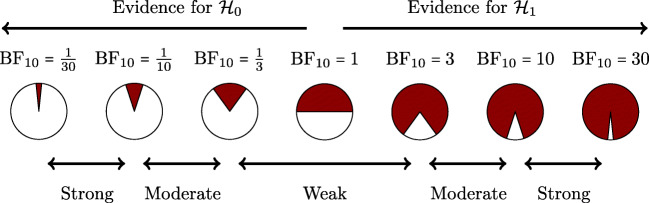
“According to common interpretive guidelines (Van Doorn et al., 2021), a Bayes Factor between 0.33 and 0.10 can be considered moderate evidence for the null, and this result falls at the upper end of that range.”
From This is not the way: global directional cues do not improve spatial learning in an immersive virtual environment (2025) · cites this paper as Van Doorn et al., 2021
Self-check
Percentages, sums and reported differences re-computed from the paper’s own numbers.
Each contradiction between two passages listed here was confirmed by an independent check.
Rated minor: it would not touch a result — a value no result rests on, a p-value that stays on the same side of the significance level, or a conflict that is clerical, resolved elsewhere in the paper, or outside its own findings.
In the paper
§ The JASP guidelines for conducting and reporting a Bayesian analysis > Stage 3: Interpreting the results > Stereogram example
“For parameter estimation, the results of the two-sided t test are presented in Fig. 6a.”
§ The JASP guidelines for conducting and reporting a Bayesian analysis > Stage 3: Interpreting the results > Stereogram example
“The left panel shows the one-sided procedure for hypothesis testing and the right panel shows the two-sided procedure for parameter estimation.”
Citations
Cites
Kass, R. E., & Raftery, A. E. (1995) · Journal of the American Statistical Association · doi:10.1080/01621459.1995.10476572 · Cited by 12,558
Statistical Methods for Research Workers
(1945) · American Journal of Clinical Pathology · doi:10.1093/ajcp/15.11.552b · Cited by 10,880
brms : An R Package for Bayesian Multilevel Models Using Stan
Bürkner, P.-C. (2017) · Journal of Statistical Software · doi:10.18637/jss.v080.i01 · Cited by 9,476 · cited 1×
“Popular packages for conducting Bayesian analyses in R are the BayesFactor package (Morey & Rouder, 2015) and the brms package (B¨urkner, 2017), among others (see https://cran.r-project.org/web/views/Bayesian.html for a more exhaustive list).”
MethodStan : A Probabilistic Programming Language
Carpenter, B., Gelman, A., Hoffman, M. D., Lee, D., Goodrich, B., Betancourt, M., Brubaker, M., Guo, J., Li, P., & Riddell, A. (2017) · Journal of Statistical Software · doi:10.18637/jss.v076.i01 · Cited by 7,754
JAGS: A program for analysis of Bayesian graphical models using Gibbs sampling
Plummer, M. (2003) · Cited by 4,720
Hoeting, J. A., Madigan, D., Raftery, A. E., & Volinsky, C. T. (1999) · Statistical Science · doi:10.1214/ss/1009212519 · Cited by 4,118
Bayesian t tests for accepting and rejecting the null hypothesis
Rouder, J. N., Speckman, P. L., Sun, D., Morey, R. D., & Iverson, G. (2009) · Psychonomic Bulletin & Review · doi:10.3758/pbr.16.2.225 · Cited by 3,688
Probabilistic programming in Python using PyMC3
Salvatier, J., Wiecki, T. V., & Fonnesbeck, C. (2016) · PeerJ Computer Science · doi:10.7717/peerj-cs.55 · Cited by 2,544
Using Bayes to get the most out of non-significant results
Dienes, Z. (2014) · Frontiers in Psychology · doi:10.3389/fpsyg.2014.00781 · Cited by 1,998
Computing Bayes Factors by Combining Simulation and Asymptotic Approximations
Diciccio, T. J., Kass, R. E., Raftery, A., & Wasserman, L. (1997) · Journal of the American Statistical Association · doi:10.1080/01621459.1997.10474045 · Cited by 1,943
Research works printed but not linked: 3
- Jeffreys, H. (1939). Theory of probability, 1st. Oxford University Press.
- Jeffreys, H. (1961). Theory of probability. 3rd. Oxford University Press.
- Wrinch D Jeffreys H On certain fundamental principles of scientific inquiry Philosophical Magazine 1921 42 369 390
Cited by
Items 501–600 of 995
Thurley, J., Buades‐Rotger, M., Serfling, G., Howaldt, T., Reisch, N., & Krämer, U. M. (2024) · Psychoneuroendocrinology · doi:10.1016/j.psyneuen.2024.107111 · Cited by 9
Moizz, A., & Akhtar, S. M. J. (2024) · Asian Journal of Economics and Banking · doi:10.1108/ajeb-01-2024-0005 · Cited by 4
Tracking Childhood Lead Exposure in Early Industrial Romanians
Bharatiya, M., Austin, C. E., Arora, M., Feeney, R. N. M., Leonard, N. D., Low‐Choy, S., Paul, B. T., Soficaru, A., Zhao, J., & Smith, T. M. (2024) · Chemosphere · doi:10.1016/j.chemosphere.2024.142947 · Cited by 5
Liu, W., Heij, J., Liu, S., Liebrand, L. C., Caan, M. W. A., van der Zwaag, W., Veltman, D. J., Lü, L., Aghajani, M., & van Wingen, G. A. (2024) · Journal of Affective Disorders · doi:10.1016/j.jad.2024.11.009 · Cited by 5
Woh, P. Y., Chen, Y., Kwok, K. W. H., & Quiroga, J. (2025) · Microbiology Spectrum · doi:10.1128/spectrum.02292-24 · Cited by 4
Mazer, P., Pasion, R., Fontes, M., Pires, C., Silveira, C., & Ferreira‐Santos, F. (2025) · Brain and Cognition · doi:10.1016/j.bandc.2025.106329 · Cited by 4
The role of cognitive load in automatic integration of emotional information from face and body
Puffet, A.-S., & Rigoulot, S. (2025) · Scientific Reports · doi:10.1038/s41598-025-12511-8 · Cited by 6
“Conversely, B10 values between 1 and 3 (weak evidence), 3 and 10 (moderate evidence), and above 10 (strong evidence) support the alternative hypothesis 28,31 .”
InfluentialEarly Visual Processing and Perception Processes in Object Discrimination Learning
Quiñones, M., Gomez, D. M., Montefusco‐Siegmund, R., & Aylwin, M. D. L. L. (2021) · Frontiers in Neuroscience · doi:10.3389/fnins.2021.617824 · Cited by 4
Kelter, R. (2021) · Computational Statistics & Data Analysis · doi:10.1016/j.csda.2021.107326 · Cited by 7
Zhao, X., Wang, L., & Maes, J. H. R. (2021) · Addictive Behaviors Reports · doi:10.1016/j.abrep.2021.100385 · Cited by 8
Reduced sensitivity but intact motivation to monetary rewards and reversal learning in obesity
Işıklı, S., Bahtiyar, G., Zorlu, N., Düsmez, S., Bağcı, B., Bayrakçı, A., Heinz, A., & Sebold, M. (2022) · Addictive Behaviors · doi:10.1016/j.addbeh.2022.107599 · Cited by 4
Castro-Rodríguez, J. A., Fish, E. N., Montgomery, S., Kollmann, T. R., Iturriaga, C., Shannon, C. P., Karpievitch, Y. V., Ho, J., Chen, V., Balshaw, R. F., et al. (2023) · EClinicalMedicine · doi:10.1016/j.eclinm.2023.102082 · Cited by 6
Neural, physiological and behavioural correlates of empathy for pain in Tourette syndrome
Weiblen, R., Robert, C., Petereit, P., Heldmann, M., Münte, T. F., Münchau, A. M., Müller‐Vahl, K., & Krämer, U. M. (2023) · Brain Communications · doi:10.1093/braincomms/fcad212 · Cited by 4
“49 For correlating EEG re-sults with other measures, we used the same approach as with the behavioural data and calculated the four difference values for each combination of conditions for mu power in the right central cluster.”
Zola, A. R., & Engeln, R. (2023) · PLoS ONE · doi:10.1371/journal.pone.0291853 · Cited by 6
Allen, K., Harris, D., Arthur, T., Wood, G., & Buckingham, G. (2023) · Quarterly Journal of Experimental Psychology · doi:10.1177/17470218231214479 · Cited by 6
“We interpret BF 10 0.3 as moderate evidence in favour of the null hypothesis, and BF 10 0.1 as strong evidence in favour of the null hypothesis (van Doorn et al., 2021).”
MethodInfluentialPapadopoulou, A.-K., Samsouris, C., Vlachos, F. M., Badcock, N. A., Phylactou, P., & Παπαδάτου-Παστού, Μ. (2023) · Laterality Asymmetries of Body Brain and Cognition · doi:10.1080/1357650x.2023.2284407 · Cited by 5
“Bayesian inference is becoming increasingly popular (van Doorn et al., 2021), as it allows the monitoring of evidence as the data accumulate (Rouder, 2014).”
BackgroundAlmutairi, M. F., Gulden, S., Hundscheid, T. M., Bartos̆, F., Cavallaro, G., & Villamor, E. (2023) · Children · doi:10.3390/children10121903 · Cited by 7
Model‐based and model‐free mechanisms in methamphetamine use disorder
Robinson, A. H., Mahlberg, J., Chong, T. T. ‐., & Verdejo‐García, A. (2023) · Addiction Biology · doi:10.1111/adb.13356 · Cited by 4
“33 Sample size was based on previous addiction studies of the Two-Step Task.”
MethodLuo, X., Wang, L., & Zhou, X. (2024) · Cognition · doi:10.1016/j.cognition.2024.105738 · Cited by 5
The perception of dramatic risks: Biased media, but unbiased minds
Pachur, T. (2024) · Cognition · doi:10.1016/j.cognition.2024.105736 · Cited by 9
“…strong, or very strong evidence, respectively; conversely, a BF 10 of 1/3 – 1, 1/10 – 1/3, 1/30 – 1/10, or < 1/30 indicates weak (i.e., inconclusive), moderate, strong, or very strong evidence for the absence of an effect, respectively (cf. van Doorn et al., 2021; Wagenmakers, Love, et al., 2018).”
BackgroundMahdiannur, M. A., Martini, M., Astriani, D., Rosdiana, L., & Fauziah, A. N. M. (2024) · International Journal of Interactive Mobile Technologies (iJIM) · doi:10.3991/ijim.v18i06.47941 · Cited by 8
Visualizing threat and trustworthiness prior beliefs in face perception in high versus low paranoia
Bott, A., Steer, H. C., Faße, J. L., & Lincoln, T. M. (2024) · Schizophrenia · doi:10.1038/s41537-024-00459-z · Cited by 5
“We complemented the frequentist analyses with Bayesian analysis counterparts performed with JASP 60 according to guidelines 61,62 , and report Bayes Factors (BF) along with the p -values.”
The drawing effect: Evidence for costs and benefits using pure and mixed lists
Huff, M. J., Namias, J. M., & Poe, P. (2024) · Memory & Cognition · doi:10.3758/s13421-024-01551-6 · Cited by 4
“2021).”
Bartura, K., Abrahamsen, F. E., Gustafsson, H., Hatzigeorgiadis, A., & Görgülü, R. (2024) · Scandinavian Journal of Medicine and Science in Sports · doi:10.1111/sms.14647 · Cited by 6
How small differences grow over time – the snowball effect of grit on practice in sport
Cocić, D., Larkin, P., Hendry, D. T., Williams, A. M., O’Connor, D., & Bilalić, M. (2024) · International Journal of Sport and Exercise Psychology · doi:10.1080/1612197x.2024.2359476 · Cited by 6
“A BF between 3 and 10 suggests moderate evidence, a BF from 10 to 30 indicates strong evidence, a BF from 30 to 100 is indicative of very strong evidence, and a BF above 100 is considered to provide extreme evidence – van Doorn et al., 2021).”
Arunkumar, M., Rothermund, K., Kunde, W., Mocke, V., & Giesen, C. G. (2024) · Psychonomic Bulletin & Review · doi:10.3758/s13423-024-02525-0 · Cited by 5
Morris, S., Farran, E. K., & Gilligan-Lee, K. A. (2024) · Journal of Experimental Child Psychology · doi:10.1016/j.jecp.2024.105986 · Cited by 7
Jainta, B., Zahedi, A., & Schubotz, R. I. (2024) · Journal of Cognitive Neuroscience · doi:10.1162/jocn_a_02204 · Cited by 6
“On the basis of recent literature, we considered Bayes factor (BF) > 3 and BF as significant evidence for accepting and rejecting the tested hypothesis, respectively (van Doorn et al., 2021).”
MethodBayesian Tools of the Trade for Developmental Psychologists: A Quick-Start Guide Using JASP
Coon, J., Silva, P. N., Etz, A. J., & Sarnecka, B. W. (2024) · Journal of Cognition and Development · doi:10.1080/15248372.2024.2386032 · Cited by 8
“14 When it comes to interpreting the posterior summary, the “ P (incl),” “ P (excl),” “ P (incl | data),” “ P (excl | data),” and “ BF inclusion ” are columns we will not be focusing on in our example (for details about these see van Doorn et al., 2021; Wagenmakers et al., 2018).”
Self-citationChowdhury, N. S., Chang, W., Cavaleri, R., Chiang, A. K., & Schabrun, S. M. (2024) · BMC Neuroscience · doi:10.1186/s12868-024-00885-w · Cited by 5
“A Bayes factor (BF) > 3 would provide at least moderate evidence that the rapid and traditional map parameters were inside the equivalence region, whereas a BF between 1 and 3 provided anecdotal/weak evidence that rapid and traditional map parameters were inside the equivalence region [52].”
BackgroundLimb dominance does not have a meaningful impact on arterial occlusion pressure
Yamada, Y., Hammert, W. B., Kataoka, R., Song, J. S., Kang, A., & Loenneke, J. P. (2024) · Clinical Physiology and Functional Imaging · doi:10.1111/cpf.12906 · Cited by 4
“The results were interpreted taking into consideration the JASP guideline for conducting and reporting a Bayesian analysis (van Doorn et al., 2021) and the example application with JASP (Wagenmakers et al., 2018a).”
Liu, W., Heij, J., Liu, S., Liebrand, L. C., Caan, M. W. A., van der Zwaag, W., Veltman, D. J., Lü, L., Aghajani, M., & van Wingen, G. A. (2024) · European Neuropsychopharmacology · doi:10.1016/j.euroneuro.2024.07.014 · Cited by 4
On the Effect of Robot Errors on Human Teaching Dynamics
Huang, J., Sheidlower, I. S., Aronson, R. M., & Short, E. S. (2024) · International Conference on Human-Agent Interaction (HAI) · doi:10.1145/3687272.3688320 · Cited by 8
van Baak, C., Liebst, L. S., & Lindegaard, M. R. (2024) · Crime & Delinquency · doi:10.1177/00111287241298693 · Cited by 4
“The following thresholds to evaluate the relative evidence of the null hypothesis ( H 0 ) vis-à-vis the alternative hypothesis ( H 1 ): 1 to 3, weak; 3 to 10, moderate; > 10, strong (van Doorn et al., 2021).”
Forage ecology of Neotropical fish in Brazilian biomes using stable isotopes
Martinelli, L. A., Augusto, F. G., Filho, A. L. A., Nardoto, G. B., Diniz‐Reis, T. R., Benedito, E., & Marques, T. S. (2024) · The Science of The Total Environment · doi:10.1016/j.scitotenv.2024.177682 · Cited by 3
Foley, S., Jadva, V., & Golombok, S. E. (2024) · Reproductive BioMedicine Online · doi:10.1016/j.rbmo.2024.104747 · Cited by 7
The role of anchoring information in judgments of learning
Ikeda, K., Hattori, Y., Ito, Y., & Hamamoto, Y. (2024) · Memory & Cognition · doi:10.3758/s13421-024-01670-0 · Cited by 5
“Second, in accordance with van Doorn et al. (2021), the Cauchy prior distribution ( location parameter = 0 and scale parameter = 1/ √ 2 ) was used as a weakly informative prior distribution for each parameter of the predictive variables to calculate BF 10 s because noninformative prior distribution…”
An introduction to Bayesian geospatial analysis using a Bayesian multilevel model case study
Tu, W., Yu, L., & Tu, J. (2025) · Annals of GIS · doi:10.1080/19475683.2025.2451230 · Cited by 4
Selvanathan, H. P., Valdenegro, D., Noor, M., Visintin, E. P., Lalot, F., Sainz, M., Bilewicz, M., Hayward, L. E., Sebben, S., Ullrich, J., et al. (2025) · Group Processes & Intergroup Relations · doi:10.1177/13684302241309539 · Cited by 5
“Since Bayesian inference was used to estimate the parameters, the comparison was made using the Bayes factor (BF; van Doorn et al., 2021).”
Level of M1 GABAB predicts micro offline consolidation of motor learning during wakefulness
Cardellicchio, P., & Borgomaneri, S. (2025) · npj Science of Learning · doi:10.1038/s41539-025-00299-1 · Cited by 4
Do item-specific control adjustments transfer across response modalities?
Colvett, J. S., Wetz, L., & Bugg, J. M. (2025) · Quarterly Journal of Experimental Psychology · doi:10.1177/17470218251330852 · Cited by 7
“Analyses were run using the baseline settings 5 of JASP Version 0.17.1 (JASP Team, 2022; Van Doorn et al., 2020).”
InfluentialSchultz, B. K., Evans, S. W., Schoemann, A. M., & Murray, E. R. (2025) · Journal of School Psychology · doi:10.1016/j.jsp.2025.101465 · Cited by 4
Differential effects of working memory load on priming and recognition of real images
Castellà, J., Ríos, R. P., Baqués, J., & Allen, R. J. (2020) · Memory & Cognition · doi:10.3758/s13421-020-01064-y · Cited by 4
“Bayes Factor analysis assesses the strength of evidence for the data under the alternative against the null hypothesis and provides a test of equivalence between groups/conditions (Barchard, 2015; Mulder & Wagenmaker, 2016; van Doorn et al., 2019).”
BackgroundHenningsson, S., Leknes, S., Asperholm, M., Eikemo, M., & Westberg, L. (2021) · Biological Psychology · doi:10.1016/j.biopsycho.2021.108164 · Cited by 5
Meaningful boundaries create boundary conditions for control
Colvett, J. S., & Bugg, J. M. (2021) · Psychological Research · doi:10.1007/s00426-021-01580-9 · Cited by 5
Mallise, C. A., Murphy, V. E., Campbell, L., Woolard, A. J., Whalen, O. M., Milton, G., Mattes, J., Collison, A., Gibson, P. G., Karayanidis, F., et al. (2021) · Frontiers in Psychology · doi:10.3389/fpsyg.2021.713804 · Cited by 5
Pelzer, E., & Turner, B. O. (2021) · Communication Teacher · doi:10.1080/17404622.2021.2001551 · Cited by 4
Two attentive strategies reducing subjective distortions in serial duration perception
Sierra, F., Poeppel, D., & Tavano, A. (2022) · PLoS ONE · doi:10.1371/journal.pone.0265415 · Cited by 3
“A BF of 1 reveals that both models predicted the data equally well [46].”
BackgroundDeconfounding serial recall: Response timing and the overarching role of grouping.
Cowan, N., & Elliott, E. M. (2023) · Journal of Experimental Psychology Learning Memory and Cognition · doi:10.1037/xlm0001157 · Cited by 6
Emotional arousal does not modulate stimulus-response binding and retrieval effects
Giesen, C. G., & Eder, A. B. (2022) · Cognition & Emotion · doi:10.1080/02699931.2022.2130180 · Cited by 5
Chen, Y. (2022) · PLoS ONE · doi:10.1371/journal.pone.0276254 · Cited by 6
The relationship between family support system with maternal postpartum rage
Fikri, M., Neviyarni, N., & Afdal, A. (2022) · International Journal of Public Health Science (IJPHS) · doi:10.11591/ijphs.v12i1.22011 · Cited by 7
Effect of selective attention on auditory brainstem response
Kumar, S., Nayak, S., & Pitchaimuthu, A. N. (2023) · Hearing Balance and Communication · doi:10.1080/21695717.2023.2168413 · Cited by 4
“Even though BF10 values favour the alternative hypothesis, the strength of the evidence is weak as BF10 value between 1 to 3 represents an anecdotal evidence [39].”
BackgroundThe role of general change mechanisms in sudden gains in the treatment of anorexia nervosa
Brockmeyer, T., Titzmann, M., Zipfel, S., Wild, B., Resmark, G., Teufel, M., Giel, K. E., de Zwaan, M., Dinkel, A., Herpertz, S., et al. (2023) · Behaviour Research and Therapy · doi:10.1016/j.brat.2023.104285 · Cited by 7
Rapid adaptation of primate LGN neurons to drifting grating stimulation
Daumail, L., Carlson, B. M., Mitchell, B., Cox, M. A., Westerberg, J. A., Johnson, C., Martin, P. R., Tong, F., Maier, A., & Dougherty, K. (2023) · Journal of Neurophysiology · doi:10.1152/jn.00058.2022 · Cited by 4
Multibridge: an R package to evaluate informed hypotheses in binomial and multinomial models
Sarafoglou, A., Aust, F., Marsman, M., Bartos̆, F., Wagenmakers, E., & Haaf, J. M. (2023) · Behavior Research Methods · doi:10.3758/s13428-022-02020-1 · Cited by 6
“This is particularly important for Bayes factor hypothesis testing; when the purpose is parameter estimation, however, it may be more informative to assign prior parameter distributions that are relatively wide (e.g., Doorn et al. 2021).”
BackgroundSelf-citationMorava, A., Tari, B., Ahn, J., Shirzad, M., Heath, M. D., & Prapavessis, H. (2023) · Frontiers in Psychology · doi:10.3389/fpsyg.2023.1157644 · Cited by 6
Ben-Zion, D., Gabitov, E., Bitan, T., & Prior, A. (2023) · Neuropsychologia · doi:10.1016/j.neuropsychologia.2023.108652 · Cited by 7
Chatlaong, M. A., Stanford, D. M., Miller, W. M., Davidson, C. J., & Jessee, M. B. (2024) · Clinical Hemorheology and Microcirculation · doi:10.3233/ch-232036 · Cited by 4
Examining the time course of post collaborative benefits across word lists and prose passages
Wei, Y., Charbonneau, B. Z., Meade, M. L., & Hutchison, K. A. (2024) · Memory & Cognition · doi:10.3758/s13421-024-01609-5 · Cited by 5
“For the interaction effect, we found a BF 10 = 0.10, which means that, given the data, the null interaction model is 10 times more likely than the model containing the interaction, indicating moderate-to-strong support for the null interaction (van Doorn et al., 2021).”
InfluentialOjeda-Aravena, A., Azócar-Gallardo, J., Herrera-Valenzuela, T., & García‐García, J. M. (2021) · Retos · doi:10.47197/retos.v42i0.86397 · Cited by 4
Applied Bayesian Approaches for Research in Motor Neuron Disease
Temp, A. G. M., Naumann, M., Hermann, A., & Glaß, H. (2022) · Frontiers in Neurology · doi:10.3389/fneur.2022.796777 · Cited by 4
“Aspiring and already-practicing Bayesians should also be aware of on-going, fundamental discussions and developments in the field; nonexhaustive examples include critiques aimed at the application of Bayes factors in ANOVA designs with continuous outcomes (53) and how to accordingly modify Bayes factors for various te…”
BackgroundInfluentialThe impact of markets on moral reasoning: Evidence from an online experiment
Gehrlein, J., Crede, A., & Adrian, N. (2020) · Journal of Behavioral and Experimental Economics · doi:10.1016/j.socec.2020.101577 · Cited by 6
Bayesian Hierarchical Modeling: An Introduction and ReassessmentPreprint
Veenman, M., Stefan, A. M., & Haaf, J. M. (2022) · doi:10.31234/osf.io/pskvx · Cited by 4
Self-citationSimple and intuitive statistical data analysis and teaching for medical students using JASPPreprint
Panchawagh, S., Kamath, Y., & Siddiqui, A. (2023) · doi:10.36227/techrxiv.24046605.v1 · Cited by 4
Ray, N. J., Cullell, N., Clark, O. J., Delgado-Sánchez, A., Caruana, G., Elias-Mas, A., Ferrer, J., Buongiorno, M., Castejón, J., Sánchez‐Benavides, G., et al. (2024) · bioRxiv (Cold Spring Harbor Laboratory) · doi:10.1101/2024.10.14.618324 · Cited by 5
Universal rhythmic architecture uncovers distinct modes of neural dynamicsPreprint
Karvat, G., Crespo‐García, M., Vishne, G., Anderson, M. C., & Landau, A. N. (2024) · bioRxiv (Cold Spring Harbor Laboratory) · doi:10.1101/2024.12.05.627113 · Cited by 4
False memory in posttraumatic stress disorder and borderline personality disorder
Miano, A., Schulze, K., Moritz, S., Wingenfeld, K., & Roepke, S. (2022) · Psychiatry Research · doi:10.1016/j.psychres.2022.114547 · Cited by 7
Prati, G. (2023) · Transportation Research Record Journal of the Transportation Research Board · doi:10.1177/03611981231179464 · Cited by 3
“…the strength of an effect, assuming it is present; therefore, the CI for an effect size is conditional on the alternative hypothesis being true ( 36 ) and, as such, should be interpreted after performing a test to index support for the alternative hypothesis over the null hypothesis (e.g., the…”
BackgroundDream habits in a large cohort of preteens and their relation to sleep and nocturnal awakenings
Eichenlaub, J., Bouet, R., Pinelli, M., & Portrat, S. (2024) · Journal of Sleep Research · doi:10.1111/jsr.14339 · Cited by 3
“The statistical analyses were performed using JASP (van Doorn et al., 2021; Wagenmakers, Love, et al., 2018; Wagenmakers, Marsman, et al., 2018).”
Beyond beauty: Does visual art facilitate social cognitive skills?
Ozbay, Y., Oosterwijk, S., & Stamkou, E. (2024) · PLoS ONE · doi:10.1371/journal.pone.0308392 · Cited by 3
Testing Bayesian Informative Hypotheses in Five Steps With JASP and R
Garofalo, S., Finotti, G., Orsoni, M., Giovagnoli, S., & Benassi, M. (2024) · Advances in Methods and Practices in Psychological Science · doi:10.1177/25152459241260259 · Cited by 8
“…the main advantages of the BF is, indeed, that it overcomes the dualistic reasoning typical of null hypothesis significance testing (accept/ reject H 0 ) by quantifying and comparing the evidence in favor of one hypothesis over the other (van Doorn et al., 2021; Wagenmakers, Marsman, et al., 2018).”
GABAergic modulation of beta power enhances motor adaptation in frontotemporal lobar degeneration
Hughes, L. E., Adams, N., Rouse, M. A., Naessens, M., Shaw, A. D., Murley, A. G., Cope, T., Holland, N., Nesbitt, D., Street, D., et al. (2025) · Alzheimer s & Dementia · doi:10.1002/alz.14531 · Cited by 9
Kim, S., Kim, S., & Yoon, S. (2025) · Journal of Affective Disorders · doi:10.1016/j.jad.2025.05.025 · Cited by 4
Value-modulated attentional capture depends on awareness
Garre-Frutos, F., Lupiáñez, J., & Vadillo, M. A. (2025) · Psychonomic Bulletin & Review · doi:10.3758/s13423-025-02734-1 · Cited by 5
“We interpreted BF s using the conventional thresholds provided by Van Doorn et al. (2021).”
A Tutorial on Conducting and Interpreting a Bayesian Independent T ‐Test Using Open‐Source Software
Malone, H., & Coyne, I. (2025) · Journal of Advanced Nursing · doi:10.1111/jan.70122 · Cited by 4
“Guidelines specific to JASP software, for planning, executing, interpreting and reporting a Bayesian analysis are provided by the van Doorn et al. (2021) paper.”
InfluentialLucho, S. R., Posso, D. A., de Almeida, L. B., Basso, L. F., & Souza, G. M. (2025) · Plant Physiology and Biochemistry · doi:10.1016/j.plaphy.2025.110801 · Cited by 3
Avdullahu, A., Strauß, S., Herrmann, T. A., & Rummel, N. (2025) · Learning and Instruction · doi:10.1016/j.learninstruc.2025.102275 · Cited by 3
Association of cancer with neuropathological markers of Alzheimer's disease and related dementias
Teipel, S. J., Akmatov, M. K., Michalowsky, B., Junghanß, C., Holstiege, J., & Bohlken, J. (2025) · Alzheimer s & Dementia Diagnosis Assessment & Disease Monitoring · doi:10.1002/dad2.70222 · Cited by 3
Action and abstraction: Motor interference changes meaning in language understanding
Solana, P., Escámez, O., Vigliocco, G., Casasanto, D. J., & Santiago, J. (2026) · Journal of Memory and Language · doi:10.1016/j.jml.2026.104749 · Cited by 4
Brown, J. O., Chatburn, A., Wright, D. L., & Immink, M. A. (2022) · Journal of Motor Learning and Development · doi:10.1123/jmld.2022-0016 · Cited by 4
Assiamah, S., Kankam, C. K., Banini, E. K., Agyeman, S., & Adinkrah-Appiah, K. (2023) · Journal of Building Engineering · doi:10.1016/j.jobe.2023.106835 · Cited by 5
Concepts in Space: Enhancing Lexical Search With a Spatial Diversity Prime
Malaie, S., Karimi, H., Jahanitabesh, A., Bargh, J. A., & Spivey, M. J. (2023) · Cognitive Science · doi:10.1111/cogs.13327 · Cited by 4
Measuring temporal bias in sequential numerosity comparison
Dolfi, S., Testolin, A., Cutini, S., & Zorzi, M. (2024) · Behavior Research Methods · doi:10.3758/s13428-024-02436-x · Cited by 4
“A BF between 1 and 3 (or between 1 and 0.33) can be considered anecdotal evidence, a BF between 3 and 10 (0.33–0.10) can be considered moderate evidence, and a BF larger than 10 ( 0.03) can be considered as strong evidence (van Doorn et al., 2020).”
InfluentialThe Bayesian Approach to Audit Evidence: Quantifying Statistical Evidence Using the Bayes Factor
Derks, K., de swart, J., Wagenmakers, E., & Wetzels, R. (2025) · Auditing A Journal of Practice & Theory · doi:10.2308/ajpt-2021-086 · Cited by 9
Self-citationInvestigating the neural effects of typicality and predictability for face and object stimuli
Ficco, L., Li, C., Kaufmann, J. M., Schweinberger, S. R., & Kovács, G. (2024) · PLoS ONE · doi:10.1371/journal.pone.0293781 · Cited by 4
Mental health among centenarians living in Switzerland
Uittenhove, K. L., Rohner, S. L., Falciola, J., da Rocha, C. G., Röcke, C., Cavalli, S., Herrmann, F. R., Jopp, D. S., & von Gunten, A. (2024) · Psychogeriatrics · doi:10.1111/psyg.13137 · Cited by 4
Cronin-Golomb, L. M., Pejic, J., Miller, H. E., & Bauer, P. J. (2024) · Cognitive Development · doi:10.1016/j.cogdev.2024.101454 · Cited by 5
Håman, L., Källstrand, J., Carlsson, I., Ivarsson, A., Kristén, L., & Lindgren, E. (2024) · Journal of Clinical Medicine · doi:10.3390/jcm13133918 · Cited by 5
Dominant or Submissive? Exploring Social Perceptions Across the Human-Robot Spectrum
Ratajczyk, D. (2024) · International Conference on Human Machine Interaction (ICHMI) · doi:10.1145/3678429.3678431 · Cited by 5
“Following guidelines for interpreting Bayesian factors [26], this provides moderate evidence in support of hypothesis 4a.”
Mandal, A., Röer, J. P., Liesefeld, H. R., & Liesefeld, H. R. (2024) · Visual Cognition · doi:10.1080/13506285.2024.2397825 · Cited by 7
“To classify the strengths of evidence through the Bayes Factors, we used Jeffreys’s criterion (van Doorn et al., 2021) – which states that for the alternative hypothesis, BF s between 1 and 3 are weak evidence, BF s between 3 and 10 are moderate evidence, and BFs greater than 10 are strong evidence.”
Exploring Estimation Procedures for Reducing Dimensionality in Psychological Network Modeling
Shi, D., Christensen, A. P., Day, E. A., Golino, H. F., & Garrido, L. E. (2024) · Multivariate Behavioral Research · doi:10.1080/00273171.2024.2395941 · Cited by 8
“…the posterior mass and demonstrates that there is a 90% probability that the true network structure ( i.e., edges) falls within the specified interval range, assuming that the alternative hypothesis one specifies is true ( Morey et al., 2016; van Doorn et al., 2021; Wagenmakers et al., 2018).”
What guides the judgment of learning: Memory or heuristics? An event-related potential study
Yücetepe, S., & Irak, M. (2024) · Neuropsychologia · doi:10.1016/j.neuropsychologia.2024.109011 · Cited by 3
Exploring fonts as retrieval cues in text-based learning
Krieglstein, F., Jansen, S., Meusel, F., Scheller, N., Schmitz, M., Wesenberg, L., & Rey, G. D. (2024) · Acta Psychologica · doi:10.1016/j.actpsy.2024.104606 · Cited by 3
Genotypic Influences on Actuators of Aerobic Performance in Tactical Athletes
Flück, M., Protte, C., Giraud, M., Gsponer, T., & Dössegger, A. (2024) · Genes · doi:10.3390/genes15121535 · Cited by 6
Dietary Variation Among Herculaneum's Victims of Mt. Vesuvius via Dental Microwear Texture Analysis
Schmidt, C. W., Remy, A., & D’Anastasio, R. (2025) · American Journal of Biological Anthropology · doi:10.1002/ajpa.70000 · Cited by 3
Rodrigues, M., Edwards, J., Rosic, T., Wang, Y., Talukdar, J. R., Chowdhury, S. R., Parpia, S., Babe, G., de Oliveira, C., Perez, R., et al. (2025) · PLOS mental health. · doi:10.1371/journal.pmen.0000253 · Cited by 5
Teipel, S. J., Tang, Y., & Khachaturian, A. S. (2025) · Alzheimer s & Dementia Translational Research & Clinical Interventions · doi:10.1002/trc2.70083 · Cited by 3
“WhenwecheckedtherobustnessoftheBF 10 ,wefound forallthreecomparisonsthatevenwithanunrealisticallynarrowscale of the Cauchy prior, the maximum BF 10 was only around 1, indicating inconclusive evidence.”
The effect of prolonged elbow pain and rTMS on TMS-evoked potentials: A TMS-EEG study
Chowdhury, N. S., Chang, W., Cheng, D., Manivasagan, N., Seminowicz, D. A., & Schabrun, S. M. (2025) · Imaging Neuroscience · doi:10.1162/imag.a.7 · Cited by 3
“…‘strong’, ‘very strong’, and ‘extreme’ evidence for the alternative hypothesis, while BF 10 ’s of 1/3– 1, 1/10– 1/3, 1/30– 1/10,1/100– 1/30, and 1/100 indicated ‘anecdotal’, ‘moderate’, ‘strong’, ‘very strong’, and ‘extreme’ evidence in favor of the null hypothesis (van Doorn et al., 2021).”
Sun, Y., Lin, Y., & Han, S. (2025) · Psychological Research · doi:10.1007/s00426-025-02160-x · Cited by 4
“For parameter estimation, δ was assigned a Cauchy prior distribution with r = 1 / √ 2 (Van Doorn et al., 2021).”
Metadata
- Authors
- van Doorn, J., van den Bergh, D., Böhm, U., Dablander, F., Derks, K., Draws, T., Etz, A., Evans, N. J., Gronau, Q. F., Haaf, J. M., Hinne, M., Kucharský, Š., Ly, A., Marsman, M., Matzke, D., Gupta, A. R. K. N., Sarafoglou, A., Stefan, A., Voelkel, J. G., & Wagenmakers, E.-J.
- Affiliations
- University of Amsterdam (NL)
- Nyenrode Business University (NL)
- University of California, Irvine (US)
- Stanford University (US)
- ORCID
- Venue
- Psychonomic Bulletin & Review
- Published
- 2020-10-09
- Volume
- 28
- Issue
- 3
- Pages
- 813-826
- ISSN
- 1069-9384 (ISSN-L)
- 1531-5320
- PMC
- PMC8219590
- OpenAlex
- W3091779368
- Semantic Scholar
- c4bca921d78c0f4fb8569eb9d5c0cb42cbb3ec0b
- Cited by
- 1,114
- References
- 63
- Citations by year
- 2026: 111 · 2025: 169 · 2024: 216 · 2023: 202 · 2022: 177 · 2021: 139 · 2020: 71
- FWCI
- 103.84
- Type
- journal article
- Language
- en
- Open access
- hybrid
- doi.org
- Licence
- cc-by
- creativecommons.org/licenses/by/4.0 (tdm)
- creativecommons.org/licenses/by/4.0 (vor)
- Locations
- Psychonomic Bulletin & Review (publishedVersion, cc-by)
- PubMed Central (publishedVersion, cc-by)
- PubMed (publishedVersion)
- UvA-DARE (University of Amsterdam) (acceptedVersion, cc-by)
- Centrum Wiskunde & Informatica (CWI), the national research institute for mathematics and computer science in the Netherlands (submittedVersion)
- Data Archiving and Networked Services (DANS) (submittedVersion, other-oa)
- Radboud Repository (Radboud University) (submittedVersion)
- PsyArXiv (OSF Preprints) (submittedVersion, cc-by)
- PsyArXiv (OSF Preprints) (submittedVersion)
- Radboud Repository (Radboud University) (submittedVersion, other-oa)
- Funders
- National Science Foundation (1321846)
- Universiteit van Amsterdam
- Nederlandse Organisatie voor Wetenschappelijk Onderzoek (016.Vici.170.083, 406.18.559, 451-17-017)
- Topics
- Physical Sciences › Mathematics › Statistics and Probability › Statistical Methods and Bayesian Inference
- Social Sciences › Decision Sciences › Statistics, Probability and Uncertainty › Meta-analysis and systematic reviews
- Physical Sciences › Computer Science › Artificial Intelligence › Bayesian Modeling and Causal Inference
- Keywords
- Bayesian inference, JASP, reporting guidelines, statistical reporting, open-source statistical software
- MeSH terms
- Bayes Theorem, Data Interpretation, Statistical, Humans, Research Design, Models, Statistical, Guidelines as Topic
About these checks
Registry, retraction, Cites and statistics results are computed, not judged, with one exception: a printed reference that no index lists is read once by a model before it counts as a citation error. Claims are extracted by a model and kept only when their quote appears verbatim in the text; each cited source is then checked, with a model’s help, for whether it says what the claim relies on. Those verdicts can be wrong — read the claim’s quote and the cited source before relying on one.
The claim verdicts this report counts are experimental: their accuracy is not yet measured.
A language model drew the claims from the paper on 2026-10-04, under version 3 of the claim definition (model deepseek-v4.1-flash, prompt extract-v3).
A second model labelled each claim on 2026-10-04 (model jev-1.13-20260917, definition revision gold-guideline-v0.2).
Cited sources are checked with a language model’s help (qwen3.8-omni-flash).
Statistics and arithmetic are recomputed, not judged.
Confidence bands are shown only for fields calibrated on our annotated test set. None is calibrated yet, so no band is shown.
What counts as a claim ›How we measure confidence ›How we check this ›
Are you an author, or do you see a problem with this page? Request a review
Data sources
Bibliographic data: Semantic Scholar, OpenAlex, Crossref.
Contains information from the Semantic Scholar Academic Graph Datasets, made available under the ODC Attribution License (ODC-BY 1.0).
Semantic Scholar’s data is described in: Kinney, R., et al. (2023). The Semantic Scholar Open Data Platform. arXiv:2301.10140.
